




Impact statement
Coastal regions are relevant because of the physical complexity of land meeting the ocean. At the same time, coastal development is an important element of the ocean economy. In recognition of this aspect, the 2030 Agenda for Sustainable Development and its SDG #14 call for the following priority actions: reducing marine pollution, particularly from land-based sources, litter, hazardous substances and nutrients. To achieve sustainable development in coastal systems, a better understanding of the role and impact of pollution and the connectedness of the elements, namely, pollution, climate and the people, as well as associated impacts unfolding in integrated social–ecological systems is necessary. Science is called upon to investigate the transport pathways of pollutants and nutrients from sources on land, through rivers and the air, to coastal waters, the open ocean, and its seafloor, as the final sink. It is also called upon to build on the well-founded strengths in diagnosis and process understanding of systemic environmental problems. In this paper, we provide a framework vision for coastal pollution information services, tools and toolboxes to support sustainable development and healthy ocean areas, whilst drawing from fundamental natural and physical science expertise as well as transdisciplinary science. We seek to justify the enabling capacity of tools connecting scientific efforts to societal demands. We propose an innovative framework for developing an iterative process for the development of coastal pollution information services, tools and toolboxes to overcome the pollution–climate–people complexity in social–ecological systems. To ensure that the approach will be useful for practitioners in the management domain, we propose a participatory process for mapping multiple perspectives and user needs that may not have direct links to pollution science products. Therefore, the framework will have an impact on the work of coastal managers and planners tackling current sustainability challenges.
Introduction
During the 2020 World Forum for Democracy, the UN Secretary-General (António Guterres) declared a triple planetary emergency caused by three connected crises: a climate crisis, a nature crisis and a pollution crisis (Guterres, Reference Guterres2020). Rockström et al. (Reference Rockström, Steffen, Noone, Persson, Chapin, Lambin, Lenton, Scheffer, Folke, Schellnhuber, Nykvist, de Wit, Hughes, van der Leeuw, Rodhe, Sörlin, Snyder, Costanza, Svedin, Falkenmark, Karlberg, Corell, Fabry, Hansen, Walker, Liverman, Richardson, Crutzen and Foley2009) similarly highlight persistent pollution, alongside biodiversity loss and climate change, as three instances where planetary boundaries have been exceeded beyond a ‘safe operating space for humanity’. The planetary crises interact in multiple ways, increasing the risk of environmental degradation, and exceeding planetary boundaries. Coastal regions are unique for the physical interaction of land with the ocean, and coastal development is an important element of the ocean economy as part of a very complex land–ocean system (Winther et al., Reference Winther, Dai, Rist, Hoel, Li, Trice, Morrissey, Juinio-Meñez, Fernandes, Unger, Scarano, Halpin and Whitehouse2020). The Sustainable Development Goal (SDG) #14 of the 2030 Agenda for Sustainable Development, a key goal to improve the state of the oceans, calls for prioritising actions in reducing marine pollution from land-based sources, litter, hazardous substances and nutrients (United Nations, 2015). Likewise, European Union member states are committed to achieving good environmental status of marine waters, ‘where these [waters] provide ecologically diverse and dynamic oceans and seas which are clean, healthy and productive’ (European Parliament and the Council of the European Union, 2008). In eight of 10 cases, marine pollution originates from land-based sources (Blümel et al., Reference Blümel, Fisch, Franke, Frey, Froese, Greinert, Gutow, Gutt, Hain and Haroon2021). The three main land-based sources of marine pollution are the following: land-based industry, sea-based industry with mainland connection and municipal-based industry (Willis et al., Reference Willis, Serra-Goncalves, Richardson, Schuyler, Pedersen, Anderson, Stark, Vince, Hardesty, Wilcox, Nowak, Lavers, Semmens, Greeno, MacLeod, Frederiksen and Puskic2022).
The interactions between marine pollution, climate change and people in coastal and marine ecosystems must be recognised and better understood (Schiedek et al., Reference Schiedek, Sundelin, Readman and Macdonald2007). This includes sustained and novel scientific exploration of pollution pathways from sources on land, through rivers, and the air, to coastal waters, the open ocean, and its seafloor, as a sink of nutrients and pollutants. These complex pathways cannot be understood without considering the role of humans and their many, often conflicting, extractive and non-extractive activities in the ocean and coastal systems. The relationship between pollution pathways and the long-term fate of pollution, climate change and the ongoing and increasing human interest in a multi-use and connected coastal and ocean landscape forms a locus for a complex coastal social–ecological system (SES) (Refulio-Coronado et al., Reference Refulio-Coronado, Lacasse, Dalton, Humphries, Basu, Uchida and Uchida2021). The scientific understanding of marine pollution is inseparably connected to the inevitable impacts of climate change within the Anthropocene (Cabral et al., Reference Cabral, Fonseca, Sousa and Costa Leal2019).
Marine pollutants, such as natural or human-made substances or energy introduced by humans into the environment (United Nations Environment Programme, 1982), include a variety of physical, chemical and biological substances that negatively affect ecological systems once they occur at scale, exceeding a certain threshold. River basin drainage and direct point sources are often the primary pathways for land-based sources. They account for about 80% of global marine pollution (Cabral et al., Reference Cabral, Fonseca, Sousa and Costa Leal2019). Marine pollutants have harmful effects on the organisms living in the marine environment and on the natural environments (United Nations Environment Programme, 1982; United Nations, 2015; Willis et al., Reference Willis, Serra-Goncalves, Richardson, Schuyler, Pedersen, Anderson, Stark, Vince, Hardesty, Wilcox, Nowak, Lavers, Semmens, Greeno, MacLeod, Frederiksen and Puskic2022). In this article, we focus on persistent organic pollutants (POPs), a subset of substances that are bioaccumulative, toxic and globally distributed due to their persistence and ability to undergo long-range transport. The adverse effects of POPs on human and environmental health have resulted in the listing of 30 substances subject to global governance under the UN Stockholm Convention (Blümel et al., Reference Blümel, Fisch, Franke, Frey, Froese, Greinert, Gutow, Gutt, Hain and Haroon2021). Data and information on the potential impact of chemical pollutants from offshore wind farms are still scarce. Therefore, the article also focuses on offshore wind farms as potential new local point sources for pollution.
The objective of the paper is to establish the need for pollution management tools and approaches that are appropriate for the interacting impacts of climate and pollution in complex coastal SESs (Gain et al., Reference Gain, Giupponi, Renaud and Vafeidis2020; Horcea-Milcu et al., Reference Horcea-Milcu, Martín-López, Lam and Lang2020). We create a theoretical basis and justification for understanding the impact of climate change and pollution on complex coastal SESs (see section ‘Understanding the impact of climate change and pollution on complex coastal social–ecological systems’) by using a semi-systematic review of scientific literature and 120 peer-reviewed publications (see Appendix of the Supplementary Material for papers). We use a qualitative analysis based on an inductive approach (grounded theory method; Glaser and Strauss, Reference Glaser and Strauss2017). Keywords used within bibliographic databases, including Web of Science (WoS) and Scopus were ‘climate change’, ‘pollution’, ‘coast’, ‘ocean’, ‘marine system’ and ‘social–ecological’ in publication title, abstract, keyword (Scopus) or Topic (WoS), with no date limitation. Keywords served as initial filters to find other papers and branches of interest in a snowball sampling approach. Grey literature was not considered. In combination with a case study approach, we relate the academic findings from the review to three connected propositions: i) there is a need for a system perspective due to manifold interactions between pollution, the environment and people (see section ‘A system perspective on pollution, the environment, and people’); ii) climate change will exacerbate the feedback and impact of pollution, including already regulated substances (see section ‘Climate change exacerbating pollution’); and, iii) the interaction of pollution and climate change impacts propagates throughout complex coastal SESs (see section ‘Case studies of pollution and climate change impacts in complex coastal SESs’). We also relate the propositions to a diversity of cause–effect relationships, and interconnectedness of the SDGs of the 2030 Agenda for Sustainable Development. This paper proposes the need for climate-smart socially innovative tools and approaches for managing pollution in a changing climate and for achieving sustainable development (see section ‘A social–ecological systems perspective on Sustainable Development Goals, pollution and climate change’). These include coastal pollution information services, tools and toolboxes to overcome the pollution–climate–people complexity in SESs (see section ‘Climate-smart socially innovative tools and approaches’). To support societal transformation under climate change, we need socially innovative tools and approaches that connect the complexity of pollution science with the complexity of coastal SESs (see section ‘Towards societally relevant tools and approaches in support of sustainable development’).
Understanding the impact of climate change and pollution on complex coastal social–ecological systems
A system perspective on pollution, the environment and people
Humans interrupt the functions and processes of ecosystems in many ways through economic activities, amongst others. Pollution of soils and water degrades food systems, which can affect the ability to feed present and future society (Passarelli et al., Reference Passarelli, Denton and Day2021). Watson et al. (Reference Watson, Paterson, Queirós, Rees, Stephens, Widdicombe and Beaumont2016) pointed out that poor regulatory management of pollution often results in human health impacts, economic losses, or ecosystem degradation. Lotze et al. (Reference Lotze, Guest, O’Leary, Tuda and Wallace2018) identified marine pollution as one of the top four threats to the marine environment, followed by fishing, habitat alteration and climate change. Pollution and fishing are longstanding problems in the marine environment that often receive widespread media attention (Lotze et al., Reference Lotze, Guest, O’Leary, Tuda and Wallace2018).
Coastal regions provide valuable ecosystem services but are also sensitive and vulnerable to environmental changes (Ramesh et al., Reference Ramesh, Chen, Cummins, Day, D’Elia, Dennison, Forbes, Glaeser, Glaser, Glavovic, Kremer, Lange, Larsen, Le Tissier, Newton, Pelling, Purvaja and Wolanski2015; Lu et al., Reference Lu, Yuan, Lu, Su, Zhang, Wang, Cao, Li, Su, Ittekkot, Garbutt, Bush, Fletcher, Wagey, Kachur and Sweijd2018). The introduction of hazardous substances, such as one of the POPs, represents a major threat to marine and coastal processes. Chemical pollution and pollution from other ‘novel entities’ could potentially generate unacceptable environmental change. It has been projected that the planetary boundary for chemicals, in general, has already been exceeded (Persson et al., Reference Persson, Carney Almroth, Collins, Cornell, de Wit, Diamond, Fantke, Hassellöv, MacLeod, Ryberg, Jørgensen, Villarrubia-Gómez, Wang and Hauschild2022). Similarly, Cousins et al. (Reference Cousins, Johansson, Salter, Sha and Scheringer2022) reported on the exceedance of boundaries for an individual class of organic pollutants, per- and polyfluoroalkyl substances (PFAS) (Cousins et al., Reference Cousins, Johansson, Salter, Sha and Scheringer2022).
Climate change negatively impacts individual species, trophic groups, habitats and coastal ecosystems. These impacts often have an additive or synergistic effect that amplifies other environmental changes caused by human activities (Gissi et al., Reference Gissi, Manea, Mazaris, Fraschetti, Almpanidou, Bevilacqua, Coll, Guarnieri, Lloret-Lloret, Pascual, Petza, Rilov, Schonwald, Stelzenmüller and Katsanevakis2021). Climate change is also substantially altering the chemistry of the oceans, which is affecting the nutritional ecology of marine biota in addition to the physiology and health of the ecosystem. There is also evidence that climate change results in altered contaminant loads in fish and marine mammals, with concomitant declines in nutritional value to humans (Alava et al., Reference Alava, Cheung, Ross and Sumaila2017).
These manifold interactions between pollution, the environment and people pose major challenges to the management of marine pollution. However, three strategic measures could shift the trajectory from a polluted marine environment to a healthier marine environment. These are societal behaviours; equity and access to technologies; and governance and policy (Willis et al., Reference Willis, Serra-Goncalves, Richardson, Schuyler, Pedersen, Anderson, Stark, Vince, Hardesty, Wilcox, Nowak, Lavers, Semmens, Greeno, MacLeod, Frederiksen and Puskic2022). Taking a systemic view of marine pollution, at least two specific interventions (‘leverage points’) could enhance the transformation towards sustainability (Riechers et al., Reference Riechers, Brunner, Dajka, Duse, Lubker, Manlosa, Sala, Schaal and Weidlich2021). Firstly, international environmental regulations, such as those set under the UN Stockholm Convention, or climate protection legislation that addresses the root causes of marine pollution and regulates negative or unintended effects. Secondly, the application of inter- and transdisciplinary solution-oriented pollution research in support of pollution prevention, which engages with a plural of scientific perspectives and a diversity of stakeholders (Riechers et al., Reference Riechers, Brunner, Dajka, Duse, Lubker, Manlosa, Sala, Schaal and Weidlich2021).
Climate change exacerbating pollution
In 2019, climate change contributed to extreme weather events that caused at least 100 billion U.S. dollars in direct damages. However, the impacts of climate change are compounded by changes in SESs associated with displacement, health, security and food production (Desai et al., Reference Desai, Bresch, Cazabat, Hochrainer-Stigler, Mechler, Ponserre and Schewe2021). Climate change has had unforeseen effects on water quality that alters contaminant loads in fish and marine mammals (Alava et al., Reference Alava, Cheung, Ross and Sumaila2017). Synergistic effects between climate change and chemical pollution can either be dominated by climate change (climate change leads to an increase in exposure to pollutants) or dominated by chemical pollution (exposure leads to an increase in vulnerability to climate change) (Cabral et al., Reference Cabral, Fonseca, Sousa and Costa Leal2019). Interactions of pollutants with climate parameters such as temperature, precipitation and salinity affect the distribution, cumulative effects and toxicity of chemical pollutants. This is particularly true in coastal regions with localised pollution (Jones et al., Reference Jones, Doubleday, Prowse, Wiltshire, Deveney, Ward, Scrivens, Cassey, O’Connell and Gillanders2018).
For example, Wang et al. (Reference Wang, Sun and Yao2016) have shown that global warming directly promotes the secondary emission of POPs. In this context, a global rise in temperature will cause POPs to be released from soils and oceans. In addition, the melting of glaciers and permafrost may release POPs into freshwater ecosystems. Global extreme weather events such as droughts and floods also redistribute POPs. The key influence here is soil erosion caused by flooding. Changes in atmospheric circulation and ocean currents have already significantly affected the global transport of POPs. In contrast, ocean warming has altered the biological productivity of the oceans, which has altered the POPs storage capacity of the oceans (Wang et al., Reference Wang, Sun and Yao2016).
Case studies of pollution and climate change impacts in complex coastal SESs
In this section, we present case studies on the impacts of pollution and climate change in complex coastal SESs. The first case study is on POPs and emerging organic contaminants undergoing long-range transport and their effects remote from sources (Box 1). The second case study is on chemical emissions from offshore wind turbines with mostly local or regional effects (Box 2). Both case studies exhibit multiple cause-and-effect relationships. Each case concludes with an assessment that outlines the positive and negative effects of pollution, and climate change impacts in complex coastal SESs. The focus is also broadened to include their relationship to the UN SDGs. Although a quality assessment of positive and negative effects is normative in nature, this approach is useful to demonstrate the multiple cause-and-effect relationships between intended and unintended side effects.
Pollution in polar regions and the risk of climate change.
Polar regions are hotspots of a rapidly changing climate and therefore play a special role in the future of the climate system. As rising temperatures shift chemical balances and alter both physical and biological conditions in polar regions, there is an urgent need to fill knowledge gaps and provide an understanding of the biogeochemical cycling of POPs in polar regions in order to develop appropriate management measures for protecting the polar environment (Lohmann et al., Reference Lohmann, Breivik, Dachs and Muir2007; Nizzetto et al., Reference Nizzetto, Macleod, Borgå, Cabrerizo, Dachs, Guardo, Ghirardello, Hansen, Jarvis, Lindroth, Ludwig, Monteith, Perlinger, Scheringer, Schwendenmann, Semple, Wick, Zhang and Jones2010). In the past two decades, organophosphate esters (OPEs) have increasingly been used as alternative flame retardants (as replacements of widely banned polybrominated diphenyl ethers [PBDEs]) and plasticisers on a global scale. Similarly, PFAS have unique properties, resulting in numerous industrial and commercial applications, from food packaging materials to outdoor gear and from the galvanic industry to firefighting foams. Certain PFAS are considered very persistent and very bioaccumulative (vPvB) and have been widely regulated (Wang et al., Reference Wang, DeWitt, Higgins and Cousins2017). Because all PFAS are, or ultimately transform into, persistent substances, they are considered ‘forever chemicals’ and even a complete global ban will not lead to a considerable decline in environmental concentrations and hazards (Cousins et al., Reference Cousins, Ng, Wang and Scheringer2019). Because of the longevity of OPEs and PFAS large concentrations of the substances have been stored in the earth’s frozen environment, called the cryosphere. Global warming and thus melting ice shields, glacier retreat and permafrost thawing will expand the relative abundance and concentration of these substances in the aquatic system, possibly affecting ocean health (Xie et al., Reference Xie, Wang, Wang, Castro-Jiménez, Kallenborn, Liao, Mi, Lohmann, Vila-Costa and Dachs2022a). The Arctic cryosphere is becoming a source of pollutants, such as PFAS, OPEs as well as other persistent substances that have been banned long ago. These include, for example, polychlorinated biphenyls (PCBs) and PBDEs (AMAP, 2020; Joerss et al., Reference Joerss, Xie, Wagner, von Appen, Sunderland and Ebinghaus2020). Climate-induced changes in contaminant pathways and fate can result in altered exposure pathways and contaminant levels in polar wildlife. Future research will need to understand how these changes affect humans, particularly Arctic Indigenous Peoples and Local Communities, for example, via food consumption (AMAP, 2020; Blümel et al., Reference Blümel, Fisch, Franke, Frey, Froese, Greinert, Gutow, Gutt, Hain and Haroon2021).
Figure 1 provides an example for feedbacks of reinforcing effects to achieve the SDG #12 and SDG #14.
Positive and negative pollution effects on Sustainable Development Goals relating to sustainable production and secondary sources.

In this case, sustainable production and responsible application of chemicals in the current production cycle (SDG #12) are juxtaposed with climate change and the impact on the marine environment from chemicals released (SDG #14). The use of chemicals in existing production cycles places SDG #12 at the forefront of establishing sustainable industrial design upfront and responsible application of chemicals for production. Environmentally responsible production management in line with agreed international frameworks will contribute to reducing the release of new and emerging contaminants into the marine environment, thus enabling a positive intended side effect. As climate change progresses, legacy pollutants will be released into the air, water and soil by climate-induced changes, previously captured in the ice masses of the polar regions. This in turn can have a significant impact and unintended side effect on the state of the marine environment (SDG #14), as well as on the health of existing human communities and new settlements as the polar regions become increasingly habitable. The successful mitigation of climate change (SDG #13) could reduce or limit the extent of pollutant release from polar ice.
Offshore wind farms as potential new point sources for pollution.
The gradual expansion of offshore wind farms to meet energy production needs are subject to significant, economic, social and ecological concerns worldwide (Mangi, Reference Mangi2013; Wiser et al., Reference Wiser, Rand, Seel, Beiter, Baker, Lantz and Gilman2021). There is substantial scientific uncertainty regarding the magnitude of offshore wind energy impacts on birds, marine mammals’ ecosystem functions, and structures across the seabed and water column (Galparsoro et al., Reference Galparsoro, Menchaca, Garmendia, Borja, Maldonado, Iglesias and Bald2022). Furthermore, the potential chemical emission sources of turbine structures are varied and pose a risk to multi-use opportunities of shared ocean space (Schultz-Zehden et al., Reference Schultz-Zehden, Lukic, Ansong, Altvater, Bamlett, Barbanti, Bocci, Buck, Calado, Varona, Castellani, Depellegrin, Schupp, Giannelos, Kafas, Kovacheva, Krause, Kyriazi, Läkamp, Lazić, Mourmouris, Onyango, Papaioannou, Przedrzymirska, Ramieri, Sangiuliano, van de Velde, Vassilopoulou, Venier, Vergílio, Zaucha and Buchanan2018), as well as to food webs and human health. Corrosion protection of wind turbines is a potential source of chemical emissions, especially from commonly used galvanic anodes. These are designed to release a combination of the alloying elements aluminium and zinc the rare (and technology-critical) elements indium and gallium, which are added for improved corrosion prevention. In addition, the anodes also contain incidental impurities, such as the eco-toxic elements cadmium and lead. Even though no acute toxicity of dissolved galvanic anodes was observed for bacteria (Bell et al., Reference Bell, von der Au, Regnery, Schmid, Meermann, Reifferscheid, Ternes and Buchinger2020), biological effects were observed for amphipods and oysters (Levallois et al., Reference Levallois, Caplat, Basuyaux, Lebel, Laisney, Costil and Serpentini2022). The interaction of multiple stressors, such as cadmium exposure and noise, has been shown to have an effect on lobsters (Stenton et al., Reference Stenton, Bolger, Michenot, Dodd, Wale, Briers, MGJ and Diele2022), making it even more challenging to predict the effects of small changes in concentrations of a contaminant in the marine environment. The impact of climate change itself could increase metal release and the mortality of biota inhabiting wind farms due to higher water temperature and lower pH (Voet et al., Reference Voet, Van Colen and Vanaverbeke2022). The current scientific monitoring of emissions from offshore wind farms is very scarce, and the effects of emissions are nearly impossible to predict. However, there is an increasing risk to the multiple uses of ocean space, which is facing increasing demand in economic strategies (Schultz-Zehden et al., Reference Schultz-Zehden, Lukic, Ansong, Altvater, Bamlett, Barbanti, Bocci, Buck, Calado, Varona, Castellani, Depellegrin, Schupp, Giannelos, Kafas, Kovacheva, Krause, Kyriazi, Läkamp, Lazić, Mourmouris, Onyango, Papaioannou, Przedrzymirska, Ramieri, Sangiuliano, van de Velde, Vassilopoulou, Venier, Vergílio, Zaucha and Buchanan2018; Schupp et al., Reference Schupp, Bocci, Depellegrin, Kafas, Kyriazi, Lukic, Schultz-Zehden, Krause, Onyango and Buck2019; Blümel et al., Reference Blümel, Fisch, Franke, Frey, Froese, Greinert, Gutow, Gutt, Hain and Haroon2021).
Figure 2 provides an example for feedbacks of reinforcing effects to achieve the SDG #7, SDG #13 and SDG #14.
Positive and negative effects in regard to achieving the Sustainable Development Goals relating to clean energy from the sea versus new point sources.

In this case, there are interlinking causes and related effects between climate change and clean energy goals (SDG #13 and SDG #7), and reducing chemical pollution in the marine environment (SDG #14). This results in a complex relationship between the societal need for energy production, and actions to mitigate climate change. Similarly, potential new sources of pollution are emerging in an environment highly desirable for economic development. SDG #7 aims to achieve access to affordable, reliable, sustainable and modern energy. Offshore wind farm developments, as outlined in the previous section, play an important role in fulfilling this goal, resulting in an intended effect. Furthermore, SDG #13 calls for an urgent reduction in greenhouse gasses to combat climate change and its impacts. To achieve this goal, greenhouse gas emissions need to be limited and economies need to be shifted from their reliance on fossil fuels towards carbon neutrality. This is essential for meeting climate targets formulated by the UN Paris Agreement and to limit global warming to well below 2°C, but preferably to 1.5°, compared to pre-industrial levels. It is also needed for strengthening resilience and adaptive capacity to respond to climate-related hazards and natural extreme events. The expansion of offshore wind farm developments in turn will have an unintended side effect on the marine environment and will therefore affect the aim of achieving SDG #14. This is because offshore wind turbines function as chemical point sources of chemical emissions.
Climate change impacts have reached and affected previously inaccessible and remote areas such as the Arctic and Antarctica (Teran et al., Reference Teran, Lamon and Marcomini2012; Xie et al., Reference Xie, Zhang, Wu, Zhang, Wei, Mi, Kuester, Gandrass, Ebinghaus, Yang, Wang and Mi2022b). The remobilisation of ‘cryo-archived’ contaminants is likely to change the extent of human exposure to contaminants and the response of human populations to that exposure (Balbus et al., Reference Balbus, Boxall, Fenske, McKone and Zeise2013). Thawing permafrost threatens to release biological, chemical and radioactive materials. These all represent legacy pollutants that have accumulated and buried or been covered with ice over centuries (Miner et al., Reference Miner, D’Andrilli, Mackelprang, Edwards, Malaska, Waldrop and Miller2021). Temperature-dependent increases in emissions from (re-)volatilisation from primary and secondary sources outside the Arctic are also important. Thus, current and future research will need to understand the various biogeochemical and geophysical processes under climate change as well as anthropogenic pressures to be able to predict the environmental fates and toxicity risk of POPs and emerging organic contaminants in polar regions (Xie et al., Reference Xie, Zhang, Wu, Zhang, Wei, Mi, Kuester, Gandrass, Ebinghaus, Yang, Wang and Mi2022b; see Box 1).
Another example of complex interactions in a coastal SES can be found in the relationship between climate change, the need for clean and renewable energy, and marine pollution. Offshore wind farms and offshore hydrogen production are considered major elements of efforts to mitigate energy-related carbon emissions towards achieving UN Paris Agreement goals (2016). Harnessing wind for energy generation, particularly from offshore wind farms, has become a primary renewable energy resource in the marine environment. The global offshore wind market has developed rapidly over the past decade. From an initial concentration of offshore wind constructions in Europe, the majority of new installations in recent years have been observed in Asia, especially in China (Global Wind Energy Council, 2022). In Europe, offshore wind power produces 28 GW compared to 55.9 GW worldwide and the UN has set the ambitious goal of expanding the global offshore wind capacity to 380 GW by 2030 (Global Wind Energy Council, 2022; WindEurope, 2022).
The impacts and adverse effects of wind turbine technology on the marine environment have been well-studied, including, noise, habitat change and bird collision (Carstensen et al., Reference Carstensen, Henriksen and Teilmann2006; Larsen, Reference Larsen and Guillemette2007; Busch et al., Reference Busch, Gee, Burkhard, Lange and Stelljes2011; Dolman and Jasny, Reference Dolman and Jasny2015; Kastelein et al., Reference Kastelein, Huijser, Cornelisse, Hoek, Jennings and Jong2019). However, data and information on the potential impact of chemical pollutants from turbines in a rapidly developing global offshore wind market are only emerging. As for Germany, a zero-discharge policy applies to offshore wind farm construction; procedures are established and measures are taken in order to prevent emissions from turbine operation (BSH, 2015). Similar measures are stated within OSPAR guidelines, which consider the approval of turbine utilisation in line with the marine environment and awareness of their ecotoxicological properties (OSPAR Commission, 2008a, 2008b). Corrosion protection is another critical element for the sustained operation of wind turbines, with emissions of metals from galvanic anodes or organic contaminants from coatings becoming a potential source of pollution (Kirchgeorg et al., Reference Kirchgeorg, Weinberg, Hörnig, Baier, Schmid and Brockmeyer2018; Reese et al., Reference Reese, Voigt, Zimmermann, Irrgeher and Pröfrock2020; see Box 2).
A social–ecological systems perspective on sustainable development goals, pollution and climate change
The concept of SES as a framework to understand complex and connected landscapes is not new (Berkes et al., Reference Berkes, Folke and Colding1998). However, the SES framework is becoming more prominent in understanding coastal systems (Lazzari et al., Reference Lazzari, Becerro, Sanabria-Fernandez and Martín-López2019; Lazzari et al., Reference Lazzari, Martín-López, Sanabria-Fernandez and Becerro2020) as an approach to integrate and disentangle the complex dynamics between both social and ecological system components. The framework has recently been applied in several coastal-ocean settings, such as tourism and fisheries (Lazzari et al., Reference Lazzari, Becerro, Sanabria-Fernandez and Martín-López2021), coastal zone governance (Delgado et al., Reference Delgado, Zuniga, Asun, Castro-Diaz, Natenzon, Paredes, Pérez-Orellana, Quiñones, Sepúlveda, Rojas, Olivares, Marín and Marin2021), marine pollution (Riechers et al., Reference Riechers, Brunner, Dajka, Duse, Lubker, Manlosa, Sala, Schaal and Weidlich2021) and coastal resilience (Rölfer et al., Reference Rölfer, Celliers and Abson2022).
The SESs perspective is suitable to understand the nature of adaption to climate change (Salgueiro-Otero and Ojea, Reference Salgueiro-Otero and Ojea2020). The concept of SESs is closely linked to sustainability research (Horcea-Milcu et al., Reference Horcea-Milcu, Martín-López, Lam and Lang2020) and numerous recent studies have highlighted the need for transformative knowledge and action towards achieving sustainability goals in coastal areas and the SESs in their entirety (e.g., Charli-Joseph et al., Reference Charli-Joseph, Siqueiros-Garcia, Eakin, Manuel-Navarrete and Shelton2018; Folke et al., Reference Folke, Polasky, Rockström, Galaz, Westley, Lamont, Scheffer, Österblom, Carpenter, Chapin, Seto, Weber, Crona, Daily, Dasgupta, Gaffney, Gordon, Hoff, Levin, Lubchenco, Steffen and and Walker2021; Rölfer et al., Reference Rölfer, Celliers and Abson2022). To produce such transformative knowledge, such as the identification of management solutions that can tackle sustainability challenges, the dynamic interplay of system components and processes in SESs must be established, and potential positive and negative effects, such as those highlighted in Section ‘Case studies of pollution and climate change impacts in complex coastal SESs’, must be identified. For both case studies, there are relationships, intended and unintended effects, between the pathways and fate of pollution, climate change, and the roles and responsibilities of humans in complex coastal SESs. The case studies are presented to demonstrate the intertwined nature of marine pollution; the exacerbating influence of climate change, which is sometimes subject to a normative assessment of political priorities and societal demands; and an increasing need to manage these compounding effects and impacts as part of an SES. It has already been shown that sustainability, expressed in the terminology of the SDGs, is connected (Bhaduri et al., Reference Bhaduri, Bogardi, Siddiqi, Voigt, Vörösmarty, Pahl-Wostl, Bunn, Shrivastava, Lawford, Foster, Kremer, Renaud, Bruns and Osuna2016). Equally so, and based on the complexity of climate change adaptation, the issue of managing the sources and sinks of pollution, compounded by climate change, is a matter best dealt with by considering the role of humans in SESs. Pollution management is connected to solutions for climate change and adaptation options. Climate change both compounds the effect of pollution, but the mitigation of climate change can also contribute to further pollution in the marine environment. The global interest in increasingly harnessing an ocean economy as well as societal interest is also impacted by the interaction of pollution and climate change (Bennett et al., Reference Bennett, Blythe, White and Campero2021).
The case studies demonstrate that potential impacts of pollution occur on very different levels, resulting in significant uncertainties. In terms of offshore wind farming, these uncertainties result, for example, from varying priorities for the expansion of megawatt capacity of installed wind farm constructions, which are again due to political and societal priorities. Regarding sustainable management of chemicals, uncertainties result from the preparedness of international industries to agree on and implement common principles for sustainable production that allow for minimising the adverse impacts on human health and the environment. SDGs and the relationships between marine pollution and climate change may thus create conflicting management strategies and solutions in a social system with many possible trade-offs and options for intervention. Identifying interventions for change that influence and even steer negative or positive feedback, causing desired or undesired effects, is a prerequisite to reducing problematic developments in complex SESs (Nilsson et al., Reference Nilsson, Chisholm, Griggs, Howden-Chapman, McCollum, Messerli, Neumann, Stevance, Visbeck and Stafford-Smith2018; Riechers et al., Reference Riechers, Brunner, Dajka, Duse, Lubker, Manlosa, Sala, Schaal and Weidlich2021). Understanding the impact of climate change, the connectedness of pollution through the release of contaminants from new point sources in offshore waters and from climate change and people’s impact on the environment requires innovative tools and approaches to bridge the gap between scientific efforts and societal demands.
Climate-smart socially innovative tools and approaches
Given the complex interaction between pollution, climate change, the environment and people, and the need for an SES perspective to achieve sustainable development, what tools and approaches are needed for action? What ‘box of tools’ can reduce complexity and address the management needs of a range of actors to deal with the current and future impacts of pollution in a changing climate? We argue that a distinction between science, synthesis and management tools is necessary to address different groups appropriately. The goal of developing climate-smart socially innovative pollution services (e.g., equivalent to climate services), tools and toolboxes are twofold. Firstly, it will support the transfer of a considerable volume of scientific data and information on pollution to society in order that it may become embedded as knowledge for decision-making. Secondly, it will provide a range of scientific services and products to stakeholders and users responsible for the production and introduction of pollution, but also to those who must manage the impact of pollution introduced by humans from land-based activities in the marine environment.
In this context, social innovation is defined as individuals, organisations and networks that work to generate, select and institutionalise novel solutions with specific social goals from numerous perspectives (Olsson et al., Reference Olsson, Moore, Westley and McCarthy2017). Social innovation is considered to be successful when it radically shifts broad social institutions (economies, political philosophies, laws, practices and cultural beliefs) that provide structure to social life (Folke et al., Reference Folke, Polasky, Rockström, Galaz, Westley, Lamont, Scheffer, Österblom, Carpenter, Chapin, Seto, Weber, Crona, Daily, Dasgupta, Gaffney, Gordon, Hoff, Levin, Lubchenco, Steffen and and Walker2021). In terms of the blue economy, it has been proposed that social innovation may contribute to changing behaviour across institutional settings, markets and public sectors, and enhance inventiveness in the integration of social, economic and environmental objectives (Soma et al., Reference Soma, van den Burg, Hoefnagel, Stuiver and van der Heide2018). Following the ‘European research and innovation roadmap for climate services’, a climate and information service is the transformation of climate-related data – together with other relevant information – into customised products, such as projections, forecasts, information, trends, economic analysis, assessments (including technology assessment), counselling on best practices, development and evaluation of solutions useful for the society at large (European Commission et al., Reference Jacob, Runge, Street, Martin and Scott2015).
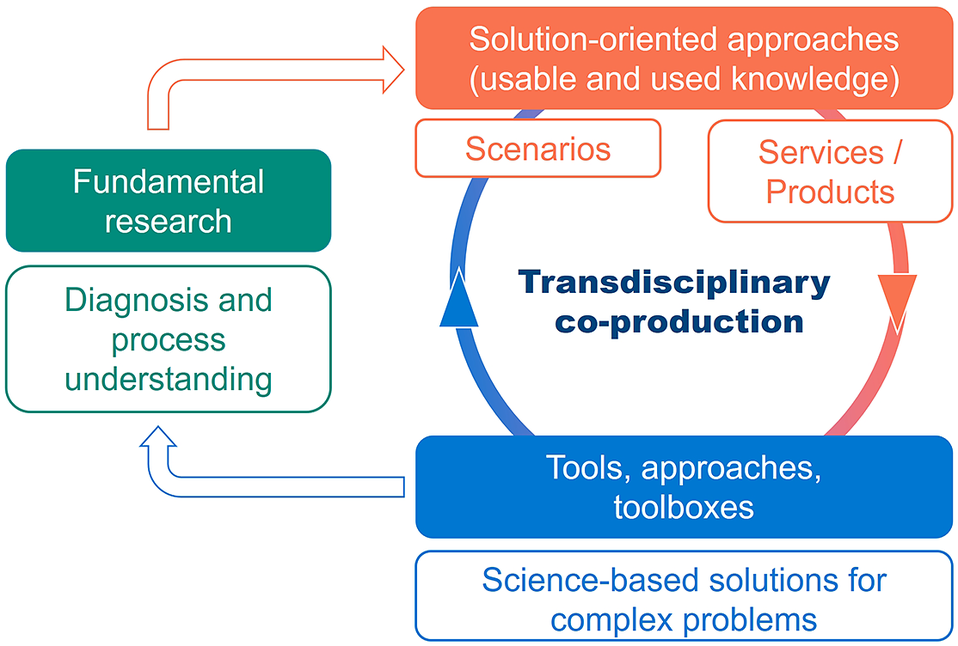
As the compounding effects of climate change in marine pollution research is a key research gap, we will assess and propose an iterative process for developing coastal pollution information services by deriving the framework and by looking at a set of 14 tools (Figure 3 and Appendix of the Supplementary Material). In this regard, it is important to build on the well-founded strengths in diagnosis and process understanding of earth system environmental problems (German National Academy of Sciences Leopoldina, 2022; see Figure 3). It is also necessary to advance the creation of multiple-use concepts based on scientific evidence as well as science-based approaches to solving complex problems geared towards science-based solutions for a sustainable coast in 2050.
An iterative process for developing coastal pollution information services, tools and toolboxes to support the sustainable development of coastal and ocean areas.

The scientific community’s depth of knowledge of pollution research and the capacity (strength in diagnosis and process understanding) is well-established (German National Academy of Sciences Leopoldina, 2022). There is a range of long-term observations, remote sensing, and modelling capabilities, as well as lab and field infrastructure available that are fit to provide diagnosis and in-depth process understanding. In particular, the analysis and assessment of human pressure and singular uses are widely available. Whilst there is some experience in the interaction with stakeholders, science is asked to interact with a wide range of users (green boxes, Figure 3). The contemporary challenge, in the face of global change and the need for sustainability, is to produce scientific outputs and the scaling up and bringing together of forecasting and predictive capabilities beyond analysis. Here, the exploration of ‘what-if’ scenarios in a scientifically sound manner will be based on reconstruction and projection. These scenarios will align with societal demands and policy options, for example, in managing and planning current energy transitions. The goal is to create solution-oriented knowledge relevant to a various stakeholders and their decision-making context (orange boxes, Figure 3).
We are proposing that there is a need for the scientific community dealing with marine pollution to consider a range of solutions in the form of services, tools and approaches that can be co-produced with stakeholders (blue boxes, Figure 3). Designing management and policy-making solutions for existing and emerging pollution challenges within an SES with compound environmental and social challenges are rooted in contemporary trans-disciplinary approaches (Celliers et al., Reference Celliers, Costa, Williams and Rosendo2021b). These approaches often encompass various forms of co-production, including an interdisciplinary team of scientists and societal actors. This will ensure optimal interest and use by various actors involved in the direct and indirect impact of marine pollution. Vice versa, a process will be implemented taking up the gain of knowledge into further advancement of diagnosis and process understanding capabilities.
The complexity of pollution management in SESs requires a ‘box of tools’ (including science, synthesis and management tools) intended, first, for stakeholder use and the provision of both hind- and foresight analysis of impacts, and second, for the identification of ‘leverage points’ (interventions) to minimise negative feedbacks (Meadows, Reference Meadows1999). The identification of these interventions is ensured by a combination of approaches of stakeholder interaction and structuring of findings in appropriate detail. This approach has gained particular attention over recent years in coastal systems (e.g., Fanini et al., Reference Fanini, Costa, Zalmon and Riechers2021; Riechers et al., Reference Riechers, Brunner, Dajka, Duse, Lubker, Manlosa, Sala, Schaal and Weidlich2021) and in relation to climate change (e.g., Rosengren et al., Reference Rosengren, Raymond, Sell and Vihinen2020; Egerer et al., Reference Egerer, Cotera, Celliers and Costa2021). A broad range of tools can be used to connect the constantly increasing scientific understanding of the fate and impact of pollution and the compounding impact of climate change with societal actors in an SES. The table in the Supplementary Material summarises possible tools and approaches usable for transdisciplinary co-production in connecting pollution science to society, decision- and policy-makers (Appendix of the Supplementary Material).
Towards societally relevant tools and approaches in support of sustainable development
In this paper, we highlight the complex interaction between pollution, the environment and people. It became clear that climate change will exacerbate the feedback and impact of pollution on SESs. There is also an increasing need to understand complex coastal SESs through the lens of pollution. This means that it is increasingly necessary to understand the role and impact of pollution on the entire system as it is itself impacted by climate change. The impact of climate change, the connectedness of SES elements, namely, pollution, climate and the people, the science of pollution and a new emphasis on social innovation require new tools to bridge the science-society gap: that is the ‘last mile’ between the scientific products and outputs, and their use in society (Celliers et al., Reference Celliers, Costa, Williams and Rosendo2021a).
In the ‘last mile’ moment of the ‘pollution–climate–society’ nexus, social innovation is fundamentally linked to technical and scientific solutions. This is also an opportunity to consider the critical importance of understanding the flow of scientific data on the sinks and sources of pollution, and its long-term fate, through complex societal processes with often nonlinear decision-making. In an SES, the objective of the ‘last mile’ moment is to identify a range of processes and approaches, that result in specific and bespoke products for users in the management domain and for users in the production of chemical pollutants. The application of the tools concludes with better and wiser decision-making related to pollution management. For example, a participatory modelling process for mapping the perspectives of pollution-affected stakeholders, including a pre-analysis of the most relevant stakeholders in the management domain and their specific management needs that may not have direct links to pollution science products. The social innovation that is proposed as part of the solution to ongoing pollution impacts, may also be useful in addressing the tension between the negative feedback between the SDGs: in particular, the interactions between SDG #14 and SDG #13 (‘climate action’), and SDG #7 (‘ubiquitous, affordable, reliable clean and modern energy’). The globally promising and most discussed part of the ‘solution’ for reducing carbon emissions, based on marine renewable energy, is presented as the development of offshore wind farms. The expectation is that governance systems become fit to create the enabling conditions for making offshore wind energy an important contributor to achieving climate and renewable energy targets (Lange et al., Reference Lange, O’Hagan, Devoy, Le Tissier and Cummins2018). However, unintended side effects between the rapid expansion of offshore wind farms and their possible impact as a source of (heavy) metal pollution need to be considered. These impacts require careful negotiation of management solutions for planning spatial resources. Participatory approaches, which are necessary for co-developing tools tailored to serve defined user needs, will help facilitate reaction to the impacts of unintended side effects. There are several winners and losers regarding offshore wind farms. The right balance amongst different interests requires both technical solutions and social interventions regarding resource needs, biodiversity, human and ecosystem health and planning of spatial resources. The social interventions assume the need for an inter- and transdisciplinary approach (Adler et al., Reference Adler, Hirsch Hadorn, Breu, Wiesmann and Pohl2018; Tsatsaros et al., Reference Tsatsaros, Bohnet, Brodie and Valentine2021) and the use of a co-production framework (Briley et al., Reference Briley, Brown and Kalafatis2015; Bremer et al., Reference Bremer, Wardekker, Dessai, Sobolowski, Slaattelid and van der Sluijs2019; Chambers et al., Reference Chambers, Wyborn, Ryan, Reid, Riechers, Serban, Bennett, Cvitanovic, Fernández-Giménez, Galvin, Goldstein, Klenk, Tengö, Brennan, Cockburn, Hill, Munera, Nel, Österblom, Bednarek, Bennett, Brandeis, Charli-Joseph, Chatterton, Curran, Dumrongrojwatthana, Durán, Fada, Gerber, JMH, Guerrero, Haller, Horcea-Milcu, Leimona, Montana, Rondeau, Spierenburg, Steyaert, Zaehringer, Gruby, Hutton and Pickering2021). The specific methodology is dependent on the agreed objective of the activity and on the objective related to the scope of pollution research, the products of the science and management, or the operational needs of stakeholders.
The expected outcome of a new combination of socially innovative tools and approaches is to co-produce pollution information and knowledge products that can support the transformation to sustainability. Such combinations of tools (toolboxes) intend to guide regulation, monitoring and assessment of pollution and ecosystem health in coastal regions, which is subject to increasing demands and competing stakeholder interests (e.g., offshore wind farms, aquaculture, new multi-use concepts, tourism and recreation, shipping, fishery) in a rapidly changing climate. While the science needs to continue exploring regional to global pollution monitoring, assessment and management, regulators also need bespoke information on the environmental pressures and risks posed by (new) pollutants and their complex interactions within the SESs. As such, scientific products and outputs form the input to co-production processes, aligning with key stakeholders’ needs. The increased efficiency and greater relevance of the science-to-policy process can make a greater contribution to achieving a good environmental status in the oceans and seas, as proposed by the European Parliament and the Council of the EU (European Parliament and the Council of the European Union, 2008). The process is also meant to improve the state of the ocean by fulfilling the SDGs included in the 2030 Agenda for Sustainable Development (United Nations, 2015).
Open peer review
To view the open peer review materials for this article, please visit http://doi.org/10.1017/cft.2023.11.
Supplementary material
The supplementary material for this article can be found at https://doi.org/10.1017/cft.2023.11.
Data availability statement
Data/code sharing is not applicable to this article because no data/code were analysed in this study.
Acknowledgements
The work described in the article content contributes to Future Earth Coasts, a global research project of future earth.
Author contribution
M.L., L.C. and R.E. designed the paper content, developed figures and drafted the manuscript. They developed the underlying concept, provided oversight and revised and edited the text. D.C., A.E., H.J. and L.R. drafted paragraphs and edited the text, figures and developed Appendix of the Supplementary Material.
Financial support
The conceptual work has been carried out in the context of the current Program-Oriented Funding (POF IV) of the Helmholtz Association. L.C., D.C. and L.R. acknowledge funding from the Helmholtz-Zentrum Hereon project I2B CoastalClimateServices@GERICS.
Competing interest
The authors declare no competing interest.


 Open access


Comments
No accompanying comment.