

Wearing a face mask in public areas may impede the spread of an infectious disease by preventing both the inhalation of infectious droplets and their subsequent exhalation and dissemination. In the event of a pandemic involving an airborne-transmissible agent, the general public will have limited access to the type of high-level respiratory protection worn by health care workers, such as N95 respirators. Images of members of the public wearing surgical masks were often used to illustrate the 2009 H1N1 flu pandemic. However, the evidence of proportionate benefit from widespread use of face masks is unclear.
A recent prospective cluster-randomized trial comparing surgical masks and non-fit-tested P2 masks (filters at least 94% of airborne particles) with no mask use in the prevention of influenza-like illness. The findings of the study found that adherence to mask use significantly reduced (95% CI, 0.09-0.77; P = .015) the risk for infection associated with influenza-like illness, but that less than 50% of participants wore masks most of the time.Reference MacIntyre, Cauchemez and Dwyer 1 Facemasks may prevent contamination of the work space during the outbreak of influenza or other droplet-spread communicable disease by reducing aerosol transmission. They may also be used to reduce the risk of body fluids, including blood, secretions, and excretions, from reaching the wearer's mouth and nose.
To date, studies on the efficacy and reliability of face masks have concentrated on their use by health care workers. Although health care workers are likely to be one of the highest risk groups in terms of exposure, they are also more likely to be trained in the use of masks and fit tested than the general public. Should the supply of standard commercial face masks not meet demand, it would be useful to know whether improvised masks could provide any protection to others from those who are infected.
Methods and Materials
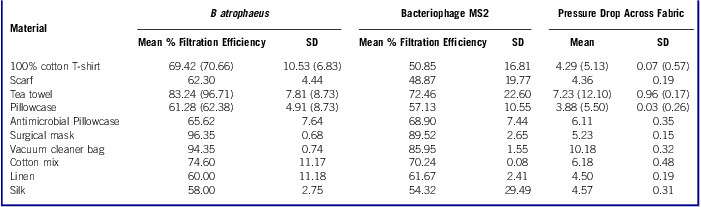
In this study, common household materials (see Table 1) were challenged with high concentrations of bacterial and viral aerosols to assess their filtration efficiencies. Surgical masks have been considered the type of mask most likely to be used by the general public, and these were used as a control. The pressure drop across each of the materials was measured to determine the comfort and fit between face and mask that would be needed to make the material useable in mask form. We devised a protocol for constructing a “homemade” mask, based on the design of a surgical mask, and volunteers were invited to make their own masks. These were then quantitatively fit tested. To determine the effect of homemade and surgical masks in preventing the dispersal of droplets and aerosol particles produced by the wearer, the total bacterial count was measured when the volunteers coughed wearing their homemade mask, a surgical mask, and no mask.
Filtration Efficiency and Pressure Drop Across Materials Tested with Aerosols of Bacillus atrophaeus and Bacteriophage MS2 (30 L/min)Footnote a
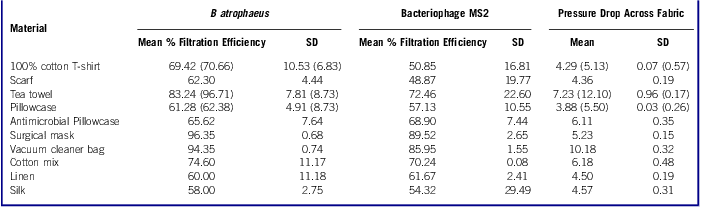
a Numbers in parentheses refer to the results from 2 layers of fabric.
Testing the Filtration Efficiency
A range of common household materials were tested, together with the material from a surgical mask (Mölnlycke Health Care Barrier face mask 4239, EN14683 class I), for comparison. Circular cutouts of the tested materials were placed without tension in airtight casings, creating a “filter” in which the material provided the only barrier to the transport of the aerosol.
A Henderson apparatus allows closed-circuit generation of microbial aerosols from a Collison nebulizer at a controlled relative humidity. This instrument was used to deliver the challenge aerosol across each material at 30 L/min using the method of Wilkes etal,Reference Wilkes, Benbough, Speight and Harmer 2 which is about 3 to 6 times per minute the ventilation of a human at rest or doing light work, but is less than 0.1 the flow of an average cough.
Downstream air was sampled simultaneously for 1 minute into 10 ml of phosphate buffer manucol antifoam using 2 all-glass impingers. One impinger sampled the microorganisms that had penetrated through the material filter, while the other sampled the control (no filter). The collecting fluid was removed from the impingers and assayed for microorganisms. This test was performed 9 times for each material. The filtration efficiency (FE) of the fabric was calculated using the following formula (cfu indicate colony-forming units):
 $${\rm{FE}}\: = \:\frac{{{\rm{Upstream}}\,{\rm{cfu}}\, {\rm{ - }}\, {\rm{Downstream}}\,{\rm{cfu}}\:\times \:100}}{{{\rm{Upstream}}\,{\rm{cfu}}}}\eqno\rm$$
The pressure drop across the fabric was measured using a manometer (P200UL, Digitron), with sensors placed on either side of the filter casing, while it was challenged with a clean aerosol at the same flow rate.
Microorganisms
Two microorganisms were used to simulate particle challenge: Bacillus atrophaeus is a rod-shaped spore-forming bacterium (0.95-1.25 μm) known to survive the stresses caused by aerosolization.Reference Cox 3 The suspension was prepared from batches previously prepared by the Health Protection Agency, Centre for Emergency Preparedness and Response Production Division.Reference Sharp, Scawen and Atkinson 4 Each material was challenged with approximately 107 cfu B atrophaeus.
Bacteriophage MS2 (MCIMB10108) is a nonenveloped single-stranded RNA coliphage, 23 nm in diameter, known to survive the stresses of aerosolization.Reference Dubovi and Akers 5 Each material was challenged with approximately 109 plaque-forming units (pfu) of bacteriophage MS2.
The two test organisms can be compared in size to influenza virus, which is pleomorphic and ranges from 60 to 100 nm; Yersinia pestis, which is 0.75 μm; B anthracis, which is 1 to 1.3 μm; Francisella tularensis, which is 0.2 μm; and Mycobacterium tuberculosis, which is 0.2 to 0.5 μm.Reference Stanley 6 Bacteriophage MS2 and B atrophaeus were chosen as the test organisms to represent influenza virus. This decision was made not only because of the lower risks of associated infection but also because the work would be technically easier to carry out using an Advisory Committee on Dangerous Pathogens (ACDP) class 1 organism versus an ACDP class 2 organism influenza.
Making the Face Mask
For this study, 21 healthy volunteers were recruited, 12 men and 9 women. The participants were aged between 20 and 44 years; the majority was in the 20- to 30-year age range. Each volunteer made a homemade face mask following a protocol devised by the authors. All face masks were made with 100% cotton t-shirt fabric using sewing machines to speed construction. A surgical mask (Mölnlycke Health Care Barrier face mask 4239, EN14683 class I) was used as a control. Also, all volunteers completed a questionnaire indicating their opinions of mask wearing.
Determining the Fit Factor of the Mask
A commercial fit test system (TSI PortaCount Plus Respirator Fit Tester and N95- Companion Module model 8095) was used to measure respirator fit by comparing the concentration of microscopic particles outside the respirator with the concentration of particles that have leaked into the respirator. The ratio of these 2 concentrations is known as the fit factor. To conduct the fit test, the apparatus was set up and operated according to the manufacturer's instructions.
Volunteers were instructed to fit their surgical and homemade face masks with no help or guidance from the operator; to ensure that the mask was comfortable for 2 minutes; the participants were given time to purge any particles trapped inside the mask. The fit test was then conducted with volunteers performing the following consecutive exercises, each lasting 96 seconds: (1) normal breathing, (2) deep breathing,Reference Myers, Peach, Cutright and Iskander 7 (3) head moving side to side, (4) head moving up and down, (5) talking aloud (reading a prepared paragraph), (6) bending at the waist as if touching their toes, and (7) normal breathing.
Determining the Effect of Masks in Preventing the Dispersal of Droplets and Aerosol
An enclosed 0.5-m3 mobile sampling chamber, or cough box, which was constructed for the purpose of sampling aerosols and droplets from healthy volunteers (PFI Systems Ltd, Milton Keynes), was placed in a 22.5-m3 high-frequency particulate air-filtered environmental room. Four settle plates were placed in the cough box to sample for droplets, together with a 6-stage Andersen sampler to sample and separate small particles.Reference Andersen 8 A Casella slit-air samplerReference Bourdillon, Lidwell and Thomas 9 was also attached to the cough box. Tryptose soya agar was used as the culture medium. Volunteers wearing protective clothing (Tyvek suits) coughed twice into the box, and the air inside was sampled for 5 minutes. Each volunteer was sampled 3 times: wearing the homemade mask, the surgical mask, and no mask. The air within the cough box was high-frequency particulate air filtered for 5 minutes between each sample to prevent cross-contamination between samples. The plates were incubated for a minimum of 48 hours at 37°C before counting.
Statistical Analysis
To evaluate the face mask fit, the median and interquartile range were calculated for each exercise and face mask for the 21 individuals. Wilcoxon sign rank tests were used to compare the masks. The same approach was used to determine differences between the different mask types and their efficacy in preventing dissemination of droplets and particles
Results
Filtration Efficacy
All the materials tested showed some capability to block the microbial aerosol challenges. In general, the filtration efficiency for bacteriophage MS2 was 10% lower than for B atrophaeus (Table 1). The surgical mask had the highest filtration efficiency when challenged with bacteriophage MS2, followed by the vacuum cleaner bag, but the bag's stiffness and thickness created a high pressure drop across the material, rendering it unsuitable for a face mask. Similarly, the tea towel, which is a strong fabric with a thick weave, showed relatively high filtration efficiency with both B atrophaeus and bacteriophage MS2, but a high pressure drop was also measured.
The surgical mask (control) showed the highest filtration efficiency with B atrophaeus. Also, as expected, its measured low pressure drop showed it to be the most suitable material among those tested for use as a face mask. The pillowcase and the 100% cotton t-shirt were found to be the most suitable household materials for an improvised face mask. The slightly stretchy quality of the t-shirt made it the more preferable choice for a face mask as it was considered likely to provide a better fit.
Although doubling the layers of fabric did significantly increase the pressure drop measured across all 3 materials (P < .01 using Wilcoxon sign rank test), only the 2 layers of tea towel material demonstrated a significant increase in filtration efficiency that was marginally greater than that of the face mask.
In the questionnaire on mask use during a pandemic, 6 participants said they would wear a mask some of the time, 6 said they would never wear a mask, and 9 either did not know or were undecided. None of the participants said that they would wear a mask all of the time. With 1 exception, all participants reported that their face mask was comfortable. However, the length of time each participant kept their mask on during testing was minimal (15 min), and with long-term wear, comfort might decrease.
Facemask Fit Testing
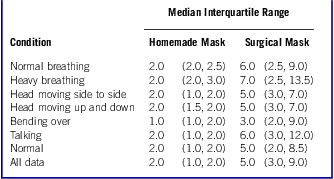
A Wilcoxon sign rank test showed a significant difference between the homemade and surgical mask for each exercise and in total (all tests showed P < .001). The median and interquartile range for each mask and exercise are given in Table 2.
Median and Interquartile Range Results from Respirator Fit Testing of Homemade and Surgical Masks
Prevention of Droplet and Particle Dissemination When Coughing
Results from the cough box experiments showed that both the surgical mask and the homemade mask reduced the total number of microorganisms expelled when coughing (P < .001 and P = .004, respectively; see Table 3).
Median Colony-Forming Units by Sampling Method Isolated From Volunteers Coughing When Wearing a Surgical Mask, a Homemade Mask, and No Mask
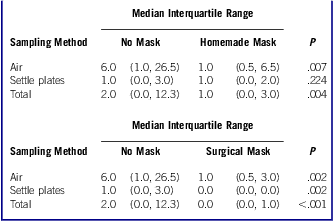
On analyzing the effect of mask wearing in reducing the number of microorganisms isolated from the Anderson air sampler (Table 4), the surgical mask was found to be generally more effective in reducing the number of microorganisms expelled than the homemade mask, particularly at the lowest particle sizes. The number of microorganisms isolated from the coughs of healthy volunteers was generally low, although this varied according to the individual sampled (Table 3). It is possible, therefore, that the sampling limitations negatively affected the statistical analysis.
Total Colony-Forming Units Isolated by Particle Size From 21 Volunteers Coughing When Wearing a Surgical Mask, Homemade Mask, and No Mask
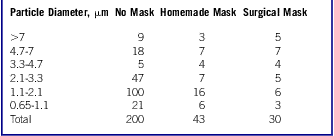
Pearson χ2 tests comparing the proportion of particles greater than 4.7 μm in diameter and particles less than 4.7 μm in diameter found that the homemade mask did not significantly reduce the number of particles emitted (P = .106). In contrast, the surgical mask did have a significant effect (P < .001).
Discussion
Facemasks reduce aerosol exposure by a combination of the filtering action of the fabric and the seal between the mask and the face. The filtration efficiency of the fabric depends on a variety of factors: the structure and composition of the fabric, and the size, velocity, shape, and physical properties of the particles to which it is exposed.Reference Lavoie, Cloutier, Lara and Marchand 10 Although any material may provide a physical barrier to an infection, if as a mask it does not fit well around the nose and mouth, or the material freely allows infectious aerosols to pass through it, then it will be of no benefit.
The test organisms in this study can be used to estimate the efficacy of these masks against influenza virus because essentially any aerosolized particle will behave predominately in the air as a result of its physical characteristics rather than its biological properties (ie, influenza virus particles will travel in the air in the same manner as particles of an equivalent size). Therefore, as we have tested a viral pathogen smaller than influenza and a bacterial pathogen larger than influenza, we have tested the face masks with a suitable challenge across the size range of influenza virus particles. Furthermore, the data from this study could also be applied to other organisms within this size range that are potentially transmitted via the aerosol route.
Quantitative fit testing can only estimate the combined effects of filtration efficiency and goodness of fit. Although sensitive to particles with diameters as small as 0.02 μm, it is not sensitive to variations in particle size, shape, composition, or refractive index. As a result, this method of fit testing does not allow the distinction between true bioaerosols and droplet contamination.
A study conducted in the Netherlands using a commercial fit-test system (Portacount Plus Respirator Fit Tester) on volunteers wearing both improvised masks made from tea cloths and surgical masks over a 3-hour period found results similar to those found in this study.Reference van der Sande, Teunis and Sabel 11 The authors demonstrated a median protection factor of between 2.2 and 2.5 for various activities when wearing a mask with a tea towel filter and protection factors of between 4.1 and 5.3 for the surgical mask. It was interesting that the study also found that median protection factors increased over the 3-hour period for those wearing the homemade masks, decreased for those wearing filtering face piece (FFP2) masks that lower the wearer's exposure to airborne particles by a factor of 10, and showed no consistent pattern for those wearing a surgical mask.Reference van der Sande, Teunis and Sabel 11
The materials used in this published study were fresh and previously unworn. It is likely that materials conditioned with water vapor, to create a fabric similar to that which has been worn for a couple of hours, would show very different filtration efficiencies and pressure drops. In contrast, a study of breathing system filters found a greater breakthrough of bacteriophage MS2 on filters that had been preconditioned. Although the droplet sizes for both virus and bacteria were the same and affected the filter media in a similar manner, it was suggested that the viruses, after contact with the moisture on the filter, were released from their droplet containment, and driven onward by the flow of gas.Reference Wilkes, Benbough, Speight and Harmer 12
The average concentration of Streptococcus organisms in saliva has been estimated to be 6.7 × 10⁷ cfu/mL,Reference Bennett, Fulford and Walker 13 which is higher than that of influenza viruses in inoculated volunteers.Reference Hall, Douglas, Geiman and Meagher 14 Therefore, the number of oral microorganisms isolated may well provide an indication of the concentration of influenza being shed. Results from the cough box demonstrated that surgical masks have a significant effect in preventing the dispersal of large droplets and some smaller particles when healthy volunteers coughed. The homemade mask also prevented the release of some particles, although not at the same level as the surgical mask. The numbers of microorganisms isolated from the coughs of healthy volunteers was in general very low, and it is likely that had we used volunteers with respiratory infections, the homemade mask may have shown a more significant effect in preventing the release of droplets.
It was observed during this study that there was greater variation among volunteers in their method of fitting the surgical mask. The need to tie the straps at the back of the head meant that the surgical mask was fit in a variety of ways. In contrast, the face mask had looped elastic straps that were easier for the volunteer to fit.
Comfort should be an important factor in the material used to make a homemade mask. The pressure drop across a mask is a useful measure both of resistance to breathing and the potential for bypass of air around the filter seal. If respiratory protection is not capable of accommodating the breathing demands of the wearer, then the device will impose an extra breathing load on the wearer, which is especially impracticable for people with breathing difficulties. Furthermore, the extra breathing load may induce leakage owing to the increased negative pressure in the face mask.Reference Clayton, Bancroft and Rajan 15
In practice, people will not wear an uncomfortable mask for a long period; even if they do, it is unlikely that they will wear the mask properly. During the outbreak of severe acute respiratory syndrome, an account of a flight from Bangkok, Thailand, to Manchester, England. described mask wearers removing their mask to cough, sneeze, and wipe their nose (not necessarily into a handkerchief) and to sort through the communal bread basket.Reference Syed, Sopwith, Regan and Bellis 16 For those who wear a mask for necessity, such as health care workers, regular training and fit testing must be emphasized. Whereas, for those who choose to wear a homemade mask, the requirements of cleaning and changing the mask should be highlighted. Most importantly, the lower protective capabilities of a homemade mask should be emphasized so that unnecessary risks are not taken.
Conclusion
A protective mask may reduce the likelihood of infection, but it will not eliminate the risk, particularly when a disease has more than 1 route of transmission. Thus any mask, no matter how efficient at filtration or how good the seal, will have minimal effect if it is not used in conjunction with other preventative measures, such as isolation of infected cases, immunization, good respiratory etiquette, and regular hand hygiene. An improvised face mask should be viewed as the last possible alternative if a supply of commercial face masks is not available, irrespective of the disease against which it may be required for protection. Improvised homemade face masks may be used to help protect those who could potentially, for example, be at occupational risk from close or frequent contact with symptomatic patients. However, these masks would provide the wearers little protection from microorganisms from others persons who are infected with respiratory diseases. As a result, we would not recommend the use of homemade face masks as a method of reducing transmission of infection from aerosols.