


Introduction
Negative side effects of business have become more and more visible over the past decade in terms of social, environmental and economic problems. For instance, the global financial crisis that started in the USA in 2007 as a result of subprime mortgage lending (Ackermann Reference Ackermann2008) and more recently the Volkswagen scandal about clean air violations, fuelled the debate about the ethical behaviour of firms (EPA 2016). Such events have led to intensified societal calls demanding that companies look beyond pure profit maximization (Kotler and Lee Reference Kotler and Lee2005; Porter and Kramer Reference Porter and Kramer2011). Here, organizational scholars can contribute by defining new business models that compel improved connections among businesses, societies and communities (Porter and Kramer Reference Porter and Kramer2011). As a consequence, research interest in such alternative business models has increased in the past decade under a variety of labels, such as cooperative enterprise (Cheney et al. Reference Cheney, Cruz, Peredo and Nazareno2014), social enterprise (Doherty et al. Reference Doherty, Haugh and Lyon2014), hybrid organizations (Battilana and Lee Reference Battilana and Lee2014), and social entrepreneurship (Zahra et al. Reference Zahra, Rawhouser, Bhawe, Neubaum and Hayton2008). The common characteristic that these organizational forms seem to be better able to meet both social and economic goals.
In particular, the cooperative enterprise (CE) is recognized already for decades as an organizational form that can address socio-economic problems, respond to societal needs, overcome market failures and alleviate problems for customers, members and society (Cheney et al. Reference Cheney, Cruz, Peredo and Nazareno2014; Costa et al. Reference Costa, Andreaus, Carini and Carpita2012; Storey et al. Reference Storey, Basterretxea and Salaman2014). Scholars recognize that the cooperative model contains elements of social entrepreneurship, social enterprises and hybrid organizations (Doherty et al. Reference Doherty, Haugh and Lyon2014). Likewise, the International Labour Organization recognizes the relevance of CEs “as important in improving the living and working conditions of women and men globally as well as making essential infrastructure and services available even in areas neglected by the state and investor-driven enterprises” (ILO 2017).
Unfortunately, the literature on the CE as an organizational form is highly fragmented in what is currently considered as mainstream organizational literatures, i.e. the fields of economics, management, business, and sociology. For example, Mazzarol et al. (Reference Mazzarol, Limnios, Reboud, Mazzarol, Reboud, Limnios and Clark2014a, p. 11) report that “scholars working with a wide range of backgrounds […] including economics, agriculture, sociology, social policy, regional studies, management, marketing, entrepreneurship, labour studies, history, political economy, law, accounting and finance” are studying cooperatives. In an effort to synthesize current knowledge of CE in the mainstream organizational literature—broadly ranging from work in economics, management, and business, to sociology—we aim to contribute to the knowledge of organizational aspects of one of the four SE models identified (Defourny and Nyssens Reference Defourny and Nyssens2017) and empirically tested (Defourny et al. Reference Defourny, Nyssens and Brolis2020): the social cooperative model. By studying the CE from an organizational perspective, we seek to complement literature dealing with CE’s historical development, legal requirements or specific societal impact or policy, for example in the field of social issues. Thus, the research question for this study is as follows: ‘What future avenues for research can be derived from the current topics of CE research in the organizational literature?’.
Our study makes various contributions to benefit both research and practice. First, our study explores a number of reasons why CE have received limited attention so far in the mainstream organizational literature. Second, our study synthesizes the literature on CE in the mainstream organizational literature. In this way, we connect a variety of insights that help in better understanding the CE as an organizational form. Additionally, this allows us to provide an overview of the various organizational mechanisms available to those responsible for CE effectiveness, especially with respect to sustainable development practices and entrepreneurial opportunity generation. Third, by comparing the mainstream organizational literature to the social issues’ literature on CE, a valuable bridge is built between those studying effective organizational design versus those primarily studying effective societal impact. Finally, we highlight the need for multilevel studies into CEs.
The structure of our paper is as follows. We first demarcate the CE and describe the mainstream organizational literature that we used as a basis for this study by providing an overview of definitions, the nature, and research contexts of CE. Next, we conduct a systematic literature review of the current body of knowledge on CE in organizational research. Based on our review, we categorize and cluster the main themes discussed in the organizational literature with regard to CE. Finally, we derive future research avenues by integrating the available organizational knowledge with respect to the CE organizational form.
Cooperative Enterprise: Definition, Nature and Context
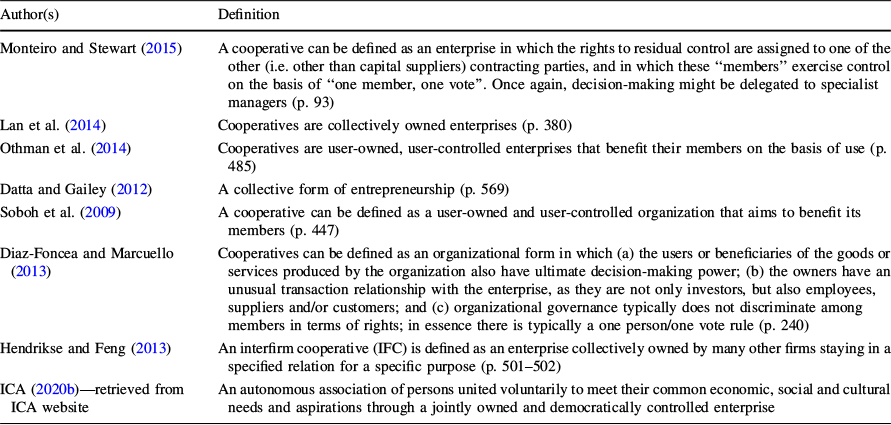
Defining the CE is not as straightforward as it seems, since various definitions appear in the literature (see Table 1). Each definition can be associated with a particular theoretical framework. The International Cooperative Alliance (ICA) defines a CE as follows: “A cooperative is an autonomous association of persons united voluntarily to meet their common economic, social and cultural needs and aspirations through a jointly owned and democratically controlled enterprise” (ICA 2020b). This is a definition widely accepted by practitioners and scholars alike (Battaglia et al. Reference Battaglia, Bianchi, Frey and Passetti2015; Bernardi and Miani Reference Bernardi and Miani2014).
Definitions of cooperative

Author(s) |
Definition |
|---|---|
Monteiro and Stewart (Reference Monteiro and Stewart2015) |
A cooperative can be defined as an enterprise in which the rights to residual control are assigned to one of the other (i.e. other than capital suppliers) contracting parties, and in which these “members” exercise control on the basis of “one member, one vote”. Once again, decision-making might be delegated to specialist managers (p. 93) |
Lan et al. (Reference Lan, Zhu, Ness, Xing and Schneider2014) |
Cooperatives are collectively owned enterprises (p. 380) |
Othman et al. (Reference Othman, Mansor and Kari2014) |
Cooperatives are user-owned, user-controlled enterprises that benefit their members on the basis of use (p. 485) |
Datta and Gailey (Reference Datta and Gailey2012) |
A collective form of entrepreneurship (p. 569) |
Soboh et al. (Reference Soboh, Lansink, Giesen and van Dijk2009) |
A cooperative can be defined as a user-owned and user-controlled organization that aims to benefit its members (p. 447) |
Diaz-Foncea and Marcuello (Reference Diaz-Foncea and Marcuello2013) |
Cooperatives can be defined as an organizational form in which (a) the users or beneficiaries of the goods or services produced by the organization also have ultimate decision-making power; (b) the owners have an unusual transaction relationship with the enterprise, as they are not only investors, but also employees, suppliers and/or customers; and (c) organizational governance typically does not discriminate among members in terms of rights; in essence there is typically a one person/one vote rule (p. 240) |
Hendrikse and Feng (Reference Hendrikse, Feng and Grandori2013) |
An interfirm cooperative (IFC) is defined as an enterprise collectively owned by many other firms staying in a specified relation for a specific purpose (p. 501–502) |
ICA (2020b)—retrieved from ICA website |
An autonomous association of persons united voluntarily to meet their common economic, social and cultural needs and aspirations through a jointly owned and democratically controlled enterprise |
However, despite the widespread use of this definition, CE can also be owned by companies, not only by persons. For instance, suppliers can own an interfirm cooperative, as is common in agribusiness (Hendrikse and Feng Reference Hendrikse, Feng and Grandori2013). Persons are therefore to be understood in this definition as consisting of both independent natural and legal entities. Monteiro and Stewart (Reference Monteiro and Stewart2015) offer a definition from the ownership and rights control perspective, given the particular ownership structure of CE, and they also provide a perspective on the role of the members in the decision-making process. Othman et al. (Reference Othman, Mansor and Kari2014) explain briefly who the owner is, how control is exercised and how the benefits are received in a CE. Table 1 summarizes these and more definitions associated with CE.
Connecting the nature of the cooperative model to its identity, the ICA provides values and guidelines for characterising CE identity. “Cooperatives are based on the values of self-help, self-responsibility, democracy, equality, equity and solidarity. According to their founders’ tradition, cooperative members believe in the ethical values of honesty, openness, social responsibility and caring for others” (ICA 2020a,2020b). There are seven ICA principles, namely (1) Voluntary and open membership; (2) Democratic member control; (3) Members’ economic participation; (4) Autonomy and independence; (5) Education, training and information; (6) Co-operation among Cooperatives; and (7) Community concern. These guidelines help to put the mission of CE into practice in their own context (Cheney et al. Reference Cheney, Cruz, Peredo and Nazareno2014; Novkovic Reference Novkovic2008).
Historically, CE have played a key role in social and economic development (Stiglitz Reference Stiglitz2009, p. 350) in that, they have produced and marketed goods in the agricultural, and food industries (Battilani and Zamagni Reference Battilani and Zamagni2012), provided services in wholesale and retail industries (Balnave and Patmore Reference Balnave and Patmore2012; Mason Reference Mason2012; Robertson Reference Robertson2012; Webster Reference Webster2012) to its members, their customers and communities (Balnave and Patmore Reference Balnave and Patmore2010; Battaglia et al. Reference Battaglia, Bianchi, Frey and Passetti2015; Fernandez Reference Fernandez2014). The CE can be seen as an ideal hybrid organization that is able to create both social and economic value. Further, as an organizational form the CE can take a variety of legal structures, from an agricultural cooperative to a financial institution or a credit provider (Mazzarol et al. Reference Mazzarol, Limnios, Reboud, Mazzarol, Reboud, Limnios and Clark2014a).
Research Approach
We conducted a review to assess the current state of the literature on CE, as this “helps develop a reliable knowledge base by accumulating knowledge from a range of studies” (Tranfield et al. Reference Tranfield, Denyer and Smart2003, p. 220). This review follows a systematic review approach, which means that we follow a systematic method of collecting and reviewing articles by following the steps explicated by Tranfield et al. (Reference Tranfield, Denyer and Smart2003). Relevant papers selected for the study are examined for recurring key concepts, the nature of CEs, used theoretical approaches and the specific research context, which are clustered into a number of themes. Using this methodology enabled an appraisal of the current body of knowledge in management field and closely related literature on the topic, by which we identified potential gaps for future research in this domain.
The first challenge for this study was to define the primary search strings as the use of the keyword ‘cooperative’ and related variants led to thousands of documents unrelated to the CE but focussing on variants of the verb cooperating. In particular, we faced the challenge that ‘cooperative’ has various meanings within the mainstream organization literature—defined here as belonging to the economics, management, business and sociology fields—referring to concepts such as cooperation, cooperative strategy (Parmigiani and Rivera-Santos Reference Parmigiani and Rivera-Santos2011), collaboration (Strand and Freeman Reference Strand and Freeman2015), alliances (Albers et al. Reference Albers, Wohlgezogen and Zajac2016), relations between organizations and their partners (Barringer and Harrison Reference Barringer and Harrison2000). However, none of these papers dealt with the CE as a specific entity but with organizations or people collaborating.
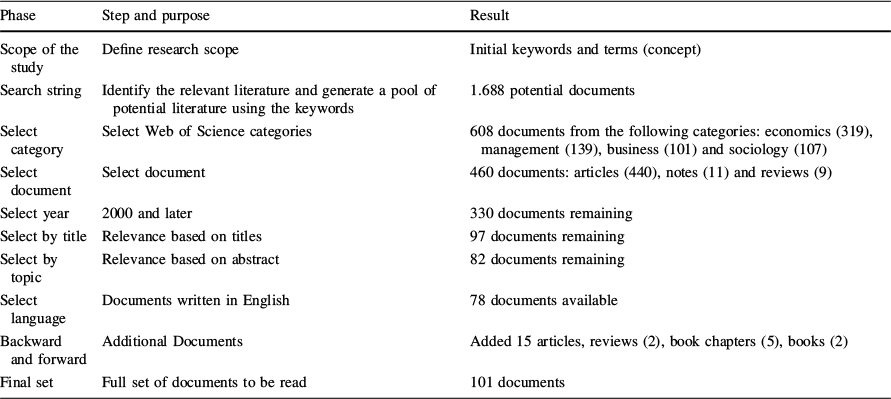
Consequently, the review protocol was based on the following selection criteria and procedures. The first step was to identify studies focused specifically on the CE. We searched the Web of Science database with the keywords “cooperative” and “co-operative”. The primary search string we used was “cooperative*”. The keyword included an asterisk (*) to find keyword variations such as “cooperative” and “co-operative”. Next, we limited our results to the categories Economics, Management, Business, and Sociology. We chose these categories as the fields they represent are those most closely dealing with organizations and organizing specifically. We further limited our results studies published as journal articles, research notes and reviews. Furthermore, we selected only those studies published in or after 2000, as very few papers on CE were published before—and the most important older work would surface in our final review step. After these initial five selection steps in the Web of Science database, we selected papers based on the relevance of the title and then on the abstract’s content to be sure that the dealt with CE. We excluded a few papers that were not written in English. Based on our full reading of the set of remaining relevant papers, we searched back-and-forwards for additional relevant documents listed in the papers’ references. In this step, we added an additional number of often mentioned relevant journal articles, reviews, book chapters and books. After these steps, our full set of documents used in our review consisted of 101 sources. Our selection steps and the resulting size of our paper sample in each step is mentioned in Table 2.
Results per step of the systematic literature review

Phase |
Step and purpose |
Result |
|---|---|---|
Scope of the study |
Define research scope |
Initial keywords and terms (concept) |
Search string |
Identify the relevant literature and generate a pool of potential literature using the keywords |
1.688 potential documents |
Select category |
Select Web of Science categories |
608 documents from the following categories: economics (319), management (139), business (101) and sociology (107) |
Select document |
Select document |
460 documents: articles (440), notes (11) and reviews (9) |
Select year |
2000 and later |
330 documents remaining |
Select by title |
Relevance based on titles |
97 documents remaining |
Select by topic |
Relevance based on abstract |
82 documents remaining |
Select language |
Documents written in English |
78 documents available |
Backward and forward |
Additional Documents |
Added 15 articles, reviews (2), book chapters (5), books (2) |
Final set |
Full set of documents to be read |
101 documents |
We clustered the organizational research along a number of key themes, based on often recurring concepts and topics, theoretical approaches, the nature of the CE and specific research contexts. These themes were addressed by scholars in various ways, using both qualitative and quantitative methods to assess performance, survival, growth, and efficiency of CEs. Also, some of these studies involve direct comparison between CEs and investor-owned firms (IOFs). We further noticed a relatively recent blossoming interest in CEs. Approximately, 60% of the papers in our review appeared in the past decade (cf., in the social issues’ literature, the interest has increased substantially in the past five years). Furthermore, we also found studies undertaken on CE in Africa, South America, Asia and Oceania, evidencing how the research landscape on other continents differs from the traditional cooperative movement in Western, i.e. Anglo-American and European contexts. In Fig. 1, we have depicted how we framed and categorized our key themes to provide an integrated overview of the CE as a research field, showing the main themes and concepts we identified in relation to the CE.
Research landscape on cooperative enterprise

Findings
In our findings, we discuss the five most prominent themes that emerged from our clustering and categorization. These themes are: (a) reasons for the limited attention in the organizational literature; (b) ownership and governance; (c) efficiency and performance; (d) strategy and growth; (e) social enterprise and hybrids, and (f) social entrepreneurship. In addition, we compare our findings in the organizational literature to the research on cooperatives in the social issues literature.
Limited Attention for the CE in the Current Mainstream Organizational Literature
During the review process, a range of possible reasons emerged for research on CE being treated as less relevant to organizational scholars in economics, business, management and sociology. Since scholars consider the CE as a player in the economic market, it assumes that the CE conducts itself in the same way and with the same opportunistic logic as the IOF counterpart. Similarly, the predominant economic model of capitalism (Sandmo Reference Sandmo2011) in which the for-profit corporation is the model for all other organizational forms, and which is positioned according to logics such as capital and profit maximization, and efficiency, creates the impression that the cooperative model and non-investor-owned sectors are of limited relevance (Mintzberg Reference Mintzberg1996). Additionally, the economic nature of the firm (Putterman and Kroszner Reference Putterman and Kroszner1996), as well as the economic neoliberalism framework, reinforce these capitalist logics which are characterized by strong private property rights, free markets, and free trade (Harvey Reference Harvey2005). Although CE do not pursue profit maximization as a central goal, the rational of cost efficiency still drives CE performance (Hendrikse and Veerman Reference Hendrikse and Veerman2001).
This lack of interest in CE is reflected, for example, in this organizational form not being dealt with in economic textbooks (Hill Reference Hill2000). For instance, between 1905 and 2005 Kalmi (Reference Kalmi2007) compiled a longitudinal sample of Economics textbooks at the University of Helsinki, Finland. He argued that a shift in the economics paradigm explains why CE have been omitted in Economics textbooks. Additionally, this lack of interest is also reflected in media reports. A study performed by (Mangan and Byrne Reference Mangan and Byrne2018) analysed media coverage and reports in the United Kingdom regarding to the bank sector, where business reporting capitalist narratives, the study identified how media play a role delegitimizing co-operative banks.
CE are often considered to be economically less efficient than IOFs (Hendrikse and Feng Reference Hendrikse, Feng and Grandori2013). In the past, Porter and Scully (Reference Porter and Scully1987) pointed out that cooperatives can suffer from structural inefficiencies: “The horizon problem, the transferability problem, and the control problem have implications for technical efficiency, factor-price efficiency and scale efficiency” (p. 498). Similarly, Hendrikse and Feng (Reference Hendrikse, Feng and Grandori2013) explain how CE face the horizon problem, control problem and portfolio problem. Basically, because of the limited transferability of ownership rights and to CE’ special features, CE can suffer an underinvestment problem, because the members are disincentivized to provide resources for long term investment strategies. Besides, a diversification problem influencing the CE’s decision-making process arises. These aspects are explained from the ownership rights perspective, because CE has a different ownership configuration. These problems appear to withhold CE from achieving efficiency. Despite the arguments mentioned above, Fahlbeck (Reference Fahlbeck, Karantininis and Nilsson2007) reports no support for a horizon problem in agricultural cooperatives or efficiency.
Another possible explanation for the limited research attention lies in the social focus of CE. Although CE typically are commercially and economically oriented, they are at the same time socially focused. Levi and Davis (Reference Levi and Davis2008) claim that this dual orientation of CE has a negative impact on their profits and efficiency. However, the interplay between social and economic objectives is inherent to CE. Unlike IOFs, CE have a broad social mission that transcends their economic role (Kalmi Reference Kalmi2007). CE promote social stability and alleviate poverty in the communities where they are established (Simmons and Birchall Reference Simmons and Birchall2008). In the following sections, we discuss papers that demonstrate that research on CE does not merit limited attention as inefficiencies, ownership and governance, and the social focus of CE are not as problematic as portrayed.
Cooperative Enterprise Ownership and Governance
Two key elements are central to CE and the cooperative model, namely ownership and governance structure. There is a deep link between the ownership structure and governance of a cooperative. The particular ownership structure requires a corresponding governance mechanism to manage CE. Hansmann (Reference Hansmann1996), who wrote extensively on ownership, governance structure and rights, claimed that non-capitalist firms which include CE, play a vital role within many sectors in the economy (Hansmann Reference Hansmann1999). Research shows that CE can be owned by consumers (Ashforth and Reingen Reference Ashforth and Reingen2014), workers (Lambru and Petrescu Reference Lambru and Petrescu2014; Leca et al. Reference Leca, Gond and Cruz2014; Storey et al. Reference Storey, Basterretxea and Salaman2014; Vuotto Reference Vuotto2012) and suppliers (Boone and Ozcan Reference Boone and Ozcan2013). Thereby within member-based organization, democracy, equality, and power, play a role to equalize and balance ownership and governance structure (Jaumier Reference Jaumier2017; Limnios et al. Reference Limnios, Mazzarol, Soutar and Siddique2018). Thus, currently, many research avenues on CE ownership, governance structure remains open.
In this regard, Birchall (Reference Birchall2010) proposed the concept of member-owned business (MOB) which brings together the multiple roles that members play in a CE. He addresses the fact that a large spectrum of business organizations actually work with this ownership configuration. Additionally, in this regard Mazzarol et al. (Reference Mazzarol, Clark, Reboud and Limnios2018) developed a conceptual framework of this concept to understand the nature’s complexity of MOB. A cooperative firm is a user-owned and user-controlled enterprise (Soboh et al. Reference Soboh, Lansink, Giesen and van Dijk2009), which means the owners have a dual role (Nunez-Nickel and Moyano-Fuentes Reference Nunez-Nickel and Moyano-Fuentes2004). Additionally, this ownership structure of CE assures a higher probability of survival during the time into market (Monteiro and Stewart Reference Monteiro and Stewart2015; Nunez-Nickel and Moyano-Fuentes Reference Nunez-Nickel and Moyano-Fuentes2004).
From a governance perspective, scholars often present the CE as an alternative organization form and alternative business model (Cheney et al. Reference Cheney, Cruz, Peredo and Nazareno2014; Loconto and Simbua Reference Loconto and Simbua2012; Paranque and Willmott Reference Paranque and Willmott2014) that faces global challenges, reduces poverty and fosters social integration. Therefore, inter-governmental organizations generally support the cooperative movement, since CE create an environment that fosters economic and social development. For example, the International Labour Organization (ILO), in its 90th session on 3 June 2002, recognized the importance of the CE in economic and social development, and so promoted the CE (ILO 2002). Moreover, the United Nations (UN) declared 2012 to be the International Year of Cooperatives.
In addition, based on the concepts of ownership, governance structure and voting rights, Chaddad and Cook (Reference Chaddad and Cook2004) present an analysis of ownership and rights. They developed a conceptual typology from an ownership rights perspective, using various cases of cooperatives that had faced survival challenges, and in response started to evolve towards a new cooperative model. There is evidence that to survive into the market, the traditional CE needs to be more flexible. Therefore, organizational innovations come up as adaptations to the new economic environment (Katz and Boland Reference Katz and Boland2002), and even more so when the CE is subject to a political and governmental constraints (Lambru and Petrescu Reference Lambru and Petrescu2014) or cultural constraints that affect its daily running (Bernardi and Greenwood Reference Bernardi and Greenwood2014; Bernardi and Miani Reference Bernardi and Miani2014).
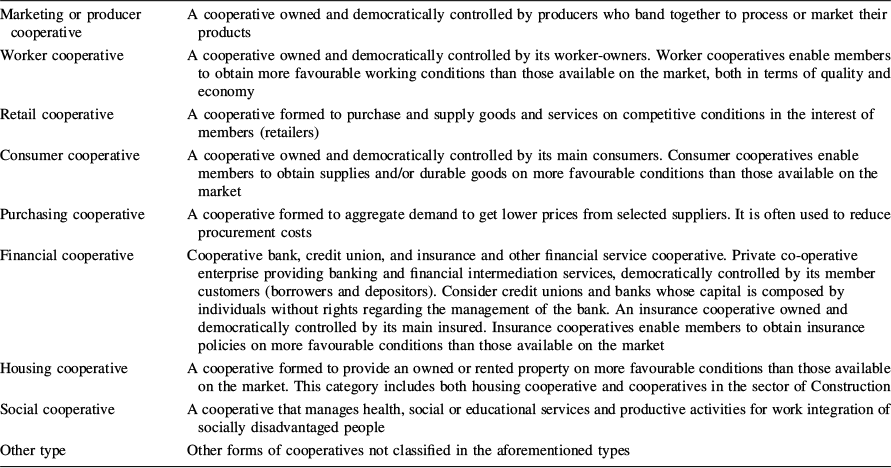
The CE has to be economically efficient to fulfil the needs of members as efficiently as possible (Skurnik Reference Skurnik2002; Toms Reference Toms2012). Otherwise, if a CE starts sliding into inefficiency, its members will lose the incentive to belong to a CE. A worker CE is an example of how ownership and governance structure play a role in balancing the tensions between economic and social aims to achieve success. A comparative case study of two large retailers in Europe, namely the Eroski group in Spain and the John Lewis Partnership in the UK, shows that it is possible be efficient and deliver excellent performance, even while facing economic and market challenges (Storey et al. Reference Storey, Basterretxea and Salaman2014). Table 3 summarize various types of CE by ownership and business activity.
Typology of the cooperative enterprise by ownership and business activity

Marketing or producer cooperative |
A cooperative owned and democratically controlled by producers who band together to process or market their products |
Worker cooperative |
A cooperative owned and democratically controlled by its worker-owners. Worker cooperatives enable members to obtain more favourable working conditions than those available on the market, both in terms of quality and economy |
Retail cooperative |
A cooperative formed to purchase and supply goods and services on competitive conditions in the interest of members (retailers) |
Consumer cooperative |
A cooperative owned and democratically controlled by its main consumers. Consumer cooperatives enable members to obtain supplies and/or durable goods on more favourable conditions than those available on the market |
Purchasing cooperative |
A cooperative formed to aggregate demand to get lower prices from selected suppliers. It is often used to reduce procurement costs |
Financial cooperative |
Cooperative bank, credit union, and insurance and other financial service cooperative. Private co-operative enterprise providing banking and financial intermediation services, democratically controlled by its member customers (borrowers and depositors). Consider credit unions and banks whose capital is composed by individuals without rights regarding the management of the bank. An insurance cooperative owned and democratically controlled by its main insured. Insurance cooperatives enable members to obtain insurance policies on more favourable conditions than those available on the market |
Housing cooperative |
A cooperative formed to provide an owned or rented property on more favourable conditions than those available on the market. This category includes both housing cooperative and cooperatives in the sector of Construction |
Social cooperative |
A cooperative that manages health, social or educational services and productive activities for work integration of socially disadvantaged people |
Other type |
Other forms of cooperatives not classified in the aforementioned types |
NB: Many cooperatives are multi-functional; Table based on (Zeuli and Cropp Reference Zeuli and Cropp2004) and World Co-operative Monitor (WCM 2019)
Cooperative Enterprise Efficiency and Performance
It is not possible to explain the present success of CE without analysing their advantages over their competitors. Therefore, market competitors have to be assessed (Fridell Reference Fridell2009). For that reason, scholars usually compare CE to corporations or IOFs, as to identify the differences between the economic behaviour of the different organizational forms, and thus to obtain a benchmark for measuring the CE against the IOF.
The debate about efficiency and performance in CE remains undecided. Although in the past the CE was considered less economically efficient than comparable IOFs, Bonin et al. (Reference Bonin, Jones and Putterman1993) presented evidence that theoretical and empirical studies about efficiency, productivity and survival of producer cooperatives are ambiguous. This argument was discussed by Sexton and Iskow (Reference Sexton and Iskow1993) from a theoretical standpoint, to show that CE could be as efficient as IOFs.
Nowadays, based on empirical studies into efficiency, there is no evidence to support the claim that IOFs are more efficient than CE. Market power and competition have pushed the CE to achieve greater technical efficiency (Maietta and Sena Reference Maietta and Sena2008). In fact, some empirical studies show that CE can obtain not only similar, but even higher efficiencies than IOFs (Terreros and Gorriz Reference Terreros and Gorriz2011), while they are always striving to become a cost-efficient player in their own business (Alavosius et al. Reference Alavosius, Getting, Dagen, Newsome and Hopkins2009; Suzuki Reference Suzuki2009). Further, studies that try to establish whether or not a CE size matters in affecting the performance and efficiency of the CE, have ambiguous and often even contradictory results. In fact, studies do not show a clear relation between organizational size and performance (Campos-Climent and Sanchis-Palacio Reference Campos-Climent and Sanchis-Palacio2015). Soboh et al. (Reference Soboh, Lansink, Giesen and van Dijk2009) present a theoretical and empirical review of the economic literature on performance in agricultural marketing cooperatives. Their review looked at theoretical approaches and empirical studies from economic and financial perspectives. The study shows three distinct views of the CE, as a vertical integration firm, an independent firm, and a coalition of firms. Despite theoretical and empirical studies recognizing the differences between IOFs and CE, empirical studies find the CE to be the same as an IOF. Further, the data used to analyse cooperative efficiency and performance is generally in the form of financial ratios (Othman et al. Reference Othman, Mansor and Kari2014).
Soboh et al. (Reference Soboh, Lansink, Giesen and van Dijk2009) point out that for the CE, a pure financial focus does not provide due consideration of the member perspective of the CE being a firm with a dual purpose and multiple objectives. However, to assess the performance of the CE using the views of a vertical integration or a coalition of firms is difficult. Soboh et al. (Reference Soboh, Lansink, Giesen and van Dijk2009) established that in order to perform a comparative study, it is necessary to collect information not only from the CE itself but additionally from both the members at the moment they join a CE and firms that decided not to join a CE. Finally, some studies tried to assess the social aspect of the CE, and therefore focussed on the aspect of created social value, which is also an important position to consider. The CE’s social component means that some consider it to be a not-for-profit organization (Costa et al. Reference Costa, Andreaus, Carini and Carpita2012).
Cooperative Enterprise Strategy and Growth
In a world dominated by corporations and IOFs, the strategy of the firm plays a key role in the road-map for companies to survive in the market (Porter Reference Porter2008). Corporations and firms follow different strategies to be competitive and efficient (Porter and Kramer Reference Porter and Kramer2006; Teece Reference Teece2010). Therefore, for CE sustainability in the long term, strategy management is important.
The CE has to face challenges such as globalization and trade liberalization in sectors such as agribusiness (Campos-Climent et al. Reference Campos-Climent, Apetrei and Chaves-Avila2012). Also, sometimes strategies have to be reshaped, even exploiting existing resources to deliver a complex service, such as assisting the elderly or the disabled (Canet-Giner et al. Reference Canet-Giner, Fernandez-Guerrero and Peris-Ortiz2010). This is even more valid in highly competitive markets with intensive capital investments, such as the US Bio-ethanol industry that was investigated by Boone and Ozcan (Reference Boone and Ozcan2016). They discuss how the CE’s strategic choice to enter this market explains their survival and endurance in comparison to IOFs.
Creating strategic alliances allows CE to achieve their goals (Fazzi Reference Fazzi2012). Koljatic and Silva (Reference Koljatic and Silva2011) reported an exploratory study in which, despite operating as CE, certain undertakings involved in traditional sectors within traditional business such as collecting solid waste (paper, cardboard, glass and plastic) or arts and crafts, can achieve improved performance by arranging strategic alliances with both public and private partners. This they do by giving them access to resources and training, and particularly by helping them to sell their products. CE use other strategies such as mergers and acquisitions similarly (Worthington Reference Worthington2004). Further, CE have incorporated internationalization (Flecha and Ngai Reference Flecha and Ngai2014; Molina Reference Molina2012), vertical integration (Boland et al. Reference Boland, Bosse and Brester2007), diversification and R&D as strategies in their growth models (Julia-Igual et al. Reference Julia-Igual, Melia-Marti and Garcia-Martinez2012).
One example of strategy implementation in a CE is the case of an Italian retailing cooperative. Battaglia et al. (Reference Battaglia, Bianchi, Frey and Passetti2015) investigated how a cooperative implemented sustainability accounting in response to a variety of market pressures and tensions. The results of this strategy reinforced the CE’s level of mutuality and increased the social and economic value added.
Further, survival and growth of the CE also depend on how the CE is willing to handle its specific context. Referring to handling the context, we have not only internal factors in mind, but also external factors that affect the performance and growth of CE. For instance, Ekberg (Reference Ekberg2012) shows the case of Western European consumer CE, and how these CE responded to different revolutions in the food retailing market, i.e. to the supermarket revolution, the chain store revolution and the consumer revolution. In addition, effects of constrained supply and price contracts are also reported (Hovelaque et al. Reference Hovelaque, Duvaleix-Treguer and Cordier2009). Also, Gagliardi (Reference Gagliardi2009) published an empirical study about the relation between local banking institutions’ development and that of cooperative firms which suggests that both the CE and the IOF tend to grow with local banks’ support. However, the CE tended to grow less than the IOF; therefore, one key external factor of firm growth was shown to be local banking institutions’ development.
Cooperative Enterprise as Social Enterprise and Hybrid
Over the past decade, there has been increasing scholarly attention to organizations that combine business and social purpose (Bacq and Janssen Reference Bacq and Janssen2011; Doherty et al. Reference Doherty, Haugh and Lyon2014; Laville and Nyssens Reference Laville, Nyssens, Borzaga and Defourny2001). In various fields this type of organization is labelled as a social enterprise (SE) (Laville and Nyssens Reference Laville, Nyssens, Borzaga and Defourny2001; OECD 1999). What is key to remember for CE is that both the combination of business and social purpose is important, but also the entrepreneurial opportunities that CE will need to pursue. Additional key factors that characterize the CE are social and environmental sustainability (Hart and Milstein Reference Hart and Milstein2003), corporate social responsibility (Battaglia et al. Reference Battaglia, Bianchi, Frey and Passetti2015), and ethical and social responsibility.
SE are highly diverse, taking various legal forms in different countries (OECD 1999). As an organizational form, the SE is often described as a hybrid (Peredo and McLean Reference Peredo and McLean2006). The hybrids combine for-profit with non-profit organizational features (Puusa et al. Reference Puusa, Hokkila and Varis2016), thereby pursuing a double bottom line (Bacq and Janssen Reference Bacq and Janssen2011) with both economic and social goals (Battilana and Dorado Reference Battilana and Dorado2010; Battilana et al. Reference Battilana, Lee, Walker and Dorsey2012). Therefore, organizations such as cooperatives, mutual benefit societies and associations were included in the SE category (Laville and Nyssens Reference Laville, Nyssens, Borzaga and Defourny2001). The boundaries of such SEs are rather fuzzy, and therefore not easy to determine (Mueller et al. Reference Mueller, D’Intino, Walske, Ehrenhard, Newbert, Robinson and Senjem2015), even more so if it is a CE, The CE as an organizational form exists in continuous conflict between goals and values, as a hybrid (Ashforth and Reingen Reference Ashforth and Reingen2014). Moreover, the CE regularly exceeds boundaries within the institutional context, also overlapping with traditional categories of organizational forms such as private, public and non-profit organizations (Brandsen and Karré Reference Brandsen and Karré2011). Hence, the complexity in which the CE is embedded makes it hard to categorize. Still, CE is considered as an SE and a hybrid that generates both economic and social benefits (Battilana and Lee Reference Battilana and Lee2014; Mazzarol et al. Reference Mazzarol, Simmons, Limnios, Mazzarol, Reboud, Limnios and Clark2014b).
Cooperatives and Social Entrepreneurship
Specifically, insights for CEs can be drawn from the social entrepreneurship literature. Even with various schools of thought on social entrepreneurship (Bacq and Janssen Reference Bacq and Janssen2011), the CE shares some characteristics with social entrepreneurship (Chell Reference Chell2007). Both the social element and an entrepreneurial element are present (Lan et al. Reference Lan, Zhu, Ness, Xing and Schneider2014; Mair and Marti Reference Mair and Marti2006). The first common feature is setting their main mission as one linked to a social goal. Secondly, both business forms entail processes of identifying, evaluating and exploiting social opportunities (Bacq and Janssen Reference Bacq and Janssen2011), and finally, they both create new social ventures (Zahra et al. Reference Zahra, Rawhouser, Bhawe, Neubaum and Hayton2008). Articulating this, Diaz-Foncea and Marcuello (Reference Diaz-Foncea and Marcuello2013, p. 245) propose a complete definition of cooperative entrepreneurship as “a group who manage the venture creation process, take risk and make judgmental decisions to create a business in a participatory way with the objective of obtaining mutual benefit to be distributed with equity among them”.
A social entrepreneur’s main goal is to create social value for overcoming social problems and market failures. This pre-condition is also present in the CE process. For instance, a study conducted in a rural cooperative development in China suggests that social entrepreneurship in rural cooperative development has multiple characteristics which include the institutional setting, contextual factors, historical path and personal experiences (Lan et al. Reference Lan, Zhu, Ness, Xing and Schneider2014). However, although the social goals are important to CE and SE alike, we also need to underscore the wealth of opportunities created by following an entrepreneurial approach (Gawell Reference Gawell2013a). Entrepreneurs can choose the legal form and organizational model of their new ventures from several options of for-profit and non-profit organizations, of which one is the CE (Diaz-Foncea and Marcuello Reference Diaz-Foncea and Marcuello2015). In this regard, the CE offers people opportunities for creating new ventures—albeit that necessity driven entrepreneurship should not be ignored (Gawell Reference Gawell2013a). The case of women’s cooperatives in India illustrates a significant contribution to wealth creation (Datta and Gailey Reference Datta and Gailey2012) and women’s empowerment (Lecoutere Reference Lecoutere2017). Self-employment also offers opportunities that contribute to social inclusion. Additionally, scholars put forward other reasons that explain why the CE firm formation is an attractive option. For instance, in the case for cooperatives with the American Capitalist system anti-corporate movements (Schneiberg Reference Schneiberg2013), social movements (Schneiberg et al. Reference Schneiberg, King and Smith2008), collective actions (Baranchenko and Oglethorpe Reference Baranchenko and Oglethorpe2012) and institutional considerations provide such reasons (Boone and Ozcan Reference Boone and Ozcan2013).
Reducing unemployment remains as one of the biggest challenges for governments worldwide. Various studies have shown the role that CE can play in reducing unemployment (Diaz-Foncea and Marcuello Reference Diaz-Foncea and Marcuello2015; Kalmi Reference Kalmi2013). In addition, Diaz-Foncea and Marcuello (Reference Diaz-Foncea and Marcuello2015) shows the patterns of firm formation in Spain. One of the findings of their study is that worker cooperatives are more disconnected from the economic dynamic than IOFs. That indicates the prevailing level of unemployment to be the main determinant in workers’ cooperative formation. Further, the formation rate of cooperatives is higher in areas characterized by high unemployment.
Therefore, both society and public institutions recognize that firm formation as a part of the entrepreneurial process is a driving force for economic development. This is illustrated by a case in Papua New Guinea in which the government and public institutions revitalized CE by implementing a reformed cooperative policy for economic growth, and thus showing that the CE is a suitable vehicle for economic and social development (Garnevska et al. Reference Garnevska, Joseph and Kingi2014). Hence, the role governments play in setting the institutional context to foster CE as essential tools in combatting poverty, helps in economic development and social entrepreneurship (Cox and Le Reference Cox and Le2014; Vuotto Reference Vuotto2012).
Finally, the role that universities play in entrepreneurship, technological entrepreneurship and innovation systems is widely known (Van Looy Reference Van Looy2009; Wells Reference Wells2012), However, we do not yet know much about the contribution of supporting firm formation process in other types of organization such as CE. Here, the case of technological incubators of popular cooperatives in Brazil (Leca et al. Reference Leca, Gond and Cruz2014), this study provides a starting point for understanding the new paths for universities can take, with new roles to play in entrepreneurship, especially in worker cooperatives. This case shows how the University of Rio de Janeiro’s initiative is a reaction to the country’s growing unemployment.
Comparison to Social Issues literature
The ‘social issues’ field primarily focusses on the alleviation of human and social problems. However, over the past five years interest in SE, including the CE is booming in the social issues’ literature, e.g. (Defourny et al. Reference Defourny, Nyssens and Brolis2020) and is perceived as an effective means to alleviate human or social problems. Interestingly, in our systematic review, a disconnect seems to exist between the mainstream organizational literature in economics, business, management and sociology, and the social issues literature. Therefore, we provide a brief overview of the main themes discussed in three of the leading social issues journals with respect to CE and SE as a means to cross-fertilize organizational and social issues literature (Valentinov and Iliopoulos Reference Valentinov and Iliopoulos2013).
We searched the Web of Science ‘social issues’ category for papers on cooperatives. The fast majority of papers was published in three journals: Voluntas (18), Nonprofit and Voluntary Sector Quarterly (11), and the Journal of Social Issues (2)—arguably the three leading social issues journals. After scanning abstracts in these three journals, 31 papers remained that dealt with cooperatives. Three key themes emerge from these 31 papers: national historical development, demarcation of the concept, and focus on social impact.
First of all, the literature mainly focusses on the (historical) development of cooperatives, often in a specific sector, in one country. Studied countries are Canada, Bolivia, Germany, Italy, Nicaragua, Portugal, Spain, Scotland, South Korea, Sweden, Ukraine and the USA. Sectors studied are for example (rental) housing, finance (credit unions, microfinance institutions, banking), agriculture, child day care, and education. Second, more recently, social issues scholars have attempted to develop typologies with respect to the broader concept of SE, including CE (Bidet et al. Reference Bidet, Eum and Ryu2018; Defourny et al. Reference Defourny, Nyssens and Brolis2020), with special attention to the hybrid balance between social and market identity, e.g. (Avila and Amorim Reference Avila and Amorim2020). In this way, social issues scholars aim to abstract from findings on SE in various countries and synthesize existing knowledge. Third, the explicit attention to emancipatory issues is striking in contrast with the organizational literature. For example, indigenous and colonial heritage (Ferguson Reference Ferguson2018), solidarity economy (Bell, Leopold, Berry, and Hall Reference Bell, Leopold, Berry and Hall2018), immigrant employment (Sala-Rios et al. Reference Sala-Rios, Farre-Perdiguer and Torres-Sole2017), women participation (Bezboruah and Pillai Reference Bezboruah and Pillai2015). Attention to specific organizational aspects is rather limited: starting a social venture (Edenfield and Andersson Reference Edenfield and Andersson2018), regeneration during crisis (Narvaiza et al. Reference Narvaiza, Aragon-Amonarriz, Iturrioz-Landart, Bayle-Cordier and Stervinou2017), governance (Hatak et al. Reference Hatak, Lang and Roessl2016), and strategizing (Jager and Beyes Reference Jager and Beyes2010). Considering the different foci, while having similar debates on hybridity, there seems to be much opportunity for cross-fertilization of both streams of knowledge.
Conclusions and Avenues for Future Research
The global financial crisis that started in 2007 revealed structural economic market problems. The serious difficulties private and public sectors experienced, boosted the research interest in alternative organizational forms that could provide innovative solutions to the market and society at large (Gawell Reference Gawell2013b). However, organizations with a not-for-profit and social orientation—such as volunteer organizations and associations—suffer from limited resources to support their daily activity as these organizational forms (partly) depend on donations, sponsorships, grants and/or philanthropy. Therefore, over the past decade management scholars have turned their attention to alternative organizational forms, such as CE and SE which try to address the global challenges and blend social and economic value (Battilana and Dorado Reference Battilana and Dorado2010; Battilana and Lee Reference Battilana and Lee2014; Doherty et al. Reference Doherty, Haugh and Lyon2014), improving the living and working conditions of people globally.
The cooperative movement has a key role in social and economic development ever since the Rochdale Society in the nineteenth century (Wilson et al. Reference Wilson, Shaw and Lonergan2012) which developed into the modern co-operative movement in the twentieth century (Wilson et al. Reference Wilson, Webster and Vorberg-Rugh2013). Although, CE is not a new phenomenon, it is worthy to be rediscovered in the organizational literature. Some studies have demonstrated how the CE is often overseen, particularly in textbooks (Hill Reference Hill2000; Kalmi Reference Kalmi2007). Therefore, we investigated and disclosed a range of possible reasons for such limited attention to the CE. This paper also discussed some of the underlying reasons for limited attention and how these reasons need to be reappraised at present.
We conducted the systematic literature review to identify the current knowledge and research about CE in the mainstream organizational literature: drawn from the economics, business, management and sociology fields. This review allowed us to categorize relevant studies and provide an overview of main themes according to our concept-based approach. Further, this study provides a range of concepts and topics that scholars have studied. Our comparison between the CE and IOF as competitors within the economic market is a way of assessing them and establishing a benchmark (Fridell Reference Fridell2009). However, it is always an incomplete assessment, due also to scholars generally missing the social component of the CE, and focusing their efforts on financial and productivity ratios (Costa et al. Reference Costa, Andreaus, Carini and Carpita2012; Soboh et al. Reference Soboh, Lansink, Giesen and van Dijk2009). Nonetheless, the CE faces other tensions, conflicts and dualities as well (Ashforth and Reingen Reference Ashforth and Reingen2014), the CE has shown remarkable stability and resilience in dealing with crises (Birchall Reference Birchall2013), therefore we propose that the CE as an organizational form should both be seen as an appropriate organizational form for a wide range of contexts and a type of Social Enterprise that can very well combine social and economic value. Various reasons for the limited attention to CE were debunked, including its inefficiency, while the many options for ownership and governance structures where presented. Still, there are many opportunities for future research on CE, of which the main avenues are discussed below.
First of all, studies that involve research in different or single levels of analysis are widely known in organizational literature, looking at, e.g. individuals, groups\teams, organizations, industry, country or geographic region. Nevertheless, the majority of the scholarly work listed in our review belong to a macro level of analysis such as organization, country and industry. However, studies that analyse CE in other levels of analysis such as that of the individual, team or group, and at the inter-organizational level of analysis, remain scarce. Hence, research that will develop a better understanding of CE using multilevel analysis, is a still worthy endeavour (Hitt et al. Reference Hitt, Beamish, Jackson and Mathieu2007).
Second, studies that examine how the social component of the CE can be assessed are scarce. That in itself is a challenge, and more so if researchers want insight into both social and economic components in order to obtain a full picture of CE’s nature. As we mentioned, CE have a broad social mission beyond their economic role (Kalmi Reference Kalmi2007). All types of CE attend to improving capabilities of its members, promoting social stability and trust, building up social capital among members, community and stakeholders (Hatak et al. Reference Hatak, Lang and Roessl2016). Additionally, there is evidence that CE perform better than IOF when for example organizational misconduct is considered (Ehrenhard and Fiorito Reference Ehrenhard and Fiorito2018). Thereby, some research questions related to the process of sounding out the complete nature of a CE arise, asking, e.g. how CE engage in both communities and society for local development, what governance mechanisms are used to balance the social as well as economic impact, in which context is the economic performance of CE comparable or superior to IOF, and what role is the CE form playing in contemporary societies across the globe?
Third, in recent years new challenges have emerged for sustainable development and CE as well. Such challenges relate to issues such as climate change, the use and exploitation of natural resources, the digital work force, (gender) inequality, sustainable development, and grand societal challenges (George et al. Reference George, Howard-Grenville, Joshi and Tihanyi2016). Some of these issues have received much more attention in the social issues’ literature. Research questions deserving of scholarly attention in this area refer to how these challenges affect CE and how CE can or should respond to them. Such challenges bring new avenues to be studied in the quest for fitting organizational structures, corporate governance regimes, and necessary organizational changes. As a consequence, the question rises what types of strategies CE need to follow in addressing these challenges. Thus, knowledge of CE’s management practices can be much improved.
Fourth, nowadays a key factor in giving firms a competitive advantage is entrepreneurial opportunity generation especially in relation to innovation (Gawell Reference Gawell2013b). Recent research has shown that innovation does not happen in isolation, but that it occurs within a collaborative context. However, studies that link innovation to CE in intra and inter-organizational context have not yet received much attention. Research questions to be answered in this regard, include considering how the journey of new product development is structured in a CE, whether or not CE are involved in R&D activities, how CE reacts to developing or implementing new technologies, what type of technologies enhance CE performance, and more recently trends such as artificial intelligence and smart industry. In addition, it is well-known that cooperation and collaboration between companies as partners (Barringer and Harrison Reference Barringer and Harrison2000; Strand and Freeman Reference Strand and Freeman2015) and in alliances (Fornell et al. Reference Fornell, Lorange and Roos1990), hold advantages for companies that work in an inter-organizational relationship, improving performance and developing competitive advantage (Fazzi Reference Fazzi2012). Also, the early process of cooperative formation is not much studied and would benefit from the work on community self-organizing, e.g. the study by Edelenbos et al. (Reference Edelenbos, van Meerkerk and Schenk2018). One way to achieve competitive advantage is through vertical integration, scaling up their efforts and managing resources efficiently through a CE (Hendrikse and Feng Reference Hendrikse, Feng and Grandori2013), besides gain access to resources, information and inputs (Morfi et al. Reference Morfi, Nilsson and Osterberg2018). Therefore, considering that from the members’ perspective a CE has a dependent nature, encourages us to explore the research questions about how CE and members work together as a network. Likewise, based on the 6th principle of cooperatives “Co-operation among Cooperatives” (ICA 2020b), we should also consider the network between cooperatives, (Menzani and Zamagni Reference Menzani and Zamagni2010).
Limitations
We recognize that our study has various limitations. Firstly, we were challenged with having to find a good search string, since the word cooperative, or co-operative, is widely used as a concept with various meanings in different fields, but at the same time is used to identify CE as an organizational form. Secondly, we could not provide an exhaustive account of everything written about CE, because there is extensive literature on such entities in other related fields and our focus was mainly to synthesize the knowledge in the mainstream organizational literature and provide future research avenues. We examined the literature to obtain a state-of-the-art account of the CE in the organizational literature. Thirdly, although the review protocol uses a recognized database such as the Web of Science, despite our back- and forward search, we could have omitted other relevant research published before our protocol time-line, as well as research recorded in other databases. Finally, we provide evidence, maintain objectivity and independence regarding the current body of knowledge (Pawson Reference Pawson2013).


 Open access

