


1. Introduction
The high-power microwave (HPM) has an important application in the military field. Therefore, the majority of countries have invested heavily in the relevant research of HPM for a long time [Reference Rostov, El’chaninov and Klimov1, Reference Min, Kwon and Sattorov2]. In a broader sense, the HPM pulse is just a special form of various microwave signals used by human in daily life. Therefore, when a new class of HPM signal is generated, it means that this new type of HPM signal will have a potential broad application in the civil field. The HPM signal with ultrahigh repetition frequency characteristic studied in this paper has this property.
There are three methods for human to generate HPM signals. The first method is to use the microwave semiconductor solid-state devices for generating microwave signal [Reference Maslennikov and Serebryakova3]. The advantage of this method is used to generate continuous wave less than 1 kW. If this method is used to generate pulse wave, the peak power of the pulse will not be higher than that of continuous wave. The second method is to adopt the electronic vacuum devices [Reference Zhang, Jin and Yang4–Reference Sayapin, Levin, Dai and Krasik6]. The electronic vacuum devices can be divided into the magnetron tubes, klystron, traveling wave tube, and so on. The different electronic vacuum devices have their own characteristic to generate microwave signal. The maximum peak power generated by using electronic vacuum devices can reach to tens of MW level for the pulse wave and 10 kW level for the continuous wave. However, it is impossible to produce the pulse wave with the width of nanosecond level and the power of MW level by using these electronic vacuum devices. The third one to produce the HPM signal is adopting the vacuum relativistic devices [Reference Huo, Chen and Sun7–Reference Korovin, Mesyats, Pegel, Polevin and Tarakanov9], which is the main way to generate the HPM pulse with the width of nanosecond level and power of GW level. However, the repetition frequency of the pulse generated by using vacuum relativistic devices is difficult to reach kHz level. Moreover, huge volume and weight are also needed due to the requirement of high voltage and high current. Therefore, if there is a simple and cheap method to generate the HPM pulse with the width of ns level, repetition frequency of MHz level, and peak power of 100 kW-MW level, it will be a new breakthrough in the form of microwave signal generation.
In fact, one type of ultrahigh repetition frequency pulse signal without center carrier frequency can be generated in the field of HPM technology [Reference Valizade, Rezaei and Orouji10]. This type of pulse is usually produced by using the fast discharge characteristics of avalanche semiconductor. The repetition frequency of such pulse signal is generally in the range from tens of kHz to hundreds of kHz. Also, the peak power of hundreds of kW can also be reached. However, the instantaneous bandwidth of this pulse is mainly determined by its rising edge and falling edge. Therefore, the instantaneous bandwidth of this pulse without center carrier frequency is usually not exceeding 2 GHz. The majority of the energy is collected in the range from DC to a few MHz. Thus, this type of pulse is difficult to be radiated by using an antenna. Though this pulse plays a good role in the short-distance application in the field of electronic countermeasures, its application is still limited.
Generally speaking, the pulse compression technology is an effective technology for generating the HPM pulse [Reference Rajput, Parmar, Bhat, Maheswari and Choyal11, Reference Zhang, Mishakin and He12]. By using the pulse compression technology, a long pulse with the length of μs level can be compressed to a short pulse with the length of nanosecond level. And then, a higher peak power can be achieved. The current pulse compression technologies applied in the field of HPM are mainly the switched energy storage (SES) technology and the SLAC energy double (SLED) technology [Reference Vikharev, Gorbachev and Ivanov13, Reference Rhee, Cho, Kim and Ko14]. The basic principle of the above pulse compression technology is that a long pulse is injected to a cavity and stored. And then, a switch is used to make the cavity mismatch and a narrow pulse is obtained. The narrow pulse is usually associated with the sizes of cavity. In the process of compression, the peak power of the generated pulse can be greatly improved by using a big cavity. However, limited by the speed and loss of switch [Reference Zucker15], the above pulse compression method is difficult to adopt for obtaining ultrahigh repetition frequency. The repetition frequency is usually in the level of several hundred Hz.
In this paper, a novel pulse compression method based on the path encoding technology is proposed for obtaining HPM pulse with ultrahigh repetition frequency. This method can be understood that a long pulse is divided into a number of narrow pulses. The first feeding narrow pulse propagates slowly or a longer path, and the later injected narrow pulse propagates faster or a shorter path. Then, the different narrow pulses will overlap each other at the end of the transmission path. Pulse compression is realized, and the peak power is simultaneity increased. Then, a narrow HPM pulse with higher power is achieved. For the generated HPM pulse, except the characteristics of ultrahigh repetition frequency, high peak power, and wide instantaneous bandwidth, the remarkable characteristic of the pulse studied in this paper is that this pulse has a center carrier frequency. Thus, good antenna radiation ability can be obtained. In addition, the carrier frequency of the pulse studied in this paper can be arbitrarily selected in the range from 100 MHz to tens of GHz. It is an enormous advantage for the HPM produced system. Therefore, it can be said that this kind of pulse signal is a new type of HPM signal and never been effectively generated by human beings before.
2. Path Encoding Pulse Compression
2.1. Mechanism of Path Encoding Pulse Compression
The principle of the path encoding pulse compression is encoding the electromagnetic wave in the different period times of a long pulse. When a long pulse is divided into a number of narrow pulses, by changing the group velocity or path by encoding the frequency, phase, and amplitude, these narrow pulses in the different period times will overlap each other at the end of the transmission path. Then, the long pulse will be compressed in time field and a narrow pulse is obtained with a higher peak power.
There are three ways to realize pulse compression without using high-power switch. The first one is the velocity modulation. It means that the pulse compression is realized by changing the velocity of electromagnetic wave. When the velocity of first feeding electromagnetic wave is reduced and the velocity of final feeding electromagnetic wave is increased, the different parts of electromagnetic wave will overlap each other at the end of the transmission path. Then, the long pulse signal will be compressed in time field, and a shorter pulse with higher peak power is obtained. The second way is the multipath modulation. It means that the different parts of electromagnetic wave will propagate from different paths. When the different parts of long pulse propagating from the different paths arrive to the output at the same time, the long pulse will be compressed to a short pulse in time field. The third way is changing the velocity and the propagation paths of electromagnetic wave at the same time. The third way is the mixed usage of the first way and the second way. The path encoding pulse compression technology is the third way for realizing pulse compression. By encoding the frequency, phase, and amplitude of the different parts of long pulse, the different parts of long pulse propagating from different paths will overlap at the output. Then, the long pulse will be compressed in time field and a narrow pulse with higher peak power is obtained.
For the single path, the pulse compression can only be realized by using velocity modulation. If a section of coaxial line is well matched, it is impossible to realize pulse compression because the group velocity of electromagnetic wave is unique. If the port of the coaxial line is mismatched, the electromagnetic wave can be exported from the two ports of coaxial line with vibrating waveform under the condition of unique speed and single path. Though the pulse compression can be realized by changing the propagation path of the exported electromagnetic wave, the compression gain cannot be obtained because the maximum compression gain equals to 1 in theory.
If we want to obtain compression gain, the velocity modulation must be induced under the condition of single path. The rectangular waveguide is a typical dispersive system. It is a good choice for modulating the velocity of propagation electromagnetic wave to realize pulse compression. The velocity modulation is the external phenomenon. In fact, the parameters, which are needed to be modulated, are the frequency and phase of the electromagnetic wave in different periods of long pulse. Thus, the compression gain can be realized by encoding the frequency and phase of pulse wave propagates in the matched rectangular waveguide.
The principle and implementation process of the path encoding pulse compression for a matched rectangular waveguide are shown in Figure 1. The long pulse with the width of Nt 0 is hoped to be compressed as a narrow pulse with the width of t 0. First of all, the long pulse is divided into N-part short pulses in time field. Then, the short pulses are set to different frequencies and the different group velocities are obtained due to the dispersion characteristic of rectangular waveguide. Here, the group velocities for the different short pulses are named as Vg 1, Vg 2, …, Vgn. Assume that the length of rectangular waveguide is L and the propagation time for the first subpulse passing the rectangular waveguide is T 0, i.e., T 0 = L/Vg 1. Then, encoding the subpulses from the second to N th and making their propagation time to satisfy the condition of T 0 − t 0, T 0 − 2t 0, …, T 0 − (n − 1)t 0, the short pulses will overlap after passing the rectangular waveguide. Thus, N-times pulse compression will be realized for the long pulse in theory.
The principle of path encoding pulse compression for a section of matched rectangular waveguide (single path).

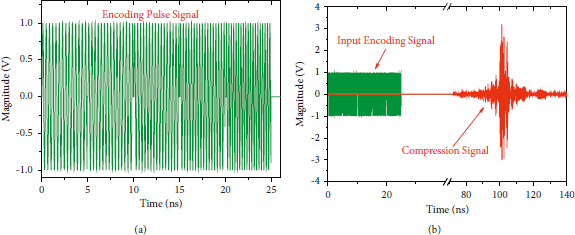
To demonstrate the effectiveness of velocity modulation for realizing pulse compression, a numerical simulation is carried out. A BJ32 rectangular waveguide with the length of L = 20 m is used. The input pulse with a length of 25 ns is hoped to be compressed to 5 ns. The implementation process is shown as the following steps. First of all, the input pulse is divided into 5 subpulses. Then, the group velocities of the subpulses are modulated to satisfy the condition shown in Figure 1.
The velocity modulation is realized by changing the carrier frequency of each subpulse. As shown in Figure 2(a), each short subpulse is set to 5 ns and the total length of the input signal is 25 ns. The carrier frequencies of the subpulses are set to 2.8 GHz, 2.9325 GHz, 3.1146 GHz, 3.3812 GHz, and 3.8119 GHz, respectively. When the encoding pulse signal shown in Figure 2(a) is fed into the rectangular waveguide, the compressed waveform is obtained as shown in Figure 2(b). According to the compressed waveform shown in Figure 2(b), it can be seen that the long pulse with 25 ns is successfully compressed to 5 ns. The peak power is improved by 9 times compared with the input signal. This is because the subpulses with different frequencies are overlapped at the output port by adopting the velocity modulation. Because of the typical beat wave effect, the compressed waveform is a nonideal rectangular pulse wave.
The simulated pulse compression result of velocity modulation for the matched rectangular waveguide. (a) The encoding pulse input signal with the length of 25 ns. (b) The compression signal with the width of 5 ns.
According to the simulated result shown in Figure 2(b), the pulse compression can be realized by encoding the frequencies of subpulses for a single path. However, the cost of this method is obviously high. This is because the only way to realize pulse compression for a single path is modulating the group velocity of electromagnetic wave. A very long length is needed. In addition, a wide bandwidth is also needed. If the bandwidth of input pulse signal needs to be decreased, the length of waveguide needs to be lengthened. Then, a longer rectangular waveguide should be adopted. Therefore, the method by encoding the frequency of single path has a big difficulty in the practical application.
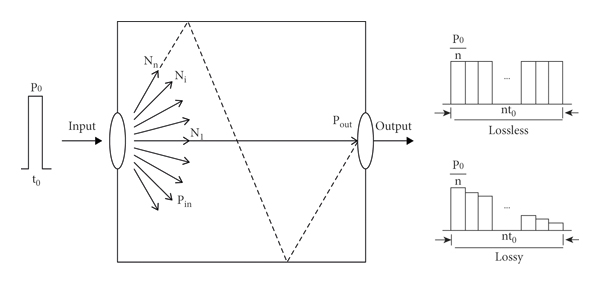
In order to reduce the size, a multipath transmission environment is adopted. For the multipath environment, pulse compression can be realized by adopting the path modulation method. The effective method to realize path modulation is to utilize the multipath effect of a big cavity [Reference Artemenko, Igumnov and Yushkov16]. Thus, a big cavity is adopted to realize path modulation. The principle of path encoding pulse compression for big cavity is shown in Figure 3. For the sake of simplification, the assuming condition is given as follows: (1) the cavity is lossless; (2) the input and output ports are N-element antennas with omnidirectional radiation characteristic and equal amplitudes; (3) the times for the short pulses passing the transmission paths from the first to N th satisfy the condition of T 1, T 1 + t 1 …, T 1 + (n − 1)t 1, where T 1 is time for a short pulse passing the first path and t 1 is the delay time between the adjacent paths. According to the above assumption, a long pulse with the width of Nt 1 will be obtained at the output when a short pulse with the width of t 1 is fed into the input of cavity. And then, the maximum power of output long pulse is reduced to 1/N of the power of input short pulse. In fact, the cavity is lossy. Also, the energy of input short pulse is almost impossible to be equally distributed in the separate paths. The amplitude of the output long pulse is uniform. By using the simulation software of CST, the output long pulse waveform is obtained as shown in Figure 4(a) when a narrow pulse with the width of t 1 is fed into a big cavity. It can be seen that the amplitude of output pulse is gradually attenuated [Reference Hong, Lathrop, Mendez and Kim17].
The principle of encoding pulse compression by using a big cavity (multipath).
The simulated results by utilizing the multipath effect of big cavity. (a) The output pulse when a short pulse is fed into the big cavity. (b) Time-reversal long pulse by reversing the time sequence of output pulse of big cavity. (c) The output compression signal when time-reversal long pulse is fed into the big cavity.
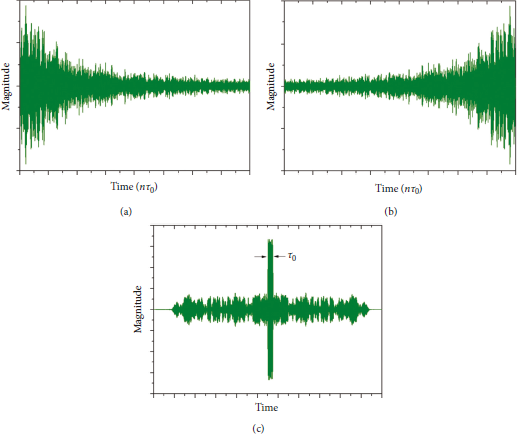
Assuming that the length of the obtained long pulse shown in Figure 4(a) is Nt 0 and reversing its sequence, a new long pulse is obtained as shown in Figure 4(b). Feeding the new long pulse into the big cavity, a narrow pulse is obtained at the output port as shown in Figure 4(c). It can be seen that the width of the output pulse is compressed to t 0 in time and the peak power will be improved greatly compared with the long pulse shown in Figure 4(b). The aim of pulse compression is achieved, and the power can be improved by utilizing the multipath effect of big cavity without microwave switch. Therefore, in the next section, the path encoding pulse compression is mainly realized by using a big cavity.
In the above simulation, a full-blown technology of time-reverse is adopted for realizing pulse compression [Reference Xiao, Antonsen, Ott and Anlage18, Reference Carminati, Pierrat, Rosny and Fink19]. However, the time-reverse technology is not the necessary condition for compressing a long pulse to a narrow pulse. The essentiality of the time-reverse technology is a method to realize pulse encoding. In fact, the time-reverse technology is not the only way to realize pulse encoding. In theory, for the given multipath cavity, the hoped narrow pulse can be realized when the multipath transmission characteristic is obtained and encoded appropriately. Up to now, the high-speed sample method has proved to be a high-precision pulse compression method for the given cavity. However, the restriction of the high-speed sample method is obvious. This method is difficult to guide the optimize design of cavity for further obtaining high compression gain. Thus, the research of new highly effective encoding method is still an important aspect in the future work.
2.2. Realization of Path Encoding Pulse Compression
As mentioned in Section 2.1, according to the reciprocity principle, by feeding the encoded long pulse at the input of cavity with a completely reversal sequence in accordance with the original long pulse, a narrow pulse which is similar to the original input short signal is obtained. This means that the input long pulse has been successfully compressed in time filed. In this section, a big cavity is used to realize path encoding pulse compression. Whether the input long pulse signal can be compressed effectively is mainly determined by the loss of metal cavity. In fact, even the metal cavity is made by using the best conductor of silver, and the effective length of output long pulse is usually about 10 μs when a nanosecond narrow pulse is fed into the cavity. Generally speaking, the energy utilization efficiency of path encoding pulse compression will drop sharply after 4 μs; thus, the length of 4 μs is considered in the following chapters.
The key issue of realizing path encoding pulse compression is encoding the input long pulse signal by segments. Here, the input long pulse signal can be dispersed into points one by one. The phase information and the amplitude information of each point directly determine whether the pulse compression can be realized or not and the pulse compression efficiency.
The path code is closely associated with the actual hardware. In theory, for the given metal cavity with input/output structures, the input signal can be encoded for realizing pulse compression gain under the condition without prior knowledge. However, it is almost impossible to be realized in the practical application due to the error. At the present time, the simple and effective way to realize path encoding is adopting the hardware high-speed sampling method under the current implementation condition. The method of hardware high-speed sampling can be named as the hardware encoding method.
The implementation process of hardware encoding method is given as the following steps. First, the hardware system including the metal cavity and input/output structures is constructed. Then, a nanosecond-level rectangular pulse with center carrier frequency is produced by using a microwave signal source. The rectangular pulse is fed into the cavity at input port. Because of the multipath effect of cavity, a long pulse response signal with amplitude oscillation attenuation will be obtained at the output of cavity. Second, a high-speed digital oscilloscope is used to sample the output response signal of cavity. A fixed length of the output response signal is intercepted according to the need compression time. For example, if the 4 μs time-length pulse is needed to be compressed for getting a narrow pulse of 10 ns, we need to produce a narrow rectangular pulse with 10 ns pulse width for feeding the cavity and intercept the output long pulse response signal with 4 μs time-length at the output of cavity.
The third step is to process the captured long pulse response signal in digital field. For the captured long pulse response signal, its format is digital form. Then, the path encoding long pulse signal can be directly obtained by numerically reversing the sequence of the captured long pulse response signal. This path encoding long pulse signal is induced into an arbitrary waveform generator (AWG), and the corresponding encoding microwave long pulse is produced. When the encoding microwave long pulse is fed into the cavity, the pulse compression will be realized and a nanosecond level narrow pulse whose width equals to the original narrow pulse is achieved at the output port of cavity.
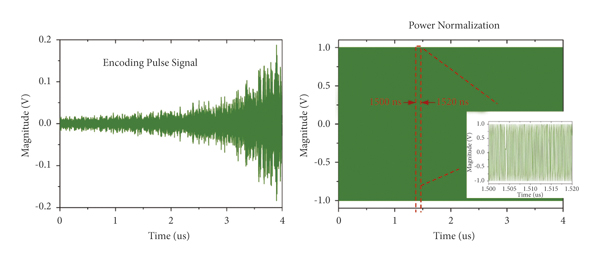
The fourth step is to remake the encoded long pulse signal. Obtaining higher compression gain is the fundamental purpose of pulse compression. In order to improve the pulse compression gain, the amplitude compensation is adopted to modify the input encoded long pulse response signal. The concrete remake process of encoded long pulse signal is shown in Figure 5. Keeping the phase information of each point, the amplitude of half signal cycle is normalized by the maximum value in this half signal cycle. By using the amplitude normalization, the power restriction caused by the metal loss of cavity can be effectively solved. Compared with the result without amplitude normalization, the compression gain of the output pulse will be improved to several orders.
The amplitude normalization of the input encoding long pulse signal.
It should be said that hardware high-speed sampling method with amplitude compensation is a concise and effective encoding method for path encoding. However, how to optimize the encoding method to improve the compression efficiency and compression gain under the condition of fixed hardware is still the topic that needs to be further studied in the future work. Because the highly effective encoding method is the fundamental guarantee for getting the higher pulse compression gain, the exploration of new path encoding method and implementation form is also the focus of the future research.
3. Obtaining the HPM Pulse with Ultrahigh Repetition Frequency
In order to obtain the HPM pulse with ultrahigh repetition frequency and demonstrate the effectiveness of path encoding pulse compression technology, the related experiment research has been carried out in this section. Because the path encoding pulse compression method is a new approach to obtain HPM pulse with ultrahigh repetition frequency and this form to produce HPM pulse has never been used before, there are not much enough technical data available in the literature. Therefore, it can be said that this kind of pulse signal is a new type of HPM signal.
3.1. The Principle of Generating HPM Pulse
In this subsection, the system configuration for obtaining HPM pulse with ultrahigh repetition frequency is introduced and shown in Figure 6 by using path encoding pulse compression technology. As shown in Figure 6, the encoding long pulse signal with power compensation is induced into the AWG and then the corresponding encoding microwave long pulse is cycle generated. A microwave long pulse train is obtained. The power amplifier is used to amplify the microwave pulse train. Because the microwave pulse train is cycle generated by using the AWG, the microwave pulse train will be shown as a continuous signal in time field. Then, the requirement and cost of power amplifier are greatly reduced. The power amplifier can be realized by adopting the conventional solid-state devices.
The principle for obtaining HPM pulse with ultrahigh repetition frequency.
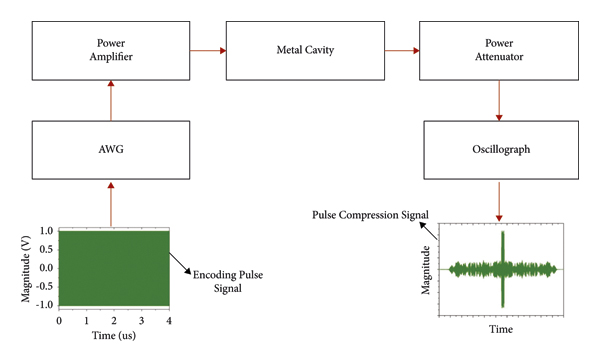
The metal cavity is used to realize pulse compression. When the encoding microwave long pulse train is fed into the cavity, a microwave narrow pulse train will be obtained and a higher power is achieved. If the length of the encoding microwave long pulse is T 1, the repetition frequency of the microwave narrow pulse train equals to f = 1/T 1. Because the length T 1 of encoding long pulse signal can be set to microsecond level, the repetition frequency of the microwave narrow pulse train can reach to hundreds of kHz, which is higher than that of HPM pulse generated by using the conventional vacuum relativistic technology. In addition, the repetition frequency can be easily changed by changing the length T 1 of the encoding microwave long pulse signal. The power attenuator is used to attenuate the power of output HPM of cavity for detecting its power by using a high-speed sampling oscilloscope.
3.2. Experimental Study
In order to verify the above system configuration for obtaining HPM with ultrahigh repetition frequency, the experiment research is carried out in this section. In the experimental study, two basic principles are followed. The first one is that the pulse paths can be separated enough. The second one is that the loss of the path is as small as possible. Based on the above two basic principles, a metal cavity made of copper is designed to carry out the pulse compression experiment.
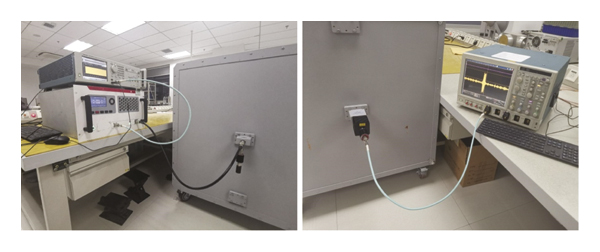
The designed metal cavity is fabricated and shown in Figure 7. Two BJ32 waveguides, which are set at the two opposite square faces of the cavity, are used as the input and output ports for radiating and receiving microwave signals. To simplify the difficulty of design, the cavity is designed as a symmetrical structure. Also, the input and output ports are set up symmetrically. Of course, if the structure is an asymmetric structure, it is also feasible for realizing pulse compression in principle. The experiment system is built according to system configuration. This metal cavity is a cuboid with the sizes of 1 m × 1 m × 2 m. In the experiment of obtaining HPM pulse, the output power of the compressed pulse is approximately hundreds of kW level. In order to avoid instrument damage, an appropriate high-power attenuator is added to the output port of cavity for keeping the pulse power in the safe receiving range of the high-speed sampling oscilloscope. Based on the measurement result, the total attenuation of the attenuator and feed line is 64.94 dB. The HPM pulse obtained system according to the principle of Figure 6 is also shown in Figure 7.
The fabricated cavity and the HPM pulse obtained system according to the principle of Figure 6.
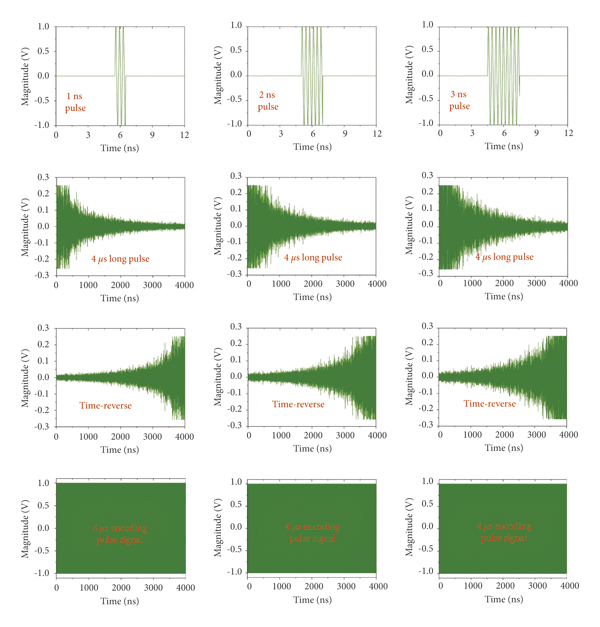
In the HPM pulse obtained experiment, the hardware high-speed sampling method is adopted for obtaining HPM pulse with ultrahigh repetition frequency. The concrete remake process of encoding long pulse signals with power normalization is shown in Figure 8. The detail is given as follows. First, the microwave narrow pulses with center carrier frequency of 2.856 GHz are constructed by using AWG. As shown in Figure 8(a), the widths of the input narrow pulses are set to 1 ns, 2 ns, and 3 ns, respectively. Second, the produced microwave narrow pulses with different widths are fed into the cavity and then the corresponding pulse response signal of cavity is obtained. Because of the multipath effect of cavity, the effective length of the pulse response signal can reach to 10 μs level. Because the amplitude of the pulse response signal drops sharply after 4 μs, the 4 μs time-long pulse response signal is intercepted by using a high-speed sampling oscilloscope for carrying out the HPM pulse obtaining experiment. The intercepted 4 μs time-long pulse response signals for different narrow pulses are shown in Figure 8(b). After reversing the sequences of intercepted pulse response signals in the digital field and normalizing their amplitudes, the path encoding long pulse signal will be obtained.
The concrete remake process of encoding long pulse signal by using the power normalization method.
When the path encoding long pulse signals are imported into the AWG and the output microwave long pulse train of AWG is amplified by using a power amplifier, the power of the encoded long pulse will be increased to 500 W level. When this encoded microwave long pulse is fed into the metal cavity, a compressed narrow microwave pulse train with higher power and repetition frequency of hundreds of kHz will be monitored at the output of the metal cavity. Figure 9 gives the measurement results of the compressed pulse signals with different pulse widths. The input path encoding long pulse signal is also shown in Figure 9. The obtained power of HPM is equal to the sum of the power detected by using an oscilloscope and the total attenuation of attenuator and feed line.
The pulse compressed signals with different pulse widths for 4 μs time-length: (a) 1 ns pulse width compressed signal, (b) 2 ns pulse width compressed signal, and (c) 3 ns pulse width compressed signal.
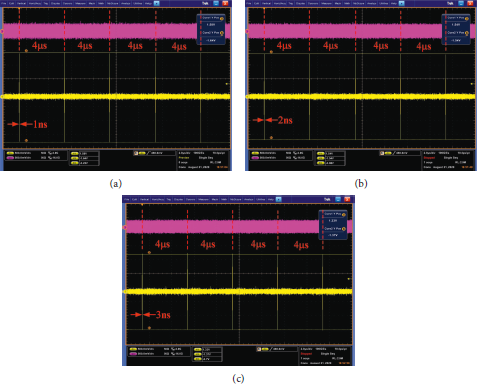
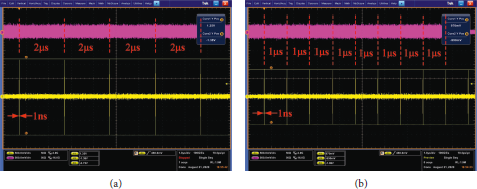
As shown in Figure 9, the encoded microwave long pulse is cycle generated by using the AWG and the encoded microwave pulse train is shown as a continuous signal in time field. When the encoded microwave pulse trains are fed in cavity, the narrow microwave pulse train is obtained. Because the encoding long pulse signals are 4 μs time-length, the repetition frequency of the microwave narrow pulse train equals to f = 1/T 1 = 250 kHz. According to the measured results, the widths of the obtained corresponding compressed pulses are approximately 1 ns, 2 ns, and 3 ns, respectively. The peak power of the 1 ns compressed pulse signal is approximately 161.6 kW. For 2 ns compressed pulse signal, its peak power can reach to 147.8 kW. Furthermore, the peak power of 113.7 kW is achieved for the 3 ns compressed pulse signal. Because the input power is kept at 500 W level and the encoding long pulse is 4 μs time-length, the energy utilization efficiencies for 1 ns, 2 ns, and 3 ns pulse widths are approximately 8.1%, 14.8%, and 17.1%, respectively. The corresponding compression gains for different pulse width signals are better than 220 times. Furthermore, the measured peak power gradually decreases along with the increase in narrow pulse width. In these experimental data, the repetition frequency of obtained HPM pulse is 250 kHz, which is higher than that of HPM pulse generated by using the conventional vacuum relativistic technology.
If the 2 μs time-length of pulse response signal is captured and encoded for generating the path encoding long pulse signal, the repetition frequency of 500 kHz will be achieved for the compressed HPM pulse. If the time-length of the path encoding long pulse signal is further decreased, the repetition frequency of the output compressed HPM pulse will further be increased. Thus, the repetition frequency of the output compressed HPM pulse can be increased to 1 MHz when the time-length of the path encoding long pulse signal is selected as 1 μs. Figure 10 shows the measured output compressed HPM pulses when the repetition frequencies are set to different values. As shown in Figure 10, it can be seen that the corresponding pulse peak powers are about 116.2 kW and 59.8 kW for the repetition frequencies of 500 kHz and 1 MHz, respectively. The energy utilization efficiencies are approximately 11.6% and 11.9% for the repetition frequencies of 500 kHz and 1 MHz, respectively.
The compressed signals with 1 ns pulse width for different repetition frequencies: (a) repetition frequency of 500 kHz and (b) repetition frequency of 1 MHz.
The above measured results have verified the effectiveness of the path encoding pulse compression technology for obtaining HPM pulse with ultrahigh repetition frequency. Based on the path encoding pulse compression technology, the HPM pulse with ultrahigh repetition frequency of hundreds of kHz can be obtained easily and effectively. The repetition frequency of the generated HPM pulse can be easily changed by adjusting the time length of path encoding long pulse signal. In addition, the frequency band of the obtained HPM pulse can also be easily changed by changing the center carrier frequency.
The method proposed in this paper for obtaining HPM pulse can be realized by using a conventional continuous microwave source. Thus, this method is a simple and cheap way for generating the HPM pulse with a high repetition frequency of MHz level and peak power of several hundreds of kW. In the measured experiment, the maximum output power of the power amplifier is only about 500 W level. However, under the current technical condition, 1 kW output power can be easily obtained when the solid-state devices or traveling wave tube are adopted. If the power amplifier with 1 kW output capacity is adopted, the peak power of the output compression pulse will reach to several hundreds of kW level. Moreover, if the method of power synthesis is adopted, the output power of power amplifier will be further increased to 5 kW level. Then, the compression pulse signal with peak power of MW level and repetition frequency of MHz level is very likely obtained. This is because the output power of this HPM pulse obtaining system is almost linear, increasing along with the increasing of input power based on the experimental results.
For a long time, the only way to obtain HPM pulse with GW-level power is adopting relativistic devices. Such devices usually work at a voltage of 500 kV and an instantaneous current of 10 kA. Under the condition of obtaining GW-level power, the overall energy utilization efficiency is difficult to reach more than 10%. Huge volume and weight are also needed due to the requirement of high voltage and high current. However, the working voltage of conventional electronic vacuum devices is usually lower than 100 kV and the current is at the magnitude of 100 A. The energy utilization efficiency can reach to 50%. Also, the output power can easily reach to tens of MW. Combining the proposed pulse compression technology and conventional electric vacuum devices, the compression HPM pulse with the power of GW level will be obtained easily.
Compared with the present vacuum relativistic technology, the present compression technology for obtaining GW-level power greatly reduces the requirements of high voltage and high current. Thus, the design difficulty of high-voltage power for HPM system has been greatly reduced. The volume and weight will also be greatly reduced. Higher reliability and longer service life can be obtained. Thus, the proposed path encoding compression technology is of great importance for obtaining HPM pulse if 1 GW power level is required.
4. Interference Effect Experiment
This new type of HPM pulse with center carrier frequency, ultrahigh repetition frequency higher than 250 MHz, and peak power higher than 100 kW is generated in the laboratory for the first time. Its application needs to be further studied in the future. However, combined with the application analysis of the ultrawideband (UWB) pulse without center carrier frequency, this new kind of HPM pulse with center carrier frequency and ultrahigh repetition frequency will have a strong ability to interfere the communication or data transmission links. Therefore, in order to verify the interference ability of this new type of HPM pulse, the numerical simulation of interference of the communication link is firstly carried on in this section. The communication rate is set as 100 Mbt, and the width of the HPM pulse is set to 3 ns. Figure 11 shows the receiver sensitivity along with the change of bit error ratio (BER). The jamming-to-signal ratio (JSR) is set as 5, and the repetition frequency is set to 100 kHz for the interference simulation.
The simulation result of the HPM pulse with the repetition frequency of 100 kHz for the interference of the communication link.

As shown in Figure 11, it can be seen that the BER is almost irrelevant to the sensitivity of receiver when the jamming-to-signal ratio (JSR) reaches to 5 and the repetition frequency reaches to 100 kHz. For the majority of communication or digital transmission links, the BER of 10−4 is not acceptable in the actual application. It means that the receiving capability of the receiver has been destroyed when this type microwave pulse is used to interfere the transmission link.
In order to further verify the feasibility of this new type of pulse with high repetition frequency for interference of the transmission link, an interference effect experiment system was established as shown in Figure 12. This experiment system is mainly composed of pulse microwave source with high repetition frequency of several hundreds of kHz, a radiation antenna, and a jamming target. For the communication link, the jamming target is a tablet computer. The interference effect experiment is carried out as follows. First, a communication link between the tablet computer and control computer is established through WiFi link. Second, the 1 ns HPM pulse train with high repetition frequency is generated by using the HPM pulse obtained system. The center carrier frequency of the HPM pulse train is set as same as the carrier frequency of WiFi link for the tablet computer. Third, the HPM pulse train is radiated to the tablet computer by using the radiation antenna. The repetition frequency and radiation power of the HPM pulse are changed under the condition of fixed pulse width. The communication link is monitored by using the control computer to estimate the effect of the HPM pulse with repetition frequency of hundreds of kHz.
The interference experiment of communication link. (a) The experiment principle of interference of communication link. (b) Photograph of the experiment set up.
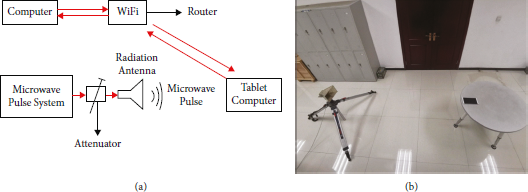
The experimental results show that the communication link between the tablet computer and control computer is successfully blocked when the repetition frequency reaches to 250 kHz and the power density is higher than 6.7 μW/cm2 at the target position. The interference of the control link for small unmanned aerial vehicles (SUAV) is also carried out by using an SUAV to replace the tablet computer shown in Figure 12. For the SUAV, its control link is successfully blocked when the power density is higher than 43.4 μW/cm2 with the repetition frequency of 1 MHz. The above experimental results verified the feasibility of 1 ns narrow pulse with ultrahigh repetition frequency for the interference of the communication and control links. This means that this new type of pulse has an expansive application foreground. Because the above experimental results are obtained under the condition of single objective, the interference effect for different objectives must be carried out by adjusting the pulse width and repetition frequency for achieving good jamming performance.
5. Conclusions
Based on the proposed path encoding pulse compression technology, a novel method for obtaining HPM pulse with ultrahigh repetition frequency and center carrier frequency is proposed in this paper. To demonstrate the effectiveness of the proposed method, a HPM pulse generating experiment was carried out based on an S-band microwave source. According to the measurement results, the HPM pulse with ultrahigh repetition frequency of several hundreds of kHz can be obtained easily and effectively. The repetition frequency of the HPM pulse can be easily changed and reached to the range from several hundreds of kHz to MHz level under the condition of the current technology. The effect experiments of interfering communication and control links of tablet computer and SUAV are also carried out by using the obtained HPM pulse. The experimental result shows that the communication link between the tablet computer and control computer will be successfully blocked when the power density is higher than 6.7 μw/cm2 with the repetition frequency of 250 kHz. The control link of SUAV can also be successfully blocked when the power density is higher than 43.4 μW/cm2 with the repetition frequency of 1 MHz. Of course, these effective data are obtained under the condition of the particular device. More effect experiments of different objectives must be carried out by adjusting the parameters of HPM for achieving good jamming performance. In the future, looking for the highly effective path encoding for improving the compression efficiency and compression gain will still be the important research aspect of the next research work.
Data Availability
All data included in this study are available upon request to the corresponding author.
Conflicts of Interest
The authors declare that they have no conflicts of interest.


 Open access

