

1. Introduction
Extending resource loops, i.e., use phase, can substantially reduce material throughput and overall system load while still enabling efficient recovery at the end of life through remanufacturing (Reference Bocken, de Pauw, Bakker and van der GrintenBocken et al., 2016; Reference Geissdoerfer, Pieroni, Pigosso and SoufaniGeissdoerfer et al., 2020). A product designed for extended life may achieve a total service life comparable to multiple remanufacturing cycles, yet with fewer recovery operations and lower environmental impact. The need to prioritise longevity is rooted in modern industrial history as mass production and planned obsolescence have normalised disposability, leading to a replacement of craftsmanship and repair culture with convenience and short-term consumption (Reference Aras Beger, Idowu, Schmidpeter, Capaldi, Zu, Del Baldo and AbreuAras Beger, 2022; Reference CooperCooper, 2004). Ecodesign emerged as a systematic approach to reducing environmental impacts across the product life cycle, emphasising improvements in areas such as material efficiency, energy use, and end-of-life recovery (Reference Charter and TischnerCharter & Tischner, 2001; ISO 14062, 2002). In the wake of transgressed planetary boundaries, new business models, technological enablers, and growing consumer awareness of sustainability are creating momentum toward operationalizing circularity (Reference Geissdoerfer, Pieroni, Pigosso and SoufaniGeissdoerfer, 2020). Within circular economy research, product design strategies can be framed in relation to resource loop dynamics. Reference Bocken, de Pauw, Bakker and van der GrintenBocken et al. (2016) distinguish between strategies for slowing resource loops, such as durability, repair, and emotional attachment, and strategies for closing loops through recycling and recovery. Here, a key circular strategy is remanufacturing, which enables product value retention, while simultaneously enabling repair, and refurbishment (Reference Kurilova-Palisaitiene, Vogt Duberg, Johansson and SundinKurilova-Palisaitiene et al., 2020). This, as it preserves much of a product’s embedded energy and material integrity, enabling multiple lifecycles and significantly reducing environmental impacts (Reference Sundin and BrasSundin & Bras, 2005).
The furniture industry is an interesting candidate for these practices. Furniture as a product group is both material-intensive and culturally significant, shaping our homes, workplaces, and public spaces. In the EU alone, businesses and consumers discard approximately 10 million tons of furniture to landfills and incineration each year (European Environmental Bureau, 2017). Hence, this study explores design strategies for product life extension, including remanufacturing, that are applicable to the furniture sector.
1.1. Aim
The purpose of this study is to explore and synthesise current research on design strategies for product life extension, with a specific focus on applications in the furniture sector. The review examines how design-oriented approaches can be conceptualised, categorised, and applied to support extended product life and to complement remanufacturing as a circular practice. Specifically, the study addresses the following research questions:
RQ 1 How can the concept of product life extension be understood and structured from a design perspective?
RQ 2 What design strategies and attributes support extended product life within the furniture sector?
2. Methodology
In addressing the research questions, a literature review was performed in which the design strategies for product life extension was identified. Incorporating existing knowledge related to how design can contribute to the prolonged life of products, especially in the realm of furniture, the goal was to find, organise and unify knowledge. The review focuses on conceptual and applied studies on design strategies and design parameters rather than production processes, logistics, or business models.
2.1. Literature review
This review adopted a hybrid approach. A semi-systematic review design, as recommended by Reference SnyderSnyder (2019), to address interdisciplinary and emergent research directions. This combines theoretical rigour with a flexible orientation and is thus appropriate for mapping dispersed research areas across more than one discipline. In addition, elements of an integrative review (Reference TorracoTorraco, 2016) were applied, which enabled the combination of theoretical and applied studies to generate new conceptual frameworks, rather than just summarising existing findings (ibid.). This ensures flexibility in exploring diverse perspectives while also enabling structured synthesis and critique of design strategies relevant to product longevity.
The search was conducted primarily through the Scopus and Web of Science databases. This because they cover a relevant spectrum of journals and peer reviewed articles. Initial search strings included combinations such as product design AND longevity, remanufactur* AND design. Additional search terms were developed iteratively during the process to capture the range of concepts associated with product longevity and life extension-oriented design. To ensure coverage of relevant work not easily captured by keywords, snowball sampling from reference lists of key articles was employed, alongside forward and backward citation tracking, until no new design aspects emerged, i.e., until empirical saturation was reached. The search initially included general studies on design for extended product life and longevity, with subsequent filtering to identify applicability to the furniture sector.
Consistent with Reference SnyderSnyder (2019) specific inclusions and exclusions were used to provide for targeting and consistency. Literature was included if they: Explicitly addressed choices, guidelines, strategies, or frameworks related to product design that enhance product longevity; Discussed theoretical, methodological, or practical aspects of design that support extended lifespan; Published in English and published in peer-reviewed journals or established conference proceedings. Literature was excluded if: Limited to manufacturing or business operations with no design component; Did not mention product longevity, design strategies, or design attributes; Merely descriptive or did not contribute conceptually.
The database searches initially identified 336 articles. Following title and abstract screening and preliminary assessment of relevance, 59 articles were selected for full-text review. After further screening and citation tracking, the final analytical sample consisted of 31 articles that contributed to the thematic synthesis.
The analytical basis for the synthesis was established by the final collection of literature.
A two-stage integrative process was used to analyse and synthesise the literature. First, a thematic analysis was conducted to find common themes, relationships and design orientations in the literature. Reference Ryan and BernardRyan and Bernard (2003) suggests that when finding an interesting expression one should ask what this is an expression of, entailing that themes are not always explicit. In the second stage, these thematic findings were further abstracted into heuristic constructs through an ideal-type synthesis, drawing on Reference Weber, Shils and FichWeber’s (1949) interpretive methodology, which involves the analytical accentuation of characteristic features that occur in the empirical material, to construct conceptually clear and explanatory models.
In order to construct ideal types, the elements forming the characteristics must be grounded in the conceptual material, as it is essential that the ideal types remain relatable to the design reality in which the studied phenomenon occurs (Reference Jansson BoströmJansson Boström, 2020).
Through an interpretive review of literature on design strategies for extended product life, a body of strategic principles aimed at enabling longevity in furniture design was identified. In line with the methodological guidance offered by Reference Jansson BoströmJansson Boström (2020), only a limited number of elements were accentuated to enable the construction of clear and coherent ideal types. To reduce the overall complexity of the material and strengthen the representativeness of the resulting categories, the strategies from the reviewed literature were first clustered through a thematic synthesis. This yielded recurring conceptual patterns, abstracted into three distinct characteristics that appeared across the material; The design’s technical orientation toward physical durability and reparability, Its capacity for functional adaptation and contextual flexibility; and Its potential to promote emotional engagement or attachment. These characteristics formed the analytical foundation for constructing the three ideal types presented in the next section: Technical Longevity , Functional Longevity , and Emotional Longevity .
3. Results
The analysis revealed a wide variety of design strategies spanning material, functional, and user-oriented aspects of longevity. To provide conceptual clarity and respond to the first question, these findings were synthesised into an overarching framework, The Longevity Trinity, which structures the diversity of design approaches identified in the literature.
3.1. The Longevity Trinity
To address the first research question, the reviewed literature was synthesised into an overarching framework termed the Longevity Trinity. Through iterative thematisation and ideal-type abstraction, three analytically distinct yet interdependent design orientations were identified: technical, functional, and emotional longevity. These ideal types serve as heuristic constructs that clarify recurring design logics in the literature rather than representing statistical distributions.
Technical longevity concerns the material and structural capacity of a product to endure and be recovered across multiple lifecycles, including durability, repairability, and remanufacturability. Functional longevity addresses continued usefulness and relevance over time through adaptability, upgradability, and multifunctionality. Emotional longevity relates to sustained user attachment and perceived value, including aesthetic durability, biophilic qualities, and identity-supporting design.
As the review undertakes a design-oriented perspective, economic, behavioural, and technological factors are treated insofar as they manifest through design decisions. The framework structures the identified strategies and furniture-adapted attributes within each dimension. The following sections detail the sub-strategies and design attributes associated with technical, functional, and emotional longevity.
3.2. Technical longevity
Technical longevity refers to the material and structural capacity of a product to endure and be recovered for continued use. For furniture design, this dimension entails strategies that enable durability, maintenance, and value retention across multiple lifecycles.
3.2.1. Remanufacturing and refurbishment
The overarching strategy of remanufacturing and refurbishment integrates a range of sub-strategies that collectively enhance technical longevity, contributing to Design for Remanufacturing and Refurbishment. Remanufacturing aims to return used products to an as-new condition through disassembly, inspection, repair, and reassembly (Reference Ijomah, McMahon, Hammond and NewmanIjomah et al., 2007; Reference SundinSundin, 2004), while refurbishment focuses on restoring function and appearance through selective renewal or refinishing (Reference Bovea and Pérez-BelisBovea & Pérez-Belis, 2018). Both strategies rely on a combination of technical enablers and informational enablers. These include identifiability, accessibility, modularity, manageability, standardisation, disassembly, durability, and cleanability. Each sub-strategy addresses a specific aspect of product design proposing design attributes as described in Table 1.
Technical longevity design sub-strategies and attributes

3.3. Functional longevity
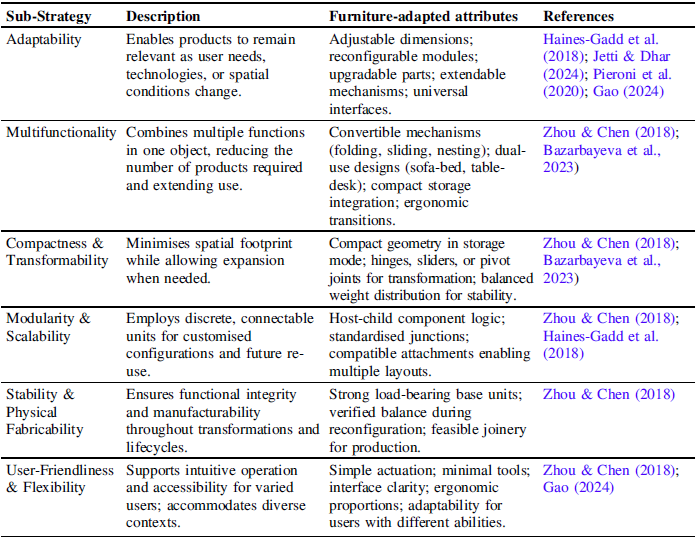
Functional longevity refers to the continued usefulness and relevance of a product over time. Within furniture design, this dimension focuses on strategies that enable adaptation, upgrade, and reconfiguration across changing needs and contexts as presented in Table 2.
3.3.1. Adaptability
Adaptability allows furniture to remain relevant by accommodating changing user needs and contexts. Features such as reconfigurability, adjustability, and upgradeability can prevent premature replacement (Reference Jetti and DharJetti & Dhar, 2024). Examples include modular shelving systems, height-adjustable desks, and extendable tables. Adaptability ensures that furniture evolves alongside users, reducing functional obsolescence.
3.3.2. Multifunctionality
Multifunctional or convertible furniture integrates multiple uses within a single object by enabling transformation between compact and expanded forms. Typical examples include sofa-beds, wall beds, or hybrid office units that fold out when needed. Such designs are especially relevant in urban living, where spatial constraints heighten the demand for space efficiency. By consolidating roles, multifunctional furniture can reduce the number of items required in a household, thereby delaying replacement and enhancing overall utility.
Convertible furniture can be systematically optimised to occupy minimal space in its compact state while still fulfilling diverse functions when expanded (Reference Zhou and ChenZhou & Chen, 2018). Furniture units can be connected via hinges or slides, allowing products to shift between forms without compromising stability or usability. Importantly, this flexibility not only maximises utility but also contributes to product longevity, as furniture that adapts to changing needs is less likely to be discarded prematurely (Reference Jetti and DharJetti & Dhar, 2024).
Functional longevity design sub-strategies and attributes

3.4. Emotional longevity
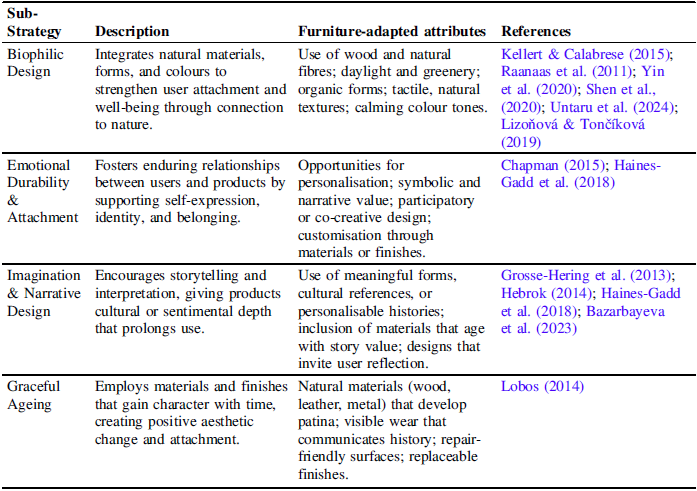
Emotional longevity refers to the sustained attachment and perceived value a product holds for its users over time. In the context of furniture design the emotional dimension, presented in Table 3, focuses on strategies that foster enduring aesthetic appeal, personal meaning, and experiential connection throughout extended use.
3.4.1. Timeless design
Timeless design seeks to prevent aesthetic obsolescence by emphasising qualities that remain relevant across generations. Reference LobosLobos (2014) identifies four pillars of timelessness: visual simplicity, efficiency, durable materials, and user-centred experience. Reference Juergen and LaswandiJuergen and Laswandi (2023) add further elements such as material quality, colour harmony, and simple geometric forms. Historical analyses of Polish furniture reveal that usability, honest material use, and restrained geometry continue to resonate decades later, highlighting the enduring appeal of minimalist and functional design (Reference Różańska, Szymczyk, Kujawa and BalcerzakRóżańska et al., 2021). However, some scholars caution that “timelessness” is context-dependent; what appears classic in one culture or era may be less enduring in another (Reference Flood Heaton and McDonaghFlood Heaton & McDonagh, 2017).
3.4.2. Biophilic design
Biophilic design incorporates natural materials, forms, and colours to foster long-term preference and attachment. Reference Kellert and CalabreseKellert and Calabrese (2015) distinguish between direct experiences (e.g., plants, natural light) and indirect experiences (e.g., wood textures, natural motifs and shapes). Empirical studies show that wooden and natural elements can reduce stress (Reference Raanaas, Evensen, Rich, Sjøstrøm and PatilRaanaas et al., 2011; Reference Yin, Yuan, Arfaei, Catalano, Allen and SpenglerYin et al., 2020), improve well-being (Reference Shen, Zhang and LianShen et al., 2020), and create more welcoming atmospheres (Reference Untaru, Han, David and ChiUntaru et al., 2024). In the context of furniture, biophilic qualities may not only enhance aesthetic appreciation but also strengthen users’ psychological attachment to natural materials.
3.4.3. Attachment and identity
Emotional durability focuses on fostering strong, lasting relationships between users and products. Reference ChapmanChapman (2015) emphasises how products that support self-expression, identity, and belonging are less likely to be discarded. Reference Haines-Gadd, Chapman, Lloyd, Mason and AliakseyeuHaines-Gadd et al. (2018) further show that personalisation and symbolic associations can extend use.
3.4.4. Imagination and narratives
Products that invite interpretation, storytelling, and imagination retain hedonic and symbolic value (Reference Grosse-Hering, Mason, Aliakseyeu, Bakker and DesmetGrosse-Hering et al., 2013; Reference HebrokHebrok, 2014). For example, personalized or historically inspired furniture may evoke nostalgia and cultural meaning that prevent premature replacement.
3.4.5. Graceful ageing
Emotional durability is also supported by materials and finishes that age visibly yet attractively. Reference ChapmanChapman (2015) note that patina, wear, and evolving aesthetics can add rather than reduce value. This quality aligns particularly well with natural materials such as wood, leather and metals (Reference Kellert and CalabreseKellert & Calabrese, 2015), where natural wear can enhance rather than diminish appeal.
Emotional longevity design sub-strategies and attributes

4. Discussion
The ideal types–longevity dimensions – provide a conceptual structure for clarifying how different design logics contribute to extended product life. While prior research has addressed product longevity from multiple disciplinary perspectives (Reference Bocken, de Pauw, Bakker and van der GrintenBocken, 2016; Reference ChapmanChapman, 2015; Reference Haines-Gadd, Chapman, Lloyd, Mason and AliakseyeuHaines-Gadd et al., 2018), the concept is often treated in fragmented ways. Engineering and remanufacturing literature predominantly emphasise durability, reliability, and recoverability (Reference SundinSundin, 2004; Reference Bovea and Pérez-BelisBovea & Pérez-Belis, 2018; Reference Hilton, Thurston and NasrHilton & Thurston, 2019; Reference Joustra, Flipsen and BalkenendeJoustra et al., 2021; Reference Ijomah, McMahon, Hammond and NewmanIjomah et al., 2007) whereas design research has explored emotional durability and user attachment (Reference Kellert and CalabreseKellert & Calabrese, 2015; Reference ChapmanChapman, 2015; Reference Haines-Gadd, Chapman, Lloyd, Mason and AliakseyeuHaines-Gadd et al., 2018). Studies on adaptability, ergonomics and multifunctionality in turn, are more furniture specific in the academic discussion (Reference Zhou and ChenZhou & Chen, 2018; Reference Pieroni, McAloone and PigossoPieroni et al., 2020; Reference Jetti and DharJetti & Dhar, 2024; Reference GaoGao, 2024). These strands rarely converge within a unified design-oriented structure.
The proposed framework contributes theoretically by integrating these dispersed perspectives into a coherent, multidimensional framework. Rather than equating longevity with physical robustness alone. This framing shifts the focus from incremental improvements in durability toward a broader understanding of how material integrity, continued usefulness, and sustained user attachment jointly shape extended product life.
The ideal-type synthesis aided in making a conceptual differentiation without excessively reducing the complexity of the field to isolated strategies. In doing so, the framework contributes to forming a design perspective capable of articulating interdependencies between the three dimensions.
Design for Remanufacturing and Refurbishment emerges as a particularly integrative strategy across the dimensions. Although often seen as a technical approach, it can also contribute to functional continuity by enabling upgrades and configuration changes (Reference Bumgardner and NichollsBumgardner & Nicholls, 2020) and may enhance emotional value by sustaining a recognisable and trustworthy product identity across lifecycles, as well as keeping the product up with trends and personal needs. Remanufacturing does not necessarily reset a product’s meaning. Instead, material traces of previous use or renewal can support a narrative of continuity and stewardship. As Digital Product Passports for furniture can include material, process, supplier, logistics and environmental data, such as wood species, trunk diameter, harvesting time, transport and sawmill processing details, as well as traceability of boards, components and the final product – while also supporting updates over time (Reference Gallina, Lanbach, Ahmeti, Ritter, Revenko, Belova, Steinwender and BachlechnerGallina et al., 2025) – digital product passports could possibly enhance users’ emotional connection to furniture by making its material history visible (Reference Fletcher, Graff, Hong and NirmalFletcher et al., 2025) reinforcing the narrative strategy.
Material selection also carries cross-dimensional implications. Natural materials such as wood can support repair and refinishing whilst also providing sensory and symbolic qualities that promote long-term attachment (Reference Raanaas, Evensen, Rich, Sjøstrøm and PatilRaanaas et al., 2011; Reference Yin, Yuan, Arfaei, Catalano, Allen and SpenglerYin et al., 2020; Reference Shen, Zhang and LianShen et al., 2020; Reference Untaru, Han, David and ChiUntaru et al., 2024). However, repeated recovery cycles may affect the technical and experiential performance of natural materials furniture, which suggests a need for further investigation. Future research could explore how these materials perform in multiple lifecycles. Future research could also include anchoring the framework with designers and industry, furthering the knowledge regarding strategies and attributes, hence making it more operational.
Overall, the findings highlight how the physical and psychological properties of furniture interact with the component of time, positioning product longevity as a design problem of continuity; continuity of materials, usefulness, and meaning across multiple lifecycles.
5. Conclusions
This research suggest that product longevity can be understood through three analytically distinct yet interdependent orientations: Technical Functional and Emotional longevity (RQ1). These ideal types provide a heuristic structure for clarifying how different design logics contribute to extended product life. In addition, the research identified furniture-relevant design strategies within each dimension, ranging from remanufacturing and modularity to adaptability, multifunctionality, biophilic design, and emotional attachment (RQ2).
To conclude, designing for longevity, in the furniture context, therefore entails designing for continuity of value by sustaining material integrity, functional relevance, and user meaning across multiple lifecycles.
Acknowledgement
The author would like to thank the Kamprad Family Foundation of Entrepreneurship, Research & Charity for the funding of this research through the program called “Strategier för ökad cirkularitet hos träförädlande industri (CirkuTrä)” (Ref: 20230011).
The author would also like to express his utmost gratitude to Professor Erik Sundin and Associate Professor Johannes Matschewsky for their valuable feedback and insightful guidance throughout this work.


 Open access

