

“If you see something, you have to be blind, deaf, and dumb; that’s how it works here.”
“If you keep silent, you don’t mess with them, and they won’t mess with you.”
“Everyone here knows what to talk about and what not to talk about.”
Numerous individuals worldwide live under the sway of criminal control.Footnote 1 In such communities, residents employ various coping strategies (Bell-Martin and Marston Reference Bell-Martin and Marston2023; Rios Contreras Reference Rios Contreras2014; Córdova Reference Córdova2022; Ley Reference Ley2018; Moncada Reference Moncada2020; Reference Moncada2021; Rios Arias Reference Arias2019; Zubillaga, Llorens, and Souto Reference Zubillaga, Llorens and Souto2019). As the epigraph’s statements exemplify, many residents choose strategic silence to protect themselves from criminal gang activities. In addition, criminal groups may use residents’ silence to shield themselves from various actors (Bell-Martin and Marston Reference Bell-Martin and Marston2023). For example, gangs may use silence to protect their activities and territory from rival gangs or to protect themselves from the state. This latter use occurs particularly in contexts where the state is available to citizens in that it possesses both the capacity and the will to address complaints (i.e., it is neither corrupted nor colludes with alleged criminal organizations).Footnote 2 By contrast, in contexts that lack a responsive state, citizen reports pose little threat to criminal gangs, and thus these gangs do not depend as much on maintaining silence for their survival.Footnote 3
The theoretical development of criminal control logics has primarily emerged from environments with low state presence or high police corruption, such as Colombia, Brazil, and Mexico (Arias Reference Arias2017; Arias and Barnes Reference Arias and Barnes2017; Ley, Mattiace, and Trejo Reference Ley, Mattiace and Trejo2019; Magaloni, Franco-Vivanco, and Melo Reference Magaloni, Franco-Vivanco and Melo2020; Magaloni, Robles, et al. Reference Magaloni, Robles, Matanock, Diaz-Cayeros and Romero2020). In these contexts where the state is unavailable, community silence is a less relevant coping strategy, and is often overlooked in the literature on criminal control dynamics. This research aims to contribute to this gap in the literature by focusing on Montevideo, Uruguay, a case with an available state, and exploring how criminal gangs establish Commitments of Silence (CS) and the factors contributing to their formation.
CS are tacit agreements in which communities agree to keep silent about a gang’s operations, effectively shielding the gang.Footnote 4 In exchange for this silence, gangs avoid disrupting the life of the community, thus affording community members a degree of peace and orderliness. This tranquility does not entail the absence of violence but rather reduces the likelihood of community members being targeted by gang-related activities.Footnote 5 CS thus represents a tacit exchange between the community and the gang, fostering relative stability by concealing gang operations.
The goal of CS is to prevent community members from reporting gang crimes. An available reporting option threatens gangs, so they strive to secure the community’s commitment to silence. They achieve this through either forced or negotiated means: Forced CS uses violence, whereas negotiated CS employs benevolent strategies. The variation in the type of CS can be explained by the structure of local reciprocity networks, characterized by long-term exchanges among individuals. These exchanges involve neighbors assisting each other with daily needs, such as providing babysitting and healthcare or volunteering at the neighborhood soup kitchen. CS integrate into these networks, affecting the community’s ability to regulate gang violence and to influence strategies for maintaining silence.
This article delves into the dynamics of local criminal gangs operating within their home neighborhoods. Homegrown gang members, who live in the same community where they operate, are inherently part of the structure of local reciprocity. This network is characterized by long-standing social connections between gang members and other individuals in the community who are engaged in reciprocal relationships. As a result, it amplifies the influence of community characteristics on gang behavior, underscoring the intricate interplay between social dynamics and criminal activities at the local level.
I develop the argument with reference to two communities located in Casavalle, a neighborhood on the outskirts of Montevideo, the capital of Uruguay. I use a process-tracing analysis drawing mainly on interview-based fieldwork to uncover the logics behind the operation of criminal gangs and their relationship with the communities with which they coexist.
This article contributes to research on crime and gang-related violence in four ways. First, it enhances understanding of criminal dynamics in contexts where the state is available to citizens, challenging previous assumptions. Second, it introduces the concept of CS and highlights the role of communities in influencing gang violence, advancing understanding of territorial control by criminal groups. Third, it provides new insights into state–citizen relations and the establishment of social order, in which CS emerges as an alternative mechanism for achieving stability and order. Last, the article enhances understanding of how social networks act as both regulators and protectors of criminal operations.
Dynamics of Criminal Organization–Community Relationships
How have prior studies explained the diverse ways in which criminal organizations establish relationships with the communities in which they operate?
Existing explanations emphasize gang rivalry as a key factor driving violence. According to Olson’s (Reference Olson1993) “stationary bandits” model, drug-trafficking organizations are more inclined to collaborate with communities when they anticipate long-term control and future gains (Arjona Reference Arjona2016; Magaloni, Franco-Vivanco, and Melo Reference Magaloni, Franco-Vivanco and Melo2020; Mampilly Reference Mampilly2015; Moncada Reference Moncada2021; Staniland Reference Staniland2012).Footnote 6 Monopolistic territorial control fosters expectations of sustained cooperation. Conversely, rival organizations, with shorter time horizons because of territorial contestation, tend to extort and dominate communities (Barnes Reference Barnes2018; Reference Barnes2022; Magaloni, Franco-Vivanco, and Melo Reference Magaloni, Franco-Vivanco and Melo2020; Yashar Reference Yashar2018). Although these explanations clarify escalating violence levels, they fall short in explaining why gangs engage violently with communities in the absence of territorial contestation. Additionally, they do not address why, in cases of gang rivalry, one gang may interact violently with the community while another does not.
Another strand emphasizes that the relationship between the state and criminal organizations significantly influences gangs’ interactions with communities. Successful gang operations typically involve some degree of informal state protection, although they may also experience conflict with the state (Arias and Barnes Reference Arias and Barnes2017; Durán-Martínez Reference Durán-Martínez2018; Snyder and Durán Martínez Reference Snyder and Martínez2009). This relationship can range from active partnership to mutual tolerance to violent discord, resulting in varying levels of violence (Barnes Reference Barnes2017; Moncada Reference Moncada2013; Reference Moncada2021). Collaboration with state agents often grants criminal organizations impunity and enables extortion strategies (Magaloni, Robles, et al. Reference Magaloni, Robles, Matanock, Diaz-Cayeros and Romero2020). Conversely, when gangs face substantial police repression, they may provide goods and services to garner public support and deter resident denunciations (Barnes Reference Barnes2018).
Finally, community strength is considered a crucial variable influencing criminal groups’ strategies and behavior (Berg and Carranza Reference Berg and Carranza2018; Staniland Reference Staniland2012). Scholars argue that close-knit communities are less susceptible to domination by illicit groups (Arias Reference Arias2017; Magaloni, Franco-Vivanco, and Melo Reference Magaloni, Franco-Vivanco and Melo2020). These socially dense communities resist the infiltration of protection rackets, criminal gangs, or insurgent forces (Arjona Reference Arjona2016; Kaplan Reference Kaplan2017; Ley, Mattiace, and Trejo Reference Ley, Mattiace and Trejo2019), effectively containing the expansion and establishment of criminal actors (Magaloni et al. Reference Magaloni, Diaz-Cayeros, Matanock and Romero2011).
Although communities with dense participation in formal organizations—such as neighborhood associations, local government bodies, NGOs, and trade unions—are recognized for their role in regulating violence (Ley, Mattiace, and Trejo Reference Ley, Mattiace and Trejo2019; Moncada Reference Moncada2019; Reference Moncada2021; Varshney Reference Varshney2001), informal communal ties—everyday personal connections and social networks within the community—play a greater role in the case of homegrown criminal gangs. Importantly, scholars have observed that when drug traffickers operate within their own communities, they enjoy broader support and are less inclined to resort to violent tactics (Blume Reference Blume2021). According to Magaloni, Robles, and coauthors (Reference Magaloni, Franco-Vivanco and Melo2020), strong communal bonds shape the interactions between homegrown gangs and residents, fostering solidarity and adherence to ethical codes. Grisaffi (Reference Grisaffi2021) argues that in Bolivia, the drug trade is woven into a local moral fabric emphasizing kinship, reciprocal relationships, and community well-being, thereby explaining the lower levels of drug-related violence compared to other Latin American nations.
Although previous research examining the relation between communal ties and the behavior of locally originated criminal organizations has centered on production zones, rural areas, and regions with limited state presence (Blume Reference Blume2021; Grisaffi Reference Grisaffi2021; Magaloni et al. Reference Magaloni, Diaz-Cayeros, Matanock and Romero2011), this study aims to enhance understanding by focusing on an urban setting where state institutions are present. Moreover, prior studies have not explored the variations in violent behavior among homegrown gangs. Therefore, my research contributes to this literature by examining how communal reciprocity structures might influence the dynamics between homegrown gangs and the community.
Situating the Concepts
Commitments of Silence
The comparative politics literature focuses on criminal governance schemes when analyzing the logic of territorial control by criminal groups. Criminal governance involves local systems of control imposed by criminal organizations, which enforce formal or informal rules that restrict the behavior of both criminal and noncriminal civilians. Such governance affects the daily routines and activities of the governed (Lessing Reference Lessing2021). Studies of criminal governance explore power dynamics between politicians, state agents, and criminal organizations across subnational units, highlighting their co-constitution (Albarracín and Barnes Reference Albarracín and Barnes2020; Arias Reference Arias2017; Barnes Reference Barnes2017). Criminal governance is not necessarily linked to a weak or absent state but is often embedded in a larger domain of state power (Arias Reference Arias2017; Lessing Reference Lessing2021). Scholars have shown how long-standing criminal order schemes are based on specific engagements between the state and illicit actors (Arias Reference Arias2006; Reference Arias2017; Auyero and Sobering Reference Auyero and Sobering2019; Dewey Reference Dewey2015; Dewey, Míguez, and Saín Reference Dewey, Míguez and Saín2017; Durán-Martínez Reference Durán-Martínez2018; Magaloni, Franco-Vivanco, and Melo Reference Magaloni, Franco-Vivanco and Melo2020).
The concept of criminal governance primarily focuses on top-down impositions of governance schemes by criminal groups, neglecting the role of the “governed.” The concept of CS differs from criminal governance by emphasizing a relational concept that entails community involvement in gang operations. Examining CS offers a comprehensive way to understand criminal organizations’ territorial activities, because not all gangs engage in governance activities (Blattman et al. Reference Blattman, Duncan, Lessing and Tobón2021; Lessing Reference Lessing2021). Even when CS occurs within the framework of a criminal governance scheme, it is useful to study it as a distinct phenomenon. CS involves community participation in gang operations, which underscores the crucial role communities play in shaping territorial control strategies.
In exchange for community members’ silence, gangs provide them with relative tranquility in their day-to-day lives by refraining from disturbing them. “Disturbing” community members in this context can refer to extortion, abuse, evicting them from their homes, or other forms of harassment by gangs. Additionally, gangs and criminal groups may provide resources, such as direct bribes or protection from robbers, in exchange for residents’ silence (Vargas Reference Vargas2016). These arrangements are pivotal for shielding criminal organizations’ illicit activities and maintaining operational stability, because they dissuade residents from reporting crimes or cooperating with police investigations.
Moreover, community silence also offers residents peace of mind, functioning as a form of life insurance. Importantly, this tranquility does not necessarily guarantee an absence of violence but rather a reduction in the likelihood of community members becoming targets of gang activities, as previously mentioned. This exchange relationship allows gangs to survive and operate their illicit enterprises. CS enables gangs to reduce the visibility of violence, avoid attracting attention, and achieve relative stability by keeping their operations unnoticed.
Reciprocity and Social Network Structure
The comparative politics literature often employs the concept of social capital to explain social exchange relationships, which Robert Putnam (Reference Putnam1995, 67) defines as “features of social organization such as networks, norms, and social trust that facilitate coordination and cooperation for mutual benefit.” Putnam (Reference Putnam2000, 19) further underscores that social capital encompasses “connections between individuals and the norms of reciprocity and trustworthiness.” However, scholars have criticized the vagueness and conceptual stretching of this definition (MacLean Reference MacLean2010; Sartori Reference Sartori1970).
In response to these concerns, I deliberately refrain from using the concept of social capital. Instead, I adopt a narrower focus and specifically examine reciprocity to elucidate the type of CS established by criminal gangs in their operating communities. Although previous authors often highlighted the role that formal organizations play in regulating violence, informal communal ties are more significant for homegrown gangs. Strong communal ties influence gang interactions with residents, fostering solidarity (Blume Reference Blume2021; Grisaffi Reference Grisaffi2021; Magaloni et al. Reference Magaloni, Diaz-Cayeros, Matanock and Romero2011). Consequently, daily community engagement is crucial in understanding CS as an exchange relationship.
Reciprocity stands as a defining aspect of social interactions (Blau Reference Blau1964; Homans Reference Homans1961), and the exchange of benefits serves as a fundamental societal principle. Hobhouse (Reference Hobhouse1906) called reciprocity the “vital principle of society,” and Simmel (Reference Simmel and Wolff1950) argued that social equilibrium and cohesion rely on the reciprocity of service and return service. It is widely accepted as a universal trait of social beings; Becker (Reference Becker1956) proposed the term “homo reciprocus” and Gouldner (Reference Gouldner1960) identified a “norm of reciprocity” that drives individuals to help those who have helped them. More recently, reciprocity has been described as providing an evolutionary basis for societal cooperation (Nowak and Sigmund Reference Nowak and Sigmund2000).
The norm of reciprocity is not constant. Scholars have shown that it is structured and varies (Emerson Reference Emerson1972; Molm Reference Molm2010; Molm, Collett, and Schaefer Reference Molm, Collett and Schaefer2007; Tilly Reference Tilly2005). Specifically, reciprocity can be diversified, involving interactions across various social groups, or concentrated, focusing on a limited number of relationships (Hyden Reference Hyden2006; MacLean Reference MacLean2010).
Building on these individual-level typologies, I extend the characterization to community-level reciprocity networks, distinguishing between fragmented and extended structures. Fragmented structures involve individuals with concentrated reciprocal relations, whereas extended structures encompass diversified relationships. Granovetter’s (Reference Granovetter1973) framework helps elucidate these structures. Fragmented structures consist of strong links—ties within the immediate circle of family and friends—but lack weak links connecting individuals to broader networks.Footnote 7 In contrast, extended structures include both strong and weak links, with the latter playing an essential role in fostering community integration, as Granovetter notes.
Scholars have used the concept of social network structure to explain violence outcomes. Notably, lower levels of violence are associated with extended network structures, rather than with fragmented ones. How do extended structures help reduce violence levels? Studies of political violence (Barnes Reference Barnes2017; Kalyvas Reference Kalyvas2015), including civil wars, drug trafficking, and ethnic conflicts, have revealed that the mechanisms linking network structures to violence vary depending on the source of the threat.
Studies of civil wars show that cohesive communities can resist external armed groups (Arjona Reference Arjona2016; Kaplan Reference Kaplan2017). Ley and colleagues (Reference Ley, Mattiace and Trejo2019) find that socially dense indigenous communities in Mexico are more resistant to narco-conquest, whereas Berg and Carranza (Reference Berg and Carranza2018) suggest that well-organized neighborhoods in Honduras deter criminal groups. Conversely, when violence originates within a community, extended social networks foster collective efficacy by alleviating communal tensions (Kasarda and Janowitz Reference Kasarda and Janowitz1974; Sampson Reference Sampson1988; Warner and Rountree Reference Warner and Rountree1997). For example, Varshney (Reference Varshney2001) argues that interethnic engagement reduces violence in Indian cities, and Krause (Reference Krause2018) suggests that cross-cleavage identities in African communities help prevent communal religious wars.
Depending on the source of violence, extended social networks may work as a mechanism for either internal social control or shelter from external violent threats, influencing the persistence of criminal organizations in socially dense communities (Browning Reference Browning2009; Pattillo Reference Pattillo1998; Sampson, Raudenbush, and Earls Reference Sampson, Raudenbush and Earls1997; Sampson and Wikstrom Reference Sampson, Wikstrom, Kalyvas, Shapiro and Masoud2008). For homegrown criminals, these networks may regulate crime-related violence, rather than entirely preventing criminal groups from operating (Browning, Dietz, and Feinberg Reference Browning, Feinberg and Dietz2004). Residents with long-standing ties to community leaders or gang members can use these connections to influence gang behavior, often deterring violence (Marston Reference Marston2020).
Social networks can also be useful for criminal activities. Arias (Reference Arias2006) shows that drug-trafficking organizations in Brazilian favelas leverage tightly knit communities for legitimacy, establishing ties with state actors and using local informants (Arias Reference Arias2017; Magaloni, Franco-Vivanco, and Melo Reference Magaloni, Franco-Vivanco and Melo2020; Perlman Reference Perlman1976).Footnote 8 Although violent mechanisms such as force and intimidation play a significant role in the running of illegal operations, scholars contend that social capital serves as a stable and reliable resource (Corsino Reference Corsino2013). Organized crime thrives by using local resources, gaining social acceptance, and adapting to community needs (Van de Bunt, Siegel, and Zaitch Reference Van de Bunt, Siegel, Zaitch and Paoli2014).
Building on this research, my theory explains different types of CS based on reciprocity network structures. Specifically, when gangs are embedded in the community and violence originates internally, the community plays a significant role in regulating this violence.
Argument
I argue that the structure of local reciprocity networks shapes various types of CS. Reciprocity networks involve long-term exchange relationships between individuals (MacLean Reference MacLean2010, 17). The exchange primarily involves assistance with everyday needs, such as providing babysitting, picking up children from school, caring for neighbors’ health, or working for the neighborhood’s soup kitchen. These exchanges are reciprocal, with individuals giving and receiving in return. Reciprocity may not be immediate, but those in the network maintain this relationship, knowing they can rely on each other’s help whenever needed (Molm Reference Molm2010).
I base this argument on an in-depth study of two communities in the Casavalle neighborhood on the outskirts of Montevideo, focusing on the behavior of homegrown criminal gangs—those operating within their own residential neighborhoods. In Uruguay, most gangs have not expanded beyond their local territories. The homegrown nature of these gangs leads gang members to establish close relationships with community members and to emphasize long-term ties that amplify the influence of community characteristics on gang behavior (Blume Reference Blume2021). Because the members of homegrown gangs belong to the local reciprocity network, the network structure matters and defines the preexisting social ties between gang members and other community members involved in give-and-take relationships.
Local reciprocity networks can be extended—widespread among community members—or fragmented; that is, concentrated in small groups within the community. In fragmented networks, reciprocal relations are concentrated within clusters associated with family and friendship ties. Intra-cluster reciprocity is robust, but inter-cluster ties are weak. Members of the same cluster assist each other with childcare, financial matters, and personal difficulties, but these ties do not extend to neighbors in other clusters. By contrast, widespread networks of reciprocity involve diversified reciprocal relations among neighbors, extending to all community members. Solidarity occurs at both dyadic and community levels, with neighbors collaborating on solutions to address community welfare needs, such as finding emergency housing or raising funds for a neighbor’s wheelchair.
The structure of reciprocity plays a crucial role in framing CS and determining whether the community’s commitment to silence is forced or negotiated. The mechanism connecting reciprocity networks and CS relies on the capacity of the community to regulate gang violence (Sampson, Raudenbush, and Earls Reference Sampson, Raudenbush and Earls1997). Scholars have shown that, when criminals are homegrown, social networks may have the ability to regulate crime-related violence (Bell-Martin and Marston Reference Bell-Martin and Marston2023; Blume Reference Blume2021; Browning, Dietz, and Feinberg Reference Browning, Feinberg and Dietz2004; Marston Reference Marston2020) and that communities with extended social networks can achieve collective efficacy in regulating neighborhood crime and violence (Kasarda and Janowitz Reference Kasarda and Janowitz1974; Sampson Reference Sampson1988; Warner and Rountree Reference Warner and Rountree1997).
The reciprocal nature of CS and the embeddedness of homegrown gang members in the community’s reciprocity network both help explain the impact of reciprocity networks on CS. Given these two factors, CS become intricately woven into the community’s existing network of reciprocal relationships. This embeddedness affects the community’s capacity to influence the gang and regulate its use of violence and, subsequently, affects the means available to the gang to ensure silence.
When reciprocity networks are extended, the gang and community members are socially connected through ongoing reciprocal relationships. These relationships not only discourage the use of coercive force to elicit CS but also promote the development of mutually beneficial exchanges. In this scenario, CS occurs within the framework of existing reciprocal ties; it grants the community a degree of influence over the gang’s behavior and its ability to regulate violent activities. Gang members must provide benefits to secure neighbors’ silence, foster robust social ties, and achieve a negotiated coexistence. Consequently, the community may turn a blind eye to certain aspects of gang activities in exchange for these benefits, thereby exerting a form of influence over the gang’s operations and helping curb violence. For example, gangs may contribute to the community by donating gifts to children or supporting local initiatives such as soup kitchens. Additionally, they may cover neighbors’ utility expenses. In exchange for these benefits, neighbors maintain silence and refrain from reporting crimes related to the gang. This silence is rooted in the gang members being part of the community and their active involvement in reciprocal interactions.
In fragmented structures, gang members belong to one reciprocity cluster based on family and friendship ties. The absence of reciprocity with other clusters means (1) that the participation of community members outside the cluster in the CS must be forced and (2) that the community lacks leverage over the gang, weakening its ability to regulate violence. Because gang members are homegrown, community members know them, but if there are no social ties binding them, neighbors from other clusters are potential threats and informants. Although it is possible for homegrown gangs to establish systematic negotiated CS with various clusters in fragmented communities, it is highly unlikely. Social ties within such contexts are frequently marked by frictions and coexistence disputes among clusters. Because the structure of reciprocity ties is a product of historical processes, it is unlikely that these ties can be altered in the short term. Consequently, to ensure silence, gangs resort to violent strategies such as extortion, evictions, and threats, thus intimidating potential whistleblowers. Silence in forced CS is rooted in community members’ fear of retaliation from gangs that enforce silence through violent methods. Figure 1 summarizes the argument.

Figure 1 Structure of Reciprocity Networks and Types of Commitments of Silence
Research Design
Montevideo as a Case of State Availability
I chose Montevideo as the empirical setting for this study because of the role of the state. Theories of territorial control by criminal groups have been developed primarily in settings where the state is often unavailable to receive citizens’ crime reports and respond accordingly; for example, because of a weak or corrupted police force. Therefore, it is crucial to understand the dynamics of territorial control in contexts where the state is available (Gerring Reference Gerring2006).
Uruguay’s National Police is highly esteemed for its professionalism, minimal corruption, and widespread legitimacy (Sanjurjo and Trajtenberg Reference Sanjurjo and Trajtenberg2022; Tiscornia and Pérez Bentancur Reference Tiscornia and Bentancur2022). Latinobarómetro (2021) data confirm the police as Uruguay’s most trusted institution, with a 65% approval rating. This trust has increased over time, surpassing even esteemed institutions such as the parliament, political parties, the government, and the Electoral Court (see figures A.1 and A.2).
In 2010, the National Police launched a comprehensive reform—lauded as one of the region’s most effective—aimed at combating corruption through centralized policing (Malone, Dammert, and Pérez Reference Malone, Dammert and Pérez2023; Milanesi Reference Milanesi2020). The reform streamlined police operations, reduced its involvement in private security, established the Republican Guard, and restructured the Montevideo headquarters of the National Police. Centralization addressed corruption issues by reducing the autonomy of individual police stations, decreasing their control over personnel and resources (Milanesi Reference Milanesi2020).
Since 2016, Montevideo’s police has implemented the Programa de Alta Dedicación Operativa (PADO), which focuses on high-crime areas such as Casavalle (Bogliaccini et al. Reference Bogliaccini, Pereira, Pereira, Giambruno and Borba2022). PADO’s aims are to reduce property crime, enhance crime-solving efficiency, build trust in the police, and improve citizens’ perceived safety. In addition, the introduction of the new Code of Criminal Procedure (CPP) in late 2017 marked a significant shift toward an accusatorial system by strengthening evidence-gathering procedures for prosecutions and allowing the use of protected witnesses.
The Cases in Context
Criminal groups in Montevideo are concentrated in impoverished urban areas (Ladra Reference Ladra2014; Leal Reference Leal2021). These groups originated as criminal families and then expanded their illicit activities, particularly local drug dealing, leading to territorial disputes and violence (Díaz et al. Reference Díaz, Fynn, Bentancur and Tiscornia2022). The Interior Ministry’s Bi-Annual Homicide Report (2018–19) noted that 50% of homicides in 2018 were attributed to gang conflicts and that the homicide rate that year for Montevideo reached a record high of 16.9 per 100,000 inhabitants. Casavalle, located at the northern outskirts and accounting for 6% of Montevideo’s population, recorded the highest homicide rate in that year of any neighborhood. It grapples with significant social vulnerability, including housing, economic, labor, and environmental precariousness, along with one of the city’s highest poverty levels, both in terms of income and unsatisfied basic needs (Intendencia de Montevideo 2018).
Despite being designated as a single neighborhood, Casavalle encompasses diverse communities; it has been described as a “territorial mosaic” (Lombardo Reference Lombardo2005, 62). According to a 2011 survey by the Municipality of Montevideo, only 3% of the neighborhood’s residents identified their home as “Casavalle,” whereas the remaining 97% referred to their specific community or neighborhood (Bervejillo Reference Bervejillo2012). Casavalle’s diversity can be traced to different population waves that occurred during its formation (Álvarez Pedrosian Reference Álvarez Pedrosian2013). Its development unfolded in three stages: foundational, private land-division–led urbanization, and state-led urbanization.
My research focuses on two communities within Casavalle: Paths and Pigeons: Both are housing complexes built during the third stage of urbanization.Footnote 9 These communities are located very close to each other, only separated by a public square. They share similar sociodemographic characteristics, including levels of poverty, unemployment, household overcrowding, and access to government services (Intendencia de Montevideo 2018). Additionally, both areas host homegrown criminal gangs involved in the micro-trafficking of illicit drugs: The Amal gang operates in the Paths community, and the Inga gang is active in the Pigeons community. These gangs are family-based criminal groups, each comprising 15 to 20 members. In both communities, the groups exhibit a hierarchical structure, led by adults within the family, followed by several youths (referred to as perros [“dogs”]) who handle distribution and surveillance tasks within the neighborhood. Although these groups have a long-standing involvement in criminal activities, they entered the drug trade only in the early 2000s, primarily focusing on small-scale drug trafficking within their resident communities. This pattern is characteristic of criminal organizations involved in micro-trafficking in Montevideo: Operating in a small market with narrow profit margins, these smaller-scale criminal organizations have limited firepower and work within compact territories (Feldmann and Luna Reference Feldmann and Luna2023; Fynn, Pérez Bentancur, and Tiscornia Reference Bell-Martin and Marston2023).
Despite their shared characteristics, there are notable differences in how the gangs ensure community members’ silence in each case. Hence, the selection of these two cases is based on a most-similar criterion (George and Bennett Reference George and Bennett2005; Gerring Reference Gerring2006; Seawright and Gerring Reference Seawright and Gerring2008).
Process-Tracing Design
The case studies rely on interview-based fieldwork to elucidate the dynamics of criminal gangs and their relationship with the coexisting community. From June 2019 to March 2022, I conducted 68 in-depth interviews with various local actors, including neighborhood residents, community leaders (ranging from NGO staff to teachers and social workers), and government officials (details are presented in tables A.1 and A.2 in the online appendix). Interviews with members of the criminal groups were not feasible because of security concerns. On three occasions, neighbors advised against conducting interviews for safety reasons, leading to their cancelation. Despite Uruguay’s relatively low levels of violence and lower organizational density than other countries in the region, the scarcity of information about this phenomenon rendered it unsafe to attempt contact with these group members.
I used a process-tracing approach to identify the linkages between local reciprocity networks and CS. This technique is based on causal process observations (CPOs), which are diagnostic pieces of evidence that support or challenge descriptive or causal hypotheses (Collier, Brady, and Seawright Reference Collier, Brady and Seawright2010; Mahoney Reference Mahoney2012). Each CPO was analyzed in terms of its probative value, using various tests based on the concepts of necessity and sufficiency (Van Evera Reference Van Evera1997). Therefore, some pieces of evidence carried more inference leverage than do others.Footnote 10 To present the evidence, I adopted the structure proposed by Pérez-Bentancur, Piñeiro, and Rosenblatt (Reference Pérez Bentancur, Rodriguez and Rosenblatt2020) and derived the following descriptive and causal hypotheses:
H1. The outcome: In communities with extended reciprocity networks, the CS established between the community and the gang will be negotiated (descriptive).
H2. The outcome: In communities with fragmented reciprocity networks, the CS established between the community and the gang will be forced (descriptive).
H3. The independent variable: In communities with extended reciprocity networks, relationships of exchange among neighbors are widespread among all community members (descriptive).
H4. The independent variable: In communities with fragmented reciprocity networks, relationships of exchange among neighbors are restricted to family groups (descriptive).
H5. The mechanism: The reciprocity network structure in each case determines the type of CS established by influencing the community’s ability to regulate the gang’s use of violence (causal).
Results: A Tale of Two Communities
In this section, I delve into the connection between reciprocity structures and CS by presenting a comparative analysis of the CS established within the Paths and Pigeons communities and the Amal and Inga gangs, respectively. I present evidence concerning descriptive and causal inferences regarding the CS in each case, the structure of reciprocity networks, and the mechanism that connects these two factors.
The Outcome: Negotiated and Forced Commitments of Silence
To empirically describe a CS, one needs to identify pieces of evidence that reflect the give-and-take relationship: Community members offer silence in exchange for gangs refraining from disturbing them, thereby ensuring a degree of tranquility. This tranquility does not imply the absence of violence but rather a decreased chance of community members becoming targets of gang activities, as previously mentioned. Moreover, because CS may be either negotiated or forced, empirical observations should also provide information on the activities that gangs engage in to ensure the participation of community members in the CS. In a negotiated CS, nonviolent actions are typically observed, where gang members provide benefits to neighbors in exchange for the latter’s silence. By contrast, in a forced CS, the gang often uses violent strategies to ensure that neighbors continue to remain silent.
In both cases, community members know that they must keep quiet about the operations of local drug trafficking gangs if they want relative peace of mind. For instance, neighbors living in both Pigeons and Paths neighborhoods say things like, “If you don’t mess with them, they won’t mess with you,” or “Everyone here knows what to talk about and what not to talk about” (CPO1, CPO2, and CPO13 in the online appendix). Similarly, workers in these neighborhoods often prefer to “pretend we don’t know what’s going on” (CPO3).
However, there is a marked difference between the two cases in what motivates silence. Testimony from members of the Paths community suggests that the exchange relationship with the gang is the primary reason for their silence (CPO4–CPO12). Some neighbors claim that they do not report the gangs’ crimes because gang members are good to the people in the neighborhood. One neighbor explains, “The gang members are very good with the neighbors, they help them … so the truth is that there is no interest in reporting them. They are good people. They are excellent people” (CPO4).
The Amal gang does not rely on violence to maintain their CS. In fact, a community worker who has been working in the neighborhood since 1995 says that she has never witnessed any violence (CPO5). Instead, the Amal gang operates on good terms with their neighbors, often providing day-to-day assistance with basic needs. By doing so, they foster extended networks of reciprocity to ensure the CS. As one neighborhood councilman explains,
The Amal gang has a very effective strategy for avoiding denunciations. If you need something, Amal will provide it for you. Would you denounce me? No. Tomorrow you need a plate of food, and I give it to you. Are you going to denounce me? Tomorrow, you need to pay the electricity; I give you the money without any conditions because you are not going to pay me back. Are you going to report me? (CPO6)
In the case of the Pigeons community, the motivation for silence is quite different. Neighbors state that they must remain quiet to avoid retaliation from the gang (CPO14–CPO23). The Inga gang mostly uses violent actions to ensure the CS, often threatening or evicting people who do not offer their support. For instance, during an interview, a community leader explained that families are displaced if the family house provides a convenient location for the gang business and the family is suspected of nonaffiliation with the gang or of being a whistleblower (CPO20).
Unlike in the Paths community, the residents of Pigeons are willing to report the gang’s actions but fear retaliation. Therefore, instead of CS being negotiated, community members are forced to commit to silence to protect the gang’s actions. As one neighbor states, “If you see something, you must be blind, deaf, and dumb. That’s how it works here. Out of respect and fear of the reprisals they can take against your family…. Most of us want to leave, but that’s the reality we must live with. We are hostages” (CPO14).
An observable implication of the type of CS established is the type of actions gangs use to ensure silence. Through a systematic analysis of the 68 interviews, I identified 50 references to both violent and nonviolent actions used by the Inga and Amal gangs to achieve community silence. Although this systematization is not exhaustive, it provides an overview of the differences between the two gangs. Table A.1 summarizes the frequency of these actions by gang (CPO24). Overall, the Amal gang mostly employs nonviolent means intended to assist neighbors or the community, such as purchasing gifts for the children’s soccer club, donating food to soup kitchens, or paying for the electricity bills of neighbors (CPO6–CPO12). By contrast, the most frequently mentioned actions used by the Inga gang are violent actions such as evictions, threats, and the control of movement within the neighborhood (CPO15–CPO23).
The evidence suggests the existence of a negotiated CS in the Paths community and a forced CS in the Pigeons community. Table 1 indicates that both cases have CPOs constituting hoop tests (necessary but not sufficient) for inferring the exchange relationship and fear of retaliation as the basis for silence. In both cases, the type of action used for achieving silence is considered a straw-in-the-wind test; that is, the evidence supports the descriptive inferences but is neither necessary nor sufficient.
Table 1 Descriptive Inference: Negotiated and Forced CS

The Independent Variable: Reciprocity Network Structures
To empirically observe the structures of reciprocity networks, I present evidence that shows instances of exchange among community members. This evidence assesses the structure of the networks by including information on those engaged in reciprocal exchanges. Additionally, I provide evidence suggesting that reciprocity structures preceded the establishment of CS in each case, having been forged before the emergence of gangs at the origin of each community.
Extended Reciprocity Networks in the Paths Community. In 1956, the Montevideo Departmental Council initiated a “master plan” that called for the decentralization of Montevideo and the creation of local communities on the city’s outskirts (CPO25). This urban planning initiative laid the foundation for communities like the Paths. The housing unit hosting the Paths community was built between 1957 and 1958 as part of the master plan’s goal to address urban challenges, such as sprawl and the decay of community life (CPO25–CPO31).
The formation of the Paths community involved not only housing construction but also the provision of essential services to foster a distinct community profile (CPO27 and CPO29). Cultural activities organized by local authorities and politicians further aimed to strengthen community bonds (CPO32). Residents attest that this approach to community building affected the social makeup of the Paths community compared to neighboring areas. According to one interviewee cited by Filardo (Reference Filardo2005),
From a social point of view, each place is very different, here you cross a street, and the communities are very distinct, because in general they have a different past…. The Paths housing development is much older; it dates to the late fifties. When the development was built, a health and educational complex was also built, consisting of schools, a nursery, a kindergarten, and a polyclinic. This already gives you a certain profile, a different perspective of the neighborhood. (CPO30)
Many neighbors who eventually formed the Paths community had lived in precarious conditions in the area before the complex’s construction (CPO33–CPO35). Thus, they had shared the struggle to gain decent housing.
As the Paths community evolved, these established relationships were reinforced through collective activities. The accounts of neighborhood relationships from the 1960s emphasize extended community-level connections (CPO36–CPO38). Collective celebrations, such as street decorations, neighborhood carnival parades, and Children’s Day parties, showcased the community’s cohesion. For instance, a neighbor recalls that on Children’s Day everyone got together, decorated the streets, and “each mother would contribute a cake and some cookies, and a table would be set up in the middle of the street where the children would dance” (CPO37).
Currently, community members maintain exchange relationships that involve caring for each other’s children and for elderly people in need, helping neighbors during crises such as fires or floods, and cooking collectively to provide food for food-insecure community members, among other activities (CPO39–CPO44). An interviewee describes how people take care of each other, including picking up children from school and caring for them as if they were their own: “They call someone an aunt who is not the aunt.” She provides an anecdote to further illustrate the close relationships between neighbors: “One day, a girl who was often abandoned came with a neighbor who was not a direct relative [who] announced that she would start taking care of her. There was no legal process involved, but the neighbor had a long-standing relationship with the family that spanned generations. As a result, she was essentially adopting the child” (CPO39).
Similarly, a staff member of a state organization in the neighborhood remarked, “One must be present to realize how much time they devote to each other, the places they offer, the ways in which they help at times when one would really shoot the other way. The solidarity is very impressive” (CPO40). Another community worker offered similar testimony, stating, “It is a beautiful neighborhood, with very supportive people. When things are bad, you always have people who come to lend a hand. And that seems to me to be a culture that comes from the 60s; there is a very rich solidarity culture here” (CPO41).
These exchange relationships have been strengthened by years of living together as a community. For example, a community healthcare worker stated,
We are talking about people who come from [families that have been involved for] generations in processes of neighborhood construction, even processes of how they organized themselves to distribute the land, how they organized themselves to build their community, and these processes generate certain bonds that are seen in a circulation of favors among them” (CPO42)
The structure of reciprocity networks in Paths is widespread, as evidenced by community members expressing that they know they can rely on all their neighbors to address welfare and care needs. One neighbor provides an example: “We have been neighbors for years since I was a little girl, and you know you can count on them for anything. You can call house to house, and there will always be an older person or someone who has lived in Paths for forty-something years to help out” (CPO43).
Furthermore, the way the community organizes itself and collectively reacts to meet the needs of its members also indicates an extended network of reciprocal relations. In this regard, a former principal of a local high school states, “As soon as someone is going through a difficulty, the neighborhood immediately looks for a solution.” To illustrate this point, she recalls when the house of a wheelchair user was flooded and the community members gathered to discuss how to help her: “They first found a place where the person could stay until the situation was fixed, and they also got her a better wheelchair” (CPO44).
In 1994, a group of Paths residents, under the leadership of a woman named Teresa, established a community hall and a daycare center for the neighborhood that meets in that hall. With support from the Montevideo municipal government, they acquired land, constructed the community hall, and later entered into an agreement with the Centers for Child and Family Care plan (CAIF). Still operating under this agreement, the hall serves nearly 200 children and their families (CPO45).
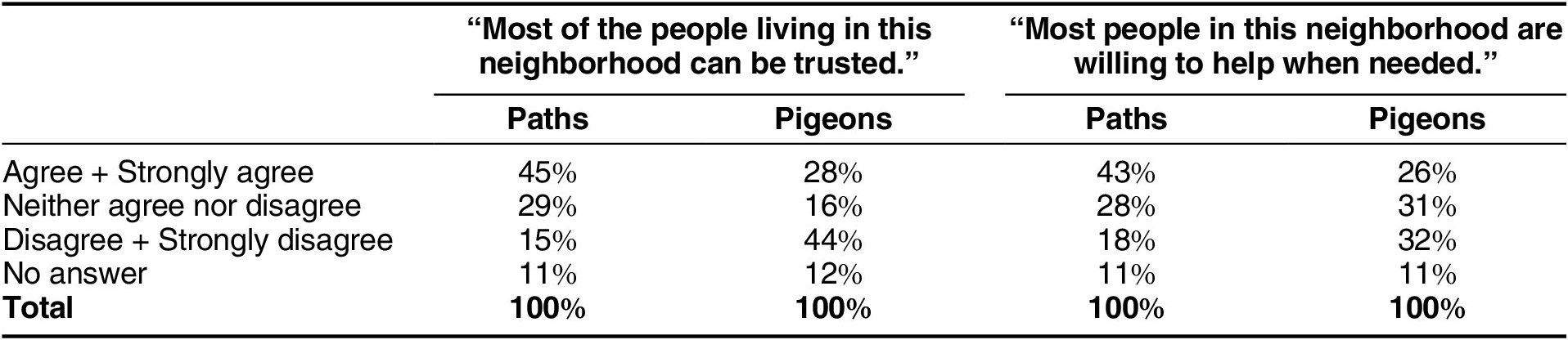
Finally, survey data from the Municipality of MontevideoFootnote 11 show that 45% of Paths respondents (N = 95) agreed that “most people in this neighborhood can be trusted” and 43% agreed that “most people in this neighborhood are willing to help when needed.”Footnote 12 In contrast, 15% disagreed with the former statement, and 18% disagreed with the latter statement (see table 2; CPO46).Footnote 13 These results suggest that the exchange relationships and solidarity ties among community members in Paths are widely recognized and are perceived positively.
Table 2 Neighborhood Perception Survey: Paths and Pigeons Residents

Note: These are responses to this question: “In every community, some people get together with others and trust each other, while others do not. Now, I would like to talk about trust and solidarity in your community. Using the following scale (SHOW CARD), how much do you agree with the following statements?”
Source: Based on 2011 survey by the Municipality of Montevideo in Casavalle.
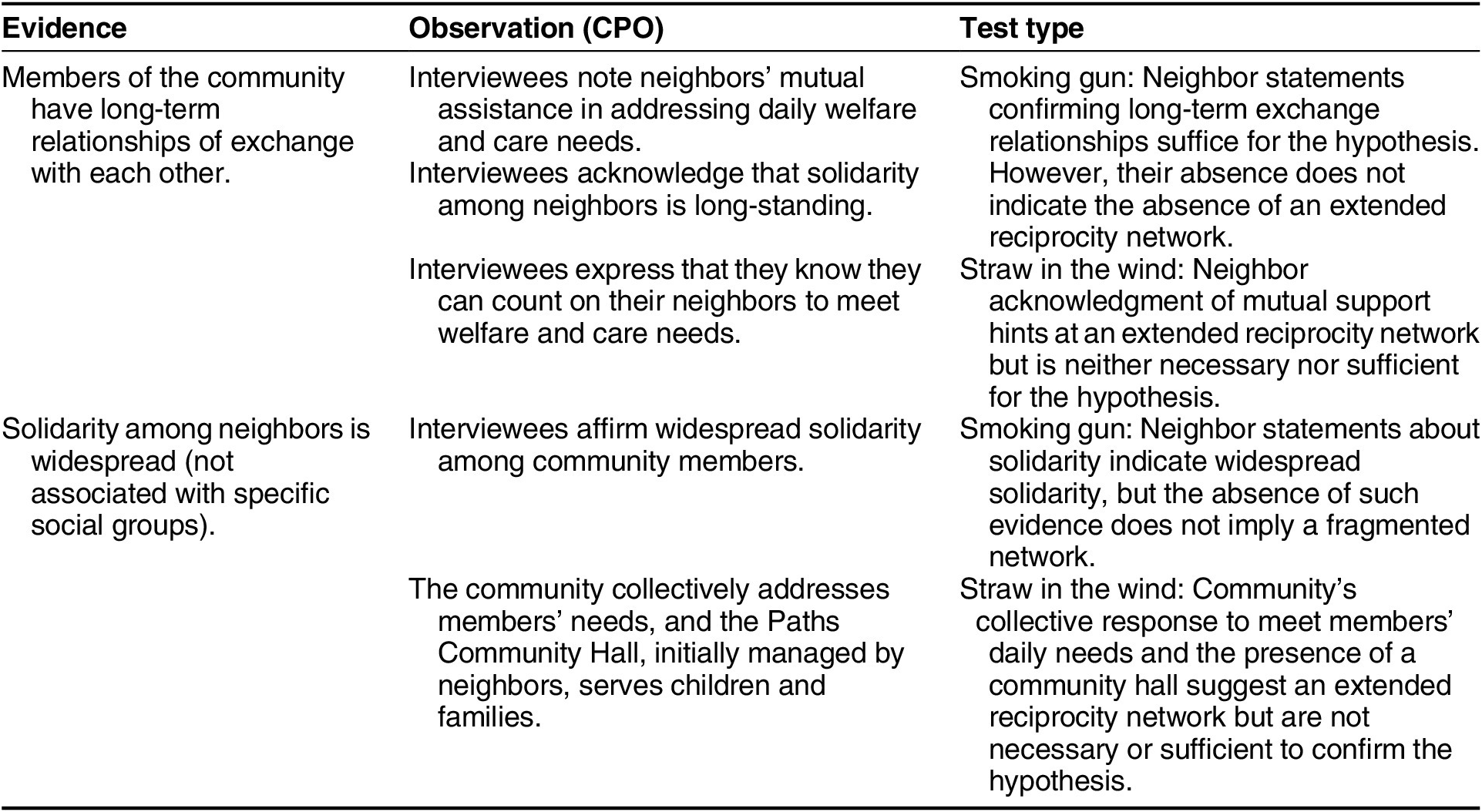
The evidence indicates the presence of reciprocal ties among neighbors, who collectively address daily communal welfare and care-related challenges. Community members recognize their ability to rely on any neighbor to fulfill their needs, based on a shared sense of responsibility and mutual support. The Paths community features a neighbor-run community hall serving the welfare needs of children and their families. This evidence suggests the existence of reciprocity networks that encompass a significant portion of the community, indicating an extensive and interconnected structure. Some of the evidence serves as a “smoking gun” test, supporting the inference of widespread long-term reciprocal relationships among community members; other evidence provides empirical hints that support this inference, such as community members expressing trust in their neighbors and the existence of a community center (table 3).
Table 3 Descriptive Inference: Extended Structure of Reciprocity Networks in the Paths Community

Fragmented Reciprocity Networks in the Pigeons Community. The narrative of community formation and the resultant reciprocity networks in the Pigeons community housing complex diverges significantly from that of the Paths. Unlike Paths, which was developed to revitalize community life, the Pigeons community emerged as part of a housing policy primarily focused on relocating squatters from downtown Montevideo, with little emphasis on fostering community bonds (CPO47 and CPO48).
The construction of Pigeons, comprising 540 dwellings, was driven by the need to provide temporary housing solutions for populations residing in downtown Montevideo after the eradication of informal settlements. The housing complexes were overseen by the Honorary Commission for the Coordination and Promotion of Social Action Housing, operating under President Juan María Bordaberry’s administration (CPO49 and CPO50). Political restrictions during his dictatorship (1973–85) further stifled community life in Pigeons. Regulations imposed on residents prohibited public meetings, gatherings, and what were perceived to be disruptive activities (CPO51).
The settlement process exacerbated the fragmented structure of reciprocity networks, because the first residents came from diverse social backgrounds. Unlike the Paths community, which accommodated families with preexisting ties, the Pigeons community hosted individuals with varied origins, including those relocated from downtown Montevideo. The lack of a cohesive plan for integrating these diverse groups and the subsequent challenges of coexistence between people unfamiliar with one another resulted in a fragmented reciprocity structure (CPO52–CPO57).
Today, the Pigeons community is still characterized by the coexistence of disconnected family groups. Although there is strong reciprocity within each group, there is weak reciprocity between them. Community members acknowledge that they help each other to solve everyday problems associated with welfare and care needs, but they aid mainly family members (CPO58–CPO63). As a former principal of a local high school expressed, “In Pigeons, there is solidarity and complicity, but mostly among those of the same family. Generally, family members take care of each other. They keep things within the family and generate a kind of community life, but only among themselves…. It is a more segregated feeling, so to speak” (CPO58).
Fragmented reciprocity, however, does not equate to total isolation of family clusters. These family groups have lived together in the community for generations. As a result, neighbors from different clusters have some level of familiarity with each other and have basic interactions typical of daily coexistence. Some interviewees admitted to extending cordial greetings to their neighbors on the block or to parents who take their children to the same school, but such interactions do not extend beyond commonplace greetings (CPO58 and CPO59). The residents assert that nonfamily neighbors do not have personal relationships with each other. According to one resident, “Of course, I know the neighbors of Pigeons, I know them all by name, but not personally in the sense of having a relationship with them” (CPO59). Knowing each other is not enough to establish a reciprocal relationship, let alone sustain an extensive network of reciprocity.
The lack of solidarity exchange links between different family clusters is evident in the absence of a sense of community among Pigeons’ residents (CPO60–CPO63). The absence of a sense of community makes it easier for people to turn a blind eye to the needs of others and focus solely on their own problems. As one community member puts it, “People see when there are others who need help and act like little monkeys: ‘I don’t see, I don’t hear, I don’t talk’” (CPO61).
Additionally, members of the community report that there are significant coexistence issues among residents. The cohabitation of multiple unconnected family groups in an overcrowded neighborhood creates permanent friction, which, in turn, intensifies the fragmentation. For instance, neighbors expanded their homes over time to accommodate relatives or friends, making the streets increasingly narrow and resulting in disputes over land boundaries between family groups (CPO56). These coexistence problems are so deeply ingrained that, according to one neighbor, the only way to solve them would be to get rid of the neighborhood altogether: “We would have to throw a bomb at the housing unit and eliminate it. There is no way to fix that” (CPO62).
Unlike the Paths community, the 2011 survey by the Municipality of Montevideo in Casavalle indicates notable distrust and reluctance to help among Pigeons’ residents: 44% of the 89 respondents disagreed or strongly disagreed with the statement, “Most of the people in this neighborhood can be trusted,” and 32% disagreed with the statement “Most people in this neighborhood are willing to help when needed.” Conversely, 28% of respondents agreed or strongly agreed with the former statement, and 26% agreed with the latter statement (see table 2 and CPO63).
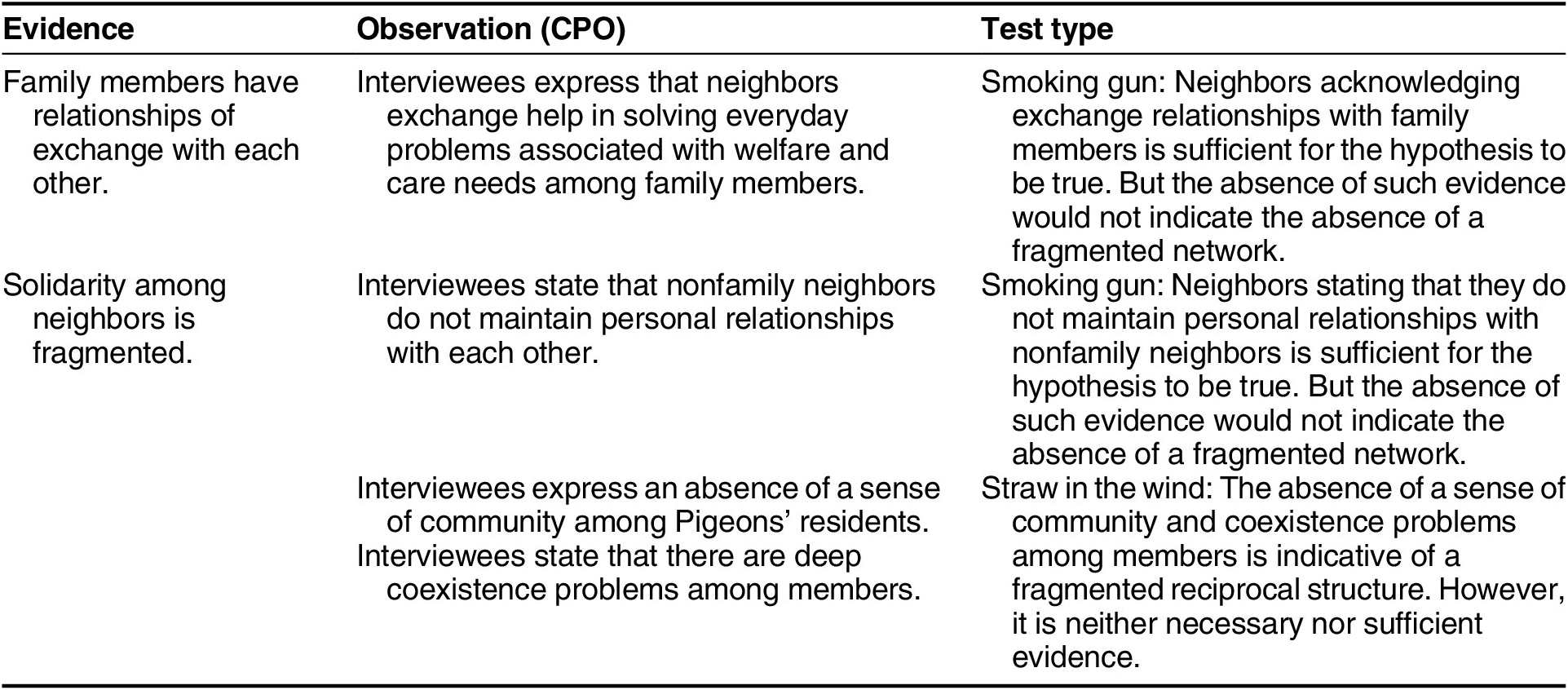
The evidence presented indicates a fragmented reciprocity network within the Pigeons community. Table 4 shows that some of the evidence meets a smoking gun test: It is sufficient, but not necessary, to support the inference of fragmented exchange relationships among community members. Other evidence, such as community members expressing a lack of a sense of community and the existence of deep coexistence problems, align with the inference but meet straw-in-the-wind tests, providing evidence that is neither necessary nor sufficient.
Table 4 Descriptive Inference: Fragmented Structure of Reciprocity Networks in the Pigeons Community

The Mechanism: How Networks of Reciprocity Affect Commitments of Silence
Two key elements are crucial to understanding the connection between local reciprocity networks and the type of CS. First, CS involves an exchange relationship, and second, homegrown gang members belong to the reciprocity network of the community. Therefore, the CS, as an exchange relationship, is integrated into the existing reciprocity network of the community so that the structure of reciprocal relationships determines whether the community has leverage over the gang—affecting its ability to regulate gang violence and consequently the means available to ensure the CS.
In the case of extended reciprocity networks, the community plays a crucial role in establishing and maintaining the CS. Extended exchange networks create connections and social ties between neighbors and gang members, which generate benefits for both parties. Community members establish a “negotiated coexistence” with the gang, in which they tolerate the gang’s activities in exchange for reciprocal benefits, such as continued participation in the reciprocity network. Consequently, the community has some leverage over the gang’s actions and can regulate the levels of violence. To gain legitimacy and secure the CS in the Paths community, the Amal gang members must participate and encourage reciprocal exchanges with all community members. The accounts of community leaders illustrate this idea (CPO65–CPO67). One community leader said, “Here [in the Paths community] we all help each other. This is how things work in this neighborhood, and they [Amal gang members] know it: If they don’t collaborate with the neighborhood, they will lose the respect they have earned” (CPO64). The Amal gang is actively involved in endeavors aimed at enhancing the neighborhood’s well-being. For example, a community leader referred to specific activities “such as the cleanup of garbage dumps and helping neighbors when they need money or to solve a specific problem.” Through such initiatives, Amal members emerge as positive leaders within the community, garnering legitimacy and esteem among residents (CPO65).
The extended reciprocity networks demand that local gang members acknowledge and uphold established ties to ensure loyalty and commitments of silence. In this dynamic, community members wield significant influence over the gang, using it as a mechanism to regulate violence. A tangible example is exemplified by a former teacher from the local school; it underscores how community members strategically leverage their connections within the extended network to shape the gang’s behavior. A highly respected elderly woman, this former teacher consistently positions herself at the school gate. She possesses an intimate familiarity with all the families residing in the vicinity. Her purpose for stationing herself there is twofold: to attend to the needs of both the faculty and the children and to leverage the respect accorded to her by the gang. She is cognizant that her presence serves as a deterrent, ensuring that gang members adhere to appropriate behavior while she remains at her station (CPO66).
The extended reciprocity networks in Paths create a strong sense of community that transcends individual clusters. This community sense is manifested in a protective mindset toward all its members, as emphasized by a former local high school principal who noted feeling safe while walking through the neighborhood (CPO67). Even gang members, integral to the community, benefit from this protective dynamic. A resident explains their inclusion as follows: “They are part of our community; we live and share our lives together since we were very young” (CPO68). This protection derives not only from the absence of neighbor reports on gang activities but also from the shared sense of community belonging.
In contrast, in fragmented reciprocity structures, gang members belong to a single cluster of reciprocity based on family and friendship ties. They maintain reciprocal social relationships within this cluster but lack solidarity ties with other clusters: Thus, the community has little leverage over the gang, and its ability to regulate violence is weakened. This implies that belonging to the community has no impact on how neighbors are treated by the gang. To wit, a resident of the Pigeons community said, “The Inga gang shows no regard for whether someone is from the neighborhood. For instance, they control specific streets and place guards who question passersby about their destination and purpose, regardless of whether the passers are locals or not” (CPO70). This CPO underscores that being from the neighborhood does not grant one any special treatment from the gang.
This sentiment is common among Pigeons’ residents. In personal interviews, they frequently conveyed feelings of powerlessness and fear of gang retaliation (CPO71–CPO73). Community members describe needing to remain silent to avoid reprisals against their families, comparing their situation to being blind, deaf, and mute. For example, a community leader emphasized the neighbors’ sense of helplessness, explaining that “gangs forcibly took over houses, violently evicting those not connected to them. To avoid retaliation, residents remain silent, as the gangs mark their territory” (CPO72). Despite residents’ strong desire to leave, they feel trapped and held hostage by the gangs, unable to change their circumstances. As one interviewee said, “That is how it operates, and there is nothing you can do about it” (CPO73).
The fragmented structure means that gang members only have reciprocal social relationships with community members who belong to their familiar circle and lack exchange relationships with other community members. Thus, although they belong to the same community, links occur only within the family clusters. This fragmentation affects how the community views and reacts to the gang’s actions. Although a small group of community members supports the gang, most oppose its operations in the neighborhood (CPO74 and CPO75). A community worker in the neighborhood highlights this division among neighbors, stating, “There is a division among the neighbors between those who collaborate with them, favoring their actions, and those who do not and are therefore considered enemies, who are the vast majority of the neighbors” (CPO74).
Because gang members are homegrown, community members know who they are, where they operate, and where they live. However, because of the lack of social ties linking the solidarity groups, neighbors become potential informants about the gang’s operations. Instead of having leverage over the gang’s actions, the community poses a threat to the gang. In response to this threat, the gang seeks to ensure community participation in the CS by blocking the possibility of denunciation through fear. A community worker’s account is quite illustrative: “Evictions generally occur because you are not affiliated with them, so to speak. Here, we all know each other and see what they do and where they are. The gang sees you as able to denounce them” (CPO75).
The evidence collectively supports the inference that community leverage connects the structure of local reciprocity networks with resulting CS. Table 5 indicates that some evidence serves as a smoking gun test, being sufficient to validate this inference. For the Pigeons community, the Inga gang’s disregard for local status, their control over the streets, and their interrogation of passersby suggest a lack of community solidarity. Residents’ pervasive sense of powerlessness and fear of gang retaliation, likened to being “blind, deaf, and mute,” further undermine their ability to influence gang actions. Forced evictions and marked territories illustrate the gang’s dominance and the community’s helplessness, as reflected in interviewees’ resignation. Overall, these pieces of evidence act as smoking gun tests. Although not strictly necessary, this evidence clearly reveals the community members’ lack of leverage over the gang’s use of violence.
Table 5 Causal Inference: How Reciprocity Networks affect Commitments of Silence

In contrast, the mutual assistance and reciprocal exchanges between gang members and residents in the Paths community foster strong social ties, enabling the community to influence gang behavior. The gang’s involvement in community initiatives and efforts to maintain legitimacy, along with respected community figures ensuring gang compliance, demonstrate the regulatory power of extended reciprocity networks. Thus, gang members are protected by their community ties, while the community regulates gang violence through these networks. Other pieces of evidence, such as those on social ties among community members, provide hints that align with the causal inference but are straw-in-the-wind tests—neither necessary nor sufficient to prove it.
Conclusions
In this article, I argue that the structure of local reciprocity networks affects the type of CS that homegrown gangs establish with the communities where they operate. By conceiving these commitments as exchange relationships, I posit that CS are embedded in the preexisting reciprocity network of the community.
This research contributes to the literature on crime and violence in comparative politics in three ways. First, by introducing the concept of CS, it enriches discussions of the logic of territorial control by criminal gangs, addressing a gap in the literature that has focused on criminal governance schemes. Criminal governance typically emphasizes top-down control, neglecting the role of the “governed.” CS diverges from criminal governance in that it involves community participation in gang operations. Because not all gangs engage in governance, exploring CS provides a more comprehensive understanding of criminal organizations’ territorial activities and emphasizes the crucial role that communities play in shaping these strategies. This shift moves away from the top-down perspective that dominates the mainstream literature and recognizes communities as key influencers in shaping criminal gangs’ operations. Furthermore, the emphasis on reciprocity and its enduring nature highlights the role that long-term processes play in shaping criminal organizations. In contrast to mainstream short-term explanations, this project underscores the importance of considering the stability and historical context of the communities in which criminal organizations operate.
CS serves as an alternative mechanism for establishing order by regulating violence and thereby advances understanding of state–citizen relations and social order. Criminal organizations, through CS, can functionally contribute to state stability and reduce repression in subnational territories. The literature on criminal governance highlights a reciprocal relationship between the state and criminal organizations, where the state offers protection and criminal organizations contribute to social stability. This research extends this perspective by showing that communities can also engage in reciprocal relationships with criminal gangs and can play a key role in regulating drug-related violence and establishing order. Importantly, the findings demonstrate that state protection of criminal groups is not always necessary to achieve stability (i.e., protection rackets), because CS may persist independently. This challenges classical Weberian conceptions that associate state weakness with social disorder (Huntington Reference Huntington1968; O’Donnell Reference O’Donnell1993; Reference O’Donnell2010). In general, research on the politics of crime tends to view communities as passive and neutral environments where criminal activities occur and in which residents adopt a resigned attitude toward the coercive power of criminal organizations. However, this perspective fails to recognize communities as effective actors that may resist or negotiate local norms and establish order.
This research contributes to the literature on the relationship between social networks and crime and aligns with critiques that challenge the assumption that cohesive social networks are inherently positive; that is, it acknowledges that such networks can have a “dark” side (Browning Reference Browning2009; Browning, Dietz, and Feinberg Reference Browning, Feinberg and Dietz2004; Field Reference Field2003; Kalyvas Reference Kalyvas2006; Levi Reference Levi1996). By arguing that socially dense communities not only facilitate the territorial persistence settlement of criminal organizations but also shield their activities, this work challenges systemic perspectives on social networks at the local level (Kasarda and Janowitz Reference Kasarda and Janowitz1974; Sampson Reference Sampson1988; Warner and Rountree Reference Warner and Rountree1997).
Although my theory posits that social networks can function as regulators of crime and violence, it also recognizes that they may work to protect gang operations. This apparent contradiction is possible when gangs are homegrown and embedded in the community where they operate. These conditions stand in stark contrast with other cases in the region, where national or even transnational criminal organizations lacking community ties seem to wield significant influence. In such scenarios, the literature emphasizes how strong communal ties may serve as a shield against external violent threats, rather than as mechanisms for regulating violence. Therefore, instead of regulating violence and establishing negotiated CS, extended reciprocal networks potentially could prevent the establishment of external criminal organizations in the community. However, the dynamics of such organizations and their interactions with local communities lie beyond the scope of the proposed theoretical framework.
This research also has implications for public security policy. Its findings highlight that communities can serve as key allies for effective state interventions. To achieve effective and lasting results, state interventions must be accompanied by an available state. Violent state crackdowns that do not offer an exit alternative are likely to increase levels of violence and harm the safety of community members, leading them to become more fearful and reluctant to break silence (Bogliaccini et al. Reference Bogliaccini, Pereira, Pereira, Giambruno and Borba2022; Magaloni, Franco-Vivanco and Melo Reference Magaloni, Franco-Vivanco and Melo2020). My findings suggest that a viable way to dismantle homegrown criminal gangs is to make the state available and generate bonds of trust between police institutions and community members. Therefore, the legitimacy of the state is a crucial factor to consider when implementing policy measures that seek to shift territorial control from criminal groups to the government.
Although making the state available and legitimate is essential for successfully dismantling a criminal gang, it does not suffice on its own. There must also be a community that is willing to collaborate. Without such a community that is willing to break their silence and report criminal activity, it is unlikely that the police’s attempts to dismantle a gang will succeed. The research findings suggest that community collaboration with the state is more likely when criminal groups establish commitments of silence through force rather than negotiation. As a result, the success of such intervention is not solely dependent on the criminal group or the state but also on the historical relationship between the community and the gang. This creates a normative tension between the benefits of a tightly knit community and the state’s ability to disrupt a criminal organization’s territorial control strategies. Ultimately, the more fragmented the community, the greater the chances of successful state intervention. Therefore, as the state seeks to establish its legitimacy in these territories, it should also endeavor to weaken the social cohesion that exists between gang members and the surrounding community.
Supplementary material
To view supplementary material for this article, please visit http://doi.org/10.1017/S1537592724002780.
Acknowledgments
I am grateful to Juan Pablo Luna, Fernando Rosenblatt, Carla Alberti, Benjamin Lessing, Andreas Feldmann, Deborah Yashar, Eduardo Moncada, Verónica Pérez Bentancur, and Lucía Tiscornia for their valuable feedback and suggestions, which helped shape this article. I also thank the attendees of the REPAL 2024 conference for their thoughtful comments and the reviewers and editors of Perspectives on Politics for their careful reading and recommendations, which improved the final version.