

Introduction
Increased labour force participation among women has created a growing demand for childcare and, at the same time, an interest in the value of high-quality services from a child development perspective has emerged (Gambaro et al., Reference Gambaro, Stewart, Waldfogel, Gambaro, Stewart and Waldfogel2014). A universal high-quality preschool system is seen as vital in equalising opportunity structures (Esping-Andersen, Reference Esping-Andersen2015), with increasing access to quality childcare creating a ‘double dividend’ – supporting gender equality and the equalisation of children's upbringing.
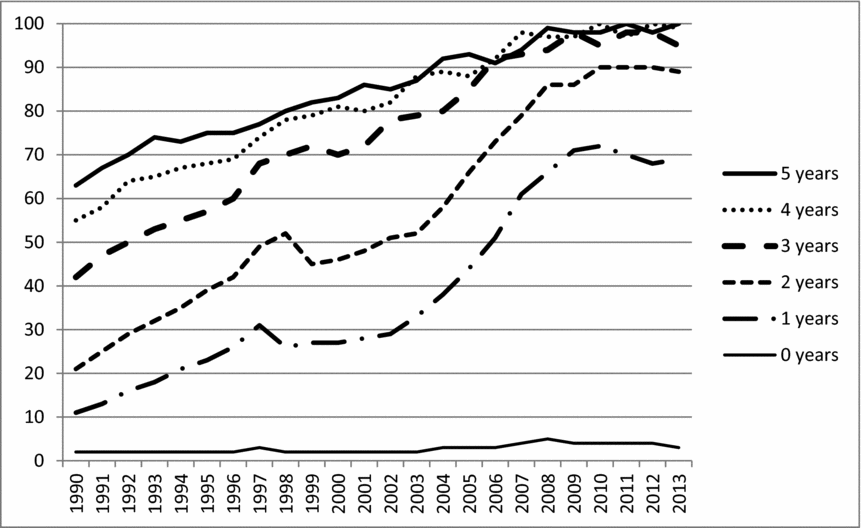
Childcare systems vary widely across welfare states. The Scandinavian welfare states were early in developing universal high-quality publicly funded services. Esping-Andersen (Reference Esping-Andersen2015) asserts that social democrats in the 1960s began to give priority to family policy and support for women's employment primarily in the name of gender equality. Within a couple of decades an essentially universalist childcare system had been established with extraordinarily high-quality norms in all respects and, in parallel, the establishment of very generous parental leave and child allowances. However, Scandinavian childcare history is more complex than is suggested by this account (e.g. Ellingsæter and Gulbrandsen, Reference Ellingsæter and Gulbrandsen2007; Leira, Reference Leira1992). Norway moved into the ‘social democratic space’ much later than Denmark and Sweden, with spending on childcare services as a percentage of GDP quadrupling between 1980 and 2009 (Ferragina and Seeleib-Kaiser, Reference Ferragina and Seeleib-Kaiser2015). Norway's latecomer position reflected a childcare system which had been evolving over a long period of time. The breakthrough of a truly universal system – in the supply of places, lowering of parents’ fees and the right to a place – actually occurred from the early to the late 2000s, a period that saw a formidable increase in childcare usage. From 2000 to 2010, there was a substantial increase in already quite high levels for 3–5 year olds, from 78 to 97 per cent; in effect, nearly all children of this age group were enrolled. An even more spectacular change ensued among the youngest children; coverage rates for the 1 and 2-year-olds rose from lows of 27 and 46 per cent, respectively, to highs of 72 and 90 per cent (Figure 1).
Childcare coverage by age of child, 1990–2013 (Per cent).
The question addressed here is whether this decade of marked policy transformation has influenced ideas about the suitability of institutional care for young children. The analysis is motivated by policy feedback theories, assuming that, once in place, institutions create feedback effects on the society from which they have arisen – major institutional changes will thus lead to attitudinal adaptation and change (Svallfors, Reference Svallfors2010). The analysis concentrates on childcare policy feedback effects among the target group, i.e. mothers with preschool-age children. Two specific questions are illuminated: Did mothers’ ideas about the best care for children change in the aftermath of childcare reforms? What typifies the changes and what mechanisms are likely to have been in play? The data are taken from representative surveys among mothers of preschool-age children in 2002 and 2010.
Policy feedback and attitudes
Family policy resources make some choices easy to realise, and they legitimise certain practices (Lewis, Reference Lewis2008). Childcare reform not only changes parents’ access to care resources, it may also bring about changes in the way parents think about care. Here, the policy feedback framework is employed as the analytical lens with which to investigate the relationship between policy change and mothers’ attitudes to childcare. Policy feedback is not a new concept, but it has recently been given more systematic theoretical and empirical attention (Kumlin and Stadelmann-Steffen, Reference Kumlin, Stadelmann-Steffen, Kumlin and Stadelmann-Steffen2014). Feedback effects were studied at the level of political elites, but the literature investigating effects of policy design on political behaviour and political attitudes among ordinary citizens is growing (Campbell, Reference Campbell2012). The policy feedback concept does not have a standard definition (Kumlin and Stadelmann-Steffen, Reference Kumlin, Stadelmann-Steffen, Kumlin and Stadelmann-Steffen2014). But in general it implies a deeper interplay of policy reform and impact going beyond the generation of electoral reward or punishment, i.e. policies can set political agendas and shape identities and interests, channel or constrain agency, define incentives and redistribute resources: policy reform may also influence beliefs about what is possible, desirable and normal (Soss and Schram, Reference Soss and Schram2007). The last-mentioned, representing a fairly broad notion of cultural policy feedback effects, is the point of departure of the present study and includes ‘normative feedback’, which is when public policies provide citizens ‘with a sense, not only of what their material interests are, but also the desirable state of affairs’ (Svallfors, Reference Svallfors2010: 120).
Increased empirical attention to policy feedback first occurred in the study of welfare-state-related attitudes (Kumlin and Stadelmann-Steffen, Reference Kumlin, Stadelmann-Steffen, Kumlin and Stadelmann-Steffen2014). It is assumed that social policy programmes become integral parts of a new status quo, shaping how different social groups interpret their relationship with the welfare state (Jordan, Reference Jordan2013). Two types of causal mechanism have been emphasised – psychological adaptations to institutionalised realities and policies structuring material interests (Kumlin and Stadelmann-Steffen, Reference Kumlin, Stadelmann-Steffen, Kumlin and Stadelmann-Steffen2014). However, identifying the mechanisms that link public programmes with individual attitudes remains a general challenge (Campbell, Reference Campbell2012). According to Campbell, the conditions under which feedbacks emerge, or fail to emerge, is a lacuna in the feedback literature.
Soss and Schram (Reference Soss and Schram2007) argue that the conditions under which feedback effects on attitudes should be seen as likely need to be specified. Their point of departure is that policies are not encountered by ‘the public’; they are encountered in different ways by different publics, and policy feedback processes vary across policy types. They propose a general analytical framework where the main distinction is between policy visibility and policy proximity. Visibility concerns the degree to which a policy is salient to mass publics. Proximity concerns the direct versus distant form in which a policy is encountered; the extent to which it will affect people's lives in immediate, concrete ways.
To our knowledge, there are no studies of policy feedback about childcare reform in terms of changing attitudes to childcare. However, attitudes to the role of governments in taking responsibility for providing childcare have been examined in several studies. A European study shows that support for such provision in general is high, although highest support is found in Northern Europe (Meuleman and Chung, Reference Meuleman, Chung and Ervasti2012). Moreover, findings indicate the existence of feedback effects of policies on attitudes related to both policy visibility and policy proximity.
Several studies indicate that policy visibility, in terms of existing childcare arrangements, shapes attitudes to the public provision of childcare services. A comparison of European countries shows that individual level support for government responsibility for childcare provision is related to a significant degree to the welfare regimes in which they are formed (Guo and Gilbert, Reference Guo and Gilbert2014). In another study of attitudes towards public childcare, comparing East and West Germany, it is suggested that existing childcare policy is the most important determinant (Goerres and Tepe, Reference Goerres and Tepe2012). Goerres and Tepe argue that existing policies entail ‘regime socialisation’, citizens socialised into demanding a level and quality of welfare state activities that mirrors the institutional framework. Cohort replacement, that is the process by which older generations are dying out and being replaced by younger generations with other attitudes, is a key mechanism through which welfare state attitudes change (see also Ellingsæter and Gulbrandsen, Reference Ellingsæter and Gulbrandsen2007; Svallfors, Reference Svallfors2010).
Some studies support the significance of proximity; social welfare preferences are affected by the particular benefits individuals associate with policies (Guo and Gilbert, Reference Guo and Gilbert2014). One study concludes that welfare state attitudes are influenced more by self-interest than by altruism; people with children tend to support more government provision with regard to family-relevant policies than other policy domains (Ainsaar, Reference Ainsaar and Ervasti2012). However, in another study of attitudes towards provision of public childcare, it is indicated that intergenerational solidarity is at work as well (Goerres and Tepe, Reference Goerres and Tepe2010). Still, individuals assumed to have a direct interest in the expansion of childcare services more often support government childcare provision: Women working longer hours, individuals with young children, those who have recently experienced childcare responsibilities.
Moreover, institutions such as the media influence how individuals perceive policies (Campbell, Reference Campbell2012). Schneider and Ingram's (Reference Schneider and Ingram1993) notion of social construction of target populations is relevant for understanding visibility and proximity as feedback mechanisms for the present study. They address the (subtle) messages of policy design, referring to the cultural characterisation and popular images of the groups whose behaviour and wellbeing are affected by public policy. Characterisations are normative and evaluative, portraying groups in positive or negative terms through symbolic language, metaphors and stories. Policy sends messages about what the government is supposed to do, the groups people belong to, what they deserve from government and what is expected of them; messages that are absorbed by citizens and affect their orientations.
The making of a universal childcare system in Norway
It is important to examine policies unfolding over time; social policies must be the starting point and not just the end point of analysis (Skocpol, Reference Skocpol1992, cited in Pierson, Reference Pierson1993: 627). Moreover, policy feedback rarely operates in isolation from features of the broader political environment, and the impact of policies is likely to occur in interaction with other policies and variables (Pierson, Reference Pierson1993). The evolution of childcare services in Norway is illustrative of these points.
Childcare services have gradually evolved in a complex interplay of increasing supply and rising demand (Ellingsæter and Gulbrandsen, Reference Ellingsæter and Gulbrandsen2007). ‘Full coverage’, i.e. places in childcare centres available to all parents who want a place for their child, has been an almost universal political aim, but its realisation has taken decades. In Norway, services are publicly subsidised and monitored, while ownership is a public/private mix (Ellingsæter, Reference Ellingsæter, Gambaro, Stewart and Waldfogel2014).
In the 1990s, the decade before the policy reforms examined here, coverage rates improved for all children aged 1–5 years (Figure 1). However, this was largely due to the removal of one age group from the childcare market when the mandatory school age was lowered from 7 to 6 in 1997 (Ellingsæter and Gulbrandsen, Reference Ellingsæter and Gulbrandsen2007). The expansion of actual places was much lower than in the two preceding decades. Moreover, places added for the 1–2 year olds were mainly in the form of ‘family kindergartens’ (usually one employee taking care of 4–5 children in one of the parents’ homes). These units were considered more ‘family like’ and thus better suited for the youngest children than were ordinary childcare centres with many children. With the exceptions of the public subsidy and some public control of the operation, they resemble private child-minder arrangements.
The gap between demand and supply was considerable (Ellingsæter and Gulbrandsen, Reference Ellingsæter and Gulbrandsen2007). About four in five mothers of preschool-age children were employed, including those with children under the age of three years but the demand for public childcare was overshadowed by the paramount policy debate of the 1990s, which was concerned with parents spending ‘more time' with children’ (Ellingsæter, Reference Ellingsæter2003). This was the goal when paid parental leave was extended to one year in 1993, and also of a cash-for-care reform introduced in 1998. Parents who did not use publicly subsidised childcare were to receive a monthly benefit equalling the state subsidy for a place in childcare services. The cash-for-care arrangement was based on the assumption that parental care was best for the youngest children. The controversy over the cash-for-care benefit, between centre-right proponents and the left-wing opposition, dominated the latter part of the decade. However, there were indications that cultural ideas of motherhood and childhood were changing. From the mid-1990s to the early 2000s, traditional attitudes to working mothers and negative views on childcare were disappearing (Ellingsæter and Gulbrandsen, Reference Ellingsæter and Gulbrandsen2007) through a combination of continuous liberalisation of attitudes in most age groups, and the replacement of older more traditional cohorts with more liberal ones.
Introduction of the cash-for-care benefit was not just the endpoint of a policy process, it opened up a new political space where processes transforming childcare provision into a universal system took shape in the following decade. With the cash-for-care benefit in place, the controversy could be put to one side (at least temporarily) (Ellingsæter and Gulbrandsen, Reference Ellingsæter and Gulbrandsen2007). Childcare services came to dominate the policy reform and policy discourse of the 2000s. In 2003, the majority opposition was instrumental in forging the all-party Childcare Compromise on legal and economic measures (Ellingsæter, Reference Ellingsæter, Gambaro, Stewart and Waldfogel2014; Ministry of Children and Family Affairs, 2003). Municipalities had responsibility for developing and managing childcare facilities but, in 2004, a legal obligation to provide a sufficient number of places was imposed. Public subsidies to services were to be increased substantially to 80 per cent of running costs. A maximum parent fee was introduced. The succeeding majority centre-left government, in office from 2005 to 2013, was strongly committed to achieving ‘full coverage’, allocating large funds to finance the expansion of places. A substantial number of part-time places were substituted with full-time places, which had been in short supply. Finally, in 2009 a right to a place in childcare services for children aged 1–5 was introduced. In 2012, the red–green government abolished the cash-for-care benefit for two-year-olds, while the amount of benefit was increased for one-year-olds.
As in many other countries, there was a shift towards a social investment paradigm motivating childcare provision in the 2000s (e.g. Jenson, Reference Jenson2004). Childcare services were increasingly being considered as part of life-long learning and as an investment in future productive citizens (Ministry of Children and Family Affairs, 2003). The traditional social pedagogical model was weakened to some extent, and there was more emphasis on investment in human capital (Ellingsæter, Reference Ellingsæter, Gambaro, Stewart and Waldfogel2014). This shift is also evident in the public discourse; more attention is now directed at the advantage of an early childcare start for children's cognitive development. For example, newspapers refer to research showing that an early start gives children a head start in school; parents should not be afraid of placing one-year-olds in childcare services (Aftenposten, 2015). But a rival discourse considers childcare harmful for one year olds; they are not ready to be separated from their parents. Childcare services of high quality are also considered an important arena for securing equal opportunities and reducing social inequality (e.g. NOU, 2012).
Hence, early in the 2000s, when the gap between supply and demand of childcare services was huge, especially for children under three years, mothers with preschool-age children had different experiences and most likely different childcare expectations from those of mothers at the end of the decade, (Figure 1). A survey in 1999 had indicated a substantial excess of demand over supply for childcare places among mothers of children aged 1–2 years (Reppen and Rønning, Reference Reppen and Rønning1999).
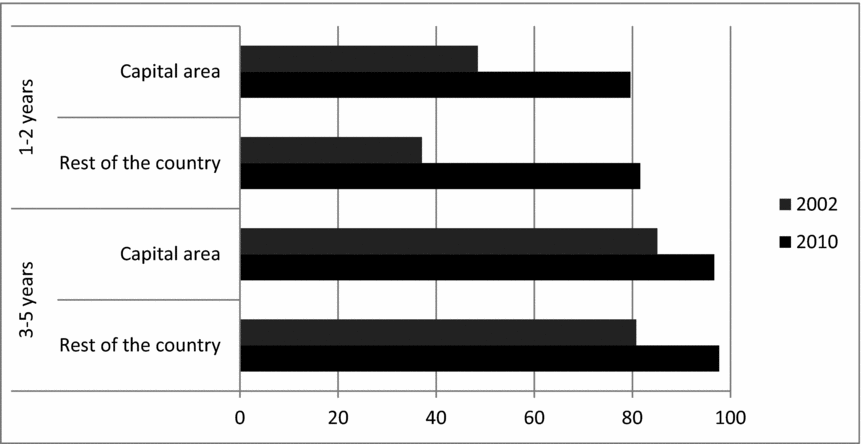
By 2010 the situation had dramatically altered. The greater number of places in the latter part of the decade closed most of the gap, despite the fact that declining fees had increased the demand for childcare even further. Still, in 2010, one in four received the cash-for-care benefit involuntarily while waiting for a place in childcare services (Moafi and Bjørkli, Reference Moafi and Bjørkli2011). Differences in coverage rates in 2002 between the capital area and the rest of the country, most notably among 1–2 year olds, had disappeared by 2010 (Figure 2). Enrolment of the youngest children in regions outside the capital actually moved ahead of the capital itself, which was probably related to the higher immigrant population in the capital. The proportion of parents receiving the cash-for-care benefit for one- and two-year-olds declined considerably in tandem with expanding childcare services (from 74 per cent in 2000 to 28 per cent in 2010) (Ellingsæter, Reference Ellingsæter2012). A minor decline in coverage rates among 1–2 year olds right after introduction of the cash-for-care benefit (Figure 1) could be taken as a change in the preferences of parents, but it probably reflected municipalities reducing the number of places in anticipation of a decline in demand that did not occur.
Childcare coverage by region and age of children, 2002 and 2010 (Per cent).
The 2000s saw equalisation in the use of childcare benefit. Socio-economic differences diminished: Childcare usage among parents with lower income and education increased relatively more compared to other groups (Kitterød et al., Reference Kitterød, Nymoen and Lyngstad2012; Sæther, Reference Sæther2010). The small minority of parents of children aged 3–5 not attending were less well educated and had lower income than other families (Sæther, Reference Sæther2010). Variation in childcare enrolment among children of 1–2 years of age, the target group for the cash-for-care benefit, differed more. Enrolment was lower among children of mothers with only primary education and non-Western immigrant background, and in families with no earners (Kitterød et al., Reference Kitterød, Nymoen and Lyngstad2012). Although there were still socio-economic differences, the relationship between mothers’ employment and usage of childcare services weakened.
Data
The data are from two telephone-based surveys on children's care arrangements in Norway. The surveys were undertaken by Statistics Norway, on behalf of the Ministry of Family Affairs, in the spring of 2002, and the Ministry of Education and Research and the Ministry of Children, Equality and Social Inclusion in the autumn of 2010. In 2002, 3,176 mothers with at least one child under six years of age were interviewed, representing a response rate of 82 per cent. Mothers of children under three years of age were over-represented in the sample, which has been adjusted by a sample weight in the analysis. Number of observations is shown unweighted. In 2010, 3,262 parents of children 0–9 years of age were interviewed; the response rate was 54 per cent. A combined sample and non-response weight rate was calculated in order to adjust for overrepresentation of certain groups in the sample. The surveys were supplemented with information from various administrative registers (e.g. education, income, country of birth) and are documented in Pettersen (Reference Pettersen2003) and Wilhelmsen and Löfgren (Reference Wilhelmsen and Löfgren2011).
The two surveys differ in focus and content, but include some of the same questions covering parents’ attitudes to care arrangements for children, which is the dependent variable in the present article (see discussion of differences and similarities between the surveys in Kitterød et al. (Reference Kitterød, Nymoen and Lyngstad2012)). The analysis is restricted to a subsample of partnered mothers (married and cohabiting) whose youngest child is 0–5 years of age, as measured at the end of the year. Single mothers have been omitted from this analysis partly because of specific policy measures for this group that may influence attitudes to various childcare arrangements, and partly because of their different choice situation related to, for example, household income. After excluding a few observations with missing information on two of the independent variables (mother's working hours and country of birth), our subsamples comprise 2,608 mothers in 2002 and 1,761 in 2010.
Mothers’ attitudes to various childcare arrangements, in particular the use of childcare services, are investigated by undertaking identical bi-variate and multivariate analyses for 2002 and 2010. Some analyses on a pooled data-file are conducted in order to examine the effect of survey year when differences in the composition of the analysis samples are controlled for.
Dependent variable
The dependent variable is constructed from the mothers’ answers to a question on the type of childcare arrangement they considered best for children of different ages (zero, one, two, three, four and five years). They were given a list of ten different arrangements with the option to combine alternatives: Mother, father, relative, nanny, au pair, ‘family kindergarten’, regular childcare services, ‘barnepark’ (outdoor care 3–4 hours per day), ‘open childcare’ (a place where parents/nannies could gather with their children on a couple of mornings per week, facilitated by pedagogical staff), and other arrangements. The Norwegian term for childcare services is kindergarten (barnehage), but here ‘childcare services’ or ‘childcare’ is used interchangeably. Based on the answers to these questions, a dependent variable ‘best childcare arrangement’ was constructed with four categories: 1) ‘Parents only’: Those who answered mother and/or father and no alternative. 2) ‘Childcare services only’: Those who answered either regular childcare services or ‘family kindergarten’ and no alternative. 3) ‘Childcare services in combination’: Those who answered regular childcare services or ‘family kindergarten’, combined with one or more other arrangement. 4) ‘Other arrangements only’: All other arrangements, alone or in combination.
Independent variables
The independent variables include both explanatory and control variables. The main explanatory variables express policy proximity, that is, self-interest (education, employment/working hours, income) and policy visibility, that is, existing childcare structures. Of particular interest is whether differences in attitudes between mothers in various socio-economic groups and mothers in various parts of the country changed during the period. Differences in the composition of the analysis samples are controlled for. The explanatory variables are operationalised as follows:
Self-interest
Unfortunately information about mothers’ actual use of childcare services for children at different ages is not available. Mother's educational attainment: Taken from official registers, this differentiated between mothers with high school education or less and mothers with a university education. In addition, a category for observations with missing information on education includes mothers who have not been educated in Norway (mostly immigrants). Mother's employment and working hours: Based on survey information, this variable is differentiated among mothers who are not gainfully employed, mothers who usually work 1–29 hours per week, 30–39 hours per week and at least 40 hours per week. Those who were on parental leave at the time of the survey are categorized according to their employment status prior to the leave. The couple's net income in 2009 NOK: The sum of the mother's and her partner's income is taken from official registers and includes wages and salaries, net income from self-employment, various pensions and social security benefits, and net capital income. Income quintiles are used in the analyses.
Existing childcare structures
Region: Taken from administrative registers distinguished between those living in the capital area (Oslo/Akershus), on the one hand, and those in the rest of the country, on the other. Previous studies have shown that intra country differences in childcare provision caused by local decisional autonomy are common (e.g. Andronescu and Carnes, Reference Andronescu and Carnes2015; Evers et al., Reference Evers, Lewis and Riedel2005). Hence levelling off institutional differences may affect mothers’ aggregate attitudes.
Control variables
Number of children 0–5 years and 6–17 years in household are taken from the population register and used as continuous variables in the multivariate analyses. Age of youngest child in household: This is the child's age at the time of the interview taken from the population register. A set of dummies was included where mothers of a one-year-old child are used as reference. Mother's country of birth: taken from official registers distinguished between mothers born in 1) Norway, 2) EU/EEA, USA, Canada, Australia and New Zealand, and 3) Africa, Latin America, Oceania except Australia and New Zealand, and Europe outside EU/EEA. A more detailed classification of countries is not possible given the size of the sample, but distinguishing between the two groups of foreign-born mothers actually captures crucial differences with regard to childcare usage and employment rates (Moafi and Bjørkli, Reference Moafi and Bjørkli2011). Survey year: Dummy variable with 2002 as reference.
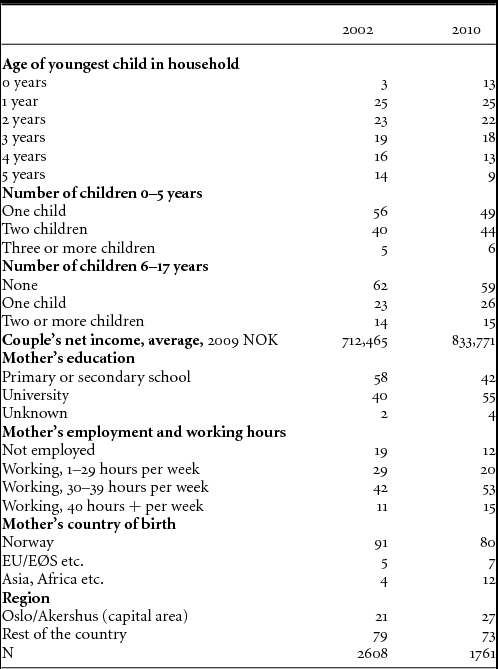
Descriptive statistics for the independent variables are presented in Table 1. The net income of couples was higher in 2010 than in 2002, as were the percentages of mothers with a university education, mothers who worked for pay for at least 30 hours per week, and also foreign-born mothers.
Descriptive statistics for the independent variables. Percent and average.
Changes in mothers’ attitudes to childcare: 2002 and 2010
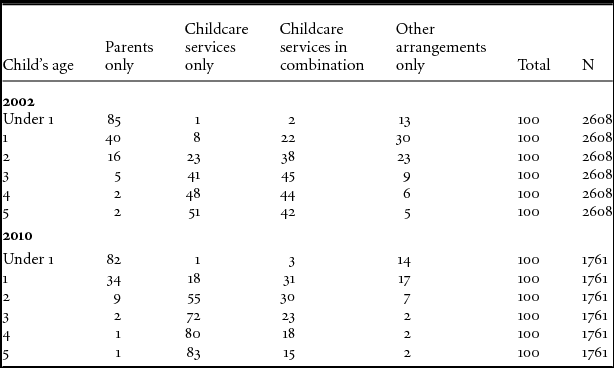
Childcare reforms of the 2000s were accompanied by major shifts in the attitudes of mothers to the best form of care. A move towards ‘childcare services only’ was the main trend. Childcare services in 2002 already had a strong position among mothers for the 3–5 age groups. The majority considered either ‘childcare services only’ or the more conditional alternative ‘childcare services in combination’ as the best forms of care for this age group, with more or less equal shares on both alternatives. In 2010, however, the proportion of mothers preferring ‘childcare services only’ had increased strongly from 41–51 per cent to 72–83 per cent (Table 2). Very few thought that children in these age groups should be cared for by parents only or other arrangement not including childcare services. For two-year-olds, the proportion of mothers who believed that ‘childcare services only’ was best also increased significantly, i.e. from 23 per cent in 2002 to 55 per cent in 2010. All other alternatives became less common and, in particular, it is worth noting that in 2010 only nine per cent believed that two-year-old children should be looked after by their parents only. As for the one-year-olds, a sizeable proportion in both years believed that parents only was the best childcare solution, but many also considered ‘childcare services in combination’ or ‘other arrangements only’ as the best. In 2002, only 8 per cent believed that ‘childcare services only’ represented the best arrangement; by 2010 this had increased to 18 per cent. ‘Childcare services in combination’ was more common in 2010 than in 2002, while ‘other arrangements only’ and ‘parents only’ were less common. Attitudes to the best care for children under the age of one remained virtually unchanged. In both 2002 and 2010, nearly all mothers believed that children below one year of age should be looked after by the parents only.
Mothers’ attitudes towards best care arrangement for children at different ages. 2002 and 2010. Percent
Thus, in general, mothers of preschool-age children in 2010 were far more positive about ‘childcare services only’ as best for children of all ages than were mothers in 2002. In examining whether this also holds when differences between the analysis samples are taken into account, we analysed the pooled data-file with survey year included as an independent variable in addition to the other independent variables. As for the dependent variable, ‘best childcare arrangement’, a dummy with two possible outcomes is used, namely ‘childcare services only’ vs. all other arrangements. The analysis is undertaken by logistic regression and estimates are presented as odds ratios. This means that the reference group of a categorical variable is set to 1; while coefficients above 1 indicate a positive effect and below 1 a negative effect. We conducted identical analyses for mothers’ attitudes to the best care arrangement for children at all ages except those under one year, since almost nobody believes that children of this age should attend childcare on a full-time basis.
The estimated effects of survey year show that, for children at all ages, mothers were more likely in 2010 than in 2002 to mention ‘childcare services only’ as the best childcare arrangement, and this was the case even when all other independent variables were controlled for (Table 3). A multinomial logistic regression was also conducted, estimating the odds of ‘childcare services only’, ‘childcare services in combination’ and ‘other arrangements only’ being preferred to ‘parents only’. Recall Table 2, however, indicating that in both surveys very few mothers preferred ‘parents only’ for children in the oldest age groups. As reported in Table 4, mothers were more likely in 2010 than in 2002 to prefer ‘childcare services only’ over ‘parents only’ for children at all ages. For children one and two years of age, mothers were also more likely in 2010 than in 2002 to prefer ‘childcare services combined’ rather than ‘parents only’.
Logistic regression of changes from 2002 to 2010 in attitudes towards best care arrangement for children at different ages. Kindergarten only rather than all other arrangements. Odds ratios. N= 4369.
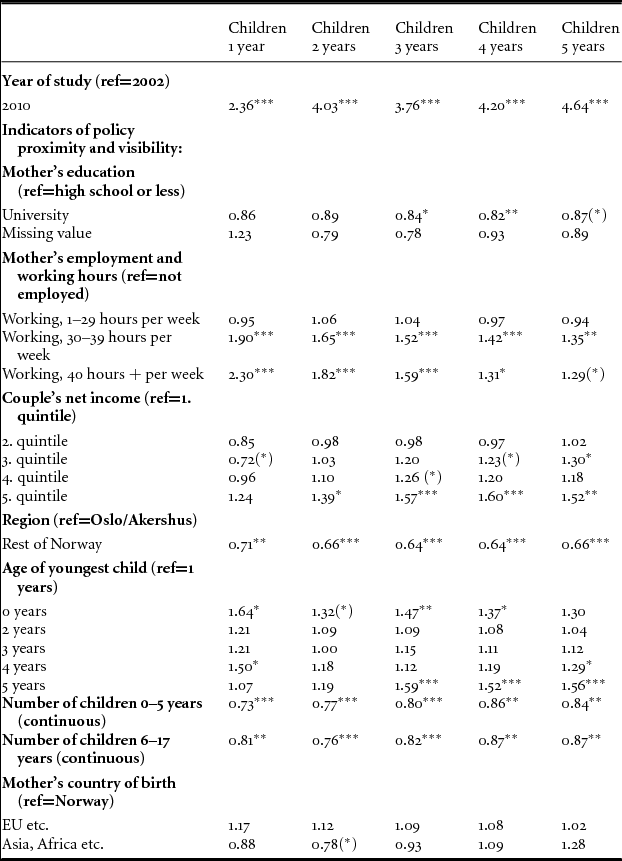
*** significant at 0.001-level, ** significant at 0.01-level, * significant at 0.05-level, (*) significant at 0.10-level.
Multinomial logistic regression of changes from 2002 to 2010 in attitudes towards best childcare arrangement for children at different ages. Reference category=only parents. Odds ratios. N=4369
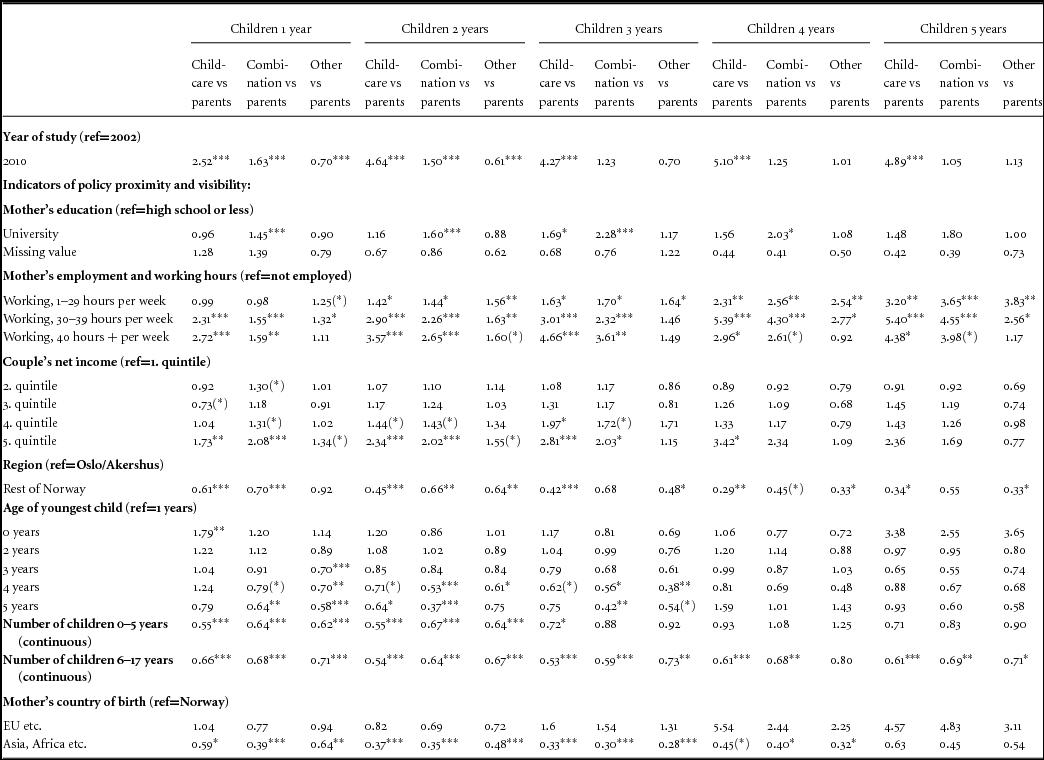
*** significant at 0.001-level, ** significant at 0.01-level, * significant at 0.05-level, (*) significant at 0.10-level.
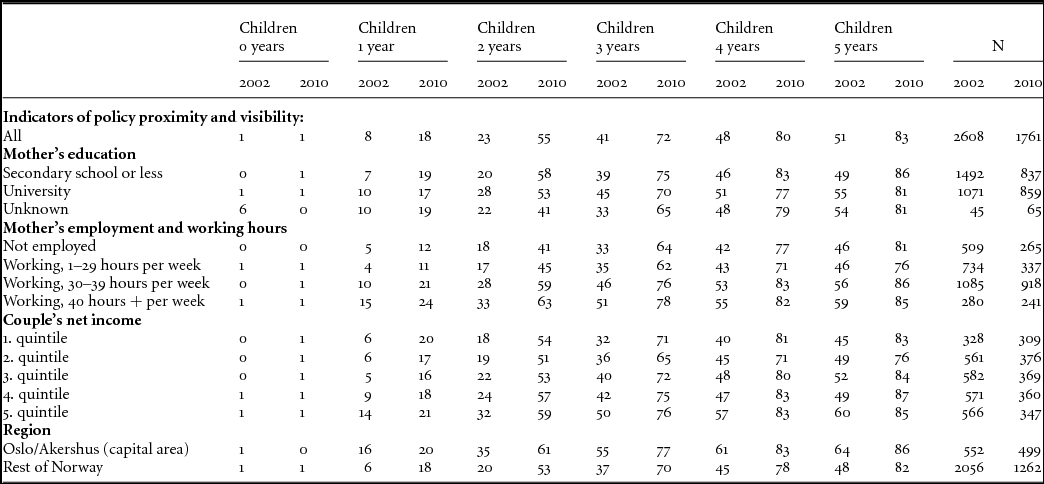
Now to the question about whether the childcare preferences of mothers in various socio-economic groups and in various parts of the country differed less in 2010 than in 2002; that is, whether all groups of mothers became more positive towards the use of childcare on a full-time basis in this period and whether the changes were more pronounced in certain groups than in others. Table 5 gives the percentages of mothers in various socio-economic groups and in different parts of the country who believed that ‘childcare services only’ was the best childcare arrangement for children at different ages in 2002 and 2010. The proportions supporting fulltime childcare increased among all groups of mothers in the 2002 to 2010 period for children at all ages except those below one year. Both less educated and highly educated mothers more often supported ‘childcare services only’ in 2010 than in 2002, and the same was the case for mothers in all income groups, employment statuses and parts of the country. It seems, however, that positive attitudes to ‘childcare services only’ increased more among mothers living outside the capital area than among those within it, and more so among the less educated than the highly educated.
Percentage of mothers who consider childcare services only is the best care arrangement for children at different ages. 2002 and 2010.
To gain a better understanding of possible changes in the associations between mothers’ attitudes to childcare and the various independent variables, a set of identical multivariate analyses was run for 2002 and 2010. The dependent variable was a dummy distinguishing between mothers who believe that ‘childcare services only’ is the best arrangement, on the one hand, and those favouring any of the other arrangements, on the other. Results from logistic regressions are reported in Table 6. For most variables the estimated effects are fairly similar in 2002 and 2010, which indicates that the change towards more positive attitudes concerning ‘childcare services only’ took place among most groups of mothers. There are some exceptions related to the two explanatory variables, visibility and proximity, that is, region and self-interest.
Logistic regression of attitudes towards best care arrangement for children at different ages. Childcare services only rather than all other arrangements. Odds ratios. N=2608/1761
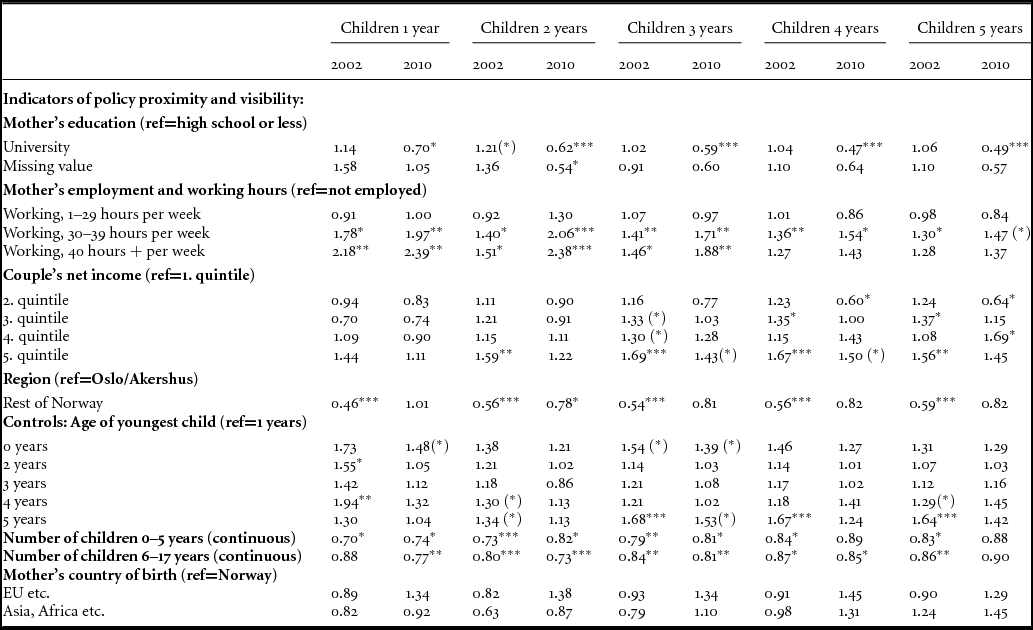
*** significant at 0.001-level, ** significant at 0.01-level, * significant at 0.05-level, (*) significant at 0.10-level.
While there was a strong negative effect of region in 2002 in all models, the 2010 models produced no significant effects, except for mothers’ attitudes to the best childcare for two-year-olds when the effect was negative. In an additional analysis (not shown) an interaction term between region and survey year was included in order to indicate whether the differences between the 2002 and 2010 estimates were statistically significant. There were large and statistically significant interaction terms for children at all ages, which meant that the effect of region differed significantly between the two surveys. While mothers in the capital area were more positive towards full-time childcare than mothers in the rest of the country in 2002, there were no clear differences in 2010, except in the case of childcare for two-year-old children. As can be seen in Table 5, this results from the more significant increase in preference for institutional childcare among mothers living outside the capital area than among those living within it, where the support for ‘childcare services only’ was already high in 2002.
In addition, when it comes to one of the indicators of reform proximity, or self-interest, the effects of mothers’ education differ between 2002 and 2010. In 2002, there were no statistically significant effects of mothers’ education, except for the two-year-olds, where university educated mothers were more inclined than the less educated to prefer ‘childcare services only’ to other categories taken together. But, by contrast, there were clear negative effects of being university educated in 2010. Additional analyses (not shown), including an interaction term between mother's education and survey year, yield significant interaction terms in all models. Hence, the effect of mothers’ education differs significantly between the two surveys. It may be surprising that in 2010 the less educated mothers, more than the most highly educated, were inclined to favour ‘childcare services only’ as the best childcare solution. However, further analyses reveal that, although university-educated mothers more often point to ‘childcare services in combination’ as being the best type of childcare, this does not mean that they prefer ‘parents only’ or ‘other arrangements only’ more often than the less educated. In an additional analysis the two categories ‘childcare services only’ and ‘childcare services in combination’ were collapsed and the odds of preferring either alternative rather than the other two categories were estimated. There were no significant effects of being highly educated in 2010 (results available on request).
As far as the other indicators of reform proximity or self-interest are concerned, i.e. mothers’ employment and working hours, attitudes were similar in 2002 and 2010. The main pattern at both points in time was that mothers in full-time work were more supportive of ‘childcare services only’ as the best form of care for children at all ages than were mothers working part-time, compared to mothers not employed. The third indicator of self-interest, the couple's net income, does not reveal any systematic pattern. Support of ‘childcare services only’ seems to have been relatively stronger in the highest income quintile early in the decade and weakened over time, but the change was not statistically significant.
Universalising services, changing attitudes
The normality and desirability of institutionally based childcare challenges deep-seated traditional family norms and values historically contested in Norway just as in many other countries. The present study demonstrates the usefulness of contributions from the policy feedback literature in expanding our understanding of the processes that may or may not generate attitudinal change.
The present Norwegian case addresses feedback effects related to extensive policy change from the early to the late part of the 2000s. The accomplishment of a universal childcare system in terms of supply of places, lowering of parents’ fees and the right to a place represented a major expansion of childcare resources. This, together with a substantial increase in childcare enrolment, was especially striking among children 1–2 years of age. The role of childcare in the bringing up of children was reinforced, but also equalised as enrolment increased relatively more among children from less well-resourced backgrounds. The analysis of survey data from 2002 and 2010 has established that change in policies and practices was followed by attitudinal change. Support of ‘childcare services only’ as the best form of care saw a massive increase. In 2010 the majority of mothers believed that this was the best for children aged 2–5 years; a change from 2002 which represented an average increase of about 30 percentage points. Attitudes regarding one-year-olds were still divided, but childcare services became more positive as an alternative. Attitudes were stable only with regard to children under one, where it is believed that parents are still the best carers. Regional differences in attitudes disappeared in tandem with equalised institutional structures, and attitudes became more positive across all socio-economic groups. Change in the socio-economic composition of mothers at the two points in time does not explain these trends. Attitudinal change thus signifies the emergence of a new norm: institutional care for young children is not only normal, but desirable.
As already noted, however, a main challenge in the feedback theory literature is how to determine the extent to which attitudinal change is a feedback effect of policy change. The association between institutional change and attitudinal change is difficult to disentangle (Campbell, Reference Campbell2012; Guo and Gilbert, Reference Guo and Gilbert2014; Jordan, Reference Jordan2013; Svallfors, Reference Svallfors2010). There are many processes of change occurring at the same time, and institutional change takes place mostly through incremental processes, which complicates the separation of effects (Svallfors, Reference Svallfors2010). The possibility that attitudinal change in the Norwegian case was generated by other unmeasured changes cannot be ruled out, though assuming that similar changes are occurring in other welfare states with less, or no, policy change is not plausible. Yet there are no available studies or data to validate this. On the other hand, some features of the present study strengthen the likelihood of policy feedback effects. One aspect setting this study apart is that although policy changes in the period examined were part of a long-term incremental process, they were extraordinary in finalising a fully universal childcare system. Another is that the data are unique, covering the target group before and after this particular period of institutional change.
Moreover, conditions and mechanisms that make feedback effects more or less likely can be productively assessed by applying the concepts from the policy feedback literature previously outlined: policy visibility and proximity, and the social construction of target groups. Childcare policy change in Norway can be labelled ‘visible-close’: Policy visibility increased substantially. Policy proximity was very high for the target group, mothers with preschool-age children, constituting an ‘affected public’ likely to pay close attention to changing policy realities (Soss and Schram, Reference Soss and Schram2007).
Policy visibility of childcare changed profoundly during the 2000s, not just of existing childcare structures, but also of discourses. While mothers’ attitudes in 2002 articulated regional differences, this had disappeared by 2010, when variation in access to childcare institutions had been levelled out. Support of universal childcare may be part of a modernisation process spreading from urban areas to the rest of the country in tandem with service expansion. The policy and media discourses both shifted from a focus on ‘more time with children’ to recognition of the existence of parents’ ‘childcare squeeze’. Parents demanding a sufficient number of full-time places, especially for the youngest children, moved centre stage. The substantial expansion of childcare resources – with childcare as a social right the crowning achievement – signalled that the government was being responsive to the needs of the target group (working parents/mothers) and that their interests coincided with those of the public (see Schneider and Ingram, Reference Schneider and Ingram1993). These developments are likely to have undermined the long-standing ambivalence surrounding institutional childcare.
One mechanism behind policy feedback effects may have been ‘regime socialisation’ (Goerres and Tepe, Reference Goerres and Tepe2012) reflecting the different institutional setup encountering mothers at the end of the 2000s compared to the beginning. Following this line of reasoning, new mother cohorts are socialised into different expectations and attitudes regarding public childcare from the ones they are replacing, which will result in an aggregate change in attitudes. However, this is likely to be only a partial effect, as mothers in our two samples do not represent completely different cohorts; only eight years between the surveys means that some mothers in 2010 may also have had children of the relevant age(s) in 2002. A period of comprehensive institutional and behavioural change may also involve social multiplier effects (Glaeser et al., Reference Glaeser, Sacerdote and Scheinkman2003). The vanishing of regional differences in attitudes may also in part be influenced by the aggregate change in attitudes of others, as may the more positive attitudes across socio-economic groups.
The heightened support for childcare as the best form of care may also reflect changing ideas about what childcare is good for. Childcare as an investment in the early development of children has gained more prominence as a policy rationale. It has attracted a lot of attention in media discourse, informed by new research advocating the benefits of childcare for the cognitive abilities of children, especially children from disadvantaged backgrounds. It is interesting to note, however, that the higher educated mothers, although to a lesser extent than the less well educated, now favour ‘childcare services only’ as the best alternative; relatively more of them prefer ‘childcare services in combination’. Advocacy of the blessings of childcare may reduce trust in parents’ own abilities in less resourceful groups.
Policy proximity also changed in the time period examined. Citizens encounter and internalise policy messages not only through observation of politics and media coverage, but also through their direct personal encounter with public policy (Schneider and Ingram, Reference Schneider and Ingram1993). As ever more mothers, in all socio-economic groups, have direct experience with childcare services, supporting this as the best form of care could be a justification of their own practices. But it may also be that they actually experience childcare as the best. This is corroborated by parents – both middle and working class – reporting a high degree of trust in childcare services (Ellingsæter and Pedersen, Reference Ellingsæter and Pedersen2015), and that parents are more satisfied with the quality of services (www.epsi-rating.com).
Finally, policy feedback effects are likely to be conditioned on the timing of reform. Policy change may go with the stream, or it may go against it (Campbell, Reference Campbell2012). The long-lasting huge gap between demand and supply of childcare in Norway is a blatant example of lags between family policies and actual changes in family practices and preferences. This study indirectly indicates that not all institutional changes have feedback effects on attitudes (see Svallfors, Reference Svallfors2011). Policies instituted to reverse or hold up change, which was the case with the cash-for-childcare reform in Norway, are much less likely to produce feedback effects. Still, the cash-for-childcare benefit, and the surrounding discourse, which neglected parents’ needs for childcare services, may have meant that the ambivalence towards institutional childcare would linger on. But by the early 2000s, parents’ receptivity to childcare had been growing for some considerable time. Childcare policy change legitimated the suppressed preferences of the target group, rewarding individuals who lived up to them, reinforcing attitudes underpinning these practices, and all making for the extraordinarily rapid attitudinal change that was to come.


 Open access

