

The number of students who complete archaeology and anthropology degrees is relatively small worldwide, especially since the job market and funding pools are tiny (Arendt Reference Arendt2013; Colley Reference Colley2004; Collis Reference Collis, Rainbird and Hamilakis2001; Pyburn Reference Pyburn, Bender and Smith2000). In the United States, for example, access to and awareness of such fields and professions is not as widespread as for other disciplines (Agbe-Davies Reference Agbe-Davies2002; Franklin Reference Franklin1997; Pyburn Reference Pyburn, Bender and Smith2000). With challenges such as these, most undergraduate students in the United States enroll in archaeology and anthropology courses to complete general education requirements in the liberal arts, laboratory analysis, history, and social awareness, or to fulfill their personal interests (Agbe-Davies et al. Reference Agbe-Davies, Galle, Hauser and Neiman2014; Fagan Reference Fagan1992, Reference Fagan2000). Therefore, American undergraduate anthropology departments, in which archaeology specializations and courses are usually housed, typically have relatively small numbers of majors, although their faculty and course offerings may support popular minor programs and general higher education learning.
Within this common American context of teaching anthropology to small groups of majors in addition to the masses, students, as well as faculty and administrations, may grow skeptical of the discipline. For instance, based on my personal observations, students may wonder why they need to take anthropology courses other than to complete graduation requirements. In addition, although small-group learning has benefited many students in my department and across multiple disciplines (Stein et al. Reference Stein, Colyer and Manning2016; Vega and Tayler Reference Vega and Tayler2005; Wilson et al. Reference Wilson, Goodman and Cronin2007; Yamarik Reference Yamarik2007), I have witnessed some students doubt their choice of study because they are not enthusiastic about small cohorts. Faculty may stress over how to effectively teach anthropology to both majors and nonmajors, who may have differing degrees of interest in the subject. Administrators may provide less funding to programs that serve only small numbers of majors, despite the larger numbers of nonmajors who enroll in the courses. And in light of current national and international political and social climates, people both within and outside of colleges and universities may question the roles and effectiveness of such programs in students' personal and professional development. To help address such circumstances, the Society for American Archaeology (SAA) created a curricular task force charged with establishing helpful teaching guidelines (Kamp Reference Kiddey2014; see also Bender Reference Bender, Bender and Smith2000). The task force prepared seven guiding principles for teaching archaeology, including
1. Discuss the importance of stewardship;
2. Take into account the diverse pasts of stakeholders;
3. Articulate the social relevance of the past;
4. Include a consideration of archaeological ethics and values;
5. Teach effective written and oral communication;
6. Provide fundamental archaeological skills;
7. Incorporate real-world problem-solving.
The SAA also provided suggestions on how to structure courses to effectively address each principle (Bender Reference Bender, Bender and Smith2000; Carter Reference Carter2014; Jenks Reference Jenks2014; Jones Reference Jones2014; Kamp Reference Kamp2014; Newman and West Reference Newman and West2014; Seebach Reference Seebach2014; Stone Reference Stone2014; Wholey and Nash Reference Wholey and Nash2014). In courses dominated by nonmajors, such as introductory sections, the guidelines recommend emphasizing how archaeology benefits stewardship, diverse interests, and society at large. In intermediate and upper-level courses where archaeology majors may dominate, the SAA recommends that these principles be addressed, along with professional ethics, communication, basic archaeological skills, and real-world problem-solving.
This article demonstrates how I enable active, interdisciplinary learning environments at Utica College, providing experiences that embody current academic frameworks of my department, my institution, and the Society for American Archaeology. In particular, I examine a simulated excavation performed in Introduction to Archaeology (ANT 267) and the final research paper or project conducted in Archaeology of North America and the Caribbean (ANT 323). In the simulated excavation, students reflect on how archaeology may complement other fields and vice versa. In the final project, students combine archaeology with other disciplines to create and explore new information. Such multilayered approaches help students learn, apply, and contribute to archaeology and other practices in ways that prepare them to address change and uncertainty through the practice of creativity and thoughtfulness. I follow this discussion by offering suggestions on how to better link such strategies and courses to broader academic programs in order to continue to build on student success. By incorporating the different educational goals and outcomes via active learning methods in these assignments, I argue that instructors can help majors and nonmajors in at least three ways.
First, through engaging, student-centered activities complemented by guided instruction (Smith and Burke Reference Smith and Burke2005), faculty can help student populations who are diverse in interests as well as backgrounds, abilities, and needs understand and apply different archaeological approaches so that they may recognize the field's contributions to societies around the world. Second, instructors can highlight transferable skills within archaeology's methods, theories, and social contributions, such as critical thinking and cultural relativism as applied through archaeological field methods, qualitative and quantitative analysis, data visualization, oral communication, writing, project management, and teamwork (Arendt Reference Arendt2013; Bartoy Reference Bartoy, Skeates, McDavid and Carman2012; Kiddey Reference Kiddey2011). Finally, by exploring archaeology as a multimethod, interdisciplinary field, students can be encouraged to build on archaeology's potential in working with other disciplines. In turn, learners can not only enhance their own interdisciplinary skills of citing common ground and differences across disciplines but also use this insight to foster efficient collaboration across fields in order to create meaningful innovations and reflections in response to various problems and concerns (Arendt Reference Arendt2013; Coleman and Simpson Reference Coleman and Simpson1999; Mazur-Stommen Reference Mazur-Stommen2006; Repko et al. Reference Repko, Szostak and Buchberger2017).
Whether students major in archaeology, anthropology, or another program, they can develop interdisciplinary perspectives and learn how to communicate and innovate across stakeholder groups. They will devise strategies for analyzing and solving problems using multiple lines of information—skills important for success in archaeology and many other fields and professions, especially those concerned with sustainably addressing pressing needs and problems around the world (Arendt Reference Arendt2013; Hamilakis Reference Hamilakis2004; Repko et al. Reference Repko, Szostak and Buchberger2017; Smith and Burke Reference Smith and Burke2005). With these goals in mind, courses and teaching approaches can question stereotypes depicting archaeology as a “useless” discipline (Arendt Reference Arendt2013:79), and they can prepare students to engage in and adapt to countless personal and professional situations while also learning about archaeology, its benefits, and its potential to work with both similar and different fields. The active learning of multimethod, interdisciplinary archaeology, therefore, can prepare college-level students to address change and uncertainty in their homes, communities, and professions.
UTICA COLLEGE IN CONTEXT: A BRIEF HISTORY AND DESCRIPTION OF ITS ACADEMIC STRUCTURE
Before addressing the ANT 267 excavation and the ANT 323 final project, I provide a brief history and overview of Utica College and its academic structure. In 2016, Utica College celebrated its seventieth anniversary as an institution of higher education. It was founded by Syracuse University in 1946, with assistance from the GI Bill, and it largely functioned as an extension campus (Crisafulli Reference Crisafulli2000:xiii–xiv). Since Utica's beginning, the college has been a small, predominantly undergraduate institution where students pursue majors informed by the liberal arts and professional programs (Behrens Reference Behrens1997; Crisafulli Reference Crisafulli2000). In 2011, Utica College became fully independent from Syracuse as it began to offer its own degrees to all incoming students. Currently, over 5,000 full-time and part-time students are enrolled in face-to-face, online, hybrid, or blended programs (Utica College 2019a).
Utica College is currently composed of three academic schools: the School of Business and Justice Studies, the School of Health Professions and Education, and the School of Arts and Sciences. The first two schools are predominantly composed of professional training programs, such as Business Management, Criminal Justice, Nursing, and Elementary Education. The School of Arts and Sciences contains a variety of programs often grouped under STEAM (Sciences, Technology, Engineering, Arts, and Mathematics), such as biology, computer science, physics, social sciences, and the humanities. The Sociology and Anthropology Department, of which I am a member, sits within the college's social sciences programs, and it offers a combined sociology and anthropology major, as well as minors in anthropology, sociology, gender studies, and aging studies. Within the major, this department currently provides students the ability to choose one of five specializations: archaeology, cultural anthropology, criminology, gender, or a “build your own” option in which students can take any of the department's elective courses to design their own program of study within the major. Introduction to Archaeology (ANT 267) is a required course for students who want to complete the archaeology specialization, whereas Archaeology of North America and the Caribbean (ANT 323) is an elective they can take within the course of study.
Utica's School of Arts and Sciences provides the majority of the college's liberal arts courses, many of which are offered through the Sociology and Anthropology program. Liberal arts courses form an important and necessary part of not only Utica's mission but the mission of most not-for-profit American institutions of higher education. While varying definitions of liberal arts or liberal education exist (Mulcahy Reference Mulcahy2009), Utica College, through advisement from the New York State Education Department (2018), builds its liberal arts courses around the goal of exposing students to (Utica College 2019b)
1. Critical-thinking, primarily for acquisition of broadly applicable skills;
2. Normative questions (What ought to be?) rather than solely descriptive questions (What is?);
3. Theory extending beyond the immediate field of inquiry;
4. Broader social or ethical implications of what is being taught;
5. A sense of responsible citizenship.
Utica provides an array of liberal arts courses, most of which help students achieve the institution's mission of developing skills for lifelong learning, success, and ethical integrity, as well as seeking out and understanding diverse perspectives. To achieve such goals, Utica College and its faculty promote the development of the following five key intellectual skills: communication, critical analysis and reasoning, quantitative literacy, synthesis, and social awareness (Utica College 2019c).
Utica's standards for liberal arts and its five key intellectual skills overlap with the SAA's seven guiding principles by promoting social and historical awareness, informed citizenship, critical thinking, communication, and ethical responsibility. The college's Sociology and Anthropology Department (Utica College 2019d) is also aligned with the aforementioned initiatives by upholding its newly revised learning goals.
Students will
1. Apply a sociological and anthropological perspective.
2. Recognize, assess, and apply the methods of sociological and anthropological research.
3. Identify and interpret the major theoretical perspectives in sociology and anthropology.
4. Demonstrate an understanding of diversity within and between societies and across geographic regions.
Utica's archaeology courses integrate the SAA teaching principles, the college's key intellectual skills and liberal arts mission, and the Sociology and Anthropology program's learning goals through their focus on the relevance of archaeological methods, theories, and information to societies around the world and to real-world problem-solving. Yet the potential of Utica's archaeology and anthropology courses, particularly intermediate- and advanced-level classes, to offer important professional and personal development opportunities to a variety of students is not always realized.
This occurs for multiple reasons. First, although the Sociology and Anthropology Department teaches many students on campus and online in introductory anthropology and sociology courses as part of Utica's general education requirements, as well as in a few upper-level courses that have been well integrated into the course offerings of other programs, intermediate and upper-level courses such as ANT 267 and ANT 323 that have no formal ties to other departments and educational programs see less enrollment. The lower enrollment in such courses is due to the relatively small number of sociology and anthropology majors when compared with the number of students enrolled in other programs. Over the last three years, Utica's Sociology and Anthropology Department has had, on average, 20 enrolled majors, which is about the tenth highest number out of 20 programs in the School of Arts and Sciences (Utica College Factbook 2018). In contrast, the number of students majoring in programs within the School of Health Professions and Education as well as the School of Business and Justice Studies over the last few years has typically ranged from about 40 to over 200. These schools, as well as their counterparts at peer institutions such as Nazareth College (IPEDS 2017–2018a), Niagara University (IPEDS 2017–2018b), and Saint John Fisher College (IPEDS 2017–2018c), have had larger numbers of enrolled majors and graduates in recent years compared to social science programs such as sociology and anthropology at Utica College (IPEDS 2017–2018d).
In addition, nonmajors at Utica are often prevented from taking the department's intermediate- and upper-level courses because they lack space in their schedules outside course requirements specific to their programs of study. Aside from archaeology, majors in the Sociology and Anthropology Department express a range of interests in careers within areas such as social work, education, international affairs, forensic anthropology, and law. They can choose other elective courses over archaeology electives that more directly address their concerns.
Furthermore, communication between faculty and students and faculty and student advisors is not always consistent, contributing to the dearth of awareness students might have about various courses available for them to take. Finally, students may enter Utica College without an understanding of what anthropology and archaeology are or of what these disciplines provide to the public, so they hesitate to sign up for what they may perceive to be unfamiliar or intimidating courses. These are some of the challenges faced by Utica's archaeology and anthropology courses, such as Introduction to Archaeology and Archaeology of the Caribbean and North America, which are not officially part of the school's general education program that students need to take in order to demonstrate their achievement of the college's five key intellectual skills. The following section describes the archaeology courses I teach and the strategies I use in order to help support students' personal and professional development and adaptability.
INTRODUCTION TO ARCHAEOLOGY (ANT 267): EXPLORATIONS IN INTERDISCIPLINARY PROBLEM-SOLVING
I first taught Introduction to Archaeology at Utica College in the spring semesters of 2010 and 2011 during my first two years in a full-time tenure-track position. In these first iterations, I taught it primarily as a lecture- and discussion-based course, in which I presented the history of the discipline as well as its predominant methods, theories, and contributions. Typical assignments consisted of essays and exams that charged students with explaining and reflecting on key topics we addressed throughout the semester, including the importance of stewardship, archaeology's social relevance, and archaeological ethics. This course structure is common to many introductory archaeology courses.
In 2012, I transformed this course into one that more deeply engages students with archaeology through applied, interdisciplinary means, particularly the means of understanding common ground and differences between archaeology and other fields so that distinct disciplines can be more strongly integrated to create new knowledge and solutions around relevant questions and problems (Repko et al. Reference Repko, Szostak and Buchberger2017). My goals for this course format included helping students learn, practice, and apply archaeological methods and theories to past and present social issues in order to experience how archaeology and archaeologists react to and collaborate with different stakeholders in their discipline and the larger social worlds in which they exist. Alongside topics on archaeological history, methods, theories, policies, and contributions to the public, I incorporated a simulated excavation project, described below, during which students applied the topics we investigated. In addition, students explored possible relationships between archaeology and their particular programs of study. I have taught the course in such a way ever since.
Since 2013, due to an increase in elective courses offered by the Sociology and Anthropology Department's four full-time faculty members, I have taught ANT 267 in rotation with other elective courses. These include Archaeology of North America and the Caribbean and Caribbean Peoples and Cultures, as well as required courses for Sociology and Anthropology majors and students in other programs, such as Introduction to Anthropology; Human Beings in Evolutionary Perspective; and Cultures, Health, and Healing. As a result, I most recently taught ANT 267 in the spring semesters of 2016 and 2019. Currently, this course helps satisfy departmental major and college liberal arts requirements, but it is not directly tied to any of Utica's general education requirements.
THE SIMULATED ARCHAEOLOGY EXCAVATION PROJECT: DESCRIPTION, GUIDELINES, AND OUTCOMES
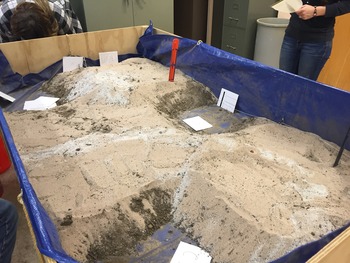
With support from the Utica College School of Arts and Sciences, and the help of a woodworking neighbor, I organized the creation of an elevated archaeology excavation box that measures about 2.4 (length) × 1.5 (width) × 0.6 (depth) m. I decided that an excavation box would be suitable because it could be housed in the anthropology laboratory to ensure year-round use of the simulation—away from the weather conditions that often grace Utica's landscape in New York State, such as rain, sleet, snow, and subzero temperatures.
From a local home supply store, I bought enough bags of dark topsoil, fine beige sand, and coarse white sand to fill the majority of the box. Each layer is about 10–15 cm deep. Within the distinct layers, I created noticeable features with rounded or straight sides. I also deposited a number of artifacts—primarily objects that would be recognized as toys by most of the students who would enroll in the course. The artifacts, features, and layers served as the remains of the site's social and physical context that I created for the exercise—those of a recently abandoned playground. Each time I teach the course, I refill the box with the previously used soil, sand, and artifacts to re-create the archaeological layers, features, and deposits. In the assignment directions presented below, I provide students with the site and project context to give them some guidance on ways in which to think about the site.
To introduce students to the simulation excavation, I provide the following information and guidelines in the assignment instructions (complete assignment instructions in Supplemental Text 1):
On the campus of Utica College in New York State, archaeologists recently identified an archaeological site that was possibly in the continued use of a local community from the early twentieth century to the early twenty-first century (ca. 1900–2000). Historic documents and test excavations suggest that this site contains the remains of a playground or play area that was an important place for community social gatherings, particularly for children and their families. The community is believed to have been a capitalist society. From the earliest to the latest period of its existence, this community underwent economic, political, technological, and social transformations that may have impacted the ways in which persons of different genders used and distributed children's toys in the play area.
Students will excavate this site and pursue the following objectives in this archaeological project:
1. Carefully uncover and analyze all remaining layers, features, and artifacts at the site.
2. Establish a site chronology to determine the age of the site and its contents.
3. Identify and interpret site elements useful to understanding how, over the last century, children played with toys at the site and what kinds of toys they played with. How might the remains of such behaviors and objects inform our understanding of the transformations in playtime, toys, and gender constructs at this former play area in the capitalist American community of Utica, New York?
During the exercise, students develop skills expected of most archaeologists conducting academic and cultural resource management projects. They survey or scan the box visually for any signs of archaeological remains on or near the site's surface. As they completely excavate the matrices in the box, students dig with trowels and other tools while keeping precise field data sheets for every layer and excavation unit encountered on the site (Figure 1). During the entire process, students draw plan and profile maps, and they take clear photographs of the excavation site to depict features and objects. Students are also expected to keep project journals or field notes in which they write entries for each day they excavate and/or analyze archaeological materials. In the entries, they describe all their relevant ideas and actions, including the artifacts and information they identify, the questions they raise and their answers to those questions, and their reflections on the work they complete. As a complement to these hands-on activities, students learn about additional components of archaeological work that I do not cover directly in this project, such as alternate excavation sampling methods and remote-sensing methodologies.
Simulated excavation in progress. Photograph by author.

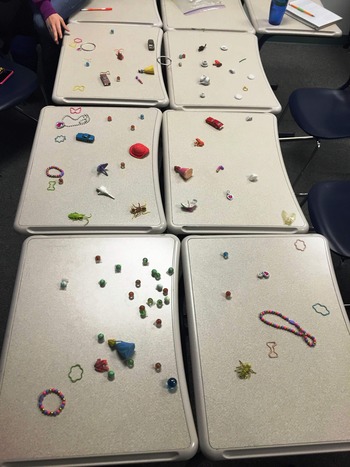
Students also engage in data analysis during and after the excavation, through which they assess artifact and attribute frequencies, design charts and visuals, and test ideas about why changes in objects, activities, and social contexts occurred over time. After students excavate the entire archaeology table, they re-create the units and layers by reviewing their site maps and reconstructing on tables where they found artifacts and features. They delineate and analyze artifact and feature distributions from top to bottom, thereby performing another analytical strategy that allows them to interpret the site level by level, with the artifact contents of every excavation unit present and visible together (Figure 2).
Site reconstruction in the classroom showing Layer 1 artifacts. Photograph by author.

Their interpretations are also informed by research on the histories of many toys they excavated, including marbles, Potato Head figures, Matchbox cars, and Disney princess dolls. Such information helps students establish site chronologies, and it provides them with background on how these toys were created and used in different ways over time. For instance, students were shocked to learn that, according to the Classic Toy Museum (2014) in Burlingame, California, original Potato Head toys, unlike today's reusable plastic versions, initially required the use of real potatoes, on which the toy's manufactured body parts were affixed using sharp metal pushpins.
Alongside field data collection and historical analysis, students also evaluate academic and public perceptions of gender and gender roles, as understood through the material culture of toys and play, from the earliest constructed historical context of the site up to the time that the students conduct the project. Through their efforts to understand past and present gender constructs through objects often associated with children, students recognize the centrality of material culture to the creation, enactment, contestation, and transformation of gender identities, as well as the challenges involved in understanding how similar and different gender identities might be materially represented (Baxter Reference Baxter2005; Conkey and Spector Reference Conkey and Spector1984; Nelson Reference Nelson2006).
From their journals, site records, and project data, students craft individual site reports or final papers from which they design a group presentation that they deliver to a public audience at the annual Utica College Student Research Day—now called the Student Conference for Research, Professional Activities, and Creative Arts. Throughout the project, students learn that all elements—including site survey and sampling, excavation, data collection, analysis and synthesis, teamwork, and public discourse through written and oral communication—are important characteristics of professional work in archaeology and other fields. In addition, all components contribute to the educational and professional development goals set out by the Sociology and Anthropology Department, Utica College, and the Society for American Archaeology.
In each of the six semesters I have taught this intermediate liberal arts course, each class has had an average of seven registered students—admittedly, a small number for any undergraduate course. This is nonetheless a relatively good enrollment since it is a course that is a requirement for a only a small number of majors and, in terms of general education requirements, only helps nonmajors satisfy the need to complete liberal arts credit. Students in this class have pursued a range of majors, including sociology and anthropology, biology, psychology, government, nursing, and cybersecurity. Historically, I have taught more students outside the Sociology and Anthropology Department than within it. The number of sociology and anthropology majors taking the course, however, has gradually increased. In Spring 2019, all but one of the six students enrolled were sociology and anthropology majors; the other was a history major and anthropology minor. Those six students comprised almost one-third of the number of department majors at the time. Clearly, this course is becoming more central to department majors, a fluid cohort that continues to pursue a number of different interests in courses taught both within and outside of the program.
In addition to carrying out the archaeological excavation and analysis, all students, regardless of their major, had to develop interdisciplinary strategies for applying archaeological perspectives to other careers and vice versa, which they shared in class discussions, journal entries, and the project's final paper. The ways in which students related their majors to the course and archaeology were diverse. Collectively, students who were not sociology and anthropology majors identified similarities in research methodologies used by archaeologists and those used by practitioners of their own disciplines. Cybersecurity students, for example, recognized similarities in the analyses conducted by computer forensic scientists and archaeologists. This helped them recognize how methods for uncovering clues from one discipline could benefit the other. In addition, this realization enhanced their self-confidence and self-purpose in completing the project. Psychology and government students stressed the importance of contextual analysis to their majors and to archaeology, and this informed their creation and application of multilayered approaches and perspectives in the project. Interestingly, the sociology and anthropology majors expressed the most difficulty in relating the course to their overall major. The most common reason for frustration cited by these students was they thought the relationships between the course and their major were obvious, so they felt limited in the strategies they could identify. By conducting a multistep, hands-on archaeological project, however, they developed a better sense of how archaeology might operate within and alongside other anthropological subfields, sociology, and the worlds in which they live. As they reflected on interdisciplinary relationships, they realized that information about the past could be integrated into strategies that process present situations and address current challenges. Overall, both majors and nonmajors learned new perspectives in this course, and they found ways to continue using those ideas to help them develop into thoughtful, analytical practitioners.
The simulated archaeology excavation offered in Introduction to Archaeology challenges students to understand basic archaeological methods and principles and apply them to unique situations both inside and outside of archaeology in ways that promote active, interdisciplinary learning. The various education and professional development goals outlined by my department, institution, and the SAA are achieved by students proficiently learning how archaeology works as a distinct discipline as well as one that naturally and effectively integrates with other fields to identify and address real-world problems. This includes preparing students to meet their own personal and professional needs and demands.
Course evaluations of this activity indicated that students valued this course as contributing to their academic and professional development. Just over 90% of the 23 students who responded to course evaluations across all six semesters communicated that the excavation project contributed to clear, effective learning. They also expressed that the course in general and the excavation project in particular were implemented in such a way that supported their success in the course. The following student comments speak to these ideas:
The excavation project was a great way to be introduced to the topic of archaeology. I really enjoyed not only reading about the practices but also implementing them. This was a great activity, and I would recommend it for future classes (Spring 2012).
It was easy to feel connected to that project, and it felt exciting to see what we would uncover in our box of sand. It was different, nice that it was hands-on, and made the written portion very easy to complete (Spring 2019).
Informal conversations with students also revealed that hands-on learning greatly enhanced class members' comprehension of course material, and it also helped them build on collaboration skills. In addition, students found it refreshing to reflect on relationships between archaeology and their majors or careers of interest. This component of the assignment increased their awareness of how different professions and disciplines might operate together and impact students' lives.
In the next section, I describe a project in the course Archaeology of North America and the Caribbean (ANT 323), which also tasks students with exploring challenges by combining archaeology and anthropology with other disciplines. The outcome for many students enrolled in this course was that they found active, innovative ways in which they could have a positive impact on their lives, communities, and fields of interest.
ARCHAEOLOGY OF NORTH AMERICA AND THE CARIBBEAN (ANT 323): THE FINAL PROJECT
Archaeology of North America and the Caribbean is an upper-level elective, for which there are no prerequisites and which is open to all students regardless of their major. For majors, completion of the course helps satisfy program requirements, including the archaeology specialization. Nonmajors who successfully complete the course earn liberal arts credit. The course has been taught only once, in the spring of 2015, during which 10 students enrolled. As previously stated, this is a relatively low but solid number of students, given the enrollment challenges faced by all of Utica's liberal arts courses tied to limited program and degree requirements. In the course materials, I describe Archaeology of North America and the Caribbean as follows:
This course explores central topics in the archaeology of North America and the Caribbean. Students will gain an understanding of the regions' peoples and cultures, from its first human migrants to the recent past, including Amerindian communities, European settlers, and enslaved and free people of African descent. Students will learn how material remains can inform understandings of continuity and change in cultural, social, political, and ecological contexts in North America and the Caribbean. Students will also consider how past and present constructs of ethnicity, class, gender, and race can be recognized and studied archaeologically to elucidate and work against past and present social injustice.
In the final project, an 8–10 page paper, students pursue a topic related to concerns explored in the class as well as to their majors. To assist students, I provide final project possibilities that incorporate the majors of students enrolled in the course. In 2015, enrolled students represented a variety of degree programs, including communications, education, international studies, and sociology and anthropology. Alternatively, students can design their own project with instructor approval. Below are some of the final project possibilities I offered the 2015 class (for the complete final paper instructions see Supplemental Text 2) :
A. If you are considering a career in education, create a set of four lesson plans on a topic related to the course. Combine archaeology and education methods and information to create your lesson plans. In your portfolio, include background information on the topic, as well as lesson plans, learning objectives, learning resources, lecture and activity notes, and learning outcomes.
B. If you are interested in conducting travel, impacting the tourism industry, and/or influencing national and international sociocultural policies and relationships, create an excursion that visits a series of at least four sites in American or Caribbean locations of your choice. These sites can include but are not limited to terrestrial and underwater archaeological sites, historical landmarks and centers, and museums. In your paper, explain a useful itinerary for visiting the sites, including relevant background information and a map depicting site locations. Also, explain the following: Why are the sites significant to local and international populations? What can one accomplish when visiting them? How do the sites relate to one another? What are the costs and other logistical issues involved in traveling to and visiting the sites? How are these sites protected and maintained through public and private means? What challenges do the sites and the people for which they hold significance currently face, and how are such challenges being addressed?
C. If you are interested in communications, public policy, and/or government, explore the history and current practices in the preservation policies and laws of an American or Caribbean region. What laws have existed to protect historical and heritage sites, and how are they enforced? What impact have these laws and procedures had on heritage sites? How is information at historic and heritage sites communicated to the public? What recommendations can you provide regarding preservation law and public education initiatives?
D. Referring to course material, explore facts and myths about pirates and their lives. You should choose some piece of literature, film, artwork, toy, amusement ride, or other piece of pop culture and, based on research, discuss which aspects of your subject are factual and which are fictional. How has your subject influenced present-day notions and social constructions of past pirates and piracy? How might modern pirates fit into these personae, and how might they differ from them?
Projects pursued by students included the following ideas: Two education students prepared in-depth lesson plans and activities under option A. A sociology and anthropology major completed option B. An international studies student completed option C in order to better understand the nature of archaeological sites in his home country of Venezuela. A sociology and anthropology major with specific archaeology interests completed option D as an extension of a section in the course where we assessed how archaeologists study and interpret the material and social histories of piracy. In addition, a cybersecurity student investigated multiple lines of evidence in order to assess the validity of his family's oral history about their involvement in early European colonial settlements in New York State.
By providing project ideas deliberately tailored to students' interests and majors—and tied to relevant learning and professional goals outlined by my department, institution, and the SAA—I offer students opportunities through which they can enhance their interdisciplinary problem-solving skills, even after the course ends. For example, the student projects described in the previous paragraph, such as the education students' lesson portfolios, could all be transformed and expanded on in future classes and professional situations. Such course and project planning strategies are beneficial to nonmajors and majors alike because they help them learn to address familiar yet new situations. No matter the issues at hand, challenges and moments of uncertainty are often effectively navigated and assessed by many of the skills provided through interdisciplinary archaeology and anthropology courses, such as reflecting on and applying social awareness, critical analysis, communication, multilayered problem-solving, and ethical responsibility. As in the ANT 267 student course evaluations, ANT 323 student reflections also identified areas of growth and satisfaction within anthropological and interdisciplinary learning. For example,
The class made me think about how different topics from different times could be related and how they could have had an impact on how people carry themselves today (Spring 2015).
[The professor] even tailored the final to our own interests! That was awesome and showed that she really cared about us (Spring 2015).
In addition, all six students who responded to the course evaluation at the end of Spring 2015 reported that overall they had engaged with effective, interactive learning and problem-solving built on holistic analysis and interdisciplinarity.
SUPPORTING ENRICHED STUDENT DEVELOPMENT THROUGH ARCHAEOLOGY IN HIGHER EDUCATION
Introductory, intermediate, and upper-level archaeology courses have much to offer students pursuing anthropology or another discipline because they contribute to their development as efficient drivers of change and responders to uncertainty. As witnessed at Utica College, these courses provide diverse students with opportunities to expand on their applied problem-solving and research skills, writing and oral communication abilities, and computer literacy. Students learn to appreciate how analysis and discovery through ethical, humanistic, and scientific paradigms help mitigate potential hazards in personal and professional contexts.
Although the courses and activities discussed here are effective on their own, they exist along with other archaeology and anthropology learning opportunities, such as appropriate reading and multimedia assignments, guided lessons, discussions, and field trips. Internship and independent study options near and far are also available. Students can also enroll in the college's summer forensic anthropology field school in Albania. Even though students may not participate in all of the options available, singularly and collectively, such opportunities provide important experiences and perspectives that inform students' decisions regarding their educational and professional development pursuits in and outside of archaeology and anthropology. The simulated excavation, for example, helps students better realize their understanding of, interest in, and benefit from archaeology, anthropology, and interdisciplinary studies. The simulation also helps make archaeology more accessible and tangible to students before they devote large amounts of money and time to field schools. Simulations also provide academic institutions, faculty, and students with limited resources alternate means through which to teach, learn, and apply methods, theories, and multifaceted problem-solving strategies in controlled, low-stakes excavation and laboratory settings outside of “live” archaeological sites (see Bowman and Dean Reference Bowman, Dean, Burke and Smith2007; Chilcott and Deetz Reference Chilcott and Deetz1964; Cosgrove et al. Reference Cosgrove, Frankel and Thomas2013; Rice Reference Rice1985).
So, how might departments such as the Sociology and Anthropology program at Utica College maintain and build on the success of archaeology courses and opportunities? Important issues to analyze include evaluating diverse barriers that may impact students' access to courses. In addition to educational institutions exposing more students to anthropology before they enter university and making anthropological skills and contributions more visible in post-graduate careers, faculty in higher education should be aware of how program and college-wide graduation requirements affect the frequency with which students enroll in nonrequired courses or electives. With that knowledge they can make appropriate curricular adjustments. For example, Introduction to Archaeology (ANT 267) could be changed from a department elective to a department requirement, still open to nonmajors, to ensure that more sociology and anthropology students take the course. Archaeology of North America and the Caribbean (ANT 323) could make a larger campus-wide impact by getting designated as a general education social science and writing course.
Student evaluations should also continue to be analyzed for insight. In addition, in keeping with increased needs and demands for learning assessment in American higher education (Fletcher et al. Reference Fletcher, Meyer, Anderson, Johnston and Rees2012; Hernon et al. Reference Hernon, Dugan and Schwartz2013; Walser Reference Walser2015), formal and guided evaluations of ANT 267, ANT 323, and other elective courses within the program will develop so that faculty and administration can better track and assess student success in achieving the program's and institution's learning goals. To date, formal assessment in the Sociology and Anthropology Department is focused on core required courses that all majors have to take. Plans are in place to soon expand departmental and institutional assessment of elective courses. Such efforts will increase understanding of how ANT 267 and ANT 323 may operate to better serve majors and nonmajors in developing anthropological and interdisciplinary perspectives. If possible, such data could then be compared with that of other programs across the United States, particularly similar programs at comparable institutions. Analyses across our program and others might offer guidance on how students in general could continue to benefit from archaeology and interdisciplinarity well into the twenty-first century. For instance, such assessments across departments at different institutions might evaluate course and assignment formats used in order to see the impacts of hands-on activities, written assignments, data collection and analysis, lecture, and discussion. Reflections on course offerings might also explore the possibility of teaching online versions of the archaeology courses discussed in order to attract distance learning students—a growing student population at Utica and across the country. However, careful planning of appropriate assignments would have to take place to ensure that online students received adequate guidance and support in their completion of diverse hands-on, excavation, writing, and critical-analysis activities.
Whatever actions are taken to enhance learning and increase student numbers, they will require careful planning and review in order to assess their potential benefits and challenges. While a rise in student numbers is beneficial, larger class sizes may complicate learning processes and activities—for instance, by reducing personal interactions between class members. Instructors should be aware of such challenges so that they can prepare responsive strategies. By focusing on how individual courses might be connected to larger academic programs and initiatives, we can better communicate and realize the benefits of those courses to larger numbers of students and, perhaps, even the communities from which they hail.
In conclusion, the use of applied and interdisciplinary curriculum design, teaching, and learning in archaeology and anthropology courses can make our respective subfields and professional circles more meaningful and applicable to majors and nonmajors alike, thus sustaining them in achieving real-world awareness and diverse problem-solving in the twenty-first century and beyond.
Supplemental Material
For supplemental material accompanying this article, visit https://doi.org/10.1017/aap.2019.41
Supplemental Text 1. ANT 267 Excavation Project Instructions.
Supplemental Text 2. ANT 323 Final Paper Instructions.
Acknowledgments
The author wishes to thank Utica College for supporting and funding the research. The author also thanks the helpful feedback from colleagues and reviewers of this manuscript. No permits were needed to conduct this research.
Data Availability Statement
No original data were presented in this article.