


Introduction
The Great Bustard Otis tarda is a globally threatened species that once naturally inhabited steppe in the grassland zones of Asia, Anatolia, Europe, Britain, and North Africa (Kollar Reference Kollar1996, Nagy Reference Nagy2018). However, the species adapted to live in agricultural mosaics and thrived in the areas of low-intensity disturbance and cultivation (Lane et al. Reference Lane, Alonso and Martín2001, Moreira et al. Reference Moreira, Morgado and Arthur2004). Nevertheless, because of ever-increasing habitat loss and disturbance resulting mostly from agricultural intensification and hunting, the species has suffered dramatic declines throughout its range, it became extinct in many localities in the last century, and has been listed as globally ‘Vulnerable’ since 1994 (BirdLife International 2017). According to the latest estimate, there are only 43,847–56,695 Great Bustards in the wild (Alonso Reference Alonso2014).
The Great Bustard subspecies present in Turkey is the nominate Otis tarda tarda (BirdLife International 2017). The species is distributed in the steppe zone of Turkey, which happens to be one of the habitats suffering the most severe destruction and the lowest effective protected area coverage, with only 1.5% of its surface being effectively conserved (Kirwan et al. Reference Kirwan, Demirci, Welch, Boyla, Özen, Castell and Marlow2010, Ambarlı et al. Reference Ambarlı, Zeydanlı, Balkız, Aslan, Karaçetin, Sözen, Ilgaz, Gürsoy -Ergen, Li̇se, Çağlayan, Welch, Welch, Turak, Bilgin, Özkil and Vural2016). With 21 sites triggering Important Bird Area (IBA) criteria for Great Bustards (Eken et al. Reference Eken, İsfendiyaroğlu and Bozdoğan2006), Turkey once was a stronghold for the species, which occurred in more than 80 localities and had 3,000–4,000 breeding individuals (Goriup and Parr Reference Goriup and Parr1985, Kasparek Reference Kasparek1989). The Great Bustard population in Turkey has been thought to be made up of two subpopulations: one occupying the inner part of the western 2/3 of the country and the other occupying the eastern 1/3 (Kirwan et al. Reference Kirwan, Demirci, Welch, Boyla, Özen, Castell and Marlow2010). Due to widespread habitat loss, agricultural intensification, and illegal hunting, the species’ range in Turkey has shrunk substantially, and its population has declined by around 70–77% over the last four decades (Goriup and Parr Reference Goriup and Parr1985, Özbağdatlı et al. Reference Özbağdatlı, Karauz and Bünyamin2004). Consequently, the species was listed as ‘Endangered’ (EN) in the most recent national Red List assessment (Kılıç and Eken Reference Kılıç and Eken2004), but the last national-scale study of the species was over a decade ago (Karakaş and Akarsu Reference Karakaş and Akarsu2009), and its current status in the country remains mostly unknown. According to the most recent estimate produced upon request by BirdLife International, there were 700–1,180 Great Bustards in Turkey in 2016 (BirdLife International 2021).
Here, by combining data from our fieldwork over the last five years with monitoring studies conducted by public institutions, sightings submitted to online databases, and literature searches, we aim to (i) provide up-to-date distributional and population estimates for the Great Bustard in Turkey, (ii) investigate its mostly unknown in-country movement patterns, (iii) conduct a new national Red List assessment, (iv) determine the identity and intensity of the threats facing the species, and (v) make recommendations to guide future studies and to ensure the protection of the remaining populations.
Methods
Field surveys
Geographic coverage of our studies is shown in Figure S1 in the online supplementary material. Most data for the inner-western and central Anatolia populations came from our studies and observations conducted over the last five years, while we referenced other studies for information on most populations in eastern Turkey. The majority of the studies we conducted in inner-western and central Anatolia involved monthly observations spanning multiple years, while the remaining ones were single-year studies conducted in spring and summer. Except for the studies we conducted near the Syrian border, which involved multiple-year winter surveys, our eastern Turkey studies involved single-year surveys conducted in the breeding season. Our fieldwork involved some intense and opportunistic data collection in regions of known occurrence, as is the case with most red-listed species (Dormann Reference Dormann2007). Still, most of our fieldwork consisted of unbiased sampling following survey methods mentioned or recommended in Alonso and Alonso (Reference Alonso and Alonso1996), Lane et al. (Reference Lane, Alonso and Martín2001), and Alonso et al. (Reference Alonso, Martín, Alonso, Palacín, Magaña and Lane2004). The method we used most frequently was driving in vehicles slowly along transects (15–20 km/h on average; Alonso and Alonso Reference Alonso and Alonso1996), with transects around 1–2 km apart, assuming a maximum detection distance of 700–800 m (Alonso and Alonso Reference Alonso and Alonso1996). Teams consisted of at least two experienced observers equipped with binoculars and telescopes. We also used vantage points to scan large areas using telescopes. Great Bustards show high sex-size dimorphism, resulting in undercounting of the smaller females (Alonso and Alonso Reference Alonso and Alonso1996), so we noted numbers of females and males separately whenever possible and used sex ratio estimates from some reliable studies conducted in Turkey, which ranged between 1:1.38 and 1:1.75 (male:female; Heunks et al. Reference Heunks, Heunks, Eken and Kurt2001, Gürkan et al. Reference Gürkan, Bekir and Özbağdatlı2003, Özbağdatlı et al. Reference Özbağdatlı, Karauz and Bünyamin2004, Karakaş and Akarsu Reference Karakaş and Akarsu2009, Tanrıverdi Reference Tanrıverdi2015), to improve our population size estimates. We also documented all possible threats to the species during this fieldwork.
Population size estimates
Evidence from our own fieldwork, published literature (Table S1), monitoring surveys by the General Directorate of Nature Conservation and National Parks, surveys by BirdLife Turkey in central and south-eastern Anatolia, the eBird database (eBird 2019), and sight records and photographs from a national database (TRAKUS 2021) were combined to make the population size estimates. We estimated a minimum and maximum population size for most of the sites to account for uncertainty.
To present the most up-to-date population size estimates, we excluded records before 2018 except for populations for which the only records were from before 2018. In those cases, we used the most recent records available, but applied to them a decline factor determined by the mean population size decline in the country (see Results). We obtained the final breeding and wintering population size estimates by summing all the local estimates. We also reviewed all the studies reporting Great Bustard population size estimates in Turkey to present a picture of the population changes over the last 50 years (Table S1).
Distribution and movements
Given the extreme hunting pressure on the species, we provided no point locations on our maps. Instead, we used 50×50 km UTM grid squares to present the distributional range of the species. This method also allowed us to account for uncertainty in the reported location of some historical records. Great Bustards display in an exploded lek system, in which, earlier in the season, displays take place in large and compact flocks, which then “explode” over a larger but clearly defined space, where males display solitarily, but mostly within visual reach of each other (Morales et al. Reference Morales, Jiguet and Arroyo2001). In this type of lek system, the whole lek is detectable only when the smaller aggregations are mapped over a larger scale (Burnside Reference Burnside2012). In the current study, we defined Great Bustard localities as areas having at least one or multiple closely located leks. We also projected the known leks on a map to check how many of them are found within the IBA network in Turkey (Kılıç and Eken Reference Kılıç and Eken2004) by using ArcGIS Pro 2.6 (ESRI 2020).
We reviewed all the sources used for the population estimates (see above, also Table S1) to evaluate the historical distribution of the species. We assessed the current distributional range by using the most recent location estimates. We utilised all our data sources along with some publications from other countries in the species’ range (e.g. Farago Reference Farago1990, Streich et al. Reference Streich, Litzbarski, Ludwig and Ludwig2006, Geacu Reference Geacu2016) to estimate the potential movement patterns of the species within and through Turkey.
National Red List assessment
We obtained the life history information about the species from BirdLife International (2021), and used the Guidelines for Using the IUCN Red List Categories and Criteria Version 14 (IUCN Standards and Petitions Committee 2019) along with Guidelines for Application of IUCN Red List Criteria at Regional and National Levels Version 4.0 (IUCN 2012) to assess the Red List category of the breeding Great Bustard populations in Turkey. See Appendix S1 for the detailed methodology followed to make the assessment. We measured the area of occupancy and extent of occurrence (IUCN Standards and Petitions Committee 2019) by using ArcGIS Pro 2.6.
Threat assessment
We used data collected during our field surveys, all the Great Bustard studies conducted in Turkey, and national and international species action plans (Appendix S2, Table S2) to determine the threats Great Bustards face in Turkey. We quantified how many of these studies reported each threat type and assessed each threat type’s impact level (three levels: low, medium, high) by referring to the studies reporting them and our own observations.
Results
Distribution, population estimates and movements
The national population of Great Bustards in Turkey is made up of two seemingly discrete subpopulations as indicated in previous studies (Kasparek Reference Kasparek1989, Gürkan et al. Reference Gürkan, Bekir and Özbağdatlı2003, Özbağdatlı and Tavares Reference Özbağdatlı and Tavares2006, Karakaş and Akarsu Reference Karakaş and Akarsu2009, Usta et al. Reference Usta, Tatar, Yıldırım, Çatal and Bolat2016): one in inner-western and central Anatolia (henceforth the western population) and one in eastern and south-eastern Anatolia (henceforth the eastern population; Figure 1a). These two subpopulations seem to be separated by the Anatolian diagonal, a well-known biogeographic barrier (Figure 1a; Ekim and Güner Reference Ekim and Güner1986, Gür Reference Gür2016).
Maps showing the historical and current distributions of the breeding (a) and wintering (b) Great Bustards in Turkey.
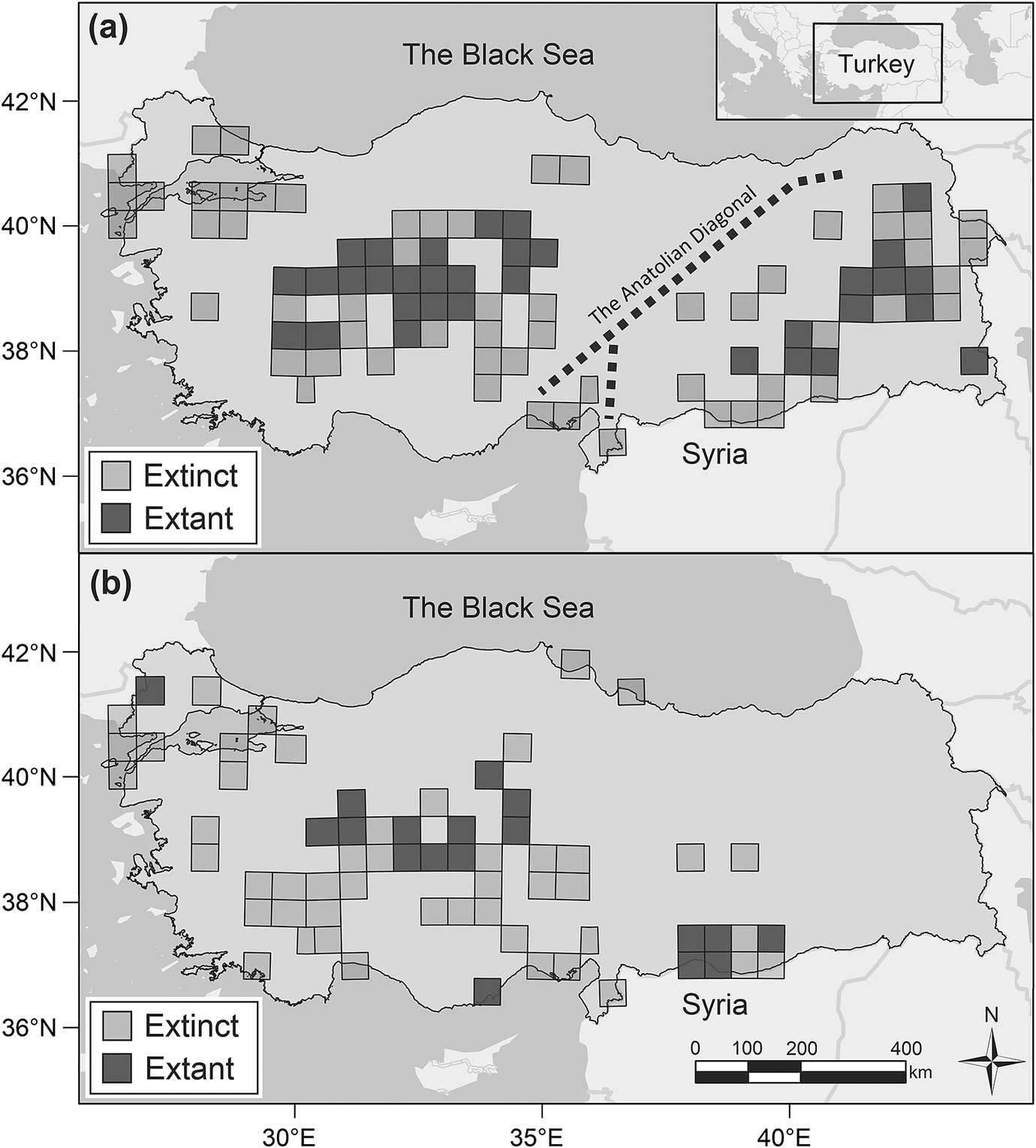
The current estimated breeding population size of the Great Bustard in Turkey is only 559–780 individuals, which is 20–29% smaller than the last estimate in 2016 and 27–38% smaller than the estimate in 2004 (Table S1). The species’ breeding range has shrunk by around 65% since the early 20th century, and the populations in north-west Turkey have completely disappeared (Figure 1a). More recently, breeding populations along the Syrian border and in the eastern Mediterranean region have also gone extinct, possibly due to agricultural intensification and a shift to irrigated farming in these regions (Eken et al. Reference Eken, İsfendiyaroğlu and Bozdoğan2006). The two remaining populations in Turkey are distributed in as few as 26 localities. Twenty of the 27 leks in these localities are totally, and three of them partially, located within the IBA network. Twenty of the 27 leks are very small with fewer than 30 individuals (Figure S2). The western population holds around 359–500 individuals (almost two-thirds of the national total), the eastern population around 200–280.
We estimated the wintering population size of Great Bustards in Turkey as 593–775 individuals. The previous estimate was 400–1,000 individuals (Kılıç and Eken Reference Kılıç and Eken2004). Currently, most of the wintering populations are found in central Anatolia and south-eastern Turkey (Figure 1b): 468–630 individuals winter in inner-western and central Anatolia, and 120–140 individuals winter in south-east Anatolia. The wintering range of the species has shrunk by around 61% since the beginning of the 20th century (Figure 1b), and wintering grounds in south-eastern Turkey, which used to harbour as many as 800–1,000 in winter (Kılıç and Eken Reference Kılıç and Eken2004), now only host 100–120 individuals. A list of all Great Bustard localities and their population size estimates is available upon request from the corresponding author.
Migratory movements of the species in Turkey are still mostly unknown (Figure 2). The breeding populations in central Anatolia are mostly resident and perform facultative, short-distance migrations, which seem to be driven mostly by snowfall (Kasparek Reference Kasparek1989, Özbağdatlı et al. Reference Özbağdatlı, Karauz and Bünyamin2004). However, several old and recent records (OST 1975, Goriup and Parr Reference Goriup and Parr1985, Kasparek Reference Kasparek1989, eBird 2019) indicate that during harsh winters birds in the western population might leave their breeding grounds for the warmer Mediterranean coast (Figure 2). Nevertheless, the western population stays mostly within central Anatolia and congregates in a few IBAs in winter (Karataş et al. Reference Karataş, Özelmas and Erkara2021). The eastern population is migratory, and has historically wintered in the eastern Mediterranean Turkey and south-eastern Turkey (Özbağdatlı et al. Reference Özbağdatlı, Karauz and Bünyamin2004, Kirwan et al. Reference Kirwan, Demirci, Welch, Boyla, Özen, Castell and Marlow2010). Studies in eastern Turkey, surveying the migrating Great Bustards and reporting their directions of flight, provided supporting evidence for the north-east/south-west migration route to and from near or beyond the Syrian border (Figure 2; Tanrıverdi Reference Tanrıverdi2015).
Map showing suspected (the arrows with question mark) and known (the arrow without question mark) post-breeding movements of Great Bustards within and through Turkey.
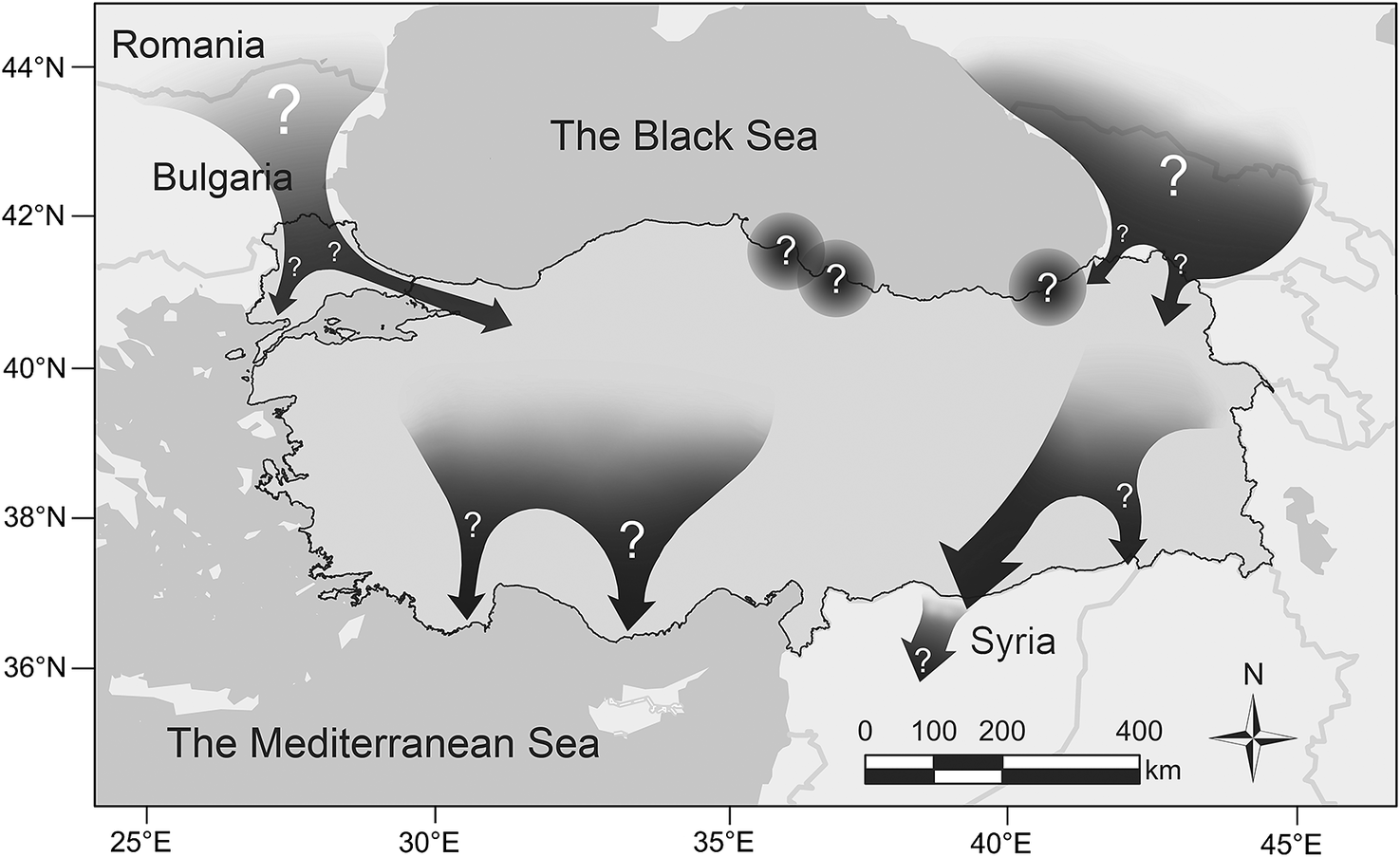
Other Great Bustard movements in Turkey are less certain. Several historical and recent records of migrating Great Bustards from the deltas on the Black Sea coast, Istanbul, the Bosphorus and Thrace (Goriup and Parr Reference Goriup and Parr1985, Kasparek Reference Kasparek1989, Karakaş and Akarsu Reference Karakaş and Akarsu2009, Kirwan et al. Reference Kirwan, Demirci, Welch, Boyla, Özen, Castell and Marlow2010, eBird 2019) suggest some previously undescribed migratory movements involving small numbers of birds along the Black Sea coast and across the Bosphorus (Figure 2). It is even possible that some birds breeding in Russia might be migrating through eastern Turkey, as suggested by observations of several hundred migrating individuals, which is simply too many to originate only from Turkey (Tanrıverdi Reference Tanrıverdi2015).
National Level Red List assessment
We found that, depending on method used (Appendix S1), Great Bustard populations in Turkey have declined by either 64–77% or 30–74% over the last 30 years, which equals a span of three generations. Both of these estimates resulted in a A2a trigger (IUCN Standards and Petitions Committee 2019) for the EN category. Again, depending on method used, the species’ populations have declined by either 28–59% or 20–27% over a span of two generations. According to both these results, the C1 criterion is triggered for the EN category. Area of occupancy and extent of occurrence triggered no category. Since Turkey’s populations do not seem to be substantially connected with populations outside Turkey, we assumed that there is no considerable rescue effect potential. Therefore, we did not change our final category estimate (IUCN 2012). However, we note that the 30-year decline estimates may not be very reliable because the population size estimates we used give huge ranges (Table S1; Appendix S1). Therefore, our final categorisation for the Great Bustard populations in Turkey is EN with only the C1 trigger.
Threats
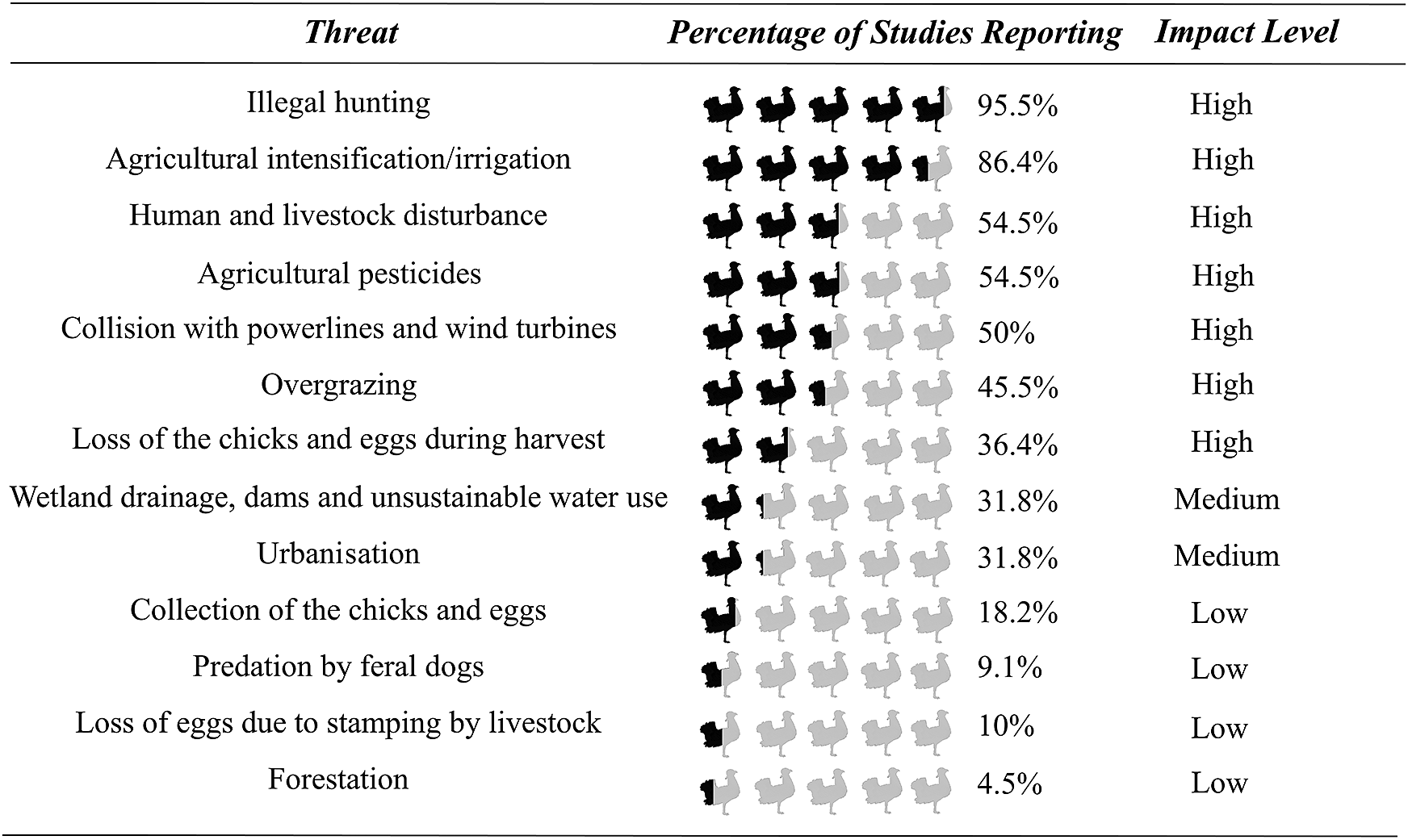
Great Bustards in Turkey are facing a wide array of threats, and those with the most severe impact are illegal hunting, agricultural intensification, disturbance, collision with powerlines, overgrazing, and unchecked use of pesticides in agriculture. Figure 3 gives a list of threats for the Great Bustard populations in Turkey, proportions of the studies reporting each threat, and their impact level.
Threats for Great Bustard populations in Turkey, the percentage of studies reporting them, and their estimated impact level (three levels: high, medium and low).
Discussion
With 559–780 breeding and 593–775 wintering individuals, Turkey still holds nearly as many Great Bustards as all of its neighbours, the Balkan countries, and Ukraine combined, and ranks seventh in the world in terms of size of the Great Bustard population supported (BirdLife International 2021). However, the country’s populations are declining very rapidly, and the remaining numbers are small and face a wide array of threats.
Distribution, population estimates and movements
It has long been suggested that there are two distinct Great Bustard subpopulations in western and eastern Turkey (Karakaş and Akarsu Reference Karakaş and Akarsu2009), and our findings support this view. The Anatolian diagonal, which lies between the two populations, is a well-known biogeographic barrier shaping phylogeography and the distribution of various organisms (Nilson et al. Reference Nilson, Flärdh and Andrén1990, Gül Reference Gül2013, Mutun and Dinç Reference Mutun and Dinç2019). The diagonal is located at the eco-regional transitional zone, where there is a sharp environmental gradient (temperature seasonality, precipitation, elevation; Gür Reference Gür2016). It is because of this that the diagonal is thought to act as a dispersal barrier for many taxa (Gür Reference Gür2016), and the diagonal may also restrict the dispersal of a weak disperser like the Great Bustard, considering that the females of the species are mostly philopatric to their breeding grounds and the males perform short to medium distance natal dispersal (Alonso and Alonso Reference Alonso and Alonso1992, Martín et al. Reference Martín, Alonso, Alonso, Palacín, Magaña and Martín2008). Nevertheless, some historical and recent records from places closer to or along the Anatolian diagonal (Kasparek Reference Kasparek1989, Karakaş and Akarsu Reference Karakaş and Akarsu2009) and the fact that some of the females from the populations in Central Asia are capable of surprisingly long-distance migrations (Kessler et al. Reference Kessler, Batbayar, Natsagdorj, Batsuur and Smith2013) may suggest that there was or still is some movement across it and that some undiscovered populations may still exist along it, serving as links for gene flow between the two populations. Surveys searching the diagonal for the possible populations and molecular studies employing collection of feathers and/or faeces and subsequent mtDNA sequencing (Martín et al. Reference Martín, Alonso, Alonso, Pitra and Lieckfeldt2002, Idaghdour et al. Reference Idaghdour, Broderick and Korrida2003) may be needed to solve this mystery.
The Turkish population has declined substantially over the last few decades, and the majority of the remaining leks are very small and at high risk because the extinction rate of a lek increases rapidly below the 30-individual threshold (Pinto et al. Reference Pinto, Rocha and Moreira2005). Furthermore, the species has gone extinct in more than half of its Turkish breeding range, possibly rendering the remaining populations more isolated (Martín et al. Reference Martín, Alonso, Alonso, Pitra and Lieckfeldt2002). The remaining populations should be protected to curb further isolation, and the larger leks (one in Eskişehir province and two in Muş province; Figure S1), should be protected with utmost care considering the potential roles of these leks as source populations for other smaller populations (Martín et al. Reference Martín, Alonso, Alonso, Pitra and Lieckfeldt2002).
Records of Great Bustards migrating along the Bosphorus and on the Turkish Black Sea coast are intriguing and need more research. Great Bustard populations in central and eastern Europe and Ukraine can perform facultative movements in winter in response to decreasing temperatures and snowfall, reaching as far as Italy, Romania, and Greece (Farago Reference Farago1990, Kollar Reference Kollar1996, Streich et al. Reference Streich, Litzbarski, Ludwig and Ludwig2006, Geacu Reference Geacu2016). It is possible that some of these wintering individuals might occasionally migrate to the Thracian part of Turkey and across the Bosphorus into Anatolia. Judging by the observations on the ground, suggesting that the populations in Crimea are mostly staying within the peninsula in winter (M. Kessler in litt. 2021), it is more likely that the wintering individuals found in north-western Turkey originate from central and/or eastern Europe. Similarly, the sightings from north-eastern Turkey may be attributable to some birds that breed in the Crimean Peninsula and Rostov and Volgograd, Russia, with the former being less likely. Great Bustards breeding in Crimea might be taking an eastern route along the Black Sea coast when the region experiences harsh winters, and the individuals from the migratory populations in Rostov and Volgograd, which can migrate south-west to winter in Crimea (Oparina et al. Reference Oparina, Litzbarski, Oparin, Vatske and Khrustov2001, Watzke Reference Watzke2007), might be crossing the Caucasus to reach southern Georgia (as reported by A. Abuladze in litt. 2021) and eventually Turkey. The records in mid-northern Turkey are more difficult to explain. The most plausible explanation for the spring sightings is that the individuals spotted in this region were simply dispersing individuals looking for new leks or conspecific groups (Lane et al. Reference Lane, Alonso and Martín2001). The winter records from the same region, on the other hand, might suggest that the region served as a wintering ground for the extinct populations in inner northern Turkey. There is also a possibility that the region hosted small groups of wintering individuals from Ukraine and Russia; the individuals reaching north-eastern Turkey might have followed the coastline to reach mid-northern Turkey. The possible and previously uninvestigated movements presented in this section may imply that Turkey used to be or might still be an important migratory corridor or wintering ground for some populations outside Turkey.
Further research is also needed to shed light on the movements of relatively better known western populations. Several winter records from the Mediterranean coast suggest that some individuals might fly south in winter. Research is also needed in eastern Anatolia. Several hundred individuals were spotted migrating through a single locality in one day (Tanrıverdi Reference Tanrıverdi2015), hinting at an important migratory corridor in eastern Turkey. Such a corridor is also suggested by the astonishing numbers of wintering Great Bustards observed in south-eastern Turkey in the past, which were simply too many to derive from national breeding populations (Kirwan et al. Reference Kirwan, Demirci, Welch, Boyla, Özen, Castell and Marlow2010). Some of the birds that visit south-eastern Turkey might be moving further south to winter in Syria. Satellite tracking (e.g. Burnside Reference Burnside2012, Ashbrook et al. Reference Ashbrook, Taylor, Jane, Carter and Szekely2016) and the use of stable isotopes (e.g. Shaw and Ryan Reference Shaw and Ryan2015) could help resolve the mysteries surrounding the migratory movements of the species in and around Turkey.
Threats and conservation measures
Europe has the largest Great Bustard population in the world (Nagy Reference Nagy2018), and the Red List status of the species on the continent is ‘Least Concern’ (BirdLife International 2015) owing to the large populations in the Iberian Peninsula and slowly growing populations in central Europe (Nagy Reference Nagy2018). Conversely, the population in Turkey is currently EN at the national scale, and constantly shrinking. However, as with many of the other Great Bustard populations in the world (e.g. Horreo et al. Reference Horreo, Palacín, Alonso and Milá2013, Barati et al. Reference Barati, Abdulkarimi and Alonso2015, Vadász and Lóránt Reference Vadász and Lóránt2015, Alonso et al. Reference Alonso, Palacín, Onrubia, Aboulouafae, Amezian, El Idrissi Essougrati, El Khamlichi and Noaman2016, Wang et al. Reference Wang, González, Yang, Neuhaus, Blanco-Fontao and Ruckstuhl2018), leading causes of Great Bustard population declines in Turkey are human-related.
Illegal hunting remains a significant and probably the most serious cause of population declines in Turkey. Hunting pressure exists throughout the range of the species in Turkey, and it has been reported as a threat by almost all of the studies that have been conducted in Turkey. Effective wardening and the involvement of local people in conservation, which has proved to be a very successful conservation tool in other parts of the world (e.g. Gibson and Marks Reference Gibson and Marks1995), are needed to stop illegal hunting of the species in the country, which will, however, probably remain the most serious threat for the species in the near future.
Agricultural intensification and the abandonment of dry cereals for irrigated cash-crops such as maize Zea mays and sugar beet Beta vulgaris have been widespread in the steppes of Anatolia in recent decades (Yılmaz et al. in prep.), and 86.4% of studies in Turkey reported this as a threat. Great Bustards are known to avoid irrigated fields (Lane et al. Reference Lane, Alonso and Martín2001, Sani Reference Sani2015), and water abstraction and diversion for irrigation (Ambarlı et al. Reference Ambarlı, Zeydanlı, Balkız, Aslan, Karaçetin, Sözen, Ilgaz, Gürsoy -Ergen, Li̇se, Çağlayan, Welch, Welch, Turak, Bilgin, Özkil and Vural2016) have destroyed wetland habitats and freshwater springs, on which many Great Bustards in Turkey depend (Karakaş and Akarsu Reference Karakaş and Akarsu2009). Mechanisation in agriculture causes direct mortality through egg and chick loss during harvest (Kılıç and Karakaş Reference Kılıç and Karakaş2005, Vadász and Lóránt Reference Vadász and Lóránt2015, Nagy Reference Nagy2018) and provides the opportunity to plough and cultivate hills in the landscape, which were once habitat islands that Great Bustards used as leks (Heunks et al. Reference Heunks, Heunks, Eken and Kurt2001, Karakaş and Akarsu Reference Karakaş and Akarsu2009). Pesticide use, which can harm Great Bustards directly (Karakaya et al. Reference Karakaya, Karataş and Özelmas2017) and/or indirectly by reducing their food supply (Martín et al. Reference Martín, Alonso, Alonso, Palacín, Magaña and Martin2007) is also a widespread practice in Great Bustard habitats in Turkey (Karakaya et al. Reference Karakaya, Karataş and Özelmas2017). A return to a more traditional agricultural scheme, involving a mosaic landscape of fallow land, semi-natural habitat patches, and various kinds of crop (Lane et al. Reference Lane, Alonso and Martín2001), with appropriate compensation for farmers for setting aside land, delayed harvest, and lowered use of pesticides, could help preserve the remaining populations.
Overgrazing is widespread in Anatolian steppes, where it threatens various taxa (Ambarlı et al. Reference Ambarlı, Zeydanlı, Balkız, Aslan, Karaçetin, Sözen, Ilgaz, Gürsoy -Ergen, Li̇se, Çağlayan, Welch, Welch, Turak, Bilgin, Özkil and Vural2016) including Great Bustards. Overgrazing causes severe degradation in steppe habitats, decreasing the amount of high-quality habitat for Great Bustards. We saw during our studies that the situation is grave in central Anatolia, where most of the remaining steppes are overgrazed leaving them with a few non-palatable, thorny plants species that do not serve as good Great Bustard habitats. Designations of fenced no-grazing areas and effective wardening seem to be the only viable means of minimizing this threat.
Disturbance caused by human presence, agricultural activities, vehicle traffic, and livestock herding is another severe threat to the species. Studies elsewhere have shown that anthropogenic disturbance can significantly reduce breeding success in Great Bustards (Rocha et al. Reference Rocha, Morales and Moreira2013, Ponce et al. Reference Ponce, Salgado, Bravo, Gutiérrez and Alonso2018) and induce flight responses that increase energy expenditure and the risk of collision with powerlines (Kollar Reference Kollar1996, Sastre et al. Reference Sastre, Ponce, Palacín, Martín and Alonso2009, Torres et al. Reference Torres, Palacín, Seoane and Alonso2011). Furthermore, human and livestock disturbance and hunting pressure in Turkey are forcing Great Bustard populations into highly suboptimal and marginal habitats, best exemplified by a population in central Anatolia, which has its lek on small bare islands in a hypersaline lake (Özgencil and Özcan Reference Özgencil and Özcan2018), and by another one, which seems to be breeding in and around a Scots pine Pinus sylvestris forest in eastern Turkey (Per et al. Reference Per, Özbek, Uzunhisarcıklı and Bilgili2012).
Urbanisation is putting additional pressure on the species’ populations in Turkey. Apart from the usual problems that come with urbanisation and infrastructure development (Sastre et al. Reference Sastre, Ponce, Palacín, Martín and Alonso2009, Torres et al. Reference Torres, Palacín, Seoane and Alonso2011), railway construction is a particular threat for the species. Many of the species’ populations in Turkey are found on state farms, within which agriculture is practiced on large, flat, and continuous pieces of land. Unfortunately, such land is also in demand for building high-speed railways owing to its topography and no-cost expropriation. A few important Great Bustard breeding grounds have already been fragmented as a result, and there is a constant risk of collision with trains for Great Bustards living in these areas.
Collision with powerlines is a major cause of mortality in Turkey. Great Bustards fly fast, but they lack good aerial manoeuvrability owing to their weight and their visual systems are poorly equipped to identify obstacles in the flight path, which result in high rates of collisions with powerlines (Janss and Ferrer Reference Janss and Ferrer2000, Martin and Shaw Reference Martin and Shaw2010, Raab et al. Reference Raab, Spakovszky, Julius, Schütz and Schulze2011, Keskin et al. Reference Keski̇n, Durmuş, Karakaya and Özelmas2019). Most central Anatolian populations are located near some sort of powerline (Akarsu Reference Akarsu2016, Özgencil and Özcan Reference Özgencil and Özcan2018), and we have found several dead Great Bustards under the powerlines during our studies. This threat can be eliminated by moving the powerlines underground (Raab et al. Reference Raab, Schütz, Spakovszky, Julius and Schulze2012), but this is expensive, making it hard to realize. Therefore, conservation efforts should better be focused on stopping further powerline constructions in or around the Great Bustard localities.
Lack of scientific research and constant monitoring is also making the Great Bustard populations in Turkey vulnerable. Most of the populations in Turkey are not monitored regularly. Although a great initiative by the General Directorate of Nature Conservation and National Parks in Turkey to monitor Turkey’s existing populations has been providing lots of data since 2016, these efforts are limited by the availability of the resources and field staff. Therefore, large-scale and intensive scientific surveys and monitoring studies are urgently needed, especially in eastern Turkey, which has not received much scientific attention for the last two decades.
Supplementary Materials
To view supplementary material for this article, please visit http://doi.org/10.1017/S0959270921000289.
Acknowledgements
We thank Adem Akyol, Umut Tank, Cansu Özcan, and Selami Oral for their help in data collection, Kiraz Erciyas, Güven Eken, Mustafa Çulcuoğlu, Emrah Çoban, Suat Mert, Kerem Ali Boyla, Zülfü Fərəcli, Alexander Abuladze, and Mimi Kessler for providing data, and General Directorate of Nature Conservation and National Parks (DKMP), Ministry of Agriculture and Forestry in Turkey for sharing their survey data, Nigel Collar for being kind enough to do the first review of the manuscript and provide lots of highly useful comments, and the two referees, whose suggestions and contributions have improved the manuscript significantly. Our fieldwork was supported by Eskişehir Osmangazi University (grant numbers 201319008 (2013-64) and 201619A232 (2016-1345)), by Ministry of Environment and Urbanisation (2018), Ministry of Agriculture and Forestry (2016, 2019), and Doğa Derneği (2016, 2018).


 Open access

