


Introduction
The linkage between public opinion and policy is a basic principle of democratic government (Pitkin Reference Pitkin1967). It is also central to many of our models of the domestic politics of international relations, which argue that democratic states conduct themselves fundamentally differently in both conflict and co-operation because policy makers can be held accountable by the public at large (Bueno de Mesquita et al. Reference Bueno de Mesquita, Morrow, Siverson and Smith1999; Fearon Reference Fearon1994, though see Weeks Reference Weeks2014). There are a variety of mechanisms through which public opinion can shape foreign policy (Foyle Reference Foyle1999; Payne Reference Payne2019), ranging from the direct effect of the ballot box (Aldrich et al. Reference Aldrich, Sullivan and Borgida1989) to indirect effects channeled through elected (Gelpi and Grieco Reference Gelpi and Grieco2015) and unelected officials (Lin-Greenberg Reference Lin-Greenberg2021). In some of these models, strategic policy makers take public opinion into account ex ante, while in others retrospective publics sanction policy makers for their misbehavior ex post. Yet most of these models rest on two assumptions about information. First, the public is aware of foreign policy; voters can’t hold policy makers accountable if they aren’t paying attention. Second, policy makers are aware of public opinion; it’s harder to do what the public wants if you’re misreading the room.
While international relations (IR) scholars have extensively investigated the accuracy of the first assumption (see, for example, Holsti Reference Holsti2004; Saunders Reference Saunders2015), the plausibility of the second assumption – that political elites generally understand what the public thinks – has yet to be systematically explored in foreign policy. Instead, this assumption has more thoroughly been investigated by a rapidly growing body of research in American and Comparative politics, which has found that political elites tend to systematically misread public opinion (Broockman and Skovron Reference Broockman and Skovron2018; Clausen Reference Clausen1977; Hertel-Fernandez et al. Reference Hertel-Fernandez, Mildenberger and Stokes2019; Miller and Stokes Reference Miller and Stokes1963; Pereira Reference Pereira2021; Walgrave et al. Reference Walgrave, Jansen, Sevenans, Soontjens, Pilet, Brack, Varone, Helfer, Vliegenthart, van der, Breunig, Bailer, Sheffer and Loewen2023). Elites often perceive public sentiment to be more conservative than it really is (Broockman and Skovron Reference Broockman and Skovron2018; Hertel-Fernandez et al. Reference Hertel-Fernandez, Mildenberger and Stokes2019; Pilet et al. Reference Pilet, Sheffer, Helfer, Varone, Vliegenthart and Walgrave2023), or project their own views onto the masses (Franceschet et al. Reference Franceschet, Lucas and Rayment2024; Furnas and LaPira Reference Furnas and LaPira2024; Pereira Reference Pereira2021; Sevenans et al. Reference Sevenans, Walgrave, Jansen, Soontjens, Bailer, Brack, Breunig, Helfer, Loewen, Pilet, Sheffer, Varone and Vliegenthart2023). Yet this literature typically focuses on domestic rather than foreign policy issues. We thus have little sense of whether the same elite misperceptions that occur in the domestic realm also hold in foreign policy, and whether the psychological dynamics that these studies have identified also operate in this very different context.
In this article, we show that elite misperceptions of public opinion do not stop at the water’s edge: foreign policy elites systematically misperceive public preferences across a wide range of foreign policy issues. Leveraging seven paired surveys drawing on 4,852 foreign policy leaders and 13,687 American adults spanning four different presidential administrations from 2004–24, we show that foreign policy elites consistently underestimate Americans’ support for global engagement. Across a wide range of international policy questions – from security, to the environment, to international political economy – we find that elites harbor a stereotype of the public as isolationist, misperceiving the US public as being less internationalist than they are. Whereas the existing literature on elite misperceptions of public opinion in the context of domestic political issues has found that elites tend to suffer from projection biases, exaggerating how much the public shares their views, we draw on the similarity contingency model of social inference from social psychology (Ames Reference Ames2004) to show that in the foreign policy domain the effects of projection are dominated by pluralistic ignorance, in which elites exaggerate how much the public disagrees with them. We also replicate and extend these findings in a paired survey experiment on foreign policy elites and a nationally representative sample of the American public in the context of the domestic politics of multilateralism. The experiment provides more direct evidence in support of our proposed stereotype mechanism, shows our findings are robust across both elected and unelected elites, and demonstrates that because of this isolationist stereotype, elites actually misperceive public opinion in foreign policy to a greater extent than the public itself does.
In using paired survey data to document systematic misperceptions in elite perceptions of public opinion across a wide range of foreign policy issues over a prolonged time period, our findings contribute to research on political elites and public opinion in at least two ways. First, they identify a distinctive dynamic in how elites perceive public opinion in foreign policy issues in the United States that differs from how we typically understand elite misperceptions in domestic political issues. In domestic politics, US political elites tend to project their own views onto the public, exaggerating how much the public agrees with them, whereas in foreign policy, elites tend to underestimate how much the public agrees with them, relying on stereotypes that swamp the effects of projection. Second, they encourage IR scholars who study public opinion to also consider second-order beliefs as an additional quantity of interest: not just what the public thinks about foreign policy, but what foreign policy elites think the public thinks – a shift to second-order beliefs that has implications for everything from our theoretical models of the domestic politics of conflict to the empirical strategies we use to test microfoundations in IR.
Democratic Responsiveness and Elite Misperceptions
Many models of domestic politics in IR argue that one reason why democracies behave fundamentally differently in foreign policy than their non-democratic counterparts has to do with the constraining effects of public opinion, which occupies a prominent place in everything from audience cost models (Fearon Reference Fearon1994; Smith Reference Smith1998) to selectorate theory (Bueno de Mesquita et al. Reference Bueno de Mesquita, Morrow, Siverson and Smith1999; see also Croco Reference Croco2011). Unlike selection-based models, in which public opinion shapes foreign policy because voters choose political leaders whose foreign policy preferences mirror their own (Tomz et al. Reference Tomz, Weeks and Yarhi-Milo2020), constraint-based models argue that decision makers attend to public sentiment in order to avoid paying political costs.
Responsiveness to public opinion, however, requires political elites to know what the public wants, and a growing body of research in political behavior suggests we should not take this assumption for granted. This literature, which tends to focus on domestic political issues rather than foreign policy, has tended to emphasize three main findings. First, elites routinely and systematically misperceive public preferences (Broockman and Skovron Reference Broockman and Skovron2018; Clausen Reference Clausen1977; Hertel-Fernandez et al. Reference Hertel-Fernandez, Mildenberger and Stokes2019; Miller and Stokes Reference Miller and Stokes1963; Pereira Reference Pereira2021; Walgrave et al. Reference Walgrave, Jansen, Sevenans, Soontjens, Pilet, Brack, Varone, Helfer, Vliegenthart, van der, Breunig, Bailer, Sheffer and Loewen2023). This pattern holds both inside and outside the United States (see, for example, Pereira Reference Pereira2021; Walgrave et al. Reference Walgrave, Jansen, Sevenans, Soontjens, Pilet, Brack, Varone, Helfer, Vliegenthart, van der, Breunig, Bailer, Sheffer and Loewen2023), for both elected elites and unelected ones (Furnas and LaPira Reference Furnas and LaPira2024), and for both party leaders and backbenchers (Walgrave et al. Reference Walgrave, Sevenans, Varone, Sheffer and Breunig2025), and is typically attributed to the audiences with whom elites come into most frequent contact, such as corporate interest groups or unusually mobilized constituents (Broockman and Skovron Reference Broockman and Skovron2018; Hertel-Fernandez et al. Reference Hertel-Fernandez, Mildenberger and Stokes2019; Pereira Reference Pereira2021). Second, in the American context, political elites tend to perceive public opinion as more conservative than it actually is, with Republican elites being especially susceptible to these misperceptions (Broockman and Skovron Reference Broockman and Skovron2018; Hertel-Fernandez et al. Reference Hertel-Fernandez, Mildenberger and Stokes2019). Third, political elites tend to engage in projection, presuming the public agrees with them more than they actually do (Furnas and LaPira Reference Furnas and LaPira2024; Otjes and Rasmussen Reference Otjes and Rasmussen2026; Pereira Reference Pereira2021; Sevenans et al. Reference Sevenans, Walgrave, Jansen, Soontjens, Bailer, Brack, Breunig, Helfer, Loewen, Pilet, Sheffer, Varone and Vliegenthart2023). The more elites share the public’s views, the more accurate their perceptions are of public opinion (Franceschet et al. Reference Franceschet, Lucas and Rayment2024).
If elite misperceptions of public opinion are so pervasive in domestic politics – including on political issues where the electoral implications of being on the wrong side are high (Broockman and Skovron Reference Broockman and Skovron2018) – it seems plausible that they should also appear in the foreign policy domain. However, it is not clear that the dynamics documented by the existing literature, compelling as they are in the context of domestic politics, should necessarily manifest the same way in foreign policy. First, as Milner and Tingley (Reference Milner and Tingley2015) note, many foreign policy issues in the security domain (Should we send troops to another country? Should we work through international organizations?) tend to feature relatively diffuse rather than concentrated distributional impact, thereby rendering corporate lobbying less central than in many domestic political issues. And, in IR, we are often interested in a much broader set of political elites than elected officials: the notion of a ‘foreign policy establishment’ (sometimes pejoratively referred to as ‘the blob’) (Busby and Monten Reference Busby and Monten2008) stretching far beyond Capitol Hill, to Foggy Bottom, defense intellectuals, foreign policy think tanks, and so on. In this sense, the determinants of constituency-level dyadic representation may not necessarily translate to broader questions of what foreign policy elites writ large think the public wants.
Secondly, foreign policy issues tend to be less strongly ideologically sorted than their domestic political counterparts (Holsti Reference Holsti2004). The traditional axis of debate in US foreign policy centers on the question of how large a role the United States should play in the world (Klingberg Reference Klingberg1952) – with internationalists on one side, and isolationists on the other – a distinction not consistently correlated with left–right political ideology (Kertzer Reference Kertzer2013, 232; Tama Reference Tama2024), which is why partisan stereotypes about Democrats and Republicans tend to be much weaker in foreign policy than domestic politics (Kertzer et al. Reference Kertzer, Brooks and Brooks2021). Traditionally, left- and right-leaning parties in the United States overlapped considerably in foreign policy stances, and where they diverged, the disagreement centered on the manner in which the United States was involved, rather than the extent: whether the United States should prioritize working with international institutions to solve global problems, or prioritize military means, for example (Holsti Reference Holsti2004; Wittkopf Reference Wittkopf1990).
Thirdly, and most importantly, while projection is one social inference strategy observers can utilize to assess what other people think, there are others that may be more relevant in the context we study here (Nisbett and Kunda Reference Nisbett and Kunda1985). At its heart, estimating the views of others requires observers to engage in perspective-taking (Pronin Reference Pronin2008). Sometimes when we engage in perspective-taking, we incur false consensus effects, incorrectly projecting our own views onto others (Fields and Schuman Reference Fields and Schuman1976; Marks and Miller Reference Marks and Miller1987), but we can also incur pluralistic ignorance effects, relying on stereotypes and incorrectly assuming others don’t share our views (Miller and McFarland Reference Miller and McFarland1987; Shamir and Shamir Reference Shamir and Shamir1997). Although the existing literature in political behavior has tended to emphasize projection as the strategy elites use when estimating public opinion, presumably both projection and stereotyping occur (Franceschet et al. Reference Franceschet, Lucas and Rayment2024, 592); otherwise, it is not clear why liberal elites would perceive publics as more conservative than they actually are (Broockman and Skovron Reference Broockman and Skovron2018; Pilet et al. Reference Pilet, Sheffer, Helfer, Varone, Vliegenthart and Walgrave2023), for example.
Scope Conditions for Strategies of Social Inference
Under what conditions are observers likely to rely on stereotyping rather than projection? The similarity contingency model of social inference from social psychology (Ames Reference Ames2004) argues that which inferential strategy will dominate depends on the perceived similarity of the target.Footnote 1 When observers perceive a target group as more similar to themselves, they will be more likely to engage in projection and attribute their own views to the target – which is why people assume their friends are more likely to share their political views than they actually do (Goel et al. Reference Goel, Mason and Watts2010), and tend to make more egocentric errors when thinking about their friends than thinking about strangers (Clement and Krueger Reference Clement and Krueger2002). In contrast, when observers perceive a target group as being dissimilar, they will be more likely to rely on stereotypes to infer the group’s views.Footnote 2 Although stereotypes may contain a ‘kernel of truth’ (McCauley Reference McCauley, Lee, Jussim and McCauley1995), they also tend to be more extreme, exaggerating differences between groups, known as the ‘contrast effect’ in social judgment (Hovland et al. Reference Hovland, Harvey and Sherif1957) – which may explain why partisans tend to perceive outpartisans as more extreme in their views (Levendusky and Malhotra Reference Levendusky and Malhotra2016) and demographic composition (Ahler and Sood Reference Ahler and Sood2018) than they actually are.
Which social inference strategy elites use, then, will depend on the context. Projection may be a useful inferential strategy when politicians seek to estimate the views of their base, whom they perceive as members of the ingroup (Sevenans et al. Reference Sevenans, Walgrave, Jansen, Soontjens, Bailer, Brack, Breunig, Helfer, Loewen, Pilet, Sheffer, Varone and Vliegenthart2023), but it is arguably less relevant in the foreign policy context, because foreign policy elites tend to perceive the mass public as dissimilar, which is why a prominent strand in foreign policy discourse seeks to insulate foreign policy making from mass politics (Morgenthau Reference Morgenthau1948). In foreign policy, a widespread narrative exists of the American public as being more inward-looking than elites: nationalists rather than cosmopolitans, ignorant of the benefits of international engagement, skeptical of international institutions, focused on problems at home, leery of opening their country up or bearing costs abroad (Kull and Destler Reference Kull and Destler1999), and disconnected both from the world around them and from decision makers inside the Beltway (Page and Bouton Reference Page and Bouton2007). For purposes of simplicity, we call this stereotype isolationism.
This stereotype has deep roots in American history (Kupchan Reference Kupchan2020). During the interwar period, organizations like the Council on Foreign Relations were formed precisely to counteract what they saw as the American public’s isolationist tendencies (Parmar Reference Parmar1999), and political cartoons from the early 1940s frequently depicted Americans as an uninformed ostrich with their head in the sand (Minear Reference Minear1999). Given the rise of public opinion polling, in which political elites can track the public’s views in granular detail – and which often shows that the public can actually be quite supportive of involvement abroad – one might expect that these stereotypes would no longer be consequential. Yet despite polling to the contrary, this isolationist narrative about the public is still salient today, whether in pundits routinely publishing analyses warning of an ‘isolationist backlash’ in the wake of the drawn-out war in Afghanistan and failed intervention in Iraq (Alden Reference Alden2005), or in political memoirs littered with similar inward-looking imagery about the public. Obama (Reference Obama2020, 656) recalls his chief of staff opposing a possible US intervention in Libya on the grounds that ‘I don’t think we got clobbered in the midterms because voters don’t think you’re doing enough in the Middle East’. Blinken (Reference Blinken2021) has made similar comments about the public’s skepticism as well. We see the continued pervasiveness of this discourse about the public in foreign policy as a challenge for theories of elite perceptions rooted in projection. It seems less likely that elites will simply project their own views onto the public when asked to assess public opinion in foreign policy issues, and more likely that they will anchor on isolationist stereotypes.
Moreover, because stereotypes function as perceptual screens that affect how information is interpreted, we would expect that the rise of public opinion polling should not erase the impact of stereotypes, because elites’ stereotypes about the public affect which public opinion polls they find credible (Kertzer et al. Reference Kertzer, Rathbun and Rathbun2020). Historical cases of post-Cold War foreign policy decision making offer anecdotal evidence that political elites’ isolationist stereotypes of the public shaped their decision making even in the presence of contradictory polling data. Dauber (Reference Dauber2001, 215–18), for example, argues that the Clinton administration withdrew from Somalia in 1993 not because public opinion had turned after the Black Hawk Down incident, but because officials presumed it would turn, with contemporaneous polling data revealing Americans were far more willing to stick with the mission than the White House assumed. Sobel (Reference Sobel2001, 194–202) similarly finds that the Bush administration’s decision not to send peacekeeping troops to Bosnia in 1992 was driven by concerns about potential public opposition, despite public opinion polls showing relatively high levels of support.
In sum, our theoretical framework suggests a series of observable implications. First, foreign policy elites will misperceive public opinion on foreign policy issues, just as political elites frequently misperceive public opinion on domestic issues. Second, the dynamics driving these misperceptions will substantively differ from those emphasized by the existing literature on elite misperceptions in domestic politics. Given the extent to which elites tend to perceive the public as unsophisticated on foreign policy issues (Powlick Reference Powlick1991), and the widespread perception of a gulf or disconnect between elites and masses in foreign policy more generally (Kertzer Reference Kertzer2022), elites’ perceptions of public opinion on foreign policy issues will be characterized by a reliance on stereotypes, rather than just projection. Political elites will thus underestimate how much they agree with the public, rather than solely imputing their own preferences.
Observational Data
Methods
We first investigate these questions using observational data. Beginning in the 1970s, the Chicago Council on Global Affairs (CCGA) began fielding paired surveys on nationally representative samples of the American public, and samples of ‘foreign policy opinion leaders’, including members of executive branch agencies, Congress, academia, think tanks, the media, and interest groups. Although not limited to current policy principals, this type of ‘heterogeneous elite’ sample (Kertzer and Renshon Reference Kertzer and Renshon2022) has several advantages for understanding elite perception and democratic responsiveness in the context of foreign policy. This wider elite, although not always directly involved in day-to-day government decision making, plays a crucial role in shaping what foreign policy issues receive national attention, scrutinizes policy responses, and forms the pool of experts from which government officials are largely drawn (Busby et al. Reference Busby, Kafura, Monten and Tama2020; Hafner-Burton et al. Reference Hafner-Burton, Hughes and Victor2013; Saunders Reference Saunders2022). Moreover, in the foreign policy context, the line between those currently serving in government and those outside of it is often blurry: individuals often rotate across administrations between government positions, think tanks, and industry. In our data, for example, as we show in Appendix §1, many respondents not currently serving in government have nonetheless amassed considerable government experience. As Furnas and LaPira argue, these unelected elites ‘are important to democratic responsiveness in their own right because they influence the policy agenda, craft and implement policy, promote and critique policy decisions… and frame the rhetoric that reelection-motivated politicians use to justify the policy positions they take’ (Furnas and LaPira Reference Furnas and LaPira2024, 959). Focusing exclusively on the perceptions of elected officials thus misses an important set of pathways through which public opinion shapes political outcomes, especially in foreign policy (Lin-Greenberg Reference Lin-Greenberg2021).
Beginning in 2004, the CCGA elite survey included a series of questions asking respondents to estimate the proportion of Americans who held particular views on foreign policy questions: for example, whether the United States ‘should or should not participate in the Kyoto agreement to reduce global warming’, or the proportion of Americans who would ‘favor the use of U.S. troops to stop a government from committing genocide and killing large numbers of its own people’. Following the 2004 survey, these elite surveys went on hiatus for a decade. We partnered with the CCGA to reinstitute them on a biannual basis beginning in 2014, whereupon we included questions asking elites to assess public support for a set of foreign policy statements – for example, the proportion of Americans who believe the United States should play an active part in world affairs, who support sending weapons to Ukraine, and so on. Some of these statements are internationalist in orientation (for example, that trade is good for the US economy), whereas others are isolationist in orientation (for example, that the United States should decrease its commitment to NATO). By comparing elites’ estimates with the actual levels of support expressed by respondents in the public survey in a given year, we are able to assess how accurately foreign policy elites estimate public opinion – the same approach traditionally used by studies of elite perceptions of public opinion in domestic issues (see, for example, Broockman and Skovron Reference Broockman and Skovron2018; Pereira Reference Pereira2021). Altogether, we measure elite perceptions of public opinion in foreign policy using twenty-four different questions, fielded on 4,852 foreign policy elites and 13,687 members of the American public across seven different waves from 2004–24, constituting what we believe to be the largest and most wide-ranging collection of data on elite perceptions of public opinion in foreign policy to date. Information about sampling strategy, sample composition, and representativeness is discussed in Appendix §1, along with question wording in Appendix §2.
Results
As a first cut we begin with Figure 1, which simply plots the average level of public support for each policy (on the x axis), versus elite perceptions of public support for each policy (on the y axis), with 95 per cent bootstrapped confidence intervals.Footnote 3 The dashed diagonal line indicates what a perfect correspondence between mass opinion and elite perceptions would look like; points situated above the diagonal indicate policies for which elites overestimate public support, whereas points situated below the diagonal indicate policies for which elites underestimate public support. As Figure 1 shows, elites systematically misperceive public opinion in foreign policy; only on one of the twenty-four items (involving using force to protect the supply of oil) do elite perceptions resemble reality. Interestingly, elite perceptions of public opinion in foreign policy appear remarkably uncorrelated with actual levels of public support (r = 0.06); If we fit a linear smoother to the data (shown in blue), its slope is nearly flat. Appendix §2.1 conducts an informal meta-analysis of studies documenting elite misperceptions of public opinion in domestic politics, showing that if anything, elite misperceptions in the foreign policy domain appear to be significantly starker than they are in the domestic political questions studied by Broockman and Skovron (Reference Broockman and Skovron2018), Furnas and LaPira (Reference Furnas and LaPira2024), Hertel-Fernandez et al. (Reference Hertel-Fernandez, Mildenberger and Stokes2019), and Pilet et al. (Reference Pilet, Sheffer, Helfer, Varone, Vliegenthart and Walgrave2023), where the correlation between public support and elite perceptions ranges from r = 0.58 to r = 0.97.
Elites systematically misperceive public opinion in foreign policy.
Note: Figure 1 shows public support and elite estimates’ of public support for twenty-four different foreign policy questions from 2004–24. Point estimates accompanied by 95 per cent bootstrapped confidence intervals.

To substantively interpret the results, we turn to Figure 2, which presents the actual level of public support in our surveys (in black) with elites’ estimated levels of public support (in gray), alongside 95 per cent bootstrapped confidence intervals, for each foreign policy question within each year. As Figure 2 shows, whether gauging real world policy questions (for example: Should the United States participate in the Kyoto agreement to fight climate change? Should we send weapons to Ukraine?) or alternative hypothetical interventions (for either humanitarian goals or material security interests), and whether under Democratic or Republican administrations, foreign policy elites systematically misperceive public opinion about foreign affairs.
Elites systematically misperceive the public as more isolationist than it really is.
Note: dots in black denote the percentage of the American public that supports a given policy; dots in gray denote the average elite perception of public support (both accompanied by 95 per cent bootstrapped confidence intervals). The results show that elites systematically underestimate the public’s support for internationalist policies, and overestimate the public’s support for isolationist policies.

Crucially, though, Figure 2 shows that these misperceptions are not random, and instead are remarkably directionally consistent. First, elites consistently underestimate public support for internationalist policies – whether in regard to multilateral questions about working through international institutions, militant internationalist questions about engaging militarily, or economic internationalist questions about trade. For example, in 2004, 80 per cent of elites underestimated the extent to which the public is interested in participating in the International Criminal Court, or complying with rulings from the World Trade Organization, while in 2018 and 2020, 95–99 per cent of elites underestimated the extent to which the public saw international trade as beneficial for the US economy. Secondly, elites consistently overestimate public support for isolationist policies in which the United States looked inward or was unwilling to shoulder costs: 88–95 per cent of elites overestimated the extent to which the public wanted to decrease immigration, 91 per cent overestimated the extent to which the public wanted to decrease America’s NATO commitment, and 97 per cent overestimated the public’s opposition to ‘friendshoring’ – the practice in which supply chains are routed through American allies at the expense of consumer prices – presuming instead that the public would prioritize their personal pocketbooks over geopolitical considerations. Altogether, these findings suggest elites have an overarching isolationist stereotype of the public. Given the variation in types of questions studied here, which were fielded during four different presidential administrations, it seems unlikely that these consistent patterns are reducible to question wording effects, or are artifacts of a particular presidency.Footnote 4 Public support for internationalist policies in our data is underestimated by an average of 80 per cent of elite respondents, while public support for isolationist policies in our data is overestimated by an average of 93 per cent of elite respondents.Footnote 5 The supplementary analysis in Appendix §2.3 shows that these results do not appear to be the result of satisficing, or elites simply picturing the public as being split down the middle.
We can further disentangle the relative effects of stereotyping and projection in the radar plots in Figure 3, which disaggregate elites’ estimates of public support based on whether the elites themselves personally support or oppose the policy. If elite misperceptions of public opinion in foreign policy are driven by projection effects, we should expect that supporters (in blue) will overestimate public support, while opponents (in red) will underestimate it. Instead, the radar plots show that even though supporters generally perceive higher levels of public opinion than opponents do, both supporters and opponents alike underestimate support for internationalist policies, and overestimate support for isolationist policies. Appendix §2.2 replicates this pattern at the individual level with a set of hierarchical models that estimate the simultaneous effects of projection and stereotyping, confirming that stereotyping not only offsets, but even dominates, the effects of projection in our sample, consistent with our theoretical framework.Footnote 6
Stereotyping dominates projection in elite assessments of public opinion in foreign policy.
Note: each radar plot compares the distribution of elites’ estimates of public opinion based on whether the elites personally support (in blue) or oppose (in red) the policy in question, alongside the actual level of public support (in gray). Faint dotted lines denote 95 per cent bootstrapped confidence intervals. If misperceptions in foreign policy were driven by projection, we would expect that supporters would overestimate public support, and opponents underestimate it. Instead, we find that even supporters underestimate public opinion for internationalist policies, and even opponents overestimate public opinion for isolationist policies.

These results also highlight another difference between the study of elite misperceptions in domestic versus foreign policy. In domestic politics, elite misperceptions of public opinion are often attributed to the distorting role of corporate lobbying, which leads legislators to mistake interest group demands for the public’s preferences (see, for example, Hertel-Fernandez et al. Reference Hertel-Fernandez, Mildenberger and Stokes2019). In foreign affairs, however, corporate interest groups tend to favor the same outward-looking policies (increased immigration, the United States playing an active role in global affairs, etc.) that our elite respondents presume the public opposes.Footnote 7
Experimental Data
The previous analysis utilized survey data to show that elite misperceptions of public opinion extend to foreign policy, but in a distinct manner from how existing studies have shown political elites to misperceive public opinion in domestic issues: in the foreign policy context, these misperceptions are consistent with elites relying predominantly on stereotyping as a strategy of social inference, systematically viewing the public as more isolationist or inward-looking than it really is.
At the same time, this analysis has three limitations. First, while our findings are consistent with a stereotyping mechanism, they do not offer a direct test of the mechanism itself, which requires obtaining an individual-level measure of elites’ stereotypes about the public to show that elites who embrace an isolationist stereotype of the public are more likely to misperceive public opinion in foreign affairs. Secondly, it is missing a crucial counterfactual of how non-elites fare at these tasks: if everyone gets these kinds of questions wrong, then our observational results tell us less about foreign policy elites systematically misreading the public due to deep-seated stereotypes, and more about how difficult assessing second-order beliefs is more generally. Thirdly, because of the breadth of issues explored above, we lack the space to analyze how these misperceptions vary across types of elites, or whether elites have specific subsets of the public in mind.
To address these questions, we fielded a follow-up experiment studying public support for one of the central foreign policy issues featured in the analysis above: multilateralism. In the past decade, IR scholars have been interested in why powerful countries like the United States work through international institutions, given that the ostensible gains from burden sharing are often trumped by a loss of control. One set of explanations for this multilateral push has to do with public opinion: democratic leaders prefer to intervene multilaterally because multilateral interventions are more popular among the public as a whole (Thompson Reference Thompson2009). As a result of these important insights, a flood of research has emerged, using public opinion data and survey experiments to show that interventions conducted with the blessing of an international institution are indeed more popular than those without, and offering a range of potential explanations – from instrumental arguments about burden sharing, to normative arguments about morality – about why this might be the case (Busby et al. Reference Busby, Kafura, Monten and Tama2020; Chapman Reference Chapman2011; Chu Reference Chu2025; Grieco et al. Reference Grieco, Gelpi, Reifler and Feaver2011; Mikulaschek Reference Mikulaschek2019; Tago and Ikeda Reference Tago and Ikeda2015). Yet, like most IR scholarship using experiments to study microfoundations of our theoretical models, it measures actual public attitudes and treats those as leaders’ incentives, rather than measuring what leaders think their incentives are. Given our findings above, we should not presume the two to be the same.
Methods
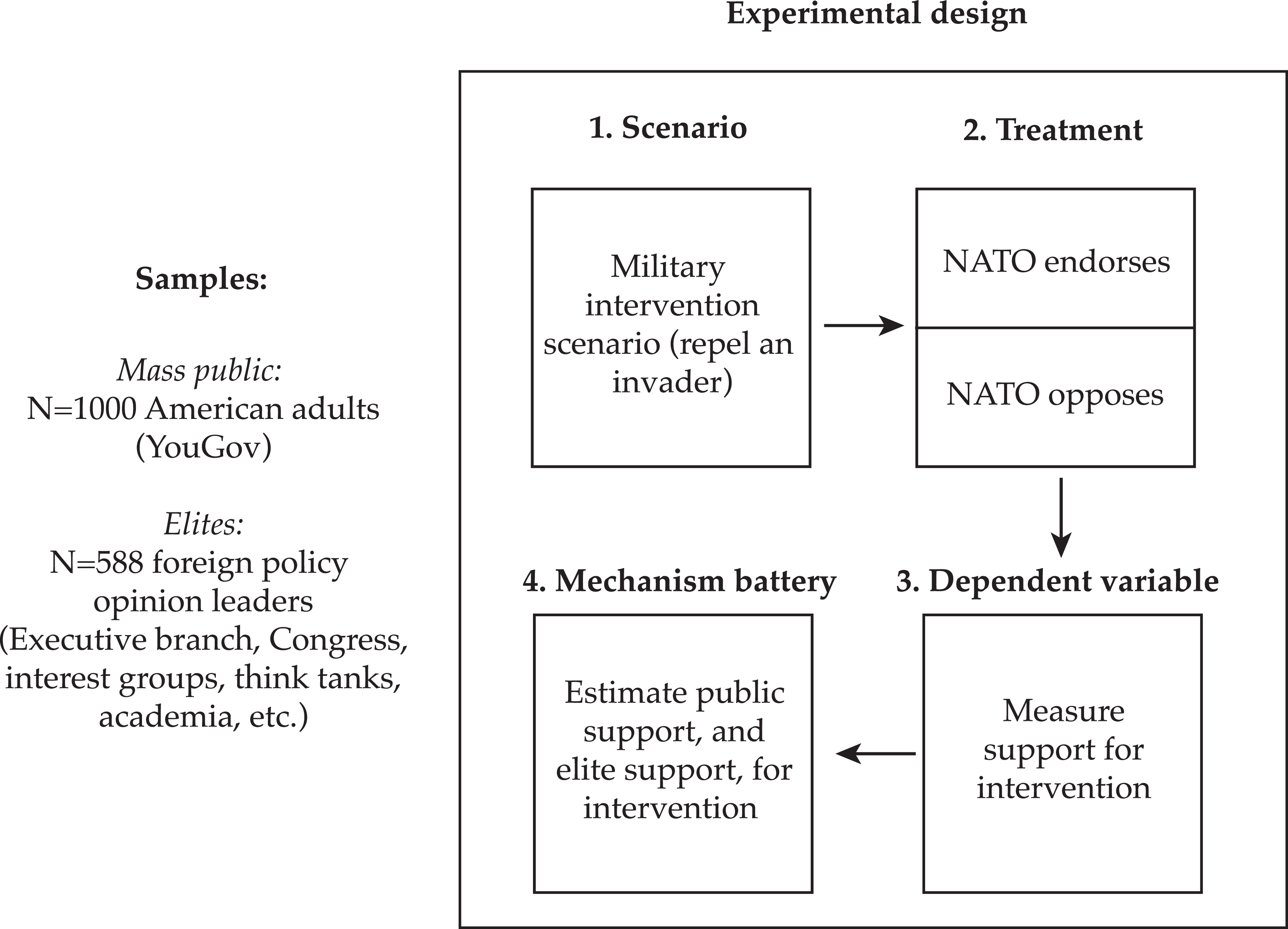
In our 2018 elite and mass surveys, we embedded a survey experiment, the general structure of which is summarized in Figure 4. In it, respondents were told they would be presented with a hypothetical scenario, using language modified from Tomz and Weeks (Reference Tomz and Weeks2013):
Experimental design.

We are going to describe a situation the United States could face in the future. For scientific validity the situation is general, and is not about a specific country in the news today. Some parts of the description may strike you as important; other parts may seem unimportant. Please read the details very carefully. After describing the situation, we will ask a few questions.
They were then presented with the details of a military intervention scenario, building off of the classic repel-an-invader scenario used in experiments like Herrmann et al. (Reference Herrmann, Tetlock and Visser1999), Kertzer and Brutger (Reference Kertzer and Brutger2016), Tomz (Reference Tomz2007), and others. The baseline vignette language is shown below:
A country in Africa recently sent its military across the border into the territory of a weaker neighbor. The attacking country is not a democracy and invaded its neighbor as part of a long-standing feud. The invading military is now carrying out brutal killings of civilians. There is also some concern that political instability in the wake of the invasion will contribute to terrorism and the flow of migrants out of the country. The attacking country’s military is much stronger than that of its neighbor, but much weaker than that of the United States.
The scenario was designed both to avoid priming respondents to think about a specific recent military intervention and to generate disagreement among our respondents: it implicates both humanitarian concerns and concerns about political instability and terrorism, for example (offering both moral and strategic rationales for intervening), but also locates the conflict in an area many Americans do not perceive as paramount to US security interests. It also deliberately controls for a number of contextual factors that might cause ‘information leakage’, as would be the case if the experimental treatment also affects beliefs about unintended features of the scenario.
Building off prior experimental research on the effects of cues from international organizations on support for the use of force (Busby et al. Reference Busby, Kafura, Monten and Tama2020; Chu Reference Chu2025; Grieco et al. Reference Grieco, Gelpi, Reifler and Feaver2011; Mikulaschek Reference Mikulaschek2019), we also randomize whether respondents are told that the mission has received the blessing of an international organization – in our case, NATO, whose stance on military intervention, Chu (Reference Chu2025) shows, has historically been associated with higher levels of support for the use of force. Military interventions endorsed by NATO have been significantly more popular among the American public than interventions without any international organization (IO) endorsement, and no less popular than military interventions endorsed by both NATO and the UN.Footnote 8 Half of respondents were told that ‘The North Atlantic Treaty Organization (NATO) supports taking military action to push out the invading army’; the other half were told that ‘The North Atlantic Treaty Organization (NATO) opposes taking military action to push out the invading army’. Respondents were then asked the extent to which they support or oppose the United States sending its military to push out the invading army, on a six-point Likert scale ranging from ‘Support a great deal’ to ‘Oppose a great deal’.Footnote 9
The value of the experiment is threefold. First, in addition to measuring respondents’ support for the use of force, we also asked respondents in both samples to estimate the proportion of the American public that would support the mission, along with the per cent of ‘foreign policy decision-makers and experts’ that would do the same. In this manner, we can assess the accuracy of each group’s second-order beliefs, comparing the estimated and actual popularity of the intervention across each sample. Secondly, we can directly test the stereotyping mechanism, testing whether elites who perceive the public as isolationist in general are more likely to misperceive public opinion in the specific use of force scenario implicated by the survey experiment. Thirdly, if the results are driven by a widely held stereotype of the public in the foreign policy establishment, our results should be robust across types of elites, and should not merely correspond to the views held by particular subgroups of the public.
Results
We present the results in three stages. We begin by showing that NATO endorsements bolster support for the use of force, with strikingly similar results for both the public and elites, but that despite these similarities, elites systematically underestimate the popularity of NATO endorsements, and that these results are not limited to particular types of foreign policy elites. We then show that the main predictor of these misperceptions is the magnitude of elites’ isolationist stereotypes about the public. We conclude by showing that elites misperceive public opinion more than the public misperceives public opinion, and that elites’ misperceptions cannot be attributed to the views held by particular subgroups of the public.
IO endorsements and elite misperceptions
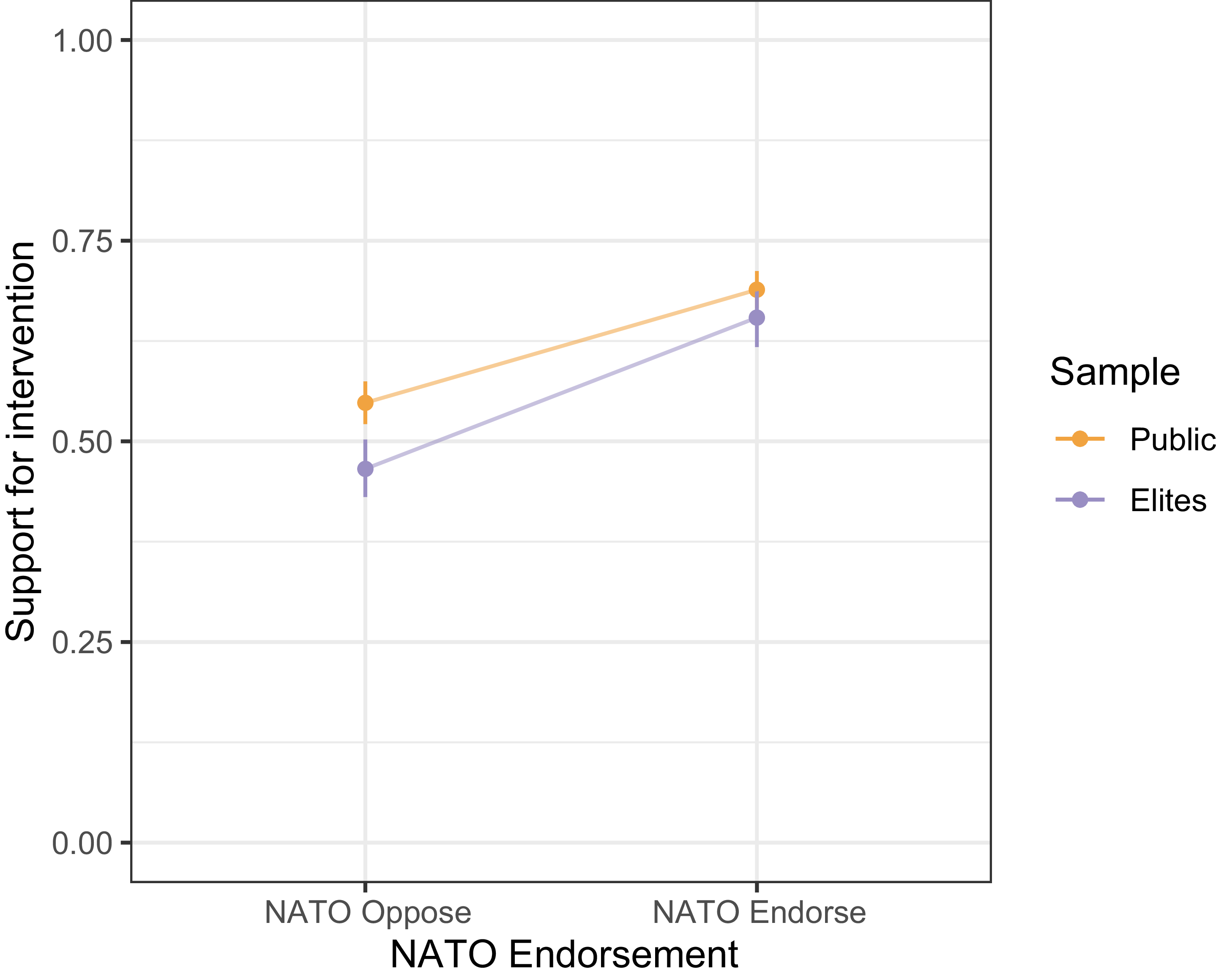
Figure 5 presents the cell means of the endorsement experiment. Although elites are less supportive than the public when NATO opposes the intervention, a NATO endorsement brings both groups onto the same page, and the magnitude of the treatment effect does not significantly differ by sample. These results are not only consistent with claims that elite–public gaps may be smaller than political scientists often assume (Kertzer Reference Kertzer2022), but are also broadly consistent with the magnitude of the NATO endorsement effects estimated in Chu (Reference Chu2025), who varies the instrumentation a number of ways (including altering the target of the intervention, the NATO endorsement language, and whether the names of NATO member countries are mentioned), suggesting these findings are also unlikely to be an artifact of our question wording.
NATO endorsement effects do not significantly differ between the public and elites.
Note: plot shows cell means and 95 per cent bootstrapped confidence intervals.

More importantly for our purposes, as Figure 4 shows, in addition to asking respondents for their own levels of support for the proposed military intervention, we also asked them to estimate the proportion of the public, and the proportion of foreign policy elites, that support the mission. In this way, we can test (i) whether elites effectively underestimate the effect of NATO cues on support for the use of force; (ii) which types of elites read public opinion more accurately; and (iii) whether the level of elite misperceptions of public opinion is greater or lower than the level of public misperceptions of public opinion, providing a comparative perspective that is often missing in studies of elite misperceptions of public opinion.
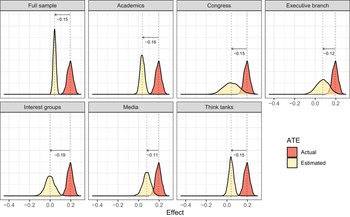
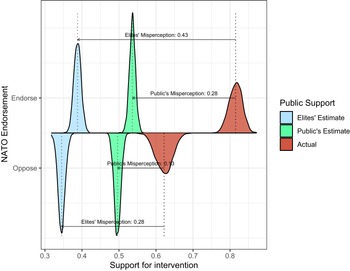
Figure 6 presents a set of density distributions of bootstrapped average treatment effects. The distributions in red denote the average treatment effect of NATO endorsements on the public’s support for the use of force, while the distributions in yellow indicate the average treatment effect of NATO endorsements on elites’ estimates of the public support for the use of force. The arrow in each panel thus denotes the degree of misperception; the fact that the arrow points to the left in each panel shows that all of our elite subsamples underestimate the effect of NATO on public support for the use of force; in the full elite sample, for example, the effect of a NATO endorsement on estimates of the public’s support for the use of force is only 4 percentage points, 15 percentage points lower than the actual level.Footnote 10 As the figure shows, the results are also largely consistent across different types of elites. It is not the case, for example, that elites more directly connected to electoral pressures more accurately perceive public opinion. Figure A7 in Appendix §3 presents cell means rather than average treatment effects, showing that elites underestimate the popularity of the intervention in both conditions (consistent with elites underestimating the public’s internationalism in general), but that the degree of misperception is larger in the NATO Endorse condition than the NATO Oppose condition. On average, elites underestimate the popularity of an intervention with NATO’s blessing by 43 percentage points, while underestimating the popularity of an intervention without NATO’s blessing by 28 percentage points.
Elites underestimate the power of NATO endorsements.
Note: Figure 6 presents density distributions of bootstrapped average treatment effects of NATO endorsements on the public’s support for the use of force (in red), and on elites’ estimates of the public’s support (in yellow). The plot shows that although NATO bolsters support for the use of force in the public by an average of 19 percentage points, elites generally assume NATO has a much more modest (4 percentage point) effect on public support, and that these misperceptions are of similar magnitude for all elite subsamples.

Isolationist stereotypes are positively associated with misperceptions
To capture the role of elite stereotypes about public opinion, we leverage the two elite perception questions fielded in the same 2018 study wave as the experiment. The first asks respondents to estimate the proportion of Americans who agree that the United States should play an active role in the world; the second asks respondents to estimate the proportion of Americans who agree that international trade is good for the United States. In each case, low estimates indicate the presence of an isolationist image of the public, skeptical about the benefits of international engagement. Consistent with the previous analysis, foreign policy elites vastly underestimate the proportion of Americans who agree with each statement, but importantly, these estimates are correlated with one another (r = 0.45), suggesting they tap into the same latent construct – elites’ beliefs about the extent to which the public is isolationist in orientation. We therefore take the mean of these two items and reverse-code them to create an individual-level measure of how isolationist each respondent perceives the American public to be.Footnote 11
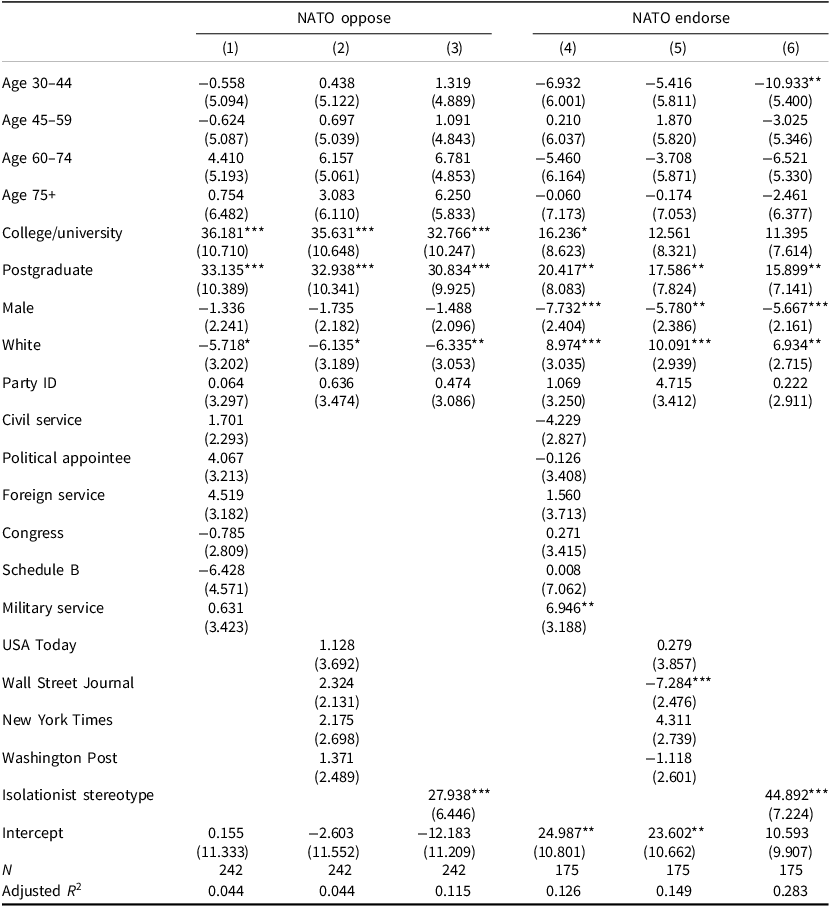
We then estimate a series of regression models to study the determinants of elite misperception of public opinion in a multivariate context. As Table 1 and Table A7 in Appendix §3.2 show, the type of foreign policy elite sampled, elites’ types of experience (for example, experience as a political appointee or Schedule B employee), and elites’ information environments as measured by their media consumption patterns do not consistently predict their levels of misperception of public opinion in the experiment. In fact, a series of Wald tests suggest there is little evidence that elite type or experience significantly improve model fit at all. Importantly, however, our stereotype measure (coded so that larger values indicate a more isolationist stereotype) has a substantively large and statistically significant effect. Changing a respondent’s isolationism stereotype from one standard deviation below the mean to one standard deviation above the mean is associated with an 8 percentage point increase in misperceptions in the NATO Oppose condition, and a 13 percentage point increase in misperceptions in the NATO Endorse condition. The more elites cling to an isolationist stereotype of the public more generally, the less accurate their estimates of public opinion are in the experiment. The other covariate significantly and substantively associated with the size of misperception is education: the most educated respondents (who are most likely to be exposed to narratives about the public’s isolationist tendencies) display the largest misperceptions. Finally, consistent with our observational results, Appendix §3.3 finds that the effect of stereotyping in the experimental data dominates that of projection.
Isolationist stereotypes, not types of experience in government or media consumption, are positively associated with misperceptions

*p < .1; **p < .05; ***p < .01. Positive values = larger misperceptions.
Robustness checks
These experimental results are robust to several other alternative explanations. One alternative interpretation might be that these systematic misperceptions about public opinion are simply an artifact of question wording, or respondents’ tendency to not be very good at estimating numeric properties of groups more generally, even in the absence of biased information (Landy et al. Reference Landy, Guay and Marghetis2018). If so, then these results tell us less about how foreign policy elites systematically misread the public, and more about the difficulty of assessing second-order beliefs more generally. Importantly, however, the experiment also asked the public to estimate public support for the intervention. As Figure 7 shows, foreign policy elites are systematically less accurate in their views about public opinion than the public itself is; in each treatment condition, elites underestimate public support by about 15 percentage points more than the public does.Footnote 12 These findings are particularly important because they stave off a potential critique of some existing studies of elite misperceptions of the public (see, for example, Broockman and Skovron Reference Broockman and Skovron2018; Hertel-Fernandez et al. Reference Hertel-Fernandez, Mildenberger and Stokes2019), which show that elites misread the public, but leave open the possibility that everyone does; we show this is incorrect. These results also offer an interesting contrast with Walgrave et al. (Reference Walgrave, Jansen, Sevenans, Soontjens, Pilet, Brack, Varone, Helfer, Vliegenthart, van der, Breunig, Bailer, Sheffer and Loewen2023), who found that elites have more accurate perceptions of public opinion in domestic political issues than the public does itself; in our data from the foreign policy domain, this appears not to be the case.
Elites misperceive public opinion more than the public itself does.

Finally, another interpretation of these results might be that elites estimating public opinion are not holding onto a stereotype about the public as a whole, but rather, are thinking about the most vocal or politically engaged subset of the public (Pereira Reference Pereira2021). Yet, as Figure 8 shows, the effect of a NATO endorsement is even stronger among individuals who are more politically engaged or politically sophisticated, suggesting the degree of misperception would actually be larger rather than smaller. In fact, Figure 8 shows more generally that there are no subgroups of the public whose distributions of support even remotely match those estimated by foreign policy elites.
Are elites thinking of specific subgroups of the public when they estimate public opinion?
Note: Figure 8 shows that elites’ estimates are inaccurate compared to the actual levels of public support expressed by any subgroup of the public; it is not the case that elites’ perceptions of public opinion better correspond with the views of more politically engaged or politically sophisticated members, for example.

Conclusion
This article has sought to foster dialogue between two areas of political science that often don’t engage with one another. IR scholars are familiar with the important role that misperceptions play in international politics, but tend to focus on how leaders misperceive actors abroad, rather than voters at home. Political behavior scholars have shown that political elites tend to misperceive public opinion, but typically focus on domestic rather than foreign policy issues.
Using an analysis of paired elite and mass surveys from 2004–24, we show that foreign policy elites systematically misperceive public opinion, but using a distinct mechanism from those documented in much of the existing literature in political behavior. Rather than merely projecting their beliefs onto the public, elites also rely on an isolationist stereotype that assumes the public is more inward-looking and skeptical of global engagement than polling data suggests it is. Fielding a paired experiment, we replicate this finding in the context of the domestic politics of multilateralism, where we show elites significantly underestimate how much Americans respond to the blessing of NATO, and that the main predictor of these misperceptions is elites’ stereotypes about the public. The combination of observational and experimental data increases our confidence in the validity of the findings. One critique one might levy against the experiment, for example, is that the results might be an idiosyncratic effect of survey wording in response to a hypothetical scenario, or an artifact of a particular issue rendered unusually salient by the Trump administration. Yet this cannot explain why we obtain similar results with the observational data, across twenty-four different questions, spanning four different presidential administrations. Similarly, one might interpret the observational results not as elites misreading the public, but as these types of social inference questions being inherently challenging more generally. Yet the experimental results show that not only does the mass public outperform elites at assessing public opinion, but elites misperceive public opinion more than the public misperceives elite opinion.
These findings have a number of implications. For public opinion scholars, our findings suggest that theories of domestic politics in IR that link the behavior of leaders to the attitudes of citizens should give greater attention to elite perceptions of public opinion, rather than just public opinion itself. The implications here may go beyond the study of IOs, and apply to other issues in IR investigated by survey experiments – whether leaders can back themselves out of audience costs (Lin-Greenberg Reference Lin-Greenberg2019) may matter less than whether leaders think they can; whether the public views nuclear weapons use as taboo (Press et al. Reference Press, Sagan and Valentino2013) may matter less than what leaders think the public thinks; whether the public is swayed by international law (Wallace Reference Wallace2013) may matter less than the hold leaders think legal commitments have on the public; and so on. More generally, we should be cautious about automatically equating the results of mass public survey experiments with leaders’ perceptions of what their incentives are.
For IR theorists more broadly, our findings offer an alternative perspective on private information. Models of crisis bargaining frequently assume the other side’s resolve is private information, but one’s own resolve is not (Kertzer Reference Kertzer2016, 148). Many formal models of domestic politics allow publics to be uncertain about their leader’s type (see, for example, Canes-Wrone et al. Reference Canes-Wrone, Herron and Shotts2001; Smith Reference Smith1998), but few permit leaders to be uncertain about their public’s. Our findings suggest these assumptions may be worth revisiting. For political behavior scholars, our findings raise important questions about structural differences between elite misperceptions in domestic and foreign policy realms that are a promising avenue for future research not just in IR, but in American and comparative politics as well. And although our data predate the second Trump administration, our findings that the American public are consistently less isolationist than political elites expect help contextualize a recurring pattern in polling data during 2025 that has found that the administration’s inward-looking foreign policies (on trade, immigration, and foreign aid, for example) are markedly out of step with public opinion (see, for example, Kafura and Dong Reference Kafura and Dong2025).
There remains much more to learn about the nature, drivers, and effects of elite misperceptions of public attitudes. How do the perceptions of public opinion by top-ranking decision makers currently in office differ from those held by foreign policy elites more broadly? How do the public‘s self-reported foreign policy attitudes (as measured by survey responses) map onto their revealed preferences? To what extent is the effect of stereotyping moderated by the availability of polling data and the stakes of the situation? Where do elites’ stereotypes about public preferences in foreign policy come from, and how do these stereotypes change over time (Kertzer et al. Reference Kertzer, Brooks and Brooks2021)? As Saunders (Reference Saunders2011) shows, one way that leaders matter in foreign policy is by varying in their belief systems. If leaders vary systematically in the stereotypes they have about public opinion – or, the extent to which they perceive the public as dissimilar to themselves, and thus, the extent to which they rely on stereotypes in the first place – this suggests additional pathways through which leaders affect foreign policy behavior. Similarly, how do elite misperceptions of foreign policy preferences vary across time and space? Although we show here that foreign policy elites have isolationist stereotypes about the mass public in the United States from 2004–24, it is likely that foreign policy elites will subscribe to different stereotypes in other contexts, particularly given variation in each country’s national narratives and formative experiences. Better understanding elites’ second-order beliefs about public preferences in foreign policy is thus a crucial avenue for future research in both IR and political behavior alike.
Supplementary material
The supplementary material for this article can be found at https://doi.org/10.1017/S0007123426101495.
Data availability statement
Replication data for this paper can be found at https://doi.org/10.7910/DVN/071QHF.
Acknowledgments
The authors are grateful to Nic Pantelick for helpful research assistance, and Marijke Breuning, Ethan Busby, Stephen Chaudoin, Jonathan Chu, Rebecca Dudley, Josh Goldstein, Christoph Mikulaschek, Andrew Payne, Miguel Pereira, Beenish Pervaiz, Dina Smeltz, and audiences at American University, Brigham Young University, Brown University, The Ohio State University, Oxford University, and APSA for helpful feedback and discussions.
Financial support
This work was supported by the Chicago Council on Global Affairs and the Strauss and Clements Centers at the University of Texas at Austin.
Competing interests
The authors declare none.





 Open access

