




The End of the World by Luca Signorelli
The closing decades of the fifteenth century were a period of general anxiety in Italy, marked by a revival of fatalistic worldviews and prophetic systems of belief.Footnote 1 The approaching of the chiliastic year 1500 also coincided with a deep and multi-faceted crisis that emerged following the French invasion of the Italian peninsula in 1494. In this turbulent period of unceasing conflict and recurrent epidemics, visual culture and the decorative arts served as expressive vehicles of a preoccupation with apocalyptic visions of the end of the world, millennial anticipations of a new age and a resurgence of medieval prophecies for the coming of Antichrist.Footnote 2
The most significant Italian artwork dealing with these concerns was Luca Signorelli's fresco cycle (1499–1504) of the last judgement in the Cappella Nuova (today often known as the San Brizio Chapel) in Orvieto Cathedral, a milestone of visual eschatology and a crowning achievement of Renaissance art. Commissioned by the Opera del Duomo of Orvieto in April 1499, the Cappella Nuova frescoes depict the court of heaven in the vault, and episodes from the end of the world and the last judgement on the walls. Some of the ceiling compartments had already been painted in 1447 by the Dominican friar Fra Angelico (c.1395–1455), with images of biblical prophets and Christ sitting in judgement. The majority of the extant frescoes were executed by the Umbrian painter Luca Signorelli (c.1450–1523), who found the opportunity to demonstrate his expressive power and creative genius, predominantly in his masterful depictions of the anatomy of the human body.Footnote 3 No artist before him had taken on the challenge of inventing such an immense variety of nude figures, an accomplishment of unprecedented scale and great influence on later artists, most notably the Old Testament ceiling frescoes (1508–12) and the Last Judgement (1535–41) by Michelangelo (1475–1564) in the Sistine Chapel.Footnote 4
Signorelli's ceiling paintings in the Cappella Nuova represent angels, apostles, church fathers, Patriarchs, virgins and martyrs, a scheme that had already been devised by Fra Angelico half a century earlier.Footnote 5 The major wall frescoes depict the Sermon and Deeds of the Antichrist, the Signs of the End of the World, the Resurrection of the Dead, the Crowning of the Elect, the Elect Being Called to Paradise, the Damned Being Plunged into Hell, and the Torments of the Damned; monumental subjects that complemented the effect of liturgical ceremonies by arousing feelings of awe and terror in the congregation.Footnote 6 This profoundly symbolic cycle of eschatology was not invented by Signorelli alone. According to the minutes of the Opera's board meeting of 25 November 1499, a proposal by Gian Ludovico Benincasa that the decoration in the chapel should be ‘advised orally by the venerable masters in theology of this city … provided that it may not depart from the theme of the Last Judgement’ found unanimous approval.Footnote 7 The identity of Signorelli's advisers remains a subject of speculation, but they most likely belonged to the predominant religious order in Orvieto, the Dominicans.Footnote 8
A different individual must have collaborated with Signorelli on the iconography of the chapel's lower walls. These areas were decorated with naturalistic busts of six celebrated poets, including Dante and Virgil, framed by grotesque ornamental motifs.Footnote 9 Their portraits are surrounded by monochrome roundels with underworld episodes from the works of these authors, such as Purgatorio and the Aeneid, representing mythological voyages made to Hades by Hercules, Orpheus, Aeneas and Dante. Situated at eye level and intended for close examination, these classical episodes demonstrate a wide imaginative scope and literary power, which in turn indicates the involvement of a learned iconographic adviser.Footnote 10
The Innovation of the Antichrist
The narrative sequence of the Orvieto cycle begins on the north side of the chapel's eastern wall with the Sermon and Deeds of the Antichrist (Figure 1), one of the most provocative topics in the history of the Christian faith. The protagonist is the arch-deceiver and false prophet of the medieval tradition, the Antichrist,Footnote 11 a long-haired man who superficially resembles Christ both in his looks and actions. The central story in the right foreground presents the greatest of hypocrites seducing his audience through preaching. Immediately behind him stands the devil himself, a symbolically left-handed demon,Footnote 12 who is literally manipulating the actions of the Antichrist and whispers evil instructions to his ear. The people attending the sermon, one of which is Dante Alighieri, are of different ages, time periods and social classes.Footnote 13 Some of these figures are portraits of famous men of Signorelli's time,Footnote 14 an indication of a narrative that is both urgently contemporary and timeless, but also a stern reminder that the Antichrist's preaching could deceive even the most excellent individuals.
Luca Signorelli, Sermon and Deeds of the Antichrist, c.1502–4, fresco, San Brizio Chapel, Orvieto Cathedral, Orvieto. Image in the Public Domain on Wikimedia Commons, online at: <https://commons.wikimedia.org/wiki/File:Luca_Signorelli_-_Sermon_and_Deeds_of_the_Antichrist_-_WGA21202.jpg>, accessed 21 December 2022.

In the composition's background, Signorelli depicted a variety of smaller groups representing the actions of the Antichrist and their disastrous consequences: he conducts false miracles in imitation of Christ, such as the pseudo-healing of a sick man (or perhaps the pseudo-resurrection of a dead man) who is seen rising from his bed; with the pretense of justice, he orders the beheading of two virtuous old men, namely the two witnesses of the last days who would be murdered by the beast (Revelation 11: 3–14);Footnote 15 his distribution of seductive bribes and gifts spreads corruption and greed, a condition personified by the stereotypical figure of a Jewish moneylender surrounded by avaricious men and women;Footnote 16 his hypocritical preaching captivates learned audiences and causes confusion among theologians and churchmen; his wrathful intentions cause outbreaks of violence, especially against those who refuse to worship him; finally, he has ordered the construction of a centrally planned church – conceived by Signorelli in the High Renaissance style – dedicated to his false religion and guarded by violent soldiers, a spectacular, yet structurally disturbing, temple in Jerusalem that creates a purposeful effect of asymmetry.Footnote 17 The dramatic ending of the story takes place in the upper lefthand section of the composition: at the peak of his pride, the Antichrist has attempted a pseudo-Ascension into heaven from the Mount of Olives. There, he is confronted by the Archangel Michael who smites him to the ground along with his crushed followers.
Context, Sources and Meaning
The Antichrist has generally been praised as the most singular innovation in the Cappella Nuova, and sometimes also as the central story of the entire cycle.Footnote 18 Signorelli's sense of pride in this masterpiece is testified by his inclusion of a full-body self-portrait in the far lefthand corner of the picture. More than an authorship signature, the imposing figure of the dignified, black-clothed painter stands next to the dying and dead bodies of the victims of violence and murdered martyrs. His gaze is fixed directly on the viewer, acting as both an Albertian narrator and a contemporary prophet who visualized the end times with tremendous vividness.Footnote 19 The man who stands beside him, dressed as a Dominican monk, is most probably Fra Angelico, the friar who had painted the chapel's vault half a century earlier. By looking and pointing outside the pictorial frame toward the chapel's altar, Fra Angelico leads the spectator's gaze toward the centre of devotion. The faithful presence and testimony of the two artists thus creates a meaningful contrast with the false doctrines of the Antichrist.Footnote 20
Signorelli's subject derived largely from the medieval iconography of the Antichrist and the traditional understanding of his life as an outward imitation of Christ's life.Footnote 21 It is therefore all the more surprising that the Orvieto Antichrist was an entirely novel subject with no iconographic precedents or successors in the visual art of Italy.Footnote 22 Its general meaning can be contextualized within a climate of socio-economic hardship, public health crisis and revived eschatology in late fifteenth-century Orvieto. In addition to its civic history of heresy and strife,Footnote 23 the fortress town had been under siege by French troops, who bombarded it in 1497. Its population had also been severely affected by the first known epidemic of syphilis,Footnote 24 which appeared in Naples in 1495 and spread almost immediately throughout Europe. The completion of a 1,500-year period after the Saviour's birth was further marked by terrifying signs, such as a sublime celestial event witnessed in Gubbio on 29 September 1499 and interpreted by the Orvietan notary and chronicler Tommaso di Silvestro as a monstrous omen and a cause for despair.Footnote 25
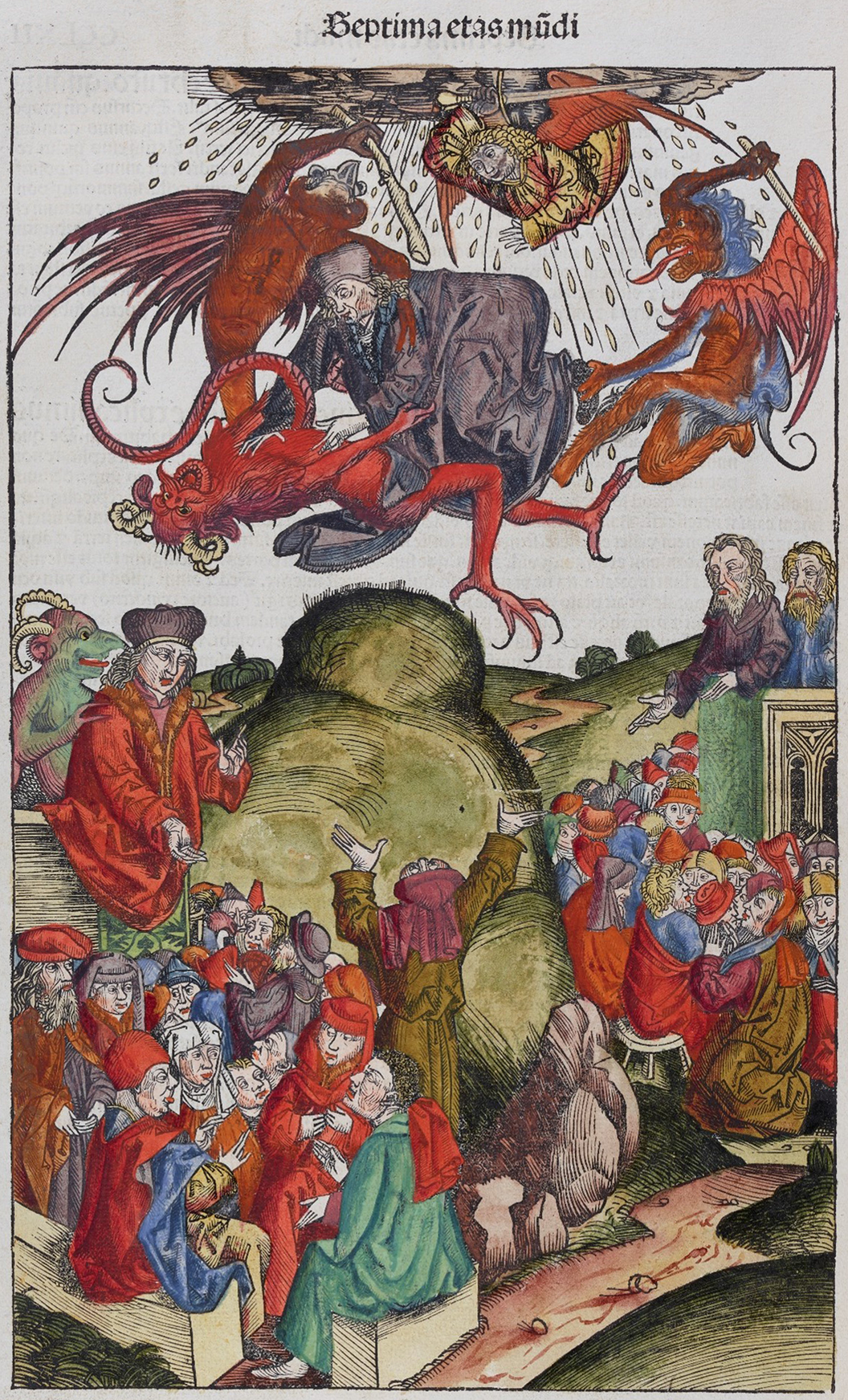
A subject that has not yet been fully resolved concerns the literary and visual sources used by Signorelli. A common proposal refers to the Golden Legend (c.1265), a highly influential late medieval book of hagiographies compiled by the Dominican archbishop, Jacobus de Voragine, which described the disastrous acts of the Antichrist, ending with his annihilation by the Archangel Michael in a manner similar to Signorelli's visual narrative.Footnote 26 Other scholars have drawn attention to the Liber chronicarum,Footnote 27 a famous illustrated encyclopedic text by the German humanist Hartmann Schedel with accounts of world history, including the reign of the Antichrist and the end of the world. Published in Nuremberg in Latin and German editions in 1493, the chronicle enjoyed wide distribution across Europe, and it is highly likely that Signorelli or some local theologian in Orvieto was aware of its content. The similarities between the Orvieto fresco and the chronicle are indeed compelling: the latter's story of the Antichrist (fol. 262v), illustrated by Michael Wohlgemut (Figure 2), represents the exalted protagonist in the act of preaching, while the bestial devil behind him is whispering instructions to his ear, a unique pictorial motif repeated by Signorelli a few years later. Furthermore, the chronicle's Antichrist is defeated by the Archangel Michael in an aerial battle which produces a rain of fire and brimstone, another invention that was strikingly similar to the Orvieto scene.
Michael Wohlgemut, ‘Sermon of the Antichrist’, in Hartmann Schedel, Liber chronicarum (Nuremberg, 1493), fol. 262v, woodcut, Cambridge University Library, Inc.0.A.7.2[888]. Reproduced by permission of the Syndics of Cambridge University Library.
An alternative interpretation was offered by André Chastel, who saw Signorelli's Antichrist as a veiled condemnation of the short-lived puritanical regime of Florence (1494–8) under the ‘demonic’ influence of the Dominican friar Girolamo Savonarola (1452–98).Footnote 28 The key text for comprehending Signorelli's fresco, Chastel argued, is a letter by the humanist Marsilio Ficino addressed to the Roman Curia, with an introduction entitled: ‘Apology of Marsilio Ficino on Behalf of the Many Florentines Deceived by the Antichrist, Girolamo of Ferrara, the Greatest of Hypocrites, to the College of the Cardinals’.Footnote 29 The date of this letter, the authenticity of which is now widely accepted, falls between Savonarola's execution in May 1498 and Ficino's death in early October 1499. Its apologetic content identified the recently-executed Dominican with the long-anticipated Antichrist as a pseudo-prophet whose diabolic enterprise had deceived even the most virtuous Florentines with the power of his hypocrisy.Footnote 30
The hypothesis that Signorelli was aware of Ficino's letter is apparently purely speculative. One might still argue that the artist was personally motivated to denounce the fraudulent attitude of Savonarola. Both men had enjoyed the patronal support of the Medici family in Florence during the late 1480s. However, whereas Signorelli had reportedly risked his own life for Medici causes,Footnote 31 Savonarola would eventually turn against them. It could be further assumed that the posthumous demonization of Savonarola might have been particularly important to the religious authorities of Orvieto, a town with close ties to the papacy. Savonarola's accusations of clerical corruption and papal hypocrisy had led to his excommunication by Pope Alexander VI (r. 1492–1503) in May 1497. It is therefore not entirely implausible that Signorelli's patrons, ever faithful to Rome, decided to denounce the friar.Footnote 32 Nonetheless, the problematic aspects of Chastel's hypothesis are many and can only be summarized here in brief. Signorelli's Antichrist neither resembles the known likeness of Savonarola,Footnote 33 nor is he dressed in contemporary clerical clothing. More importantly, the notorious case of Savonarola would not only have been a sensitive issue for the primarily Dominican theologians who were consulted on the subject matter of the Cappella Nuova,Footnote 34 but would also have been irrelevant to the local concerns of the town's politico-ecclesiastical authorities.Footnote 35
The Medieval Antichrist as the Arch-Hypocrite
Notwithstanding the general dismissal of Chastel's interpretation, his unintended association of Signorelli's preaching Antichrist with the intellectual perversion of hypocrisy (and its successful effect in current society) deserves exploration. The vivid theatricality of Signorelli's scene was plausibly related by Jonathan Riess to the theatrical tradition of the Antichrist myth, arguing that the painter may have seen or read a mystery play about the Antichrist and the end of the world. We know, for example, of a play about Antichrist that was staged in the cathedral of Orvieto in 1508, although there is no evidence that a similar drama had been staged in the town before the execution of Signorelli's fresco around 1503.Footnote 36
Riess also saw a similarity between the surviving stage directions of the medieval German drama Ludus de Antichristo (‘The Play about the Antichrist’) and Signorelli's composition, namely in the spatial relation of the spectators to the Temple of Jerusalem.Footnote 37 Surviving in a single manuscript from the Benedictine monastery of Tegernsee in Bavaria (c.1160),Footnote 38 the Ludus de Antichristo is the earliest and the most impressive of the known medieval Antichrist plays. Its protagonist is described as accompanied by ‘Hypocrisy’ on the right, and ‘Heresy’ on the left, both escorted by choruses. The false humility of the former enables the Antichrist to win the favour and support of the laity, while the latter helps him to demolish the teaching of the clergy. In a dramatic climax, the Antichrist approaches the throne of the king of Jerusalem, sings to the hypocrites that he was born within the church, and then reveals his true intentions. The hypocrites lay down their outer garments before their master; they depose the king of Jerusalem – who had been deceived by their good appearances – and crown the Antichrist.Footnote 39
With its demonstration of hypocrisy as an apocalyptic sign of the last days and a key feature of the Antichrist, the Ludus de Antichristo essentially revived the long-forgotten Gregorian image of the Antichrist as the absolute master of hypocrisy (omnium hypocritarum caput) and the head of an ‘ecclesiastic’ body of hypocrites (Moralia 25.16.34).Footnote 40 The sixth-century portrayal of the Antichrist by Saint Gregory as an exemplar of hypocrisy appears not to be found in the religious thought of fifteenth-century Italy, but some aspects of it would have survived in the theatrical tradition of the Antichrist, not least because of the intrinsic relationship of the theatrical medium to the very notion of hypocrisy.Footnote 41 It is surely difficult to tell whether Signorelli or his advisers were aware either of the Ludus de Antichristo or of the Gregorian portrayal of the Antichrist as the arch-hypocrite. Yet their iconographic emphasis on theatrical notions of oratorical performance and deception makes it plausible to assume that the reign of the Orvieto Antichrist was conceived as an apocalyptic age of hypocrisy.
The Iconography of Hypocrisy
Regardless of humanistic worldviews and millenarian trends, references to clerical hypocrisy in the art of Signorelli's time are scarce. Essentially, they are confined to illustrations of the Divina Commedia, such as Sandro Botticelli's graphic representation of monk-like hypocrites (Inferno, Canto XVIII), bowed down by the weight of their leaden cloaks.Footnote 42 Even a prominent critic of ecclesiastical hypocrisy such as Leonardo da Vinci (1452–1519) was seemingly uninterested or perhaps reluctant to use his art to criticize the church. In one of his polemical writings, Leonardo epitomized the timelessness of clerical hypocrisy with the aphorism: ‘Pharisees – that is to say, friars’;Footnote 43 while in another, he compared the clergymen who criticized painters for working on feast days to the Pharisees who had rebuked Jesus and his disciples for healing people and gathering food on the Sabbath.Footnote 44 These anti-clerical sentiments are not visible in Leonardo's artistic production, apart perhaps from his portrait of Judas in the Last Supper fresco (c.1495–8), which was allegedly based on the likeness of an importunate prior of Santa Maria della Grazie (Milan).Footnote 45
The rarity of visual references to hypocrisy is surprising, given the rich iconographic tradition found in Italy and other regions during the fourteenth and early fifteenth century.Footnote 46 Two common examples are the French type of a nun with a rosary faking the acts of devotional reading and prayer (Papelardie);Footnote 47 and the animal allegory of a fox in priest's garb preaching to a flock of geese, a warning against the rhetorical brilliance of hypocritical preachers seducing naïve flocks.Footnote 48 The Italian tradition of that period relied heavily on Dante's Inferno,Footnote 49 particularly on the placement of hypocritical clergymen amongst the fraudulent of the second lowest circle of hell (Canto XXIII).Footnote 50 The depiction of hypocrites in large wall paintings often came with a satire on their sanctimonious religiosity, including invented scenes from the last judgement, narrating the unsuccessful attempts of hypocrite friars to secretly put themselves amongst the good.Footnote 51 It therefore seems that Signorelli's eschatology signified the reignited interest of Italian artists in the visualization of nearly every aspect of the apocalyptic sublime: the medieval iconography of the Antichrist, the cruelty of his hypocritical regime leading the world to its end, the satirical horrors of the final judgement and hellish visions of the afterlife.
Millenarian Aspects of the Antichrist Myth
A question that is worth asking is whether Signorelli's portrayal of the Antichrist as a preaching hypocrite came with a subtle criticism of clerical hypocrisy. His revival of the Antichrist tradition arguably emphasized the ever-looming danger of false teachers and heretics in a manner that was not devoid of ambiguity. It has been suggested, for example, that the story's warning signs of doomsday do not refer to contemporary ideas of millenarian theology and church reform.Footnote 52 However, the imposing temple of Signorelli's fresco alludes to the unholy church of the Antichrist, a concept used by millenarian theorists from as early as the twelfth and thirteenth centuries.Footnote 53 The contradictions of Signorelli's message are even more visible in his treatment of eschatological prophecy and preaching. Even a critic of Chastel's hypothesis such as Riess stressed that the Antichrist functioned as a condemnation of uncontrolled apocalyptic exhortation of contemporary doomsday preachers, who prophesied that the current church was in its last days, and whose false miracles and lies had been emboldened by the greatly influential sermons of Savonarola.Footnote 54 Some reasonable questions are, therefore: how could a religious narrative persuade audiences of the closeness of the end of the world by outrightly denouncing all those who prophesied about it; and how could the artist negotiate the anti-clerical connotations of the Antichrist myth?
The entire notion of an Antichrist presented serious threats to the Church, which was one reason why accounts of Antichrist had been traditionally relegated to the sphere of the legendary and non-orthodox.Footnote 55 The unpopularity of the story amongst ecclesiastical patrons of art in Italy was apparently owed to its malefic and provocative aspects, but perhaps also to its anti-clerical allusions. The appearance of the Antichrist, even on a fictional or symbolic level, presupposed a time of major crisis and discord for both church and state. The prophesied pseudo-Christs of the New Testament would be ‘disguising themselves as apostles of Christ’ (2 Corinthians 11: 13), having the appearance and attitude, not of a bestial demon, but of a seeming saint, a Christ-like man who ‘takes his seat in the temple of God, proclaiming himself to be God’ (2 Thessalonians 2: 4).Footnote 56 The Antichrist would inevitably appear within the Church, in the form of heresy, as a wolf in sheep's clothing, which explains, for example, why the Liber chronicarum, which, as discussed above, was the most likely source for Signorelli's fresco, depicted the Antichrist in contemporary clerical clothing (a choice not followed by Signorelli).
An answer to the question of whether or not Signorelli's narrative came with millenarian hints could be found in the assembly of debating friars of different orders, who are seen standing right behind the Antichrist and the devil. For some commentators, these learned clergymen stand as the sole pillar of faith and resistance against the evil one and his heresy,Footnote 57 whereas others have read them as disputing, and confused by, or converted to, his false teachings.Footnote 58 Apart from a white-clothed friar who is pointing toward the heavens, the rest of the group engages in futile disputes or consults the scriptures. These signs may well indicate confusion and discord within the Church of God, typical symptoms of the age of the Antichrist. However, this particular assembly may have been invented by Signorelli at a later stage in the design, in order to replace an initial group of debating demons who are inspecting a book, as has been recently proposed.Footnote 59 The latter construct has survived in a magnificent black-chalk drawing by Signorelli (c.1500–3), now in the Morgan Library and Museum (Figure 5),Footnote 60 the enigmatic purpose of which deserves elaboration. Indeed, the entire graphic production of Signorelli for the Cappella Nuova frescoes requires close study in the attempt to shed light on the artist's original intentions for the Antichrist.
Invention and Design – the Influences of Dante
The Antichrist's novelty differentiates it from every other narrative in the Cappella Nuova, apart perhaps from the equally innovative End of the World. Despite being the first episode in chronological order of the events of the Apocalypse, technical and stylistic evidence show that the Antichrist was executed in the later stages of decoration (c.1503),Footnote 61 possibly after thematic modifications. The surviving contracts for the overall commission clarify that the iconography was developed with theological advisers within the specific context of the last judgement;Footnote 62 unusually restrictive terms which suggest that Signorelli may have sought leeway for originality from the outset of his project. His artistic profile and previous experience with complex iconographies reveal, indeed, a highly inventive draftsman and painter who would not have unquestionably complied with iconographic prescriptions.Footnote 63 The ambitious nature of his project would have inspired him to try out novel ideas and explore different solutions, at least on drawing paper. Besides, for such large-scale narrative paintings there was plenty of creative space for all the agents involved (patrons, advisers and artist), although the degree of dialogue and flexibility allowed by the commissioners is not easy to assess.Footnote 64
Signorelli's primary model of inspiration was the Divina Commedia.Footnote 65 His study of Dante's masterpiece is attested by the eleven episodes from Purgatorio (Cantos I–XI) painted on the chapel's lower walls; by the depiction of the damned entering hell (Antinferno, Canto III) on the altar wall;Footnote 66 as well as by the two portraits of Dante in the socle area and in the Antichrist. Signorelli's entire view of eschatology was heavily inspired by Dante: both produced a universal yet deeply personal vision of the contemporary world and the eternal afterlife. It has even been suggested that the aims and methods of the two artists are so analogous that ‘a knowledge of the Commedia helps one to understand Signorelli's frescoes better …[and] an understanding of the frescoes can also help us to understand the Commedia, even though the painter worked a century and a half after the poet’.Footnote 67
A crucial aspect of Dante's worldview was the sharp distinction between true faith and institutional religion, for which reason the simoniac popes of his time, along with countless sinful cardinals and bishops, were condemned to the eternal punishments of hell. While this anti-clerical aspect of the Commedia is not observed in Signorelli's frescoes, a study of his extant drawings indicates that some of his boldest ideas remained unexecuted, perhaps owing to his patrons’ disapproval. Among his surviving studies on paper, about ten have been related to the last judgement cycle, none of which is a compositional drawing.Footnote 68 Of these, only two correspond clearly to executed figures, namely the avaricious moneylender in the foreground of the Antichrist,Footnote 69 and a demon throttling a nude man in the Torments of the Damned.Footnote 70 A couple of studies are seemingly related to the monochrome roundels, and most of the others represent helpless nude men and women who are being captured, carried or beaten by demons. Judging from the content of these stories, including their fictive illumination from the left side, they were intended for the Torments of the Damned.Footnote 71 The absence of drawings connected to the actual paintings is due not only to an accident of survival, but also to the experimental character of a design process that was remarkably fluid and lengthy. As an absolute master in the anatomical design of the human body, Signorelli would have prepared hundreds of drawings, trying out and eventually discarding numerous ideas before reaching successful solutions for the vigorous body postures and actions of his figures.
Discarded Novelties
One of the most captivating drawings relating to the Orvieto cycle represents a scene from Dante's Inferno (Cantos XXXII.124–39; XXXIII.1–90): in the second region of the lowest circle of hell – the icy Antenora – Dante and Virgil encounter two wicked men in the circle of traitors: Count Ugolino and Archbishop Ruggieri (Figure 3).Footnote 72 Ugolino, the less evil of these two men is narrating his betrayal by the archbishop of Pisa, who had him and his innocent children imprisoned and starved to death. While narrating, Ugolino is holding down Ruggieri by the neck and is about to continue gnawing his already deformed skull. The latter, whose hands are tied behind his back, is silently enduring the horrific punishment of being cannibalized, one of the most disturbing scenes in the entire Inferno.Footnote 73 The particular subject and circular format of this composition leave no doubt that it was intended for the decoration of the Cappella Nuova's lower walls with monochrome roundels. Its infernal subject and fictive illumination from the left side further indicate that it was intended for the socle zone beneath the Torments of the Damned (Figure 4).Footnote 74 For reasons which are not clear, the scene was discarded. A possible justification for this decision is that the infernal punishment of a highly placed cleric may have been judged by Signorelli's advisers or patrons as an inappropriate image for worshippers.Footnote 75 An entire series from Inferno may actually have been planned at an early stage, but later abandoned due to its controversial character.Footnote 76 Two possible relics of this hypothetical programme have been traced to below the altar wall's Antinferno: the partial figure of an avaricious sinner lying on the ground and biting his hand, revealed during the restoration of the altar wall's pictures in the mid-1990s, may have been inspired by the Inferno's region of Caina; and a rectangular episode with the scourging of women and the flaying of men by demons might be a variation on two different stories from the Inferno, the punishment of lust (Canto XVIII) and politico-ecclesiastical discord (Canto XXVIII), respectively.Footnote 77
Luca Signorelli, The Encounter of Dante and Virgil with Count Ugolino and Archbishop Ruggieri, c.1500–3, drawing, black chalk on paper, 31.2 x 25.6 cm, British Museum, London, Department of Prints and Drawings, inv. 1885,0509.41. Reproduced by permission of the Trustees of the British Museum, London.

Luca Signorelli, Torments of the Damned, c.1500–3, fresco, San Brizio Chapel, Orvieto Cathedral, Orvieto. Image in the Public Domain on Wikimedia Commons, online at: <https://commons.wikimedia.org/wiki/File:Luca_Signorelli_-_The_Damned_-_WGA21220.jpg>, accessed 21 December 2022.

Another discarded invention, and one of the most impressive drawings of Signorelli's entire graphic oeuvre, is the previously mentioned study of four bat-winged demons acting as learned scholars (Figure 5).Footnote 78 The demon with the largest horns on the right is holding up an open book in the manner of prophesying or preaching a heretical doctrine. The other three are viewing the book's content, and one of them, the farthest, makes use of pince-nez spectacles, an ingenious mocking of false erudition, or false prophecy and heresy. Art historians have generally agreed that this drawing was intended for the Orvieto cycle; however, no consensus has been reached about its purpose and meaning.
Luca Signorelli, Four Demons Inspecting a Book, c.1500–3, drawing, black chalk on paper, 35.5 x 28.4 cm, The Morgan Library and Museum, New York, inv. 1965.15. Photographic credit: The Morgan Library and Museum, New York.

A close investigation of the chapel's paintings shows that the western frescoes receive fictive light from the left, and the eastern frescoes from the right: their notional sources of illumination were therefore the southern windows behind and above the altar. This pattern of painted light had a double function: it reflected the direction of real sunlight coming inside the chapel, but it also symbolized the spiritual light of divine grace radiating, as it were, from the altar. Given that the Morgan drawing is lit from the right, it must have been associated either with the Antichrist, the Signs of the End of the World, the Crowning of the Elect or the monochrome roundels in the dados. The Crowning can be safely excluded on thematic grounds, while the idea for an abandoned monochrome is highly unlikely because of the drawing's ambitious scale and content.Footnote 79 The attitudes and postures of the four demons resemble some of the prophesying figures in the right foreground of the Signs of the End of the World (Figure 6) as some authors have already proposed;Footnote 80 although the former's pseudo-scholarly subject has little to do with the latter's scenes of physical disaster and chaos.
Luca Signorelli, Signs of the End of the World, c.1502–4, fresco, San Brizio Chapel, Orvieto Cathedral, Orvieto. Image in the Public Domain on Wikimedia Commons, online at: <https://en.m.wikipedia.org/wiki/File:Luca_signorelli,_cappella_di_san_brizio,_apocalisse_01.jpg>, accessed 21 December 2022.

On balance, the Morgan study seems to fit in better with the Sermon and Deeds of the Antichrist in its early stages of design, due to their common emphasis on hypocritical preaching, devilish sophistry, and what the Golden Legend described as ‘the Antichrist's false explanation of the Scriptures’.Footnote 81 In any event, the crucial question is why an invention of such skill and wit was eventually abandoned? To assume that Signorelli merely experimented with this idea without intending to use it would unconvincingly relegate a sheet that demonstrates all the artist's virtues at once into a purposeless study. In fact, the mastery of its black-chalk technique, the volume of its figures, and the specificity of its narrative, point to a carefully planned thought that was meant to convey a certain message related to the pretensions of devilish heretics and false prophets. A possible explanation for its omission is that the scene came under scrutiny by Signorelli's advisers who eventually disapproved of it. The sarcastic conception of demons acting as learned scholars (or theologians) could have been perceived as reminiscent of millenarian accounts and satires of demonic clergymen acting as the devil's instruments. The revival of the millenarian movement during the last decades of the fifteenth century had come with the revived conception of corrupt clergy as a demonic, bestial fraternity that belonged to the hordes of the Antichrist.Footnote 82 The Orvietan authorities, ever faithful to the papacy, may have exerted tight control over Signorelli's most ambiguous inventions.Footnote 83 Hence, instead of the four naked demons, the less controversial group of disputing theologians with books was eventually depicted right behind the devil, in order to express the confusion in ecclesiastic circles caused by the discourses of the Antichrist.
In conclusion, the available evidence regarding the execution of the Cappella Nuova cycle points toward a prolonged process of design characterized by stimulating oral discussions and programme modifications. The commission of such an artistically promising, yet controversial, project resulted in astonishing novelties, but perhaps also in abandonments of potentially offensive ideas. The idea that Signorelli's cycle of the last judgement may have initially included millenarian hints cannot be argued with certainty, not least because it would project post-Reformation views on to an artist of the late Quattrocento. Yet the discarding of Signorelli's controversial inventions, the overall absence of episodes from the Inferno, as well as the suppression of anti-clerical aspects of both the Commedia of Dante and the Antichrist myth, indicate a politically correct iconographic approach and reassurance to contemporary viewers that the church and its clergy could not be blamed for the socio-political decay and hypocrisy of the last days.


 Open access



