




Introduction
The emergence and spread of the Urnfield culture decidedly shaped the cultural dynamics of prehistoric Europe in the second half of the second millennium BC (Cavazzuti et al. Reference Cavazzuti, Arena, Cardarelli, Fritzl, Gavranović, Hajdu, Kiss, Köhler, Kulcsár and Melis2022). The full acceptance of the cremation rite, accompanied by hoarding practices of metal, and the wide distribution of specific metal types are some of the manifestations of the Urnfield phenomena that spanned over the vast area of western, central, and southeastern Europe. The appearance of urn cemeteries in the central Balkans, a region located on the southeastern fringe of the Urnfield Culture in the territories of today’s Serbia, was not sufficiently explained for a long time, mainly due to the lack of tangible chronological data. Following the typo-stylistic criteria of pottery and characteristics of grave rituals (arrangement of an urn and accompanied vessels, the outline of the graves and occurrence of specific metal finds), the previous research identified several regional groups (Belegiš, Paraćin, Brnjica) that were, using the analogies, chronologically set between the end of the Middle Bronze Age (15th century BC) and throughout the Late Bronze Age (14th–11th century BC) (Bulatović et al. Reference Bulatović, Gori and Vander Linden2018; Vasić Reference Vasić2013). Regarding the wider cultural frame, the urn cemeteries of the central Balkans were mainly seen as an echo of the overall rise of cremation practice in Europe (Medović Reference Medović2013; Vasić Reference Vasić2013).
Recent publications of several 14C dates from sites in Serbia, traditionally assigned to Paraćin or Brnjica groups, indicated different regional and chronological developments when it comes to the emergence, duration, and outline of cremation cemeteries (Bulatović et al. Reference Bulatović, Molloy and Filipović2021; Kapuran et al. Reference Kapuran, Gavranović and Jovanović2022; Mehofer et al. Reference Mehofer, Gavranović, Kapuran, Mitrović and Putica2021). In addition, the absolute dates from the newly excavated sites, such as the cemetery of Ranutovac in southern Serbia (Bulatović Reference Bulatović2020), suggested that cremation as a general way of dealing with the deceased started in this area already in the Early Bronze Age or between 22nd and 20th century BC. The thus far presented absolute dates from other sites confirmed the presence of urn burials between the 15th and 13th century in central Serbia along the Morava River valley (Paraćin group), while the few dates from sites of the Brnjica group in southern Serbia indicate the 14th through 12th centuries BC (Bulatović et al. Reference Bulatović, Gori and Vander Linden2018, Reference Bulatović, Molloy and Filipović2021; Kapuran et al. Reference Kapuran, Gavranović and Jovanović2022).
Recent research and fieldwork at sites in eastern Serbia, encompassing both urn cemeteries and associated settlements (Gavranović et al. Reference Gavranović, Kapuran, Mehofer and Waltenberger2020), has provided a number of well-contextualized samples: cremated human remains, animal bones, burnt grain and charcoal from pyres. As the initial research focus was on copper production, the first published 14C dates came from settlement sites with abundant evidence of metal processing (e.g., Trnjane, Ružana and Čoka Njica) as well as from a few urn graves from previously investigated urn cemeteries (Trnjane). Surprisingly, the first results suggested the occupation of settlements and use of the cemeteries between the 19th and 17th century BC (Kapuran Reference Kapuran2022; Kapuran et al. Reference Kapuran, Gavranović and Mehofer2020; Mehofer et al. Reference Mehofer, Gavranović, Kapuran, Mitrović and Putica2021). Expanding on this small published dataset, here we present 38 new radiocarbon dates from sites in eastern Serbia, including the samples from ongoing investigations in the urn cemetery Hajdučka Česma (23 dates) and from nearby burial grounds with very similar grave architecture in Borsko Jezero (5 dates), Kriveljski Kamen (3 dates) and Šoka lu Patran (2 dates) as well two dates from the cemetery of Magura (Lazić Reference Lazić, V, M, K and M2016), located some 30 km to the south. In addition, we also present one new radiocarbon date from the settlement area and one from the cemetery in Trnjane and one from Čoka Njica settlement.
Eastern Serbia
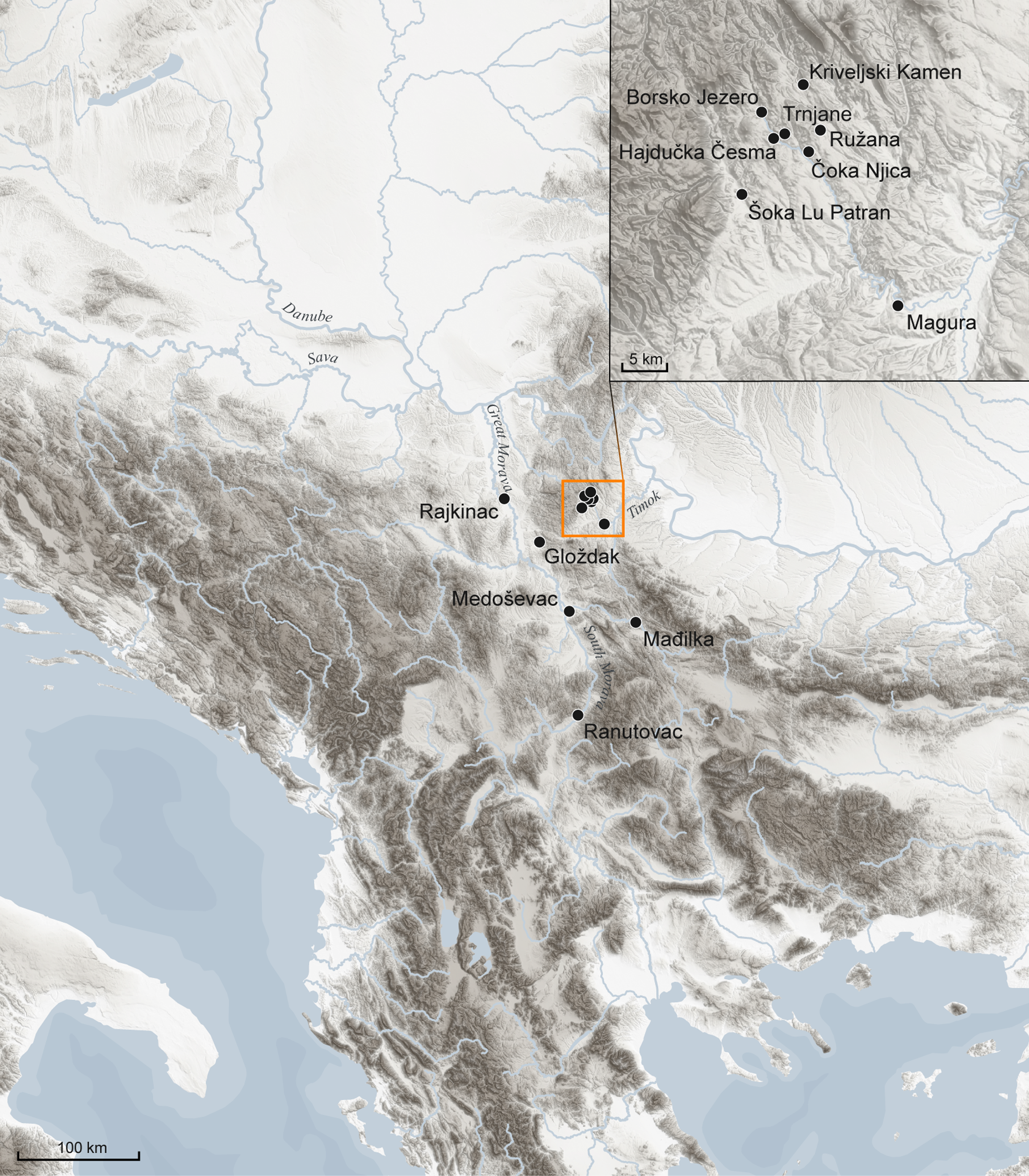
The region of eastern Serbian is framed by the Danube and Timok Rivers in the North and East, the Morava River valley in the West and the Balkan Mountain range (Stara Planina) in the South (Figure 1). This area is best known for extremely abundant copper ore deposits, exploited from early prehistory until the present day. The famous site Rudna Glava provided one the earliest evidence of copper mining and extraction in Europe, with absolute dates spanning 5500–4500 BC (Middle Neolithic and Early Copper Age) (Jovanović Reference Jovanović and B1995; Borić Reference Borić, T and B2009; O’Brien Reference O’Brien2015). As the more recent investigations demonstrated, the local Late Neolithic and Copper Age communities were also engaged in copper smelting and extraction (Radivojević and Roberts Reference Radivojević and Roberts2021).
Location of the discussed sites (I. M. Petschko).
Until the 1980s, little was known about Bronze Age developments in eastern Serbia. Investigations at the site of Trnjane near Bor brought the first findings of this period to light (Jovanović Reference Jovanović and E1999; Jovanović and Janković Reference Jovanović, Janković and N1996). Of particular significance was an urn cemetery located at the edge of the settlement border, featuring a style and arrangement of graves that was previously unknown to this region. The graves comprised circular stone structures (diameter between 1.5 and 3.5 m) with a centrally deposited urn (Figure S10). Apart from urns, little else was found in the 43 graves in Trnjane, with one bronze knife, a few stone axes and smaller vessels being the only grave goods. Since this funeral rite seemed indicative of the Urnfield period and there were certain pottery analogies with the other cemeteries in the central Balkans, Trnjane was initially assigned to the Late Bronze Age or a span between the 14th and 11th centuries BC (Jovanović Reference Jovanović and E1999; Vasić Reference Vasić2013). The same dating and close association with the spread of the Urnfield culture was assumed for similar urn cemeteries subsequently discovered in eastern Serbia, such as Borsko Jezero (Kapuran and Miladinović-Radmilović Reference Kapuran and Miladinović-Radmilović2011) or Kriveljski Kamen (Kapuran et al. Reference Kapuran, Miladinović-Radmilović and Jovanović2013).
A new impetus to the research in eastern Serbia was given with the start of a joint Austrian-Serbian project in 2017 that included a reevaluation of older findings, intensive geophysical prospections, a wide range of archaeometallurgical analyses and excavations at the sites of Trnjane (settlement area), Čoka Njica (settlement) and at the urn cemetery of Hajdučka Česma. The first results (Gavranović et al. Reference Gavranović, Kapuran, Mehofer and Waltenberger2020; Kapuran et al. Reference Kapuran, Gavranović and Mehofer2020; Mehofer et al. Reference Mehofer, Gavranović, Kapuran, Mitrović and Putica2021) enable several preliminary conclusions:
-
Bronze Age communities in Eastern Serbia were intensely engaged in copper ore processing and the production of raw copper.
-
Both the material culture and the first 14C dates suggest a clear association between copper-producing settlements and nearby urn cemeteries with circular stone structures.
-
The first few radiocarbon dates indicated a much higher date for the sites of Trnjane, Čoka Njica and Ružana (19th–17th century BC) than had previously been assumed based on archaeological finds (Urnfield period or 14th–11th centuries BC).
Sites and samples
Hajdučka Česma
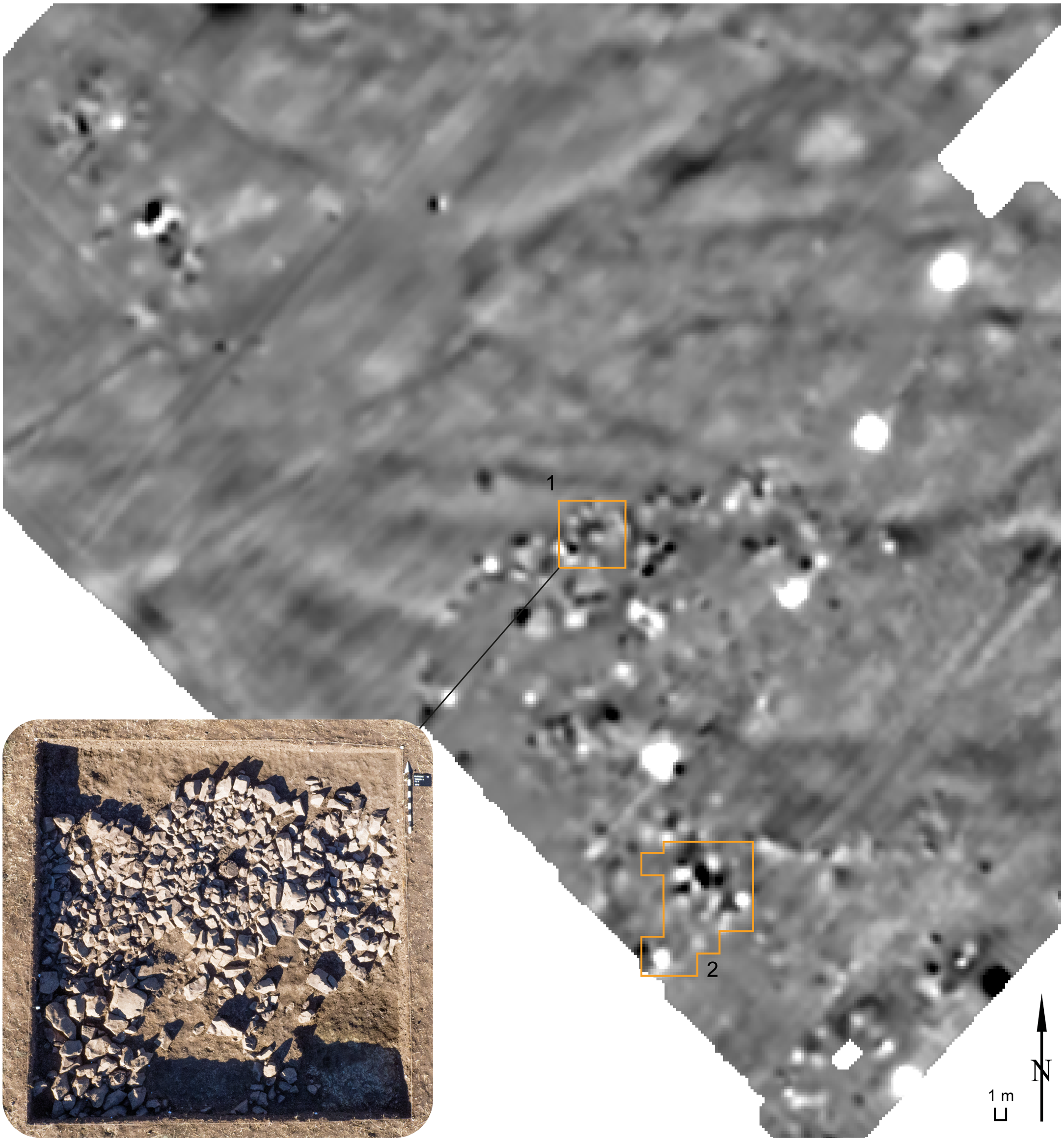
Three urn vessels that were found accidentally in 1992 and stored at the Museum in Bor provided the first hint about the existence of a cemetery at Hajdučka Česma (Lazić Reference Lazić2004). The geophysical prospection and subsequent excavations in 2018 and 2019 revealed a burial ground situated on a slightly sloping terrace above the Brestovačka River, some 5 km west of the city of Bor and just 1.5 km south of the Trnjane site (Figure 1). Based on geophysical anomalies and the results of the first excavations, the cemetery consists of at least 80–90 densely arranged circular stone structures with several recognizable clusters (Figure 2). In the two trenches excavated thus far, 14 urn graves have been uncovered. In most cases, one urn was placed within a circular stone structure measuring between 1.5 and 4 m in diameter. In one case, however, three urns were deposited close to each other within one construction (Figures 2 and 3, Graves 5, 12, and 13). The grave architecture follows a uniform pattern, with larger stones in the outer ring and somewhat smaller and often crushed stones filling the inner space of the circle. The urn was placed in the center, either within a small pit or on a stone slab, and additional stones were placed to border the urn and cover it (Figure 3).
Results of geomagnetic prospection at Hajdučka Česma, photo of Trench 1 and location of Trench 1 and 2 (M. Gavranović).
Plan of cemetery Hajdučka Česma and drawings of the urns (M. Konrad, A. Kapuran, M. Dević, I. M Petschko).
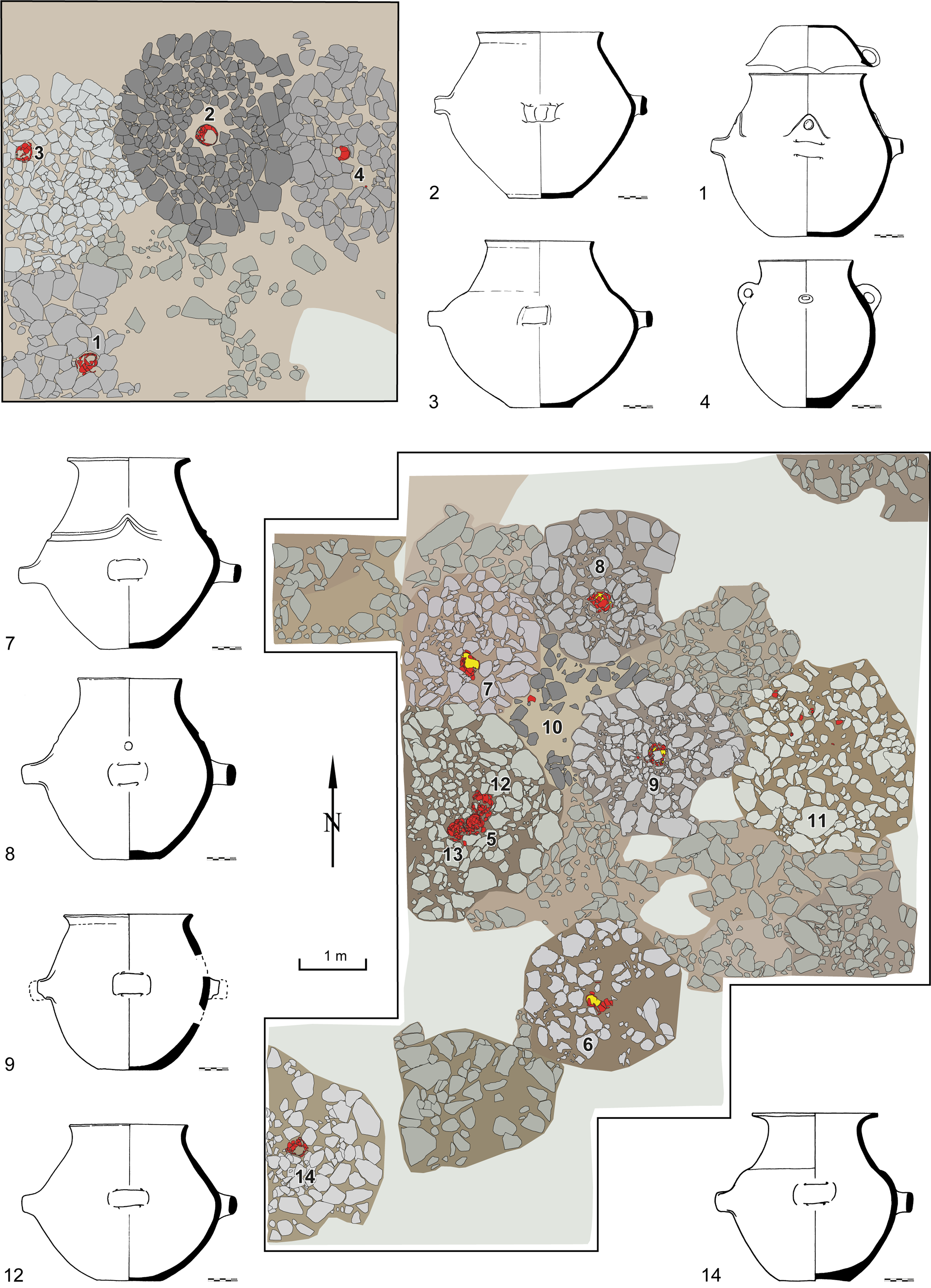
In terms of horizontal stratigraphy, a couple of assessments were made in the field. In Trench 1, the stone structure of Grave 2 clearly disturbed the outer ring of structures of Graves 3 and 4 and was thus certainly built after the two adjacent graves already existed (Figure 3). The circumferential larger stones of Grave 1 were placed above the stones of Grave 3 indicating a stratigraphically younger position. In Trench 2, only remnants of Graves 11 and 10 survived the subsequent activities, making them stratigraphically the oldest features. Conversely, the position and the extension of Grave 9 speak for it being one of the youngest features in this particular grave cluster. The stone structure with Graves 5, 12 and 13 is stratigraphically above Grave 7 and certainly younger. Grave 7 appears to cut the structure of Grave 8 and is thus definitely built after, while the relation between Graves 5, 12 and 13 and Grave 9 is not clear (Figure 3).
The content of the urns was micro-excavated in several layers in the post-excavation processing. In cases of better-preserved urns, all parts of the body were present, with a general tendency for the cranium and upper limb fragments to be found in the upper sections. This advocates for an anatomical layering of cremated remains within the urn. Except for the urn from Grave 1 with cremated remains of two individuals (one adult female and one subadult), other urns contained bones of one individual with a prevalence of children and subadult age groups (Table 1). The urn from Grave 1 is also thus far the only one found with a reversed bowl on top, serving as a lid.
Radiocarbon dates for cemeteries and settlements of copper-producing societies in eastern Serbia
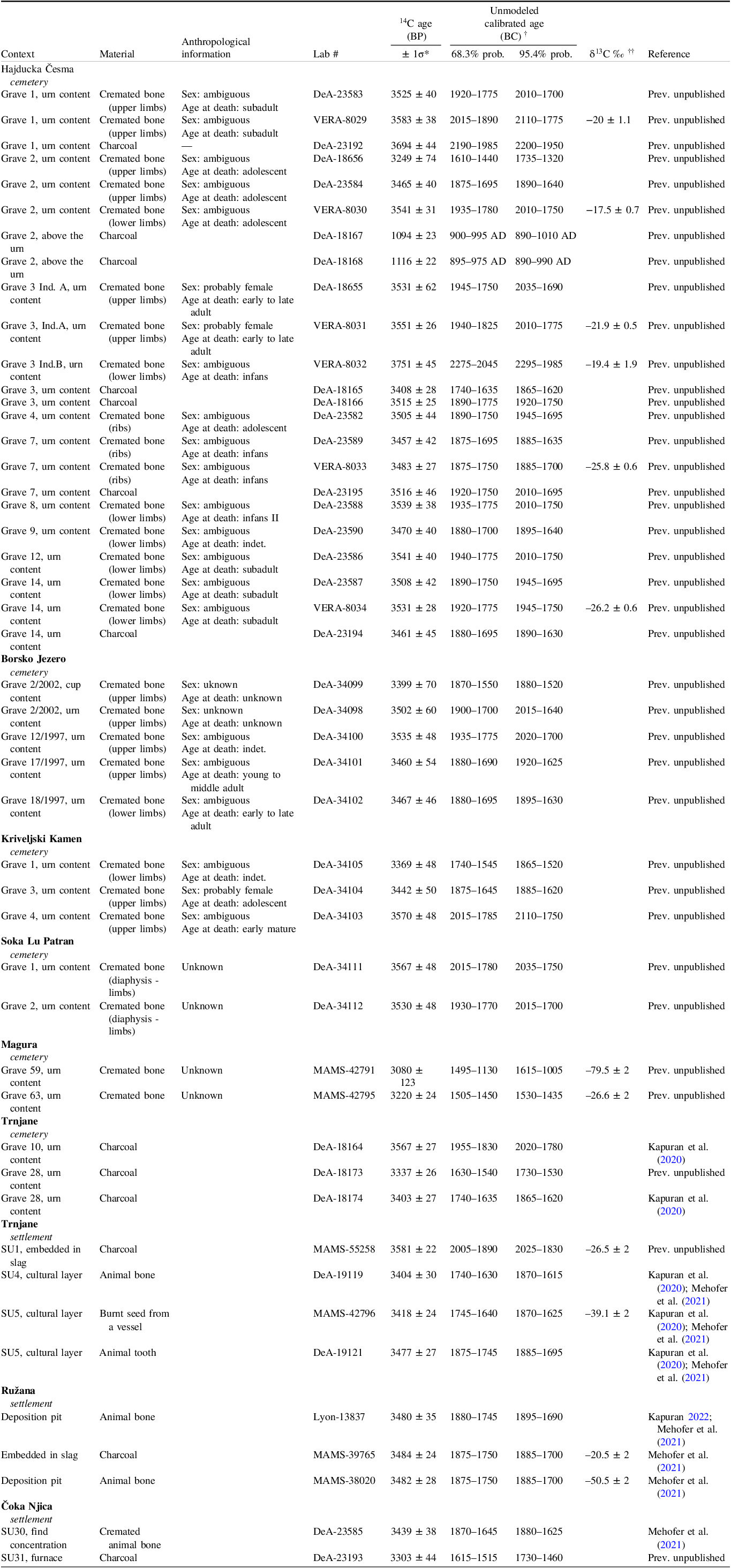
* Several dates with high measurement uncertainties, such as MAMS-42791 (± 123 years) and several DeA (Debrecen) results (e.g., ± 60 to 70 years), appear to be due to low yield or carbon content. Reports from the Debrecen laboratory further indicate that measurement errors for cremated bone were generally enhanced by a factor of two.
† All dates BC, with two exceptions noted (DeA-18167, DeA-18168).
†† δ13C measurements were not provided by Isotoptech Zrt. All available values listed in the table were measured via AMS (not IRMS) and may be subject to some fractionation during sample preparation. The values are thus useful only for quality control, not extended analysis. We note that several reported values are unusual, including one from cremated bone (MAMS-42791, –79.5 ± 2‰). The reason for this is unclear, but note that MAMS-42791 had low yield and carbon content (1.4%).
Apart from cremated human remains, the urns also contained charcoal pieces, which most probably derive from the pyre fuel and were gathered up with the bones. The urns also contained a few chronologically non-indicative grave goods (two spindle whorls and one metal sewing needle). Smaller cups, beakers, bowls, and ladle-like vessels found outside the urns in some grave structures may hint at funeral feasts or gatherings.
In terms of relative chronology, the archaeological material from Hajdučka Česma can be confidently synchronized with neighboring sites such as Trnjane or Borsko Jezero (Kapuran et al. Reference Kapuran, Gavranović and Jovanović2022). In particular, the resemblance of urn shapes, usually undecorated and with four handles on the shoulder area (Jovanović and Janković Reference Jovanović, Janković and N1996; Kapuran et al. Reference Kapuran, Gavranović and Mehofer2020), indicates that the sites are of similar date. However, the material culture provides little reference for absolute dating.
For absolute dating by radiocarbon, we sampled cremated human remains from Graves 1, 2, 3, 4, 7, 8, 9, 12 and 14. The amount of bone in the almost destroyed Graves 10 and 11 and within the two partially preserved urns of Graves 5 and 13 was very low, comprising just a few fragments found outside the urns; we thus chose not to proceed with dating these graves. In addition, we dated charcoal samples from the urns in Graves 1, 2, 3, 7 and 14 for comparison.
Borsko Jezero
The cemetery of Borsko Jezero is situated on the elevated plateau on the bank of today’s artificial lake of the same name, some 3 km west of Hajdučka Česma (Figure S1). Most of the site is under water, and the remains of the grave structures are partly visible when the water level is low. Excavations in 1997 and 2002 led to the discovery of 32 graves, most being heavily eroded due to the changing water level (Kapuran and Miladinović-Radmilović Reference Kapuran and Miladinović-Radmilović2011; Kapuran et al. Reference Kapuran, Miladinović-Radmilović, Vuković, D and M2017; Lazić Reference Lazić2004). The recorded circular stone structures are similar in appearance and size range (between 1.5 and 4 m in diameter) to the grave features of Hajdučka Česma, with an outer ring of larger stones and smaller stones inside the ring (Figure S2).
Each structure was built for one urn, which was placed in the center and flanked by additional large stones. Most of the urns were placed in a small pit. The anthropological analyses identified a high degree of bone fragmentation and high burning temperatures, and on a few bone fragments, traces of melted copper were observed (Kapuran and Miladinović-Radmilović Reference Kapuran and Miladinović-Radmilović2011; Kapuran et al. Reference Kapuran, Miladinović-Radmilović, Vuković, D and M2017). This might indicate the presence of metal artifacts burned on the pyre.
Apart from urns, the archaeological finds included smaller associated vessels (cups, beakers and bowls) and several spindle whorls of the same type as in Hajdučka Česma. The urn repertoire compares well with Trnjane and Hajdučka Česma, although finds that might indicate a reliable absolute date (e.g., characteristic metal objects) are lacking.
The state of preservation and available documentation do not allow observations of the stratigraphical relations between graves. Judging by the position of the investigated areas and the fact that the large central part of the plateau on the natural elevation is unexcavated, the original number of graves is certainly much higher than 32.
Samples for radiocarbon dating were selected from cremated bones originating from the urns stored at the Museum in the city of Bor. From Grave 2/2002, we took two samples (Figure S4). The first sample is a cremated bone from the urn contents. A small beaker and a spindle whorl were also found inside the urn, and the beaker was also filled with cremation remains. A cremated bone from this beaker represents the second sample from Grave 2/2002.
The urns in Graves 17 and 18 were placed in smaller stone structures (diameter 1.5–2 m) and dug relatively deep into the ground, contributing to the better protection of the urn shape and content. In Grave 18, a spindle whorl was found beside the urn). From each of the urns, samples of cremated human remains were taken (Figure S3)
The circular stone structure of Grave 12 (diameter 2.5 m) featured very large stones in the outer ring (in excess of 50 cm), and the urn was placed in a shallow pit. In addition to the cremated remains of one individual with occasional traces of melted metal, the urn also contained one spindle whorl (Kapuran et al. Reference Kapuran, Miladinović-Radmilović, Vuković, D and M2017).
Kriveljski Kamen–Bunar
This site is located 10 km to the north of the city of Bor (Figure 1) on a small flat terrace below a rock formation that dominates the local landscape (Kriveljski Kamen). The excavation in 2012 resulted in the discovery of four circular stone structures, each with an urn (Kapuran et al. Reference Kapuran, Miladinović-Radmilović and Jovanović2013; Kapuran et al. Reference Kapuran, Miladinović-Radmilović, Vuković, D and M2017). Due to the shallow position (just 20 cm under the surface) the stone structures and urns were disturbed by subsequent activities as the area was also used for an Early Middle Age necropolis (Figure S6).
The four structures varied in size (diameter between 1.5 and 3.5 m) and had no stratigraphic relationship to one another. Concerning typology, the four urns (each with four horizontal handles on the shoulder area) correspond to the shapes already observed at Trnjane and suggest a similar timeframe (Figure S5)
Anthropological analysis revealed comparable cremation practices as at Trnjane or Hajdučka Česma, with white, calcinated bones. The urn from Grave 3 contained the remains of two individuals (an adult of unknown sex and a juvenile), while the other urns contained the remains of just one adult individual.
Samples for radiocarbon dating were taken from the adult individual in Grave 3 and from cremated remains of individuals buried in Graves 1 and 4 (Kapuran et al. Reference Kapuran, Miladinović-Radmilović, Vuković, D and M2017).
Šoka Lu Patran
The excavation of this site, located on the banks of the Zlotska River some 6 km southeast of the city of Bor (Figure 1), took place in the 1960s, but the results were never published. The Museum in Bor has two urns with cremated human remains that were found at the site. Unfortunately, there are no details about the grave features or structures. Still, the shape of the urns fits well into the pottery repertoire known from neighboring cemeteries at Trnjane and Borsko Jezero (Figure S7). The appearance and white color of the bones suggest high burning temperatures. Samples for radiocarbon dating were taken from cremated remains in both urns, which we preliminary describe as Grave 1 and Grave 2.
Magura
The cemetery of Magura is located in the immediate vicinity of the Late Roman Palace “Felix Romuliana” near Gamzigrad. This naturally elevated area was used in the 4th century AD as a prominent place for erecting large tumuli graves for emperor Galerius and his mother, Romula. The large tumuli covered a part of the Bronze Age cemetery, which was excavated between 1991 and 1996 (Lazić Reference Lazić2011, Reference Lazić, V, M, K and M2016). In total, 82 urn graves were uncovered, many of them within circular stone structures comparable to the sites near Bor mentioned above. Some of the urns were, however, also found in a simple pit, without a surrounding stone construction.
Based on the pottery analyses and a few indicative metals at Magura, such as a small spearhead and a pin with a biconical head, the chronological range of the site was set between the 18th and 14th centuries BC, with three successive phases (Lazić Reference Lazić, V, M, K and M2016). Whilst the urns from the oldest phase are of a very similar shape to Trnjane, Hajdučka Česma and Borsko Jezero, the two younger phases are characterized by new types with a pronounced funnel neck, cupped plastic ornaments, incised decoration, and simple plastic cord decoration around the belly (Figure S9). Assigned to the youngest phase are also the two metal objects, both indicative of the beginning of the Late Bronze Age (Vasić Reference Vasić2003; Leshtakov Reference Leshtakov2015). Another characteristic of the younger phase are urn lids made of flat stone slabs with incised, grid-like decorations.
As the anthropological analysis is still not completed and a final publication is lacking, details regarding the urn contents are largely unknown. We took samples for radiocarbon dating from the cremated remains of Graves 59 and 63.
Grave 59 had a circular stone structure (diameter 3 m) with a centrally positioned urn and was assigned to the older phase of the cemetery (Lazić Reference Lazić, V, M, K and M2016: Fig. 5/1). The urn was decorated with cupped plastic ornaments arranged in the same manner as the handles (Figure S8).
Grave 63 was without a stone structure and belongs, according to the preliminary report, to the youngest phase (Lazić Reference Lazić, V, M, K and M2016). The urn has a pronounced funnel neck, plastic ribbon around the belly, and four small horizontal handles; it was covered with a stone slab serving as a lid. The urn contained cremated human remains and a small spearhead (Figure S9).
Trnjane, Ružana and Čoka Njica
In addition to the presented dates from cremated burials, we also include two new dates from the sites Trnjane and Čoka Njica and already published dates from the site Ružana, most of them coming from the newly excavated settlement features with traces of copper processing. In general, cultural layers in all three settlements were not particularly thick (between 30 and 40 cm) hindering an elaborate stratigraphical distinction of features and finds (Kapuran et al. Reference Kapuran, Gavranović and Mehofer2020; Mehofer et al. Reference Mehofer, Gavranović, Kapuran, Mitrović and Putica2021). All three settlement sites are unfortified and located on terraces and slightly sloping terrain.
At the Trnjane settlement, our excavations in 2017 and 2018 resulted in a large number of finds, including pottery, different types of slags, animal bones and stone tools. However, the architectural remains were eroded and not well preserved (Kapuran et al. Reference Kapuran, Gavranović and Mehofer2020). Samples for radiocarbon dating include charcoal embedded in copper slag found on the surface of the site (SU1), two animal bones representing two different levels of a cultural layer (SU4 and SU5) and a burnt seed found embedded within the wall of a vessel from the lower part of the cultural layers (SU 5). From the adjacent cemetery (Figures S10 and S11), excavated in the 1980s, we dated two charcoal pieces found in the urn of Grave 28 and one from the urn of Grave 10. The stone structures of Graves 10 and 28 are among the largest of the cemetery (diameter 2.7 m and 3.2 m, respectively), and Grave 28 urn contained a small bronze knife (Hänsel and Teržan Reference Hänsel and Teržan2000).
The three dates from the Ružana settlement site, excavated between 2013 and 2015, originate from two animal bones and one charcoal piece, all found in the immediate vicinity of a smelting installation in a pit-like structure filled with slag, ashes and animal bones (Figures S12 and S13). Both sampled bones had a green hue due to contact with copper (Kapuran et al. Reference Kapuran, Zivkovic and Strbac2016; Mehofer et al. Reference Mehofer, Gavranović, Kapuran, Mitrović and Putica2021); preliminary zooarchaeological analyses indicated deer or roebuck. The charcoal was extracted from the surface of a large slag piece weighing more than 3 kg. The diagnostic pottery from Ružana included beakers, bowls and pyraunoi, for which there are good parallels in the nearby settlement site of Trnjane.
The site of Čoka Njica is located on a dominant plateau overlooking the city of Bor, some 2 km east of Trnjane. The existence of the prehistoric site was first indicated by the discovery of pottery generally associated with the Bronze Age (Srejović and Lazić Reference Srejović, Lazić and M1997). Following the 2018 geophysical survey, our excavations in 2019 confirmed the presence of Bronze Age architectural features, including the remains of an oval-shaped clay structure with a stone foundation (Figures S14a and S14b). The vitrified floor within and around the structure indicates exposure to high temperatures. Just one stratigraphic phase was identified, and the installation was built directly on virgin soil. The large number of plate slag pieces around the structure, as well as small pieces of purified copper, indicate that the installation was used for refining copper, most probably the last step of copper production (Mehofer et al. Reference Mehofer, Gavranović, Kapuran, Mitrović and Putica2021). A large pottery assemblage includes well-preserved vessels (beakers and bowls), which suggest the Bronze Age occupation of the site. Samples for radiocarbon dating comprise a piece of charcoal found within slag (SU31), and one calcinated animal bone found near the oval installation (SU30).
Methods
Evaluation of bone calcination
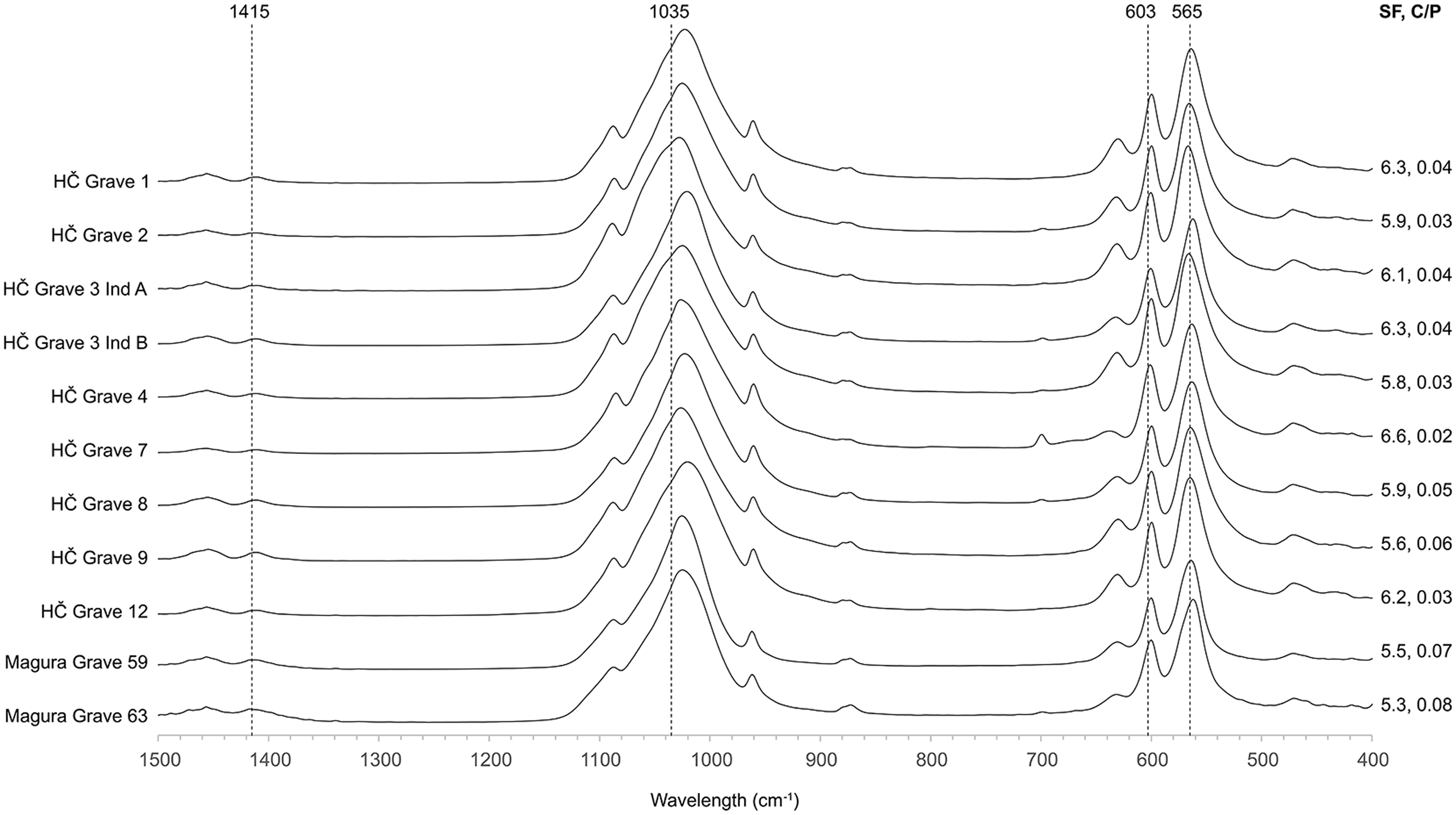
Bones from the urn burials were inspected for visual indications of the degree of calcination, particularly color and heat cracks. Changes in the FTIR spectra of bone correlate in a well-established manner with bone color and can provide a further indication of heating temperature and calcination (Stiner et al. Reference Stiner, Kuhn, Weiner and Bar-Yosef1995; Weiner Reference Weiner2010, 292–295). We carried out FTIR measurements on representative bone fragments from the urn burials of Hajdučka Česma and Magura using a Bruker Alpha II ATR-FTIR instrument, with scans between 1500 and 400 cm–1 at a resolution of 4 cm–1. Each spectrum is an average of 24 scans. Key indices for crystallinity and carbonate content were calculated from the resulting spectra, namely splitting factor (SF) and carbonate-phosphate ratio (C/P). SF, also known as crystallinity index (CI), describes the degree of separation between absorption lines at 603 and 565 cm–1 (Weiner and Bar-Yosef Reference Weiner and Bar-Yosef1990; Olsen et al. Reference Olsen, Heinemeier, Bennike, Krause, Hornstrup and Thrane2008). The sum of the two peaks is divided by the valley between, i.e. (A603+A565)/Avalley, with each value measured relative to a baseline drawn between 750 and 495 cm–1. SF values above ca. 5 are associated with a high degree of recrystallization and temperatures above ca. 650ºC (Stiner et al. Reference Stiner, Kuhn, Weiner and Bar-Yosef1995; Olsen et al. Reference Olsen, Daróczi and Kanstrup2023). C/P was measured as the ratio of absorption lines at 1415 and 1035 cm–1 (i.e. A1415/A1035) (Garvie-Lok et al. Reference Garvie-Lok, Varney and Katzenberg2004; Olsen et al. Reference Olsen, Heinemeier, Bennike, Krause, Hornstrup and Thrane2008). Values <0.1 are typical of well-calcined bone (Olsen et al. Reference Olsen, Heinemeier, Bennike, Krause, Hornstrup and Thrane2008; Reference Olsen, Daróczi and Kanstrup2023). FTIR analysis of bone is increasingly performed using ATR (Attenuated Total Reflectance) mode rather than transmission mode. Though not providing identical results, for the purpose of assessing calcination, spectra and indices of both modes show closely similar features and ranges (Beasley et al. Reference Beasley, Bartelink, Taylor and Miller2014; Olsen et al. Reference Olsen, Daróczi and Kanstrup2023; Özdemir et al. Reference Özdemir, Bayarı, Şen and Araujo-Andrade2022).
Radiocarbon dating
Here we present 36 new radiocarbon dates from urn burials in eastern Serbia, and two from associated settlements. From the cemeteries, we ran 23 dates from Hajdučka Česma, five from Borsko Jezero, three from Kriveljski Kamen, two from Šoka Lu Patran and two from Magura, plus one previously unpublished date from the Trnjane cemetery (DeA-18173). This data is discussed alongside previously published results from the copper-producing settlements of Trnjane, Rużana and Čoka Njica. One previously unpublished date is provided from the Trnjane settlement (MAMS-55258) and another from the Čoka Njica settlement (DeA-23193). All dates are listed in Table 1.
The two main materials selected for dating were cremated human bone and charcoal. For the urn burials, cremated bone was the preferred material and at Hajdučka Česma many of the burials are represented by multiple measurements on bone fragments and/or charcoal. In one case a seed found embedded in a vessel was dated (MAMS-42796). The previously published dates from settlements include measurements on unburnt animal bones.
Cremated bone offers the advantage that it is linked with certainty to the context, and if fully calcinated is highly resistant to post-depositional contamination (Lanting et al. Reference Lanting, Aerts-Bijma and van der Plicht2001). Charcoal carries a higher risk of being intrusive or residual than cremated bone, particularly in shallow graves, although if collected from urns (as is often the case in our samples), it likely represents pyre fuel.
The amount of carbon exchange between bone and the pyre atmosphere can vary greatly according to burning conditions, and open-air experiments have yielded ranges such as 40% to 95% (Snoeck et al. Reference Snoeck, Brock and Schulting2014) or 30% to 85% (Rose et al. Reference Rose, Meadows and Henriksen2020). Notably, carbon exchange will vary greatly within a single pyre. If short-lived materials were used as fuel, this effect would not distort the apparent age of the bone; in fact, the exchange would tend to counter the inbuilt age due to bone turnover and bring the apparent age closer to the cremation event. However, old wood used as fuel will increase the apparent age of cremated bone. The effect is particularly dramatic in experiments where modern bone is burned with ancient wood or fossil fuels (Rose et al. Reference Rose, Meadows and Henriksen2020; Snoeck et al. Reference Snoeck, Brock and Schulting2014). Fortunately, the “old wood effect” on archaeological cremated bone was arguably minor in most cases (Van Strydonck Reference Van Strydonck, G and GC2016, 81–82; Van Strydonck et al. Reference Van Strydonck, Boudin and Mulder2010), except perhaps in northern regions dominated by old forests of long-growing tree species. In general, it seems that smaller logs, young branches and brushwood were gathered as fuel for pyres, and not larger valuable pieces of timber (Tiedtke Reference Tiedtke, J, M, W, H, N and Tiedke2015). The average age of most timber used for fuel was probably not more than about 30–50 years. An “old wood effect” on the bone would have been further limited by the partial nature of exchange, but even in cases where carbon exchange for an individual bone sample reached 95%, the effect would not be large nor have a major impact on most chronological issues. The effect is generally probably too small to reliably detect within the precision range afforded by the radiocarbon calibration curve (Van Strydonck Reference Van Strydonck, G and GC2016, 81–82).
All of the new dates from Hajdučka Česma, Borsko Jezero, Kriveljski Kamen and Šoka Lu Patran were measured at the Isotoptech Zrt facility in Debrecen and the Vienna Environmental Research Accelerator (VERA). The dates from Magura and most previously published dates were run at the Curt-Engelhorn-Zentrum Archäometrie (CEZA) in Mannheim. Charcoal samples were treated with an acid-alkaline-acid (AAA) protocol to remove carbon-bearing contaminants (Molnár et al. Reference Molnár, Janovics, Major, Orsovszki, Gönczi, Veres, Leonard, Castle, Lange and Wacker2013a; Mook and Streurman Reference Mook, Streurman, WG and HT1983; Wild et al. Reference Wild, Golser, Hille, Kutschera, Priller, Puchegger, Rom, Steier and Vycudilik1997). Pre-treatment protocols for cremated bone vary between laboratories but comprise successive applications of bleach and acetic acid to remove organic matter and extraneous or diagenetic carbonate (Lanting et al. Reference Lanting, Aerts-Bijma and van der Plicht2001; Major et al. Reference Major, Dani, Kiss, Melis, Patay, Szabó, Hubay, Túri, Futó and Huszánk2019); studies generally indicate good agreement and repeatability (see also Major et al. Reference Major, Dani, Kiss, Melis, Patay, Szabó, Hubay, Túri, Futó and Huszánk2019; Naysmith et al. Reference Naysmith, Scott, Cook, Heinemeier, van der Plicht, van Strydonck, Bronk Ramsey, Grootes and Freeman2007; Rose et al. Reference Rose, Meadows, Palstra, Hamann, Boudin and Huels2019). CO2 was released from the samples by acid hydrolysis and combustion, then catalytically converted to graphite. Accelerator mass spectrometry (AMS) radiocarbon analysis of the samples, along with standards and blanks, was made at Isotoptech Zrt and CEZA using a MICADAS (IonPlus®) accelerator (Molnár et al. Reference Molnár, Rinyu, Veres, Seiler, Wacker and Synal2013b; Wacker et al. Reference Wacker, Bonani, Friedrich, Hajdas, Kromer, Němec, Ruff, Suter, Synal and Vockenhuber2010a, Reference Wacker, Němec and Bourquin2010b), and at VERA using a 2.7MV tandem accelerator (Steier et al. Reference Steier, Dellinger, Kutschera, Priller, Rom and Wild2004; Wild et al. Reference Wild, Golser, Hille, Kutschera, Priller, Puchegger, Rom, Steier and Vycudilik1997).
Radiocarbon ages are reported in 14C years before present (BP) following international convention (Millard Reference Millard2014; Stuiver and Polach Reference Stuiver and Polach1977) (Table 1). Calibrated ages in calendar years were obtained using OxCal v 4.4 (Bronk Ramsey Reference Bronk Ramsey2009a) and IntCal20 (Reimer et al. Reference Reimer, Austin, Bard, Bayliss, Blackwell, Bronk Ramsey, Butzin, Cheng, Edwards and Friedrich2020) interpolated to yearly intervals (Resolution = 1). Age ranges are given at 68.3% and 95.4% highest probability density (hpd; or “highest posterior density” for modeled ranges).
Bayesian modeling
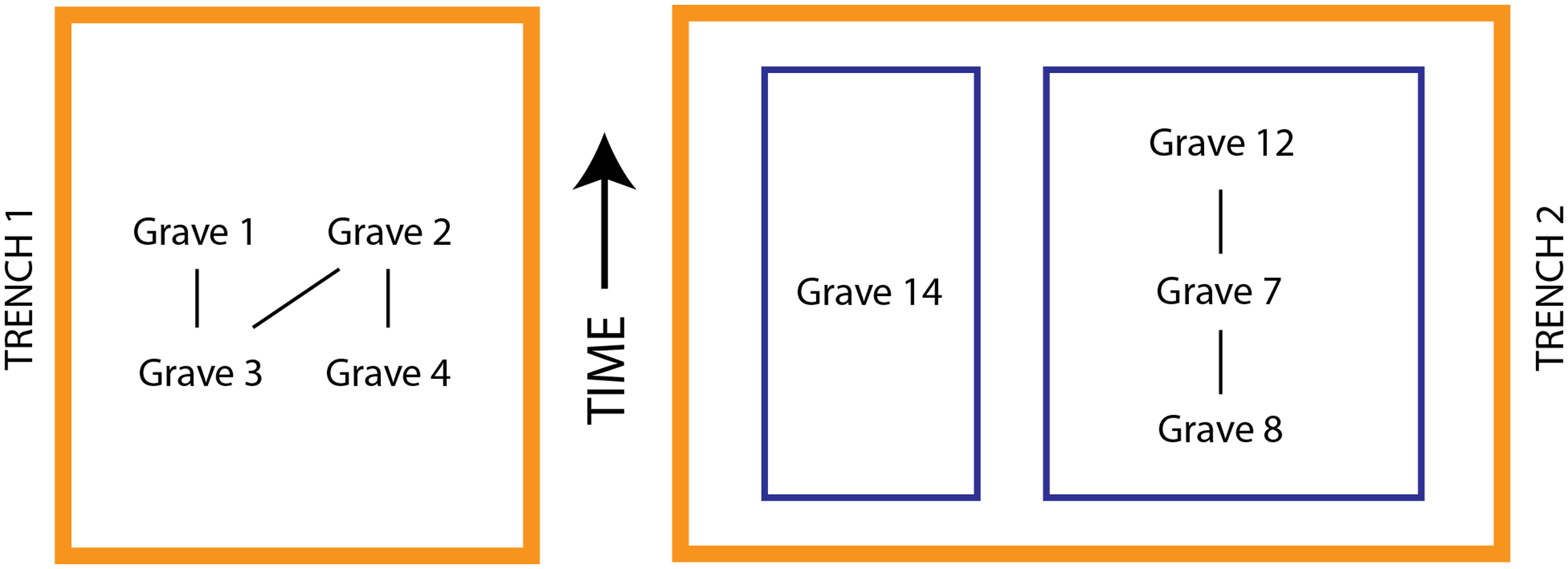
Where stratigraphic or other relative chronological relationships between burials are known, this information can be imposed on the 14C data using a Bayesian approach in order to obtain more precise calendar estimates (Buck et al. Reference Buck, Kenworthy, Litton and Smith1991, Reference Buck, Litton and Smith1992). Such an approach is worth pursuing mainly for larger ordered datasets, such as we have for Hajdučka Česma where the recently excavated graves cut one another (Figure 4). In addition to Hajdučka Česma, we included a simple single-phase model for Borsko Jezero. Other cemetery and settlement datasets have too few dates to apply a Bayesian approach usefully, and/or lack stratigraphic relationships. The models were built using OxCal v 4.4 (Bronk Ramsey Reference Bronk Ramsey2009a), and dates were arranged in a sequence of “phases” according to the grave and the relationships schematically represented in Figure 4. The modeling output provides posterior probability distributions for individual dates as well as boundaries and phase estimates. The model code is provided in the Supplementary Material.
Schematic picture of stratigraphic relationships between graves utilised in the Bayesian model for Hajdučka Česma (L. Webster).
Results of FITR measurements on cremated bones from Hajdučka Česma and Magura (L. Webster).
We applied OxCal’s outlier functionality to address possible outliers and offsets (Bronk Ramsey Reference Bronk Ramsey2009b). This is one of two approaches commonly used to address outliers in OxCal. The alternative “agreement index” approach involves iterative removal of dates with the lowest agreement index until the overall model agreement exceeds 60%. Use of OxCal’s outlier functions is preferable, since it allows poorly fitting data to be identified and downweighed automatically, rather than being manually and fully eliminated from consideration. Under this “outlier function” approach, dates are assumed to follow a particular distribution around the target event: for example, a Student’s t distribution (so-called “General” model) for short-lived samples or an exponential distribution for charred wood with potential inbuilt age. Individual dates are assigned an initial prior probability of being an outlier (e.g., 5% for short-lived samples). The model subsequently calculates a posterior outlier probability for each date and downweighs those with higher values.
The datasets of Hajdučka Česma and Borsko Jezero include two types of materials for dating—charcoal and cremated bone—both of which may have “t-type” (time variable) offsets causing them to deviate from the event we intend to measure (i.e., time of death and cremation). Charred wood from the pyre may be subject to an “old wood effect,” and a few charcoal samples taken from the grave might be residual, associated with activity pre-dating the cremation. Common practice is to assume that charcoal samples follow an exponential distribution (the so-called “Charcoal” model in OxCal), approaching the event-of-interest from below, and to assign a 100% prior outlier probability (i.e., the biological age is always earlier than the context). We use the so-called “Charcoal Plus” model, which allows a small possibility that a few charcoal samples might be intrusive and hence younger than the event (Dee and Bronk Ramsey Reference Dee and Bronk Ramsey2014); this seems appropriate considering the shallow nature of the graves.
The question of how to appropriately model the “old wood effect” in cremated bone is less straight forward, and thus we opted to test and compare several model variants. Several authors have recommended applying the “Charcoal” model to cremated bone (Fitzpatrick et al. Reference Fitzpatrick, Hamilton and Haselgrove2017; Garrow et al. Reference Garrow, Meadows, Evans and Tabor2014). Rose et al. (Reference Rose, Meadows and Henriksen2020) argued for a slightly modified version (their “Cremation” model), which enforces a minimum offset and largely eliminates sub-decadal deviations from the cremation age. In all cases, the individual bone dates are assigned a prior outlier probability of 100% (i.e., having a biological age earlier than the cremation event). We tested the “Charcoal”/”Charcoal Plus” models and the “Cremation” model of Rose et al. (Reference Rose, Meadows and Henriksen2020) for Hajdučka Česma and Borsko Jezero, before proposing our own model.
We do not find convincing the assumption that cremated bone dates will follow an exponential distribution approaching the cremation event. Rather, it seems more logical that they will follow a normal distribution N(μ,σ) whose center μ is offset from (i.e., older than) the cremation event. The magnitude of the offset is determined by factors including the average turnover rate in bone, the average “inbuilt” age of the pyre fuel and the average carbon exchange during cremation. The width or standard deviation (σ) of the normal distribution is determined by the variation in these same three factors. Thus, in the Bayesian model we propose, the outlier distribution of cremated bone data follows this shape. A reasonable estimate for N(μ,σ), was reached as follows: Considering general life expectancy and variation in turnover across skeletal elements, the inbuilt age in bone likely follows a distribution on the order of N(–15,10) years.Footnote 1 We assume the fuel age to follow a distribution of N(−45,15) years, based on the likely sources of pyre fuel as discussed above. Unfortunately, no direct information about species or growth period could be determined directly from the samples themselves. Based on the highly varying carbon exchange indicated by experiments, we estimate this proportion to vary according to N(0.5,0.2). This suggests an overall offset on the order of N(–30,15) years, which we implemented in OxCal as a prior (without scaling, and clipping the upper tail to zero for x > 0). This distribution was applied to all dates from cremated bone, with the prior outlier probability of each set to 100%. In order to check the sensitivity of the Hajdučka Česma and Borsko Jezero models to our estimates of μ and σ, we tested various values, for example μ of 30 years up to several hundred years.
Results
Bone calcination
Bones from the urn burials for which new dates are presented, consistently showed a white color and surface cracks indicative of high temperature (above ca. 650ºC) and a high degree of calcination (Figure S15). We carried out FTIR analysis on representative bones from the urn burials of Hajdučka Česma and Magura, obtaining SF values more than 5.0 and C/P ratios below 0.1 (Figure 5), thus confirming that the dated material is well-calcined. Hence, we may expect that the 14C signal was not subsequently altered during burial.
Independent 14 C dates
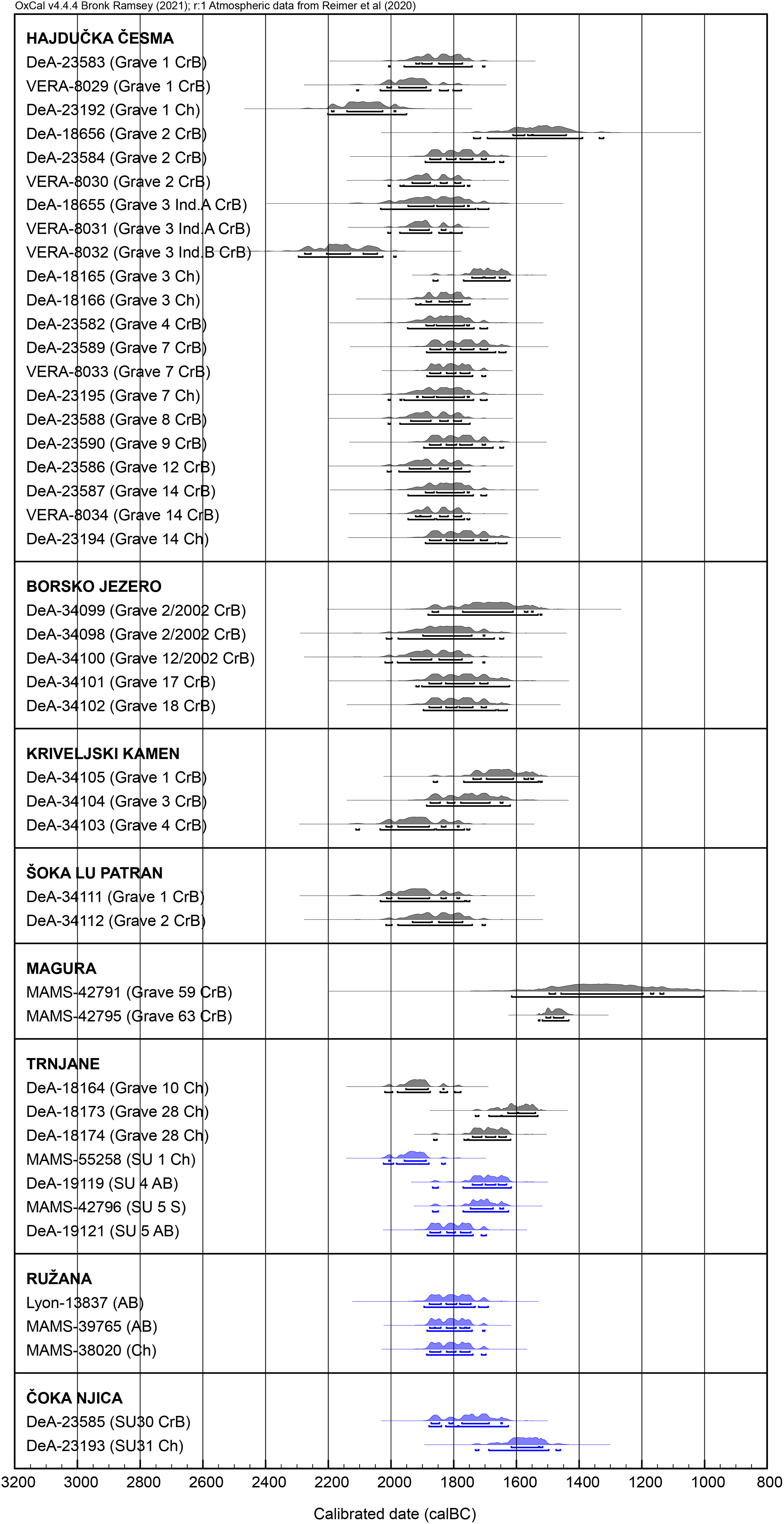
Radiocarbon dates from the urn burials and copper-producing settlements of Bronze Age eastern Serbia—including new and previously published dates—are listed in Table 1. For each result, the site name, context, sample material, 14C age and calibrated calendar age are given. Figure 6 plots the independently calibrated dates, with 68.3% and 95.4% highest probability distribution (hpd) ranges marked. The 14C datasets generated for the urn cemeteries at Hajdučka Česma and Borsko Jezero indicate that both were used predominantly during the 19th and 18th centuries BC. There is generally good agreement across these two datasets, with only two clear outliers (DeA-18167 and DeA-18168, 10th century AD) and three measurements that show poor overlap with the other results (DeA-23192, DeA-18656 and VERA-8032). The 10th century AD dates come from charcoal pieces that were found in Grave 2 but not within the urn, thus helping to explain the intrusion. Note that a plateau and wiggles in the calibration curve limit the calendrical precision attainable from individual measurements during the 19th and 18th centuries BC (see Figure S16). Smaller datasets from Kriveljski Kamen and Šoka Lu Patran indicate that these cemeteries belong to a similar timeframe: the two dates from Šoka Lu Patran fall between 2000 and 1800 BC and the three dates from Kriveljski Kamen between ca. 2000 BC and 1600 BC. These new results compare well with Trnjane, where both the cemetery and settlement date to the first half of the 2nd millennium BC. The Trnjane dates have a wide range, falling somewhere between the late 20th and 16th centuries BC. The settlements at Ružana and Čoka Njica also produced 14C dates comparable with the urn cemeteries. Three consistent results from Ružana point to the 19th and early 18th centuries BC, while two dates from Čoka Njica are spread between the 19th and 16th centuries BC. Magura appears distinctly later, in the 15th century BC or later; MAMS-42795 indicates 1505–1450 BC (68.3% hpd), but MAMS-42791 has poor measurement precision and spans the 15th through 12th centuries BC.
Independently calibrated 14C dates from urn cemeteries and settlements of copper-producing societies in eastern Serbia. The type of material dated is indicated in brackets: CrB = cremated bone, Ch = charcoal, AB = animal bone, S = seed. Highest probability density (hpd) ranges for 68.3% and 95.4% are marked with bars below each result. Blue indicates dates from settlement rather than cemetery contexts. Two outliers, DeA-18167 and De-18168 (10th century AD) are not shown.
For the Hajdučka Česma cemetery it is possible to compare results from cremated bone and charcoal. In five cases both material types were dated from the same graves (1, 2, 3, 7 and 14), although we should exclude Grave 2 where both charcoal results are strong outliers and cannot relate to the burial. Notably, charcoal and cremated bone results from Graves 3, 7 and 14 find good agreement. In Grave 3, one charcoal result overlaps well (DeA-18166), while another (DeA-18165) could be younger. In Grave 1, the charcoal-derived measurement may be older than the cremated bone date though the probability distributions do overlap. Given the potential for encountering “old wood” and the shallowness of the graves, both older and younger dates from charcoal samples find reasonable explanations. However, since most charcoal samples were collected from within urns, we may expect–and indeed find–that dates from charcoal and bone usually agree well.
The generally good agreement of charcoal and cremated bone dates from the same graves, as well as the close similarity of results obtained from these materials across all of the Hajdučka Česma graves, suggests there is not a major impact from carbon exchange during cremation—at least not an effect noticeable within the precision limits afforded by the calibration curve. If pyres consisted predominantly of very old wood, we would expect the cremated bone to yield younger ages than fuel remains, since the carbon exchange is partial, not 100%. While carbon exchange can reach 95% in individual samples, it will vary greatly throughout the pyre. The apparent ages of bone fragments from different cremation events and even from the same pyre would have different fuel compositions and varying carbon exchange offsets, and thus different apparent ages. On the contrary, the consistent results from Hajdučka Česma suggest that pyre fuel was dominated by younger wood and branches and that the dates from bones and charcoal generally reflect the cremation events quite reliably.
Results for two individuals in Grave 3 of Hajdučka Česma indicate different ages, since the probabilities do not overlap. However, we are cautious about interpreting this, particularly since we have just one date from Individual B. The early result may be merely a matter of measurement statistics or it could reflect a real difference between the individuals. If the latter is true, there are several possible explanations: bones from an older burial might have been coincidently collected with the pyre remains or there may have been an intentional, ritual deposition of previously cremated remains into the urn (see regional studies where similar situations were observed; Sabaux et al. Reference Sabaux, Veselka, Capuzzo, Snoeck, Sengeløv, Hlad, Warmenbol, Stamatki, Boudin and Annaert2021). Perhaps old fuel was used, although this seems less likely based on our overall data. On the available data, we would caution against to over-interpretation.
Bayesian modeling
Bayesian chronological models for Hajdučka Česma and Borsko Jezero are shown in Figures 8, S17 and S20. The highest probability density (hpd) ranges at 68.3% and 95.4% are provided in Table S1. Only two results were omitted from modeling at the outset: DeA-18167 and DeA-18168, since these are obviously outliers. For all other data, we utilised OxCal’s outlier functionality to address possible outliers and offsets (Bronk Ramsey Reference Bronk Ramsey2009b).
We tested and compared several approaches to modeling potential inbuilt age within the cremated bone data. We found negligible differences between applying the “Charcoal”/’Charcoal Plus’ distributions and the “Cremation” model of Rose et al. (Reference Rose, Meadows and Henriksen2020) and therefore provide here only results for the latter (Figure S17 left). When applied to Hajdučka Česma and Borsko Jezero, these models yield broad posterior probability distributions (150–200 years or more at 68.3% hpd). Notably, the posterior “Cremation” distribution output by the model has a 68.3% range of –225 to –15 years with a mean of –185 years (Figure S18). When we consider that carbon exchange is, on average, around 60% and the inbuilt age due to bone turnover is small in comparison (a few decades at most), this would imply a mean fuel age on the order of 300 to 400 years. If the “Cremation” model of Rose et al. (Reference Rose, Meadows and Henriksen2020) is to be used, a more reasonable output is obtained by limiting the maximum scale of the outlier distribution to 100 rather than 1000 (Figure S17 right). This has methodological difficulties, however, since the posterior probability of the scaling factor is simply clipped rather than properly optimized based on the imposed constraints (compare Figure S19a–b). The result is that the model essentially uses the highest allowable scale.
In our view, the inbuilt age of cremated bone is better represented by a normal distribution N(μ,σ), offset from the cremation event. Our model utilizing this approach is presented in Figure 7. We initially tried to define only the distribution shape and allow the modeling process to determine a scale between 1 and 100, or 1 and 1000. However, we found that the model alone was unable to determine a realistic scale and favored large offsets of several hundred years that produced even wider posterior distributions than Rose et al. (Reference Rose, Meadows and Henriksen2020)‘s “Cremation” model with 0 to 1000 magnitude. Therefore, we chose to specify the scale of the outlier distribution following a well-reasoned, albeit coarse estimate. As argued above, we consider N(–30,15) to provide an acceptable in the case of Hajdučka Česma and Borsko Jezero. We tested the sensitivity of the models to this choice and found that altering μ and σ by up to several decades has minimal effect.
Bayesian analysis for Hajdučka Česma and Borsko Jezero. Individual probability distributions before and after modeling are shown in light and dark grey respectively. Calculated transition boundaries are colored green and phase estimates red. Highest posterior density (hpd) ranges after modeling (68.3% and 95.4%) are marked with bars below each result. The model uses OxCal’s outlier analysis to account for possible outliers and offsets. This preferred version of the model uses a normal distribution with an offset (–30 ± 15 years) to allow for inbuilt and minor “old age” effects in the cremated bone.
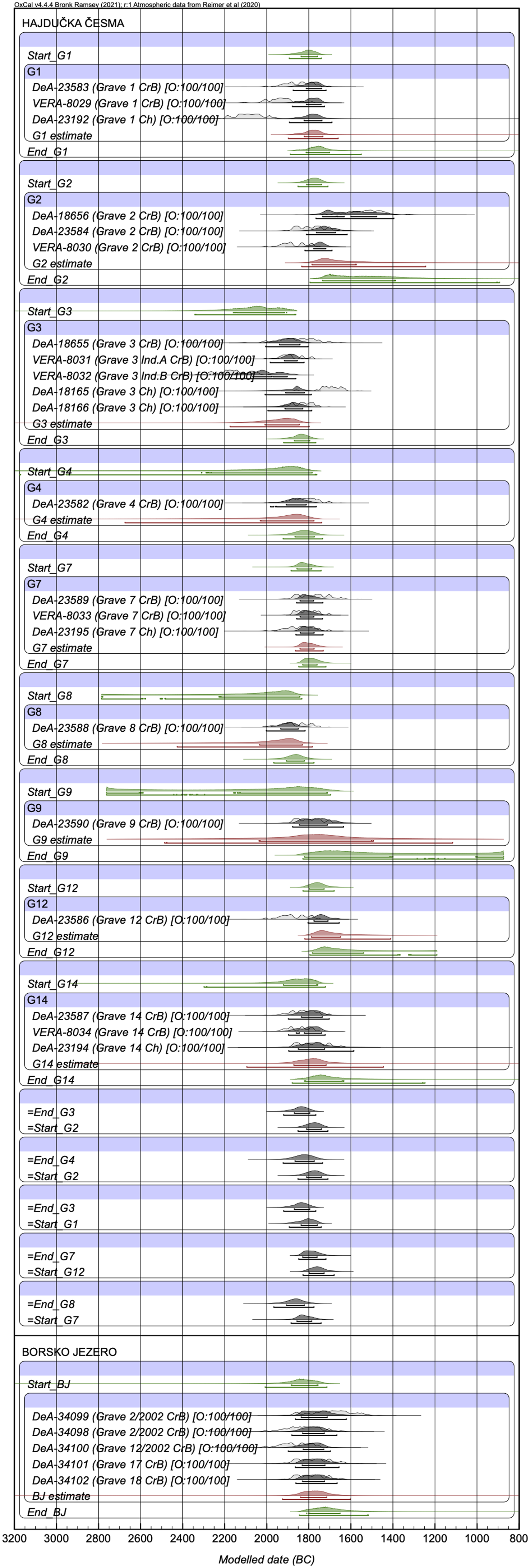
The output of our preferred model for Hajdučka Česma and Borsko Jezero (Figure 7) is, in fact, similar to the “Cremation” model of Rose et al. Reference Rose, Meadows and Henriksen2020 with a maximum scaling of 100 (Figure S17 right; Table S1). Figure S20 compares our preferred model with the highly simplified case in which cremated bones are treated as short-lived samples using a “General” model or Student’s “t” distribution, applying a prior outlier probability of 5% to each (Figure S20 right). The probability distributions are of similar width and shifted by several decades—as would be expected since our preferred model assumes only a modest offset.
Bayesian modeling of the Hajdučka Česma and Borsko Jezero datasets, utilizing stratigraphic relationships and making reasonable allowance for inbuilt age effects, does provide substantially improved dating estimates. The models show that both urn cemeteries were used close to 1800 BC. The period of use at Borsko Jezero most likely fell in the range of 1840–1715 BC (68.3% hpd). At Hajdučka Česma, it is possible to estimate dates for earlier and later graves. Grave 3 was most likely used from 2010–1845 BC, although we acknowledge that the difference between the dates of the two individuals may deserve further investigation. Graves 1, 7 and 14 straddle 1800 BC with respective estimates of 1820–1735 BC, 1840–1775 BC and 1870–1720 BC (all 68.3% hpd). Grave 2 may be somewhat later (1785–1575 BC).
Based on our analysis for Hajdučka Česma and Borsko Jezero, we wish to highlight several points regarding the modeling of inbuilt age in cremate bone: First, critical evaluation of approaches previously used in the literature indicates a tendency to over-estimate the effect. The same is true for our modeling approach if scaling is not specified. At least for datasets of modest size, such as presented here, we doubt the Bayesian modeling process can provide reliable estimates of the scale of these offsets. In most cases, the inbuilt age of cremated bone is likely less than several decades. Finally, a normal distribution with an offset from the cremation event seems more appropriate than an exponential distribution.
Discussion
The radiocarbon dating results provide strong arguments that the initial dating of urn cemeteries and associated copper-production settlement sites in eastern Serbia (14th to 11th centuries BC) is incorrect. With the possible exception of Magura, which is located some 30 km out of the core zone with copper deposits, all of the sites are much earlier. Results consistently fall in the first half of the 2nd millennium BC and tend to cluster around 1800 BC. Borsko Jezero and the dataset from Hajdučka Česma point with particular clarity to the 19th and 18th centuries BC. Bayesian modeling enables a somewhat narrower estimate for Borsko Jezero (1840–1715 BC, 68.3% hpd), and provides dates for earlier and later individual graves at Hajdučka Česma. Radiocarbon dates from the urn cemeteries Kriveljski Kamen-Bunar and Šoka Lu Patran, as well as from the settlement sites in Trnjane, Ružana and Čoka Njica, suggest a comparable occupation between the 20th and 16th centuries BC. This assessment is confirmed by the variety of measured samples (animal bone, seeds, charcoal), all providing very similar ages.
A comparison with recently presented absolute dates from other urn cemeteries in central Serbia (Gloždak, Rajkinac and Mađilka), which all span the 15th through 13th centuries BC (Kapuran et al. Reference Kapuran, Gavranović and Jovanović2022), clearly signifies that Bronze Age communities in eastern Serbia adopted and practiced cremation and urn burials significantly earlier. The current data indicates the start of copper-producing activities and the onset of the cemeteries with specific grave architecture, occurred by at least the 19th century BC. From the 15th century BC, some elements from eastern Serbia, including the grave architecture, started to appear in other parts of the central Balkans, with the Magura cemetery currently being the best example of continued existence and development in terms of both material culture and burial practices (Lazić Reference Lazić, V, M, K and M2016). Based on our current data, we assume a substantial decrease in Bronze Age activities in the copper-rich zone in eastern Serbia from the 16th century BC.
According to the currently available data, cremation in the urn cemeteries in northeastern Serbia was performed in a quite uniform manner with high burning temperatures. Unlike in some neighboring regions to the north (Kapuran Reference Kapuran2019), there is no evidence of bi-rituality, which could be interpreted as an experimental phase (Cavazzuti et al. Reference Cavazzuti, Arena, Cardarelli, Fritzl, Gavranović, Hajdu, Kiss, Köhler, Kulcsár and Melis2022). There is no indication of the preferential use of cremation with regard to the age, sex, or social status of the deceased. The cemeteries like Hajdučka Česma or Trnjane represent most probably communal burial grounds and distinct landscape markers with their elaborate grave architecture. The analysis of urn contents and a small amount of charcoal pieces speaks for a careful selection of cremated body parts from the pyre. We also observed the intentional reassembling of the body within the urns, with the deposition of bones from all body parts in a seemingly anatomical order. A similar practice was also attested in several contemporary Middle Bronze Age groups in the Carpathian Basin (Sörensen and Rebay-Salisbury Reference Sørensen and Rebay-Salisbury2022).
Still not entirely solved is the relationship between urn burial grounds in eastern Serbia and the cemetery of Ranutovac in southern Serbia, which has absolute dates between the 22nd and 20th centuries BC (Bulatović Reference Bulatović2020; Bulatović et al. Reference Bulatović, Gori and Vander Linden2020) and thus only marginally overlaps the dates presented here. Apart from certain similarities in the appearance and layout of the graves (circular stone structures in a dense arrangement), Ranutovac exposes a different mortuary practice (scattered cremations covered with cups and bowls) and a distinct pottery repertoire. Burial grounds very similar to the ones in eastern Serbia in terms of grave architecture (circular stone structures) and deposition of cremated remains (urns) were also discovered further to the south on the Chalkidiki peninsula in Greece with sites Kriaritsi and Nea Sikioni showing a striking resemblance (Asouhidou Reference Asouhidou, E and S2012). As the absolute dates from the sites in Greece are still not available, the chronological assessment was made only based on pottery indicating the last stage of the Early Bronze Age or approximately the 21st–19th centuries BC. Hence, the phenomenon of Early to Middle Bronze Age cremation burials with corresponding grave architecture appears to have an even wider distribution than previously assumed. The dates from sites in eastern Serbia presented here are further evidence of this development, which is, in this particular case, obviously closely linked with the exploitation of copper sources and metal production.
The dates from eastern Serbia clearly rule out any kind of connection of the local population with the Late Bronze Age Urnfield phenomena of central and south-eastern Europe, as was postulated in most of the previous works dealing with cremation burials in this region (Kapuran et al. Reference Kapuran, Miladinović-Radmilović and Jovanović2013; Vasić Reference Vasić2013). Cremation as a prevailing rite and deposition of human remains in urns buried in communal cemeteries with thus far unknown indications of social stratification were obviously performed much earlier among some communities in the Balkans (Bulatović et al. Reference Bulatović, Gori and Vander Linden2018). From the wider region, comparable radiocarbon dates (20th–17th centuries BC) are also known for the cremation burials in Transylvania north of the Danube, which are assigned to the local Wietenberg culture (Bălan et al. Reference Bălan, Fântâneanu, Popa, Tentiş and Burlacu-Timofte2017, Reference Bălan, Quinn and Hodgins2018; Boroffka Reference Boroffka1994; Ciugudean and Quinn Reference Ciugudean, Quinn, RE and R2015). Although not directly analogous with eastern Serbia in terms of material culture and cemetery arrangement, these dates highlight the acceptance of specific burial practices (cremation, deposition in an urn) in regions of the wider Carpathian Basin already in the first centuries of the 2nd millennium BC (Cavazzuti et al. Reference Cavazzuti, Arena, Cardarelli, Fritzl, Gavranović, Hajdu, Kiss, Köhler, Kulcsár and Melis2022; Parditka and Duffy Reference Parditka and Duffy2023). Comparable and contemporary burial practices with an urn deposited in a pit are also described for Vatya culture in the Great Hungarian Plains (Vicze Reference Vicze2011). Despite the structural similarity of the body treatment and final deposition of the cremated remains, all these groups expose significant differences in material culture and have different economic backgrounds (Sörensen and Rebay-Salisbury Reference Sørensen and Rebay-Salisbury2022). While, for instance, Vatya culture is believed to be strongly oriented to agriculture with almost nonexistent metal production (Găvan Reference Găvan2015), the here-discussed communities in eastern Serbia were primarily engaged in copper production. However, the radiocarbon dates from the Carpathian basin, including the Wietenberg and Vatya culture areas, signify substantial cultural changes around 1600 BC, which may also have affected the apparent decrease of activities in eastern Serbia in the same period.
Conclusion
The dates presented here place the dating of Bronze Age urn cemeteries and associated settlements in eastern Serbia between the 20th and 16th centuries BC, and thus much earlier than previously thought. At this stage of the investigation, neither dates nor archaeological material indicates the inner dynamic among the discussed sites, with the exception of the Magura cemetery, which appears to have been used after 1600 BC. Determining whether this cemetery was, in fact, also in use during earlier centuries would require radiocarbon dating of more graves. In contrast to the other urn cemeteries (Hajdučka Česma, Borsko Jezero, Kriveljski Kamen), Magura is not directly connected to metal-producing settlements as it is located outside of the core copper deposit area around Bor.
In the context of currently available radiocarbon dates for the Bronze Age in the central Balkans south of the Danube, our results suggest a revision of the existing chronology for the 2nd millennium BC. While most dates from other sites (Gloždak, Rajkinac, Mađilka) point to cultural and regional changes from the 15th century onwards, the results from eastern Serbia provide new insights into developments during the first half of the 2nd millennium BC, which corresponds to the end of the Early Bronze Age and the Middle Bronze Age. Particularly significant traits of this period are the full acceptance of the cremation rite and the layout of urn cemeteries, which subsequently had an essential role in all following regional cultural manifestations until the beginning of the Iron Age.
The fact that the urn cemeteries in eastern Serbia currently appear as an isolated group within the given time frame (20th–16th centuries BC) is most likely the consequence of an insufficient number of radiocarbon dates from the adjacent region, particularly to the south, where cemeteries of similar appearance are known. A more comprehensive dating of other sites from the region is essentially needed in order to elucidate the dynamics of cremation burials and to establish a new chronological frame. The connection of the sites in eastern Serbia with similar cemeteries, based on a solid number of radiocarbon dates, is one of the crucial tasks for future investigation. Only then will the full magnitude of cultural developments during the first half of the 2nd millennium BC between the Danube and Northern Greece be better understood.
Supplementary material
To view supplementary material for this article, please visit https://doi.org/10.1017/RDC.2025.8
Acknowledgments
This research was funded by FWF (Austrian Science Fund) Project (P32095) “New insights in Bronze Age metal producing societies in western and central Balkans” (PI Mario Gavranović) and by the research project “Bronze Age in north-eastern Serbia–metallurgy, settlement and necropolises, funded by Institute of Archaeology, Belgrade (PI Aleksandar Kapuran). We thank the Museum for Mining and Metallurgy in Bor, Serbia and Igor Jovanović for the access to the samples and collaboration. The samples from Magura were provided by Miroslav Lazić (Department of Archaeology, University Belgrade). The GIS digitization of Hajdučka Česma trench 2 was done by Michael Konrad. We thank Mike Dee for discussing approaches to Bayesian modeling of potential offsets in cremated bone.


 Open access

