

Introduction
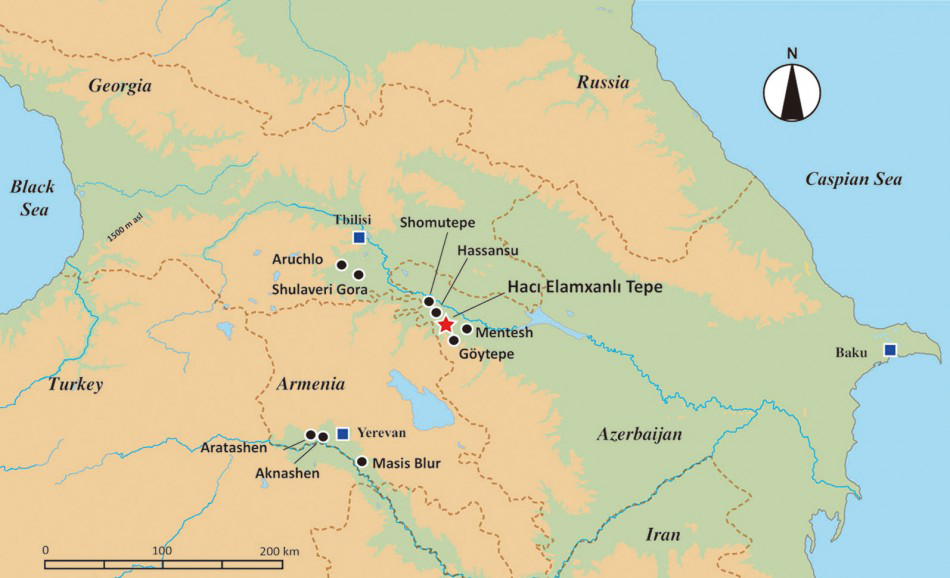
Map showing the location of Hacı Elamxanlı Tepe and related Neolithic sites in the southern Caucasus.

Over the past decade, great advances have been made in research on Neolithisation processes in the southern Caucasus. One such achievement involves the dating of the emergence of a full-fledged, food-producing economy, which is now assigned to the beginning of the sixth millennium BC (Nishiaki et al. 2015a). The southern Caucasian communities were situated directly to the north of the Fertile Crescent, where a food-producing economy emerged as early as the tenth millennium BC; the apparently late adoption of such an economy in the neighbouring southern Caucasus poses intriguing questions as to the environmental and social contexts that led to this great cultural change.
The introduction of a food-producing economy in this region is associated with the Shomutepe-Shulaveri culture (Pottery Neolithic; Reference NarimanovNarimanov 1987). Although a number of settlements of this culture have been discovered since the 1960s, the absence of a rigorous chronological framework has been an obstacle to the determination of the contexts in which it emerged and developed. A key site through which to investigate this issue is Hacı Elamxanlı Tepe, located in the Middle Kura Valley, west Azerbaijan (Figure 1).
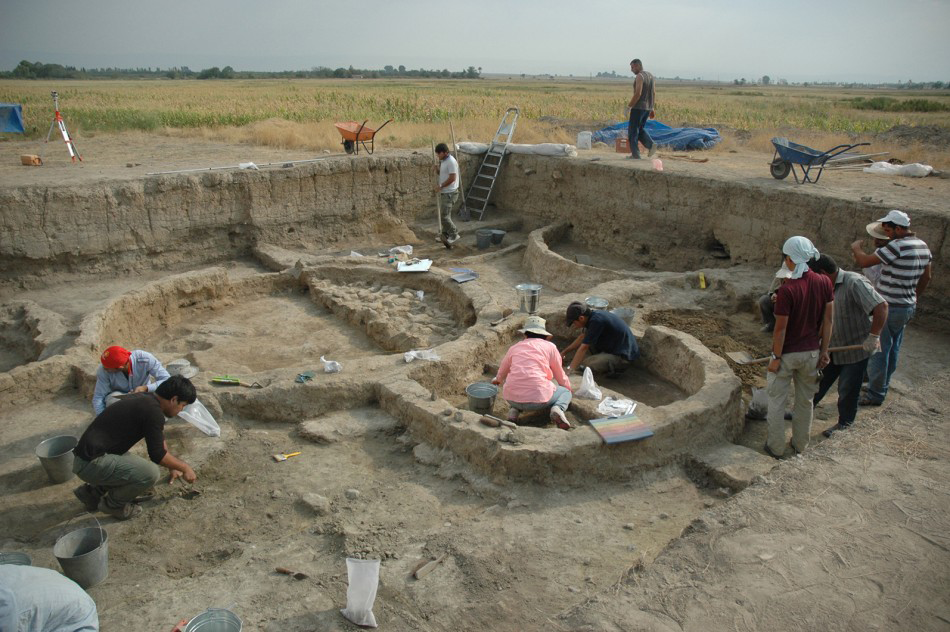
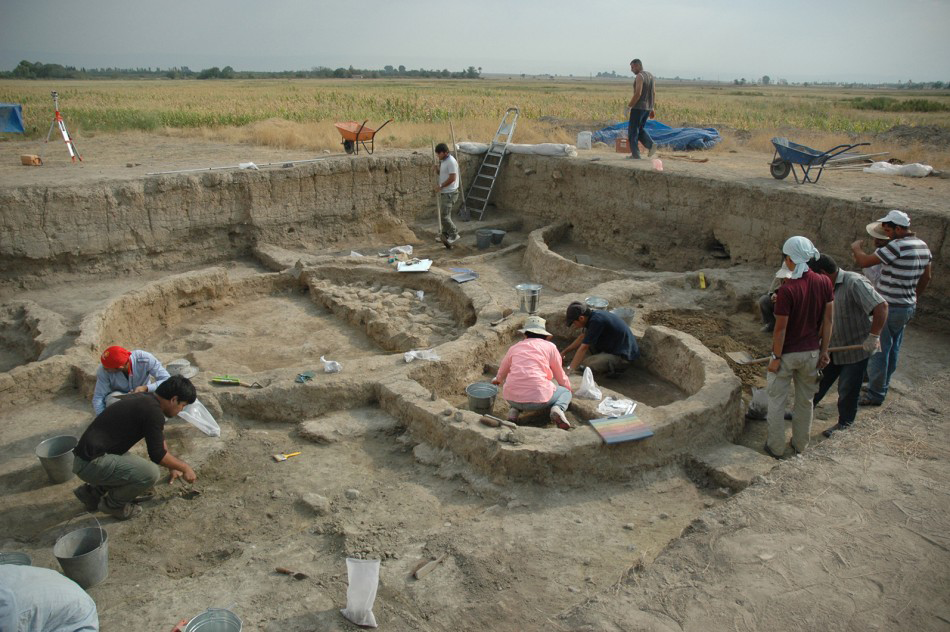
General view of Hacı Elamxanlı Tepe facing north.
Excavations: the 2012–2015 seasons
Hacı Elamxanlı Tepe is a small mound of approximately 60 × 80 × 2m, situated around 8km east of Tovuz (Figure 2). It was discovered in 2011 during a field survey conducted by the Azerbaijan-Japan archaeological mission to Göytepe, one of the largest Neolithic settlements of the Shomutepe-Shulaveri culture (Reference Guliyev, Nishiaki, Matthews and CurtisGuliyev & Nishiaki 2012, 2014; Kadowaki et al. 2015). The surface finds at Hacı Elamxanlı Tepe yielded extremely few pottery sherds but abundant Neolithic flaked stone artefacts, thereby suggesting an earlier Neolithic date.
Excavations conducted during 2012–2015 confirmed this initial assessment (Nishiaki et al. 2015b, in press). A series of radiocarbon dates firmly situate the four architectural levels within a short time period of 5950–5800 cal BC, thus placing it earlier than other dated Shomutepe-Shulaveri sites in the Middle Kura Valley (Nishiaki et al. 2015a). At the same time, the associated archaeological records show evidence of full cereal and animal domestication, along with a unique set of cultural remains that differ from those documented at later settlements such as Göytepe.
The archaeological finds
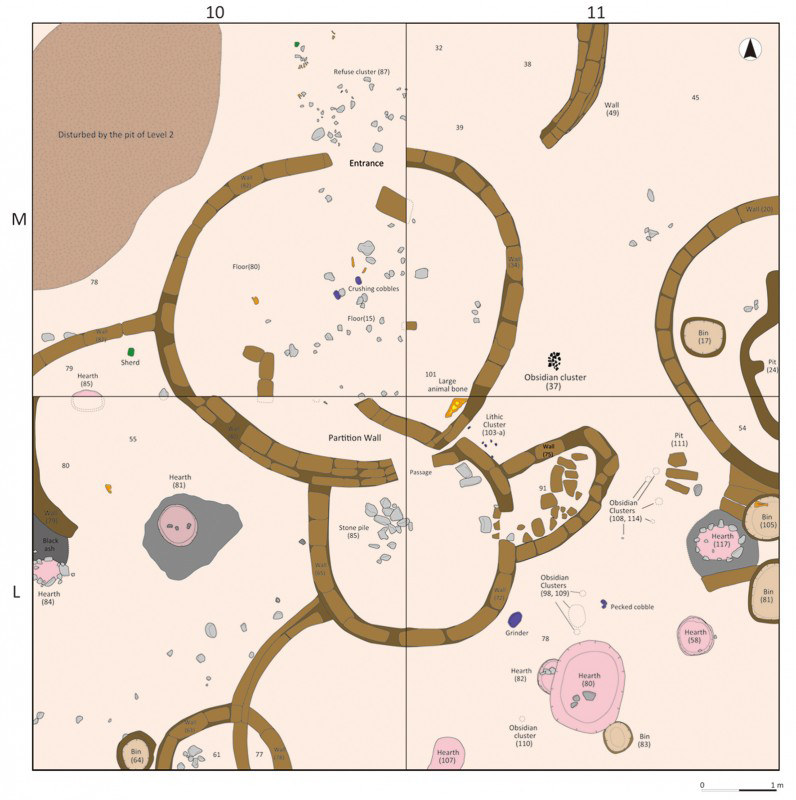
Neolithic architecture of level 3 at Hacı Elamxanlı Tepe.
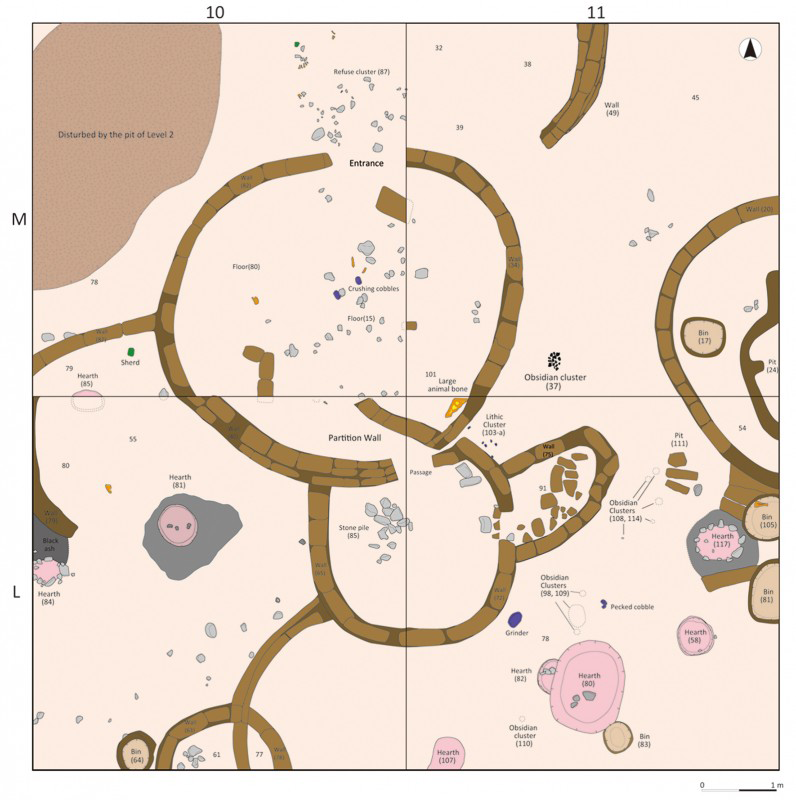
Excavation identified a mud-brick structure with a distinct plan resembling a ‘snowman-shape’, or the figure ‘8’: a circular room of about 5m in diameter attached to a smaller round room of approximately 2–3m in diameter, connected to each other by a narrow doorway (Figure 3). This type of architecture seems to characterise the early Shomutepe-Shulaveri settlements, such as in the lower levels of Aratashen, Archulo and Imiris Gora (Reference Munchaev, Masson and MerpertMunchaev 1982; Badalyan et al. 2010; Hansen & Mirtskhulava 2012). It is not seen at later settlements, where the architecture consists of several circular buildings connected with curved walls, forming one oval unit encompassing an internal, open-air courtyard (Reference Guliyev, Nishiaki, Matthews and CurtisGuliyev & Nishiaki 2012).
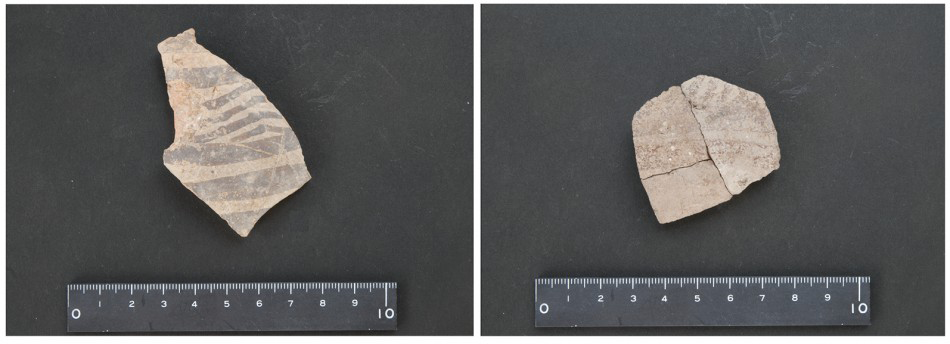
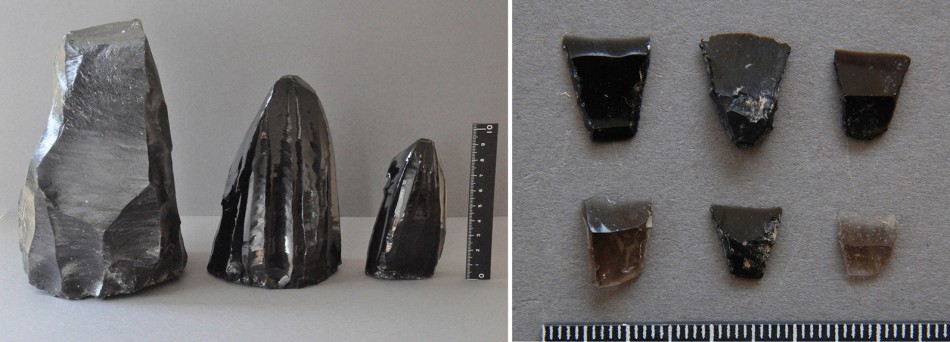
The artefact assemblage includes very few sherds of pottery, mostly just plain coarsewares. Two fine painted sherds, however, were present, being the northernmost examples reminiscent of a north Mesopotamian tradition of the Samarra type (Figure 4). They were most probably imports from the south. The flaked stone artefacts also display regional links. The blanks were produced with pressure (Figure 5, left), a technology distinctive to the eastern wing of the Fertile Crescent. The most characteristic tools are transversal arrowheads (Figure 5, right), whose parallels are widely known among Late Neolithic settlements in the Fertile Crescent. Ground-stone artefacts are also common. They include a shaft-straightener, a flat pebble with a groove along the shorter axis, which parallels the tradition in the eastern wing of the Fertile Crescent.
Neolithic painted sherds from Hacı Elamxanlı Tepe.

Neolithic obsidian artefacts from Hacı Elamxanlı Tepe.

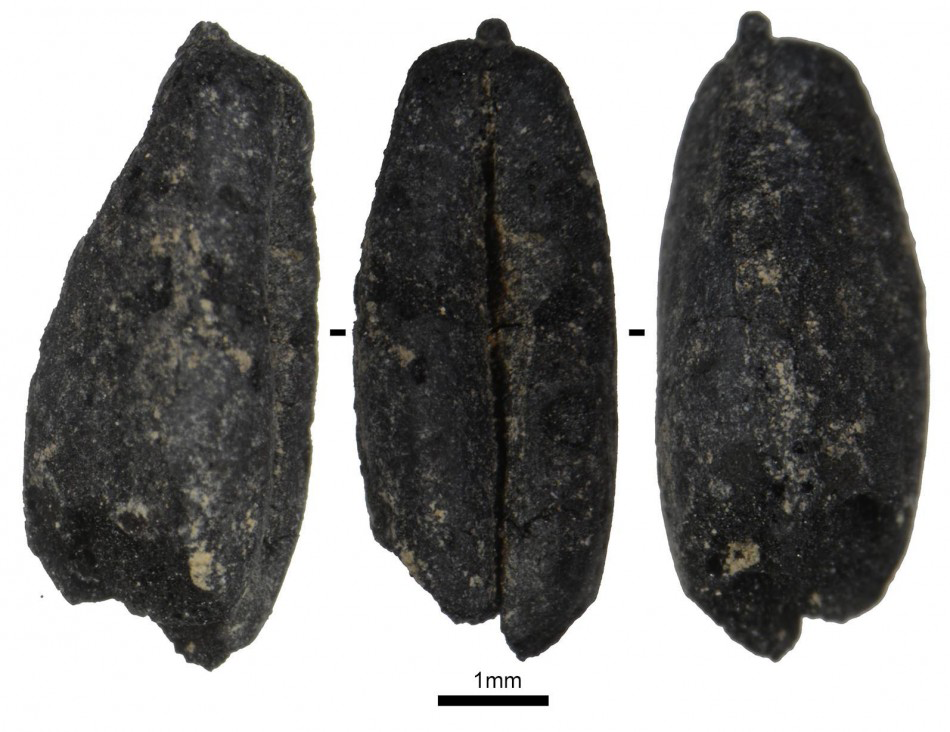
Neolithic hulled wheat grain from Hacı Elamxanlı Tepe.

The faunal remains are predominantly from domesticated animals. Sheep and goat remains are most common, followed by those of pigs and cattle. Their age profiles indicate their primary use as being for meat consumption. The occurrence of vertebrae deformities, however, indicates that some cattle were also used as draft animals. Plant remains also indicate a food-producing economy, with a large amount of wheat and barley remains. The most important characteristic is the scarcity of free-threshing varieties, a contrast with evidence from the later settlement of Göytepe, in which free-threshing wheat along with barley are among the primary crop plants (Nishiaki et al. 2015b). Instead, as in the Fertile Crescent, hulled wheat and barley are dominant at Hacı Elamxanlı Tepe (Figure 6). A major change in crop types occurred within a few centuries of the early sixth millennium BC.
Discussion
Excavations at Hacı Elamxanlı Tepe have yielded two important implications for the origins of a food-producing economy in the southern Caucasus. First, radiocarbon dates indicate that Hacı Elamxanlı Tepe is one of the oldest Shomutepe-Shulaveri settlements known in the Middle Kura, although occupation levels with comparable dates are also found from the Ararat Plain (Figure 1; Badalyan & Harutyunyan 2014). This fact indicates that a full-fledged food-producing society appeared at almost the same time in both areas of the Lesser Caucasus Mountains. Second, the current data from Hacı Elamxanlı Tepe point to differences in architecture, stone artefacts, pottery, and animal and plant remains from those found in the later Shomutepe-Shulaveri settlements, implying that this culture evolved through rapid socio-economic changes immediately after its emergence.
We then need to ask about the origin(s) of the society at Hacı Elamxanlı Tepe. Given our limited knowledge of earlier cultural assemblages in this region, this question is yet to be answered. The very rare use of pottery, however, suggests that the authors of this culture were from a local aceramic community, rather than an external society with knowledge of pottery that was already fully developed outside this region. At the same time, finds from our excavations point to the significance of a wide range of cultural contacts with the south that were involved in the formation of this cultural entity. As future research on earlier aceramic entities in the region progresses, the data from Hacı Elamxanlı Tepe will serve as an important reference point to interpret Neolithisation processes in the southern Caucasus.