





Introduction
Reproductive synchrony is defined as ‘the tendency of individuals to carry out some part of the reproductive cycle at the same time as other members of the population’ (Ims Reference Ims1990, p. 135). Reproductive synchrony is evident among a wide array of species due to factors such as predation avoidance, communal living and breeding and seasonality of environment (Ims Reference Ims1990). Because of this, species that occupy ranges in temperate to high latitudes, where seasonal climate patterns occur, commonly exhibit reproductive synchrony (Ims Reference Ims1990). The timing of reproduction can have profound impacts on the survival of both offspring and parent due to temporal variations in ambient temperatures and food availability and resulting energy budgets (Festa-Bianchet Reference Festa-Bianchet1988b, Bronson Reference Bronson2009). Aligning reproduction throughout a population allows for maximizing access to food resources, decreasing risks of predation and ensuring the ability to find a mate (Ims Reference Ims1990).
Even in reproductively synchronous populations with narrow birth windows, variation in reproductive timing occurs at both population and individual levels. At the population level, temporal variation often derives from differing environmental conditions. For example, brown bears (Ursus arctos, Linn.) have been shown to give birth later under favourable environmental conditions (Friebe et al. Reference Friebe, Evans, Arnemo, Blanc, Brunberg and Fleissner2014), whereas Antarctic fur seals (Arctocephalus gazella, Peters) demonstrate delayed birth dates in years with low food availability (Boyd Reference Boyd1996). Numerous long-term studies have identified individual-level factors, including maternal age, reproductive experience and body condition, which have been shown to impact future reproduction and reproductive timing. For example, future reproduction for experienced breeders may be negatively impacted through costs of reproduction (Guinness et al. Reference Guinness, Albon and Clutton-Brock1978, Festa-Bianchet Reference Festa-Bianchet1988b, Hadley et al. Reference Hadley, Rottela and Garrott2007) or positively impacted if females that often reproduce are also well adapted at accruing resources to recover from and prepare for reproductive events (Clutton-Brock Reference Clutton-Brock1984). Additionally, animals in the best condition often give birth earlier (Festa-Bianchet Reference Festa-Bianchet1988a, Sydeman et al. Reference Sydeman, Huber, Emslie, Ribic and Nur1991, Lunn & Boyd Reference Lunn and Boyd1993, Plard et al. Reference Plard, Gaillard, Coulson, Hewison, Delorme and Warnant2014, Maniscalco & Parker Reference Maniscalco and Parker2018). It is important to understand the combination of individual- and population-level variation in reproductive timing, as both influence reproductive synchrony and a population’s responses to environmental variation.
Reproductive timing can vary between populations of the same species (Pitcher et al. Reference Pitcher, Burkanov, Calkins, Le Boeuf, Mamaev, Merrick and Pendleton2001, Plard et al. Reference Plard, Gaillard, Bonenfant, Hewison, Delorme and Cargnelutti2013, Ketterson et al. Reference Ketterson, Fudickar, Atwell and Greives2015). Variation in reproductive timing between populations can result from factors such as local weather patterns and latitudinal variation (Pitcher et al. Reference Pitcher, Burkanov, Calkins, Le Boeuf, Mamaev, Merrick and Pendleton2001, Moore et al. Reference Moore, Bonier and Wingfield2005, Peláez et al. Reference Peláez, Gaillard, Bollmann, Heurich and Rehnus2020). In mammals, research has shown that populations at higher latitudes tend to give birth later than populations at lower latitudes (Temte Reference Temte1994, Pitcher et al. Reference Pitcher, Burkanov, Calkins, Le Boeuf, Mamaev, Merrick and Pendleton2001, Kiyota et al. Reference Kiyota, Tomita and Baba2009, Peláez et al. Reference Peláez, Gaillard, Bollmann, Heurich and Rehnus2020). Despite research demonstrating this variation between populations, there is limited information on the reproductive timing of immigrants that have recruited into a local, recipient population from other populations with potentially different reproductive timing. In many populations, it is challenging to discern whether an individual is an immigrant or locally born, as not all locally born individuals are marked or genetically sampled, and thus studies that examine differences between the two are uncommon (Millon et al. Reference Millon, Lambin, Devillard and Schaub2019). Almost all of our knowledge on the subject comes from translocations of wild species. Evidence has shown that translocated populations respond differently to the same photoperiod when compared to native populations in white-tailed deer (Odocoileus virginianus, Zimm.; Jacobson & Lukefahr Reference Jacobson, Lukefahr, Cearley and Rollins1998, Sumners et al. Reference Sumners, Demarais, Deyoung, Honeycutt, Rooney, Gonzales and Gee2015). If reproductive timing differs for immigrants into a new, reproductively synchronous population, this could have profound impacts on immigrant fitness, given that reproductive timing might affect the early-life survival of their offspring (Festa-Bianchet Reference Festa-Bianchet1988b, Proffitt et al. Reference Proffitt, Garrott and Rotella2008a, Reference Proffitt, Rotella and Garrott2010). Immigrant individuals may greatly influence local population growth (Millon et al. Reference Millon, Lambin, Devillard and Schaub2019). Therefore, additional studies are needed to determine potential differences in birth-date synchrony that may occur between immigrant and locally born individuals.
Weddell seals (Leptonychotes weddellii, L.) are the world’s southernmost breeding mammal, occupy a circum-Antarctic range and have documented breeding colonies from as far south as 78°S and as far north as 54°S (Stirling Reference Stirling1969, King Reference King1983, LaRue et al. Reference LaRue, Salas, Nur, Ainley, Stammerjohn and Pennycook2021). These colonies consist of female seals aggregating on annually occurring, fasted sea ice around open water cracks. As with many other species of pinnipeds, reproductive synchrony is exhibited within a given site, and the birthing period typically lasts approximately within a 2 month period (Stirling Reference Stirling1969, Atkinson Reference Atkinson1997, Rotella et al. Reference Rotella, Paterson and Garrott2016). Although specifics in birth timing have not been widely studied, synchrony in arrival dates on reproductive sites indicates that synchrony in some features of the annual cycle commonly occurs in other marine mammal species such as southern elephant seals (Mirounga leonina, Linn.; Oosthuizen et al. Reference Oosthuizen, Pistorius, Bester, Altwegg and de Bruyn2023). It has been demonstrated in southern elephant seals that the vast majority (80%) of females arrive at a breeding site within a period of 26 days (Oosthuizen et al. Reference Oosthuizen, Pistorius, Bester, Altwegg and de Bruyn2023). However, previous studies also provide evidence of strong asynchrony in moult timing; for example, only 20% of individual northern elephant seals (Mirounga angustirostris, Gill) moulted at the same time (Beltran et al. Reference Beltran, Lozano, Morris, Robinson, Holser and Keates2024). Additionally, Weddell seals exhibit latitudinal variation in birth timing among sites, which is probably due to variation of daily photoperiod (Stirling Reference Stirling1969, Testa et al. Reference Testa, Siniff, Croxall and Burton1990, Temte Reference Temte1994, Kiyota et al. Reference Kiyota, Tomita and Baba2009). Weddell seal populations at higher latitudes generally give birth later in the year, with some populations at 77°S and 78°S having been found to have a mean pupping date in the fourth week of October, and a population at 60°S having a mean pupping date 8 weeks earlier, in the first week of September (Stirling Reference Stirling1969, Testa et al. Reference Testa, Siniff, Croxall and Burton1990).
After giving birth, Weddell seals nurse their pups for an average of 5–7 weeks (Wheatley et al. Reference Wheatley, Bradshaw, Davis, Harcourt and Hindell2006). Females subsequently breed late in lactation or shortly after weaning their pup (Hill Reference Hill1987). This breeding period occurs while seals are still aggregated in pupping colonies and ~8 months prior to the following birthing period (Hill Reference Hill1987). Although breeding in Weddell seals occurs under sea ice and is rarely documented (Cline et al. Reference Cline, Siniff and Erickson1971), among-population variation in breeding dates probably follows a similar pattern to that documented for birth dates across latitudinal gradients. Accordingly, if seals breed in their natal colony before immigrating, they may be expected to give birth at a different time than seals in the recipient population if the two populations are at different latitudes. Alternatively, immigrant seals could have similar birth timing to locally born mothers in the recipient population if the immigrant seals are from nearby populations that have similar birth timing or if the immigrant seals bred in the recipient population in the previous year.
The Erebus Bay population of Weddell seals is an ideal location to study potential differences between immigrants and locally born Weddell seals. Erebus Bay comprises the largest and southernmost (−77°62´ to −77°87´) population of the species and has been the subject of intensive capture-mark-recapture studies for more than half a century (Stirling Reference Stirling1969, Siniff et al. Reference Siniff, DeMaster, Hofman and Eberhardt1977, Rotella Reference Rotella2023). Given its southerly location, all immigrants must originate from populations further north. Additionally, previous work has identified various characteristics that influence birth date timing in locally born seals (Rotella et al. Reference Rotella, Paterson and Garrott2016). Using data gathered from this population, we aimed to assess whether the timing of birth dates for pups born to immigrant mothers differs from that of pups born to locally born mothers, and whether the relationships between various factors shown to be related to birth timing for locally born mothers also hold for birth timing for immigrant mothers.
Methods
Study area, study population and field methods
The study area is located in Erebus Bay, Antarctica (−77.62°S to −77.87°S, 166.3°E to 167.0°E), and it contains 8–14 annually occurring pupping colonies that form in conjunction with perennial sea-ice cracks caused by tidal movements and glacial pressure (Cameron & Siniff Reference Cameron and Siniff2004). The number of pups born on the sea ice during each spring can vary from 400 to 800. Annually from 1982 to the present, all pups born in the study area have been individually marked with coloured and numbered tags attached to the interdigital webbing of each rear flipper as part of a long-term capture-mark-recapture study (Siniff et al. Reference Siniff, DeMaster, Hofman and Eberhardt1977, Rotella Reference Rotella2023). These efforts have provided a large population of known-age animals that are known to have been born locally in Erebus Bay. Rates of tag loss in Erebus Bay are very low (Testa & Rothery Reference Testa and Rothery1992, Cameron Reference Cameron2001), and every year broken and missing tags have been replaced to maintain individual mark-recapture sighting histories. Due to the tagging efforts of the project, by 1997, all mothers in the study area could be identified as either being 1) locally born if they were tagged originally as a pup in the study area or 2) an immigrant if they were an adult first detected in the study area without any tags (all untagged mothers are tagged within 1–2 days of when they first give birth in the study area).
From 1997 to 2019, researchers attempted to visit each colony every 2 days throughout the birthing period, which allowed birth dates to be assigned to a specific 48 h window (as well as allowing researchers to determine pup sex and maternal identity). Birth dates precise enough to analyse could not be determined for all pups each year because inclement weather and/or other logistical constraints sometimes lengthened the time interval between repeat visits. In the analyses presented here, we only analysed birth dates that were accurately measured within 48 h as determined by timing of colony visits and the visual characteristics of the pup, its umbilical stump and/or the placenta (Rotella et al. Reference Rotella, Paterson and Garrott2016). In 2013, logistical constraints prevented researchers from collecting birth dates consistently through the birthing season, and thus no data from that year are considered here. Birth dates were available for 7539 (4932 produced by locally born mothers, 2607 produced by immigrant mothers) pups produced by 2210 different mothers (1254 locally born mothers, 956 immigrant mothers). The probability of detection for adult females over the course of multiple within-season surveys is ~1.0 (Hadley et al. Reference Hadley, Rotella, Garrott and Nichols2006, Stauffer et al. Reference Stauffer, Rotella and Garrott2013), which allows researchers to accurately determine presence or absence for all adult females in the study area, regardless of their reproductive status.
Female Weddell seals in Erebus Bay tend to give birth later than those in almost all other studied populations (Stirling Reference Stirling1969) and are highly philopatric to Erebus Bay when giving birth (Cameron et al. Reference Cameron, Siniff, Proffitt and Garrott2007). Given the southerly location of Erebus Bay, it is probable that all immigrants to the Erebus Bay population originate from colonies at more northerly locations that have earlier birthing times, but the specific source populations are unknown.
Data analysis
We used Bayesian linear regression modelling with normally distributed errors in the response variable to investigate a variety of possible sources of variation in pup birth dates. To standardize birth dates, all dates were converted to Julian dates. Birth dates during leap years were multiplied by 365/366 to ensure that all dates represented the same portion of the year regardless of leap year status (Zeng et al. Reference Zeng, Sentinella, Armitage and Moles2024). Uncertainty in recorded birth dates, which was typically less than 24 h given that each pupping colony was usually visited every other day, was not considered in the analyses. The overall mean birth date of all included individual births (across all seals and all years) was then calculated, and each individual birth date was subtracted by the mean to determine how far away an individual birth date was from the population mean.
For each pup’s birth date that was included in the analysis, we classified the pup’s mother with a binary covariate that indicated whether she was an immigrant (immigrant = 1) or locally born (immigrant = 0). Overall, we predict that immigrant mothers would give birth earlier than locally born mothers after controlling for other covariates (β immigrant < 0; Hypothesis 1) given what has been observed in translocations in other species (Jacobson & Lukefahr Reference Jacobson, Lukefahr, Cearley and Rollins1998, Sumners et al. Reference Sumners, Demarais, Deyoung, Honeycutt, Rooney, Gonzales and Gee2015) and because immigrant seals are almost certainly coming from more northerly populations where birth dates are expected to be earlier.
Previous work on birth timing for locally born mothers identified a variety of characteristics that were associated with individual variation in birth dates. Primiparous mothers and females who had skipped pupping the previous year tended to give birth earlier than others (Rotella et al. Reference Rotella, Paterson and Garrott2016). We predicted that such patterns would also apply to the birth timing patterns for immigrant mothers. To account for possible differences in birth timing associated with a mother’s reproductive experience in the current year, we classified each pup’s mother as being either a first-time mother in Erebus Bay (first = 1) or an experienced mother (first = 0). Additionally, we included information regarding whether each pup’s mother had skipped reproduction in Erebus Bay in the previous year. Mothers that had skipped reproducing in the previous year but were detected in Erebus Bay were coded as skip_present = 1. However, females are not always present in Erebus Bay, and we include an indicator variable for a mother that was not in Erebus Bay the previous year (skip_away = 1).
Although previous studies have shown that age can impact birth date in Weddell seals (Rotella et al. Reference Rotella, Paterson and Garrott2016), we could not include a continuous age variable as immigrant seals are of unknown age. However, it has been shown that in Erebus Bay a female, on average, has her first pup at 7.6 years of age (standard deviation (SD) = 1.7 years), but there is large individual heterogeneity in age at primiparity, such that it is common for there to be multiple seals for all reproductive states (first-time mother, experienced mother, skip present and skip away) for ages up to 12 years (Proffitt et al. Reference Proffitt, Garrott and Rotella2008b). Thus, we find it improbable that our data contain age biases.
It is unknown whether seals that did not attend Erebus Bay gave birth in the year they were away. However, previous research has demonstrated that Weddell seals in Erebus Bay are unlikely to give birth in other areas (Chambert et al. Reference Chambert, Rotella and Garrott2015) due to their high levels of reproductive site fidelity (Cameron et al. Reference Cameron, Siniff, Proffitt and Garrott2007). Nevertheless, if reproductive site fidelity is lower than assumed, it is possible that some females that were not seen in Erebus Bay in the previous pupping season (skip_away) might have produced a pup in another location in the previous year. If so, such females might not produce pups earlier in the subsequent year due to the energetic cost of producing a pup, and they may more closely resemble the experienced mother group (first = 0). Additionally, it has been hypothesized that female Weddell seals may be present in breeding colonies when skipping (skip_present) to socially facilitate oestrus synchronization (Chambert et al. Reference Chambert, Rotella and Garrott2015), thus allowing more synchronous parturition than what would be expected in individuals who skipped outside of breeding colonies (skip_away) and that may have bred at any of a variety of latitudes. Despite this, due to the research demonstrating site fidelity, we predicted that females that did not reproduce in Erebus Bay during the previous year would give birth earlier regardless of if they attended Erebus Bay or not (β skip_present and β skip_away < 0; Hypothesis 2). We also predict that immigrant seals will display the same patterns in birth dates when having their first pup or after skipping reproduction, in Erebus Bay or elsewhere, as locally born seals (β first:immigrant or β skip_present:immigrant or β skip_away:immigrant = 0; Hypothesis 3), as it has been shown that reproductive site fidelity in Weddell seals increases as they age (Cameron et al. Reference Cameron, Siniff, Proffitt and Garrott2007, Stauffer et al. Reference Stauffer, Rotella and Garrott2013). Therefore, immigrant seals have probably permanently settled in Erebus Bay and become residents. We predicted that seals that did not produce a pup in the previous year (first, skip_away and skip_present) would birth earlier than those that had produced pups in the previous year (experienced; Hypothesis 4), on the basis of previous findings (Rotella et al. Reference Rotella, Paterson and Garrott2016). We also included a binary covariate (male) that indicated whether a pup was a male (male = 1) or female (male = 0). We expected male pups to be born earlier (βmale < 0; Hypothesis 5), as demonstrated in previous work (Rotella et al. Reference Rotella, Paterson and Garrott2016).
To account for a possible lack of independence among multiple birth dates associated with the same individual mother, we included a random effect of maternal identity (normally distributed intercept adjustments with mean = 0). We also included a random effect for year (normally distributed intercept adjustments with mean = 0). We expected the random effect of maternal identity to be far more impactful than year on birth date (Hypothesis 6), as shown in previous work (Rotella et al. Reference Rotella, Paterson and Garrott2016).
To evaluate the relationships between each of the covariates and pup birth dates, we used a model that included categorical indicators for immigrant status, maternal reproductive status, pup sex, interactions between the maternal reproductive status indicators and the immigration status indicator and the random effects of maternal identity and year. We eliminated any non-informative parameters by evaluating whether estimated coefficients were close to zero and had credible intervals that widely overlapped zero (Arnold Reference Arnold2010). We found that the interaction coefficients were non-informative (see the ‘Results’ section) and proceeded with a simpler model that did not include any interaction terms.
Given the coding of the binary covariates, the intercept in the model represents the average birth date for a female pup (male = 0) born to a locally born mother (immigrant = 0) that produced a pup in the study area in the previous year (first = 0). Births dates, β i,j,k (observation on pup i, with mother j, in the season k), were treated as independent normal random variables with mean μ i,j,k , with μ i,j,k being a function of the explanatory variables, where η j is the random effect of maternal identity and γ k is the random effect of year (see Equation 1):
 $$\begin{align}\begin{array}{l}{\unicode{x3bc}}_{i,j,k}=\ {\unicode{x3b2}}_{male}\times {male}_i+{\unicode{x3b2}}_{immigrant}\times {immigrant}_i\\\qquad+\ {\unicode{x3b2}}_{first}\times {first}_i+{\unicode{x3b2}}_{skip\_ present}\\\qquad\times\ skip\_{present}_i+{\unicode{x3b2}}_{skip\_ away}\times skip\_{away}_i+{\unicode{x3b7}}_j+{\unicode{x3b3}}_k\end{array}\end{align}$$
We used the default weakly informative priors in the rstanarm package for all prior distributions (Gabry & Goodrich Reference Gabry and Goodrich2020). The two random effects, maternal identity (η) and year (γ), were treated as independent normal random variables with means equal to zero and variances ση and σγ. We fit the models in the R programming language (R Core Team 2024) using the rstanarm package (Gabry et al. Reference Gabry, Ali, Brilleman and Novik2024a), which utilizes the Stan C++ library for Bayesian estimation to implement Markov chain Monte Carlo sampling (Gabry et al. Reference Gabry, Ali, Brilleman and Novik2024a). For both models, we ran three chains with 6000 samples per chain after discarding 1000 samples for burn-in. We assessed posterior convergence with the Gelman-Rubin statistic (convergence was assumed for values < 1.001). We assessed model fit using Bayesian R 2 (Gelman et al. Reference Gelman, Goodrich, Gabry and Vehtari2019) with the rstantools package (Gabry et al. Reference Gabry, Goodrich, Lysy, Johnson, Badr and Colombo2024b) and by conducting posterior predictive checks with the bayesplot package (Gabry et al. Reference Gabry, Simpson, Vehtari, Betancourt and Gelman2019) that evaluated the model’s ability to generate simulated data with similar medians, SDs and distributions to those for the actual birth dates used in the analyses.
Results
A total of 7539 birth dates were available for 2120 different mothers with between 1 and 17 recorded birth dates per individual mother (all mothers: mean = 3.41, SD = 2.76; locally born mothers: mean = 3.93, SD = 2.95; immigrant mothers: mean = 2.70, SD = 2.33). The overall pup sex ratio was 0.50 male (n = 3752 male pups, 0.49 for locally born mothers, 0.51 for immigrant mothers). The dataset included > 254 samples for each covariate level (first = 1: n = 1701 (909 locally born mothers, 792 immigrant mothers); first = 0 (i.e. experienced mothers): n = 4027 (2810 locally born mothers, 1217 immigrant mothers); skip_present: n = 1230 (886 locally born mothers, 344 immigrant mothers); skip_away: n = 581 (327 locally born mothers, 254 immigrant mothers)).
The data were collected over 22 separate years (mean births/year = 343, range = 128–524). On average, birth dates were known for 77% of the pups born in each year (range = 34.1–95.2%). Based on upper and lower values for key quantiles for birth dates, 50% of all births occurred over a 9 day span from 24 October to 2 November, and 95% of the births occurred over a 27 day span from 17 October to 12 November. The overall range of birth dates was 8 October–28 November, and the mean birth date was 29 October (SD = 6.9 days). On average, births occurred each year over a 37.7 day period (SD = 5.2 days) that began on 14 October (SD = 3.3 days) and ended on 21 November (SD = 3.8 days).
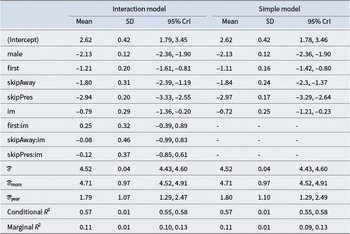
We achieved convergence for both models, and each had an R 2 value of 0.57 when both the stochastic (random effects) and deterministic (fixed effects) portions of the model were considered. Posterior predictive checks indicated that the model was able to generate simulated data with similar predicted medians, SDs and distributions to those found in the actual birth date data (for 1000 replicated predicted datasets, the median and SD of the replicated birth dates were within 0.06 and 0.003 days, respectively, of the values for the actual data, and the distributions for the predicted and observed data matched each other well). Estimated coefficients in the models were quite precise, with the exception of the values for interaction terms (Table I), which were determined to be non-informative parameters, leading us to make inferences from the simpler model without these interaction terms. The interaction terms being non-informative aligns with our prediction that the impacts of maternal reproductive status on birth date would be similar for locally born and immigrant mothers.
Summary of estimated coefficients, their standard deviations (SDs) and 95% credible intervals (CrIs) as well as estimates for stochastic portions of the model and the amount of variance explained by deterministic and stochastic portions of the model for a model that contains interaction terms and one that does not. The coefficients from top to bottom are as follows: ‘intercept’ is the model’s base case - a female pup born to a locally born mother who has had pups before and gave birth the previous year in Erebus Bay; ‘male’ indicates whether a pup was a male (male = 1) or female (male = 0); ‘first’ indicates whether it is the first pup born to a mother (first = 1); ‘skipAway’ indicates whether a mother was not present in Erebus Bay during the previous year (skipAway = 1); ‘skipPres’ indicates whether a mother was in Erebus Bay but did not give birth to a pup (skipPres = 0); ‘im’ indicates whether a mother is an immigrant (im = 1) or locally born (im = 0); ‘first:im’ is our interaction term between our first coefficient and our im coefficient; ‘skipAway:im’ is our interaction term between our skipAway coefficient and our im coefficient; ‘skipPres:im’ is our interaction term between our skipPres coefficient and our im coefficient; $\widehat{\sigma}$
is the amount of variance associated with fixed effects;
$\widehat{\sigma}$
is the amount of variance associated with fixed effects; $\widehat{\sigma}$
mom is the amount of variance associated with maternal identity;
$\widehat{\sigma}$
mom is the amount of variance associated with maternal identity; $\widehat{\sigma}$
year is the amount of variance associated with year; conditional R
2 is the amount of variance in birth date explained by the fixed and random effects; and marginal R
2 is the amount of variance in birth date explained by the fixed effects.
$\widehat{\sigma}$
year is the amount of variance associated with year; conditional R
2 is the amount of variance in birth date explained by the fixed and random effects; and marginal R
2 is the amount of variance in birth date explained by the fixed effects.

In contrast to our Hypothesis 1, we found little evidence that immigrant mothers give birth earlier than locally born mothers (Table I). We found that, on average (i.e. for a mother with an average individual random effect value in a year with an average random effect of year value), immigrant seals gave birth just 0.72 days earlier (95% credible interval (CrI): −1.21, −0.23) than locally born mothers. Furthermore, there was considerable overlap in CrIs for predicted birth dates for pups born to immigrant mothers vs locally born mothers that shared values for other covariates (Fig. 1). For example, a locally born first-time mother giving birth to a son is predicted to give birth 0.62 days earlier than the mean birth date (95% CrI: −1.47, 0.24), whereas an immigrant first-time mother giving birth to a son is predicted to give birth 1.34 days earlier than the mean birth date (95% CrI: −2.20, −0.47).
The birth dates predicted by the model relative to the mean birth date (29 October) for all combinations of maternal immigrant status, maternal reproductive status and pup sex. Predicted values for immigrant (Imm.) mothers are represented by blue and predicted values for locally born (Local.) mothers are represented by red. Male pups are denoted by squares in a darker shade, and female pups are denoted by circles in a lighter shade.

In keeping with our Hypotheses 2 and 4, we found that mothers that skipped reproduction in year t - 1 or that had their first pup in year t tended to give birth at least 1 day earlier than those that had produced pups in year t - 1 (experienced). This occurred regardless of whether they had been away from Erebus Bay in year t - 1 (skip_away: estimated coefficient = 1.84 days earlier, 95% CrI: −2.30, −1.37), had been present in Erebus Bay in year t - 1 (skip_present: estimated coefficient = 2.97 days earlier, 95% CrI: −3.29, −2.64) or had their first pup in year t (first: estimated coefficient = 1.11 days earlier, 95% CrI: −1.42, −0.80). Additionally, it should be noted that although the 95% CrIs for the two skip coefficients do not overlap, predicted birth dates for pups born to skip_away vs skip_present mothers that shared values for all other covariates had 95% CrIs that overlapped considerably (Fig. 1). Moreover, aligning with our Hypothesis 3, as we determined the interaction model to be unnecessary, differences in birth timing associated with a mother’s breeding state in the previous year are consistent for immigrant and locally born mothers. Furthermore, as predicted in Hypothesis 5, we found that male pups were, on average, born 2.13 days earlier (95% CrI: −2.36, −1.90) than female pups, with there being no evidence of a difference in the relationship with the immigrant status of the mother.
The deterministic portion of the model (fixed effects) explai ned only a modest portion of the total variance in birth dates (R
2
marginal = 0.11). The total amount of variance increased markedly when the random effects were considered (R
2
conditional = 0.57). As we predicted in Hypothesis 6, the amount of variance associated with maternal identity ( $\widehat{\sigma}$
mother = 4.71, SD = 0.97) was greater than the amounts associated with year (
$\widehat{\sigma}$
mother = 4.71, SD = 0.97) was greater than the amounts associated with year ( $\widehat{\sigma}$
year = 1.80, SD = 1.10) or fixed effects (
$\widehat{\sigma}$
year = 1.80, SD = 1.10) or fixed effects ( $\widehat{\sigma}$
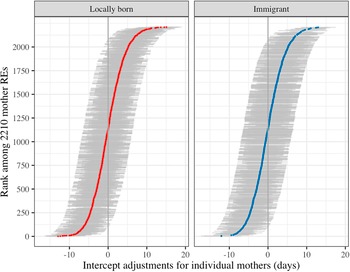
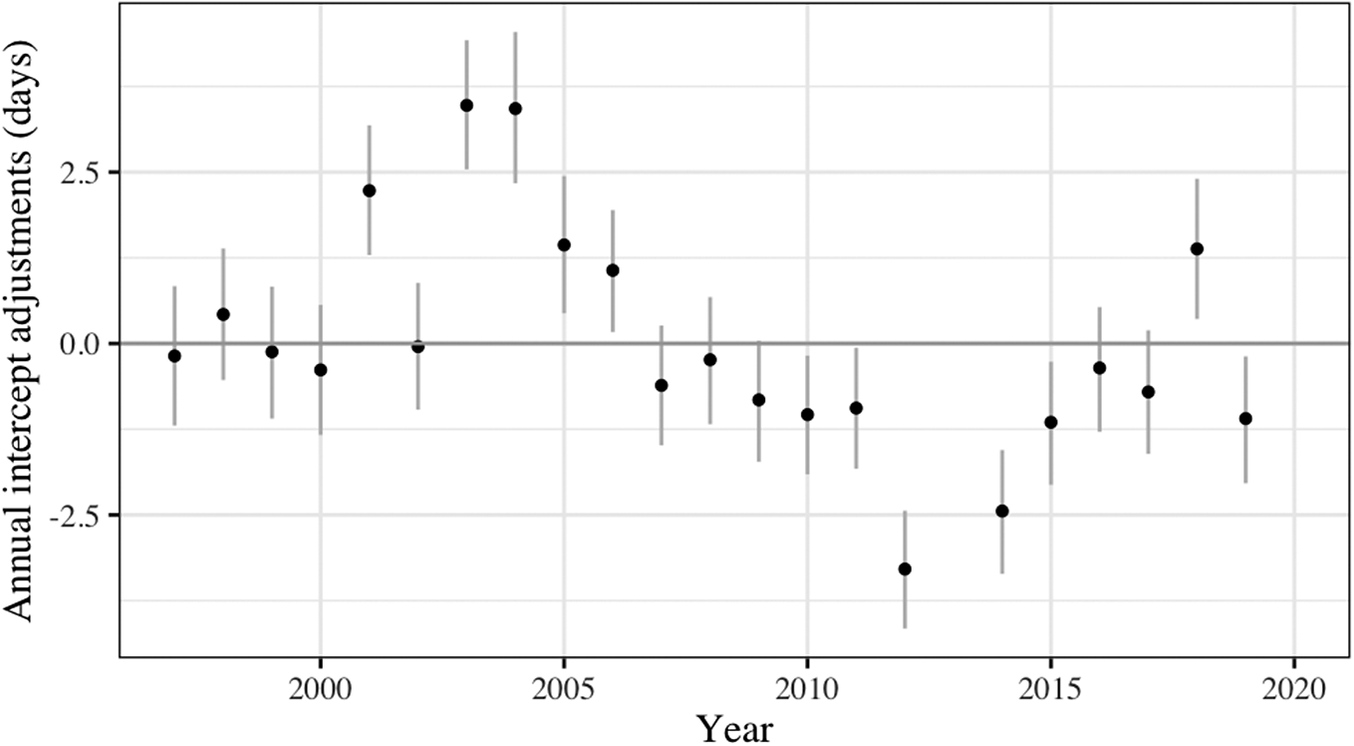
fixed = 4.52, SD = 0.04). We also found that estimated values for individual maternal random effects were well intermixed for immigrant and locally born individuals (Fig. 2). Given the relatively small values for random year effects, mean annual birth dates were consistent across all years (Fig. 3).
$\widehat{\sigma}$
fixed = 4.52, SD = 0.04). We also found that estimated values for individual maternal random effects were well intermixed for immigrant and locally born individuals (Fig. 2). Given the relatively small values for random year effects, mean annual birth dates were consistent across all years (Fig. 3).
The intercept adjustment posterior mean and 95% credible interval for each level of maternal identity. The two plots are differentiated by immigrant status, with immigrant mothers in blue on the right and locally born mothers in red on the left. The y-axis displays the rank among 2210 mother random effects (REs). The shapes of both graphs are very similar.

The estimated posterior mean and 95% credible interval adjustment for each year examined in the study.

Discussion
Using 7539 birth dates across 22 separate years and 2210 mothers, we are able to demonstrate several new findings regarding the relationship between a Weddell seal mother’s immigrant status and the timing of her pup’s birth date. We did not find evidence that birth timing for immigrant and locally born mothers differs in biologically significant ways. This result is novel, as all prior information on this matter is from translocations of animals and indicates that individuals new to an area behave differently in regards to reproductive timing (Jacobson & Lukefahr Reference Jacobson, Lukefahr, Cearley and Rollins1998, Sumners et al. Reference Sumners, Demarais, Deyoung, Honeycutt, Rooney, Gonzales and Gee2015).
Over the past 20 years, immigrant females have accounted for ~40% of all mothers in Erebus Bay (J.J. Rotella, unpublished data, 2024). Although their precise origins are unknown, immigrants into Erebus Bay might be from unstudied or minimally studied northern populations in the Ross Sea. These populations may be in close enough proximity to Erebus Bay to have similar reproductive timing. The most probable potential populations are located between 0.5° and 2.0° latitude farther north along the Victoria Land coast (Santos Rodriguez Reference Santos Rodriguez2025, J.J. Rotella, unpublished data, 2024). The only other potential populations with studied birthing times similar to those of Erebus Bay are the population that may exist in the Bay of Whales (Lindsey Reference Lindsey1937) and the population at White Island (Gelatt et al. Reference Gelatt, Davis, Stirling, Siniff, Strobeck and Delisle2010). The White Island population is small (~1% of the size of Erebus Bay), and it is probable that all movements of individuals between the two populations have been documented (Levinson & Rotella Reference Levinson and Rotella2025). Based on the distance between the Bay of Whales and Erebus Bay, the lack of evidence for Weddell seals at the Bay of Whales in recent broad-scale survey efforts (LaRue et al. Reference LaRue, Salas, Nur, Ainley, Stammerjohn and Pennycook2021) and features of unpublished genetic data for females born in Erebus Bay and immigrants found in Erebus Bay (J.J. Rotella, unpublished data, 2024), immigration from the Bay of Whales seems improbable. Alternatively, these results could suggest that immigrants are able to adjust their reproductive timing to match that of their new colony to improve their fitness, especially in an extreme environment where reproductive synchrony is imperative for success.
We also demonstrate that maternal reproductive status impacts both groups of seals in very similar ways, as evidenced by the lack of information provided by the interaction terms of our more complex model. If potential fitness costs are associated with Weddell seal migration, such as navigating an unfamiliar environment, these do not appear to impact reproductive synchrony (Bonte et al. Reference Bonte, Van Dyck, Bullock, Coulon, Delgado and Gibbs2012). Given that Weddell seals tend to be philopatric, it is likely that there is an unidentified impetus for these movement events. Regardless, we demonstrate that immigrant seals are able to adapt their life history timing to their new environment. It should be noted that even though we do not find any discernible difference in birth-date timing between locally born and immigrant Weddell seals, it is possible that these two groups might differ in other aspects of their life history and demographic traits.
Our results agree with prior findings from Rotella et al. (Reference Rotella, Paterson and Garrott2016) that Weddell seals give birth earlier if they did not pup the previous season. Interestingly, we show that both immigrant and locally born seals that did not pup during the previous year in Erebus Bay give birth at similar times regardless of whether they were seen in Erebus Bay in the previous year or spent the previous year elsewhere. Skip_away and skip_present mothers are estimated to give birth within 1.12 days of one another. This result indicates that females, regardless of where they were originally born, are unlikely to produce pups outside of Erebus Bay after they first give birth inside Erebus Bay, which aligns with previous conclusions (Chambert et al. Reference Chambert, Rotella and Garrott2015).
In contrast to clear information regarding where females give birth, data on female breeding locations are limited. It is probable that female seals observed in Erebus Bay during the pupping season are also being bred there late in that season. However, females not seen in Erebus Bay could either breed in other areas or arrive in Erebus Bay to breed late in the season after population surveys have concluded. Seals being bred in other areas are either breeding earlier than those in Erebus Bay due to the shift in reproductive patterns in populations farther north or at similar times depending on the proximity of the population to Erebus Bay. Although our current data are unable to differentiate between these two possibilities, it is clear that both locally born and immigrant seals are able to synchronize their parturition dates with those of Erebus Bay seals. Genetic investigations or data from biologging devices could assist in revealing where seals are during the breeding period and improve our understanding of how such synchronization is accomplished. It may also be informative to examine reproductive synchrony at other colonies if Erebus Bay seals are found to visit during birthing or breeding periods.
Birth date in Weddell seals impacts survival in early life. It has been demonstrated that pups born later survive better in the pre-weaning period (Proffitt et al. Reference Proffitt, Rotella and Garrott2010), and mass late in lactation has been shown to be important for survival into adulthood (Proffitt et al. Reference Proffitt, Garrott and Rotella2008a). Pups born earlier in the year have been reported to have a lower weaning mass compared to those born at or after the mean birth date (Macdonald et al. Reference Macdonald, Rotella, Garrott and Link2020). Given similarities in predicted birth dates for pups born to immigrant and locally born mothers, hypothetically it is improbable that birth-date differences alone lead to survival differences for pups born to immigrants vs locally born mothers. Future research comparing body mass attributes and survival rates of pups born to immigrant mothers with values for pups born to locally born mothers would be valuable.
Our results clearly demonstrate that maternal identity is the most important variable affecting a pup’s birth date, and that individual variation in birth timing was similar between locally born and immigrant mothers. Individual variation is often due to underlying genetic or phenotypic differences that may be more advantageous under different environmental conditions (Wilson & Nussey Reference Wilson and Nussey2010). Although individual heterogeneity in vital rates is not a main driver of growth for this population (Macdonald et al. Reference Macdonald, Rotella and Paterson2023), it may be important for population persistence (Gibert Reference Gibert2016). To understand more about what factors drive variation in Weddell seal birth dates, it could be informative to study mothers who give birth very early or very late. Birth date is known to be heritable in some long-lived birds and mammals (Findlay & Cooke Reference Findlay and Cooke1982, Plard et al. Reference Plard, Gaillard, Coulson, Hewison, Douhard and Klein2015, Oosthuizen et al. Reference Oosthuizen, Pistorius, Bester, Altwegg and de Bruyn2023), such that mothers who tend to give birth early have daughters who tend to give birth early. Thus, it could be informative to examine trends in birth dates for lineages of seals to attempt to recognize patterns in closely related individuals. It also could be useful to investigate underlying physiological mechanisms that may influence birth date, such as embryo implantation and ovulation, and how environmental conditions might impact these mechanisms.
Weddell seals demonstrate incredible consistency in regard to their parturition date. Female seals are able to synchronize this period regardless of whether a seal was born locally, or immigrated to an area. Clearly, the largest influence on birth date is individual maternal identity, and, after this, variation is primarily due to an individual’s reproductive status in the previous year and the sex of a pup. It is currently unknown how well Weddell seals can adjust birth dates at the population level, as the birthing period has been remarkably consistent, even during a large environmental perturbance (a mega-iceberg event), when birth dates were delayed by just 3–5 days (Rotella et al. Reference Rotella, Paterson and Garrott2016). Understanding population-level plasticity of Weddell seal reproductive timing may be important in the future, as environmental conditions are expected to alter in Antarctic regions (Dawson et al. Reference Dawson, England, Morrison and Boeira Dias2025), and so a shift in reproductive timing may occur. Such shifts in reproductive timing due to environmental change have already been demonstrated in several Antarctic birds (Barbraud & Weimerskirch Reference Barbraud and Weimerskirch2006, Descamps et al. Reference Descamps, Tarroux, Lorentsen, Love, Varpe and Yoccoz2016), as well as in two phocid species in other regions: harbour seals (Phoca vitulina, Linn.; Reijnders et al. Reference Reijnders, Brasseur and Meesters2010, Osinga et al. Reference Osinga, Pen, de Haes and Brakefield2012) and grey seals (Halichoerus grypus, Fabricius; Bowen et al. Reference Bowen, den Heyer, Lang, Lidgard and Iverson2020). Furthermore, these shifts may lead to phenological mismatches between predators and the resources they need, which can have profound impacts on population growth rates, trophic interactions and the strength of natural selection (Renner & Zohner Reference Renner and Zohner2018, Visser & Gienapp Reference Visser and Gienapp2019 ).
In summary, we find that immigrants to the Erebus Bay Weddell seal population give birth at similar times to locally born mothers, despite all immigrants originating in a more northerly location. The biggest driver for reproductive timing was maternal identity, with certain individuals being more likely to give birth earlier than others year after year. Reproductive synchrony is crucial for resource alignment in this southernmost mammal population, and the amount of individual heterogeneity among both immigrant and locally born seals may allow the population to be robust to temporal changes that may occur in the timing of key events in the annual cycle. The results shown here provide baseline information that could be used to evaluate possible changes in reproductive timing in Earth’s southernmost mammal in future decades.
Acknowledgements
We thank the many graduate students and field technicians who have collected data on this project. All animal seal handling was conducted under the National Marine Fisheries Service (NMFS permit nos. 1032-1679, 1032-1917, 17236, 21158, 26375) and the Antarctic Conservation Act (ACA) and approved by the Animal Care and Use Committee (IACUC) at Montana State University (current protocol no. 2019-93-124) and University of Minnesota. We appreciate the logistical support for fieldwork in Antarctica provided by the United States Antarctic Program and its various contractors, including but not limited to Lockheed Martin, Raytheon Polar Services Company, Antarctic Support Associates, the United States Navy and Air Force and Petroleum Helicopters Incorporated. This work used the Animal Resources Center (RRID:SCR_026351), which is supported by the Office of Research and Economic Development at Montana State University.
Author contributions
ASB: conceptualization, analyses, writing and editing, data collection. PML: conceptualization, editing, data collection. JJR: conceptualization, analyses, writing and editing, data collection.
Financial support
This project was supported by the National Science Foundation (NSF), Division of Polar Programs (grant no. 2147553 to JJR) and prior NSF grants to R.A. Garrot., JR, D.B. Siniff and J. Ward Testa.
Competing interests
The authors declare none.



 Open access

