

In November 2015 the governments of Northern Ireland, the United Kingdom and Ireland announced the conclusion of 10 weeks of negotiations with the acceptance of ‘A Fresh Start: The Stormont Agreement and Implementation Plan’ (Northern Ireland Office 2015). The deal was intended to save power-sharing between the region’s unionist and nationalist communities by securing the full implementation of the 2014 Stormont House Agreement, specifically its provisions on welfare reform and paramilitary activities. The deal also addressed the functionality of the Northern Ireland Assembly through the reduction of the total number of Assembly members and executive portfolios, the creation of an official opposition and restructuring the Petition of Concern (PoC).
The Petition of Concern is a legislative mechanism that invokes cross-community voting rules on proposed legislation, a kind of veto common to consociational power-sharing arrangements. A PoC requires the signatures of any 30 members of the Legislative Assembly (MLAs) to be tabled; the proposed legislation must then receive consent from both the nationalist and unionist communities. Originally the PoC was used sparingly on issues of symbolic importance to the designated communities. Seven PoCs were tabled between the adoption of power-sharing in 1998 and its suspension in 2003. During the first full legislative session, 2007–11, 33 petitions were submitted on 21 topics. The 2011–16 legislative session, however, saw a dramatic increase in PoC votes – 118 petitions on 33 issues.Footnote 1 While the procedure was intended as a protection mechanism for communities to safeguard their vital interests, it is now widely considered a ‘blocking mechanism’ and an abuse of its original intention (McCallister Reference McCallister2015).
Veto rights are an integral component of consociational democracy but there are competing interpretations of their impact. First, it is not always clear which actors can access veto rights. The distinction between liberal and corporate consociationalism suggests that in some cases the veto players are predetermined while in other cases they are able to self-identify themselves. Second, it is not always clear what constitutes the ‘vital interests’ of an ethno-national group in need of veto protection. The distinction between restrictive and permissive vetoes suggests that either a predetermined set of issue areas are constitutionally protected or that groups determine for themselves what constitutes their vital interests. Finally, the ultimate effect of veto rights is unclear – that is, whether vetoes lead to moderation and stability or to intransigence and instability.
This article considers three interrelated components of veto rights: how vital interests are articulated, how vetoes are implemented, and what political incentives they offer for ethnic conflict management. First, I consider the comparative implementation of veto rights: who has veto rights? To what issue areas do they apply? What incentives do they offer? I then assess the impact of permissive vetoes, focusing on the Northern Irish experience. I do this through a review of the 1999–2002, 2007–11 and 2011–16 sessions,Footnote 2 employing Hansard records from the legislative debates at which a PoC was enacted, reports from the Assembly and Executive Review Committee, scholarly writings on veto rights, as well as semi-structured elite interviews I conducted in autumn 2015 with members of the Northern Ireland Assembly. While Northern Ireland is often considered the most stable example of power-sharing – ‘it shines as the brightest star in the new consociational universe’ (Taylor 2009: 7) – there is an increasing sense that veto rights are being abused by the parties, posing a potential threat to political stability. While we should be cautious about generalizing from a single case study, a review of the PoC offers insights into the functionality of power-sharing in the region, elucidates how vetoes operate under a permissive approach, and assesses whether the critique of permissive vetoes as incentivizing instability is valid. While a restrictive approach in which ‘less is more’ (McEvoy Reference McEvoy2013) is generally considered to favour moderation, I argue that a permissive approach, in which groups can determine their own vital interests, can also offer important incentives for moderation and stability in divided societies. These incentives relate to flexibility in vital interest identification, the threshold for veto enactment, and justification for veto use.
CONSOCIATIONALISM, VITAL INTERESTS AND VETO RIGHTS
Consociationalism is a theory of institutional design for divided societies, which recommends the inclusion and representation of group identities through four institutional mechanisms: executive-level power-sharing, proportionality, group autonomy and veto rights (Lijphart Reference Lijphart1977). This facilitates both shared- and self-rule, creates a durable peace and enhances prospects for political stability (Hartzell and Hoddie Reference Hartzell and Hoddie2003; Lijphart Reference Lijphart2008; McCulloch Reference McCulloch2014; O’Leary Reference O’Leary2005). Each of the four institutions can be implemented in diverse ways; one way to distinguish between different power-sharing designs is the liberal–corporate distinction. As articulated by McGarry and O’Leary (Reference McGarry and O’Leary2007: 675), corporate rules ‘accommodate groups according to ascriptive criteria, such as ethnicity or religion’, whereas a liberal consociational framework determines who is to share power on the basis of voter support.
Consociationalists argue that broad inclusion is needed because when groups feel uncertain about their access to decision-making channels, they are liable to seek extra-constitutional forms of ensuring their collective concerns are heard (O’Leary Reference O’Leary2005). This approach, however, is often criticized as providing incentives for political extremism and ethnic outbidding. Jarstad (Reference Jarstad2008: 124) suggests, ‘by granting warring parties a stake in government, violence is rewarded’. As a system that requires parties to be the most vocal and ‘robust defender of the group cause’ (Mitchell et al. Reference Mitchell, Evans and O’Leary2009), consociationalism, critics argue, encourages parties to take more extreme positions in order to retain this title. Power-sharing, Roeder and Rothchild (Reference Roeder and Rothchild2005: 9) suggest, produces a game of political brinkmanship as parties attempt to extract concessions from the other side; this undermines the pursuit of political stability. Nevertheless, each of the consociational institutions can be designed to encourage parties to move towards the centre and to promote stability, when they are designed with moderation in mind.
As a key power-sharing institution, the veto has a variable effect. Bieber (Reference Bieber2005: 95) suggests that vetoes ‘can have the most serious negative repercussions on the functioning of any institutional arrangement’. By contrast, Lijphart outlines a rationale for thinking that they have an ameliorating effect:
The too-frequent use of the veto by a minority is not very likely because it can be turned against its own interests, too. Second, the very fact that the veto is available as a potential weapon gives a feeling of security which makes the actual use of it improbable … Finally, each segment will recognize the danger of deadlock and immobilism that is likely to result from an unrestrained use of the veto. (Lijphart Reference Lijphart1977: 37)
McEvoy (Reference McEvoy2013: 255) argues that veto rights may facilitate a sense of post-conflict security and are often required for groups to commit to a peace deal in the first place, though she is careful to note that veto misuse ‘may lead to stalemate within the power-sharing executive and risk collapse of the political system’. Koneska (Reference Koneska2014) argues that parties using their veto rights can be destabilizing, whereas threatening to use them is more likely to lead to accommodation. Consequently, veto rights can play a key conflict-regulating role, though their impact is uncertain (O’Flynn Reference O’Flynn2010; Schneckener Reference Schneckener2002).
Vetoes are enacted in diverse ways. They range in terms of ‘veto players (who has veto powers); veto issues (what they can veto); and veto points (where they can veto)’ (McEvoy Reference McEvoy2013: 259, original emphasis). Veto rights may be constitutionally enshrined or they may be informally practised. Veto points can appear in the legislature, executive or both. The veto may require those present and voting to vote against a proposal in sufficient numbers or it may be enacted by parties withholding consent by not showing up to vote. A veto may prompt an immediate suspension of the proposed legislation or it may defer the vote and refer the issue to an appropriately representative committee for further consideration; it may also be referred to the constitutional courts for resolution. There is, thus, a range of ways in which to implement veto rights (Ram and Strøm Reference Ram and Strøm2014). Some of these strategies are better equipped to protect vital interests than others. Some may push parties to the extremes and others may pull them closer to the centre.
McEvoy’s analytical framework is an important contribution to the study of veto rights, particularly on the matter of process; it provides a clear indication of the diversity of ways vetoes operate in practice. Yet, there is an earlier fundamental question: Why have veto rights at all? Lijphart (Reference Lijphart1990: 495) calls vetoes ‘the ultimate weapon that minorities need to protect their vital interests’. While the other consociational institutions should ensure the participation and representation of minority groups as well as the protection of group interests, the veto serves as a mechanism of last resort, a kind of insurance in case other mechanisms fail. If vetoes are, as Lijphart notes, intended to protect the ‘vital interests’ of ethnic groups, three aspects of vetoes seem pertinent: Whose vital interests are protected? What constitutes a vital interest? What is the causal effect of vital interest protection?
Whose Vital Interests?
The first question addresses the actors entitled to veto rights and whether their identity is predetermined or self-defined. Table 1 demonstrates the distinction between liberal and corporate veto players in leading consociations. A corporate veto constitutionally identifies those – and only those – groups entitled to veto rights. In Bosnia’s state constitution, for example, only the three declared constituent peoples can veto proposals: ‘A proposed decision of the Parliamentary Assembly may be declared to be destructive of a vital interest of the Bosniac, Croat, or Serb people by a majority of, as appropriate, the Bosniac, Croat, or Serb Delegates.’ In Cyprus’s 1960 constitution and in the failed Annan Plan of 2004, both Greek Cypriots and Turkish Cypriots had veto rights.
Liberal and Corporate Veto Players
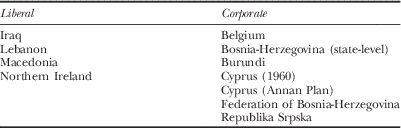
Corporate vetoes are often required to get groups to commit to the new political arrangement in the first place (McEvoy Reference McEvoy2013), and they can often appease group-based insecurities by investing on-going confidence in the system. However, they have the potential to exclude. In Bosnia, so-called ‘Others’ – Jewish, Roma, Yugoslav and those who reject ethnic labels – are without veto protections. This may disinvest and marginalize them from the system and, consequently, threaten overall political stability.
A liberal veto, by contrast, relies on numerical voting formulae rather than ascriptive features. In Macedonia, veto rights apply when proposed legislation fails to obtain ‘a majority of the votes of the Representatives claiming to belong to the communities not in the majority in the population of Macedonia’ (Ohrid Framework Agreement 2001). This is, strictly speaking, a minority veto which ‘bundles’ all minorities together: ‘the smaller ethnic minorities can never veto legislation without the support of ethnic Albanians, so their vital interests are only protected to the extent that they overlap’ with the largest minority group (Kelleher Reference Kelleher2005). Generally, a liberal veto allows representatives to self-identify and also has the added benefit of flexibility: depending on the veto threshold, the veto players may vary and parties may have to cooperate across either intra- or inter-group lines for the veto to be enacted. It also adjusts to changes in the demographic configuration of the population. The major challenge for liberal vetoes is to ensure that the threshold does not pre-emptively exclude certain groups.
What Constitutes a Vital Interest?
The question of what constitutes a vital interest is difficult to answer without essentializing the ethnic group. Nonetheless, we may consider a vital interest to include those issue areas central to the group’s well-being, survival and sense of itself. Vital interests can be identified either constitutionally (on what issue areas are vetoes permitted?) or politically (what issue areas do groups articulate as vital interests?). Restrictive veto rights limit veto use to high-stakes issues of an ethno-national dimension, which are constitutionally delineated. In Macedonia, ‘culture, use of language, education, personal documentation, and use of symbols, as well as laws on local finances, local elections, the city of Skopje, and boundaries of municipalities’ are the only areas subject to veto use (Ohrid Framework Agreement 2001). In Lebanon, ‘major issues’ including foreign affairs, citizenship and personal autonomy laws, budgetary and development plans and the appointment of top civil servants require the approval of two-thirds of cabinet members. Permissive vetoes allow their use on all proposed legislation and are typically enacted through weighted or qualified majority voting rules. In Burundi, a predetermined legislative ratio of 60 per cent Hutu to 40 per cent Tutsi representation works with qualified majority rules to ensure a permissive minority veto (Vandeginste Reference Vandeginste2015). In Belgium, a delaying veto allows three-quarters of the members of one of the linguistic groups to declare proposals to be of ‘a nature to gravely damage relations between the Communities’; this refers the motion to the Council of Ministers for revision (Article 54). See Table 2 for examples of polities where restrictive and permissive veto rights have been implemented or proposed.
Permissive and Restrictive Veto Rights

With restrictive vetoes, different consociations have answered the question of what constitutes a group’s vital interests in different ways. As noted in Table 3, while there is a general trend towards identifying culture, language and education as vital interests, this is not conclusive. Others mark out international relations and political decision-making powers as vital. This variance in practice speaks to the different manifestations of divisions in different societies. Conflicts with an internationalized dimension, such as Cyprus, are likely to emphasize foreign affairs, while those in which the territorial configuration of the state remains contentious are likely to see territoriality as vital, as with Bosnia’s Entities. What is vital about vital interests is often specific to the polity in question.
Vital Interest Categories in Restrictive Veto Rights
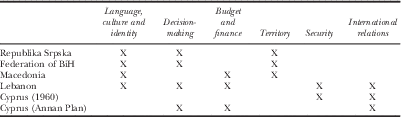
A permissive veto permits much greater latitude as groups are able to self-identify and articulate their own vital interests.Footnote 3 In contrast to its Entities, which adopt a restrictive approach, Bosnia’s state-level constitution contains a corporate-permissive clause. A member of the presidency or a majority of delegates from one of the three constituent peoples in the House of Peoples can declare proposals destructive of their vital interests (General Framework Agreement for Peace (1995) Annex 4, Article 3e). A committee is set up to mediate the conflict, and if it fails to resolve the issue within five days, the legislation is referred to the Constitutional Court (Bahtić-Kunrath Reference Bahtić-Kunrath2011; McEvoy Reference McEvoy2013).Footnote 4 Between 1996 and 2013, nine issues have been adjudicated by the courts, of which three were declared destructive of Bosniak vital interests, including proposals on refugee and displaced persons and on permanent and temporary residences for citizens, and one destructive of Croat vital interests (proposal on higher education).Footnote 5
As noted above, Northern Ireland provides a permissive veto to unionists and nationalists; an assessment of all vetoes enacted between 1999 and 2016 in the Northern Ireland Assembly suggests that, with some important exceptions, Northern Ireland’s vetoes align with the vital interest categories identified in a restrictive approach. Examples include: Irish-language schooling, the Union flag on UK driving licences issued in Northern Ireland, the display of Easter lilies in the parliament buildings and the functioning of power-sharing institutions, such as the North–South Council or Civic Forum (AIMS; McCaffrey Reference McCaffrey2013). Indeed, many of the issues relate specifically to identity symbols, decision-making procedures, education and cultural rights. The difficulty of a permissive approach is that not all issues subject to a veto will align with a group’s vital interests; some issues may be vetoed for partisan or ideological reasons. As discussed further below, these might include, as they have in Northern Ireland, proposals on marriage equality, welfare reform and avoiding scrutiny of MLAs.Footnote 6
What Incentives Do Vetoes Offer?
Constitutional designers wanting to promote inter-ethnic moderation are likely to favour restrictive vetoes. Not only do they serve as a key area of group protection, offering groups the reassurance that their vital interests are protected, but restrictive vetoes have the advantage of not deadlocking the entire decision-making process. By marking out only those issues deemed to be of fundamental importance, it limits the threat of tit-for-tat vetoes. Many scholars advocate a restrictive approach. Schneckener (Reference Schneckener2002: 221) argues, ‘veto rights should be more restricted in order to prevent their misuse’. McEvoy (Reference McEvoy2013: 272) suggests veto issues ‘should be clearly defined in legislation and be agreed upon among the political parties. These include identity issues, symbols, language, culture, education, the budget, and security’ (McEvoy Reference McEvoy2013: 272). Schwartz (Reference Schwartz2015), writing in the context of Northern Ireland, recommends that vetoes should be restricted to only three areas: language, culture and symbols; legacies of the conflict; and the constitutional arrangements set up under the Good Friday Agreement (1998). In limiting the policy areas to which vetoes apply, a restrictive approach incentivizes stability by limiting the frequency of veto votes and the possibility of misuse.
However, there are drawbacks to a restrictive approach, including the matter of who decides what constitutes a vital interest. Constitution-writing moments are marked by tense power dynamics between majorities and minorities and, increasingly, between domestic actors and international mediators. Vital interest clauses may end up protecting only those issues vital to the party with the most power and intentionally excluding issues of importance to smaller parties or they may reflect the priorities of international rather than domestic actors. There is also the matter of those issues not specified in the constitution. As Bieber notes (2005: 97), when a number of areas are marked out as vital interests, there is still ‘the inherent danger that other decisions that might have a profound impact on minorities, such as economic policy or infrastructural development, are excluded and thus are beyond the reach of the minorities’ veto’. This closes off a key avenue of protection, the very purpose for which vetoes were designed; this risks alienation and disinvestment from the system. Veto rules must be ‘sufficiently inclusive to pacify all potential spoilers’ (Ram and Strøm 2014: 351). An overly restrictive approach may unintentionally incentivize instability or even trigger power-sharing collapse, as was the case in Cyprus.
Yet, many scholars are wary of permissive vetoes, in part because ‘vital interests can be interpreted broadly, leaving room for the vetoing of virtually any decision’ (Bieber Reference Bieber2005: 97). A permissive approach is more politicized and may result in a greater number of issue areas being considered as vital by political parties. Vital interests may also fluctuate according to circumstances on the ground. This, however, could have a positive effect; a permissive approach adapts to the socially constructed nature of group identities and allows parties to respond to issues as they gain salience and to address key issues that may not have been anticipated at the constitution-writing moment. Nevertheless, the major concern remains that it is easier to invoke a permissive veto for opportunistic reasons ‘unrelated to community concerns’ (Bieber Reference Bieber2005: 97). Where groups retain high levels of antipathy towards one another, the push to the extremes can be acute. If groups are not committed to the state and its legitimacy, they may not hesitate to employ too-frequent vetoes, which can lead to legislative paralysis. Moreover, post-conflict environments are largely characterized by mistrust and insecurity. Groups may see others as out to harm their vital interests and employ veto rights pre-emptively as an act of self-preservation. A permissive approach is consequently considered more open to abuse and more likely to entail some degree of legislative deadlock than a restrictive approach. When it comes to vetoes, less, it might be concluded, is more (McEvoy Reference McEvoy2013).
PERMISSIVE VETOES IN NORTHERN IRELAND: A CASE STUDY OF MODERATION?
Northern Ireland is deeply divided between British unionists, who wish to remain part of the United Kingdom, and Irish nationalists, who want the reunification of Ireland. After 30 years of conflict in which more than 3,500 people lost their lives, a power-sharing agreement was adopted in 1998. The Good Friday Agreement implemented a number of novel power-sharing institutions, many of which lean towards liberal consociationalism. These include institutions that link the North to the Republic of Ireland and the Republic to the UK; the appointment of a First Minister and deputy First Minister who share equal executive responsibilities, nominated by the two largest parties in the Assembly; a multiparty executive created through the allocation of portfolios based on a party’s seat-share in the Assembly;Footnote 7 and the election of MLAs by single-transferable vote in multimember districts. MLAs must self-designate as nationalist, unionist or other, which allows for cross-community voting rules, such as weighted majority (60 per cent of all those present and voting plus 40 per cent in each of unionist and nationalist voting blocs) and parallel consent (50 per cent in each of nationalist and unionist voting blocs). Certain key issues are automatically subject to cross-community consent, including the election of the speaker, standing orders and budget ratification. For all other issues, there is the PoC; this safeguards the vital interests of the communities by ensuring that contentious legislation has the support of both unionists and nationalists. These arrangements support a ‘parity of esteem’ between the nationalist and unionist communities, ensure that both communities have access to decision-making powers and guarantee that their voices are heard in the development and implementation of government policy (McGarry and O’Leary Reference McGarry and O’Leary2009).
The PoC contains liberal and corporate aspects. There is no requirement that all 30 signatories must be from the same party or community designation. Parties with an ‘other’ designation, such as the Alliance Party and the Greens, have signed petitions and at least four have been co-signed by unionist and nationalist parties. Once the 30-signature threshold has been met, corporate rules kick in, mandating a majority vote from each of the unionist and nationalist designations. The procedure is widely permissive: ‘there is no topic, however mundane, that cannot be the subject of a Petition of Concern’ (Schwartz Reference Schwartz2015). It is also open to all legislative proposals, including primary legislation, private members’ bills and legislative consent motions, as well as to individual clauses and amendments to bills. It can be enacted at any stage of the legislative process.
PoCs are contentious. Popular blogging site Slugger O’Toole (2015) has dubbed them ‘the dirtiest words in politics’, some MLAs have labelled them anti-democratic (McCallister Reference McCallister2015), some opposed the community designation process at the heart of the petition, and all parties are keen to limit their use, though they disagree on how to accomplish this. In 2014, the Assembly and Executive Review Committee (AERC) undertook a review of the PoC, investigating four issues: whether to establish an ad hoc committee on conformity with equality to review a PoC prior to a vote (already an option under the existing standing orders); whether to restrict PoCs to key areas; whether to modify the 30-signature threshold and; whether to replace it with an alternate mechanism, such as weighted voting without community designations. These four categories confront the two main critiques of permissive vetoes: that the too-frequent use of vetoes creates legislative deadlock and that PoCs are abused by parties vetoing non-vital issues.
Legislative Deadlock
One of the noted criticisms of the PoC is its frequency of use (AERC 2014), particularly between 2011 and 2016, when 118 petitions were tabled. There are two points to note, however. First, because the petition can apply to a specific clause in a bill, there are often multiple petitions on the same bill. To take a contentious piece of legislation, the Welfare Reform Bill (2015) was subject to two joint petitions by Sinn Féin, the Social Democratic and Labour Party (SDLP) and the Greens, while the Democratic and Unionist Party (DUP) invoked 46 PoCs on individual amendments to the bill. The use of the PoC drops to 33 times in the 2011–16 period if we consider the number of topics to which it pertains. The second point relates to the 30-signature threshold. During the 1999–2002 period, no party could table a PoC on its own, but since 2007, the DUP has captured more than 30 seats. This makes it the only party that does not need to cooperate with other parties to trigger cross-community voting rules.Footnote 8 This privileged status has emboldened the party: while it co-sponsored only one PoC in the first legislative period, it signed over 70 in the 2011–16 period, most of them without the support of other parties. The fact that only one party has this kind of leverage risks alienating the other parties who do not have the same advantage and undermining the legitimacy of the procedure.
PoC votes have become more frequent, but have they led to legislative deadlock? Conley and Dahan (Reference Conley and Dahan2013: 193) argue that while PoCs may occasionally be used for partisan purposes, ‘on balance [they] were employed sparingly and on issues of great significance to one or the other community’, particularly prior to 2011. Other scholars contend that concerns about deadlock are overstated. McCrudden and his co-authors suggest it is useful to compare the Assembly against the Scottish Parliament, which enjoys a wider range of devolved powers, does not have a mechanism on a par with the PoC, and is governed by a one-party majority government, and yet, they note, it only passed eight more pieces of legislation than the Assembly over the same time period (McCrudden et al. Reference McCrudden, McGarry, O’Leary and Schwartz2016: 34). This suggests that, contrary to the assumption that vetoes necessarily result in legislative deadlock, Assembly business is able to keep pace with more ‘ordinary’ decision-making procedures while still protecting the vital interests of the communities. The anomalous case here appears to be the welfare reform proposals, which resulted in tit-for-tat vetoes over most of 2014–15.
Yet, the frequency of PoCs is a concern. The AERC report considered adopting an ad hoc committee to screen all PoCs for their conformity with equality; this could limit superfluous votes. They also debated whether to limit PoCs to key areas – though the committee considered key areas to mean the kind of legislation to which the petition could apply, rather than to the content of the legislation. A vital interest clause to limit the topics to which vetoes apply does not appear to have been considered. Moreover, parties appear hesitant to identify the range of issues that would qualify as vital interests and seem to appreciate the flexibility provided by a permissive approach (interviews with SDLP, Sinn Féin, Alliance and DUP MLAs, 2015). There was also the sense that it might be an ‘exhaustive and futile task to extend the list of “key decisions”’ (AERC 2014).
While the AERC could not agree on how to reduce the frequency of PoC votes, the issue is addressed in the Fresh Start deal. The agreement reduces the number of Assembly members from 108 to 90 for the 2021 elections while pledging to keep the 30-signature threshold for PoCs.Footnote 9 Whether this changes the fact that only one party is large enough to invoke a petition on its own will be contingent on election results. At a minimum it raises the percentage of MLAs required for a petition to move forward. Overall, while PoC votes have become more common over the 2011–15 period, they have not yet unduly restricted legislative functionality (Conley and Dahan Reference Conley and Dahan2013; McCrudden et al. Reference McCrudden, McGarry, O’Leary and Schwartz2016: 34).
Potential for Abuse
By allowing vetoes on any and all topics, a permissive approach may encourage parties to veto any legislation with which they do not agree, whether it conflicts with their vital interests or not. As Kelleher warns (2005: 5), if vital interests are defined too broadly, it risks holding other parties ‘ransom over a wide range of legislative issues’. This is particularly the case for the DUP as it is the only party large enough to invoke a veto on its own.
Have the parties abused the spirit of the PoC? The voting record suggests that, for the most part, they have not (AIMS; Conley and Dahan Reference Conley and Dahan2013; Schwartz Reference Schwartz2014). In a review of PoC use, I identify three broad categories: vital interests as defined by a restrictive approach (e.g. education, culture, language, etc.), equality issues without a specific ethno-national dimension (i.e. issues that are vital to groups that are not ethno-nationally mobilized), and issues that are non-vital (i.e. motivated by ideological or partisan reasons). I followed three steps in assessing Petitions of Concern. Firstly, I reviewed the Hansard record to see if parties framed their use of the PoC in terms of vital interests (they typically did not). Secondly, I asked MLAs to identify issues which would constitute a vital interest for their community (they were generally hesitant to provide a comprehensive list). Thirdly, I categorized each PoC according to whether the issue could fall within a wide restrictive approach (see Table 3). For issues where it was not immediately clear if a vital interest was at stake, I reviewed news media reports and scholarly sources before making a categorization.
In the 2011–16 period – which has been singled out as particularly abusive (BBC 2013) – approximately 70 per cent of PoC topics are vital interests as understood in a restrictive approach. Examples include whether the Union flag should appear on UK driving licences issued in Northern Ireland, whether to support development proposals for Coláiste Dhoire, an Irish-language school, and the transfer of broadcasting powers. Twelve per cent – marriage equality, welfare reform and the anti-abortion provisions in the Criminal Justice Bill – are non-ethnic equality issues, and another 18 per cent fall into the questionable category. This includes the DUP and Sinn Féin vetoing investigations into the actions of their respective MLAs, and DUP votes on the planning bill, rates relief for community amateur sports clubs and the vetoing of a call for an inquiry into alleged political interference on the part of the Housing Executive.
While the majority of vetoes relate to vital interests, are the rules still too permissive? There are four possible strategies for addressing the potential abuse of veto powers. First, there is the catch-all argument, which leaves things much as they are. The position here is to let parties decide which issues should be subject to veto rights, accepting that some abuses of the spirit of the PoC will occur. It is better, the catch-all position suggests, to cast the net wide than risk harming or denying vital interests. Only two non-vital PoCs were invoked in the 2007–11 period and none in the short-lived 1999–2002 period. While unwarranted votes did increase in the 2011–15 period, they did not overtake the legislative agenda. Partisan vetoes still represent a minority of all PoCs; nonetheless given that abuses are increasing, the catch-all status quo may, with time, become the least-preferred option.
At the opposite end of the spectrum is the argument that the PoC should only be restricted to issues of an ethno-national nature. The logic here is that as a consociational device, it is intended to regulate matters of unionist and nationalist importance (Schwartz Reference Schwartz2014). Writing about Sinn Féin, Alliance and the Greens tabling a PoC against an amendment to the Criminal Justice Bill that would further criminalize abortion, Schwartz suggests that while thwarting the legislation may be ‘a victory for enlightened and progressive politics’, from a consociational perspective ‘there is no distinctly unionist or nationalist aspect to the question of whether a woman should have the right to make decisions about what happen within her own body’ (2014: 4). Yet this kind of restrictive approach does not solve the problem of protecting the vital interests of the two communities that may fall through the cracks (e.g. proposals on the A5 Dual Carriageway, ostensibly an infrastructure issue that, by further linking Derry-Londonderry to Dublin, takes on an ethno-national hue) nor does it prohibit parties from violating the rights of non-ethnic groups, such as women seeking their reproductive rights or LGBT couples seeking to marry, through veto use.
One way to address these equality issues is to combine a restrictive approach with equality protections for non-ethnic groups. Section 75 of the Northern Ireland Act already aims to take account of the impact of decision-making on nine identity groups before any decision is made, but it is clear that some equality issues have still been subject to veto use, in part because they have been ethnicized by the parties. One such issue is marriage equality. While marriage equality – the extension of civil marriage rights to same-sex couples – is ostensibly neither unionist nor nationalist, the nationalist parties are ardently in support and the unionist parties fundamentally opposed to its extension to Northern Ireland. Given its evangelical Christian background, many in the DUP see traditional marriage as a vital interest of the unionist community: ‘I think it is [a vital interest] for the majority of people of Northern Ireland, and, I believe, in both communities’ (interview with DUP MLA, November 2015). Unionists also see the nationalist parties as co-opting LGBT rights. One Ulster Unionist Party (UUP) member argued in the legislative debate on marriage equality that the LGBT community ‘is being deliberately used by some parties in the House for perceived political advantage’ (Hansard, 2 November 2015).Footnote 10 Sinn Féin has consciously extended the language of parity of esteem to sexual minorities, suggesting that they know what it feels like to be ‘treated as second-class citizens’ (Nagle Reference Nagle2015). They, in conjunction with other parties including the SDLP, tabled five motions on marriage equality in the 2011–16 period, all of which have been vetoed by the DUP.Footnote 11 When asked about Sinn Féin’s motivation on this issue, one MLA replied that ‘I know what it is like to be discriminated against, as a woman, as a republican’ and that it is therefore important to ‘create space for that discriminated community to be heard’.
This approach is in line with liberal consociationalism’s core belief in rewarding ‘whatever salient political identities emerge in democratic elections, whether these are based on ethnic or religious groups, or on subgroup or transgroup identities’ (McGarry and O’Leary Reference McGarry and O’Leary2007: 675). A liberal consociational arrangement is meant to lessen the salience of ethno-national identities in daily governance processes. Vetoes are intended to protect minority rights and a veto that is used to further constrain and restrict the rights of minorities of any kind should be considered suspect. As one MLA notes, any time a PoC is used to the detriment of minorities, it should be considered abuse (interview with Sinn Féin MLA, November 2015). Yet the major difficulty with this approach is that it does not offer a clear mechanism for resolving issues where the rights of different groups come into conflict (e.g. the rights of the mother versus the rights of the foetus in the case of abortion).
The final way, and the approach advocated here, is to maintain the flexibility of a permissive approach but to include a justificatory clause for its use and to ensure thresholds are high enough that they encourage the parties to work together. A protocol on Petitions of Concern was included in the Fresh Start deal, which notes that petitions are only to be tabled in ‘exceptional circumstances’ and that when one is tabled, the parties must ‘state the ground or grounds upon which it is being tabled and the nature of the detriment which is perceived as arising from an affirmative vote on the matter’ (A Fresh Start 2015). This new justificatory element will represent a break from past practice: under the current rules, parties are not required to relate their PoC to an understanding of vital interests or to provide an explanation for the petition. Moreover, they rarely invoke any direct vital interest in the legislative debates on cross-community votes (Hansard records, 1999–2016). A justificatory approach is also a reasonable compromise between permissive and restrictive approaches and should go some way to limiting frequent and sometimes frivolous vetoes. This, however, ultimately depends on the parties themselves.
Does the Petition of Concern Offer Incentives for Stability?
Unionists and nationalists have shared power in Northern Ireland for nearly two decades, and while politics has not always run smooth, there is a reasonable degree of stability that would be impossible without power-sharing (McGarry and O’Leary Reference McGarry and O’Leary2009). Veto rights have been important in this regard. Despite concerns about the incentive structure of permissive vetoes, the PoC has primarily been used to protect the vital interests of the unionist and nationalist communities and to ensure that contentious legislation has the support of both communities. PoCs have not paralysed the legislative agenda nor have they been excessively abused. There are a few major exceptions, namely welfare reform and marriage equality, but overall the procedure has been used in a manner akin to a restrictive approach.
Initial thinking on vetoes suggests that a permissive approach is inherently destabilizing. The experience from Northern Ireland suggests that, within certain parameters, a permissive veto approach that contains liberal consociational aspects can potentially encourage moderation and stability. Firstly, this is because the rules for tabling a PoC do not name the groups – i.e. any 30 MLAs can sign a petition, regardless of their party or community designation. This offers two different moderation-inducing incentives. The first incentive is that it facilitates cooperation between parties from the same community designation. The majority of nationalist petitions have included both Sinn Féin and the SDLP (McCaffrey Reference McCaffrey2013). Prior to the DUP surpassing the 30-signature threshold, unionist PoCs were the result of cooperation between the DUP and UUP. Requiring two or more parties to sign a petition would increase the likelihood that vital, rather than partisan, interests, are at stake. If parties need additional support for their petition, they will be judicious in their use of vetoes. The second incentive is that it provides opportunities for parties to potentially work across their community designations. The Alliance Party and the Greens have supported PoCs and, though admittedly rare, there have been cross-community petitions. This means that the PoC can protect a community’s vital interests while still accommodating cross-community cooperation, a central motivation of a liberal consociational approach. Corporate-restrictive rules, by contrast, entrench parties in their respective silos.
A second benefit of a permissive approach is that by allowing parties to articulate their own interpretation of their vital interests, it offers a level of flexibility that adapts to circumstances on the ground as well as providing groups with a level of confidence that their voices and their interests matter. Under a restrictive approach, there remains the concern that an issue can arise that is vital to a community but that it does not have veto protection. The A5 Dual Carriageway mentioned above is one such issue. A liberal-permissive approach limits this prospect. Parties have less incentive to destabilize a system which they support.
The incentives for moderation could nonetheless be made stronger. Both the frequency and potential for abuse can be lessened by a higher threshold for tabling a PoC – particularly if it requires more than one party to invoke it – and by the need to offer justification for its use by explaining the harm that would arise if the proposed legislation passes. The reduction in the number of Assembly members from 108 to 90 while maintaining the 30-signature requirement for a PoC should address the threshold issue. The Fresh Start Agreement also contains provisions for justification. It maintains a permissive approach on what constitutes ‘exceptional circumstances’ but is unclear on how the justification is assessed and by whom. One possibility might be for the Presiding Officer and a representative committee to assess the grounds on which a PoC is tabled (AERC 2014). Another might be for the courts to adjudicate the legitimacy of the petition, as in Bosnia (Schwartz Reference Schwartz2015), though it may be preferable for the consociational actors to work out their difficulties together (McCrudden et al. Reference McCrudden, McGarry, O’Leary and Schwartz2016). While the Northern Ireland Assembly will need to work through what constitutes exceptional circumstances, a justificatory clause, when combined with the higher threshold, is likely to make parties be more judicious in their use of veto rights.
CONCLUSION
This article considers the articulation and protection of vital interests, how veto rights are used (and abused) and what incentives they offer for moderation and political stability in consociational systems. In consociational theory, mutual veto rights represent the primary means by which ethnic groups defend their ‘vital interests’. Yet the implementation of veto rights is often criticized for rewarding extremism and producing institutional instability. This critique, however, needs further contextualizing. There are diverse ways to implement veto rights and in this article I have focused on whether the groups that can access veto rights are predetermined (the liberal–corporate distinction) and whether the issue areas to which vetoes apply are constitutionally proscribed (the restrictive–permissive distinction). These different arrangements offer different incentive structures (the moderation–extremism distinction). Drawing on the experience of Northern Ireland, which has a liberal-permissive veto approach, I have considered the critique that permissive vetoes are employed too frequently and are liable to misuse. I have found both concerns to be valid but somewhat overstated.
There are risks to generalizing from a single case study, particularly one situated in a reasonably stable context, and we should be cautious about making grand claims about any institutional rule. Yet an analysis of the PoC in Northern Ireland at least requires us to reconsider the less-is-more approach to veto rights. While further comparative analysis is required, Belgium’s permissive alarm-bell procedure has only been used twice and Bosnia’s permissive veto is used more sparingly than its Entity-veto counterpart, in part, we may speculate, because of the justificatory rules attached to it. Whether or not the Northern Ireland experience is transferrable to other divided settings is contingent upon further research. Nonetheless, the argument presented here suggests that a more flexible permissive approach, when it includes justificatory rules and high thresholds for enactment, may contribute to moderation and stability in deeply divided societies.



