



INTRODUCTION
Influenza infection can manifest to varying degrees of severity. While most people infected will be asymptomatic, there is substantial morbidity and mortality resulting each year in England and across Europe [Reference Fleming1–Reference Beauté3], with endpoints ranging from consulting primary care through to hospitalization and mortality. The impact of influenza typically varies by age group according to the subtype circulating [Reference Beauté3]. However there are individuals who are at elevated risk of developing severe disease following infection [4] and so selectively targeted by annual influenza vaccination programmes traditionally in many countries. These programmes in developed countries have typically focused on ⩾65-year-olds, <65-year-olds in a clinical risk group and, more recently following the emergence of the 2009 pandemic influenza strain, pregnant women, vaccinating whom provides protection to the young infant. A small number of countries, however, also recommend targeting healthy children or all persons from age 6 months [5, 6]. In addition to providing a direct benefit to the child themselves, as children are thought to be key transmitters of influenza [Reference Mossong7] vaccination is thought to also provide indirect protection to the wider community through reducing transmission of infection [Reference Ghendon, Kaira and Elshina8, Reference Piedra9], with a high burden still seen in the elderly and high-risk groups [Reference Cromer10].
Based on (a) mathematical modelling studies [Reference Baguelin11] that predicted the population-wide impact of vaccinating school-age children and (b) the recent licensure of a live attenuated influenza vaccine in Europe, the Joint Committee on Vaccination and Immunization (JCVI) recommended [12] the introduction of an annual influenza vaccination programme for healthy children aged 2–16 years. A phased introduction of the programme commenced in 2013–2014, when immunization was offered to all children aged 2–3 years across the UK together with children aged 4–11 years resident in seven geographical pilot areas in England [13]. Assessment of the health impact of the first year of the programme on respiratory and influenza healthcare-level outcomes found [Reference Pebody14] a consistent, albeit not statistically significant, decrease in cumulative disease incidence across targeted and non-targeted age groups for a range of different disease indicators in primary-school-age vaccination pilot areas relative to non-pilot areas.
School absenteeism can be an important consequence of influenza infection. Absence of pupils from schools due to illness can have social and economic implications extending beyond those directly associated with the child, with parents and carers often needing to take time off work to care for their children [Reference Neuzil, Hohlbein and Zhu15]. Studies elsewhere have assessed the potential impact of paediatric influenza vaccination programmes on school absenteeism, with the expectation there would be reductions in school respiratory illness absenteeism following vaccination of healthy pupils [Reference Neuzil, Hohlbein and Zhu15–Reference Mears17]. The majority of available studies have been conducted in the United States and concluded such school-based programmes resulted in a modest reduction in absenteeism, with some suggesting a possible indirect impact in other school-age groups [Reference Hull and Ambrose18, Reference Hull and Ambrose19]. There were, however, several limitations with these studies, including assessing the broad outcome of all-cause absenteeism (illness and non-illness), low vaccination coverage, limited statistical power, and lack of adjustment for potential confounders between pilot and control schools such as deprivation and historical absenteeism patterns.
The impact of paediatric influenza vaccination on school absenteeism in England, and indeed elsewhere in Europe, has to the best of our knowledge yet to be demonstrated. The availability of national school-level absenteeism data in England through a mandatory reporting system and coding on the general cause allows us to assess if any impact of the newly established universal childhood influenza vaccination programme has been observed on illness absenteeism. The key aim of this paper is to compare illness absenteeism rates in primary schools in influenza vaccination pilot with non-pilot areas during the 2013–2014 influenza season. A secondary objective is to assess if any indirect impact was observed in older non-targeted age groups in secondary school-age children in the same locality where primary schools are vaccinated.
METHODS
Data
Absenteeism
The Department for Education in England collates and reports on enrolment-level absence data each year for pupils of compulsory school age in England. The National Pupil Database [20] provided school-level absence data for each state-funded primary and secondary school in England, with a breakdown by term and school year group from autumn 2011 to spring 2014. Illness absenteeism for each term was defined as the proportion of authorized half-day absence sessions due to any illness, and does not include unauthorized absences where the school is not satisfied of the authenticity of the illness.
Vaccination
During 2013–2014, seven geographically discrete pilot areas in England offered influenza vaccine to all children of primary-school age (4–11 years): Bury, Cumbria, Gateshead, Leicester City and Rutland, South East Essex and the London boroughs Havering and Newham. This was an estimated target population of children aged 4–11 years of 199 475 [Reference Pebody14]. Schools and associated absenteeism data were assigned to either pilot or non-pilot areas by postcode based on area boundaries of the pilot sites.
Vaccine uptake was collated by each NHS England pilot area team at school and year-group level and reported to Public Health England at the end of the season [Reference Pebody14]. End-of-season uptake values were defined as the proportion of children in the target school population who received at least one dose of influenza vaccine during the 2013–2014 campaign. Except for Cumbria, all pilot sites delivered vaccine through school programmes and school-level uptake by year group was matched to the Department for Education absenteeism dataset by postcode and school name, year group and postcode. Cumbria was excluded from all multilevel analyses as school-level uptake data was not available.
Other variables
School-level characteristics for 2013–2014 were available from the Department for Education's annual school census [21] and were matched to school-level absenteeism data with the Department for Education's unique school identifier. Potential confounding variables identified as likely to impact on absenteeism and controlled for included historical school absenteeism by year group, school setting (urban/rural), the proportion of children with special educational needs, the level of deprivation (measured through the Income Deprivation Affecting Children Index; IDACI [22]) and the proportion of pupils with a defined ethnicity (grouped by he Office for National Statistics census categories).
Analysis
Descriptive
The proportion of sessions missed due to illness absenteeism by pupils in both primary schools (age 4–11 years) and secondary schools (age 11–16 years) was determined for pilot and non-pilot areas in England, comparing values in both autumn and spring terms for the 2013–2014 period. Crude prevalence ratios for absenteeism were then calculated for pilot relative to non-pilot areas for the autumn 2013 and spring 2014 school terms. The proportions were also compared for other school terms back to autumn 2011 to determine if there were systematic baseline differences between schools in the pilot and non-pilot areas.
Continuous covariates were categorized according to their distribution to ensure sufficient numbers in each category and then compared between pilot and non-pilot schools to see if there were notable differences. At the school level, IDACI rank was grouped into quintiles; proportion of pupils of white ethnicity was categorized as <50% and ⩾50%; other ethnic groups were split into <10% and ⩾10% and proportion of pupils with special educational needs was categorized as <20% or ⩾20%. School setting was grouped according to the following levels: urban, town, village and hamlet. Absenteeism was then compared across the covariates.
Multilevel work
As influenza started notably circulating at the beginning of 2014 [23] until April 2014, absenteeism during the spring 2014 term was defined as the dependent variable. Absenteeism data was available at year level nested within schools (Fig. 1). A linear multilevel regression model was constructed to model spring 2014 school illness absenteeism and determine the impact of vaccination. We controlled for potential confounders identified in the literature as relevant and available through the school-level census as mentioned above and adjusted for clustering within schools (confirmed as significant at 95% level by comparing log likelihoods between models with fixed and random intercepts at school level). Model residuals were assessed to determine fit and if normality assumptions were appropriate. At the year-group level, variables modelled were spring 2014 absenteeism (the dependent variable), autumn 2013 absenteeism and the average of absenteeism in autumn and spring terms in 2011–2012 and 2012–2013 (to adjust for background patterns), and number of pupils. At the school level, variables modelled were vaccine pilot status (pilot or non-pilot), urban/rural status, special educational needs, deprivation rank and ethnicity proportions (white and other). A third level of geographical region [24] was included to adjust for geographically varying influenza activity [Reference Green25]. This model was run separately for primary-school and secondary-school data.
Absenteeism data and analysis flow. *Out of the 809 pilot schools, 224 were located in Cumbria.

To assess the dose-response relationship, the model with primary-school data was additionally run with vaccination modelled as a continuous variable at the school level. Vaccine uptake, the proportion of children in the target population who received at least one dose of influenza vaccine during the campaign period, was modelled and set to 0% in non-pilot areas.
All statistical analyses were carried out using R version 3.0.2 (R Development Core Team, Austria), with the multilevel model fitted using the nlme package [26].
RESULTS
Low levels of influenza activity were seen in the community in England in 2013–2014, with the 2009 pandemic A(H1N1) virus predominating and illness through health system-based surveillance mainly reported in young adults [27]. Significant increases in activity occurred after Christmas, with a peak in activity seen in February/March 2014 and circulation continuing until the end of April. This period coincided with the spring 2014 term absenteeism data. All influenza A(H1N1)pdm09 viruses characterized were antigenically and genetically similar to the strains in the vaccine utilized in 2013–2014 [27], suggesting a good match. In the first year of the pilot childhood influenza vaccination programme, uptake reached 43% in 2-year-olds, 40% in 3-year-olds and in 4- to 11-year-olds in the six pilot sites with school- delivered programmes, it reached 56%, ranging from 46% to 72% [Reference Pebody14].
For 2013–2014, 99·8% of state-funded primary schools (16 755/16 788) and 99·6% of secondary schools (3315/3329) in England had illness absenteeism and covariate data available for analysis, equating to 6 852 760 students. When stratified by pilot vaccine status, 5% of primary schools (n = 809) and 5% of secondary schools (n = 159) were in vaccine pilot sites (Fig. 1). Vaccination information was available for the majority of primary schools in pilot sites except for those in Cumbria (n = 224). Out of the 585 schools with vaccination information available, 530 (91%) were matched to the absenteeism dataset, with the 55 schools not matched either classified as independent and absenteeism data not available for this study, or no matching absenteeism record was found.
The characteristics of pilot and non-pilot schools are shown in Table 1. Between the two groups, school characteristics were broadly similar. Significant differences were seen for deprivation, with a larger proportion of pupils in the most and least deprived quintiles in pilot sites relative to non-pilot sites. By ethnic group, differences were slight but significantly lower proportions of pupils were classified as ‘white’, ‘mixed’ and ‘other’ in pilot relative to non-pilot areas, with a significantly higher proportion classified as ‘Asian’.
Characteristics of schools in influenza vaccine pilot and non-pilot areas*

SEN, Special educational needs; IDACI, Income Deprivation Affecting Children Index.
*P values determined using χ 2 tests for categorical data and t tests for continuous data and emboldened if <0·05.
In primary schools, the largest range in absenteeism was seen by deprivation (Fig. 2a ) with the highest absenteeism seen in the second most deprived quintile (2·82%) and the lowest in the fifth quintile (2·48%), a decrease with decreasing deprivation. In secondary schools, the highest level of absenteeism across variables was seen in schools in hamlets (3·34%, Fig. 2b ) while the lowest was seen in schools with <50% of pupils with white ethnicity (2·57%). The range of proportion of sessions recorded as absent by year group within schools was fairly narrow (Supplementary Appendix Fig. A1).
Crude absenteeism stratified by school-level characteristics in (a) primary schools, (b) secondary schools.

When stratifying by pilot/non-pilot area, at an aggregate level, proportion of sessions missed due to illness were consistently lower in pilot relative to non-pilot areas across primary/secondary schools and term in 2013–2014 (Supplementary Appendix Fig. A2). When assessing the crude difference in illness absenteeism proportions between pilot and non-pilot areas in the previous two seasons, 2011–2012 and 2012–2013, this was also generally the case, although to varying degrees. There was a slight negative correlation seen with school-level uptake and absenteeism in 2013–2014 [Spearman correlation coefficient of −0·097, 95% confidence interval (CI) −0·186 to 0·002] (Supplementary Appendix Fig. A3), suggesting absenteeism was lower for schools with higher vaccine coverage, although it was not significant.
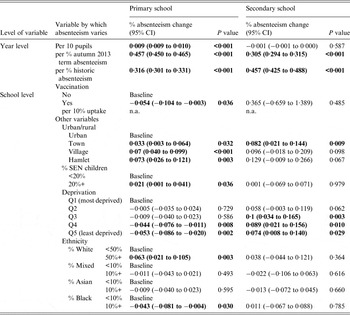
Table 2 presents the difference in absenteeism by covariate for primary- and secondary-school children when controlling for possible confounders and clustering at the school level. The impact of being in a pilot area (with an average school uptake of 56%) relative to a non-pilot area was a significant decrease in primary-school absenteeism of 0·054% (95% CI −0·104 to −0·003, P = 0·036, Table 2). This is equivalent to an average of 4 days per school and, when taking the average uptake in schools of 56%, translates to 20 children needing to be vaccinated to avert an illness absent whole day. When considering linear variation by uptake level, an increase in uptake of 10% resulted in a decrease in absenteeism of 0·008% (1 day per school), which approached statistical significance (P = 0·062).
Adjusted impact on absenteeism determined through linear multilevel regression, with vaccination modelled as a pilot or non-pilot site for primary- and secondary-school children, England, spring 2014
CI, Confidence interval; SEN, Special educational needs.
There was a higher level of illness absenteeism in secondary schools located in primary-school-age vaccination pilot areas relative to control areas, although the difference was not significant (P = 0·485, Table 2).
DISCUSSION
During 2013–2014, low levels of influenza activity were reported in the community and schools, with only 9% of outbreaks reported in schools [27], compared to 36% the previous year [23]. Despite a fairly narrow range of proportion of sessions absent by year groups within schools, a borderline statistically significant impact of vaccinating primary-school children against influenza was reported in primary schools when adjusting for confounders, with a decrease in illness absenteeism reported in primary-school-age pilot relative to non-pilot schools. This decrease was also seen when assessing the level of coverage, although the dose-response relationship only approached significance. In secondary schools, however, there was no significant indirect impact on illness absenteeism of being located in a pilot area where primary schools were vaccinated.
The relative reduction in primary-school illness absenteeism observed in pilot vaccination areas in the spring 2014 term of 0·054% may seem fairly modest. However, the potential impact in England pilot areas of achieving uptake of 56% uptake was appreciable, and would equate to a total of 10 651 avoidable illness absence sessions or 5325 days in the 530 observed primary schools in spring 2014. The implications of averting illness absenteeism in children will enable both the pupils themselves to benefit more from their education [28], benefits to the schools by minimizing the potential disruption of influenza outbreaks on school life and will extend to societal benefits such as minimizing parental/carer time off work and associated costs [Reference Mears17]. These results suggest an impact of the programme on illness absenteeism in vaccinating schools, complementing evidence of impact on healthcare indicators published from England in the 2013–2014 influenza season [Reference Pebody14]. It should also be noted that this modest effect was seen in a year with relatively mild influenza circulation [27] and so the benefits of vaccination may well be greater in more severe influenza seasons. The evidence presented here adds to the literature on influenza vaccination and absenteeism, where a significant impact was seen both at the population level [Reference Hull and Ambrose18, Reference Hull and Ambrose19, Reference Davis29] or individual pupil level [Reference King30, Reference King31].
An increase in uptake of 10% resulted in a decrease in absenteeism of 0·008%, although this only approached significance. This pattern is concordant with other studies [Reference Graitcer32–Reference Kawai34], although it is difficult to compare impact as they were assessed on a weekly or daily time scale (compared to our assessment at term level) and relevant impact will tend to be higher when assessing the peak of activity which we cannot determine [Reference King33]. It will be important to further assess this apparent impact in future seasons as the childhood influenza vaccination programme is rolled out across England and more schools are vaccinating. As 2013–2014 was a fairly low intensity season, the epidemiological impact of vaccinating school-age children is likely to be greater in future, more intense influenza seasons.
While an overall impact was observed in vaccinating primary schools, there was no evidence of a significant impact on illness absenteeism in secondary-school children in pilot areas, suggesting no detectable indirect community-level impact of the programme on this indicator in 2013–2014. The literature assessing the indirect impact of such a programme on school absenteeism is limited, with a range of observations [Reference Hull and Ambrose18, Reference Davis29, Reference Graitcer32, Reference King33, Reference Monto35, Reference Loeb36], although overall a positive impact was seen. While there were large numbers involved in this analysis, the number of secondary schools was considerably less than for primary schools and so a larger clustering effect is to be expected which may affect the significance. Additionally, most studies demonstrating indirect effects in different age groups were set within schools where both primary and secondary pupils attended. In this study, secondary schools were assigned to vaccine pilot or non-pilot areas based on their postcode and children attending secondary schools may travel longer distances across pilot area boundaries thus potentially diluting possible herd effects. Proximity of school types should be assessed in more detail to determine if transmission patterns are potentially interrupted in nearby schools.
This study is one of the first in Europe to look at the impact of seasonal influenza vaccination programmes on school absenteeism, with little published on this topic outside of North America. This observational study was ecological in design, meaning the findings are applicable for the population as a whole rather than at the individual level. However the association seen is promising. By utilizing a well-established mandatory dataset, it included a large number of pupils from state-funded schools and so allowed for sufficient power, despite small vaccine pilot areas, and allowed for adjustment for key confounders within a multilevel analysis. The availability of illness absenteeism provided a more specific outcome compared to all-cause absenteeism which has been reported in many other studies [Reference Davis29, Reference Graitcer32, Reference Kjos37]. Conversely, the limitation is that seasonal variations in illness absenteeism can result from illnesses other than influenza, although routine assessment of other respiratory viruses showed no peak in activity during the spring 2014 term [27].
Influenza vaccination reached an encouraging uptake level (56%) and the variation across sites allowed us to explore a possible dose-response relationship with school absenteeism through ecological analysis. However, information was not available at the school level on vaccination of at-risk children who are separately targeted as part of the routine influenza vaccination programme. An initial examination of uptake levels at the end of 2013–2014 by vaccine pilot and non-pilot areas for 2- to 16-year-olds in a predefined clinical risk group suggested uptake in at-risk children was slightly higher in vaccine pilot areas relative to non-pilot areas [38] which may result in an overestimation of the impact of vaccinating healthy children as we looked at the impact in children overall irrespective of risk status. However, we did set uptake to 0% in non-pilot areas which, conversely, may underestimate the effect. It will be important to consider this as a confounder in future studies, particularly when pilot areas are larger.
A limitation of the study was the availability of data aggregated by term. While the majority of activity was seen in the spring 2014 term, there were some outbreaks seen towards the end of the autumn 2013 term and so we may not have fully captured the influenza season by analysing spring 2014 data only and thus underestimated the programme impact. However, data only available at term level (rather than by date) means any impact at the end of the autumn term would likely have been masked by the rest of the term. Typically to assess the impact of influenza, weekly data should be assessed for correlations, and absenteeism compared at the peak week of influenza for a more sensitive analysis. We cannot therefore use this data to monitor influenza activity within a season [Reference Besculides39]. However as obtaining daily or weekly absenteeism data through special studies is intensive [Reference Schmidt, Pebody and Mangtani16], these ad-hoc studies often suffer from a power issue and studying an entire term, as we did using routine data from the Department for Education, and comparison between pilot and non-pilot areas allows an estimation of the total impact of the vaccination programme for most of the influenza season instead of a single week. However a pilot study with weekly data may help to determine and confirm differences between pilot and non-pilot areas coincide with the timing of influenza circulation. The proportion of sessions missed due to illness were also lower in pilot relative to non-pilot areas in the autumn 2013 term, albeit to a smaller degree than in the spring 2014 term –more regular data will help to determine the timing of fluctuations. Other information of interest would be a measure of children attending school with less severe disease, which may increase the potential for transmission.
In conclusion, observations during the first year of the universal influenza vaccination programme suggest a modest but significant reduction in illness absenteeism in primary schools where healthy children of primary-school age were offered vaccine. However there was no significant indirect effect on illness absenteeism in secondary schools, suggesting no detectable indirect impact of the programme on illness absenteeism in 2013–2014. The assessment of term-level absenteeism has provided community insights which should be used in conjunction with healthcare surveillance when evaluating the impact of such a programme.
SUPPLEMENTARY MATERIAL
For supplementary material accompanying this paper visit http://dx.doi.org/10.1017/S0950268816001680.
ACKNOWLEDGEMENTS
This work was supported by Public Health England where the lead author and corresponding author are employees. This work was supported through core surveillance funding from the Department of Health. The funders had no role in study design, data collection and analysis, decision to publish, or preparation of the manuscript.
DECLARATION OF INTEREST
None.



