




In the village of Siān, in the Jarquyeh district of Isfahan province, the festival Shast-Sheshi (or Shast-o-Shashi; of or related to “sixty-six”) unfolds annually, beginning on the sixty-sixth day after Nowruz, the first day of springFootnote 1. This date coincides with the pre-Islamic Khordadgan (properly, Khordādagān) festival, historically celebrated on the sixth day (named Khordad) of the month of KhordadFootnote 2. The occasion stems from the Zoroastrian practice of marking feast days when the names of the day and the month overlappedFootnote 3. The most famous of these celebrations is Mehragān, which falls on the sixteenth day (Mehr) of the month of Mehr and is dedicated to the deity MithraFootnote 4.
The most notable rite of the Shast-Sheshi festival involved immersion in a pond (later a pool) fed by the spring Shāh Chashme (“king water source”), now dry. The festival's rituals also include visits to the Gate of Paradise grotto, the Oven of Fatima, and the Cave of Forty Girls—sacred sites aligned with Khordad's role as a female divinity, in addition to her role as the beneficial protector of water. The festival also has been an occasion for giving gifts to brides and a place for newlywed honeymoons. This rich collection of practices draws thousands of attendees from the region. Lasting ten days to a month, the festival transforms Siān village into a bustling hub, with vendors establishing a temporary market. Despite its setting around a Shia shrine complex (emāmzāde), the event retains a predominantly secular character, given its emphasis on sociocultural rites rather than strictly religious ones. Shast-Sheshi is so prominent that it served as a climatic marker: the period from 15 Esfand to sixty-six days after Nowruz was called qomishe, denoting a time of unstable and unpredictable precipitation.
This study is based on my visits to the area and my interviews with local residents (2013–2024) and local informants who participated in the festival or recorded the memories of elders. Several valuable documents from the 1970s, when the festival was at its peak in modern times, were shared with me by Mahmud Taqizāde. These include tickets sold for entering the pool, donation receipts, and minutes of meetings of the board of trustees of the shrine complex. I also drew on correspondence between the endowment organization (Sāzmān-e Owqāf), Isfahan branch, which oversaw the shrine complex, and the gendarmerie precinct in Mohammadābād (the former administrative seat of Jarquyeh), which was responsible for maintaining law and order during the festival. In these documents, the festival is most commonly referred to as the ceremony of the sixty-sixth day of Nowruz, for the pilgrimage to the shrine of Shāh ‘Abd-al-Mozaffar (Fig. 1)Footnote 5.
A 20-rial ticket issued for entry into the pool area during the festival in the 1970s. The date on the stamp is partially truncated. The five listed trustees of the shrine include four individuals from Siān village and one representative from the endowment organization in Isfahan.

Although Shast-Sheshi continues to attract thousands of visitors each year, it has in recent years lost many of its core elements, leaving its present form a mere shadow of its former existence. In this account, I use the present tense for events occurring in the most recent period (roughly since the 2000s) and the past tense for traditions that, according to informants, are no longer practiced. Additionally, much of the information in this study is derived from the recollections of older individuals. Although these memories are invaluable, they are often fragmented, inconsistent, and occasionally contradictory.
The forgotten Khordadgan
The Zoroastrian or Mazdean pantheon is topped with the Heptads, consisting of the supreme deity Ahura Mazda and his six beneficent divinities, the Ameshāspands, which include three males (Vahman, Ardvahisht, Shahrēvar) and three females (Spandārmad, Khordād, Amurdād). Each of these seven “Holy Immortals” constitutes a month in the Zoroastrian calendar, which has endured since pre-Islamic times. The remaining five months of the solar year are dedicated to originally lesser Zoroastrian divine beings (yazatas). Additionally, in the Zoroastrian calendar, each of the thirty days in a month is assigned a fixed name. The first seven days of each month are named after the Heptad, following the order given above, and the remaining 23 days are named after lesser divinities. These day names have survived exclusively among Zoroastrians.
Khordad (Middle Persian, Hordād or Xordād) is the current pronunciation of Old Iranian Haurwatāt (wholeness, integrity), to whom the hymn “Hordād Yasht” is dedicated in the Avesta (Zoroastrian sacred book)Footnote 6. Khordad was the deity presiding over water, often mentioned together with another deity, Amurdād, who supervised plants. Khordad presides over the third month of the calendar and also over the sixth day of each month. Already in the early centuries of Zoroastrianism, Khordad's place as the divinity of water was overshadowed by two other deities. One was Tishtrya or Tīr, the divinity associated with rainfall, to whom the fourth month of the year and the thirteenth day of the month belongs; their concurrence was celebrated as TiragānFootnote 7. The other deity was Anāhita (or Anāhīd or Nāhid), who replaced the earlier Apām Napāt (Āpas, Ābān), presenting a divinity of fertility and water. By the time of the Sasanians (224–651 CE), Anahita had decreased the status of other female divinities, including Khordad. Khordad seems to have been destined for oblivion for a long time, so much so that the Zoroastrian Pahlavi sources misunderstand her gender as masculine and fail to mention her dedicated festival, Khordadgan.
Much of what we know about ancient Iranian calendars and festivals comes from the eleventh-century Chorasmian scholar Abu Reyḥān Biruni, who took a keen interest in Iranian history and culture; much of his documentation is not found in other sources. In his Āthār al-bāqia, Biruni describes customs and festivals associated with each month of the Persian calendar (and other Iranian calendars). Although Biruni gives detailed description of certain months, the section on Khordad is among the briefest. Under Khordād-māh (month), he writes: “The sixth day, or Khordād-ruz, is a feast called Khordādagān, named after the concurrence of the day and month.”Footnote 8 Biruni remains silent about the customs associated with the festival or the regions where it was celebrated across Iran, which suggests that, by his time, Khordadgan had largely faded as a custom for Iranian-speaking peoples. However, the seventeenth-century Persian dictionary Borhān-e qāte‘ mentions Khordādagān under “Khordād,” echoing Biruni's statements, but adds: nik ast dar in ruz ṭalab-e ḥājāt az malāʾeke o fereshtehā kardan o zan khwāstan (it is auspicious on this day to petition the angels for one's needs and to seek (or ask for) a wife)Footnote 9. This addition may derive from a manuscript of Biruni's Āthār unknown to Sachau (its editor and translator), but perhaps accessible to one of Borhān's sources.
Aside from Biruni, medieval Persian literature offers little useful information about Khordadgan. The eleventh-century poet Mas‘ud Sa‘d Salmān of Lahore, known for his interest in calendrical feasts and observances, composed brief pieces on Khordad and its associated day. Rather than emphasizing its cultural significance, he, as for many other events, treated it as an occasion for hedonism. In a verse, he wrote: “It would not be just if, on the Day of Khordad, you do not fulfill yourself with the delight and joy of wine in the morning.”Footnote 10 This perspective is not unusual for medieval Persian poets, who often viewed pre-Islamic Persia as a time of cultural freedom and joy.
Another authority on Zoroastrian traditions is the Persian rivayats, a series of exchanges between the Zoroastrian community in India and their co-religionists in Iran from the fifteenth century onward. These contain detailed descriptions of certain Zoroastrian festivals, for example, that of Spandārmad, occurring on the fifth day of the twelfth monthFootnote 11. Yet in the published rivayats, there is no mention of Khordadgan, although there are several citations concerning the day of Khordad (the sixth day) of some other months, including the sacred sixth day of Farvardin (as Nowruz-e Khordādi) and the sixth day of Spandārmad (as Khordād-sāl gāh)Footnote 12.
In her detailed ethnographic survey of Zoroastrian communities in the Yazd region (to the east of Jarquyeh), with a focus on one village, Mary Boyce highlights three special feasts in the month of Khordad, observed on the days of Ormazd, Vahman, and OrdibeheshtFootnote 13. She also provides an extensive account of annual festivals held at specific times at various pilgrimage shrinesFootnote 14. She does not mention Khordadgan or its date among these celebrations.
The information given above is all I have found in surviving sources about Khordadgan; that is, the concurrence of the day and the month of Khordad, with little detail about the festival's content or customs, aside from Borhān's allusion to the auspiciousness of seeking a wife on that day. It is the Shast-Sheshi festival that sheds light on what Khordadgan might have involved in an unknown, distant past. The name Shast-Sheshi, which expresses its date (“sixty-six” days after the beginning of Nowruz), alone conclusively associates it with Khordadgan. The rites involved in Shast-Sheshi further support this connection: its focal ritual, immersion in water, highlights Khordad's link to water, and other elements of the festival align with Khordad's feminine nature. The Shast-Sheshi festival demonstrates how ancient traditions can endure in unexpected times and places and preserve traces of rituals otherwise lost to time.
The setting
Jarquyeh, locally known as Garkuya, is a historical district (formally a subprovince, as of 2021) southeast of the city of Isfahan, characterized by its semiarid landscape and sparse population. With 23,000 inhabitants, the district comprises two dozen settlements, including several small townships with populations in the low thousandsFootnote 15. The Shast-Sheshi festival takes place in the village of Siān, locally called Seyyun, which has a fluctuating population, with 140 permanent residents and 700 visitors during holidays. The village is situated eighty kilometers from IsfahanFootnote 16. Few people outside the area know about the district or the village and its festival, and no anthropological or archaeological studies exists on the area.
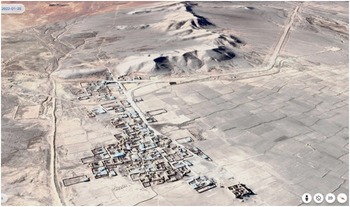
The village of Siān is situated on a plain, with mud-brick dwellings at its core, extended some 900 meters between an abandoned fort to the north and a now-dried-up natural spring to the south (Fig. 2). Immediately to the southwest rise three low, interconnected mountains. These are, from west to east: Mount of the Ghoul's Abode, which contains a cave with ancient wall drawings; Mount Tanur, at whose southern foot lies a sacred pit known as the Oven of Fatima; and Mount Chehel Dokhtar, which houses a shallow shelter called the Forty Girls.
View of Siān looking southwest. Note the abandoned fort on the bottom (north) and the adjoining triad mountains to the top (south) of the fields. Source: google earth, 21 September 2024.

The Shāh Chashme water source, located at the foot of Mount Chehel Dokhtar, was central to the Shast-Sheshi festival. Initially the spring emerged within a pond of collected water, which may have been natural, man-made, or a combination of both, with runoff feeding into an irrigation canal. According to my informants, this pond bore a physical resemblance—albeit on a smaller scale—to the pond in the village of Dastgerd in central Jarquyeh. They also recalled that the pond in Siān was surrounded by various trees, such as mulberries, elms, and elders, and sustained a variety of wildlife, including aquatic vegetation and fish, which were considered sacred and were fed through votive offerings. The pond's depth varied, measuring approximately 1.2 meters near the source and becoming shallower toward the discharge point. At some point, a rectangular concrete curb enclosing an area of roughly 100 square meters was built around the pond, resulting in the pool depicted in older photographs, although its bottom remained a mix of bedrock and soil. The spring continued to flow until 1971, when it dried up; thereafter, water was drawn from a mechanized well to fill the pool, but this, too, eventually ran dry. In 2010, the pool was filled with dirt, ostensibly for hygiene reasons—although it was likely motivated by fundamentalist objections to the exposure of wet bodies.
By the now-dry Shāh Chashme stands the shrine complex (āstāne), known as the emāmzāde of a certain Shāh ‘Abd-al-Moẓaffar, or Abol-Moẓaffar, locally known as Emāmzāde Shāh Chashme (Fig. 3)Footnote 17. The complex consists of interconnected brick structures, including a sanctuary adorned with a wooden latticed grill (żariḥ) that surrounds the tomb. Above, a stucco ceiling supports a low-pitched dome. The shrine opens into a courtyard through a lofty portico (eyvān), flanked with two rows of chambers (Fig. 4). On the opposite side of the complex, there is the entrance, flanked by a dozen empty arcades that form a small bazaar (bāzārche), whose sole function is to accommodate vendors during the Shast-Sheshi festival. The architectural style of the shrine complex is minimalist, with only a few embellishments, such as blue tiling and Quranic inscriptions. In the center of the roughly square courtyard, measuring 250 square meters, grows a small garden, which appears to have replaced a traditional water basin—common in such medium-size complexes—after water became scarce. In the courtyard stands a stone statue of a lion (Fig. 5), dated 1033 AH/1624 CE, resembling similar stylistic lion statues found in public spaces in Isfahan. This particular lion is said to have been relocated from the nearby Siān cemetery of the gabrs (Zoroastrians), and it was believed that sterile women could become pregnant by passing beneath it. At the main entrance of the complex, a vaulted vestibule (hashti) features murals on both sides, painted with abstract representations of plants and animals (Fig. 6), which have been vandalized. The complex has not received professional architectural assessments. Given its elaborate design and size, the shrine complex is far too grand for the village of Siān alone, and it serves the entire Jarquyeh districtFootnote 18. Its maintenance is funded by local donations through the national endowment organization.
View of the shrine complex looking east, circa 2010. Note the abandoned pool in the lower left and the adobe wall on the cliff overlooking the pool being demolished. The blue-tile dome, seen here, was later covered with the silver waterproof sealer visible in this photograph. Courtesy of Mahmud Taqizāde.

Looking west to the shrine's portico (eyvaān), with mount forty girls in the background. The rock shelter (eshkaft) of forty girls is faintly visible mid-slope. Courtesy of Mahmud Taqizāde.

A stone lion statue dated to 1624, located in the courtyard of the shrine. Local tradition holds that this lion desecrated the sacred spring of Shāh Chashme by urinating in it during the Shast-sheshi festival, and was subsequently petrified when attempting to enter the shrine's sanctuary. It also was believed that women struggling with infertility could conceive by crawling beneath the lion. Photograph by the author, 2024.

The vestibule (hashti) of the shrine complex, opening into the courtyard, with the sanctuary's entrance visible at the far end. The steel-latticed gates on either side of the vestibule lead to arcades (bāzārche), which serve exclusively as vendor stalls during the festival. Photograph by the author, 2024.

There were once additional constructions near Shāh Chashme, many of which are now gone. Adjacent to the pool on its west side stood a caravanserai that accommodated visiting families, especially during the festival, but it was demolished in the early 2010s. Across the street from the shrine, there used to be one or two dozen guestrooms, which survive only in photographs. These structures could have been renovated, but they were demolished. No one explained why they were demolished.
A systematic yet subtle effort under the current Islamic regime appears to be underway to transform this largely secular festival into a strictly Shia event. This has been partly accomplished by dismantling the infrastructure that once sustained the festival, including filling in the pool that was central to its rituals. Despite the loss of water and the destruction of key structures, the festival persists and even flourishes—at least as measured by attendance and the influx of vendors, and its extended duration.
Duration and attendance
The Shast-Sheshi festival begins on the sixty-sixth day after the spring equinox and lasts for several days, although accounts vary on its exact duration. Some informants recall a ten-day festival, whereas others suggest it lasted up to twenty days. Surviving documents provide additional clues. A 1978 record lists donations collected over the course of a monthFootnote 19. A 1981 letter requests security personnel from the third to the twentieth of Khordad, spanning from one day before the festival's start until its conclusionFootnote 20. This letter also requests 220 liters of gasoline to power the electric turbine, as Siān had no electricity at the time. A 1982 letter requests security guards for the festival's first seven days, with additional coverage over the next five weekendsFootnote 21.
This variation in the reported duration suggests that, although the festival's start date has remained fixed, its length has not been strictly defined. Within the Zoroastrian framework, both historical and contemporary records indicate that other calendrical festivals may last up to ten days. As Mary Boyce argues, the expansion of original single-day festivals resulted from confusion within Zoroastrian communities caused by ancient calendar reformsFootnote 22.
In practice, the first four days of Shast-Sheshi attracted the largest crowds, and the event still remained popular for two weeks, although festivities could extend up to a month. In more recent times, reflecting contemporary work schedules, short visits are especially frequent on weekends.
In the heyday of the festival, informants recall that the shrine complex was so crowded that it was difficult to enter or move forward. There were concerns about children getting lost in the crowd. Merchants and peddlers selling goods had to keep a vigilant watch for potential theft. To maintain order, the presence of gendarmes was especially notable during the first days of Shast-Sheshi. I could not find a photograph depicting the size of the crowd.
Surviving minutes of meetings help estimate the number of attendees. These minutes meticulously documented fundraising efforts, including the cash thrown into the tomb and the number of donation tickets (barg-e qabz) sold in denominations, as well as the revenue from selling the skins of the sheep slaughtered during the festival. Although purchasing tickets was voluntary, most families observed the norm by purchasing one ticket for each family. Tickets were sold at a table under the shrine's portico and by ticket sellers moving among the crowdFootnote 23. In 1971, a total of 1,541 donation tickets were sold in denominations ranging from 5 to 100 rials. By 1978, this number had increased to 4,387 tickets (with denominations ranging from 5 to 500 rials)—likely reflecting improved travel accessibilityFootnote 24. The lowest denomination each year corresponds to pool entrance tickets, whereas higher denominations were for either entrance to the festival—typically one ticket per family—or general donations. The collected funds were handed over to the Isfahan branch of the national endowment organization and used for the maintenance of the shrine complex.
Travel and lodging
It was widely believed that failing to attend the festival could bring bad luck. If misfortune occurred on that day, the blame often fell on those who had chosen not to participate. This belief was particularly strong among women, who were especially eager to take part, not only because the festival offered a rare opportunity to engage in activities outside the household, but also because it was a time for giving gifts to fiancées and brides, and sometimes for wedding ceremonies. This tradition resonates with the association of Khordadgan with marriage and seeking a spouse.
Older attendees recalled traveling from nearby settlements on donkeys and mules. The late Shahrbānu Esmā’ilzāde vividly remembered women gathering at dawn in the plaza of Yangābād village (presently, Nikābād, the administrative seat of Jarquyeh) to mount pack animals, preparing for a half-day journey to Siān. Other attendants described long processions of pack animals winding their way from various settlements toward the destination. In later years, group journeys became more organized, with pilgrims traveling in minibuses. Today, most attendees arrive by car on weekends, and the venue offers ample open, unbuilt space to accommodate hundreds of motor vehicles.
The festival attracted families from across the district of Jarquyeh. From Yangābād alone—its population was formerly 4,000—some 80 percent of the residents would attend, with a daily average of four hundred pilgrims. Visitors also came from the neighboring district of Rudasht, as well as from the city of Shahrezā and especially its village Shāh(zāde) Sayyed Ali-Akbar, to the west of SiānFootnote 25. These attendance patterns underscore the festival's regional significance, indicating that its importance was primarily local rather than national.
Pilgrims typically stayed overnight, often for more than one night. The large number of attendees found accommodation in various places. The shrine complex itself offers twenty-eight rooms to rent, along with its courtyard and portico, which serve as lodging spaces. Many people also pitched tents or stayed outdoors on carpets, kilims, and manufactured mats (zilu), taking advantage of the mild weather in early June. A dozen or so guesthouses across the street, constructed during the Pahlavi period (Fig. 8), and now demolished, were available for rent. The old caravanserai, although dilapidated for years, was still usable for lodging. Many travelers also stayed in local houses in Siān. Currently, no systematic plan exists to accommodate the increasing number of pilgrims, who mostly avoid staying overnight.
No specific festival foods were mentioned to me, but women baked a type of scone called mālak. Other common dishes included kuku (vegetable cutlets), ābdukhiār (buttermilk with cucumbers), and a local omelet made with dried chives—meals well-suited to the warming weather. In recent years, these customary foods have largely been replaced by fast food sold by vendors.
Fair and entertainment
The Shast-Sheshi festival features a vibrant fair, with a lively assembly of stalls and amusements for public enjoyment. The fair has a notable parallel in Ardahāl, in the Kashan district, held in early autumn and reminiscent of MehragānFootnote 26. The economic benefits of the festivals likely has played a role in the Shast-Sheshi festival's enduring presence.
The fair attracts vendors and peddlers from Jarquyeh and nearby regions, including Isfahan, Shahrezā, and Rudasht. It takes place both indoors, within the dozen rooms of the bāzārche in the shrine complex, and outdoors in makeshift stalls, booths, and counters. Lasting some two weeks, the fair offers a diverse array of goods. Not long ago, it was a primary source for textiles, clothing, kitchenware, and agricultural supplies that villagers would otherwise need to buy in town. Dried fruits from orchard-rich neighboring districts were especially popular. One attendee recalled a vendor making ice cream on-site—a novelty before the advent of electricity. Toys such as dolls and clay whistles also were sold, and firecrackers entertained children. Today, the fair remains robust, particularly for inexpensive goods ordinarily unavailable in Jarquyeh's towns, as well as goods that satisfy the shopping interests of women. Fast food is as abundant as in most other places in the modern world.
A key feature of the fair is street performances, in which wandering entertainers such as trickers (ma‘rekegir), magicians (chashmband), and strongmen (pahlavān) captivate audiences by performing feats such as breaking chains with their arms, shattering stones with their hands, or handling snakes (Fig. 7). These performances add a dynamic and colorful element to the festival atmosphere.
Street showmanship at the festival. People stand in the pickup to watch. Photograph taken in early 2000s. Courtesy of Mahmud Taqizāde.

Looking north to the pool and guestrooms (in the background), both demolished. The water originally entered from the south side, near the Gate of Paradise (see Figure 9) at the foreground of this photograph, before the pond was reshaped as this pool. Photograph taken in early 2000s. Courtesy of Mahmud Taqizāde.

Water immersion
The central rite of the Shast-Sheshi festival was immersion and swimming in the pond, later pool, originally fed by the spring Shāh Chashme. The stream-fed nature of the pond and pool ensured that the water remained clean throughout the festival.
The primary purpose of entering the water was to promote healing or maintain good health. Unlike solemn religious ablutions, this ritual was a celebratory activity, characterized by dunking, swimming, and jubilant water-splashing—especially among children—which captured the festival's joyous and playful spirit. A folkloric legend added a mystical dimension to the practice. On the first day of Shast-Sheshi, a shāh-māhi (king-fish) adorned with golden earrings was said to appear in the water, and whoever glimpsed it would have their wishes grantedFootnote 27. To increase their chances, participants took care not to stir up mud, ensuring the water remained clear for the fish's anticipated revelation. Another legend told of a lion that defiled Shāh Chashme by urinating in it. When the lion attempted to enter the shrine's sanctuary, it was turned to stone—a form it remains to this day, standing frozen in the shrine's courtyard (Fig. 5). Similarly, a camel-shaped stone near the water source was believed to be a camel turned to stone for the same offense.
Water immersion was a convention for almost all attendees—male and female, young and old. Due to the large number of participants, the activity was meticulously scheduled. Tickets were sold for half-hour sessions to manage access to the pool. Records indicate that in 1971, in all 1,307 tickets were sold at 5 rials each, and by 1978, ticket sales had increased to 3,700, with a price of 10 rials per ticketFootnote 28. Pool tickets were not mandatory, but people usually purchased them as a donation.
The pool was strictly segregated by gender, and participants recall that the schedule varied over time. In earlier times, women bathed in the mornings while men bathed in the afternoons. Later, the schedule alternated hourly: men would bathe from 7 to 8, followed by women from 8 to 9, and so forth until dusk. Women would undress on the stepped platform beside the pool, leaving their clothes in bundles or baskets, and enter the water topless. To maintain decorum, the site was guarded by gendarmes, with particular efforts to prevent men from watching from elevated areas during women's sessions. A wall was built atop the overlooking cliff (Fig. 9) to serve as a visual barrier, with guards stationed behind it to shoo away onlookers. The wall has now been demolished.
Gate of Paradise grotto, photographed on January 23, 2002. The wall atop the cliff, originally constructed to block the view of the pool, has since been demolished, and a light pole mounted on a concrete pedestal was put in its place. Once lush and tall, the ashk trees have withered into dry, dying shrubs. The pond visible in the foreground no longer exists. Courtesy of Mahmud Taqizāde.

Pilgrimage sites
The consecrated rite of the Shast-Sheshi festival was immersion in the spring of Shāh Chashme, typically performed at least once during each visit. Those who stayed longer could (and still can) engage in additional activities. The shrine complex, a Shi’i emāmzāda, is considered sacred, and visiting and honoring its sanctuary during Shast-Sheshi is customary, although it is not a central ritual. In the past, honoring the shrine followed the standard practice seen across Iran—circling the tomb and touching its latticed grill.
What is unique to the Shast-Sheshi festival is the inclusion of three natural sites of historical and legendary significance. Closely associated with stories of women, each of these sacred sites plays a vital role in shaping both the distinct character of the festival and the cultural identity of the village.
Dar-e Behesht: Gate of Paradise
Located at the foot of the short cliff facing the former pool (Fig. 9), Dar-e Behesht is a small grotto recessed into the stone, measuring around one cubic meter. As part of a longstanding tradition, visitors light candles in this cavity. They also attempt to press pebbles onto the vertical stone wall by using warm candle wax, in the belief that a successful attempt brings good fortune.
Outside the grotto, ashk shrubs or trees grow abundantlyFootnote 29. These bushes are always adorned with wish-bands (dakhil), typically tied by women, further reinforcing the site's auspicious reputation. In local belief, tying a strip of cloth to a sacred tree is a way to seek divine assistance, make a wish, or express gratitude for a fulfilled prayer. The fabric is left to flutter in the wind, symbolizing the persistence of one's plea. In Jarquyeh, ashk is considered sacred beyond this ritual use—its branches also are fastened to house gates to ward off wild animals and deter thieves, serving as both a spiritual and practical safeguard.
Kuh-e Tanur and the Oven of Fatima
Among the triad of mountains near Siān, the second closest to the village is Kuh-e Tanur (Mount Oven). On its southern limestone slope lies Tanur-e Fāteme (Oven of Fatima), an oval-shaped pit cave with an opening measuring 60 by 40 cm (Fig. 10). Accessible only to spelunkers with slender frames, the pit leads to a narrow passage that opens into an underground cave. The pit is dry in the summer, but in winter, its walls become moist, and it emits warm vapor that can be felt by hand.
The Oven of Fatima at the foot of Mount Oven (Kuh-e Tanur). during the Shast-sheshi festival, women toss votive offerings—typically inexpensive ornaments—into the pit while seeking blessings. The pit is connected to a large cave beneath it, which emits warm vapor during cold weather. Photograph by the author, 2024.

This site, about a half an hour's leisurely walk from Shāh Chashme, holds special significance for female pilgrims. Women throw into the pit votive offerings, such as inexpensive rings, bracelets, or earrings, and seek blessings, particularly for fertility. Families gather nearby for picnics; they brew tea and bring āsh (a thick soup) as part of their offerings. Occasionally, a sheep is slaughtered, and the meat is distributed among pilgrims in portions of 100 to 200 grams. Nowadays, Islamists dismiss people's behavior at the location as mere superstition, arguing that it contradicts historical evidence on Fatima, the daughter of the Prophet.
Eshkaft: the Forty Girls rock shelter
Kuh-e Chehel Dokhtar (Mount of Forty Girls) overlooks the shrine complex and Shāh Chashme (Fig. 4). Midway up its slope, facing the village, lies a rock shelter (eshkaft), about ten meters wide, two meters deep, and just half a meter high. Surrounded by ashk shrubs, this site is a pilgrimage destination where visitors light candles and tie wish-bands on the nearby bushes (Fig. 11).
The Forty Girls rock shelter, located mid-slope on the namesake mountain, where pilgrims light candles and tie wish-bands (dakhil) to nearby salt (ashk) trees. the sanctuary and the legend of the Forty Girls—said to have fled assailants—bear striking parallels to two other cleft sanctuaries in Iran: Bibi Shahrbānu and Bānu Pārs, where a sasanian princess is said to have sought refuge from Arab pursuers. Photograph by the author, 2024.

According to local legend, forty girls fleeing terrifying assailants found refuge when the mountain miraculously opened to shelter them. Beyond its mythic origins, the rock shelter became a site for fulfilling vows. Decades ago, a local woman named Shahrbānu Arab-Mo'meni, hoping to overcome infertility, vowed to visit the cave daily if granted a child—a promise she kept for life. Each afternoon, she would carry a lantern to the cave and light it, returning home by sunset, then climbing back at sunrise to retrieve the spent lamp. Her cat always followed her.
The Forty Girls legend and sanctuary find striking parallels in two other cleft shrines, Bibi Shahrbānu near Rey and Bānu Pārs or Pir-e Sabz near Yazd. Both share a foundational Zoroastrian legend of a princess, said to be a daughter of Yazdegerd III (the last Sasanian king), fleeing the Arab invasion. Pursued by enemies, she invoked divine aid, and the mountain opened to offer her refuge. Today, Bibi Shahrbānu, now a shrine visited by Shia Muslims, is a pilgrimage site for women, particularly those seeking fertility. Bānu Pārs, a Zoroastrian shrine, holds an annual five-day pilgrimage in JulyFootnote 30. Both sanctuaries reflect the enduring cult of Anahita, the Zoroastrian goddess of fertility and waters, who later overshadowed Khordad, as earlier describedFootnote 31.
Cave of the Ghoul
The farthest of the triad mountains is known as Kuh-e Khāne-ye Ghul (“Mount of the Ghoul's Abode”). On its northern face lies a large cave—difficult to access but not perilous. The entrance measures two meters high and four meters wide, with the cave extending about seven meters deep. Inside, colorful rock formations, predominantly yellowish, are a striking sight (Fig. 12). While not a site of Shast-Sheshi, the cave is significant to the history of Siān and its festival. Local residents regard the cave as menacing, and children are forbidden to enter.
The Cave of the Ghoul in Mount Ghoul. The cave floor slopes downward toward the end, where pits have been dug by treasure hunters. Photograph taken by the author, 2023.

The walls display white line images of enigmatic figures, possibly depicting ram or goat heads, positioned upside down or sideways (Fig. 13). The ceiling featured miniature depictions of rams in aggressive postures, carved into the rock surface. During a 2023 visit, a local man showed me two such carvings, and I discovered two more. Due to their small size—about 2 cm—photographs were ineffective. By the time of my visit the following year, these carvings had gone; it appeared that large chunks of rock bearing the carvings were hacked away from the cave's ceiling. Despite the cave's remarkable art, the cave remains unstudied by professionals. Repeated amateur excavations for hidden treasures have further disturbed its interior. No one knew if anyone had ever found any objects.
A drawing in the Cave of the Ghoul. Photograph taken by the author, 2024.

Reflections on the village's past
Although my focus here is to describe Shast-Sheshi and demonstrate that this festival is a survival of Khordadgan, circumstances compelled me to study the village of Siān more closely to better understand the festival's development and the causes for its decline. By piecing together my field research and the available information, I attempt to reconstruct a chronology of Siān, tracing its growth as a village on the inner Iranian Plateau, along with the shrine and festival associated with it. I begin with the toponym itself.
Siān is also known as Siān-e Namaki (“Salt Siān”) to distinguish it from another village of the same name in the neighboring district of Rudasht. Siān is locally referred to as Seyyun, prompting four potential etymologies:
(1) Numerical origin: Seyyun could be the plural of the number three (sē), meaning triad, or those three, signifying the three adjoining mountain crests in the area.
(2) Pre-Iranian roots: The name may have a pre-Aryan origin. Similar nearby toponyms are Siān (locally Seyyunchi), Barsiān (Bissiun), and Sichi in Rudasht, Neysiān in Ardestān, Sichān (now absorbed into the Isfahan metropolitan area), and farther north Sialk in Kashan. These peculiar names suggest a shared ethnonym-cum-toponym heritage. There are also two villages in Farāhān and Khomeyn (Central Province) called Siān.
(3) Stone-related origin: The toponym may derive from the Caspian word si (stone), related to the ancient Iranian root *sikā- (stone)Footnote 32.
(4) Salt-related origin: Seyyun may be a term denoting salt or salinity. Middle Persian sōr, Ossetic sūr, Balochi sor, Zaza sōl, Bakhtiari sūr, and Khārgi sur all derive from Old Iranian šaura- Footnote 33. This etymology suggests a progression: Seyyun < Seyyān < Sergān < Sōragān (compare to Balochi sorag, or salt land, and the village Seryon or Siryān in Rudasht). The existence of a nearby salt mine (therefore the epithet of the village, “Salt Siān”) supports this hypothesis. The mine could have supported the village's economy through salt exportationFootnote 34.
The ridges connected to Siān reveal features integral to the area's settlement history. The site the Cave of the Ghoul (Fig. 12), with its drawings and carvings, suggests that early inhabitants engaged in spiritual practices. Given the cave's elevation, size, and distance from the water source, it is unlikely to have served as a residence, more likely functioning as a temple or sacred site. The drawings—attributed in local folklore to divs (demons) and ghouls—may predate the spread of Zoroastrianism in the region.
During later visits to Siān, I met treasure hunters who had been exploring the area for years. They guided me to sites in the foothills beyond the Triad Mountains (Fig. 2), where I observed reddish pottery shards scattered near the caves we visited. At Kuh-e Sangi, they showed me a partially unearthed rock-cut niche, which they claimed once held human bones, possibly from a Zoroastrian dakhma (to be discussed). Two spelunkers also had ventured into the pit cave named the Oven of Fatima (Fig. 10) using climber's rope and tools. In the vast, dark, and damp chamber beneath the ground, they reported human traces, including a 75-cm rock carving of a human figure and the image of two overlapping hands imprinted on the stone wall. These sites require professional investigation to determine the date and nature of early human presence in the Siān area.
The presence of a Zoroastrian background, likely in a proximate past, is perceptible throughout Jarquyeh, including Siān, although no Zoroastrians live in the area at present.Footnote 35 A notable example is the so-called Zoroastrian cemetery (gurestān-e gabrhā) near Siān's shrine, although its gravestones have disappeared recently without being documentedFootnote 36. Burial practices here reflect adaptations to Islamic law, which was intermittently enforced upon Zoroastrians during the Islamic period. Yet evidence of authentic Zoroastrian funerary practices exists, including the possible remnants of a dakhma at the aforementioned Kuh-e Sangi. The nearby rocky hill, named Kuh-e Ākherat (afterworld mountain), also suggests a Zoroastrian influence, likely connected to towers of silence like those in Yazd, where bodies were exposed to scavenging birds to avoid contaminating the earth, considered sacred.
There are reasons to infer a pre-Islamic origin for the shrine complex. Despite Siān's small size, the shrine serves the entire Jarquyeh district, which accounts for its larger-than-usual scale compared to other rural shrines. Its portico (eyvān) reflects an Ilkhanid style (thirteenth century), and its Shia function belongs to the Safavid period; later additions to the shrine followedFootnote 37. The shrine's roles hosting the solar event of the Shast-Sheshi festival and serving as the place of congregation during the spring equinox at Nowruz further suggest a Zoroastrian heritage. However, there is more plausible evidence: during excavations on the cliff above Dar-e Behesht (Fig. 9) for an electricity pole, a child's skeleton was uncovered in a dust-filled rock chamber some two meters below the rock surface. This chamber was connected by a sloping tunnel to another chamber within the shrine's wall. Officials hastily filled the tunnel, and, as my informants told me, no permission was granted for further investigation. The stone chamber may have been a Zoroastrian astōdān (bone house, or ossuary), where the bones of the deceased were placed after being exposed to the elements in a dakhma or to vultures for defleshing.
The history of Zoroastrian presence in Siān and Jarquyeh remains inconclusive. One can surmise that pockets of Zoroastrian communities coexisted with Muslims here until recently, as is the case for some Zoroastrian villages in the neighboring province of Yazd.
The origins of Siān stem from its proximity to the Shāh Chashme natural spring, located at the lowest point in Lower (northern) Jarquyeh. Before it dried up, the spring had a discharge of six inches of headwater flow, sufficient to irrigate only a few hectares of landFootnote 38, Significant agricultural expansion would only be feasible with the introduction of the karez or qanat, an innovative subterranean channel system for which Iran is internationally knownFootnote 39. This transformative development may have coincided with the southward migration of Iranian-speaking Medes into the Zāyandarud basin and farther into Jarquyeh, which constituted the southernmost district of ancient Media. Linguistically, the vernacular speech of Jarquyeh belongs to the Median group of Iranian languages, suggesting that Jarquyeh's settlements have experienced minimal demographic influx of outsiders over millenniaFootnote 40. The region's social structure is not tribal but is composed of settled people identified by their villages, which have likely undergone intermittent shifts in location throughout Jarquyeh's long history, adapting to environmental and economic changes while maintaining their linguistic and cultural identity.
The adoption of karez technology in Siān enabled the irrigation of up to 150 hectares of fields, which, together with the village, form a quarter-circle pattern with a 1.5-kilometer radius. Satellite imagery reveals the open shafts of six now-dry karez lines, each extending up to six kilometers from their point of origin to their outlet. Over the village's long history, older karez systems were likely abandoned and replaced by new ones, reflecting the typical pattern of settlements on the Iranian Plateau, which relied on a shifting network of subterranean channels that drew water from higher elevations and conveyed it to the arid plains.
The current nucleus of Siān village spans 300 meters in diameter, featuring a nucleated layout of narrow, winding lanes lined with about one hundred adobe, vaulted houses, most now in ruins. In the central courtyards of some dwellings, pomegranate trees still stand. These structures could be a century old or far older, as construction materials and techniques have remained largely unchanged, and adobe buildings in arid zones can endure indefinitely with regular maintenance. However, excavations for water and natural gas pipelines have uncovered the remains of dwellings buried 1.5 meters beneath the present structures, suggesting that layers of dried mud from earlier buildings accumulated over time as older buildings collapsed or were demolished. Collective memory recalls the village being inundated by floodwater on two occasions, which may have further contributed to these layers. There are also remnants of two of three watchtowers that stood ten meters tall in the village. Unlike some other Jarquyeh settlements, there is no evidence of windcatchers (bādgir) or cisterns in Siān. The village also lacks landlords’ large, ornate houses (khāne-ye arbābi), probably because the landlords resided in Isfahan or, in a more distant past, in the fort in the north of the village.
The dwellings themselves reveal little diachronic information without professional archaeology, so let us turn to the morphology of the village as a whole. The village's lanes and the fort follow an SSW direction (30 degrees SW), as do the surrounding agricultural plots. This layout aligns with Bonine's hypothesis that, in Yazd's settlements, the orientation of streets and lots generally follows the slope of irrigation canalsFootnote 41. The only exception to this layout is Siān's shrine, which faces the qibla angle (53 degrees SW). Satellite images reveal similar patterns in other Jarquyeh villages, where practical topographic considerations tend to take precedence over the theoretically optimal orientation of facing directly south to receive maximum sun exposure in winters. This phenomenon warrants further research, both within the Jarquyeh district as a whole and in the context of a broader geographical framework.
Dominating the landscape is the fort (qal‘e) at the north end of the village, representing the larger type of rural fortress once common across the Iranian Plateau. Covering about two thousand square meters, the crumbling fortification contains four courtyards surrounded by multiresidence mud-brick dwellings (Fig. 14). The fort is enclosed by thick outer walls and features six circular watchtowers, each twelve meters high. Three of the four isolated outer towers have been demolished to make way for agricultural land, and there is nothing left of the likely dry moat (khandaq) surrounding the fort.
A courtyard in the fort of Siān. The photograph, taken in 2023, shows two-story dwellings in the background, one-story dwellings to the right, and stables on the left. The fort has been completely abandoned since the 1950s. Courtesy of Mahmud Taqizāde.

The history of the Siān fort remains unknown. Although its architecture is not unusual, it likely features local adaptations, as is common with many Iranian qal‘es. Evidence suggests that the fort once accommodated a residential population, likely stratified economically, as the dwellings range from one to four stories—possibly indicating its role as a citadelFootnote 42. As with many rural forts, Siān's likely served multiple purposes: housing villagers, providing storage facilities (including grain silos), and offering refuge during raids. Such forts were gradually abandoned as improved security reduced their necessity during the reign of Reza Shah Pahlavi (1925–1941). By the 1940s, the fort's population had dwindled to just nineteen people, likely its last inhabitantsFootnote 43. The fort's construction suggests a much more prosperous past of Siān.
Another significant building was the caravanserai near the shrine complex, now demolished, without leaving behind photographs or written descriptionsFootnote 44. According to local recollections, the caravanserai was built of mud bricks and featured an elegant wooden gate. This modest “inn” primarily accommodated visitors to the shrine complex, especially during Shast-Sheshi. It was not one of the standard Shah-Abbasi caravanserais, which were built at one-day travel intervals along major transit routes. Instead, Siān's caravanserai reflected the village's location off the main north-south transit route through Jarquyeh.
The water from the spring discharge, joined by more abundant water from a concurrent karez, provided sufficient power to operate a flour mill. The mill, which stood in the modern small park near the shrine complex, was in a fairly large building that also housed a carpentry shop and a blacksmith's forge, now demolished. According to a written document, the mill served nearby villages but prioritized the needs of Siān's inhabitants. Inside Sian there were two mills drawn by camels and another water mill. Moreover, the village once had businesses, including retail stores and a textile factory. When water was available the agricultural output of Siān was similar to that of most other villages in Jarquyeh, with grains, fruits, and cotton as cash cropsFootnote 45. There was limited animal husbandry, with each house having a cow for domestic consumption.
Accurate population data for Siān village is preserved in a handwritten list, compiled in response to a questionnaire dated 15 Mordād 1343 (August 6, 1964), which was part of the nationwide land distribution initiative of the 1960s. The document records a population of 321 organized in seventy-five households, listing the head of each household, his occupation, the household size, and the quantities of wheat required for both sustenance and cultivation. The recorded occupations include fifty-nine farmers (zāre‘), nine landless farm laborers (hiār), one druggist (’aṭṭār), one farmer and bathkeeper (hammāmi), one farmer and barber (salmāni), two farmers and supervisors (?) (nāżur), one headman (kadkhodā) and farmer, and one retired man (khāne-neshin). The most frequently occurring surname on the list was Dorostkār, whose family later had two members serving on the board of trustees of the shrine complex (Fig. 1). The families Kāvei, recorded with two households, and Shekāriān, with one household, each had one member on the board of trustees. Another member of the trustees, J. Mokhtāri, represented the endowment organization from Isfahan. Interestingly, Siān has never had clergy; mullahs from nearby villages would perform funerals and other needed servicesFootnote 46.
Just as much of the Jarquyeh district, Siān has witnessed a sharp decline in its rural economy in recent decades, largely due to the drying up of its karez system. The subsequent digging of mechanical deep wells further lowered the water table, eventually also exhausting those wells. For a brief period, water was transferred via an open canal from the Mahyār plain to the northwest of Siān, but this measure lasted only four years. As of 2024 drinking water is delivered to households via a pipeline from the distant Kuhrang region. Residents have even heard far-fetched promises of transferring desalinated water from the Persian Gulf. Such erratic measures, evidently without professional planning, are not uncommon in water management under the Islamic Republic.
The current state of Siān is dire. Farming has come to a complete halt, and, as of 2024, the village's roughly 140 permanent residents are almost entirely retirees. A junkyard of rusted farm machinery now sits at the village's edge—a silent marker of its agricultural past. The once-thriving primary school, active and lively before the Islamic Revolution, now serves just nine students. Although the mosque and ḥoseyniye remain, their role has dwindled to occasional food distribution within the welfare framework of the Islamist regime.
Conclusion
Siān's Shast-Sheshi, unmistakably a continuation of the cult of the deity Khordad, points to the festival's profoundly ancient origins. Why so ancient? The festival's roots must date back to a time when Khordad's protective function over water had not yet been transferred to the deities Tir and Anahita. Consequently, Shast-Sheshi, as the sole surviving vestige of Khordadgan, challenges the notion that Anahita entirely supplanted Khordad. Instead, Shast-Sheshi demonstrates that the cult of Khordad endured, at least in a remote, obscure part of the Iranian Plateau. It shows that Zoroastrianism was not a monolithic religion but rather a tapestry of local cults, each with its own sacred patrons and distinct rituals.
Chronic droughts and shifting lifestyles have led to the increasing depopulation of villages such as Siān. At the same time, a surge in religious zeal has driven political authorities to enforce a uniform religious ideology across the nation. In this context, it seems that Khordad's mythical adversary, the demon Tarshna (thirst), continues to prevail in symbolic form in this ancient land.
Acknowledgements
This study benefited greatly from the support and insights of both field collaborators and scholars. Mahmud Taqizāde, a native of Siān who has attended the Shast-Sheshi festival every year since childhood, generously shared his memories and gathered information from elder villagers. His invaluable assistance during my multiple field visits to Siān was especially enhanced by the participation of his artist daughter, Masih, who skillfully documented the visits through photography. Mohammad Tāvusi, another passionate young advocate for the history and culture of Jarquyeh, provided indispensable support by collecting additional information. Local expert ‘Ali Shafi‘i Nikābādi, my principal informant on the Median language of Jarquyeh many years ago, also contributed valuable memories and accounts of the Siān festival, supplemented by observations from other compatriots. On the scholarly side, I owe a special debt of gratitude to Lois Beck, who meticulously edited the initial draft of this paper and offered invaluable ethnographic comments. Her feedback prompted further research to address key gaps in the study. I am also deeply grateful to Maryam Borjian for her insights concerning the placement of Khordad in the broader context of Persian mythology and Zoroastrian traditions. Finally, I extend my thanks to botanist Bahram Grami, who provided valuable information on the salt tree (ashk) that grows in the region.



 Open access

