

This paper is published in full in Antiquity 83 no. 321 September 2009. Here we publish an accompanying photo essay.
Map of Hadramawt showing the Jol (Plateau) bisected by the Wadi Hadramawt-Wadi Masila.

Qubr Rukamy. Stone pile forming a tumulus, presumed in most cases to contain a burial within a constructed chamber. The term "Qubr Rukamy" refers to the present-day appearance as a heap of stones. Remnants of a central chamber may be evident.

Qubr Rudhumy. Readily identified as a High Circular Tomb by archaeologists, these monuments are fashioned around a central chamber and use tabular or blocky stone (not regularly dressed or shaped) in construction. This technique may account for the differences between rukam and rudhum appearance. Both types may be rujm. Matthew Senn as scale.

Multiple Islamic graves on low terrace near the wadi bed. This cluster is in current use and contains more than 30 distinct burials, each slightly over a meter in diameter.

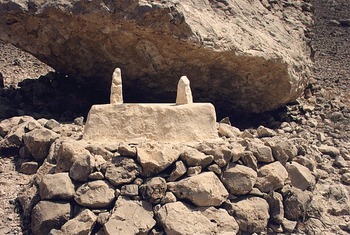
Detail of Islamic (Al-Aly Bedouin) grave showing shahed, or upright stone. Grave mound is just over one meter diameter.

Qubr 'Arumiy located on high plateau overlooking and visible from wadi bed.

Detail of a tail element from Qubr 'Arumiy.

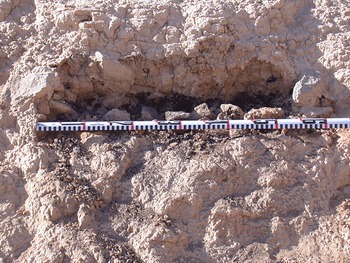
Raybun camel burial, remnant of baliya practice, excavated by the Yemeni-Soviet expedition in front of 3rd century BC tombs.

Tomb number 56 camel burial at Raybun. [Records of the Yemeni-Soviet Expedition].

Camel burial placed into and re-using qubr rukamy in the Wadi Harou.

Trilith in Wadi Sana later modified for runoff water diversion. The ring of stones around the hearth in foreground has been robbed to create a low wall incorporating in-situ standing stones of the trilith elements.

Trilith element and hearths behind in partial view of a well-preserved trilith monument. Note on the right the pair of solitary standing stones flanked by trilith uprights. Four boulders lie beyond, and two of the parallel line of hearths may also be seen in the background (center, far right). Khalid BaDhofary as scale.

Madhba, or hearth for roasting meat. The elements of the hearth are terms used also for groups of people as components of a larger group of people. We argue that there is a strong link between the location of hearths for roasting meat and territorial rights. Trilith monuments with their symbolic alignments of stones and hearths signaled territorial rights just as hearths do for the groups that still use them today.

Meat roasting pit in Wadi Sana silts, dated 6000-5000 years ago.

Tribesmen roasting meat at tribal gathering site where community feasts take place each year. Photograph from the 1960s by Hadrami photographer Ahmad Sa'id BaJunayd.

Group around a madhba. Photograph from the 1960s by Hadrami photographer Ahmad Sa'id BaJunayd.

Al-Aly bedouin around a madhba in Wadi Sana.

Al-Aly bedouin guard set up a hearth to which family and visitors came each evening at the RASA Project camp in Wadi Sana. The camp cook's hearth and kitchen tent are in the background.

Tomb of a Wali (Saint) in Wadi Sakhdan. Note the Islamic appropriation of an older qubr rukamy.