




INTRODUCTION
In 1998, it was demonstrated that calcined bone can be radiocarbon (14C) dated using the carbon present in the inorganic fraction of bone commonly called bioapatite (Lanting and Brindley Reference Lanting and Brindley1998; Lanting et al. Reference Lanting, Aerts-Bijma and van der Plicht2001). This discovery led to an exponential increase in the amount of 14C dates associated with cremation burials. As such, a great number of cremated human remains from archaeological contexts located in Belgium were 14C dated over the last two decades. Most of these data were placed in public repositories such as the Royal Institute for Cultural Heritage web-based 14C databases (http://c14.kikirpa.be/ and http://radiocarbon.kikirpa.be/). This large volume of data, combined with the great number of 14C dates obtained on collagen samples from inhumations since the introduction of 14C dating method in the late 1940s, constitutes a valuable dataset to explore changes in funerary practices in in Belgium from the Mesolithic to the Middle Ages.
Archaeological records highlight the existence of periods in which cremation was widely used, as is the case during the Late Bronze Age with the macro-scale diffusion of the so-called Urnfield culture (Falkenstein Reference Falkenstein2012; Capuzzo and Barceló Reference Capuzzo and Barceló2015; De Mulder et al. Reference De Mulder, Leclercq, Van Strydonk and Warmenbol2016). In other periods, such as the Mesolithic and the Neolithic, inhumation seems to be the dominant funerary rite in Belgium (Toussaint Reference Toussaint2013; Meiklejohn et al. Reference Meiklejohn, Miller and Toussaint2014). However, 14C dates are rarely used as data to describe these changes in funerary practices (Capuzzo Reference Capuzzo2014; Morell Reference Morell2019; Schmid Reference Schmid2019). Previously published 14C dates are used here to quantify such changes in the area corresponding to modern Belgium from the Mesolithic to the Middle Ages covering more than 11,000 years.
SITES, CONTEXTS, AND SAMPLING
Available information on 14C-dated funerary contexts located in Belgium is spread over various databases and publications. The majority of these 14C dates were processed by the Radiocarbon Dating Laboratory at the Royal Institute for Cultural Heritage (KIK-IRPA) in Brussels (Belgium) and are included in their web-based 14C databases. The database at http://c14.kikirpa.be/ includes samples measured between the creation of the Laboratory in the 1960s and 2014. These samples were measured in the facilities of the KIK-IRPA using liquid scintillation counters (IRPA-series), the AMS facilities of Utrecht (UtC-series) (van der Borg et al. Reference Van der Borg, Alderliesten, Haitjema, Hut and Van Zwol1984, Reference Van der Borg, Alderliesten, Houston, De Jong and Van Zwol1987), and Kiel (KIA-series) (Nadeau et al. Reference Nadeau, Grootes, Schliecher, Hasselberg, Rieck and Bitterling1998). Dates measured after 2014, year of the MICADAS installation at the KIK-IRPA (Boudin et al. Reference Boudin, Van Strydonck, van den Brande, Synal and Wacker2015), are gathered in the database at http://radiocarbon.kikirpa.be/ (RICH-series). Additional dates on Belgian material were also obtained by the laboratories of Louvain-la-Neuve (Lv-series), Frankfurt (Fra-series), Hannover (Hv-series), Beta Analytic (Beta-series), CEDAD-Lecce (LTL-series), Gif-sur-Yvette (GifA-series), Groningen (GrA- and GrN-series), Geochron Laboratories (GX-series), Glasgow (SUERC-series), Oxford (OxA-series), and Poznan (Poz-series).
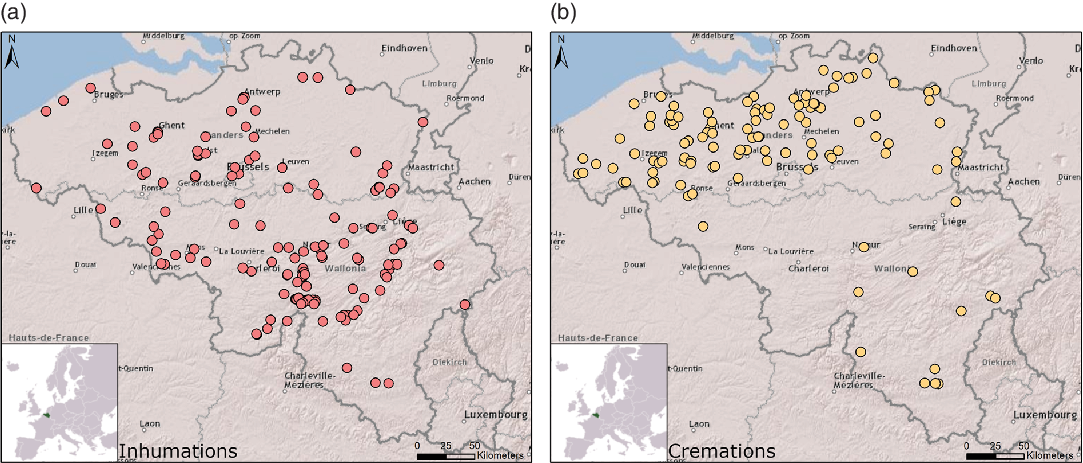
The collected dataset is composed of 592 14C dates from 176 archaeological sites associated with inhumations, 760 14C dates from 117 archaeological sites referring to cremation graves, 2 14C dates linked to both cremated and inhumed human remains, and 74 14C dates from charcoal collected from 20 barrows (Figure 1 – Supplement 1). Since 14C dates on charcoals collected from barrows cannot be linked to the practice of inhumation or cremation due to the absence of human remains in these contexts (see section Biases of the Data and Adopted Solutions), these data were used only to highlight the presence of this particular type of funerary structure. Samples from inhumations were mainly obtained from human bone collagen (93%) and charcoal (7%). Cremations were dated using bone apatite from cremated human (78%) and animal (2%) bone, as well as charcoal (20%). The spatial distribution of the collected data is not homogeneous (Figure 1). A lack of 14C-dated cremations is observable in the Walloon region in southern Belgium, while Flanders (north of Belgium) has a higher concentration of dated cremations which can be explained by the introduction of commercial archaeology in Flanders in 2005.
Spatial distribution of radiocarbon-dated funerary contexts in Belgium: (a) inhumations and (b) cremations from 10,000 BC to 1200 AD.
BIASES OF THE DATA AND ADOPTED SOLUTIONS
The preservation of human bone from archaeological contexts varies across different parts of Belgium. Human remains dating to the prehistoric periods (Mesolithic and Neolithic) were almost exclusively found in Wallonia thanks to excellent preservation conditions of caves and rock shelters. These contexts are absent in Flanders, where open-air burial sites were more likely to be destroyed or buried under meters of sediment, as often happens in dynamic alluvial and marine systems (Verhegge et al. Reference Verhegge, Missiaen, Van Strydonck and Crombé2014, Reference Verhegge, Missiaen and Crombé2016; Verhegge Reference Verhegge2015; Sergant et al. Reference Sergant, Vandendriessche, Noens, Cruz, Allemeersch, Aluwé, Jacops, Wuyts, Windey, Rozek, Depaepe, Herremans, Laloo and Crombé2016).
Furthermore, poor preservation of unburnt bone (inhumations) is common in acidic soils such as the schist soils of the Ardennes plateau, in southern Belgium, and the sandy soils of northern Flanders (Garland and Janaway Reference Garland and Janaway1989; Nafte Reference Nafte2000; Nielsen-Marsh et al. Reference Nielsen-Marsh, Smith, Jans, Nord, Kars and Collins2007; De Reu Reference De Reu2012; Surabian Reference Surabian2012; Estévez et al. Reference Estévez, Villagran, Balbo and Hardy2014; Kendall et al. Reference Kendall, Høier Eriksen, Kontopoulos, Collins and Turner-Walkere2018). In these regions unburnt bone (inhumations) is rarely recovered and, thus, unavailable for anthropological studies. This is the case of the La Tène cemetery of Neufchâteau-Le Sart “Bourzi”, located in the Ardennes, where inhumation burials under tumuli were only recognised thanks to the shape of the grave, the funerary goods, and the discolouration of the soil where the skeleton used to be (Cahen-Delhaye Reference Cahen-Delhaye1997). The same is also observed in the other sites located in the same geological region, such as the La Tène cemetery of Léglise-Gohimont (Cahen-Delhaye and Hurt Reference Cahen-Delhaye and Hurt2013). In both cases, charcoal samples recovered from the grave were interpreted as elements of the wooden funerary structure and were used for 14C dating. In the sandy regions of northern Belgium, aerial photographic surveys identified a large number of circular soil and crop marks. These were interpreted as funerary barrows but, in most cases, human remains were not recovered (Bourgeois and Talon Reference Bourgeois, Talon and Clark2009; De Reu and Bourgeois Reference De Reu, Bourgeois, Fontijn, Louwen, van der Vaart and Wentink2013; De Reu Reference De Reu2014). This not only due to the soil’s acidity, but also to the intense ploughing activities carried out in northern and western Flanders, that flattened the barrow mounds leaving the ditches as only visible traces in the archaeological record. Samples of charcoal were nevertheless found in some of these ditches and were used to date the structures. To this effect, De Reu (Reference De Reu2014) proposed to use 14C-dated charcoal samples collected in the bottom layer of the ditches, thereby rejecting samples derived from upper or other layers. This paper adopts the same approach; however, a specific assignment of these dates to either the inhumation or the cremation practice is not always possible due to the absence of graves and human remains. For this reason, these dates were only used to visualize the temporality of barrows and not as a proxy to understand variations in the number of individuals buried in this type of funerary structures.
The much higher crystallinity of calcined bone compared to unburnt bone (e.g. Lebon et al. Reference Lebon, Reiche, Bahain, Chadefaux, Moigne, Fröhlich, Sémah, Schwarcz and Falguères2010; Zazzo and Saliège Reference Zazzo and Saliège2011; Snoeck et al. Reference Snoeck, Lee-Thorp and Schulting2014b) increases the material’s resistance to taphonomic alterations. For this reason, calcined bones are often recovered even in acidic soils (e.g. Quintelier and Watzeels Reference Quintelier, Watzeels and Annaert2018; Annaert et al. Reference Annaert, Boudin, Deforce, Ervynck, Haneca, Lentacker and Snoeck2020). Burned at temperatures above 650°C, calcined bone is generally white as all organic matter has been destroyed (Stiner et al. Reference Stiner, Kuhn, Weiner and Bar-Yosef1995; Zazzo et al. Reference Zazzo, Saliège, Person and Boucher2009) and only the inorganic fraction, called bioapatite, remains. In 1998, Lanting and Brindley showed that calcined bone provided reliable 14C dates. It is important, however, to remain critical when interpreting results obtained from calcined bone, since a large part of the carbon present in calcined bone (up to 95%) originates from the fuels used during the cremation process (Olsen et al. Reference Olsen, Heinemeier, Bennike, Krause, Hornstrup and Thrane2008, Reference Olsen, Heinemeier, Hornstrup, Bennike and Thrane2012; Zazzo et al. Reference Zazzo, Saliège, Person and Boucher2009, Reference Zazzo, Saliège, Lebon, Lepetz and Moreau2012; Van Strydonck et al. Reference Van Strydonck, Boudin, Hoefkens and De Mulder2005, Reference Van Strydonck, Boudin and De Mulder2010, Reference Van Strydonck, Decq, Van den Brande, Boudin, Ramis, Borms and De Mulder2015; Hüls et al. Reference Hüls, Erlenkeuser, Nadeau, Grootes and Andersen2010; Snoeck et al. Reference Snoeck, Brock and Schulting2014a, Reference Snoeck, Schulting, Lee-Thorp, Lebon and Zazzo2016). A recent 14C dating study of the Early Medieval cemetery of Broechem (Belgium) has shown that calcined human and pig bone from the same grave yielded differences of up to 100 years (Annaert et al. Reference Annaert, Boudin, Deforce, Ervynck, Haneca, Lentacker and Snoeck2020). At present, it is unclear what causes this difference (“old-wood” effect, freshwater reservoir effect, etc.), but this study highlights the need for critical evaluation of 14C dates that were obtained from calcined bone. Overall, research on human bones from Roman to post-Medieval Belgian sites indicated a lack of importance of fish products for the diet, thus the bias caused by the reservoir effect seems to be negligible (Ervynck et al. Reference Ervynck, Boudin, van den Brande and Van Strydonck2014). Still, in the frame of this work, differences of up to 100 years will only minimally affect the modeling results.
While calcined bone can suffer from an “old-wood” effect, dates obtained from charcoal samples can also be problematic. When an organic sample is 14C dated, the timespan between the death of the live-being and the moment of measurement is calculated in terms of the residual 14C remaining. Still, the moment in which an organism stops exchanging 14C with the atmosphere does not always coincide to the particular moment that we want to date. In case of charcoal, the 14C date refers to the moment in which the plant was cut down or even to a previous moment during the life of the plant recorded in its inner structure made of growth rings (Schiffer Reference Schiffer1986; Bowman Reference Bowman1990; Ashmore Reference Ashmore1999; Capuzzo Reference Capuzzo2014). Since the exact contemporaneity of the 14C measurement and the calendrical date of the archaeological context cannot be reliably asserted, dates on charcoal must have a value as terminus post quem. In addition, charcoal can be intrusive from a younger layer by bioturbation and resulting in a too young 14C date, or residual, which means that it was present before the archaeological event occurred and will lead to a too-old 14C date (Crombé et al. Reference Crombé, Groenendijk and Van Strydonck1999; Van Strydonck et al. Reference Van Strydonck, Crombé and Maes2001).
Eventually, the sampling biases need to be taken into account. These biases are particularly intense for archaeological remains dating to the Roman period. A large number of Roman inhumations and cremations lack 14C dates because of the archaeological preference of typological dating of grave goods, such as pottery and metal objects.
To reduce the uncertainty of certain previously published dates, and to improve precision and accuracy of the analyses carried out, the dataset was refined as follows: (1) Priority was given to dates that were derived from human bone collagen (inhumations) and from fully calcined human bone apatite (cremations). (2) Dates from cremated animal bone and charcoal were excluded if dates based on human remains (i.e. recovered in the same grave) existed. (3) To avoid counting the same depositional event twice and to prevent the non-independence of dated events (Barceló et al. Reference Barceló, Capuzzo and Bogdanović2014), multiple 14C dates from the same grave (obtained on the same material and the same individual) were combined before calibration using the R_Combine function of the program OxCal 4.3 (Bronk Ramsey Reference Bronk Ramsey2009). Their pooled mean was calibrated using the IntCal13 calibration curve (Reimer et al. Reference Reimer, Bard, Bayliss, Beck, Blackwell, Bronk Ramsey, Buck, Cheng, Edwards, Friedrich, Grootes, Guilderson, Haflidason, Hajdas, Hatté, Heaton, Hoffmann, Hogg, Hughen, Kaiser, Kromer, Manning, Niu, Reimer, Richards, Scott, Southon, Staff, Turney and van der Plicht2013). Examples of this are the two 14C dates on the cremated remains of the Middle Bronze Age structure S107 at Zingem “Ouwegemsesteenweg”, which were combined in a unique measurement, and the two dates from the Late Bronze Age cremation grave 1 at Borsbeek “Vogelenzang” (De Mulder et al. Reference De Mulder, Van Strydonck, Annaert and Boudin2012). (4) 14C dates with σ > 100 years were rejected for the most recent periods (from the Bronze Age onwards), this choice resides in the necessity to reduce the error within the modeled dataset while at the same time maintaining a usable sample size. (5) Samples not clearly associated with the funerary evidence and structure, like infiltrated charcoals and samples that provided aberrant dates were excluded from the analyzed dataset. This is the case of the date obtained on the calcined bone KIA-37581 from Grave 52 at Destelbergen “Eenbeekeinde” which is much older than expected, probably due to presence of secondary carbonates (De Mulder et al. Reference De Mulder, Van Strydonck and Boudin2009). The date on charcoal KIA-28310 from the site of Waardamme, Vijvers, was also excluded. It is more recent than expected and can probably be linked with the Roman occupation next to the monument rather than the use of the barrow itself (De Reu and Bourgeois Reference De Reu, Bourgeois, Fontijn, Louwen, van der Vaart and Wentink2013). (6) The 14C dates from the laboratory of Louvain-la-Neuve (Lv-series) (Gilot Reference Gilot1997) were not corrected for the isotopic fractionation after the measurement of the 13C/12C ratio and needed to be corrected and made 80 years older, as suggested by Vrielynck (Reference Vrielynck1999).
As a result of the filtering and combining process, from the original dataset of 1428 14C dates, we retained 1286 14C dates (90%) for the analysis, 667 related to cremations, 582 to inhumations, and 38 to unknown burials (barrows).
METHOD: DATES AS DATA
14C dates as data are frequently used in order to track long-term processes, such as demographic variations in the past (Shennan et al. Reference Shennan, Downey, Timpson, Edinborough, Colledge, Kerig, Manning and Thomas2013; Capuzzo et al. Reference Capuzzo, Zanon, Dal Corso, Kirleis and Barceló2018; Fyfe et al Reference Fyfe, Woodbridge, Palmisano, Bevan, Shennan, Burjachs, Legarra Herrero, García Puchol, Carrión, Revelles and Roberts2019) or to interpret changes in dated variables such as settlements, burials structures, metal and pottery typologies (Caracuta et al. Reference Caracuta, Fiorentino and Martinelli2012; De Reu and Bourgeois Reference De Reu, Bourgeois, Fontijn, Louwen, van der Vaart and Wentink2013; Capuzzo Reference Capuzzo2014). The most frequently used method is the Summed Calibrated Probability Distribution (SCPD), which is based on the sum of individual confidence intervals of 14C dates after calibration (see Capuzzo et al. Reference Capuzzo, Zanon, Dal Corso, Kirleis and Barceló2018 for references on the method). Peaks in the SCPD curve correspond to episodes of maximum development of the studied phenomenon, whilst troughs are interpreted as moments of crisis or contraction. This method, however, is affected by biases due to sample size and calibration process (Williams Reference Williams2012; Contreras and Meadows Reference Contreras and Meadows2014; Crema et al. Reference Crema, Bevan and Shennan2017). The very sharp and punctual peaks, observable in most SCPDs, are in fact a direct consequence of the calibration process. They are the effects of particular sections of the IntCal13 calibration curve, called calendar-age steps, whose shape is the result of a fast decrease in 14C concentrations in the atmosphere (Williams Reference Williams2012). To avoid the noise artefacts characteristic of SCPDs, this study uses kernel density plots (Feeser et al. Reference Feeser, Dörfler, Kneisel, Hinz and Dreibrodt2019; Loftus et al. Reference Loftus, Mitchell and Bronk Ramsey2019; McLaughlin Reference McLaughlin2019; Mazzucco et al. Reference Mazzucco, Gibaja, Capuzzo, Gassin, Mineo and Ibáñez2020) to describe variations in the use of funerary practices in Belgium. The OxCal 4.3 tool KDE_Plot that provides a kernel density distribution for the samples (Bronk Ramsey Reference Bronk Ramsey2017), is implemented with Belgian data. The kernel plot removes the high frequency noise of the SCPDs, retaining only the lower frequency signal and thus eliminating data dispersion (Bronk Ramsey Reference Bronk Ramsey2017). The result is a smoother curve, without sharp spikes and edges typical of the SCPDs, which are still visible in the background of the KDE plots (Figures 2–5).
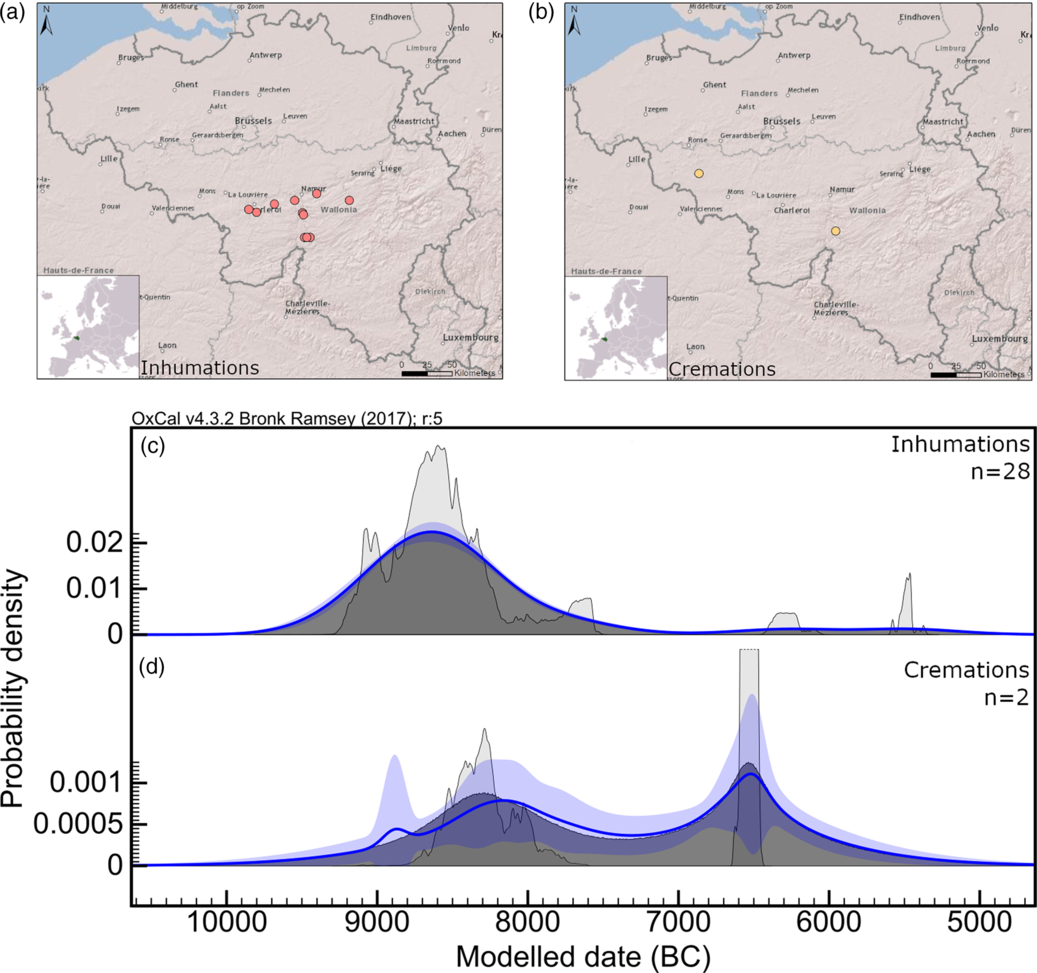
Maps with the spatial distribution of Mesolithic 14C-dated funerary contexts and KDE plots showing the temporal distribution of the data for (a, c) inhumations and (b, d) cremations.
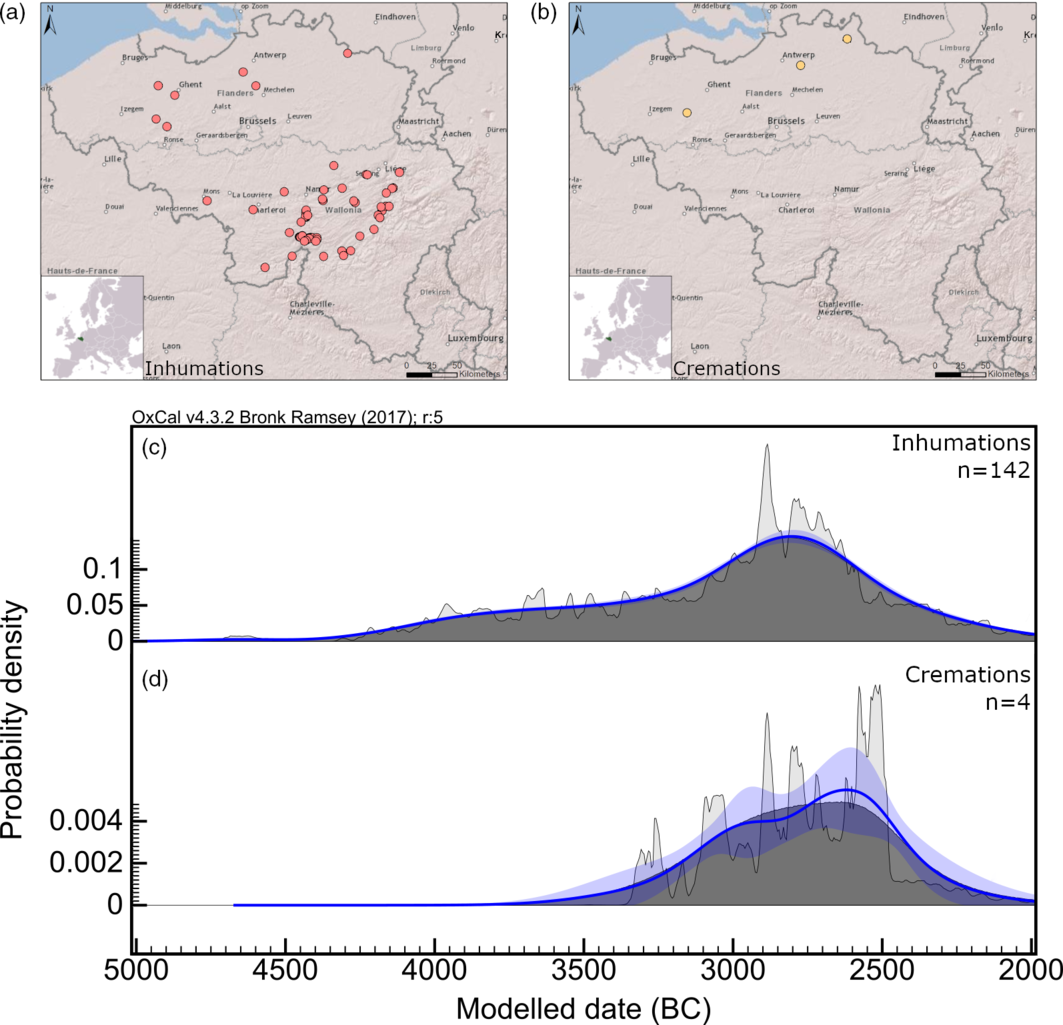
Maps with the spatial distribution of Neolithic 14C-dated funerary contexts and KDE plots showing the temporal distribution of the data for (a, c) inhumations and (b, d) cremations.
Maps with the spatial distribution of Metal Ages (Bronze and Iron Ages) 14C-dated funerary contexts and KDE plots showing the temporal distribution of the data for (a, c) inhumations, (b, d) cremations and (e) barrows.

Maps with the spatial distribution of Roman and medieval 14C-dated funerary contexts and KDE plots showing the temporal distribution of the data for (a, c) inhumations and (b, d) cremations.
The shape of the KDE plots and the corresponding scale of probability density values is directly correlated to the number of samples per timespan. The overall probability of each KDE plot is normalised to the number of included events and is based on probability per year. Considering the effects of taphonomic biases on temporal series, much more dated samples are expected for the most recent periods compared to the oldest phases. For this reason, variations in the number of dated contexts for periods characterized by few samples are barely detectable when included in the same KDE plot with periods with a high number of dated contexts. To avoid such a bias, nine KDE curves were produced. For each period, defined according to the conventional chronological framework (i.e. Mesolithic, Neolithic, Metal Ages, and Roman/Medieval), two KDE curves were made: one composed of 14C dates from inhumations and another one with measurements on cremations. An additional KDE plot was obtained with dates on charcoal from barrow structures. The values of probability density obtained for each KDE plot were used to determine the intensity of the variations detected in 14C data. The KDE plots were then used as a proxy to infer changes in the use of the two funerary practices. Our data were also tested using the OxCal 4.3 tool KDE_Model (Bronk Ramsey Reference Bronk Ramsey2017). While for some periods (e.g. the Neolithic) the results of the modeling are the same as when using the KDE_Plot function, for others (e.g. the Metal Ages), the KDE_Model emphasizes the spurious peaks resulting from the calibration. To avoid this, the KDE_Plot function was chosen.
To date the abandonment of cremation in Belgium during the Middle Ages, statistical modeling in the OxCal 4.3 software was used (Bronk Ramsey Reference Bronk Ramsey2009). Middle Ages 14C dates were constrained in a single phase delimited by two simple boundaries. This allowed to calculate the time span of the boundary which describes the abandonment of cremation, obtaining a probability distribution in which the dated event is located according to the 1-σ and 2-σ probabilities.
RESULTS
The Mesolithic Period
The first known occurrence of cremation burials in Belgium dates to the Mesolithic period. The oldest dated context is the site of Abri des Autours, where cremated remains were recovered in an Early Mesolithic rock shelter (OxA-5838, 9090 ± 140 BP; Polet and Cauwe Reference Polet and Cauwe2007). The second oldest 14C-dated Mesolithic cremation burial is from the site of Leuze-en-Hainaut/Blicquy “Ville d’Anderlecht”, where a pit yielded calcined bones, charcoal, and lithic tools (KIA-26463, 7695 ± 35 BP; Pleuger et al. Reference Pleuger, Paridaens, Gillet and Van Assche2005). Cremation represents an exception in the Mesolithic period, since the predominant rite appears to be inhumation as confirmed by the 28 14C dates from 12 archaeological sites with inhumations against only two dates from cremation contexts (Figure 2c–d). 14C-dated Mesolithic inhumations appear exclusively in caves such as the Grotte du Bois Laiterie at Profondeville/Rivière (Otte and Straus Reference Otte and Straus1997), Grotte Margaux at Dinant/Anseremme (Cauwe Reference Cauwe1998), and rock shelters, like the Abri de Chauveau at Yvoir/Godinne (Toussaint and Becker Reference Toussaint and Becker1993), clustered in the Sambre and Meuse basin in southern Belgium (Meiklejohn et al. Reference Meiklejohn, Miller and Toussaint2014) (Figure 2a).
The Neolithic Period
During the Neolithic inhumation continues to be the predominant funerary practice in Belgium, whilst the use of cremation remains limited. Collective inhumation burials were often found in caves and rock shelters located in the Walloon region between the karstic areas of the Belgian Meuse basin and the Ardennes (Figure 3a). In the same area, collective burials are also present in megalithic structures, such as the 14C-dated sites of Lamsoul (Toussaint et al. Reference Toussaint, Pirson and Jadin2005) and Wéris I (Toussaint Reference Toussaint2003). Inhumations are also found in mine shafts such as at Spiennes (Toussaint et al. Reference Toussaint, Collet and Vander Linden1997; Collet et al. Reference Collet, Vanmontfort and Jadin2011; Lavachery et al. Reference Lavachery, Collet, Toussaint and Woodbury2015) and Avennes-Braives (Toussaint et al. Reference Toussaint, Collet and Vander Linden1997).
In Flanders, Late Neolithic barrows were recognised, although no human remains were recovered in it, therefore the attribution to inhumations or cremations is not possible. An example is the site of Deinze, Aquafin “RWZI”, which is considered to be one of the earliest barrows in northwestern Belgium (De Clercq and Van Strydonck Reference De Clercq and Van Strydonck2002; De Reu and Bourgeois Reference De Reu, Bourgeois, Fontijn, Louwen, van der Vaart and Wentink2013).
Seventy-three archaeological sites with inhumed human remains provided 142 14C dates that were used for the analysis. The number of dated cremation contexts is much lower, only four 14C dates from three archaeological sites (Kruishoutem “Wijkhuis”, Oud-Turnhout “Hueve Akkers”, Ranst “Zevenbergen”) could be included in the KDE plot (Figure 3b, d).
The KDE plot shows a peak in the practice of inhumation in the Late/Final Neolithic, between ca. 3100-2600 BC (Figure 3c). The sharp peak at 2900 BC is a calibration effect caused by the presence of a calendar-age step between 2950 and 2850 BC in the IntCal13 calibration curve (Reimer et al Reference Reimer, Bard, Bayliss, Beck, Blackwell, Bronk Ramsey, Buck, Cheng, Edwards, Friedrich, Grootes, Guilderson, Haflidason, Hajdas, Hatté, Heaton, Hoffmann, Hogg, Hughen, Kaiser, Kromer, Manning, Niu, Reimer, Richards, Scott, Southon, Staff, Turney and van der Plicht2013). This period is followed by the introduction of the Bell Beaker tradition on the Belgian territory as attested by the presence of Bell Beaker vessels at the 14C-dated sites of Mol “Bergeijkse Heide” (Beex and Roosens Reference Beex and Roosens1963; Lanting and van der Waals Reference Lanting and van der Waals1976), Kruishoutem “Kapellekouter” (Braeckman Reference Braeckman1991), Sint-Denijs-Westrem “Flanders Expo” (Hoorne et al. Reference Hoorne, Sergant, Bartholomieux, Boudin, De Mulder and Van Strydonck2008) and Hansbeke “Voordestraat” (Hoorne et al. Reference Hoorne, Sergant, Boudin, Taelman, Vanhee and Van Strydonck2009). The only Bell Beaker archaeological context clearly related to cremation practice is the site of Kruishoutem “Wijkhuis” (De Laet and Rogge Reference De Laet and Rogge1972) where a layer of charcoal and cremated bones were found associated with a Bell Beaker with maritime decorations and a flint arrowhead as grave goods. The site was dated using charcoal, but the large standard deviation of the date does not allow to refine its chronology (IRPA-131, 4035 ± 190 BP).
The Metal Ages (Bronze and Iron Ages)
The trend marked by a predominant adoption of inhumation over cremation seems to change entirely during the Metal Ages. The data retained for the KDE modeling after the filtering process include 66 14C dates from 19 archaeological sites with inhumations, 523 14C dates from 90 archaeological sites with cremated remains, and 38 14C dates from 18 barrows (Figure 4). A large variety of burial structures can be observed in the Metal Ages. During the Early and Middle Bronze Age, barrows are often present in northern Flanders such as the sites of Oedelem-Wulfsberge (Bourgeois et al. Reference Bourgeois, Cherretté and Meganck2001; Cherretté and Bourgeois Reference Cherretté, Bourgeois, Bourgeois and Meganck2005), Waardamme-Vijvers (Demeyere and Bourgeois Reference Demeyere and Bourgeois2005), and Merelbeke-Axxes (De Clercq et al. Reference De Clercq, Bastiaens, Deforce, Desender, Ervynck, Gelorini, Haneca, Langohr and Van Peteghem2004), Weelde-Groenendaalse Hoef (Beex Reference Beex1959) and Weelde-Hoogeindse Bergen (Van Impe and Beex Reference Van Impe and Beex1977). Barrows are also present in the Walloon region, but these contexts were not excavated and/or dated. In the large majority of the Flemish barrows no bone material was preserved due to the intense ploughing in the area. Cremated human remains were only recovered in few sites, such as at Ronse-De Stadstuin (Pede et al. Reference Pede, Clement, De Cleer, Guillaume and Cherreté2015) and Weelde-Schootseweg (Annaert et al. Reference Annaert, Cooremans, Deforce and Vandenbruaene2012). The KDE plot obtained with 14C dates from charcoal samples collected in the bottom layers of the ditches shows a peak in the use of the barrows during the Middle Bronze Age at ca. 1500 BC (Figure 4e), as already observed by De Reu and Bourgeois (Reference De Reu, Bourgeois, Fontijn, Louwen, van der Vaart and Wentink2013).
The deposition of unburnt individuals in collective cave burials is still practised in Late Bronze and Iron Age Wallonia (e.g. the sites of Trou del Leuve at Sinsin (Warmenbol Reference Warmenbol2006), Trou de Han at Han-sur-Lesse (Warmenbol Reference Warmenbol1996, Reference Warmenbol2013; Jasinski and Warmenbol Reference Jasinski, Warmenbol and Campbell2017; Gautier and Warmenbol Reference Gautier and Warmenbol2019), and Grotte de On at Jemelle (Polet et al. Reference Polet, Warmenbol, Boudin and Goffette2017)). Less frequent are the funerary contexts located in the Walloon region that can be dated to the Early Bronze Age. An exceptional case is the site of Rebaix “Couture-Saint-Vaast”. Although no bones were preserved due to soil’s acidity, structure 2, interpreted as an inhumation grave, was dated using charcoal originating from the original wooden planks of the grave structure (Lv-2195, 3660 ± 80 BP; Cammaert et al. Reference Cammaert, Clarys, Van Assche, Gailly, Bloch and Mathieu1996).
Cremation burials seem to be concentrated in the Flemish regions, although this may be a consequence of the higher research intensity in the area. A large variation in the type of cremations exists: (1) urn cremations in many cases with remains of the pyre, (2) the so-called “bonepack grave” (Knochenlager) in which the bones probably were wrapped in a perishable container before being deposited in the soil, (3) the Brandgrubengrab with cremated remains and a large amount of charcoal from the pyre (De Mulder et al. Reference De Mulder, Van Strydonck and Boudin2009; De Mulder et al. Reference De Mulder, Van Strydonck and De Clercq2013; De Mulder Reference De Mulder2014).
The popularity of the inhumation rite appears to be very low in the Early Bronze Age and at the beginning of the Middle Bronze Age, which are characterized by the almost total absence of 14C-dated inhumations. Then, from ca. 1500 BC onward, a slow increase of dated contexts is visible. In general, the magnitude of such change is very low as marked by the low values of probability density corresponding to only 19 sites included in the KDE plot; an overall stability seems to be the distinctive trait for the use of inhumation in the Metal Ages. On the contrary, cremation shows a different pattern with a slowly positive trend from the end of the Early Bronze Age to the beginning of the Middle Bronze Age, which becomes more pronounced from ca. 1300 BC. The maximum development of cremation burials occurs around 1050–800 BC, corresponding to the Late Bronze Age. This period is defined by the European-scale diffusion of cremation burials within the traditionally defined “Urnfield culture” (Capuzzo and Barceló Reference Capuzzo and Barceló2015), whose introduction in the Belgian area was mediated by the Rhin-Suisse-France orientale group (Brun and Mordant Reference Brun and Mordant1988; De Mulder et al. Reference De Mulder, Leclercq, Van Strydonck and Berg2008). It is interesting to observe that this pronounced increase of cremation burials matches the decrease of inhumation contexts detected for the Late Bronze Age-Iron Age transition. During the Iron Age, the number of those who were cremated does not show significant variations and stability seems to be apparent.
The sharp peaks, visible at ca. 800 and 400 BC in the background of the KDE graphs are an effect of the calibration process on the SCPDs. These time spans correspond to two large calendar-age steps located just before and after the so-called Hallstatt Plateau (van der Plicht Reference Van der Plicht, Marian Scott, Alekseev and Zaitseva2004) in the IntCal13 calibration curve (Reimer et al. Reference Reimer, Bard, Bayliss, Beck, Blackwell, Bronk Ramsey, Buck, Cheng, Edwards, Friedrich, Grootes, Guilderson, Haflidason, Hajdas, Hatté, Heaton, Hoffmann, Hogg, Hughen, Kaiser, Kromer, Manning, Niu, Reimer, Richards, Scott, Southon, Staff, Turney and van der Plicht2013).
Roman Times and Early Middle Ages
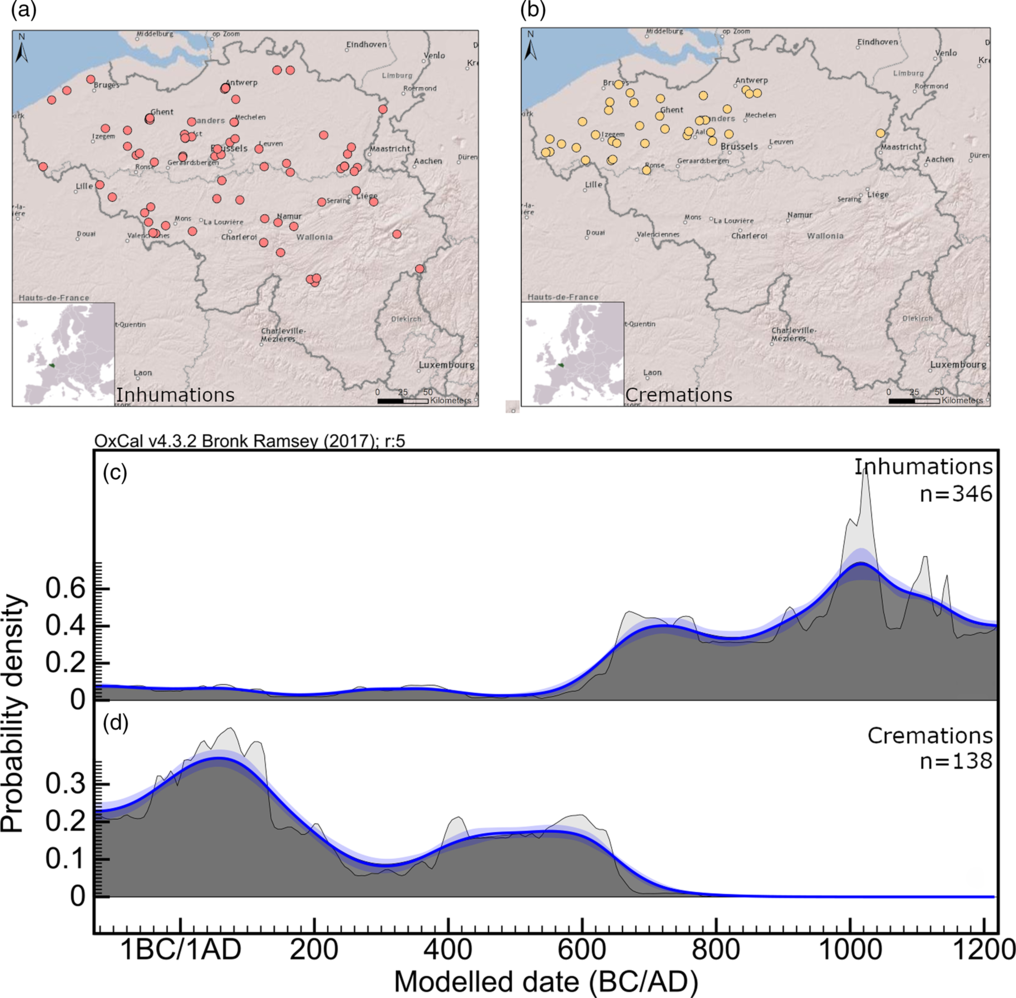
The last analyzed chronological window covers the period of the Roman Empire and the Early Middle Ages. The spatial distribution of collected data is not univocal (Figure 5). 14C-dated inhumations are spread all over the Belgian area with some apparent gaps in forested areas like Limburg and the Ardennes, while 14C-dated cremations appear to be clustered exclusively in Flanders, and in particular in the Scheldt valley. Collected data include 346 14C dates from 86 archaeological sites with inhumation contexts and 138 14C dates from 36 archaeological sites with cremations. Roman burials were placed preferably along and in the surroundings of roads leading to main cities, such as Atuatuca Tungrorum (present Tongeren), the Roman civitas close to the river Meuse (Brulet Reference Brulet2008; Veldman et al. Reference Veldman, Geerts, Hazen and van der Velde2012; Hanut Reference Hanut2017). Brandgrubengräber, that became increasingly popular during the Late Iron Age, remained the main cremation type used in the most Romanised part of Flanders (De Mulder et al. Reference De Mulder, Van Strydonck and De Clercq2013). In the peripheral Campine region, in northeastern Flanders, a continuity in indigenous rituals prevails, as at Weelde-Schootseweg, where cremated remains were scattered on the bottom of circular or rectangular enclosures (Annaert et al. Reference Annaert, Cooremans, Deforce and Vandenbruaene2012).
In the Early Middle Ages, the topographical distribution of burial grounds is rather complex. In the 5th and 6th centuries, people used larger communal burial grounds, often situated near roads or waterways. A spatial reference to either Bronze Age burials or Roman burial grounds is not uncommon. From the 7th century onwards, the burial grounds tend to become smaller and more focused on families and ancestors. It is only in the 8th and 9th centuries that we see the reorganization of the funerary rites around churches (a.o. monasteries), with the arrival of the first churchyards around private churches (Theuws Reference Theuws2004; Loveluck Reference Loveluck2013).
The analysis of 14C-dated funerary context shows contrasted patterns for inhumations and cremations. For the Roman period cremation seems to be the predominant rite. An increase in the use of cremation is visible between the second half of the 1st century BC and the Romanization of present Belgium at the end of the first century AD, although the intensity of such a rise in the KDE plot can be emphasized by the calibration process. Then, the end of the Roman period shows a contraction in the amount of cremations. This negative trend is interrupted only at the beginning of the Middle Ages. From ca. 400 AD, a mild positive trend in the use of cremation is visible in the KDE plot. This is probably related to new influences and arrival of new settlers from the northeast of Europe, but this requires further research (Tys Reference Tys, Annaert, De Groote, Hollevoet, Theuws, Tys and Verslype2012).
After ca. 640 AD a dramatic drop in cremations is visible in the KDE plot, and cremation as funerary rite clearly goes out of use. After the early 8th century, cremation burials are absent from the record. As a result of the OxCal modeling, at the current stage we can date the abandonment of the cremation practice in the second half of the 7th century AD: between 661 and 681 AD for the 1-σ probability and between 652 and 695 AD for 2-σ probability (Figure 6).
Boundary showing the 1-σ and 2-σ probabilities for the abandonment of the cremation practice in Belgium during the Early Middle Ages.

The use of the inhumation rite follows a reverse trajectory. Until ca. 600 AD the KDE curve related to inhumation burials maintains a neutral trend, suggesting a constant and moderate popularity of this rite during the Late Roman period and the ages immediately afterwards (the so-called migration period). From 600 AD onward, the curve acquires a remarkably positive trend, which persists until the end of the analyzed time span. In other words, the beginning of the general use of inhumation as predominant burial rite starts in present-day Belgium in the course of the 7th century.
DISCUSSION
The KDE-based reconstructions show variations in funerary practices across Belgium between the Mesolithic and the Middle Ages. The comparison between KDE plots representing the use of inhumation and cremation allows to observe changes in funerary practices among local communities and to identify temporal trends in funerary dynamics over 11,000 years.
During the Mesolithic, inhumation is the dominant funerary practice while cremation was only observed in two cases. 14C-dated inhumations appear clustered in the Early Mesolithic, in the time span 9300–7600 BC, with a peak at ca. 8600 BC (Figure 2c). This result confirms the decline in the number of sites from the Early to the Late Mesolithic (Meiklejohn and Babb Reference Meiklejohn and Babb2009; Miller et al. Reference Miller, Stewart, Zwyns and Otte2009; Sergant et al. Reference Sergant, Crombé and Perdaen2009). In northwestern Belgium, a marked dominance of contexts belonging to Early Mesolithic was observed both from the analysis of excavated archaeological sites and the distribution of 14C dates from salvage excavations. The distribution of these dates also showed a strong concentration between 8700 and 7000 BC, corresponding to the Early Mesolithic and the first part of the Middle Mesolithic (Crombé et al. Reference Crombé, Perdaen and Sergant2008; Sergant et al. Reference Sergant, Crombé and Perdaen2009). Among the possible contributing factors causing this decrease in sites is the 8200 cal BP (6200 cal BC) climatic event causing a decrease in temperature in Europe between 8500 and 8100 cal BP (Alley et al. Reference Alley, Mayewski, Sowers, Stuiver, Taylor and Clark1997; Von Grafenstein et al. Reference Von Grafenstein, Erlenkeuser, Müller, Jouzel and Johnsen1998; Barber et al. Reference Barber, Dyke, Hillaire-Marcel, Jennings, Andrews, Kerwin, Bilodeau, McNeely, Southon, Morehead and Gagnon1999; Alley and Ágústsdóttir Reference Alley and Ágústsdóttir2005; Matero et al. Reference Matero, Gregoire and Ivanovic2017). However, new hypotheses highlight the resilience in hunter-gatherer societies to climate and environmental change (Crombé et al. Reference Crombé, Verhegge, Deforce, Meylemans and Robinson2015; Crombé and Robinson Reference Crombé and Robinson2017) and consider the possibility of a subsistence specialization and changes in social structure or mobility strategies (Miller et al. Reference Miller, Stewart, Zwyns and Otte2009; Griffiths and Robinson Reference Griffiths and Robinson2018). The introduction of cremation in northwestern Europe during the Mesolithic was confirmed by other archaeological contexts such as the 14C-dated cremated human remains from Heffingen-“Loschbour”, in Luxembourg (Beta-132067, 7960 ± 40 BP; Toussaint et al. Reference Toussaint, Brou, Le Brun-Ricalens, Spier, Crombé, Van Strydonk, Sergant, Boudin and Bats2009; Brou et al. Reference Brou, Le Brun-Ricalens, Toussaint and Spier2015) and those from the Site 21 at Oirschot V in the Netherlands (GrA-13390, 8320 ± 40 BP; Arts and Hoogland Reference Arts and Hoogland1987; Lanting et al. Reference Lanting, Aerts-Bijma and van der Plicht2001). The low number of 14C-dated cremation burials for this period, however, limits further interpretation of the results.
The Neolithic does not seem to indicate a shift in funerary practices. Inhumation is still the predominant rite, as shown by the 73 archaeological sites with inhumations compared to the three sites with cremations (Figure 3). The increase in the number of inhumations dating to the Middle Neolithic as shown in Figure 3c, can be linked to the presence of human groups whose material culture belongs to the Michelsberg culture and, in particular, to the Spiere group (Cauwe Reference Cauwe2004; Bostyn et al. Reference Bostyn, Monchablon, Praud and Vanmontfort2011; Crombé et al. Reference Crombé, Sergant and Lombaert2011) in the Belgian area. The bias caused by taphonomic degradation, most likely contributed to the positive trend observed in this KDE plot. The peak in inhumation graves observed between ca. 3100–2600 BC (Figure 3c) is determined by 14C dates from funerary contexts located in caves and rock shelters in the Meuse basin in Wallonia. This signals the importance of collective cave burials during the end of the Late and the beginning of the Final Neolithic (Cauwe et al. Reference Cauwe, Vander Linden and Vanmontfort2001; Cauwe Reference Cauwe2004; Toussaint Reference Toussaint2013). The analysis of 14C dates from collective burial caves shows that the depositions are frequently not contemporary, proving a continuous use of these contexts for more than one generation. Therefore, the 14C dates demonstrate that these burials do not correspond to a single depositional event but to a series of events with different calendar ages. This allows to reject the possibility of a bias caused by multiple dates of contemporary individuals in collective burials. The KDE plot for the Neolithic inhumations (Figure 3c), including dates from different individuals buried in different periods, reflects well this situation.
The KDE plots referring to the Metal Ages (Figure 4c–d) show a small number of 14C-dated inhumations and cremations in Early Bronze Age. This can be an effect of the limited archaeological evidence for this period, as demonstrated by the still existing problems in recognising specific types in the material culture of the first phase of the Bronze Age in Belgium (Warmenbol Reference Warmenbol2004). However, it can be also a consequence of the ploughing activities, which dramatically flattened most of the barrow mounds, destroying the burials and causing a lack of available samples to date. The high diffusion of barrows in Flanders dates to the Early and Middle Bronze Age (Figure 4e), thus proving the existence of funerary structures in this period. In the few cases where some information remained, cremation seemed to be the traditional practice in barrows, and most tombs were quite poor (Bourgeois and Talon Reference Bourgeois, Talon and Clark2009: 42). This would imply that the increase of cremations documented at the end of the Middle Bronze Age (Figure 4d) should be dated to an earlier phase. However, due to the lack of reliable archaeological evidence, this hypothesis cannot be confirmed.
The end of the Middle Bronze Age and the beginning of the Late Bronze Age represent a moment of change in funerary dynamics (Figure 4c–d) with a large increase in the number of individuals using cremation. The floruit in the use of cremation burials in the Ha A2-B1 phases (Figure 4d) matches the arrival of the first pottery from the Rhin-Suisse-France orientale (RSFO) cultural group that was dated to the beginning of Ha A2 phase (ca.1100 BC) (Leclercq Reference Leclercq2014). RSFO pottery was found associated with inhumed individuals at the sites of Trou del Leuve at Sinsin and Trou de Han at Han-sur-Lesse (Warmenbol Reference Warmenbol1988, Reference Warmenbol1996, Reference Warmenbol2006, Reference Warmenbol2013), but also, and mainly, with cremated remains from the sites of Blicquy and Velzeke-Paddestraat (De Mulder et al. Reference De Mulder, Van Strydonck, Boudin, Leclercq, Paridaens and Warmenbol2007). The RSFO influence extended all over Belgium until the northern part of the Scheldt basin. The arrival of new people, objects, and ideas from Central European areas in Belgium, could have promoted the large adoption of (urn) cremations as observed in our results. However, cremations in urns belonging to the “urnfield” tradition were already present, although sporadic, since the Middle Bronze Age B (De Mulder Reference De Mulder2019), as recorded at the sites of Kruishoutem “Moerasstraat” (KIA-38496, 3250 ± 40 BP; Deschieter and De Wandel Reference Deschieter and De Wandel2010), Aalter “Oostergem” (KIA-40864, 3060 ± 20 BP; Vanhee and De Mulder Reference Vanhee and De Mulder2013), Blicquy (KIA-23752; 3185 ± 30 BP; De Mulder et al. Reference De Mulder, Van Strydonck, Boudin, Leclercq, Paridaens and Warmenbol2007) and Tessenderlo “Engsbergen” (KIA-33618, 3210 ± 30 BP; De Mulder Reference De Mulder2010).
During the Iron Age the amount of people practicing cremation and inhumation seems to be constant. The Early Iron Age matches the Hallstatt plateau, a flat portion in the IntCal13 calibration curve (Reimer et al. Reference Reimer, Bard, Bayliss, Beck, Blackwell, Bronk Ramsey, Buck, Cheng, Edwards, Friedrich, Grootes, Guilderson, Haflidason, Hajdas, Hatté, Heaton, Hoffmann, Hogg, Hughen, Kaiser, Kromer, Manning, Niu, Reimer, Richards, Scott, Southon, Staff, Turney and van der Plicht2013); this implies that dates between 750 and 400 BC are characterized by large timespans when calibrated. Such a bias contributed to the flat shape of the KDE plots for that period (Figure 4c–d).
In the Iron Age, cremation is predominant, with a slow transition from urn cremations towards cremations without urn (Bourgeois Reference Bourgeois1989). This could partially explain the decrease in the amount of cremations (Figure 4d), determined by the less visibility in the archaeological record of “bonepackgraves” and Brandgrubengraben compared to the traditional cremations in urn. This poor knowledge of Late Iron Age burial grounds in Flanders can perhaps be explained by the different burial structures. In the Campine region, for instance, from the Late Iron Age onwards, cremated remains were scattered over the bottom of the grave, e.g. Weelde-Schootseweg (Annaert et al. Reference Annaert, Cooremans, Deforce and Vandenbruaene2012) and Klein-Ravels (Verhaert et al. Reference Verhaert, Annaert, Langohr, Cooremans, Gelorini, Bastiaens, Deforce, Ervynck and Desender2001/2002). These kinds of burials are not visible anymore due to intensive ploughing activities.
Important transformations in social dynamics occurred during the Bronze-Iron Age transition and along the Iron Age, referring to the cultural and social exchanges among Hallstatt C warrior elites, spreading across Western and Central Europe (Kristiansen Reference Kristiansen1998, Reference Kristiansen and Demoule2009; Milcent Reference Milcent2004; Brun et al. Reference Brun, Chaume, Dhennequin and Quilliec2009; Schumann and van der Vaart-Verschoof Reference Schumann and van der Vaart-Verschoof2017). This is reflected in funerary contexts by the presence of weapons and prestige objects amongst grave goods. It is the case of grave 72 from the site of Neerharen-Rekem “Hangveld” (GrA-17787, 2690 ± 60 BP and GrA-19062, 2670 ± 45 BP), in which the cremated remains of three individuals were deposited together with three bronze swords, three bronze spearheads and two chapes (parts of a scabbard), and grave 122.05 at Hofstade “Kasteelstraat” (RICH-24353, 2784 ± 28 BP; Hiddink Reference Hiddink2018) where the urn of a cremation grave contained broken and bent fragments from a bronze sword and a chape (De Mulder Reference De Mulder, Schumann and van der Vaart-Verschoof2017; Warmenbol Reference Warmenbol, Schumann and van der Vaart-Verschoof2017). The centrality of the role of the warrior persists in the Late Iron Age society, as proven by the discoveries of chariot burials dating back to the Hallstatt D-La Tène period in the Ardennes region in southern Belgium, as at the site of Neufchâteau-le Sart “Bourzy” (Cahen-Delhaye Reference Cahen-Delhaye1997).
Among the Romans in Belgium, cremation seems to be the main funerary practice (Figure 5c–d). Roman inhumations and cremations were commonly not 14C dated because of typological dating of grave goods, such as pottery and metal objects, partly explaining the low amount of dates recorded (Figure 5c). This sampling bias is clearly visible in the absence of dated cremations from Wallonia, suggesting limited use of cremation in this region. However, cremations are largely documented in the Walloon region, e.g. at the sites of Biesme Mettet, Bois Saint-Pierre Ellezelles, Beauflot-Pivache Fize-le-Marsal, Pommeroeul and Wanzoul (Van Doorselaer Reference Van Doorselaer1964; Brulet Reference Brulet2008; Hanut Reference Hanut2017), contradicting this observation. Future research aims to fill this lacuna.
The Romanization of the Belgian provinces started in the second half of the first century AD, 100 years after the victory of Julius Caesar over the “Belgian” tribes. During the Early and Middle Roman Period, Belgium and, in particular, Flanders underwent intensive socio-economic transformations as shown by the archaeological, historical and palynological data (De Clercq Reference De Clercq2009). This period shows an increase in the number of cremation burials. In contrast, in the Late Roman Period the number of cremations decreases (Figure 5d). This is in agreement with the archaeological evidence since Late Roman graves were mostly inhumation graves (Brulet Reference Brulet2008). This period experienced the first contacts with tribes from the other side of the Rhine (second half of the 2nd century AD) leading to a time of socio-economic and political upheaval and decline. Such a climate of instability could have affected the number of funerary contexts recorded.
The resumption of cremations at ca. 400 AD seems to be an indication of arrival of people from northern regions where cremation remained the dominant funerary rite (De Mulder et al. Reference De Mulder, Van Strydonck, Annaert and Boudin2012; Annaert et al. Reference Annaert, Deforce and Vandenbruaene2009; Annaert Reference Annaert2018). The dissolvement of the Roman governance, the regionalization and the arrival of new Germanic settlers give a certain context to this process. The reference to ancestors by the re-use of Bronze-Iron Age funerary structures is a remarkable feature of the burial rite in these centuries (Van Beek and De Mulder Reference Van Beek and De Mulder2014). An example is at the site of Beerse “Krommenhof” where four of the Bronze Age barrows were re-used as burial context between approximately 600 and 775 AD (Annaert Reference Annaert2018; Delaruelle et al. Reference Delaruelle, de Smaele, Thijs, Verdegem, Scheltjens and Van Doninck2014). At Borsbeek the re-use of a Late Bronze Age urn in the Merovingian period during the 5th-6th century AD was confirmed by two 14C dates on cremated remains (KIA-37917, 1460 ± 35 BP; KIA-40552, 1465 ± 30 BP; De Mulder et al. Reference De Mulder, Van Strydonck, Annaert and Boudin2012).
In the second half of the 7th century AD the cremation rite gradually lost its importance. The explanation for this process is not Christianization as such, since before that period, cremation was used in distinctive Christian burial contexts as was the case elsewhere in Western-Europe (for example the double grave in the Frankfurter dom dated ca. 700–730 AD, containing the bodies of two 4-year-old girls, one inhumed and one cremated—Wamers Reference Wamers2015). The shift towards exclusive inhumation is most likely the result of the stronger organization of the Christian church and the way it implemented a certain orthodoxy in liturgical matters and in afterlife rituals (Gilchrist Reference Gilchrist2012). More particularly, the rise of church burial grounds and the increasing value of bodily preservation for the peregrinatio to the Christian heaven appear to have been of some importance here.
CONCLUSION
Kernel density models are applied to 14C-dated archaeological contexts to reconstruct variations in funerary practices, specifically inhumation and cremation, in the Belgian territory from the Mesolithic to the Middle Ages. As in every kind of research dealing with the analysis of big datasets of 14C-dated archaeological contexts, it is always important to take into account the possibility of sampling and taphonomic biases that can alter the shape of the KDE plots. Comparison with local archaeological narratives provides crucial additional information for the interpretation of KDE plots.
The plots confirm that during the Mesolithic, Neolithic and the Early Bronze Age inhumation was the main funerary practice in the Belgian area. The earliest occurrence of cremation is dated to the Mesolithic period, but its practice remained sporadic until the Metal Ages. Starting from the Middle Bronze Age, cremation became the predominant rite with a high intensity during the Late Bronze Age in correspondence to the “urnfield” phenomenon. During the Iron Age and the Roman period cremation remained the most adopted funerary practice, with a slightly negative trend towards the Late Roman Period. A resumption is documented in the Early Middle Ages, due to the arrival of new people practicing cremation. Cremation was then abandoned in the second half of the 7th century AD. Inhumation, which is characterized by an overall stability until the ca. 600 AD, shows a positive trend from that date, becoming the unique rite used in the Belgian territory during the High Middle Ages.
This study shows the high potentialities of kernel density analyses applied to 14C-dated archaeological contexts as a method to quantify changes in social dynamics in the past, and in particular when comparing continuities and discontinuities in two different proxies. Furthermore, the influence of the calibration bias is less important than in summed calibrated probability distributions. Finally, the obtained values of probability density play an important role in the interpretation of the KDE plots, since they provide information on the intensity and therefore the significance of the observed variations.
ACKNOWLEDGMENTS
This project was made possible thanks to the financial support of the FWO-F.R.S.-FNRS with the EOS project No. 30999782 CRUMBEL. Cremations, Urns and Mobility – Ancient Population Dynamics in Belgium. We would like to thank the Fonds Wetenschappelijk Onderzoek – Vlaanderen (FWO) for C. Snoeck’s post-doctoral fellowship. We acknowledge the City of Mechelen and the Museum of Natural Sciences for making available the 14C dates from Mechelen Sint Romboutskerkhof and Minderbroedersklooster. R. Annaert was supported by a FWO special PhD fellowship.
Supplementary material
To view supplementary material for this article, please visit https://doi.org/10.1017/RDC.2020.88


 Open access

