

Today, more than half of the world’s carbon emissions originate from a single continent: Asia.Footnote 1 When taken literally, the statement presents a purely continental, terra-centric perspective of the Anthropocene and its most well-known problem. However, approaching the statement from an oceanic-vertical perspective shifts the focus to the role of Asia’s marine regions in the onset and development of the Anthropocene. These regions, important contributors to emissions through offshore oil and gas reserves, so far have no narrative in Asia’s Anthropocene.
Initial humanities and social science research on the Anthropocene primarily attributed responsibility for climate change and other planetary-scale transformations to a small group of Euro-American economic elites. These economic elites set in motion the transatlantic capitalist economic system that the authors associate with New World plantation economies and exploitative slave labor regimes. Similarly, the Industrial Revolution’s shift in modes of production was associated with the efforts of British industrialists to lessen dependence on unruly labor. Plans to technologically reduce such dependence then gave birth to large-scale mechanization powered by water and steam in the Age of Coal. In this view, the Western (Euro-American) capitalist path of fossil fuel–based technological advancements, enabling the rise and political influence of this small class of economic elites, resulted over the long run in an exponential increase in fossil fuel consumption and the related emissions of greenhouse gases. Such claims – along with the creation of additional “-cenes” like “capitalocene” and “plantationocene” by the authors – due to their deficits helped spur research into the global origins of the Anthropocene.Footnote 2 Recent studies, recognizing these deficits – which include neglecting the huge ecological problems created by the planned economies of communist-ruled countries and a West-centric bias that allowed selectively focusing on a capitalist elite instead of governmental socioeconomic development agendas and living standard improvements – have started to explore Asia’s place in the trajectory of the Anthropocene. A major contribution is Amitav Ghosh’s The Great Derangement, written by one of Asia’s most well-known novelists.Footnote 3 His book drew attention to the missing narrative of climate change, which he sees as the most prominent problem of the Anthropocene, in global histories of Asia. Ghosh’s book was thought-provoking, as he connected climate change to the results of the Great Divergence between Asian and Western economies.Footnote 4 He argued that colonialism hindered Asia’s industrialization in the nineteenth and early twentieth centuries, thereby delaying its contribution to global greenhouse gas emissions and reducing the continent’s overall share.Footnote 5 While this view of events pre-independence is open to debate, it draws attention to the developmentalist policies of Asian governments post-independence. Over decades, these governments drastically increased their countries’ fossil fuel production and consumption, impacting greenhouse gas emissions. Moreover, Asian political elites decided on their countries’ post-independence technological trajectories but also operated in a world of global political connections and disruptions, which facilitated or inhibited their fuel extraction and energy generation regimes.
This chapter underscores the absence of an oceanic Anthropocene narrative specific to Asia’s marine regions and emphasizes that claims about the Western-capitalist trajectory leading to the Anthropocene are not universally applicable. It advocates for establishing an oceanic Anthropocene narrative for Asia, centering on the sudden synchronization of terrestrial and oceanic energy transitions to oil economies. This convergence of two previously distinct energy regimes is identified as a pivotal moment in the emergence of Asia’s Anthropocene. In other words, the focus is on the mid-twentieth century, marking the onset of large-scale oil extraction in Asian marine regions, concurrent with the continent’s land-based socioeconomic development projects driven by this fossil fuel, especially in rapidly industrializing Japan.
I delve into the historical roots of the oceanic Anthropocene, contrasting the offshore oil drilling trajectories of Asia with those of the United States and other regions. These trajectories, though interconnected, were shaped by local environmental and political factors that either facilitated or hindered the discovery and development of offshore oil fields. The analysis underlines the role of Asian political elites, notably cabinet members and senior bureaucrats, as key proponents of these offshore fossil fuel development projects in Asian waters. This novel oceanic Anthropocene narrative aims to start a dialogue with recent scholarship on the global histories of development, the environment, and technology: Temporally, the analysis spans from the first offshore wells in the 1880s through subsequent historical periods, including decolonization, the Cold War, and the United Nations’ first and second “Decades of Development” (1961–1980). Spatially, the oceanic-vertical perspective transgresses the traditional horizontal scope of terrestrial and maritime histories. This perspective encompasses transformations not just on the sea surface but also in the deeper geological layers harboring oil and gas reserves, which, through carbon emissions, connect to the atmosphere and the water column. Geographically, the sites of analysis extend from the Persian Gulf in West Asia to the South China Sea in Southeast Asia, and further north to the East China Sea and the Sea of Japan in East Asia. An oceanic-vertical perspective, oriented downward, is vital given that recent global histories of development, environment, and technology, along with modern histories of Asia in the world, still neglect Asia’s marine regions.Footnote 6 In its spatial dimension, “downward-oriented” refers, two-dimensionally, to departing from and coming back to the sea surface in the direction of Earth’s center. While environmental studies have begun to expand beyond terrestrial confines, addressing some ocean-related development issues, they predominantly concentrate on overfishing, overhunting, or other unsustainable practices.Footnote 7 Although these issues are important, most of these processes did not represent planetary-scale shifts toward the oceanic Anthropocene in Asia. Therefore, this chapter integrates the oceanic-vertical perspective into a broader analysis of the environmental conditions and ecological footprints of changing energy regimes during the long nineteenth century’s Great Transformation and the Great Acceleration since the mid-twentieth century, topics that have increasingly captured the attention of global historians.Footnote 8
This chapter examines Earth’s amphibious transformation by investigating oil extraction as the reasons behind the early extension of the built environment onto Asian sea surfaces. It explores the questions of why and how oceanic and terrestrial energy transitions began to synchronize in the mid-twentieth century in the Asian Anthropocene. This is achieved by highlighting the local environmental conditions, political institutions in Asian marine regions, and the agency of Asian political elites. The argument posits that these Asian political elites, along with their socioeconomic development agendas, were the key proponents in appropriating Asian marine regions for offshore oil exploitation during the post–World War II decolonization era. The chapter emphasizes that the development of these offshore oil fields was in most cases not driven by a small group of Western or transnational corporate capitalists, nor by structural choice limitations like infrastructural and jurisdictional legacies from colonialism. Even in cases where colonial powers initiated offshore drilling, decolonization led to new, Asian political elites strongly reducing foreign influence. The contingent geographical locations of oil fields and their largely unfavorable physical geographies (such as local coastal and oceanic environmental conditions, ranging from water depths to the impacts of monsoons and tropical cyclones) initially inhibited offshore oil drilling. These factors, the chapter argues, connected the offshore fossil fuel development projects to the strong agency of Asian political elites. The locations and physical geographies, combined with political factors, diverged from trajectories in the United States and other regions, delaying offshore oil drilling in most Asian waters until the 1950s, around the time most Asian political entities under discussion had achieved independence. The availability of open waters offshore oil technology from the United States about this time made Asian marine regions accessible by artificial islands, in this chapter meaning drilling barges and offshore platforms. Later, after oil well development, tankers and other vessels also had easy access, whereas terrestrial fossil fuel development projects were strongly shaped by whether Western or Japanese colonialism had resulted in the construction of transportation and other physical infrastructures. Therefore, in contrast to terrestrial sites, the agency of Asian political elites regarding marine regions was largely unaffected by structural choice limitations related to physical infrastructure legacies from colonial times. This also holds true for polity-related structural choice limitations, as marine regions beyond the territorial sea were mostly unaffected by global or domestic legal structures created during colonialism. Consequently, Asian political elites were central in extending their countries’ jurisdictional control to Asia’s continental shelf and its oil and gas deposits and later asserting it through EEZs in deeper waters. Offshore oil technology enabled decentralized production through multiple platforms, but these platforms operated within a governmental legislative framework that followed territorialization and partitioned state-controlled waters into individual leases, allowing the state to control oil companies’ operations. In efforts to decolonize economic structures established during colonialism, Asian political elites founded national oil companies. Private transnational companies had to collaborate with these entities under state-defined conditions, thereby enhancing control over offshore oil drilling. These characteristics of Asian marine regions thus link the otherwise very heterogenous group of Asian political elites. Their intertwined offshore fossil fuel developmentalisms, driven by economic and military concerns as well as distrust in foreign oil companies, define these individuals, primarily cabinet members and senior bureaucrats, as a group. Offshore oil was a part of their industrial policies, resource security plans, and trade policies. In Japan, where oil imports surged post–World War II, offshore oil was also related to, though not an integral part of, the Ministry of International Trade and Industry’s broader physical infrastructure development strategies, such as ports and shipping industry expansion, which both facilitated import of and depended on oil. The contemporary Japanese economy’s high oil demand, connecting it to other Asian countries and accelerating offshore exploration and production, will guide this analysis and investigation of Asian marine regions in the Indian and Pacific Oceans. The focus is primarily on oil, as natural gas played a limited role in Asian energy economies until the 1980s, despite earlier adoption in countries such as Japan, beginning in the early 1970s.Footnote 9
By transgressing terrestrial perspectives, this chapter enhances our understanding of Asian political elites’ role in ushering parts of the ocean into the Anthropocene, as well as the corresponding transitions in terrestrial and oceanic energy regimes. It also scrutinizes the relationship among the globalization of technological advancements, the contingent geographical locations of oil fields, and their local physical geographies. In this regard, it highlights the strong changes in the agency of Asian political elites before and after the 1950s. Historian Elizabeth Chatterjee’s research into electrical grids and “fossil developmentalism” in Asia, primarily in India and China, similarly investigated the post-empire agency of political elites, emphasizing their state-led moral projects to democratize energy consumption as a key factor behind Asia’s rising greenhouse gas emissions and the onset of the Asian Anthropocene.Footnote 10 I opt not to use the term “fossil developmentalism,” as my focus is on oceanic material conditions. I prefer to distinguish the exploration and development of offshore oil and gas reserves from their subsequent terrestrial usage for socioeconomic development, which the term “fossil developmentalism” tends to merge. Nonetheless, I concur with Chatterjee’s arguments, though with several significant exceptions. Setting aside her terra-centric perspective, her example of electric grids is problematic in demonstrating the strong agency and fossil fuel–based developmentalisms of Asian political elites. Historically, until the recent advent of marketable renewable electricity, the quality of electricity did not vary among producers, unlike most commodities. Variations, such as in voltage, were more likely to be competitive disadvantages. The limited number of power plants in the centralized, fossil fuel–dependent grid system, coupled with high upfront investment costs, lengthy construction periods, and other entry barriers, created a market environment discouraging competition, often leading to natural monopolies or oligopolies.Footnote 11 Experimental forays into decentralized power generation, like Maoist Chinese biogas digester campaigns in the 1970s, were quickly abandoned by most people.Footnote 12 The military importance of centralized electrical grids and the challenges of purchasing or expropriating private or national park land for transmission lines emphasize the immense challenges faced by private entities, indicating that strong governmental involvement was a near-universal norm, not a voluntary choice.Footnote 13 Extending grids to economically unfeasible “remote” areas supports Chatterjee’s notion of a moral project, yet even today comprehensive nationwide access remains unrealized in some Asian countries.Footnote 14 Altogether, such electric grids exemplify that the agency of Asian political elites on land was drastically more inhibited by structural choice limitations originating in colonial legacies or infrastructural and technological systems than was the case for the marine regions that will be investigated here. Thus, on land, the agency of Asian political elites was drastically more constrained by structural choices rooted in colonial legacies or infrastructural and technological systems than in the marine regions this study explores.
The Materiality of Offshore Oil Fields and Asian Energy Regimes
This section presents a concise longue durée history of the evolving energy regimes in Asia, both terrestrial and oceanic, situated within the framework of global energy regime changes. It emphasizes the critical period from the 1880s to the 1970s, during which Asian political elites developed offshore oil fields into “powerful” contributors to the oceanic Anthropocene. An energy transition is defined as the gradual shift from a specific energy provision pattern to a novel state of an energy system.Footnote 15 The outcome was not a simple switch from one fuel or stage to another, but rather a layering, meaning the evolution of a new, hybrid form of energy provision in which newer elements are added rather than replacing the old ones. While such energy transitions are global phenomena, their causes, pace, fuel compositions, and social, political, environmental, and other impacts varied greatly on the local level.Footnote 16 Prior to the mid-twentieth-century Anthropocene, several global energy transitions occurred. On land, these ranged from mastering fire to using and cultivating plant biomass such as wood and charcoal as fuels; harnessing animal muscle power, with animals becoming prime movers; the shifts in the eighteenth and later centuries from biomass to fossil fuels and from animate to inanimate, mechanical prime movers, such as steam engines; and today’s transition from fossil fuels to low-carbon energy sources such as wind, solar, and nuclear energy.Footnote 17 Crucially, Asia’s marine regions lacked the distinct flora and fauna that characterized its terrestrial pre–fossil fuel economies. In terrestrial Asia, domesticated animals, such as cattle, horses, goats, Arabian and Bactrian camels, donkeys, water buffalos, yaks, Bali cattle, and gayals, or tamed ones like elephants, played central roles in pre–fossil fuel energy regimes.Footnote 18 Although freshwater fish such as carp were domesticated, they were not used as prime movers. No large marine mammals, such as whales, were domesticated, thus preventing a marine equivalent to terrestrial animal husbandry of prime movers or dung-based biofuel.Footnote 19 With the arrival of Western whaling ships in Asia’s West Pacific waters in the early nineteenth century, whaling became rampant. For decades, whaling ships commercially extracted large amounts of an actual oceanic biofuel, whale oil, until it was increasingly supplanted by cheaper lamp oils in the latter half of that century.Footnote 20 Seaweed was consumed but not developed as a biofuel like terrestrial plants were.Footnote 21 Furthermore, while ancient river-powered watermills on land, boat mills, and later hydroelectric dams harnessed river flows, equivalent energy capture from ocean currents was impracticable, except for moving ships.Footnote 22 Sailing vessels also tapped offshore wind power, unlike windmills. In essence, from the viewpoint of terrestrial energy transitions, Asian marine regions remained in the very early stage of a biomass, pre–fossil fuel economy until the late nineteenth century, and in many cases even longer. Some marine regions experienced a transient surge in whale oil extraction, long after the invention of fire. Yet, marking a distinct oceanic temporality, many Asian marine regions bypassed the millennia-long terrestrial transition of using more biofuels and harnessing animal muscle power. They even skipped the initial phase – the Age of Coal – of the emerging global fossil fuel economy, instead rushing into the exploitation of offshore oil and entering the Asian Anthropocene.
Energy transitions are intricately linked with technological advancements and new conceptions of economy and society. To grasp the impacts of the tremendous changes in terrestrial energy regimes initiated by Asian political leaders during decolonization, it is crucial to recognize the connection to the ocean’s role as a fuel source. Until the late nineteenth century, the ghost acreage provided by marine regions for fuel production was limited to the brief surge in whale oil production. “Ghost acres” refer to the acres effectively gained or saved by a country through outsourcing commodity production overseas, exemplified by the British Empire’s production of food and raw materials for consumption or processing in Britain, as analyzed by historian Kenneth Pomeranz and others.Footnote 23 A key driver of Britain’s Industrial Revolution and a contributor to the Anthropocene’s later onset was the transition to fossil fuels to circumvent the Malthusian environmental and spatial constraints of a biofuel economy. The eighteenth-century crisis of deforestation and wood scarcity in Britain was alleviated by increasingly exploiting coal fields, or “subterranean forests,” a term coined by historian Rolf P. Sieferle.Footnote 24 Taking a brief detour into a solar system perspective by moving beyond Earth’s boundaries, these fossil fuels were relatively easy to access on Earth, located in subsurface geological layers. This situation is unique to Earth within the solar system, as it stems from the existence, death, and decomposition of organic lifeforms over millions of years, creating mining conditions absent on other celestial bodies. Back in the eighteenth century, the British economy’s reliance on coal as a substitute for forest resources placed it in a special global position. The demand for vast coal quantities and the advantageous location of coal fields, easily accessible from population centers, marked a highly important environmental-geographic distinction compared to precolonial India, with its extensive forests, and China, with large distances separating major coal fields from populous areas.Footnote 25 According to environmental scientist Vaclav Smil’s 2010 calculations, replacing that year’s global fossil fuel power output with plant biomass for carbon neutrality would have required at least 12.5 million square kilometers of unobstructed land, not accounting for necessary fertilizer and water, for industrial forestry. This area is roughly equivalent to the combined territories of the terrestrial United States and India.Footnote 26 Thus, the nineteenth-century rise in Asian countries’ use of energy-dense fossil fuels relied on subterranean spaces, reducing the need for forested areas. With the advent of offshore oil fields, vastly exceeding whale oil quantities, vast expanses of oceanic ghost acres emerged for the first time in history, further reducing the necessity for forest spaces. The availability of these oceanic ghost acres thus mitigated the fuel-related environmental pressure on terrestrial space.Footnote 27 The ocean’s role now extended well beyond providing nutritional ghost acres. It offered Asian countries energy quantities very difficult to match through terrestrial industrial forestry or biofuel farming due to physical space limitations. In the 1960s and 1970s, many Asian countries, still reliant on biomass fuels, faced accelerated deforestation and related challenges, further prompting political leaders to explore and utilize offshore oil. By 1975, around the end of the period investigated here, offshore oil’s share in total production varied widely among Asian countries but was substantial in several cases (see Table 2.1). Limited data on offshore platforms, their locations, and production levels nevertheless indicate the strong increase in platform numbers (see Table 2.2). Asian political elites, by claiming marine regions that harbored offshore oil fields, created an important oceanic substitute for an otherwise much larger demand for terrestrial fuel sources, contingent on their countries’ transitions from biomass to coal and oil.
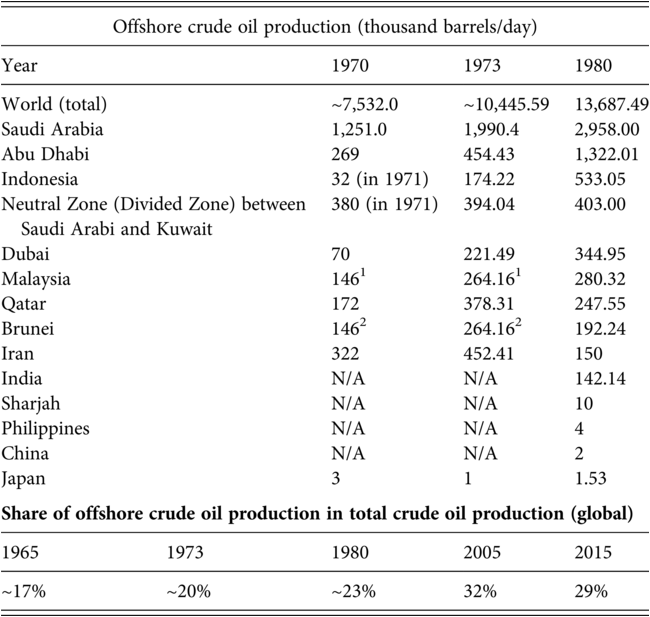
Table 2.1 Long description
The table is titled Offshore crude oil production, thousand barrels per day. It has three columns titled Year, 1970, 1973, and 1980. It presents the following data.
Row 1 is titled World, total.
Row 1 Column 1 reads. Approximately 7,532.0.
Row 1 Column 2 reads. Approximately 10,445.59.
Row 1 Column 3 reads. 13,687.49.
Row 2 is titled Saudi Arabia.
Row 2 Column 1 reads. 1,251.0.
Row 2 Column 2 reads. 1,990.4.
Row 2 Column 3 reads. 2,958.00.
Row 3 is titled Abu Dhabi.
Row 3 Column 1 reads. 269.
Row 3 Column 2 reads. 454.43.
Row 3 Column 3 reads. 1,322.01.
Row 4 is titled Indonesia.
Row 4 Column 1 reads. 32, in 1971.
Row 4 Column 2 reads. 174.22.
Row 4 Column 3 reads. 533.05.
Row 5 is titled Neutral Zone, Divided Zone, between Saudi Arabi and Kuwait.
Row 5 Column 1 reads. 380, in 1971.
Row 5 Column 2 reads. 394.04.
Row 5 Column 3 reads. 403.00.
Row 6 is titled Dubai.
Row 6 Column 1 reads. 70.
Row 6 Column 2 reads. 221.49.
Row 6 Column 3 reads. 344.95.
Row 7 is titled Malaysia.
Row 7 Column 1 reads. 146, Together with Brunei.
Row 7 Column 2 reads. 264.16, Together with Brunei.
Row 7 Column 3 reads. 280.32.
Row 8 is titled Qatar.
Row 8 Column 1 reads. 172.
Row 8 Column 2 reads. 378.31.
Row 8 Column 3 reads. 247.55.
Row 9 is titled Brunei.
Row 9 Column 1 reads. 146, Together with Malaysia.
Row 9 Column 2 reads. 264.16, Together with Malaysia.
Row 9 Column 3 reads. 192.24.
Row 10 is titled Iran.
Row 10 Column 1 reads. 322.
Row 10 Column 2 reads. 452.41.
Row 10 Column 3 reads. 150.
Row 11 is titled India.
Row 11 Column 1 reads. N/A.
Row 11 Column 2 reads. N/A.
Row 11 Column 3 reads. 142.14.
Row 12 is titled Sharjah.
Row 12 Column 1 reads. N/A.
Row 12 Column 2 reads. N/A.
Row 12 Column 3 reads. 10.
Row 13 is titled Philippines.
Row 13 Column 1 reads. N/A.
Row 13 Column 2 reads. N/A.
Row 13 Column 3 reads. 4.
Row 14 is titled China.
Row 14 Column 1 reads. N/A.
Row 14 Column 2 reads. N/A.
Row 14 Column 3 reads. 2.
Row 15 is titled Japan.
Row 15 Column 1 reads. 3.
Row 15 Column 2 reads. 1.
Row 15 Column 3 reads. 1.53.
The section titled Share of offshore crude oil production in total crude oil production, global, has five columns. It presents the following data.
Approximately 17 percent in 1965.
Approximately 20 percent in 1973.
Approximately 23 percent in 1980.
Approximately 32 percent in 2005.
Approximately 29 percent in 2015.
1 Together with Brunei.
2 Together with Malaysia.
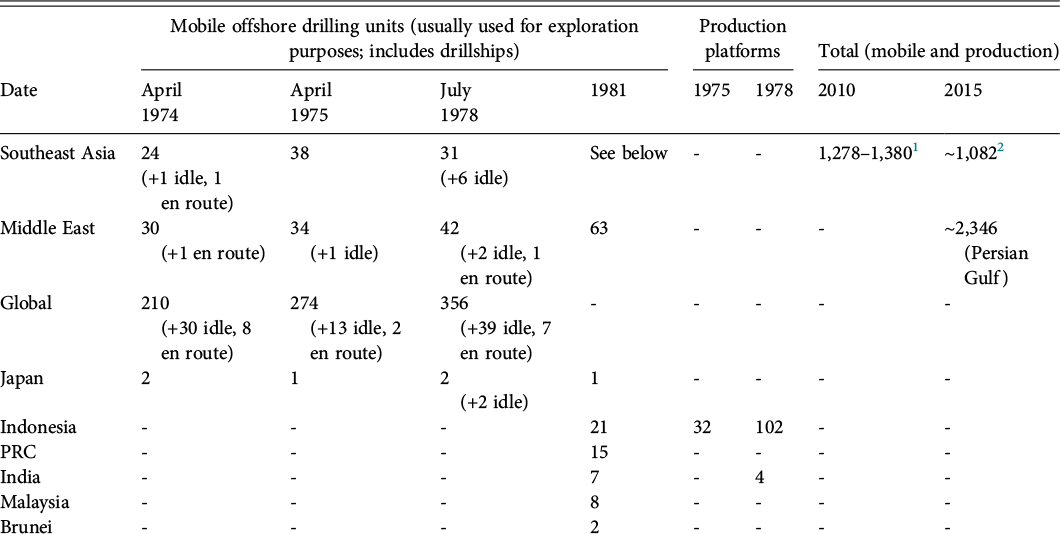
Table 2.2A Long description
The table has three columns. Column 1 is titled Mobile offshore drilling units, usually used for exploration purposes; includes drillships. Column 2 is titled Production platforms. Column 3 is titled Total, mobile and production. Column 1 has four sub-columns titled April 1974, April 1975, July 1978, and 1981. Column 2 has two sub-columns titled 1975 and 1978. Column 3 has two columns titled 2010 and 2015. It presents the following data.
Row 1 is titled Southeast Asia.
Column 1, sub-column 1. 24, plus 1 idle, 1 en route.
Column 1, sub-column 2. 38.
Column 1, sub-column 3. 31, plus 6 idle.
Column 1, sub-column 4. See below.
Column 2, sub-column 1. Blank.
Column 2, sub-column 2. Blank.
Column 3, sub-column 1. 1,278 to 1,380. Note: South China Sea and further Chinese and Indonesian waters.
Column 3, sub-column 2. Approximately 1,082. Note: South China Sea.
Row 2 is titled Middle East.
Column 1, sub-column 1. 30, plus 1 en route.
Column 1, sub-column 2. 34, plus 1 idle.
Column 1, sub-column 3. 42, plus 2 idle, 1 en route.
Column 1, sub-column 4. 63.
Column 2, sub-column 1. Blank.
Column 2, sub-column 2. Blank.
Column 3, sub-column 1. Blank.
Column 3, sub-column 2. Approximately 2,346, Persian Gulf.
Row 3 is titled Global.
Column 1, sub-column 1. 210, plus 30 idle, 8 en route.
Column 1, sub-column 2. 274, plus 13 idle, 2 en route.
Column 1, sub-column 3. 356, plus 39 idle, 7 en route.
The rest are blank.
Row 4 is titled Japan.
Column 1, sub-column 1. 2.
Column 1, sub-column 2. 1.
Column 1, sub-column 3. 2, plus 2 idle.
Column 1, sub-column 4. 1.
The rest are blank.
Row 5 is titled Indonesia.
Column 1, sub-column 4. 21.
Column 2, sub-column 1. 32.
Column 2, sub-column 2. 102.
The rest are blank.
Row 6 is titled P R C.
Column 1, sub-column 4. 15.
The rest are blank.
Row 7 is titled India.
Column 1, sub-column 4. 7.
Column 2, sub-column 2. 4.
The rest are blank.
Row 8 is titled Malaysia.
Column 1, sub-column 4. 8.
The rest are blank.
Row 9 is titled Brunei.
Column 1, sub-column 4. 2.
The rest are blank.
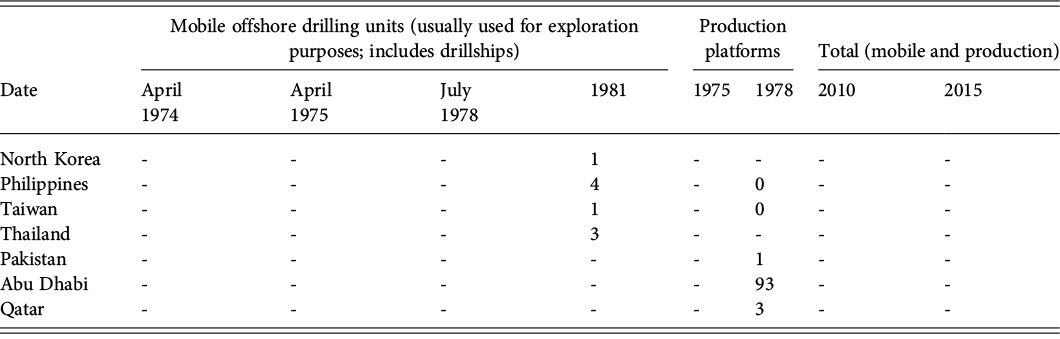
Table 2.2B Long description
The table has three columns. Column 1 is titled Mobile offshore drilling units, usually used for exploration purposes; includes drillships. Column 2 is titled Production platforms. Column 3 is titled Total, mobile and production. Column 1 has four sub-columns titled April 1974, April 1975, July 1978, and 1981. Column 2 has two sub-columns titled 1975 and 1978. Column 3 has two columns titled 2010 and 2015.
The table continues to present the following data.
Row 10 is titled North Korea.
Column 1, sub-column 4. 1.
The rest are blank.
Row 11 is titled Philippines.
Column 1, sub-column 4. 4.
Column 2, sub-column 2. 0.
The rest are blank.
Row 12 is titled Taiwan.
Column 1, sub-column 4. 1.
Column 2, sub-column 2. 0.
The rest are blank.
Row 13 is titled Thailand.
Column 1, sub-column 4. 3.
The rest are blank.
Row 14 is titled Pakistan.
Column 2, sub-column 2. 1.
The rest are blank.
Row 15 is titled Abu Dhabi.
Column 2, sub-column 2. 93.
The rest are blank.
Row 16 is titled Qatar.
Column 2, sub-column 2. 3.
The rest are blank.
The source is provided below the table.
1 South China Sea and further Chinese and Indonesian waters.
2 South China Sea.
Globally, the ocean’s transformation into a fossil fuel source is important, as the combustion of its fuel products, whether offshore or onshore, leads to greenhouse gases accumulating in the atmosphere. These emissions affect biogeochemical cycles that interconnect the atmosphere, sea, and land, resulting in climate change (ocean warming, sea level rise) and ocean acidification. In this source-sink cycle, the ocean, acting as a carbon sink, has absorbed about a quarter of all human-caused carbon emissions, slowing climate change but increasing surface water acidity by more than 25 percent since preindustrial times. The ocean also absorbed more than 90 percent of the excess heat, strongly reducing the impacts on land but changing habitat conditions for marine life and leading to thermal expansion (water increasing in volume through warming) causing sea level rise.Footnote 28
Discussing the material conditions of marine regions and offshore oil fields, the transition to offshore energy was enabled by the liquidity of oil, flowing because of natural or induced pressure toward extraction points drilled from the water’s surface into the seabed. In contrast, coal’s solid and immobile nature makes its aquatic extraction economically unfeasible. Consequently, the ocean never saw an energy transition to coal. Similarly, oil’s liquidity facilitated the loading and unloading of tankers and allowed the use of offshore pipelines connecting platforms and terrestrial infrastructures, the latter a development unachievable with coal’s bulkiness. This liquidity also makes oil spills an important environmental risk, a topic to be discussed further in Chapter 6. Likewise, the physical properties of the ocean allowed for the movement of exploration and production equipment, making offshore oil geographies accessible with minimal transportation infrastructure compared with land, as Chapter 5 further illustrates. In contrast, operating in terrestrial regions unconnected by road or rail and lacking local market demand entailed prohibitive financial costs, meaning coastlines and rivers were important geographical access, export, and supply nodes even for terrestrial oil exploration and production. In Asia, the locations of oil fields and their physical geographies thus heavily influenced the timing of when Asian political elites were able to tap into these oceanic ghost acres.
The Development of Early Japanese Offshore Oil Production in a Global Context
Japan was among the first countries to engage in offshore oil drilling.Footnote 29 Historical records indicate that oil harvesting, albeit limited, has been conducted in Echigo Province (now Niigata Prefecture) in central-west Honshu since at least the seventh century. The terrestrial part of the region experienced a surge in oil field exploration during the late nineteenth century, driven by growing industrial and consumer oil demand. In the early 1880s, oil seepage was spotted in the Sea of Japan, about 40–50 meters offshore from the coastal town of Amase (尼瀬, now part of Izumozaki).Footnote 30 This bubbling oil, typically indicating gas pressure–driven releases from offshore fields, was a globally known geological phenomenon in the nineteenth century, though its usual cause – seabed cracks due to plate tectonics and seismic activity – was not yet understood.Footnote 31 Japanese oil companies, deducing the presence of offshore oil near the region’s land-based wells, created extraction sites in the late 1880s. These sites were established through land reclamation to form small artificial islands, then using caissons to prevent water ingress and manual digging to reach the oil-bearing layers. The early 1890s witnessed the growth of this nascent offshore oil infrastructure. Consulting a US advisor led to the adoption of mechanized drilling rigs and anti-flooding technology, enabling deeper and more productive drilling.Footnote 32
The geographical contingency of Japan’s coastal and offshore oil fields, resulting in physical geographies unfavorable for technological advancements, discouraged a strong push for offshore drilling by Japanese political elites until after World War II. Unlike the continuous stretch of fields from shallow to deep waters in the US Mississippi River delta, Japan’s fields lacked the geographical features that advanced offshore technology. The burgeoning Japanese demand for oil due to industrialization suggested a local market, unlike some other regions analyzed later. Without the inhibitions resulting from the geographical contingency of field locations, the great divergence between the offshore oil field exploitation abilities of Japanese and US experts could have been narrower and the energy transition in Asia’s waters potentially pushed earlier by Japanese political elites. My key point is that in the late nineteenth century, when offshore drilling was emerging in both Honshu and Southern California, trans-Pacific technology transfer facilitated Japan’s offshore oil expansion, and differences were small. In 1894, in response to numerous gas seepages, oil drilling commenced at Summerland’s beach, a coastal community in Southern California near Santa Barbara. Over the years, derricks were erected in tidal zones, and by the spring of 1898, the Southern Pacific Railroad constructed the first wooden pier extending about 50 meters into the Pacific, on which derricks were set up, over time expanded to more than 370 meters. The pier marked the beginning of US offshore oil drilling in marine waters.Footnote 33 By 1902, more than a hundred such offshore oil wells were operational in Summerland. The offshore advance by several companies necessitated technological adjustments for aquatic conditions, with issues like subsidence and well flooding at sand beaches. Originally designed for ports, built at sites with calm waters, wooden piers now had to withstand harsher conditions in offshore field locations, including waves, storms, and shipworms.Footnote 34 Meanwhile, in Japan around 1900, access to offshore drilling sites near Amase beach improved by replacing small reclaimed land pathways, prone to erosion from water and storms, with sturdier wooden piers akin to those in Summerland.Footnote 35 By the nineteenth century’s end, the offshore oil seascapes created by private companies in Niigata Prefecture and Southern California were remarkably similar (see Figures 2.1 and 2.2).
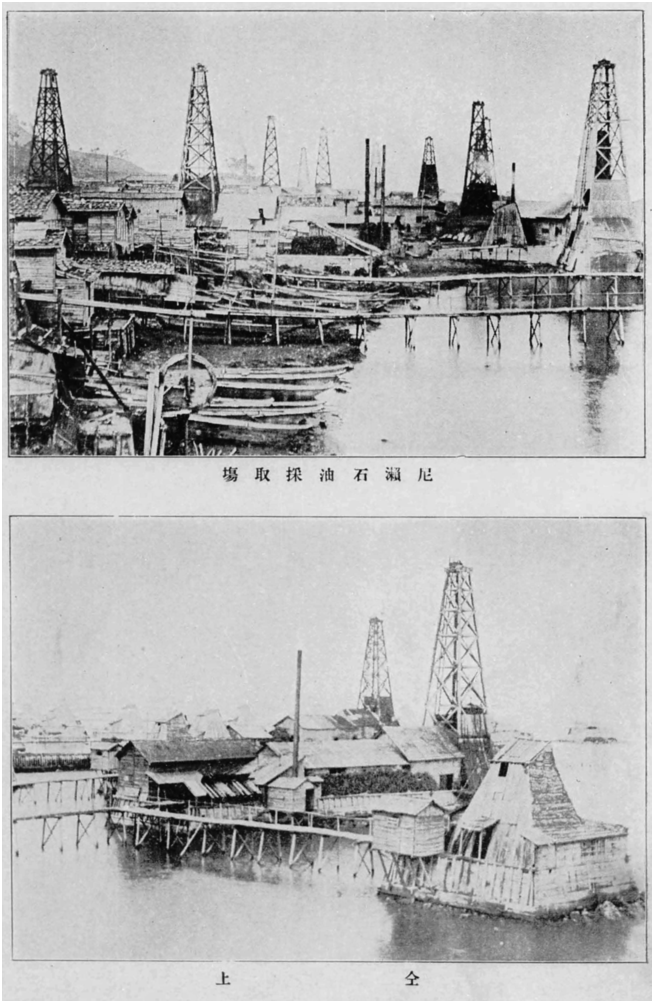
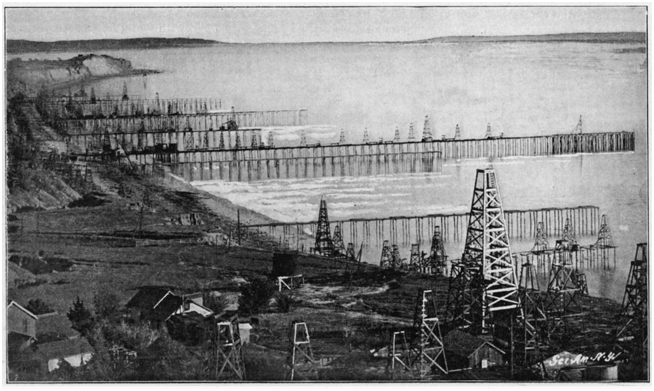
Throughout the first half of the twentieth century, offshore oil drilling in Japan and other regions diverged due to different physical geographies. The physical geography of the Mississippi River delta and a few other places encouraged a continuous technological expansion of offshore oil technology from standing to deeper and rougher, open waters. Starting in the mid-1920s, new geophysical surveying technology provided more precise data on geological formations and potential oil fields. It facilitated exploration in Louisiana’s bayous – the shallow, standing waters and tidal marshes – within the Mississippi River delta, resulting in an expansion of aquatic drilling down the river. By 1938, offshore oil exploration reached the Gulf of Mexico’s bays. US oil companies had designed mobile drilling structures – the first generation of artificial islands for oil drilling – including submersible steel drilling barges hosting derricks, dredge-hosting barges for canal digging between bayous, and barges providing mobility to worker accommodations, diesel electric generators, and radio equipment.Footnote 36 Oil companies circulated these technologies among regions with analogous physical geographies, all accessible by other vessels as well, including Pacific and other coastlines (coastal Peru, Brunei, California, Brazil, and Egypt), shallow and largely enclosed waters (Venezuela’s Lake Maracaibo), or rivers (Burma’s Irrawaddy).Footnote 37 Returning to the Japanese empire, the lack of comparable physical geographies meant that for decades political elites neglected potential oil fields. Nippon Oil Co. (Nihon Sekiyu K.K.), dominating about 80 percent of Japan’s domestic production, certainly contributed to this lack of attention by shifting its focus during the early twentieth century from exploration to refining imported oil. The low price of imported oil compared to domestically produced oil further discouraged investing in new technology.Footnote 38 The key point is that as the importance of environmental differences diminished due to offshore oil technology having become sufficiently advanced, Japanese cabinet members and senior bureaucrats lost access to US technology in the late 1930s and throughout the Pacific War (1941–1945). Yet, oil’s strategic importance in the Japanese government’s decision to continue the war in China (1937–1945) was critical, with US–Dutch–British sanctions being the Tōjō Hideki (1884–1948) government’s primary cause for the invasion of the Dutch East Indies for its oil wells and the war with the United States and the Dutch government-in-exile. US offshore oil production in California and the Mississippi River delta was well known among the Japanese affected by it. For example, in March 1939, related to the struggle between the federal government and several US states over legal control of offshore oil fields, US Representative Sam Hobbs (D-Alabama) criticized in Congress that the “vast bulk of the oil now being extracted [from California’s offshore wells] is being sold to Japan and Japan has as much right to buy as any other purchaser, but we need that oil [for a US Navy reserve].”Footnote 39 Even without such attention-catching statements aimed at denying oil sales to Japan, Japanese political elites were informed through the companies involved in importing Californian oil about its offshore origins – and technological advancements for decades were regularly mentioned in US oil industry journals.Footnote 40
During World War II, Japanese oil experts’ efforts to improve the empire’s oil situation through offshore drilling were unsuccessful. In 1944, oil seeps were observed in a lagoon (Đầm Thị Nại) near the coastal city of Qui Nhon (Quy Nhơn) in central Vietnam, then part of Japanese-occupied French Indochina. This discovery led to exploratory drilling on the lagoon’s shores and within it, using a pontoon – a hollow, airtight, and thus floating structure. Indeed, the obvious absence of geophysical surveying equipment and exploration expertise was problematic. With such resources, it would have been evident that no oil field existed there, rendering the exploratory drilling unnecessary.Footnote 41 In British Burma, the invading Japanese military faced challenges when Burmah Oil Co.’s and Indo-Burmah Petroleum Co.’s wells were destroyed, denying them access.Footnote 42 At that time, most of Burma’s oil wells were along the banks of the Irrawaddy River. Prior to British colonial rule, the Upper Burmese (Kingdom of Ava) oil economy, exploiting riverside fields, depended on the Irrawaddy for transportation.Footnote 43 Even when British companies began to dominate Burmese oil production near the end of the nineteenth century, the river remained the only practical transport route between Rangoon, Mandalay, and other markets for some time. This geographical situation once again emphasized the importance of locations for economically feasible production. Without a local market nearby, it necessitated proximity to waterways for long-distance transport, until road, railway, or pipeline construction changed conditions. Additionally, the local physical geography had to be conducive to offshore drilling. In 1925 and 1926, at the Lanywa field, like the larger Chauk field located near the town of Lanywa in upper Burma, where the Irrawaddy spanned about 1.6 kilometers, the Indo-Burmah Petroleum Co. walled off part of the river’s west bank through a dike reclamation project. This landfill construction posed substantial engineering challenges due to the summer monsoon, when strong rainfall could make the river rise more than 12 meters and its flow increase to 9 km/h.Footnote 44 Subsequently, demonstrating global technological connections, the company used designs developed in US waters and erected derricks on piers for drilling in the walled-off, slow-moving waters (see Figures 2.3 and 2.4). During their occupation, the Japanese extracted a very limited amount of oil from these fields after wells and facilities were destroyed during the British withdrawal.Footnote 45
Indo-Burmah Petroleum Company’s drilling operations in the bed of the Irrawaddy River, Lanywa, Upper Burma (circa 1932). The reclaimed dike wall that strongly reduced water flow on the river’s west bank and, in the background, offshore oil derricks are visible.
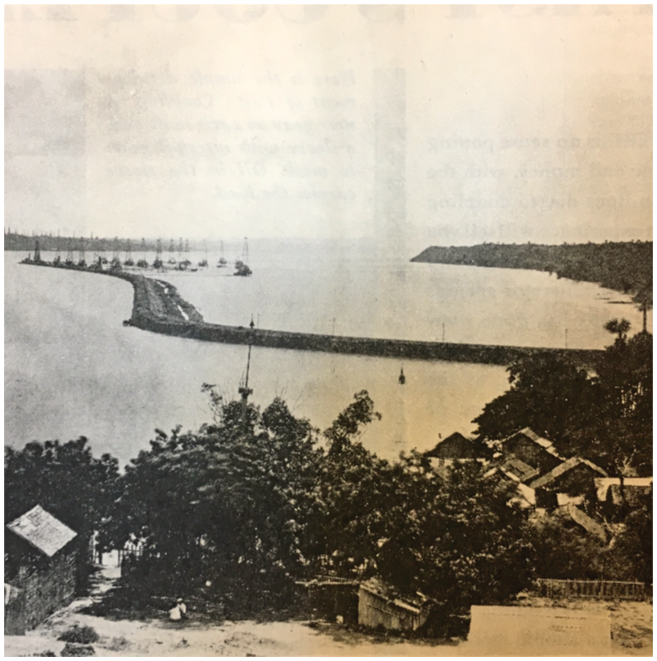
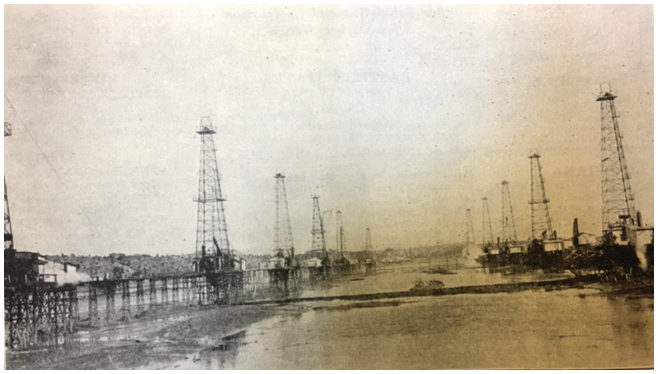
The field locations, their physical geographies, the global trajectory of offshore oil technology advancements, and eventually the lack of access to this technology meant that despite Japanese companies initiating East Asia’s first offshore oil project in the late nineteenth century, Japanese political elites played no role in shifting Asia’s waters into the Anthropocene for many decades. Instead, British private oil companies, operating in colonial Burma and Brunei, played a major role, but only in the latter case until the 1980s, as I will show later here. This context is crucial for understanding the radical shift toward Asian political elites’ agency during postwar decolonization and Japan’s global reintegration.
The Growing Role of Asian Political Elites
Evidence suggests that Japanese wartime political elites could have extracted oil from new offshore wells if they had access to US technology and the capability to defend these sites. In August 1952, shortly after the allied occupation ended in April, Tōhoku University analyzed an oil sample from a postwar offshore exploration off Akita Prefecture’s coast in northwest Honshu.Footnote 46 Discoveries of small oil fields along Akita City’s coastline since the late nineteenth century suggested the presence of offshore fields under the Sea of Japan, similar to the ones in the Niigata Prefecture. The exploration technologies employed by these prospectors were derived from those developed in Louisiana’s bayous. Resembling submersible drilling barges first designed in 1928, hosting a derrick on top of a substructure bridging two floating units, the prospectors connected two boats with the drilling apparatus set up between them. In waters about ten meters deep, they struck oil approximately twenty-seven meters beneath the seabed. While the related newspaper article lacks detail, the depth of this drilling was within the capabilities that US oil companies had developed by the mid-1930s.Footnote 47 The discovery, arguably occurring fifteen years later than it might have, demonstrated that importing globally circulating US technology could have enabled large-scale exploration in the shallow waters adjacent to Asia’s terrestrial oil regions.
Undoubtedly, a notable encouragement for Japanese postwar political leaders was the announcement by British Malayan Petroleum Co., owned by Royal Dutch Shell, of its offshore expansion in British-controlled Brunei in 1953. Brunei, gaining independence only in 1984, is one of the few examples where Western colonial and economic elites had a substantial impact. The discovery of the Seria oil field in 1929 was prompted by gas seepages. It was located near Brunei’s western border, within a mangrove swamp close to the Seria stream and the coast. Despite efforts to raise the land by about one meter using millions of tons of sand, the area remained prone to occasional flooding due to heavy rainfall in the winter monsoon season. Initially, the challenges posed by the seasonally flooded, muddy terrain did not lead to adaptations for drilling in permanently submerged spaces. It was not until 1933 that global technology circulations led to the construction of a US-style pier, featuring a single derrick, into the South China Sea. This development was followed in 1936 by four derricks on a second, more robust and longer pier. However, further exploration efforts were limited to new directional drilling technology that allowed for drilling from beach sites into the geological strata beneath nearshore waters.Footnote 48 The harsh winter monsoon waves, particularly severe in December and January, likely meant that the wooden piers served primarily for testing purposes, and the pier-based approach was not further pursued at that time.Footnote 49 Nonetheless, following the announcement in the previous year, 1954 marked the installation of the South China Sea’s first seabed-fixed offshore platform. This artificial island featured a robust steel jacket design, developed in the latter half of the 1940s for the Gulf of Mexico’s rough open waters, sturdy enough to withstand the powerful surges of Brunei’s winter monsoons.Footnote 50
This example of the increasingly global use of open-water platforms further encouraged the Japanese government to accelerate exploration in Japan’s and other waters. The formation of the Hatoyama Ichirō administration in late 1954 brought this objective into focus for Japan’s first postwar Five Year Plan (1956–1960). Subsequently, in December 1955, following the Plan’s finalization, a semi-public entity – with the majority of shares held by the Finance Ministry – was established, based on negotiations between the Ministry of International Trade and Industry (MITI) and private oil companies. This entity, the Japan Petroleum Exploration Co. (JAPEX; Sekiyu Shigen Kaihatsu K.K.), was charged with the costly exploration and development of new fields around the Japanese archipelago while not interfering with the activities of existing private companies. Historian Richard J. Samuels termed the subsequent fossil fuel developmentalism, or the limited state jurisdiction in markets and mutually supportive relationship between Japanese governmental institutions like MITI and private oil companies, as politics of reciprocal consent. A primary focus of JAPEX was to import offshore oil technology.Footnote 51 In the long run, this knowledge acquisition illustrates that several Asian governments integrated geophysical surveying, platform construction, and maintenance into their socioeconomic development strategies. In Japan, the first platform was built in 1959, a development discussed later, followed by Singapore in 1969.Footnote 52 This trend was subsequently adopted by other countries, including China and South Korea in the 1980s, with Asia-based companies contributing to technological advancements and reducing the dominance of US Gulf of Mexico platform and equipment manufacturers.
State-supported exploration projects and governmental appropriation of marine regions since the mid-1950s showed that Asian political elites were now guiding the wave of offshore fossil fuel development. Onshore oil fields near water bodies were considered indicators of potential offshore fields, and US technology enabled exploration of these vast marine regions further off the coast, marking the onset of the oceanic Anthropocene. Consequently, the Japanese government not only concentrated on Japan’s waters but also became the primary importer and major financier of projects throughout Asian waters. Simultaneously, the accessibility of marine regions by offshore oil industry platforms and vessels, capable of making transoceanic journeys, once again highlighted that the Asian political elites’ agency was hardly constrained by structural choice limitations stemming from colonial-era decisions regarding physical infrastructure, in contrast to terrestrial projects. My key point is that state-led offshore fossil fuel developmentalisms and military-related energy security concerns now became evident in governmental agendas and marine region appropriations, contrasting with earlier endeavors. Previous offshore drilling, dating back to the late nineteenth century, occurred within the already claimed territorial seas of Japan, Brunei, and in a Burmese river. In the 1950s, the Japanese government committed to thoroughly exploring the archipelago’s territorial sea. Furthermore, the 1950s and 1960s saw large-scale, state-led marine space appropriation extending from the Persian Gulf’s continental shelf to the South China Sea and further north. Such claims accelerated globally after World War II in reaction to the US Truman administration’s claim in 1945 over continental shelf resources and culminated in the United Nations Convention on the Continental Shelf (1958, entering into force in 1964), through which signatory governments granted each other legal control over offshore oil exploitation within these submerged regions wherever technology could reach oil fields. Importantly, structural choice limitations in the form of international law did not hinder the development of offshore oil wells. Thus, the territorialization of continental shelves and the creation of domestic legal regimes for exploiting their resources emphasized the agency of Asian political elites vis-à-vis oil companies, whether private or state-owned.
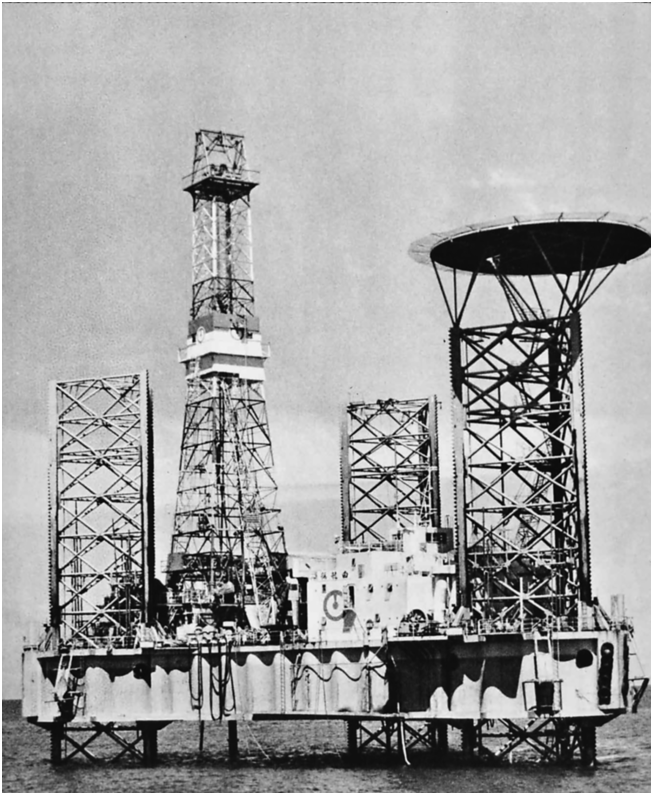
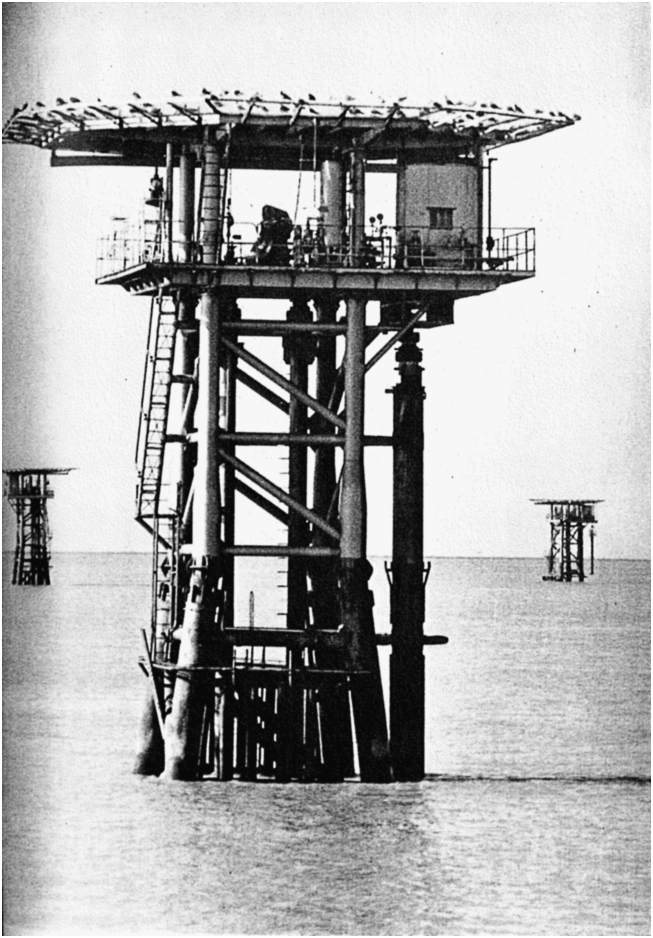
Starting with technology importation, JAPEX purchased a jack-up rig design originally developed for the US Gulf of Mexico. Unlike the seabed-fixed platform offshore of Brunei, the jack-up rig, initially named Hakuryū-gō and later renamed Dai-1 Hakuryū, evolved from submersible drilling barges designed for Louisiana’s bayous. Towed by tugboats, the Dai-1 Hakuryū floated to its destination with its legs extended (jacked up) above the water. There it stabilized itself by lowering its legs and submerging them into the seabed, in the process elevating its deck (between the legs) above the sea surface for safety against waves (see Figure 2.5). This mobile offshore drilling unit’s design allowed exploratory drilling at various sites, highlighting the minimal transport infrastructure requirements. The Japanese government subsidized JAPEX’s increase in offshore exploration capabilities, a response to oil scarcity issues stemming from Japan’s limited expertise in this field before and during World War II. The decision also reflected global maritime connections, as an alternative would have been to tow a platform from the US Gulf Coast to Japan. Constructed by a Japanese heavy industry company, Dai-1 Hakuryū commenced operations off Akita Prefecture in April 1959.Footnote 53 By November, the floating island discovered the Tsuchizaki offshore oil field near Michikawa, close to Akita City, with more discoveries during the following months.Footnote 54 Seabed-fixed platforms were then used for oil extraction and transportation to the coast (see Figure 2.6).
The Dai-1 Hakuryū, a jack-up rig, the first offshore oil platform constructed in Japan. Its mobility enabled the discovery of multiple very small offshore oil fields around Japan.
Whereas Japanese offshore oil fields were very small compared to major oil regions, almost simultaneously a government-supported project discovered a large offshore field in the Persian Gulf, accelerating this marine region’s energy transition as well. Post–World War II, the Persian Gulf and its littoral emerged as a pivotal oil region, with terrestrial fields indicating offshore reserves. In 1951, the US company ARAMCO (Arabian-American Oil Co.) discovered an offshore field near Saudi Arabia, the first in the Gulf’s comparatively shallow waters, beginning production in 1957.Footnote 55 At the time oil wells available to the Japanese were very scarce and imports dependent on foreign suppliers.Footnote 56 The discovery garnered the attention of Japanese political and economic leaders. When offshore oil exploration gained the Japanese government’s support in the mid-1950s, businessman Yamashita Tarō (1889–1967), who received support from members of Prime Ministers Tanzan Ishibashi’s (1956–1957) and Kishi Nobusuke’s (1957–1960) cabinets, proposed a plan to develop Persian Gulf offshore oil for sale to Japan. After lengthy negotiations from February 1957 to July 1958, Yamashita’s earlier established Arabian Oil Co. (Arabia Sekiyu K.K.) secured a newly created concession in the waters off the Saudi Arabia–Kuwait Neutral Zone.Footnote 57 Utilizing jack-up rigs built in the US Gulf of Mexico and towed across the ocean, the substantial Khafji oil field was discovered in January 1960. A preceding July 1959 drilling explosion not only caused serious platform damage but also indicated the oil field’s presence, leading to generous Japanese government funding – US$42 million initially, with an additional US$175 million loan proposed by then Minister of International Trade and Industry (and, from 1960, Prime Minister) Ikeda Hayato for field development.Footnote 58 By 1966, Arabian Oil’s offshore wells notably supplied 14 percent of Japan’s oil imports.Footnote 59
In the context of the growing agency of West Asian or Middle Eastern political elites, key figures such as Saudi Finance Minister Mohammed Suroor Sabban (1898–1971) and Oil Director Abdullah Tariki (1919–1997), alongside their Kuwaiti colleagues, successfully negotiated far more favorable terms (56 and 57 percent share) with Yamashita’s company compared with those offered by Western oil majors (50 percent share). This enhanced bargaining power, particularly evident in the newly formed concessions stemming from the appropriation of marine regions, bolstered their efforts to decolonize their oil industries.Footnote 60 The movement toward decolonization also played a crucial role in Saudi Arabia and Kuwait becoming founding members of the Organization of the Petroleum Exporting Countries (OPEC) in 1960, ultimately contributing to the drastic oil price hike in 1973. Moreover, the Saudi and Kuwaiti negotiations with Arabian Oil, and the latter’s exploration successes, encouraged other Asian governments to claim jurisdiction over continental shelves and their oil resources, extending their control beyond territorial seas. These appropriations contributed to the onset of the oceanic Anthropocene, facilitated by the Law of the Sea, which during the second half of the twentieth century offered governments control over multiple spatial layers of the ocean.Footnote 61
In Japan, while the agency of capitalists like Yamashita is undeniable, the support from Japanese diplomats and the Ministry of International Trade and Industry was highly important. Following World War II, Japan’s loss of its colonial empire, coupled with the Allied occupation’s initial demilitarization and deindustrialization policies, disrupted access to overseas oil, leaving only marginal oil fields domestically. Therefore, the oil concerns of postwar Japanese elites are best understood through a transwar lens connecting prewar, wartime, and postwar periods. Strong memories of the 1941 oil embargo heightened energy security concerns among them, many of whom had been influential before and during the war era – among them Kishi, who during wartime had led the ministries of munitions and commerce. These concerns, amplified by the Suez Crisis (1956) that delayed oil deliveries to Europe, strongly increased their willingness to support initiatives to diversify oil supply sources and provide Japanese companies operating abroad control over oil production and exportation to Japan. During the 1960s, the soaring oil demand of the high-growth economy further intensified these fears.Footnote 62 This combination of energy security fears and rapidly rising oil demand prompted Japanese political elites, in concert with their Saudi and Kuwaiti counterparts, to establish the socioeconomic development framework within which Arabian Oil operated.
Before shifting attention to Japan and other Asian regions, I want to address another exception (following Brunei) to my argument, represented by the British-controlled territories in West Asia. Here, local Asian elites initially lacked control over offshore oil development, with Foreign Office and Commonwealth Relations Office officials in charge. These officials, together with Western oil companies, had shown interest in offshore oil since the late 1930s, but World War II changed priorities.Footnote 63 In 1948, following the Truman Proclamation of 1945, British officials discussed the best strategy for compelling local sheikhs to claim jurisdictional control over the continental shelf. Sir Rupert Hay (1893–1962), the Chief Political Resident in the Persian Gulf, expressed his strong feelings of civilizational superiority and colonialist paternalism vis-à-vis local political elites, whom he considered to be in serious need of British education, guidance, and punishment, when he emphasized his doubts regarding their capability to make such proclamations: “The Shaikhdom of Qatar and the Trucial Shaikhdoms are ruled autocratically by Shaikhs whose ignorance is only exceeded by their rapacity. It would probably be difficult to make them understand what exactly they were required to do in making a formal assertion of sovereignty over the seabed and they would certainly expect some immediate return for their action.”Footnote 64 Here we see the process of imposing new international law in a West Asian colonial setting. British officials in the Trucial States (now the United Arab Emirates), Qatar, and Bahrain provided proclamation texts and oversaw their publication, staggering them to mask the overt colonial directive.Footnote 65 However, this British dominance was an exception. Postcolonial political elites in other parts of Asia had freedom of action, incorporating offshore oil drilling into their state developmentalisms. During decolonization, the Trucial States also stopped being an exception. Remarkably, by 1967, four years before formal independence, Abu Dhabi’s emir, Zayed bin Sultan al-Nahyan (1918–2004), began inviting Asian companies to bid for concessions, previously restricted to European and American firms.Footnote 66 In the same year, Abu Dhabi joined OPEC. After independence, the unified government of the sheikhs continued this OPEC membership, further dismantled the influence of European and American oil companies, and integrated offshore oil drilling into their fossil fuel–based development strategies.Footnote 67
Asia’s Terrestrial and Oceanic Energy Transitions Synchronizing in the Anthropocene
The offshore focus of Asian political elites signified the synchronization of Asia’s terrestrial and oceanic energy transitions, integrating many Asian marine regions into the fossil fuel economy characteristic of the Anthropocene epoch, albeit at different paces. Driven by the Japanese high-growth economy’s burgeoning oil demand, Japanese elites’ energy security fears, and their own fossil fuel–based development agendas, the newly independent governments in Southeast and East Asia began appropriating marine regions and establishing legal frameworks for offshore oil exploration.
After independence, Indonesian political elites initially faced challenges not that different from wartime Japan, inhibiting their plans for offshore oil field exploration. Despite commercial exploitation of terrestrial oil wells since the 1880s, locations and material conditions had not resulted in offshore drilling, neither under Dutch colonialism nor during the Japanese occupation (1941–1945). In 1951, after the independence war (1945–1949), the Indonesian parliament, aiming to decolonize the economy, passed a motion prohibiting further concessions until a new oil law was created. Enacted in 1960, this law permitted transnational oil companies to operate only as contractors of Indonesia’s national oil companies, reinforcing governmental control over the industry. During the last years of Sukarno’s (1901–1970) rule as president from 1945 to 1967, foreign oil companies faced diminishing returns and feared nationalization. The left-leaning, increasingly authoritarian government’s socioeconomic development policies led to rampant inflation and mandated low domestic oil prices aimed at democratizing consumption.Footnote 68 Therefore, access to foreign offshore oil technology was not relevant at first due to the government not offering concessions and, reminiscent of wartime Japan, from 1960 lacked access due to the unwillingness of foreign oil companies to work with the Indonesian government. If they did anything during that period, Western capitalist elites unwittingly limited Indonesian carbon emissions. Negotiations regarding one single offshore concession began in 1964 but stalled until Sukarno’s influence waned after October 1965. The subsequent Suharto (1921–2008) regime, in office from 1967 until 1998, viewed offshore concessions as a means to increase tax revenues and curb inflation. Ibnu Sutowo (1914–2001), the head of the national oil company Permina (in 1968 merging into Pertamina) and, from 1966, the minister of mines, facilitated the involvement of foreign oil companies through production-sharing agreements with Pertamina. Therefore, marine regions from north Sumatra to East Kalimantan became sites of intense exploration by Japanese, US, Australian, Canadian, and European oil companies, culminating in the dedication of the first offshore production platform in October 1970.Footnote 69 The proximity across the ocean to the Japanese market meant most of the oil was exported there. Altogether, the new concession law, the production agreements, and the dominant role of Pertamina emphasize the agency in shaping the industry’s legal and operational framework that Indonesian political elites had gained in the early years of Suharto’s dictatorship.
The formation of the Committee for Co-ordination of Joint Prospecting for Mineral Resources in Asian Offshore Areas (CCOP) illustrates the importance of offshore oil in the realm of intergovernmental development initiatives. Offshore oil exploration and production became prominent topics on the political and economic agendas of the UN and its regional organizations. In November 1965, the United Nations Economic Commission for Asia and the Far East (ECAFE) convened an expert group that initiated the first surveying project. As a report from early 1965 stated, exploration in member countries (which did not include Arab countries) was almost entirely limited to Brunei, Japan, and Iran. In 1966, a part of ECAFE formed the CCOP with support from several Western governments. Its membership comprised Japan, South Korea, Taiwan, and the Philippines – the three noncommunist countries geographically and, in terms of transport distance, closest to Japan. All three had gained independence after World War II. By 1973, South Vietnam, Thailand, Cambodia, Malaysia, Indonesia, and Singapore had joined this group of Asian countries bordering the West Pacific Ocean.Footnote 70 The World Bank subsequently provided support to the Thai government for developing offshore gas fields in government-appropriated marine regions, which formed a national oil company, the Petroleum Authority of Thailand, in 1978.Footnote 71 In Malaysia, offshore oil exploration off Sarawak’s coast in North Borneo began in the 1950s, amid the waning days of British colonialism. The proximity to Brunei’s offshore oil fields was a major factor. Initial discoveries occurred in the early 1960s, around the time Sarawak became part of Malaysia in 1963. Exploratory drilling off the east coast of West Malaysia (the Malayan Peninsula) commenced only after 1969, a long time after achieving independence in 1957. These discoveries led to oil becoming integral to the government’s socioeconomic development agenda. In 1974, the year after the first Oil Shock, the national oil company Petronas was established, gaining ownership of the country’s oil resources and being wholly government-owned. In 1976, Prime Minister Hussein Onn (1922–1990) and his staff enforced a drastic production split in favor of the Malaysian state among transnational oil companies.Footnote 72
Amid the war, South Vietnam, or the Republic of Vietnam, faced unique challenges. News of offshore oil field surveying in early 1971 led US antiwar activists to allege that US involvement in Vietnam was to protect US oil interests, a claim President Richard Nixon dismissed as “Nuts!” in one document.Footnote 73 The development of South Vietnam’s first offshore oil fields in 1973 provided vital foreign exchange (about US$17 million) and fuel following the US troops’ departure in the same year, yet it did not alter the war’s outcome. Post-1975, the unified communist government was in control of these offshore oil fields but struggled to develop them due to the Soviet Union’s lack of offshore oil and gas technology adaptable to the material conditions of Vietnam’s waters. Negotiations with the Italian national oil company ENI for an agreement in early 1978 faltered, almost certainly as a result of the escalating maritime boundaries conflict in the South China Sea between the Vietnamese and Chinese governments, a situation ENI staff evaluated as too dangerous, emphasizing that Western capitalist corporations had no influence in this regard.Footnote 74 While OPEC is perhaps the most well-known oil organization emerging from decolonization, across Asia, the jurisdictional control over continental shelves, nationalization of offshore oil and gas resources, establishment of national oil companies, and the relegation of foreign companies to junior partner roles were the norm between the 1950s and 1970s.
Asian ECAFE representatives also contemplated a group for countries around the Indian Ocean. In this region, offshore fields seemed to be limited to the Persian Gulf, a few fields off India (such as Bombay High off Mumbai, discovered in February 1974), and the western part of Indonesian waters. This group never materialized. In the following years, as the governments of Asian countries like India, who possessed no large oil reserves, continued to struggle with higher oil prices after the 1973 Oil Shock, the World Bank partially funded the development of Bombay High (now Mumbai High Field). The discovery of the field in the wake of the oil price rise played an important role in the World Bank’s decision to start financing oil development in India and other Asian countries. The World Bank previously had not funded any oil development, emphasizing once more that the offshore oil exploration boom in Asian waters in most cases had been the result of decision made by Asian elites. Returning the focus to the Bombay High field’s material conditions, once again, the winds and waves of summer monsoons and tropical cyclones complicated development and operation, yet it provided India’s national oil company with some of the desperately needed fossil fuels required for the government’s development agenda.Footnote 75
The CCOP’s first survey project had far-reaching implications, including sparking some of the world’s most notorious maritime boundary conflicts. Between October and November 1968, toward the end of the UN’s first global “Decade of Development,” surveyors from Japan, South Korea, and Taiwan, supported by US experts, explored the East China Sea and the Yellow Sea. These events are the strongest illustration of Asian governments’ predominant role in the onset of Asia’s oceanic Anthropocene. Their agency is exemplified by them claiming jurisdictional control over the same marine regions, denying access to both each other and Western corporate capitalists. The doubtlessly most important sentence in the 1969 survey report stated: “A high probability exists that the continental shelf [beneath the East China Sea] between Taiwan and Japan may be one of the most prolific oil reservoirs in the world.”Footnote 76 It also highlighted the Yellow Sea’s lower but still substantial economic potential: “A second favorable area for oil and gas is beneath the Yellow Sea where three broad basins are present.”Footnote 77 The East China Sea survey findings were the main reason for the ongoing Senkaku/Diaoyu Islands conflict among the governments of Japan, Taiwan, and China, exacerbating global security risks. In the context of the large-scale appropriation of marine regions during that time, control over these islands equaled control over the surrounding continental shelf, including some of the hoped-for fossil fuel fields. The administration of US President Richard Nixon refrained from involvement in this dispute. In 1970, it informed US companies operating in Taiwanese concessions, contested by Mao Zedong’s government, that their vessels could not expect US protection. The conflict between Chinese and Taiwanese political elites thus led to the withdrawal of US capitalist corporations. Analytically, in terms of the parties dominating the conflict, this withdrawal emphasized the very limited agency of US companies. Territorial disputes among Chinese, Taiwanese, and Japanese political elites have regularly resurfaced over the decades.Footnote 78
In the Yellow Sea, the South Korean government under Park Chung-hee (1917–1979), in office from 1961 to 1979, quickly granted concessions. However, exploration was hampered by Chinese boundary disputes, military threats, and the Mao administration’s unwillingness to participate in negotiations. Like many other governments, South Korea established a national oil company, the Korea National Oil Corporation (Hanguk Seogyu Gongsa), and eventually redirected its focus to undisputed marine regions.Footnote 79 The South China Sea conflict, although not a result of the CCOP report, is again noteworthy in this context of control over islands and surrounding marine space. As the ENI staff had rightly expected, from the mid-1970s, the Vietnamese and Chinese governments engaged in violent clashes in the disputed region.Footnote 80 Several other governments also issued their own claims and became involved in the conflict. Altogether, in the transition of parts of the South China Sea, East China Sea, and Yellow Sea into the oceanic Anthropocene’s oil economy and Asia’s corresponding climate change narrative, Western corporate capitalism was not a major player.
In China, similar to many other Asian countries, field locations and their physical geographies initially did not encourage early political interest in offshore oil exploration. US technological advancements in the late 1930s, enabling exploration in the Gulf of Mexico’s bays, coincided with China’s war against Japan, which controlled the coastline, followed from the late 1940s by Cold War tensions with the United States. These factors hindered the different Chinese governments from engaging in exploration programs. Another major problem was the very different material conditions of offshore oil regions in the Soviet Union, the Chinese government’s primary ally after the communists’ 1949 victory in the Civil War. In the same year, the Soviet oil industry started developing substantial production infrastructure off Baku in the Caspian Sea’s nontidal waters. The discovery of large oil fields in the Volga Basin and West Siberia after World War II nonetheless shifted research focus to swampy or permafrost regions, giving no priority to the development of platforms and equipment for exploration in rougher, open waters. Western export restrictions to the USSR and China constituted another political obstacle to the expansion of offshore oil drilling in communist-ruled countries. From 1948, Western companies required government approval to sell such technology, often withheld due to oil’s strategic importance in the global Cold War.Footnote 81 In 1964, officials from the German Democratic Republic observed that Soviet technical expertise was confined to stationary, seabed-fixed platforms suitable for mild waters. This was a serious disappointment, as the Caspian Sea conditions were not applicable to the Baltic Sea.Footnote 82 Similarly, Chinese political elites could not obtain open marine water technologies from the USSR, and by the 1960s, Sino–Soviet relations had strongly deteriorated, leading to the withdrawal of Soviet technicians and an increased emphasis on Chinese self-reliance, which, from 1966, was accompanied by the “Cultural Revolution.” The Maoist propaganda of self-reliance at China’s only noteworthy oil field, the Daqing field in Manchuria, therefore epitomized a technology degeneration in the oil industry.Footnote 83 I will not go so far as to claim that Maoist Marxism in China and this technology degeneration unwittingly had a positive effect by preventing carbon emissions, akin to imperialism in Asia, as suggested by Amitav Ghosh. But it is notable that instead of experiencing a lock-in effect by investing substantial amounts of capital in oil platforms and related infrastructures, China has experienced what can be called a lock-out effect, preventing large-scale offshore exploration and development for decades.
In the 1960s, lacking US, Soviet, or other expertise and technological support, this lock-out effect made China unable to extract oil from offshore fields other than through some minor experiments with fixed platforms. Access to US technology could have made Bohai fields exploitable much earlier. Only in the early 1970s, catalyzed by the CCOP 1969 survey report, did the Mao government manage to implement noteworthy state-controlled exploration activities, starting in the Bohai Sea and made possible by the acquisition of offshore oil technology during a period of rapprochement with the United States and Japan, ending the lock-out. By the late 1970s, China had further opened up and negotiated joint venture agreements with transnational oil companies.Footnote 84 In China, however, as in nearly all other parts of Asia, it was strong state control and governmental economic planning, not freely operating corporate capitalists, that steered the marine regions’ energy transition into the oceanic Anthropocene.
Asia’s Oceanic Anthropocene in Earth’s Amphibious Transformation
The oceanic dimension of the Anthropocene cannot be fully understood without considering the local dynamics of accelerating global offshore oil exploitation, which, since the 1950s, has synchronized Asia’s terrestrial and oceanic energy transitions in this new epoch. Offshore oil production originated in Honshu at about the same time as in Southern California. Yet the absence of oil-bearing bayou-like waterscapes in Japan and other Asian countries did not encourage continuous technological development for increasingly deeper and rougher waters, thereby disconnecting Asia’s terrestrial and offshore oil fields. In certain Asian regions, local environmental conditions such as rough waves from monsoons or tropical cyclones made aquatic drilling drastically more difficult than in the calm bayous, turning these sites irrelevant for global technology circulations for decades. When US open waters technology was eventually transferred to Asian waters during the 1950s, decolonization was already in full swing. Large-scale offshore oil exploitation in most of Asia’s coastal countries began post-independence, driven by Asian political elites and influenced by the interplay of emerging political institutions and the material conditions of marine regions. Contingent oil and gas field locations in unfavorable physical geographies were a significant factor. But political factors such as military conflicts, Cold War tensions, and economic decolonization also influenced the divergence, especially as US companies’ expanding exploration and production capabilities made many undiscovered Asian fields theoretically accessible. Corporate capitalists therefore were not a dominant force. Their technology was important, but its export was controlled by the US government, which blocked sales to Cold War adversaries. Additionally, the socioeconomic development agendas of Asian political elites undermine any Eurocentric claims that corporate capitalism is the defining cause of climate change in Asia’s oceanic Anthropocene, while at the same time drawing attention to offshore oil drilling and carbon emissions in communist systems. This pattern of government officials’ control over corporate capitalism also characterized other marine regions – I do not claim that it was unique to Asia. For example, even in the United Kingdom, the establishment of the British National Oil Co. in 1975, albeit with more limited power compared to many Asian countries, aimed to ensure state participation in the offshore oil industry that emerged in UK waters during the 1960s and 1970s. Later, Prime Minister Margaret Thatcher’s (1925–2013, in office 1979–1990) neoliberal policies dismantled it, profoundly changing the United Kingdom’s political economy of offshore oil. The United States, where offshore oil drilling developed without a national oil company and where corporate capitalism greatly influenced policies on royalties, lease fees, and lease offerings, was an exception rather than the norm between the 1960s and the late 1980s, before the partial or full privatization of many Western national oil companies. Another important exception were the countries of the greater Gulf of Guinea region (Nigeria, Gabon, Angola, etc.), where close relations between local cash-hungry elites and foreign oil companies meant that national oil companies never developed the capacity to more than formally subordinate the latter, unlike in most Asian countries.Footnote 85
The agency of Asian political elites was strongly supported by certain special characteristics of marine regions. Unlike terrestrial spaces, offshore oil and gas development projects in these marine regions were hardly affected by colonial legacies and corresponding structural choice limitations in terms of infrastructure and legal frameworks. This point is exemplified by the Asian political elites’ appropriation of marine regions, establishment of legal regimes, and integration of large quantities of newly discovered offshore oil-rich oceanic ghost acres into their socioeconomic development agendas. These marine region characteristics, coupled with access to Japan’s growing oil market, united this group of Asian political elites in their offshore fossil fuel developmentalisms.
What does this strong agency of political elites indicate about the future of the ocean in Asia’s Anthropocene and the global energy transition toward renewable energy sources? After terrestrial and oceanic energy transitions synchronized through oil economies, there is no reason to believe they will desynchronize. In the ongoing global energy transition, solar is the only renewable source far exceeding any imaginable energy demand even far beyond this century. Wind power, although very contingent upon local material conditions, is another realistic long-term substitute for power generated by fossil fuels, along with, in much more limited capacities, other renewables (tidal, ocean temperature gradients, geothermal, hydroelectric, etc.), as well as more controversial but maybe essential nuclear power (to be addressed in Chapters 4 and 7).Footnote 86 The unrealistic spatial demands of wood and other terrestrial biofuels and the low output of other energy sources have been previously noted. As offshore oil created vast oceanic ghost acres, reducing the need for forest space, I have little doubt that Asian governments will again seek to use substantial amounts of ghost acres from marine areas for renewable energy generation, such as floating solar photovoltaics and offshore wind turbines, to reduce terrestrial space demands. Since 2007, floating solar photovoltaics have been installed on calm lake waters, reminiscent of Louisiana’s bayous in offshore oil history.Footnote 87 These technological advancements that began in bayous eventually led to the rough, open waters of the Gulf of Mexico. In the case of floating solar photovoltaics, unobstructed marine waters typically allow slightly higher energy generation than terrestrial locations, further enhancing the attractiveness of marine ghost acres for renewable energy production, which I further address in Chapter 7.Footnote 88
Consequently, future and more in-depth narratives about Asia’s oceanic Anthropocene must thoroughly examine the various government activities that have shaped, and might continue to shape, the ocean focus of Asian political elites. This examination should encompass governmental failures and corruption, along with their underlying causes. In multiple states, offshore oil revenues were not solely dedicated to development agendas. They were also partially misappropriated or illegally used by corrupt officials and others. Pertamina is one such example.Footnote 89 Another troubling case of governmental failure and flawed incentive structures, though not corruption, involves the numerous unsuccessful Japanese government-funded offshore oil exploration projects. These projects had failure rates of 97–98 percent and incurred immense taxpayer costs due to the wasteful incentive structure and serious moral hazards originating from the energy security concerns of Japanese political elites. These elites were prepared to have the state absorb most of the capital costs in the event of failure.Footnote 90 Without question, such fear-driven planning missteps, possibly exacerbated by apocalyptic narratives, should be avoided in the current global energy transition.
Offshore oil and gas drilling extended the increasingly interconnected Asian energy space into marine regions, both above and below the sea surface, playing a key role in Earth’s amphibious transformation. By 1970, Japanese companies, particularly through government-led agenda setting, expected to soon import liquefied natural gas (LNG) from Brunei and were engaged in a multitude of offshore drilling operations across the Indian and Pacific Oceans, as Tsumura Akinobu and Shimada Yoshihito, JAPEX’s director for research and planning and its vice president, respectively, explained to their ENI colleagues. Since 1972, Japan indeed had begun importing LNG from Brunei, with suppliers like Indonesia and Abu Dhabi joining in the late 1970s, eventually also exploiting offshore deposits.Footnote 91 Large-scale investments in production sites and transportation infrastructure, such as drilling rigs, refineries, LNG terminals, tankers, storage sites, pipelines, and oil or gas power plants, created carbon lock-in effects that persist in the present energy transition away from fossil fuels. However, the carbon lock-in was not only due to the production chain from extraction to end consumption, and its infrastructural embeddedness in the built environment. The availability of oil and natural gas on offshore drilling rigs also supplied fuel for generators, powering these rigs, their living quarters, and energy-intensive systems, ranging from electronic equipment to electric lighting and, since the 1950s, air-conditioning. The corresponding extension of the human habitat onto sea surfaces was therefore necessitated by offshore platforms having to operate without access to centralized, public, terrestrial power or water grids.Footnote 92 A case in point is again Yamashita’s Arabian Oil Co., which operated off the Neutral Zone without previous permanent coastal settlements in proximity, establishing its own gas-powered facilities both onshore and offshore.Footnote 93 In the same way, the use of coal or heavy fuel oil on ships for both propulsion and electricity provision created a technological synergy that further exacerbated the carbon lock-in.
This fossil fuel lock-in effect was also evident in mariculture, where reliance on plastic construction materials added to it, as will be discussed in Chapter 8. Plastic also connected the carbon lock-in and the ocean in other ways. Strangely reminiscent of anadromous fish such as salmon, returning from the ocean to the rivers where they were born to spawn, disturbing amounts of plastic “born” from offshore oil “returned” to the ocean due to human indifference. Plastic waste is circulating in the Pacific Ocean, widely known as the Great Pacific Garbage Patch, but it also pollutes many other marine regions and numerous coastlines. Only recently has serious cleanup work begun. Regardless, the link between offshore oil drilling and the production of oil-based consumer goods like plastics, deeply ingrained in everyday culture since the 1950s or later, depending on the region, further intensified the carbon lock-in. Therefore, the fossil fuel–based development agendas that shaped Asia’s oceanic Anthropocene not only integrated marine regions into a fossil fuel–centered energy space; they also magnified the carbon lock-in effects that define this energy space, posing additional hurdles for the transition to oceanic renewable energy sources.
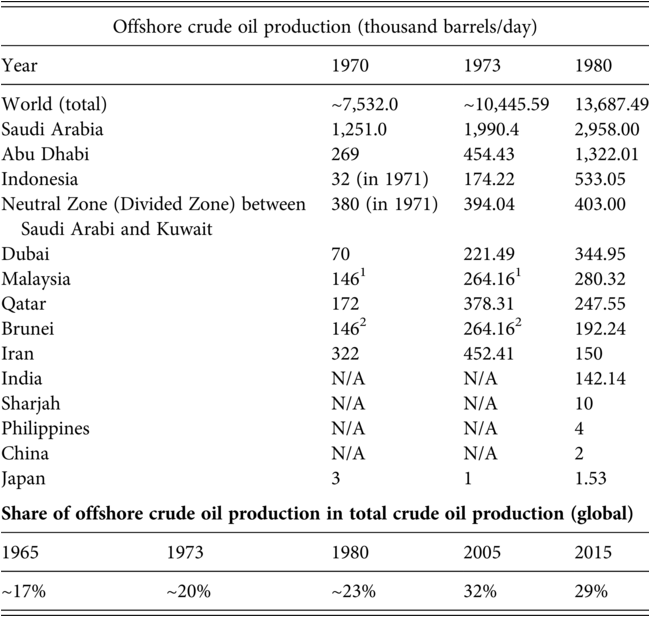
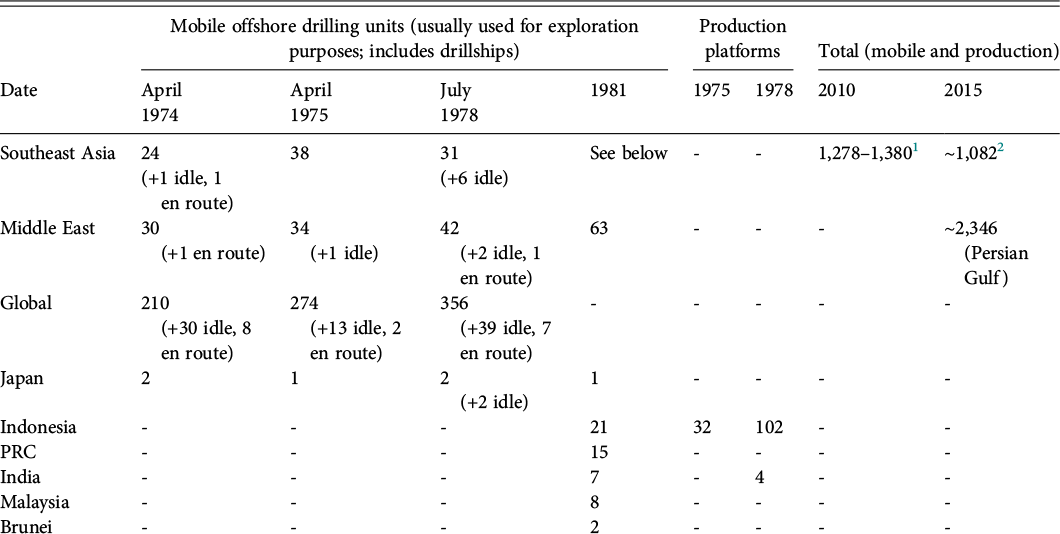
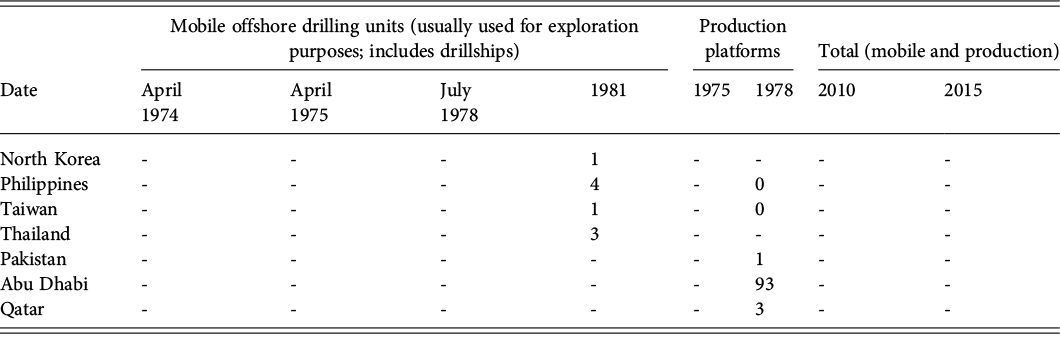
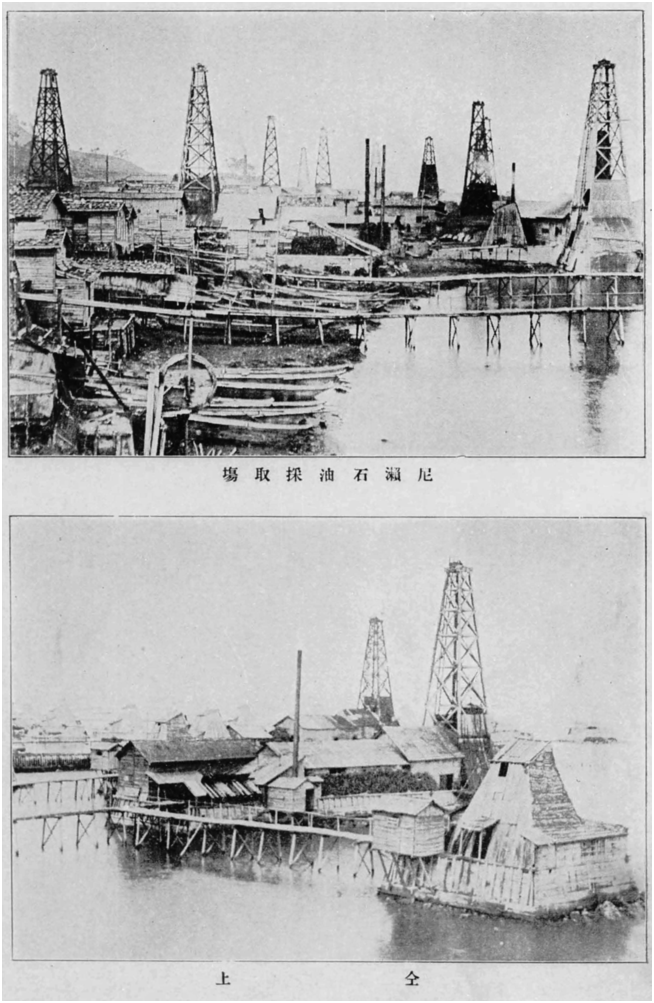
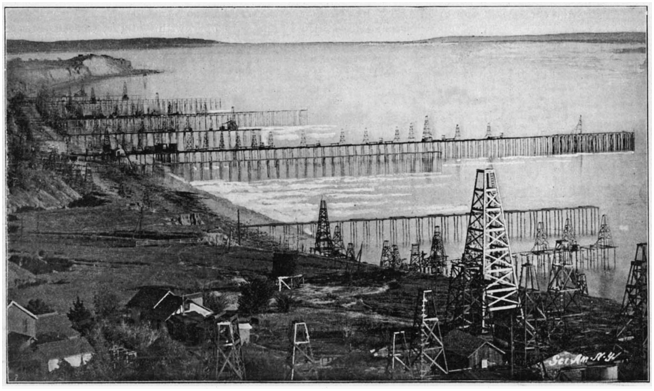
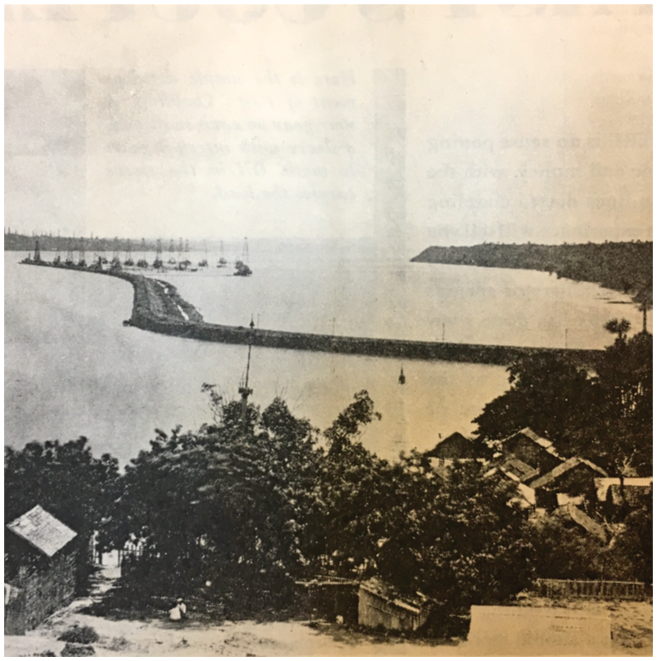
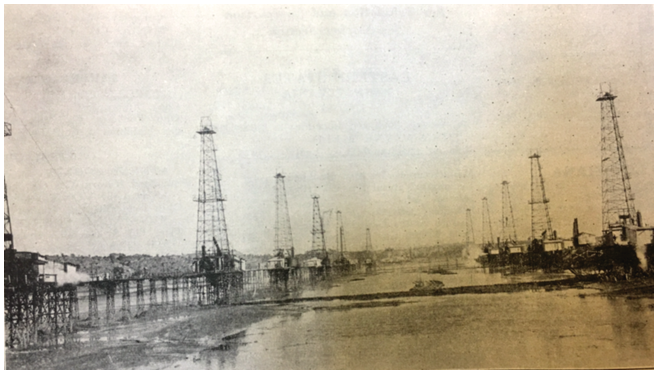
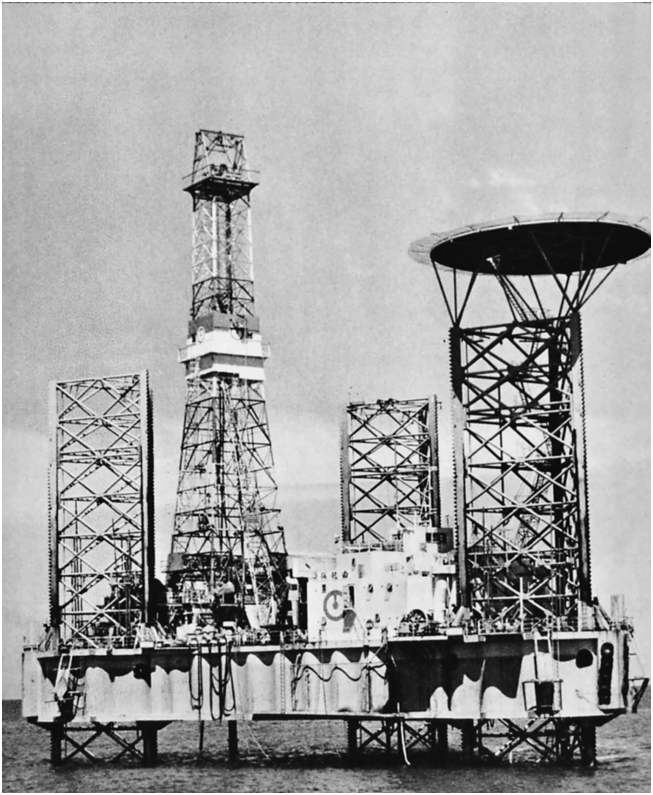
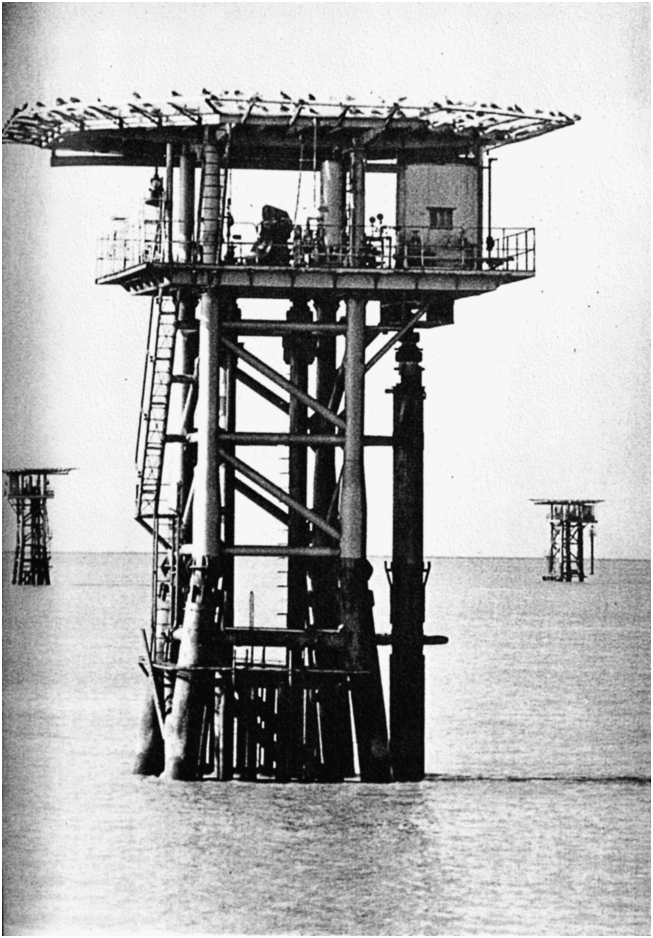

 Open access