


It is common across the American states for judges to be elected. Only 11 states do not hold any trial court judicial elections,Footnote 1 leaving thousands of judges across the remaining states subject to various public accountability mechanisms. These range from infrequent retention elections to partisan primaries and general elections. To that end, a great deal of research has addressed the extent to which local and state judges are responsive to their constituents’ preferences (e.g., Hall Reference Hall1987; Huber and Gordon Reference Huber and Gordon2004; Hanssen Reference Hanssen2004; Brace and Boyea Reference Brace and Boyea2008; Choi, Gulati, and Posner Reference Choi, Mitu Gulati and Posner2010).
Much of the existing literature on judicial accountability focuses on the nature of selection: appointive vs. elective, partisan vs. nonpartisan, competitive vs. retention, etc. (e.g., Taylor Reference Taylor2021; Badas and Stauffer Reference Badas and Stauffer2019; Canes-Wrone, Clark, and Park Reference Canes-Wrone, Clark and Park2012). Our study focuses, instead, on how trial court judges respond to changes in their constituencies. When an incumbent judge’s geographic constituency changes, does sentencing behavior conform to the new electorate’s preferences? We also examine whether—in subsequent elections—the public punishes judges who are not responsive. If judges do not conform their sentencing behavior to their new constituents’ preferences, then the judges: (1) might have an incentive to retire or (2) could be punished at the ballot box.
Our study exploits a change in the electoral rules that govern trial court judicial elections in North Carolina. Up until 1996, North Carolina (N.C.) Superior Court judges had been elected in statewide races. Reforms under the label Bill 41 localized Superior Court elections into 46 district-level competitions. We examine the degree to which judges exhibit responsiveness to local voters using 135,481 case-level terminations resulting in incarceration before and after the Bill 41 electoral reforms.Footnote 2
Our results—which are conditional on the relative ideological polarization of each district—suggest that Bill 41 induced accountability to the narrower, district-level constituency among some of North Carolina’s judges. Cumulative distribution plots show that judges across liberal and conservative districts assign noticeably different sentences after Bill 41. Our regression analyses—controlling for judge-level characteristics through fixed effects—reveal similar results. First, districts that closely approximate North Carolina’s mean ideology do not yield a change in judicial behavior. Second, judges tend to sentence more leniently when assigned to districts that are increasingly liberal. Third, judges assigned to conservative-leaning districts—those that are ideologically adjacent to the statewide mean ideology—sentence more punitively. Fourth, and surprisingly, districts that are considerably more conservative relative to the entire state do not show responsive sentencing behavior.
Despite the asymmetry of our results, further analysis shows that the electorate will still have its say; we find that unresponsiveness leads to electoral punishment or preemptive retirement. Those relatively unresponsive conservative judges—those who respond least to their narrower constituencies introduced by Bill 41—are more likely to end their judicial service sooner.
Electoral incentives for judicial behavior
Elections are meant to induce responsiveness to public preferences. That much has been clear in political science at least since the days of Miller and Stokes (Reference Miller and Stokes1963), Fenno (Reference Fenno1978), and Mayhew (Reference Mayhew1974). The electoral connection is concisely captured in the oft-repeated theorem that United States (U.S.) Members of Congress are “single-minded seekers of reelection,” and that their “reelection quest establishes an accountability relationship with an electorate” (5–6). Indeed, scholars have provided extensive evidence regarding electoral accountability; candidates for public office adjust their platforms to suit the electorate’s interests and, once elected, avoid making decisions that may elicit future rejection at the ballot box (e.g., Besley and Coate Reference Besley and Coate2003; Barro Reference Barro1973; Ferejohn Reference Ferejohn1986; Besley Reference Besley2006; Bartels Reference Bartels1991; Glazer and Robbins Reference Glazer and Robbins1985).
This line of inquiry is well entrenched in the state judicial politics literature, where scholars have persistently examined how various institutions provide different incentives for judicial actors to conform to public opinion. From Hall’s (Reference Hall1987; Reference Hall1992) pioneering work, which establishes theoretical arguments and empirical evidence regarding the electoral incentives judges face in terms of public preferences, scholars have expanded their examinations of how judicial behavior systematically varies with institutional rules. These include variations across states with regard to: (1) selection mechanisms—in terms of, merit selection (e.g., Hall Reference Hall2001; Goelzhauser Reference Goelzhauser2018), initial election (e.g., Bonneau Reference Bonneau2006; Gill and Eugenis Reference Gill and Eugenis2019), and retention elections (e.g., Hall and Brace Reference Hall, Brace, Gillman and Clayton1999; Holmes and Emrey Reference Holmes and Emrey2006); (2) partisan signals to voters (e.g., Bonneau and Cann Reference Bonneau and Cann2015; Canes-Wrone, Clark, and Kelly Reference Canes-Wrone, Clark and Kelly2014; Badas and Stauffer Reference Badas and Stauffer2019); and (3) salience of legal policy areas (e.g., Canes-Wrone, Clark, and Semet Reference Canes-Wrone, Clark and Semet2018; Carson et al. Reference Carson, Crespin, Eaves and Wanless2011).
Our study focuses on competitive elections for state trial court judgeships. Many prior studies of judicial responsiveness focus on state courts of last resort, given their policy impact on salient issues like capital punishment and abortion (Canes-Wrone et al. Reference Canes-Wrone, Clark and Park2012; Canes-Wrone et al. Reference Canes-Wrone, Clark and Kelly2014). Still, trial court judges face similar electorally induced incentives, especially in terms of criminal sentencing—a salient issue on which the public holds “well-defined policy preferences” (Cann and Wilhelm Reference Cann and Wilhelm2011); increases in public punitiveness over the last half century have corresponded to higher incarcerations rates across the United States (Enns Reference Enns2014). But evidence remains mixed regarding what institutions tend to incentivize higher levels of judicial responsiveness among trial court judges.
For example, Gordon and Huber (Reference Gordon and Huber2007) use Kansas’s district-level variations across partisan-contested and nonpartisan retention elections to provide evidence of greater punitiveness among judges elected in partisan systems. Lim (Reference Lim2013) finds evidence that sentencing is considerably more heterogeneous among Kansas judges who rely on partisan signals in their re-election efforts, as compared to those judges facing retention elections, who must signal voters with their sentencing behavior. Looking at cross-state variations in sentencing, Taylor (Reference Taylor2021) finds that trial judges facing retention and nonpartisan elections tend to be marginally more punitive than those who face partisan elections. Electoral incentives are also temporally conditional, where length of term offers the strategic judge an opportunity to conform to public preferences differently over time. Huber and Gordon (Reference Huber and Gordon2004) find that trial judges sentence criminals more punitively as elections approach. Judicial incumbents—across the partisan divide—avoid instances of perceived underpunishment as public and media attention increases with proximate elections. Our research contributes to this line of inquiry by examining how trial court judges change their sentencing behaviors in response to their state’s new electoral rules.
This research also examines the effect of constituency size on judicial responsiveness. Scholars have noted the empirical norm that incumbent vote shares tend to be decreasing as the size of the electorate increases e.g., Hogan Reference Hogan2004. And those regularities hold in judicial elections, as several notable state court studies consider the effect of district-level vs. statewide constituencies. Hall and Bonneau (Reference Hall and Bonneau2006) find that state high court partisan elections centered in districts rather than statewide elections result in fewer challengers than: (a) nonpartisan district elections or (b) partisan statewide elections. Streb and Frederick (Reference Streb and Frederick2009)—studying variations across states in whether intermediate appellate judgeships are selected on statewide or district-level ballots—find that district-level elections are less competitive, decreasing the likelihood of a challenger. At the same time, the literature suggests that district-level competitions lower the cost of candidate entry. In particular, scholars identify this regularity in the context of congressional redistricting, where district maps offer incentives for challenger entry (e.g., Carson et al. Reference Carson, Crespin, Eaves and Wanless2011; Williamson Reference Williamson2019). We believe our research is among the first to examine how judges respond to being assigned to localized constituencies after previously being elected in statewide competitions.
North Carolina’s institutional changes in Bill 41
This study examines judicial responsiveness among North Carolina’s Superior Court judges—the state’s main trial court with jurisdiction over felony cases, civil cases involving more than $10,000, and misdemeanor cases appealed from North Carolina’s District Courts.Footnote 3 On August 2, 1996, North Carolina ratified Bill 41, which changed the electoral institutions used to select Superior Court judges. Prior to Bill 41, judges: (a) competed in statewide elections and (b) rotated across the state’s 46 districts.Footnote 4 After Bill 41, Superior Court elections localized into districts. Since Superior Court judges serve 8-year terms, every judge serving during the passage of Bill 41 in August 1996 would be up for re-election at some point between the 1996 and the 2002 judicial elections, depending on when their 8-year term expired.
Legal commentary and analysis around this time suggest that North Carolina policymakers wanted to enhance the electoral connection for judges. Leading up to the introduction of Bill 41 in North Carolina’s General Assembly, scholarly debate discussed how different selection mechanisms—including merit selection with retention elections—might achieve varying degrees of responsiveness to voters (e.g., Rosch and Rubin Reference Rosch and Rubin1987; Helms Reference Helms1987). One policy research memo discussed that, over the recent decades, “the nature of [North Carolina] judicial elections made it difficult to identify any real issues and any real reasons for ousting an incumbent judge” (Grimes Reference Grimes1997, 2287). While part of this stems from the Democrats’ dominance of North Carolina politics for the better part of the twentieth century, (2314) notes that the emergence of genuine two-party competition in the 1980s—along with relaxed campaign and election rules—helped to resolve “past problems with voter apathy in North Carolina’s judicial elections.”
Bill 41 also instituted a second electoral reform, which would take effect in later elections: primary elections in 1998 and later would be nonpartisan. When more than two individuals seek the same judicial office, a nonpartisan primary clusters candidates of all partisan affiliations to run in a single “jungle” or “top-two” primary. In effect, this allows for two candidates of the same partisanship to run against one another for the same office in the general election, while the voters do not have a partisan signal across contests.Footnote 5
While the 1996 election remained a partisan competition, North Carolina’s eventual change to nonpartisan primaries in 1998 poses a threat to our inferences. Our goal is to study the effect of imposing district-level elections in 1996. While nonpartisan and partisan elections differ in the information given to voters, prior scholarship provides empirical evidence that voters are sophisticated enough to perceive partisanship without labels at the ballot box (e.g., Bonneau and Cann Reference Bonneau and Cann2015). Those findings might help to ameliorate any concerns we have about sequential, contaminating institutional changes. Even more, our identification strategy is driven by incumbents who were elected in 1996 or earlier under partisan labels, suggesting that those judges have a preexisting partisan reputation with voters.
Expectations for judicial responsiveness
Our research examines trial judges’ substantive behavior vis-à-vis criminal sentencing, and how those choices might correspond to local preferences. As states have changed judicial selection mechanisms to induce varying degrees of public accountability, scholars continue to focus on the degree to which trial court judges are attentive to their constituents’ preferences. North Carolina’s judicial reforms in the mid-1990s are particularly ripe for such an endeavor, as the geographic narrowing of judicial electorates following Bill 41 alters the incentives trial judges face. In particular, Bill 41 changed North Carolina’s trial court judicial elections from statewide to district-level constituencies. Given a variety of considerations, we develop expectations for how these electoral changes might impact the choices judges make.
We identify three realistic possibilities for what these electoral changes might mean for criminal sentencing. First, a judge—in anticipation of changes in the electorate—might always assign more punitive sentences in order to satisfy voters and deter negative media and interest group attention. This would be consistent with existing evidence of judicial accountability, especially in low-information retention elections (e.g., Huber and Gordon Reference Huber and Gordon2004; Canes-Wrone et al. Reference Canes-Wrone, Clark and Semet2018). Second, judges’ policy preferences may be strong enough that sentencing behavior would not systematically vary in response to changes in the electorate. Third, judicial sentencing could be a dynamic, strategic process, whereby judges attempt to retain office by tailoring their sentences to the preferences of their voters.
We believe the third possibility is most likely at play in North Carolina’s Superior Courts following the electoral reforms. That is, the incentives created by localized elections tend to push judges toward responsiveness because local voters now can focus their attention on local judgeships. Electoral change incentivizes office-seeking and office-retaining judges to defer to their constituents’ preferences; judges assigned to liberal districts will sentence criminals more leniently, while judges assigned to conservative districts will sentence more punitively. As judges’ district-level electorates are increasingly ideologically polarized, we expect to observe corresponding increases and decreases in judges’ punitiveness. Judges assigned to moderate districts—that is, those districts approximating the state’s mean ideology—should maintain their prior sentencing practices, as they had previously been elected by voters statewide. Finally, we believe those judicial actors who do not respond to their new constituents will lose re-election or opt not to continue their service on the Superior Court.
Existing studies of district size in judicial elections suggest countervailing pressures on incumbent judicial officeholders. On one hand, smaller districts tend to yield larger vote margins for incumbents compared to larger or statewide districts. On the other hand, smaller districts lower the cost of candidate entry and increase constituent attention on incumbent officeholders. We believe this last point is particularly important following an institutional change, as took place with Bill 41 in North Carolina. Furthermore, scholars also examine how interest groups and media impact constituents’ perceptions of incumbent officeholders. Localized elections, which are typically low information, might decrease the efficacy of outside groups in attracting the public’s attention to incumbent judges as compared to statewide judicial races. Still, Bill 41 simplifies the informational environment for voters, who—after 1996—only vote for judicial candidates in their home districts. Indeed, the institutional change gives voters the simpler task of voting for one judicial representative at the local level, and—in so doing—likely increases voters’ attentiveness to those judges in the elections immediately following the electoral reform.
While we expect the choices judges make to tend toward responsiveness, we anticipate several reasons why some judges may be unwilling to acquiesce to local voters’ preferences. First, some judges may desire electoral or appointive promotions within or outside the state judiciary—ambition that requires attention to a broader constituency (e.g., Nelson Reference Nelson2014; Budziak Reference Budziak2013; Jensen and Martinek Reference Jensen and Martinek2009). Second, judges have sincere policy preferences, and significant deviations from those preferences decrease a judge’s overall utility (e.g., Brace, Hall, and Langer Reference Brace, Hall and Langer1998). Third, some judges may have realized that—after Bill 41—their electoral prospects were dim, and therefore decided not to cater to local voters. Fourth, trial court judicial behavior is intricately related to prosecutorial behavior and discretion—a consideration that we directly address below.
Measuring sentencing & district preferences
We expect that North Carolina’s judges will strategically defer to their district voters’ preferences in terms of criminal sentencing. To provide evidence of electoral responsiveness, we require measures of: (1) a judge’s sentencing behavior before and after the electorate change and (2) local-level preferences. These components of our expectations map onto our outcome variable, which captures case-level sentencing decisions, and our primary explanatory variable, which approximates the post-Bill 41 district-level preferences. We begin by discussing our outcome variable.
Outcome variable: Sentencing decisions
To measure a judge’s sentencing, we utilize incarceration sentences assigned to an individual defendant in a given case. Because our expectation centers on the effect of institutional change on judicial sentencing, we employ case-level terminations both before and after Bill 41’s passage in August 1996. We obtained a full database of sentencing data from the North Carolina Administrative Office of the Courts. These data comprise every case filed at the North Carolina Superior Courts from January 1995 to October 2010. From these cases, we keep in our sample those in which: (a) the defendant was found guilty and (b) incarceration was a component of the sentence. Each case includes detailed information on case disposition, charged offenses, and characteristics of the defendants. In total, our data include 135,481 case-level terminations. We provide an overview of these data in Table 1 below.
As we summarize in Table 1 below, cases in our outcome variable can be terminated through: (1) judge-assigned sentences or (2) judge-approved plea bargains. We include both for purposes of our outcome variable. First, judge-assigned sentences occur after jury or bench trial convictions using North Carolina’s structured sentencing system. The system requires the judge to choose a sentence from a predetermined range, which depends on: (a) the severity of the offense and (b) the offender’s previous criminal record—variables for which we also control in our models. The sentence may generally consist of incarceration time or alternative punishments such as probation.Footnote 6 We exclude homicide sentences due to the difficulty of putting capital sentences on a single dimension with prison terms. Additionally, capital sentences are rare enough across districts, thus making it challenging to include as a dependent variable.Footnote 7 Although the system imposes constraints on the choices of judges, it still leaves considerable discretion for the assignment of sentences. For example, an offender with no prior criminal history who is convicted of assault with a deadly weapon with the intention to kill may be sent to prison or be assigned an alternative punishment (e.g., probation). If the judge decides to assign incarceration time, the minimum sentence length ranges from 15 to 31 months.Footnote 8
Descriptive Statistics—Incarceration Convictions

Note: This table, which is based on data from the North Carolina Administrative Office for the Courts, refers to criminal cases decided at the North Carolina Superior Courts from January 1995 to October 2010. We exclude from the sample all homicide cases, as well as cases with missing information on any of the following: the sentence assigned, the method of disposition, the main charged offense or the defendant’s age, gender or race/ethnicity.
Second, our outcome variable also includes sentences determined by plea bargains, an empirical approach that is consistent with existing models of judge sentencing (e.g., Gordon and Huber Reference Gordon and Huber2007; Huber and Gordon Reference Huber and Gordon2004). As it happens in all American states, the vast majority of the cases are terminated through negotiated guilty pleas, which we observe in the topmost section of Table 1. Consistent with a well established literature in law and economics, we contend that bargaining operates under the shadow of the judge—that is, the defendant and the prosecutor negotiate, taking into consideration the harshness of the sentence to be assigned in the event of a conviction at trial (Elder Reference Elder1989; LaCasse and Payne Reference LaCasse and Abigail Payne.1999; Kuziemko Reference Kuziemko2006; Boylan Reference Boylan2012; Bonneau and McCannon Reference Bonneau and McCannon2019). Hence, the judge’s expected sentencing behavior also affects cases decided by a plea bargain, although the effect is indirect. In our regressions, we include an indicator variable for bargained cases, along with dummy variables for the judge in each terminated case.Footnote 9
In addition to detailing our outcome variable in terms of method of disposition, Table 1 also presents summary statistics among cases that resulted in incarceration. Importantly, we detail the time of trial court disposition—that is, pre- and post-Bill 41. Approximately 3.65 percent of dispositions—or 4,950 cases—occur prior to Bill 41’s enactment.Footnote 10 While some judges in our data enter judicial service after Bill 41’s enactment, the causal identification of the effect of interest stems only from those judges who are in service both before and after the electoral reform. We include judges who enter after Bill 41 due to power concerns. This helps with the estimation of important control variables, which correlate with our outcome variable. We provide further discussion regarding our control variables in our Model Specifications section below.
Table 1 also details additional breakdowns of case types across our outcome variable. These include charged offense, defendant characteristics, and average sentence length across method of disposition. The population of cases includes many more male than female defendants. White and African American defendants appear in similar proportions and represent most of the cases, and the average defendant age is 30.84 years.
Explanatory variable: Electorate’s conservativeness
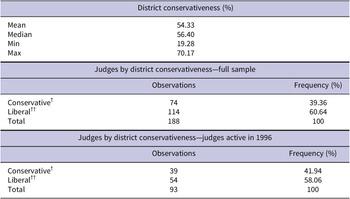
As we summarize in Table 2, our primary explanatory variable is an approximation for district-level preferences on sentencing. Our variable measures the conservativeness of each district to which a given judge was assigned. Our ideal explanatory variable would directly measure district-level punitiveness among voters—how harsh a judge’s constituents would like sentences to be. While scholars have developed national- and state-level punitiveness measures (e.g., Neill, Yusuf, and Morris Reference Neill, Yusuf and Morris2015; Enns Reference Enns2014), we are unaware of localized measures regarding voter preferences on criminal justice issues. As such, we believe our conservativeness measure sufficiently captures what judges perceive from their constituents.
Descriptive Statistics—District Conservativeness

Note: This table contains information on our measure of judicial district conservativeness, the Republican vote share in the 2000 presidential election. We obtained vote share data from the North Carolina Board of Elections. †. Republican vote share above 56.47% (statewide vote share). ††. Republican vote share below 56.47%.
To measure each district on the liberal-conservative continuum, we utilize the two-party vote in the 2000 U.S. presidential election. Presidential voting outcomes are readily available at the precinct level for the 2000 election, which allows for an almost exact matching with the judicial districts across our data.Footnote 11 Using the statewide two-party vote, we measure district conservativeness as the district-level Republican vote share—those votes cast for then-Governor George W. Bush—in the 2000 election.
There are 66 judicial districts represented by at least one judge. Vote shares for Bush in the 2000 elections lie between 19.28% and 70.17%. The unweighted mean of vote shares for Bush across districts is 54.33%. As a basis for comparison, the statewide vote share for Bush was 56.47%.Footnote 12 Thus, voting records for the 2000 presidential election indicate a high variance in the preferences of the electorate across districts. We welcome the high variance in district-level preferences, as it helps to identify whether judges with different electorates react differently to their constituents following the passage of Bill 41.
We define a judge’s district as conservative if its Republican vote share in the 2000 presidential election was greater than 56.47%, the statewide vote share. Otherwise, we classify a district as liberal.Footnote 13 We argue that this approach, and the one we take in our regression analyses further below, allows us to capture how conservative or liberal a district is relative to the entire state. Table 2 presents the distribution of judges in the sample according to their districts’ conservativeness. There are 188 judges in the whole sample. When all such judges are accounted for, those from liberal districts constitute a majority (60.64%). The distribution is very similar if we only consider the 93 judges in activity in 1996, when Bill 41 was approved.
Electorate’s preferences and sentencing decisions
As a first endeavor toward examining our responsiveness hypothesis, we consider several baseline comparisons before and after Bill 41. Figures 1, 2, and 3 illustrate how judges diverge in sentencing behavior after Bill 41. Once judges are assigned to particular districts, we observe sentences that are more tailored to the exhibited policy preferences of those district-level voters.
Assigned Sentences’ Length—Judges from Liberal and Conservative Districts.

Reaction to Bill 41—Judges from Liberal and Conservative Districts.

Reaction to Bill 41—Four Groups of Judges.

Cross-sectional comparison
Figure 1 depicts the cumulative distribution functions of the incarceration sentence length assignments by judges from liberal and conservative districts in all years in the sample. The x-axis plots the normalized sentence.Footnote 14 The figure reveals that judges from liberal districts tend to assign sentences in the most lenient range of the scale (less than 1/3) more often than their counterparts from conservative districts. The latter group of judges assigns relatively more sentences in an intermediate range (from 1/3 to 2/3). Both groups of judges assign sentences in the harshest range (from 2/3 on) with similar frequency. A two-sample Kolmogorov-Smirnov test rejects the null hypothesis of equality of the two CDFs at a confidence level of 1%.
Reaction to Bill 41
Figure 2 shows similar CDFs. This figure only considers judges that were serving at the time Bill 41 was approved. The left-hand plot depicts cases disposed by judges from liberal and conservative districts before Bill 41’s passage. The right-hand plot depicts cases disposed by the same two groups of judges after Bill 41’s passage. The distinction between the two groups of judges is not very clear in the period prior to Bill 41 (left) but becomes more evident after (right). Judges from conservative districts start assigning sentences that are harsher than the ones chosen by judges from liberal districts. It is worth noticing that the CDFs in the right-hand side of Figure 2 are similar to the ones in Figure 1. Figure 2 thus suggests that judges responded to the change in the preferences of their electorate caused by Bill 41.
A more detailed examination of the data—however—reveals that the relationship between voters’ preferences and judges’ behavior is not as simple as the previous paragraphs suggest. Figure 3 separates judicial districts into quartiles, from least to most conservative (i.e., lowest to highest level of support for Bush in the 2000 election). The figure depicts CDFs of assigned incarceration time before and after Bill 41’s approval within each quartile, revealing an interesting pattern. Judges in the first quartile become more lenient after Bill 41’s passage, while judges in the third quartile assign harsher sentences. Judges in the second quartile—who are elected by districts roughly as conservative as the whole state—seem to be less affected by the passage of the bill. All these effects are consistent with our expectations and with our observations in Figure 2. But judges in the fourth quartile, who have the most conservative districts, appear not to change their sentencing behavior at all after Bill 41.
A variety of confounding factors can make our simple analysis of histograms misleading. Taking from these figures some general impression of how judges reacted to Bill 41, our next section investigates the effects of Bill 41 in a more rigorous manner.
Empirical analysis
To expand on the descriptive evidence we found in the figures above, this section utilizes several difference-in-difference models to examine what changes in judges’ case-level sentencing behaviors occur following Bill 41, which assigned judges to specific districts.
Measuring district conservatism
As we discussed in our explanatory variable section above, our expectations require us to measure more than the dichotomy between liberal and conservative districts. To evaluate the impact of Bill 41 on sentencing behavior, we begin by defining a measure of the preferences of the judge’s post-Bill 41 district electorate by each case i. Again, we utilize an approximation of punitiveness preferences using the district-level 2000 U.S. presidential election Republican vote share. The statewide Republican vote share in that election was 56.47%. We define the following two variables:
 $$ \begin{array}{rlll}& {\mathrm{Liberal}}_i=\mathrm{max}\hskip0.3em \left\{0.5647-{\mathrm{District}\ \mathrm{Conservativeness}}_i,0\right\}& & \\ {}\mathrm{and}\hskip11.11pt & {\mathrm{Conservative}}_i=\mathrm{max}\hskip0.3em \left\{{\mathrm{District}\ \mathrm{Conservativeness}}_i-0.5647,0\right\},\end{array} $$
where District Conservativeness $ {}_i $
is the Republican vote share in the district of the judge in charge of case i. The variables Liberal
$ {}_i $
is the Republican vote share in the district of the judge in charge of case i. The variables Liberal $ {}_i $
and Conservative
$ {}_i $
and Conservative $ {}_i $
separately capture the distance from the statewide center in the liberal-conservative spectrum for liberal and conservative districts.
$ {}_i $
separately capture the distance from the statewide center in the liberal-conservative spectrum for liberal and conservative districts.
Model specifications
To evaluate the impact of Bill 41 on sentencing behavior, we then estimate the following specification:
 $$ {\mathrm{Sentence}\hbox{'}\mathrm{s}\ \mathrm{Length}}_i={\displaystyle \begin{array}{l}\alpha +{\gamma}_C\hskip2.77695pt {\mathrm{Conservative}}_i*{\mathrm{Bill}\ 41}_i+{\gamma}_L\hskip2.77695pt {\mathrm{Liberal}}_i\\ {}*\hskip2pt {\mathrm{Bill}\ 41}_i+\delta \hskip2.77695pt {\mathrm{Bill}\ 41}_i+{\lambda}_{{\mathrm{judge}}_i}+\beta {X}_i+{\epsilon}_i.\end{array}} $$
The dependent variable $ sentence $
is the log of the assigned sentence length.
$ sentence $
is the log of the assigned sentence length. $ Bill\hskip2.77695pt 41 $
indicates if the disposition of case i took place after the bill’s ratification, which we interact with our variables for district-level preferences:
$ Bill\hskip2.77695pt 41 $
indicates if the disposition of case i took place after the bill’s ratification, which we interact with our variables for district-level preferences: $ libera{l}_i $
and
$ libera{l}_i $
and $ conservativ{e}_i $
. The variables
$ conservativ{e}_i $
. The variables $ {\lambda}_{{\mathrm{judge}}_i} $
are judge-specific dummies, which we include in place of a direct measure for judicial preferences.Footnote 15 The vector
$ {\lambda}_{{\mathrm{judge}}_i} $
are judge-specific dummies, which we include in place of a direct measure for judicial preferences.Footnote 15 The vector $ {X}_i $
is a series of controls, which include a full set of dummies for the charged offense severity, as defined by North Carolina for the purpose of delimiting judicial discretion under structured sentencing. We regard these severity measures as reasonable approximations for case salience, where higher severity increases the likelihood of heightened media and public attention.Footnote 16 Other controls in
$ {X}_i $
is a series of controls, which include a full set of dummies for the charged offense severity, as defined by North Carolina for the purpose of delimiting judicial discretion under structured sentencing. We regard these severity measures as reasonable approximations for case salience, where higher severity increases the likelihood of heightened media and public attention.Footnote 16 Other controls in $ {X}_i $
include several defendant characteristics: ethnicity, gender, previous criminal history, age, and age squared. We also include dummies indicating the year of disposition and the county of prosecution of the case. Finally, we include a dummy indicating whether the case was resolved by plea bargain. In our regression analysis, we only consider cases in which incarceration time was assigned.Footnote 17
$ {X}_i $
include several defendant characteristics: ethnicity, gender, previous criminal history, age, and age squared. We also include dummies indicating the year of disposition and the county of prosecution of the case. Finally, we include a dummy indicating whether the case was resolved by plea bargain. In our regression analysis, we only consider cases in which incarceration time was assigned.Footnote 17
The coefficients $ {\gamma}_C $
and
$ {\gamma}_C $
and $ {\gamma}_L $
are the main parameters of interest. A positive value for
$ {\gamma}_L $
are the main parameters of interest. A positive value for $ {\gamma}_C $
and a negative one for
$ {\gamma}_C $
and a negative one for $ {\gamma}_L $
indicate that the sentencing behavior of Superior Court judges tends to correspond to the desires of their voters after the passage of the bill. Therefore, positive (negative) estimates for
$ {\gamma}_L $
indicate that the sentencing behavior of Superior Court judges tends to correspond to the desires of their voters after the passage of the bill. Therefore, positive (negative) estimates for $ {\gamma}_C $
(
$ {\gamma}_C $
( $ {\gamma}_L $
) are consistent with the hypothesis that judges are responsive to the electorate’s preferences. We also estimate the following specification, which allows for nonlinearities in the effects of the interactions between the passage of Bill 41i and the variables Conservativei and Liberali:
$ {\gamma}_L $
) are consistent with the hypothesis that judges are responsive to the electorate’s preferences. We also estimate the following specification, which allows for nonlinearities in the effects of the interactions between the passage of Bill 41i and the variables Conservativei and Liberali:
 $$ \begin{array}{rlll}{\mathrm{Sentence}\hbox{'}\mathrm{s}\ \mathrm{Length}}_i=\hskip-12pt & \hskip2.77695pt \alpha +{\gamma}_{C,1}\hskip2.77695pt {\mathrm{Conservative}}_i*{\mathrm{Bill}\ 41}_i+{\gamma}_{C,2}\hskip2.77695pt {[{\mathrm{Conservative}}_i*{\mathrm{Bill}\ 41}_i]}^2& & \\ {}& \hskip2.77695pt + {\gamma}_{L,1}\hskip2.77695pt {\mathrm{Liberal}}_i*{\mathrm{Bill}\ 41}_i+{\gamma}_{L,2}\hskip2.77695pt {[{\mathrm{Liberal}}_i*{\mathrm{Bill}\ 41}_i]}^2& & \\ {}& \hskip2.77695pt + \delta \hskip2.77695pt {\mathrm{Bill}\ 41}_i+{\lambda}_{{\mathrm{judge}}_i}+\beta {X}_i+{\epsilon}_i.\end{array} $$
The main parameters of interest in specification 3 are $ {\gamma}_{C,1} $
,
$ {\gamma}_{C,1} $
, $ {\gamma}_{C,2} $
,
$ {\gamma}_{C,2} $
, $ {\gamma}_{L,1} $
, and
$ {\gamma}_{L,1} $
, and $ {\gamma}_{L,2} $
. The specification is flexible enough to allow judges from moderate and extreme districts to react differently to the passage of Bill 41.
$ {\gamma}_{L,2} $
. The specification is flexible enough to allow judges from moderate and extreme districts to react differently to the passage of Bill 41.
Estimating Bill 41’s effect on sentencing
In Table 3, we present results from ordinary least squares specifications 2 and 3, as defined above.Footnote 18 Column (1)—from specification 2 above—allows for a straightforward linear relationship between our interaction terms (i.e., county-level ideology× Bill 41) and criminal sentencing. Column (2) includes linear and quadratic terms for both of our interactions, which allows for a curvilinear relationship across the polynomial in specification 3 above. Column (3)—similar to column (2)—includes only one squared term for conservative $ * $
Bill 41. Finally, columns (4) and (5) use subsetted versions of our data by district ideology; they provide straightforward—if incomplete—tests regarding whether conservative or liberal districts, respectively, lead to more lenient or punitive sentencing.
$ * $
Bill 41. Finally, columns (4) and (5) use subsetted versions of our data by district ideology; they provide straightforward—if incomplete—tests regarding whether conservative or liberal districts, respectively, lead to more lenient or punitive sentencing.
Reaction to Bill 41

Note: OLS estimates. The unit of observation is a case. Standard errors, provided in parentheses, are adjusted for two-way clustering at the judge-period levels, where period refers to pre- and post-Bill 41; $ {}^{*}p<0.10 $
,
$ {}^{*}p<0.10 $
, $ {}^{**}p<0.05 $
,
$ {}^{**}p<0.05 $
, $ {}^{***}p<0.01 $
. In columns (1)–(3), we include all nonhomicide criminal cases prosecuted from January 1995–October 2010, except for those cases in which critical information was missing, as explained in Table 1. Columns (4) and (5) include only cases decided by judges from conservative and liberal districts, respectively. The variables
$ {}^{***}p<0.01 $
. In columns (1)–(3), we include all nonhomicide criminal cases prosecuted from January 1995–October 2010, except for those cases in which critical information was missing, as explained in Table 1. Columns (4) and (5) include only cases decided by judges from conservative and liberal districts, respectively. The variables $ convict\hskip2.21384pt history $
2–6 indicate the defendant’s previous number of criminal record points, as employed by the N.C. structured sentencing rules (2 = 1–4 points; 3 = 5–8 points; 4 = 8–14 points; 5 = 14–18 points; and 6 = 19 or more points). Further controls: judge dummies, county dummies, prosecution year, and offense severity.
$ convict\hskip2.21384pt history $
2–6 indicate the defendant’s previous number of criminal record points, as employed by the N.C. structured sentencing rules (2 = 1–4 points; 3 = 5–8 points; 4 = 8–14 points; 5 = 14–18 points; and 6 = 19 or more points). Further controls: judge dummies, county dummies, prosecution year, and offense severity.
First, we examine the results as they pertain to liberal districts, where we expect the judges assigned after Bill 41 will render increasingly lenient sentences as the district constituents become more liberal. The linear terms in column (1) provide a straightforward test; given the concomitant effects of: (i) the interaction variable liberal $ * $
Bill 41 paired with (ii) the term Bill 41, we observe a negative effect on sentence length. Therefore, as a North Carolina county is increasingly liberal (i.e., then-Governor Bush’s county-level vote-share is
$ * $
Bill 41 paired with (ii) the term Bill 41, we observe a negative effect on sentence length. Therefore, as a North Carolina county is increasingly liberal (i.e., then-Governor Bush’s county-level vote-share is $ <0.5647 $
and decreasing), judges are decreasingly punitive in their criminal sentencing following Bill 41’s passage. These results for judges in liberal counties hold across Table 3’s columns (1), (3), and (5) (subsetted data). Column (4) does not include data for liberal counties. Column (2) includes a quadratic term liberal
$ <0.5647 $
and decreasing), judges are decreasingly punitive in their criminal sentencing following Bill 41’s passage. These results for judges in liberal counties hold across Table 3’s columns (1), (3), and (5) (subsetted data). Column (4) does not include data for liberal counties. Column (2) includes a quadratic term liberal $ * $
Bill 41
$ * $
Bill 41 $ {}^2 $
, which does not suggest that judicial responsiveness operates differently in districts that are more or less liberal.
$ {}^2 $
, which does not suggest that judicial responsiveness operates differently in districts that are more or less liberal.
Second, we examine whether judges assigned to more conservative districts sentence more punitively following Bill 41. Column (1)’s linear term, conservative $ * $
Bill 41, is not statistically significant.Footnote 19 Columns (2), (3), and (4), which include a quadratic term, reveal the nonlinear nature of judicial responsiveness in conservative districts; our results are consistent across those columns, the last of which uses subsetted data.
$ * $
Bill 41, is not statistically significant.Footnote 19 Columns (2), (3), and (4), which include a quadratic term, reveal the nonlinear nature of judicial responsiveness in conservative districts; our results are consistent across those columns, the last of which uses subsetted data.
First, column (2)’s linear term conservative $ * $
Bill 41 is significant; when combined with the constitutive term Bill 41, it reveals that small increases in district-level conservativeness (i.e., counties that are above but still reasonably proximate to then-Governor Bush’s statewide, county-level mean vote-share, 0.5647) correspond to more punitive sentences. Of the 50 North Carolina counties above Bush’s statewide mean vote-share, 12 of those counties were within four percentage points. Therefore, about 25 percent of conservative districts are reasonably proximate to the statewide mean. Second, column (2)’s squared term—conservative
$ * $
Bill 41 is significant; when combined with the constitutive term Bill 41, it reveals that small increases in district-level conservativeness (i.e., counties that are above but still reasonably proximate to then-Governor Bush’s statewide, county-level mean vote-share, 0.5647) correspond to more punitive sentences. Of the 50 North Carolina counties above Bush’s statewide mean vote-share, 12 of those counties were within four percentage points. Therefore, about 25 percent of conservative districts are reasonably proximate to the statewide mean. Second, column (2)’s squared term—conservative $ * $
Bill 41
$ * $
Bill 41 $ {}^2 $
—reveals that judges in increasingly conservative counties begin to sentence less punitively than their conservative colleagues in more moderate districts. Across our model specifications, we find mixed evidence regarding our responsiveness expectations. While judges in moderately conservative districts sentence more punitively, we observe the opposite relationship among judges in increasingly conservative districts. The existing judicial politics literature suggests that judge ideology would play a role in sentencing tendencies e.g., Brace, Hall, and Langer Reference Brace, Hall and Langer1998. Acquiescence to public preferences could be particularly challenging when a judicial actor is mismatched with a given district. We examine further below whether these judges end up: (1) retiring from the bench early or (2) being punished at the ballot box due to their lack of responsiveness to district voters.
$ {}^2 $
—reveals that judges in increasingly conservative counties begin to sentence less punitively than their conservative colleagues in more moderate districts. Across our model specifications, we find mixed evidence regarding our responsiveness expectations. While judges in moderately conservative districts sentence more punitively, we observe the opposite relationship among judges in increasingly conservative districts. The existing judicial politics literature suggests that judge ideology would play a role in sentencing tendencies e.g., Brace, Hall, and Langer Reference Brace, Hall and Langer1998. Acquiescence to public preferences could be particularly challenging when a judicial actor is mismatched with a given district. We examine further below whether these judges end up: (1) retiring from the bench early or (2) being punished at the ballot box due to their lack of responsiveness to district voters.
Regarding our other coefficient estimates, we note that they appear to support the reasonableness of our findings. Settled or bargained cases tend to result in shorter sentences across all columns, as do cases resolved by both public defenders or private attorneys. The coefficients for the defendant’s age and age squared are positive and negative, respectively. Both are significant, suggesting that shorter sentences are assigned to very young and very old defendants. The results also indicate that female defendants tend to receive shorter sentences than males. Moreover, Hispanics tend to be assigned shorter sentences than nonHispanic Whites, whereas the coefficients associated with African American defendants are not significant in most specifications. Finally, criminal defendants with longer criminal histories are assigned more punitive sentences. Overall, we regard these findings as comporting with our overall understandings of the justice system. Additionally, we note that all of our specifications include judge, county, and year fixed effects. This allows for us to make claims regarding our explanatory variables of theoretical importance while controlling for any judge-level, county-level, or temporal idiosyncrasies.Footnote 20
Punishments for nonresponsiveness
The results above suggest judges reacted differently to the passage of Bill 41. Judges assigned to more liberal districts exhibit responsiveness in our expect direction—assigning more lenient sentences. In districts that are marginally more conservative than the statewide mean, we observe judges assigning more punitive sentences. The sentencing behavior of judges whose districts are extremely conservative, however, do not fall in line with our expectation of responsiveness. While it is possible that these judges are simply more motivated by their individual preferences than by constituency pressures, it would seem odd that only judges assigned to more conservative districts exhibited sincere behavior.
Nevertheless, we expect that less responsive judges will be more likely to not seek reelection or to lose their reelection. We present evidence supporting this hypothesis in Table 4 below. Specifically, we examine the performance of the 93 judges in office during the passage of Bill 41 in subsequent elections between 1996 and 2002. As we discussed above, Superior Court judges serve 8-year terms; therefore, every judge serving during the passage of Bill 41 in August 1996 would be up for reelection at some point between the 1996 and the 2002 judicial elections. If it is the case that judges from very conservative districts decided not to pander to voters, then the turnover for these judicial seats should be higher than that of their peers from moderate and more liberal districts.
Electoral Performance After Bill 41

Note: This table reports OLS estimates. The unit of observation is a judge. Standard errors are provided in parentheses; $ {}^{*}p<0.10 $
,
$ {}^{*}p<0.10 $
, $ {}^{**}p<0.05 $
,
$ {}^{**}p<0.05 $
, $ {}^{***}p<0.01 $
. The sample includes all judges active at the moment of the passage of Bill 41. The dependent variable,
$ {}^{***}p<0.01 $
. The sample includes all judges active at the moment of the passage of Bill 41. The dependent variable, $ early\hskip2.21384pt exi{t}_j $
, indicates whether a judge stopped serving before 2002.
$ early\hskip2.21384pt exi{t}_j $
, indicates whether a judge stopped serving before 2002.
In our analysis below, we set the unit of analysis to be a judge. Let the dummy $ early\hskip2.77695pt exi{t}_j $
indicate whether judge j served until before 2002.Footnote 21 The dummy indicates the success of judge j in the first election to take place after the passage of the bill. To identify whether judges from the more extreme districts performed worse than their counterparts from moderate districts in the wake of Bill 41, we consider the following specification:
$ early\hskip2.77695pt exi{t}_j $
indicate whether judge j served until before 2002.Footnote 21 The dummy indicates the success of judge j in the first election to take place after the passage of the bill. To identify whether judges from the more extreme districts performed worse than their counterparts from moderate districts in the wake of Bill 41, we consider the following specification:
 $$ \begin{array}{rl}{\mathrm{Early}\ \mathrm{Exit}}_j=\alpha +{\theta}_l\hskip2.77695pt {\mathrm{Liberal}}_j+{\theta}_c\hskip2.77695pt {\mathrm{Conservative}}_j+{\epsilon}_j,& \end{array} $$
where $ {\mathrm{Liberal}}_j $
and
$ {\mathrm{Liberal}}_j $
and $ {\mathrm{Conservative}}_j $
are defined as in (1). The parameters of interest are
$ {\mathrm{Conservative}}_j $
are defined as in (1). The parameters of interest are $ {\theta}_l $
and
$ {\theta}_l $
and $ {\theta}_c $
. A positive
$ {\theta}_c $
. A positive $ {\theta}_l $
indicates that, among judges from liberal districts, the turnover following the approval of Bill 41 is higher for judges whose districts are more extreme. Similarly, a positive
$ {\theta}_l $
indicates that, among judges from liberal districts, the turnover following the approval of Bill 41 is higher for judges whose districts are more extreme. Similarly, a positive $ {\theta}_c $
indicates that, among judges from conservative districts, judges from extreme districts have higher turnover than those from relatively moderate districts.
$ {\theta}_c $
indicates that, among judges from conservative districts, judges from extreme districts have higher turnover than those from relatively moderate districts.
Table 4 presents the results of probit estimation of specification 4 above. The estimated coefficient for judges in liberal districts is not statistically significant. In contrast, the estimate for judges in conservative districts is 7.08 and significant at 5%. This suggests that judges assigned to conservative districts after Bill 41 were more likely to leave office or lose their reelection. These results are consistent with the evidence that judges from very conservative districts were the ones to react the least to the passage of Bill 41. Taken together, the results from this section and the previous ones suggest that judges from the most conservative districts did not pander to voters and, as a consequence, were subsequently punished at the ballot box. Above, we suggested several possible reasons why a judge might not exhibit responsiveness. First, some judges may be attentive to different audiences for career advancement. Second, judges may prioritize their sincere policy preferences over satisfying voters. Third, a judge assigned to a particular district may realize that reelection is unlikely. Fourth, and finally, judges operate in concert with prosecutors—a constraint that may be more severe on some judges in some locations. While we do not have sufficient data to adjudicate among these possibilities, we believe the empirical evidence paired with several plausible explanations provides a compelling story—and one that is likely worth further investigation.
Conclusion
This paper examines how the sentencing behavior of elected trial judges is affected by changes in electoral incentives. With this intent, we explore a unique change in the electoral rules for North Carolina’s main trial court. Bill 41, passed in 1996, changed the selection method of Superior Court judges from statewide to district-level elections. We argue that the change in size and scope of the judges’ constituencies pressure judges to change their sentencing behaviors. Judges assigned to more liberal districts would sentence more leniently, while those assigned to more conservative districts would sentence more punitively. For judges who do not tailor their criminal sentencing to local preferences, they risk losing their office.
We provide evidence that some judges adapted their sentencing decisions to suit their constituents’ preferences. Specifically, judges from liberal districts became relatively more lenient, while those from moderately conservative districts started assigning harsher sentences. However, judges from the most conservative districts did not respond as we had expected to their new local constituents.
Our findings comport—in part—with a theory of responsive judicial behavior. But importantly, we note that further research must be done to examine why certain judges do not alter their official behavior in response to institutional changes. First, future work might examine whether judges’ preferences are symmetric around their ideal points. Our results suggest that some judges did not assign sentences that were much more punitive, in line with the conservativeness of their districts. Second, a possible line of inquiry includes whether some judges are ambitious office seekers, who are less responsive to local preferences and instead cater to a broader audience or constituency—whether it be the statewide electorate, the governor, or certain federal officials. Additionally, while our models include judge-level fixed effects, we importantly note the astute reviewer comments—that it would be interesting to have a direct measure of judicial preferences.
We then explore one possible implication of these main results—namely, whether some judges’ lack of responsiveness impacts their chances of reelection. We provide support for this hypothesis by comparing the electoral performance of judges from moderate and extreme districts in the wake of Bill 41. We show that judges from the most conservative districts, which are precisely the ones whose sentencing patterns were not affected by the bill, face lower chances of reelection than their counterparts from liberal and moderately conservative districts.
In this research, we strive to contribute to the literature on electoral connections between judges and voters. While it is well established that variations in electoral institutions lead to disparate policy outcomes, it is not altogether clear that this fits with the expectations we have for objective or impartial courts. At the very least, this research presents a step forward in understanding the fine-grained nature of how judges exhibit responsiveness to voters. Furthermore, the enduring judicial reform movement results in regular changes in judicial selection and retention. As such, we expect to observe many more systematic variations in how judges resolve disputes in court.
Acknowledgements
The authors sincerely thank J.B. Duck-Mayr, Dino Hadzic, James L. Gibson, Sanford C. Gordon, Alessandro Lizzeri, Michael J. Nelson, Miguel M. Pereira, Andrew R. Stone, Nicholas W. Waterbury, and conference participants at the 2019 American Law & Economics Association Annual Meeting for their thoughtful comments that have significantly improved this manuscript. Replication materials are available at the Dataverse archive for the Journal of Law and Courts: https://dataverse.harvard.edu/dataverse/jlc.
Supplementary materials
To view supplementary material for this article, please visit http://doi.org/10.1017/jlc.2022.19.



 Open access

