

The following article seeks to reassess the study of archaeological fieldwork archives. Rather than considering the archive as a source of archaeological information, this research focuses on the production and transformation of archaeological evidence in the archive. Archaeological archives rarely reflect a single reality of either archaeological results or the excavation that they record. For this reason, this article argues that research needs to focus on engaging with archaeological and recording processes—as revealed in the archaeological field archive—rather than on reinterpreting past results or reestablishing historical narratives of excavations. Archival and archaeological processes have a direct impact on the creation and transfer of archaeological evidence (Baird and McFadyen Reference Baird and McFadyen2014:14). By evaluating the historical archiving process, many past practices, biases, silences, and distortions are revealed, which can better inform future archaeological archiving and recording (Carter Reference Carter2006:1; Wallace Reference Wallace2010:186). A sometimes-tenuous relationship exists between archaeology and its archives, leading to many of the problematic considerations discussed below. This is apparent in the emphasis on the collection and creation—rather than use—of archaeological archives and the lack of consistency in methodological approaches across published literature and projects (Brown Reference Brown2003, Reference Brown2007; Merriman and Swain Reference Merriman and Swain1999). In addition, there is the problematic and widespread interpretation of the archive as a final stage of an archaeological project (Swain Reference Swain, Skeates, McDavid and Carman2012). Despite much evidence to the contrary, excavation is often seen as the most important source of archaeological evidence, and it has been described as the “signature” of the discipline (Cherry Reference Cherry2011). Excavations have led to both the “storage” and “publication” crises (Cherry Reference Cherry2011; Fagan Reference Fagan1995; Kersel Reference Kersel2015; Merriman and Swain Reference Merriman and Swain1999; Swain Reference Swain, Skeates, McDavid and Carman2012). The ongoing importance of the archaeological archive both in its use—from reassessment of excavations and engagement with colonial origins of archaeology to a broader archaeological historiography—as well as its continued accumulation, means that it needs to be conceptually and methodologically reassessed. Other disciplines, particularly archival studies, provide valuable theories and methodologies that deserve to be properly considered from an archaeological perspective. Here, a holistic approach to the study of archaeological archives is adopted. There are several reasons for this. The first is that other disciplines—including, but not limited to, the archive profession—have developed useful methods and concepts. However, the second reason is that these approaches have often developed independently, with little or no integration. There is often a failure in archaeology to engage with archives critically and understand their role in the production or construction of knowledge. All too often, archaeological archives are considered primarily as repositories of information, used to establish “lost” narratives without considering what they say about archaeological processes and the development of the discipline. Therefore, this research considers a wide range of methods and theories as a starting point in assessing what archives can reveal about archaeological processes. The archive is one of, if not the only, resource available to understand and assemble all the different aspects of archaeological knowledge by looking at both the content and formation of knowledge within it.
The main portion of this article details a case study based on a set of archive material from the Petrie Museum of Egyptian and Sudanese Archaeology, University College London (UCL) to provide practical examples of the methods established. The first section introduces the data and archive material, followed by the main methods applied to the material. These practical examples are followed by a results section, which provides information on key areas of the archaeological archives analyzed. A final discussion section highlights some of these issues further—in particular, omissions, distortions, and absences in the archive—and it considers the broader applicability of the methodology developed.
BACKGROUND
The following research is very much inspired by the archival turn that resulted from a broad shift in seeing the archive-as-source to the archive-as-subject (Stoler Reference Stoler2009). Analysis of materials within their original context and thinking about the original purpose of archives can reveal the complexities of the production of a particular type of knowledge. In contrast, reading against the archival grain is a way of applying key contextual differences to the information in the archive, extracting this information and questioning it based on current knowledge and biases rather than in the construction of the archive itself (Rutherford Reference Rutherford2009; Stoler Reference Stoler2002, Reference Stoler2009). Furthermore, understanding the intended use of archive material allows researchers to reconstruct other narratives that the material may reveal, which archaeological practice and museums have a duty to engage in (Riggs Reference Riggs2016).
The focus in the case study and examples is on early twentieth-century archaeological fieldwork archives. They represent the beginning of a more formalized and standardized approach to archaeological recording, so they permit more interpretation of the archaeological and recording methods used, as well as how these continue to be used in the twenty-first century. A fundamental consideration in research across archival literature is the role of “context.” However, different studies and disciplines emphasize different types of archival contexts and processes. This includes the contexts before the creation of a record, both in broad and specific terms as well as during and after the creation of records and their accession into and archive collection (Portuondo Reference Portuondo2016; Stanley Reference Stanley, Moore, Salter, Stanley and Tamboukou2017; Wylie Reference Wylie2016). Archaeological archives continue to have traces of the political, elite, and—in many cases—colonial structures in place at their creation that, in turn, continue to influence the production of archaeological knowledge (Riggs Reference Riggs2019a, Reference Riggs, Bärnighausen, Caraffa, Klamm, Schneider and Wodtke2019b).
For this reason, when using archaeological archives, a large number of agents and agencies need to be considered (for example, the creator, archaeologist, archivist, curator, researcher) who play different roles in the creation and formation of archival collections (Portuondo Reference Portuondo2016; Yale Reference Yale2016). A major complication in understanding the creation context or process of fieldwork archives is when their “creation” occurs: does it occur during fieldwork (when a feature is excavated), prior to excavation (regarding decisions about how fieldwork is going to be conducted and recorded), or afterward (when the material is compiled and transferred to an archive or institution). All of these aspects, as well as associated institutional influence—and often, control—can affect the interpretation of documents and the way knowledge is produced and actively transformed in the archaeological archive (Assmann Reference Assmann, Erll and Nünning2010; Brusius Reference Brusius2017; Zeitlyn Reference Zeitlyn2012). These questions are particularly important when considering historical archaeological archives that were not necessarily created with the intent of being archived and curated into institutions.
Therefore, the examples below consider a wide range of these processes or contexts from before the creation of archives, through their curation, to the researcher context today (Stanley Reference Stanley, Moore, Salter, Stanley and Tamboukou2017; Table 1).
Simplified Typology of Contexts and Processes Considered When Analyzing the Archive Material in the Case Study.

DATA
The records considered in this case study are from an excavation led by the British School of Archaeology in Egypt (BSAE). The BSAE was set up in 1905 by (William Matthew) Flinders Petrie and was run out of University College London. After the school was closed in 1956, its archive material was given to the Petrie Museum of Egyptian and Sudanese Archaeology in University College London (Stevenson Reference Stevenson2019:11). The examples considered are all from the same excavation season. Sponsored by the BSAE, the excavation took place at the archaeological site of Abydos in Egypt between 1921 and 1922. Abydos is an extensive archaeological site in Upper Egypt composed of different areas, including mortuary landscapes, temples, and a town (for more information on the site and previous excavations, see O'Connor Reference O'Connor2009). Using one of Petrie's excavations for this research is especially relevant due to the widespread influence of many of his excavation and recording methods, which were published in 1904 in Methods and Aims in Archaeology. Often dubbed the "Father of Scientific Archaeology," using Petrie’s excavation archives are ideal for this case study due to his influence on the development of fieldwork methods (Drower Reference Drower1985; Murray Reference Murray1961). This is not to mention the large number of influential archaeologists, such as George Reisner or O. G. S. Crawford, who conducted fieldwork in Egypt, and many, such as Francis Llewellyn Griffith and John Garstang, who trained under Petrie (Crawford Reference Crawford1955:91; Drower Reference Drower1985:85; Greaves and Rutland Reference Greaves, Rutland and Greaves2015:21; Hauser Reference Hauser2008:24). This makes archives from Egyptian excavations a germane place to consider the way that knowledge is produced in archaeological archives more widely.
Between 1921 and 1922, Petrie and a team of archaeologists and Egyptologists—including Hilda Petrie, Henri Bach, Ethel Bensen, Gertrude Caton-Thompson, Elmer Montgomerie Neilson, and G. W. H. Walker—led an excavation in parts of the North Cemetery at Abydos (Figure 1). This work mostly focused on a series of three sets of subsidiary burials, referred to as the “Tombs of the Courtiers,” each associated with a king or queen of the First Dynasty—Djer, Djet, and Merneith—each of whom is actually buried in another part of Abydos, the Umm el-Qa'ab (Petrie et al. Reference Petrie, Gardiner, Petrie and Murray1925). Each of the subsidiary burials is similarly laid out and as can be seen on the plans below, the burials are arranged in single rows, likely interred at the same time. About 30 graves from one of the rows of First Dynasty burials had previously been excavated by Peet in 1911 as part of a cemetery “S,” and it was on this basis that Petrie decided to explore this part of the North Cemetery (Peet Reference Peet1914; Petrie et al. Reference Petrie, Gardiner, Petrie and Murray1925:1). At least 525 of these burials were excavated over the course of the season, which were referred to and published as the Tombs of the Courtiers in 1925 (Petrie et al. Reference Petrie, Gardiner, Petrie and Murray1925). The 1925 excavation report is relatively brief and does not contain detailed information about the burials—only 121 are listed in the published tomb registers in the appendix, and this information is limited. The main source of information for these burials can be found in the archives of the Petrie Museum. The archives available include
• 682 tombcards
• Two notebooks
• 143 photographs (negatives)
• Other museum documentation (accession registers, object distribution lists, etc.)
• 200 objects from the excavations
Plan of the three enclosures as published by Petrie and colleagues in 1925.

Tombcards
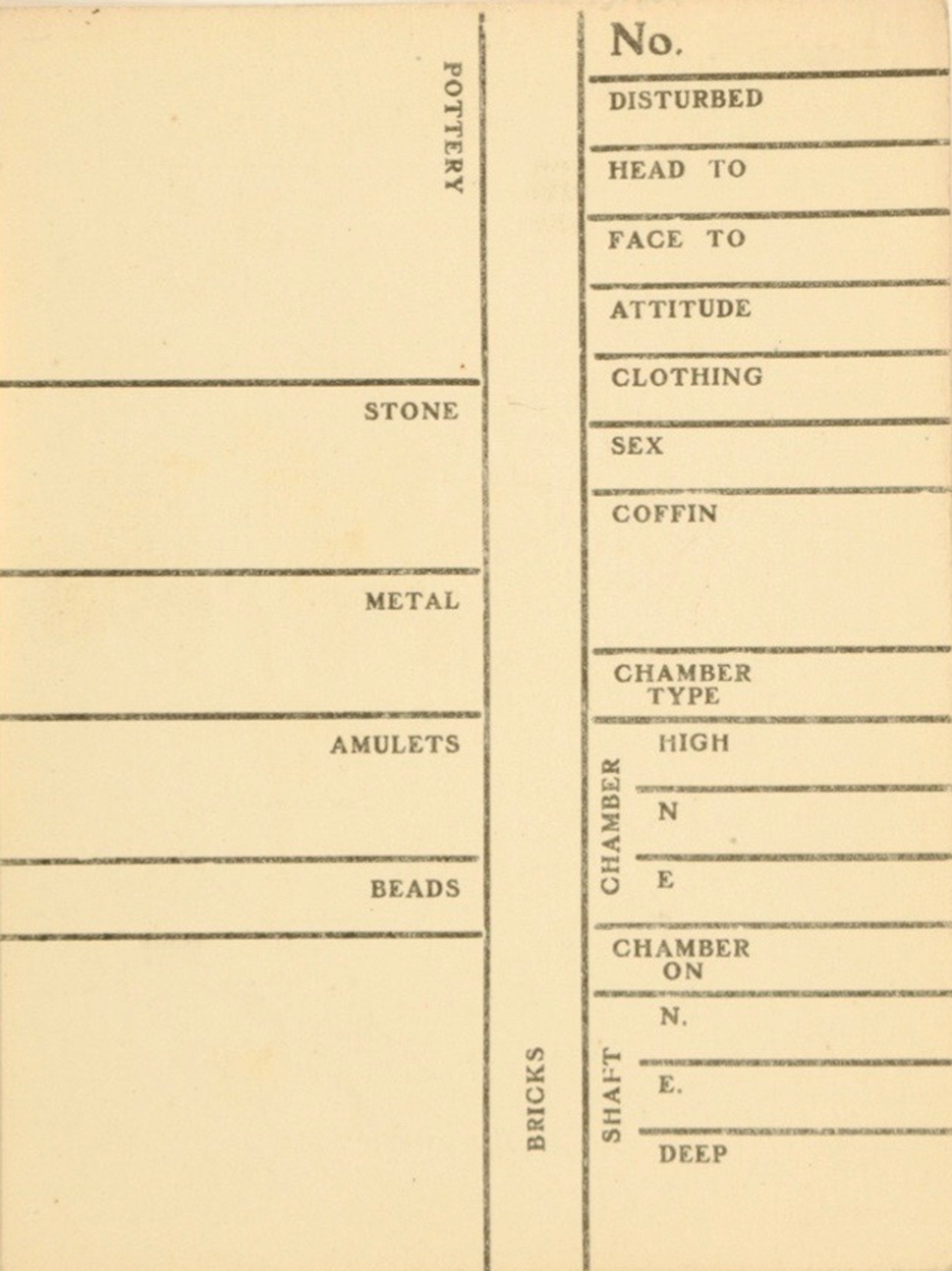
The 682 tombcards are relatively small (115 × 90 mm) preprinted cards that were filled out at the time of the excavation (Figure 2). As can be seen on the figure below, they were designed to record several aspects of the burials, which can be split into roughly four types of information:
(1) Basic contextual information (e.g., the number of the grave, whether or not it is disturbed)
(2) The interred individual (e.g., the position and orientation of the skeleton, coffin, clothing)
(3) The physical properties of the grave itself (e.g., dimensions, number of chambers, superstructure)
(4) Objects and artifacts found in or associated with the grave (e.g., pottery, metal, amulets)
Blank example of the type of tombcards used in the 1921–1922 season at Abydos London (no accession number). (Courtesy of the Petrie Museum of Egyptian and Sudanese Archaeology, UCL.)
Petrie and the BSAE were by no means the only ones to use tombcards in Egypt at the time, and they were used at several archaeological sites. Their exact origin remains unclear, and it seems George Reisner was using a non-preprinted version of tombcards as early as 1899–1902 (Stevenson Reference Stevenson2019:92). The Egypt Exploration Fund also used tombcards from 1908,Footnote 1 although in a slightly different format, and from 1910, tombcards of the type shown above seem to have become an essential part of the recording of burials on BSAE sites.
Notebooks
The notebooks are pocket style (165 × 110 mm), kept by Petrie on most of his excavations. There are two notebooks relating to the 1921–1922 excavation season: notebooks 5a and 76. Unlike the tombcards, these contain less standardized and more varied information—including survey notes, sketches, and skeletal measurements.
Photographs
There are 143 negatives that relate directly to the Tombs of the Courtiers excavations, 49 of which were not included in the 1925 publication (Petrie et al. Reference Petrie, Gardiner, Petrie and Murray1925). These images range from general shots of Abydos and the excavation to the graves and some of the objects. Most of the negatives are numbered with the grave number, and they can be associated to specific burials.
Museum Documentation and Other Archives
Other material considered in the research include the museum accession registers for objects associated with the Tombs of the Courtiers excavations as well as object distribution lists. The object distribution lists were particularly useful in their reference to objects that were sent to institutions other than the Petrie Museum. There are 18 lists available in the Petrie Museum (PMA/WFP1/D/25/1–PMA/WFP1/D/25/18).Footnote 2
Objects
There are 200 objects in the Petrie Museum that can be provenanced to the Tombs of the Courtiers excavation, many of which can be associated with a specific tomb either through accession information, object marks, or both. Objects from the 1921–1922 seasons can also be identified in other institutions through the object distribution lists and the Artefacts of Excavation Project.
METHODS
The first type of archive material considered were the 682 tombcards. The first aspect to highlight is that the majority of these are numbered in the top right-hand corner. This number normally refers to the number of the grave that can be associated with those on the plans published in 1925. Slightly confusingly, despite there being only 682 cards, these are numbered between 1 and 1,003. Although at first it seemed possible that some cards were missing within the archive, there is also a discrepancy in how the cards were numbered. Certain numbers were reused across multiple cards, other cards record multiple grave numbers, and others are not numbered at all (some are blank, they contain vague descriptions of the location, or they have alphanumerical values that do not correlate with the publication).
To make sense of the inconsistencies in the numbering of the cards, each was assigned a new “TC” (for tombcard) number between 1 and 682 in numerical order to comprehend how they had originally been numbered. Part of the table created can be seen below, and it shows the new TC numbers and the original identifiers used on the cards (Table 2).
Part of the Table Showing the New Assigned “TC” Numbers in Relation to the Identifier in the Top Right-Hand Corner of the Tombcards.

As is clear from the table, this starts off relatively consistently: TC1 records burial number 1, TC2 is 2, TC3 is 3, and so on, until TC15, which records grave 20a. This is but one instance of a gap in the numerical sequence in the cards (there are no cards recording a burial 16, 17, 18, or 19). Assigning the cards their own numbers facilitated the identification of which grave numbers or identifiers were used on the cards and how. This revealed that although there are 682 cards numbered between 1 and 1,003, only 725 of these numbers are used, and there are several numerical gaps in the sequence. Sometimes these gaps may be of only one number, and in other cases, an entire sequence is missing. To complicate matters further, some numbers are repeated on several cards, some cards are blank in the top-right hand corner, and others have a descriptive or alphanumerical identifier (e.g., 20a, 20b, 20c, or “South Shuna Wall”).
Despite the inconsistencies in the numbering of the tombcards, the identifier in the top right-hand corner can be used to cross-reference information available on the burials from across the different sources considered. For example, grave 461 has at least three different archival sources (Figure 3):
(1) A tombcard (TC396)
(2) A sketch in notebook 5a
(3) A photograph (PMAN210)
Three different archival records for tomb “461”: (a) sketch in notebook 5a; (b) tombcard (TC396); (c) negative (PMAN210), Petrie Museum of Egyptian and Sudanese Archaeology, University College London. (Courtesy of the Petrie Museum of Egyptian and Sudanese Archaeology, UCL.)

Grave 461 also appears on the published tomb register, and some of the information recorded clearly indicates that these sources are all referring to the same grave.
Beyond written sources, 200 accessioned objects in the Petrie Museum originate from the 1921–1922 excavations at Abydos. Of these, 186 are attributed to 57 specific burials from the Tombs of the Courtiers. Three of these no longer have tombcards associated with them, but the remaining 54 do, which gives a total of 172 objects that should be described on the relevant tombcards. For example, UC17456 is a ceramic jar provenanced to grave 228, and it is clearly referenced on the correct tombcard (TC193; Figure 4). However, 48 of the 172 objects (28%) are not described on the tombcard for the burial with which they are associated.
Tombcard for grave 228 and UC17456. (Courtesy of the Petrie Museum of Egyptian and Sudanese Archaeology, UCL.)

In addition to archaeological data, the material in the archive also includes references to the running of the excavations. This includes names on the back of 99 of the tombcards (Figure 5). These are likely those of Egyptian Quftis who helped supervise the excavations (Quirke Reference Quirke2010). There is also evidence for different handwriting, which suggests that at least six different people were involved in the writing up of the tombcards. However, few of the cards are dated or even refer to Abydos explicitly.
Back of the tombcard for grave 33, with names “Hasan” and “Mhd Sayd.” (Courtesy of the Petrie Museum of Egyptian and Sudanese Archaeology, UCL.)

RESULTS
Based on the different contexts of archival data established in Table 1, the following section outlines some of the main results from the study, particularly regarding the production and construction of knowledge.
Most of the burials discussed in the 1921–1922 archive material possess a unique tomb number, which can be used to cross-reference information across the 1925 publication, the tombcards, the notebooks, as well as other types of archival information. However, these are sometimes ambiguous due to inconsistencies of recording across the different archival media. Although an original hypothesis in the early stages of this research was that the absence of numbers on the tombcards was because they had been used for other archaeological features, the content of some of the tombcards indicates that they were not all used to record burials. In addition, several tomb numbers used in the publication, notebooks, and Petrie Museum catalog do not have tombcards. Whether these are missing or were never completed is unclear. For example, a burial numbered 121 is attested to in the notebooks, the publication, objects, and museum documentation, but it does not have—or, at least, no longer has—a tombcard associated with it. Therefore, to make effective use of the tombcards and notebooks, an understanding of the broad context of the site and archive material, as well as the context of each of the tombcards or notebook entries, is essential (Lutkehaus Reference Lutkehaus and Sanjek1990; Stanley Reference Stanley, Moore, Salter, Stanley and Tamboukou2017; Wylie Reference Wylie2016).
Thinking about the site archives within different contexts can also help establish the way in which knowledge from the excavation was translated into the archives and later published. This is particularly evident when looking at the various types and amount of information available on different records of the same foundational archaeological evidence. For example, the tombcard for burial 461 is relatively sparse and contains very little information, other than the dimensions of the grave. Based on the tombcard, burial 461 appears to contain no skeletal or artifactual remains. However, both a separate photograph and sketch of the burial provide more information on this burial, including detailed information on the types of artifacts (Figure 3). Consequently, each of the three different types of record provides a slightly different perspective on the same archaeological evidence, and it is only with holistic analysis of the entirety of evidence available that an accurate understanding of the data can be attained.
Another example of this can be seen through grave 328, which, again, has a relatively incomplete tombcard. As with burial 461, this grave has a particularly detailed sketch included with the tombcards, but it was made on the back of a discarded envelope (Figure 6). It is possible that in examples such as these, the tombcard was left incomplete due to the information having been recorded in a different medium. However, given the haphazard nature of a sketch on the back of a used envelope, this also raises the question of how many other records of this type have not survived.
Sketch of grave 328 on the back of an envelope in the Petrie Museum archive (no accession number). (Courtesy of the Petrie Museum of Egyptian and Sudanese Archaeology, UCL.)

In some cases, rather than simply providing different amounts or types of information, the various records of a burial offer contradictory evidence, which is reflected in the publication of the excavation in 1925. UC18217, a ceramic bowl in the Petrie Museum, is a clear example of this inconsistent transfer of information. The bowl still has a clear pencil mark on it from the excavation that associates the object with the Tombs of the Courtiers grave 537. However, there is no reference to any objects having been found on the relevant tombcard. Grave 537 is also one of the burials listed in the published tomb register, but again, there is no reference to any associated pottery. There are also several photographs of grave 537 that clearly show ceramic artifacts in situ (Figure 7). Therefore, it appears that even when the information is available in alternative media, parts of the 1925 publication are based, primarily, on the information provided by the tombcards, which in several cases do not contain all the recorded evidence from the burials.
Photograph of grave 537 PMAN146. (Courtesy of the Petrie Museum of Egyptian and Sudanese Archaeology, UCL.)

Use of Tombcards
As already mentioned above, the use of tombcards was a conscious decision that influenced how archaeological data at Abydos was recorded. The type used by the Petrie and the BSAE, slightly different from those used by other excavators in Egypt, appears to be a formalization of previous methods of excavation. Petrie's Reference Petrie1904 publication, Methods and Aims in Archaeology, outlines a near-identical method of recording graves before his use of tombcards on archaeological sites. This includes recommendations of 12 types of information:
(1) Position relative to other tombs
(2) Size of pit (direction, depth)
(3) Position of chamber
(4) Filling intact or estimate of time open
(5) Objects found loose
(6) Chamber plan
(7) Primary or secondary burials
(8) Position of body, head direction, face direction, attitude of body and limbs
(9) Position of beads and small objects on body
(10) Coffin or cartonnage
(11) Inscription or figures, if any
(12) Position and nature of all objects
Each of these is reflected on the tombcards later used in BSAE excavations.
It remains unclear why Petrie chose to move to this more formalized method of archaeological recording. It is possibly a consequence of the excavation of extensive cemetery sites, where it would be impossible for Petrie himself to record every burial uncovered. Certainly, by the end of Petrie's career, tombcards were given to each of the Western staff when working on cemetery sites (Drower Reference Drower1985:389).
To this end, they may simply be a way of making other team members follow his required recording methods—already established in 1904, if not before—to his standards. From Petrie's own description of the excavations of an extensive cemetery at Naqada in 1895, a complex burial could take several hours to record effectively (Petrie and Quibell Reference Petrie and Quibell1896:ix). Therefore, a combination of his own experience of recording at extensive cemetery sites, the emphasis on systematic recording, the number of Western staff on his excavations, and the importance of find distributions at the end of an excavation likely inspired Petrie to use tombcards on his own excavations. To what extent Petrie was influenced by other members on his excavations, or in discussion with other archaeologists working in Egypt and already using tombcards or formalized recording, is unclear. That said, potential influences on the decision to use BSAE tombcards and on their design should not be dismissed, particularly on their format. But their clear reflection of Petrie's 1904—and to a lesser extent, 1896—recommendations on the recording of graves suggests an independent conceptual development. Unfortunately, an early explanation by Petrie himself on tombcards—in the 1914 publication of a 1912 excavation at the site of Tarkhan—makes no reference to the reason for their adoption or conception:
Each grave when opened was drawn on the register-card at its correct azimuth on the ground; the distance of the N.E. corner was then measured up the axis, and along at the nearest boundary of the 50-foot strip; the length, breadth, and depth were then noted. The position of the skeleton and the pottery was drawn on the back of the card. Notes were filled in about disturbance, direction of head and face, sex, clothing, coffin; old types of pottery or stone vases were identified from a set of plates of types and recorded on the card, as well as any other objects found in the grave. The bones were then measured, removed, and the ground finally searched for beads and other small objects [Petrie Reference Petrie1914:2].
Petrie's reference to cards as “register cards” rather than tombcards may reflect one of their key purposes, linked to the publication and dissemination of the excavation. They certainly appear to have had a direct link with the tomb registers published in excavation reports. As an aside, Petrie was certainly no stranger to the advantage of recording information on slips of paper or cards that could be easily contrasted and compared, and this was one of his fundamental methods for developing seriation or sequence dating based on the ceramic remains from graves excavated at Naqada. In his own description, Petrie wrote that he created 900 paper slips, each representing a different tomb, with the types of pottery found in each (Petrie Reference Petrie1899). These could easily be rearranged and classified by Petrie based on his interpretation of the relative dates for each of the defined pottery types. Although these paper slips are likely an independent development by Petrie, the obvious advantages of being able to rearrange and reclassify them easily may have also influenced his decision to use tombcards. The number of different requirements on the tombcards means that they can easily be resorted or classified based on the different elements recorded (e.g., by pottery type, type of superstructure, etc.). This emphasizes particular aspects of recording over the archaeological context itself and the geographical location of the graves, which are more likely to be grouped based on either the presence or lack of particular elements.
Previous Excavations
In addition to the influence on the recording methods used, previous excavations at Abydos had a direct influence on the 1921–1922 season. Parts of one of the rows of First Dynasty burials, and some of the surrounding graves, had previously been excavated by Thomas Eric Peet in 1911 for the Egypt Exploration Fund as part of a cemetery “S,” and it was on this basis that Petrie—as stated in the opening of the 1925 excavation report—decided to explore this part of the North Cemetery (Peet Reference Peet1914; Petrie et al. Reference Petrie, Gardiner, Petrie and Murray1925:1). Interestingly, one set of burial numbers—those used for the North row of Merneith's enclosure—are based on Peet's previous excavation of these some graves in 1911 (Figure 8).
Numbers used by Peet in the 1911 excavation of tombs in the north of the enclosure of Merneith. The numbers in red indicate those reexcavated in 1921–1922 and assigned the same number. Blue numbers are used in both seasons but in references to different tombs, and green numbers are not used in 1921–1922. (Data taken from Peet Reference Peet1914 and Petrie et al. Reference Petrie, Gardiner, Petrie and Murray1925)

However, these appear to be the only numbers used by both excavation seasons to refer to the same burials, given that other numbers do not correspond across the 1921–1922 plan and Peet's excavation in 1914. What should be the same “burials” are sometimes recorded differently by Peet and Petrie, which seems to suggest that some of the burials are different—despite being recorded as the same number and placed in the same location on the map. When the number from the 1911 excavation refers to another type of burial, these are often reassigned to different burials in the 1921–1922 excavation season. For example, Petrie refers to 79 subsidiary burials around the enclosure of Merneith. These are numbered 161–169, 204–210, 212–214, 220–229, 230–239, 240–275, and 300–304. The northern row of these (161–169, 204–210, 230–239, and 300–304) are based on Peet's 1911 numbering of the same set of burials. However, most of the other numbers used by Petrie for the other subsidiary burials in the square of Merneith (e.g., 240–275) had previously been used by Peet for later Middle Kingdom shaft burials. Nevertheless, this demonstrates that the 1911 excavation had an influence on not only the focus of the 1921–1922 season but also the archival records. It seems likely that the other numbers used during the Tomb of the Courtiers were also based on this initial sequence, with different team members assigned different sets of numbers, which could explain some of the longer gaps. There are precedents for this at other sites in Egypt, where different cemeteries were assigned sequences of numbers (Brunton Reference Brunton1927).
DISCUSSION
Many of the problems and inconsistencies in the archive material from the Tombs of the Courtiers will be familiar to researchers who use, and indeed create, archaeological archives and records. Although this archive is particular in many ways to its historical, cultural, and geographical context, the evidence for issues, influences, and biases can be drawn out to archaeological archives more broadly. Each of the contexts discussed in Table 1 has the potential to influence the creation, access, and use of any archaeological archive, and the above case study merely highlights some practical examples of this. Of course, different archives will have their own particularities and quirks. Nevertheless, these apparent idiosyncrasies can be problematized and generalized through the different archival contexts and processes outlined. Drawing on examples from the case study, the following discussion addresses two of the fundamental issues with the production of knowledge in archaeological archives more widely: the distortion and absence of archaeological evidence.
Archival Distortion
The creation of archives in the field can result in a bias, or amplification, of certain information and types of information in the resulting records and archives. Archaeological remains such as those excavated from the Tombs of the Courtiers often lose their individuality in published reports. Conversely, burials that are different are more likely to be discussed individually, thereby amplifying nonnormative ones at the expense of more general trends. In this way, it could be argued that the 1925 publication emphasizes differences in the original archaeological record, whereas the archive—by its more repetitive and standardized nature—emphasizes similarities and the norm. This aspect of “distortion” of knowledge—specifically, the incongruity between the published volume and the “primary” material of the archive itself—needs to be carefully considered when examining the archaeological archive, not just in terms of the evidence excavated but in the presentation of the fieldwork processes themselves.
For example, the archives considered in the above case study all present a Western perspective of archaeological excavations. They emphasize the foreign team members and make little reference to modern Egypt or Egyptians. As with Egyptology, as a discipline in general, and museums that house the products of excavations such as Petrie's, discussed above, this archive was shaped and influenced by colonialism and elitism (Colla Reference Colla2007:10; El Shakry Reference El Shakry2007:2). Petrie's own views as an avowed eugenicist (Brusius Reference Brusius2017; Challis Reference Challis2013) also influence the content and formation of his field archives (as an obvious example, the cranial measurements included in the notebooks). The Egyptian context can still be identified within these archives, be that in the presence of names or the influence of Egypt and Arabic in the archives (for example, the use of redîm to refer to surface debris). The local context still influenced the formation of these archives and the production of archaeological knowledge (El Shakry Reference El Shakry2007:2).
These distortions and specific perspectives of archaeological narratives highlight a key issue in the nature of the archaeological archive. The aim of an archaeological archive is typically defined as ensuring the potential “reexamination” or “reinterpretation” of archaeological activities (Swain Reference Swain and Brown2007). These definitions present a stark contrast to definitions presented by the archival profession that emphasize the preservation or use of archives as distinct from their original purpose. For many archaeologists, there is a clear distinction between material relating to the evidence excavated or uncovered (be it documentation or artifacts) and material relating to the history of the archaeological process (e.g., administrative records, personal material, etc.; Fowler and Givens Reference Fowler, Givens, Silverman and Parezo1995; Kirakosian and Bauer-Clapp Reference Kirakosian and Bauer-Clapp2017:298). Both types of material can be considered part of the archaeological record given the importance of the creation context of archival materials in fieldwork and related research. The archaeological archive is described as unusual due to the preservation of both documentary and material collections (Perrin et al. Reference Perrin, Brown, Lange, Bibby, Carlsson, Degreave and Kuna2014:19). Materials, not just paper records, have always played a—if not the—major role in archaeological archives. The inclusion of a range of materials within the archaeological archive also bestows different roles on some of these materials, based on how they are used and engaged with. Therefore, archaeological archives or records take on several roles: historical artifacts, objects to be studied or displayed, and containers of excavated archaeological evidence.
Looking at archival concepts and theories beyond those specific to archaeological archives can be a useful way to consider the complex nature of the archive. This includes the records continuum, which provides an interlinked model of connection between the social and organizational value of archives (McKemmish Reference McKemmish2001:335; Upward Reference Upward1996), which, of course, is of immense importance from the archaeologist's perspective (Figure 9).
The Records Continuum (dimensions in blue, axes in red). (Reproduced from Upward Reference Upward1996:273, Reference Upward, McKemmish, Piggott, Reed and Upward2005:203).

The records continuum is composed of several axes and dimensions that represent different recordkeeping activities. Records can be used, and can develop, in different ways while still feeding back into acts and activities. The axes of the continuum are used to represent different aspects of accountability and how these develop over the continuum, whereas the dimensions represent different types of potential actions or changes that can occur simultaneously (Upward Reference Upward1996:274; Reference Upward, McKemmish, Piggott, Reed and Upward2005:202). These relate directly to some of the contexts considered in the archival research discussed above. Significantly, viewing the archaeological archive through the prism of the records continuum allows archives to take on multiple roles in archaeological research (Baird and McFadyen Reference Baird and McFadyen2014:29). Moreover, this also reflects the many different influences on the production of archaeological knowledge and its interpretation. For this reason, the role of the archaeologists and fieldwork interventions, which are often only seen as a complement to the production of historical knowledge (Barrett and Hamilton Reference Barrett, Hamilton, Gardner, Lake and Sommer2018:11), are recentered in this process of knowledge production. Indeed, their role is a crucial yet, to date, underappreciated one.
Absences
“Absences” in the archive are a consistent issue in current research. For some academics, including historians such as Carolyn Steedman, absences provide one of the most interesting aspects of archival research (Steedman Reference Steedman2003; Velody Reference Velody1998). The nonrepresentation of a particular social or ethnic group or, for many feminist researchers, the lack of women in the archival record forms the basis of a considerable amount of research (e.g., Eichhorn Reference Eichhorn2013; Stoler Reference Stoler2009). For many, absences also provide the main attraction of performing archival research. Other absences in the archival record are more procedural: papers that were never archived, that got lost, or that have simply decayed. Much as in archaeological research, certain types of evidence are more likely to have survived than others (Lucas Reference Lucas2012:19). Therefore, distinctions should be drawn between different types of archival absences:
• Records that were never created
• Records that were never archived
• Archives that were intentionally destroyed
• Missing or misplaced documents that may still have a record in an archive catalog or in a published work and have been lost
• Assumed absences
Another distinction should be drawn between documents we know to be missing or absent—such as if a record of them does exist somewhere—and those for which the absence is only assumed. In both cases, any content reconstructed is most likely an interpretation, with all of the frailties inherent in this process.
These different types of absences are noticeable in the archives from the Tombs of the Courtiers considered above, particularly in the tombcards. The lack of a written list, either contemporary to the cards or after they were accessioned, makes it harder to assess whether the set is complete. The repetition of certain numbers and lack of others also mean that a missing number would not necessarily raise alarm. Therefore, the potential for “absent” or “missing” cards—and the impossibility of certainty in this regard—is easily established. Of course, this is far from uncommon in archaeological (or any) archives, and it is a problem that only becomes amplified with the passage of time from the initial construction of an archive. For this reason, the relevance of this specific case more broadly is apparent.
In addition, these different types of absences have different implications. To make sense of and interpret these different types of absences, they need to be referred to in different ways. Figure 10 presents a proposed schema for systematizing these varied absences, which are listed below:
• Misplaced/missing archives could include, for example, a digital version of an archive that no longer existed in a physical format. For instance, in the digitized scans of the tombcards considered above, at least one card is missing from the file. This demonstrates the importance of checking the physical version of archives, if possible, even if archival research is increasingly using scans or copies of the original material (Lorimer Reference Lorimer, DeLyser, Herbert, Aitken, Crang and McDowell2010).
• Indexical absences can be used to refer to information that is implied to have existed based on archival processes. For example, in the case study outlined above, the numbering of tombcards between 1 and 1,003 could suggest that 1,003 cards are available when there are in fact only 682. It seems more likely for some of the longer ranges of “missing” numbers that numbers were assigned to excavators, or areas, while on site. These missing numbers therefore offer a different set of information that relates more directly to the recording methods being used and the potential distribution of numbers to different teams, or recorders. They also indicate that a running register or list of numbers did not exist or, if it did, certainly was not effectively used. This is where the archiving of historical documentary archaeological archives is problematic. They are typically not considered as individual archival records but an overall excavation archive.
• This is information that still exists in the historical record, such as a publication, but can no longer be traced to an archival source. For example, much of the information in the 1925 report is not reconstructable based on the existing archive material alone. A source of some kind must have existed, which is now missing from the archive. These could be referred to as “historiographical ghosts,” a term that has been used elsewhere, because they no longer exist in the archival records but do in the historical ones (Tortorici Reference Tortorici2015). This term can be expanded to “archival ghost” and “artifactual ghost” to describe instances where, similarly, the existence of a record could be suggested from another source—as in the case of references to tombs in notebooks or on museum objects but not on the existing tombcards. The reference of contexts/burials in other sources proves that archaeological contexts are missing from the tombcards, but not necessarily that tombcards ever existed that recorded these contexts.
Flowchart for the different types of absences identified.

“Ghost,” for these purposes, suggests that the archaeological context or evidence did exist, as known from other sources (published, artifactual, etc.) and that an archival record may have existed. An example of this would be references to a grave 121 in the 1925 publication and in the artifactual record but the lack of a tombcard. Absence, on the other hand, is assumed based on the archival or historical context. For example, the numbering of the cards could suggest that some are missing, but this is only an assumption given that they have no trace or “ghosts” from other sources of information. Beyond the physical absence of records is the less tangible absence of particular types of information or groups from the site archive as a whole. This includes the lack of individuality or other aspects of research, which could be referred to as omissions from the archival record, with (again) different types being distinguished—in particular, between intentional and unintentional omissions.
With all types of absence, once identified, it is necessary to evaluate the reasons why they occurred. For example, if the information is presented in another format, such as the sketch of burials highlighted above, this may make the record of the burial on a tombcard superfluous in the eyes of the archive's creators. Other types of information may be missing due to the disturbance of a particular context rather than a deliberate choice not to archive the information. In other cases, data was available, but a conscious or unconscious decision was made to exclude it from the archive. These decisions are, in many ways, a reflection of the archaeological and archival processes themselves and the choice to only record—or present—particular perspectives, narratives, and, in some cases, voices. This is prevalent, although it may manifest in different ways, in all outputs of knowledge. When considering the historical and cultural context of the excavation, the archival record of the 1921–1922 season also reveals additional types of absences or silences in the archive. The different handwriting present on tombcards suggests that excavation records from only six people working on the site have survived, despite the fact that there must have been many more given the scale of the excavation. Few names are present on the tombcards and the notebooks. Of these, only two—Flinders and Hilda Petrie—are referred to in the 1925 publication (Table 3).
Names Appearing in the Tombcards and the Published Excavation Report of the 1921–1922 Excavations at Abydos (Tombs of the Courtiers Tombcards; Quirke Reference Quirke2010).

Workmen or women from the site remain anonymous, and they are rarely referenced in either the archived or published material. Nevertheless, the presence of names in the archives hint at the considerable amount of work produced by local Egyptians. Understanding these absences could allow researchers to reestablish narratives that were previously controlled by colonial-era Egyptologists and archaeologists (Basu and De Jong Reference Basu and De Jong2016; Guha Reference Guha2002). This relates to broader issues of representation in archaeology and beyond, with certain perspectives and narratives emphasized at the expense of others (Shalaby et al. Reference Nora, Damarany and Kaiser2020). Such examples can also be useful as a reflexive exercise in current practice to identify how current practices also lead to unconscious biases and omissions.
By focusing on their production and, in particular, on omissions such as those discussed above, it is possible to use these archives to understand and establish narratives hidden by the very context in which the archives were created (Basu and De Jong Reference Basu and De Jong2016; Carruthers and Van Damme Reference Carruthers and Van Damme2017:267). This continues to influence the production of knowledge to this day. For example, the lack of emphasis on learning Arabic to conduct archaeology in Egypt (e.g., Hansen Reference Hansen2008) means that there continues to be little engagement with Arabic literature on many of these issues. This includes both recent research and the often overlooked work of medieval Arabic scholars on the study of “Ancient” Egypt (El-Daly Reference El-Daly2005:10). The risk of privileging particular forms of knowledge—with narrative orthodoxy typically dictated by Western elites (whether institutionally or individually)—both in the past and to this day, is near ubiquitous in both archaeology and academia (Bhambra et al. Reference Bhambra, Gebrial and Nişancıoǧǧlu2018; Bruchac Reference Bruchac and Smith2014; Heath-Stout Reference Heath-Stout2020). For this reason, the problematic trends highlighted in the production of knowledge in archives, such as the one considered here, have far broader implications across the discipline. Although the archive discussed here highlights issues of colonialism and elitism, each archive will have its own particularities that can be deconstructed through the methodology employed above, facilitating a deeper appreciation of the specific limitations and shortcomings of the shaping of an archive as a source of knowledge.
CONCLUSION
To summarize, when viewed naïvely, the archaeological fieldwork archive has the potential to offer a limited and often misleading perspective on knowledge. As illustrated in the case study above—which can be extrapolated to encompass a far broader range of archaeological archives—archaeological knowledge is both constructed and transformed in the archive. This article has provided practical recommendations for engaging with this complex production of knowledge. This includes greater engagement with all the processes and contexts that influence the creation, curation, and use of both archaeological archives (as summarized in Table 1) and the records continuum (Figure 9).
In evaluating a set of standardized archival records such as tombcards that are not archived individually, it is essential to assign each of them unique identifiers to assess not only how many there are but to which burial(s) or context(s) they refer. This allows an assessment of which context(s), known to exist from other sources, do not have records. Fundamentally, the absence of a context's reference in the historical site archive does not mean it did not exist. When evaluating inconsistent records from an excavation, it is important to consider them as a whole and not assign a greater reliability on a certain type of record, such as the tombcards, as the basis for the overall evaluation. Other sources, the publications, and artifactual records (which may be distributed worldwide) must all be considered. Beyond this, some information, or type of information, is often not recorded at the time of the excavation. Some participants or excavation processes are not described or named in the archival records or publication. Perhaps more significantly, some of the individuals named in the published report of the excavation are not identifiable in the archive material, whereas others, who are present in the archives, are not referred to in the report. To identify and analyze any of the types of absences effectively, it is essential to understand the archiving, excavation, and historical contexts as much as possible. As argued by Stoler (Reference Stoler2002:99), only by first reading the archive “along the grain” is it possible to identify and analyze the biases and omissions that an archive collection presents.
The archaeological process influences each stage and context of archaeological archives, and this needs to be established in any theoretical or methodological approach. Although the archive and the archaeological site can be paralleled in many ways, a more crucial question may be how the archaeological site—rather than the evidence—is transformed in the archive. As a place where knowledge is both transformed and produced, what is included within an archive needs to be carefully considered. Archives continue to shape future scholarship and the memory of past research (Schwartz and Cook Reference Schwartz and Cook2002:2). When dealing with archives produced in a colonial or neocolonial context, it is essential to be aware of these absences and distortions. This is also true of many other unsavory facets of past (and, regrettably, in some cases, present) practice, such as elitism, classism, and sexism. Something that both archaeology and archives have in common is the power to focus on and tell certain stories over others (Meskell Reference Meskell and Meskell1996:5; Schwartz and Cook Reference Schwartz and Cook2002). The extent to which the process of knowledge construction can impact these foci and narratives has, however, been underappreciated to date. The above case study is but one—fairly typical—example of just such a process, and much work remains to be done to rebalance our understanding of how these sources of knowledge came into existence, and what has been omitted as a result. The study of more alternative archives, such as workmen's songs and interviews, have begun to fill some of these gaps in the archive, as have projects such as the Abydos Temple Paper Archive project (2021), which presents a crucial Egyptian perspective on excavations and the history of archaeology (Clément Reference Clément2010; Georg Reference Georg2015; Shalaby et al. Reference Nora, Damarany and Kaiser2020).
Archives present distorted perspectives on not just the archaeological evidence uncovered but the excavation or fieldwork itself. This can be influenced by many things—although, in the material considered here, the colonial and neocolonial contexts are a significant aspect. Thinking about the archaeological and archival processes in all of the contexts outlined above can help to identify and understand some of these distortions, acknowledging the influence of multiple facets of colonialism and postcolonialism on all of the contexts explored. Moving away from traditional narratives facilitates embracing a more postcolonial approach to archival and archaeological research (Meskell Reference Meskell and Meskell1996:4; Riggs Reference Riggs2016). Engaging directly with all stages of the archival processes and all of the people involved can be helpful in deconstructing and reassessing these different meanings in the archive (Ketelaar Reference Ketelaar2001, Reference Ketelaar, Gilliand, McKemmish and Lau2017). In the case of archaeological archives, this also includes the archaeological process: recognizing what has been lost and recovering it where possible is crucial to fully understanding the archive. This includes practical aspects, such as the availability of archives or their reduction and systemization of archaeological evidence, as well as more complex distortions or omissions within and between archival collections. Archaeological sites and research continue to have an impact on local communities and countries that need to be acknowledged in any new narratives produced. Only through such a holistic approach to the archaeological archive can their full potential be realized.
Acknowledgments
Many thanks to Anna Garnett, Alice Williams, and Catriona Wilson for access to the Petrie Museum archives. This article is in part based on research undertaken during my PhD, so as ever many thanks are due to Alice Stevenson and Stephen Quirke for their supervision and ongoing support.
Data Availability Statement
Original data were not used in the preparation of the article. All archives are available through the Petrie Museum of Egyptian and Sudanese Archaeology, University College London.
Competing Interest Statement
The author has declared no competing interests in relation to the publication of this research.


 Open access

