


1. Introduction
Living Labs are intermediaries for collaborative innovation that bring developers and users together to create and test sustainable solutions (Reference KatzyKatzy, 2012). They operate within a Quadruple Helix Model, engaging stakeholders to promote the co-creation of value for economic, social, and environmental benefits (Reference Compagnucci, Spigarelli, Coelho and DuarteCompagnucci et al., 2021). Living Labs focuses on user-driven innovation, analysing existing product-service systems and socioeconomic influences to develop integrated technical and social innovations that promote sustainable development (Reference Liedtke, Jolanta Welfens, Rohn and NordmannLiedtke et al., 2012). By placing users at the centre of the innovation process, Living Labs can contribute directly to achieving the United Nations Sustainable Development Goals and support the transition towards sustainability at the local level (Reference Compagnucci, Spigarelli, Coelho and DuarteCompagnucci et al., 2021). However, one of the key challenges faced by Living Labs is the development of viable business models to sustain their operations and resources (Reference KatzyKatzy, 2012). Many Living Labs rely on project-based funding, limiting their ability to evolve into self-sustaining entities. This paper addresses this issue through the case study of the PISCES project (Plastics in Indonesian Societies). The project aims to combat plastic pollution in Indonesia using Living Labs as a systems-level intervention (Reference JarvisJarvis, 2023).
The study introduces a novel approach by integrating a modified Engineering Design Process (EDP) into Business Model Innovation (BMI). While traditional EDP excels in structured, goal-oriented problem-solving, it remains underexplored in the context of business modelling. By combining the systematic rigour of EDP with the market-oriented focus of BMI, this research seeks to bridge the gap between these domains, offering a replicable framework for developing sustainable business models.
2. Background
2.1. The PISCES project
Plastics in Indonesian Societies, PISCES Partnership (2024) is an interdisciplinary initiative addressing Indonesia’s critical plastic pollution problem. It aims to develop sustainable solutions through a systems-level approach, combining research, community engagement, and policy advocacy.
The project is structured into six interconnected work packages (WPs): WP1 and WP2 focus on understanding the sources, pathways, and monitoring of plastic waste. WP3 assesses the environmental, social, and economic impacts of plastic pollution. WP4 and WP5 address behavioural, cultural, and systemic interventions. WP6 implements and tests solutions through innovative designs and practical applications.
A key feature of the PISCES project is the establishment of living labs—real-world platforms for co-creating and testing interventions (Reference JarvisJarvis, 2023). The first living lab, launched in Banyuwangi, East Java, focuses on reducing plastic waste through improved collection, sorting, and sustainable packaging alternatives, aligned with Indonesia’s goal to cut plastic leakage by 70% by 2025. By integrating local participation and scalable solutions, PISCES seeks to transform plastic waste management, protect ecosystems, and promote sustainable practices across Indonesia.
2.2. Engineering design process
As a noun, ‘Design’ refers to a ‘plan’ for change from an undesirable situation to a desirable one. ‘Design’ as a verb is referred to as ‘Designing’ or ‘Design Process’, and it is a process through which designs are developed. The design process involves constructing the change needed (problem-understanding) and the plan for the change (problem-solving). Blessing (1995) classified design process models into descriptive and prescriptive models. Descriptive models, focusing on successful processes and products, are used to develop prescriptive models, which suggest systematic, methodical sequences of steps (often called phases or stages of the design process). Many prescriptive design process models exist in current literature, such as by Pugh Reference Pugh(1991), French Reference French(1985), and Pahl & Beitz Reference Pahl and Beitz(1996). Broadly, the engineering design process has been classified into four phases: task clarification, conceptual design, embodiment design, and detail design (Reference Pahl and BeitzPahl & Beitz, 1996). The task clarification phase starts with the perceived need(s), and based on that, a list of requirements is developed. The conceptual design phase starts with a set of requirements with relative importance, and then, a feasible principle solution or ‘concept’ is developed to satisfy the main requirements. In the embodiment design phase, a layout of the product is developed from the principle solution or ‘concept’ considering technical, economic, environmental, aesthetic, and ergonomic criteria. The purpose of the detailed design phase is to furnish a tested and producible design that can be produced, distributed, consumed, and retired appropriately.
2.3. Business model innovation
The concept of business models has gained significant attention in both academic and practical spheres, though its definition remains somewhat ambiguous (Reference Zott, Amit and MassaZott et al., 2011). In a broad sense, a business model describes how an organization creates, delivers, and captures value (Reference Osterwalder and PigneurOsterwalder & Pigneur, 2010). The Business Model Canvas (BMC), introduced by Osterwalder and Pigneur Reference Osterwalder and Pigneur(2010), is one of the most widely used tools for mapping a business model. It breaks the model into nine essential components: customer segments, value propositions, channels, customer relationships, revenue streams, key resources, key activities, key partnerships, and cost structure.
The BMC has found diverse applications across various sectors. For example, it has been applied in healthcare settings to assess stakeholder needs and guide service expansion (Reference Sibalija, Barrett, Subasri, Bitacola and KimSibalija et al., 2021). The BMC also served as a business information literacy instruction platform, helping students to understand the different purposes of the many information sources available and integrate research findings into business planning (Reference O’NeillO’Neill, 2015). Empirical testing of the BMC’s efficacy in venture success revealed that certain elements, particularly customer segmentation, value proposition, and channel, significantly improved performance in startup pitch competitions (Reference LaddLadd, 2018).
Design thinking has emerged as a valuable approach to Business Model Innovation (BMI), particularly in the context of sustainability and circularity. It offers a user-oriented methodology that emphasizes stakeholder needs and co-creation (Reference Kurek, Brandli, Leite Frandoloso, Lange Salvia and MazuttiKurek et al., 2023). The application of design thinking to BMI encompasses various activities, including workshops, brainstorming, and prototyping (Reference Kurek, Brandli, Leite Frandoloso, Lange Salvia and MazuttiKurek et al., 2023). Researchers have developed frameworks like the Circular Sprint to guide the development of circular business models using design thinking principles (Reference Santa-Maria, Vermeulen and BaumgartnerSanta-Maria et al., 2022). However, the field lacks standardization and repeatability in design approaches for BMI, highlighting the need for more consistent methodologies (Reference Bryant, Straker and WrigleyBryant et al., 2020). Chantzaras Reference Chantzaras(2020), for instance, found that highly structured, business-oriented design thinking methods such as Design Sprints and Enterprise Design Thinking Labs enhance documentation and goal alignment but often restrict creative exploration. This over-structuring can lead to repetitive outcomes that limit innovation and reduce competitive advantage (Reference ChantzarasChantzaras, 2020). These findings emphasize the importance of balancing structure and flexibility when applying design thinking to BMI.
2.4. Research gap
The existing literature acknowledges the significance of design thinking in BMI, emphasizing its application both as a mindset and a methodology (Reference YouYou, 2022). Key elements such as multidisciplinary collaboration, participatory design, and design reasoning are widely regarded as central to BMI studies. However, despite the widespread recognition of design thinking’s benefits, its application often lacks the systematic structure necessary for addressing the complexity of business model development.
Notably, the literature provides limited insights into how a systematic Engineering Design Process (EDP) can be adapted to guide BMI. While participatory design and collaborative frameworks are well-studied, there is a significant gap in research on how EDP’s structured, step-by-step methodologies can be integrated into BMI to enhance predictability and replicability. Furthermore, a fundamental disconnect exists between traditional EDP and BMI: EDP predominantly focuses on technology-centric solutions, while BMI necessitates a deep understanding of market dynamics, stakeholder needs, and value creation (Reference Panarotto, Isaksson, Habbassi and CornuPanarotto et al., 2020).
To bridge this gap, a modified EDP is required—one that combines the systematic nature of EDP with the market-oriented focus of BMI. Such an approach would enable the development of business models through clear, structured frameworks that guide interdisciplinary teams in a goal-oriented and replicable manner. This study addresses this gap by proposing and evaluating a modified EDP tailored to the unique demands of BMI, particularly for service-oriented enterprises.
2.5. Aim, objective, and research Question
The overarching aim of this project is to establish the PISCES Living Lab as a self-sustaining service enterprise. Currently funded through the PISCES project, the lab needs a viable business model to remain operational once the funding period is over. The focus of this work is on developing a viable business model through the application of a modified EDP. The specific objective of this paper is to design and evaluate a workshop template based on a modified EDP to facilitate the development of the Living Lab’s business model. The research seeks to answer the following question:
How can a modified engineering design process guide interdisciplinary teams in collaboratively developing a business model for a service-oriented enterprise like the PISCES Living Lab?
The outcomes of this workshop provide insights into bridging the gap between the engineering design process and Business Model Innovation.
3. Methodology
3.1. Workshop participants and programme overview
The first PISCES entrepreneurship workshop was held in Banyuwangi, Indonesia, to facilitate the initial development of the PISCES Living Lab as a service enterprise. This paper focuses exclusively on the first workshop, which aimed to conceptualize the business model using a modified EDP. Two additional workshops were conducted at three-month intervals following the first, focusing on validating the value proposition, gathering feedback from target users, and refining the cost structure and revenue model. While these subsequent workshops contributed to the iterative development of the Living Lab, they are beyond the scope of this paper and are not discussed here.
The first workshop brought together a diverse group of six participants from the UK and Indonesia, including members with key roles in the PISCES project, such as the principal investigator, work package leaders, task leaders, and the Living Lab manager. Among the participants, four were senior academics, one was an early-career researcher, and one was a postgraduate student serving as the Living Lab manager. Their disciplinary backgrounds covered ecotoxicology, environmental management, sustainable operations, and international relations. Notably, none of the participants had prior expertise in BMI and EDP, which shaped the design and delivery of the workshop activities. The event was led by two senior faculty members - who acted as mentors - from India with expertise in design and entrepreneurship and coordinated by the first author, ensuring the seamless conduct of the programme.
The four-day workshop was structured to blend expert knowledge and collaborative exercises. Each day was comprised of six hours of activities, beginning with an hour-long expert lecture by the mentors, followed by collaborative exercises to apply the concepts learned. The programme was as follows:
-
Day 1: Participants engaged in foundational activities to clarify the workshop’s focus and objectives. Following an expert session on the design process, the group explored key questions to define the overarching goals and primary functions of the PISCES Living Lab, laying the groundwork for subsequent conceptual development.
-
Day 2: Building on the insights from the first day, the focus shifted to the conceptual design phase. Participants focused on conceptual design by identifying solutions in terms of processes, resources, stakeholders, infrastructure, organization and cultural needs for each prioritized function. By synthesizing these solutions, participants developed an initial conceptual design of the Living Lab.
-
Day 3: The third day was dedicated to planning for the implementation of the conceptual design. Participants refined the list of functions, developed a preliminary layout of the lab and cost structures, and created revenue generation plans necessary to operationalize the Living Lab.
-
Day 4: Participants attended an expert talk on supply chain management and business modelling, followed by the development of the foundational building blocks for the Living Lab’s business model.
3.2. Workshop set-up
The workshop was conducted in a closed meeting room. The room was equipped with a projector for presentations and instructions, ensuring all participants clearly understood the tasks at each phase. A Miro board was used as a collaborative digital tool to document outputs from each activity, enabling real-time visualization and organization of ideas. Physical flip boards were made available to support brainstorming and rough work, enabling participants to sketch, annotate, or outline their thoughts before consolidating them to the digital board. A U-shape seating arrangement was made to facilitate discussions and promote social interaction among participants (Reference Kaya and BurgessKaya & Burgess, 2007).
3.3. Templates
The workshop templates were designed to guide participants through the conceptualization of a business model for the PISCES living lab using a modified version of the EDP (Reference Pahl and BeitzPahl & Beitz, 1996). The design aimed to provide participants with minimal prior experience in entrepreneurship and design with a structured pathway for developing the business model.
The workshop was divided into four sequential phases: Task Clarification, Conceptual Design, Embodiment Design, and Detail Design, with clearly defined tasks and outcomes for each phase. The templates used for each phase are described in Figure 1, which highlights the questions asked/activities guiding each phase, the intended outcomes, and the tools used.
The workshop template

In the Task Clarification phase, participants focused on identifying and prioritizing the core functions of the living lab, distinguishing between essential and desirable features. The Conceptual Design phase encouraged participants to explore how these prioritized functions could be realized, considering resources, stakeholders, and infrastructure. During Embodiment Design, participants refined the functions, estimated target user populations, and developed cost and revenue structures for the lab. Finally, in the Detail Design phase, participants integrated insights from previous stages into a unified business model, focusing on the key flows of material, information, and money within the lab’s operations.
Although not explicitly labelled as a distinct phase, reformulation was inherently embedded throughout all workshop phases. During each phase’s transition, participants were prompted to revisit initial assumptions, refine priorities, and incorporate new insights from evolving discussions. This iterative review process ensured continuous alignment between proposed solutions, stakeholder needs, and economic feasibility, reflecting the dynamic nature of EDP and BMI.
4. Results
The outcomes of the workshop are presented in this section, organized according to the four phases of the systematic design process: Task Clarification, Conceptual Design, Embodiment Design, and Detailed Design. Each phase is built upon the results of the previous one, contributing to the progressive development of a conceptual business model for the PISCES Living Lab as a service enterprise.
4.1. Task clarification
The task clarification phase aimed to establish the key focus areas of the PISCES Living Lab as a service enterprise by identifying its core functions, stakeholders, and priorities. Participants organised their ideas using the collaborative tool Miro Board and systematically documented the outcomes through the Functions-Users-Payers Board and the Functions-Competitors Board.
The Functions-Users-Payers Board captured the primary offerings of the living lab and linked each function to its potential users and payers. This mapping process facilitated the alignment of the lab’s services with stakeholder needs. The board provided clarity on how different offerings, such as training, co-creation support, and prototyping assistance, would serve specific user groups while identifying payers who could sustain these operations. A snapshot of this board is presented in Figure 2.
Outcomes from the task clarification phase: functions-users-payers board

The Functions-Competitors Board explored the competitive landscape for selected functions by identifying existing competitors and analysing their strengths and weaknesses. Figure 3 shows a cropped version of the board displaying the competitor analysis for three selected functions. This assessment enabled participants to pinpoint gaps in the market and differentiate the living lab’s services.
Outcomes from the task clarification phase: functions-competitors board (only three functions are shown here)

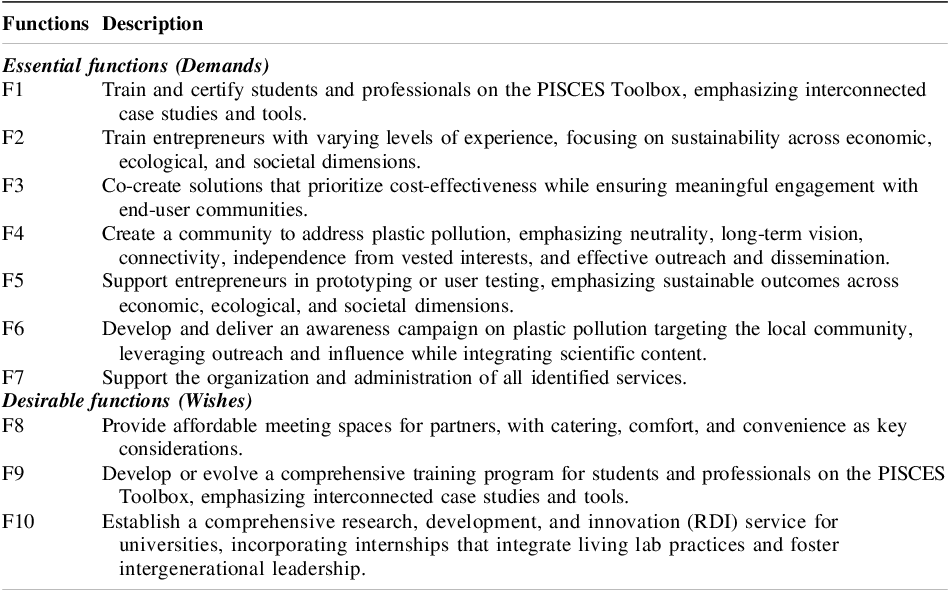
In addition to the visual mappings, the participants discussed and prioritized the functions of the living lab, categorizing them into essential (Demands) and desirable (Wishes) functions. These priorities were informed by the insights gained from the Functions-Users-Payers Board and the Functions-Competitors Board. Table 1 summarizes these prioritized functions, which include training programs, community-building initiatives, prototyping support, and administrative services categorized as demands, while additional features like meeting spaces and advanced training programs were classified as wishes.
Outcomes from the task clarification phase: list of functions

4.2. Conceptual design
The necessary processes, resources, stakeholders, infrastructure, organizational structure, and cultural considerations for each essential function (demand) were identified during the conceptual design phase. The detailed outcome for one of the functions (F1) is shown in Figure 4, and similar evaluations were conducted for all other essential functions.
One of the outcomes of the conceptual design phase

4.3. Embodiment design
In the embodiment design phase, the team decided to focus on the functions that could contribute to the revenue plan in the near future. They used flipcharts to brainstorm and map infrastructure requirements, ensuring alignment with the operational activities of the Living Lab. As shown in Figure 5(a), the cost structure includes an annual expenditure of approximately 1,200 million IDR, covering infrastructure (172.5 million IDR), salaries (672 million IDR), and consumables (320.65 million IDR). As shown in Figure 5(b), revenue generation was planned through workshops and projects, with an annual income projection of 1,227 million IDR.
Outcomes from the embodiment design phase: (a) Cost structure, and (b) Revenue plan

4.4. Detail design
The detailed design phase resulted in the completion of the Business Model Canvas (see Figure 6) for the PISCES Living Lab, outlining its key components. It was observed that the questions formulated during the task clarification phase helped participants articulate the value propositions, which focused on employability through skill-building, community welfare, and addressing environmental challenges. Similarly, key activities and key partners were identified during the conceptual design phase, while the cost structure and revenue model were established during the embodiment design phase. The remaining components, including customer segments, channels, and key resources, were finalized later, leading to the completion of the BMC.
The outcome from the detail design phase: business model canvas

5. Discussion and conclusions
The integration between the EDP and BMI was achieved by embedding business-oriented questions into each phase of the design process. This approach ensured a balanced focus on both technical and market considerations. For instance, participants were prompted to consider the potential market needs, stakeholders, revenue generation, etc., alongside technical requirements. This structured yet flexible approach allowed interdisciplinary teams to develop a business model collaboratively, making the process both systematic and adaptable to the specific context of the PISCES Living Lab. Participants with limited or no entrepreneurial experience successfully navigated through the design phases within the prescribed timeline.
The integration of collaborative tools, such as the Miro board and flipcharts, facilitated idea generation, organizing and synthesizing information, data visualization, and documentation, contributing to the overall success of the workshop.
While the workshop template proved effective for the PISCES Living Lab, its generalizability remains to be tested in future applications. The workshop’s structured approach can potentially be adapted to other service-oriented enterprises, but further validation in different contexts is needed. Future studies should explore the applicability of this template across various business types to confirm its broader utility. Additionally, the template can be refined or extended for Product-Service Systems (PSS), which combine physical products with service offerings, thereby expanding its potential applications.
Future work could also explore how embedding business model innovation into the engineering design process supports interdisciplinary education. Combining technical problem-solving with value creation, this phased approach could be adapted into project-based courses or innovation challenges, helping students from diverse backgrounds collaboratively address complex, real-world challenges. Such integration offers a practical framework for balancing technical feasibility, stakeholder needs, and financial viability - elements that are often treated separately in traditional engineering and business curricula.
Furthermore, the business model developed for the PISCES Living Lab requires validation through real-world testing to ensure its viability. This will be addressed in subsequent work, involving piloting the model in a real or simulated market context, gathering feedback from stakeholders, and evaluating its performance against key business metrics.
Acknowledgements
This work is supported by the project “A Systems Analysis Approach to Reduce Plastic Waste in Indonesian Societies (PISCES)”, funded by UK Research and Innovation (UKRI) and UK Global Challenges Research Fund (GCRF) (Grant Ref: NE/V006428/1). We would like to acknowledge Prof. Eddy Soedjono, and Dr. Gede Hendrawan for their valuable participation in the workshops.




 Open access

