


Introduction
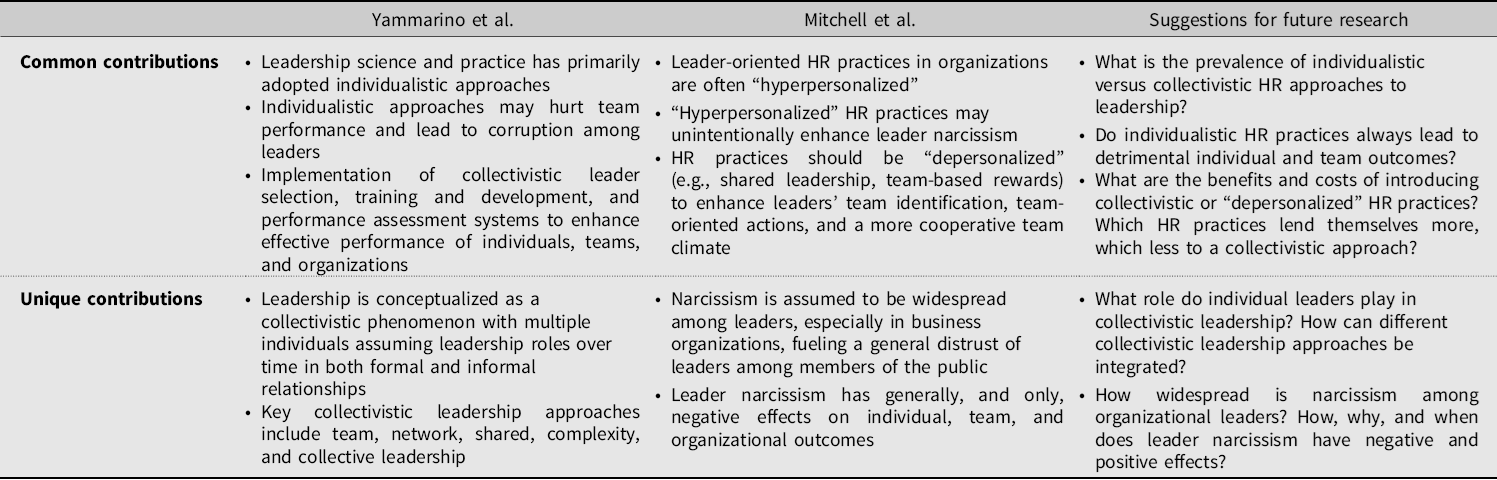
In the first part of this commentary, I compare Mitchell et al.’s (Reference Mitchell, Haslam, Burke and Steffens2026) focal article with a focal article by Yammarino et al. (Reference Yammarino, Salas, Serban, Shirreffs and Shuffler2012) that was published in this journal 14 years ago. These focal articles make three interesting common contributions, whereas their respective unique contributions seem rather small and leave several important questions unanswered. Accordingly, in the second part of this commentary, I outline suggestions for future research on collectivistic leadership, leader narcissism, and human resource (HR) practices to advance this literature. Table 1 summarizes the common and unique contributions and the future research suggestions.
Common and Unique Contributions of Yammarino et al. and Mitchell et al. and Suggestions for Future Research

Common contributions of Yammarino et al. and Mitchell et al.
First, both focal articles draw attention to a potentially overly individualistic approach to leadership in organizations. In their article titled “Collectivist Leadership Approaches: Putting the ‘We’ in Leadership Science and Practice,” Yammarino et al. suggest that “traditional and contemporary leadership work, both science and practice, has focused primarily on the leader as an individual” (p. 382). Similarly, Mitchell et al. criticize that most current leader-oriented HR practices are “hyperpersonalized,” including highly competitive leader selection and promotion practices, leader-centric training and development programs, and elevated leader compensation and rewards. Second, both focal articles propose potential undesirable consequences of an overly individualistic approach to leadership. Yammarino et al. suggest that such an approach may hurt team performance and lead to corruption among leaders, whereas Mitchell et al. focus on the potential for increased leader narcissism (which they assume to be generally detrimental). Third, both focal articles argue that alternative HR practices should be implemented to prevent the potential negative consequences of an individualistic approach to leadership. Yammarino et al. suggest introducing collectivistic leader selection (e.g., based on the preference for working with others), training and development (e.g., team training to enhance shared mental models), and performance assessment systems (e.g., combining individual and collective assessments). Similarly, Mitchell et al. propose that “depersonalizing” HR practices, such as shared leadership, framing leadership as a group process in training programs, and team-based rewards, may enhance leaders’ identification with the team, team-oriented actions, and a more cooperative team climate.
Unique contributions of Yammarino et al. and Mitchell et al.
Both focal articles make unique and incremental contributions above and beyond the respective other focal article. On the one hand, Yammarino et al. suggest conceptualizing leadership “as a ‘we’ or collectivistic phenomena [sic] that involves multiple individuals assuming (and perhaps divesting themselves) of leadership roles over time in both formal and informal relationships” (p. 382). They further review research on five collectivistic leadership approaches, including team, network, shared, complexity, and collective leadership. Although these collectivistic leadership approaches differ somewhat in their respective focus, they have in common that they are not primarily leader-centric but emphasize the role of team coordination and team effectiveness, shared responsibilities among team members, social relations and interactions, and leadership as a socially constructed phenomenon.
On the other hand, Mitchell et al. focus specifically on leader narcissism and how it may be stimulated or suppressed by certain “hyperpersonalized” and “depersonalizing” HR practices, respectively. To this end, these scholars assume that narcissism is widespread among leaders in contemporary business organizations, fueling “a general distrust” (p. 3) among members of the public. Moreover, Mitchell et al. assume that high levels of leader narcissism have generally negative effects on individual, team, and organizational outcomes.
Future research on collectivistic leadership, leader narcissism, and HR practices
The common contributions of the two focal articles raise several important questions that could be addressed in future research. Most fundamentally, studies should examine the actual prevalence of individualistic or “hyperpersonalized” versus collectivistic or “depersonalizing” HR approaches to leadership. It may be possible that, in practice, many organizations are already implementing the latter, or a mix of the two approaches. Furthermore, research could investigate whether, why, and when which specific individualistic HR practices lead to detrimental individual (leader and follower), team, and organizational outcomes. Finally, intervention studies could examine the benefits and costs of introducing specific collectivistic or “depersonalized” HR practices. This might include answering the question which HR practices lend themselves more and which less to collectivistic approaches. For instance, it may be easier or more beneficial to “depersonalize” training and development as opposed to selection and compensation practices.
The unique contributions of the two focal articles also raise several important questions. Based on Yammarino et al.’s suggestion approach leadership as a collectivistic phenomenon, studies could examine the role of individual leaders, including their personality and behavior, in collectivistic leadership processes. Moreover, theory development and research on the common and unique aspects, as well as a possible integration of different collectivistic leadership approaches is needed. Studies could empirically test Mitchell et al.’s assumptions on leader narcissism by estimating its prevalence in different organizations. Moreover, in line with research suggesting that selfishness can sometimes be healthy, whereas altruism sometimes can be pathological (Kaufman & Jauk, Reference Kaufman and Jauk2020), studies could explore both the potential costs and benefits of leader narcissism, as well as potential mechanisms and boundary conditions of these effects. Indeed, several systematic reviews and meta-analyses have suggested that leader narcissism does not only have negative effects. For example, Braun (Reference Braun2017) concluded that leader narcissism may also positively affect follower attributions of charisma, future-oriented leader actions (e.g., investments in internationalization and new technology), higher leader performance under conditions of high uncertainty and dynamic market conditions, and improved follower career development. A meta-analysis found positive, albeit relatively weak, associations between chief executive officer narcissism and firm performance, innovation, and growth (Cragun et al., Reference Cragun, Olsen and Wright2020). Another meta-analysis suggested that the positive association between narcissism and leader emergence may be explained by the overlap between leader narcissism and extraversion (Grijalva et al., Reference Grijalva, Harms, Newman, Gaddis and Fraley2015). Accordingly, future research could explore whether individualistic or “hyperpersonalized” approaches to leadership may in fact activate leader extraversion rather than leader narcissism.
Concluding remarks
The focal articles by Yammarino et al. and Mitchell et al., make several interesting common contributions regarding collectivistic leadership and HR practices. At the same time, their unique contributions regarding specific approaches to collectivistic leadership and leader narcissism, respectively, seem rather small and leave several important questions unanswered. Accordingly, based on a comparison of the common and unique contributions of these focal articles, I suggested several directions for future research to advance this literature.

 Open access

