

1. Introduction
If the 19th century was marked by a wave of democratisation that introduced first-past-the-post (FPTP) single-member districts (SMDs), and the 20th century by electoral reforms that established proportional representation (PR), a new wave of electoral reform emerged as the 20th century was coming to a close. The so-called ‘mixed-member system’, which elects members from two overlapping tiers – SMD and PR – gained widespread acceptance, both among established democracies seeking reform from purely FPTP or PR systems and among newly formed democracies.Footnote 1 This system was intended to bring ‘the best of both worlds’ (Shugart and Wattenberg, Reference Shugart and Wattenberg2001), by enabling voters to select a governing party (a merit of FPTP systems), while also allowing multiple parties to represent a diverse spectrum of voters (a merit of PR systems). Underpinning this design was the assumption that the two tiers would function independently, thereby simultaneously ensuring accountability and proportionality. Following Cox’s (Reference Cox1997) logic, short-term, instrumentally rational voters would cast strategic votes for viable candidates in the SMD tier, while voting ‘sincerely’ for their preferred party in the PR tier.Footnote 2 In this sense, some scholars viewed mixed-member systems as a valuable opportunity for ‘controlled comparison’, in which nearly all possible intervening variables – such as culture, social cleavages, and socioeconomic development – are held constant, allowing researchers to observe the differing outcomes of SMD and PR elections conducted among the same electorate (Moser, Reference Moser1999; Moser and Scheiner, Reference Moser and Scheiner2004).
However, as it turned out, mixed-member systems were ‘not simple combination of PR and SMD’ (Nishikawa and Herron, Reference Nishikawa and Herron2004). There is suggestive evidence that voters do not make their decisions in the SMD and PR tiers independently under mixed-member systems. In fact, many have suggested the possibility that contamination occurs between the two tiers. For instance, voters may want to engage in straight voting, choosing the same party’s candidate in the SMD tier and party list in the PR tier, rather than split-ticket voting, where they support different parties across the two tiers (Herron et al., Reference Herron, Nemoto, Nishikawa, Herron, Pekkanen and Shugart2018). Also, the presence of SMD candidates running in a district may influence voter decisions. These candidates can directly present their party’s platform and ‘give their party a human face’ that voters can connect with (Cox and Schoppa, Reference Cox and Schoppa2002). By providing more information about their parties, SMD candidates can affect voter decisions regarding which party to support in the PR tier (Ferrara et al., Reference Ferrara, Herron and Nishikawa2005). Moreover, voters who are not short-term instrumentally rational, but instead possess strong party identities, may lose the incentive to vote if their preferred party does not field a candidate in their district. In such cases, they may be forced to choose among less palatable options in the SMD tier just to vote for their preferred party in the PR tier. Incumbency can also be a source of contamination. Incumbent SMD members, who have the time and resources to engage with constituents and deliver local benefits, may increase their party’s PR vote share within the district (Hainmueller and Kern, Reference Hainmueller and Kern2008). Karp (Reference Karp2009) similarly shows that candidate characteristics, such as incumbency or party leadership, can influence a party’s PR vote share. Carella and Eggers (Reference Carella and Eggers2024) provide suggestive evidence that SMD candidates with local origins can boost their party’s support in the PR tier. There is also evidence of ‘reverse contamination,’ where constituents evaluate a candidate’s seriousness based on whether they refrain from running simultaneously on the PR tier (Krauss et al., Reference Krauss, Nemoto and Pekkanen2012). As a result of these contamination effects, parties are often expected to oversupply SMD candidates to boost their PR vote share – even if those candidates are not electorally competitive – leading to deviations from Duvergerian logic, which predicts that only two viable candidates will compete in each SMD (Herron et al., Reference Herron, Nemoto, Nishikawa, Herron, Pekkanen and Shugart2018; Díaz, Reference Díaz2021). This, in turn, can increase the distortion between vote share and seat share, while also failing to produce stable majorities – bringing about ‘the worst of both worlds’ (Doorenspleet, Reference Doorenspleet2005; Jastramskis, Reference Jastramskis2019).
As an established democracy that adopted the Mixed-Member Majoritarian (MMM) system in 1994, Japan has become a focal point in the study of mixed-member systems. A central debate concerns whether a contamination effect exists within Japan’s electoral system. Several studies find that the placement of SMD candidates significantly boosts a party’s PR vote share (Cox and Schoppa, Reference Cox and Schoppa2002; Ferrara et al., Reference Ferrara, Herron and Nishikawa2005; Nemoto, Reference Nemoto, Pekkanen, Reed, Scheiner and Smith2018). On the other hand, Maeda (Reference Maeda2008) argues that the contamination effect may be overstated due to endogeneity bias. Also, there have been cases where contamination effect was found in some parties but not in others, but there was no systematic explanation about it. This research aims to overcome these limitations by leveraging electoral data from nonmajority-seeking parties – specifically, the opposition parties that increased or reduced their district candidates as they sought contamination or engaged in coordination. As a result of these shifting strategies, we observe significant variation in the presence or absence of these parties’ SMD candidates over the past decade. In the following sections, this study examines the debate surrounding the contamination effect in the Japanese context and explains the strategies of coordination and contamination that led to variation in the number of candidates. A panel regression analysis is then conducted to measure the relationship between nonmajority-seeking parties’ district candidacy and their PR vote share as well as the candidate’s characteristics and their party’s PR vote share, using election data from 2013 to 2025. The results suggest significant contamination effects between a party’s candidacy in the SMD tier (or the district tier in the case of the House of Councillors) and its PR vote share in both House of Representatives (HoR) and House of Councillors (HoC) elections. Also, candidates with more credentials, as well as parties with more high-quality candidates, were more likely to benefit from the contamination effect. Finally, this study considers the implications of these findings for Japan’s party system and the broader quality of democratic representation.
2. Contamination effect in Japanese elections
The Japanese Diet employs a mixed-member system in both chambers: the lower chamber – the HoR – and the upper chamber – the HoC. Until 1993, the HoR elected members using a Single Non-Transferable Vote (SNTV) system within Multi-Member Districts (MMDs). Due to criticism that the SNTV system led to excessive intra-party competition and money politics, the Diet passed an electoral reform law in 1994 that established 300 SMDs and introduced a parallel 200-seat PR tier, with MPs elected from 11 regional blocs. Since then, the total number of HoR members has been reduced to 465, comprising 289 SMD members and 176 PR members.
HoC consists of two tiers: a district tier and a national tier. The district tier elects councillors from individual districts, which typically correspond to a single prefecture.Footnote 3 The magnitude of each district is determined by the population of the corresponding prefecture – MMDs with magnitudes ranging from 2 to 6 are assigned to more populous prefectures, while SMDs are assigned to less populous prefectures. Since 1983, the national tier has adopted a PR system, although the specific rules have evolved – from closed-list PR to open-list PR, and eventually to a partial open-list PR system (Nemoto and Shugart, Reference Nemoto and Shugart2013).Footnote 4 In both chambers of the Diet, the seat allocations in the SMD (district) tier and the PR tier are independent of one another, making Japan a prototypical MMM electoral system.
Due to its MMM characteristics, Japanese elections have attracted attention from both scholars of MMM systems and those seeking to prove or disprove the existence of the contamination effect. Ferrara et al. (Reference Ferrara, Herron and Nishikawa2005) and Herron and Nishikawa (Reference Herron and Nishikawa2001) each compare districts from the 1996 and 2000 HoR elections where parties nominated SMD candidates and those where they did not, and they find that PR vote shares were higher in the former across all parties in both elections. Similarly, Cox and Schoppa (Reference Cox and Schoppa2002) find that in the 1996 and 2000 HoR elections, both the Democratic Party of Japan (DPJ) and the New Frontier Party (NFP) gained more PR votes in districts where they fielded SMD candidates. For the HoC elections, Nishikawa (Reference Nishikawa2003) finds that DPJ and SDP candidates boosted party vote share, while there was no significant impact for Komeito and Liberal Party candidates. However, these results may be spurious, as parties are more likely to nominate candidates in districts where they already enjoy some level of support. To address this concern, Cox and Schoppa (Reference Cox and Schoppa2002) also conduct an inter-temporal analysis, comparing districts where the DPJ did not field a candidate in 1996 but did so in 2000. Their findings suggest that the DPJ’s PR vote share increased more in these districts than in those where it abstained from fielding a candidate in both elections. Yet even this result may be inconclusive, given that the DPJ absorbed many former NFP members after the NFP’s dissolution, making the DPJ of 1996 and the DPJ of 2000 organisationally heterogeneous. Nemoto (2018) also provides strong suggestive evidence of contamination effects by comparing a party’s PR vote share with its SMD candidacy status, using data from the 2014 and 2017 HoR elections. But this analysis does not address endogeneity bias, as no control variables were included.
However, Maeda (Reference Maeda2008) argues against the existence of a contamination effect. He highlights the tendency of parties to field SMD candidates in districts where they expect to perform well, which introduces the risk of endogeneity bias. To account for this, Maeda employs a treatment-effects model and finds no evidence of contamination in the elections held between 2000 and 2005. But the validity of this conclusion is limited by the lack of substantial variation in the presence or absence of candidates during the period studied, making it difficult to observe statistically meaningful effects. Furthermore, the scope of analysis was constrained by frequent mergers and splits among parties, which complicate consistent comparisons across election cycles.
To address the limitations posed by endogeneity bias and lack of independent variable’s variation in previous studies, this research draws on the electoral outcomes of the parties participating in both the SMD (district) tier and the PR tier. Most of these parties have employed a strategy of attempting to ‘contaminate’ PR votes through the nomination of SMD candidates – with the JCP being the most prominent example, having once fielded candidates in nearly every district (Catalinac, Reference Catalinac2016). However, since 2015, some parties have engaged in active electoral coordination with other opposition parties and have strategically withdrawn their candidates from several districts. On the other hand, when opposition coordination has proved futile, some opted to pursue independent strategies by gradually increasing the number of SMD candidates they field. This variation across districts and over time presents a valuable opportunity to examine whether the presence of these parties’ candidates in the SMD tier affects their performance in the PR tier. While previous studies, such as Nakakita (Reference Nakakita2022), have acknowledged the JCP’s contamination strategy, they have not offered a comprehensive theoretical and empirical analysis of its effects (Nemoto, Reference Nemoto2024). Using electoral records and administrative data, this study investigates whether the contamination strategies pursued by these parties were indeed effective. Before delving into the empirical analysis, however, I first examine the coordination or contamination strategies that the parties engaged in, and the resultant variation of candidacy in the districts.
3. The strategy of contamination and coordination
In this section, I provide a brief overview of the strategic decisions of parties regarding whether to pursue contamination or coordination, and the resultant shifts in their candidate nominations. After the introduction of MMM in 1994, many niche parties, such as the JCP, realised that their prospects of winning a seat in an SMD by a plurality of votes had diminished. Their focus, therefore, shifted to obtaining PR seats. However, somewhat ironically, their PR strategy was to nominate their party’s candidate in as many SMDs as possible and boost their PR votes through contamination. Aside from the aforementioned reasons for pursuing contamination, election laws provided another incentive. As the Japanese Public Offices Election Law strictly restricts the means of advertising the party in the PR tier itself, fielding a candidate in an SMD and using that candidate’s posters, campaign rallies, televised speeches, and newspaper advertisements to promote the party’s PR vote was perhaps an effective strategy for parties centred on PR (Nakakita, 2022).
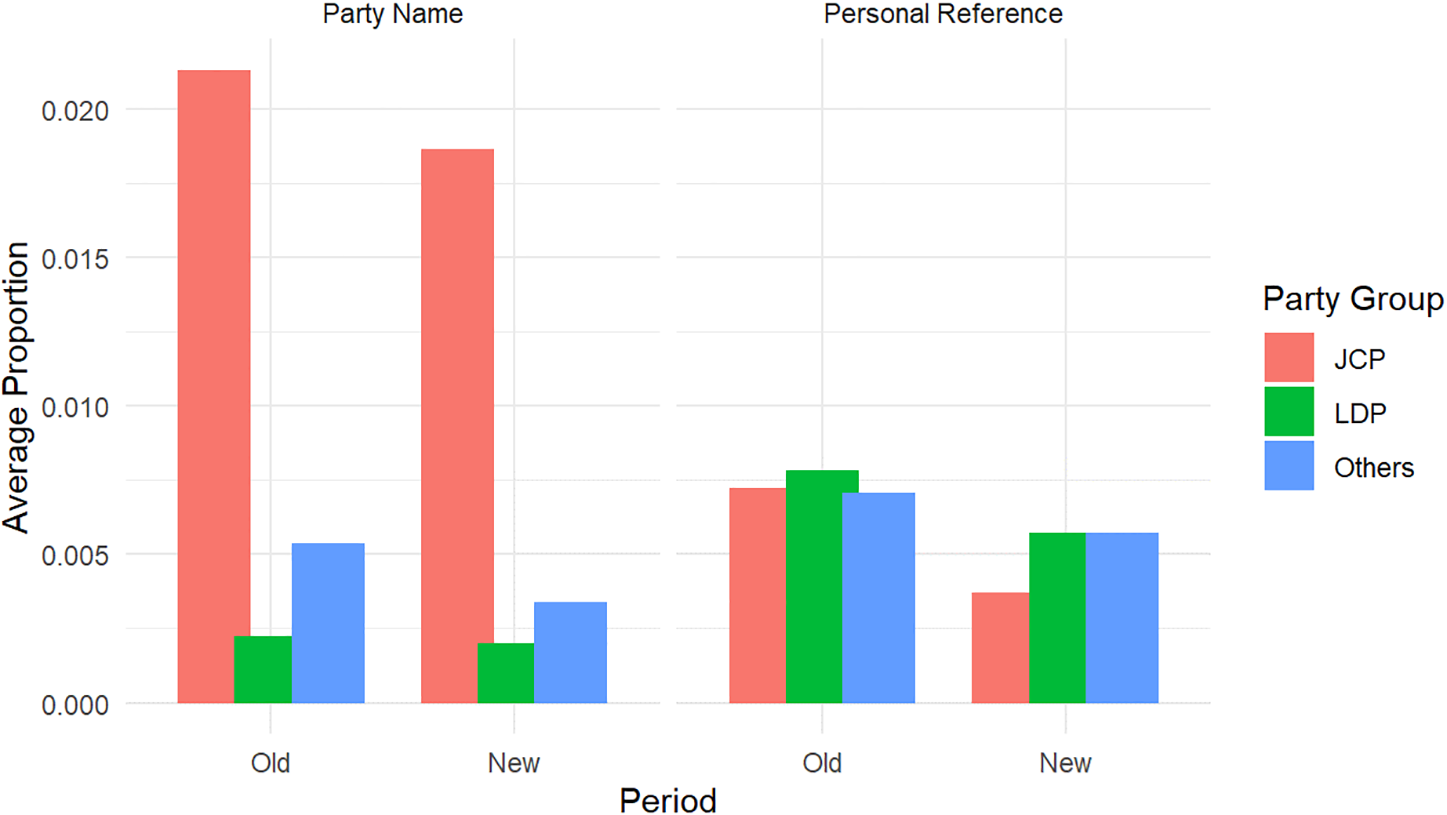
The JCP is perhaps the best example of this strategy. An isolated far-left party, it held about 5–7% of HoR seats during the SNTV-MMD era. After the 1994 electoral reform, realising it was uncompetitive in most SMDs, the JCP decided to focus on the PR tier while still nominating candidates in all 300 SMDs to advertise the party and maximise the ‘contamination effect’ (Nakakita, 2022). An analysis of JCP election manifestos highlights this strategy: unlike other parties that promote both candidates and the party, JCP manifestos centre almost entirely on party platforms. Using Crisp et al. (Reference Crisp, Schneider, Catalinac and Muraoka2021), Figure 1 shows that JCP candidates mention party names(avg_partyname) far more often than personal references(avg_personalpronoun). While the transition from SNTV-MMD to the SMD system led most parties to stress party identity, the JCP did so to an even greater extent, as its SMD candidates – unlikely to win district seats – had little reason to campaign for themselves.
The percentage of party name and personal pronoun in manifestos of candidates.

Figure 1. Long description
The bar graph compares the average proportion of party name and personal reference mentions in manifestos of candidates across different periods and party groups. The x-axis represents the period, divided into Old and New, while the y-axis shows the average proportion. The graph is divided into two main sections: Party Name and Personal Reference. Each section contains bars for three party groups: JCP, LDP, and Others, represented by red, green, and blue colors, respectively. In the Party Name section, the JCP group shows the highest average proportion in the Old period, followed by a lower but still significant proportion in the New period. The LDP group has a lower average proportion in both periods, while the Others group shows a moderate proportion in the Old period and a slight increase in the New period. In the Personal Reference section, all three groups have relatively similar proportions in the Old period, with the LDP group slightly higher. In the New period, the proportions for all groups decrease, with the LDP group maintaining a slightly higher average proportion. All values are approximated.
In the 2000s, as the DPJ rose as the main opposition to the LDP, coordination among opposition parties developed with the DPJ at its centre. In 2009, the Social Democratic Party (SDP) and the People’s New Party (PNP) entered into coordination with the DPJ, agreeing to limit competition in the SMD tier (Maeda, Reference Maeda2025). While the JCP did not enter into formal coordination, it withdrew its candidates from almost half of the SMDs, benefiting the DPJ (Nakakita, 2022). However, after the DPJ’s collapse in 2012, Japanese politics shifted from a two-party to a multi-party system with new ‘Third Force’ (dai-sankyoku) parties such as the JIP, Your Party, and the Tomorrow Party (Nemoto, Reference Nemoto, Herron, Pekkanen and Shugart2017). Among these, the JIP – founded by Osaka Governor Hashimoto Tōru – became the most prominent, known for its right-wing populism and focus on administrative reform. Meanwhile, the JCP gained strength as a staunch opposition party, even attracting some disillusioned supporters from right-wing Third Force parties (Maeda, Reference Maeda2017). Rather than coordinate, the go-it-alone strategy and efforts to enlarge their foothold through contamination once again became prevalent.
The political landscape changed, however, in 2015. When the Abe Cabinet revised the interpretation of Article 9 of the Constitution, declaring collective self-defence constitutional and implementing new security legislation accordingly, opposition parties condemned the move as unconstitutional. This prompted electoral coordination among the JCP, Democratic Party (DP) – formed through a merger of the DPJ and a faction of the JIP – the SDP, and other groups, leading to modest success in the 2016 HoC election. In the 2017 HoR elections, the DP disintegrated: more conservative members formed the Party of Hope with Tokyo Governor Koike Yuriko, while more liberal members established the Constitutional Democratic Party (CDP). The JCP stood down in many districts to support CDP candidates, allowing the CDP to emerge as the largest opposition party despite the LDP’s victory. Meanwhile, the JIP cooperated with the Party of Hope by refraining from fielding candidates in each other’s strongholds – Tokyo and Osaka, but both parties received a setback.
Eventually, the CDP, the Party of Hope, and several unaffiliated opposition MPs reorganised into the new CDP and the more centrist Democratic Party for the People (DPFP) in 2020. In the lead-up to the 2021 HoR election, the two parties signed an agreement not to field competing candidates in SMDs. In this election, opposition coordination reached its peak, with the JCP withdrawing from 184 SMDs. Nevertheless, the CDP lost 13 seats, while the JIP and DPFP gained significantly despite not participating in the coordination. This outcome discouraged further cooperation between the JCP and the CDP. As a result of the shift away from broad opposition coordination, the JCP fielded 33 district candidates in the 2022 HoC election and 213 SMD candidates in the 2024 HoR election – a significant increase from the 2019 HoC and 2017 HoR elections, though still fewer than in the pre-coordination period. Similarly, the JIP increased its district candidates from 7 to 19 in the 2022 HoC election and its SMD candidates from 94 to 163 in the 2024 HoR election. The DPFP also expanded its presence, doubling its SMD candidates from 21 to 41 in the 2024 HoR election.
In sum, the JCP and CDP(and their predecessor DP) actively participated in opposition coordination during the 2016, 2017, 2019, and 2021 elections, although their cooperation was significantly limited in the 2022 and 2024 elections. In contrast, the JIP and DPFP engaged in limited coordination in their initial elections but subsequently refrained from further cooperation and instead increased the number of candidates they fielded in later elections. These diverging patterns of candidate nominations have created cross-sectional and intertemporal variations of candidacy in the SMD or District, as shown in Tables 1 and 2. In the next session, I leverage these variations to examine whether the presence of nonmajority-seeking party candidates in SMDs influenced their PR vote share, drawing on electoral data from this period.
The number of SMDs where each parties fielded a candidate in HoR elections

Table 1. Long description
The table presents data on the number of single-member districts where various political parties fielded candidates in House of Representatives elections over four years: 2014, 2017, 2021, and 2024. The table has four rows and eight columns. The columns are labeled by party names: Liberal Democratic Party, Komeito, Constitutional Democratic Party, Japan Innovation Party, Democratic Party for the People, Japanese Communist Party, Social Democratic Party, Reiwa Shinsengumi, and Sanseito. The rows are labeled by the years 2014, 2017, 2021, and 2024. Row 1: Liberal Democratic Party, 283; Komeito, 9; Constitutional Democratic Party, blank; Japan Innovation Party, 77; Democratic Party for the People, blank; Japanese Communist Party, 292; Social Democratic Party, 18; Reiwa Shinsengumi, blank; Sanseito, blank. Row 2: Liberal Democratic Party, 277; Komeito, 9; Constitutional Democratic Party, 63; Japan Innovation Party, 47; Democratic Party for the People, blank; Japanese Communist Party, 206; Social Democratic Party, 19; Reiwa Shinsengumi, blank; Sanseito, blank. Row 3: Liberal Democratic Party, 277; Komeito, 9; Constitutional Democratic Party, 214; Japan Innovation Party, 94; Democratic Party for the People, 21; Japanese Communist Party, 105; Social Democratic Party, 9; Reiwa Shinsengumi, 12; Sanseito, blank. Row 4: Liberal Democratic Party, 266; Komeito, 11; Constitutional Democratic Party, 207; Japan Innovation Party, 163; Democratic Party for the People, 41; Japanese Communist Party, 213; Social Democratic Party, 10; Reiwa Shinsengumi, 19; Sanseito, 85.
The number of SMDs where each parties fielded a candidate in HoC elections

Table 2. Long description
The table presents data on the number of single-member districts where each party fielded a candidate in House of Councillors elections from 2013 to 2025. It includes columns for each party: LDP, Komeito, CDP, JIP, DPFP, JCP, SDP, Reiwa, Sanseito, and Hoshu. The rows are labeled with the years 2013, 2016, 2019, 2022, and 2025. The table shows the following data: Row 1: LDP 49, Komeito 7, CDP 14, JIP 9, DPFP 14, JCP 46, SDP 5, Reiwa, Sanseito, Hoshu. Row 2: LDP 45, Komeito 7, CDP 19, JIP 7, DPFP 14, JCP 14, SDP 3, Reiwa 1, Sanseito, Hoshu. Row 3: LDP 45, Komeito 7, CDP 28, JIP 19, DPFP 13, JCP 33, SDP 4, Reiwa 5, Sanseito 45, Hoshu. Row 4: LDP 45, Komeito 7, CDP 28, JIP 14, DPFP 21, JCP 28, SDP 6, Reiwa 12, Sanseito 45, Hoshu 5. The table highlights the varying levels of participation and coordination among different parties over the years, with notable changes in the number of candidates fielded by each party in different election years.
4. Data and analysis
As shown above, there has been an ongoing debate over whether a contamination effect exists between the SMD (or District tier) and the PR tier. While some studies suggest that the PR tier can influence outcomes in the SMD tier (as demonstrated by Krauss et al. (Reference Krauss, Nemoto and Pekkanen2012)), this study focuses exclusively on whether the District tier affects outcomes in the PR tier. I hypothesise that the presence of a party’s candidate in a district is likely to have a positive effect on the party’s PR vote share by facilitating the mobilisation of supporters and attracting non-affiliated voters. Using electoral data from the 8 parties that participated in elections between 2013 and 2025, I seek to empirically test the following hypothesis.
Hypothesis 1: If a party fields a candidate in a district, that party’s PR vote share in that district will be higher than in districts where it does not field a candidate.
However, candidates differ in their ability to attract votes for their party. As noted by Hainmueller and Kern (Reference Hainmueller and Kern2008) and Herron and Nishikawa (Reference Herron and Nishikawa2001), whether a candidate is an incumbent in a district may affect the party’s PR vote share. Karp (Reference Karp2009) further shows that candidate characteristics such as incumbency or party leadership can increase the magnitude of the contamination effect. When evaluating candidates and parties, voters often rely on candidates’ background characteristics, such as local assembly experience or a bureaucratic career, to infer their ability to deliver particularistic benefits or pursue programmatic policies (Gagnon et al., Reference Gagnon, McElwain and Ikeda2026). These evaluations may also extend to the party that nominates such candidates. Accordingly, parties that nominate more qualified candidates may be viewed more favourably by voters. I hypothesise that when a candidate running in a district possesses credentials that signal competence, this will increase the party’s PR vote share relative to candidates without such credentials.
Hypothesis 2: If a candidate with credentials signalling competence runs in a district, his or her party’s PR vote share in that district will be higher than in districts where the candidate lacks such credentials.
To test whether a contamination effect exists between the SMD tier and the PR tier, I analyse Japanese Diet election results from the period 2013–2024, covering the 2014, 2017, 2021, and 2024 HoR elections, as well as the 2013, 2016, 2019, and 2022 HoC elections. Specifically, I examine whether the presence of party candidates in the district tier is associated with an increase in their party’s PR vote share in the same district. To do so, I employ a two-way fixed effects panel regression model, controlling both district-specific and year-specific effects, in order to isolate the impact of candidate presence on PR vote share over time.
However, as Maeda (Reference Maeda2008) points out, there could be a potential selection bias because parties tend to field candidates in districts that are their strongholds, in order to avoid forfeiture and to conserve their party’s or candidates’ assets and energy from being wasted in hopeless districts. To address this selection bias and estimate the average treatment effect on the treated (ATT), I used propensity score weighting implemented with the WeightIt package in R (Greifer, Reference Greifer2025). Each district’s propensity score (e(x i )) to have a candidate from a given party was estimated using a logistic regression on the pre-treatment covariate – the party’s previous PR vote ratio. Control districts were then weighted by e(x i )/(1−e(x i ))so that their covariate distribution matched that of the treated group. Covariate balance was evaluated using standardised mean differences, confirming that all covariates were adequately balanced (SMD < 0.1) after weighting. In Appendix A., the regression results for unweighted data are provided, and there is no significant difference between the weighted and unweighted analyses.
The dependent variable is the PR vote share of the parties in each district. This dataset was constructed using official election results from the Japanese Ministry of Internal Affairs and Communications (MIC). While obtaining district-level PR vote data was relatively straightforward for HoC elections – as each prefecture functions as a district – the process was more complex for HoR elections, where PR results are not published at the SMD level. Instead, the MIC provides vote totals at the municipal level, so the data had to be aggregated and regrouped into SMD units based on municipal boundaries.
Our main independent variable, Candidate, captures the presence of a party’s candidate in a given district. It is coded as 1 if the respective party fielded a candidate in the district, and 0 if it did not. The candidacy status for each party was constructed using SMD-level data for HoR elections and district-level data for HoC elections, based on official records from MIC.
Since the demographic and socioeconomic composition of a district can influence electoral outcomes, I include a set of social and economic control variables in the analysis. These variables include: total population, male population ratio, percentage of residents aged 65 and over, district area size, urbanisation rate (calculated as the proportion of the population residing in Densely Inhabited Districts [DIDs]), per capita income, proportion of people employed in agriculture, and the rate of university-educated individuals. These data are sourced from the Japanese System of Social and Demographic Statistics, provided by MIC. While data are available at the prefectural and municipal levels, I reconstructed the variables at the district level to align with electoral boundaries.Footnote 5 , Footnote 6
I include year and district fixed effects in all models to control for unobserved time-specific and district-specific factors. In addition, standard errors are clustered at the year and district levels to account for intra-group correlation. Models 1 through 8 analyse the relationship between candidacy and PR vote share for LDP, Komeito, JIP, DPFP, CDP, JCP, Reiwa Shinsengumi(Reiwa), and SDP.
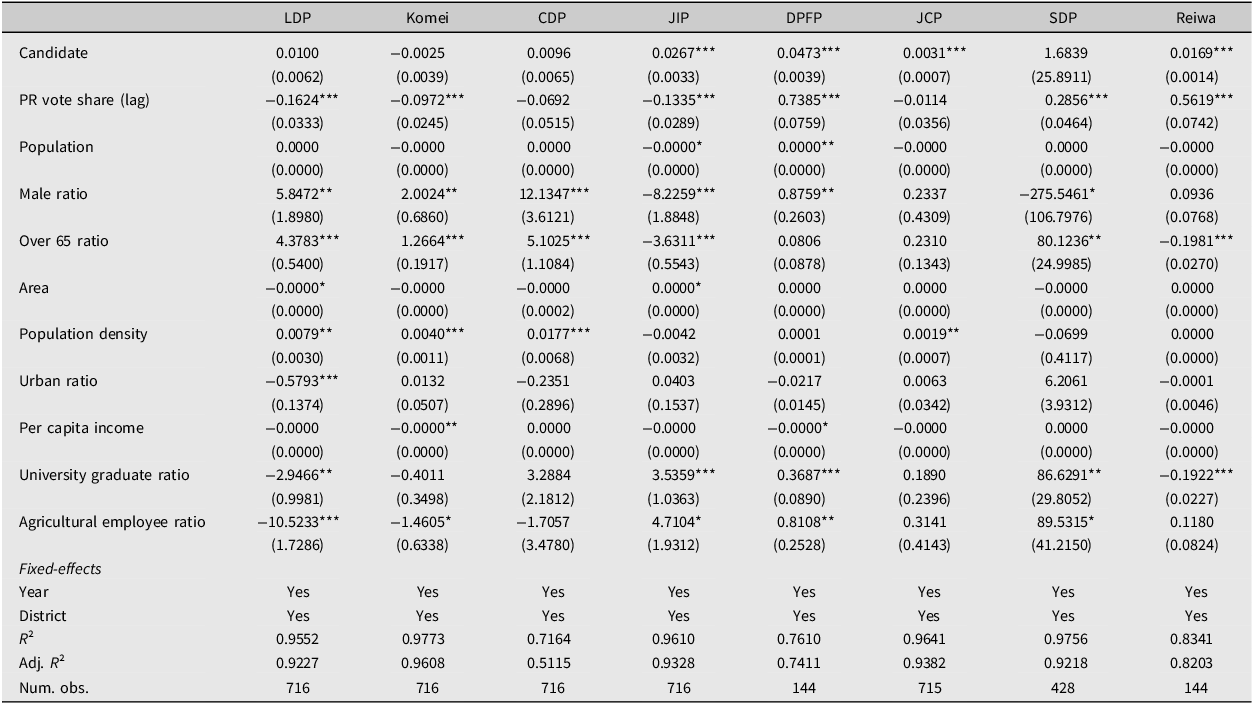
Table 3 shows that the presence of JIP, DPFP, JCP, and Reiwa candidates in the SMD tier has a statistically significant positive effect on their respective performances in the PR tier, while the candidacy from other parties does not seem to have a statistically meaningful effect. Specifically, the effect is estimated at 0.31% points for the JCP and 2.7% points for the JIP, 4.7% points for the DPFP, and 1.7% points for Reiwa. While all coefficients are statistically significant, the magnitude of the JCP’s contamination effect is notably smaller than that of the JIP, DPFP, Reiwa, and also smaller than the effect size reported by Nemoto (2018).
The size of the contamination effect in the House of Representatives elections

Table 3. Long description
The table presents data on the contamination effect in the House of Representatives elections, focusing on various political parties. It includes columns for LDP, Komei, CDP, JIP, DPFP, JCP, SDP, and Reiwa, with rows detailing candidate, PR vote share, population, male ratio, over 65 ratio, area, population density, urban ratio, per capita income, university graduate ratio, and agricultural employee ratio. The table also includes fixed-effects for year and district, along with R-squared values and the number of observations for each party. Notable trends include significant positive effects for JIP, DPFP, JCP, and Reiwa candidates in the PR tier, with varying magnitudes of impact.
Note: ***p < 0.001; **p < 0.01; *p < 0.05.
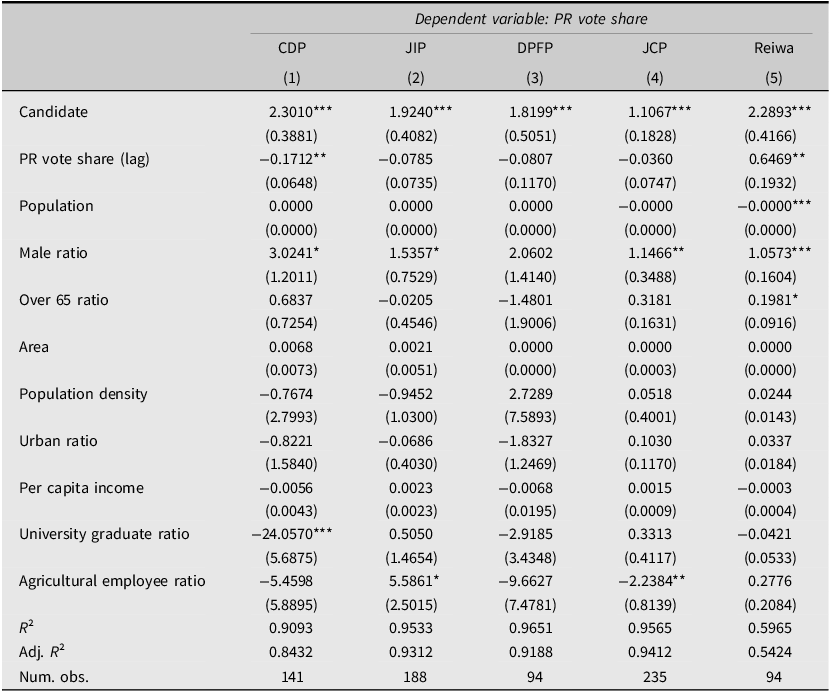
Table 4 demonstrates that the positive relationship between District candidate presence and PR vote share holds for the HoC elections. LDP, Komeito and SDP are excluded from this analysis because there is little or no variation in the candidacy status for these parties, as can be seen in Table 2. Overall, the presence of a District candidate increases the JCP’s PR vote share by approximately 1% point, and the JIP’s PR vote share by about 1.9% points, CDP by 2.33% point, and DPFP by 1.8% point.
The size of the contamination effect in the House of Councillors elections

Table 4. Long description
The table presents data on the size of the contamination effect in the House of Councillors elections, focusing on the relationship between District candidate presence and PR vote share. It includes columns for different political parties: CDP, JIP, DPFP, JCP, and Reiwa. Each column lists various factors such as Candidate, PR vote share lag, Population, Male ratio, Over 65 ratio, Area, Population density, Urban ratio, Per capita income, University graduate ratio, and Agricultural employee ratio. The table shows coefficients and standard errors for each factor, indicating their impact on the PR vote share. Notable trends include significant positive effects of Candidate presence on PR vote share for all parties, with CDP showing the highest increase at 2.3010 and Reiwa at 2.2893. The Male ratio and University graduate ratio also show significant impacts across different parties.
Note: ***p < 0.01; **p < 0.05; *p < 0.1.
In both the HoR and HoC elections, the size of the contamination effect for the JCP was smaller than that of other parties, while the candidacy of the LDP, Komeito, and SDP did not have any statistically significant effects. The insignificance of LDP, Komeito, and SDP is likely explained by the fact that they either field too few or too many candidates, and most of them were (or were not) fielded in the same district over time, resulting in limited variation across elections. Using a fixed effects model, it is difficult to capture contamination in such a setting. Although the JCP’s candidates appear to have some contamination effects, the extent of their effect is limited, and they are not as effective as those of other parties in mobilising support for the party. This may be due to the candidate quality, hypothesised in Hypothesis 2. Unlike other parties, whose dual-listed SMD candidates may have a chance of being elected either in the SMD tier in the PR tier, most of the JCP’s district candidates have little realistic prospect of entering the Diet, as they have no realistic prospects of winning an SMD seat, and for a small PR seat allocation, dual-listing is closed for most of the candidates.Footnote 7 As a result, the party is less able to recruit high-quality candidates such as local council members, mayors, former bureaucrats, or specialists who are ambitious to become an MP. This limitation may reduce the party’s ability to attract voters whose evaluations depend in part on the perceived quality of district candidates.
To assess this mechanism, I now turn directly to Hypothesis 2, which examines whether candidate quality has a differential impact on PR vote share. In defining credentials, I use eight categories: former HoR member, HoC member, local assembly member, parliamentary secretary, national bureaucrat, local bureaucrat, lawyer, doctor, and business executive. These are identified by Smith (Reference Smith2018) as characteristic examples of qualifications required for a viable candidate. They typically possess one or more of the following attributes: prior electoral or political experience necessary to mount an effective campaign, a strong local support base, established ties to local and central government that can deliver benefits to the district, or the intellectual capacity and policy expertise required for national-level governance (Gagnon et al., Reference Gagnon, McElwain and Ikeda2026). Figure A.1 shows the proportion of candidates possessing these credentials for each party in the 2012, 2014, and 2017 HoR elections. The figure indicates that while the LDP has the highest proportion of credentialed candidates, with every candidate having at least one of the credentials, the DPJ and its successor CDP, as well as the JIP, also field a substantial number of credentialed candidates. In contrast, the JCP has the lowest proportion of credentialed candidates, most of whom are local assembly members.Footnote 8
As with the decision to field candidates, the presence of credentialed candidates may also be endogenously determined. Stronger candidates are more likely to contest districts where their party is already electorally competitive, as such districts offer a higher probability of winning a seat. To address this potential selection bias and estimate the ATT, I employ propensity score weighting using WeightIt. Specifically, I estimate each district’s propensity score to have a credentialed and non-credentialed candidate from a given party using a logistic regression model based on the party’s previous PR vote share in the district. Using these estimated propensity scores, I construct weights to balance treated and control observations and then estimate the ATT. I also report regression results without weighting in Figure A.3 in the Appendix, and they do not show any significant difference. I also control for total population, the male population ratio, the proportion of residents aged 65 and over, district area size, the level of urbanisation, per capita income, the share of employment in agriculture, and the proportion of university-educated.
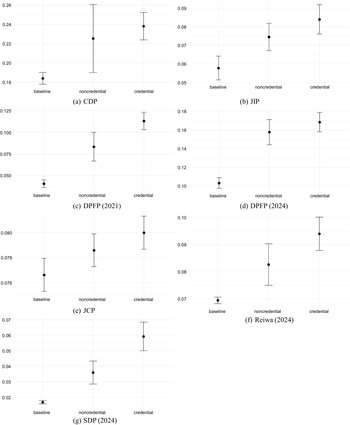
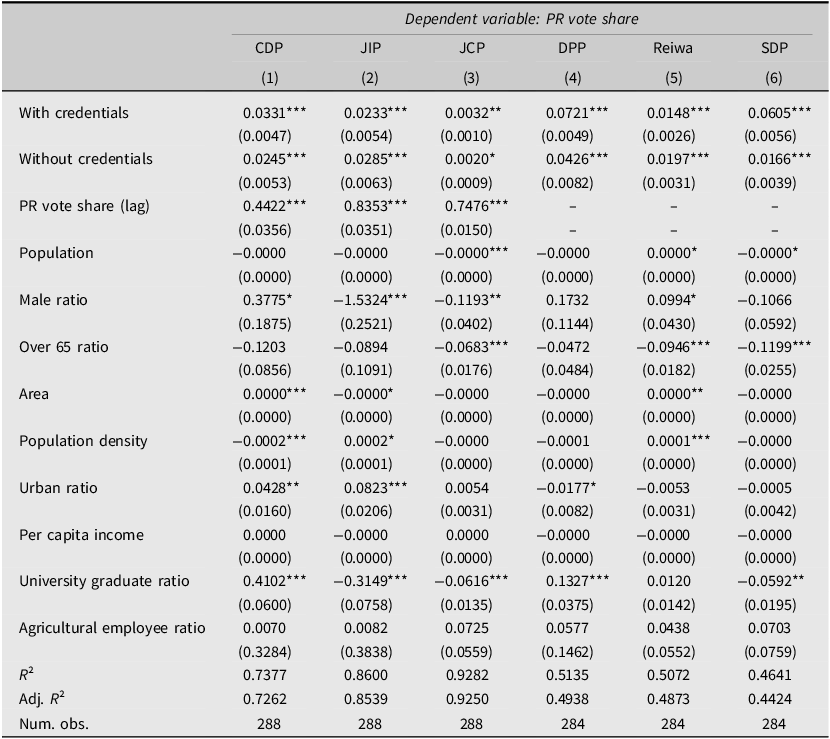
Table 5 reports the effects of credentialed and noncredentialed candidates on each party’s PR vote share in the 2017 HoR election for the CDP, JIP, and JCP, and in the 2021 HoR elections for DPFP, Reiwa and SDP. The LDP and Komeito are excluded because all of their candidates possess some form of credential, leaving insufficient variation for analysis. The coefficients for credentialed candidates are statistically significant for all three parties. While the difference between credentialed and noncredentialed candidates is statistically significant for the JIP, marginally insignificant for the JCP (p = 0.137), significant in 2021 but insignificant in 2024 for DPFP, significant for SDP, insignificant in 2021 but significant in 2024 for Reiwa, and insignificant for the CDP, credentialed candidates consistently exhibit larger contamination effects on average. The average PR vote share among districts with credentialed, non-credentialed candidates, and without candidates is shown in Figure 2.
Average PR vote share among districts by candidate type: no candidate(baseline), noncredentialed candidate, and credentialed candidate. Note: points are group means; bars are 95% confidence intervals; control variables are set on their mean value.

Figure 2. Long description
The image contains seven graphs labeled (a) through (g), each showing average PR vote share among districts by candidate type: no candidate (baseline), noncredentialed candidate, and credentialed candidate. Each graph includes points representing group means and bars indicating 95% confidence intervals. The x-axis represents the candidate type, while the y-axis represents the average PR vote share. The graphs compare different political systems or datasets: (a) CDP, (b) JIP, (c) DPFP (2021), (d) DPFP (2024), (e) JCP, (f) Reiwa (2024), and (g) SDP (2024). Each graph shows variations in PR vote share based on the presence and type of candidate, with control variables set at their mean values. The data suggests that the presence of credentialed candidates generally leads to a higher PR vote share compared to noncredentialed candidates and the baseline. All values are approximated.
The size of contamination effect for credentialed and non-credentialed candidates

Table 5. Long description
The table presents data on the effects of credentialed and non-credentialed candidates on the proportional representation (PR) vote share for different political parties in the 2017 and 2021 House of Representatives (HoR) elections. The parties analyzed include the CDP, JIP, JCP, DPFP, Reiwa, and SDP. The table has six columns representing each party and several rows detailing the impact of candidates with and without credentials, along with other variables such as PR vote share lag, population, male ratio, over 65 ratio, area, population density, urban ratio, per capita income, university graduate ratio, and agricultural employee ratio. Each cell contains coefficients and standard errors indicating the statistical significance of the effects. Notable trends include the consistent larger contamination effects of credentialed candidates across parties, with varying levels of statistical significance.
Note: *p < 0.01; **p < 0.05; ***p < 0.1.
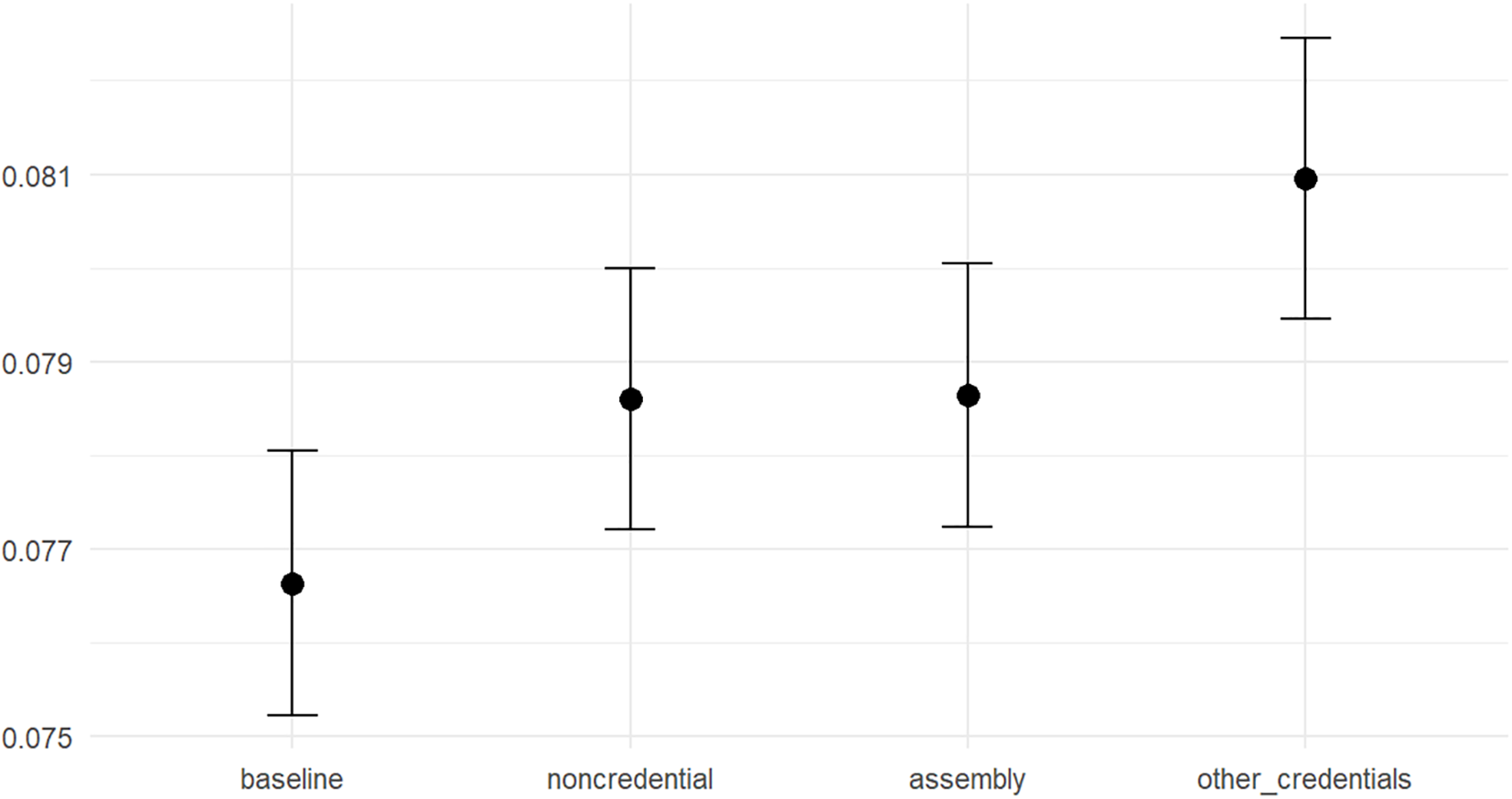
Credentialed candidates may differ in their ability to influence voter support. For example, current or former Diet members may have a stronger impact than municipal assembly members, who represent only a portion of a district. As shown in Figure A.1(d), most of the JCP’s credentialed candidates are prefectural or municipal assembly members, whereas other parties field a larger share of Diet members and other professionals. To assess whether these differences translate into variation in electoral effects, I distinguish between assembly members and other types of credentialed candidates and compare their respective impacts. Figure 3 shows that candidates with non-assembly credentials generate significantly higher PR vote shares on average. In contrast, the PR vote share associated with assembly-member candidates is not significantly different from that of noncredentialed candidates in the case of the JCP. These findings suggest that the relatively weak contamination effect for the JCP may be attributable not only to the lower ratio of credentials among its candidates but also to the composition of those credentials. Specifically, JCP candidates are more likely to possess local assembly experience, which appears to be less electorally advantageous than other forms of political or professional credentials.
Average JCP PR vote share among districts by candidate type: no candidate(baseline), noncredentialed candidate, local assembly members, and other credentialed candidates.

Survey evidence further supports the argument that differences in candidate quality shape voter perceptions. Using data from the UTokyo–Asahi Survey (UTAS) conducted during the 2012 and 2017 HoR elections, I examine whether the contamination effect for each party differs among voters who report that they consider candidate characteristics – such as personal appeal or competence – when making vote choices and voters who do not consider them. The results, shown in Figure 4 indicate substantial heterogeneity between parties. In the 2017 survey, among voters who consider candidate appeal or ability important, the presence of CDP candidates increases support for the party; this effect disappears among respondents who do not prioritise such traits. For the JIP, this pattern can be seen in the 2012 survey, although the contamination effect seems to be at play for all groups of voters in the 2017 survey wave. In contrast, for the JCP, the relationship operates in the opposite direction in the 2017 survey. Among voters who value candidate traits, the presence of JCP candidates is associated with decreased party support, whereas among those who do not prioritise such traits, the effect is slightly positive. Taken together, these findings suggest that contamination effects are conditional on both voter preferences and candidate quality. Parties that field relatively high-quality candidates are better positioned to benefit from candidate-centred evaluations, while parties with weaker candidate pools are less likely to mobilise support – and may even experience negative spillovers – among voters who place greater weight on candidate characteristics.
Support for a party among voters who think candidates appeals and capabilities are important, not important, and are neutral.

Figure 4. Long description
The image contains four graphs labeled (a) CDP (2017), (b) JIP (2012), (c) JIP (2017), and (d) JCP (2017). Each graph shows the percentage of voters who think candidates’ appeals and capabilities are neutral, important, and not important. The graphs use two colors, red and blue, to differentiate between two categories: CDP, JIP, and JCP. The y-axis represents the percentage of voters, while the x-axis categorizes voters’ opinions into neutral, important, and not important. Each graph includes error bars indicating the variability of the data. The graphs suggest that voters’ perceptions of candidates’ appeals and capabilities influence their support for parties. All values are approximated.
In sum, our analysis shows that the presence of the JCP, JIP, or DPFP candidates in SMDs for the HoR and districts for the HoC is associated with a significant increase in their respective parties’ PR vote shares. However, the magnitude of the JCP’s vote gain is smaller than that of the JIP or DPFP. Also, election results and survey data show that credentialed candidates and candidates from CDP and JIP show a higher contamination effect, while candidates without such credentials were not as effective. These results show that marginal parties’ ability to seek contamination in the PR tier is not without limits. While nominating candidates can enhance PR support through contamination effects, the effectiveness of this strategy depends critically on candidate quality. At the same time, marginal parties seeking to boost support by recruiting credentialed candidates face structural constraints: their limited electoral competitiveness makes it difficult to attract high-quality candidates in the first place. In the following section, I delve deeper into the strategic calculations behind this aspect of contamination effect, focusing on how it shapes collective action problems and coordination dilemmas among opposition parties.
5. Collective action problem caused by contamination effect
As demonstrated above, the presence of a contamination effect creates strong incentives for opposition parties to field many SMD or District candidates to enhance their PR vote share. Yet doing so risks fragmenting the opposition vote, potentially handing the ruling party an easy plurality victory. Opposition parties thus face a strategic dilemma between long-term party-building and short-term coordination to avoid vote-splitting.
This dilemma reflects a classic collective action problem. To increase their total seat share and form a viable alternative government, opposition parties must coordinate by standing down uncompetitive candidates in favour of ideologically proximate allies. However, coordination entails individual costs: parties forgo potential PR vote gains, local visibility, and organisational expansion. When these individual costs outweigh the collective benefits, parties are unlikely to cooperate – making this a textbook case of collective action failure (Olson, Reference Olson1965; Bueno de Mesquita, Reference Bueno de Mesquita2016).
There are factors that alleviate or deepen this dilemma. Fielding candidates imposes direct financial burdens that can alleviate this problem. Under the Public Offices Election Law, each HoR SMD candidate must pay a deposit of 3 million yen (approximately 20,000 USD as of 2025), refunded only if the candidate receives at least 10 per cent of the district vote (Harada and Smith, Reference Harada and Smith2014).Footnote 9 For small opposition parties, this threshold proved difficult: during the 2000s, about 80 per cent of JCP HoR candidates and 90 per cent of HoC candidates forfeited their deposits. These constraints led the JCP to abandon its long-standing policy of contesting every district, standing down in 25 and 148 districts in the 2005 and 2009 HoR elections (Nakakita, 2022). Similar financial and strategic pressures affected other small parties such as the DPFP and Your Party (Minna no Tō). Both suffered under-nomination in PR races – Your Party forfeited two PR seats in 2009, and the DPFP lost three in 2024 for nominating fewer PR candidates than seats allocated by vote share. For these parties, coordination not only consolidated the anti-LDP vote but also helped mitigate financial strain. Given the financial burden and the lack of ability to attract qualified candidates, it is easy to understand JCP’s relative assertiveness in choosing to coordinate in favour of other parties’ candidates.
There are also limits to these contamination benefits, which are derived from the way in which votes are translated into PR seats. The PR tier of the HoR is divided into 11 regional blocs, with seats allocated using the D’Hondt method, which assigns seats sequentially based on each party’s vote total divided by the number of seats already won plus one (Volić, Reference Volić2024). Because of this allocation rule, even marginal changes in vote share can determine seat outcomes, and parties intentionally target marginal PR blocs to gain additional seats (Catalinac and Motolinac, Reference Catalinac and Motolinia2021b). For example, in the 2021 HoR election, the JCP needed only 0.336 per cent more votes in Hokkaido, 0.558 per cent in Minamikantō, and 0.546 per cent in Hokuriku to gain an additional seat; in 2024, it fell short by 0.38 per cent in Tōhoku and 0.284 per cent in Tokyo. Yet the estimated electoral bonus from contamination – about 0.275% points – was too small to yield an additional seat, even if the JCP had nominated candidates in two-thirds of the districts from which it withdrew. In the national tier of the HoC, which also employs the D’Hondt method, the JCP faced similar constraints. The party could have gained an additional seat in 2022 with 0.37 per cent more of the national PR vote, and in 2016 with 0.59 per cent more. Given that JCP candidacy in the district tier correlates with roughly a one-percentage-point increase in PR support, nominating candidates in two-thirds of withdrawn districts might have produced one more seat – but no more. These marginal returns suggest why the JCP, given its modest contamination gains, adopted coordination strategies more proactively than other parties.
Asymmetries between coordination partners could also weaken the collective aspect of the collective benefit. Small parties such as the JCP risk losing visibility without reciprocal benefits in seats, while larger partners like the CDP or DPFP worry that smaller allies’ voters may not transfer support as promised (Nemoto and Tsai, Reference Nemoto, Tsai, Pekkanen, Reed, Scheiner and Smith2016). Although coordination has sometimes boosted the total number of opposition seats, the JCP has gained little direct benefit. Unified opposition candidates have usually come from centrist parties, and where JCP nominees did run as unified candidates, they rarely attracted full opposition support and never won a seat.Footnote 10 As Maeda (Reference Maeda, Scheiner, Smith, Pekkanen and Reed2018) shows in the 2017 HoR election, the JCP’s PR vote loss was strongly and negatively correlated with the CDP’s gain – evidence that coordination imposes electoral costs on the JCP through contamination effects.
The JCP’s participation might still be justified if compensated by policy concessions – such as protecting Japan’s pacifist constitution – but such gains remain elusive. The growing presence of right-leaning parties like the JIP and DPFP, and the merger of CDP with their erstwhile competitor Komeito, have further weakened incentives for sustained cooperation. As ideological heterogeneity widens, coordination becomes electorally costly: centrist or swing voters may recoil from alliances with the JCP, while JCP supporters resist cooperation with increasingly conservative partners.
By contrast, the LDP–Kōmeitō coalition, which lasted from 1999 to 2025, consistently managed to coordinate successfully through a strategic vote-bartering mechanism across electoral tiers. When an LDP candidate ran in an SMD, coalition supporters were instructed to vote for Kōmeitō in the PR tier, and vice versa. This system was reinforced by providing geographically targeted spending to regions compliant in vote bartering (Catalinac and Motolina Reference Catalinac and Motolinac2021a) and by granting policy concessions and government posts to Kōmeitō (Liff and Maeda, Reference Liff and Maeda2019; Nakano, Reference Nakano2016; Nakakita, Reference Nakakita2019; Sohn, Reference Sohn2024). Opposition parties, lacking comparable access to government resources or patronage, could not emulate this arrangement, leaving Japan’s MMM system tilted in favour of the ruling coalition.Footnote 11
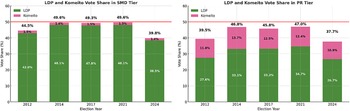
The failure of strategic coordination leads to an overwhelming advantage for the largest party in SMD (Moser, Reference Moser1999). As a result, even though the LDP-Komeito coalition had never received a majority of votes in the SMD and PR tier of the HoR elections since 2012 (as can be shown in Figure 5), they managed to gain a huge majority of seats in all but the 2024 HoR and 2025 HoC elections. While there may be many reasons behind LDP’s continued dominance in elections, it seems that failure of the opposition to coordinate electorally was clearly one of them (Catalinac, Reference Catalinac2025).
LDP and Komeito’s vote share in the HoR SMD and PR tier (2012–2024).

Figure 5. Long description
The image contains two bar graphs side by side. The left graph shows the vote share of LDP and Komeito in the SMD tier from 2012 to 2024. The right graph shows the vote share of LDP and Komeito in the PR tier from 2012 to 2024. Each graph has a y-axis labeled ‘Vote Share (percentage)’ ranging from 0 to 60. The x-axis of each graph is labeled ‘Election Year’ with years 2012, 2014, 2017, 2021, and 2024. In the SMD tier, LDP’s vote share is 44.5 percent in 2012, 49.6 percent in 2014, 49.3 percent in 2017, 49.6 percent in 2021, and 39.8 percent in 2024. Komeito’s vote share is 1.5 percent in 2012, 1.4 percent in 2014, 1.5 percent in 2017, 1.5 percent in 2021, and 1.4 percent in 2024. In the PR tier, LDP’s vote share is 27.6 percent in 2012, 33.1 percent in 2014, 33.3 percent in 2017, 34.7 percent in 2021, and 26.7 percent in 2024. Komeito’s vote share is 11.8 percent in 2012, 13.7 percent in 2014, 12.5 percent in 2017, 12.4 percent in 2021, and 10.9 percent in 2024. The graphs illustrate the changes in vote shares over the years for both parties in different electoral tiers. All values are approximated.
Ironically, the same contamination dynamics that advantage the LDP can also hurt it when conservative parties fail to coordinate. In the 2025 HoC election, the right-wing populist Sanseito fielded candidates in every prefecture, drawing support from disaffected LDP voters frustrated with the moderate policies of the Kishida and Ishiba cabinets. This over-nomination took away votes from the LDP and contributed to losses in several strongholds to CDP and DPFP candidates (Lee, Reference Lee2026). Also, in October 2025, Kōmeitō split from its long-standing coalition with the LDP, prompting the latter to form a new alliance with the JIP. This realignment marks a major turning point in Japan’s post-1999 electoral politics. Unlike the LDP- Kōmeitō coalition, LDP-JIP coalition is unique in that it competed in 85 SMDs in the 2026 HoR election. If the two parties continue to compete among themselves, opposition parties might stand a chance in a three(or more)-way election. Together, these developments underscore how strategic vote coordination remains a crucial determinant of electoral success even for the ruling coalition.
In sum, the contamination effect amplifies collective action problems in Japan’s mixed-member system. By distorting incentives for electoral coordination, it blocks electoral coordination among parties and therefore distorts voter’s choice.
6. Conclusion
Many researchers have examined whether the contamination effect contributes to a higher number of SMD candidacies than would be expected under Duvergerian logic. While contamination has been cited as one of the key factors contributing to the high effective number of parties in recent Japanese elections, empirical results have been inconclusive in identifying the existence and extent of this effect in Japan’s electoral context. This study addresses that gap by analysing the electoral performance of the Japanese parties, demonstrating that the presence of a party’s candidate in a district is statistically significantly associated with a higher PR vote share for that party. Also, candidates that possess credentials such as prior political or professional experience are more effective at boosting their party’s vote share than candidates without such credentials. These findings indicate that the contamination effect encourages parties to field additional candidates to boost PR performance, though the returns to this strategy depend on candidate quality, with more credentialed candidates delivering greater gains.
Previous research has warned that such an oversupply of candidates, driven by contamination incentives, can result in greater disproportionality and minority governments – especially in new democracies where party systems are weakly institutionalised (Moser, Reference Moser1999; Moser and Scheiner, Reference Moser and Scheiner2004). Japan, often regarded as a consolidated democracy, was thought to be immune to such distortions. The early 2000s, characterised by the rise of the DPJ and the formation of a DPJ-led coalition government, seemed to support the view that Japan was evolving toward a stable two-bloc party system under the MMM framework, with no evidence of excessive SMD candidacies caused by contamination. This expectation, however, collapsed with the failure of the DPJ government and the party’s subsequent disintegration. Since 2012, Japan has experienced a return to multi-party system dynamics, with multiple successor and splinter parties – such as the DPFP (from the DPJ) and the JIP (from the LDP) – competing not only with the LDP, but also with one another to become the dominant opposition force. This fragmentation has been exacerbated by deep ideological divides over issues like constitutional revision and foreign policy, as well as lingering antagonism between party support bases, shaped by historical experiences from the SNTV era (Sohn, Reference Sohn2021; Maeda, Reference Maeda2023). As a result, instead of converging into cooperative blocs, opposition parties have grown more hostile and competitive.
This study demonstrates that Japan’s MMM system has contributed to the fragmentation of the party system. The PR tier provides a viable electoral arena for smaller and newly formed parties, allowing them to maintain visibility and organisational survival. However, as these parties seek to expand their presence in the PR tier, they are incentivised to field more candidates in the SMD tier due to the contamination effect – where running a candidate in the district tier boosts the party’s PR vote share.
This mechanism, however, generates a collective action problem among potential allies. Although parties may benefit collectively from electoral coordination in the SMD tier, the opportunity costs of forgoing potential PR gains discourage them from withdrawing candidates. Consequently, rather than fostering structured competition between cooperative party blocs, the MMM system produces a crowded electoral field. This often leaves voters without clear cues about candidate viability, increasing the likelihood that SMD contests are won by candidates with only a narrow plurality of support and exacerbating concerns about representational legitimacy. Furthermore, opposition fragmentation and the resulting lack of clear alternatives can hinder electoral accountability: when voters perceive few viable options, they are less likely to swing away from the ruling party to punish poor performance (Maeda, Reference Maeda2009).
On the other hand, when parties do succeed in overcoming the collective action problem by standing down in certain districts, this may deprive supporters of stood-down parties of their preferred electoral choices. As Maeda (Reference Maeda2025) demonstrates, this effect is particularly pronounced when an unpopular party – such as the JCP or Kōmeitō – becomes the unified coalition candidate, as evidenced by lower turnout and higher rates of invalid voting in those districts. Such constraints on voter choice can heighten dissatisfaction with electoral representation and erode confidence in democratic legitimacy.
The result of this study raises questions about the viability of realising the oft-cited promise of MMM systems – delivering ‘the best of both worlds.’ As Shugart and Wattenberg (Reference Shugart and Wattenberg2001) emphasise, countries contemplating the adoption of MMM should carefully consider not only its advantages but also the institutional constraints and contextual conditions that affect its operation. One key factor insufficiently explored here is the relative size of the SMD and PR tiers. The extent and consequences of contamination effects are likely to vary depending on the ratio between SMD and PR. In MMM systems where the SMD tier dominates, parties may find that the gains from strategic coordination in SMD races outweigh the benefits of oversupplying candidates to boost PR performance (Ferrara and Herron, Reference Ferrara and Herron2005). In contrast, systems where the PR tier dominates may reduce the incentive to coordinate, since oversupply has less impact on overall seat allocation (Herron et al., Reference Herron, Nemoto, Nishikawa, Herron, Pekkanen and Shugart2018). Japan’s configuration is relatively balanced: in the HoR, 62.2 per cent (289 of 465 seats) are elected through SMDs, and 37.8 per cent (176 of 465 seats) through PR; in the HoC, the split is 59.7 per cent (148 of 248 seats) district tier and 40.3 per cent (100 of 248 seats) PR tier. Future research could explore how contamination effects shape parties’ nomination strategies across MMM systems with varying SMD–PR compositions, thereby shedding light on how institutional setting conditions coordination incentives and candidate entry decisions.
Moreover, future research could focus on the micro-foundations of the contamination effect – namely, the behaviour and perceptions of individual voters. Do voters consciously perceive SMD candidacies as influencing their decisions in the PR tier? And if so, what are the cognitive or informational mechanisms through which this contamination occurs? Understanding how and why individual voters make linked decisions across tiers is crucial to fully explaining the dynamics of contamination. Individual-level analysis, including election surveys or survey experiments, as pioneered by Ferrara et al. (Reference Ferrara, Herron and Nishikawa2005), could be employed in this approach. Such approaches would help uncover whether contamination arises from partisan loyalty, candidate visibility, issue cues, or other voter-level factors, offering a more complete picture of the phenomenon.
Supplementary material
The supplementary material for this article can be found at https://doi.org/10.1017/S1468109926100358.
Acknowledgements
I would like to thank Jung-Hwan Lee, the Editor, and anonymous reviewers for helpful comments and suggestions.
Competing interests
The author declares none.





 Open access

