





Early identification and intervention for individuals at clinical high risk for psychosis (CHR-p) has provided opportunities to reduce symptoms and potentially prevent transition to threshold psychosis.Reference Fusar-Poli, Borgwardt, Bechdolf, Addington, Riecher-Rössler and Schultze-Lutter1 Given consensus that individuals with a CHR-p syndrome merit identification and treatment,Reference Fusar-Poli, Borgwardt, Bechdolf, Addington, Riecher-Rössler and Schultze-Lutter1–Reference Woodberry, Shapiro, Bryant and Seidman3 it is critical to identify how different types of stigma may be associated with psychosocial functioning and recovery.Reference Addington, Cornblatt, Cadenhead, Cannon, McGlashan and Perkins4–Reference Rüsch, Heekeren, Theodoridou, Müller, Corrigan and Mayer8 Our research programme proposed that the publicly held conceptions associated with a psychosis risk syndrome (i.e. the CHR-p ‘label’) could exert negative effects, in addition to the symptoms and behaviours that are likely to influence stigma.Reference Yang, Wonpat-Borja, Opler and Corcoran9 Studies of public attitudes show that psychosis-related labels, including CHR-p, as well as symptom manifestations independent of labelling, elicit stigmatising responses such as fear, perceptions of risk for violence and desire for social distance comparable in strength to the diagnosis of ‘schizophrenia’.Reference Mendonça, Fekih-Romdhane and Loch10–Reference Anglin, Greenspoon, Lighty, Corcoran and Yang12 In light of this, we sought to clarify the comparative contributions of two main types of stigma for individuals identified as CHR-p: (a) ‘labelling-related’ stigma, or stigma associated with the CHR-p label itself and (b) ‘symptom-related’ stigma, or stigma arising from mental health symptoms and experiences in the period preceding, or at the time of, CHR-p identification.Reference Yang, Wonpat-Borja, Opler and Corcoran9,Reference Yang, Link and Ben-David13 In a first single-site study with 38 CHR-p participants,Reference Yang, Link and Ben-David13 we found that symptom-related stigma was more salient when compared with labelling-related stigma using our newly developed measures. Further, stigma associated with symptoms was found to be associated with depression, while stigma related to labelling was associated with anxiety. This initial study focused on stigma's associations with symptomatology, thereby gauging the potential relationship of symptoms with the experience of stigma.
Current study: advances in the assessment of stigma in CHR-p
In the current study, we are interested in the potential stigma correlates of a range of psychosocial variables, controlling for CHR-p symptom severity. In addition, the previous studyReference Yang, Link and Ben-David13 included participants whose average attendance in the CHR-p programme was 11.5 months, a period long enough to expect a treatment-initiated abatement of symptoms, which could lead to attenuation of stigma. The current study advances this area by examining, within a multi-site sample of individuals who had been recently (typically <1 month and no more than 6 months) identified as at CHR-p, which type of stigma (label or symptoms) is endorsed more highly and which type shows significant associations with psychosocial factors of self-esteem, social support and quality of life (per prior reviewReference Dubreucq, Plasse and Franck14). The current study provides another advance by assessing individuals’ awareness of being at risk for psychosis; this is crucial when measuring labelling-related stigma in particular, as up to one-quarter of individuals who meet criteria for CHR-p are not aware of, or do not acknowledge, being at risk for a psychotic disorder which may be, in part, because of the lack of exposure to and understanding of clinical terminology when CHR-p status is communicated.Reference Polari, Street, Conus, Finkelstein, Hartmann and Kim15,Reference Takahashi, Katagiri, Higuchi, Nishiyama, Arai and Tagata16
Study hypotheses and implications
Conveying the at-risk psychosis label can elicit both beneficial and detrimental effectsReference Schiffman, Horton, Landa and Woods17,Reference Zhang, McConnell, Carter and Pugh18 ; these include relief in learning the identification (e.g. a positive effectReference Uttinger, Koranyi, Papmeyer, Fend, Ittig and Studerus19,Reference Woodberry, Powers, Bryant, Downing, Verdi and Elacqua20 ) and negative expectations of how others would perceive them (e.g. a stigmatising effectReference Colizzi, Ruggeri and Lasalvia5,Reference Rüsch, Corrigan and Heekeren21,Reference Rüsch, Müller and Heekeren22 ). Alternatively, stigmatising responses can arise in regard to symptoms.Reference Denenny, Thompson, Pitts, Dixon and Schiffman23–Reference Gronholm, Thornicroft, Laurens and Evans-Lacko25 The stigma of mental health symptoms encompasses the multifactorial experience of psychosis risk syndromes, and also reflects the experience of independent and overlapping dimensions of symptom development (e.g. depression, anxiety and attentional and other cognitive challenges).Reference Solmi, Soardo, Kaur, Azis, Cabras and Censori26 Based upon previous findings showing symptom-related stigma to be more prominent than labelling-related stigma among individuals with CHR-p,Reference Yang, Link and Ben-David13 we hypothesise the following: (a) symptom-related stigma will be greater than labelling-related stigma across stigma domains; and (b) symptom-related stigma will show significant associations with psychosocial variables of self-esteem, social support and quality of life when comparative effects of labelling-related stigma are simultaneously accounted for. Identifying the comparative impacts of labelling- versus symptom-related stigma is important in terms of weighing up the benefits and risks in regards to either type of stigma during CHR-p identification,Reference Schiffman, Horton, Landa and Woods17,Reference Zhang, McConnell, Carter and Pugh18,Reference Corcoran, Malaspina and Hercher27–Reference Woods, Carlson and McGlashan29 and for the clinical management of stigma-related issues to reduce its burden among patients.
Method
Baseline data for 150 help-seeking individuals who met CHR-p criteria was collected from February 2013 to September 2016 via a longitudinal multi-site study conducted in three out-patient clinical high-risk (CHR) clinics at Beth Israel Deaconess Medical Center/Harvard Medical School (Boston, MA), MaineHealth Institute for Research (Portland, ME) and New York State Psychiatric Institute/Columbia University (NYSPI; New York, NY). Participants were referred to mental health treatment if not already receiving it.
Participants
Participants were help-seeking individuals, aged 12–35 years, who met criteria for one of more of three CHR-p syndromes assessed by the Structured Interview for Psychosis-Risk Syndromes (SIPS, Version 5.0)Reference Miller, McGlashan, Rosen, Cadenhead, Cannon and Ventura30: brief intermittent psychosis syndrome, attenuated positive symptom syndrome and genetic risk and functional decline syndrome. Exclusion criteria included history of threshold psychosis, acute risk of self-harm/violence, major medical/neurological disorder and IQ < 70. All participants provided written informed consent; minors provided written informed assent with written informed consent from a legal guardian.
All procedures contributing to this work comply with the ethical standards of the relevant national and institutional committees on human experimentation and with the Helsinki Declaration of 1975, as revised in 2013. All procedures involving human participants were approved by the Beth Israel Deaconess Medical Center (IRB# 2016P000183), MaineHealth Institute for Research (IRB# 3996), NYSPI (IRB# 7112R) and New York University (IRB# FY2016-1286) institutional review boards.
Measures
Sociodemographic and clinical covariates
Demographics questionnaire
Demographic variables, including age, years of education, gender, country of birth, preferred language, annual household income, marital status, employment status, student enrolment status, race/ethnicity and family history of psychosis, were collected via self-report.
Symptoms and functioning
The clinician-administered SIPS assesses positive, negative, disorganised and general symptoms.Reference Miller, McGlashan, Rosen, Cadenhead, Cannon and Ventura30 Individual items are rated from 0 (absent) to 6 (extreme) and summed to generate symptom scores for positive (five items; range = 0–30), negative (six items; range = 0–36), disorganised (four items; range = 0–24) and general (four items; range = 0–24) symptom subscales. The modified Global Assessment of Functioning (GAFReference Cornblatt, Auther and Niendam31) is a clinician-rated assessment of the impacts of symptoms on daily life (range = 0–100, with higher scores reflecting greater functioning). The Structured Clinical Interview for Diagnostic and Statistical Manual of Mental Disorders, Version IV (SCID IVReference First, Spitzer, Gibbon and Williams32) was used to identify comorbid Axis I disorders.
Awareness of psychosis risk
Per prior work,Reference Yang, Woodberry, Link, Corcoran, Bryant and Shapiro33 participants were asked two questions: (a) ‘Has anyone told you that you were ‘at-risk for’ or ‘developing’ [condition]?’); and (b) ‘Do you think you are at risk for or developing [condition]?’. The five conditions were ‘depression’, ‘anxiety’, ‘bipolar’, ‘psychosis’ and ‘schizophrenia’. Respondents who endorsed either being ‘told’ or ‘thinking’ they were at risk for ‘psychosis’ or ‘schizophrenia’ were included as being aware of their psychosis risk state. Endorsement of being ‘told’ or ‘thinking’ one was at risk for ‘psychosis’ or ‘schizophrenia’ could arise from their self-perception and/or from being told by others, including receiving a formal CHR-p diagnosis at a CHR programme (below).
Independent variables
Stigma (labelling-related and symptom-related versions)
Three stigma domains were assessedReference Yang, Link and Ben-David13 – ‘negative emotions’ (referring to shame-related emotions); ‘secrecy’; and ‘experienced discrimination’ (henceforth abbreviated as ‘discrimination’). For each stigma domain, parallel items assessed labelling-related versus symptom-related stigma. Items related to high-risk psychosis labelling stigma assessed experiences of being identified as at CHR-p using the anchor ‘About being told I am at-risk for or developing psychosis … ’. Symptom-related stigma was assessed using the anchor ‘About my symptoms and experiences … ’. To capture the full scope of heterogeneous symptom experiences in this sample, the anchor did not specify the type of symptom. Accordingly, participants may have interpreted this item in terms of a wide range of specific (e.g. perceptual disturbances) and non-specific (e.g. anhedonia) symptoms associated with psychosis, or any comorbid symptoms (e.g. depression, anxiety). All other phrasing was identical across item versions, enabling direct comparison (see Supplementary Table 1 available at https://doi.org/10.1192/bjp.2024.209, including alternate wording for ‘labelling-related’ stigma items if respondents did not report being aware of their psychosis risk). Higher summed scores reflect greater endorsement of stigma.
(a) Negative emotions.Reference Yang, Link and Ben-David13 Three shame-related items (rated 1 [not at all] to 4 [a lot]; range = 3–12) assessed ‘shame’, ‘embarrassment’ or ‘feeling different from others’ attributed to either labelling-related (Cronbach's α = 0.75) or symptom-related (Cronbach's α = 0.80) types.
(b) Secrecy.Reference Yang, Link and Ben-David13 Five items (scored 0 [no] or 1 [yes]; range = 0–5) assessed whom the respondent had told of their CHR-p label (Cronbach's α = 0.72) or symptoms (Cronbach's α = 0.66).
(c) Discrimination.Reference Yang, Link and Ben-David13 Five items (rated 1 [never] to 5 [very often]; range = 5–25) assessed experienced unfair treatment from others attributed to either labelling-related (Cronbach's α = 0.90) or symptom-related (Cronbach's α = 0.92) types.
Dependent variables
Rosenberg Self-esteem Scale
The Rosenberg Self-esteem ScaleReference Rosenberg34 has 10 items (scored 1 [strongly agree] to 4 [strongly disagree]) assessing global self-worth (Cronbach's α = 0.90; range = 10–40).
Word Health Organization Quality of Life Scale-Brief
To confirm factor structure and reduce the number of outcomes, the World Health Organization Quality of Life Scale-Brief 26-item measure (items rated 1–5) was factor analysed.Reference Group35,Reference Oliveira, Carvalho and Esteves36 Based on examination of the scree plot and confirmed by parallel analysis, a three-factor solution was implemented using Direct Oblimin rotation. The three factors accounted for 49.6% of variability (Supplementary Table 2) and were treated as dependent variables. Subscale scores were generated for the following: (a) ‘satisfaction with life and functioning’ (nine items; range = 9–45; Cronbach's α = 0.83); (b) ‘satisfaction with environment’ (eight items; range = 8–40; Cronbach's α = 0.80); and (c) ‘satisfaction with relationships’ (three items; range = 3–15; Cronbach's α = 0.75). The single-item ‘satisfaction with health’ comprised a final subscale (range = 1–5), as per the original scale, and it remained separate from extracted factors.
Norbeck Social Support Questionnaire
We used the Norbeck Social Support Questionnaire (NSSQ)Reference Norbeck, Lindsey and Carrieri37 to assess loss of social support by summing (scored 0 [no], 1 [yes]; range = 0–3) participants’ loss of important relationships owing to ‘others finding out about’, ‘feeling different from others due to’ and ‘not wanting to burden others about’ their mental health condition or treatment (Cronbach's α = 0.64).
Data analysis
Primary analyses are reported for participants with complete data who reported any awareness of psychosis risk (n = 113), as this group could most adequately reflect upon ‘labelling-related’ stigma for CHR-p (supplementary analyses for two additional subsamples were conducted to corroborate findings with this primary analytic group, below). Characteristics were summarised using descriptive statistics (Table 1). For each stigma domain (shame-related emotions, secrecy, discrimination), a paired-sample t-test assessed differences between labelling- versus symptom-related subscales.
Sample characteristics for individuals at clinical high risk for psychosis who endorsed awareness of psychosis risk, N = 113

GAF, Global Assessment of Functioning; ADHD, attention-deficit hyperactivity disorder; MDD, major depressive disorder.
a. Ranges for symptom subscales are 0–30 (positive symptoms), 0–36 (negative symptoms) and 0–24 (disorganised and general symptoms).
b. Range for the GAF is 0–100.
c. Column percentage does not sum to 100% as 43 (38.7%) respondents reported ‘not knowing’.
Next, we examined associations between stigma type and dependent variables. We first conducted separate multivariate linear regressions for each stigma domain to test: (a) the independent association of labelling- and symptom-related stigma with the joint distribution of dependent variables; and (b) the combined association of labelling- and symptom-related stigma with the joint distribution of dependent variables, with and without adjusting for covariates (site, age, gender, race/ethnicity, family history of psychosis and positive, negative and disorganised symptoms;Reference Yang, Woodberry, Link, Corcoran, Bryant and Shapiro33 Supplementary Table 3).
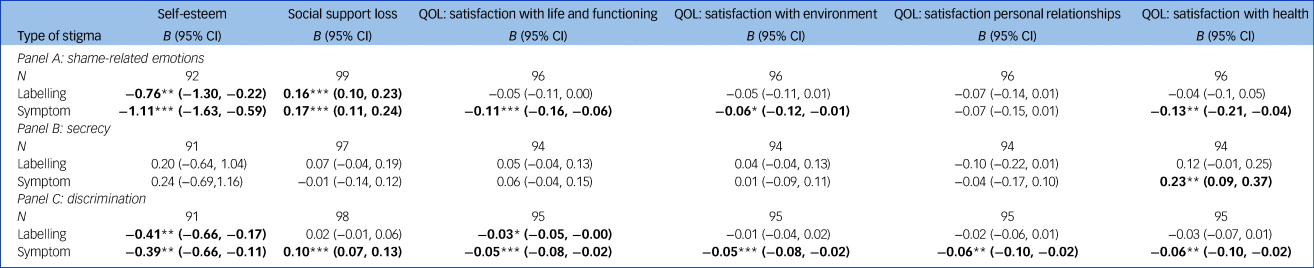
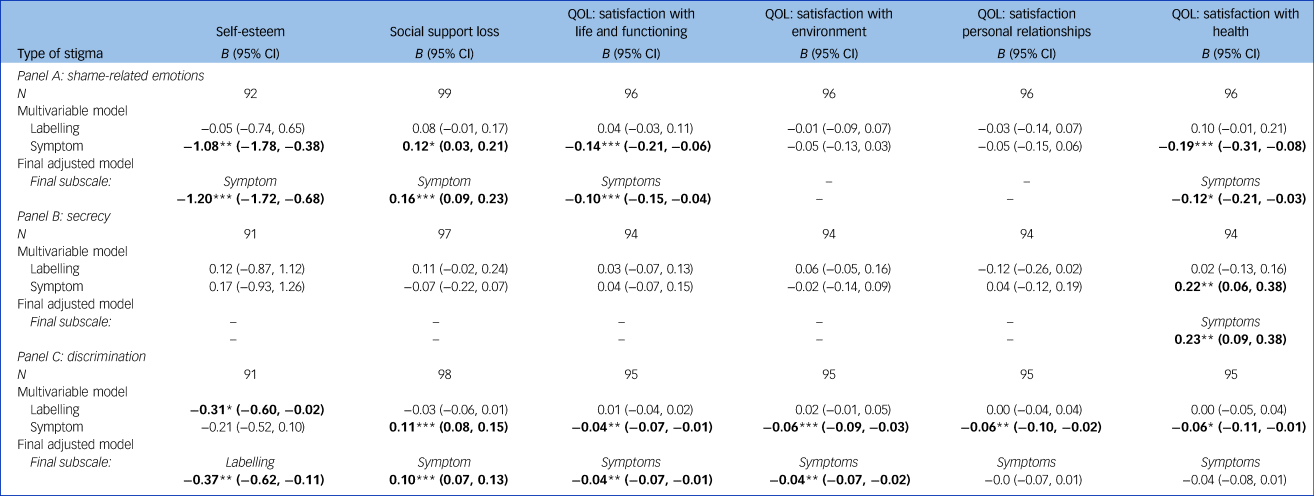
Next, bivariate models were used to independently assess the association of the labelling- and symptom-related version of each stigma domain with psychosocial variables (Table 2), while multivariable models were used to associate labelling- and symptom-related stigma domains simultaneously (i.e. controlling for the effect of the other) with each of the psychosocial variables (Table 3) (henceforth, ‘multivariable model’). Based on which stigma type remained significant (P < 0.05), a predominant stigma type was identified for use in the ‘final adjusted models’ that were adjusted for covariates (demographics and symptoms) (Table 3; Supplementary Table 4 shows parameter estimates for all variables). Bivariate, multivariable and final adjusted modelling was also conducted for the entire sample, including all participants who met CHR-p criteria, regardless of awareness of psychosis risk (n = 150; Supplementary Tables 5 and 6), and for the subset of individuals who reported awareness of psychosis risk and who received a formal CHR-p diagnosis at a CHR programme (n = 89; Supplementary Tables 7 and 8) (see Supplementary Figure 1 for flowchart of subsamples). Lastly, exploratory interaction analyses were conducted to examine the implications of race/ethnicityReference Misra, Jackson, Chong, Choe, Tay and Wong38 and family history of psychosisReference Kim, Polari, Melville, Moller, Kim and Amminger39 on associations between stigma and psychosocial variables (Supplementary Tables 9 and 10), as these have shown salience in relation to mental illness stigma. Significant interactions are cautiously presented in these supplementary tables given the likelihood of Type 1 error.
Bivariate models between stigma domain (shame, secrecy and discrimination) and psychosocial variables: linear regression results, N = 113
QOL, quality of life.
Betas are unstandardised. Significance at *P < 0.05, **P < 0.01, ***P < 0.001.
Linear regression models between stigma domain (shame, secrecy and discrimination) and psychosocial variables: multivariable models and adjusted models, N = 113
QOL, quality of life.
Betas are unstandardised. Significance at *P < 0.05, **P < 0.01, ***P < 0.001. Final adjusted models adjust for: age, gender, race/ethnicity, family history of psychosis, total positive symptoms, total negative symptoms, total disorganised symptoms and site; double-dash (–) in unpopulated cells indicates that neither the labelling nor the symptom subscale was moved to the final adjusted model.
Statistical significance was considered P < 0.05. Analyses were cross-checked by two independent teams using SPSS version 26/27 and SAS version 9.4 (Cary, NC, USA; see https://www.sas.com/en_us/home.html).
Results
Awareness of psychosis risk
For the primary analyses, 113 participants endorsed having been told or thinking they were at risk for ‘psychosis’ or ‘schizophrenia’.
Sample characteristics
Participants were primarily students (82%), male (63.1%) and White (63.1%). Participants had a mean age of 18.6 years (s.d. = 3.7), reported moderate positive (M = 14.2; s.d. = 3.6), negative (M = 15.3; s.d. = 6.5) and general (M = 11.5; s.d. = 4.1) symptoms, reported some disorganised symptoms (M = 7.4; s.d. = 3.9) and reported marked functional impairment (GAF M = 46.4; s.d. = 10.0) (Table 1).
Is stigma higher based on one's label or one's symptoms?
Participants endorsed greater symptom-related (M = 7.0; s.d. = 2.3) versus labelling-related (M = 6.3; s.d. = 2.3) shame (t(109) = 3.71, P < 0.001). Conversely, participants endorsed greater labelling-related (M = 2.7; s.d. = 1.6) versus symptom-related (M = 1.9; s.d. = 1.4) secrecy (t(106) = 5.37, P < 0.001). There was no significant difference in endorsement of symptom-related (M = 10.0; s.d. = 4.8) versus labelling-related (M = 9.7; s.d. = 5.0) discrimination (t(108) = 0.67, P = 0.51).
What is the overall relationship of stigma type to all dependent variables?
Multivariate omnibus tests of each stigma type on the joint distribution of dependent variables show that symptom stigma appears more strongly associated (η2) than labelling stigma across all dependent variables, even after accounting for covariates (η2 = 0.11–0.35 for symptom-related stigma domains versus η2 = 0.06–0.17 for labelling-related stigma domains) (Supplementary Table 3).
Table 2 shows that, of the 16 statistically significant bivariate relationships between stigma domains and dependent variables, 12 (75%) are attributable to symptom-related stigma and four (25%) to stigma related to the high-risk psychosis label. While both labelling-related and symptom-related stigma domains were associated with self-esteem and social support loss, symptom-related stigma showed eight statistically significant associations with quality-of-life factors whereas labelling-related stigma showed only one statistically significant association.
Is labelling-related or symptom-related stigma significantly associated with psychosocial factors?
In the following, we describe the multivariable and final adjusted models, focusing on describing associations between labelling-related stigma domains and dependent variables, and symptom-related stigma domains and dependent variables (Table 3).
Labelling-related stigma
In the multivariable models, after controlling for symptom-related counterparts, only labelling-related discrimination was significantly associated with lower self-esteem (Table 3). This association remained significant in the final adjusted model (B = −0.37; 95% CI [−0.62, −0.11], R 2 = 0.27). Labelling-related emotions and labelling-related secrecy were not significantly associated with any dependent variables in the multivariable model step (Table 3).
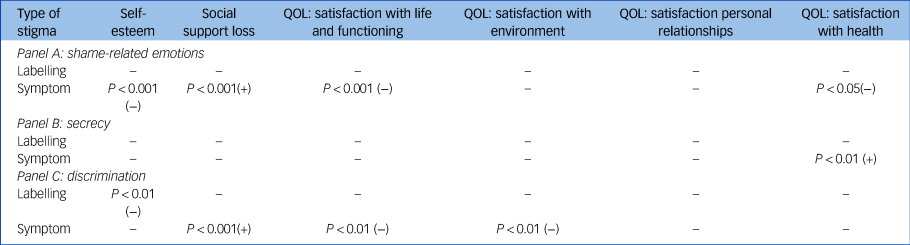
Accordingly, when examining the final adjusted models between all stigma domains related to the high-risk psychosis label and dependent variables, only one statistically significant association was found between labelling-related discrimination and self-esteem (Table 4).
Stigma and psychosocial variables: summary of final adjusted models, N = 113
QOL, quality of life.
In unpopulated cells, a double dash (–) indicates this stigma variable did not advance to the final adjusted model. In populated cells, (−) indicates an inverse relationship between stigma variable and psychosocial variable; (+) indicates a positive relationship between stigma variable and psychosocial variable.
Symptom-related stigma
Symptom-related emotions, after controlling for its labelling-related counterpart in the multivariable model, was significantly associated with worse self-esteem, satisfaction with life and functioning, satisfaction with health and greater social support loss (Table 3). These associations remained significant in the final adjusted model for the following: self-esteem (B = −1.08; 95% CI [−1.78, −0.38], R 2 = 0.36); satisfaction with life and functioning (B = −0.14; 95% CI [−0.21, −0.06], R 2 = 0.31); satisfaction with health (B = −0.12; 95% CI [−0.21, −0.03], R 2 = 0.16); and social support loss (B = 0.16; 95% CI [0.09, 0.23], R 2 = 0.21) (Table 3).
Symptom-related secrecy, after controlling for its labelling-related counterpart in the multivariable model, was significantly, and somewhat unexpectedly, associated with greater satisfaction with health. This association remained significant in the final adjusted model (B = 0.23, 95% CI [0.09, 0.38], R 2 = 0.21) (Table 3).
Symptom-related discrimination, after controlling for its labelling-related counterpart in the multivariable model, was significantly associated with reduced satisfaction with life and functioning, satisfaction with environment, satisfaction with personal relationships, satisfaction with health and greater social support loss (Table 3). These associations remained significant in the final adjusted model for the following: satisfaction with life and functioning (B = −0.04; 95% CI [−0.07, −0.01], R 2 = 0.26), satisfaction with environment (B = −0.04; 95% CI [−0.07, −0.02], R 2 = 0.21) and greater social support loss (B = 0.10; 95% CI [0.07, 0.13], R 2 = 0.33) (Table 3).
Overall findings
When examining the final adjusted models between all symptom-related stigma domains and dependent variables, eight statistically significant associations were found (Table 4). These associations persisted even after accounting for participants’ positive, negative and disorganised symptoms, with these symptoms remaining significantly associated with various dependent variables in the final models (Supplementary Table 4). Among the symptom-related stigma findings, shame-related emotions (four significant associations) and discrimination (three significant associations) most frequently accounted for the overall relationship between stigma and psychosocial factors.
As an additional check to examine the role of positive symptoms, we explored whether individuals at CHR-p, stratified into ‘high’ versus ‘low’ positive symptoms (per median split), showed differing associations between symptom-related stigma and dependent variables; the results (available upon request) were relatively consistent among subgroups.
Is this overall pattern corroborated in supplementary CHR-p subsamples?
The bivariate models, multivariable models and final adjusted models were replicated among the following: (a) all individuals who met criteria for CHR-p (n = 150; Supplementary Tables 5 and 6) and (b) among individuals reporting awareness of psychosis risk and who were formally conveyed a CHR-p designation (89/113; Supplementary Tables 7 and 8). While isolated variations in significant associations were found, the overall pattern in the final adjusted models remained consistent across the primary sample and these two supplementary samples, corroborating the predominant pattern between symptom-related stigma and dependent variables (i.e. accounting for ten of ten total significant associations in the first supplementary sample [n = 150] and seven of eight [87.5%] total significant associations in the second supplementary sample [n = 89]).
Exploration of whether patterns of association differ by race/ethnicity or family history of psychosis
For the primary analyses, interaction analyses were conducted to explore whether race/ethnicity and family history of psychosis affected associations between stigma and psychosocial variables. We tested 22 interactions and found only three (14%) to be significant and none to be large (see Supplementary Tables 9 and 10). In fact, the adjusted R-square increment achieved when interaction terms were added was generally very small (mean change = 0.8%; range: −0.33%, 1.47%). As a result, we have chosen not to strongly interpret interactions, and instead include results in the supplement as exploratory findings for future research.
Discussion
We found that symptom-related stigma had a stronger negative association with psychosocial functioning than did labelling-related stigma in individuals who had been recently identified as meeting criteria for CHR-p and who acknowledged psychosis risk. The finding that associations between stigma and psychosocial variables remain when symptoms are controlled indicates that stigma processes (especially CHR participants’ stigmatising perceptions about symptomsReference Yang, Link and Ben-David13) are an independent factor related to psychosocial outcomes. Stigma related to having symptoms requires addressing in its own right. This is especially true given the critical developmental period during which CHR-p individuals are identified.Reference Yang, Wonpat-Borja, Opler and Corcoran9 Symptom-induced experiences of stigma, especially shame and perceived discrimination, are occurring when identity and social networks are being consolidatedReference Eccles, Midgley and Wigfield40 and their negative impacts at this time are reflected in loss of social support and worse quality of life. The comparatively prominent role of symptom-related stigma was corroborated in two supplementary samples: when we included individuals who met CHR-p criteria but who did not acknowledge being at psychosis risk,Reference Yang, Woodberry, Link, Corcoran, Bryant and Shapiro33 and among only those who had both been informed of and acknowledged psychosis risk.
That the stigma reported was primarily associated with symptoms makes sense given the myriad symptoms experienced by individuals identified as at CHR-p.Reference Woodberry, Shapiro, Bryant and Seidman3,Reference Solmi, Soardo, Kaur, Azis, Cabras and Censori26,Reference Miller, McGlashan, Rosen, Cadenhead, Cannon and Ventura30 CHR-p samples are known to have a range of both independent and overlapping psychotic and non-psychotic symptoms.Reference Solmi, Soardo, Kaur, Azis, Cabras and Censori26 Most study participants (>66%) reported comorbid depressive and/or anxiety disorders. As a first step to address symptom-related stigma, community-level campaignsReference Srihari, Ferrara, Li, Kline, Gülöksüz and Pollard41 to help contextualise psychotic-like symptoms could be implemented to reduce community stigma associated with CHR-p symptomatology. In addition to improving lay recognition of the warning signs of early psychosis,Reference McFarlane, Cook, Downing, Verdi, Woodberry and Ruff42,Reference McFarlane, Levin, Travis, Lucas, Lynch and Verdi43 such community-level efforts (e.g. in schools and churches) could lower reticence to contact CHR-p programmes among symptomatic individuals by decreasing symptom-related stigma. Community-level campaigns could emphasise accurate information about the risk for transition to threshold psychosis (~25% at 3 yearsReference De Pablo, Radua and Pereira44) when CHR-p symptoms are present, which was found to reduce social distancing attitudes among young adults.Reference Yang, Anglin, Wonpat-Borja, Opler, Greenspoon and Corcoran11 Second, future interventions could address stigmatising perceptions associated with symptoms and related experiences by targeting both internalised and external exposures to stigma.Reference Lucksted, Drapalski, Brown, Wilson, Charlotte and Mullane45 Internalised beliefs about stigma associated with CHR-p and non-CHR-p specific symptoms could manifest in shame, alienation and differentness, or as feelings of ‘not fitting in with others’.Reference Gronholm, Thornicroft, Laurens and Evans-Lacko25 External manifestations of symptom-related stigma – that is, perceived and/or actual negative treatment from others – include being teased, shunned and categorised as odd by peers or family.Reference Colizzi, Ruggeri and Lasalvia5,Reference Anglin, Greenspoon, Lighty, Corcoran and Yang12 Stigma interventions can target shame-related emotions using cognitive behaviouralReference Morrison, Birchwood, Pyle, Flach, Stewart and Byrne46 and family psychoeducationalReference Schiffman, Horton, Landa and Woods17,Reference McFarlane, Cook, Downing, Verdi, Woodberry and Ruff42,Reference McFarlane, Levin, Travis, Lucas, Lynch and Verdi43 approaches and discriminatory experiences using adaptive coping strategies. What is key is to deal with the entire range of stigmatising experiences associated with symptoms, their impacts and the attributions assigned to them.Reference Woodberry, Powers, Bryant, Downing, Verdi and Elacqua20 This includes the harmful reactions people receive as well as their own internal but socially influenced concerns about what their emerging problems mean. One key caveat is to approach secrecy related to symptoms and experiences carefully given its apparent and somewhat unexpected protective relationship with satisfaction with health; secrecy about one's symptoms may be adaptive in many circumstances (e.g. to avert school-based bullyingReference Colizzi, Ruggeri and Lasalvia5,Reference Gronholm, Thornicroft, Laurens and Evans-Lacko24 ). Accordingly, interventions could encourage gradual disclosureReference Rüsch and Kösters47 of CHR-p symptoms to social circles that individuals identify as safe. Support from peersReference Biagianti, Quraishi and Schlosser48 with lived experience of CHR-p could help address perceptions of differentness associated with symptoms and in coping with discriminatory experiences.
We found that, after adjusting for symptom-related stigma, only one stigma variable (i.e. discrimination) related to the high-risk psychosis label was associated with psychosocial outcomes (i.e. self-esteem) among our recently identified CHR-p sample. This finding is consistent with our prior study showing that despite mitigating negative emotions (e.g. shame), the communication of CHR-p status by a CHR programme had a negative impact on how individuals viewed themselves and expected others to view them.Reference Woodberry, Powers, Bryant, Downing, Verdi and Elacqua20 Of note, in contrast to our symptom-related stigma probe, our labelling-related stigma probe asked specifically about stigma associated with the high-risk psychosis label. It thus did not encompass other labels (e.g. ‘depressed’, ‘anxious’, ‘weird’, ‘odd’) that could be more relevant to identity, stigma and psychosocial functioning.Reference Colizzi, Ruggeri and Lasalvia5,Reference Anglin, Greenspoon, Lighty, Corcoran and Yang12,Reference Gronholm, Thornicroft, Laurens and Evans-Lacko24,Reference Gronholm, Thornicroft, Laurens and Evans-Lacko25 Two study findings suggest that labelling-related stigma may still be problematic for a substantial subsample of CHR-p participants. First, approximately one-quarter of our total CHR-p sample (37/150; 24.7%) did not identify with or agree with being at risk for developing schizophrenia or psychosis. Second, we found that secrecy associated with receiving the CHR-p designation was endorsed significantly more highly than secrecy related to symptoms. In either case, respondents may anticipate that community members are likely to conflate ‘psychosis risk’ with the concept of ‘psychosis’, thus evoking comparably severe stereotypes (e.g. of violence) and discrimination (e.g. social distance) from others.Reference Yang, Anglin, Wonpat-Borja, Opler, Greenspoon and Corcoran11 These findings show that many CHR-p participants do not identify with the CHR-p label (whether via lack of exposure to, understanding ofReference Polari, Street, Conus, Finkelstein, Hartmann and Kim15,Reference Takahashi, Katagiri, Higuchi, Nishiyama, Arai and Tagata16 or active rejection of the label) and as a result withhold the information from others.
Limitations include the cross-sectional design, which precluded evaluating causality. Second, given recent receipt of the CHR-p designation among study participants, experiences of labelling-related stigma were time-limited. On average, participants were typically assessed at <1 month and no more than 6 months from CHR-p identification, when formal CHR-p labelling is most likely to occur. Accordingly, longitudinal evaluation is warranted to examine how labelling-related stigma could affect psychosocial outcomes over time. Further, individuals who entered specialised CHR-p services could be less susceptible to, and less likely to endorse, stigma associated with the high-risk psychosis label. Labelling-related stigma could also have been underestimated by the focus on the psychosis risk label specifically, as no standardised or uniform guidelines of conveying CHR-p status currently existReference Schiffman, Horton, Landa and Woods17,Reference Zhang, McConnell, Carter and Pugh18,Reference Yang, Woodberry, Link, Corcoran, Bryant and Shapiro33 ; instead, our findings reflect (and adjust for) the varied and individualised communication methods applied by CHR-p programme clinicians by site. Another limitation is that symptom-related items likely encompassed stigmatising perceptions of co-occurring symptoms and experiences at time of CHR-p identification in addition to those specifically leading to identification. Asking specifically about stigma related to positive (and perhaps negative) symptoms associated with CHR-p might yield different results.
Future directions
Our findings point to, within a relatively large, multi-site sample, the strong relationship between symptom-related stigma and psychosocial functioning. That identification as CHR-p may have less to do with key aspects of youths’ self-esteem, quality of life and social support than the stigma they associate with the symptoms they experience, independent of the actual symptoms they experience, places the onus on addressing both community-level and internalised stigma in addition to symptoms. We recommend that specialised programmes and adjunctive stigma interventions address perceptions of how people may respond negatively to symptoms and experiences related to CHR-p and how patient-related factors (e.g. cultural meanings related to mental health symptoms;Reference Misra, Jackson, Chong, Choe, Tay and Wong38 family history of psychosisReference Kim, Polari, Melville, Moller, Kim and Amminger39) affect individuals; such interventions could take place as community-level campaignsReference Oliveira, Carvalho and Esteves36,Reference McFarlane, Cook, Downing, Verdi, Woodberry and Ruff42,Reference McFarlane, Levin, Travis, Lucas, Lynch and Verdi43 and at the level of individual CHR-p participants. We also recommend that future investigations, including qualitative studies,Reference Ben-David, Birnbaum, Eilenberg, DeVylder, Gill and Schienle49 examine the comparative stigma of different types of labels that these young people may have received or identify with, some of which may be related to the experience of CHR-p, with others relating to the multitude of other factors that come to define individuals as they grow up. Similarly, future studies should examine how specific symptom-related stigma is associated with psychotic versus non-psychotic symptoms, and the processes by which stigma is internalised and subsequently mitigated. In closing, our findings indicate that additional addressing of stigma could maximise youths’ potential for recovery and optimise this pivotal early intervention effort in psychiatry.
Supplementary material
Supplementary material is available online at https://doi.org/10.1192/bjp.2024.209
Data availability
The data that support the findings of this study are available from the corresponding author, L.H.Y., upon reasonable request.
Acknowledgements
We would like to thank Dan Shapiro, Caitlin Bryant, Emily Kline and Leda Kennedy for their assistance in collecting data at Beth Israel Deaconess Hospital; Donna Downing, Mary Verdi and Anna Cloutier for their assistance in collecting data at MaineHealth Institute for Research; Chris Kang for her help in formatting the manuscript; and Gary Brucato, Francesca Crump, Emily He, Bernalyn Ruiz, Jenny Shen, Junko Morita and Lily Kamalyan for their assistance in collecting data at New York State Psychiatric Institute/Columbia Medical Center. We thank Peter Byrne and Stacia Friedman-Hill for their support. We finally dedicate this manuscript to beloved friend and collaborator, Larry Seidman.
Author contributions
L.H.Y., W.M., C.C., K.W. and B.G.L. formulated the research question and designed the study. K.W. and R.G. carried out the study. D.H., M.G. and D.B. analysed the data, and L.H.Y., B.G.L., C.C., K.W. and W.M. interpreted the data. D.B., M.G. and L.H.Y. conducted the literature search. L.H.Y., M.G. and D.B. wrote the first draft, and B.G.L., C.C., K.W., R.G. and W.M. commented on and edited the manuscript for intellectual content. L.H.Y., B.G.L. and M.G. revised the manuscript based on reviewers’ comments. All authors reviewed the manuscript for important intellectual content and approved the revised manuscript for publication.
Funding
L.H.Y. was supported by funds from NIMH R01-MH096027 (PI: Yang), entitled ‘Stigma Associated with a High-Risk State for Psychosis’, a Brain and Behavior Foundation Young Investigator Award (NARSAD 17839) and NIMH R21 HG010420-01 (PI: Yang). C.C. was supported by funds from NIMH R01MH107558. During the 36 months before submission, K.W. was supported by funds from NIH (R01 MH096027; R21 MH093294; U01 MH081928; R01 MH101052; K23 MH102358), the Massachusetts Department of Mental Health (‘Training for Early Intervention in Psychosis’; and SCDMH82101008006) and the Sidney R. Baer, Jr Foundation. R.G. reports non-financial support from Genentech, grants from Otsuka, non-financial support from Bioadvantex, grants from Allergan and consultation for Signant outside the submitted work. W.M. was supported by funds from the MaineHealth Institute for Research. D.B. was supported in part by funds from the National Human Genome Research Institute, University of Michigan Training Program in ELSI Research (T32HG010030). D.H. was supported in part by funds from the National Institute of Mental Health, Harvard T.H. Chan School of Public Health Training Program in Psychiatric Genetics and Translational Research (T32MH017119).
Declaration of interest
None.
Transparency declaration
We affirm that the manuscript is an honest, accurate and transparent account of the study being reported, and that no important aspects of the study have been omitted.
Analytic code availability
The analytic code used to generate the findings of this study are available from the corresponding author, L.H.Y., upon reasonable request.
Research material availability
No additional research materials other than de-identified data and analytic code will be made available.


 Open access


eLetters
No eLetters have been published for this article.