

In this article we study the spread of anti-government violence across international boundaries. Specifically, we examine whether communications technology can facilitate spatial dependence in anti-government violence as it moves from one country to one or more neighbors. Technology certainly allowed the events of the Arab Spring to spread very rapidly, often across international borders (Lotan et al. Reference Lotan, Graeff, Ananny, Gaffney, Pearce and Boyd2011; Stepanova Reference Stepanova2011). Little attention, however, has been paid to the mechanisms that allow these spatial relationships to occur. We demonstrate that this process has been slowly taking place for more than a decade in Africa. Our findings suggest that increasing interconnectivity from communications technology can facilitate the spread of anti-government violence from one country to another.
Past research, which most often examines the spread of larger-scale conflicts, such as domestic armed conflicts and civil wars, argues that diffusion across state boundaries occurs because actors observe the events occurring in a neighboring country and emulate those actions against their own government (Anselin and O’Loughlin Reference Anselin and O’Loughlin1992; Gleditsch Reference Gleditsch2002; Braithwaite Reference Braithwaite2006, Reference Braithwaite2010; Buhaug and Gleditsch Reference Buhaug and Gleditsch2008; Maves and Braithwaite Reference Maves and Braithwaite2013). However, these analyses assume that actors within one country are always more likely to be aware of the violent events occurring in their neighbor, rather than some more distant state, simply because they share a border. Thus adjacency matrices that attempt to capture spatial dependence in conflicts do not incorporate actors’ potential variation in awareness of neighboring events, thereby potentially overestimating the degree of dependence. We argue that in order to emulate violent events in neighboring countries, actors must become aware of these events through their exposure to information about them.
We make three contributions to the literature. First, we elucidate the commonly discussed (but as yet unmodeled) assumption that access to information concerning events across geographical boundaries allows for the theoretical diffusion mechanism of emulation to occur across those boundaries. Second, we attempt to directly model this access to information instead of assuming that state contiguity alone captures emulation behavior. Third, we apply these constructs to explain the spread of anti-government violence rather than the more common outcomes of domestic armed conflicts and civil wars. Examining low-intensity acts of government violence rather than larger sustained and organized mass rebellions provides a harder test of our theory due to the lower likelihood that displaced populations and refugees will spread news by word of mouth.
Our methodological contribution is somewhat unique in the spatial econometrics literature, in that we allow spatial dependence to be conditioned by our primary explanatory variables. This approach allows the researcher to analyze more connectivity information in the spatial modeling process than is ordinarily possible. This is especially useful in the absence of measurable connectivity outside of geographic boundaries and distance. Conditioning the spatial dependence also relates to our theoretical contribution, in that we attempt to properly model our theorized channel of connectivity between units, in this case countries.
The article proceeds in several sections. We first review the literature on the spread of violence. Second, we detail our theoretical contribution regarding the role of information acquisition in spatial dependence. Third, we introduce our data and modeling procedure. We then explain our data sources and research design, and discuss our empirical results. The final section concludes by highlighting the potential implications of our findings and suggestions for future work.
THE SPREAD OF VIOLENCE
There is growing and increasingly compelling evidence that numerous forms of violent conflict are not independent, isolated phenomena. Rather, they exhibit non-random spatial distribution patterns that suggest a high degree of interdependence. In other words, conflict behavior at the sub-state level has the potential to spread across state boundaries and act as a form of contagion. The vast majority of conflict contagion analyses specifically examines large-scale domestic armed conflict and civil wars (Anselin and O’Loughlin Reference Anselin and O’Loughlin1992; Gleditsch Reference Gleditsch2002; Braithwaite Reference Braithwaite2006, Reference Braithwaite2010; Buhaug and Gleditsch Reference Buhaug and Gleditsch2008; Salehyan and Gleditsch Reference Salehyan and Gleditsch2006; Maves and Braithwaite Reference Maves and Braithwaite2013). However, evidence also exists for the spread of protests and rioting behavior (Govea and West Reference Govea and West1981; Hill and Rothchild Reference Hill and Rothchild1986; Hill, Rothchild and Cameron Reference Hill, Rothchild and Cameron1998; Myers Reference Myers2000) as well as international terrorism (Midlarsky, Crenshaw and Yoshida Reference Midlarsky, Crenshaw and Yoshida1980; Braithwaite and Li Reference Braithwaite and Li2007; Neumayer and Plümper Reference Neumayer and Plümper2010; Cliff and First Reference Cliff and First2013).
In order to examine the extent to which anti-government violence in a neighboring country increases the probability of anti-government violence at home, one must overcome two hurdles. First, we make the distinction between outcomes that are spatially dependent on one another and those that occur due to similar underlying causes. Are there circumstances in which violence is truly spatially dependent, or are we simply observing similar outcomes that geographically cluster together because these countries exhibit similar underlying factors that raise the risk of violence? This is known as Galton’s problem (Galton Reference Galton1889). In other words, are acts of violence against the government occurring in one’s own country dependent on similar acts of violence occurring in a prior time period abroad? Or are these acts of violence occurring due to similar domestic conditions? A second hurdle is determining the appropriate measure of dependence. Measures of interstate contiguity, length of shared borders and distances between state capitals are all different ways of capturing geographic proximity, and have all displayed evidence of interdependence (Anselin and O’Loughlin Reference Anselin and O’Loughlin1992; Murdoch and Sandler Reference Murdoch and Sandler2002).
However, Buhaug and Gleditsch (Reference Buhaug and Gleditsch2008) find that geographic proximity, regardless of how it is measured, only minimally influences civil conflict contagion. Instead, they find that transnational ethnic ties, as well as similar political regimes and underlying economic conditions that make countries more prone to conflict at the outset, are more significantly driving the geographic clustering of conflict. Similarly, Salehyan and Gleditsch (Reference Salehyan and Gleditsch2006) show that the negative externalities associated with civil conflicts, such as the migration of refugees and movement of weapons, flow from conflict zones into neighboring countries. Although these findings might be interpreted as countering spatial dependence arguments, they still demonstrate that geographical proximity allows for transboundary movements of the negative externalities resulting from one state’s conflict, raising the risk of conflict in a proximate state. These effects would then be less likely to occur the farther away a state is from the conflict-ridden state.
More recent evidence for spatial dependence utilizes government characteristics as a conditioning factor. Braithwaite (Reference Braithwaite2010) finds that higher levels of state capacity reduce the likelihood of conflict contagion due to the government’s enhanced ability to buffer the spread of violence. Therefore, large-scale organized conflicts against the government should only be able to spread from a neighboring country when one’s own government is unable to contain the violence. Maves and Braithwaite (Reference Maves and Braithwaite2013) examine the institutional design of autocratic regimes as a conditioning factor to the spread of civil conflict. They find that autocratic countries with legislatures are more likely to experience their own war when conflict is occurring in a neighboring country. This is because of both negative externalities resulting from the neighbor’s conflict and the decreased credibility of promised political reforms beyond the establishment of a legislature, which fuels domestic opposition and leads to a higher likelihood of conflict emulation.
Although empirical findings have provided fairly consistent evidence that conflict is spatially dependent, the most common mechanism by which this dependence is argued to occur, largely drawn from the policy diffusion literature, is through the emulation of actions.Footnote 1 We do not disagree that the process of emulation is potentially at work. Rather, we argue that because emulation crucially depends on exposure to information regarding actions to emulate, and because this exposure to information naturally varies from country to country, the probability of contagion should be conditioned by this exposure to information.
HOW INFORMATION LEADS TO EMULATION
Two common mechanisms are used to explain the diffusion of civil conflicts across state boundaries. The first mechanism relies on a purely rational learning framework. Actors are exposed to information concerning proximate events that they then process in an unbiased manner. This unbiased information is systematically utilized to order their preferences among a set of outcomes. Actors then engage in subsequent actions that represent their ordered preferences and maximize their utility. When applying the rational learning framework to conflict diffusion, we can argue that potential opposition groups engage in a strict cost-benefit analysis when deciding whether to violently challenge their government. Learning from their observation of a successful rebellion in a neighboring country, they will emulate those actions to achieve a similar outcome at home (Lake and Rothchild Reference Lake and Rothchild1998).
A second explanatory mechanism holds that neighboring conflicts may create a large cross-border migration of refugee populations, which could intensify resource competition and potentially shift the balance of power among competing ethnic groups in receiving countries (Salehyan and Gleditsch Reference Salehyan and Gleditsch2006; Gleditsch Reference Gleditsch2007; Buhaug and Gleditsch Reference Buhaug and Gleditsch2008). Sudden shifts in the distribution of resources might intensify existing frustrations and lead to a higher likelihood of rebellion (Gurr Reference Gurr1993). Refugees can also act as a source of information concerning conflicts from which they were displaced, revealing new choices of action for potential rebel groups, leading to subsequent spillover effects (Moore and Davis Reference Moore and Davis1998; Buhaug and Gleditsch Reference Buhaug and Gleditsch2008).
Although these mechanisms are certainly reasonable and have made numerous contributions, particularly in the policy diffusion literature, a strict rational learning framework leaves two features of conflict diffusion unexplained.Footnote 2 First, a rational learning approach would argue that acts of anti-government violence must be successful in order for neighboring opposition groups to emulate the behavior. If violence against the government is observed as being an unsuccessful policy-changing strategy by neighboring groups, then this would not maximize utility and thus would not be a preferred strategy. However, successful acts of anti-government violence rarely change government policy in favor of the opposition. Yet this does not appear to slow the rate of anti-government violence. Second, a rational learning approach suggests that actors seek to maximize their utility over outcomes by searching all available information, not just the set of actions used by potentially unrelated opposition groups in bordering countries. However, since this approach does not explain this type of bounded information seeking, this theoretical approach may be inappropriate for explaining the cross-border spread of anti-government violence. We also do not expect the spread of anti-government violence across state borders to be triggered by the flow of refugees. This mechanism should only apply to high-intensity domestic armed conflicts and civil wars, which are far more likely to produce large-scale refugee populations.
We instead choose to utilize a cognitive heuristics framework to explain the cross-border spread of anti-government violence because it allows us to resolve the above-mentioned shortcomings of the purely rational learning approach in our specific context. First, acts of anti-government violence do not necessarily need to be successful, in that they achieve some intended policy outcome in order for actors in a neighboring state to be willing to emulate those actions. Second, actors do not need to seek out all available information concerning events abroad to make rational decisions about whether or not to violently challenge their government.
In explaining the diffusion of pension reform across Latin America, Weyland (Reference Weyland2005, 271) states, “A bold innovation attracts disproportionate attention from neighboring countries; it is then widely adopted on the basis of its apparent promise, not its demonstrated success...Thus, the cognitive heuristics framework argues that diffusion is shaped by the inferential shortcuts of bounded rationality.” We believe two principle inferential shortcuts—availability and representativeness—help explain why actors are likely to emulate acts of anti-government violence occurring in neighboring states.
The availability heuristic is the tendency for people to overemphasize the significance of immediate information, particularly in situations of uncertainty. This tendency is also correlated with the perceived magnitude of the consequences of this information (Kahneman, Slovic and Tversky Reference Kahneman, Slovic and Tversky1982). In our case, information concerning acts of violence within neighboring states is more likely to be immediately available or present in the minds of those who are informed of the violence. This is especially the case for events that are potentially perceived to be of lesser magnitude, such as nonviolent protests or demonstrations. Though, of course, this does not exclude the potential salience of these types of events in general. Actors will be disproportionately influenced by attention-grabbing events and will be less likely to draw on events perceived to produce consequences of lesser magnitude.
The representativeness heuristic is the tendency to draw excessively confident inferences from observations that may not represent the true population (Kahneman, Slovic and Tversky Reference Kahneman, Slovic and Tversky1982). In our case, the act of violently challenging one’s government may be perceived as an early sign of success in itself, even though it may not achieve the ultimate success of policy change, for example. Actors may then overestimate the probability of success in challenging their own government by generalizing from some immediately available observations of violence in a neighboring country and more readily emulate those actions. These cognitive heuristics then suggest that emulation of anti-government violence in neighboring states will not only occur if those events successfully achieve their end goals. They also suggest that actors do not need to seek out all available information regarding possible choices of behavior in order to rationally resort to emulating the violent actions of their neighbors.
Each of these mechanisms, however, relies on a critical assumption: that individuals are aware that conflict is occurring in a neighboring country. That is, in order for one to emulate the actions of another, one must be informed about those actions. This point is commonly discussed but is often left as an assumption in modeling geographic proximity. For example, Hill and Rothchild (Reference Hill and Rothchild1986) state, “What is transmitted from one country to another is information about the political conflict between one or more collectivities.” They argue that observing other groups engaging in political action may stimulate a sense of collective political identity and provide a source of instruction on the means by which to challenge the government, thereby raising the chances of emulating those actions.
In summarizing an argument by Kuran (Reference Kuran1998), Maves and Braithwaite (Reference Maves and Braithwaite2013, 480) state that, “The declining costs of cross-border communication (in terms of both flows of information and the transportation of goods and peoples) are thus identified as facilitating and increasing tendency toward contagion of civil conflict.” Buhaug and Gleditsch (Reference Buhaug and Gleditsch2008) argue that “we expect reference examples and media attention to focus primarily on events in nearby states,” suggesting that mechanisms of conflict diffusion depend on information flows to receiving countries creating awareness of violent conflict events abroad.
Although information exposure is clearly recognized as the underlying process that allows emulation to occur, it is simply assumed into the equation using different measures of spatial proximity. In other words, individuals in two contiguous countries should be more informed of the activities occurring in their neighbor’s country than those in two non-contiguous countries. This assumes that exposure to information is perfectly correlated with geographical proximity and is then treated as a constant. However, it is potentially unreasonable to make this assumption, since we know that exposure to information varies independently of geographical proximity. If this is true, then the spread of conflict across geographically proximate states should be dependent on the degree to which individuals are informed about neighboring conflicts. Therefore, the degree of information exposure should condition any spatial dependence that exists among acts of anti-government violence across countries.
COMMUNICATION TECHNOLOGY AS A SOURCE OF INFORMATION
We argue that although two states may share a border, the public within both states, particularly in underdeveloped areas, may be unaware of the events occurring across each other’s borders. This may largely be due to the lack of exposure to information. If exposure to information varies across countries, then we cannot assume that contiguity alone is enough to independently explain the cross-border spread of violence. We argue that modern communication technology, such as cell phones and the internet, provides greater and more efficient access to information concerning events in neighboring states, thereby allowing the process of emulation to occur and subsequently raising the potential for violence to spread.
In describing the diffusion of protest behavior, Hill, Rothchild and Cameron (Reference Hill, Rothchild and Cameron1998, 63) state, “The spread of tactical knowledge among group members can be facilitated through technological developments that broaden access to political information… mounting mass action that serves as a model for emulation. Improved means for disseminating information also spreads new ideas about mass conflicts to other groups.” These groups can exist within and outside of state boundaries.
Communication technology can open up political opportunities previously thought to be unavailable by providing necessary information for collective action against the state or any other entity. Members of the public who traditionally would be unwilling to bear the costs of acting out in opposition for a shared cause no longer face impediments to acquiring information concerning an opposition strategy. In fact, even individuals who may not initially support a cause for violence may begin to support the cause upon acquiring informational cues from the aggregate opposition. Hill, Rothchild and Cameron (Reference Hill, Rothchild and Cameron1998, 68) argue, “Information on political opportunity will spread and promote further conflict within and across groups only when it offers individuals who receive it a reasonable prospect of further net gains.” Information acquisition will reduce the cost of collective action, and each additional supporter who is willing to engage in violence increases the likelihood of success, which raises the probability (and the perception) of potentially receiving some net gain.
However, recent evidence of the role of information and communication technology in facilitating violence is far from conclusive in a variety of contexts. In examining the role of the mass media in facilitating violence throughout the Rwandan genocide, Yanagizawa-Drott (Reference Yanagizawa-Drott2012) finds that pro-government propaganda disseminated through anti-Tutsi radio broadcasts was responsible for coordinating 10 percent of the perpetrators participating in violence. Pierskalla and Hollenbach (Reference Pierskalla and Hollenbach2013) find that greater cell phone coverage in Africa significantly increased violent conflict between 2008 and 2010 by allowing opposition groups to more easily overcome collective action problems.
Alternatively, Shapiro and Weidmann (Reference Shapiro and Weidmann2012) find that the expansion of cellular communications reduced insurgent violence in Iraq at both the district level and specific tower coverage areas. Although the increase in network coverage enhanced insurgent communications, it also increased information flow to counterinsurgent operations, generating a net decrease in insurgent violence. Using a new dataset on cross-national media accessibility, Warren (2014) shows that widespread media access reduces violent challenges to the state when the media disseminates more pro-government propaganda, dissuading potential challenges. Others find a host of outcomes associated with increased communication technology availability, including economic development in India (Abraham Reference Abraham2007), agricultural market efficiency in Niger (Aker Reference Aker2010), increased voter education and political participation in Mozambique (Aker, Collier and Vincente Reference Aker, Collier and Vincente2011), and more efficient reporting of violence allowing quicker medical responses (Diamond Reference Diamond2012).
There is no doubt that the proliferation of the internet and cell phones has improved a variety of civil relations throughout Africa. However, if government responsiveness does not improve, and if institutional mechanisms do not evolve to facilitate an internal relationship between the government and the mass public, citizens will simply utilize this technology to change the system in their favor. The efficiency in communications only helps to speed up the process of regime challenge and make it more effective by enabling collective action. If these technologies facilitate the spread of information within countries, and if the mechanism enabling violence to spread across state boundaries is emulation, then increased communications capacities in neighboring states should condition the extent to which the neighboring publics emulate the violent actions of their neighbors. We therefore derive the following hypothesis:
Hypothesis 1: Anti-government violence in country j raises the likelihood of anti-government violence in contiguous country i as communications technology increases in country i.
DATA AND METHODS
Our data come from multiple sources. Our outcome variable of anti-government violence is taken from the Social Conflict in Africa Database (SCAD) (Salehyan et al. Reference Salehyan, Hendrix, Hamner, Case, Linebarger, Stull and Williams2012).Footnote 3 Anti-government violence is defined in Salehyan et al. (Reference Salehyan, Hendrix, Hamner, Case, Linebarger, Stull and Williams2012) as: “Distinct violent event waged primarily by a non-state group against government authorities or symbols of government authorities (for example, transportation or other infrastructures). As distinguished from riots, the anti-government actor must have a semi-permanent or permanent militant wing or organization.” The same distinction between anti-government violence and riots also applies to most of the other outcomes assessed in the SCAD, including demonstrations and strikes which, together with riots, make up the types of political behavior that are most often spontaneously engaged in by segments of the mass population. As it is measured here, anti-government violence applies only to more organized and at least semi-permanent groups that have some level of military capabilities. Nevertheless, the SCAD is generally limited to much lower levels of violence than has previously been examined in a spatial context. We contend that this makes anti-government violence distinct from both protest-oriented events such as demonstrations, riots and strikes as well as higher-intensity violent events such as domestic armed conflict and civil war.
The anti-government violence variable in its original form catalogued all acts of anti-government violence in Africa from 1990–2011. We collapsed this to create a count of anti-government events for each country-year. Further, since we are interested in the effects of newer forms of communication technology (cell phones and the internet) on anti-government violence, we are forced to limit the study to 2000–11 due to data availability.Footnote 4Figure 1 shows the number and location of anti-government violent events in Africa over time.
Anti-government violence in Africa over time (2000–11) Note: darker shading indicates more events in a given country. Darker dots indicate more events in that exact location. Data are taken from SCAD.

Our theory posits a spatial relationship between the level of anti-government violence in one country and that of a neighbor. As such, we employ a spatial lag that captures this relationship much as a temporal lag captures relationships between outcomes from one year to the next. This spatial lag is our primary variable of interest. We further discuss how this variable is operationalized in the next section. Our other primary explanatory variables are the number of cell phone subscribers per capita and the level of internet usage. Both of these measure modern communication technology that is easily accessed by average citizens. This means that individual citizens can rapidly spread information about major events, thus potentially motivating other citizens elsewhere to emulate the action in their own locale. Both connectivity variables are taken from the International Telecommunications Union database. Figure 2 shows the diffusion of cell phone and internet technology in Africa over time.
Communication technology diffusion in Africa over time Note: cell phone and internet data are taken from the International Telecommunications Union website: http://www.itu.int/en/ITU-D/Statistics/Pages/default.aspxhttp://www.itu.int/en/ITU-D/Statistics/Pages/default.aspx
In order to test the alternative argument that information regarding acts of anti-government violence is spreading by word of mouth from displaced populations rather than through communications technology proliferation, we control for the sum of all refugees from neighboring countries in a given country-year and weight it relative to the size of the host country population. For example, in the case of Nigeria, we sum the total number of refugees coming from only the countries that share a border with Nigeria: Niger, Chad, Cameroon and Benin. Although Nigeria may be receiving refugees from other states, we exclude them in order to better capture the expectation that information about neighboring conflicts is coming directly from migrants who were displaced by those conflicts. Our refugee flow data come from the UN High Commission for Refugees Population Database.
We also consider the role played by the government. Recent evidence suggests that elites will likely anticipate the potential for their own citizens to emulate violence abroad. To prevent the potential conflict spillover, the government will pre-emptively repress the public (Danneman and Ritter 2014). Upon observing the use of lethal force by the government, the public might be less likely to engage in anti-government violence in the future. We therefore include a measure of government repression included in the SCAD database. This variable is coded as 1 if one or more acts of anti-government violence were repressed in the previous country-year, and 0 otherwise.
We also include a standard range of control variables typically used in the protest and conflict literatures. We control for the level of democracy by utilizing the Polity IV 10 to -10 standard regime type index as well as the polynomial term (Marshall, Jaggers and Gurr Reference Marshall, Jaggers and Gurr2012). We do this to test for the common finding that conflict events are more likely to occur in anocratic regimes than in fully fledged democracies or autocracies (Hegre et al. Reference Hegre, Ellingsen, Gates and Gleditsch2001). This measure allows us to determine whether there is an inverted U-shaped curve between democracy and intrastate conflict.
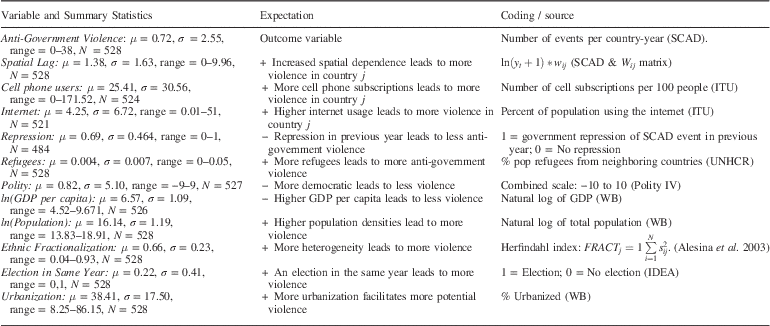
We control for the level of urbanization using a measure of the percentage of people living in urban areas. We expect that more urban areas increase communication connectivity and thus increase the potential for violence emulation. Ethnic heterogeneity is an important consideration in Africa (Horowitz Reference Horowitz1985; Hill and Rothchild Reference Hill and Rothchild1986; Collier and Hoeffer Reference Collier and Hoeffler2002; Posner Reference Posner2004). To account for this, we employ the (Alesina et al. Reference Alesina, Devleeschauwer, Easterly, Kurlat and Wacziarg2003) measure of ethno-linguistic fractionalization. We also include a measure of repression of events in the SCAD database. This is coded as a dummy variable representing government repression for an event in the previous year. Finally, we also include the standard controls of GDP per capita and population, since higher average incomes would likely facilitate and provide the opportunity and capacity to plan, organize and execute successful events. Likewise, countries with larger populations tend to generate higher policing costs and have been found to be strongly associated with violent events (Eyerman Reference Eyerman1998). Table 1 lists all variables used in our analyses along with our expected relationships, coding, sources and summary statistics.
Variables, Coding, Expected Relationships and Sources
Note: SCAD: Social Conflict in Africa Database; ITU: International Telecommunications Union; IDEA: Institute for Democratic and Electoral Assistance; WB: World Bank; UNHCR: United Nations High Commission for Refugees.
Modeling Spatial Dependence and Communications Technology Connectivity
Models of spatial dependence are becoming increasingly prevalent in social science research, including the conflict and violence literatures. However, much of this research has employed relatively basic treatments of spatial connectivity. Beyond simply accounting for residual spatial effects to get unbiased coefficients, researchers can theorize and predict the impact of spatial dependence on the outcome of interest. Franzese and Hays (Reference Franzese and Hays2008a, Reference Franzese and Hays2008b) argue that spatial dependence is more than a nuisance or control; rather, it is substantive. We also take this approach and choose to model the spatial dependence, instead of just accounting for it.
Much attention in the spatial econometric literature is necessarily given to the so-called spatial weights (or W) matrix (Plümper and Neumayer Reference Plümper and Neumayer2010; Neumayer and Plümper Reference Neumayer and Plümper2014). This matrix provides the information on connectivity from one unit to another (j to i in matrix element w ij) that allows the researcher to model spatial dependence. As such, determining the proper mode of connectivity and constructing the weights matrix is far from trivial. Indeed, the information used to determine the interconnectivity of units can seriously condition the results of any analyses (see Neumayer and Plümper in this issue). The specification of the weights matrix is perhaps the most important consideration when constructing models and theories of spatial dependence.
We began our analyses with a simple neighbor connectivity matrix, Wij, where a country takes a value of 1 when it shares a border with another and 0 when it does not. Much of the spatial literature stops at this matrix, thus assuming that spatial dependence is primarily driven by geography (Beck, Gleditsch and Beardsley Reference Beck, Gleditsch and Beardsley2006). We start with this type of weights matrix because of the unique nature of the African geopolitical system. Alternative specifications to this are distance-based matrices or a matrix based on some other spatial connectivity besides physical contiguity. We have considered both options. A distance-based matrix based on some arbitrary point, or administrate capital, is problematic in Africa because of the large variance in administrative area and capital placement. On the one hand, making the distances too short would underestimate the connectivity of countries such as Sudan, Libya and Egypt, all of which had significant numbers of social conflicts during the Arab Spring, for example. On the other hand, a larger distance would overestimate the connectivity of the smaller Western African countries, with many non-neighbors being possibly erroneously connected.
From our proposed theoretical framework, an ideal weights matrix would be based on the connectivity of communication technology between countries, but such information is not currently available. Nevertheless, we go beyond a simple geographic adjacency matrix by interacting our primary explanatory variables of internet usage and cell phone subscribers with the spatial lag. This creates a new variable that includes information on both geographic connectivity and the channels of information flow that we focus on in this article. We posit that this treatment of spatial connectivity is an important contribution for two reasons. First, we are attempting to model our theorized channel of connectivity, in this case the flow of information. Second, in the absence of a global connectivity communication technology matrix, this interactive spatial lag represents a significant improvement over a typical adjacency matrix. Our matrix is not row-standardized, as we have no theoretical justification for doing so.Footnote 5
Our theoretical focus is on how information can lead to emulation through technology. Specifically, we theorize about how this information is spread from one unit to the other (i to j), and perhaps more importantly, the mechanisms through which this diffusion takes place. Much of the spatial literature leaves this particular area of spatial diffusion unexplored. Knowing that diffusion is happening may not be enough. Further, simply knowing or theorizing that y i affects y j, while more useful than the alternative of assuming no spatial dependence, may also fall short of telling the whole story. We posit that the method of diffusion may condition the impact of the spatial effects.Footnote 6 We model our theory by conditioning the connectivity matrix with our primary explanatory variables.
Model Specification
Since our outcome variable is a count, we follow the standard approach of using negative-binomial estimation. We chose negative-binomial over poisson because of the over-dispersion of the dependent variable (Long Reference Long1997; Hilbe Reference Hilbe2011). We also follow Neumayer and Plümper (Reference Neumayer and Plümper2010) by taking the advice of Hays and Franzese (Reference Hays and Franzese2009), who suggest that W[ln(y+1)] provides a better proxy of the actual event counts opposed to Wy. We clustered the standard errors around country.
Finally, we also consider the trend and shock effects of time in our analyses. We deal with common shocks by including time fixed effects for each year. For trends, we include a time-lagged (one year) dependent variable. Both of these approaches are common procedures for dealing with time-related issues in the recent spatial econometrics literature (Beck, Gleditsch and Beardsley Reference Beck, Gleditsch and Beardsley2006; Franzese and Hays Reference Franzese and Hays2007; Neumayer and Plümper Reference Neumayer and Plümper2010, Reference Neumayer and Plümper2011; Plümper and Neumayer Reference Plümper and Neumayer2010). Failure to control for these time effects could overestimate the spatial dependence we are interested in modeling (Plümper and Neumayer Reference Plümper and Neumayer2010). Finally, the inclusion of a lagged dependent variable also makes theoretical sense in that there is likely an autoregressive nature to these events in given countries, whether spatial dependence is present or not. We specify our full model as:
 $$y_{{it}} =\rho {\bf W}y_{{it}} \, {+} \, z_{{it}} \gamma \, {+} \, \psi {\bf W}y_{{it}} z_{{it}} \, {+} \, \phi y_{{t{\minus}1}} \, {+} \, {\bf x}_{{it}} '\beta \, {+} \, \delta _{t} \, {+} \, {\varepsilon}_{{it}} ,$$
where:
∙ y it is the number of violent anti-government events in country i in year t.
∙ Wy it is the spatial lag, with W being a matrix of connectivity containing elements w ij with parameter estimate ρ.
∙ z it is the level of communication technology (cell phone or internet) for each country-year with parameter estimate γ.
∙ Wy itz it is the interaction of communication technology and the spatial lag with parameter estimate ψ.
∙ y t−1 is a one-year (first-order) lag of anti-government violent events with temporal autoregressive parameter estimate ϕ.
∙
 $${\bf x}_{{{\bf it}}} '$$
is a vector of observations on our control variables with parameter estimates vector β.
$${\bf x}_{{{\bf it}}} '$$
is a vector of observations on our control variables with parameter estimates vector β.∙ δ is a vector of time (year) fixed effects.
∙ ε it is the disturbance term.

RESULTS AND DISCUSSION
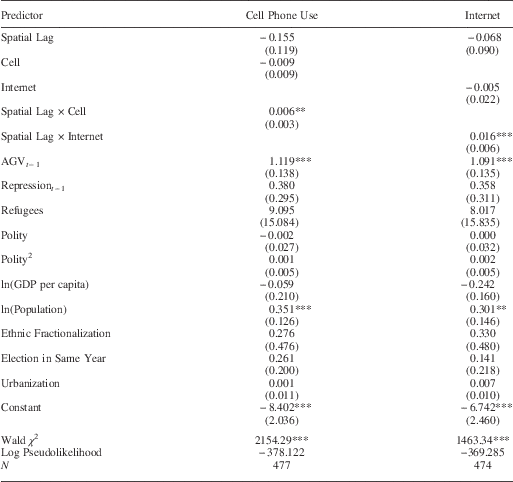
Table 2 presents the negative binomial estimation results. The first model includes the number of cell phone subscribers per 100 people, while the second model includes the percentage of the population using the internet. Each of these is interacted with the spatial lag to create our primary variable of interest. In both cases, the estimate on the interaction terms is positive and significant, thus lending support to our expectation that anti-government violence in country j increases the likelihood of violence in i under increasing levels of communication technology in country i.Footnote 7 The time-lagged dependent variable is also positive and significant, indicating that there is an autoregressive nature to anti-government violence in these countries during the 2000–11 time period.
The Spatial Dependence of Anti-Government Violence
Note: negative binomial estimation results. The outcome variable in both models is the number of anti-government violence (AGV) events. Clustered standard errors are in parentheses. Yearly time dummies were included in estimation but are not shown. ***p<0.01; **p<0.05; *p<0.10.
Although there is strong evidence in the literature that governments often engage in pre-emptive repression upon observing conflicts in neighboring countries in order to deter emulation behavior, we find no evidence that government repression inhibits the emulation of anti-government violence in our context. It also appears that the flow of refugees does not play a role in the diffusion of information leading to the emulation of anti-government violence. Although several studies show that the flow of refugees is a significant predictor of the cross-border spread of civil war (Salehyan and Gleditsch Reference Salehyan and Gleditsch2006; Buhaug and Gleditsch Reference Buhaug and Gleditsch2008), our insignificant finding aligns with our expectation that acts of anti-government violence will not produce large enough displaced populations to serve as the predominant diffusion mechanism. Instead, our findings provide evidence that the emulation of anti-government violence results from information about neighboring violence received through communications technology.
Population was the only control variable to achieve statistical significance; higher populations were associated with more violent anti-government events in both models. These results generally hold across different specifications and modeling techniques. We tested these models with measures of technology from other sources, and the substantive interpretation did not change. Further, using non-clustered standard errors or row-standardizing the weights matrix had little overall impact. Finally, the dispersion parameterization (constant or mean) had no impact on our findings. All of this indicates that our models are robust to alternative specifications and gives us more confidence in the results.Footnote 8
Substantive Effects
Although examining the direction and conventional statistical significance levels of the model coefficients is informative, the negative binomial specification does not provide a strong sense of the substantive impact or of the magnitude of the effects on anti-government violence. Because this is of particular interest when interpreting our interaction effects, we also investigate the degree to which anti-government violence becomes spatially dependent across more meaningful scenarios of the modifying variables by calculating adjusted predicted counts of the spatial lag on anti-government violence as well as the percentage increase in the estimated number of events in the following country-year.
In Figure 3 we present the predicted counts of the spatial lag on anti-government violence as the percentage of cell phone subscribers and internet usage changes. In each case, the graphs indicate that the most significant moderating effects take place toward the middle of the distributions of cell phones and internet access. If the graphs were extended to include out-of-sample predictions, we would expect to see an increasing impact on the predicted number of events as cell phone and internet penetration increase, although the confidence intervals are trending toward insignificance. This potentially indicates that at some point higher levels of communications technology become associated with higher levels of economic development and democratic consolidation, which are conditions in which we would expect to see less anti-government violence.
Predicted counts of anti-government violence Note: each graph is the adjusted predicted count of violent anti-government events under a meaningful scenario for the spatial lag being moderated by communications technology. These graphs were generated using the marginsplot function in Stata 12/13. Please see our reproduction files for more information.
Given the difficulty of interpreting interactions in which both variables are continuous, we now turn to a series of scenarios in which we employ incident rate ratios. In Table 3 we present the effect that a one-standard-deviation increase in the spatial lag has on anti-government violence in country i, given eight meaningful changes in the modifying variables while controlling for the additional explanatory factors presented in our models.Footnote 9Figure 3 displays the adjusted predicted counts of anti-government violence under different scenarios for our interactions. In the case of the incident rate ratios, we are presenting percentage changes in the likelihood that an event will occur.
Substantive Impact on Anti-Government Violence
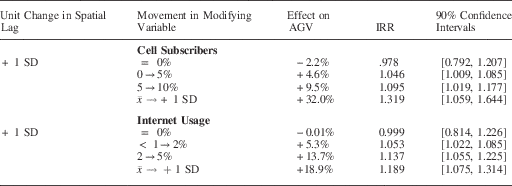
Note: the percentage impacts are the exponentiated coefficients (incident rate ratios) of the negative binomial estimations with centered interaction terms.
We began by estimating the effect of a positive standard-deviation change in the spatial lag on the percentage of violent events under the extreme case that there are no cell phone subscribers in a given country-year. This allows us to observe the effect of increasing spatial dependence on anti-government violence, solely determined by geographical proximity. When there are no cell phone subscribers, we expect there to be no relationship between our spatial lag and violent events. This condition produced 2.20 percent fewer violent events, however the relationship is insignificant, as expected.Footnote 10 When the number of cell phone subscribers moves from zero to five out of 100 people, there is a 4.6 percent increase in the expected number of violent events.Footnote 11 A move from five to ten subscribers results in a 9.5 percent increase in the expected number of violent events.Footnote 12 Finally, moving from the mean number of cell phone subscribers to one standard deviation above the mean (27 to 57) produced about a 32 percent increase in the expected number of violent events.
We then estimated the effects under meaningful values of internet users. Again, we chose to first examine the extreme case of there being no internet users in a given country-year, producing 0.01 percent fewer violent events, which again is insignificant, as expected. Although our sample includes no country-years in which there are zero internet users, 233 (about 50 percent) of our observations have only 2 percent of the population or fewer internet users in a given country-year. Moving from less than 1 percent to 2 percent of the population using the internet generated a 5.3 percent increase in the expected number of violent events. Moving from just 2 to 5 percent internet users produced a 13.7 percent increase in the expected number of violent events. Finally, moving from the mean percentage of internet users in a country-year to one standard deviation above the mean (4.49 percent to 11.23 percent), representing 90 observations or 19.25 percent of the sample, increased the expected number of violent events by 18.9 percent.
These substantive impacts serve as a strong validation of our theoretical expectations and clearly illustrate the importance of directly modeling the flow of information in this context. Anti-government violence can spread to a great extent across state boundaries, but contiguity alone is not necessarily responsible for this spread. Actors emulate these violent events against their own government only after observing or being informed of similar events in neighboring states. This flow of information, represented here through cell phone subscriptions per 100 people and the percentage of internet users, strongly condition the degree to which violence is spatially dependent across states.
CONCLUSION
In this article we examined whether acts of anti-government violence exhibit spatial dependence across state boundaries. In line with previous work, we argued that the mechanism allowing violence to spread was action emulation. In other words, actors in one country observe violent events occurring in their neighbor and emulate those actions against their own government. However, previous analyses measure spatial dependence purely through a geographical contiguity matrix, which theoretically assumes that all actors are equally aware of the violent events occurring in their neighboring state. Because access to information varies across countries, we argued that the degree to which anti-government violence is spatially dependent should be conditioned by the proliferation of information concerning neighboring events. Our analyses confirmed this expectation. Acts of anti-government violence are only likely to spread across state boundaries when access to information is high.
Our theoretical contributions are relevant to both the general spatial and conflict literatures. Theorizing the mode of connectivity, in this case information, allowed for a more properly specified test than simply assuming that connectivity existed based solely on geographic contiguity. We used a unique approach to modeling spatial dependence by interacting our spatial lag with our main explanatory variable, which allowed us to capture the conditional effects of contiguity. We also moved beyond examining traditional domestic armed conflicts and civil wars by analyzing anti-government event counts. Because these events are the least likely form of domestic opposition to produce displaced populations and refugees, they are also least likely to produce the spread of information across borders through word of mouth.
Future research should attempt to identify connectivity mechanisms beyond geographical adjacency. This would allow us to examine communication technology usage in both units j and i. This, of course, requires much more comprehensive data than are currently available. In the meantime, we have offered a method to analyze spatial dependence beyond pure geographic connectivity. Interacting a properly specified adjacency matrix with a conditioning variable allows for an analysis based more on theoretical information than geography. We can also imagine cases beyond conflict and violence in which access to information can facilitate emulation across spatial boundaries. For example, less severe forms of protest and political behavior could easily fall into this category. Finally, there are almost unlimited instances beyond geographic contiguity that would provide more appropriate tests of theories concerning diffusion processes and violent outcomes. For example, countries with similar institutional characteristics that are associated with proneness to violence might experience similar patterns of violence. This could be easily modeled in a spatial weights matrix that measures whether or not groups of countries share specific institutional qualities. We could then predict specific spatial patterns of violence based on those defined spatial assignments. We believe this study furthers our understanding of the spatial influences in violence.