1 Introduction
This community…[of citizens] is the constitution.
Why are some constitutions in democratic nations amended more frequently than others? Why are some periods within a country’s history more prone to constitutional reform than others, even though the rules of amendment have remained the same? Questions like these have animated a large body of scholarship in several academic disciplines without achieving much consensus. This Element seeks to answer these questions using new theoretical insights, data, and methods.
Scholarship of all things constitutional – whether it is constitutional design, endurance, amendment, or interpretation – often adopts an institutionalist approach. When it comes to amendment frequency and other questions of constitutional politics, George Tsebelis (Reference Tsebelis2022, 280) reminds us that political scientists have viewed amendment rules as a lynchpin institution for as long as the American Political Science Association has been around. John J.W. Burgess (Reference Burgess1890, 137), an institutionalist and one of APSA’s (problematic) founders, called amendment rules “the most important part of a constitution.” Edward S. Corwin, another institutionalist considered the founder of public law within political science, wrote frequently about the effect of the amendment rules of Article V on US constitutional law (e.g., Corwin & Ramsey, Reference Corwin and Ramsey1951).
The problem is that any institutionally focused study of constitutions relies on a very specific understanding of what a constitution is. It seems axiomatic that a constitution is a written document establishing rules for a game where elites are the major players. In democracies, the people hold the authority to make, break, or alter constitutional arrangements, but, in practice, these fundamental changes usually require the assistance of elites. Does this account provide a fair conceptualization of a constitution or an appropriate operationalization of the players within the game of constitutional politics?
Aristotle certainly did not think so. While the word “constitution” traces its origins to the Latin constitutio (which originally referred to an edict by the emperor), translations of ancient Greek political thought use the term constitution as an adaptation of a very different word: politeia. This term, by contrast, was first used to describe being a citizen (Lane, Reference Lane2015, 60). Thus, Aristotle did not define a constitution as a document, although his comparative analysis of political regimes included city-states with written legal codes (Voermans, Reference Voermans2023, 73). Instead, his conception of a constitution focused on the people and how they arranged power into a body politic. According to Aristotle (Reference Rackham1944, III, 1278b; IV, 1295a), constitutions do more than create a structure for politics; they create a “way of life.” Citizens have the potential to sustain this way of life, as Aristotle emphasized the importance of philia politikē, a political friendship that creates trust among citizens stemming from shared values and mutual respect (Hutter, Reference Hutter1979).
The social orientation of politeia allowed the term constitution to acquire additional physiological and cultural meanings over the intervening centuries. Jane Austen (Reference Austen1814/2003, 312–313) once observed that Shakespeare’s influence on the English language is so profound that “one gets acquainted with [the Bard] without knowing how. It is a part of an Englishman’s constitution.” The term taking a “daily constitutional” traces its origins to a nineteenth-century newspaper column (“Walking as an Exercise,” 1859, 59) criticizing Americans for walking “less than any civilized people under the sun.” Furthermore, neuroscientists assume that humans possess something akin to an “inner constitution”: a set of grammatical understandings that permit us to learn a moral language (Voermans, Reference Voermans2023, 14).
Thus, institutionalist narratives reflect an incomplete assumption: that constitutions are instruments designed from above to help a polity flourish. Scholars, accordingly, weigh the merits of shorter, entrenched constitutions versus longer, flexible documents (Elkins & Hudson, Reference Elkins, Hudson, Landau and Lerner2019; Tsebelis & Nardi, Reference Tsebelis and Nardi2016); presidential versus parliamentary government (Howell & Moe, Reference Howell and Moe2020; Linz & Valenzuela, Reference Linz and Valenzuela1994); and unitary versus federal systems (Elazar, Reference Elazar1987; Riker, Reference Riker1964). While these debates are important, they obscure the converse: that a vibrant civil society helps a constitution flourish. Changing a constitution’s design – at least in a democracy – can only take place under certain political and social conditions. As legal theorist Richard Albert (Reference Albert2019b, 2, 97–98) acknowledges, “No part of a constitution is more important than the rules we use to change it,” yet at the same time, “studies of formal amendment difficulty are insufficient and incorrect if they evaluate only the codified rules of change without attention to the larger political and cultural contexts in which those rules are situated.”
We contend that the lack of consensus regarding the effect of constitutional amendment rules is that these studies assume that the political capacity to navigate amendment rules is constant across space and time. A more comprehensive account of constitutional change must recognize that the likelihood of constitutional change varies by civic connectedness. The health of civil society and constitutionalism are endogenous to some extent, and this requires studying the causal arrows in both directions. While some studies have begun to explore the concept of constitutional culture, this concept has been poorly defined and operationalized, as we detail in the following passage. Similarly, social capital scholars have identified that trust and group membership impact a host of political outcomes, yet the relationship between social capital and constitutional change has not been explored within political science or law (but see Blake, Cozza, Armstrong, & Friesen, Reference Blake, Cozza, Armstrong and Friesen2024).
This Element seeks to fill that gap in the literature. Our argument is that social capital creates a political environment more conducive to constitutional reform because higher levels of civic connectedness help political entrepreneurs overcome the transaction costs created by amendment rules. Specifically, we predict amendments will be adopted more frequently in nations with higher levels of social capital or at times during a particular nation’s history when social capital is comparatively higher. In the rest of this section, we review the current state of the amendment literature, construct our theory, and preview the aggregate-level, time-series, qualitative, and experimental tests of our theory presented in subsequent sections.
1.1 What We Know about Constitutional Amendments
Most constitutions define two processes for change: rules for enacting legislation and rules for amendment. Constitutional designers typically make the former less stringent than the latter for several reasons. From the standpoint of constitutional theory, the difference between these rules separates the vox populi – registered in elections – from the constituent power, which justifies constitutional change (Loughlin, Reference 76Loughlin2014). From a political science perspective, flexible legislative rules allow policy to adapt to changing circumstances, while the stability of constitutional arrangements makes the political environment in which those policies operate more predictable (Tsebelis & Nardi, Reference Tsebelis and Nardi2016). Scholars in both fields expect that, in general, the stringency of amendment rules affects the pace of amendment.
The leading measure of the strength of amendment rules comes from Tsebelis (Reference Tsebelis2022, Reference Tsebelis2025), who applies a veto players’ framework to measure constitutional rigidity. These studies find a heteroskedastic relationship between constitutional rigidity and amendment rates, as rigidity provides a necessary but not a sufficient condition for constitutional change, especially for more consequential amendments. In other words, while high levels of rigidity strongly predict low amendment rates, the converse is not true. The effect of low levels of rigidity on amendment rates is more variable.
Sometimes, the impetus for amendments can be generated endogenously by factors other than a constitution’s amendment rule. Longer constitutions, for example, have more provisions that could malfunction, necessitating more frequent changes. Long constitutions have sometimes been referred to as “statutory constitutions” because they contain more policy-oriented provisions (Ginsburg & Melton, Reference 74Ginsburg and Melton2015). If there is an expectation that important policy commitments be constitutionalized, long constitutions will become longer in the future, as amendments are added to tackle additional issues. Scholars have found a significant and positive relationship between constitutional length and amendment frequency (Lutz, Reference Lutz1994; Negretto, Reference Negretto2012; Tsebelis & Nardi, Reference Tsebelis and Nardi2016).
In contrast to institutional approaches, a new literature emerged examining the effect of amendment culture on constitutional change (Contiades & Fotiadou, Reference Contiades, Fotiadou and Contiades2013; Fruhstorfer & Hein, Reference Fruhstorfer, Hein, Fruhstorfer and Hein2016; Ginsburg & Melton, Reference 74Ginsburg and Melton2015; Jackson, Reference Jackson2015; Tarabar & Young, Reference Tarabar and Young2021). For example, Tarabar and Young (Reference Tarabar and Young2021) use Hofstede cultural dimensions as proxies for constitutional attitudes and find that more individualistic and long-term-oriented societies have higher amendment rates, while cultures that avoid uncertainty have fewer amendments. However, the Hofstede measures are based on survey data collected from employees of IBM subsidiaries during the 1960s–1970s. Even if these data were more extensive and nationally representative, they are based on an unwarranted assumption that culture does not vary over time or subnationally.
Another prominent constitutional culture study comes from Ginsburg and Melton (Reference 74Ginsburg and Melton2015), who, in a break from their previous scholarship (Elkins, Ginsburg, & Melton, Reference Elkins, Ginsburg and Melton2009), find that most measures of constitutional rigidity do not significantly influence amendment rates when models include a measure of amendment culture. Other scholars have criticized this indicator – operationalized as a country’s amendment rate under their prior constitution – on theoretical and methodological grounds (Contiades & Fotiadou, Reference Contiades and Fotiadou2016; Tarabar & Young, Reference Tarabar and Young2021; Tsebelis, Reference Tsebelis2022). Among other shortcomings, it does not reflect attitudinal data, even though Ginsburg and Melton (Reference 74Ginsburg and Melton2015, 699) define amendment culture as a “shared set of attitudes about the desirability of amendment.” Furthermore, measuring culture using a prior constitution’s amendment rate may be an endogenous reflection of constitutional rigidity, given that amendment rules often do not change when a nation replaces an old constitution with a new one.Footnote 1
Attempts to develop the concept of amendment culture have had one important benefit: It has widened the focus from the constitutional system that regulates the supply of amendments to the political environment that provides the demand for them. Social capital is an environmental factor that has been linked to a host of political outcomes, including policy innovation (Devine, Reference Devine2024). The classic formulation of social capital comes from Robert Putnam (Reference Putnam2000, 19) who defines the concept as “social networks and the norms of reciprocity and trustworthiness that arise from them.” We focus not on the abstract concept of interpersonal connectedness but the most commonly studied consequences of those social bonds: political trust, social trust, and civic engagement.
Political scientists and legal theorists assume that trust and law are inextricably linked, providing benefits to leaders and citizens alike. As Wim Voermans (Reference Voermans2023, 25) notes, “Abstract institutions such as law decrease uncertainty, anxiety, and distrust – all of which stand in the way of large-scale human cooperation.” Likewise, David Easton (Reference Easton1975, 447–448) once argued that “no set of incumbent authorities in modern mass societies could for long assume the responsibilities of making and implementing…decisions in a political system except under conditions of trust.”
In Section 1.2, we construct a theory based on these suppositions that moves beyond the current divide in the amendment literature. Constitutional reform is not an either/or proposition between amendment rules and social forces. Neither is this phenomenon entirely top-down or grassroots. Instead, these forces are contextual and interconnected. Constitutional rules structure the transaction costs – negotiation and decision-making costs, information costs, and compliance costs – associated with amendments (Buchanan & Tullock, Reference Buchanan and Tullock1965). And one consistent finding is that social capital lowers transaction costs incurred when taking political action (e.g., Fukuyama, Reference Fukuyama2001).
1.2 Modeling the Influence of Social Capital on Strategic Policymaking Decisions
A vibrant civil society, social capital theorists posit, leads to higher levels of political trust, social trust, and civic activity. Empirical measures of these three concepts are usually correlated with each other; however, they are separate concepts built from different operationalizations. For example, levels trust in each branch of government and the party system can be used to create a measure of political trust, while social trust can be a reflection of how much trust a survey respondent places in people in general or a specific group of people, such as members of an ethnic minority or members of a respondent’s local community. Finally, membership and participation in a variety of groups (not just politically oriented ones) form the basis for measuring civic activity, as do measures of a respondent’s history of participating in protests, boycotts, and petitioning.
Each of these measures of social capital vary cross-nationally and longitudinally, although over-time variations are often very slow to develop. Further, within any one nation and at any one time, there are often gaps between levels of political trust, social trust, and civic engagement.Footnote 2 Our theory is not contingent on resolving scholarly disagreements about the formation and perpetuation of social capital. While these debates are important, it is the existence of trusting attitudes and civic activity that animates our analysis.
Our argument is that civic connectedness creates additional opportunities for constitutional change. The key question here is: opportunities for whom, and the answer must be political entrepreneurs. Even in polities with the strongest commitment to direct democracy, political elites play a larger role in the amendment process than ordinary citizens. This makes sense because, compared to citizens, elites possess greater political expertise, clearer preferences, and stronger strategic incentives (Dinan, Reference Dinan2016; Negretto & Sánchez-Talanquer, Reference Negretto and Sánchez-Talanquer2021; Velasco-Rivera, Reference Velasco-Rivera2021). At the same time, a theory that focuses on political entrepreneurs must not lose sight of the importance of social capital. The development of social capital may occur at the mass-level, but its effects have important consequences for elites. For example, Dinesen and Sønderskov (Reference Dinesen, Sønderskov, Bågenholm, Bauhr, Grimes and Rothstein2021, 541–542) note that “[w]hen citizens trust each other, they…have a higher willingness to accept the opportunity costs of participating in politics because they trust others to do the same…This in turn animates politicians to be politically responsive.”
By political entrepreneurs, we do not merely mean the James Madisons or B. R. Ambedkars of the democratic world. Instead, we mean any political leader who has political resources to deploy strategically to maximize their policy preferences. This would include all elected officials, not just legislators who sponsor a constitutional amendment. Leaders of interest groups or civil society organizations who are need not even formally included in the amendment process are also political entrepreneurs for the purposes our theory. We expect that political entrepreneurs will act in a boundedly rational fashion (see Jones, Reference Jones1999).
Political entrepreneurs, in our formulation, are not necessarily benevolent. This assumption has two important implications. First, we do not assume that the constitutional reforms they propose will necessarily be normatively good for the country in question. Second, our refusal to assume benevolence affects the methods for change that a political entrepreneur might choose. Because our study is limited to democratic nations, we assume that entrepreneurs will avoid violence or other extreme, repressive tactics as means to achieve their constitutional goals. At the same time, even the most committed democrats will sometimes challenge the rule of law.
Legal scholars have developed a lengthy literature concerning constitutional hardball: Tactics used by elected officials that, while not violative of a specific constitutional provision, seriously undermine constitutional norms (e.g., J. Fishkin & Pozen, Reference Fishkin and Pozen2018).Footnote 3 Hardball tactics usually only appear on certain issues or at certain times when the stakes of politics are extremely high, usually when the political system is under stress. In fact, one constitutional theorist (Tushnet, Reference Tushnet, Bellamy and King2025, 1074) has argued that constitutional hardball “is almost always a signal of some disorder in the existing constitutional system.” This makes it hard to predict what the consequences of hardball tactics will be without the benefit of hindsight. In other words, entrepreneurs might use hardball to save their weakened democracy or undermine it for their own purposes.
We continue this section by exploring the costs and benefits that accrue from different policymaking avenues to highlight the unique costs and benefits associated with amendments. We then outline the myriad of ways in which social capital incentivizes political entrepreneurs to pursue amendments.
1.2.1 The Costs and Benefits of Various Avenues of Constitutional Policymaking
We begin by assuming that there is always some latent demand for political reform in a democratic society. To meet this demand, political entrepreneurs have multiple pathways through which they can pursue reforms and are aware of the costs and benefits associated with these different policymaking avenues. Many of the examples detailed in the following passage come from the United States, the case country most familiar to the authors of this Element. Nevertheless, we will attempt to provide citations to comparative scholarship that suggests these avenues of constitutional policymaking generalize to other democratic nations.
We assume that political entrepreneurs prefer that any mobilization of political resources creates immediate policy benefits with the highest levels of policy security. However, they might realize trying and failing in the short run has beneficial effects on the probability of success in the long run. Political entrepreneurs may attempt to build momentum so that after a cascade of lower-level policy changes, they achieve their ultimate goal of amending the constitution. When plotting a strategy, entrepreneurs behave as though rules to enact ordinary legislation or constitutional amendments are fixed.
There are several alternative policymaking avenues that reformers could pursue in lieu of a constitutional amendment. When certain political action is not expressly forbidden by a constitution, political entrepreneurs can introduce reforms via ordinary legislation. Sometimes, as in the case of the United Kingdom, ordinary legislation can be part of the constitution itself. Elsewhere, such as in the United States, ordinary legislation can sometimes serve constitutional purposes. If a certain action is possibly unconstitutional, depending on judicial interpretation, elites could make ideologically motivated judicial appointments to avoid the need for amendments. In federal systems, entrepreneurs can also pursue legislative or constitutional policies at the subnational level. Sometimes, leaders may achieve national-level constitutional reform by challenging norms regarding the amendment process, even if they technically obey a constitution’s amendment rules.
To avoid the strictures of a national constitutional amendment, political entrepreneurs may prefer to enact their policy preferences in a national statute. These efforts can sometimes create the same high levels of policy security as constitutional amendments. After all, not all of a polity’s constitutive commitments need to be contained in their constitutional text. Eskridge and Ferejohn (Reference Eskridge and Ferejohn2001) use the term “super-statute” to describe American laws such as the Social Security Act and Civil Rights Act of 1964. These laws serve constitutional purposes and enjoy the same kind of veneration usually reserved for constitutional provisions.Footnote 4
Franklin Roosevelt may not have heard the term super-statute, but he was aware of the logic of this concept when he designed Social Security. When his advisors questioned the fairness of requiring both workers and employers to pay taxes to finance retirement benefits, Roosevelt argued that this financing method created a popular expectation, similar to how constitutional rights operate, that the government had a duty to deliver financial support to its citizens. “We put those pay roll contributions there,” he stated (as cited in Schlesinger Jr., Reference Schlesinger1959, 308–309), “so as to give the contributors a legal, moral, and political right to collect their pensions and their unemployment benefits. With those taxes in there, no damn politician can ever scrap my social security program.”
Nevertheless, statutory reforms carry several risks. Ordinary laws are subject to invalidation through judicial review. Even if a law achieves “super-statute” status, courts will still sometimes target them, as the US Supreme Court did when it struck down a significant portion of the 1965 Voting Rights Act in Shelby County v. Holder.Footnote 5 Ordinary statues are also at risk of future legislative reversal or nonrenewal. Congress has not passed an updated version of the Voting Rights Act since Shelby County, even though the Court indicated that such a revision could pass constitutional muster.
Members of Franklin Roosevelt’s administration feared the Supreme Court would strike down Social Security, as it had much of his initial New Deal policies, so they urged the president to amendment the Constitution. Roosevelt resisted amendments for several reasons, but one was based on previous political experience. As a young state senator, he watched powerful business interests succeed in killing the Child Labor Amendment in New York (Magliocca, Reference Magliocca2011). Roosevelt (Reference Roosevelt1937) understood the transaction costs created by Article V, pointing out, “thirteen states which contain only five percent of the voting population can block ratification even though the thirty-five [of the then forty-eight] States with ninety-five percent of the population are in favor of it.”
Fortunately for Roosevelt, the Supreme Court upheld the constitutionality of Social Security in 1937.Footnote 6 According to legal theorist Bruce Ackerman (1988, 270), these were no ordinary Supreme Court cases. They served as “amendment analogues”: Precedents of such importance that they cannot easily be reversed.Footnote 7 Litigation can also be helpful to political entrepreneurs when it seems as though elected officials have no appetite for enacting new policies. One famous example is when civil rights leaders convinced the US Supreme Court to order Southern lawmakers to desegregate.
However, much like interpretations of religious texts, constitutional canons can still become heresies. Thus, political entrepreneurs cannot be sure that any victory they achieve in court will last. Citizens may view constitutional change via judicial interpretation as less legitimate than other policymaking avenues. This is a problem because even if courts remain committed to upholding their precedents, they often lack the tools to enforce their own decisions. For example, scholars have questioned whether Brown v. Board of EducationFootnote 8 deserves much credit for creating racially integrated school systems (Rosenberg, Reference Rosenberg1991).Footnote 9
Political entrepreneurs in federal systems may eschew any national-level strategy in favor of state-level statutory or constitutional change. Compared to the US Constitution, American state constitutions are less rigid and change much more frequently.Footnote 10 Woodward-Burns (Reference Woodward-Burns2021) documents how federalism enables political entrepreneurs to seek out more favorable policymaking venues, while Zackin (Reference Zackin2013) describes how a commitment to positive rights developed in American state constitutions.
Of course, there are considerable costs associated with pursuing state-level reform. For one, national constitutions often limit the scope of reforms available to states. If a state reform threatens the supremacy of the national constitution, courts will strike it down. The lack of constitutional rigidity in the states means that future repeal efforts may be accomplished as easily as the initial reform.
Even if entrepreneurs achieve long-lasting success in the states, reformers hoping to translate their success to the federal level may not succeed. Advocates of fiscal conservatism, for example, secured policies limiting spending discretion in most states, but a balanced budget amendment to the US Constitution stalled in Congress in the 1990s (Woodward-Burns, Reference Woodward-Burns2021). Nevertheless, even when constitutional amendment campaigns fail, they may create momentum for future policymaking successes. For example, scholars have argued that the failure of the Child Labor Amendment in the US set the stage for the New Deal (Hartley, Reference Hartley2017).
Constitutional amendments, at the national level, offer political entrepreneurs the greatest security of any policymaking avenue. An amendment may be required even to create the possibility to pursue policy goals via statute. But unlike statutes, amendments are much harder for future lawmakers to repeal, and they can affect the behavior of both national and provincial policymakers. Courts also cannot invalidate constitutional amendments, except in nations with unamendable constitutional provisions (Roznai, Reference Roznai2017).
The policy security of formal, national constitutional reform can be so tempting that political entrepreneurs attempt to bend the rules to achieve it, especially in democracies with rigid amendment rules. In fact, the very existence of the US Constitution is the result of a hardball tactic. The Constitutional Convention was not originally intended to be an occasion to write a new founding document. Instead, delegates were supposed to consider amendments to the existing constitution, the Articles of Confederation. The Articles specified that amendments required the support of every state legislature.
However, Article VII of the Constitution stated that it would take effect after three-fourths of the states endorsed it in ratifying conventions (not state legislatures). Considering Rhode Island never sent delegates to the Constitutional Convention and North Carolina’s delegation walked out early, the Framers knew they could not meet the Article’s requirement for unanimity. So, they changed the rules of the game in the middle of the game, not just for ratifying the new constitution but to ensure it could be changed more easily with new and (slightly) less rigid amendment rules.
Understanding how the public will react to hardball tactics is important for two reasons. First, it provides insight into whether particular constitutional reform efforts will succeed. The public’s reaction to constitutional hardball will also affect the strategies that political entrepreneurs use over the long run. If the public accepts or rewards elites for using hardball tactics once, it may embolden elites to use those same tactics again in the future – in lieu of the other reform methods we have described. We consider how social capital factors into public attitudes about constitutional hardball and constitutional reform more generally in Section 1.2.2.
1.2.2 Social Capital and the Transaction Costs of Constitutional Amendments
Because constitutional amendments usually provide the highest levels of policy benefits, constitutional designers usually make amendments the most costly form of policymaking. Amendment rules structure transaction costs in several respects. For one, amendment rules seek to impose higher negotiation and decision-making costs compared to ordinary legislation. Requiring supermajorities to propose or ratify amendments means any change must satisfy the preferences of a larger proportion of the decision-making body (Buchanan & Tullock, Reference Buchanan and Tullock1965).
Compared to rules for enacting ordinary legislation, amendment rules often require consent from a wider array of actors. This also has the effect of raising negotiation and decision-making costs if one assumes preference non-uniformity across decision-making bodies (see Tsebelis, Reference Tsebelis2022). Disaggregating the constitutional amendment process provides advantages to opponents of reform, who can, as Franklin Roosevelt noted in the previous part of this section, concentrate resources on the few veto points needed to prevent ratification. Supporters, on the other hand, must endure high coordination costs needed to advance their efforts across multiple jurisdictions.
Higher negotiation and decision costs mean higher renegotiation costs as well. Rigid amendment rules, for example, raise information costs because decision-makers need to be confident that any lasting bargain they reach will be beneficial (Elkins et al., Reference Elkins, Ginsburg and Melton2009, 73). When information costs associated with constitutional change are high, the status quo may seem preferable because it is more familiar. Several studies have documented constitutional status quo bias in direct democracy contexts (Blake & Anson, Reference Blake and Anson2020; Bowler & Donovan, Reference Bowler and Donovan2000; Zink & Dawes, Reference Zink and Dawes2016).
We argue that elevated levels of social capital can lower the transaction costs associated with constitutional reform relative to other avenues of reform. One reason stems from the psychological consequences of trust. Trust is a heuristic that citizens use to evaluate government policies under conditions of risk (Rudolph, Reference Rudolph, Zmerli and van der Meer2017, 200). Thus, trust mitigates status quo bias and makes citizens more willing to embark on longer-term policy changes (Fairbrother, Reference Fairbrother2019) – like constitutional amendments.
Other social capital studies have highlighted three causal mechanisms that link social capital to the quality of government, and we believe they are equally relevant to political entrepreneurs hoping to mitigate the transaction costs imposed by amendment rules. The first is the feeling of solidarity generated by social capital (Boix & Posner, Reference Boix and Posner1998, 691; Putnam, Reference Putnam1995). As Dinesen and Sønderskov (Reference Dinesen, Sønderskov, Bågenholm, Bauhr, Grimes and Rothstein2021, 541) put it, “Collectively, more optimal solutions can…be obtained when people tend to think more in terms of ‘we’ than ‘I’ and are willing to forgo short-term self-interest.” Second, social capital is associated with increased ability and willingness of citizens to participate in politics (Putnam, Reference Putnam2000; Zmerli & Van der Meer, Reference Zmerli and Van der Meer2017). Third, “pro-social motivations associated with trust are also manifested among civil servants – drawn from a pool high-trusting citizens – who therefore feel obligated to work for the common interest” (Dinesen & Sønderskov, Reference Dinesen, Sønderskov, Bågenholm, Bauhr, Grimes and Rothstein2021, 542).
While the last causal mechanism describes how social capital directly affects elites, every one of the findings cited above could apply just as easily to elites as it does to citizens. For example, Diani (Reference Diani2006, 134) has argued that social capital is “conducive to more open attitudes by the elites towards political challengers” and “a determinant of greater openness of the ‘political opportunity structure.’” This argument sounds very similar to thinking in terms of “we” rather than “I,” and it suggests that elites use trust as a heuristic too. Elites confront constitutional decisions that are imbued with uncertainty. Instead of resorting to status quo bias, trusting elites will be more willing to amend their constitution. Elite reciprocity also increases the likelihood that any deficiency of a constitutional amendment will become the subject of future good-faith bargaining. On the other hand, distrust is associated with the rise of populism (Hooghe & Dassonneville, Reference Hooghe and Dassonneville2018, which can, in turn, lead to partisan exploitation of constitutions (Landau, Reference Landau2013).
Social capital reduces coordination costs for social movements, facilitating member recruitment, resource mobilization (Edwards, Reference Edwards and Snow2013), and cross-group solidarity. For example, as social capital levels in the US boomed following World War II, civil rights leaders found common cause with labor leaders and successfully removed poll tax provisions from most state constitutions before pursuing the same policy nationally via the Twenty-Fourth Amendment. McConnaughy (Reference McConnaughy2013) constructs a similar account of women’s suffrage during an earlier twentieth-century period of rising social capital: Alliances between suffragists and organized labor and agricultural groups facilitated the expansion of the right to vote in several states before Congress considered the Nineteenth Amendment.Footnote 11
Thus, when trust is high and participation is more robust, civil society is more likely to channel demands for reform into the political system as they will have some faith that elites will act on them. This social movement mobilization, in turn, clarifies citizen preferences for political elites, thereby reducing information costs (Tavits, Reference Tavits2006) and increasing perceptions of the probability of success. When groups are active on both sides of an issue, social movements may also illuminate potential compliance costs of an amendment. Social capital also facilitates coalition formation. For example, Boix and Posner (Reference Boix and Posner1998) suggest a link between social capital and consociational politics, where cross-cleavage coalitions are common.
Strong social movements also distribute vital information during the amendment process and can educate the public through referendum campaigns (Bowler & Donovan, Reference Bowler and Donovan2000) or amplify pressure on regional governments to ratify (Szymanski, Reference Szymanski2003). In direct democracy settings, voters rely on cues from elites and social movements to overcome information costs on complex issues. To be effective, these cues must seem credible, which, in turn, requires trust in political institutions. Indeed, support for Swiss referenda differed by 20 percentage points between low- and high-trusting citizens (Kriesi, Reference Kriesi2005).
Whether elite cues appear trustworthy is an especially important issue in the context of constitutional hardball. Because hardball tactics are not obviously illegal, it may be difficult for even the most trusting and engaged voters to realize that they should punish elites for their behavior. Trusting voters might assume that political entrepreneurs are engaging in ordinary politics (not hardball), or they may conclude that hardball is occurring but for completely justifiable reasons. For example, why did many Americans support the unorthodox process to ratify the US Constitution described earlier? It certainly did not hurt that the most trusted person in America, George Washington, presided over the Constitutional Convention, where the delegates also discussed having Washington serve as the nation’s first president (Blake, Reference Blake2019, 321).
On the other hand, even if citizens cannot decide whether a hardball tactic is legal, it should be somewhat easier for them to decide whether it is fair (see Biggers, Reference Biggers2014). Elites challenge norms to accomplish that which they could not through the normal, accepted practice of politics. Thus, the calling card of hardball tactics is a lack of reciprocity among political entrepreneurs. Social capital theorists predict that stronger interpersonal ties create stronger norms of reciprocity (Putnam, Reference Putnam2000, 21). Voters who value reciprocity in their personal lives should, presumably, wish to hold elites accountable when they do not act accordingly. Studies have shown a link between trust and a citizen’s compliance with the law (e.g., Scholz & Lubell, Reference 78Scholz and Lubell1998) as well as a regime’s commitment to the rule of law (e.g., Delhey & Newton, Reference Delhey and Newton2005). In short, there is no clear theoretical expectation about whether social capital will enable or deter constitutional hardball, which is why we examine this issue in Section 3.
1.3 The Paradox of Federalist 51
James Madison (Reference Madison1788/2008) once famously stated, “If men were angels, no government would be necessary. If angels were to govern men, neither external nor internal controls on government would be necessary.” Within this argument is a potential rival hypothesis for the relationship between social capital and constitutional change: That trusting and participatory societies would (1) write shorter constitutions, (2) adopt less stringent amendment rules, and (3) amend their constitutions less frequently over time. Law and economics scholars conceive of constitutions as a special form of a legal contract. In general, trust obviates the need for writing longer contracts to control for contingencies, allowing for a more efficient solution to this principal-agent problem. In a constitutional context, scholars have found that this efficiency translates into economic growth (Knack & Keefer, Reference Knack and Keefer1997; see also Tsebelis, Reference Tsebelis2017; and Tsebelis & Nardi, Reference Tsebelis and Nardi2016).
Scholars have found trust is associated with shorter constitutions, both cross-nationally (Bjørnskov & Voigt, Reference Bjørnskov and Voigt2014; Voigt, Reference Voigt2009) and within the American states (Ahnen & Calcagno, Reference Ahnen and Calcagno2019). While each of these studies have major empirical shortcomings – the models are overfit, test the influence of only one form of trust, and use current attitudes to predict constitutional decisions that occurred long in the past – the theoretical perspective warrants attention, as it could easily apply to the question of amendment rates. According to Buchanan and Tullock (Reference Buchanan and Tullock1965), constitutional designers must create rules for legislating and amending that are neither too stringent as to create gridlock nor too lax as to permit rights violations. This optimization decision likely reflects the level of trust at the time of enactment.
However, constitutions operate within the domain of losses as well as the domain of gains (Blake & Anson, Reference Blake and Anson2020). That is, constitutions do more than just prevent mistakes from being made, and they also enable social goods. As Voermans (Reference Voermans2023, 25) argues, “Constitutions largely consist of clever mixes of elements that facilitate two pillars of social cooperation: trust and recognition. They facilitate trust by making strangers’ behaviour more predictable…Constitutional rules also grease the wheels of human cooperation by providing convincing common narratives about the reason for cooperation, (‘good’) leadership and the acceptance of authority. On top of that, constitutions confer recognition by defining a community - establishing the ‘we’.”
All of these goals will likely require constitutional amendments over time. Amendments can redefine the “we” as new communities become integrated into the polity or update the narrative of cooperation as, for example, a monarchy evolves into a parliamentary democracy. Moreover, the mechanisms by which you make strangers’ behavior predictable at one point in time might not work in the future. For example, the separation of powers under the US Constitution was originally supposed to provide Congress with a near monopoly on making policy, while bureaucrats today provide more efficient solutions to complex social problems. Thus, while there may be good theoretical reasons to expect trusting societies write new constitutions that are shorter, we doubt whether this logic applies to making existing constitutions longer via amendment. Even trusting societies with short constitutions will, over time, encounter demands for constitutional reform.
There is one other potential complication in the relationship between social capital and constitutional amendments: reverse causality. Scholars have found that “winners” in society express higher levels of trust (Newton, Reference Newton2001), which suggests that successful constitutional amendments may create higher levels of trust. In the Supplementary Materials, Table A6, we conduct an instrumental variable analysis test that finds no evidence that constitutional amendment rates subsequently affect social capital levels. Bjørnskov and Voigt (Reference Bjørnskov and Voigt2014) conducts a similar analysis and finds no evidence that shorter constitutions produce more trusting societies.
1.4 Plan of Element
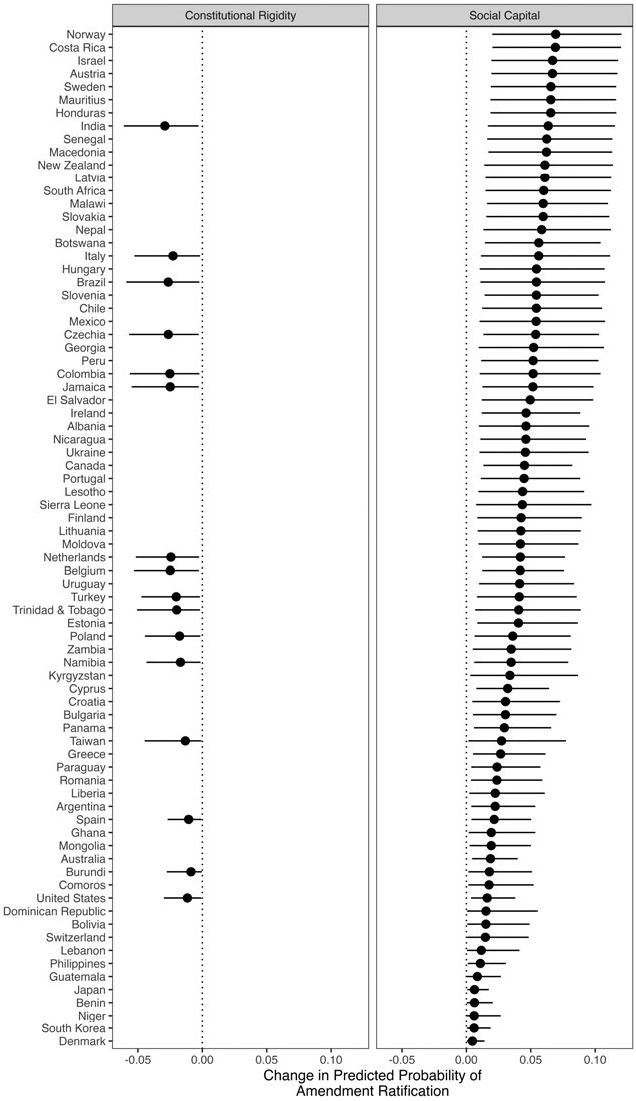
One of our contributions is providing empirical evidence that spans methods, measures, and cases rather than simply relying on one account. This Element proceeds in three parts. In Section 2, using a variety of cross-sectional and longitudinal data, we find that amendment frequency is a function of constitutional design and social capital in democracies across the world. We find that countries with higher average levels of political trust, social trust, and civic activism tend to have higher amendment rates, while countries with more rigid amendment rules have lower amendment rates. The effects of both findings are heteroskedastic. That is, we find that high rigidity and low social capital strongly predict a lower amendment rate, but the effects of less stringent amendment rules and high levels of social capital are more variable. In a longitudinal analysis, we find that amendments are more likely to occur at times within a polity’s history when social capital levels are comparatively high and when the number of political parties in a legislative body is comparatively low.
In Section 3, we consider the relationship between one measure of social capital, political trust, and support for hardball tactics to ratify an amendment. As we described earlier, hardball tactics reduce the transaction costs associated with ratifying a constitutional reform, but they may also undermine the procedural legitimacy necessary to ensure compliance and stability. Entrepreneurs in high social capital environments may reject hardball tactics, fearing a backlash from conscientious voters. Given that hardball tactics are not, ipso facto, illegal or unconstitutional, can citizens even distinguish between hardball and non-hardball tactics? Even if they can perform this task, will trusting citizens insist that elites reject hardball tactics or will they defer to elites and accept a hardball tactic as constitutionally legitimate?
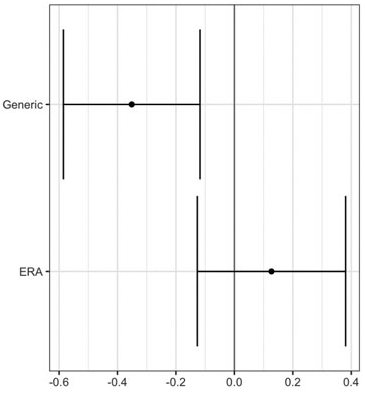
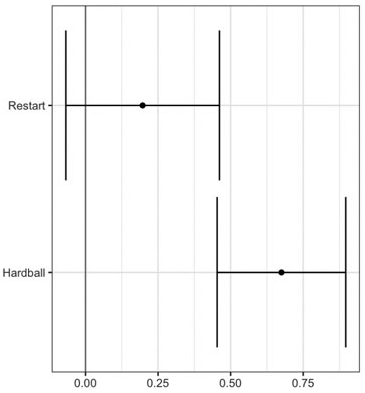
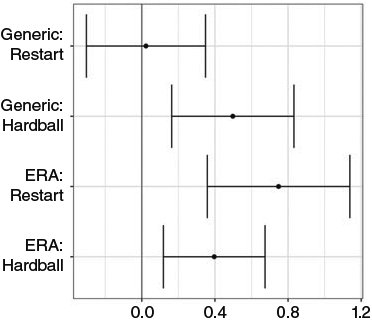
As the literature provides no clear answers, we investigate this puzzle using the case of the US Equal Rights Amendment (ERA). There is an ongoing controversy regarding the ratification status of the ERA because of a ratification deadline Congress attached when it proposed the measure. Some scholars and leaders believe the ERA requires only a simple majority vote in both houses of Congress to remove the deadline or bureaucratic certification because the deadline was nonbinding. Others believe those tactics are forms of constitutional hardball and that the only legitimate path forward is to start the entire amendment process over to ensure compliance with constitutional norms. We conduct a survey experiment and find that respondents identify restarting the amendment process is the most legitimate path, but this support for the ERA can overwhelm this finding. In other words, respondents appear to exhibit a preference for procedural legitimacy, but not at the expense of their preferred outcome. We also find that high-trusting respondents are more likely to view hardball tactics as more procedurally legitimate, which is consistent with our theoretical expectation that trust facilitates deference to elites.
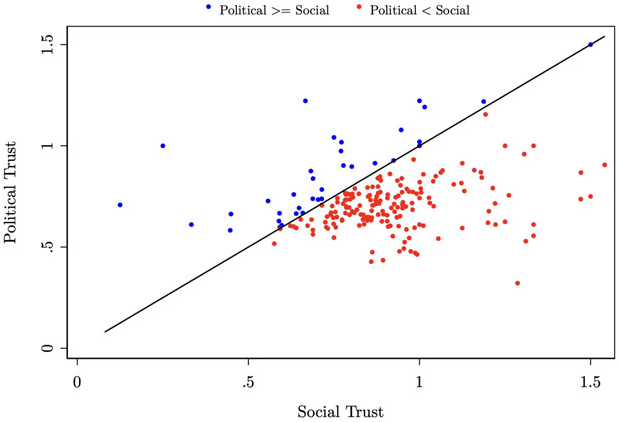
In Section 4, we examine how political entrepreneurs can leverage high levels of social trust to make up for a deficit in political trust, which is a common occurrence in the modern democratic world. We describe how Irish voters ratified an amendment overturning a prior constitutional ban on abortion. The road to repeal was purposefully made long and tedious – not by opponents of the reform but by its supporters. This amendment required consideration by a Citizens’ Assembly, comprised of ninety-nine randomly selected people who deliberated and issued recommendations on the issue. Over the course of five weekends in 2016 and 2017, the participants of the Irish Citizens’ Assembly listened to testimony from medical and legal professionals and civil society leaders, read submissions from citizens across the country, and deliberated among themselves with the help of trained facilitators. Ultimately, the Citizens’ Assembly voted to replace the Eighth Amendment’s ban on abortion with a provision allowing the Oireachtas to regulate abortion rights and provided recommendations for subsequent regulations. The Oireachtas voted to put the Citizens Assembly’s recommended reform on the ballot, and, to the surprise of most analysts, Irish voters overwhelmingly ratified them in a referendum.
At first glance, the addition of a veto player, the Citizens’ Assembly, to an already stringent amendment procedure seems puzzling. However, the process used by Ireland to change one of the constitution’s most controversial provisions came during a period of low political trust following the severe economic crisis that gripped the nation. Elite cues provide essential information to voters in direct democracy settings. We argue that the design of the Citizens Assembly allowed abortion rights advocates had to rely on the Irish people’s trust in one another. Incorporating citizen deliberation into the amendment process created a new and more credible set of cues with which voters could form their position. The fact that citizens, not politicians, were responsible for the proposal is what led many voters to update their views.
We conclude in Section 5 by recapping the main findings of this Element before laying out a research agenda for further integrating the comparative study of political behavior into comparative constitutional studies. But while there is always more to study, there is enough empirical evidence from which to assess normative implications. We offer advice to constitutional designers on how to mitigate the effects of populism, provide meaningful opportunities for public consultation during the amendment process, and optimize the stringency of amendment rules.
2 Analyzing Amendments Across Space and Time
In this section we test the relationship of social capital, constitutional rigidity, and other factors on constitutional amendment rates. We begin the Section by using social capital data from the World Values Survey (WVS) to conduct a cross-national analysis. There are two main disadvantages of the WVS data. The first is that there is a relatively small number of democratic nations included (57). The second problem is that this data source only paints an aggregate-level picture. In other words, it can only indicate whether countries with higher levels of social capital, on average, are associated with more frequent amendments. This is a problem if, within a given country, amendments are more prevalent at some times but not others. A similar problem exists if a polity’s social capital levels varies significantly over time.
Fortunately, Varieties of Democracy (V-Dem) provides a better longitudinal set of social capital data. This allows us to see if changes in social capital patterns over time align with longitudinal shifts in amendment activity. These models control for institutional, economic, and demographic features of each country. For some democracies in our sample, we are also able to create time-varying measures of constitutional rigidity because we have data on changes to the legislative party composition. This will allow us to test whether the effect of amendment rules varies based on changes to the political environment over time. The main downside of the V-Dem data is that its social capital measures are limited to a battery of civic-activity measures.
For both analyses, we limit our analysis to democratic nations, where amendment rules are more likely to constrain regimes, and social capital is more likely to influence political action. Specifying which nations are democracies is often a contentious issue. Polity IV scores are commonly used by scholars to identify the autocratic or democratic tendencies (see, e.g., Tsebelis, Reference Tsebelis2022). The scores are updated annually and range from  10 (fully autocratic) to 10 (fully democratic). The Polity Project defines a democracy as having a score of six or higher, and we adopt that measurement. The scores are based on six components, which include measures of political competition and executive constraints. For context, the United States dipped to a five in July 2024 following the Supreme Court’s ruling in United States v. Trump, which broadly immunized presidential actions from criminal prosecution.
Like Tsebelis (Reference Tsebelis2022), we include Israel in the analysis, despite the fact that the Basic Laws of Israel technically occupy quasi-constitutional status. Unlike Tsebelis (Reference Tsebelis2022), we do not include the United Kingdom because its uncodified constitution renders it an exceptional case. There is debate in the literature as to when the current UK constitution was enacted, which affects the measurement of its amendment rate and length (cf. Tsebelis, Reference Tsebelis2017, Reference Tsebelis2022) – a dependent variable and control in our analysis.
We use Bayesian simulation to estimate all models in this section. Gelman and Hill (Reference Gelman and Hill2007) suggests that Bayesian analysis recovers variance components more reliably and permits the evaluation of uncertainty around random effects estimates. We characterize the uncertainty of model parameters and predictions by summarizing the posterior distribution. What scholars would call “confidence” in the Frequentist paradigm (e.g., confidence interval) is analogous to a Bayesian’s “credibility.” To measure credibility, we calculate the proportion of the posterior distribution that lies on the same side of zero as the posterior mean. We refer to this as the Bayesian p-value or the “posterior probability.”Footnote 12
Before describing specific modeling techniques or the data on which they operate, we begin by formally specifying the six hypotheses that will be tested in this section (Western & Jackman, Reference Western and Jackman1994).
2.1 Hypotheses
Each of the following hypotheses draws on the theoretical insights laid out in the previous section about how constitutional amendment rules impose transaction costs and how social capital can assist political entrepreneurs to overcome them. There is surprisingly little agreement in the literature about how to measure the relationship between amendment rules and amendment rates. For one, operationalizing the features of amendment processes is difficult. Some studies create ordinal or linear indices, which rely on differing assumptions (Anckar & Karvonen, Reference Anckar and Karvonen2002; Elkins et al., Reference Elkins, Ginsburg and Melton2009; La Porta et al., Reference La Porta, López-de-Silanes, Pop-Eleches and Shleifer2004, Lijphart, Reference Lijphart2012; Lorenz, Reference Lorenz2005; Lutz, Reference Lutz1994; Rasch & Congleton, Reference Rasch, Congleton, Congleton and Swedenborg2006). As a result, the correlation between these measures is weak (Tsebelis, Reference Tsebelis2022, 7), and the findings are inconsistent. Some studies suggest that rigid amendment rules reduce constitutional amendment rates (Blake et al., Reference Blake, Cozza, Armstrong and Friesen2024; Ferejohn, Reference Ferejohn1997, 523; Fruhstorfer & Hein, Reference Fruhstorfer and Hein2021; Lutz, Reference Lutz1994; Negretto, Reference Negretto2012; Lijphart, Reference Lijphart2012; Tsebelis, Reference Tsebelis2022), while others produced null results (Ferejohn, Reference Ferejohn1997, 524; Ginsburg & Melton, Reference 74Ginsburg and Melton2015; Lorenz, Reference Lorenz2005; Rasch & Congleton, Reference Rasch, Congleton, Congleton and Swedenborg2006). Nevertheless, we predict:
H1: The number of constitutional amendments will be credibly lower when constitutional amendment rules are more rigid.
The leading studies in political science on the effects of amendment rule rigidity come from Tsebelis (Reference Tsebelis2022, Reference Tsebelis2025). One of the important findings in these works is that constitutional rigidity has heteroskedastic effects. That is, rigid amendment rules are strongly associated with fewer amendments, but the effect of less rigid amendment rules on constitutional reform is more variable.Footnote 13 We expect to find the same results in our analysis.
H2: The effect of amendment rules on amendment activity will be heteroskedastic and positive (less variability in amendment activity under more rigid amendment rules).
One shortcoming in Tsebelis’ work is that does not consider whether amendment rules are more effective at preventing constitutional change at some times in a democracy’s history but not others. He defines constitutional rigidity (2022, 287) as an “interaction between the institutions specified in the amendment provisions of the constitution and the preferences of the relevant actors. However, the preferences depend on the subject matter of the constitutional review, and cannot be assessed a priori and in comparative perspective.” While we agree that elite preferences vary by subject matter, the number of political parties holding legislative seats serves as a proxy for the distribution of preferences. Forming a coalition to support a constitutional amendment depends on a legislature’s partisan landscape, and we expect this will be easier when the number of parties is smaller, compared to other times in that same nation’s history.
H3: The likelihood of constitutional amendment will be credibly higher when the fractionalization of a nation’s legislature, as measured by the number of parties holding seats, is comparatively lower.
Scholars have long posited that higher levels of social capital create more responsive governments, which suggests elected officials may be more willing to tackle the transaction costs imposed by amendment rules. One theory is that trusting voters have different expectations of their elected officials as they “…place a high value on compromise and legislative productivity, rather than ideological purity and stalemate” (Uslaner, Reference 79Uslaner2000, 570). Social capital also generates democratic deliberation, which diminishes political polarization (J. S. Fishkin, Reference Fishkin2011). Considering many constitutions requires supermajority support for amendments, achieving compromise and avoiding ideologically motivated stalemate is essential. Accordingly, we predict:
H4: The number of constitutional amendments will be credibly higher in nations with higher average levels of political trust, social trust, and civic activism.
The previous hypothesis makes a cross-national prediction, but what about within one democracy’s history? Longitudinally, we expect more amendment activity (compared to less costly forms of policymaking) at times when social capital is on the rise. Consider one example from prohibition in the United States. As social capital in the United States increased in the early twentieth century (Putnam, Reference Putnam2000), temperance groups updated their strategies from enforcing local nuisance laws to state-level constitutional reform, followed by a federal statute banning the interstate shipment of alcohol, then the Eighteenth Amendment (Compton, Reference Compton2014). In other words, reformers were willing to attempt costlier methods of reform that yielded larger policy benefits as social capital increases made those options more viable.Footnote 14 Thus, we predict:
H5: The likelihood of constitutional amendment will be credibly higher at times within a nation when levels of political trust, social trust, and civic engagement are comparatively higher.
Given the previous findings that the effects of rigid amendment rules are heteroskedastic, we expect the same thing to be true (in the opposite direction) when it comes to social capital. That is, while low levels of political trust, social trust, and civic activity are strongly predictive of fewer amendments, the converse is not true. While amendment frequency depends on a number of contextual factors, including institutional rigidity, these factors might only come into play in certain trusting and participatory political environments. Ultimately, without social capital as a resource for political entrepreneurs to draw upon, reform efforts will either stall or be channeled into less costly avenues of reform.
The social capital literature suggests some reasons why this might be the case. Scholars have argued that trust and distrust are separate concepts noting, for example, that decreases in political corruption are associated with a reduction in distrust but not an increase in trust (Bertsou, Reference Bertsou2019; Van De Walle & Six, Reference Van De Walle and Six2014). Distrust is associated with citizens “exiting” political life (Hirschman, Reference Hirschman1970), leaving political entrepreneurs without the public support needed to enact constitutional amendments.
H6: The effect of political trust, social trust, and civic activism on amendment activity will be heteroskedastic and negative (less variability in amendment activity under lower levels of social capital).
2.2 Cross-National Analysis
In this portion of the section, we test our cross-national hypotheses regarding constitutional rigidity (H1) and social capital (H4) as well as the heteroskedasticity hypotheses for constitutional rigidity (H2) and social capital (H6). Our longitudinal hypotheses (H3 and H5) will be tested using V-Dem data later in this section. We test all our social capital hypotheses using a variety of indicators of political trust, social trust, and civic activity. We proceed to describe the WVS data and methods used to analyze it.
2.2.1 Data and Methods
The WVS is administered using a standardized questionnaire in nearly 100 nations that make up almost 90% of the world’s population. There have been seven waves of the survey, the first beginning in 1981 and the most recent ending in 2022. Some nations have been surveyed in all seven waves, while others have been included in fewer waves. Each WVS social capital indicator is constructed by creating a weighted, country-wave average and then a cross-wave, national average for countries surveyed in multiple waves.
There are five measures of political trust in the WVS: survey questions measuring trust in each branch of government (legislative, executive, and judicial) as well as the civil service and political parties. For this analysis, we treat the WVS measure of a respondent’s confidence in “the government” as a proxy for trust in the executive branch. A reliability analysis suggests that a single index represents the main source of variation among these five variables (Cronbach’s  = 0.96), so we also construct a political trust index by taking a factor analysis of each item described above. In other words, most survey respondents have political trust levels that are relatively stable across each question.
The WVS allows us to compare the effects of trust in political institutions with social trust. The WVS uses the standard measure of social trust: “Generally speaking, would you say that most people can be trusted or that you can’t be too careful in dealing with people?” However, the WVS also asks respondents whether they can trust people of a different nationality or religion. Once again, we construct a social trust index of these three measures (Cronbach’s  = 0.84).
Finally, we examine the effect of participatory measures from the WVS, namely group membership and civic activism. The group membership variable is the total number of group types in which a respondent has either an active or inactive membership. We limit the total number of group types to subjects of inquiry on every iteration of the WVS: church or religious organizations; sport or recreational organizations; art, music or educational organizations; labor unions; political parties, environmental organizations; professional organizations; humanitarian or charitable organizations; and other organizations. Consistent with other scholarship (Welzel, Reference Welzel2013), we limit the civic activism variable to petitioning, boycotting, and protesting, as these activities are the only ones that appear on every iteration of the WVS. We only count instances when a respondent has engaged in a given activity, not what they indicate that they “might do,” which is one of the response options.
The dependent variable in this portion of the section is the total number of amendment-events in the history of a country’s current constitution. We define an amendment-event as a year in which at least one amendment was ratified. We do not count the total number of amendments adopted in a given year because, like other studies (Ginsburg & Melton, Reference 74Ginsburg and Melton2015; Tsebelis, Reference Tsebelis2022), we assume that multiple amendments are combined into a single legislative package. Even if this assumption is flawed, there is no data available that would comprehensively, for example, count the US Bill of Rights as ten amendments (or eleven, depending on how one views the 27th Amendment), rather than one. Data for the dependent variable end in 2013, but we use all available WVS data to broaden the sample and because of the strong correlation between variables constructed using all available data and pre-2014 data.
To measure the effect of amendment rules on amendment activity, we use Tsebelis’ (Reference Tsebelis2022) measure of constitutional rigidity across every model in this section.Footnote 15 The measure is based on a veto-players approach, which assumes that any institution in the policymaking process can and will defeat any proposal that is not at least weakly preferred. The policymaking environment becomes more challenging as the number of veto players increases, which can occur either by adding new institutions to the process or by making it more difficult to reach the required majority within a given institution. The measure is a sum of the approval thresholds of the institutions required to consent to a constitutional amendment based on data provided by the Constitute Project.Footnote 16 When amendments require the approval of a bicameral legislature, the measure is based on the Euclidean distance between the partisan composition of the two chambers. This computation is based on the assumption that it is more difficult for a policy to pass in a legislature with many political parties, as opposed to fewer ones. The index also includes adding or subtracting a small constant for other procedural requirements that affect rigidity, for example, a quorum requirement or a mandate that an amendment be passed twice in the same legislative session.
Even when using all available WVS data, the small number of observations (57) limit our ability to include many independent variables. Given its importance of in other studies (Ginsburg & Melton, Reference 74Ginsburg and Melton2015; Tsebelis, Reference Tsebelis2017; Tsebelis & Nardi, Reference Tsebelis and Nardi2016), our only control variable is constitutional length. We operationalize this control by taking the natural log of the number of words in the document at the time of its writing, according to the Comparative Constitutions Project (Elkins & Ginsburg, Reference Elkins and Ginsburg2022). While Bayesian statistics is better equipped to analyses of small datasets, there is still a danger of overfitting the model with too many parameters.
Given the count nature of the dependent variable, we employ negative binomial regression. The need to amend constitutions is a function of a constitution’s age, and the constitutions in our sample vary significantly on this account. Thus, we include as the exposure term,  . Negative binomial models produce valid results even when the distribution of the dependent variable is over-dispersed, meaning its variance is larger than its mean. In our models, we do more than just include an overdispersion parameter, we model it as a function of other variables. This allows us to test whether the effects of constitutional rigidity and social capital are heteroskedastic. To put these predictions into more precise statistical context, we expect the standard deviation of the residuals to be credibly smaller at higher levels of constitutional rigidity and lower levels of social capital. For more details about model specifications, see the Supplementary Materials, Section 6.2.2.
2.2.2 Results
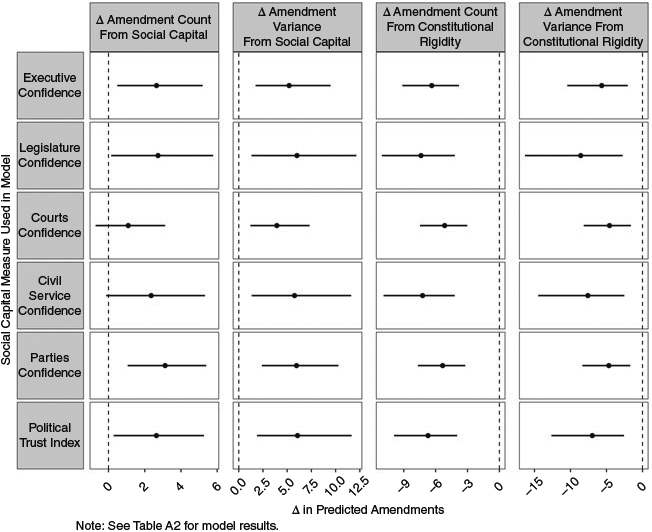
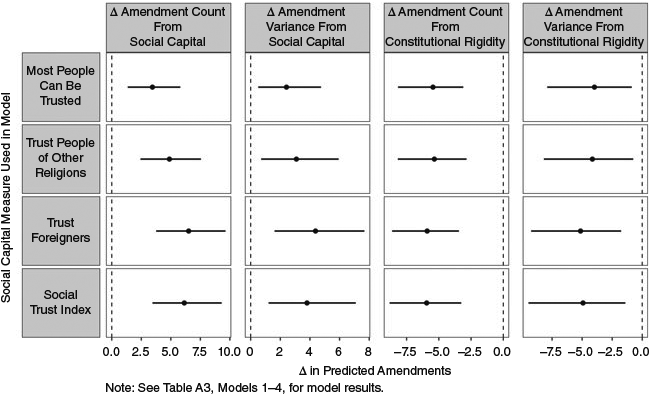
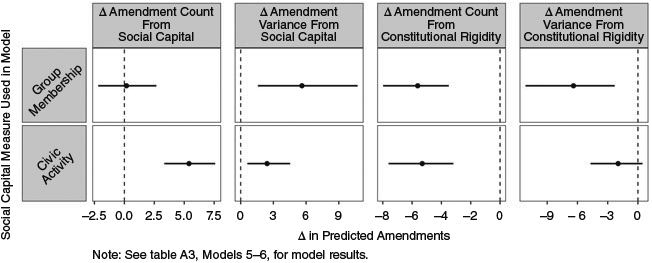
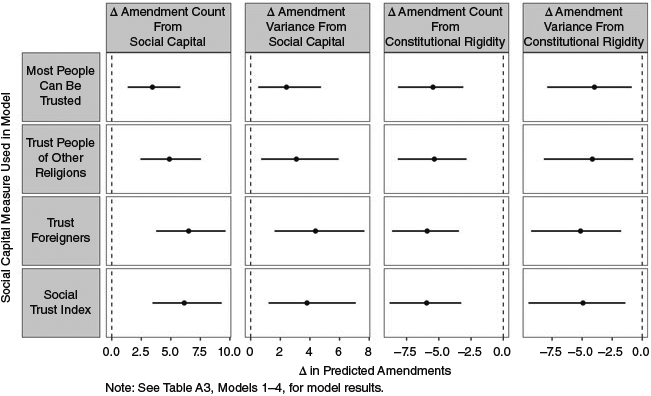
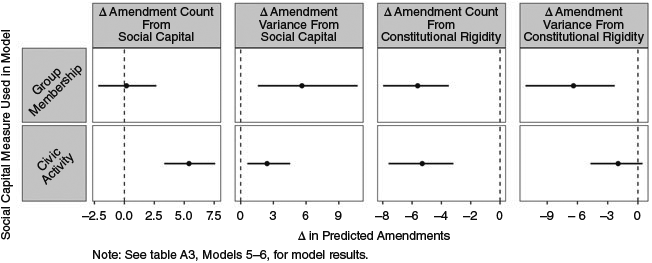
We visualize the effect sizes of the WVS social capital measures in Figures 1, which displays the results of six models of amendment activity using political trust indicators; 2, which visualizes four models using social trust indicators; and 3, which displays the results of models for group activity. As we detailed in the theory section, civic engagement, political trust, and social trust are the three most commonly studied byproducts of the strong interpersonal bonds that the concept of social capital captures. We organize our figures around each of these three subconcepts for convenience.
Effect of first differences of political trust indicators and constitutional rigidity on amendment counts and variance (with 90% credibility intervals)
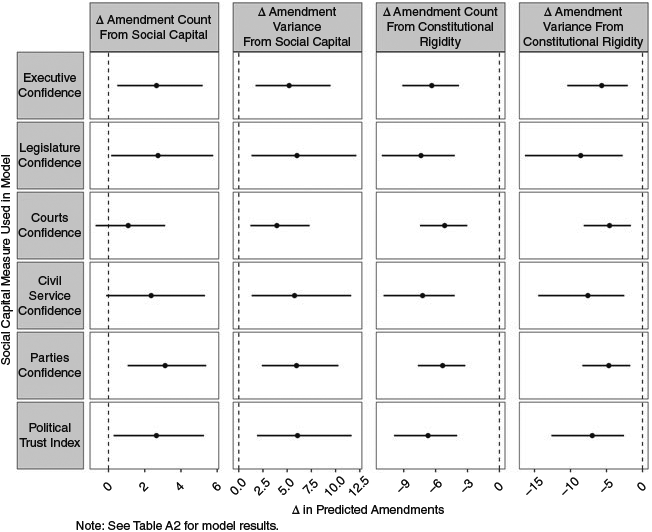
Figure 1 displays the results of six models of amendment activity using different indicators of political trust. The leftmost column displays the effect of an average first difference change in the social capital measure in question on the number of constitutional amendments, while the second column measures the variance of that relationship. The third and fourth columns of Figure 1 display the corresponding effects of an average first difference change in constitutional rigidity on the predicted amendment count and variance, respectively.
Four of the six political trust indicators produce credibly positive effects on amendment rates, as displayed in the leftmost column, which supports H4. The coefficients from the measures of confidence in the courts and civil service are positive, but they fall just short of being statistically credible. The effects of social capital are variable, as indicated by the credible, positive findings in the second column of Figure 1. In other words, while low levels of social capital strongly predict few amendments, high levels of social capital do not always translate into more amendments, consistent with H6.
In all six models, higher levels of rigidity credibly reduce constitutional amendment rates, as indicated by the credible, negative findings displayed in the third column of Figure 1. These findings provide evidence in support of H1. Like the social capital findings, these results are heteroskedastic, consistent with H2. Thus, very rigid amendment rules strongly produce low amendment rates, but more lax amendment rules do not guarantee more amendments.
Figure 2 displays the results of four models using the WVS’ social trust indicators. In this figure, every effect is statistically credible. In all four models, constitutional rigidity reduces amendment activity, and higher levels of rigidity produce less variable effects. According to the leftmost column of Figure 2, every measure of social trust is credibly associated with more amendment activity, although the second column indicated that high levels of social trust do not guarantee more amendments. Whether it is generic social trust, trust in an out-group member (someone from another nation or religion), or an index encapsulating every social trust measure, social trust helps create conditions more conducive to constitutional reform.
Effect of first differences of social trust indicators and constitutional rigidity on amendment counts and variance (with 90% credibility intervals)
Finally, Figure 3 displays the results of two models of civic activity. Group membership and the index of civic activity are positively associated with constitutional amendments, although the effect of the group membership variable is not statistically credibility. Like the models visualized in the previous figures, the effects of group membership and civic activism are heteroskedastic. Also like the other models, the effects an average first difference of rigidity levels are credibly associated with a smaller amendment count and variance, except for the effect of rigidity on amendment variance in the civic activity model displayed in the second row of Figure 3.
Effect of first differences of civic participation indicators and constitutional rigidity on amendment counts and variance (with 90% credibility intervals)
While the WVS analysis shows a broad and consistent cross-national pattern that suggests social capital and constitutional rigidity affect the pace of constitutional change, the structure of this data does not allow any analysis of why amendments are more prevalent at different points in a nation’s history. For that, we need data that vary over time and across space. Fortunately, the data in the next part of the section allow us to see this fuller picture.
2.3 Cross-National Longitudinal Analysis
2.3.1 Data and Methods
In this part of the Section, we estimate the influence of constitutional rigidity and social capital over the course of a democracy’s history. Here, we can measure the influence of both cross-national variations and (for sixteen democracies at least) over-time variations in constitutional rigidity. To measure these within-country rigidity changes, we use the Political Constraint (PolCon) dataset (Henisz, Reference Henisz2000). This measure of legislative fractionalization is equal to the probability that two random draws from one legislative chamber are from different parties.
For social capital data, we turn to V-Dem, who use over 4,000 country experts to estimate various measures of a country’s governing structures and political environment over time. We use V-Dem data for every year that a democratic nation’s current constitution has been in place up to 2013. One standard measure of social capital in V-Dem is the Civil Society Participation Index (CSPI), an aggregation of four indicators measuring the degree to which organizations engage in politics. The first indicator measures the participatory environment in which civil society organizations (CSOs) operate, with potential scores ranging from zero, where the state sponsors all organizations, to three for societies with diverse CSOs in which citizens at least occasionally participate. Next, the index includes an indicator that gauges the extent to which rulers routinely consult CSOs. The degree to which women can participate in CSOs forms another dimension of the index. Finally, the index includes a measure of the centralization of candidate nominations (Bernhard et al., Reference Bernhard, Jung, Tzelgov, Coppedge and Lindberg2017, 347–348).
As a robustness check, we examine the relationship between amendment frequency and the CSPI as well as the CSPI’s subindices measuring the degree of women’s participation, government consultation, and the strength of the CSO participatory environment. We also test whether constitutional systems that allow for direct democracy have more amendment activity. As we outlined in the previous section, social movements can leverage social capital to educate voters in referendum campaigns. Furthermore, according to Elkins and Hudson (Reference Elkins, Hudson, Landau and Lerner2019, 142), referenda “have seemingly become a ubiquitous means of ratifying constitutional change.” Specifically, we test the influence of a V-Dem measure of the credibility of the threat of a popular referendum on amendment frequency. Finally, we examine whether all CSOs have equal levels of influence on amendment activity. V-Dem (2022, 204) includes a measure of the presence of anti-system CSOs, defined as organizations seeking to “change the polity in fundamental ways, e.g., from democratic to autocratic.” Because these kinds of CSOs strongly oppose the constitutional status quo, we doubt they will seek to use constitutional amendment rules to achieve their goals. However, it is possible that elites will amend the Constitution to prevent a more radical agenda from gaining momentum.
Because the V-Dem dataset is considerably larger than the WVS, we have greater freedom to include control variables in the analysis. To rule out alternative explanations of amendment activity, we use the same control variables as other studies (e.g., Tarabar & Young, Reference Tarabar and Young2021). We include measures of the Executive Constraint component of each nation’s Polity IV score, which measures the degree to which legislatures can hold executives accountable. Low Executive Constraint scores are often associated with executives suspending constitutional provisions (Tarabar & Young, Reference Tarabar and Young2021, 8). To rule out cultural conflict as a source of demand for constitutional amendments, we control for ethnic fractionalization using the Historical Index of Ethnic Fractionalization (Dražanová, Reference 72Dražanová2020). This measure corresponds to the probability that two randomly drawn individuals within a country are not from the same ethnic group. Exogenous shocks, such as economic decline or armed conflict, often provide unexpected opportunities for amendments. Thus, we control for real per capita GDP using a country’s annual growth rate and logged base level, courtesy of Penn World Table. Finally, we include a dichotomous indicator of a major episode of political violence per country-year, as defined by the Center for Systematic Peace.
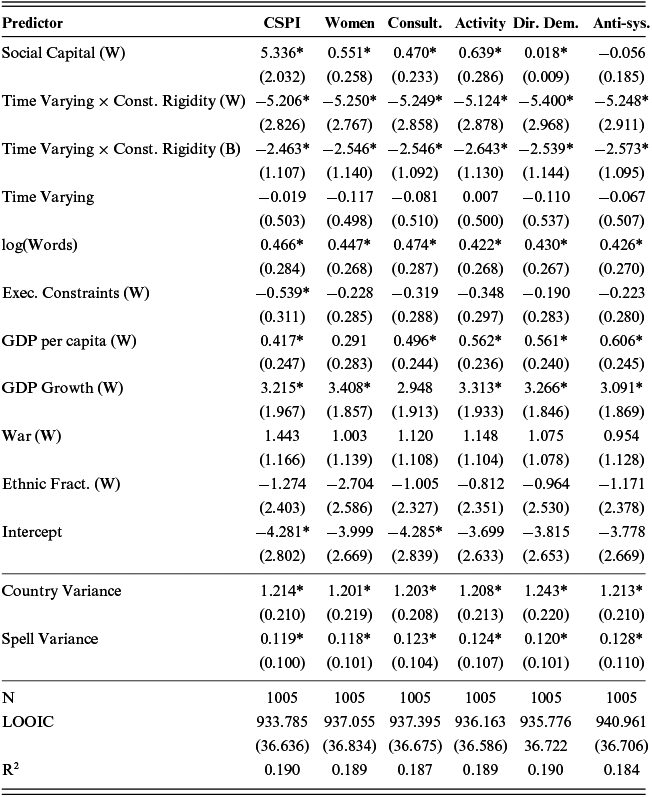
In the cross-national, longitudinal models, the dependent variable is binary, indicating country-years in which at least one amendment was adopted. We also follow the advice (at least in part) of Bell and Jones (Reference 69Bell and Jones2015). They suggest using both within- and between-transformations of the variables of interest. This permits the disentanglement of the between-country and within-country effects of those variables generating a more nuanced set of findings.Footnote 17 Thus, in Table 1, we label variables that vary within countries over time with (W) and variables that measure between-country differences (B). In this iteration of the model, constitutional rigidity has within-country variation for sixteen countries. Each model contains random intercepts for each country and spell (the period of time since the last amendment year). For more details, see the Supplementary Materials.
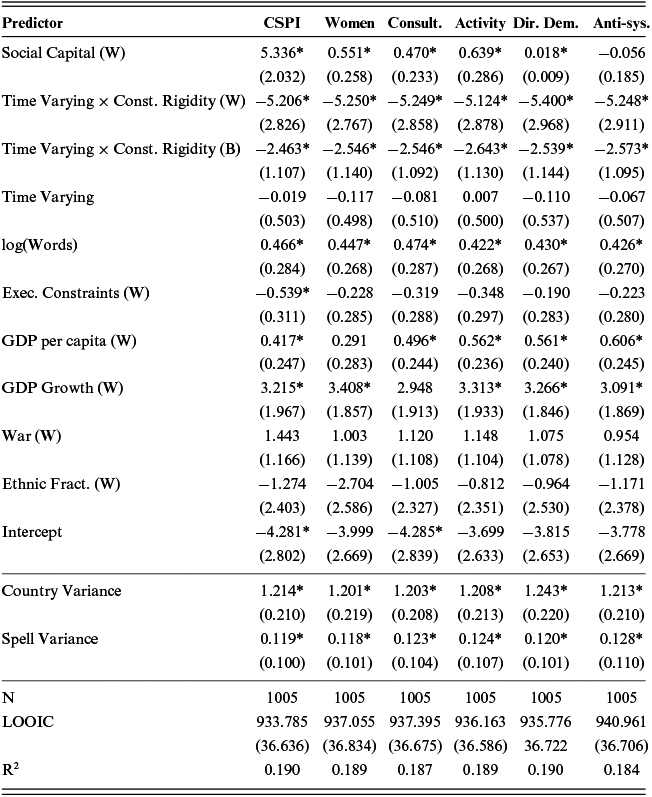
Table 1 Long description
The table presents Bayesian logistic model coefficients for amendments using six social capital measures in the models: CSPI, Women, Consult., Activity, Dir. Dem., and Anti-sys. Values in parentheses are standard errors. An asterisk indicates a statistically credible difference at 90 percent. Data mentioned are as follows.
Predictor: Social Capital (W). CSPI: 5.336*; standard error: 2.032. Women: 0.551*; standard error: 0.258. Consult.: 0.470*; standard error: 0.233. Activity: 0.639*; standard error: 0.286. Dir. Dem.: 0.018*; standard error: 0.009. Anti-sys.: −0.056; standard error: 0.185.
Predictor: Time Varying × Const. Rigidity (W). CSPI: −5.206*; standard error: 2.826. Women: −5.250*; standard error: 2.767. Consult.: −5.249*; standard error: 2.858. Activity: −5.124*; standard error: 2.878. Dir. Dem.: −5.400*; standard error: 2.968. Anti-sys.: −5.248*; standard error: 2.911.
Predictor: Time Varying × Const. Rigidity (B). CSPI: −2.463*; standard error: 1.107. Women: −2.546*; standard error: 1.140. Consult.: −2.546*; standard error: 1.092. Activity: −2.643*; standard error: 1.130. Dir. Dem.: −2.539*; standard error: 1.144. Anti-sys.: −2.573*; standard error: 1.095.
Predictor: Time Varying. CSPI: −0.019; standard error: 0.503. Women: −0.117; standard error: 0.498. Consult.: −0.081; standard error: 0.510. Activity: 0.007; standard error: 0.500. Dir. Dem.: −0.110; standard error: 0.537. Anti-sys.: −0.067; standard error: 0.507.
Predictor: log(Words). CSPI: 0.466*; standard error: 0.284. Women: 0.447*; standard error: 0.268. Consult.: 0.474*; standard error: 0.287. Activity: 0.422*; standard error: 0.268. Dir. Dem.: 0.430*; standard error: 0.267. Anti-sys.: 0.426*; standard error: 0.270.
Predictor: Exec. Constraints (W). CSPI: −0.539*; standard error: 0.311. Women: −0.228; standard error: 0.285. Consult.: −0.319; standard error: 0.288. Activity: −0.348; standard error: 0.297. Dir. Dem.: −0.190; standard error: 0.283. Anti-sys.: −0.223; standard error: 0.280.
Predictor: GDP per capita (W). CSPI: 0.417*; standard error: 0.247. Women: 0.291; standard error: 0.283. Consult.: 0.496*; standard error: 0.244. Activity: 0.562*; standard error: 0.236. Dir. Dem.: 0.561*; standard error: 0.240. Anti-sys.: 0.606*; standard error: 0.245.
Predictor: GDP Growth (W). CSPI: 3.215*; standard error: 1.967. Women: 3.408*; standard error: 1.857. Consult.: 2.948; standard error: 1.913. Activity: 3.313*; standard error: 1.933. Dir. Dem.: 3.266*; standard error: 1.846. Anti-sys.: 3.091*; standard error: 1.869.
Predictor: War (W). CSPI: 1.443; standard error: 1.166. Women: 1.003; standard error: 1.139. Consult.: 1.120; standard error: 1.108. Activity: 1.148; standard error: 1.104. Dir. Dem.: 1.075; standard error: 1.078. Anti-sys.: 0.954; standard error: 1.128.
Predictor: Ethnic Fract. (W). CSPI: −1.274; standard error: 2.403. Women: −2.704; standard error: 2.586. Consult.: −1.005; standard error: 2.327. Activity: −0.812; standard error: 2.351. Dir. Dem.: −0.964; standard error: 2.530. Anti-sys.: −1.171; standard error: 2.378.
Predictor: Intercept. CSPI: −4.281*; standard error: 2.802. Women: −3.999; standard error: 2.669. Consult.: −4.285*; standard error: 2.839. Activity: −3.699; standard error: 2.633. Dir. Dem.: −3.815; standard error: 2.653. Anti-sys.: −3.778; standard error: 2.669.
Country Variance. CSPI: 1.214*; standard error: 0.210. Women: 1.201*; standard error: 0.219. Consult.: 1.203*; standard error: 0.208. Activity: 1.208*; standard error: 0.213. Dir. Dem.: 1.243*; standard error: 0.220. Anti-sys.: 1.213*; standard error: 0.210.
Spell Variance. CSPI: 0.119*; standard error: 0.100. Women: 0.118*; standard error: 0.101. Consult.: 0.123*; standard error: 0.104. Activity: 0.124*; standard error: 0.107. Dir. Dem.: 0.120*; standard error: 0.101. Anti-sys.: 0.128*; standard error: 0.110.
N equals 1005 for all models.
LOOIC values. CSPI: 933.785; standard error: 36.636. Women: 937.055; standard error: 36.834. Consult.: 937.395; standard error: 36.675. Activity: 936.163; standard error: 36.586. Dir. Dem.: 935.776; standard error: 36.722. Anti-sys.: 940.961; standard error: 36.706.
R squared values. CSPI: 0.190. Women: 0.189. Consult.: 0.187. Activity: 0.189. Dir. Dem.: 0.190. Anti-sys.: 0.184.
Note: *indicates a statistically credible difference (90%). Each model includes random intercepts for country and spell. Predictors measuring between-country variation are marked (B), and those measuring within-country variation are marked (W).
2.3.2 Results
As predicted by H5, the within-country changes of social capital are credibly associated with amendment activity in five of the six models. Amendment activity is more likely to occur at times within a country’s history when civil society is comparatively stronger (using the CSPI or the V-Dem measure of the CSO participatory environment), when women participate more frequently in CSOs, and when the government is more likely to consult CSOs. Amendments are also more likely to occur at points when social movements can more easily leverage popular referenda. Only the presence of anti-system CSOs did not produce a credible effect, which suggests that social capital is more effective when being leveraged by social movements willing to work within status quo constitutional parameters.
Each model in Table 1 produces similar results with respect to the differences between countries in constitutional rigidity as in the WVS analysis. That is, amendment activity is credibly less common in countries with stricter amendment rules, consistent with H1. However, to measure the impact of within-country changes to constitutional rigidity, based on changes in legislative composition, we must turn to Figure 4, which visualizes the result of the first model from Table 1. The left portion of Figure 4 visualizes the credible, negative effect of constitutional rigidity in all sixteen nations where constitutional rigidity varies over time. Consistent with H3, we find that as divisions between legislative chambers increase, the probability of amendment decreases.
Effects of constitutional rigidity and social capital on amendment probability
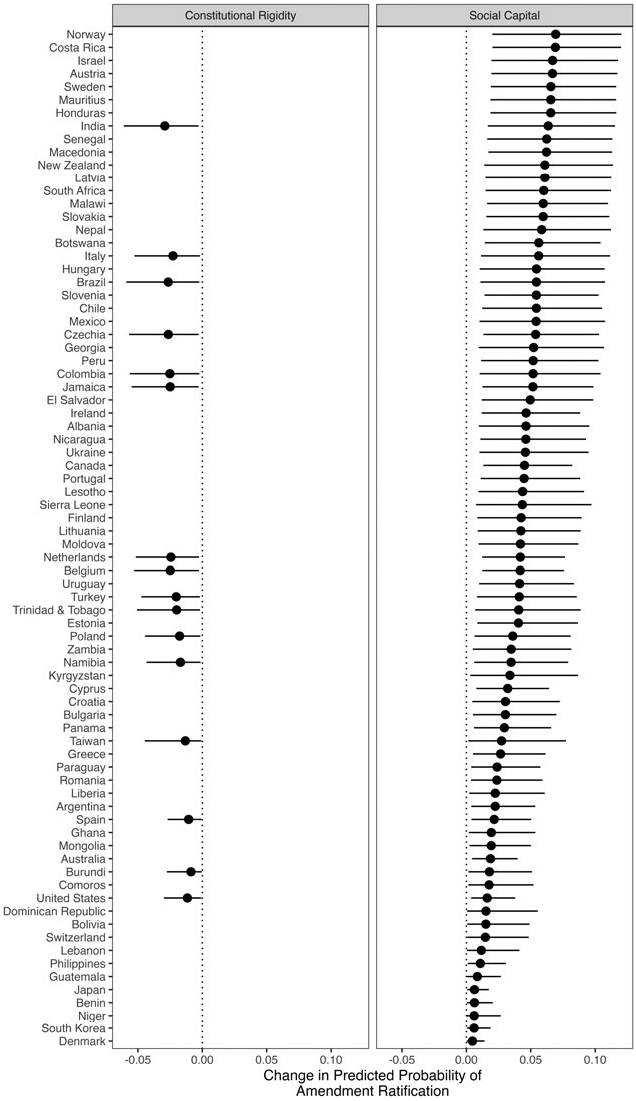
Most of the control variables in each model do not credibly affect amendment activity. However, GDP growth is associated with greater amendment activity in each of the six models. The literature is divided on whether constitutional reform is more likely to occur during economic decline or growth, but there is some support for this finding (Blake & Anson, Reference Blake and Anson2020).
As indicated on the right side of Figure 4, higher CSPI scores are associated with reliably higher amendment activity in every democracy, save two: South Korea and Denmark. The magnitude of these effects varies across countries, which is unsurprising given the heteroskedastic findings from the WVS analysis. Moreover, the variable effect sizes are consistent with existing scholarship. According to Ginsburg and Melton (Reference 74Ginsburg and Melton2015, 689), India, Brazil, and Mexico are paradigmatic examples of flexible amendment cultures, while the United States and Japan represent rigid amendment cultures. As displayed on the right side of Figure 4, social capital exerts a comparatively large effect in India (8th largest), Mexico (22nd largest), and Brazil (24th largest), and a smaller effect in the United States (67th largest) and Japan (75th largest). Thus, our results suggest that civil society plays an important role in shaping amendment culture.
As a robustness check, we looked to see whether the effect of social capital on amendment propensity was higher in nations with more rigid amendment rules. To do so, we split the V-Dem data into two subsets, one for countries with below-average and above-average levels of constitutional rigidity. We use the CSPI as the social capital indicator and include only the word length of each nation’s constitution as a control to maximize the number of observations. Then we compare the size of the social capital coefficient in the two models. The results of this analysis can be found in the Supplementary Materials, Table A5 indicate the effect of social capital is slightly but not substantially higher in more rigid constitutional contexts.
2.4 Conclusion
In this section, we found evidence for our theory about constitutional amendment rates being an interplay between institutional rules and social forces. Constitutional amendments are more likely to occur in democracies with higher levels of social capital and at times within a country’s history when social capital is comparatively higher. Social capital also tends to increase the residual variation of amendments, supporting our hypothesis that social capital is a necessary but insufficient condition. In other words, as social capital increases, so does the possibility of adopting amendments, but other country-specific factors determine whether amendments become a reality. The findings are similar for constitutional rigidity: Amendments are less frequent in nations with stricter amendment rules or at times when a country’s partisan landscape is more fractured. These effects are also heteroskedastic, meaning that while high levels of rigidity strongly predict very few amendments, the converse is not true.
The findings hold for every type of social capital measure available: political trust, social trust, group membership, and civic activism. The results are also robust to different measurements of each of these concepts and different statistical designs. And though social capital is associated with more frequent amendment activity, we cannot find any evidence that constitutional amendments can increase levels of social capital. Nevertheless, other constitutional design choices can impact levels of social capital. As we detail in Section 4, well-designed citizens’ assemblies can tap into higher levels of social trust to push through controversial constitutional amendments even when levels of political trust are lower.
We also find consistent evidence that longer constitutions are associated with more frequent amendments, regardless of social capital levels. This confirms our suspicions in Section 1.3 that James Madison may have overstated his case in Federalist 51: More angelic polities still need to live under constitutional governments, and every constitution will need to change over time. Social capital, especially political trust, facilitates these changes, but these efforts may come at a cost. As we detail in the next section, trusting citizens are willing to defer to political entrepreneurs who chose methods of adopting an amendment through less than legitimate procedures.
3 Trust and Perceptions of Constitutional Hardball
In this section, we investigate how trusting citizens respond when political entrepreneurs push legal norms to enact a constitutional amendment. We know that political trust reduces the transaction costs involved in the amendment process, making it easier for political entrepreneurs to navigate the various stages and procedures necessary to enact reform. However, it may also facilitate the amendment process by allowing political entrepreneurs to engage in constitutional hardball in a way that still garners public acceptance. As we detailed in Section 1, constitutional hardball occurs when political entrepreneurs use tactics that are not demonstrably illegal but do serious damage to constitutional norms and, potentially, the rule of law. When elites resort to hardball, they will always justify their actions as being legal, but the literature in political behavior and public law does not a provide a clear answer on how the public will react. Will citizens believe elected officials who argue that their hardball tactics are legitimate or will they insist on a stronger adherence to the rule of law?
History provides examples to support both possibilities. In the aftermath of the adoption of the French Constitution of 1958, Charles de Gaulle became president through the new constitution’s electoral college system. But de Gaulle opposed the electoral college and asked Parliament for a constitutional amendment allowing direct presidential elections. Parliament rejected de Gaulle’s idea, fearing an increase in executive power at the expense of the legislative branch.
So de Gaulle got creative. On the one hand, constitutional amendments must pass both chambers of the Parliament before being approved in a referendum. On the other hand, another section of the French Constitution allows the president to bypass Parliament and “submit to a referendum any Government Bill which deals with the organization of the public authorities.” President de Gaulle argued that a constitutional amendment changing the method of presidential election met the criteria for being (1) a government bill that (2) dealt with the organization of the executive branch. Despite protests from parliament, the media, and constitutional scholars, the referendum passed overwhelmingly. Not only did de Gaulle win reelection after using this hardball tactic, parties supporting the referendum gained seats in the subsequent general election (Albert, Reference Albert2019a, 871–874).
Recent experience in Canada tells a different story about the public’s willingness to accept hardball tactics to accomplish constitutional goals. The Canadian Charter of Rights and Freedoms was adopted in 1982, providing judicially enforceable constitutional rights for the first time in the nation’s history. The Charter was popular in English-speaking Canadian provinces, but Francophones in Quebec feared that the Charter would undermine their status. To accommodate these fears, the Charter included the controversial Section 33, also known as the Notwithstanding Clause. This provision allows both the federal parliament and provincial legislatures to foreclose judicial review on a statute with respect to violations of most of Charter rights but not language rights. The declaration remains in force for five years, but the legislature can extend the length of the override with a subsequent declaration.
While the inclusion of Section 33 did not persuade Quebec to ratify the Charter, it did provide the province with a potent weapon to resist the new constitution after it took effect. In 1988, Quebec invoked the Notwithstanding Clause to overturn a Canadian Supreme Court decision striking down a law requiring that all outdoor signs in the province be in French only. Quebec’s response to the judicial decision was roundly criticized outside the province. And while the move was initially popular within Quebec, by the time the five-year window elapsed, legislators changed their signage law to comply with the Court’s decision. One likely reason is that support for judicial review is broadly popular across every region of the nation. According to one survey in 1987 (after the Canadian Supreme Court had agreed to take the signage case), 69% of respondents believed that when a law conflicts with a Charter provision, courts (not legislatures) should have the final say. Among French-speaking respondents, support for judicial supremacy was slightly higher at 72% (Sniderman et al., Reference Sniderman, Fletcher, Russell and Tetlock1996). According to some scholars, public support for judicial review caused a backlash that led Section 33 to fall into desuetude for the next thirty years (Albert, Reference Albert and Macfarlane2018).
As interesting as these examples are, the main focus of this section is the ERA to the US Constitution, which is currently stuck in constitutional limbo. Leaders and scholars disagree over how much power Congress had to shape the ratification process when it proposed the ERA, how close the amendment is to being ratified, and what steps can be taken to facilitate its adoption. When Congress proposed the ERA in the 1970s, it imposed a statutory deadline for states to ratify. The amendment fell three states short of ratification before time ran out in 1982. Since then, three have states ratified and five states have attempted to rescind their ratifications from the 1970s.
We first provide a brief history of the ERA and detail its potential paths forward, including the use of hardball tactics. We next review the literature on how political trust might affect voters’ procedural preferences. After grounding our hypotheses, we report the results of a survey experiment that investigates public attitudes toward the three ways the ERA could be added to the Constitution. We assess whether procedural preferences exist in the abstract and whether support for the ERA or political trust mitigate them. The concluding portion summarizes our findings and provides advice to proponents of the ERA.
3.1 The ERA: Then and Now
The week leading up to the inauguration of a president is chaotic, especially when the new administration represents a different political party. The outgoing president may award some potentially controversial pardons, while incoming advisors prepare new executive orders. The final few days of President Biden’s administration, however, were extraordinary. Biden (Reference Biden2025) took the entire nation by surprise, declaring in one of his final press statements,
I have supported the Equal Rights Amendment for more than 50 years…In keeping with my oath and duty to Constitution and country, I affirm what I believe and what three-fourths of the states have ratified: The 28th Amendment is the law of the land, guaranteeing all Americans equal rights and protections under the law regardless of their sex.
Article V of the Constitution requires amendments to receive a two-thirds majority in Congress, followed by ratification in three-fourths of the states. Congress sent the ERA to the states for ratification in 1972, a year before Joe Biden was first elected to the US Senate. The most recent state to ratify the amendment was Virginia in 2020. So how could a president, who plays no role in the amendment process, declare an amendment part of the Constitution nearly five years later? And why is the ERA not listed as the 28th Amendment in official copies of the US Constitution?
When Congress proposed the ERA, it attached a seven-year deadline for state ratifications. This has been a common practice in recent American constitutional history: States had seven years to decide whether to ratify the 18th, 20th, 21st, and 22nd Amendments. However, Congress took a different action with the ERA. The deadline it set was statutory, as opposed to being written into the amendment itself. That means that Congress could extend or remove the deadline.Footnote 18
When enthusiasm for the ERA slowed across state legislatures, Congress did extend the ratification deadline until 1982, but the amendment remained three states short of ratification. In the next three decades, five states attempted to rescind their earlier ratification, but the legality of such action has never been recognized in court or by Congress. Donald Trump’s first election spurred progressives to take up the ERA’s mantle again. Nevada voted to ratify the ERA in 2017, followed by Illinois and Virginia.
When a state ratifies a constitutional amendment, it sends word to the Archivist of the United States. Once the three-fourths threshold has been reached, the Archivist officially publishes the amendment. In anticipation of Virginia’s ERA vote, the Trump Administration put up a roadblock. On January 6, 2020 – the same day that Donald Trump orchestrated an insurrection on the Capitol to seize a second presidential term – the White House Office of Legal Counsel (OLC) released a memo ordering the Archivist of the United States not to recognize any ratification of the ERA after the 1982 deadline (Office of Legal Counsel, 2020). After the failure of the Trump insurrection, President Biden urged Congress to extend the ERA’s ratification deadline. The House of Representatives has voted several times to do just that, but the Senate never took up the issue.
Other political leaders and legal scholars have argued that Trump OLC memo is completely wrong (Karni, Reference Karni2023). According to this view, Congress has no constitutional authority to bind the states to a ratification deadline unless the deadline is a part of the amendment’s text (Held, Herndon, & Stager, Reference Held, Herndon and Stager1997, 131–134). Thus, the only thing preventing the ERA from becoming part of the Constitution is the Archivist’s refusal to publish. No further congressional action would be needed if a different administration reversed the Trump OLC memo.
Despite his strongly worded press statement, President Biden was unwilling to reverse the OLC memo, likely because he (and many others) feared a constitutional crisis if the ERA became part of the Constitution under such circumstances. In 2020, Supreme Court Justice Ruth Bader Ginsburg (as cited in Berman, Reference Berman2020), a life-long proponent of women’s rights, said, “I’d like [the ERA] to start over.” Justice Ginsburg believed there was “too much controversy” regarding the number of states that had ratified. “If you count a latecomer on the plus side,” she asked, “how can you disregard states that said, ‘we’ve changed our minds’?”Footnote 19 This option sidesteps the debate over the discretion of the Archivist, the constitutionality of Congress’ deadline, and the status of states that wish to rescind their ratification votes.
While “starting over” may occupy the firmest constitutional ground, it is also the least likely to produce constitutional change. The ERA enjoyed broad, bipartisan support in Congress when it was proposed. However, like so many other issues in modern American politics, the ERA has become a partisan issue, and it is unlikely that Congress would change the ratification deadline unless Democrats control both chambers. The procedural method with the lowest transaction costs also comes with the lowest levels of legitimacy. A new OLC memo would not only contradict the findings of the Trump administration, the subsequent recognition by the Archivist would contradict Congress’ stated preferences.
3.2 Untangling the Relationship between Trust and Hardball
There is a large body of work examining the relationship between perceptions of procedural fairness and an individual’s willingness to accept the results of legal and constitutional decision-making processes, even if they disagree with the substance of outcome (Cozza, in Reference Cozzapress; Easton, Reference Easton1965; Esaiasson, Persson, Gilljam, & Lindholm, Reference Esaiasson, Persson, Gilljam and Lindholm2016; Lind & Tyler, Reference Lind and Tyler1988). Procedural legitimacy thus differs from substantive legitimacy or support for the merits of the action taken. Lind and Tyler (Reference Lind and Tyler1988), for example, find that fair application of decision-making rules builds legitimacy by engendering trust, ensuring fairness, and minimizing uncertainty. Thus, citizens should be more willing to accept decisions that they believe resulted from a fair, impartial, and legally prescribed process.
Likewise, political entrepreneurs may encounter more resistance to constitutional hardball when civil society – by which we mean institutions such as markets, religion, the family, as well as NGOs – is particularly strong. As Mark Tushnet (Reference Tushnet, Bellamy and King2025, 1085) observed, “People engaging in market transactions come to appreciate the value of forbearance and tolerance as they negotiate with trading partners; almost all religions have some version of the Golden Rule…; family members learn that they should not pursue their own self-interest but should take others’ interests into account.”
Applying these insights requires that citizens can distinguish between hardball and non-hardball tactics. However, in the context of the ERA, the task of identifying the most legitimate path to ratification may not be particularly difficult. It is clear that starting the amendment process over avoids all potential conflict about how to count states who voted to ratify then rescind. In other words, Justice Ginsburg’s preference to restart the ratification of the ERA is not based on her interpretation of Article V of the US Constitution. Rather, she is making a social science argument that the ERA is more likely to be perceived as a legitimate part of the Constitution if its ratification procedures were above reproach. Thus, we predict:
H1: Respondents view hardball ratification techniques (Archivist certification and Congress removing the ratification deadline) as significantly less legitimate than restarting the amendment process.
Even if voters have the capacity to discern the most procedurally legitimate tactic for ratifying the ERA, the logic of procedural justice studies may not translate. The premise underlying these studies is that procedural fairness signals that all people are valued members of the political community. Procedural justice, therefore, occurs when citizens have opportunity to express themselves to government officials, and government officials treat people with dignity. These psychological concerns may not be activated when respondents are asked to evaluate three ratification methods that do not involve public consultation (nor humiliating personal treatment by agents of the state).
There is considerable evidence that voters, at least in the United States, care little about “process issues” (Hibbing & Theiss-Morse, Reference Hibbing and Theiss-Morse2002). So long as the substance of any change is popular, the policymaking tactics used to create it are more or less irrelevant. In this survey experiment, voters can use their stance on the ERA as a heuristic against which they can develop an attitude about the legitimacy of its ratification method. Given previous studies of the ERA indicate high levels of public support (e.g., Mansbridge, Reference Mansbridge1986), we predict:
H2: Respondents’ views on the legitimacy of any ratification technique is significantly higher when they can activate their attitudes toward the ERA.
Elite cues assist voters in making political choices, which in the case of constitutional hardball usually means that elites deny they are doing anything wrong or that a unique set of circumstances justifies a departure from the normal practice of politics. It is difficult for most voters to dispute these justifications, given that hardball involves actions that are not obviously illegal. Trusting voters are among those most likely to believe elites, especially when the policy at issue is one that voters support. In our survey experiment, we do not provide any elite cues. Nevertheless, respondents can easily intuit that since a given ratification method is mentioned in the vignette, at least some elites must view it as a legitimate way to add the ERA to the Constitution.
H3: Respondents with higher levels of political trust view any ratification technique as significantly more legitimate compared to more distrustful respondents.
3.3 Description of Data Collection and Experimental Design
To answer these questions, we fielded a vignette-based survey experiment among US adults via Forthright Access from April 6 to 19, 2023.Footnote 20 Overall, 934 participants completed the study. The survey experiment featured a 3x2 design: Respondents were first randomly assigned to a treatment condition corresponding to one of the three methods being debated to ratify the ERA: certification by the Archivist, Congress repealing the ratification deadline, or restarting the amendment process. We suspect that perceptions of constitutional hardball are likely to be influenced by the respondent’s underlying support for the constitutional amendment in question, so we designed a control condition that does not mention the ERA. Instead, respondents were asked to evaluate the procedural legitimacy of ratifying “an amendment” using the ratification method treatment to which they were assigned.Footnote 21
All respondents begin with a vignette that summarizes the amendment process up to this point for the ERA (or the unspecified amendment).Footnote 22 Participants in the three ERA treatment groups also received the text of the ERA. Next, the vignette describes the process by which Congress or the Archivist plan to ensure the amendment’s final incorporation into the Constitution. Table 2 lays out the three different treatment conditions, which correspond to the three different ratification pathways discussed in the previous passage.
| Treatment Group | Vignettes |
|---|---|
| Removal Treatment | Since these last three states voted to ratify after [1982/ the ratification deadline], Congress could vote to remove the ratification deadline. If this vote passes, the three additional states will count as having ratified the amendment, and the [ERA/amendment] will become part of the Constitution. |
| Archivist Treatment | Since these last three states voted to ratify after [1982/ the ratification deadline], the Archivist of the United States – the person responsible for certifying the ratification of new amendments – now plans to recognize the three additional state ratifications. If the Archivist takes this action, the [ERA/amendment] will become part of the Constitution. |
| Restart Treatment | Since these last three states voted to ratify after [1982/ the ratification deadline], Congress now plans to restart the amendment process, which would require a 2/3 vote in both the House and Senate and ratification by 3/4 of the states before the [ERA/amendment] can become part of the Constitution. |
Participants were then asked: “How fair is the planned ratification process?”Footnote 23 Responses were placed on a five-point scale that ranged from “Very Fair” to “Very Unfair.” This measure serves as our dependent variable. Participants also answered a battery of political trust questions, randomly presented either before or after the participants received the vignette in order to mitigate any potential priming effects.Footnote 24 All participants completed a manipulation check in which they were asked about the content of the amendment in their vignette.
3.4 Results
To streamline the analysis, we combined the archivist and deadline removal treatments into a single “Constitutional Hardball” category.Footnote 25 We begin by noting that the ERA is overwhelmingly popular in our sample, with 74.4% of participants indicating that they supported the amendment. This support was largely consistent between treatment groups.Footnote 26
To assess H1, we conducted pairwise t-tests comparing the perceived legitimacy of restarting the amendment process versus hardball tactics for both the ERA and the unspecified amendment (Figure 5). In the ERA condition, participants did not significantly distinguish between constitutional hardball and restarting the amendment process when assessing amendment fairness (p = 0.33). The results are quite different when assessing the unspecified amendment. Here, restarting the amendment process was seen as a more fair process than engaging in constitutional hardball (p = 0.003). These results only partially support  . While participants viewed hardball techniques as significantly less legitimate under the unspecified amendment treatment, they did not distinguish between techniques in the ERA treatment.
Pairwise t-test comparing perceived legitimacy of constitutional hardball tactics versus restarting the amendment process, by amendment specificity (w/95% CIs)
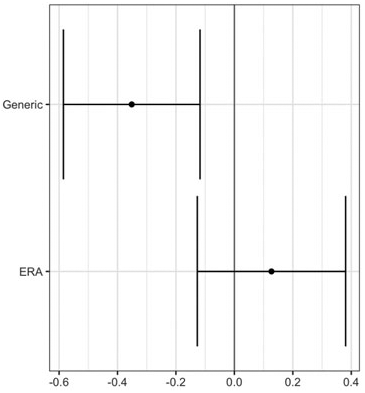
Next, we directly compared the ERA to the unspecified amendment treatments (Figure 6). The results demonstrate that constitutional hardball was seen as significantly more fair under the ERA treatment than under the unspecified amendment treatment (p < 0.001). Participants did not significantly alter their view of procedural fairness between the two amendment types with regards to restarting the amendment process (p = 0.14). These results present support for H2, suggesting that substance plays a mediating role in assessments of procedural legitimacy. Thus, individuals seem more likely to support constitutional hardball when they support the amendment in question.
Pairwise t-test comparing the perceived legitimacy of ratification techniques between respondents informed about ERA versus unspecified amendment (w/95% CIs)
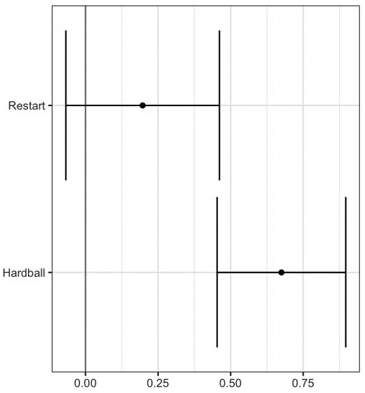
To analyze the potential moderating effect of political trust (H3), we separate the data for each treatment group based on the trust sample mean (0.41) and conduct a series of pairwise t-tests comparing the procedural legitimacy scores for high and low trusting participants (Figure 7). We find that higher levels of political trust increase perceptions of procedural fairness in three of the four comparisons (p < 0.006). While high trusters saw constitutional hardball as more procedurally fair than low trusters across both amendment conditions, there was not a statistically significant difference between high and low trusters when assessing the restart condition for the unspecified amendment (p = 0.89). This result is not entirely surprising given that an unspecified amendment proceeding through a constitutionally sound process is unlikely to evoke strong feelings as compared to the other treatment groups with stronger substantive or procedural cues. Thus, these results largely support Hypothesis 3.
Pairwise t-test comparing perceived legitimacy of ratification tactics between high versus low trusting respondents (w/95% CIs)
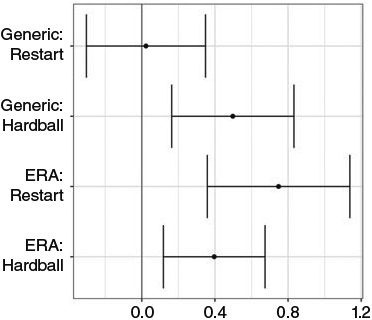
3.5 Conclusion
We find that respondents recognize that restarting the amendment process is the most legitimate tactic for political entrepreneurs, but only in the abstract. When respondents do not know that the controversy over ratification methods is in regard to the ERA, they prefer restarting the amendment process to avoid damage to constitutional norms. When they have full information, respondents view each ratification option as more or less equally legitimate. We attribute this difference to the fact that the ERA is overwhelmingly popular, while an unspecified amendment enjoys no public support. The results indicate that voters update their procedural preferences in light of their stance on the underlying issue.
However, support for the substance of an amendment is not the only factor that shapes perceptions of the legitimacy of tactics that political entrepreneurs might use to ratify it. Higher trusting respondents are significantly more likely to find each ratification more legitimate than the less trusting, and these results hold whether they are assigned to the ERA treatment condition or whether they are assessing the procedural legitimacy of an unspecified amendment (with the exception of restarting an unspecified amendment).
These findings support our theory that because hardball is not illegal, it is too difficult to expect citizens to more sophisticated constitutional attitudes than experts who also tend to disagree on the legitimacy of hardball tactics. To form attitudes on constitutional norms, most respondents will need to take cues from trusted sources. The biggest shortcoming of our experiment is that we did not provide respondents with any party cues. It would be overly optimistic to suggest that this support would hold once the amendment is subjected to negative partisanship, particularly if it were to be ratified through archivist action or a future deadline removal via Congress.
Given these results, what should proponents of the ERA do? On the one hand results presented here paint an optimistic view of the future of the ERA, given its high level of support from our sample and the willingness to let support for the substance of the policy inform attitudes on procedural legitimacy. On the other hand, ERA proponents may need to wait until levels of political trust are higher and pursue a vote in Congress to remove the ratification deadline. This “happy medium” avoids the possibility for ERA opponents to highlight the undemocratic nature of having an unelected bureaucrat decide a major constitutional question, yet it also avoids the overwhelmingly high transaction costs imposed by going through the amendment process again.
4 Abortion Rights in Ireland
Hotel ballrooms are unusual venues for making history. The Grand Hotel in Malahide, a coastal town just outside of Dublin, is a notable exception. Like most hotels, the Grand has facilities for weddings, luncheons, and corporate events, but for five Saturdays in late 2016 and early 2017, it hosted an extraordinary set of meetings. Ninety-nine people, selected at random, gathered in a conference room to participate in a Citizens’ Assembly. Housewives sat alongside students, retired teachers and truck drivers in this experiment in deliberative democracy.
The members of the Assembly gathered to address one of the most contentious issues in Irish politics: abortion. They listened to experts and advocates, becoming as one participant put it (as cited in Chalmers, Reference Chalmers2017), “the best informed amateurs in the country on this topic at the moment.” They debated among themselves, held votes, and then wrote a report justifying their positions. They recommended that the constitutional ban on abortions be repealed and replaced with a provision authorizing Ireland’s parliament – the Oireachtas – to regulate abortion access. They further recommended that abortion access be available in the first twelve weeks of pregnancy and further granted for fifteen potential reasons, including socioeconomic considerations and the mental health of the mother (Citizens’ Assembly, 2017).
Even though Ireland had prior experience with deliberative democracy, many insiders were wary of the Citizens’ Assembly. Some abortion rights advocates doubted whether the Oireachtas would take their report seriously. “The Citizens’ Assembly was designed to delay the issue falling into the lap of the government ever having to deal with it,” said Ruth Coppinger, a member of the Dail (the lower parliamentary chamber). When the Citizens’ Assembly released its report, one op-ed in the Irish Times declared bluntly: “No political commentator believes that most Irish people are about to vote for abortion on demand.” Early polling seemed to confirm this assessment: Only 19% of Irish voters supported a right to abortion for reasons other than cases of fetal abnormalities, rape, or incest (Binchy, Reference Binchy2017; Duggan, Reference Duggan2016).
Nevertheless, the Oireachtas did act on the recommendations of the Citizens’ Assembly, scheduling a referendum on May 25, 2018. An overwhelming majority of voters supported the referendum, including a majority in all but one constituency. The success of the referendum then triggered an Oireachtas vote on the regulatory recommendations put forward by the Assembly, legalizing access to abortion care in the first twelve weeks of pregnancy. As mentioned earlier, institutional theories of constitutional change cannot explain why reform supporters would create an additional veto point in the amendment process, especially considering Ireland is in the 70th percentile of constitutional rigidity according to Tsebelis (Reference Tsebelis2022). On the other hand, according to Ginsburg and Melton (Reference 74Ginsburg and Melton2015), Ireland currently ranks as one of the most amendment-friendly cultures in their sample. However, this definition of culture, based on Ireland’s amendment activity between 1922 and 1937 under their prior constitution,Footnote 27 provides little insight as to the strategic choices abortion-rights advocates would make eight decades later, especially in light of the political context Ireland faced in the wake of the global financial crisis.
Careful attention to the status of social capital in Ireland, by contrast, can provide a more satisfying explanation. Thus far, we have argued that social capital is a resource that political entrepreneurs can tap into to facilitate the amendment process. The question remains: How can elites go about harnessing existing social capital to generate constitutional reform? How do the various social capital indicators interact to facilitate reform in a given context? More specifically, how can political entrepreneurs advance constitutional change in an environment of low political trust? In this Section, we present original, qualitative data highlighting how elites leveraged the Citizens’ Assembly to facilitate the repeal process and overturn the nation’s constitutional ban on abortion. In Ireland, political trust may have been low, but social trust and civic engagement remained higher. Thus, reformers eschewed the traditional amendment process, which relied on political trust, in favor of a new process that, while more cumbersome, appealed to the trust Irish citizens have in one another.
The Irish Citizens’ Assembly was not the first time a deliberative mini-public has been used as a decision-making mechanism, nor was it Ireland’s first attempt to bring citizens into the process of significant constitutional reform. Indeed, the Irish process was modeled after similar institutions convened in British Columbia and Oregon and followed the 2012 Irish Convention on the Constitution, which was comprised of both politicians and randomly selected citizens. Given the recent decline in political trust in much of the democratic world, examining the Irish case can also help explain why other nations are adopting citizens’ assemblies. Recently, France, Scotland, and Belgium all announced the formation of their own citizens’ assemblies in 2019 to discuss policy and constitutional issues, ranging from climate change to secession. Irish leaders, in turn, were inspired by the 2004 Citizens’ Assembly on Electoral Reform convened in the Canadian province of British Columbia.
As this trust in political institutions declines, citizens are increasingly demanding a greater role in governance (Ignazi, Reference Ignazi2014; Tierney, Reference Tierney2012), but this trend is not without risks to democracy. Referendums have become the most common method of ratifying constitutional amendments around the world (Elkins & Hudson, Reference Elkins, Hudson, Landau and Lerner2019), but direct democracy sometimes produces undemocratic outcomes. Popular dissatisfaction with democracy also provides an opening for populist insurgents who claim to represent the voice of the people against a corrupt elite. Populist parties often endorse noninstitutionalized forms of political participation (Anduiza, Guinjoan, & Ricao, Reference Anduiza, Guinjoan and Ricao2019; Webb, Reference Webb2013). For example, Italy’s M5S has used internal membership polls as a way to engage their voting base and upend traditional political processes.
However, by fashioning a process that brought the voice of the people directly into the drafting and ratification stages of the amendment process, the Irish case can provide a road map for states grappling with high levels of political distrust and democratic dissatisfaction, and populist sentiment. In the concluding section to this Element, we argue that, if embedded into the larger political and social system, deliberative mini-publics such as the Irish Citizens’ Assembly can help a state harness social capital in order to reinvigorate democracy in the age of populism, overcoming political distrust by tapping into wells of social trust. We begin with a brief review of the deliberative democracy literature. We then dive deeper into the Irish case study to demonstrate the utility of the Citizens’ Assembly in the process of constitutional reform. We conclude this section by looking at potential limitations of this process in systems already captured by populist parties or in contexts of high polarization.
4.1 Deliberative Democracy
Deliberative democratic theorists have argued that lawmaking processes that ensure free and equal deliberation help legitimate law by seeking mutual acceptability and consensus (Chambers, Reference Chambers2003). According to John Dryzek (Reference Dryzek2002, v): “[T]he essence of democratic legitimacy should be sought  in the ability of all individuals subject to a collective decision to engage in authentic deliberation about that decision.” By allowing for a more accurate expression, aggregation, and representation of relevant information and opinion, deliberation not only reveals preferences but can help shape them by allowing citizens and their representatives to debate and reflect on questions of political and constitutional importance from multiple points of view.
Deliberation includes acquiring new information and correcting misinformation (Chambers, Reference Chambers2009). Deliberation also requires justification, which asks that “citizens go beyond the self-interests typical in preference aggregation and orient themselves to the common good” (Bohman, Reference 70Bohman1998, 402). Thus, deliberative processes are expected to both increase public support for democratic outcomes and result in more reasoned and effective policy outcomes. In short, deliberative democracy is designed to overcome Edmund Burke’s critique that “the multitude, for the moment, is foolish, when they act without deliberation” (as cited in Pitkin, Reference Pitkin1967, 181).
Though theorists like Burke anticipated emphasized deliberation in legislative fora, at times of low trust in representative institutions and political parties, legislatures are often ineffective at assessing public preferences, generating public buy-in, and increasing the legitimacy of policy choices. Thus, polities around the globe have begun experimenting with “mini-publics”: Small, representative groups of citizens meant to stand for and speak on behalf of the larger public. In lieu of democratic representation, citizens’ assemblies use random selection to create opportunities for citizens to engage in structured deliberation. During these processes, citizens are randomly chosen to participate in the institution, and, if the assembly is large enough, it can provide descriptive representation for key subgroups of the larger public. At the most basic level, these citizens are provided relevant information, given the opportunity to question key experts and stakeholders, and asked to deliberate with one another in order to arrive at an optimal policy recommendation. So too, these institutions often include opportunities for input from the general public and civil society.
Deliberative democratic theorists argue that such a process can ultimately allow for a more accurate expression, aggregation, and representation of informed public opinion, providing lawmakers with a more credible policy assessment (J. S. Fishkin & Luskin, Reference Fishkin and Luskin2005; Pateman, Reference Pateman2012). In this way, those deliberating demonstrate “a new appreciation for the complexity of the issues, the conflicts of values the issues pos[e], and the limitations of any one solution” becoming “sophisticated consumers of the competing policy prescriptions” (J. S. Fishkin, Reference Fishkin1995, 168). Empirically, recent studies have found that the use of mini-publics can enhance the deliberative capacity of citizens by increasing policy knowledge among the public, even if they do not participate in the body itself, and can influence vote choice (Gastil, Knobloch, Reedy, Henkels, & Cramer, Reference Gastil, Knobloch, Reedy, Henkels and Cramer2018). Including statements from the mini-public both in favor of and against the policy measure in question can also increase empathy for the other side among nonparticipants (Suiter et al., Reference Suiter, Muradova, Gastill and Farrell2000). So too, these bodies tend to depolarize opinions within the body or prevent polarization from occurring in the first place (Farrar et al., Reference Farrar, Fishkin, Green, List, Luskin and Paluck2010; J. S. Fishkin, Siu, Diamond, & Bradburn, Reference Fishkin, Siu, Diamond and Bradburn2021; Himmelroos & Christensen, Reference Himmelroos and Christensen2014; Luskin, Fishkin, & Jowell, Reference Luskin, Fishkin and Jowell2002), particularly when there are clear discussion rules and trained facilitators (Strandberg, Himmelroos, & Grönlund, Reference Strandberg, Himmelroos and Grönlund2019).
Thus, deliberative bodies can help provide citizens with the resources and skills that enable them to engage in both interpersonal and intrapersonal deliberations outside of an institutionalized context. These positive effects are likely conditional on the degree to which the recommendations or findings of the mini-public are publicized and the amount of information given to the public about how the mini-public operates. There is also evidence that being informed of a mini-public can increase efficacy among citizens and bolster a sense of legitimacy in the political system (Boullianne, Reference Boullianne2018; Knobloch, Barthel, & Gastil, Reference Knobloch, Barthel and Gastil2019). Overall, research suggests that citizens largely support the use of mini-publics in decision-making processes, even deeply divided societies and even when the decision reached is one they personally disagree with (Garry et al., Reference Garry, Pow, Coakley, Farrell, O’Leary and Tilley2022), especially if these institutions collaborate with existing representative institutions.Footnote 28
The growing use of deliberative mini-publics such as citizens’ assemblies is meant to give citizens a voice in the process of policy formation in order to craft policy solutions and legitimate political outcomes in the eyes of the citizen, providing an alternative means of assessing public preferences, generating public buy-in, and legitimizing policy choices. This alternative avenue is particularly important when trust in representative institutions is low, which may lead the public to be wary of significant constitutional revisions championed by the political class. Ultimately, by placing a constitutional decision in the hands of the people, politicians may be able to increase the salience and acceptability of constitutional change. More empirical work is needed, but these institutions are likely to be most effective when citizens are more mobilized as civil society will be better able to contribute to such a process and capitalize on any recommendations to campaign for ratification. So too, citizens’ assemblies are likely to be more effective when social trust is high as citizens are more likely to have faith that any recommendations are in the public interest. In this way, citizens assemblies can be a tool to tap into social trust and civic engagement to facilitate constitutional reform during times of low political trust.
4.2 Ireland Case Study
Under the 1937 Constitution, amendments in Ireland are proposed by a majority vote in each chamber of the Oireachtas and ratified by a majority vote in a national referendum. However, in considering the liberalization of abortion rights, Ireland added an extra step to the process by asking that the matter first be handled by a Citizens’ Assembly comprised of randomly selected citizens. Why would those seeking reform intentionally make the amendment process more difficult? As described earlier, tasking the proposal of amendments to elected officials, such as the Oireachtas, reduces information costs, as policymakers possess the expertise to diagnose constitutional problems and prescribe solutions. When voters control the ratification process, citizens take cues from their elected officials about the desirability of proposed amendments. When political trust is low, however, those cues lose their credibility. We argue that Ireland added the extra step to their process because members of the Citizens’ Assembly could provide credible signals due to their lack of reelection incentives that made people distrust their elected officials. Thus, when facing lower levels of social trust, the political elite in Ireland could rely on the trust citizens had in one another, combined with increased civil society mobilization, to facilitate the amendment process.
Ireland was among the hardest-hit countries during the 2008 financial crisis, rattling the public’s faith in their political leadership. In 2006, two years before the crisis, political trust in Ireland was comparatively high among European nations, with around 24% of citizens indicating they had a relatively high level of “trust in politicians” – measured as a six or higher on a ten-point scale – and 11 saying they had no trust at all. As the crisis unfolded, however, the number of citizens expressing relatively high trust in politicians dipped to a low of 15%, while those indicating they had no trust at all rose to a high of nearly 19% in 2012.Footnote 29 In contrast, social trust in Ireland remained relatively steady over the same period.Footnote 30 According to the European Social Survey, 35% of Irish citizens expressed a relatively high level of trust in other people in 2006 – again measured as a six or higher on a ten-point scale. This figure held relatively constant at 33% in 2012 and rose to 39% in 2018.Footnote 31
Dire economic conditions and the loss of trust in the Irish political system sparked an interest in constitutional reform. According to one party leader, “after the crash here in 2011  there was a whole flowering of citizen engagement. After that, the ideas of constitutional conventions and a review of our constitution and really a reconsideration of political mechanisms was very widespread
  it was a time of change.”Footnote 32 This observation is consistent with previous research on prospect theory that finds voters are more open to the risks associated with constitutional change when economic performance is poor (Blake & Anson, Reference Blake and Anson2020).
In 2012, the Oireachtas passed a law creating a Convention on the Constitution, a body tasked with evaluating several key changes to the constitutional text, most significantly the legalization of same-sex marriage. In an innovative development for constitutional reform, the Convention included elected officials and randomly selected citizens. Seeing the project as a success and the potential for further constitutional transformation, the Oireachtas repeated the process in 2016, establishing a Citizens’ Assembly comprised of ninety-nine randomly selected citizens – this time, without any elected officials. The first and most significant mission of the Assembly was to review the constitutional prohibition on abortion.
This was no small task. As Ireland Supreme Court Justice Mary Laffoy (Citizens’ Assembly, 2017) observed, “[Abortion] is one of the most divisive and difficult subjects in public life in Ireland.” From its inception, the Irish constitutional order embodied a tension between its dual commitment to liberal democratic principles and Catholic natural law, setting the parameters through which constitutionalism would develop over the next several decades. Though Ireland had already outlawed abortion, there was increasing concern regarding the potential for judicial intervention, particularly following the Supreme Court’s 1974 contraception decision in McGee v. The Attorney General.
Irish citizens adopted the Eighth Amendment (commonly refered to as the Eighth) in 1983, constitutionalizing the right to life of the unborn. Nevertheless, Ireland adopted several changes to the abortion provisions in the late 1980s and early 1990s, expanding access to information about abortion services abroad and clarifying the right to access abortion care if the life of the mother was in jeopardy, and in the last decade of the twentieth century. The more recent changes followed the European Court of Human Rights decision in A, B, and C v. Ireland and the tragic death of Savita Halappanavar during a septic miscarriage. While opinion polls in the years preceding the Assembly’s creation showed support for repealing the Eighth among the Irish public, there was little societal consensus surrounding what should replace it and little appetite for unrestricted access to abortion (Doyle & Walsh, Reference Doyle and Walsh2022). Thus, more substantial reform remained elusive as elites hesitated to engage with such a highly charged issue. Ultimately, as the law stood before the 2018 repeal referendum, an abortion could only be attained in Ireland if the life of the woman was at risk, including the risk of suicide.
Robust levels of social capital were largely responsible for forcing abortion rights onto the political agenda, helping remove the political blockage that had prevented repeal. Much of the groundwork for change was done by grassroots civil society organizations, such as the Abortion Rights Campaign (ARC), the Coalition to Repeal the Eighth Amendment – a broad umbrella organization that brought together more than eighty organizations pushing for the liberalization of abortion rights – the National Women’s Council of Ireland and Terminations for Medical Reasons Ireland. These organizations were largely unconnected to the political establishment, and they grew in the wake of the A, B, and C case and the death of Ms. Halappanavar (Field, Reference 73Field2018).
The grassroots campaigning by these civil society organizations raised the salience of abortion rights (Carnegie & Roth, Reference Carnegie and Roth2019). However, political entrepreneurs in Ireland, both activists and elected officials, were in a bind. While the demand for constitutional reform was apparent, the people did not quite trust the political establishment to address these demands. Given the importance of political trust identified in Section 2, how do political entrepreneurs advance constitutional change in such an environment? The answer for the Irish political establishment would be found in institutional innovation, with the Oireachtas establishing the Citizens’ Assembly following the 2016 general election. Indeed, the Assembly was a core promise of Fine Gael’s election campaign.
Initially, activist groups were skeptical of the Assembly, seeing it as a stalling tactic, once again highlighting the lack of political trust in the country. Placing the future of abortion policy in the hands of the Citizens’ Assembly seemed to serve the interests of elected officials who might wish to avoid taking a position on a difficult issue during times of political distrust. According to one member of the Joint Oireachtas Committee that acted on the recommendations of the Citizens’ Assembly, “the Government had an idea change was coming and wanted to take the nation’s temperature and start a debate.”Footnote 33 As mentioned earlier, while the public supported repeal, there much more uncertainty about how abortion rights should be regulated in the aftermath. Despite their initial hesitation, many activist leaders eventually conceded that repeal could not have happened without the Assembly, with one founding member of the ARC arguing that “without [the Assembly], we may not have won the referendum.”Footnote 34
The Citizens’ Assembly met over five weekends between November 2016 and April 2017. The ninety-nine randomly selected citizens, who were broadly representative of the population of Ireland, listened to and questioned medical, legal, and ethical experts as well as civil society leaders on both sides of the issue.Footnote 35 The citizens who served in the Assembly also had the power to shape the process, indicating what information they needed to help guide their decision-making. The Citizens’ Assembly was not only designed to promote transparency but bring the public into the debate. The Assembly received over 13,000 public comments, all of which were published online. Members of the Assembly received a random sample of these comments to read when they met. The testimony and deliberations were broadcast on television and the Internet, and the Assembly received extensive press coverage.
After collecting information and deliberating, the Citizens’ Assembly recommended repealing the Eighth Amendment and replacing it with a provision allowing the Oireachtas to regulate abortion rights via statute. The Assembly also recommended a framework for regulating abortion access in the wake of repeal, including recommending unrestricted access to abortion care in the first twelve weeks of pregnancy. It was the latter recommendation that sent shockwaves through the Irish political establishment, with many politicians stating that they were “caught off guard” by such an expansive recommendation. Following the publication of the Assembly’s final report, the proposed repeal amendment was approved by a joint Oireachtas committee representing the major political parties, the full Oireachtas, and, finally, the citizens in a referendum.
Following the referendum, the Oireachtas enacted a regulatory framework that included many of the recommendations put forward by the Assembly. Interviews conducted with members of the Citizens’ Assembly, politicians who served on the Oireachtas Committee on the Eighth Amendment, and regular citizens consistently highlighted the importance of social trust in this reform effort. Many elected officials readily admit that the Eighth Amendment could not have been repealed were it not for the Citizens’ Assembly. One member of the Oireachtas Committee stated his belief that the “Citizens’ Assembly report gave the committee a starting point that couldn’t have been agreed to without it. It was an invaluable template, and I couldn’t imagine the outcome happening the same way without it.”Footnote 36
Another member of the Oireachtas Committee argued that
with an issue as complex as [abortion], what you have to do is engage society in a way that enables society to stop and think and take a closer detailed look at what we’re talking about. And I think over the process of the last couple of years, that is what actually happened. Engagement in a real sense happened. Conversations happened. But they sprung from [the Citizens’ Assembly].Footnote 37
According to then MP Clare Daly – an abortion-rights supporter and member of the Joint Oireachtas Committee – the Assembly “provided a comfort zone for politicians to hide behind” because “it wasn’t driven by a political agenda.” Ultimately, she argues, “People were ready, it was the politicians who were behind.”Footnote 38
The citizens of Ireland and members of the Assembly seemed to agree with these sentiments. According to one citizen interviewed by the Manchester Guardian (Bannock, Reference Bannock2019),
[T]he Citizens’ Assembly meant the discussion about our abortion laws was led by the people rather than politicians. Crucially, a citizens’ assembly is non-partisan and so it creates a people-led discussion and understanding of an issue. I think this also helps create a debate that isn’t dominated by black-and-white mantras from political parties but a more nuanced discussion of the issue in question…Furthermore, politics can feel far removed from the average person and so the discussion and findings can feel far more relatable.
Yet another emphasized that
[A] citizens’ assembly has revealed itself to me to be a vital tool in a democracy – it takes the debating of a contentious issue right back down into the hands of people on the electoral roll. This is great as our politicians are so often tied into a certain viewpoint based on political agenda, party politics or personal gain.
Many members of the Assembly felt that their work ensured that they were “widely more informed than the politicians,” which helped produce a report that citizens could trust was fair and honest. At the same time, the Assembly provided elected officials with political cover on such a contentious issue. One member emphasized that the Assembly was “more honest than regular politics” and called out “spineless and dishonest politicians” for their inability to deal with the issue sooner. Another felt that “no matter what, politicians have their own political game to play. We had no political agenda as assembly members.”Footnote 39
Not only did social trust provide legitimacy to the Citizens’ Assembly, it provided an effective tool for social movements before, during, and after the Assembly process. As discussed earlier, civil society mobilization forced the issue on the national agenda in the first place. So too, when abortion-rights groups testified before the Citizens’ Assembly and campaigned for the repeal of the Eighth, they leveraged the reciprocity that comes from social trust. Their testimony relied on personal stories about experiences with abortion regulations in Ireland, such as traveling abroad to obtain an abortion, managing a pregnancy with fatal fetal abnormalities, or experiencing emotional and financial distress due to an unwanted pregnancy.
These organizations also held “speak outs” throughout the country, with regional branches of organizations like the ARC encouraging women to tell their stories of how the Eighth Amendment impacted them in order to generate conversations on a topic that had been considered taboo for much of the nation’s history (Carnegie & Roth, Reference Carnegie and Roth2019). Additionally, during the referendum campaign, abortion-rights advocates created a Twitter campaign called “she lives on your street,” which targeted men. Their message, which depended on reciprocity produced by social trust, asked men to think of their wives, sisters, and daughters as those who may need abortion care. These organizations also “retweeted” support from doctors, celebrities, and everyday people (Hunt & Friesen, Reference Hunt and Friesen2021). These tactics proved effective in persuading both the Citizens’ Assembly and the electorate. In a post-referendum exit poll, 77% of participants indicated that personal narratives, whether firsthand or reported through the media, were the most influential in their decision-making process.Footnote 40
Ultimately, the referendum passed with the support of over 66% of the public, a larger percentage than most political commentators and even pro-choice advocates anticipated. The surge of support likely flowed from the legitimacy enjoyed by the Citizens’ Assembly and widespread get-out-the-vote efforts by social movement organizations.Footnote 41 In a post-referendum survey conducted by RTÉ, respondents stated that they had more trust in the Citizens’ Assembly (6.5/10) and their fellow citizens (6.94/10) than in the political elites (4.2/10). As one citizen described the importance of the difference in trust between these two institutions: “The fact that it was citizens who recommended the terms of the referendum and informed the proposed legislation introduced greater clarity, and meant voters did not just have to trust politicians since a representative body of their fellow citizens had carefully reflected on the matter and recommended these changes following significant education and deep reflection on the situation” (Bannock, Reference Bannock2019).
In relying on social trust and tapping into a flowering of civil society mobilization, the Citizens’ Assembly helped unlock the political blockage that had prevented constitutional reform that had long enjoyed majority support among the public, providing politicians with political cover to engage in a contentious political issue at a moment of low political trust. Thus, some scholars argue the main impact of the assembly was on the political elite, not the public (Carolan & Glennon, Reference Carolan and Glennon2024).Footnote 42 However, political elites are a crucial constitutional actor in Ireland and their support is just as important to constitutional reform as the support of the public. So too, such a claim ignores the important role the Assembly played in both clarifying and shaping citizen preferences regarding the regulatory framework that would replace the Eighth.
The repeal amendment and regulatory framework were intimately intertwined in both popular discourse and in the interviews conducted for this Section. At the time of the Assembly’s conclusion, less than 30% of the public supported unrestricted abortion access in the first twelve weeks of pregnancy (as was recommended by the Assembly). By January 2019, support had risen to 57% (Doyle & Walsh, Reference Doyle and Walsh2022). Thus, civil society mobilization and elevated levels of social trust helped citizens overcome the political blockages that not only prevented repeal, but also prevented the formation of a public consensus surrounding a regulatory framework for the exercise of abortion rights.
4.3 Conclusion
It is difficult to disentangle the lines of causality to determine if the Citizens’ Assembly or preexisting support for abortion rights bears more responsibility for the success of the repeal of the Eighth Amendment. Of course, this is not an either/or proposition. Nevertheless, if constitutional rigidity matters as much as some studies suggest, and if preexisting support for abortion rights was high, there would be no need to create the Citizens’ Assembly. Instead, it seems more likely that social capital played an important, if complex, role in facilitating the amendment by reducing the transaction costs involved in the constitutional reform process. As outlined in our theory, the Citizens’ Assembly created a forum through which groups and citizens could clarify their preferences on a taboo issue. This activity provided more accurate information to the Oireachtas about citizen preferences and compliance costs, which then facilitated negotiations and coalition building. Due to the high levels of social trust in the system, these cues were seen as highly credible by both political elites and voters.
As this case study highlights, social capital is also essential to civil society organizations when pushing an issue onto the agenda or rallying public support for reform. Indeed, most activists, politicians, and citizens believe that it is unlikely that the repeal of the Eighth Amendment would have occurred were it not for the grassroots advocacy of civil society organizations, such as the ARC or the Coalition to Repeal the Eighth Amendment. The referendum campaign lowered information costs, making the preservation of constitutional status quo bias a less salient heuristic to voters.
The Irish case shows how scholars of constitutional reform should focus more attention on civil society and its relationship to amending institutions and the greater political system. It also demonstrates that when trust in political institutions is low, politicians may be able to tap into a well of social capital in order to spur constitutional reform, even at the cost of adding an amendment veto point. Finally, the Citizens’ Assembly process provides a road map for states grappling with high levels of political distrust, democratic dissatisfaction, and populist sentiment. Ultimately, deliberative democracy is a tool that political entrepreneurs can use to affect change in societies with high social capital, and, given the costs associated with establishing such institutions, may be particularly effective where political trust is low.
It is important to emphasize that Ireland is not an exceptional case. According to the most recent data from the WVS, levels of social trust are currently higher than political trust in most democratic nations. We visualize these trends using a scatterplot in Figure 8. Of course, citizens assemblies do not automatically or inexorably replace low levels of political trust with higher levels of social trust. Any public consultation in making or altering constitutions needs to be carefully designed. In the next Section, we conclude by offering some advice to constitutional designers.
Comparing levels of social and political trust (WVS)
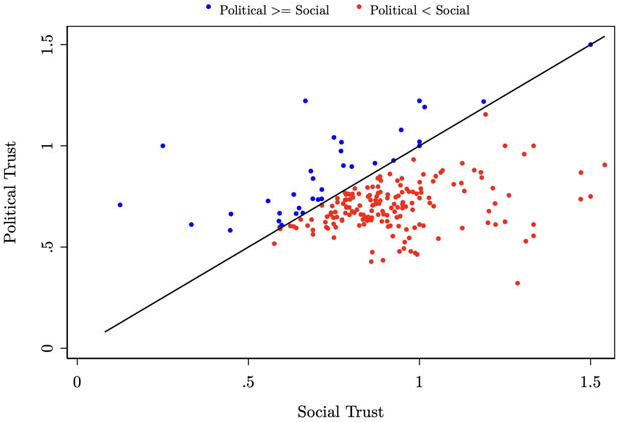
5 Conclusion
In the preceding sections, we have sought to address two fundamental questions in the study of constitutions: Why are some constitutions in democratic nations amended more frequently than others? Why do amendments occur in certain periods of a country’s history and not others? Previous studies have argued that varying rates of constitutional amendment can be explained by either the institutional rules associated with the amendment processes or a nation’s constitutional culture. While these institutional and cultural accounts provide useful insights to the study of constitutional amendment rates, when analyzed separately, they fail to provide a complete picture of both the demand for amendments and the ability of constitutional reformers to navigate often difficult amendment processes.
Institutional accounts fail to explain why amendment rates vary across time within a given polity, even as the rules for constitutional change have remained constant, or why countries with similar amendment rules nonetheless have different rates of constitutional amendment. On the other hand, cultural accounts have suffered from under-conceptualization of “constitutional culture” and fail to explain how demand for reform is channeled into actual constitutional amendments. So too, existing studies do not account for changes in constitutional culture within a given country, and thus are also unable to explain variation in amendment rates over time. Ultimately, a full account of constitutional amendment rates requires not only an analysis of institutional rules and cultural attitudes but also a comprehensive examination of the social capacity to navigate these rules across space and time.
In addition to constitutional rigidity and vague notions of constitutional culture, then, we need a clearer understanding of the public’s role in transforming demand for reform into actual constitutional change. As we have discussed throughout this Element, that role is a reservoir of trust and civic engagement that political entrepreneurs can tap into to help elites, citizens, and social movements overcome the transaction costs involved in constitutional reform, facilitating the amendment process. Without social capital to draw on, it can be quite difficult for these entrepreneurs to navigate the amendment process and reform efforts will either stall or be channeled into less costly avenues of constitutional revision, such as judicial interpretation or more limited changes to public policy.
In exploring the effects of social capital on constitutional amendment rates, our analyses of democratic constitutions across the globe, indicate that amendment frequency is a product of amendment rules, group membership, civic activism, and political trust. Unlike previous studies, we demonstrate how these factors affect constitutional reform over time and at different units of analysis. Ultimately, our findings demonstrate that amendments are adopted more frequently in democratic nations with higher levels of social capital or at times during a particular nation’s history when social capital is comparatively higher. Additionally, our analyses of the fight to ratify the federal ERA in the United States and the effort to repeal Ireland’s constitutional ban on abortion allowed us to examine how these variables affect support for both the substantive and procedural dimensions of specific amendments.
5.1 Implications for Constitutional Design
Given the findings presented in this Element, it is important to consider how constitutional designers and innovators can best design amendment processes, especially in a time of declining trust in democratic institutions. In most democratic states, constitutional amendments require the support of more than a legislative majority operating in a single session. Many require supermajorities, national referendums, consideration in multiple legislative sessions, approval in subnational units, the election of a constituent assembly, or some combination of these processes in order to ensure that changes to the nation’s foundational text have widespread support and are properly considered. Additionally, some constitutions feature a tiered amendment procedure, where significant changes require a more difficult process (Landau & Dixon, Reference Landau and Dixon2018). Citizen participation in these processes can be direct, as is the case when a referendum is held, while in others citizen influence is indirect, through the election of representatives and mobilization of civil society to ensure the preferences of constituents are reflected in legislative bodies. Elkins and Hudson (Reference Elkins, Hudson, Landau and Lerner2019) document the increasing use of referendums in amendment processes, finding that referendums are now the modal mechanism for constitutional ratification. Thus, it seems that states are increasingly preserving a direct role for the people in the amendment process.
When considering amendment processes, it is important to examine both the initiation of an amendment and its ratification. When political trust is especially high, it is possible that any amendment process, including one that only involves the country’s legislature, will be sufficient as citizens will likely defer to their elected leaders. However, as the ERA experiment demonstrated, this deference could allow political entrepreneurs to choose ratification pathways that are less legitimate. When political trust is low, entrepreneurs may be able to leverage higher levels of social trust to foster support for an amendment, as the Irish case study demonstrated.
When political and social trust are both low, and when civil society is not mobilized, it is unlikely that any amendment process is going to be successful. However, in times of high social trust and civic mobilization, the greater the opportunity for the people to participate in the process, the greater the likelihood of success. Indeed, holding a referendum to ratify a constitutional amendment may not be sufficient if citizens have not been engaged in the drafting process in some form, as they may have little understanding of the causes, content, and consequences of the constitutional change (Cozza, Reference Cozza2021). A lack of citizen deliberation, then, can have negative consequences for constitutional reform as citizens may be disengaged from the reform process and the system may be filled with misinformation or false hope and promises.
For example, while the question asked during the 2016 referendum on the United Kingdom’s membership in the European Union seemed clear, voters were not privy to the contours of a post-Brexit withdrawal agreement nor was it clear if the UK would pursue a “hard” or “soft” Brexit in the event of a Leave victory. Thus, the Remain and Leave campaigns relied on vague threats and promises, and it is not quite clear what voters had in mind when they selected “Leave” on their ballots (Cozza, Reference Cozza2021). This lack of clarity has contributed to the phenomenon of “Bregret” or having regret over the results of the 2016 referendum. In other cases, a lack of information can lead citizens to vote against a desired reform, as occurred during the Irish attempt to abolish the Seanad in 2013 (Cozza, Reference Cozza2021).
Thus, regardless of the specific process used to introduce or ratify a constitutional amendment, politicians should be engaged with their constituents, making space for civil society to help shape the constitutional reform throughout the process. Ensuring public consultation is especially important when political trust is low as the people may not readily support amendments emerging from elite-driven processes or may be susceptible to populist movements. Indeed, populist parties tend to attract citizens who are dissatisfied with the way democracy is working and who have diminished faith in the political system. These citizens also tend to seek out alternative, noninstitutionalized forms of participation (Anduiza et al., Reference Anduiza, Guinjoan and Ricao2019; Webb, Reference Webb2013) and demonstrate greater support for alternative decision-making processes (Bertsou & Pastorella, Reference Bertsou and Pastorella2016; Bowler, Donovan, & Karp, Reference Bowler, Donovan and Karp2007). By demonstrating a willingness to listen to the grievances of citizens, relinquishing some degree of decision-making power, establishing a system-wide dialogical process, and empowering alternative forms of citizen participation, political elites can work to both reform the constitutional order and potentially restore some faith in political institutions, as we saw in the Irish case. There are a variety of ways in which a state can ensure sufficient public consultation. Holding open hearings and debates, making space for citizen comment and civil society testimony, publishing reports and engaging in civic education campaigns, and ensuring that citizens and civil society have a sufficient degree of information to engage in a robust referendum campaign can help ensure an amendment in properly considered, adheres to the wishes of the population, and can harness available social capital in the system in order to facilitate reform.
Direct citizen participation need not be reserved for the ratification process, however. In light of the perceived success of Ireland’s Citizens’ Assembly, other states have begun experimenting with exercises in deliberative democracy in order to bring citizens into the initiation and drafting stages of constitutional and policy reform and, potentially, to restore some degree of political trust. Thus, it is important to conclude by considering how mini-publics can best be incorporated into amendment procedures in a way that can facilitate reform. If the goal of the polity is to reinvigorate democracy and overcome political distrust, citizens’ assemblies should be embedded into the larger political and social system.
Citizens assemblies operate best when they work alongside the existing political institutions in conjunction with civil society organizations, which can allow political elites to lean on the legitimacy these mini-publics derive from citizens’ faith in one another to help enhance their own credibility. In doing so, representative institutions can work to evaluate and confer political legitimacy on the recommendations of the assembly and political parties can incorporate those recommendations into their political campaigns ahead of any election or referendum that may follow. So too, civil society organizations could be incorporated directly into the process, providing testimony to the assembly, assisting in the dissemination of the body’s recommendations, and helping galvanize public support as the legislature and voters consider the recommendations. In this way, the entire political system – politicians, civil society organizations, and citizens – is working in concert to produce fundamental political and constitutional change.
Integrating a Citizens’ Assembly into the larger political system thus allows a country to use social capital – social trust and enhanced civic engagement – to facilitate significant constitutional change and, potentially, to bolster political trust (Boullianne, Reference Boullianne2018; Knobloch et al., Reference Knobloch, Barthel and Gastil2019). Indeed, in many countries facing the rise of new, illiberal parties, the issue is not a lack of civic engagement on the part of citizens, it is that this civic engagement is being channeled into avenues that are outside of – and often challenging the legitimacy of – the larger political system (Anduiza et al., Reference Anduiza, Guinjoan and Ricao2019). The goal of establishing a citizens’ assembly, then, is to redirect this engagement into a process that directly incorporates the voice of citizens into reform efforts, both at drafting and ratification stages, meaningfully engages civil society and bolsters faith in the system as a whole by ensuring that the various parts are working together to achieve the desired political and constitutional outcomes.
Indeed, recent studies have found that the publication of material from deliberative mini-publics can enhance the knowledge of citizens in the relevant policy area. Voters can not only learn information from citizens assemblies, they learn information that they can trust. To make informed decisions, voters often use informational shortcuts, relying on cues from political parties, the media, and civil society campaigns (Bowler & Donovan, Reference Bowler and Donovan2000; Lupia, Reference Lupia1994; Lupia & McCubbins, Reference Lupia and McCubbins1998). However, to be effective, these cues need to be credible, and credibility requires trust. During times of low political trust, these cues, particularly from political parties, may not carry as much weight with voters. To overcome this lack of credibility, states can turn to social trust – the degree to which people trust each other. Because citizens assemblies are made up of ordinary people, the legitimacy of their decisions depends on social trust. Thus, not only can a properly designed citizens’ assembly process provide voters with additional information, but it can also increase the credibility of informational cues ahead of a referendum campaign since the information is coming from regular citizens, rather than political elites.
Normatively, then, ensuring that the legislature has the power to evaluate and debate the recommendations provided by a citizens’ assembly – assuming that the recommendations are considered fairly – can enhance their reputation in the eyes of citizens by demonstrating that the political leadership of the polity takes their perspective seriously. Politicians can thus benefit from the increased levels of political trust and efficacy that result from such a process (Boullianne, Reference Boullianne2018; Knobloch et al., Reference Knobloch, Barthel and Gastil2019). Indeed, removing political leaders from decision-making entirely may further undermine trust in these institutions by making them seem unnecessary or even hostile to the interests of the people, supporting populist claims. Involving politicians in the process also increases political accountability. While members of a citizens’ assembly are not accountable to voters, elected members of the legislature are and can be judged by their actions in this process during the next election. Indeed, placing sole decision-making power or giving primacy to an unelected mini-public can raise valid legitimacy concerns (Lefont, Reference Lefont2015; Olsen & Trenz, Reference Olsen and Trenz2014; Parkinson, Reference Parkinson2006). Thus, if the goal of establishing these deliberative bodies is to bolster faith in the system and steer citizens away from illiberal populist parties, the role of representative institutions should be maintained.
Thus, the most beneficial role citizens assemblies can play in a democratic system is to serve as “brokers of knowledge,” distilling and synthesizing relevant information and measuring the opinions of an informed public (Curato & Böker, Reference Curato and Böker2016; Niemeyer, Reference Niemeyer, Groänlund, Bächtiger and Setaälaä2014). Bringing citizens into the drafting stage in this fashion can then better inform the public and political elites, inducing further reflection among voters and legislators. In this way, citizens’ assemblies are most successful at producing lasting outcomes and enhancing support for the political system when they work in tandem with political parties, legislatures, civil society organizations, and referendum processes, balancing the representative, direct, and deliberative democratic processes to inform citizens, understand their preferences and give them ownership over constitutional processes without alienating the core institutions of representative democracy. Channeling citizen demands for participation into the traditional political institutions can provide increased trust in and support for the political system by showing that the system is responsive to citizen preferences and values citizen input, narrowing the opportunity structure for populist challengers who seek to destabilize the system by appealing to public dissatisfaction with democratic processes.
The above analysis assumes social trust is higher than political trust in the polity, and that polarization is not exceedingly high, which may not always be the case. While studies have found that deliberation within a mini-public can depolarize opinion among participants (J. S. Fishkin et al., Reference Fishkin, Siu, Diamond and Bradburn2021; Himmelroos & Christensen, Reference Himmelroos and Christensen2014; Luskin et al., Reference Luskin, Fishkin and Jowell2002), thus far no study has analyzed whether the use of a citizens’ assembly can increase social trust or depolarize opinion among nonparticipants. Recent experimental analysis has also shown that citizens with higher levels of social trust are more likely than those with lower levels of social trust to support the use of participatory processes (Cozza, in Reference Cozzapress). Additionally, recent work by Garry et al. (Reference Garry, Pow, Coakley, Farrell, O’Leary and Tilley2022) finds significant public support for the use of citizens’ assemblies in deeply divided Northern Ireland, even when the outcome of the process goes against an individual’s preferences, though support is lower among those with stronger ideologies. This finding provides cautious optimism about the use of citizens’ assemblies in contexts of high polarization, but more work is needed in this area.
The arguments and analyses put forward in this Element make important contributions to the fields of political science and law and to our understanding of comparative political behavior, demonstrating the important connection between citizen attitudes and behaviors and institutional rules and processes. In doing so, we are the first to explore the relationship between social capital and constitutional change and hope to spark further inquiry into how social capital shapes constitutional processes beyond constitutional amendment. Additionally, we build upon prior research that finds social capital facilitates social movement organizing and elite coalition formation. Consequently, we contribute to ongoing debates regarding the umbrella term of social capital by specifying how specific attitudinal and behavioral components work and why they matter.
While our analyses have shed important light on the social foundations of constitutional change, this study has limitations and leaves other important questions unaddressed. Data constraints prevent testing that social capital indicators play a bigger role at which stage of the amendment process. While social norms, such as trust and participation, are factors that influence amendment culture, collecting direct, comparative measures of constitutional attitudes would be helpful. It remains to be seen if our theory generalizes to other contexts, including the erosion of democratic constitutions, constitutions in non-democracies, or international legal agreements (like Brexit). It is also unclear whether our theory applies when countries replace, rather than amend, their constitution.
Our analysis of the Irish case also indicates that in times of low political trust, constitutional reformers can tap into wells of social trust to facilitate the amendment process. The relationship between social and political trust in constitutional processes should be explored further in future studies. It is important to examine not only constitutional drafting and amending processes in contexts in which these two social capital indicators diverge but also ways in which a polity may seek to bridge this divide. Ireland sought to do so through the use of a deliberative mini-public. However, future studies should assess whether such a process can work in a highly polarized environment or in situations where social trust is low.
To Spencer, may you inherit a world more worthy of your trust. – W.D.B.
To my loving mother and first teacher, Patricia, for making all of this possible. – J.F.C.
Raymond Duch
University of Oxford
Raymond Duch is the co-founder and Director of the Centre for Experimental Social Sciences (CESS) at Nuffield College University of Oxford. He established and directed similar CESS centers in Chile, China, and India. He is also co-Director of the Candour Project that assembles a global team of research scholars with expertise in behavioral economics and data analytics addressing challenging health policy issues.
Anja Neundorf
University of Glasgow
Anja Neundorf is a Professor of Politics and Research Methods at the School of Social and Political Sciences at the University of Glasgow, UK. Before joining Glasgow, she held positions at the University of Nottingham (2013–2019) and Nuffield College, University of Oxford (2010–2012). She received her PhD from the University of Essex.
Randy Stevenson
Rice University
Randolph Stevenson is the Radoslav Tsanoff Professor of Public Affairs at Rice University in Houston, Texas. Professor Stevenson works and teaches in the areas of survey design, applied statistical methods, comparative mass political behavior, comparative political psychology, and experimental design.
About the Series
This Elements series is aimed at students and researchers interested in understanding how and why the political behaviour, perceptions, attitudes, emotional responses, interest, knowledge, and identities of citizens are conditioned on the political, social, and economic contexts in which they experience the political world.