




 Open access

Crossref Citations

This article has been cited by the following publications. This list is generated based on data provided by Crossref.
Ducoli, Serena
Dumont, Géraldine
Velimirovic, Milica
Mehn, Dora
Cocca, Mariacristina
Depero, Laura E.
and
Federici, Stefania
2025.
Quantitative evaluation of true-to-life nanoplastics using UV-visible spectroscopy and comparative analytical techniques.
Environmental Science: Nano,
Vol. 12,
Issue. 11,
p.
4935.
Reshadi, Mir Amir Mohammad
Rezanezhad, Fereidoun
Shahvaran, Ali Reza
Ghajari, Amirhossein
Kaykhosravi, Sarah
Slowinski, Stephanie
and
Van Cappellen, Philippe
2025.
Assessment of environmental and socioeconomic drivers of urban stormwater microplastics using machine learning.
Scientific Reports,
Vol. 15,
Issue. 1,
Baroni, Anna
Moulton, Chantalle
Cristina, Mario
Sansone, Luigi
Belli, Manuel
and
Tasciotti, Ennio
2025.
Nano- and Microplastics in the Brain: An Emerging Threat to Neural Health.
Nanomaterials,
Vol. 15,
Issue. 17,
p.
1361.
Schofield, John
Gorman, Alice
Antonello, Alessandro
Couceiro, Fay
Leterme, Sophie
MacGregor, Melanie
Snigirova, Anastasiia
and
Werner, Adrian D.
2025.
Archaeological and systemic context for the plastic age: Theorising the formation of contemporary and future archaeological records.
Cambridge Prisms: Plastics,
Vol. 3,
Issue. ,
Martins, Thaís Fabiane Gomes
Rani-Borges, Bárbara
Queiroz, Lucas Gonçalves
de Souza, Karen Ferreira
and
Pompêo, Marcelo
2025.
Toxicity of polyethylene microplastics combined with medroxyprogesterone on photosynthetic pigments of Lemna minor.
Aquatic Ecology,
Vol. 59,
Issue. 1,
p.
307.
Rani-Borges, Bárbara
de Jesus Rangel, Clara
and
Ando, Rômulo Augusto
2025.
Simultaneous detection of nanoplastics and adsorbed pesticides by surface-enhanced Raman spectroscopy.
NanoImpact,
Vol. 39,
Issue. ,
p.
100584.
Yang, Tong
Liu, Jinxia
Nicell, Jim
Praetorius, Antonia
Fang, Mingliang
and
Wang, Zhanyun
2026.
Diverse origins and chemical complexity of nanoplastics.
Nature Nanotechnology,
Vol. 21,
Issue. 5,
p.
628.
Manyamba, Chifundo Brian
Medison, Rudoviko Galileya
Phiri, Francina
and
Medison, Milca Banda
2026.
A synthesis of developments, challenges and prospective innovations in plastic waste management in agriculture and aquaculture systems.
Discover Environment,
Vol. 4,
Issue. 1,
Jeyachandran, Sivakamavalli
Vibhute, Prachi
Dahms, Hans‐Uwe
Mudigonda, Sunaina
Manavalan, Arulmani
and
Heese, Klaus
2026.
Microplastic Pollution in Aquaculture: Challenges and Mitigation.
Water and Environment Journal,
Vol. 40,
Issue. 1,
p.
3.
Hatvate, Navnath Tulshiram
Akolkar, Hemantkumar N.
and
Haghi, A. K.
2026.
Microplastics in Wastewater.
p.
1.
Zhu, Qi-bin
Feng, Yi-fan
Xing, Yi-fu
Zhang, Yu
Yang, Jiang-hua
Han, Cui
Liu, Xiao-jie
and
Yang, Jia-xin
2026.
17β-estradiol reshapes the reproductive dose–response to polystyrene nanoplastics in the rotifer Brachionus calyciflorus.
Aquatic Toxicology,
Vol. 297,
Issue. ,
p.
107869.
Kalinski, Jarmo-Charles J.
Pakkir Mohamed Shah, Abzer K.
Ruiz Brandão da Costa, Bruno
Farrell, Shane P.
Schellenberg, Lisa
Graves, Lana G.
Schramm, Tilman
Stincone, Paolo
Koester, Irina
Stephens, Brandon M.
Torres, Ralph R.
Cancelada, Lucia
Utermann-Thüsing, Caroline
Quinlan, Zachary A.
Wegley Kelly, Linda
Carlson, Craig A.
Castillo-Ilabaca, Cristóbal
Pantoja-Gutiérrez, Silvio
Beman, J. Michael
Hartmann, Aaron
Aron, Allegra
Siwe Noundou, Xavier
Dorrington, Rosemary A.
Tasdemir, Deniz
Haas, Andreas F.
Dorrestein, Pieter C.
Nelson, Craig E.
Aluwihare, Lihini I.
Wang, Mingxun
and
Petras, Daniel
2026.
Widespread presence of anthropogenic compounds in marine dissolved organic matter.
Nature Geoscience,
Vol. 19,
Issue. 4,
p.
478.
Ma, Cuizhu
Cai, Huiwen
Su, Lei
Chen, Qiqing
and
Shi, Huahong
2026.
Advancements in environmental nanoplastics research.
Chinese Science Bulletin,
Vol. 71,
Issue. 2,
p.
479.
Fernandes, Cristiana
Oliveira, Helena
Rocha-Santos, Teresa
and
Bastos, Verónica
2026.
Bioplastics Toxicity upon Ingestion: A Critical Review of Biotransformation and Gastrointestinal Effects.
Polymers,
Vol. 18,
Issue. 9,
p.
1091.
Carganico, Andrea
Levrini, Luca
Zecca, Piero Antonio
Mosca, Arianna
Deppieri, Alessandro
Saran, Stefano
Giannotta, Nicola
and
Borgese, Marina
2026.
Biocompatibility of Orthodontic Aligner Materials in the Digital Workflow: A Quantitative In Vitro Comparison of Thermoformed, Directly Printed, and Polyamide-12 Systems.
Journal of Dentistry,
p.
106812.
Moulton, Chantalle
Baroni, Anna
and
Tasciotti, Ennio
2026.
Micro- and Nanoplastics Exposure Across the Lifespan: One Health Implications for Aging and Longevity.
Journal of Xenobiotics,
Vol. 16,
Issue. 2,
p.
52.
Impact statement
This perspective article underscores the importance of precise size-range delineation for plastic particles, encompassing both nanoplastics and microplastics. It undertakes a comprehensive examination of the lower and upper size thresholds of nanoplastics and microplastics, considering both conceptual terminology and polymer structural aspects.
Transformation of microplastics and nanoplastics
The growing concern about plastic pollution has been the subject of debate worldwide. Microplastics have been extensively studied and recognized as a complex environmental problem. However, a new concern has recently emerged: nanoplastics. Although microplastics are mostly formed through mechanical fragmentation or degradation of larger plastics (secondary microplastics) (Kye et al., Reference Kye, Kim, Ju, Lee, Lim and Yoon2023), it is expected that the same process occurs with nanoplastics, which would be formed through continuous fragmentation of microplastics in the environment.
Weathering refers to the physical and chemical changes that plastics undergo due to factors such as sunlight (UV radiation), temperature variations, mechanical abrasion and chemical interactions with environmental substances (Wagner and Lambert, Reference Wagner and Lambert2018). These processes can cause degradation of the plastic particles, leading to changes in their structures and consequently to their properties (Pinlova and Nowack, Reference Pinlova and Nowack2024). As the exposure to adverse conditions persists, the prolonged stress on plastic polymers leads to the cleavage of intermolecular and intramolecular interactions (Kye et al., Reference Kye, Kim, Ju, Lee, Lim and Yoon2023), predominantly through mechanical fragmentation, photodegradation, thermal degradation and biodegradation (Julienne et al., Reference Julienne, Delorme and Lagarde2019; Tu et al., Reference Tu, Chen, Zhou, Liu, Wei, Waniek and Luo2020). Consequently, the progressive breakdown of polymer chains results in a reduction of particle size. Given the ongoing nature of this process, it is expected that plastics, microplastics and nanoplastics, will undergo continuous fragmentation and reduction in its size over time. This process can eventually result in the liberation of oligomers and monomers (Ganesh Kumar et al., Reference Ganesh Kumar, Anjana, Hinduja, Sujitha and Dharani2020; Biale et al., Reference Biale, La Nasa, Mattonai, Corti, Vinciguerra, Castelvetro and Modugno2021), which are considered new pollutants that have been poorly addressed (Hu et al., Reference Hu, Zhou, Chen, Zhang and Pan2023; Shi et al., Reference Shi, Wang, Wang, Qu, Jiang, Pan and Fang2023). This process is even more complex and is affected by multiple factors. According to Shi et al. (Reference Shi, Wang, Wang, Qu, Jiang, Pan and Fang2023), the kinetics of this process depends on the polymer type, molecular weight, degree of polymerization, morphology and surface density; however, research on these mechanisms remains limited.
Smaller particles possess unique properties that may influence their toxicity, bioavailability and potential to enter living organisms (Fang et al., Reference Fang, Luo and Naidu2023). The challenges related to the investigation of the impacts of nanoplastics go beyond the scope of this discussion article. The purpose of the present article is to focus on the conceptual and structural aspects of these pollutants as understanding the size limits of microplastics and nanoplastics is crucial for assessing their ecological and health implications. Defining an accurate size limit ensures comprehensive coverage of microplastic sizes, enables consistent measurement, reporting and comparability across studies, enhancing our understanding of their behavior and impacts to develop effective management strategies. Therefore, it is imperative to take certain conceptual considerations into account, particularly when it comes to the intricate physicochemical properties of polymers, before determining the minimum size at which a plastic particle can present. Establishing a clear limit for these particles remains a challenge, and this discussion aims to shed light on the final debate regarding plastic particle size. Ongoing technological advancements and interdisciplinary collaborations are key to resolving this debate and advancing our knowledge of such a ubiquitous pollutant.
Plastic particle size
Just as there remains a lack of consensus concerning methodologies for the sample collection, extraction and analysis of microplastics and nanoplastics, the classification of these particles in relation to their size also remains a subject of debate. In the scientific literature, numerous studies and environmental agencies’ guidelines propose different criteria for defining the size of microplastics. These definitions encompass a range of size thresholds, including particles up to 5 mm (Baker and Bamford, Reference Baker and Bamford2009; EFSA, 2016; GESAMP, Reference Kershaw2016, 2015), 2 mm (Ryan et al., Reference Ryan, Moore, Van Franeker and Moloney2009), 1 mm (GESAMP, 2015) or up to 500 μm (Gregory and Andrady, Reference Gregory, Andrady and Andrady2003). Besides that, the lower limits for microplastics also exhibit variability, with some studies suggesting no specific lower limit (Costa et al., Reference Costa, Ivar Do Sul, Silva-Cavalcanti, Araújo, Spengler and Tourinho2010; Koelmans et al., Reference Koelmans, Besseling, Shim, Bergmann, Gutow and Klages2015; Moore, Reference Moore2008; Ryan et al., Reference Ryan, Moore, Van Franeker and Moloney2009), while others propose a lower limit of 0.1 μm (EFSA, 2016), 1 μm (Andrady, Reference Andrady2015; Browne et al., Reference Browne, Galloway and Thompson2007; Desforges et al., Reference Desforges, Galbraith, Dangerfield and Ross2014; GESAMP, 2015; Ter Halle and Ghiglione, Reference Ter Halle and Ghiglione2021), 20 μm (Wagner et al., Reference Wagner, Scherer, Alvarez-Muñoz, Brennholt, Bourrain, Buchinger, Fries, Grosbois, Klasmeier, Marti, Rodriguez-Mozaz, Urbatzka, Vethaak, Winther-Nielsen and Reifferscheid2014) or 63 μm (Gregory and Andrady, Reference Gregory, Andrady and Andrady2003). Among all these terminologies, the most widely adopted is in between 1 and 5,000 μm.
Similar to microplastics, nanoplastics have been the subject of different classifications, as documented in the literature. However, it is worth noting that the extent of research and understanding surrounding nanoplastics is not as extensive as that of microplastics, primarily due to its emergence as a field of study in the last years. In general, the prevailing assumption among researchers is that nanoplastics can reach sizes as big as 1 μm with no lower limits (Fang et al., Reference Fang, Luo and Naidu2023) or range from 1 to 1,000 nm (Gigault et al., Reference Gigault, Halle, Baudrimont, Pascal, Gauffre, Phi, El Hadri, Grassl and Reynaud2018). Ter Halle and Ghiglione (Reference Ter Halle and Ghiglione2021) propose revising the lower limit for microplastics to 1 μm, aiming to avoid any overlap with the upper limit of nanoplastics which is also set at 1 μm. However, other classifications can be found because the size of nanoplastics is generally defined according to the size of the microplastics adopted in the studies.
Establishing a consistent size threshold to microplastics and nanoplastics
We propose the standardization of the maximum size of a microplastic up to 1 mm based on the fact that they mostly interact with high impact throughout the ecosystems when they are smaller than 1 mm. This can be evidenced by several study areas, like biology, medicine, pharmacy and biochemistry, where materials with different polymeric compositions are classified as microparticles if they are up to 1 mm in size (Ju and Chu, Reference Ju and Chu2019; Lengyel et al., Reference Lengyel, Kállai-Szabó, Antal, Laki and Antal2019; Oyewumi et al., Reference Oyewumi, Kumar and Cui2010; Stack et al., Reference Stack, Parikh, Wang, Wang, Xu, Zou, Cheng and Wang2019; Wang et al., Reference Wang, Zhang and Chu2014). Furthermore, studies suggest that plastic particles ranging from 100 to 300 μm are commonly found in the environment, while those exceeding 1 mm in size are less prevalent and not harmful to organisms (Klein et al., Reference Klein, Worch and Knepper2015; Laermanns et al., Reference Laermanns, Lehmann, Klee, Löder, Gekle and Bogner2021; Queiroz et al., Reference Queiroz, Pompêo, De Moraes, Ando and Rani-Borges2024; Rani-Borges et al., Reference Rani-Borges, Gomes, Maricato, Lins, Moraes, Lima, Côrtes, Tavares, Pereira, Ando and Queiroz2023). Accordingly, the environmental significance of larger particles (> 1 mm) is believed to have minimal environmental impact, a conclusion supported by extensive laboratory studies involving diverse aquatic and terrestrial organisms (Jacob et al., Reference Jacob, Besson, Swarzenski, Lecchini and Metian2020; Qiao et al., Reference Qiao, Mortimer, Richter, Rani-Borges, Yu, Heinlaan, Lin and Ivask2022). Regarding regulation, revising the threshold to 1 mm ensures that microplastics are genuinely micro in nature, enhancing clarity in terms of terminology, identification and classification by both scientific community and policymakers.
On the other hand, nanoplastics, as their name suggests, refer to plastic particles at the nanoscale. In 2018, Gigault et al. proposed an important definition for nanoplastics based on the colloidal behavior of particles with a size range of 1–1,000 nm, emphasizing the main differences and similarities between nanoplastics and manufactured nanomaterials to set the limits. As a material is reduced to dimensions on the nanoscale, typically between 1 and 100 nm, its properties can undergo significant changes (Roduner, Reference Roduner2006). These changes are a result of quantum and surface effects, which become more prominent when dealing with nanoscale structures. Multiple properties of a material can be affected when its size is reduced to the nanoscale (Hanachi et al., Reference Hanachi, Khoshnamvand, Walker and Hamidian2022). Some of the main observed changes include the optical, mechanical, electrical, thermal resistance, flexibility, chemical resistance, transparency and thermal and acoustic insulation properties, among others (Bond et al., Reference Bond, Ferrandiz-Mas, Felipe-Sotelo and Van Sebille2018; Li et al., Reference Li, Li, Ding, Song, Yang, Zhang and Guan2022; Shi et al., Reference Shi, Shi, Huang, Ye, Yang, Wang, Sun, Li, Shi, Xiao and Gao2024; Wang et al., Reference Wang, Gu, Dong, Chen, Jin, Gao, Ok and Gu2023; Yu et al., Reference Yu, Wu, Wang, Li, Chu, Pei and Ma2022). As an example, in the case of plastics, one of the most significant properties for determining their industrial applications is their mechanical properties (Jasso-Gastinel and Kenny, Reference Jasso-Gastinel and Kenny2017). In this regard, materials that are strong and rigid at the macroscale can become more flexible and deformable as its size is reduced (Guo and Wang, Reference Guo and Wang2019; Lutz and Grossman, Reference Lutz and Grossman2001). Size reduction introduces higher instability in the crystalline structures, making the materials more prone to deformations and fractures under lower levels of stress. Furthermore, the high surface-to-volume ratio of nanoplastics (Tallec et al., Reference Tallec, Blard, González-Fernández, Brotons, Berchel, Soudant, Huvet and Paul-Pont2019; Ter Halle and Ghiglione, Reference Ter Halle and Ghiglione2021) can result in notable alterations in mechanical properties, including hardness and strength. Thus, once a certain size is reached, it can be asserted that while the chemical structure retains the same composition, the properties that previously defined a particular type of plastic may have been compromised or lost entirely.
Regarding the limit sizes proposed by Gigault et al. (Reference Gigault, Halle, Baudrimont, Pascal, Gauffre, Phi, El Hadri, Grassl and Reynaud2018), we agree with all the reasoning presented, but we are proposing that in this discussion, the reviewing of the size limits for nanoplastics should be from 10 to 100 nm. First, considering the upper limit, the main point is that the nanomaterials are described as particles that possess at least one, and often two dimensions, and measuring less than 100 nm in size (Zhang et al., Reference Zhang, Ahmed, Wang and He2019). Hence, we propose that the upper threshold for nanoplastics should be set at 100 nm, which consequently establishes the lower threshold for microplastics at the same value. In relation to the lower limit size for nanoplastics, we believe that it is important to make a conceptual distinction between monomers, oligomers and plastics. It is well known that monomers are the basic units constituting polymers, whereas oligomers are short chains of monomers. For materials to be classified as plastics, they must have a well-defined polymeric architecture consisting of a long chain of repeated monomers (Young and Lovell, Reference Young and Lovell2011) (Figure 1). In addition, according to International Union of Pure and Applied Chemistry, “a polymer is a substance composed of molecules characterized by the multiple repetition of one or more species of atoms or groups of atoms (constitutional repeating units) linked to each other in amounts sufficient to provide a set of properties that do not vary markedly with the addition of one or a few of the constitutional repeating units” (IUPAC, 1974). Therefore, monomers and oligomers are essentially structures that do not meet the criteria to be considered plastics, as they do not exhibit a characteristic long polymeric chain and structurally lack the inherent properties of the material.
Configuration of polymer building units.
The proposed discussion focuses on the fragmentation product of nanoplastics. The main question is, at what point can these nanoparticles can still be considered as plastics? This is a complex question, as highlighted by Gigault et al. (Reference Gigault, Halle, Baudrimont, Pascal, Gauffre, Phi, El Hadri, Grassl and Reynaud2018), due to the fragmentation processes and their association with other species. Our point here, is that 1 nm definitely cannot be considered as the lower limit of a nanoplastic, and a bigger value must be set as the minimum threshold, because the size of a monomer is in the range of 1 nm, for example, considering PET (Venkatachalam et al., Reference Venkatachalam, Nayak, Labde, Gharal, Rao, Kelkar and Saleh2012), and therefore it cannot be considered as a “nanoplastic”. Due to the vast range of types of polymers, besides the number of monomers, it is commonly established for classification as a polymer a minimum range of repeated monomers combined with a threshold of 1,000 g/mol−1 or more (Hiemenz and Lodge, Reference Hiemenz and Lodge2007; Lechner et al., Reference Lechner, Gehrke and Nordmeier2014). The number of monomers criterion is based on the understanding that, with an adequate number of repeated monomers, the material begins to exhibit macroscopic properties characteristic of plastics, such as the formation of polymer chains and viscoelastic behavior. Therefore, considering various types of plastics extensively manufactured by the petrochemical industry (Table 1), taking as an example PET, which is the heaviest monomer of the series presented, to fulfill those requirements, it would give an oligomer of 5.45 nm.
Molecular structure and weight of most produced polymers in the world
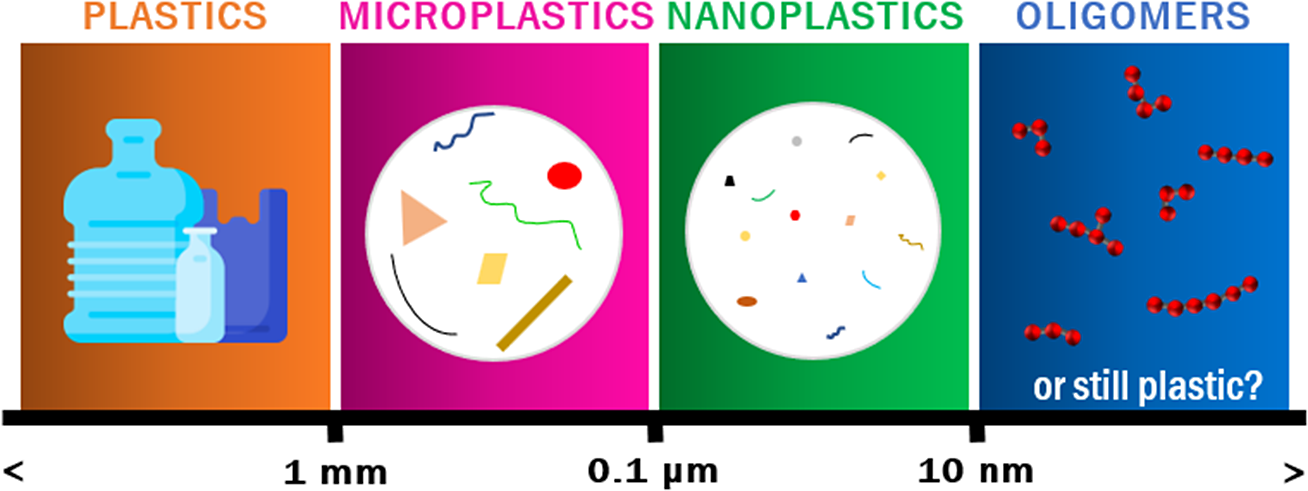
Hence, it can be concluded that the minimum size for a material to be classified as nanoplastics varies depending on its specific chemical composition. Therefore, taking PET as the lowest minimum reference, and considering the vast range of different chemical compositions of polymers, we suggest that any material smaller than 10 nm should no longer be considered as nanoplastics (Figure 2). In a field of study characterized by a significant lack of standardization, we recognize the importance of advocating for the establishment of guidelines that facilitate and enhance research pursuits. Standardization of research methodologies is a fundamental key to overcoming the complexities of characterizing nanoplastics. Establishing consistent protocols ensures reliability and comparability across studies, facilitating a more cohesive understanding of nanoplastics’ impacts and behavior. Misclassification of materials below 10 nm as nanoplastics could lead to challenges in monitoring, assessment and mitigation strategies, necessitating clear guidelines to address these potential issues.
Categorization of plastic debris according to size as applied in scientific literature and in the present study. As there is no international standard accepted worldwide, alternative categorizations are employed within the scientific literature.
In the study conducted by Ter Halle and Ghiglione (Reference Ter Halle and Ghiglione2021), the authors raised a pertinent concern regarding the term “micro(nano)plastics” and its potential drawbacks in understanding the impacts of these particles. Their research highlights the crucial role of particle size in determining the toxicity of micro- and nanoplastics. Thus, because of the variable toxicity influenced by particle size, it is essential to establish comprehensive size classification criteria based on the various facets and properties of plastics. This ensures a more accurate and effective assessment of the environmental and health implications associated with different sizes of plastic particles.
The implications of plastic’s outcome reveal that the analytical and ecological challenges associated with studying microplastics and nanoplastics will intensify as these particles diminish in size. Given the estimated quantity of plastic existing in the environment and the inescapable process of material fragmentation, it is crucial for research to encompass the examination of degradation byproducts stemming from this material. In essence, the fragmentation of nanoplastics not only perpetuates the environmental burden of plastic pollution but also presents a new dimension of contamination at the molecular level.
Conclusion
Since the presence and impacts of microplastics in the environment began to be studied, establishing standardized protocols for studying this diverse and complex pollutant has been a significant challenge. The absence of universally accepted standards has resulted in noncomparable studies and communication difficulties within the scientific community. Size classification emerges as a crucial factor concerning plastic particles. Currently, there is still no widely agreed-upon classification, despite most studies adopting similar categorizations. These classifications lack consistency with respect to the conceptual and structural definitions of the material. In this discussion, we present arguments supporting the implementation of size limits for plastic particles, encompassing both nano, as particles in the size range of 10–100 nm, and microplastics in the size range of 100–1,000 nm. By precisely defining these limits, especially the lower thresholds for nanoplastics and the upper limits for microplastics, researchers can more effectively assess the risks associated with these plastic particles and develop appropriate mitigation strategies. This holistic approach allows for a deeper exploration of the intricate pathways through which microplastics and nanoplastics interact with ecosystems, including their potential to be transformed into single molecules.
Open peer review
To view the open peer review materials for this article, please visit http://doi.org/10.1017/plc.2024.25.
Data availability
No data were used for the research described in the article.
Acknowledgments
The authors would like to thank the Sao Paulo State Research Support Foundation (FAPESP) (Process 2022/15586-0 and 2022/11983-4).
CRediT authorship contribution statement
Bárbara Rani-Borges: Conceptualization, writing – original draft, writing – review and editing. Rômulo Augusto Ando: Conceptualization, writing – original draft, writing – review and editing.
Declaration of Competing interest
The authors declare that they have no known competing financial interests or personal relationships that could have appeared to influence the work reported in this article.