


Introduction
Iran benefits from a unique zoogeographical position with elements of Palaearctic, Oriental and Afrotropical regions and it accounts for more than 520 bird species, including three species of bustards (Firouz Reference Firouz2000). However, despite an increase in ornithological activities in Iran in recent years, and unlike the Great Bustard Otis tarda and Macqueen’s Bustard Chlamydotis macqueenii, the Little Bustard Tetrax tetrax has not received specific attention (Kahrom Reference Kahrom, Coles and Collar1979, Cornwallis Reference Cornwallis, Goriup and Vardhan1983, Razdan and Mansoori Reference Razdan and Mansoori1989, Amini-Tareh Reference Amini-Tareh2000, Lane et al. Reference Lane, Alonso and Martín2001, Le Neve and Paillat Reference Le Neve and Paillat2002, Mansoori Reference Mansoori2006, Barati and Amerifar Reference Barati and Amerifar2008, Abdulkarimi et al. Reference Abdulkarimi, Daneshyar and Barati2010).
Globally listed as ‘Near Threatened’ (NT) whilst remaining widespread and numerous in some parts of its range, the Little Bustard, has two widely separated breeding populations. Both western (Spain, Portugal, France and Italy) and eastern (ranging from China to Ukraine and Iran) populations have declined dramatically since the 19th century (Tucker and Heath Reference Tucker and Heath1994) and remain threatened by land reclamation and agricultural intensification over most of their range (Wolff et al. Reference Wolff, Paul, Martin and Bretagnolle2001, Garcia et al. Reference García, Suárez-Seoane, Miguélez, Osborne and Zumalacárregui2007, BirdLife International 2009).
Little Bustard population status in Iran is unclear. The species is mainly a wintering migrant to the north of the country but a low density of breeders was reported in the early 1990s in the lowlands of the south-east corner of the Caspian Sea (Evans Reference Evans1994, Scott Reference Scott1995). Breeding could not be confirmed in recent years. The present study was aimed at finding the main areas hosting wintering Little Bustards in the north of Iran, describing preferred habitats, and estimating population size.
Material and methods
Surveys were designed to allow estimation of the total wintering population in northern Iran and assess trends using previous records and reports from other authors (Evans Reference Evans1994, Scott Reference Scott1995, Mansoori Reference Mansoori2008). Field work was conducted in the plains of Ardebil, Gilan, Mazandaran, Golestan and Khorasan-e Razavi provinces in autumn and winter over four successive years from 2005/2006 to 2008/2009. In each province, all possible Little Bustard habitats were patrolled by vehicle at least once per season. Bird census was carried out by direct observations using binoculars and spotting scopes. Upon contact, the number of birds (later categorised in group sizes of 1–5, 6–50, 51–500, 501–5,000 and above 5,000 individuals), location, habitat type and vegetation cover were recorded.
Results
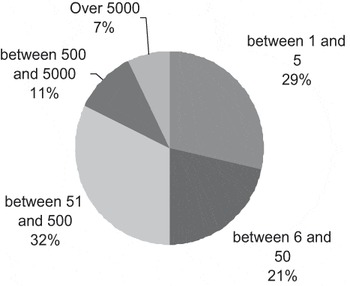
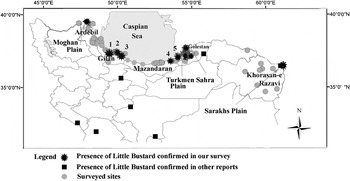
Little Bustard presence was confirmed in 15 (17.8%) of the 84 sites surveyed across Iran (Table 1). Appendix SI in the online Supplementary Material lists all the areas visited during our surveys where no Little Bustards were observed. Flock sizes comprising 51–500 individuals were the most common (Figure 1) with 32% of the records followed by flocks of 1–5 individuals (29%). Large flocks were observed primarily in Moghan Plain, Miankaleh, Gomishan, Shour Lake, Soufikam and Sarakhs Plain (Figure 2).
Frequency of number of records for different flock sizes during 2005–2009.
Map of Iran showing Little Bustard records and localities surveyed in this survey, and previous records in other parts of Iran. Key: 1 = Anzali, 2 = Boujagh, 3 = Langarud, 4 = Miankaleh, 5 = Gomishan. Turkmen Sahra plain includes many sites of the present study such as Soufikam, Anbar-Olum, Incheh, Alagol and Shour lake.
Number of Little Bustards counted and characteristics of habitats where the species was present during the surveys.

a :data source: 1 Medhdizadeh, 2 Abdi, 3 Ashoori, 4, Rabiei, 5 Shakiba, 6 Hoseini, 7 Ghaemi, 8 The Netherland Bird Watchers, 9 Khani, 10 Musavi, 11Alipour
On the western side of the Caspian Sea, the Moghan Plain in Ardebil Province is of particular significance to the Little Bustards wintering in Iran. Little Bustard counts have always been relatively high in this area, although important annual variations were observed. In good years, 8,000–10,000 Little Bustards may overwinter on the Moghan Plain whereas counts may be significantly lower in other years, sometimes below 1,000. The trend seems however to be rising on the Moghan Plain with an irregular but a steady growth of wintering populations since 2005 (Table 1).
On the opposite side of the Caspian Sea, Golestan Province, particularly Anbar-Olum and Shour lake areas and Miankaleh and Gorgan Bay in Mazandaran Province, also host wintering Little Bustards in numbers but population size is smaller than in Ardebil. Very large inter-annual variations are also observed in these two provinces.
Further east, close to the Afghanistan border, the area north of Sarakhs in Khorasan-e Razavi Province, is home to regular wintering Little Bustards. Numbers were relatively steady between winter 2003/2004 and winter 2008/2009 but the last survey in winter 2009/2010 recorded a sharp increase with a population over 3,500 birds (Table 1).
Our survey indicates that the Little Bustard has three main wintering regions in Iran including the plains in the north-west of Iran (Moghan Plain and the Gilan Province lowlands), the plains in the south-east corner of the Caspian Sea (Miankaleh in Mazandaran Province and Turkmen Sahra Plain in Golestan Province) and another small area in the Sarakhs area (Khorasan-e Razavi Province), disjunct from the two previous regions. In the latter, Little Bustards were observed only at two locations (Appendix SI).
Discussion
Our surveys have revealed the regular presence of wintering Little Bustards in Iran. Densities were higher in the plains in the north-west of the country but Little Bustards were also regularly observed south and east of the Caspian Sea and in Khorasan-e Razavi. Interestingly, populations have been increasing in Ardebil Province during the last years of the survey period. Similarly, the latest count in Khorasan-e Razavi yielded a record count compared with previous years.
Although all the areas surveyed in the present study were located in northern Iran, old records indicate that Little Bustard used to be present in central and south-west Iran (Figure 2): around Tehran (Blanford Reference Blanford1876), Shush (Khuzestan) (Ludlow Reference Ludlow1917), Abadeh (Fars) (Érard and Etchécopar Reference Érard and Etchécopar1970), Mooteh (Esfahan) (Evans Reference Evans1994), Gharpuz-Abad (Alborz) (M. Tohidifar pers. comm.), Dez (Khuzestan) (D. Scott pers. comm.) and Mousian (Ilam) (Sharifi, Shomali and Abdi pers. obs.). All these records, some of them recent, suggest that further investigations and regular surveys are required to identify other wintering grounds in Iran, particularly in the west, south-west and central parts of the country.
Most of our records were gathered between November and February, as this period corresponds to the core of the wintering season (Evans Reference Evans1994). However in the early 1970s, the main arrival reportedly occurred in late October and most birds departed the Turkmen Sahra steppes (see Figure 2) and Miankaleh Peninsula towards the end of March (D. Scott pers. comm.). Today, the Little Bustard wintering period seems to be shorter on the Moghan Plain where flocks usually arrive in mid-December and depart in mid-February. This could be related to global warming but we are lacking data to investigate this hypothesis further.
This species was considered to be a probable breeder in Miankaleh Wildlife Refuge and Golestan National Park in the 1970s (Diesselhorst Reference Diesselhorst1962, Evans Reference Evans1994, D. Scott pers. comm.). Although we could not confirm breeding during our survey, the fact that Little Bustards still breed in eastern Turkey (20–100 pairs; BirdLife International 2009) suggests that Iran may also host some breeding pairs, but more fieldwork is needed to confirm this.
Most of the habitats in the present study were within or beside wetland ecosystems, in particular Anzali Wetland, Boujagh, Miankaleh, Gomishan, Incheh and Shour Lake. It seems that proximity to a water source is an important factor in explaining the distribution of this species in northern Iran. The absence of Little Bustards in the north-eastern part of Golestan Province where the area is drier and no surface water is available supports this idea. Conversely, the small numbers of Little Bustards counted in Gilan and Mazandaran provinces that are largely under intensive rice cultivation confirm that this species avoids areas where annual precipitation (700–2,000 mm) and soil moisture are high. In January these areas, in contrast to Moghan, Golestan and Sarakhs regions, received more than 50 mm precipitation (Iran Meteorological Organization 2010), a level that may be incompatible with Little Bustard wintering requirements.
Little Bustard populations underwent a marked decrease in Miankaleh in the late 1970s and early 1980s; while flocks of 2,000–3,000 individuals were reported in Tir-Tash plain, south of the Gorgan Bay (Mazandaran) in the 1950s (Misonne Reference Misonne1953), and counts were high until the early 1970s, only small flocks were reported in the 1980s and none were seen in the early 1990s (Scott Reference Scott1995). Our survey indicates that the species returns, although irregularly, to Miankaleh. However, from the 430 non-breeding Little Bustards reported in February 1972 in Bibi-Shirvan and Lake Eymar (Golestan) Evans (Reference Evans1994), only 50 individuals were counted in the present study, indicating that the recovery, if confirmed, is geographically not homogeneous.
While the western population of Little Bustard is declining, (it has now disappeared from mainland Italy and is declining in France and Spain but appears to be stable in Portugal), its eastern populations have seemingly recovered in recent years (BirdLife International 2009). Our surveys tend to validate this observation and we estimate the current wintering population in Iran to comprise between 5,000 and 10,000 individuals. However, very important annual variations in bird counts strongly suggest that climatic conditions further north in Azerbaijan, where the number of wintering Little Bustards is in excess of 150,000, and in Kyrgyzstan and Kazakhstan where they number c.20,000 (BirdLife International 2009) may determine the number of Little Bustards wintering in north-west Iran. The severe winters observed in the later years of our study period could well explain the recorded increase in the wintering Little Bustard population.
However, other factors may also partly explain our observations. The ban on migratory bird hunting that was put in place by the Iranian authorities from 2006 to 2009, to address the problem of a potential outbreak of Avian Influenza (H5N1), has probably been extremely beneficial to Little Bustards. In fact, this species is considered halal, meaning that eating its meat is permitted in Islam and numerous individuals used to be hunted for food. Evidence of regular and massive hunting was obtained around Pol-Rud River, Roudsar and adjacent rice fields (Mr Bafarasat pers. obs.) and in Turkmen Sahra Plain (A. Khaleghizadeh pers. obs.). Live trapping is also regularly carried out and Little Bustards may sometimes be offered for sale in local markets such as that of Langarud (A. Ashoori pers. obs.). Although the Little Bustard is protected by the Environmental Laws of Iran, hunting seems to be widespread throughout its wintering grounds in northern Iran.
In Iran, as in other countries, the Little Bustard inhabits dry grassland and occurs in areas of low-intensity arable cultivation and pastoral land, selecting areas with a high diversity, preferring mosaics of pastures, legumes, vineyards and fallow land (Tellería et al. Reference Tellería, Santos, Alvarez, Saez Royuela and Bernis1988, Martínez Reference Martínez1994, Tucker et al. Reference Tucker and Heath1994, Lane et al. Reference Lane, Alonso and Martín2001). On the farmlands of Moghan Plain and Golestan Province, oilseed rape fields are attractive habitats where this species can find important food resources during winter. Countrywide, the current area under oilseed rape cultivation is increasing and has reached about 200,000 ha, of which Moghan Plain contains c.40,000 ha. This seems to have been highly beneficial for the species, although in adjacent parts of Azerbaijan, wintering birds prefer semi-desert and steppe areas under winter pasture rather than areas of intensive agriculture (BirdLife International 2009). As suggested by BirdLife International (2009), preserving habitat and working with landowners to manage land favourably on the one hand, and reducing hunting and the use of pesticides in national policies on the other, could maintain a stable population of Little Bustards in northern Iran. In addition, ensuring fields with permanent cover on arable land through agri-environment schemes using rotations and fallow land and reducing the use of pesticides is recommended.
We further recommend conducting coordinated surveys to obtain and update estimates of Little Bustard populations in Iran. National data should be shared with neighbouring countries to understand more clearly the status of the Iranian wintering population and its importance with regard to the Caucasus region and Central Asian countries. We encourage the preparation of an Asian action plan for the Little Bustard.
Supplementary Material
The online supplementary material for this article can be found atjournals.cambridge.org/bci
Acknowledgements
We are very grateful for financial support from the Provincial Offices of the Department of the Environment in Ardebil, Gilan, Mazandaran, Golestan and Khorasan-e Razavi. We thank Dr Derek Scott, Ramezan-Ali Ghaemi, Mohammad Tohidifar, Babak Musavi, Hasan Ghorbani, Mojtaba Hoseini, Mohammad Javad Alipour and Vahid Kheirabadi for providing data.



