
The Paris premiere of The Rite of Spring on 29 May 1913 was a significant event in the late-spring season of the Ballets Russes, established by Russian impresario Sergei Diaghilev, at the newly built Théâtre des Champs-Élysées. By 1913, a ‘Saison Russe’ had become a standard yet sensational feature of the Parisian calendar, and, from 1909 to 1914, Diaghilev produced new ballets to entertain an audience fascinated by Russian art and culture. Nevertheless, Diaghilev presented his most radical creations within otherwise easily accessible programmes. On the first night of The Rite of Spring, for example, the programme included Russian choreographer Mikhail (or Michel, as he was known in France) Fokine’s popular Romantic-themed ballets Les Sylphides and Le Spectre de la rose, as well as the exhilarating Polovtsian Dances from Alexander Borodin’s opera Prince Igor. Comprising thirty performances, the 1913 season was the longest by Diaghilev’s company in the French capital, featuring twelve performances of operas – Modest Musorgsky’s Boris Godunov and Khovanshchina – and eighteen programmes each of three or four ballets. Indeed, the proto–art deco venue built by Gabriel Astruc, the theatre manager who had assisted Diaghilev with his 1909 season, was designed as much for dance as for opera.
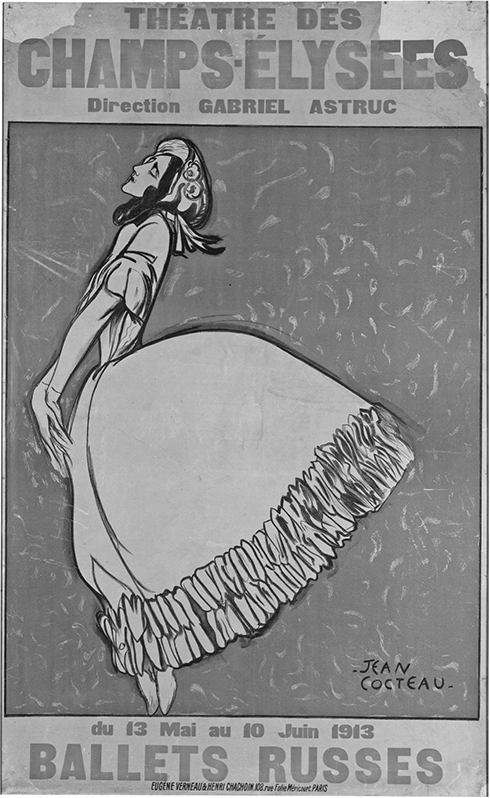
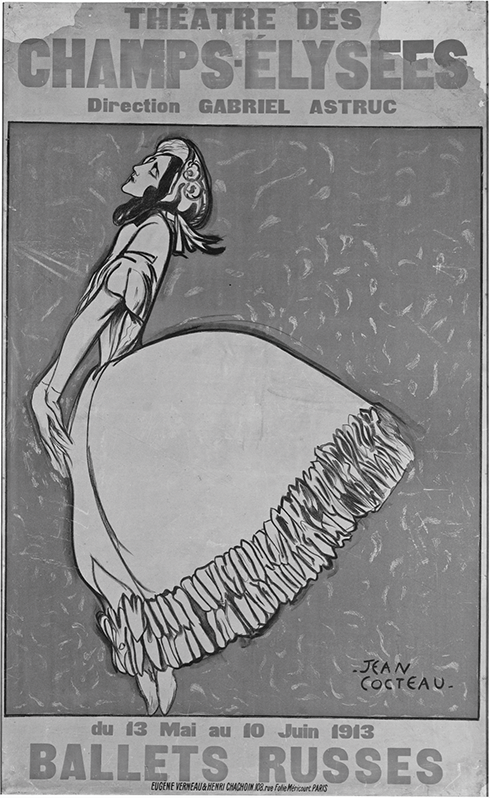
In the 1913 season, eight ballets were choreographed by Fokine, Diaghilev’s first company choreographer, all of these except Daphnis et Chloé becoming works that would help secure the pre-war foundations of the Ballets Russes. These were joined by three ballets created by the young Russian dancer Vaslav Nijinsky: L’Après-midi d’un faune, dating from 1912, the newly commissioned Jeux and, of course, The Rite. Nijinsky’s three works were radically different from one another, but each was controversial in both style and subject matter. The season saw the premiere of one further ballet, La Tragédie de Salomé, choreographed by Boris Romanov, a vehicle to appease prima ballerina Tamara Karsavina, frustrated that she was being overlooked while attention focused on Nijinsky. To market the company at a time when the cult of celebrity was emerging across the international theatrical scene, Diaghilev drew attention to his star performers: promotional material for the 1913 ‘Saison Russe’ featured drawings by the Parisian poet and artist Jean Cocteau of both Nijinsky and Karsavina in Fokine’s Le Spectre de la rose, yet neither was onstage for The Rite, a full-company ballet.1 (See Figure 1.1, Cocteau’s poster design for Karsavina.)
Poster by Jean Cocteau for the 1913 ‘Saison Russe’.
In Paris, Diaghilev welcomed works that would provoke discussion and debate in the newspapers, although he accepted that his company’s most radical creations would not find a place in his touring programme. He admired the innovative musical compositions of the emerging star Igor Stravinsky, whom he had introduced to Western audiences and whose work would feature prominently throughout his dance company’s existence (from 1911 to 1929). In 1913 he was nurturing Nijinsky as a choreographer, allowing plenty of time for him to create a distinctly modern repertory. He recognized that the ‘Russianness’ of Nikolai (Nicholas) Roerich’s colourful designs would strengthen and extend his audience’s pre-war fascination with Russian culture, while challenging existing tastes for more muted colours. Indeed, sound, colour and movement all contributed to the furore provoked by The Rite, in addition to the audience’s apparently anti-Semitic attitude to the theatre’s manager Astruc.
Rather than delving further into the history of The Rite, this chapter will set the scene for the creation and early performances of a production now regarded as much a part of the development of modern music and dance as the history of ballet. It places Diaghilev’s Ballets Russes in its broader cultural arena, revealing how the ensemble shook up Parisian theatre and how that impact, felt throughout Western and central Europe and America in the 1910s and 1920s, continues to this day. Exploring the evolution of the peripatetic company supervised by the true animateur Diaghilev, who brought together major artists of the early twentieth century, allows us to contextualize The Rite of Spring, revealing how and why Diaghilev’s most famous creation so revolutionized contemporary music theatre.
Ballet for Export
The Ballets Russes, officially established by Diaghilev in 1911, played a central role in the development of the performing arts throughout the twentieth century. Diaghilev had first presented ballet in Paris in 1909 and, in the five years leading to the outbreak of World War I in August 1914, he both challenged the prejudice against the art form and created a vibrant dialogue between dance, the visual arts and music.2 For Stravinsky, who would provide the scores for fourteen productions, ‘nothing of the kind ever existed before’;3 the troupe laid the foundation for subsequent choreographic, musical and scenic development on an international scale. The dances, which encompassed a wide range of movement, reworking the familiar and breaking with tradition, excited audiences. The music was more varied and adventurous than the scores that had previously accompanied ballet. And productions were more visually striking, from Léon Bakst’s jewel-like costumes to the more acidic palette of Natalia Goncharova and Mikhail Larionov. Stage designs evoked new worlds, stimulating the imagination, and included painted, constructed and projected settings as well as body-revealing costumes and all-over leotards. As the troupe would demonstrate, productive collaborations could open one artist’s ideas to another, rather than enlist support for what had already been accomplished.
Drawing on the ballet of nineteenth-century Russia, modified to meet and challenge the tastes of its audience, the Ballets Russes was essentially a company that presented ballet for export. The group never performed in Russia and, in the early years, Russians were critical of its productions. They disliked that Fokine’s Russian ballets should be described as wild, exotic and barbaric, and that works based on Russian culture such as Firebird and Petrushka should distort traditional narratives. In the main, they reacted more favourably to Nijinsky’s thoroughly modern works, those that puzzled, and in some cases angered, Western critics.4
At the time, Paris was recognized as the cultural heart of Europe. It was the city in which most of the ballets were premiered and, subsequently, the response of its inhabitants, whether ecstatic or controversial, could be used to further promote the company. Monte Carlo, a principality on the Mediterranean coast popular with affluent Russians, provided a base during winter and spring (between 1911 and 1914, 1923 and 1929), with rehearsal facilities and workshops in which to create new productions. London, where almost half of the company’s performances were given, was no less important. Individual seasons ran for many weeks, and the refuge Britain provided after the Great War, together with the generosity of British patrons particularly in the 1920s, contributed to the survival of the company. Through the work of Diaghilev (and the Russian ballerina Anna Pavlova who established a rival company between 1910 and 1931), twentieth-century ballet became accepted as a stand-alone, autonomous art.
Before Diaghilev: The Dance Scene and Its Impact
Ballet was at a low ebb at the start of the twentieth century. In the second half of the nineteenth century, opera had assumed the dominant position in most of the grand new European opera houses. Ballet divertissements were subsumed into operas or performed alongside them within an evening’s programme. At the same time, owing to increasing urbanization, new theatres, music halls and palaces of entertainment had developed in major cities. In these, ballet and dance had found a new home and an enthusiastic audience. While many venues were dismissed by the cultural elite, the building of the Eden-théâtre in 1883 for the presentation of spectacular Italian ballo grande in Paris – literally across the road from the state-funded opera house the Palais Garnier – challenged the supremacy of French ballet. Three decades before the creation of the Ballets Russes, ballet, even in Paris, could be an imported art.
In the first decade of the twentieth century there was a sudden choreographic vacuum in Western Europe. Two choreographers, Madame Mariquita (1838–1922) and Louise Stichel (1856–c.1933), remained active in Paris, but the deaths of the Italian Luigi Manzotti (1835–1905), Belgian Joseph Hansen (1842–1907), Austrian Katti Lanner (1828–1908) and Italian Carlo Coppi (1845–1909) cleared the field of much of the old guard. In Russia, the reign of Marius Petipa had come to an end with his retirement in 1903 and, as a result, younger choreographers including Fokine and Alexander Gorsky were taking fresh approaches to production and movement design. Both broke away from the formulaic ballets that told their stories through mime, spectacle and processions interspersed with set dances. Concurrently, there was also a move away from house composers producing generic waltzes and polkas; selected composers were now invited to create the scores for individual ballets. At the Private Opera in Moscow and subsequently at the Imperial Theatres, fine artists including Alexander Golovin and Konstantin Korovin were invited to design productions. When Diaghilev was commissioning creations in Paris, he acknowledged these developments.5
At the fin de siècle, those interested in dance were also fascinated by solo artists, particularly the Americans Loïe Fuller and Isadora Duncan, who both celebrated movement for its own sake. With Fuller, it was the amalgamation of movement and visuals as she took advantage of technical developments in coloured electrical lighting. For Duncan, it was a fascination with Hellenism and the revelation of free-flowing movement in lightweight costumes that liberated the body, as well as her unique response to concert-hall music.6 But not only solo artists were turning to concert repertoire. Music by Frédéric Chopin had accompanied ballets before Fokine created his first Chopiniana in 1906: in 1897 Max Glaseman had choreographed Chopiniana to similar music for the Royal Swedish Ballet; and in 1905 Joseph Hassreiter created Chopin’s Tänze for Vienna.
Nineteenth-century ballet was largely hierarchical, dominated by the ballerina (whose tutu had become a badge of office), a female corps de ballet who paraded more than danced (and often carried symbolic properties) and the tradition of the cross-dressing hero. In Russia and Italy men retained leading roles although generally they stood out in character or demi-character parts. Nijinsky frequently performed roles in the demi-character tradition (slaves, spirits and a puppet), but as a charismatic virtuoso dancer he was not restricted to these parts. At the same time, the Russian-born Adolph Bolm, a dancer embarking on a freelance career even before he signed up to the Ballets Russes, revealed the potential virility of the male figure. Significantly, the Ballets Russes employed as many male dancers as female and, with a succession of charismatic male leads, placed the danseur centre stage.7 In addition, unlike traditional nineteenth-century ballet, many productions privileged the portrayal of community. One or two dancers might emerge from the crowd, but it was the group that made much of the impact. Bolm as the Warrior Chief led the Polovtsian hordes in Prince Igor; Maria Piltz emerged as the sacrificial maiden from the communal rituals of The Rite of Spring; and, later in 1923, the Bride and Groom were simply a focal point for Bronislava Nijinska’s Les Noces. In these ballets, real opportunities to dance complex choreography were offered to all dancers; they did not simply decorate the stage.
When Diaghilev’s dancers arrived in Paris from the Imperial Russian Theatres of St Petersburg, Moscow and Warsaw, their schools had absorbed both French and Italian ballet techniques. The French was characteristically Romantic, aerial and lyrical, with dancers often seeming to skim the stage, whereas the Italian was markedly virtuosic, with balances, turns and an emphasis on pointe work: Italian dancers were said to have ‘points of steel’. Russian dancers were also feeling the impact of free-flowing concert dance in Fokine’s choreography.
Nevertheless, while the Ballets Russes were largely presenting novelties to Parisian audiences, some of their creations included echoes of the past. When dancers arrived for the initial 1909 season at Paris’s Théâtre du Châtelet (at which time there was no plan for the productions to tour), some aspects of their choreography echoed that of the spectacular productions of the Mariinsky in St Petersburg. Diaghilev brought to Paris the great Russian machinist Carl Waltz to ensure special effects such as the fountains in Le Pavillon d’Armide which projected water upwards on stage. (The Châtelet, built on the bank of the Seine, had a tradition of water features in its varied entertainments.) For the first version of Firebird in 1910, the bird herself flew on wires and the Knights of Day and Night were on horseback. Once the Ballets Russes was established as a touring troupe, however, these devices became impractical and productions were revised.
The influence of the old ballet could be observed in other pre-war productions. Le Dieu bleu (1911), a minor work superbly designed by Léon Bakst to evoke the Indo-China of the French colonies, appears to have been little more than a parade of stunning costumes with strong echoes of Petipa’s ballet La Bayadère (dating from 1877). The original score was by the Venezuelan Reynaldo Hahn, who composed extensively for the Parisian stage, and the ballet is remembered for Nijinsky’s solo as the god himself. Daphnis et Chloé, for all its stunning music by Maurice Ravel, was structured in three scenes, ending with a danced celebration very much like those staged in late nineteenth-century ballets.
Dancers from the Imperial Ballet were beginning to perform throughout Europe, but their performances drew on established ballets rather than the creation of new works. In 1894, Mathilde Kschessinska, Olga Prebrajenska and others danced at Monte Carlo. In 1907, Vera Trefilova and Nikolai Legat danced after Carmen at the Opéra Comique in Paris. The ballet tours to the Baltic and Eastern Europe in the summers of 1908–1910 organized by Edouard Fazer – featuring Bolm, Pavlova and Legat – may well have inspired Diaghilev’s initial planning of triple-bill programmes, ending with a divertissement of highlights from the Imperial Ballet’s repertory. In 1910 Fazer’s group’s third season in Berlin coincided with the first visit by Diaghilev’s. Dancers including Lydia Kyasht and Bolm danced in summer seasons in London and were quickly followed by others. Ballet companies including Theodore Kosloff’s Imperial Ballet and Anna Pavlova’s company were established in 1910–1911 to tour in the United States and Europe.
The Russian ‘Silver Age’
The creation of the Ballets Russes was one of several Russian cultural ventures of the early twentieth century that emerged from what is usually referred to as the ‘Silver Age’ of Russian art. Kustar-inspired crafts based on traditional Russian peasant furniture had featured prominently in the hugely popular 1900 Exposition Universelle and Parisian shops began to stock Russian arts and crafts. Europeans were fascinated by Russian literature, fashion and textiles, and they became aware of Russian myths, folk tales, archaeology and ethnography. The revival of Russian crafts became a feature of the Russian cultural scene particularly through the artist colonies established at Talashkino, the estate of Princess Maria Tenishkino near Smolensk, and at Abramtsevo, the estate of the industrialist Sava Marmontov, north-east of Moscow. Both patrons had supported Mir Iskusstva (The World of Art), the fine art periodical that Diaghilev and his colleagues produced from 1899 in St Petersburg. The Princess supported the May 1908 production of Snegurochka (Snow Maiden) by Nikolai Rimsky-Korsakov at the Opéra Comique in Paris. With designs inspired by Ivan Bilibin and choreography by Mariquita, its performances coincided with Diaghilev’s presentation of Boris Godunov at the Palais Garnier. The strong political and economic links between Russia and France were heightened by cultural diplomacy, but it is fair to say that in Western Europe there developed a noticeable fashion for Russian culture.
Diaghilev’s Career Focuses on Western Europe
Diaghilev turned his back on a career in St Petersburg to focus on Paris.8 In keeping with his experience in Russia, where he had curated a series of exhibitions of Russian and Western fine and applied arts, he presented a survey of Russian arts at the 1906 Salon d’Automne, one of Paris’s most important annual art shows. (This exhibition was also seen at the Schulte Salon, Berlin, and at the eighth Venice Biennale.) The following year, Diaghilev organized a series of concerts of music by Russian composers and in 1908 he staged Musorgsky’s opera Boris Godunov at the Opéra, directed by Alexander Sanin, starring Fyodor Chaliapin and featuring the chorus of the Bolshoi, Moscow. Although Diaghilev had been employed by the Imperial Theatres in St Petersburg for two seasons (between 1899 and 1901), his focus had been on the theatre’s publications rather than its productions; it was Boris that taught him and his colleagues the challenges of live music theatre. In terms of design, Boris was still a traditional production privileging historical accuracy with scenes from a series of artists. Once Bakst’s colourful and fantastical designs were revealed in the ballets of 1909 and 1910, the approach to theatre design began to change, although Bakst continued to be inspired by research undertaken during travels across Greece and the Caucasus.
It had been Diaghilev’s original intention that ballet would support opera during the 1909 ‘Saison Russe’, but a loss of financial support prompted him to focus on dance. He recognized that ballet needed reforming and was an art form in which he could combine his interests in art and music. In the late nineteenth century, opera had been revitalized by such projects as Sava Mamontov’s Private Opera Company in Moscow as well as the work of Richard Wagner in Germany. While Diaghilev continued to present operas through to his very last season (with Eugene Goossen’s rarely discussed Judith), it became a seasonal activity in response to the requirements of venues – a continuing reflection of the nineteenth-century traditions that combined opera and ballet. In all, Diaghilev was responsible for the production of fifteen operas. In addition, when dancing at Monte Carlo in the 1920s, the Ballets Russes served as the traditional opera-ballet. When seasons were given at the Royal Opera House in London, ballet alternated with operas that were not produced by Diaghilev. In 1913 and 1914, with additional sponsorship from Joseph Beecham, Diaghilev’s Paris and London seasons combined opera, featuring singers from Moscow, and ballet.
Diaghilev was a canny programme planner. In the 1909 Paris season he presented enhanced productions of ballets created at the Mariinsky that paid homage to France. The court of Louis XIV in Le Pavillon d’Armide, the French fashion for Orientalism in Cléopâtre, the French Romantic ballet with Les Sylphides: these left only the virile dancing of the Polovtsian hordes in Prince Igor to shake up the audience. Incidentally, for London he did not risk the inclusion of any ballet with music by Igor Stravinsky until his third season, when Firebird was presented. Petrushka would wait until early 1913, just one season ahead of The Rite of Spring. The sense of combining the safe with the controversial, mentioned at the start of this chapter, can also be observed at the Parisian premieres that aroused most controversy: this was true not only of the 1913 Rite of Spring but also of Parade in 1917 and Romeo and Juliet in 1926.
Although the company toured extensively in North and South America as well as Europe, it was only in Paris, London, Monaco and Berlin that the more controversial ballets were presented. Elsewhere the focus was on more accessible works. The popular Polovtsian Dances were performed at a quarter of all performances, closely followed by Les Sylphides. The exotic Schéhérazade was in demand given its subject matter of sex and violence in a harem, not to mention its stunning designs by Bakst, and the lively tale of toys coming to life in La Boutique fantasque, itself a reworking of the late nineteenth-century success Die Puppenfee (The Fairy Doll, 1888), was the most frequently performed of the later works. It should be noted that the Ballets Russes rarely toured its own orchestra and new scores by composers including Stravinsky and Sergei Prokofiev could present a challenge to many musicians.
Statistics in relation to creations are difficult to quantify, as certain ballets such as The Rite of Spring and Le Chant du rossignol were choreographed twice, largely reusing designs and music. Other ballets were partially rechoreographed, redesigned or adapted for specific venues, but essentially it can be said that thirty-nine productions of ballets mounted for Diaghilev’s company were first performed in Paris. This is well over half their output. Fourteen ballets were premiered in Monte Carlo as previews ahead of performances in Paris. This leaves Carnaval, first performed by the Ballets Russes in Berlin where its commedia dell’arte subject matter resonated widely with the public, and seven premieres in London. Among the latter were revivals of Swan Lake and Sleeping Beauty (virtually unknown outside Russia), both of which Diaghilev felt would appeal to the British public, generally more conservative than the French. It also includes the immediate post-war triumphs of Boutique fantasque and The Three-Cornered Hat; this is not to mention, in 1926, The Triumph of Neptune, tailored for a British public nurtured on toy theatre and pantomimes.
The Pre-Company Seasons
For the 1909 and 1910 ‘Saisons Russes’, the dancers were essentially a pickup company, only available to perform during their summer break. Ballets reworked from the repertoire of the Imperial Ballet were revitalized with new designs, modified scores and catchier titles. Le Pavillon d’Armide was a tightened version of the Mariinsky production, Cléopâtre developed from Egyptian Nights, and Les Sylphides was essentially the second version of Fokine’s Chopiniana. According to Mariinsky dancer Alexander Shiryaev, even the Polovtsian Dances from Prince Igor were a reworking of Lev Ivanov’s choreography for the 1890 staging of the opera.9 Nonetheless, Parisian audiences were stunned by the quality of the productions and the dancing, noting the dominance of the male dancers. The star of the first seasons – discounting Bakst, who was known for his bejewelled palette and exotic costumes – was the virtuoso dancer Nijinsky, who had the ability to transform himself into every role he danced. Pavlova, the intended ballerina, joined Diaghilev only for the second half of the 1909 season, enabling Karsavina to become the company’s ballerina par excellence, although she never signed a full-season contract – in modern parlance, she was a ‘Principal Guest Artist’. The choreographer of these pre-company seasons was Fokine, who preferred to convey his narrative through dance, limiting the use of pointe work to specific effects. He ensured movement and costumes fitted his subject matter evoking a multiplicity of times and places. From the season of 1910, with the premiere of Firebird, entirely new ballets were created, and Igor Stravinsky became a third star.
The 1910 ‘Saison Russe’ produced two ballets closely associated with Diaghilev: Schéhérazade and Firebird. Schéhérazade, with Bakst’s middle-Eastern sets and costumes in reds, oranges, greens and blues, had a real synergy with, and influence on, fashion and interior design. Firebird was the first truly original ballet with new narrative drawings on Russian folk tales and Eastern legends, new designs mostly by Golovin, new choreography and above all a new and wholly different score. After not being performed in 1911, it was reworked for touring from 1912, and in 1926 was redesigned by Natalia Goncharova using cloths rather than built sets.
In 1910, the Ballets Russes performed in Berlin and Brussels in addition to Paris and impresarios from around the globe vied to sign up the star dancers for their own theatres and tours. Diaghilev realized that, if he was to proceed, he would have to put dancers under long-term contracts and establish a year-round touring company. Nijinsky’s dismissal from the Imperial Theatre in 1911 over his inappropriate costume for Giselle played into Diaghilev’s hands. Having secured his star performer, he was able to lure many dancers from their secure jobs and potential pensions with the Imperial Ballet for improved salaries and the opportunity to work with innovative choreographers from abroad. A few, including Lubov Tchernicheva, wife of regisseur Sergei Grigoriev, and Nikolai Kremnev, remained with the company throughout its existence until 1929. However, as the pre-company seasons demonstrate, the Ballets Russes was a constantly changing ensemble in terms of performers and collaborators. Diaghilev employed the finest available dancers (hiding their nationality under Russian names if necessary). He looked to the Russian empire for dancers but was happy to employ those such as Lydia Kyasht and Stanislas Idzikowski, both already known in the West. After the Revolution, dancers from the former Imperial Ballet including Karsavina, Felia Doubrovska and Pierre Vladimirov made the journey to the West. In 1923 a group of Nijinska’s students from Kyiv were invited to join (the ambitious Serge Lifar arrived with this group), while a quartet of Soviet dancers on an official European tour, including Alexandra Danilova and George Balanchine, successfully auditioned for Diaghilev in 1924.
The Official Company Is Born
Establishing the company led to a second period of activity between 1911 and 1914, when the peripatetic ensemble consolidated its early successes, new productions becoming more radical – particularly those choreographed in 1912 and 1913 by Nijinsky, who challenged the technique and movement design characteristic of the much-admired Fokine. The 1911 season, however, reinforced the status of both the troupe and Fokine as choreographer. Premiered were Narcisse, the company’s first ballet inspired by classical Greece, and the romantic duet Le Spectre de la rose, both designed by Bakst, as well as Petrushka, inspired by Stravinsky’s score. Alexandre Benois, who devised the plot with Stravinsky, designed the ballet by drawing on traditional Russian puppets at an early nineteenth-century St Petersburg Butterweek (pre-Lent) fair, and Fokine brought the action to life. At the centre was Nijinsky as the downtrodden Petrushka who thwarts his controlling puppeteer.
From 1912 Fokine was overshadowed by Nijinsky who developed a different style of movement for each production: frieze-like for L’Après-midi d’un faune, while more academic – but largely danced on demi-pointe and with bent arms and hands in a loose fist – for Jeux, both ballets set to music by Claude Debussy. For The Rite of Spring the dancers’ posture was inverted and movement weighted to the earth. Yet Nijinsky’s productions did not appeal to promoters of ballet, and so despite the trauma of his dismissal in 1913 (following his marriage to the junior member of the corps de ballet and socialite Romola de Pulszky), it was advantageous for Diaghilev when Fokine was persuaded to return for the 1914 season. This season, ending just days before the outbreak of war, included the further revelation of the opera-ballets Le Coq d’or by Rimsky-Korsakov and Le Rossignol by Stravinsky, both of which were double-cast, the vocalists leaving the stage for dancers.
Significant also was the change in stage design initiated by the introduction of Natalia Goncharova and her partner Mikhail Larionov, an innovative duo who broke with Bakst’s flowing art-nouveau designs and introduced a new Russian modernism characterized by a more acidic palette. With The Legend of Joseph of 1914, in which Léonide Massine (who had joined the company that year) had his first starring role, Diaghilev commissioned a score from Richard Strauss and set designs from the first of the non-Russian designers, José Maria Sert – the Spanish innovator of mural painting. The Ballets Russes was moving away from its Russian roots.
The Impact of the Great War and Revolution
In 1914, after the London season at the Theatre Royal Drury Lane, the company dispersed for their summer vacation while war broke out. It was not until May 1915 that the company re-formed in Switzerland. In 1922, the abrupt closure of The Sleeping Princess in February left dancers once again unpaid and at a loose end, although the core was able to reform for the Paris season in May.
The war years were a period of radical experimentation: the company workshopped ideas for unrealized ballets such as the religious-themed Liturgie; and they mounted Giacomi Balla’s Fireworks, with sculpture and lighting set to Stravinsky’s score but without a single dancer. The partly Cubist Parade, which introduced designs by Pablo Picasso, featured in the one war-time Parisian season of 1917. As with The Rite of Spring, Diaghilev programmed this controversial ballet, set to a score by the French progressive Erik Satie, with more popular and accessible works: Les Sylphides, Soleil de nuit and Petrushka.
While these innovations took shape, the company was, somewhat paradoxically, at its most conservative. Touring to new venues in neutral areas, notably America and Spain, accessible ballets were danced with the addition of more ‘Russian’ works including Contes Russes, Sadko and Soleil de nuit – a ballet, like The Rite, that involved folk dances and the worship of Yarola, the sun god. As peace was established, the Ballets Russes spent fifteen months performing in Britain. This period brought about the revitalization of the company, the refurbishment of sets and costumes, and the restoration of its repertory, as well as the creation of what would be important new ballets.
During the period from 1915 to 1921, character works choreographed by Massine dominated the repertory. Le Boutique fantasque, The Three-Cornered Hat and Le Chant du rossignol were of special pride to Diaghilev, for they enabled him to showcase new designs by Picasso, André Derain and Henri Matisse – recognized as the three greatest artists of the day – when his company returned to Paris in 1919. It was also in Paris, on 15 December 1920, that Massine’s version of The Rite of Spring was created at the Théâtre des Champs-Élysées – the ballet’s original home. Reusing Roerich’s costumes and his Scene 2 backcloth, as well as Stravinsky’s slightly adapted score, Massine’s more abstract choreography was inspired by round dances and academic ballet. It was performed occasionally until 1929, gradually gaining popularity. After Massine’s departure, Diaghilev tried to rescue the Ballets Russes, now without a choreographer, by presenting Marius Petipa’s Sleeping Princess at the Alhambra, London, expecting it to be ‘the crown’ of his career.10 Yet London audiences were unused to a long run of a single programme-length ballet and, having cost twice as much as was budgeted, The Sleeping Princess was a commercial failure.
The Ballets Russes in the 1920s
The final period of the Ballets Russes, from 1922 to 1929, is remembered for a range of productions presented in Europe. Choreographers Bronislava Nijinska and George Balanchine brought academic ballet technique back into focus, albeit often in novel ways. Significant ballets included Stravinsky’s Les Noces and Apollon musagète, but the overall repertory was varied and included contributions from Massine. Les Noces, realized in 1923 after a decade’s gestation by Stravinsky (it was commissioned immediately after The Rite of Spring), portrayed an arranged Russian peasant wedding; as such, it was thought to require uniform monochrome costumes rather than the folkloric colour originally envisaged by Goncharova. Nijinska’s choreography, which emphasized the rituals and dancing of friends and guests, led to the realization of one of the company’s lasting masterpieces. Balanchine, already an inventive choreographer in Petrograd, was ready to respond imaginatively to any project Diaghilev proposed, including a new staging of Le Chant du rossignol as well as La Chatte, Apollon musagète and The Prodigal Son. His time with the Ballets Russes enabled him to devise variations on traditional dance steps: it is possible to see his development of the traditional pas de deux from Pastorale to the dance for the son and Siren in The Prodigal Son, and from La Chatte to Le Bal. Other productions in the 1920s – including Massine’s Pas d’acier with its animated set by Georgii Yakulov and Balanchine’s Prodigal Son incorporating ideas from Nikolai Foregger’s ‘machine dances’, both with scores by Sergei Prokofiev – incorporated ideas from Soviet avant-garde productions.
For Diaghilev it was often a challenge to preserve momentum with his company. He had the ability to charm both potential collaborators and sponsors. Indeed, it was very difficult to say no to him, Debussy describing him as a ‘terrible yet charming man who could make stones dance’.11 But the impresario was not good with money: it was there to be spent. As a result, the need for financial sponsorship influenced some programming. The Triumph of Neptune was created for Lord Rothermere’s popular-priced season at the Lyceum, London, in 1926. His sponsorship also guaranteed leading roles in La Chatte and Apollon musagète for his protégé Alice Nikitina. Another example is the support offered by Chanel for Massine’s version of The Rite.
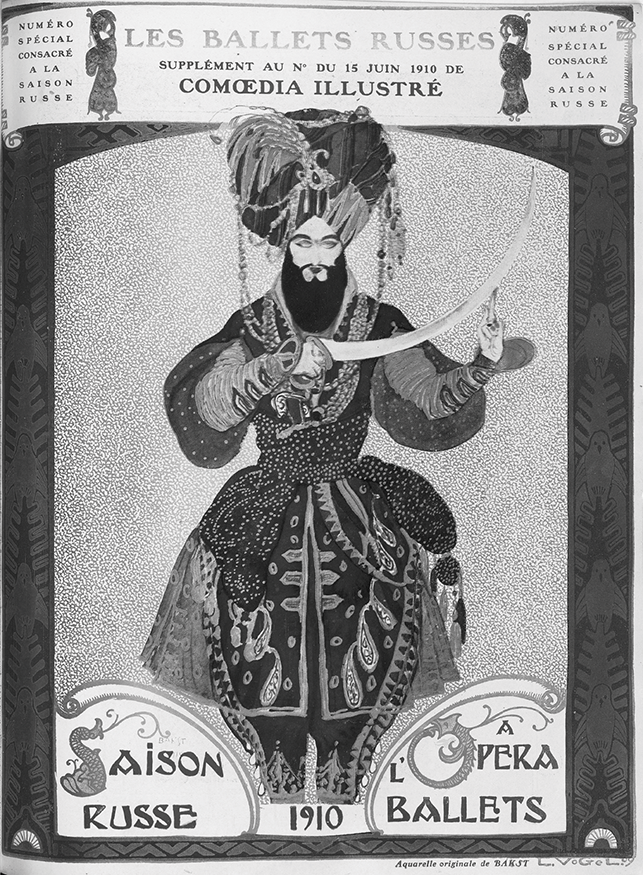
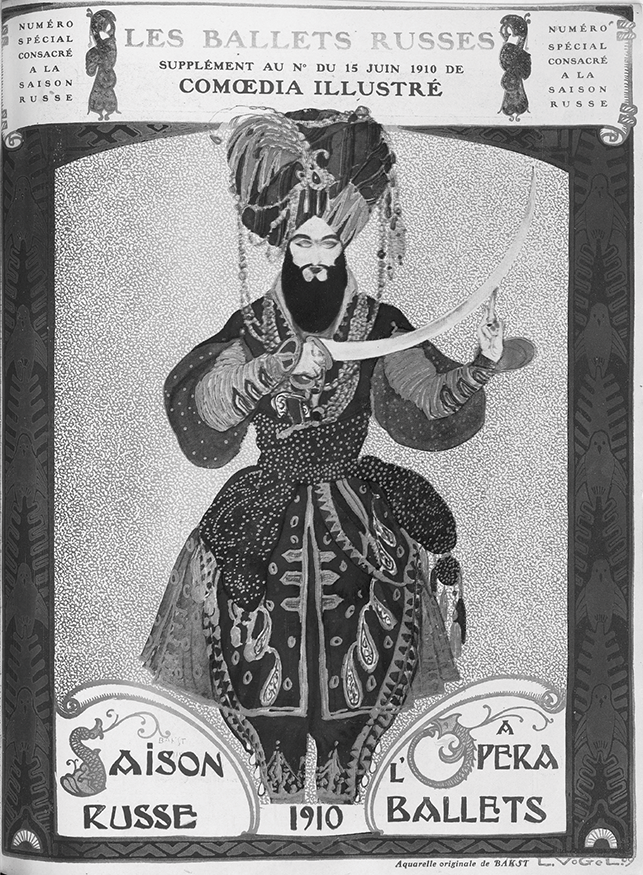
The Ballets Russes was able to take advantage of modern media and marketing using illustrated periodicals to promote the celebrity of leading artists and extend the influence of designs and illustrations through colour reproduction. (See Figure 1.2, the front cover of an illustrated souvenir programme for Diaghilev’s 1910 season, published by the full-colour magazine Comœdia illustré, an offshoot of the daily newspaper Comœdia aimed at the well-to-do of Parisian society. The cover shows one of Bakst’s costume designs for Schéhérazade.12) Diaghilev, however, ignored the potential of silent black and white film, unable to encapsulate the full performance, although he was ready to experiment with colour and sound film. Only tiny fragments of the Ballets Russes survive in amateur recordings and newsreels with the only production footage being a glimpse of a rehearsal of Les Sylphides on the open-air stage at Montreux in 1928.
Front cover of the illustrated supplement to a special edition of Comœdia illustré devoted to the 1910 ‘Saison Russe’.
Legacy
The influence of the Ballets Russes continued long after the collapse of the company with Diaghilev’s death in Venice in 1929. Works created for the troupe were revived and restaged by passing them on from one generation to the next and by archaeological investigation. Sergei Grigoriev with his wife Tchernicheva, as well as other company members including Karsavina and Leon Woizikovsky, mounted productions based on their knowledge, memories and personal interpretations. Choreographers Fokine, Massine, Nijinska and Balanchine mounted and reworked their own ballets to keep them alive, and the descendants of Fokine and Massine have taken over custodianship. Following a reawakening of interest in the 1960s and 1970s, companies including the Joffrey Ballet in the United States and the London Festival Ballet mounted careful revivals. From the 1980s with Millicent Hodson and Kenneth Archer’s investigation of Nijinsky’s choreography, initially with The Rite of Spring, evocations of lost ballets have been staged. By contrast, with the fall of the Soviet Union, Russians have attempted to reclaim a ‘lost’ heritage with glamourous but often superficial stagings.
Inspiration and ideas have proved more significant than re-stagings. Over half of the scores used by the Ballets Russes were commissions and many of those have found their place both in the concert hall and as the basis for further original choreography. Almost every choreographer since the 1960s has wanted to create a new Rite of Spring using the full score, the two-piano version or some other adaptation. (Some examples will be explored in Rachana Vajjhala’s chapter in this volume.) Ballet has continued as an independent art benefitting from collaborations with fine artists and leading composers; indeed, to compose for the theatre was to guarantee multiple performances of a score.
Dancers and choreographers who gained experience working with the Ballets Russes went on to establish and revitalize companies, the most obvious being Ninette de Valois (The Royal Ballet), Marie Rambert, George Balanchine (New York City Ballet) and Serge Lifar (the Paris Opéra); companies across the United States and Argentina also benefitted from collaborations with Fokine and Nijinska. Les Ballets 1933 and Ballets des Champs Elysées (with both of which Diaghilev’s secretary Boris Kochno was involved) followed the original template of creative collaborations between composers, designers and choreographers, and were among the most exciting successor companies in Europe. But the Ballets Russes permeated many areas of culture, and this is clearly true of fashion, which with the creations of Paul Poiret, Paquin, Bakst, Goncharova and Chanel among others developed a symbiosis with dance. This continued with the creations of Yves St Laurent, Karl Lagerfeld and Erdem.13
As an institution, the Ballets Russes became a cornerstone of twentieth-century culture. Because the company unified the arts, bringing together so many styles and schools, it had a widely pervading influence. Productions, created for a touring company rather than for a single venue, represented, as Fokine claimed, an alliance of dancing with the other arts. Throughout, the company’s activity was masterminded principally by one man. He called on friends and advisers to ensure standards were met and ideas worked out efficiently, but its success derived from his original vision and production. With the Ballets Russes, Diaghilev showed himself to be a true animateur the like of which has yet to be discovered.