




Through close study of medieval manuscript culture, modern scholars can gain insight into the activities and priorities of those who made and used the manuscripts; the study of chant, its notation and its melodies offers further perspectives into the medieval world. In this article, through a close case study, we propose a shift in methodology for identifying scribes and exploring their scriptorium context. As well as the morphology of text and musical scripts, we explore writing techniques, including ductus, placement of notational signs (neumes) within the interlinear space and the different ways of holding the pen. Further, we incorporate consideration of scribal preferences for particular notational shapes and melodic choices; these inform us about individual scribes’ understanding of the melodic and notational tradition and the relationship between copying and recall in writing practices. We take the identification of scribal stints as a starting point for examining the role that each scribe played in compiling the manuscript. As we illustrate in our case study, such investigation can shed light on scriptorium size and working practices, scribal intervention and scribal mobility.
Santo Domingo de Silos, Biblioteca del Monasterio MS 6 (henceforth Silos 6),Footnote 1 preserves the liturgy for the Old Hispanic rite. This rite was widely practised on the Iberian Peninsula until the late eleventh century, when it was suppressed in favour of the Roman rite with its Gregorian chant.Footnote 2 Most of the manuscripts containing the Old Hispanic rite have been lost or destroyed; the liturgy is preserved in a corpus of approximately forty manuscripts and fragments. These materials contain evidence about musical-scribal practices in early medieval Iberia that have not fully been explored. Palaeographical work on Old Hispanic notation has been relatively limited. In 1929, Casiano Rojo and Germán Prado compared neumes found in the Old Hispanic materials with similar Frankish neumes to establish the possible melodic contours of the Old Hispanic shapes.Footnote 3 From the 1980s onwards, a similar approach was undertaken by Herminio González Barrionuevo and Susana Zapke, who looked closely at how palaeographical elements are combined in practice to result in multiple neumes.Footnote 4 More recently, Zapke has attempted to delineate different notational scripts from the ‘north’ and the ‘south’, using the ductus (of individual notational signs), the directional axis of the script, the degree of intended diastematy and the amount of graphic diversity.Footnote 5 We found that these categories could also be applied to the work of individual scribes within a similar notational style. In collaborative work describing Old Hispanic neumes using MEI (Music Encoding Initiative) conventions, Elsa De Luca et al. have pinpointed visual and functional components of Old Hispanic neumes.Footnote 6 Some scholars have focused on identifying individual Old Hispanic music scribes: Herminio González Barrionuevo and, more recently, De Luca, Emma Hornby, Rebecca Maloy and Raquel Rojo Carrillo. These scholars have developed a methodological approach for identifying scribal hands in unpitched notation primarily based on the way specific neumes were written.Footnote 7 Elsa de Luca has identified scribal hands in the mid-tenth-century León antiphoner (L8). While L8 has such uniform notation for many neumes that scholars long considered the manuscript to have been written by a single notational hand, De Luca identified a selection of neumes in L8’s antiphoner that were written in different ways across clusters of folios; this enabled her to identify different scribes.Footnote 8 Hornby and Maloy built on this methodology in their analysis of the opening folios of L8, preceding the antiphoner proper, looking at the neumes that De Luca had found useful for scribal identification, and adding further neumes to the repertoire of likely ‘scribal tells’.Footnote 9 We adopt a similar methodology here, identifying a set of neumes that are formed in varying ways across multiple folios in Silos 6. These distinctively written neumes are clustered, suggesting the presence of different scribes.
In our approach, we build on recent trends in palaeography and musicology beyond the Iberian corpus. For example, Susan Rankin has explored the conceptual foundations and use of musical notation in Carolingian Europe.Footnote 10 These principles also underpin the Iberian materials. Throughout our research on Silos 6 and its scribal hands, the concept of a ‘house style’, or lack thereof, was crucial. David Ganz’s work on scriptorium practice established that a scriptorium can be heterogenous: ‘house style’ is dependent on the individual training of the scribes and is subject to change over time. This helped us to interpret the presence of different styles and scribes in the manuscript.Footnote 11 Other recent advances by text palaeographers can also be applied to the study of neumatic notation and musical manuscripts. Here, we have been particularly influenced by the work of Malcolm Parkes on the elements of writing in text scripts, particularly the forms and components of individual letters.Footnote 12 We have combined his approach and categorisations with the previous music-palaeographical literature in developing our understanding of the Old Hispanic notational shapes. In our present study of Silos 6, we combine these approaches, enabling us to identify not only specific neumes or scribes but also the behaviour and musical identity of individuals and their scriptorium culture.
Silos 6
Silos 6 is of particular value as a case study because, in its current state, it is the result of four layers of scribal engagement. It also comprises two sections made of different materials. As we discuss below, the first section was written on paper, and the second section on parchment. Across the manuscript, there are different notational styles and melodic dialects. These tell us that the manuscript was compiled in stages, probably at different times and across two or three institutions. This single manuscript, then, attests to multiple strands of Old Hispanic musical and notational culture.
Silos 6 is a liber misticus, containing chants and prayers for the Old Hispanic public services (vespers, matutinum and the mass), as well as mass readings.Footnote 13 In mistici, the liturgical materials are presented in order, each day starting with vespers, followed by matutinum and then the mass.Footnote 14 The only surviving examples of Old Hispanic mistici preserve materials for just a portion of the liturgical year.Footnote 15 Silos 6 is no exception. The first (paper) section contains feasts for the common of saints (saints plural (de sanctis), just man (martyr), confessor, virgins, and virgin); the second (parchment) section contains nine complete quotidian Sundays and the beginning of the tenth quotidian Sunday, ending in a lacuna.Footnote 16 While votive days, quotidian days and commons of saints are routinely placed towards the end of Old Hispanic manuscripts, this precise layout (commons immediately before quotidian Sundays), is otherwise present only in Silos 3. The rarity of this layout raises further questions. Were the two sections of the manuscript conceived separately, reflecting the distinction between their materials? Or were they conceived together, reflecting the combination of the common of saints with quotidian Sundays also preserved in Silos 3? It has previously been argued that the two sections of the manuscript have been joined together at least since the thirteenth century.Footnote 17 We suggest here that they were more likely joined even earlier: before the suppression of the Old Hispanic liturgy, but after the initial copying of each section.
a. The dating and origin of Silos 6: current scholarly understanding
Silos 6 has been dated to the late tenth or eleventh century, approximately.Footnote 18 We have not been able to pinpoint the dating of the manuscript more precisely than previous scholars. The manuscript’s origins are also unknown. Scholars have focused on different aspects of the manuscript’s provenance, appearance and material state in order to argue for different origins. We summarise these arguments here, to provide a context for our close reading of the manuscript.
As noted above, the first section of Silos 6 (folios 1r–37v) was written on an early type of paper, likely made from pulped rag.Footnote 19 The remainder of the manuscript (folios 38r–154v) was written on the more traditional material, parchment.Footnote 20 This manuscript has been cited as the first evidence of paper use in the medieval Christian West; paper-making facilites were likely in existence in Muslim Iberia by 1056 in Xàtiva and by 1086 in Toledo.Footnote 21 Silos 6 is therefore likely to have used paper imported from the Muslim world.Footnote 22 The paper section was thus conceived and executed in an institution that was open to an – at that time – unconventional technology.
In attempting to pin down the origin of Silos 6, Ruiz Asencio drew a parallel with Paris, Bibliothèque nationale de France (BNF), n.a.l. 1296.Footnote 23 BNF n.a.l. 1296 is a copy, on paper, of another manuscript: the tenth-century glossary of San Millán de la Cogolla (Madrid, Real Academia de la Historia, MS A46; henceforth A46). While BNF n.a.l. 1296 is usually dated to the first half of the twelfth century, Ruiz Asencio asserted that the date 1082 was added into A46 (fol. 171r) when A46 was used as the exemplar for BNF n.a.l. 1296. He also argued that the two paper books BNF n.a.l. 1296 and Silos 6 must have been made in the same institution. BNF n.a.l. 1296 was probably (a) copied at San Millán de la Cogolla (where its exemplar, A46, was held), (b) commissioned by the Abbey of Silos (who certainly acquired it) or (c) commissioned by another institution and later acquired by Silos. Because he did not consider the text script of n.a.l. 1296 to be characteristic of San Millán de la Cogolla, Ruiz Asencio favoured the third of these possibilities. He suggested that both BNF n.a.l. 1296 and Silos 6 originated at the cathedral of Santa María la Real de Nájera, approximately nine miles away from San Millán de la Cogolla.Footnote 24 We remain unconvinced by this line of argument. Whether BNF n.a.l. 1296 was copied in 1082 or in the twelfth century, Silos 6 was presumably copied rather earlier, since the Old Hispanic rite was in the process of being suppressed by 1082.Footnote 25 Further, use of paper cannot be used to establish a shared origin for the two manuscripts, since paper might easily have been disseminated to multiple institutions, even sheets originating from the same batch. There is thus no particular reason to associate the two paper manuscripts with each other, or with the same institution.Footnote 26
Primarily because of the text script style, Díaz y Díaz placed the origin of the parchment section of Silos 6 in the León region.Footnote 27 Ruiz Asensio instead saw the ‘ornamentation’ (especially in the parchment section) as characteristic of the Rioja.Footnote 28 According to Díaz y Díaz, the text scribe in the parchment section exhibits traits of a Visigothic script particular to the monastery of Santo Domingo de Silos, in the hills south-east of Burgos, although the evidence for manuscripts written at Silos in this period is very limited.Footnote 29 It was almost certainly at Silos by the thirteenth century.Footnote 30 Rather than trying to pinpoint the institution(s) in which Silos 6 was written, or its date of production, we have taken a different approach, looking closely at the individual scribes and their practices.
b. Notational styles and scribal identification in Silos 6
Notational style was our starting point for the identification of different groups of scribes working in specific sections of the manuscript. Ismael Fernández de la Cuesta identified three notational styles within the manuscript: one that he associated with manuscripts from the León region,Footnote 31 and two that he associated with manuscripts from further east – a region broadly defined as the Rioja.Footnote 32 We differentiate these styles visually by considering the graphic form of individual neumes. For example, the León version of the neume in Figure 1 tended to be written as a fully closed loop, bearing a resemblance to a cursive visigothic letter ‘g’.Footnote 33 The equivalent neume in Rioja notation could also be written as a closed loop, but could alternatively be written in a spiral shape. Similar illustrative examples could be multiplied; there are many neume forms that are characteristic primarily of León or Rioja notational style, although there can be much visual variation between manuscripts currently defined as using the Rioja notational style.
NHL Shapes in Rioja and León Notation in Silos 6
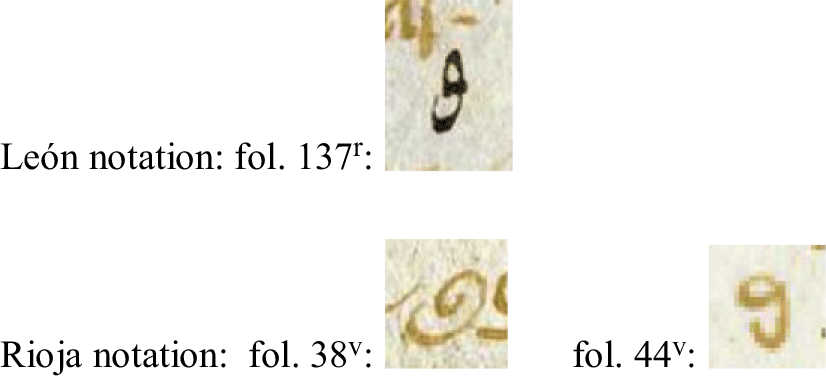
Fernández de la Cuesta’s foundational work on the notational styles used in Silos 6 was further developed and nuanced by González Barrionuevo, who identified five music scribes in the manuscript.Footnote 34 Fernández de la Cuesta identified one text hand in the paper section of Silos 6 (folios 1r–37v). He thought that this scribe also wrote almost all of the music in this section, using a Rioja notational style. This is González Barrionuevo’s Hand A.Footnote 35 A different scribe (whose ink is now very faded) used the León notational style to notate one chant on folio 20r and two on folio 37r; this is González Barrionuevo’s Hand B.
In the parchment section (folios 38r–154v), Fernández de la Cuesta did not differentiate between different text hands, while González Barrionuevo identified two or possibly three scribes.Footnote 36 Fernández de la Cuesta identified three notational styles in this section of the manuscript. He argued that the text scribe(s) of the parchment section used a Rioja notational style.Footnote 37 González Barrionuevo identified almost all of the notation in this style as having been written by Hand C, except that he considered a psallendo on folio 95r to have been notated by Hand E.Footnote 38 Fernández de la Cuesta observed a second Rioja notational style in the parchment section (used up to folio 100r), similar to that used in the paper section.Footnote 39 Within the parchment section, González Barrionuevo labelled notation in this style as having been added by Hand D.Footnote 40 He wrote that, if the two parts of Silos 6 should be considered together as a single manuscript, he would identify Hand A (in the paper section) as the same person as Hand D (in the parchment section).Footnote 41 Fernández de la Cuesta’s third notational style – a León notation – appears from folio 117v onwards;Footnote 42 according to González Barrionuevo, this notation was probably added by Hand B, the León notation scribe of the paper section.Footnote 43 There are text additions and corrections throughout the manuscript, and Fernández de la Cuesta noted their similarity to the writer(s) of the León notation.
As we will demonstrate, Hand D did not contribute to the paper section of the manuscript. After palaeographical analysis (detailed below), we concur with González Barrionuevo that Hand B indeed contributed to both parts of the manuscript. We identify three further scribes, not identified by previous scholars: one in the paper section of the manuscript (Hand G), and two in the parchment section (Hands F and H). Pace González Barrionuevo, we attribute to Hand E much more than the single chant on folio 95r.
The findings of Fernández de la Cuesta and González Barrionuevo were our departure point for close consideration of multiple aspects of Silos 6’s palaeography. The distinction between a ‘script’ and a ‘style’ is difficult to define, and is used in different ways by different scholars.Footnote 44 In our research, we observed that although each Silos 6 scribe has a unique way of writing, some scribes can be classed as sharing a single writing style;Footnote 45 we identified these styles by looking at elements such as the overall thickness of the strokes, the inclination or axis of the notation, and the shape of specific neumes. These elements intersect in various ways in each hand. Observing notational style can allow one to hypothesise about which scribes might have been trained in a similar environment and how they may have worked together. Scripts are differentiated from each other by having some or all of: a different conceptual understanding of how glyphs can be constructed, a different vocabulary of glyphs, and different functions for some of the glyphs that are shared with other scripts.Footnote 46 We agree with Fernández de la Cuesta and González Barrionuevo that there are three very different styles of notation in Silos 6; more work will need to be done across the Old Hispanic corpus to discern whether any of these in fact belong to different scripts.
In our identification of the scribes in Silos 6, we looked at a number of graphical qualities that have previously been highlighted as fruitful by scholars such as Susan Rankin and Susana Zapke. One such feature is the notational ductus. This term can refer to several things (‘the act of tracing strokes on the writing surface’,Footnote 47 the inclination of the script,Footnote 48 and the placement of signs in relation to each other).Footnote 49 It was particularly useful to look explicitly at each of these aspects in isolation. We found that the notation was consistently inclined at specific angles in relation to the text line in some sections of the manuscript but varied in other sections, leading us to hypothesise that shifts in inclination, or shifts in consistency of inclination, can be indicative of a change in hand. The writing angle of the script is separate from the way in which a scribe held his pen. The different physical techniques used during the process of writing result in variety in the thickness of the pen strokes. Thick strokes were produced using the wider part of a nib, whereas thin strokes were produced by using the thinner part of the nib. The weight of strokes and the extent of variety between thick and thin strokes in a single scribe’s work can inform us about how the pen was manipulated and, as a result, informs us of the training of individual scribes. We also looked at the graphic diversity of the musical notation; this is the vocabulary of notational signs that a scribe wrote and how he combined notational shapes to make neumes. Some scribes did not use the same neumes as others or had a preference for a particular version of a neume. The specific shape of certain neumes is a further category of analysis. We looked at the formation of particular notational shapes, considering the angling, proportion and length of pen strokes. We often found that there were consistent patterns of shape formation over the course of several folios or chants. Analysis of all of these palaeographical aspects in combination enabled us to distinguish between the different scribes who copied the musical notation of Silos 6 and to identify the unique qualities of each scribe’s handwriting.
c. Old Hispanic melodic dialects
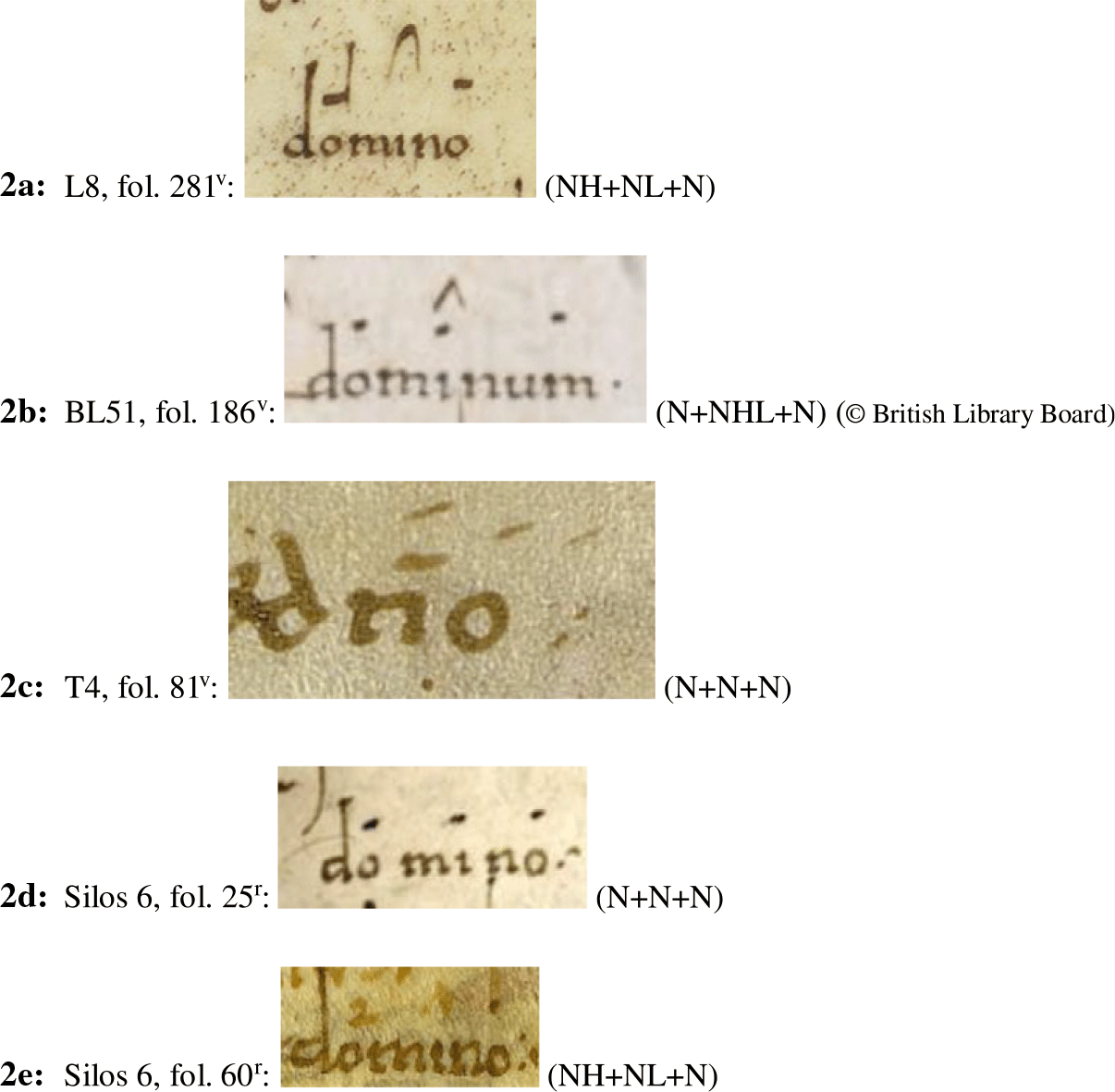
The combination of multiple notational styles in Silos 6 is relatively unusual in medieval Iberia, and it raises questions about whether the manuscript was compiled in an institution that tolerated and used more than one notational style,Footnote 50 or whether it was moved during its compilation. Here, close consideration of the melodies in Silos 6 was enlightening. Don Randel identified four melodic dialects in Old Hispanic chant, discovering regional preferences for particular melodic shapes in the responsory verse tones. He defined these dialects as León, Rioja, Toledo A and (in manuscripts using a separate liturgical tradition) Toledo B.Footnote 51 Hornby and Maloy confirmed these findings with reference to cadences and a particular set of chant openings.Footnote 52 As noted by Randel, some Silos 6 responsory tones have variants characteristic of the León region, and others have variants characteristic of the Rioja.Footnote 53 This prompted our exploration of Silos 6’s melodies more broadly, starting with the responsory verse tones, each of which we categorised regionally according to Randel’s definitions. Next, we looked at two types of cadence.Footnote 54 In some cadences, the last three syllables have the melodic contour NH+NL+N(H), typically preceded by a falling gesture on the preceding syllable (see Figure 2a).Footnote 55 While this cadence is used in different contexts in different genres, in responsories and sacrificia it is associated with the word ‘dominus’ or with other proparoxytones, and appears primarily in manuscripts associated with the León region. Different cadential strategies are used at these moments in most other Old Hispanic manuscripts.Footnote 56 When an NH+NL+N(H) cadence appeared in Silos 6 or in a chant in L8 (León dialect) that has a cognate in Silos 6, we compared all manuscripts containing cognate chants. At these moments, Rioja manuscripts have N+NHL+N(H) on the last three syllables 63% of the time in our sample (Figure 2b);Footnote 57 twelfth- to fourteenth-century (‘Toledo A’) manuscripts sometimes have León or Rioja patterns and sometimes have a third type of cadence, N+N+N (37% of the time; Figure 2c);Footnote 58 and some Silos 6 scribes show clear preferences for one or other of these three cadence forms (for two of the cadence forms in a chant written twice in Silos 6, see Figures 2d and 2e).Footnote 59
Melodic Dialects in a ‘domino’ Cadence in Vespertinus In noctibus
A further cadential strategy defined by Hornby and Maloy as a ‘three-syllable cadence’ also varies in melodic contour in different manuscripts, and this variation is aligned with the identified regional melodic dialects.Footnote 60 Such cadences typically comprise: several notes on the antepenultimate syllable, drawn from a large repertoire of recurring neume combinations; a regionally defined neume on the penultimate syllable; and N or curved NH on the final syllable of the phrase. This penultimate syllable helps us to identify the likely regional dialect of a manuscript or scribe.Footnote 61 At final cadences, in both León and Rioja dialect manuscripts, when the antepenultimate syllable ends with a downward contour or a single note, it is usually followed by v-shaped NHH on the penultimate syllable.Footnote 62 At internal cadences, this NHH is characteristic of León dialect manuscripts (Figure 3a). In this context, the Rioja manuscripts instead tend to have NHL on the penultimate syllable of the phrase, written with a gap between the first two notes (Figure 3b),Footnote 63 or a single note (N) on the penultimate syllable.Footnote 64 The twelfth- to fourteenth-century manuscripts generally have N+N on the final two syllables of all such ‘three-syllable’ cadences (Figure 3c).Footnote 65 Again, when encountering such cadences in Silos 6 or León cognates, we compared the readings across the manuscript corpus, to confirm whether the cadences in question were indeed moments that could be used to differentiate between melodic dialects.
Melodic Dialects in a Three-Syllable Cadence in Sono Alleluia Paratum cor meum, on ‘cor meum’.

Finally, we explored a particular category of phrase opening, where L8 (and other León manuscripts) tend to have NSH but some Rioja manuscripts tend to have NS.Footnote 66 Hornby and Maloy examined the opening of each chant in each manuscript across the corpus.Footnote 67 Our machine-readable transcriptions made it a simple task to search for the neumes in question, not only at chant openings, but also at internal phrase openings. We also examined the cognates across the manuscript corpus to make sure we had not missed any moments where some manuscripts open a phrase with NSH but Silos 6 has a variant.
Combining the evidence of responsory verse tones, cadences and NSH openings, we were able to confirm that the León melodic dialect is present in some parts of Silos 6, while some scribes had melodic tendencies that are related – but not identical – to the known Rioja dialect. As we show below, the melodic dialects in Silos 6 do not correlate neatly with the Rioja and León notational styles. Instead León notation is used to notate Rioja dialect; Rioja notation can be used to notate León dialect. This is most unusual among the Old Hispanic manuscripts. The melodic dialects do not correlate with the paper and parchment portions of the book either. We have aligned our scribal identifications with the melodic dialect identifications to reveal the shared or distinct scribal training and melodic knowledge of different scribes.
The paper section of Silos 6
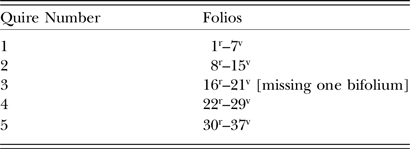
The paper section begins and ends with a lacuna. The extant manuscript starts during the mass prayers for the common of saints (plural) (de sanctis), and ends midway through vespers of the common of a virgin (de uno virgine). These folios are formed into five quires, each originally consisting of eight folios (Table 1). The third quire is missing a bifolium whose leaves were originally situated between the current folios 16v and 17r and between 20v and 21r. As a result, we lack the vespers alleluiaticus, hymn and beginning of the completuria for the common of a confessor (folio 17r begins with the end of the completuria) and most of the mass epistle (folio 21r begins with the end of this reading from Romans 10).Footnote 68
Quire Structure of Paper Section
Throughout these folios, one text scribe was responsible for writing the readings, prayers and chant texts.Footnote 69 After exploring notational vocabulary, melodic dialects and the formation of specific neume types across the paper section, we became convinced that two music scribes shared the task of notating the paper folios in its initial copying phase.Footnote 70 Hand A notated folios 16r–36v, and a newly identified hand, Hand G, notated folios 5r–8r.Footnote 71
a. Variations in the formation of specific neume types
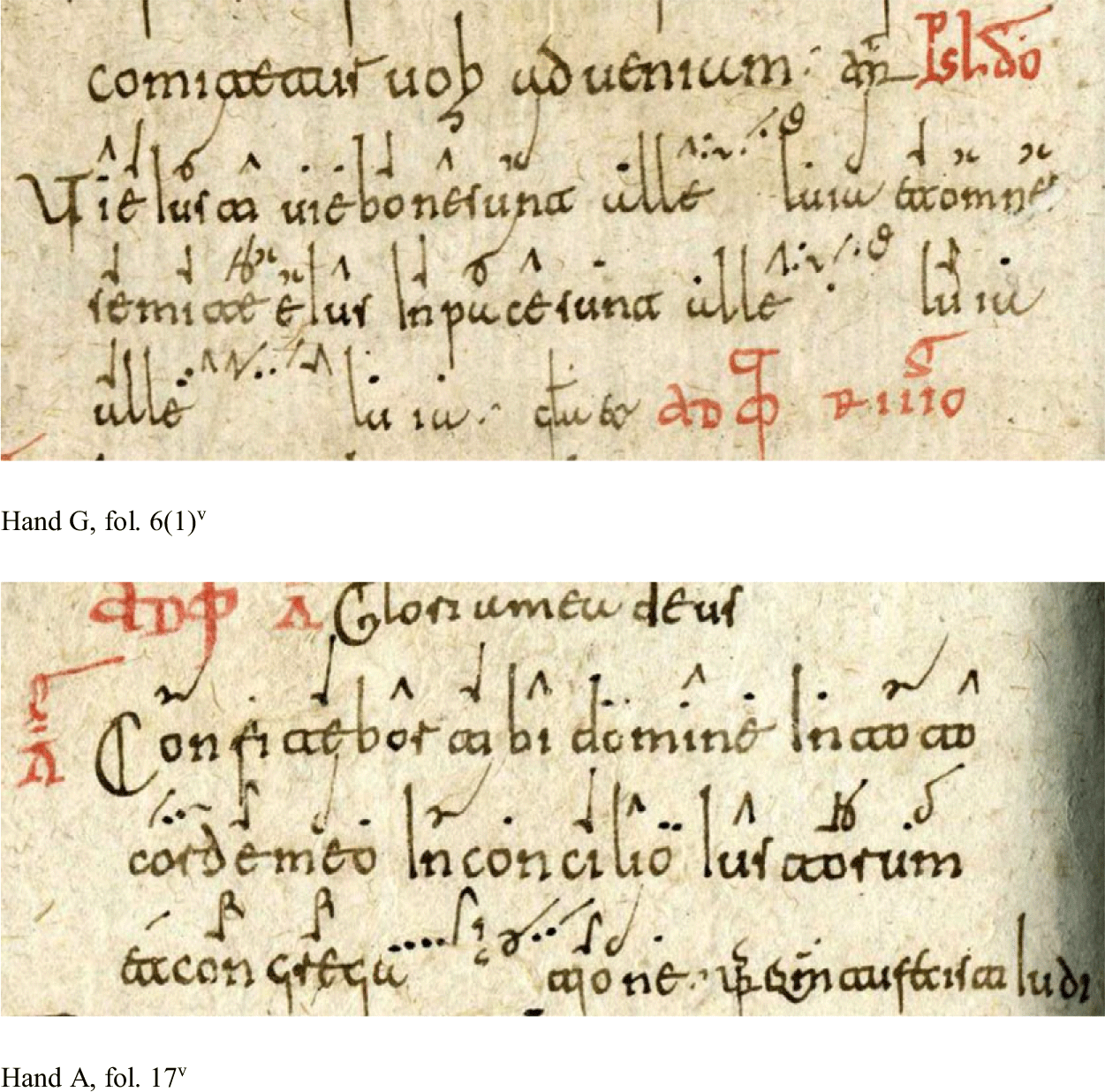
Hand A and Hand G share the same characteristically squat style of Rioja notation (see Figure 4). Despite their general similarity, they wrote specific neumes in different ways. Here, we describe four illustrative examples.
Examples of Hand G and Hand A
The g-shaped NHL neume introduced above (Figure 1) was written in different ways by Hands A and G (see Figure 5a). Hand G wrote this sign beginning with a substantial falling curve that forms the bottom of the neume, positioned to the left of the loop. This often results in the whole shape appearing to tilt to the right. Hand A began this neume with a less substantial falling curve, with the loop positioned either directly above or to the left of the bottom part of the neume, which can result in a tilt to the left.
Neume Types Formed in Varying Ways by Hands A and G
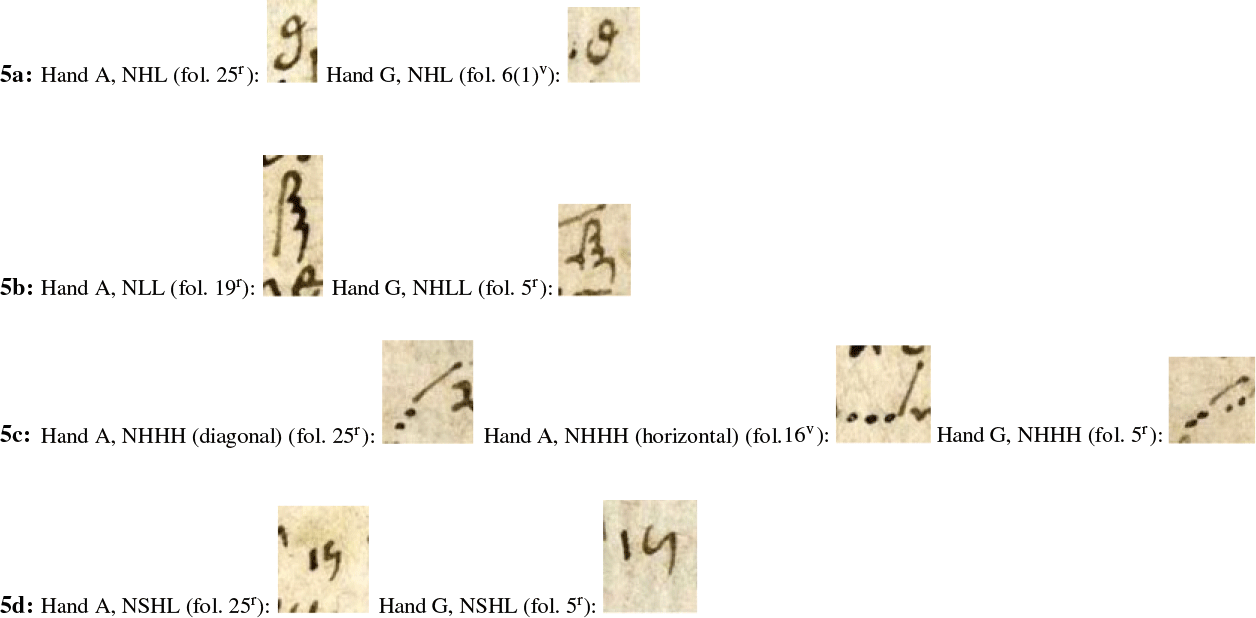
The contour NLL can be written using a stepped falling line (see Figure 5b). In Silos 6, Hand G did not write this form of NLL in isolation, but he did write a related neume with an initial horizontal stroke (NHLL), which we can use for comparison. The descending right-hand portion of this neume projects out to the right, ending with a substantial final hook. By contrast, Hand A often wrote NLL in isolation, using falling gestures that curve back towards the initial stroke with a final, tight hooked gesture.
Hand G and Hand A had different ways of forming gapped rising neumes that comprise a series of puncta followed by a virga (Figure 5c). These gapped neumes were written from left to right in an ascending diagonal direction by Hand G (consistently), and by Hand A (sometimes). When there was limited writing space, however, Hand A tended to write the puncta horizontally, to avoid over-writing the text. Even where the writing space is limited, these neumes always rise diagonally in Hand G’s notation.
A further distinctive ‘tell’ between Hand A’s notation and that of Hand G is the gapped NSHL neume (Figure 5d). The SHL portion of the neume was written with wide sweeping curved gestures on folios 5r and 7v by Hand G. In contrast, Hand A wrote the SHL portion of the neume with tight curved gestures and shorter strokes resulting in a much smaller sign.
b. Notational vocabulary
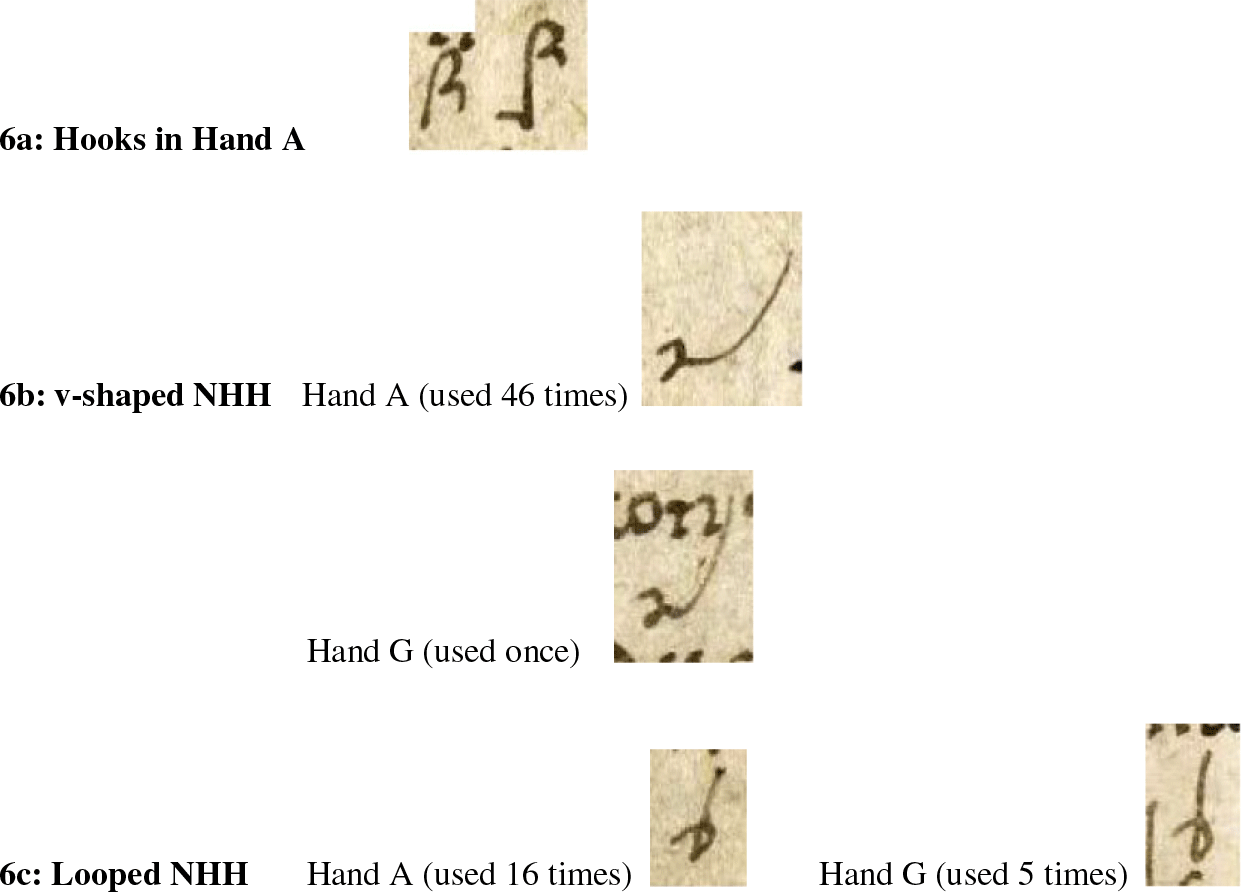
Different scribes can also be distinguished through their notational vocabulary: some common signs can be entirely absent from a particular scribe’s work, and some scribes have a marked preference for particular neumes or gestures.Footnote 72 We give two examples here, drawn from the 24 chants written by Hand A and 8 chants written by Hand G. Some neumes end with a hook, following a final fall in pitch (Figure 6a).Footnote 73 In Hand A, hooks are commonly found at the ends of NHL neumes and similar contours with additional rising notes in the middle of the neume (e.g., NHHL). Hand A wrote hooked neumes 32 times in total; there are no hooked neumes during Hand G’s stint. The frequency of v-shaped NHHs provides further insight into the habits of each scribe (Figure 6b). This neume is the most common way of writing NHH in Silos 6; it appears more than twice as often as either the looped or gapped NHH neumes.Footnote 74 Hand A follows this tendency, using v-shaped NHH 46 times (Figure 6b) and looped NHH 16 times (Figure 6c). Hand G, by contrast, used the v-shaped NHH much less frequently than the looped version (the v-shaped NHH only once, and the looped NHH five times; see Figure 6b and c for an illustration of these shapes). This suggests that while Hand G was aware of the v-shaped NHH, he had a much greater preference for the looped neume than Hand A did. As this comparison illustrates, patterns in use of common notational signs or gestures can help to support scribal identification.Footnote 75
c. Roles and responsibilities
Neumes that are Characteristic of Particular Scribes
There is little evidence with which to confirm whether Hand A or Hand G was the text scribe of the paper section, although the division of labour is suggestive. Both Hands A and G left some chants unnotated in their stints.Footnote 76 Hand A routinely notated the beginning of each liturgical day. It is plausible that Hand A set up the format for each liturgical day, copying all of the text and the opening chants, and perhaps expecting another scribe to complete the notation for the rest of the chants.Footnote 77 Hand G arguably began this task of completion, notating much of the common of a just, from the third chant onwards (omitting the vespertinus and sono – perhaps seen as Hand A’s responsibility, although Hand A had not notated them).Footnote 78 Regardless of which music scribe (if either) was responsible for the text, the music and text scripts have similar ink colour and share their stroke thickness, with similar amounts of variation between the thinner strokes (i.e. descenders and final rises of neumes). This suggests that the neumes were written at the same time as the text during this phase of production.
d. Melodic dialects
Hands A and G are also differentiated by their melodic preferences. As can be seen in Online Appendix 2, Hand A used the León melodic dialect for the two responsory tones he notated, as well as for most cadences. His melodic choices at these points contrast with cognates in Rioja dialect manuscripts 75% of the time. Apart from the León dialect moments, Hand A used N+N(H) three-syllable cadences four times (25% of the time). These are rare in the León dialect but, as noted above, are found sometimes in Rioja dialect manuscripts, as well as routinely in Toledo A. Hand G, by contrast, does not align with the León dialect at all at these points of variance. He used three-syllable N+N(H) cadences seven times (78% of the time) and the characteristically Rioja NHL+N cadence twice (22% of the time), although it is not written using the standard neume shapes either time.Footnote 79 Hands A and G, then, are distinct in their melodic dialects. Hand A is much more closely aligned to León, and Hand G tends towards a different dialect, which does not align neatly with the León or Rioja norms as currently understood. In order to explore the understanding of Old Hispanic chant by its notators, the case of Hands A and G admonishes us to investigate melodic preferences scribe by scribe, not manuscript by manuscript or institution by institution.
This evidence has significant implications for our understanding of manuscript mobility and the position of different melodic understandings within an institution. Hands A and G have such similar notational styles that they were almost certainly taught to write in the same place. Hand A faithfully copied his León-dialect exemplar – both text and music – almost all the time,Footnote 80 while Hand G added notation for a few chants, apparently without looking at that exemplar. Hand A occasionally aligns with Hand G’s type of N+N(H) cadence, implying that this was the melodic dialect in which both had been trained.Footnote 81 We cannot discern why Hand A was copying a manuscript that used a different melodic dialect from his own, although various intriguing possibilities come to mind. The paper section of Silos 6 may have been copied for export to an institution that used the León melodic dialect, and a suitable manuscript was acquired as a model. Alternatively, perhaps Hand A and G’s institution was attempting to shift across to the León melodic dialect (at the behest of a new abbot or cantor, perhaps?), and the paper section bears witness to a transitional stage in the process. It is also possible that Hand A and G’s institution needed a liber misticus exemplar for the common of saints, and were only able to source one containing León-dialect melodies, which Hand A copied directly, despite this not aligning with the institution’s preferred melodic dialect. Whichever scenario was in play, this evidence strongly implies that notated manuscripts moved; the León-dialect exemplar from which Hand A was working almost certainly did not originate in his home institution.
The parchment section of Silos 6
The parchment section of Silos 6 contains quotidian Sundays. It was not initially part of the same project as the paper section. The parchment section was compiled in multiple stages, involving three different notational styles.Footnote 82 As noted above, two of the notational styles are typical of sources produced in the Rioja region; the third is typical of sources produced in León. Each scribe in the first phase copied both text and music (Hands C, E and F); their closely similar notational style suggests that they were trained in the same institution. Their musical notation was intermittent. Sometimes complete chants were notated, sometimes entire chants were left blank, and sometimes notation was inserted only at cadence points or for complex melismas. Either during this initial copying phase, or later but within the same institution, one melisma was added in the same notational style by a different hand (Hand H; folio 71v). In the second copying phase, Hand D added a very different style of notation to many texts that had been left unnotated in the first stage (folios 44r–100r). In the final copying phase, Hand B added notation to both the paper and the parchment sections of the manuscript (folios 20r, 37r and 117v onwards), using a León notational style. As in the paper section of Silos 6, different melodic dialects can be discerned in the work of different scribes in the parchment section. Thus, Silos 6 was used and updated over time by several people, possibly in different institutions, whose varying notational styles and melodic traditions bear witness to their distinct cultural identities.
Parchment phase 1
In phase 1, the entire parchment section was laid out and the text written. Changes in text writing – indicating changes in scribal hand – coincide with changes in musical notation. Also, the ink colour used to write the text changes several times, and the first layer of notation matches closely with the text ink on each folio. These factors suggest that text and notation were written concurrently, by the same person.
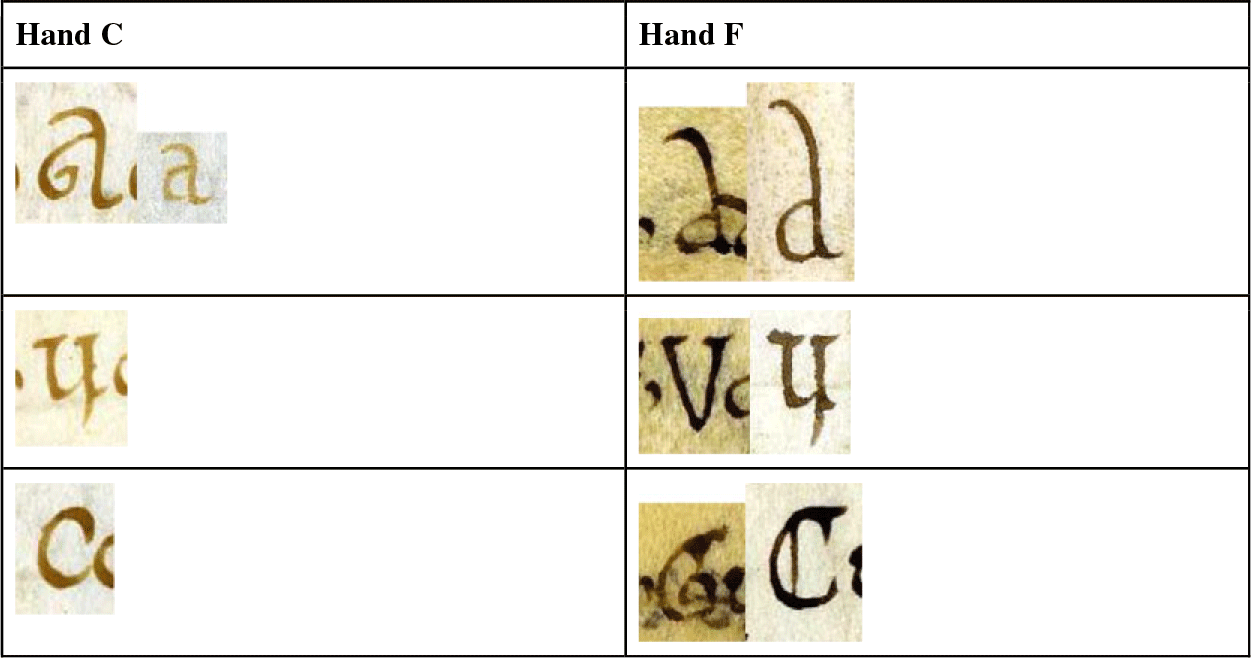
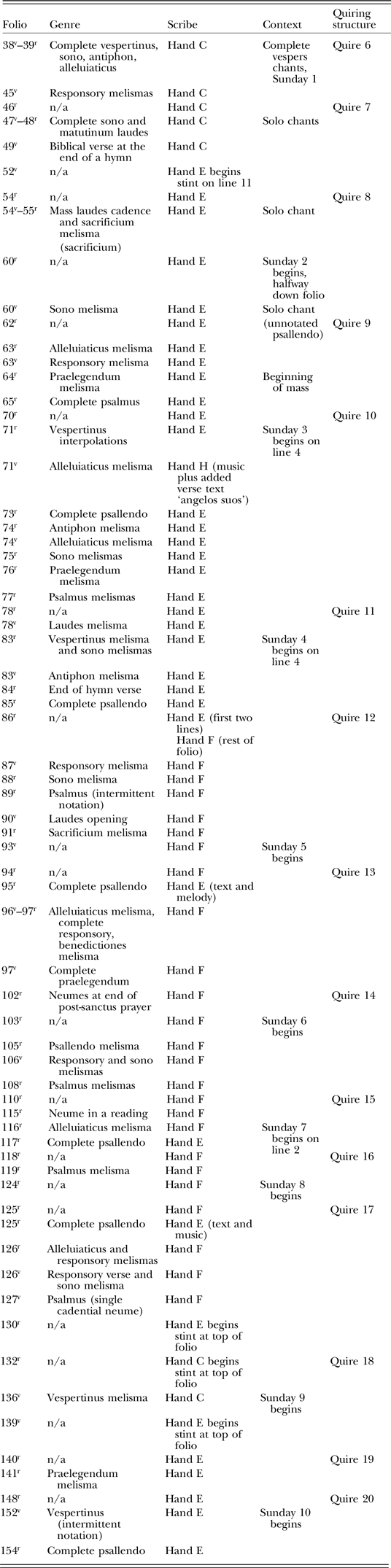
González Barrionuevo identified up to three different text scribes in the parchment section of Silos 6.Footnote 83 In his opinion, all the notation in this first layer was the work of Hand C, with Hand E responsible for a single chant. This is incompatible with our observation that the text and first layer of notation was almost certainly undertaken by the same person. Instead, when we looked closely at the notation, we could discern subtle but consistent differences in the notation correlating with the sections written by each text hand. The three text hands, then, are also the three music hands, Hands C, E and F.Footnote 84 Hand C wrote folios 38v–52v and 132r–139r.Footnote 85 Hand E wrote folios 52v–86r, 130r–131v and 139v–154v.Footnote 86 Hand F was responsible for folios 86r–129v.Footnote 87 Hand E is readily distinguishable from Hands C and F; his letter forms are larger than those of the other scribes, and idiosyncratic in their proportions. Hands C and F differ from each other most notably in their majuscule letter forms. For example, in the letter A, Hand F often wrote a very long ascending stroke that slopes downwards from left to right, whereas Hand C used much shorter and generally more vertical strokes (see Figure 7). Hand F sometimes wrote U with an angle at the bottom (resembling a modern-day V) – this is never present in Hand C’s work. Hand F also occasionally wrote certain capital letters with a stylised fork at the top (e.g., C and G), while Hand C did not. Within the main stints outlined above, the psallendi texts and melodies were sometimes added by Hand E during Hand F’s stint (for summary details, see Table 2, below).
Different Letter Forms Used by Hands C and F
Scribal Stints in the Parchment Section of Silos 6 (First Layer)
a. Notational differences between Hands C, E and F
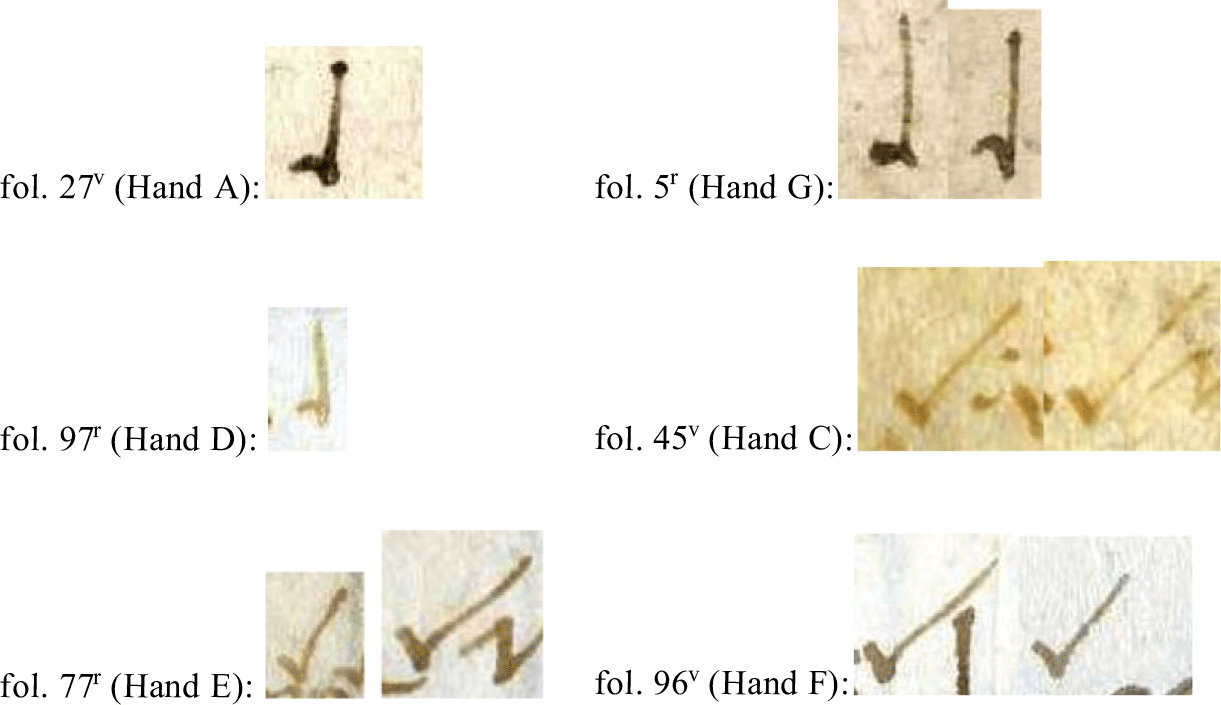
Hands C, E and F used a style of Rioja notation that often has long and thin strokes. It is distinct from the squat style used by Hands A and G (in the paper section) and Hand D (in the second layer of the parchment section). Unlike Hands A, G and D, some notational shapes written by Hands C, E and F tend to be angled towards the right, particularly the right-angled NH (see Figure 8).
Different Ways of Writing Right-Angled NH in Silos 6
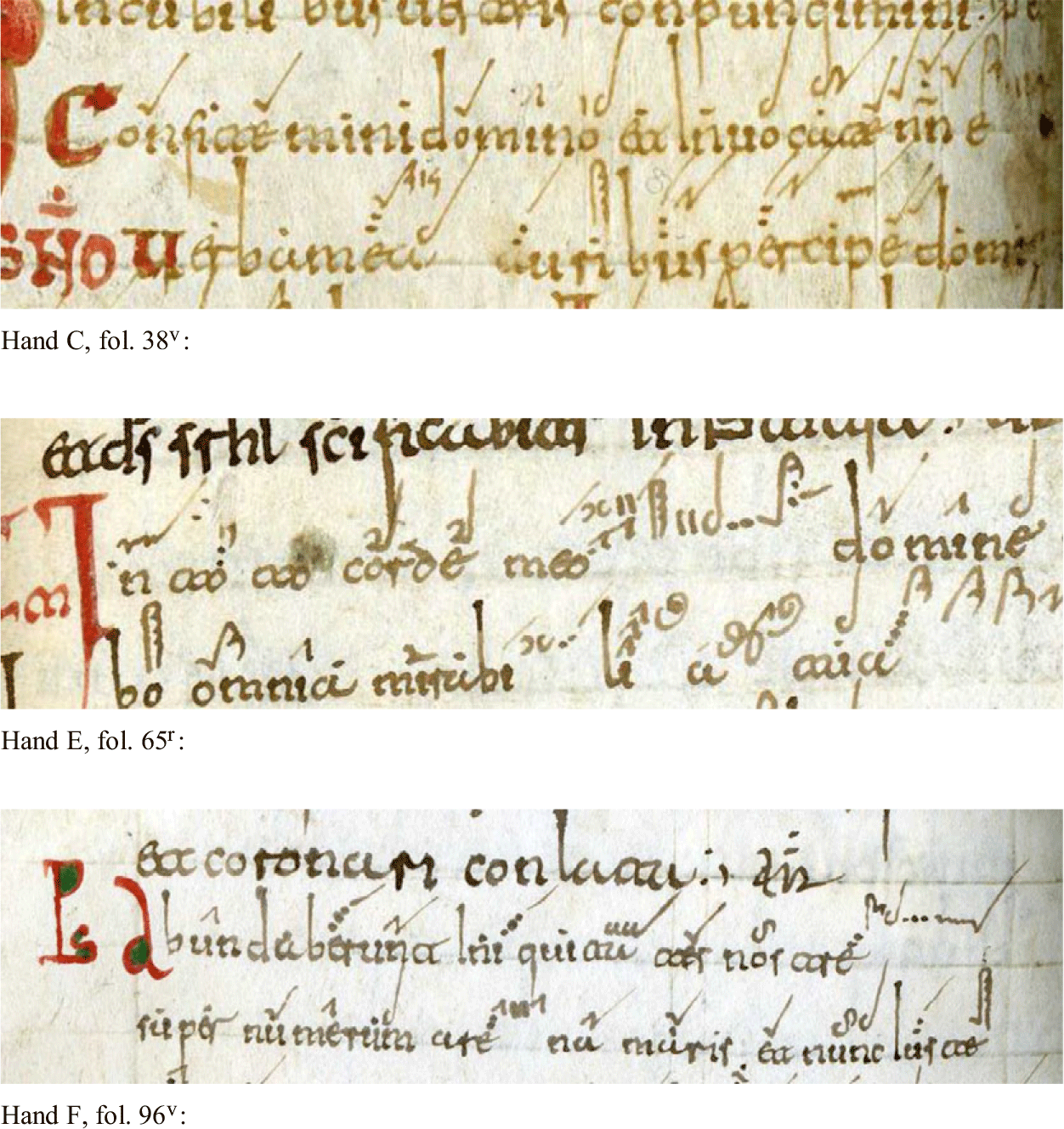
When differentiating between Hands A and G in the paper section of Silos 6, we were able to compare their distinct formation of specific notational signs. This methodology cannot be used to distinguish between Hands C, E and F, because some notational signs are written in a similar manner across the work of all three scribes, and others can vary significantly in graphic appearance within a single line of notation. Instead, each scribe’s contribution can be discerned on the basis of more general characteristics including the inclination of each notational shape on the folio and the contrast between thick and thin strokes resulting from how each scribe held their quill.Footnote 88 We undertook this work independently from our work on the text scribes, confirming only afterwards that the changes of stint coincided across both text and notation. Hand C used a thin-cut nib (see Figures 8 and 9). His notational shapes generally have thin lines with minimal contrast between thick and thin strokes, although he did sometimes rotate the nib to create lines with consistent thickness. Hand E’s notation generally has thicker lines throughout, resulting from a broader-cut nib and from Hand E’s frequent nib rotation both during and between pen strokes. Hand E’s notational signs often thicken at the top of the ascender (e.g., ‘ do mine’ in Figure 9). Sometimes Hand E refilled his quill to complete such ascenders;Footnote 89 at other times he paused before taking his quill from the parchment. This trait does not appear in the work of either Hand C or Hand F. Further, Hand E often wrote the angled NH neumes (Figure 8) with varying angles between the first and second stroke; Hand C and Hand F were much more consistent in forming a 90-degree angle between these strokes. Hand E’s ascenders are often inconsistent in their inclination: sometimes they are vertical, and sometimes they are inclined to the right. Hand C’s and Hand F’s ascenders are more consistently inclined towards the right. Hand F’s notation has a strong contrast between thick and thin strokes, suggesting that he used a broad nib, held in a fixed position.
Comparative Examples of the Notation Used by Hands C, E and F
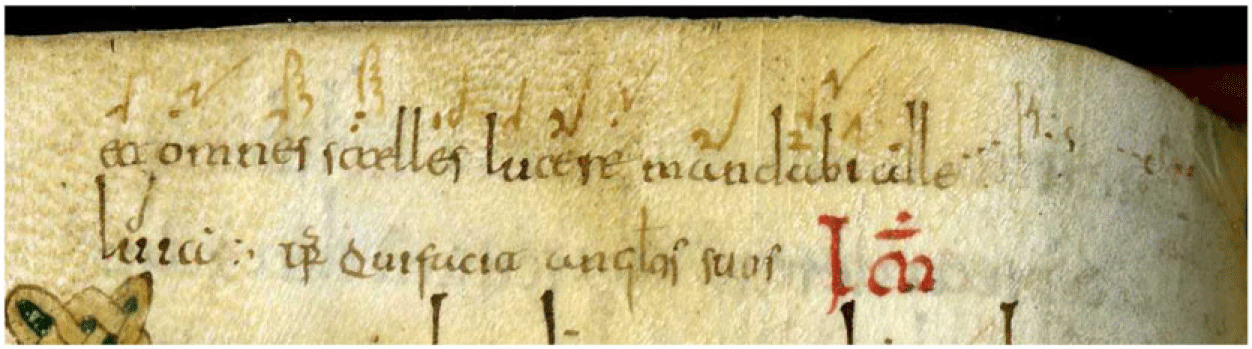
One melisma seems to have been inserted by a further hand (Hand H; Figure 10), after the initial layer was copied. Folio 71v is within Hand E’s first stint, but the notation on ‘(al)leluia’ looks quite different from Hand E’s usual neumes.Footnote 90 Hand H used a very thin-cut nib, producing thinner strokes than those observed in the notation of Hands C, E and F. Near the beginning of the melisma, there is an NL shape that ends with a hook. The distinctively wide curves of both the L and the hook are unlike those of the other scribes in the first layer.Footnote 91 The end of the verse text ‘ang[e]los suos’ may also have been written by Hand H; the top of the ‘s’ is very similar to the NL hook in the notation, and is unlike Hand E’s ‘s’ shapes on the first text system in the example.
Intervention by Hand H, fol. 71v
b. Melodic dialects
Hands C, E and F all notated cadences using a similar mix of melodic preferences, which do not correlate with a single melodic dialect.Footnote 92 Instead, each used some cadences characteristic of the León melodic dialect,Footnote 93 some characteristic of the RiojaFootnote 94 and some involving an N+N(H) cadence.Footnote 95 This combination of preferences can also be seen in the responsory verse tones notated by Hand F: one uses the León version of Randel’s Tone B, and the other uses a version of Tone C that we have been unable to assign to a particular melodic dialect. As discussed above, Hornby and Maloy observed that at some phrase openings, León dialect manuscripts use an NSH opening where Rioja and Toledo A manuscripts tend to use NS.Footnote 96 There are five such moments preserved in Hand C’s stint. Three times Hand C wrote the León NSH; twice he wrote NS, more characteristic of Rioja and Toledo A manuscripts.Footnote 97 This melodic evidence suggests that all three scribes were trained in the same melodic dialect, but that this dialect does not align with any of the dialects previously identified.
c. Roles and responsibilities
We took a holistic approach to the evidence in the initial phase of the parchment section. This sheds light on aspects of the role each scribe played in the production of this manuscript. As can be seen in Table 2 (above), the scribal stints correlate neither with the quiring structure, nor consistently with the beginning of new liturgical days. Hand C opened the parchment section by copying a fully-notated vespers (folios 38v–39r), similar to Hand A’s role of beginning the liturgical day in the paper section. After this, Hand C added intermittent notation during his two stints, including in the opening chant of the ninth quotidian Sunday. Hand E wrote three stints with intermittent notation, including in the opening chants of the third, fourth and tenth quotidian Sundays.Footnote 98 During his stints, he wrote complete notation only for a mass psalmus (folio 65r), and for four of the five psallendi.Footnote 99 As this illustrates, Hand E took particular responsibility for copying and fully notating psallendi. Hand C added only one psallendo text in his stints; this was the first chant that he left unnotated (folio 41v). He either did not have access to the psallendo melody, or did not consider notating it to be a priority. Hand F copied only one psallendo and notated just its final word (folio 105r). For the other three psallendi within Hand F’s copying stint, Hand E intervened to copy both text and melody. This confirms that Hand E had a particular expertise with this genre. While there is no direct evidence about who sang the psallendo, positioned after the closing prayers of vespers and/or matutinum, the copying practices in Silos 6 might suggest that it was a chant known and sung by a limited number of people, perhaps a solo chant.Footnote 100 Unlike Hands C and E, Hand F never added notation to the opening chant of each Sunday in his stint. He mostly added melismas to otherwise unnotated chants, although he did notate a complete responsory (folios 96v–97r) and a complete praelegendum soon after (folio 97v). On the fourth quotidian Sunday the praelegendum is Protege nos, the first quotidian Sunday to which the praelegendum Dominus regnabit was not assigned; this may have prompted notation of the whole chant.
Closer investigation of the genres in which Hands C, E and F intervened is also illuminating. According to the second prologue to L8, ‘two or three at a time sing responds, likewise Vespertini, Laudes, and Psalmi’; according to the Visigothic letter to Bishop Leudefredus, ‘to the psalmist belongs the office of singing. He is to say the Benedictiones, Psalmi, Laudes, Sacrificii, Responsoria, and whatever belongs to the skill of singing’.Footnote 101 These were the genres singled out as those for a small group of singers or the soloist (the ‘psalmist’). To this group, we can add the soni, which have very complex melodies, and psallendi, whose melodies also seem to have been a specialised skill, although they are not as complex as other chants in this group.Footnote 102 37 of the 55 chants to which Hands C, E or F added partial or complete notation belong to one of these genres – 67% of their interventions. In the parchment section as a whole, these genres account for approximately 36% of the chants whose texts were included in full or as incipits. Thus, it was important to Hands C, E and F to define (in part or in full) the melodies of the chants that were likely sung by a soloist or a small group of singers.
Hands C, E and F worked concurrently in the same scriptorium, as can be seen from their alternating stints, and from the interventions of Hand E during Hand F’s stint.Footnote 103 The close similarities between the three – and Hand H – in their textual and notational scripts suggest that all were likely trained in a single institution that had a highly consistent house style for musical notation.Footnote 104 Hand C presumably had a high status in the scriptorium: he was trusted to lay out the manuscript’s format in its opening folios, committing to parchment the institutionally-approved melodies for vespers of the first quotidian Sunday.Footnote 105 He also returned for a short second stint, showing his continued investment in the successful progression of the manuscript. Hand E copied the bulk of the parchment section. He worked alongside Hand F, usually intervening when a psallendo was to be inserted. This genre, at least, seems to have been copied from an unnotated exemplar, an exemplar in which the psallendi were unnotated, or an exemplar that did not include psallendi, since only Hand E was able to add their melodies. We have not observed any direct evidence that points to any of these scribes having copied from a notated exemplar, although of course they may have done so.
Parchment phase 2
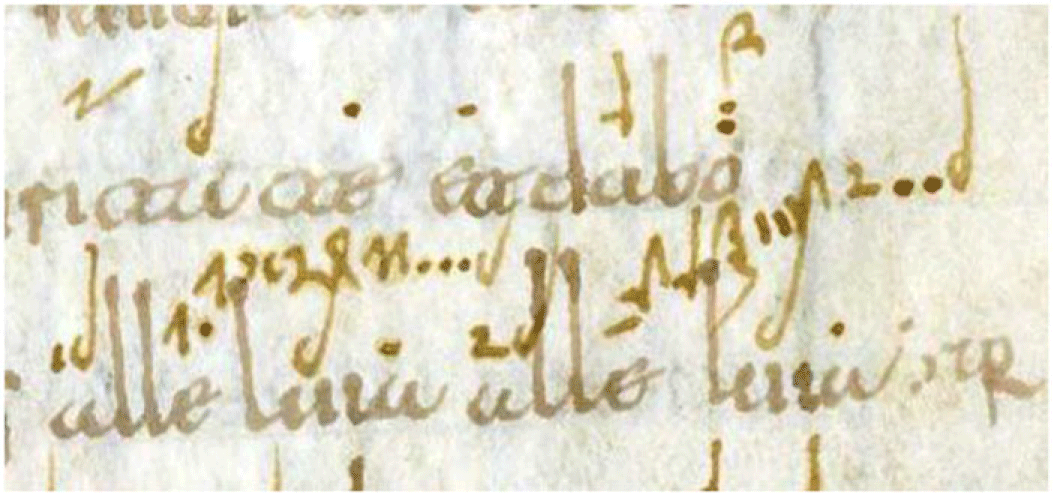
Hand D intervened in the compilation of Silos 6 between folios 44r and 100r. Hand D added notation to many chants that Hand C, E or F had notated partially or not at all. Two main factors lead us to suppose that Hand D’s interventions happened independently from, and after, the initial work on the parchment section. First, Hand D’s notation is very different stylistically from Hands C, E and F; there is nothing to connect their work in paleographic terms.Footnote 106 Second, Hands C, E and F occasionally left horizontal space between syllables, into which they inserted melismas.Footnote 107 Their melisma notation almost always fills the gap neatly; there is no additional, unnecessary space left before the next syllable, and the melisma notation does not continue above the following syllable. This suggests either that they knew the length of the melisma well enough to estimate its length accurately when writing the text, or that they notated the melisma immediately, before they wrote the next syllable.Footnote 108 When these scribes notated a melisma, they left enough space for it between the syllables of the text. When the scribes did not fill in a melisma, they did not leave a gap for it between the syllables of the text.Footnote 109 In other words, Hands C, E, and F did not space the text ready for notation except when they themselves were adding notation. On very few occasions, space is left for a short melisma that Hand D filled in (folio 60r, ‘affacie’; folio 71r, ‘declarabit’, ‘ea’, ‘hec’). In the other chants notated by Hand D, he had to insert his notation in the limited horizontal space left by Hands C, E and F. Often, he had to write the neumes relating to one syllable above the neumes of the next syllable (for an example, see Figure 11). This suggests strongly that Hands C, E and F did not anticipate the contribution of Hand D.
Notation by Hand D Where Sufficient Horizontal Space Had Not Been Left (fol. 75r)
a. Variations in the formation of specific neume types
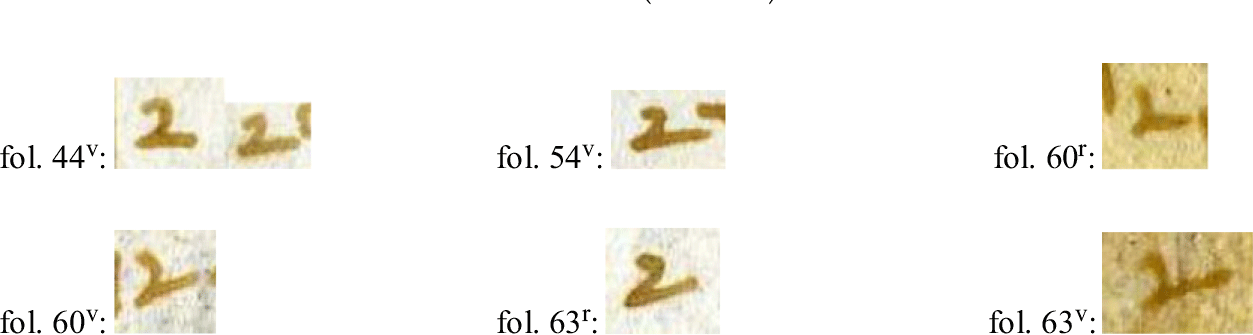
Hand D’s work is defined primarily by its inconsistency. Variations of neume shape occur across folios 44r–100r, but without any consistent patterns that would suggest multiple scribes with different ways of writing particular neumes. For example, the NH shown in Figure 12 varies in shape, across Hand D’s stint, without any discernible pattern. Sometimes there is a tight curve on the first stroke (as on folio 44v in Figure 12), and sometimes the first stroke is much less tightly curved (as on folio 60r in Figure 12). The length of the final stroke varies as well (compare folio 60v and folio 63v in Figure 12). This degree of notational variation is replicated across many of the neume types we investigated. We were unable to detect any consistent patterns in how the notational signs varied, and thus were unable to ascribe particular notational variants to distinct scribes.
Variety of Shape within Hand D’s Notation
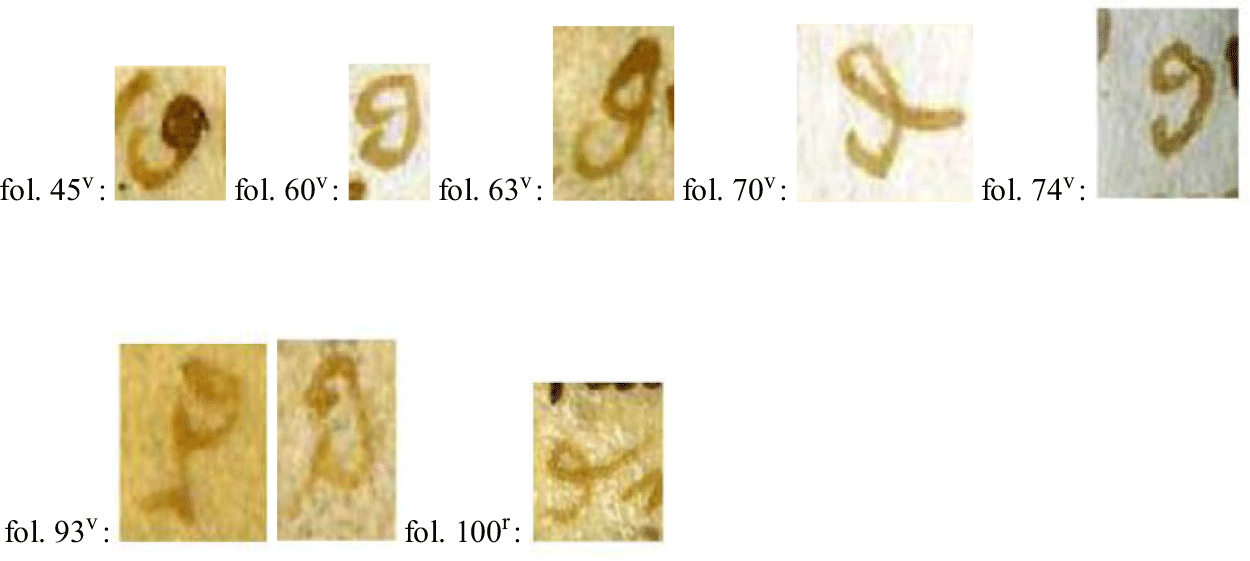
At the same time, some neume shapes are written consistently and distinctively throughout Hand D’s stint. The rising shape in Figure 13 is a good example of this. Although the inclination and proportions of these neumes can vary, their formation, with clearly defined rising curves connected by angles, is consistent throughout the folios written by Hand D.
b. Melodic dialect
Neumes Including Rising Curves in the Notation of Hand D

Hand D often notated chants using the León dialect (78% of cases).Footnote 110 Near the beginning of his stint, this scribe included some melodic readings that are not characteristic of the León dialect: on folio 45v, he wrote a Rioja responsory verse tone and an N+N cadence; in his next intervention, on folio 54v, he wrote a Rioja NHL+N cadence. After this, however, there are almost no departures from the León dialect through the rest of the stint.Footnote 111 For example, at phrase openings, Hand D almost always wrote the León dialect NSH rather than the Rioja dialect NS, sometimes even having an NSH opening where L8 does not.Footnote 112 At some points, the relationship between L8 and Silos 6 is close enough to suggest the two manuscripts have a common ancestral exemplar, especially in the long melismas that tend to be points of variance between chants.Footnote 113
c. Hands A, G and D: a comparison
As noted above, González Barrionuevo suggested that – if one should interpret the two parts of the manuscript as the result of a single project – Hand D might have been the notator of the paper section of the manuscript. We compared Hands A, G and D closely, to establish whether this is indeed likely. We did not find evidence to support González Barrionuevo’s hypothesis.
Hands A and G wrote notational signs in consistent ways. Hand D lacks this internal consistency. The g-shaped NHL illustrates this. As noted above, in Hand G’s stint, this NHL always begins with a substantial falling curve and the neume is often tilted to the right, while Hand A’s NHL has a less substantial curve and is often tilted to the left. As can be seen in Figure 14, Hand D formed this notational sign in multiple different ways. Some notational signs are written similarly by Hand A and Hand G, but differently from Hand D. For example (see Figure 15), Hand D wrote the looped NHH neume with an initial wide curved gesture that thickens as it progresses to the apex of the loop. By contrast, Hand A and Hand G often wrote this neume using a thin pen stroke, growing thicker on the right-hand side of the loop. In this neume Hand D wrote rounded loops, whereas Hand A and G wrote more angular loops. Some ascending neumes begin with a series of rising angular gestures. Hand A and Hand G formed these neumes by writing a series of neat, tight angles; Hand D wrote this gesture more erratically, with irregular sizes of gestures, sometimes curved and sometimes angled (see Figure 15).
g-shaped NHL in Hand D’s Stint
Comparison of Neumes in Hands A, G and D
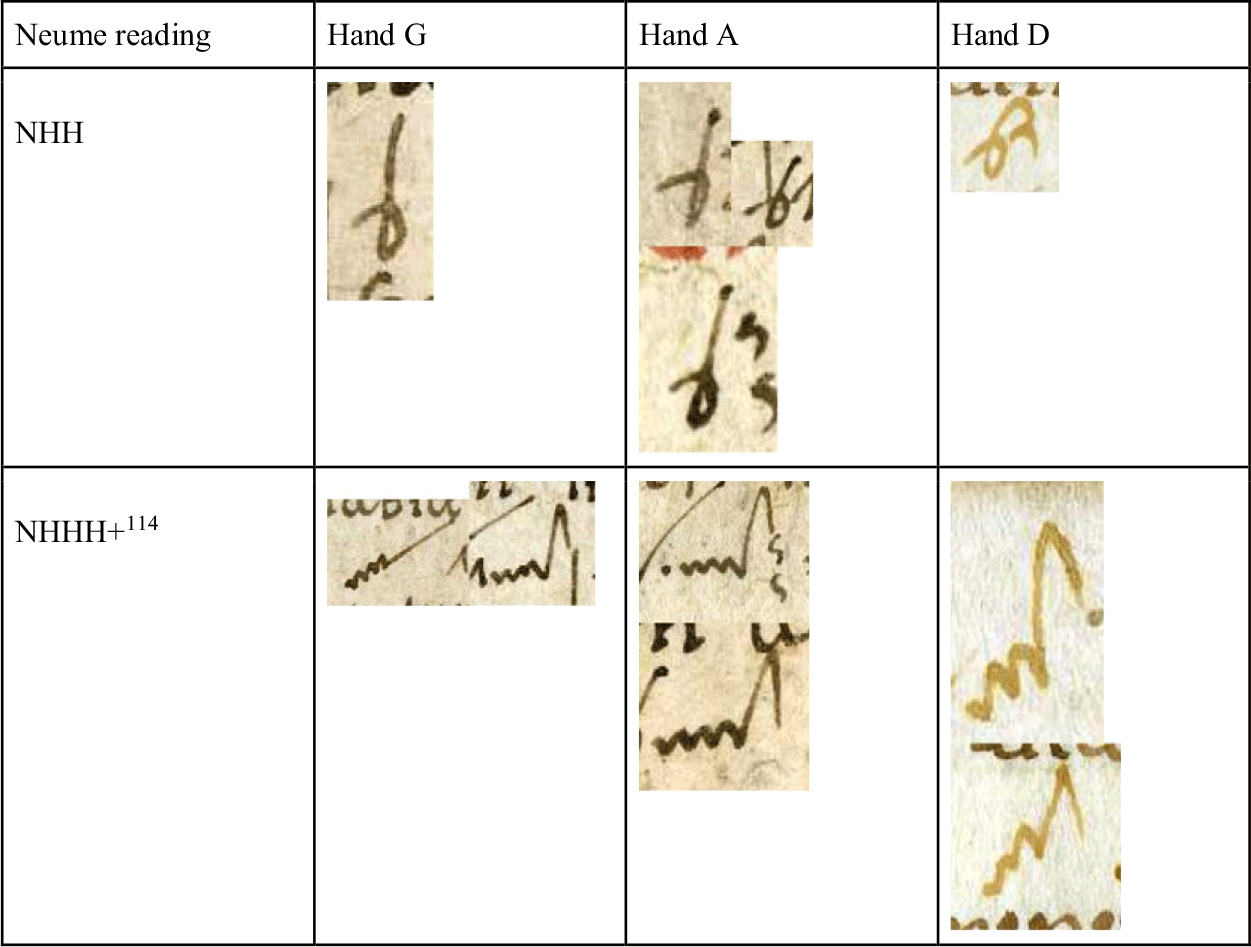
The differences between the notational scripts of Hands A, G and D confirm that they were different people. In more general terms, however, the notational style of these three scribes is very similar. They were probably trained in the same cultural milieu, perhaps even in the same scriptorium. There are parallels in the melodic dialects used by Hands G and D. When Hand G or D departed from the León exemplar, they both used Rioja cadences and N+N(H) cadences. Thus, the similarities between Hand G and Hand D go beyond the resemblance of their notational style. Both seem to have been copying a León dialect exemplar, from which they occasionally departed in similar ways. The melodic choices of Hands D and G, then, may reflect a particular institutional understanding of the melodic language of Old Hispanic chant.
The final phase of compilation: paper and parchment
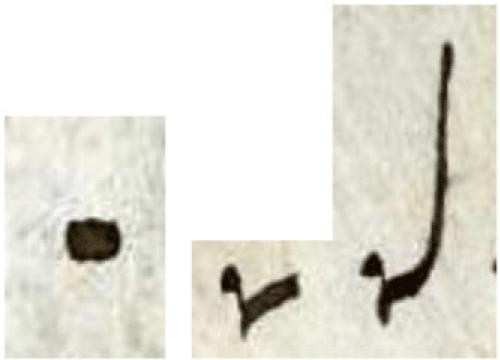
As noted above, Silos 6 contains further interventions by a scribe using a different notational style from the rest of the manuscript. This notational style is otherwise used in manuscripts associated with the León region (L8, Sal, Sant), and, in those manuscripts, the León notational style coincides with the León melodic tradition. León notation is always inclined vertically with a distinctive contrast between thick and thin strokes. This resulted from the scribes holding the nib of the quill in a fixed position so that the thick part of the nib was parallel to the vertical edge of the folio.Footnote 115 Holding the quill in this manner resulted in thick horizontal lines and thin vertical lines. The thick horizontal lines are clearly visible in puncta (see the first image in Figure 16). The distinction between thick horizontal and thin vertical lines is particularly clear in the v-shaped NH and the v-shaped NHH (see the second and third images in Figure 16).
a. León notation in the paper and parchment sections of Silos 6
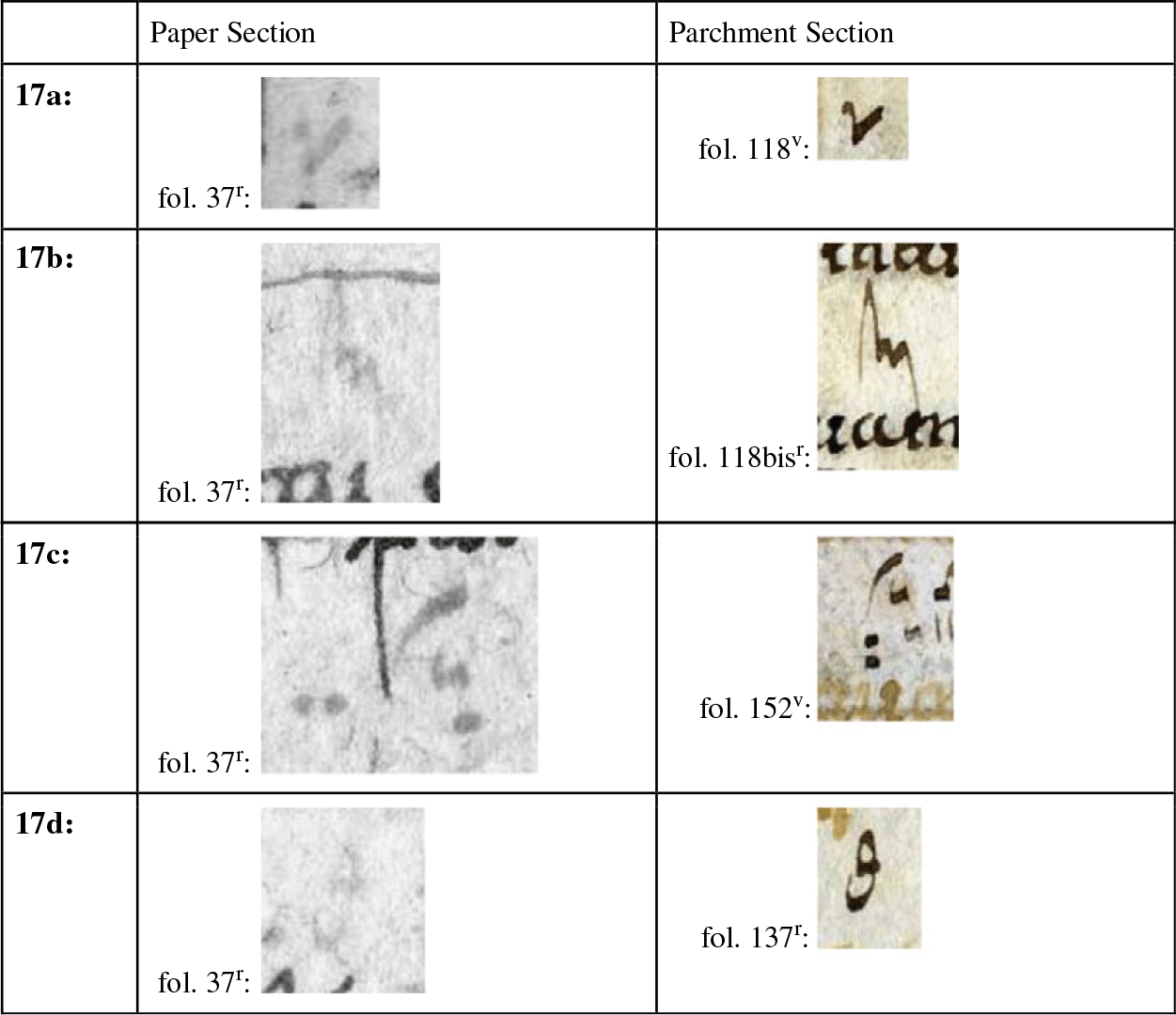
León notation is used in both the paper and parchment sections of the manuscript. González Barrionuevo tentatively identified the León notator in the parchment section as Hand B, who intervened twice in the paper portion of the manuscript (folios 20r and 37r).Footnote 116 Although the notation on folios 20r and 37r is now extremely faded, we used photo editing software to enhance the contrast.Footnote 117 We were then able to confirm that the León notation on these folios is extremely similar to that of Hand B; both hands wrote with a similar thickness, and often used neumes which are written in an idiosyncratic and almost identical manner (see Figure 17). In Figure 17b, the angle at the top of the neume is approximately 10°, there is a long stroke between the top of the neume and the subsequent gesture outwards, and the inclination of the last falling stroke is the same in both parts of the manuscript. We have not encountered the curved line at the top of the neume in Figure 17c in other León notations. The neume in Figure 17d has the loop positioned above and to the right of the initial pen stroke at the bottom left of the neume; it is very consistent in both parts of the manuscript. These similarities make it seem very likely that Hand B contributed to both the paper and parchment sections of Silos 6.
Thick and Thin Pen Strokes in León Notation
León Notation in Silos 6
b. Melodic dialect and likely exemplar
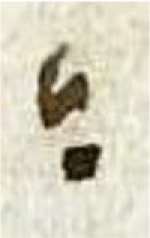
While Hand B worked in a León notational style, his melodic choices do not align with the León tradition. Hand B wrote two responsory verse tones, both following the Rioja melodic tradition.Footnote 118 Twice where L8 has a NSH unison opening, Hand B wrote the more characteristically Riojan NS.Footnote 119 In cadences where melodic dialects can be discerned, where L8 has NHH+N, Hand B wrote NHH+N (once), NHL+N (three times) and NUH+N (four times). Further, Hand B frequently used a gapped NL neume at cadences (see Figure 18). This neume is characteristic of Rioja manuscripts but is never used in the León notational style. These factors combine to suggest that Hand B was working from a Rioja dialect exemplar written in Rioja notation.
c. The nature of Hand B’s interventions
Gapped NL Neume Used by Hand B
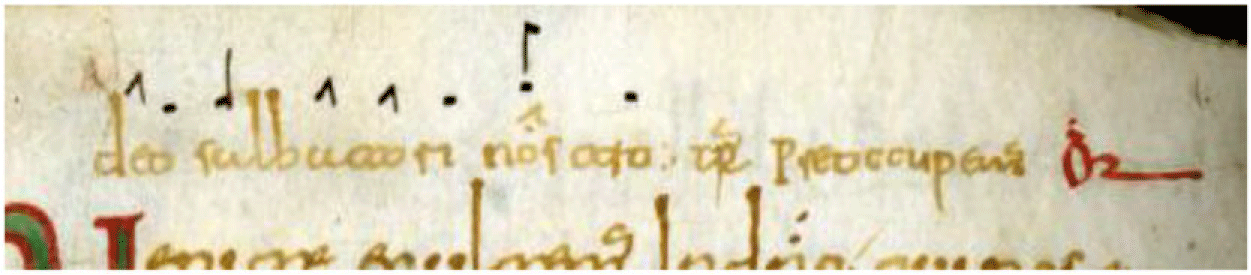
Hand B always notated complete chants, although he did not notate all of the chants that had been left unnotated by Hands C, E, F and D after folio 117v. At some cadence points and on a few syllables that have melismas, Hand B erased the notation written by a previous scribe and inserted his own notation. While Hand B may have adjusted these melodies to match his understanding of their shape, there are certainly moments where he re-wrote the notation without changing the melody. See, for example, folio 138v on ‘nostro’, where Hand B inserted his own version of NHL without erasing the previous NHL (Figure 19). This addition did not alter the melody, although his precise choice of neume shape may have changed the nuance of Hand F’s notation in some way. On some occasions, Hand B erased a punctum (N) and replaced it with an almost identical punctum.Footnote 120 Had he simply retained the previous notation, which was written at a different height above the text, it would be less easy to follow the alignment of melody with syllable boundaries.Footnote 121 Perhaps, therefore, his primary aim was to achieve notational consistency in the chants he notated, rather than particularly to revise the previous melodic version.
Intervention by Hand B on fol. 138v
Since Hand B intervened both in the paper and the parchment sections of Silos 6, the two sections of the manuscript must have been in the same institution (albeit not necessarily bound together) by that point. Further, there are many text corrections to Mass readings and prayers in very dark ink, within both the paper section and the parchment section. Although the ink used by Hand B in the musical notation of the parchment section is also very dark, in the paper section Hand B’s ink is particularly faded, making it dissimilar from the ink used in the corrections to the Mass readings. There is no particular reason to suppose that Hand B corrected the Mass readings. While the Mass readings might have been corrected for devotional purposes at any time, it is hard to imagine corrections to the Mass prayers or Hand B’s notational interventions taking place after the suppression of the liturgy. We thus suggest that the two parts of the manuscript were present in the same institution, and perhaps bound together, before the end of the eleventh century.
Conclusion
Scholars of Old Hispanic chant have known for decades that multiple scribes contributed to Silos 6. With the help of our students, and aided by digital tools, we were able to identify further scribes, combining palaeographical evidence with melodic analysis and investigation of notational vocabulary. As a result of this research, we have been able to separate the chronological and institutional layers of scribal intervention in Silos 6.
Silos 6 began as two separate projects, one on paper and one on parchment. In the initial phase of the parchment project, Hands C, E and F worked closely together on both text and notation, using a shared melodic dialect and closely related notation; they were almost certainly trained to sing and write in the same institution. All three scribes concentrated on the more complex, soloistic chants in the repertory. They notated some melismas and cadences, as well as some complete chants, with Hand E taking particular responsibility for the psallendi. Hand H added a single melisma in a similar notational style. The partial notation may have been planned from the outset, since Hands C, E and F did not leave space for melismas where they had not themselves notated them. This layer of Silos 6 was compiled in an institution with at least four scribes trained to write musical notation in a uniform way.
Hands A and G contributed to the first layer of the paper project. Their notational style is very different from that of Hands C, E and F; these two groups of scribes were not taught to notate by the same person.Footnote 122 Their copying practices were also different: unlike Hands C, E and F in the parchment section, Hands A and G almost always notated complete chants. The melodic dialect of Hand G is distinctive, and seems to have been known also by Hand A, although Hand A copied an exemplar that followed the León melodic dialect. This part of the manuscript was unlikely to have been copied in the same institution as Hands C, E and F, since the melodic dialects are not the same.
The second layer of intervention in the parchment section was undertaken by Hand D, who completed (or entirely notated) many chants on folios 44r–100r. As noted above, his contribution was not anticipated by Hands C, E and F. Hand D’s notational script is extremely close to that of Hands A and G. Further, he closely followed the León melodic dialect, like Hand A. It is very possible that Hand D trained in the same milieu, and worked in the same scriptorium, as Hands A and G. If this is the case, then the parchment section was probably moved to this institution before Hand D added notation to it.
Subsequently, corrections were made to the mass readings, and Hand B wrote chants in both sections of Silos 6.Footnote 123 By this point, the two sections were bound together, or they were at least present in the same institution. In contrast to the earlier contributions to the manuscript, Hand B used a León notational script. Hand B was certainly trained to notate in a different institution from all the other Silos 6 scribes. Hand B wrote in a Rioja melodic dialect, contrasting with the León melodic dialect of the previous layer of intervention (Hand D), and probably reflecting the melodic tradition of a different institution. Either the two sections of Silos 6 had been moved to Hand B’s institution, or Hand B had moved to the institution of Hand A and G (and perhaps D) where he contributed to Silos 6 using his preferred melodic dialect and notational style.
Thus, Silos 6 testifies to the mobility of music manuscripts and scribes in early medieval Iberia: the parchment section may have moved before Hand D’s interventions; and Hand B added notation after the entire manuscript moved again, or after he himself had travelled. Hands A and D indirectly point to further mobility, either of scribes or manuscripts. Both Hands A and D were trained to write in a notational script that we associate with a Rioja melodic dialect, but wrote chants in the León melodic dialect; either they had moved (after training) to an institution where the León melodic dialect was copied and used, or they worked in a scriptorium that had acquired and was copying León melodic dialect exemplars. Hand B, trained in León notational script but notating Rioja melodic dialect, illustrates the exact reverse. These singer-notators must have been aware of different institutional preferences for the Old Hispanic melodies, and were able to shift between them as needed. The evidence of Silos 6 admonishes us to approach the work of each scribe as a separate unit of analysis. As we have shown, individual Silos 6 scribes in different layers followed different – and identifiable – melodic dialects, and prioritised the notation of different parts of the chant repertoire, using a variety of notational styles. This manuscript was the result of multiple layers of intervention in different institutions over time, rather than being the homogeneous reflection of a particular institution’s practices.
There is wider evidence that liturgical manuscripts could move from institution to institution in medieval Iberia, including charter evidence.Footnote 124 We have encountered evidence of the movement of scribes or manuscripts in some other extant liturgical manuscripts. BL45, a Rioja manuscript, has some chants notated by a scribe trained in León notation; either the manuscript or (more likely) the scribe moved to the institution where BL45 was held.Footnote 125 Similarly, there are multiple notational styles in T6, indicating movement of the manuscript or of those who added notation to it.Footnote 126 It is too early to be able to draw wider conclusions about the extent to which notators and manuscripts moved around early medieval Iberia; each manuscript will have to be carefully examined first. We can observe now, though, that heterogeneous liturgical manuscripts might sometimes have originated in the same institution by scribes who had been trained in different places, or that stylistically very similar manuscripts might sometimes have been copied in different places by scribes who moved after they were trained in a single place.
In our work on Silos 6, we have argued that there is an institutional identity shared by Hands C, E and F, who have very similar notational styles. Other evidence beyond their notation confirms that they worked together at the same time and in the same place, including their division of labour and their shared melodic dialect. It is very likely indeed that they were trained in the same institution, and it is possible that this institution had a notational ‘house style’. We are not yet in a position, however, to identify institutional notational identity across more than one manuscript. This is, in part, because the close palaeographical work has not yet been done on enough Old Hispanic manuscripts. A more fundamental challenge – perhaps insurmountable – is that only approximately forty notated Old Hispanic manuscripts survive from the entire Iberian peninsula; no colophons confirm that two or more of these manuscripts were written at a similar time in the same institution. Even after each manuscript is studied in detail, it still may not be possible to identify notational ‘house styles’ across multiple manuscripts. (As a point of comparison, over twenty extant neumed liturgical manuscripts originate from the Abbey of Saint Gall alone.)Footnote 127
As we have illustrated, the identification of scribal hands in a medieval manuscript is the first step towards a deep understanding of the material object’s compilation. When we consider a manuscript as a product of individual people, each with their own priorities, knowledge, resources and agency, we can begin to uncover aspects of scriptorium and scribal practice and the layers of intervention that resulted in the extant manuscript.Footnote 128 We can pinpoint moments when a manuscript or a scribe (or both) moved from one institution to another. We can sometimes establish aspects of the working relationship between scribes, including scriptorium hierarchy, shared training and the particular expertise of individual writers. We can identify how many scribes worked together on a particular project, which gives a lower limit for estimating scriptorium size. We can establish some of the cultural (including musical) knowledge on which they drew, and can determine characteristics of now lost exemplars.Footnote 129 Medieval manuscripts reward very close analysis because they offer a window into medieval culture and the daily life of those who captured that culture in writing. Appreciating the work of each scribe as an individual promises to lead to a finely-grained understanding of the scribal, musical and liturgical traditions to which the manuscripts bear witness.
University of Bristol
Supplementary material
For supplementary material accompanying this paper visit https://doi.org/10.1017/S0261127922000031
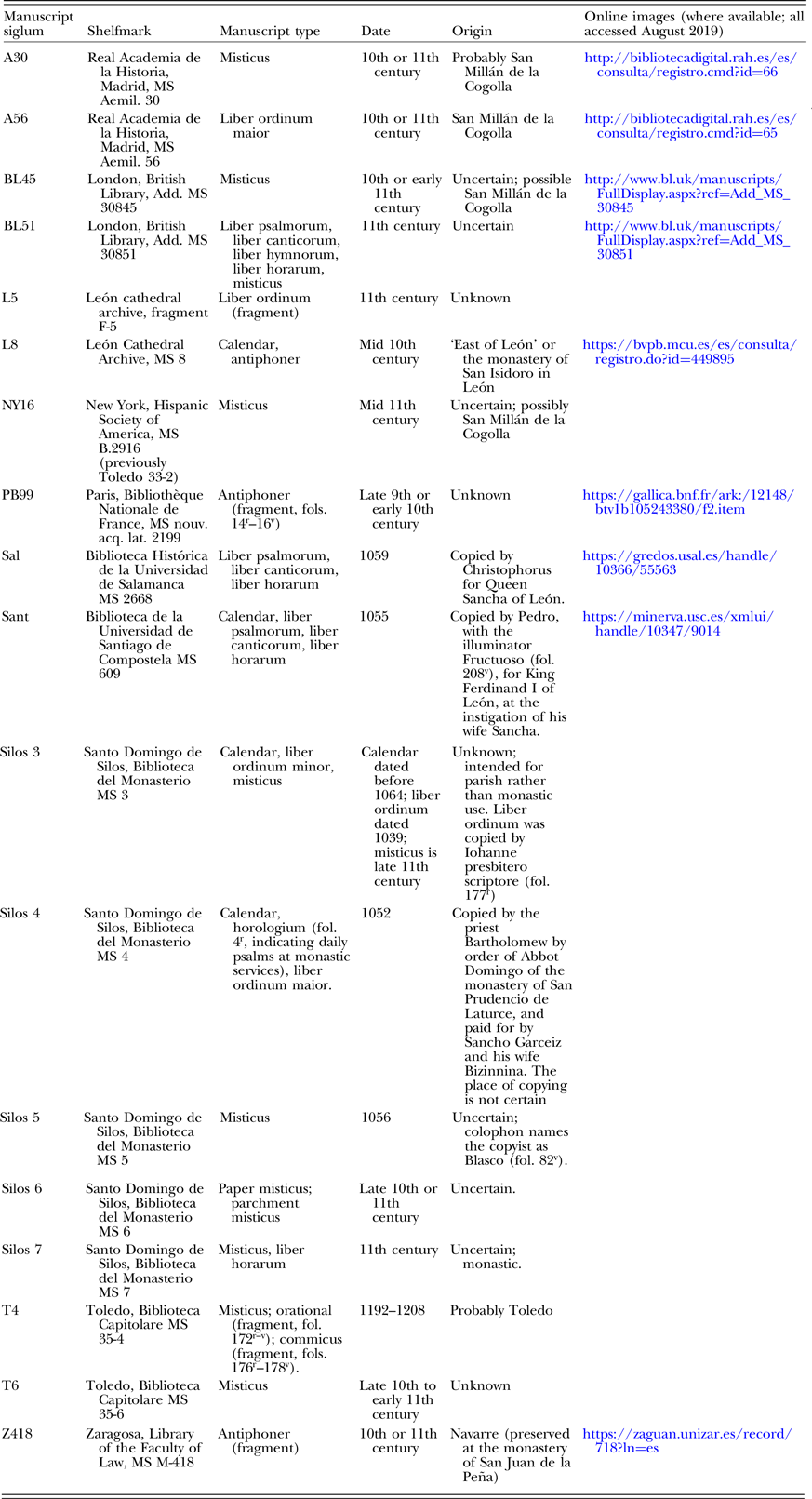
Appendix 1 Manuscript Sigla
Our manuscript sigla are largely derived from Randel, Index. Exceptions are: L8 rather than his ‘AL’ (we have chosen a siglum which combines the manuscript’s location with its shelfmark); and Z418 (thought, when Randel made his index, to have been copied at the monastery of San Juan de la Peña, hence his siglum SJP). All British Library manuscripts have been labelled BL rather than Randel’s BM, since they have been moved from the British Museum to the British Library. For summary notes on the notated chant manuscripts, with bibliography, see Hornby et al., Understanding the Old Hispanic Office, Appendix 1, pp. 347–69. See also http://musicahispanica.eu/


 Open access

