





Introduction
In recent years, many researchers and industrialists have focused on exploiting the properties of tungsten metal in various industrial applications due to the electronic structure of its valence sub-shell (d), which is partially filled, giving it more oxidation states and many stable compounds and alloys with interesting properties.
The element tungsten (W) belongs to series III and group 6 of the periodic table of the elements, with chromium, molybdenum, and seaborgium. To date, a large number of studies have reported on tungsten derivatives showing their efficiency in photoluminescence (Shivakumara et al., Reference Shivakumara, Saraf, Behera, Dhananjaya and Nagabhushana2015; Wang et al., Reference Wang, Gao, Sun, Li, Wang, Liu, Chen and Yang2020), photocatalysis (Tang et al., Reference Tang, Meng, Xue, Zhang and Li2021; Elaouni et al., Reference Elaouni, El Ouardi, BaQais, Arab, Saadi and Ait Ahsaine2023), optoelectronics (Xie et al., Reference Xie, Wu, Hu, Qian, Feng, Chen, Zhang, Xu, Hu, Liu and Zhang2018; Kara-Zaitri et al., Reference Kara-Zaitri, Bendaoudi, Ould-Mohamed and Ouahrani2022), phototherapy (Li et al., Reference Li, Zhang, Zou, Wang, Zhang, An, Yin, Hu and Hu2014; Deng et al., Reference Deng, Hou, Deng, Yang, Li and Lin2015); and electrochemical sensors (Nagarajan et al., Reference Nagarajan, Murugan and Sundramoorthy2020; Ikram et al., Reference Ikram, Javed, Shad, Sajid, Irfan, Munawar, Hussain, Imran and Dilshad2021).
Layered double hydroxides (LDHs), also called anionic clays, are lamellar materials consisting of alternating cationic layers $ {[{M}_R^{2+}{M}^{3+}{(\mathrm{O}\mathrm{H})}_{2R+2}]}^{+} $
and anionic interlayers
$ {[{M}_R^{2+}{M}^{3+}{(\mathrm{O}\mathrm{H})}_{2R+2}]}^{+} $
and anionic interlayers $ \left[{\mathrm{A}}_{1/p}^{p-},n{\mathrm{H}}_2\mathrm{O}\right] $
leading to a general formula:
$ \left[{\mathrm{A}}_{1/p}^{p-},n{\mathrm{H}}_2\mathrm{O}\right] $
leading to a general formula: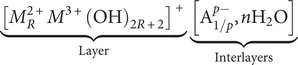 $ \underset{\mathrm{Layer}}{\underbrace{{\left[{M}_R^{2+}{M}^{3+}{\left(\mathrm{OH}\right)}_{2R+2}\right]}^{+}}}\hskip0.3em \underset{\mathrm{Interlayers}}{\underbrace{\left[{\mathrm{A}}_{1/p}^{p-},n{\mathrm{H}}_2\mathrm{O}\right]}} $
. R = Mg/Al (molar ratio). The positively charged layers contain edge-shared metal M
2+ and M
3+ hydroxide octahedra (M
2+: Mg2+, Cu2+, Zn2+ and M
3+: Al3+, Fe3+, Cr3+). This charge generated from the substitution of a divalent metal cation by a trivalent one, is neutralized by the intercalation of hydrated A
p– anions in the interlayer spaces, e.g. chloride, nitrate, sulfate, carbonate, benzoate, or tungstate, (Reichle, Reference Reichle1986; Vaccari, Reference Vaccari1999).
$ \underset{\mathrm{Layer}}{\underbrace{{\left[{M}_R^{2+}{M}^{3+}{\left(\mathrm{OH}\right)}_{2R+2}\right]}^{+}}}\hskip0.3em \underset{\mathrm{Interlayers}}{\underbrace{\left[{\mathrm{A}}_{1/p}^{p-},n{\mathrm{H}}_2\mathrm{O}\right]}} $
. R = Mg/Al (molar ratio). The positively charged layers contain edge-shared metal M
2+ and M
3+ hydroxide octahedra (M
2+: Mg2+, Cu2+, Zn2+ and M
3+: Al3+, Fe3+, Cr3+). This charge generated from the substitution of a divalent metal cation by a trivalent one, is neutralized by the intercalation of hydrated A
p– anions in the interlayer spaces, e.g. chloride, nitrate, sulfate, carbonate, benzoate, or tungstate, (Reichle, Reference Reichle1986; Vaccari, Reference Vaccari1999).
Tungstate is an oxyanion in which the tungsten atom reaches the maximum oxidation state (+VI). In aqueous solution, the tungstate [WO4]2– is generally stable only at pH > 9 and exists in different polyoxometalate forms depending on the pH of the medium (De Buysser et al., Reference De Buysser, Driessche, Vermeir, Thuy, Schaubroeck and Hoste2008), making it difficult to know the nature of the tungstate intercalated in the LDH matrix. Consequently, only a few studies have been reported, including the intercalation of [WO4]2– in Ni-Fe LDH (Wang et al., Reference Wang, Li, Hong, Yang, Liang, Dong, Zhang, Wang, Zhang, Sun, Yao, Luo, Liu, Li, Chu, Du, Gong, Sun and Tang2024) and in Mg-Al LDH at pH 9–10 (Li et al., Reference Li, Wang, Yu, Wang, Liu, Yang, He, Wang and Zhang2011), [H2W12O40]6– in Zn-Al LDH at pH 4.3 (Gardner and Pinnavaia, Reference Gardner and Pinnavaia1998), and [H2W12O42]10– in Mg-Al LDH at pH 6.5 (Del Arco et al., Reference Del Arco, Carriazo, Gutiérrez, Martin and Rives2004).
Moreover, the thermal decomposition of LDHs by dehydration, dehydroxylation, or decomposition of the intercalated anion is a well-known method for the preparation of mixed metal oxides (MMOs) (Salih et al., Reference Salih, Sabri, Tan, Sulaiman, Hussein, Said and Yap2019). The advantage of MMO materials lies in the synergy between all the oxides that form the MMO matrices, which can lead to interesting new properties. In addition, as the MMO compounds were generally formed by more than two oxide phases, this should generate a defect and a strong interfacial polarization, which can strongly influence the properties of MMOs, especially the electrical and dielectric ones.
Although a few studies have reported the optical properties of tungstate intercalated LDH, to the best of the present authors’ knowledge, the electrical and dielectric properties of these types of anionic clays, as well as their MMOs, have not yet been reported in terms of characterization of optical, electrical, and dielectric properties. Hence, the aim of this work is to synthesize tungstate intercalated Mg-Al-LDH and its derived mixed-metal oxide (MMO), obtained by calcining LDH at a moderate temperature, not exceeding 723 K, and to study and compare the optical, electrical, and dielectric properties of both materials. The choice of LDH based on magnesium and aluminum was due to the fact that this phase is thermally stable due to the high polarizing power of Al3+ (Grégoire et al., Reference Grégoire, Ruby and Carteret2012).
Materials and methods
Reagents used in the preparation of Mg-Al layered double hydroxide intercalated with tungstate ions
All reagents were purchased from Sigma-Aldrich: magnesium nitrate hexahydrate (Mg(NO3)2·6H2O) with purity (P) ≥99%, aluminum nitrate nonahydrate (Al(NO3)3·9H2O) (P≥98%), sodium tungstate dihydrate (Na2WO4·2H2O) (P≥99%), and sodium hydroxide (NaOH) pellets (P≥98%).
Preparation of LDH
Tungstate intercalated Mg-Al layered double hydroxide (LDH) was prepared with a molar ratio of Mg/Al=2. The synthesis was carried out by the co-precipitation method at constant pH (Miyata, Reference Miyata1975). In fact, an aqueous solution containing Mg(NO3)2·6H2O and Al(NO3)3·9H2O ([Mg2+]+[Al3+]=0.25 M) was added dropwise to a closed reactor containing a quantity of Na2WO4·2H2O (molar ratio of WO42–/Al3+=2.5). The pH of the reaction mixture was maintained at a constant value (10±0.2) by adding an aqueous solution of NaOH (0.5 M) under nitrogen atmosphere and at 298 K. In this step, nitrogen was used to avoid contamination by carbonate anions resulting from the reaction between atmospheric carbon dioxide and hydroxide anions from the basic medium. Once all of the salts had been added to the reactor, the slurry obtained was aged for 24 h at 298 K and under nitrogen flow. The solid was then filtered, recovered, washed several times with distilled water, dried at 50°C for 48 h, and then ground. The sample obtained was labeled LDH. The experimental Mg/Al molar ratio was ~1.95 from the ICP analysis, which gave 14.24% and 8.10% as mass percentages for Mg and Al, respectively. By combining with the thermal gravimetric analysis (TGA) results, the mass percentage of water corresponded to 10.29%, and according to the theoretical formula as reported above in the Introduction, the experimental formula of LDH was as follows:
 $$ {\mathrm{Mg}}_{1.95}\mathrm{A}\mathrm{l}{(\mathrm{O}\mathrm{H})}_{5.9}{({\mathrm{WO}}_4)}_{0.5}\cdot 0.52{\mathrm{H}}_2\mathrm{O} $$
Preparation of MMO (mixed metal oxide derived from LDH)
A mass of the prepared LDH was calcined under air at 723 K for 4 h, cooled, and ground. This sample was labeled MMO.
Physical-chemical characterization
X-ray diffraction (XRD) characterization was recorded using a Bruker-AXS diffractometer model D8 with CuKα radiation over the range 5–70°2θ.
Thermal analysis was carried out using a Shimadzu DTG model 60H, with a heating rate of 5°C min–1, air flow of 200 cm3 min–1, and precision of measurements of 0.001 mg.
Raman spectroscopy analysis was performed using a Bruker Raman Microscope Senterra II operating with a 532 nm laser, a spectral resolution of 1.5 cm–1, and an acquisition time of 1000 ms over the spectral interval between 50 and 1410 cm–1.
Diffuse reflectance spectroscopy measurements were performed using a Lambda 365 UV-Vis instrument equipped with an integrating sphere. The spectral range scanned was 1100–190 nm.
Impedance spectroscopy analysis was performed at room temperature and under a relative humidity of ~68% using a Solartron Analytical Modulab MTS instrument operating at a frequency range of 1 Hz to 1 MHz and an amplitude of 0.8 V. Approximately 200 mg of sample powder was compressed under 2 tons of pressure and placed between two parallel Cu electrodes. The electrodes were adjustable by a micrometer to control sample thickness. The resulting data were analyzed using Zview 2.2 software for electrical modeling.
Results and Discussion
X-ray diffraction
XRD pattern of LDH
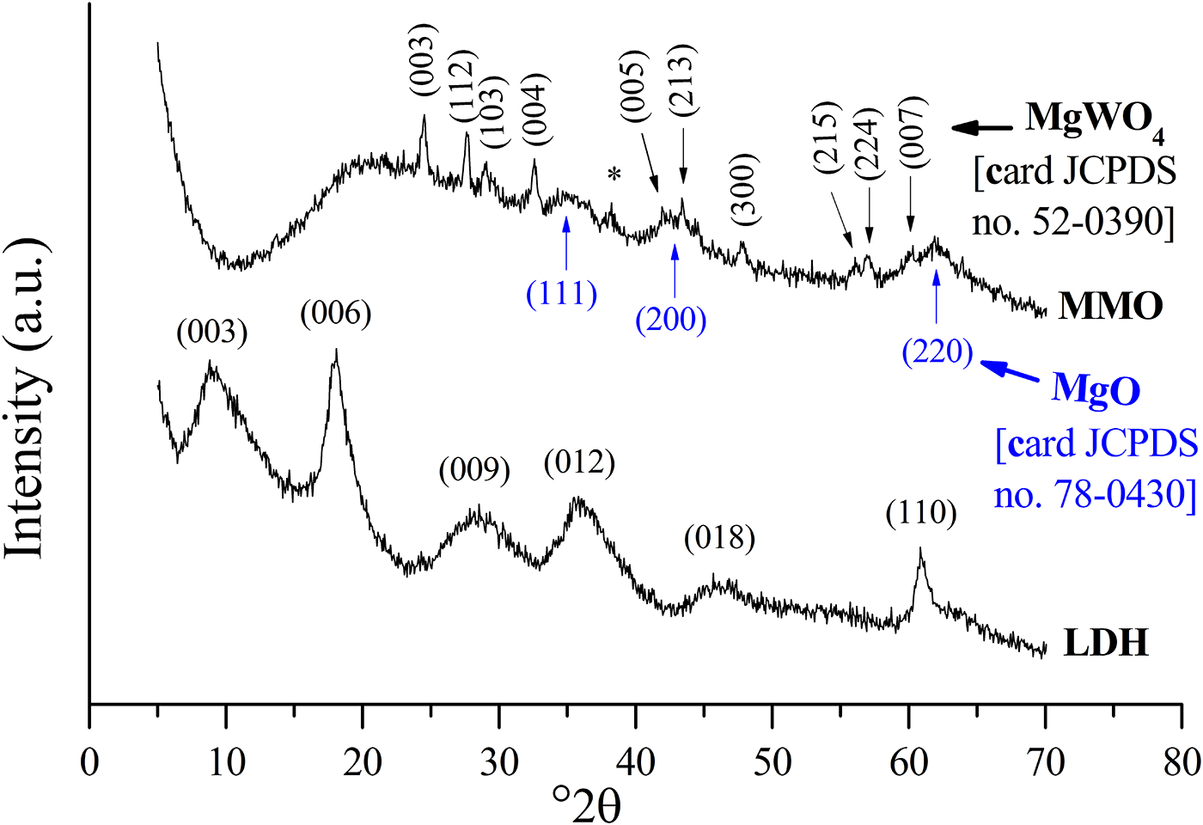
The XRD pattern of LDH with indexed lines (Fig. 1) revealed that all reflections corresponded well with those of a hexagonal lattice of space group R $ \overline{3} $
m (Li et al., Reference Li, Wang, Yu, Wang, Liu, Yang, He, Wang and Zhang2011). The cell parameter c can be calculated, therefore, via the d spacing (d
003) as follows: c=3d
003. The cell parameter a can be obtained from the (110) reflection as follows: a=2d
110. The values of a and c were 3.04 and 30.25 Å, respectively. The basal spacing d
003 was 10.08 Å, which is close to that reported previously (Li et al., Reference Li, Wang, Yu, Wang, Liu, Yang, He, Wang and Zhang2011). In addition, no diffraction attributed to carbonate- (Zhitova et al., Reference Zhitova, Krivovichev, Pekov and Greenwell2019) or nitrate- (Lahkale et al., Reference Lahkale, Elhatimi, Sadik, Bouragba, Lebbar, Elmelouky, Mortadi and Sabbar2018) containing Mg2Al LDHs with d
003 spacing of ~7.8 or 8.9 Å, respectively, was observed, indicating that no impurity of these compounds remained in the samples.
$ \overline{3} $
m (Li et al., Reference Li, Wang, Yu, Wang, Liu, Yang, He, Wang and Zhang2011). The cell parameter c can be calculated, therefore, via the d spacing (d
003) as follows: c=3d
003. The cell parameter a can be obtained from the (110) reflection as follows: a=2d
110. The values of a and c were 3.04 and 30.25 Å, respectively. The basal spacing d
003 was 10.08 Å, which is close to that reported previously (Li et al., Reference Li, Wang, Yu, Wang, Liu, Yang, He, Wang and Zhang2011). In addition, no diffraction attributed to carbonate- (Zhitova et al., Reference Zhitova, Krivovichev, Pekov and Greenwell2019) or nitrate- (Lahkale et al., Reference Lahkale, Elhatimi, Sadik, Bouragba, Lebbar, Elmelouky, Mortadi and Sabbar2018) containing Mg2Al LDHs with d
003 spacing of ~7.8 or 8.9 Å, respectively, was observed, indicating that no impurity of these compounds remained in the samples.
XRD patterns of LDH and MMO with indexed characteristic lines. Note the presence of both the cubic MgO phase (JCPDS no. 78-0430) and the tetragonal MgWO4 (card JCPDS no. 52-0390) in the MMO pattern. *No hkl values assigned by the database.

Furthermore, in contrast to other classical Mg-Al LDH intercalated with chloride or carbonate ions prepared under the same conditions (Constantino and Pinnavaia, Reference Constantino and Pinnavaia1995), the XRD pattern (Fig. 1) showed broad peaks which are indicative of poorly crystallized LDH. This is thought to be related to the size of [WO4]2–, which is larger than Cl– or CO32–. The intercalation of [WO4]2– into LDH can be associated with lattice distortion, suggesting that the layered structure was preserved, but the long-range order was disrupted (Chen et al., Reference Chen, Luo, Wang, Li, Li and Wang2024). In addition, an inversion of the intensity between the first two harmonic peaks (003 and 006) was observed compared to the usual LDH pattern. This phenomenon may be related to some high electron densities resulting from heavy interlayer molecular species located between the layers as previously reported for paratungstate intercalated LDH (Del Arco et al., Reference Del Arco, Carriazo, Gutiérrez, Martin and Rives2004) and metal complex intercalated LDH (Prevot et al., Reference Prevot, Forano and Besse2000; Sabbar et al., Reference Sabbar, de Roy and Leroux2007).
XRD pattern of MMO
The XRD pattern of MMO (Fig. 1) revealed the presence of tetragonal MgWO4 in MMO, the peaks of which are consistent with the database (card JCPDS no. 52-0390). The MgWO4 compound has three polymorphs: tetragonal, monoclinic, and triclinic. The tetragonal form is stable in the temperature range from 400 to 800–850°C, and further transforms into the monoclinic form (Borshch et al., Reference Borshch, Dorokhov and Golub1973; Li et al., Reference Li, Yang and Meng2009). The triclinic MgWO4 has been obtained at high temperatures (>1165°C) (Chang et al., Reference Chang, Scroger and Phillips1966, Dey et al., Reference Dey, Ricciardo, Cuthbert and Woodward2014). Thus, the preparation of MMO by calcination of LDH at moderate temperature (723 K) should result only in the tetragonal polymorph of MgWO4, for which the parameters a and c can be obtained from the equation:
 $$ {d}_{\mathrm{hkl}}=\frac{h^2+{k}^2}{a^2}+\frac{l^2}{c^2} $$
where d hkl is the interlamellar distance of LDH. The values of the cell parameters a and c were calculated from the observed XRD patterns to be ~5.66 and ~10.89 Å, respectively, which are similar to the values of 5.63 and 10.81 Å, respectively, reported by Meng et al. (Reference Meng, Chen, Wie, Li and Zhang2019) for the pure tetragonal MgWO4 prepared by the hydrothermal method.
Note that the presence of the MgO phase in MMOs derived from Mg-Al LDHs has already been reported by Socias-Viciana et al. (Reference Socias-Viciana, Urena-Amate, González-Pradas, Garcia-Cortes and Lopez-Teruel2008) and Lahkale et al. (Reference Lahkale, Sadik, Elhatimi, Bouragba, Assekouri, Chouni, Rhalmi and Sabbar2022). As the amount of Mg is greater than that of tungstate, according to the formula of LDH reported above in the Introduction, the excess Mg led to the formation of a cubic magnesium oxide (MgO) in MMO as a second phase, which is indicated by the appearance in Fig. 1 of three broad lines: 111, 200, and 220 with Bragg angles of 35.92°2θ, 43.21°2θ, and 62.07°2θ, respectively (card JCPDS no. 78-0430). This gives a value for a of ~4.24 Å for the MgO phase according to the equation:
 $$ {d}_{\mathrm{hkl}}=\frac{h^2+{k}^2+{l}^2}{a^2} $$
This value is similar to that reported by Daoudi et al. (Reference Daoudi, El-Helali, Othmen, Suleiman and Tsuchiya2020).
Furthermore, a third phase in the form of amorphous alumina (Al2O3) is possible due to the presence of Al as one of the components in the MMO derived from Mg-Al-LDH, as previously reported by Rey et al. (Reference Rey, Fornes and Rojo1992), Aramendía et al. (Reference Aramendía, Avilés, Borau, Luque, Marinas, Ruiz and Urbano1999), and Díez et al. (Reference Díez, Apesteguía and Di Cosimo2003). In fact, the previous studies reported the possible presence of amorphous alumina resulting from the combination of Al3+ and O2– during the calcination of LDHs.
Disposition of the tungstate ion in the interlayer space of LDH
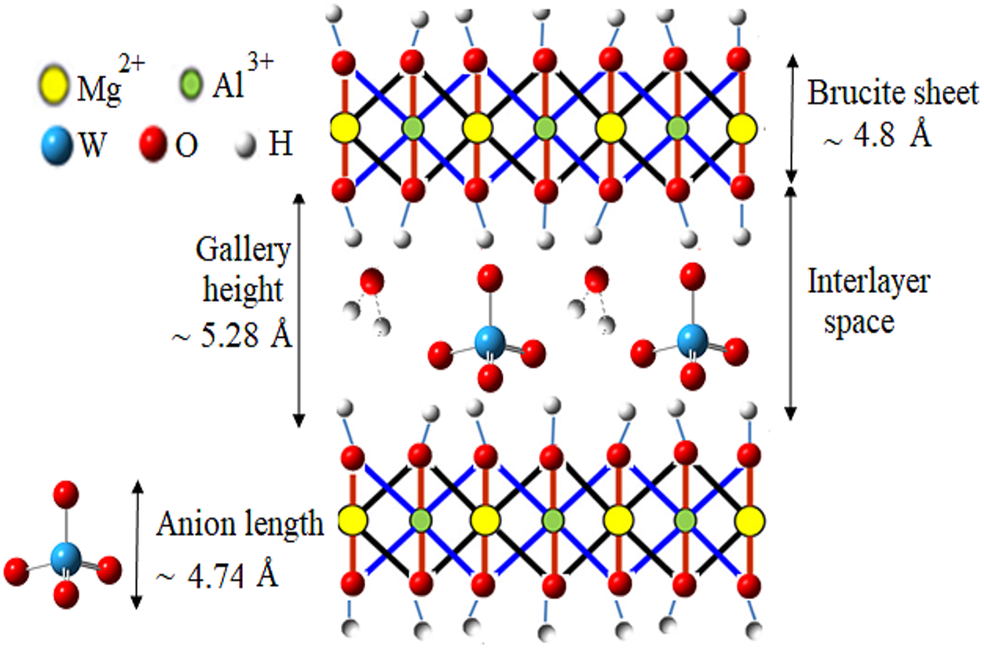
The gallery height available for the disposition of the tungstate in the interlayer space can be expressed as (Ben Zarouala et al., Reference Ben Zarouala, Elhatimi, Lahkale, Rhalmi, Chouni, Elkasiti and Sabbar2023):
 $$ {G}_{\mathrm{h}}={d}_{003}-{S}_w $$
where $ {S}_{\mathrm{w}} $
is the brucite layer thickness (=4.8 Å) and
$ {S}_{\mathrm{w}} $
is the brucite layer thickness (=4.8 Å) and $ {G}_{\mathrm{h}} $
is the gallery height available for anion disposition in the LDH interlayer. The calculated value of
$ {G}_{\mathrm{h}} $
is the gallery height available for anion disposition in the LDH interlayer. The calculated value of $ {G}_{\mathrm{h}} $
was ~5.28 Å.
$ {G}_{\mathrm{h}} $
was ~5.28 Å.
The tungstate ion can be positioned vertically in the interlayer space because its average size is ~4.74 Å (Roobottom et al., Reference Roobottom, Jenkins, Passmore and Glasser1999) (Fig. 2).
Proposed model for the location of the tungstate ion in the LDH interlayer space.

Thermal analysis
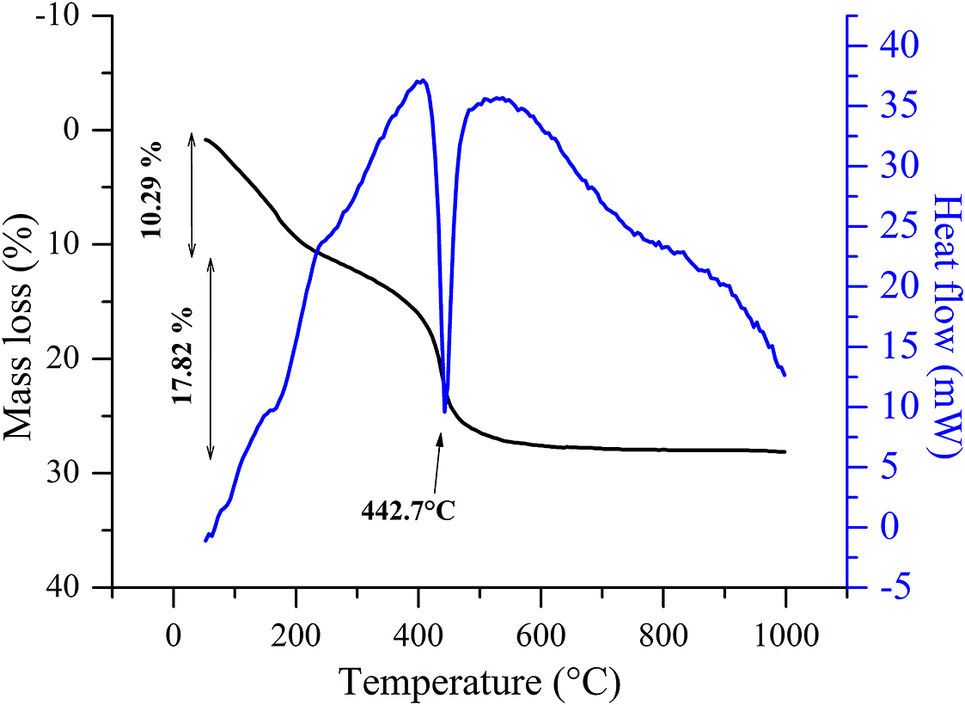
Thermal gravimetric analysis (TGA) and differential thermal analysis (DTA) were used to confirm that the desired materials were obtained. The TGA/DTA curves of LDH (Fig. 3) showed that the thermal decomposition took place in three steps, the first corresponding to the physical and interlayer water loss and ending at 219.5°C with a mass loss of 10.29%. The second and third steps were concomitant and were attributed to the dehydroxylation of the layers (destruction of LDH) and the rearrangement of the collapsed structure of LDH to form mixed metal oxides (MMO), as reported in the XRD results. This thermal behavior resulted in the appearance of an endothermic DTA peak centered at 442.7°C, corresponding to a mass loss of 17.82%. In addition, the thermal decomposition of the tungstate resulted in the formation of the tetragonal MgWO4 at the calcination temperature above 400°C. A similar result was reported for tungstate intercalated into NiAlZr layered double hydroxide (Wang et al., Reference Wang, Yang, Zhan, Wu and Li2017), with the formation of NiWO4 after calcination at 400°C.
TGA/DTA curves for LDH and MMO.The TGA curve is plotted in black, while the DTA curve is plotted in blue.

Finally, no mass loss was observed above ~500°C, indicating the purity of the precursor material (LDH).
Raman spectroscopy analysis
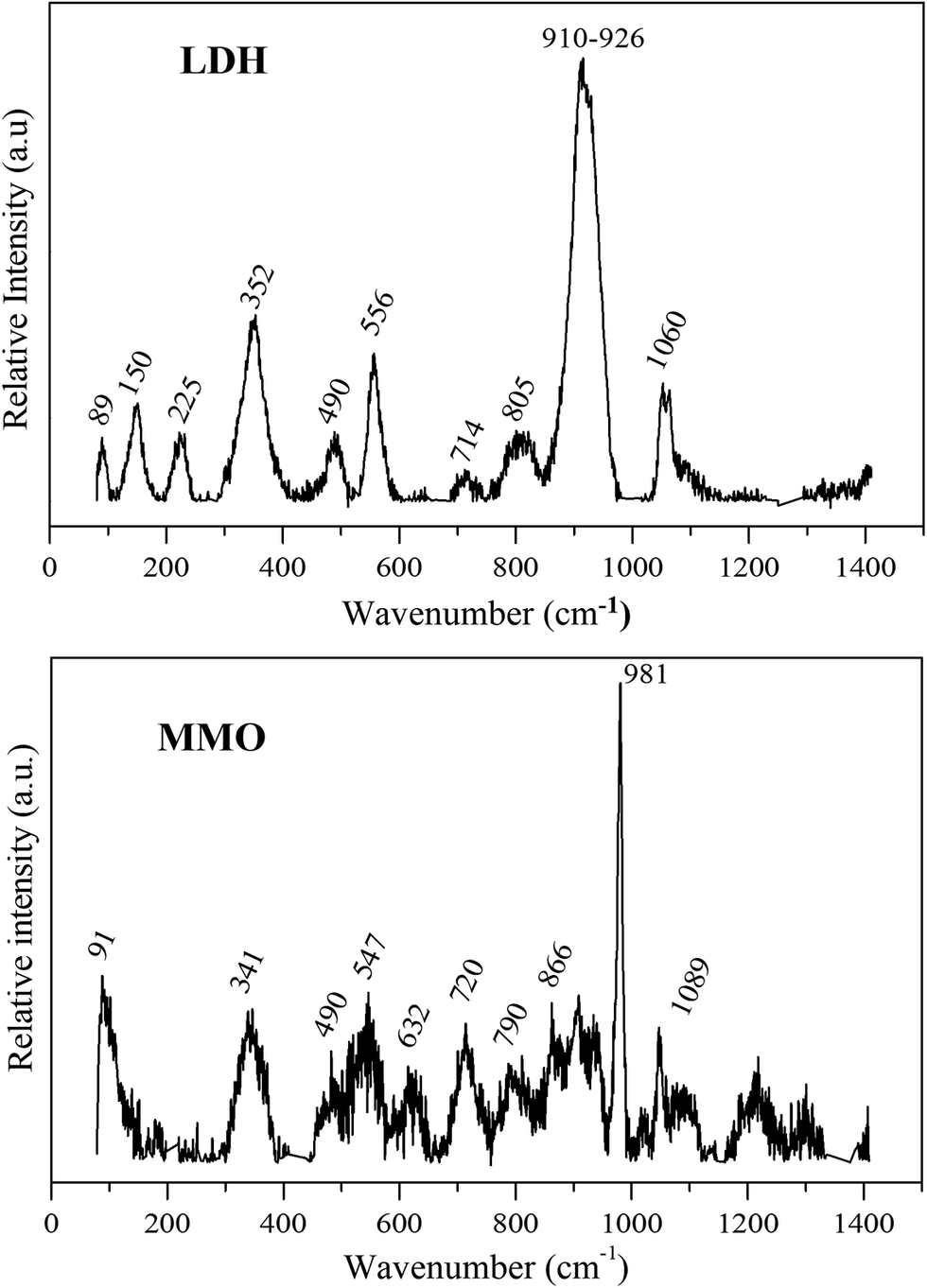
By comparing the wavelengths of the most intense bands in the Raman spectra (Fig. 4), LDH is easily distinguished from its derived MMO. In fact, for LDH, both the very intense bands at 910–926 cm–1 (ν1) and the less intense band at 805 cm–1 (ν3) correspond to the internal vibrational modes of [WO4]2–. These bands are characteristic of the tetrahedrally coordinated tungsten in [WO4]2– (Hardcastle and Wachs, Reference Hardcastle and Wachs1995; Basiev et al. Reference Basiev, Zverev, Sobol, Fedorov, Doroshenko, Skomyakov, Ivleva and Osiko1999). The bands at 490 cm–1 and 556 cm–1 are assigned to M-O vibrations (M=Mg or Al) (Paikaray and Hendry, Reference Paikaray and Hendry2012). The weak bands at ~89 cm–1 and 225 cm–1 correspond to the external vibrational modes (νext) of [WO4]2–, while the intense band at 352 cm–1 is assigned to the internal vibrational mode (ν2) of [WO4]2– (Basiev et al. Reference Basiev, Sobol, Voronko and Zverev2000). The band at 150 cm–1 is associated with the deformation vibrations in the O-M-O bond (M=Al or Mg) (Mora et al., Reference Mora, Jiménez-Sanchidrián and Ruiz2014).
Raman spectra for LDH and MMO.

Compared to tungstate, the carbonate ion (CO32–) can adopt three Raman active modes (Mora et al., Reference Mora, Jiménez-Sanchidrián and Ruiz2014), namely, symmetric stretching (ν1), in-plane bending (ν3), and antisymmetric stretching (ν4). In the Raman spectrum of carbonate intercalated Mg-Al LDH, ν1 corresponds to the strongest signal at 1060 cm–1, whereas the least intense bands, ν3 (Paikaray and Hendry, Reference Paikaray and Hendry2012) and ν4 (Donnelly et al., Reference Donnelly, Purcell-Milton, Framont, Cleary, Dunne and Gun’ko2017), appear at ~1360 cm–1 and 713 cm–1, respectively. Therefore, the weak bands at 714 cm–1 and 1060 cm–1 should be associated with the carbonate impurity adsorbed on the surface of LDH and not intercalated, as the XRD does not report the co-intercalation of carbonate with tungstate, which is confirmed by the TGA/DTA results.
However, for MMO, a strong Raman band at 981 cm–1 (Fig. 4) corresponds to a dehydrated and distorted surface WO4 structure with a dioxo O-W-O coordinated species (Kim et al., Reference Kim, Burrows, Kiely and Wachs2007). Indeed, the tetragonal MgWO4 contained in MMO can be formed from LDH above 400°C after dehydration, dehydroxylation, and decomposition of tungstate. Thus, it is plausible that MgWO4 is formed from the condensation of MgO with WO3, which should result from the thermal decomposition of tungstate, and upon dehydration, the surface of the WO x species gives rise to a strong Raman band at 981 cm–1. The bands at 866 cm–1 and 790 cm–1 have also been found in the MgWO4 polymorph (Hildebrandt et al., Reference Hildebrandt, Kahlenberg, Krüger, Wagner, Dinu, Hofer, Tropper and Liedl2023) and are attributed to the anti-symmetry stretching modes F2(ν3) with respect to a tungstate [WO4] group. The bands at 91 cm–1 and 341 cm–1 are assigned to the binding vibration δ(O-W-O) (lattice mode) (Lu et al., Reference Lu, Chen, Deng, Xu and Zhang2008). Furthermore, the presence of MgO has been demonstrated by the appearance of two bands at 547 cm–1 and 632 cm–1, due to the stretching vibrations of Mg2+ and O2– within the cubic lattice, respectively (Edwin et al., Reference Edwin, Sundara Raj, Mani, Sillanpää and Al-Farraj2024). Another weak broad band relative to MgO appears at ~1089 cm–1 (Singh and Gupta, Reference Singh and Gupta2019). The third phase that may be present in MMO is amorphous Al2O3. In fact, the bands at 490 cm–1 and 720 cm–1 have been attributed to the tetrahedral and octahedral cation vibrations relative to the amorphous alumina (Gawęda et al., Reference Gawęda, Jeleń, Zaborowska, Diduszko and Kurpaska2024). However, the absence of the bands assigned at 372 and 387 cm–1, which are characteristic of Al2(WO4)3 (Horsley et al., Reference Horsley, Wachs, Brown, Via and Hardcastle1987), showed that the amorphous Al2(WO4)3 was not formed during calcination of LDH.
Diffuse reflectance spectroscopy analysis
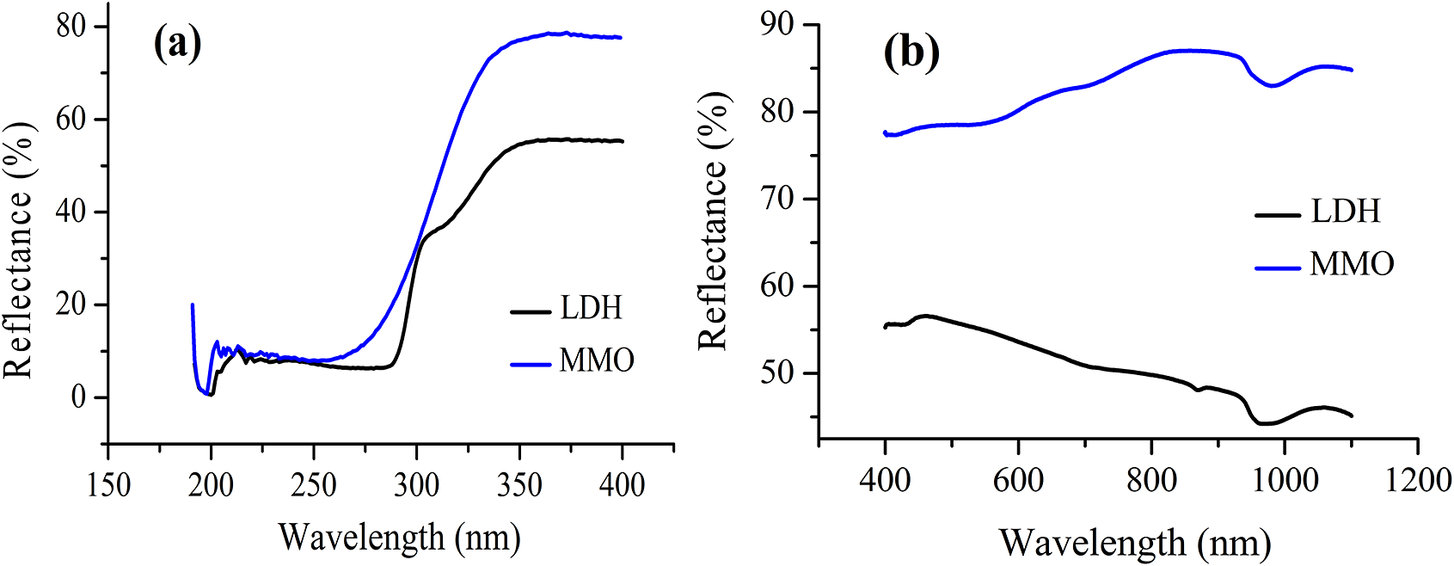
Diffuse reflectance spectroscopy is an important measurement for the study of optical properties because it is not affected by the difficulties introduced by particle size or the physical state of the samples. The reflectance spectra of LDH and MMO in the UV-Vis-NIR region (Fig. 5) showed strong percentages of light reflected by MMO compared to its precursor (LDH), especially in the Vis-NIR region. This indicates that the role of the tungstate ion is to reduce reflectance, which predicts improved light absorption in the case of LDH.
Reflectance spectra for LDH and MMO in the UV (a) and Vis-NIR regions (b).

Absorption behavior
The study of the light absorption behavior of materials is critical prior to their use in optoelectronic devices because their overall efficiency depends on their ability to absorb light over a range of required wavelengths. According to Kubelka and Munk (Reference Kubelka and Munk1931), the diffuse reflectance spectra can be transformed into the corresponding absorption spectra by the Kubelka−Munk function $ \left({R}_{\infty}\right) $
:
$ \left({R}_{\infty}\right) $
:
 $$ F({R}_{\mathrm{\infty}})=\frac{K}{S}=\frac{{(1-{R}_{\mathrm{\infty}})}^2}{2{R}_{\mathrm{\infty}}} $$
where $ {R}_{\infty }=\frac{R_{\mathrm{sample}}}{R_{\mathrm{standard}}} $
is the absolute reflectance;
$ {R}_{\infty }=\frac{R_{\mathrm{sample}}}{R_{\mathrm{standard}}} $
is the absolute reflectance; $ {R}_{\infty } $
means that the sample thickness approaches infinity (d=∞) while the background reflectance is simultaneously zero (R
g=0), and K and S are the absorption coefficient and the scattering, respectively.
$ {R}_{\infty } $
means that the sample thickness approaches infinity (d=∞) while the background reflectance is simultaneously zero (R
g=0), and K and S are the absorption coefficient and the scattering, respectively.
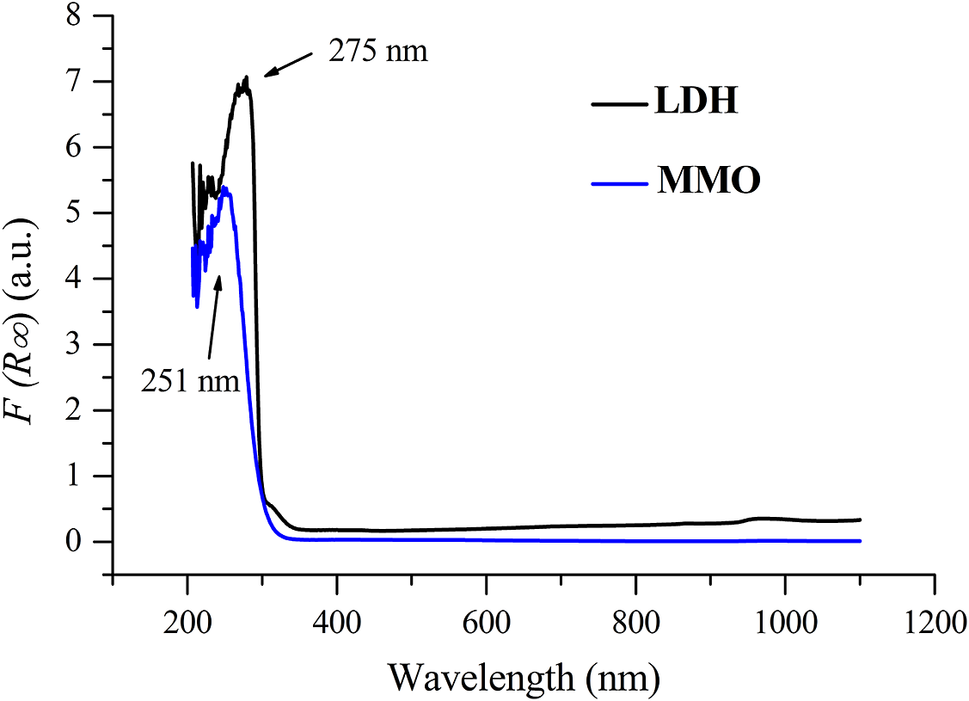
The spectrum of LDH (Fig. 6) shows a band at 275 nm with an absorption coefficient of ~7 (a.u.). This band is attributed to the distorted [WO4]2– because it is located between two hydroxylated layers or in the interlayer space. A similar result was reported for Zr(WO4)2, which showed a band at 274 nm (Ross-Medgaarden and Wachs, Reference Ross-Medgaarden and Wachs2007). However, the MMO spectrum shows a band at 251 nm with an absorption coefficient of 5.33 (a.u.). This band can be related to the infinite 3D WO6 structure in the MgWO4 phase of MMO, similar to the band at 250 nm reported for the WO3 compound (Ross-Medgaarden and Wachs, Reference Ross-Medgaarden and Wachs2007). These results indicate that calcination of LDH does not lead to an increase in light absorption, demonstrating the advantage of the intercalated anion (in this case, tungstate). As LDH and its derived MMO absorb well in the UV range, they can be used as UV shielding materials.
UV-Vis-NIR (ultraviolet-visible-near infrared) absorption spectra for LDH and MMO.

Electronic behavior
The optical bandgap energy (E g) is defined as the minimum photon energy required to excite an electron from the highest occupied molecular orbital (HOMO, at the top of the valence band) to the lowest unoccupied molecular orbital (LUMO, at the bottom of the conduction band). Free holes and electrons absorb the light as they move, while impurities and defects interact with the light through their own lattice vibrations or ionization processes.
The optical bandgap energy can be determined graphically using the following equation:
 $$ {(F({R}_{\mathrm{\infty}}).\mathrm{h}\nu )}^{\frac{1}{\unicode{x03B3}}}=\mathrm{A}\ (\mathrm{h}\unicode{x03BD} -{E}_{\mathrm{g}}) $$
where F(R ∞) is the absorption coefficient, h is Planck’s constant, ν is the frequency of the photon, A is a constant, and γ is a constant related to the type of electron transition, which is direct or indirect if γ is equal to 1/2 or 2, respectively.
E g is determined graphically by extrapolating the linear region of (F(R ∞)hν)1/n as a function of (hν) on the x-axis. In general, greater linearity of the plot indicates whether the transition is direct or indirect, and distinguishes optical bandgap energy from photocurrent measurements (Plieth, Reference Plieth and Plieth2008).
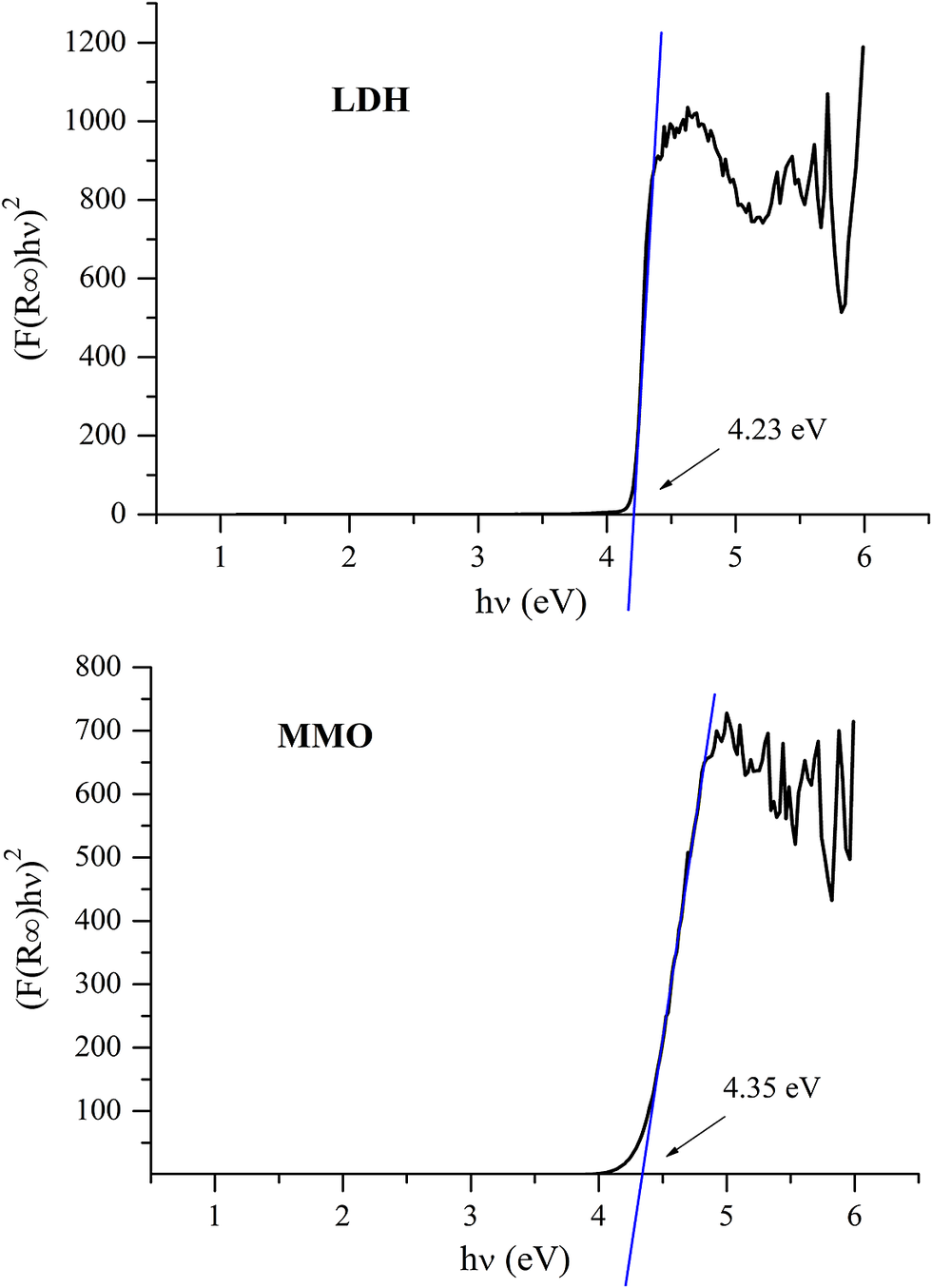
The Tauc plots (Makula et al., Reference Makula, Pacia and Macyk2018) for the LDH and MMO were well fitted to the direct electronic transition. Indeed, in the UV-Vis-NIR region (200–1100 nm) (Fig. 7), the LDH and MMO exhibited bandgap values of ~4.23 and 4.35 eV, respectively. This confirms the role of the tungstate ion in reducing the optical gap energy in the UV region, which is of interest for photonic applications. Such transitions in this light range occur mainly from the occupied O2−2p states of the valence band to the unoccupied W6+5d states of the conduction band, hybridizing with the s and p orbitals of Mg2+ and Al3+. Similar work has been reported previously for PbWO4 and ZnWO4, where the optical gap energies were ~4.2 and ~4.4 eV, respectively (Lacomba-Perales et al., Reference Lacomba-Perales, Ruiz-Fuertes, Errandonea, Martınez-Garcia and Segura2008). According to these results, both the improvement in light absorption and the reduction in optical gap energy clearly show the advantage of using LDH instead of its derived MMO in photonic applications in the UV region.
Tauc plots for LDH and MMO.

Impedance spectroscopy analysis
Electrical modeling
Impedance spectroscopy is one of the most important experimental techniques for measuring the electrical and dielectric properties of materials because it is non-destructive, fast, and simple. This technique resolves the contributions of various processes such as bulk, grain boundary, and electrode effects in the specified frequency domain. This technique is useful for estimating resistivity and capacitance and it analyzes the charge transport processes in the grain–grain boundary of solids.
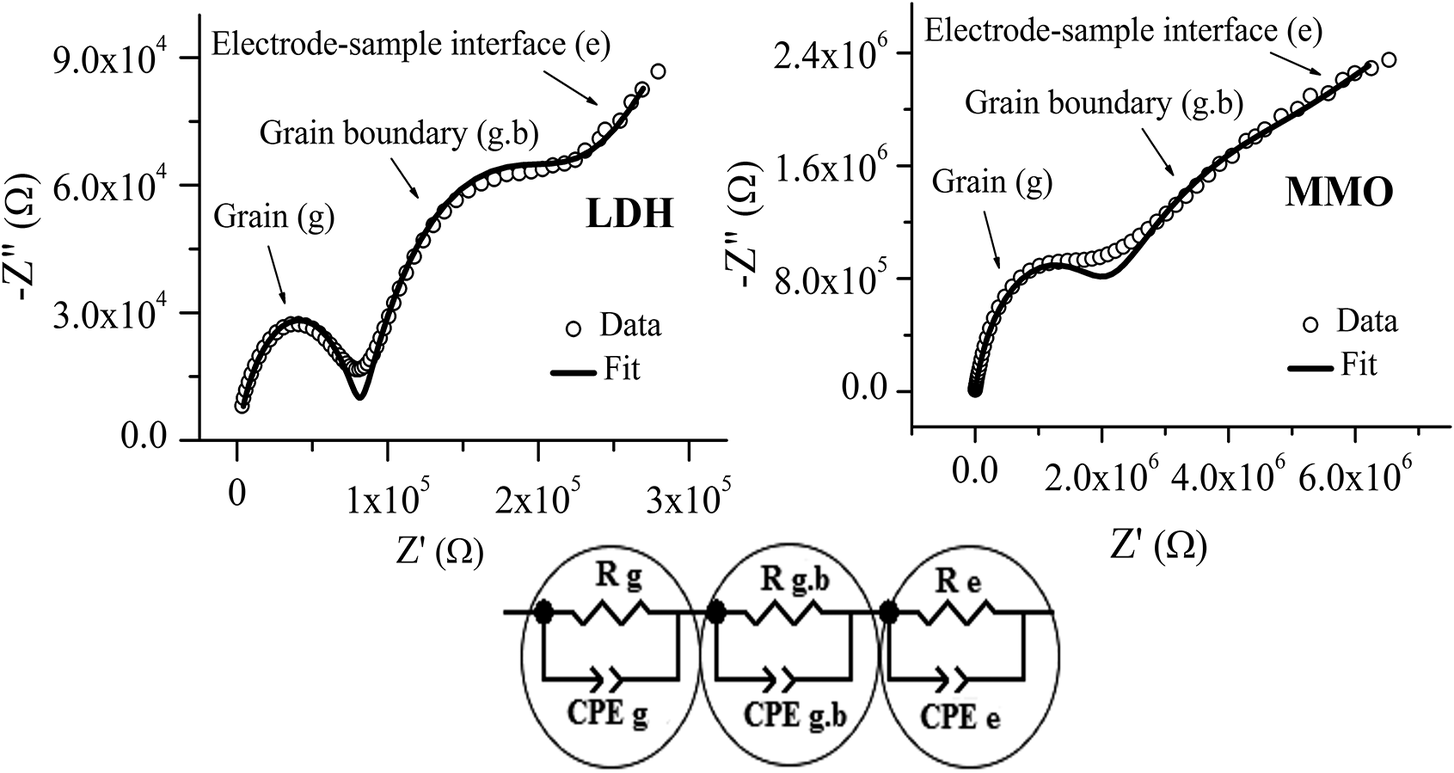
The electrical response of LDH and MMO was represented by Nyquist plots (Zhang et al., Reference Zhang, Dai, Li, Dang, Zheng, Wang, Wang, Cui, Arandiyan, Shao, Sun, Zhuang and Liu2024) (Fig. 8) which showed depressed semicircles, the data fitting of which resulted in an equivalent electrical circuit consisting of three series-connected blocks representing the contribution of the grain (g), the grain boundary (g.b), and the electrode–sample interface (e) (Fig. 8). The electrical response of the grain occurs at high frequencies, while the grain boundary and the electrode–sample interface exhibit electrical responses at low and very low frequencies, respectively. Each block consists of a parallel combination of a resistor (R) and a constant phase element (CPE). The CPE, which represents the heterogeneity of the material (Assekouri et al., Reference Assekouri, Bouragba, Lahkale, Mortadi and Sabbar2022), can be expressed as:
 $$ {Z}_{\mathrm{CPE}}=\frac{1}{T{(\mathrm{j}\unicode{x03C9} )}^{\mathrm{p}}} $$
Nyquist diagrams for LDH and MMO and their electrical equivalent circuit.

where T is a pseudo-capacitance, ω is the angular frequency (= 2πf), f is the frequency, and p is a constant that characterizes the heterogeneity of the material (0˂p˂1). Thus, the overall complex impedance Z* (ω) is expressed as:
 $$ {Z}^{\ast }(\unicode{x03C9} )=\frac{R_{\mathrm{g}}}{1+{(\mathrm{j}\unicode{x03C9} {\unicode{x03C4}}_{\mathrm{g}})}^{{\mathrm{p}}_{\mathrm{g}}}}+\frac{R_{\mathrm{g}.\mathrm{b}}}{1+{(\mathrm{j}\unicode{x03C9} {\unicode{x03C4}}_{\mathrm{g}.\mathrm{b}})}^{{\mathrm{p}}_{\mathrm{g}.\mathrm{b}}}}+\frac{R_{\mathrm{e}}}{1+{(\mathrm{j}\omega {\unicode{x03C4}}_e)}^{{\mathrm{p}}_{\mathrm{e}}}} $$
The symbol τ denotes the relaxation time and can be calculated using the following expression (Bouragba et al., Reference Bouragba, Elhatimi, Lahkale, Moujahid and Sabbar2020):
 $$ \unicode{x03C4} ={(RT)}^{\frac{1}{P}} $$
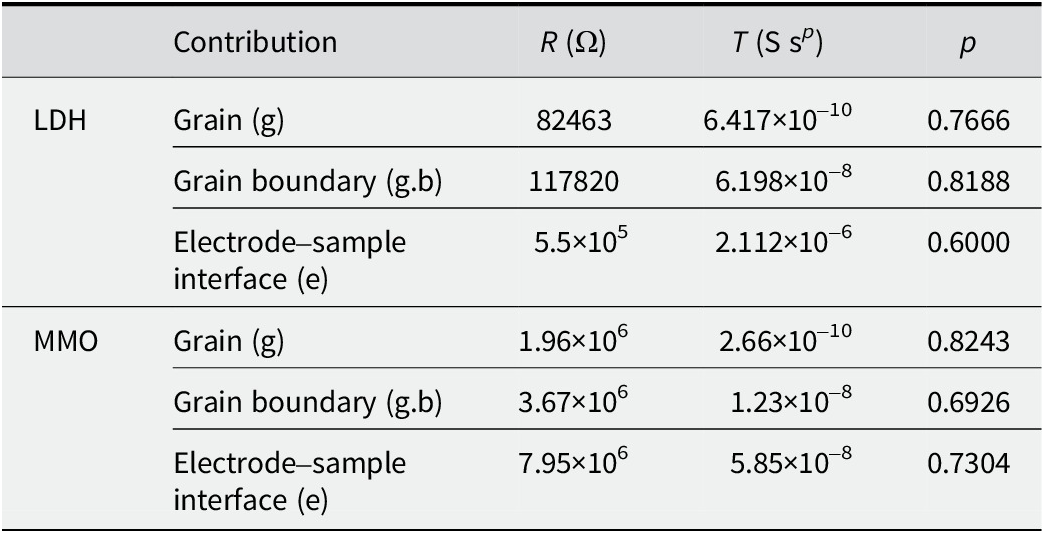
From the values of the parameters of the equivalent circuit for LDH and MMO (Table 1), and for both LDH and MMO, the resistance (R) increased in the order grain ˂ grain boundary ˂ electrode–sample interface, indicating the conductive nature of the grain as reported in previous studies (Elhatimi et al., Reference Elhatimi, Bouragba, Lahkale, Sadik, Lebbar, Siniti and Sabbar2018). In addition, the pseudo-capacitance decreased in the order electrode–sample interface > grain boundary > grain, indicating the preferential accumulation of charge carriers at the interfaces leading to interfacial polarization. Furthermore, compared to LDH, MMO showed high values of the resistance for each contribution (grain, grain boundary, electrode–sample interface). This shows that the conductive character of LDH is mainly due to the mobility of its charge carriers.
Parameters of the equivalent electrical circuit for LDH and MMO

Frequency dependence of electrical conductivity
Complex electrical conductivity is expressed as:
 $$ {\unicode{x03C3}}^{\ast}\left(\unicode{x03C9} \right)=\mathrm{k}.{\left({Z}^{\ast}\right)}^{-1}={\unicode{x03C3}}^{\prime}\left(\unicode{x03C9} \right)+\mathrm{j}{\unicode{x03C3}}^{"}\left(\unicode{x03C9} \right) $$
where k is the cell constant (= t/S) and t and S are the thickness and surface area of the sample, respectively. The real part σ’ of the complex electrical conductivity is called the alternating current conductivity ( $ {\unicode{x03C3}}_{\mathrm{ac}} $
).
$ {\unicode{x03C3}}_{\mathrm{ac}} $
).
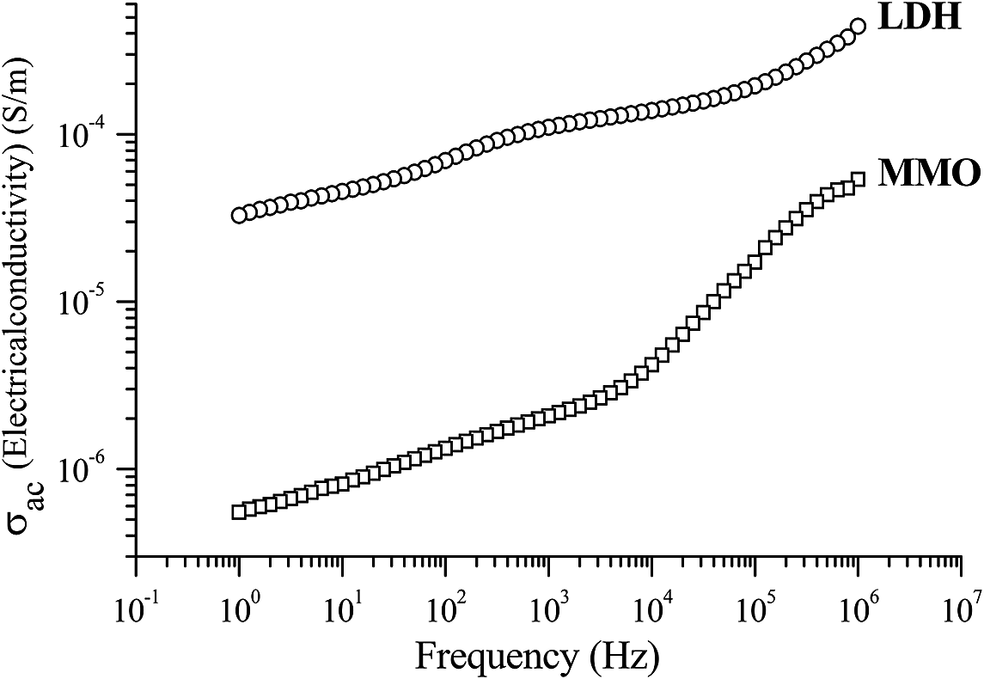
The electrical conductivity gradually increased with increasing frequency (Fig. 9), which is related to the decrease in the sample resistance and supports the hypothesis of the dominance of the hopping process in the conduction mechanism (Langar et al., Reference Langar, Sdiri, Elhouichet and Ferid2014). Indeed, compared to LDH, the electrical conductivity of MMO showed values ~10 to 100 times lower at high and low frequencies, respectively. Such a decrease in the conductivity behavior may be mainly due to the dehydration of MMO and the presence of pseudo-insulating phases in MMO, which hinder the mobility of charge carriers responsible for the conduction.
Electrical conductivity vs. frequency for LDH and MMO.

Resistance values are generally used to determine the conductivity at zero frequency, which is called the dc electrical conductivity, also known as the intrinsic conductivity ( $ {\unicode{x03C3}}_{\mathrm{dc}} $
). The dc electrical conductivity can be calculated from the following equation for the frequency value equal to 0 (Elhatimi et al., Reference Elhatimi, Lahkale, Bouragba, Sadik, Lebbar, Elmelouky, Mortadi, Siniti and Sabbar2017):
$ {\unicode{x03C3}}_{\mathrm{dc}} $
). The dc electrical conductivity can be calculated from the following equation for the frequency value equal to 0 (Elhatimi et al., Reference Elhatimi, Lahkale, Bouragba, Sadik, Lebbar, Elmelouky, Mortadi, Siniti and Sabbar2017):
 $$ {\unicode{x03C3}}_{\mathrm{dc}}=\frac{\mathrm{k}}{R_{\mathrm{g}}+{R}_{\mathrm{g}.\mathrm{b}}+{R}_{\mathrm{e}}} $$
where k is the cell constant (k=t/S), and t and S are the thickness and surface area of the electrode, respectively. In this case, S=78.54 mm2.
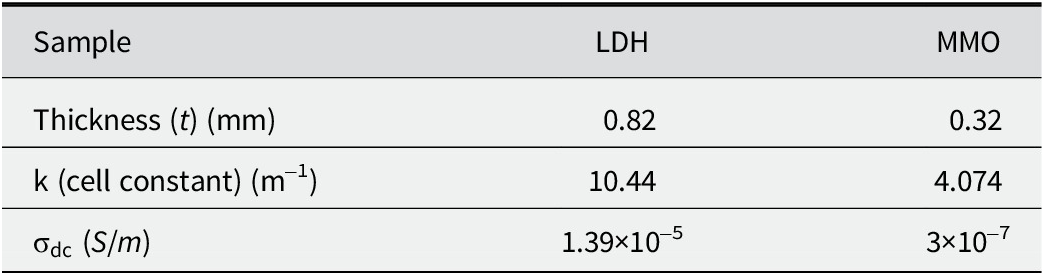
The values of $ {\unicode{x03C3}}_{\mathrm{dc}} $
(Table 2) showed that
$ {\unicode{x03C3}}_{\mathrm{dc}} $
(Table 2) showed that $ {\unicode{x03C3}}_{\mathrm{dc}} $
of LDH is about 44 times higher than that of MMO. This is mainly due to the absence of water in MMO because it was prepared from its precursor (LDH) by dehydration, dehydroxylation, and decomposition of the intercalated anion (tungstate).
$ {\unicode{x03C3}}_{\mathrm{dc}} $
of LDH is about 44 times higher than that of MMO. This is mainly due to the absence of water in MMO because it was prepared from its precursor (LDH) by dehydration, dehydroxylation, and decomposition of the intercalated anion (tungstate).
Determination of $ {\unicode{x03C3}}_{\mathrm{dc}} $
for LDH and MMO
$ {\unicode{x03C3}}_{\mathrm{dc}} $
for LDH and MMO

Frequency dependence of dielectric constant
The study of the dielectric properties of materials is of great interest to researchers and industry because they are essential for industrial applications such as energy storage devices and semiconductors. The dielectric constant is defined as the ability of a material to polarize and store charges when an external electric field is applied. This parameter is essential to study as long as it provides information about the dielectric strength of the material, and results from the orientation of the dipoles along the direction of the electric field (Rhalmi et al., Reference Rhalmi, Lahkale, Ben Zarouala, Chouni, Garmim and Sabbar2024).
The dielectric constant can be defined as the real part of the complex relative permittivity. The complex relative permittivity can be expressed as follows:
 $$ {\unicode{x025B}}_{\mathrm{r}}^{\ast}\left(\unicode{x03C9} \right)={\unicode{x025B}}_{\mathrm{r}}^{\prime}\left(\unicode{x03C9} \right)-\mathrm{j}{\unicode{x025B}}_{\mathrm{r}}^{"}\left(\unicode{x03C9} \right), $$
where $ {\unicode{x025B}}^{\prime } $
is the permittivity of the material (
$ {\unicode{x025B}}^{\prime } $
is the permittivity of the material ( $ {\unicode{x025B}}^{\prime }={\unicode{x025B}}_0{\unicode{x025B}}_r^{\prime } $
),
$ {\unicode{x025B}}^{\prime }={\unicode{x025B}}_0{\unicode{x025B}}_r^{\prime } $
), $ {\unicode{x025B}}_0 $
is the permittivity in a vacuum (
$ {\unicode{x025B}}_0 $
is the permittivity in a vacuum ( $ {\unicode{x025B}}_0 $
= 8854×10–12 F/m), and
$ {\unicode{x025B}}_0 $
= 8854×10–12 F/m), and $ {\unicode{x025B}}_{\mathrm{r}}^{\prime } $
is called the dielectric constant.
$ {\unicode{x025B}}_{\mathrm{r}}^{\prime } $
is called the dielectric constant.
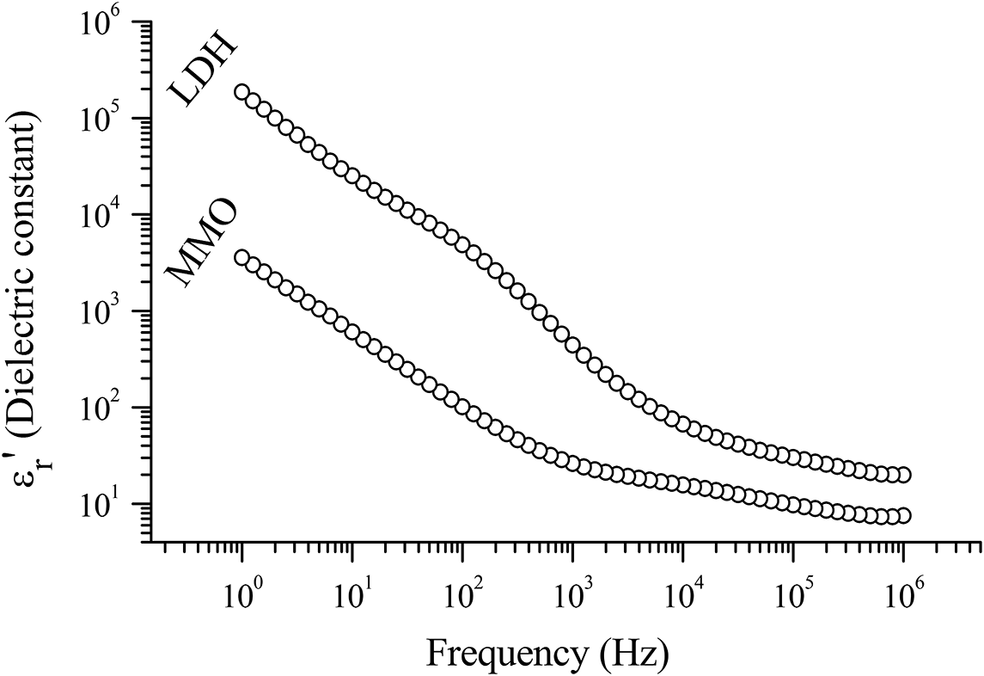
The evolution of the dielectric constant as a function of frequency for LDH and MMO (Fig. 10) showed that the dielectric constant values for both LDH and MMO decreased with increasing frequency, which can be attributed to the reduced effect of the space charge responsible for the interfacial polarization of Maxwell-Wagner (Kremer and Schönhals, Reference Kremer and Schönhals2003). However, MMO showed smaller values of $ {\unicode{x025B}}_{\mathrm{r}}^{\prime } $
in all frequency ranges, decreasing from ~100 to 10 times at low and high frequencies compared to LDH. This can be explained by the reduction of the overall polarizability of MMO due to dehydration and dehydroxylation of LDH. In addition, the presence of distorted and insulating phases in MMO scatters the charge carriers, resulting in a decrease in the polarization process.
$ {\unicode{x025B}}_{\mathrm{r}}^{\prime } $
in all frequency ranges, decreasing from ~100 to 10 times at low and high frequencies compared to LDH. This can be explained by the reduction of the overall polarizability of MMO due to dehydration and dehydroxylation of LDH. In addition, the presence of distorted and insulating phases in MMO scatters the charge carriers, resulting in a decrease in the polarization process.
Frequency dependence of dielectric constant for LDH and MMO.

Frequency dependence of the dielectric loss tangent
Studying the loss tangent behavior as a function of frequency is essential because it measures the dissipation of electrical energy in the form of heat. The more this energy is significant, the more the material heats up and the more its lifetime is reduced. Knowledge of this parameter helps to predict material degradation in various applications. The dielectric loss tangent is generally expressed via the formula:
 $$ \mathrm{Tan}\left(\unicode{x03B4} \right)=\frac{\unicode{x025B}_{\mathrm{r}}^{"}}{\unicode{x025B}_{\mathrm{r}}^{\prime }}, $$
where $ {\unicode{x025B}}_{\mathrm{r}}^{\prime } $
and
$ {\unicode{x025B}}_{\mathrm{r}}^{\prime } $
and $ {\unicode{x025B}}_{\mathrm{r}}^{"} $
are the dielectric constant and dissipation factor, respectively.
$ {\unicode{x025B}}_{\mathrm{r}}^{"} $
are the dielectric constant and dissipation factor, respectively.
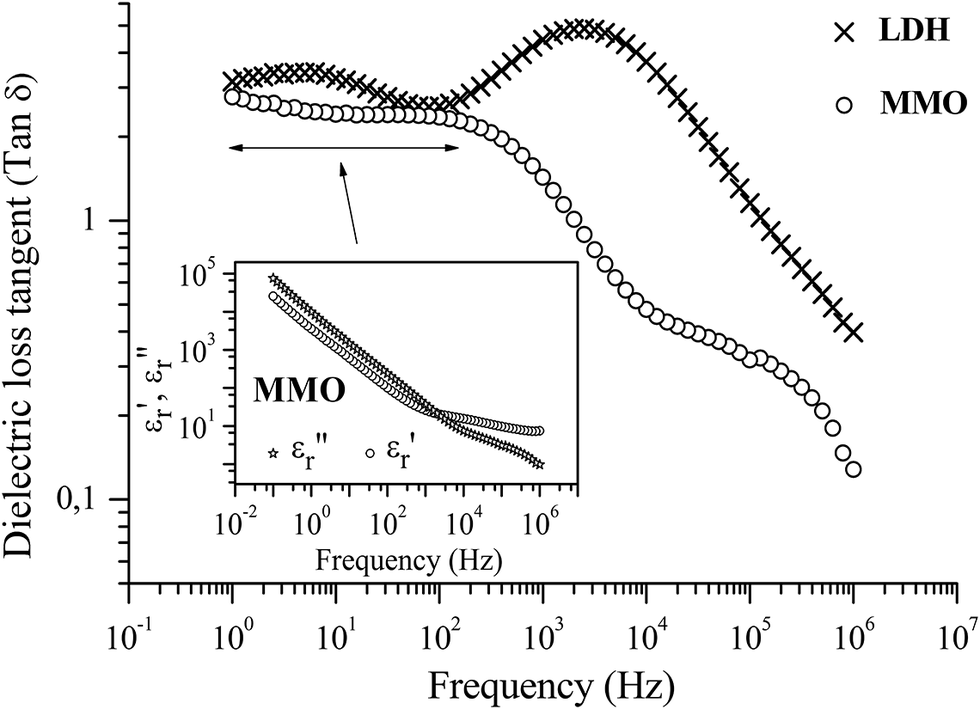
Small values for Tan(δ) were observed throughout the frequency domain (Fig. 11), especially at high frequencies for MMO, in contrast to LDH which showed improved dielectric behavior due to the dehydration and thermal decomposition of LDH to form its derived MMO. In fact, for MMO, Tan(δ) was almost frequency independent in the range 1–229 Hz, probably due to the anomalous low frequency dispersion (ALFD) of the dielectric constant described by a parallel evolution of the two parts of the complex relative permittivity (Fig. 11, inset). This phenomenon is generally present in heterogeneous materials with charge carriers of high density and low mobility (Mehrotra and Giannelis, Reference Mehrotra and Giannelis1992), mainly due to the heterogeneous oxides that make up MMO. Above 229 Hz, the dielectric loss decreases with increasing frequency for MMO up to 1 MHz, reaching a value of 0.12 which is less than the value of 4 exhibited by LDH at 1 MHz. From these results, MMO has a low dielectric loss tangent and a low dc electrical conductivity, making it interesting for dielectric applications.
Frequency dependence of dielectric loss tangent for LDH and MMO.

Summary and conclusions
The present work consisted of a comparative study of the optical and dielectric properties of Mg-Al layered double hydroxide (LDH) intercalated with the tungstate ions and its corresponding mixed metal oxide (MMO). The intercalation of tungstate ions into LDH was achieved by the co-precipitation method at pH 10. MMO was prepared by calcining LDH at 723 K. X-ray diffraction revealed both the intercalation of the tungstate ions in the LDH interlayer and the formation of MgWO4 and MgO phases in MMO. Raman spectroscopy and TGA-DTA confirmed both the intercalation of tungstate in the LDH interlayer and the formation of the expected MMO. The tungstate improved the absorption behavior of LDH by increasing the absorption coefficients in all wavelength ranges and decreasing the optical bandgap energy. However, MMO showed a high percentage of light reflection compared to its precursor (LDH), especially in the Vis-NIR region. The presence of MgWO4 in the MMO oxide was the main contributor to the optical properties of MMO. The electrical response of LDH and MMO was modeled by an equivalent electrical circuit consisting of three series-connected blocks representing the contribution of the grain, the grain boundary, and the electrode–sample interface. The MMO material showed an increase in electrical conductivity compared to its LDH precursor, while the dielectric loss was lower for MMO due to the interfacial polarization from the heterogeneous phases that make up MMO.


 Open access

