

Social media summary
Visual art makes plastic ocean pollution strikingly visible, but renders other facets of the plastic crisis obscure.
1. Introduction
Half a century has passed since the young protagonist in the classic movie The Graduate (1967) got “just one word” of career advice from an older family friend: “Plastics!” The humour of the scene turns on the older man's excited discovery of what, for the youngster, is old news. By the mid-1960s, plastic was seen as an infinitely useful, endlessly profitable substance, and its ubiquity among materials was already secured. It is telling that, for the protagonist, the main problem with plastic is that it is dull. Among the many things that he might have considered a crisis in his time – from the Vietnam War to the questionable logic of late capitalism – plastics did not rate a mention. Today, however, plastic is a crisis in the world, and of the world. The art of the present day has responded accordingly.
If plastic was abundant in the late 1960s, today it is completely omnipresent. It is in every drawer in our houses, in clothing, packaging and thousands of everyday items, as well as fulfilling specialized uses in everything from aeroplanes to lifesaving medical machinery. Modern society without plastic is unthinkable. At the same time, the production, consumption and disposal of plastics on a massive scale have led to what has rightly been framed as a ‘plastic crisis’ (Nielsen et al., Reference Nielsen, Hasselbalch, Holmberg and Stripple2019a; Vidal, Reference Vidal2020; Washington Post, 2019). Plastic is fossil based, often designed for single-use applications and does not degrade or recycle easily. Much of the plastic that is produced ends up polluting the natural environment, where it disrupts animal life and leaches toxic compounds.
Increasingly, social movements, the media, policy circles and academia have turned their attention to humanity's use of plastic and its complex consequences (Dauvergne, Reference Dauvergne2018; Nielsen et al., Reference Nielsen, Holmberg and Stripple2019b). For example, National Geographic magazine devoted a whole issue to the topic (National Geographic, 2018); the Rethink Plastic Alliance has been coordinating actions of European environmental non-governmental organizations around plastics (Rethink Plastic Alliance, 2019); and the European Commission published its Plastics Strategy and implemented a ban on a range of single-use plastics across the European Union (EU) (European Commission, 2018, 2019).
The practice of art has become an important means for drawing attention to the problems associated with plastic. In the past decade, artists, activists and scientists have increasingly engaged in artistic practice to render the plastic crisis visible in new, creative and often spectacular ways. Hence, art has come to play an important role in communicating and raising awareness about the problematic nature of the global plastic system, with visual interpretations of the plastic crisis catching the attention of media outlets and going viral on social media platforms. The aforementioned National Geographic issue on plastics, for example, draws heavily on artistic visualizations to convey the scale and urgency of the problem (National Geographic, 2018).
By narrating the crisis through emotionally charged visual messages that capture the public imagination, art politicizes plastics. The aims of this paper are therefore to conduct a novel mapping of the ways contemporary artistic visual representations narrate the plastic crisis and to explore how plastic is politicized through their different messages and aesthetics. It starts with two conceptual sections, which unpack the notion of the ‘plastic crisis’ and position art within political and aesthetic spheres. The methodology section that follows describes how the sample of 35 artworks was gathered and analysed. The analysis first shows what the artworks focus on and how, and then zooms in on specific aesthetic features of selected artworks.
2. The plastic crisis and its multiple elements
The ‘plastic crisis’ is now a familiar term among academics and the media (e.g., Vince & Stoett, Reference Vince and Stoett2018; Washington Post, 2019). It has also attracted much attention from policy-makers, as reflected in the recent EU directive (2019/904) on single-use plastics (European Commission, 2019) and many other public policies on plastics across the world (Nielsen et al., Reference Nielsen, Holmberg and Stripple2019b). Increased discussion of the plastic crisis reflects a growing understanding of its seriousness. However, not all aspects of the crisis are receiving equal attention (Nielsen et al., Reference Nielsen, Hasselbalch, Holmberg and Stripple2019a). Most often, the problem is framed in terms of marine plastic pollution, and the solution is seen to lie in recycling and changing consumer behaviours surrounding the use and disposal of single-use plastic (e.g., Jambeck et al., Reference Jambeck, Geyer, Wilcox, Siegler, Perryman, Andrady and Law2015; Pettipas et al., Reference Pettipas, Bernier and Walker2016; Xanthos & Walker, Reference Xanthos and Walker2017). We argue that the plastic crisis is more complex, and more systemic in nature, than this present popular framing would suggest. In order to achieve the necessary changes to halt this crisis, we argue that many of its neglected aspects need urgent and sustained attention.
Drawing on a large body of literature on plastics (see Sections 2.1–2.5), we conceptualize the ‘plastic crisis’ as a multifaceted phenomenon and identify five interconnected problematics: fossil dependency, toxicity, disposability, pollution and permanence (Corcoran et al., Reference Corcoran, Moore and Jazvac2014; Geyer et al., Reference Geyer, Jambeck and Law2017; Hamilton & Feit, Reference Hamilton and Feit2019; Nielsen et al., Reference Nielsen, Hasselbalch, Holmberg and Stripple2019a; Wright & Kelly, Reference Wright and Kelly2017).
2.1. Fossil dependency
Plastic manufacture today largely relies on fossil fuels, with 99% of the feedstock being fossil based (Hamilton & Feit, Reference Hamilton and Feit2019). Some of the largest fossil fuel companies (e.g., ExxonMobil, Shell, Total) manufacture plastics, allowing them to divert investments from the pressure they meet in their core business (Hamilton & Feit, Reference Hamilton and Feit2019). In 2009, 7–8% of global oil and gas production went into plastic manufacture (4% as feedstock and 3–4% as energy). This is projected to increase to 20% by 2050 (Ellen MacArthur Foundation, 2016; Hopewell et al., Reference Hopewell, Dvorak and Kosior2009). Bio-based plastics have gained attention lately, but it could also prove controversial, for example, because of the land use that goes into producing the bio-feedstock (Brockhaus et al., Reference Brockhaus, Petersen and Kersten2016). CO2-based fossil-free plastic is a future possibility, but it requires a great deal of energy to produce and is therefore currently considered economically uncompetitive (Palm et al., Reference Palm, Nilsson and Åhman2016). For now, large-scale plastic manufacturing is dependent on fossil fuel extraction, a process that generates carbon pollution and does other environmental harm.
2.2. Toxicity
Plastic harms animal life in various ways: the ingestion of large pieces interferes with breathing and digestion and ingested microparticles leach chemicals (Thompson et al., Reference Thompson, Moore, vom Saal and Swan2009). Uptake of microplastics by humans occurs through diet or inhalation, with the human health impacts still largely unknown (Wright & Kelly, Reference Wright and Kelly2017). A range of toxic chemicals, from bisphenol A (BPA) and phthalates to flame retardants and antimicrobial agents, can be found in many mass-produced plastic products. The same chemical compounds are increasingly found in various organisms, including large parts of the human population. While BPA is known to damage aquatic organisms (Thompson, Reference Thompson, Gabrys, Hawkins and Michael2013), much remains to be understood about how plastics affect human health (Galloway, Reference Galloway, Gutow and Klages2015). Plastics remain, for the moment, a somewhat amorphous threat – what Max Liboiron has called a twenty-first-century ‘miasma’ (Liboiron, Reference Liboiron, Gabrys, Hawkins and Michael2013).
2.3. Disposability
A large proportion of all the plastic produced is designed to be used briefly and thrown away. Packaging is plastic's largest application, representing 42% of all plastic that has ever been made (Geyer et al., Reference Geyer, Jambeck and Law2017). Plastic is thus largely made to be wasted (Hawkins, Reference Hawkins, Gabrys, Hawkins and Michael2013). The steady rise in the production and disposal of plastic is a significant contributor to the global trend of increasing waste. Municipal solid waste generation increased by 23% between 1990 and 2006 in the Organisation for Economic Co-operation and Development (OECD) countries, from 509 to 660 kg per year, with Iceland, Norway and the USA producing the most waste per capita (Moore, Reference Moore, Peet, Robbins and Watts2011, p. 135). Waste generation further strongly correlates with gross national income per capita (Geyer et al., Reference Geyer, Jambeck and Law2017), with 44% of the global waste in 2012 originating from OECD countries alone (Hoornweg & Bhada-Tata, Reference Hoornweg and Bhada-Tata2012, p. 9). Ultimately, this illustrates how tied disposability is to prosperity. Growth-driven societies have gained hugely from the disposability of plastic, the ongoing need for which generates a steady inflow of growth creation.
2.4. Pollution
The aspect of the plastic crisis that seems to cause the most visceral feelings is the pollution of land and ocean environments. Since plastic waste can now be found everywhere – from uninhabited Pacific Islands (Lavers & Bond, Reference Lavers and Bond2017) and the Arctic sea ice (Obbard et al., Reference Obbard, Sadri, Wong, Khitun, Baker and Thompson2014) to the nearest beach or park – it has become impossible to ignore. Plastic is found in the ocean in vast quantities, where it drifts to the shorelines, amasses in ocean gyres of marine debris, such as the Great Pacific Garbage Patch, or sinks to the seabed (Eriksen et al., Reference Eriksen, Lebreton, Carson, Thiel, Moore, Borerro and Reisser2014). It is commonplace across the world to find seabirds, fish and aquatic mammals washed up dead with bellies full of plastic (Law, Reference Law2017). With plastic production almost certain to rise, concentrations of plastic in the oceans are expected to increase, too. It has been estimated that by 2050 the oceans will contain, by weight, more plastic than fish (Ellen MacArthur Foundation, 2016). Pollution is not limited to the seas and oceans, as littering and microplastic contamination can be found on land and in soils throughout the world (Bläsing & Amelung, Reference Bläsing and Amelung2018). Pollution has received particular attention because it is highly visible, with no place or organism on Earth escaping contamination.
2.5. Permanence
Over 8300 million tonnes of plastic are estimated to have been produced so far worldwide. Some 380 million tonnes were manufactured in 2016 alone, and more than 60% of this is believed to have been discarded in the natural environment (Geyer et al., Reference Geyer, Jambeck and Law2017). Due to the durability of the compounds that make up this material, it might take decades, centuries or millennia for it to degrade. Thus, one of the most useful features of plastic becomes one of its main problems as soon as the material is thrown away. Plastics proliferate and they persist, making them arguably a key indicator of the Anthropocene (Zalasiewicz et al., Reference Zalasiewicz, Waters, do Sul, Corcoran, Barnosky, Cearreta and Yonan2016). Some scholars cite plastiglomerates – stone-like lumps of melted plastic fused with sand, recently discovered in the Hawaiian archipelago – as proof that humans have permanently changed the very geology of Earth (Corcoran et al., Reference Corcoran, Moore and Jazvac2014).
As outlined above, the plastic crisis has multiple facets, all of which deserve attention. In this article, we foreground the potential of art to open our eyes to this most common of substances. The political and aesthetic power of art can help us imagine alternative futures and stimulate critical reflections about plastics, rather than taking its ubiquity for granted.
3. Art between politics and aesthetics
There has been a recent scholarly turn towards art's capacity to unfreeze us politically and encourage active engagement (e.g., Dillet & Puri, Reference Dillet and Puri2016; Zabala, Reference Zabala2017). Scholars involved in issues related to sustainability and climate change have been investigating the role of various art initiatives in imagining alternative futures and engaging with the demands of the present (e.g., Galafassi et al., Reference Galafassi, Kagan, Milkoreit, Heras, Bilodeau, Bourke and Tàbara2018; Nurmis, Reference Nurmis2016; Tyszczuk & Smith, Reference Tyszczuk and Smith2018). The question addressed by this paper – how artistic visual representations narrate the plastic crisis – locates the artworks in question within a broader tradition of environmentally engaged art (Boetzkes, Reference Boetzkes2019; Miles, Reference Miles2014). This section will examine the features of today's art that make it a potential site for political engagement.
3.1. Reproducibility and communication
For Walter Benjamin (Reference Benjamin and Arendt1935/2007), the capacity to reproduce art that came with the invention of the camera was key to art's politicization. When works of art were precious, one-of-a-kind creations, they had an ‘aura’ of authenticity holding them apart from everyday life that made them, essentially, ritual objects. Now that images of works of art are infinitely reproducible, in the age of mechanical reproduction, the aura that once surrounded them disappears. Hence “the total function of art is reversed. Instead of being based on ritual, it begins to be based on another practice – politics” (Benjamin, Reference Benjamin and Arendt1935/2007, p. 224). The reproducibility of art through photography and video makes it accessible to a much broader audience, and the Internet has accelerated this process exponentially.
The capacity to reach a large audience quickly is crucial for plastic-related art. Many of these artworks exploit the instantaneous impact of images. Today's media users are particularly fluent in this visual language in the digital landscape (Hand, Reference Hand2012; Neumüller, Reference Neumüller and Neumüller2018). Art in other formats can also spread widely, provided it can be captured on camera. Installations, especially in public spaces, can reach an immediate audience, but also be shared in digital form. Its spread via the worldwide web and social networks also takes art beyond the professional sphere, giving the possibility for artistic visuals to be created by various agents, including amateur artists, activists and scholars.
The ways we increasingly reproduce, transmit and create art today make it particularly suitable as a vehicle for political messaging. But in what ways can art be said to be political?
3.2. Artists’ politics
While artists as individuals will all have their own ideological positions, they may resist the idea that their art directly ‘expresses’ their politics. Insofar as art generally reflects the ideology of a given society, it can never really escape being political (Berger, Reference Berger1972/2008). Before the twentieth century, it was rare for artworks to thematize specific political issues. If an artwork did have a political message, this was often coded – a kind of ‘secret language’ for those in the know, which granted artist and owner plausible deniability. In contrast, political art of the twentieth century often made a virtue of stating a political stance as clearly as possible, as manifest in, for example, American art protesting the Vietnam War, or the May ’68 posters in France.
Today, bringing attention to a political issue – such as climate change, the plastic crisis or other environmental problems – need not immediately pin the artist to a particular political ideology. An artwork can be a site for posing questions, rather than handing down answers. The very scale of the plastic crisis can feel overwhelming and induce passivity, but artists engage with the issue creatively, interrogating assumptions and imagining alternatives. By exercising their agency in this way, they can inspire audiences to act individually or collectively. Nevertheless, what artists choose to highlight is political and entangled in political discourse. Artists are, like the rest of us, ‘inside’ the problem (Coleman, Reference Coleman, D'Angelo and Kuypers2010; Entman, Reference Entman1993) and may thus also reproduce the way the public discussion on plastics is framed, focusing on some of the root causes or consequences of the plastic crisis while ignoring others.
3.3. Affective politics of art
Art's politics go beyond making a political cause the object of art, or the artist taking a particular political stance. The affective power of art also contributes to making art political. Autonomous Artists Anonymous (2017) develop this point. For them, the politics of art should not be confined to making explicitly political art, which in any case operates in commercialized and marketized spaces where it becomes a commodity and can thus also become co-opted. Instead, they argue that there is an often-neglected political potency that stems from art's affective capacity. In other words, it is affect – which arises in the artist when creating the work and in the viewer when they encounter it – that makes art political, even if an artwork does not explicitly address politics. Art can stimulate certain feelings around a topic – albeit often complex and ambiguous ones – that make us consider our relation to the world beyond ourselves in a new light. By making the world and its objects matter to us in novel ways, art can stimulate action. In this way, it is political.
The gap between knowledge and action plagues many aspects of humanity's relationship with the world: climate change (Norgaard, Reference Norgaard2011), consumption (Billig, Reference Billig1999) and, indeed, plastics (Hawkins, Reference Hawkins2009). Art may help to bridge that gap. For example, the emotional immediacy of photographs can stimulate empathy that may prompt us to take action (Heine, Reference Heine, Schneider and Nocke2014; see also Krznaric, Reference Krznaric and Skrinshire2010). Boris Groys, however, insists that “every artistic form is emotionally charged and thus also manipulative,” and should therefore be regarded critically (Groys, Reference Groys2015, p. 50). For example, photographs can be selectively enhanced and manipulated – to intensify emotional response, but also to depict what is not true. Today, a photograph and even a video can be convincingly falsified from scratch. Yet many viewers may assume that photographs present an ‘objective’ truth, free from human interpretation, and, relatedly, may see photography as apolitical and unbiased (Daston & Galison, Reference Daston and Galison2007). Photography is therefore a powerful but also potentially misleading communication tool, and the ethics of its deployment in environmental causes must be considered in this light.
4. Methodology: mapping artistic engagements with the plastic crisis
While academic literature on the intersection between art, climate change and science is growing (see Gabrys & Yusoff, Reference Gabrys and Yusoff2012), few have focused on artistic responses to the plastic crisis and its representations within visual culture. A notable exception is Amanda Boetzkes’ (Reference Boetzkes2019) book Plastic Capitalism, which closely engages with art that draws attention to problems with plastics. Boetzkes frames her investigation around the visual culture of waste in particular, rather than the plastic crisis more generally. As far as we are aware, no mapping of the emerging field of plastic-related art has been made to date that takes into account the crisis in all of its major dimensions. In response to this research gap, we have collected a sample of artistic engagements with the plastic crisis that together address all five elements of the plastic crisis as enumerated above.
The sample includes 35 artworks (objects or creations resulting from artistic practices; see Table 1). In our search for sources, we defined ‘artwork’ broadly, to include works created by artists – both professional and amateur – alongside images created by scientists and activists. Any piece of visual culture was considered for inclusion if it might be said to help viewers respond critically to the plastic crisis and imagine alternatives. Drawing on the work of Gillian Rose (Reference Rose2016), we searched for richness of detail in the materials and selected the most thought-provoking pieces. We continued the search until, having covered a wide array of perspectives on the topic, we ceased to find work that brought up new ideas. The sample is not an exhaustive catalogue of every artistic response to the plastic crisis, but is representative of the key ways in which the plastic crisis is reflected within visual culture.
The sample of artworks.
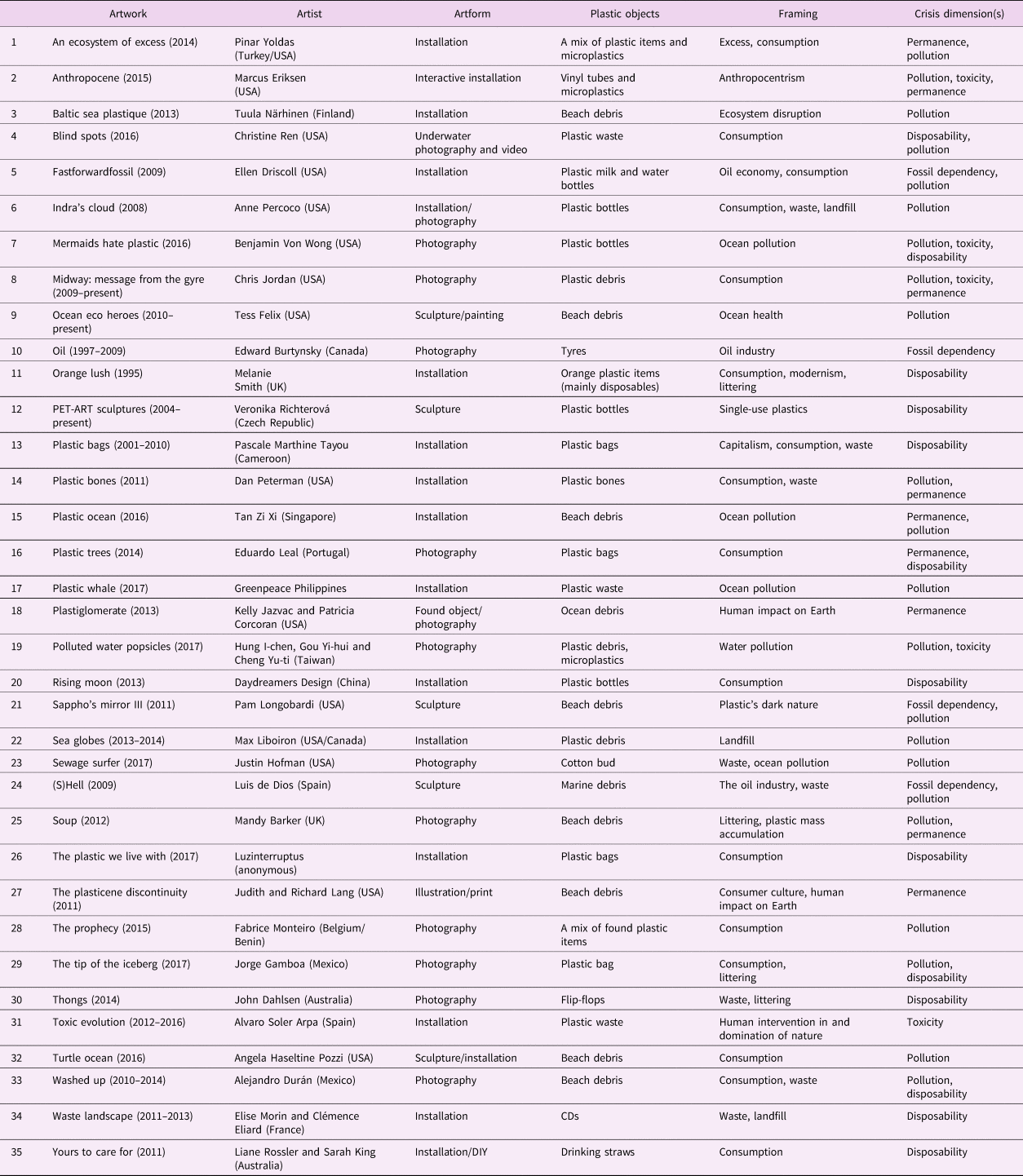
The sources were collected through online keyword searches in English. Through this approach – rather than searching in art historical publications – we were able to discover visual representations of the plastic crisis in the same way that people outside the professional art world are likely to come across them. First, we used generic search words such as ‘plastic and art’ and ‘plastic crisis and art’, intentionally using the terminology that would generate manifestations of the plastic crisis, but without indicating what exactly this crisis consisted of. This search returned a large number of artistic visual representations of the plastic crisis. However, while some elements of the plastic crisis were very present in this first step of making the sample, others were not addressed enough or at all, most notably fossil dependency and toxicity. To address this issue and to obtain a richer sample, we therefore conducted the second step of gathering empirical material by making more specific searches to find artworks that engage with the less represented aspects. This was again conducted using keywords (e.g., plastic art and toxicity) and by searching for art collectives and art–science collaborations engaging with the plastic crisis so as to include the works that might be less popular in online search engines, but possibly show a nuanced and critical engagement with different facets of the plastic crisis. Examples of these initiatives include Project Vortex, a collective of artists, designers and architects addressing issues of plastic pollution and waste, and Synthetic Collective, an interdisciplinary collaboration between artists, cultural workers and scientists visualizing the complexities of plastics. While attempting to include artworks from all around the world, the use of English search terms inevitably brought us a majority of sources from a Western context of visual culture.
Our conceptualization of the plastic crisis as multifaceted and systemic and our above-discussed positioning of art in relation to politics and aesthetics have shaped the analysis of the artworks, guiding us in what to look for and how. The analysis consisted of three key elements. First, we analysed how the plastic crisis was communicated, informed by the reproducibility and communication function of contemporary art. Second, the five interconnected problematics of plastics were used for analysing what the artworks rendered visible or concealed. While some of the analysed works focus on one particular issue, such as the plastic pollution of oceans, many of them articulate various aspects of the plastic crisis at the same time. Third, building on aesthetic theory and the discussion of the affective politics of art, the aesthetics of selected artworks were analysed in more detail. In particular, attention was drawn to the works’ emotional and manipulative elements and how these were balanced. The latter two elements of analysis were also conducted in view of the role of artists as political agents, and thus they paid attention to broader framings that artists attached to their work. Most of the works draw attention to bigger problems of modern society and the Anthropocene, such as overconsumption, wastefulness and complex human–nature relationships.
5. Making plastics political through art
The sheer number of images that address the problem of plastics speaks to the power of visuals to narrate the plastic crisis. This section shows how this political work takes place, including observations about what is made visible and what is obscured in the process.
5.1. How artworks communicate the plastic crisis
Photography can bring home the scale of the problem to viewers who may not have the chance to see it in reality. But photography is not just a method of neutral documentation; it is also a vehicle for wit. For example, Jorge Gamboa's ‘The tip of the iceberg’, which circulated widely online before ending up on the cover of National Geographic, makes an upturned plastic bag floating in the water look like an iceberg. This simple image communicates the idea that the waste we can see – in the gyres or on the water surface – is just a fraction of the total amount of plastic in our oceans.
We found several large-scale artworks that were installed in public spaces, intended to attract the interest of passers-by and encourage interaction. ‘Waste landscape’ by Elise Morin and Clémence Eliard was first exhibited at the cultural centre Centquatre in Paris and later at the Hague City Hall and the National Museum of Contemporary Art in Bucharest. The artists hand-stitched together 65,000 discarded CDs to make a silver expanse of hills and valleys that is at once eerily immaterial and reminiscent of landfill sites. Another example is the ‘Plastic whale’ by Greenpeace, a massive sculpture of a whale stuffed with plastic, installed on a beach in the Philippines. In photographic reproduction the whale looks real, a grim reminder of reality – in 2016, 13 dead whales with stomachs full of plastic were washed ashore in Germany.
The works described above arguably aim for a single, clear, instantaneously grasped message about plastics. Other works in our study, however, particularly those by fine artists designed for exhibition in gallery spaces, take a more open-ended approach to thinking and feeling through the plastic crisis, encouraging viewers to come to their own conclusions. ‘An ecosystem of excess’ by Pinar Yoldas is a notable example. Drawing on scientific work on plastics, she imagines new life forms that might arise in an ecosystem that is being transformed by the plastic crisis. Sea birds lay red ‘transchromatic eggs’ on the ocean floor, where plastic sinks; the ‘Pacific balloon turtle’ has adapted to the balloon pollution of the ocean and, instead of dying from eating the balloons, has developed an ‘elastomer’ back. Yoldas’ invented creatures are whimsical, grotesque and resilient. Their presence asks us to consider exactly how much change we are willing to force on nature in the service of our plastics addiction, while gently reminding us that the world will go on, with or without us.
Finally, there are works that politicize the plastic crisis through the creative process itself, turning what would otherwise be plastic waste into an art object. There is impact in the transformation of this utterly common waste material into something beautiful, or in some cases absurd. The process of transformation demonstrates great skill and creativity – a lavishing of care on a material that is normally considered valueless. Tess Felix's ‘Ocean eco heroes’ is one example – a series of mosaic portraits of activists involved in ocean health initiatives that are made out of plastic waste collected from beaches. Others are more DIY and invite the viewer to replicate the idea, such as ‘Yours to care for’ by Liane Rossler and Sarah King, a collection of single-stem vases made of repurposed drinking straws. By treating plastic waste as a valuable and even beautiful material, artists challenge the culture of plastic disposability.
5.2. What is communicated, what is concealed
Out of the five elements of the plastic crisis we identified, pollution is the most addressed, followed by disposability, with the two issues often depicted as intertwined. Marine plastic pollution is the most common focus of the artworks, while toxicity and fossil dependency are not engaged with to the same extent.
Justin Hofman's ‘Sewage surfer’ is a photograph of a seahorse grasping a cotton bud in the curl of its tail, a comical but alarming juxtaposition of human domesticity and wild nature. In her installation ‘Blind spots’, Christine Ren takes this human invasion of the water more literally, bringing a shopping trolley full of all of the disposable plastic items she collected over a month into a swimming pool that stands in for the ocean. Bottles, bags, wrappers – all of the detritus of normal life – escape into the water from the trolley, a graphic reminder of where so much post-consumer plastic waste ends up. Angela Haseltine Pozzi's ‘Turtle ocean’ installation offers a different take on this theme: an oceanic ecosystem diorama that looks like the real thing but is made entirely of plastics collected on the beach. But while ocean pollution is a hugely important issue, it is somewhat striking that, apart from one work, ‘Plastic trees’ by Eduardo Leal, we did not find artworks visualizing the pollution of land environments.
The artworks in our sample do not just point to the visible signs of the plastic crisis, but also hint at their less visible causes. With ocean pollution and disposability being the dominant problems thematized, consumption and wastefulness recur as causes. The content of the artworks often points to the role of consumers through the very objects that are chosen to be depicted – plastic bottles (e.g., ‘Indra's cloud’ by Anne Percoco), bags (e.g., ‘The plastic we live with’ by Luzinterruptus), toothbrushes (‘Washed up’ by Alejandro Durán), flip-flops (‘Thongs’ by John Dahlsen) and so on. The end users for all of these objects are individual consumers, so it is intuitive to associate the crisis with consumption. Some artists explicitly frame their works to present consumption as the problem and the individual consumer as being responsible. For example, a video of the ‘Turtle ocean’ installation ends with the text: “Your consumer habits make a difference to sea life.” In ‘Blind spots’, Christine Ren includes a blindfold made of a plastic bag to symbolize consumers’ wilful ignorance of the part they play in the crisis of pollution. In her video, Ren asserts that the problem is “us” and that “it's time to take off our blindfolds.” She advocates for individual waste reduction as the best cure, such as avoiding plastic bags and using refillable bottles, and she invites viewers to undertake a plastic-free challenge. This emphasis on individual consumption somewhat simplifies the message of the artworks, eliding the fact that consumer choice is often rather limited, and the most we can do is select an option from a ‘menu’ (Korczynski & Ott, Reference Korczynski and Ott2006). Refusing to use plastic bags or using a refillable bottle is a good act of responsible consumption, but it does not necessarily change the system that aims at producing more and more plastics.
Despite these dominant narratives of individual consumer responsibility, there are artworks that highlight other facets of the plastic crisis and connect to its more systemic causes. ‘Polluted water popsicles’ by Hung I-chen, Gou Yi-hui and Cheng Yu-ti is an installation consisting of 100 colourful popsicles made from polluted water in Taiwan. Around 90% of the waste captured in the popsicles is plastic – a warning that plastic toxins are already a part of our food chain. Furthermore, Alvaro Solder Arpa's ‘Toxic evolution’ sculptures are fictional creatures composed of animal bones, wire and plastic waste, with plastic represented as integral to their skeletons. It gestures towards the way plastic becomes a part of living organisms and ecosystems, which brings up another theme: plastic's permanence. ‘The plasticene discontinuity’ by Judith and Richard Lang is an exhibition documenting the fictional discovery by geologists in the year 2855 of a vein of colourful plastic items in layers of sediment.
Finally, while the theme of fossil dependency is rarely addressed in the artworks, Ellen Driscoll's installation ‘Fastforwardfossil’ is one striking exception. The work imagines a dystopic future in which the brutality of the oil economy has devastated landscapes. The work draws attention to the contrasting chronologies of the usefulness of plastic objects to us and their endurance in the landscape. Pam Longobardi with her ‘Sappho's mirror III’ and Luis de Dios with ‘(S)Hell’ likewise highlight the connection of plastics to the powerful oil industry. The latter artwork explicitly names a major corporation, while its literal shell imagery gestures to ocean pollution. In his documentary photograph series ‘Oil’, Edward Burtynsky focuses on the raw source material of plastic itself. The photographs survey the ‘landscapes of oil’, from drilling fields and refineries to piles of used car engines and burning tires. Even if it does not focus solely on plastics, this work shows the complex chain of plastic's production and makes a visual connection between the finished product, where it comes from and where it is destined to end up.
The long, complex, waste-generating processes involved in the manufacture of plastics are largely absent from the artworks in our sample, as are issues of overproduction and problems that arise at disposal, such as the difficulties of recycling most kinds of plastic, and the injustices of the global recycling industry. Most of the artworks highlight personal responsibility for the plastic crisis while neglecting to consider the role of industry, with its orientation towards infinite growth and the profit motive. The works of Burtynsky, Driscoll, Longobardi and Dios stand out in this regard, as they foreground the links between plastic production, the global market and environmental devastation.
6. Aesthetics of the plastic crisis
What unites most of the works studied is that, despite their disturbing messages about plastic, they are at the same time immensely beautiful. In this section, we analyse and discuss the aesthetic aspects of three artworks selected from our sample.
6.1. ‘Oil’, ‘Plastic trees’ and ‘Midway: message from the gyre’
We have chosen to focus on Edward Burtynsky's photo series ‘Oil’, Eduardo Leal's photo series ‘Plastic trees’ and Chris Jordan's photo series ‘Midway: message from the gyre’. Each of these artworks is located at the intersection of documentary photography, fine art photography and environmental activism, and each touches upon multiple dimensions of the plastic crisis.
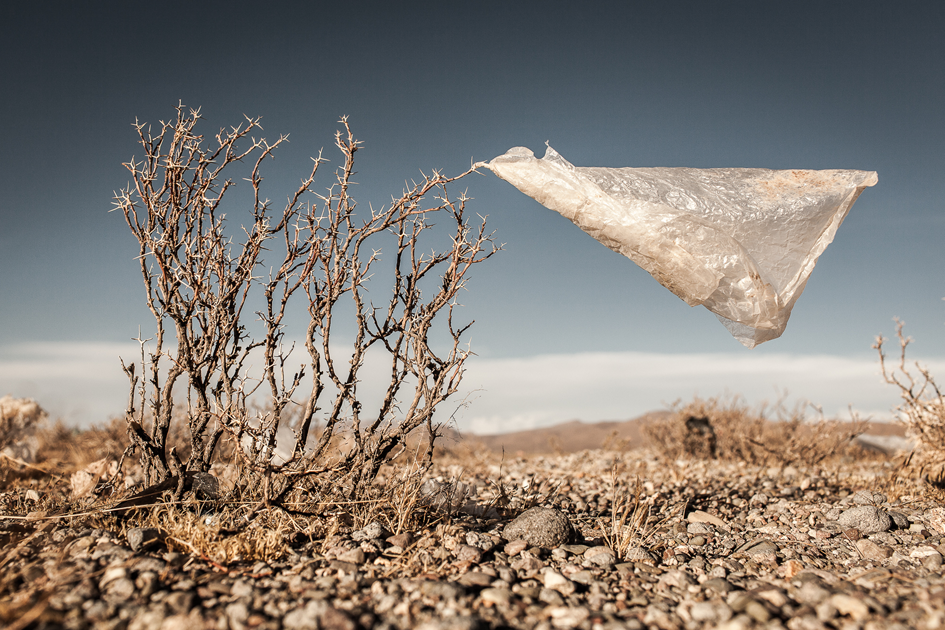
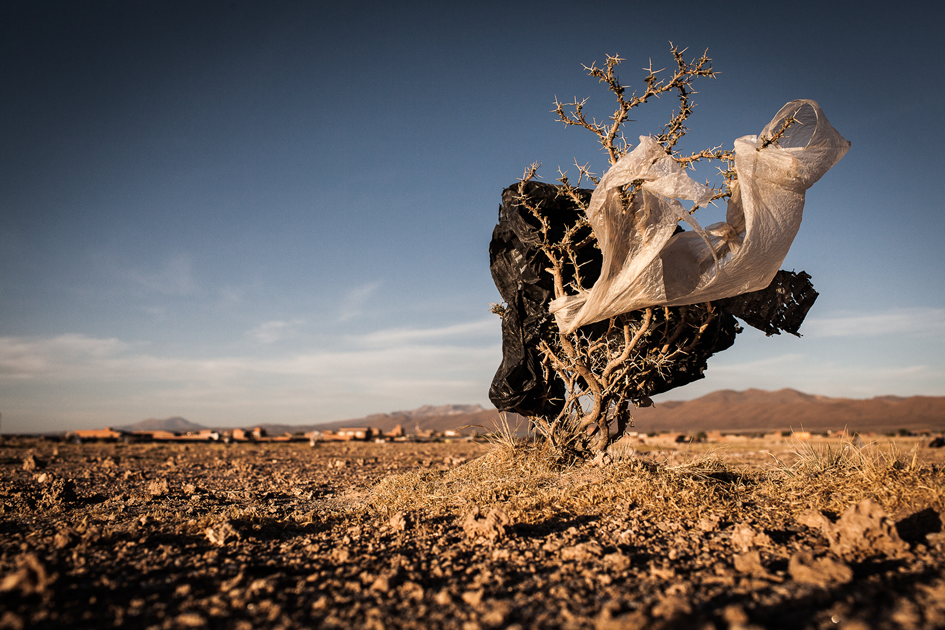
Eduardo Leal's ‘Plastic trees’ (Figures 1 & 2) was shot in the Bolivian Altiplano and documents the problem of the millions of plastic bags that travel with the wind until they get entangled in native bushes. With the photo series, Leal wants to bring attention to this form of pollution and the widespread damages associated with it, such as the deterioration of landscape, the destruction of agricultural soils and the death of domestic and wild animals (Leal, Reference Lealn.d.).
Eduardo Leal: Plastic tree #20, 2014. Photograph(s) © Eduardo Leal, reproduced by permission of Eduardo Leal.
Eduardo Leal: Plastic tree #58, 2014. Photograph(s) © Eduardo Leal, reproduced by permission of Eduardo Leal.
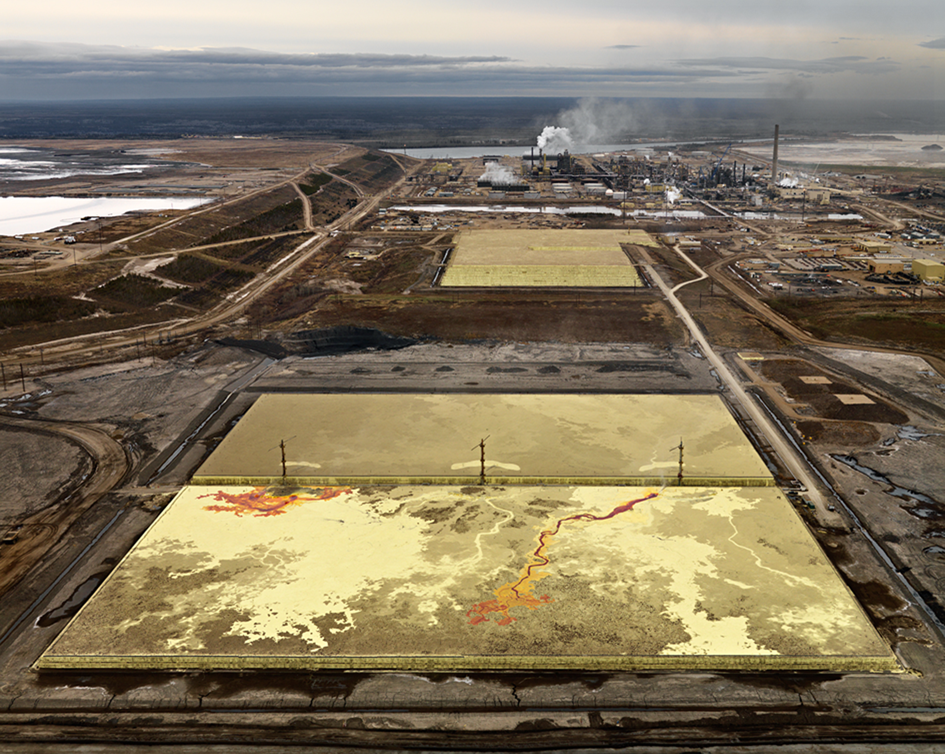
Edward Burtynsky's ‘Oil’ (Figures 3 & 4) consists of large-format landscape photographs bearing marks of the human use of fossil fuels, including sites of extraction, refinement, manufacture, use and disposal – from oil tankers to racetracks. The photographs were shot in Canada, the USA, China and Azerbaijan, and they visualize oil “as both the source of energy that makes everything possible, and as a source of dread, for its ongoing endangerment of our habitat” (Burtynsky, Reference Burtynskyn.d.b). The work is not prescriptive, but aims to “challenge us and make us ask the important questions,” says Burtynsky in an interview with Seth Curcio (Reference Curcio2012).
Edward Burtynsky: Oxford tire pile #8, Westley, CA, USA, 1999. Photograph(s) © Edward Burtynsky, courtesy Flowers Gallery, London/Nicholas Metivier Gallery, Toronto.

Edward Burtynsky: Alberta oil sands #6, Fort McMurray, Alberta, Canada, 2007. Photograph(s) © Edward Burtynsky, courtesy Flowers Gallery, London/Nicholas Metivier Gallery, Toronto.
In his artwork ‘Midway: message from the gyre’ (Figures 5 & 6), Chris Jordan photographed young albatross carcasses in different stages of decomposition with their innards full of colourful pieces of plastic. Like Leal, Jordan has an explicit programme of engaging the public and challenging common assumptions (Turns, Reference Turns2018). The images of the dead birds “help viewers reconnect on a universal level with living beings” (Turns, Reference Turns2018) and show “the result of the collective trance of our consumerism and runaway industrial growth” (Jordan, Reference Jordan2011).
Chris Jordan: Midway: message from the gyre #CF000313, 2009. Photograph(s) © Chris Jordan, reproduced by permission of Chris Jordan Photographic Arts.

Chris Jordan: Midway: message from the gyre #CF000478, 2009. Photograph(s) © Chris Jordan, reproduced by permission of Chris Jordan Photographic Arts.

Leal and Burtynsky both photograph traces of the plastic crisis on land, while Jordan deals with ocean pollution and its effects on animals. Burtynsky documents the production stage of the process, while Jordan and Leal photograph the consequences of plastic consumption and its persistence in the natural world after we have finished using it.
It is striking that there are no human beings in any of the images. The photographs can be placed within the ‘aftermath photography’ tradition, which describes photography that takes place after the fact, documenting human activity after humanity has departed the scene. This aesthetic expression has a different relation to memory and history than a spontaneous snapshot, allowing this photographic style to be a vehicle for mass mourning or mass processing (Campany, Reference Campany and Green2003).
Burtynsky's ‘Alberta oil sands’ depicts what looks like a wound in the landscape, with two red veins winding through toxic sulphuric sludge. He is often placed within the so-called deadpan photography tradition – cool, detached and sharp, often depicting objects and landscapes on a monumental scale. It moves art photography “out of the hyperbolic, sentimental, and subjective” (Cotton, Reference Cotton2014, p. 81). However, the lack of overt emotion that commonly typifies this style does not apply to Burtynsky's images. There is an affective immediacy to his images that seems to wish to connect with the viewer very intensely. The same could be said for the work of Leal and Jordan. Leal's images are shot from a frog's-eye view, turning the little stunted bushes of the Altiplano into trees in order to “show the size of the problem” (Wehelie, Reference Wehelie2015). The warm ‘golden hour’ light that haloes the bushes and the slight darkening towards the edges of each print give an elegiac sense of impending doom. Jordan shoots each albatross with a forensic starkness, framing each image alike to suggest a potentially infinite series. The result is an encounter between viewer and image that feels uncomfortably intimate: individual to individual, life to life.
The lighting and framing of these images, along with the choice of subject, suggest that Leal, Jordan and Burtynsky are all consciously working with emotions. The question is: what effect do their methods have?
6.2. Mixed emotion method: a balancing act
A lot of factors contribute to the impact of an environmentally engaged photograph. It must invite the viewer to stay with it for a while, but in order to do this, it needs to hold the viewer suspended between uplifting and distressing emotions without having them turn away in abjection or repulsion. In an interview with CNN, Leal puts it this way:
We tend to show gritty images, show the ugliest of things. … People look [at] them and they turn the page or change the webpage. I tried to create beauty, because maybe with beauty people will look at [the photos] for more time and maybe they will question themselves. (Wehelie, Reference Wehelie2015)
Jordan discusses beauty as a means to connect with the viewer. He says in an interview:
When you bring beauty and grief together, you can't look at it, because it's so sad – and you can't look away, because it's so beautiful. It's a moment of being transfixed, and the key is turned in the lock. (Bennett, Reference Bennett2013)
In a similar way, Burtynsky deliberately evokes mixed emotions in the viewer in order to stimulate critical thought:
These images are meant as metaphors to the dilemma of our modern existence; they search for a dialogue between attraction and repulsion, seduction and fear. (Burtynsky, Reference Burtynskyn.d.a)
A key question in aesthetic theory is how to categorize and explain emotional responses to artworks. The division of aesthetic experience into the beautiful and the sublime – first introduced by Edmund Burke in 1756 – is still present within contemporary debates (Guyer, Reference Guyer and Burke2015, p. xxix). The sublime is an aesthetic sensibility that is evoked when we encounter a phenomenon or object that has overwhelming power or that makes us feel very small. There is always something unsettling and disturbing about the sublime experience, which is nevertheless also deeply alluring. Burke described the effect of the sublime encounter as “astonishment” and suggested that this astonishment “is that state of the soul in which all its motions are suspended” (Burke, Reference Burke2015, part II, sections I–II). This moment of intellectual arrest is perhaps what Jordan means when he describes how the “key is turned in the lock” of the viewer's mind.
A similar quality is present in Burtynsky's work – one of his major retrospectives was indeed subtitled ‘The industrial sublime’. In the essay published with Burtynsky's photographs in the book version of ‘Oil’, Paul Roth (Reference Roth, Burtynsky, Mitchell, Rees, Roth and Schubert2009, p. 169) identifies in Burtynsky's work an engagement with a peculiarly modern form of sublime: our “dependence on automation … our astonishments at its extremes, and finally our creeping terror at its consequentiality.” Burtynsky's images have a vastness of scale that contrasts with the intimacy of Jordan's and Leal's work. The sublimity of carcasses and small bushes consists not in the size of the objects themselves, but in the scale of the devastation of which they are both symbols.
Through balancing beauty and sublimity, the artists represent something threatening – a crisis – in a visually compelling way. The beautification of crisis might, however, have concealing effects, paradoxically justifying destruction or normalizing suffering. But whether we consider these artworks effective or not in their intended effect, this very balancing act in which they are engaged – of compelling the viewer to look in the face of crisis, while making the image too beautiful to turn away from – highlights the inescapably political nature of these images. All three artists here studied are undeniably attempting to overcome the deeply human habit, when confronted with crisis, of hesitating in the gap between knowledge and action.
7. Conclusion
This paper examines how contemporary artistic visual representations narrate the plastic crisis. In their approach to creating visual impact, many artists seek to render plastics beautiful, while also articulating brutal realities of environmental harm. In terms of theme, we find that marine plastic pollution and disposability are frequently brought up, but plastic's toxicity and its dependence on fossil fuels receive less attention. This conclusion gives a different resonance to Jorge Gamboa's iconic image of a plastic bag ‘iceberg’ – the pollution that plastic creates is only a small part of a much larger disaster. The more abstract elements of the plastic crisis – its toxicity, its geological permanence and its connection with humanity's climate-changing dependence on fossil fuels – need to be made more visible.
In an overwhelming focus on ocean pollution and plastic's disposability, we find a commonality between art and prevalent media and policy framings. While ocean pollution and the overuse of disposable plastics are undoubtedly important, focusing so much attention on these issues leads to the neglect of other facets of the plastic crisis and stifles reflection on the systemic nature of the problem. The emphasis on the responsibility of the end user of disposable items – the consumer – complements this. It individualizes large-scale social problems and obscures the responsibility of industry and governments in overproduction, planned obsolescence and inadequate disposal of plastics. In fact, the plastic crisis we are living through arises out of the very structure of the economic system, with its orientation towards infinite growth and profit. This is what needs to be realized in order for the plastic crisis to be addressed at a scale that matches the problem itself. While not as numerous, some artworks in our sample have gestured towards these murkier depths, contributing to a more multifaceted and nuanced understanding of the plastic crisis. And despite the limiting focus of most of the artworks in our study on consumer responsibility, these works nevertheless effectively communicate political messages about the plastic crisis. They bring attention to the problem without putting viewers off, and they are appealing enough – and sufficiently clear in their messaging – to guarantee that they will be circulated widely. Although individual responsibility is only part of the problem, it nevertheless is not to be ignored. The artworks, stimulating strong emotions in the viewer, may help to bridge the gap between awareness of the crisis and taking action – whether that action be individual or collective. Using different aesthetic approaches, the artists create works that are often immensely beautiful, but their beauty and even sublimity do not eclipse their political power – indeed, such aesthetic factors are key to the works’ political impact. Artists working in this thematic area must tread a fine line to make their art both beautiful and impactful, and the agency of viewers may still escape or exceed the artists’ intentions.
Given the scale and seriousness of the plastic crisis, it is necessary to turn a nuanced critical gaze on the artworks that thematize it. Despite having identified some important limitations in the ways visual culture is currently engaging with this topic, we see art as having an important role in rendering visible the complex problem of plastics. Through its great affective potential, art inspires action. However, the plastic crisis is to be understood in its fullest sense, going beyond problematizing consumption, to criticize the industry seeking to produce plastics in ever-greater quantities, the governments that are refraining from challenging this, and to call for systemic change.
Acknowledgments
The authors would like to thank Edward Burtynsky, Chris Jordan and Eduardo Leal for their artwork contributions and Stefan Tramer, Katrina Zaat, the Global Sustainability editorial team and the anonymous reviewers for their generous and constructive comments on earlier drafts of this article.
Author contributions
E.C., M.P. and J.S. conceived and designed the study. E.C., K.H., M.P., J.S. and S.U. conducted data gathering and analysis. E.C., K.H., M.P., J.S. and S.U. wrote the article.
Financial support
This research was supported by the Swedish Foundation for Strategic Environmental Research (MISTRA) as part of the Sustainable Plastics and Transition Pathways (STEPS) research programme (Grant Number 2016/1489); the EU Horizon 2020 research and innovation programme Realising Innovation in Transitions for Decarbonisation (REINVENT) (Grant Number 730053); and the Kamprad Family Foundation through the project Sustainable Product Chains for Plastics (SUSPLAST) (Grant Number 20160072).
Conflicts of interest
The authors declare no conflict of interest.
Ethical standards
This research and article complies with Global Sustainability's publishing ethics guidelines.


 Open access

