


Studies about the contemporary political right in Peru have mostly focused on Fuerza Popular (FP), the political party created after Fujimorismo. The specialized literature has explored several of its most relevant aspects, including its authoritarian origins (Crabtree, Reference Crabtree2001; Loxton, Reference Loxton2021), partisan organization (Levitsky & Zavaleta, Reference Levitsky and Zavaleta2019; Vergara & Augusto, Reference Vergara, Augusto, Luna, Piñeiro Rodríguez, Rosenblatt and Vommaro2022), party substitutes originally linked to evangelical churches (Rivera & Pérez, Reference Rivera and Pérez2013), and corporate links with de facto powers (Lynch, Reference Lynch2020), among others. Few of them have addressed its ideological offering and compared it to other right-wing political projects in Peru (Meléndez, Reference Meléndez2019) and in the Andean region (Meléndez, Reference Meléndez, Luna and Rovira Kaltwasser2014). However, the Peruvian rightist camp is not limited to the Fujimorista party. The relatively recent process of hyper-fragmentation of the Peruvian party system has brought to the fore an array of right-wing organizations. Simultaneously, the process of polarization has made the political extremes attractive to growing sectors of Peruvian society.
This scenario of polarized pluralism (Sartori, Reference Sartori1976) has been very convenient for the rise of competitive ideological extremes. Renovación Popular (RP), a rebranded political organization led by Opus Dei and businessman Rafael López Aliaga, has drawn the attention of the public due to its combination of social conservatism and anti-establishment style that is in tune with rising far-right projects in the region. In this chapter, I show the rise of a far-right personalistic party in Peru, which originated in a context of polarized pluralism. I also explore its successful access to the local government office in the capital, Lima, based on a politics of confrontation and the politicization of a conservative agenda. This chapter is divided into five sections. The first describes the simultaneous processes of political fragmentation and polarization as a propitious environment for the emergence of radical projects. The second focuses on the formation of RP as the result of the appropriation of a pre-existent personal party – Solidaridad Nacional – and the evolution to a personalistic organization, still far from an institutionalized party. Then, it explores the characteristics of the far right in the Peruvian arena in comparison to the right-wing mainstream alternatives, focusing on the ‘thick ideological’ (third section) and ‘thin ideological’ (fourth section) characteristics. Finally, the chapter elaborates a partial analysis of RP’s administration in the Peruvian capital as a proxy to project what a far-right public administration might look like and its potential consequences for democracy.
6.1 Fragmented and Radicalized: The Evolution of the Right-Wing Camp in Contemporary Peru
From 2011 to 2021, the right-wing camp in Peru used to be controlled by two forces: FP – the political organization that former first lady Keiko Fujimori put together based on her father’s legacy – and Peruanos por el Kambio (PPK) – the personalistic organization that former finance minister Pedro Pablo Kuczynski created to run for the presidency. This temporary duopoly of the right wing was relatively successful. Although Keiko Fujimori lost the presidency in three consecutive ballots, FP obtained the first legislative majority in both the 2011 and 2016 elections, while Kuczynski gained access to the Executive in 2016. Each of these two right-wing projects were different: FP being more popular and conservative, and PPK more technocratic and liberal. But both defended the neoliberal model established in the 1990s (Meléndez, Reference Meléndez2019). They were two sides of the same coin and in the 2016 elections, their electoral support in the first round totalled 60 percent of the valid vote. With PPK in the Executive and FP in the Legislature, it seemed to be the most successful moment of the Peruvian right wing.
However, Peruvian politics entered a period of severe instability. Corruption scandals, triggered by the investigations of Lava Jato,Footnote 1 put most of the political leaders under preventive arrest (including former presidents Alejandro Toledo, Ollanta Humala, and Pedro Pablo Kuczynski, and former first lady Keiko Fujimori, while former president Alan García committed suicide to avoid being detained). Considering this shocking lack of leadership by the political elite, political players were not willing to wait for the next electoral cycle to attempt to gain access to power. Political pacts were replaced by betrayals and conspiracies. Consequently, since 2016, Peru has had six presidents and two attempts at the dissolution of Congress (one of them successful). The already diverse and weak party system became even more fragmented (the right-wing camp, once a duopoly, split into several factions).
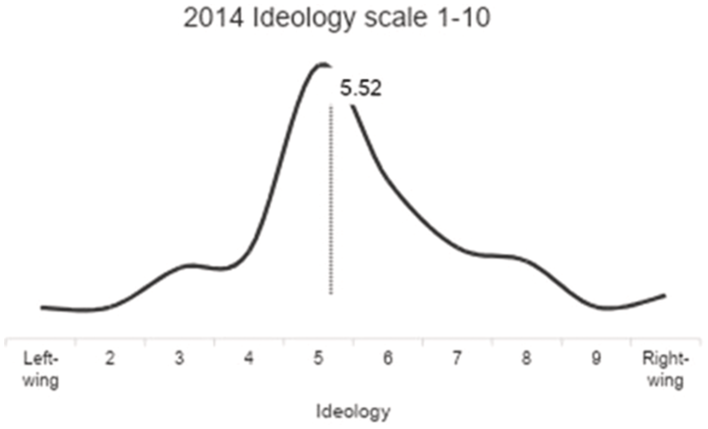
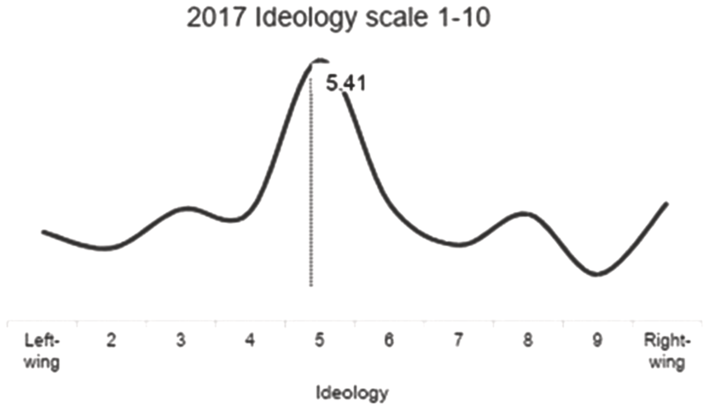
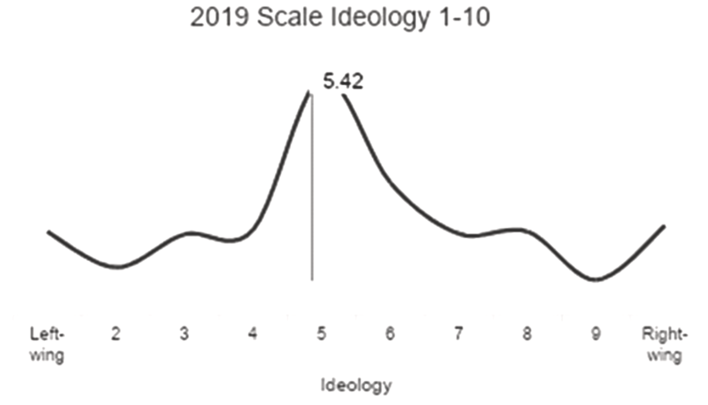
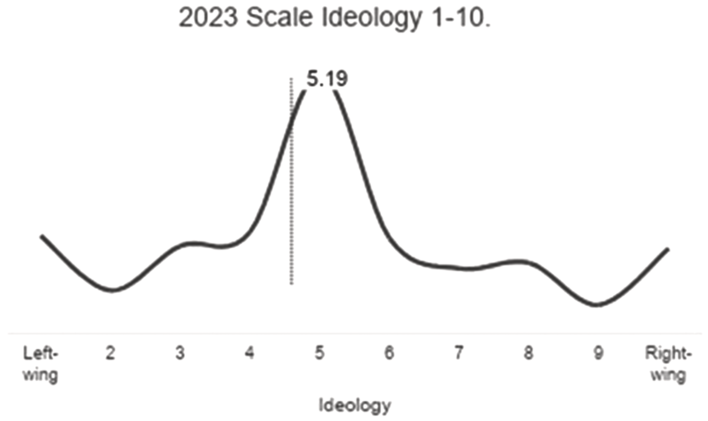
Radical positions also rapidly gained leverage on both sides of the left–right ideological spectrum. Although public opinion surveys show that in the last fifteen years Peruvian society’s ideological self-positioning has been around the centre but inclined to the right, Peruvians’ positions have changed from a normal distribution to a multinominal distribution with three peaks: one at each extreme and one in the centre. Although the average score on a 1–10 left–right scale remained stable at the centre right (5.52 in 2014, 5.41 in 2017, 5.42 in 2019) and recently turned slightly to the centre left (5.19 in 2023), the proportions of individuals placed at the extreme ends of the scale increased steadily, making it attractive to politicians to appeal to extremist positions on both sides. In addition to the fragmentation of both camps, the increasing polarization made political competition centrifugal. Thus, the opportunity for relatively small but radicalized (left-wing and right-wing) parties emerged (Figure 6.1).
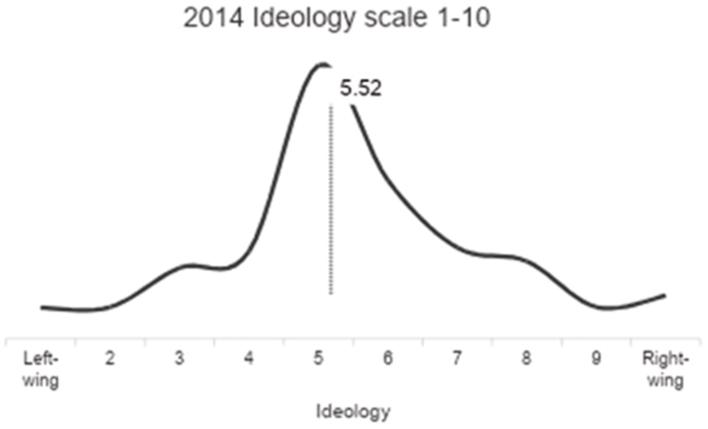
Figure 6.1a Long description
The horizontal axis of the line chart represents the 10-point ideological spectrum, where 1 indicates the far left and 10 indicates the far right. The vertical axis shows the percentage or proportion of the population at each point on the scale. The distribution illustrates where the Peruvian population concentrates across the political spectrum over this period, revealing the prevalence of centrist, left-leaning, and right-leaning positions within the electorate. The highest point is 5.52.
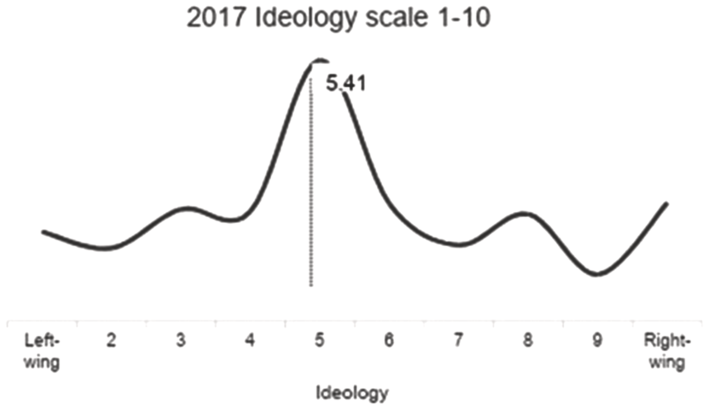
Figure 6.1b Long description
The horizontal axis of the line chart represents the 10-point ideological spectrum, where 1 indicates the far left and 10 indicates the far right. The vertical axis shows the percentage or proportion of the population at each point on the scale. The distribution illustrates where the Peruvian population concentrates across the political spectrum over this period, revealing the prevalence of centrist, left-leaning, and right-leaning positions within the electorate. The highest point is 5.41.
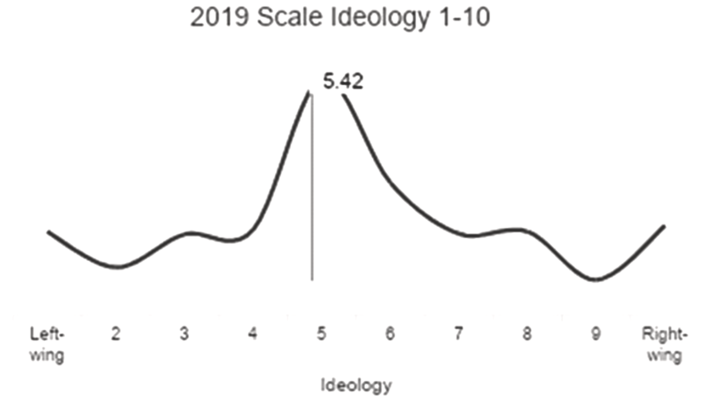
Figure 6.1c Long description
The horizontal axis of the line chart represents the 10-point ideological spectrum, where 1 indicates the far left and 10 indicates the far right. The vertical axis shows the percentage or proportion of the population at each point on the scale. The distribution illustrates where the Peruvian population concentrates across the political spectrum over this period, revealing the prevalence of centrist, left-leaning, and right-leaning positions within the electorate. The highest point is 5.42.
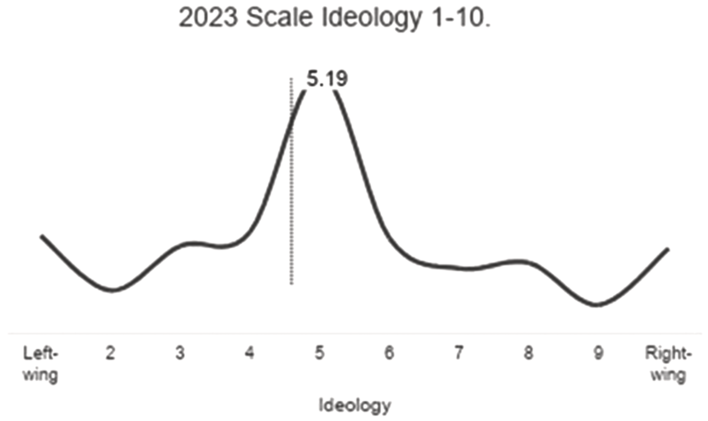
Figure 6.1d Long description
The horizontal axis of the line chart represents the 10-point ideological spectrum, where 1 indicates the far left and 10 indicates the far right. The vertical axis shows the percentage or proportion of the population at each point on the scale. The distribution illustrates where the Peruvian population concentrates across the political spectrum over this period, revealing the prevalence of centrist, left-leaning, and right-leaning positions within the electorate. The highest point is 5.19.
The political landscape in Peru shifted to a polarized pluralism of weakly organized parties featuring factors that threaten democratic stability: the salience of anti-systemic forces (e.g., former cadres of Shining Path endorsed by legal parties), partisanships shaped into negative partisanships (e.g., anti-communism and anti-Fujimorism), the predominance of centrifugal drivers over the centripetal ones, ideological patterning, and irresponsible coalitions (Sartori, Reference Sartori1976). This context was propitious for the emergence of a far-right project, more radicalized in conservative terms than its predecessors.
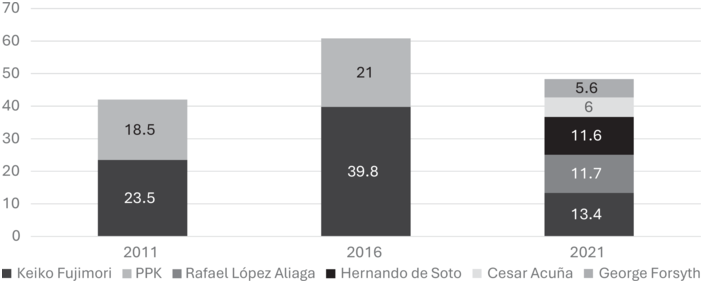
When political animosities and distrust among the Peruvian political elites were settled as the new ‘common sense’, each ideological camp fractured, revealing its more radical versions. In the case of the right, the 2021 presidential election was an opportunity for right-wing newcomers to compete for the electorate once dominated by Fujimorismo (now discredited) and PPK (already vanished). Despite its discrediting, FP remained the most solid bloc with 13.4 percent of the valid vote, followed by new organizations: RP with 11.7 percent and Avanza País (AvP) with 11.6 percent. While the former is a rebranded political party led by Opus Dei Rafael López Aliaga, the latter is an electoral vehicle of the renowned economist Hernando de Soto. Two more candidacies completed the right-wing offering: subnational leader Cesar Acuña’s Alianza Para el Progreso (APP) and former soccer goalkeeper George Forsyth’s Victoria Nacional won 6.0 and 5.6 percent shares of the vote, respectively (Figure 6.2). This high fragmentation allowed Keiko Fujimori to qualify for the 2021 ballot, in which she was defeated, as usual, by anti-Fujimorismo. Unusually, on the other hand, a radical conservative presidential candidate ended up as the third most significant force in the Peruvian political arena. What happened to Peruvian public opinion to benefit RP, an alternative that is further right than Fujimorismo?
Electoral share of right-wing parties in first-round 2011, 2016, and 2021 presidential elections.
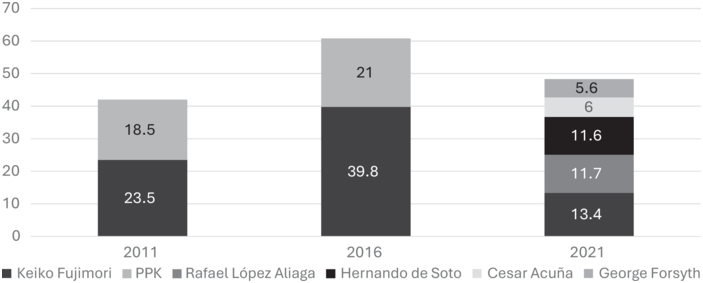
Figure 6.2 Long description
Each bar represents an election year, with segments showing individual candidates' results.
In 2011, Keiko Fujimori (23.5%) and PPK (18.5%) led the right-wing bloc to its strongest performance. By 2016, support became more fragmented among multiple candidates, with Rafael López Aliaga (7.6%), Hernando de Soto (6%), and Cesar Acuña (5.8%) all receiving smaller shares. The 2021 election shows a continued decline, with George Forsyth (13.4%) as the leading right-wing candidate but with significantly reduced overall support for the bloc.
The chart reveals substantial volatility in right-wing electoral performance over the decade, with both total vote share and candidate distribution shifting dramatically across the three electoral cycles.
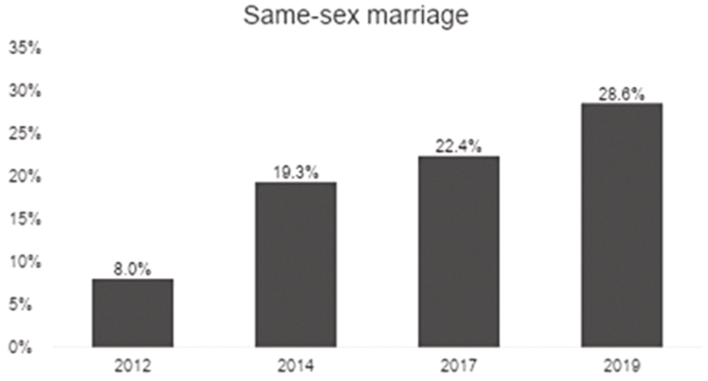
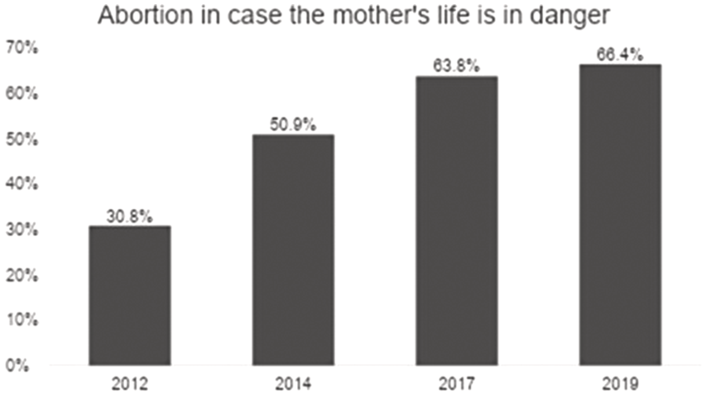
Peruvian society has not remained static on topics that matter to right-wing conservative politicians. While in socio-economic topics, public opinion preferences have remained relatively stable (e.g., support of the economic model), in the socio-cultural realm, individuals’ predilections have changed significantly. In the last decade, the percentage approval of same-sex marriage has notably increased from 8.0 percent (2012) to 28.6 percent (2019), more than a twenty percentage point rise in seven years. In the same period, the proportion of individuals who approve of abortion in cases where the mother’s life is in danger also increased from 30.8 to 66.4 percent (Figure 6.3). Optimistic interpretations considered that it was the ideal time for an alliance between leftist projects and progressive social movements, one that could promote a post-materialist agenda against the traditional elites, at least in the capital, Lima, as had happened in other capitals in the Andean region (Vergara & Baraybar, Reference Vergara and Baraybar2020).
Evolution of approval of same-sex marriage and abortion in case the mother’s life is in danger.
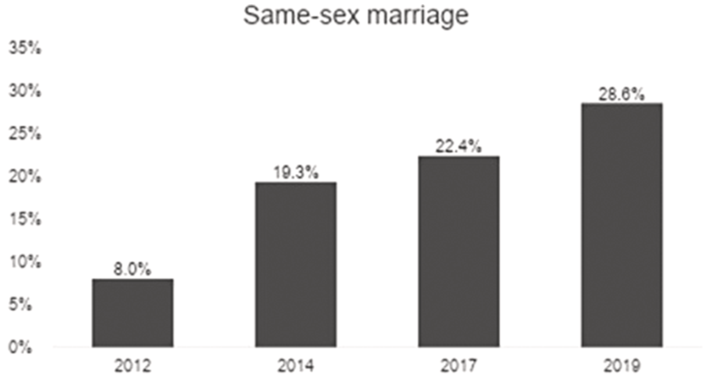
Figure 6.3a Long description
The bar chart presents the evolution of public approval for significant social issues in Peru between 2012 and 2019, based on LAPOP survey data. The left chart tracks approval ratings for same-sex marriage. It reveals a consistent and substantial upward trajectory, beginning at a modest 8.0% in 2012. Support nearly doubled to 19.3% by 2014, continued to climb to 22.4% in 2017, and reached 28.6% in 2019.
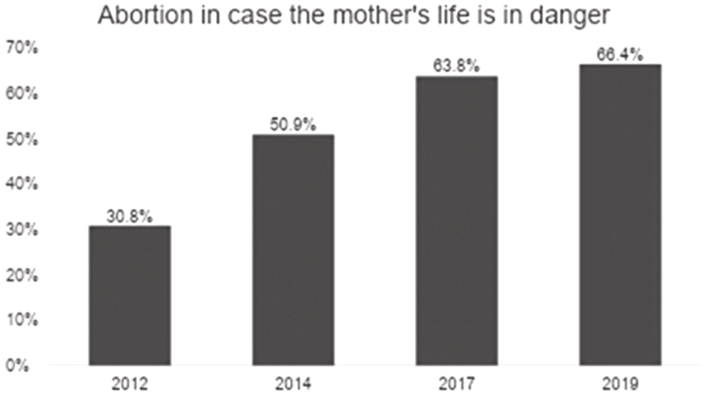
Figure 6.3b Long description
The bar chart presents the evolution of public approval for significant social issues in Peru between 2012 and 2019, based on LAPOP survey data. The chart tracks approval for abortion in the specific case where the mother's life is in danger. It shows more fluctuation while maintaining high overall support. Starting at 30.8% in 2012, approval increases noticeably to 50.9% in 2014, 63.8% in 2017, and 66.4% in 2019. The data demonstrates that a clear majority of the Peruvian public consistently supported access to abortion when the mother's life is at risk throughout the entire period.
Yet this cultural liberalization was not merely spontaneous. It was the product of a broader wave of politicization that began after the fall of Fujimori, when Peru experienced a brief progressive opening. Transitional justice initiatives gained traction, driven by pressure from human rights NGOs and international allies who successfully influenced judicial actors to pursue accountability for past abuses (Gonzalez-Ocantos, Reference Gonzalez-Ocantos2020). This judicial momentum was complemented by increasing mobilization from civil society organizations around gender violence, LGBTQ+ rights, and the recognition of indigenous peoples (Ilizarbe, Reference Ilizarbe2022). Despite this shift in public discourse, no political party was able – or willing – to fully incorporate this progressive agenda into its platform. Instead, individual legislators, often acting independently, championed these causes with just enough visibility in the media to spark reactions from conservative actors.
The advances of socially progressive sectors in promoting an agenda focused on moral values sparked the reaction of conservative sectors that considered traditional values ‘at risk’. In line with other Latin American countries, ‘pro-life’ social movements and anti-‘gender ideology’ commentators decided to confront this agenda with public manifestations (Mayka & Smith, Reference Mayka and Smith2021). ‘Con Mis Hijos No Te Metas’ (Don’t Mess With My Children) and other similar social movements, led by the Catholic Church and Evangelical and Pentecostal Organizations, have been very active in the last decade (via street protests, judicial activism, and legislative lobbying), trying to stop a new school curriculum based on gender equality (Rousseau, Reference Rousseau2020), and, more generally, to counterbalance the public discussion on minority rights, homosexuality, and abortion, by imposing a religious morality (Rivera, Reference Rivera2017). This process has made moral issues salient in the last decades and opened the possibility of political radicalization around these matters (not only in relation to the economic model). Survey evidence in Peru, as in the rest of Latin America (Abreu Maia et al., 2020), does not indicate a conservative reaction in terms of an increase in the size of this sector. But in Peru we observe a reaction in terms of the unveiling of the most conservative elite. Therefore, when analysing the political supply of the fragmented rightist camp, it is important to consider the positioning of the elites regarding moral issues. The activation of grass-roots conservative movements should be considered an antecedent to the rise of a congruent partisan vehicle. Seen in this light, RP should be conceived as the partisan effect of the traditional sectors’ reaction.
Another possibility of radicalization in the Peruvian party system emerged with the 2021 presidential candidacy of Pedro Castillo, a far-left politician, union leader, and candidate of Perú Libre, a Marxist-Leninist political party, that included among their rank-and-file members individuals associated with former terrorist groups. The election of Castillo, and then his tenure in office, intensified the already centrifugal competition, providing a political opportunity for the far right to consolidate. Most of this polarization was shaped in terms of democratic defiance. When FP, with a scant 13 percent of the valid vote, qualified for the 2021 ballot against Castillo, most of the right-wing political parties backed Fujimori’s candidacy, considered it the ‘lesser of two evils’ against Castillo, seen as a representative of communism, the regional left, and even the Shining Path. The results of the ballot favoured Castillo, with a difference of less than 50,000 votes. All the right-wing parties denounced it as a ‘fraud’ after learning the first count results; they initiated a national and international process to invalidate the elections but ultimately failed. A month later, Keiko Fujimori admitted the legitimacy of Castillo’s victory, but other right-wing politicians continue to believe that Castillo won due to fraud. López Aliaga, to this day, remains sceptical about the legitimacy of that electoral process and has demanded the dismissal of the electoral authorities.Footnote 2
During Castillo’s administration (2021–2022),Footnote 3 conservative sectors mobilized intensively against the incumbent, claiming an allegedly illegitimate government (the claim of fraud continued gaining traction among the most radical sectors), a supposedly authoritarian vein and practices of corruption (they claimed that Castillo as a communist was destroying the public administration by employing patronage tactics to get support), and demanded an electoral contest (early elections as the political ‘solution’ to the crisis). Existing organizational and discursive resources were deployed in a wave of protests demanding the removal of Castillo. A systematic analysis of right-wing protest indicates that 44 percent of the 146 social protests held between May 2021 and April 2022 claimed ‘electoral fraud’ in the 2022 elections, and 28 percent demanded the removal of the president (Coronel, Reference Coronel2022). López Aliaga was one of the more active and aggressive political leaders promoting opposition to the government. This position as a radical opponent in the context of increasing polarization turned out to be advantageous for the visibility and strengthening of his political project. Overall, a dynamic conservative grassroots reaction, in the long run, and the rise to power of a far-left project, in the short run, contributed to the emergence and growth of a far-right radical project like RP. While the context was propitious, the political resources for its creation were not necessarily available.
6.2 RP as the Appropriation of a Pre-existing Personal Party
Contemporary Peruvian political parties have been characterized as extremely weak in terms of their organizational development and social rootedness (Levitsky et al., Reference Levitsky, Loxton, Van Dyck and Domínguez2016). Party-building efforts have rarely been successful since the systemic electoral volatility is difficult to surmount. Personal and personalistic organizations might seem to be relatively promising during certain electoral campaigns but most of them disappeared from the line-up in the next electoral round. This malaise is shared by leftist and right-wing organizations, and it is not correlated with ideological stances but with the structural conditions of the Peruvian political arena: feeble party traditions, expansion of informal organizations and institutions, scant positive partisanship, among others (Meléndez & Vergara, Reference Meléndez and Vergara2014). Only a few parties could be considered as exceptions to this trend, particularly Fuerza Popular, the political party founded on the basis of Alberto Fujimori’s political legacy. A nascent partisanship (Fujimorismo) could be a valuable political resource for party-building, which is rare in the Peruvian political landscape (Meléndez, Reference Meléndez2019).
The fragmentation of the right in the context of the 2021 general elections gave room to three relevant right-wing political projects: Fuerza Popular, Avanza País, and Renovación Popular, all obtained legislative representation. FP is the enduring Fujimorista organization led by Keiko Fujimori, based on her father’s political legacy. This political party used to bring together a wide array of right-wing cadres under the mission to uphold the 1993 Peruvian Constitution and, consequently, the market-oriented economic model. In regard to social values, its political platforms categorized the party as ‘socially tolerant’, although its main political leaders called themselves ‘conservatives’ in several media interviews. However, by the 2021 campaign, many hardcore conservative leaders had left the organization due to the damage caused by the imprisonment of Keiko Fujimori during the investigations of Lava Jato and the irregular financing of political parties. Simultaneously, conservative ‘pro-family’ grassroots organizations stopped following FP’s political strategies (Coronel, Reference Coronel2022). The exit of the most conservative factions was key to understanding the emergence of a new alternative further to the right.
Still, FP is the only party in the right-wing camp (and probably in the country) that accomplishes horizontal coordination and vertical interest aggregation capacities (Meléndez, Reference Meléndez2019), conditions that a demanding typology of political parties associates with the conceptualization of ‘political party’. That being said, according to Luna and colleagues (Reference Luna and Rovira Kaltwasser2021) and other authors (Vergara & Augusto, Reference Vergara, Augusto, Luna, Piñeiro Rodríguez, Rosenblatt and Vommaro2022), FP should be categorized merely as a group of independents and avoid falling into an extreme case of stretching the party concept. However, the Fujimorista electoral resilience based on ideational resources such as a nascent partisanship has allowed FP to overcome its organizational weakness and establish itself as a stable force in the Peruvian political landscape (Meléndez, Reference Meléndez-Sánchez and Vergara2024).
The other two organizations of the right-wing camp are less institutionalized. Avanza País is composed of ambitious and opportunist politicians who endorsed the 2021 presidential candidacy of Hernando de Soto. This organization was founded more than twenty years ago (2000), originally as a leftist ‘independent’ organization that in 2006 launched the presidential candidacy of Ulises Humala, the moderate brother of former leftist president Ollanta Humala. By 2021, renowned liberal economist de Soto convinced the formal representatives of the organization to compete in general elections under his own presidential candidacy, despite his ideological distance from the founders of the party. With a high level of pragmatism, Avanza País turned into a right-wing liberal organization, that endorses a pro-market economy and individual rights in social issues. In a way, it tried to fill the void left by Peruanos por el Kambio, which shared the same ideological positioning. However, de Soto failed to control the organization. The national formal officials of the party retain legal control, and the legislators elected by the brand of Avanza País, considering their previous affiliations and pragmatism, might seek to join another political project. Others, however, may remain if their interests align with the new electoral strategies or leadership directions adopted by the organization. Following Luna and colleagues’ (Reference Luna and Rovira Kaltwasser2021) categorization, Avanza País fits as a ‘cluster of independent politicians’ joined by contingent circumstances, but who lack an organization and a leader with real electoral chances.
In the case of RP, its fate changed when López Aliaga successfully took control of the political organization. RP is not a brand-new political party. Originally, it was created in 1999 by Luis Castañeda Lossio to run for the presidency against Alberto Fujimori in 2000. Solidaridad Nacional – the previous label of this organization – as a personal party, was highly dependent on the leader/owner, who exerted absolute control, had a limited organization, and proved to have a short lifespan connected to the leader’s political fate (Kefford & McDonnell, Reference Kefford and McDonnell2018). This personal organization did not gain access to the national executive but did win local mayorships (including the capital, Lima) and legislative seats. During Castañeda’s tenure governing Lima (2003–2010, 2015–2018), he formed a group of political brokers and cadres aligned to its pragmatic and popular style of governing. Rafael López Aliaga was one of them. First as city council member (2007–2010), he ended up assuming leading functions in the organization (general secretary in 2019, and president in 2020).
When Castañeda retired from political activity in 2020, López Aliaga took over the party, modified the internal statutes, designated a new national board, and changed its name to Renovación Popular. This appropriation of the party might have been a simple migration from a personal party (dependent on Castañeda’s fate) to another one (dependent on López Aliaga’s political resources). However, López Aliaga has attempted to combine different political appeals (personalistic and ideological) with multi-level alternative leading figures (municipal and legislative arenas), which could fit better with the classification of personalistic (and unrooted) party. RP aspires to organize ambitious politicians under the leadership of López Aliaga but lacks the capacity to permanently aggregate social collective interests even among the conservative sectors. According to the typology mentioned above (Luna et al., Reference Luna and Rovira Kaltwasser2021), it is classified as an unrooted party. The right-wing party more inclined to the extreme – as we will see in the next sections – is the most highly dependent on a political personality. As happened with other far-right parties, much of its fate depends on the organizational resources available for its establishment as a permanent party (Art, 2018) in a volatile context like Peru. However, this does not mean that it lacks ideological substance.
According to RP’s political manifesto, it is a ‘theological conservative’ organization; its members endorse the ‘social doctrine of the Catholic Church’ and consider themselves ‘pro-life’. In economic terms, although they are aligned to the ‘pro-market social economy’, the party’s main leaders have shown a patrimonial style of doing business. Second, within a few years, RP has achieved electoral access to public offices in the National Legislature and local governments in metropolitan Lima, headed by political figures that work with the national leader but do not necessarily agree on relevant issues. It is still too early to see whether the leader can make unilateral decisions regarding the party, which could be interpreted as a sign of ownership.
Mere personalistic appeals are an insufficient political resource to build an enduring political organization (Cyr, Reference Cyr2017). Castañeda – the previous leader of the party – was perceived as an ideologically pragmatic politician who gained support from the impoverished urban sectors based on clientelist and pork-barrel strategies driven from the municipality of Lima. When the organization lost access to relevant public offices, Castañeda’s charisma showed its limitations. Since appropriating the party, López Aliaga has formed an upgraded political strategy that might have an impact on the future of the organization: to replicate the clientelist strategy and to add a highly ideological narrative, based on conservative values and mano dura stances. In terms of ideational resources, RP combines personalistic appeals with coherent moral values that the leadership, cadres, and followers share. They have a political cause to defend, and they are not exclusively galvanized by a personal attraction (as was the case during Castañeda’s time). But in terms of decision-making procedures, it faces organizational challenges that need to be surmounted to strengthen a far-right organization (Art, 2018). RP is still highly dependent on López Aliaga who can be perceived as the owner of the political project. There is no further evidence that this organization can evolve into a more institutionalized party, which limits its development, so far, to the fate of its leader in navigating the volatile Peruvian electoral arena. Paradoxically, this newly rebranded emerging conservative party rests on weak organizational foundations. While Fujimorismo could overcome the lack of organizational resources with a nascent partisanship, RP tries to do it by relying on a combination of personalistic appeals, and a socially conservative platform that will be described in the following section.
6.3 Varieties of the Peruvian Right
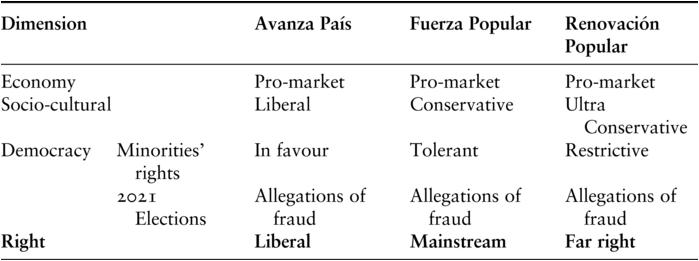
To classify RP as a far-right project in terms of its ideological tenets, it is useful to proceed comparatively, since simplistic approaches tend to wrongly classify different Peruvian right-wing parties as interchangeable. Based on the ideological and political categorization of the parties’ platforms, and their positions regarding the legitimacy of the 2021 elections, I classify currently relevant rightist parties in Table 6.1. Avanza País is a pro-market and liberal rightist party. In economic terms, its political platform conceives of economic inequalities as natural and believes the free market should prevail. In socio-cultural terms, however, they tend to take more liberal stances, for example, that gender identities are not natural but rather social constructs. Several of their lawmakers have been in favour of promoting equal rights for sexual minorities.Footnote 4
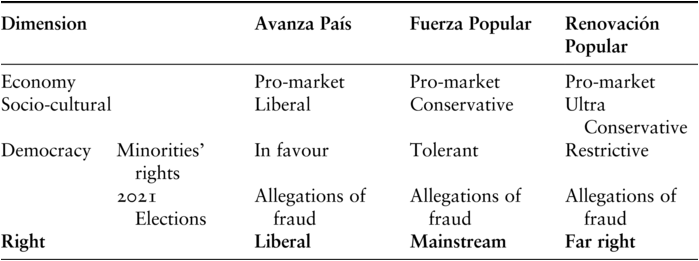
Table 6.1 Long description
The table has four columns titled Dimension, Avanza Pais, Fuerza Popular, and Renovacion Popular.
The dimension, economy, presents the following. Avanza Pais is a pro-market. Fuerza Popular is a pro-market. Renovacion popular is a pro-market.
The dimension, socio-cultural, presents the following. Avanza Pais is a liberal. Fuerza Popular is a conservative. Renovacion popular is an ultra-conservative.
The dimension, democracy and minorities’ rights present the following. Avanza Pais is in favor. Fuerza Popular is tolerant. Renovacion popular is a restrictive.
The dimension, democracy, 2021 elections, presents the following. Avanza Pais is under allegations of fraud. Fuerza Popular is under allegations of fraud. Renovacion popular is under allegations of fraud.
The dimension, right, presents the following. Avanza Pais is a liberal. Fuerza Popular is mainstream. Renovacion popular is a far right.
The note below reads. Prepared by the author.
Fuerza Popular, from the 2021 campaign onwards, has continued to be a pro-market and socially conservative party. On economic issues, Fujimoristas conceive of themselves as founders of the neoliberal model in Peru and see the maintenance of the current constitutional order as central to the defence of the legal pillars of the economic structure that considers inequalities as natural. Although they believe that state intervention is acceptable, they see it as restricted to social policies not affecting the main configuration of the economy. Regarding the socio-cultural dimension, they declare themselves to be conservativesFootnote 5 but tolerant regarding the rights of minority groups. However, they would not promote specific policies regarding those rights.
Finally, Renovación Popular fits as a far-right party. In the economic dimension, according to its party manifesto, RP endorses a ‘social pro-market economy’ based on the private property of the means of production. It considers personal liberties as superior to the state or other social organizations. This ideological pillar applies also to the socio-cultural dimension, since considerate believes that there is an ‘objective moral order’ in society, founded in ‘Western Christianity’, and that every social organization should be connected to that foundation. Followers of RP consider themselves the safeguarders of the ‘tradition and the values of the nation’.Footnote 6 For example, they maintain that class struggle destroys national unity and poses obstacles to development. They constitute the most socially conservative organization in the country.
All three political parties’ platforms are similar regarding the economic dimension (despite some nuances, they all endorse pro-market liberties). Preferences on neoliberal policies are similar among these parties; they are not matters of politicization and radicalization, as in the case of Chile (José Antonio Kast and Republicanos) or Argentina (Javier Milei and La Libertad Avanza), for example. However, significant socio-cultural differences exist. In this realm, they constitute a continuum that ranges from liberal (AvP) to conservative (FP) and ultra-conservative (RP) stances. Regarding their democratic values, these parties also constitute a continuum, from positions in complete favour of promoting democratic values (AvP), to being tolerant but not willing to promote them (FP), to being restrictive (RP). This specific point is important since it allows us to differentiate the liberal and mainstream right (AvP and FP, respectively) from the far right (RP). Although all three political parties alleged ‘fraud’ during the 2021 campaign – which was considered by some analysts as evidence of their undemocratic values – this point was circumstantial and limited to a specific electoral juncture. Their positions towards principles of liberal democracy (such as respect for minorities and pluralism) should be considered as a more precise indicator.
6.4 Levels of Populism and Other ‘Thin Ideologies’ among Right-Wing Parties
Based on the parties’ platforms and manifestos, I have classified them in terms of their ‘thick’ ideological stances, and their positions regarding liberal-democratic principles. The fragmentation of the right has led to distinctions between a liberal, mainstream, and far right. However, it is necessary to demonstrate whether or not these far-right parties can also be classified as populist radical right (PRR). According to the European academic literature, PRR parties should possess three defining attributes: social authoritarianism, nativism (in a form of xenophobic nationalism), and populism defined as a thin-centred ideology (a combination of Manichaeism and popular sovereignty) (Mudde, Reference Mudde2007). Based on the statements of the main leaders of these organizations, I attempt a complementary classification with respect to their acceptance or rejection of PRR attributes.
The social authoritarianism dimension refers to the conservation of the status quo, of the hierarchical and traditional order within a society (Mudde, Reference Mudde2007). Following Adorno’s (Reference Adorno2019) conceptualization of authoritarianism, society should be constituted by individuals predisposed to obey rules and norms imposed by the authorities, to accept the established social order, and to consent to sanctions if norms are transgressed. Far-right parties might exhibit this social authoritarianism in diverse ways, by defending the ‘traditional order’, from those who challenge it. In doing so, the radical right elaborates discourses identifying those ‘enemies’. Nationalist and punitivist narratives are regularly employed in this endeavour.
Nationalism is a doctrine that strives for the congruence of the cultural and political unit (nation and state respectively) (Mudde, Reference Mudde2007). In this sense, nationalism pursues a monocultural state through internal homogenization of society. In some cases, this defence of the unity of the nation is confronted by ‘foreign’ intervention. In Europe, PRR parties regularly reject immigrants considered a threat to their cultural homogeneity. This type of xenophobic nationalism has been rarely practised by the right-wing Peruvian parties. The main immigrant population in Peru (and in South America) has been Venezuelan, due to the diaspora caused by the economic crises of Nicolas Maduro’s administration. All right-wing parties in Peru have expressed solidarity with Venezuelan immigrants, although it is not necessarily something very popular in public opinion terms. The increase in urban crime in Lima and other Peruvian cities, with the participation of Venezuelan gangs (Guadalupe et al., Reference Guadalupe, Cisneros and Sialer2025), has aroused xenophobic attitudes among Peruvians that some politicians have tried to capitalize on, preparing bills or announcing mano dura measures against this specific population. But this framing is not presented in the same nationalistic terms as European nativism.
However, conservative national pride might be politicized in different ways. Other topics that have been addressed polemically by PRR political parties in Europe – like climate change – are treated in Peru in a ‘politically correct’ fashion, avoiding a polarizing discussion between the right-wing political parties and even RP. Tracking public declarations of López Aliaga on environmental issues, the sole reference during the 2021 presidential campaign was related to the Escazú Agreement, an international treaty signed by Latin American and Caribbean countries concerning the rights to environmental justice and sustainability, sponsored by the United Nations. The then presidential candidate’s critique was not regarding substantive ecological topics but about the sovereignty of nation-states on those issues. The adhesion to this type of international agreement is understood by López Aliaga as another example of the power of international NGOs and Latin America’s progressive actors: ‘The local caviaresFootnote 7 [progressive elites] confiscate our right to decide about our own patrimony.’Footnote 8 He questioned not specific politics regarding ecology but rather the international networks behind their promotion that allegedly undermine national sovereignty. The Peruvian right has historically criticized the role and jurisprudence of the Inter-American Court of Human Rights (IACHR) – in San José – as undue interference in the nation’s sovereignty on judicial matters. On this specific topic, Fujimoristas and hard-core conservatives share strong animosities towards what they consider foreign interference. The statement of the IACHR invalidating the presidential pardon of Alberto Fujimori – originally sentenced to twenty-five years for human rights abuses and corruption – has been contested by most of the right-wing camp.
The Peruvian right-wing is bonded, among other issues, around its anti-communism. The fact that an extra-systemic political organization, the Maoist Marxist-Leninist Shining Path, a small, radical left-wing party that evolved into a terrorist organization, initiated subversive attacks against the Peruvian state in the 1980s, has made the rejection of communism an enduring value held by a significant sector of society. It is also worth mentioning that many members of the leftist formal and democratic parties endorsed the idea of the ‘armed conflict’ as a way to access power even in the late 1980s. Based on this, the right has associated left-wing politicians with a presumed predisposition to violence and ‘terrorism’. This strategy – defined in Peru as ‘terruqueo’ – has been regularly practised, stigmatizing even the democratic left. We might consider ‘terruqueo’ as an extreme version of anti-communism because it purports to delegitimize the political rival, considering it not only violent but also anti-democratic. Although, most right-wing politicians share anti-communism, not all of them use ‘terruqueo’ – but López Aliaga does. He has been one of the right-wing politicians that frequently practises ‘terruqueo’, usually linking the stigma to the international left and other local progressive actors. For example: ‘[Gustavo] Petro supports [Pedro] Castillo because he has been a terruco. He was a guerrillero, right? A terruco then. And why no NGO, like Manuela Ramos or Flora Tristán, has said anything about this? Because they share the same ideology.’Footnote 9
The radicalized strategy of RP and its leader has led to the creation of a well-structured populist narrative that the rest of the right-wing does not share with the same intensity. Despite the fact that López Aliaga is a well-known businessman and a member of the Peruvian oligarchy, he has managed to construct a narrative in which the establishment is composed of ‘corrupt companies’ and ‘communist NGOs’ that compose a ‘mafia caviar’. Regarding the former, he rhetorically confronts the private sector that has been engaged in corrupt practices alongside Brazilian companies (e.g., Odebrecht), particularly in highway construction. At the same time, he seeks an opportunity to garner votes from the regular users of the corresponding road systems and to champion a valence issue like the fight against corruption. Regarding the latter, López Aliaga antagonizes with progressive cultural elites that challenge traditional conservative education. Many NGOs and socially progressive pundits have been the focus of his attacks, aiming to bolster his conservative following. This anti-establishment rhetoric is conceived in terms of a majoritarian justification: corrupt businessmen and ‘communist’ NGOs (aka caviares) are trying to impose their particular interests and harm those of the ‘people’, conceived as loyal Catholics who are the victims of corruption.
Paradoxically, this strategy has left Fujimorismo as the core defender of the economic establishment, since its main political platform is the defence of the 1993 Constitution. The fragmentation of the right has taken from Fujimorismo its traditional populist rhetoric, which is currently championed by RP. In doing so, RP selectively reclaims elements of the authoritarian legacy of the 1990s – especially a discourse of mano dura and societal order – but filters them through a morally conservative lens that Fujimorismo never fully embraced. The divergence becomes particularly salient in how RP wields anti-corruption as both a differentiating and delegitimizing tool. Constant references to Odebrecht and Lava Jato serve not only to evoke popular indignation but also to remind the electorate of Keiko Fujimori’s preventive imprisonment and investigations over illicit campaign financing. While both RP and Fujimorismo draw on the memory of authoritarian effectiveness, López Aliaga presents himself as having ‘clean hands’, contrasting with a Fujimorismo tainted by past corruption scandals. Thus, RP is not just reactivating an old populist-authoritarian script – it is reconfiguring it to cast both leftist forces and Fujimorismo as part of a decadent elite disconnected from the moral will of the people. All of these elements are synthesized in Table 6.2, which offers a comparative overview of the main right-wing parties in Peru along the key dimensions discussed above. This also allows us to categorize the three main right-wing parties: Avanza País as liberal, Fuerza Popular as pro-establishment, and Renovación Popular as populist.
| Dimension | Avanza País | Fuerza Popular | Renovación Popular |
|---|---|---|---|
| Xenophobic nationalism | No | No | No |
| Judicial sovereignty | No | Yes | Yes |
| Climate change denial | No | No | No |
| Anti-communism | Yes | Yes | Yes |
| Populism | No | No | Yes |
| Right | Liberal | Pro-establishment | Populist |
6.5 A Far-Right Party Ruling Local Government
Local government has been crucial for the functioning of democracy since it has been considered the level of public administration closest to the regular citizen. In this sense, the access of far-right parties to the subnational administration has been employed by them as a laboratory for their most radical policies or as a chance for moderation (Paxton, Reference Paxton2023). The fact that emerging far-right projects can access subnational administrative offices before seeking central power constitutes an excellent opportunity to analyse if, at this level, they prioritize policy over other goals, and if their behaviour once in power challenges liberal democracy. Far-right Latin American parties are a relatively recent phenomenon and, typically, their main goals point to national-level politics. Relevant far-right parties – such as the Chilean Partido Republicano and the Argentinian La Libertad Avanza – have not yet controlled municipal administrations. In this sense, the access of RP to the municipal administration of the Peruvian capital affords a good opportunity to analyse what to expect in terms of their concrete policies and their consequences for democracy.
After his defeat in the 2021 presidential elections, López Aliaga ran for the mayorship in Lima in the 2022 local elections. His candidacy obtained the largest share of votes (26.3%) at the metropolitan level, enough to be proclaimed mayor of Lima. With this simple majority, his party allocated fifty plus 1 percent of the number of council members in the capital (21 out of 39), controlling the decisions of the local government of the capital. Moreover, Renovación Popular ran for local office in thirty-eight out of forty-two districts of Lima, and obtained victories in twelve jurisdictions, most of them located in so-called Modern Lima, the districts with the highest per capita income level in the whole country. The triumph of Renovación Popular in neighbourhoods such as San Isidro, Miraflores, and San Borja surpassed 50 percent of the valid vote. No other political party obtained more victories in the capital, which shows that metropolitan Lima is a stronghold of this populist radical-right party.
It is still too early to make a proper assessment of the municipal administration of Renovación Popular. However, in its first year in office, there are some signs regarding how local governments are ruled by populist radical-right politicians in a Latin American city. At the metropolitan level, López Aliaga has continued his confrontation with some actors in the infrastructure construction business. Rutas de Lima is a private consortium that has held the licence for the maintenance of an important highway system in the capital for the last seven years, under a contract signed with previous mayors of the capital. In return, the company is able to collect tolls from the users of these routes. The new metropolitan administration has contested the prices of the tolls, considered expensive by regular users, especially in the marginal and poor areas of the city. López Aliaga has announced that this ‘abusive’ company should ‘give back’ the administration of the tolls to the city and gave an ultimatum (29 July 2023) that was not implemented, since an international arbitration ruling has favoured the private company.
What followed marked a turning point. Encouraged by the mayor’s stance, allied neighbourhood organizations filed constitutional complaints. The Peruvian Constitutional Court – controlled by conservative magistrates – responded by indefinitely suspending the tolls, citing an alleged violation of the ‘human right to free transit’. This ruling, now under international scrutiny, has escalated into ongoing arbitration procedures where the legal and contractual aberration behind the mayor’s campaign against the consortium is increasingly evident.
This arbitrary behaviour of the mayor of Lima has worried most of the members of the Peruvian formal business union, since it constitutes an attempt to breach legal contracts that should be guaranteed by any authority regardless of ideological stances. The then-president of Confederación Nacional de Instituciones Empresariales Privadas (CONFIEP), Alfonso Bustamante, published an article in the most relevant Peruvian business outlet demanding that the mayor comply with the arbitration ruling.Footnote 10 This is a recurrent example of López Aliaga’s hostility against the infrastructure business sector, presumably justified in terms of the economic situation of those who use this system and of the allegedly corrupt origins of the contractual agreement.
López Aliaga has also taken advantage of his position as mayor of Lima to advance his ultra-conservative agenda. One of the first decisions of a local municipality in Peru is to revise its ROF (Regulations of Organization and Functions). In doing so, the council of Lima changed the name and functions of some public offices, such as ‘Women and Equality’ being renamed ‘Women and Family’ and defending the rights of the LGTBQ+ population being removed from its duties.Footnote 11 Consequently, the municipality of Lima has ruled out any public policy in favour of protecting the rights of this minority group. This hostility against sexual minorities is part of a campaign by the mayorship. In July 2023, cultural associations organized OutFest Peru 2023, an international LGBTQ+ film festival that portrayed a collage of Santa Rosa de LimaFootnote 12 – the patron saint of Peru – in the festival’s poster and publicity, with the rainbow colours that characterize the pride movement. López Aliaga considered this marketing an offence ‘to the beliefs and values of the majority of the Peruvian population’,Footnote 13 and demanded ‘at least’ that the poster be changed. Since this occurred, several public and formal declarations and press releases by López Aliaga have been issued from a special tribune in the mayorship of Lima with a traditional picture of Santa Rosa de Lima behind the official podium.
Also, the metropolitan council has established the celebration of the ‘day of the family’ and, consequently, has set as the administration’s priority to promote the ‘strengthening of the family’ by explicitly eliminating the gender perspective from public policies, public services, and the institutional administration of the municipality.Footnote 14 The conservative nature of the council is also expressed in radical decisions about the city management: for example, prohibiting any public display in the Plaza Mayor for reasons of ‘public health and public security’.Footnote 15 Other local administrations of RP, including the one in charge of the municipality of Miraflores, had applied similar rulings limited to their jurisdiction.Footnote 16 On the same lines, symbolic institutional congratulations have been awarded to the National Police and the National Fire Department.Footnote 17 Moreover, the decrees issued by the mayor’s office to award the ‘medal of Lima’ – traditionally used as a symbolic form of public recognition to both national and international figures – have been employed by the current administration as an tool to strengthen public alliances with religious congregations (Santísimo Salvador de Pachacamac,Footnote 18 Hermandad de la Santísima Virgen de los Dolores de HuachoFootnote 19) and with far-right foreign political figures such as the Chilean opposition leader José Antonio Kast,Footnote 20 Argentine conservative commentator Agustín Laje,Footnote 21 and Mexican actor and potential presidential candidate Eduardo Verástegui.Footnote 22
At the district level, other Renovación Popular mayors have behaved similarly, displaying their arbitrariness in ruling the city and confronting progressive issues. Carlos Canales, the mayor of Miraflores, exemplifies this pattern. His first measure in office consisted of closing LarcoMar, the most important shopping centre in the district, arguing that the mall did not fulfil public security requirements demanded by the mayorship. Although this closure lasted less than a week, it should be interpreted as a demonstration of strength towards the private companies behind the retailers. The mayor of Miraflores has used issues with municipal licences as justification to selectively damage businesses and organizations that are not aligned with conservatives’ values. The Lugar de la Memoria, a museum for the memory of and reconciliation after the Peruvian civil war, was closed for weeks.Footnote 23 Sex-shops were closed,Footnote 24 and a micromobility (scooter rental) companyFootnote 25 was banned for allegedly not following municipal regulations. A municipal fee is intended to be imposed on personal trainers who use parks and public areas to train their students. This pattern of arbitrariness in the interpretation of municipal permits to damage businesses and organizations linked to progressive issues – the free use of public areas, sexual liberties, and the promotion of historical memories – is a demonstration of how a populist ultra-conservative local mayor can rule his district.
As mentioned at the beginning of this section, it is still too early to arrive at conclusions about RP’s administration of local governments as a far-right party. However, after a year in office, López Aliaga has shown arbitrariness in confronting political and ideological rivals – progressive sectors are stigmatized as ‘corrupt’ based on the crimes committed and confessed by the leftist former mayor of Lima, Susana Villarán. The mayor has developed a populist narrative and style in governing the capital, he has employed the idea of a superior morality of ‘the people’ to justify his confrontation with private corporations in judicial trials with the municipality, and he has taken advantage of this position to undermine the rights of women and minorities at the discursive level. Although local regulations have a limited reach in the quality of the democratic political regime (Paxton, Reference Paxton2023), being the mayor of a capital city like Lima affords a privileged and powerful position – in terms of access to media outlets and getting public attention – to shape and promote a narrative against liberal democracy.
6.6 Conclusions
The emergence of the far right in Peru can be explained, among other factors, by the dynamics of the party systems. In some cases, the confluence of right-wing and left-wing parties at the centre of the ideological spectrum, might leave a gap in the extremes of the continuum that can be the basis for the formation of ‘genuine’ radical-right parties. This is the case of the rise of Partido Republicano in Chile and Cabildo Abierto in Uruguay, for example (Chapters 5 and 7, this volume). In the case of Peru, the emergence of Renovación Popular can also be explained by party system dynamics, although its origin is the implosion of the right-wing camp in various organizations and the centrifugal political competition promoted by a polarized and radicalized environment. Between 2011 and 2021, the Peruvian rightist camp was dominated by a liberal and technocratic party (Peruanos por el Kambio) and by a conservative mano dura party (Fuerza Popular). Especially the latter can be better understood as a catch-all party of the right-wing camp, since it used to accommodate different varieties of the right under the premises of pro-market foundations and respect for Alberto Fujimori’s legacy. Among others, conservative factions cohabit under the aegis of Fujimorismo.
The last crisis of the party system in Peru produced the atomization of the right-wing camp. Specifically, Fuerza Popular was weakened and several factions abandoned the party with the incarceration of Keiko Fujimori (in 2018). Former collaborators and legislators of Fujimori decided to join other projects, such as Avanza País and Renovación Popular, in the 2021 electoral campaign. Several of the most conservative cliques – linked to social movements like Con Mis Hijos No Te Metas and activists against what they considered ‘gender ideology’ – joined López Aliaga’s relaunch of a reactionary party, in a context in which a socially progressive agenda (e.g., LGBTQ+ rights, growing pro-choice acceptance) gained ground in public opinion.
Thus, a new – albeit small – far-right project emerged ahead of the 2021 general elections, while Fuerza Popular was relegated to the role of a mainstream but increasingly discredited organization. In this context, RP strategically deployed a forceful anti-corruption narrative not only to target leftist actors but also to distinguish itself from Fujimorismo. By continuously invoking the Lava Jato and Odebrecht scandals, RP effectively reminded voters that Keiko Fujimori had spent time in preventive detention under investigation for corruption. This allowed López Aliaga to present himself as untainted – a populist with ‘clean hands’ – thereby reclaiming the symbolic capital of authoritarian toughness from Fuerza Popular but now wrapped in a cloak of moral probity and ultra-conservative values.
The political offering of a conservative party benefited from the polarized dynamics of the Peruvian electorate. The distribution of the electorate along the ideological continuum has changed dramatically since 2016, and the leftist and rightist ideological extremes – almost imperceptible a decade ago – concentrated each around 10–15 percent support among the electorate by the 2021 campaign (Meléndez, Reference Meléndez2022). Therefore, the Peruvian political arena turned into a polarized multipartyism characterized by a centrifugal competition among the parties (Sartori, Reference Sartori1976). This scenario of hyper-fragmentation and deep ideological divisions, ended up boosting the saliency of the extreme left – Peru Libre and Pedro Castillo – and extreme right – Renovación Popular and Rafael López Aliaga. Despite its critical situation, Fujimorismo stayed relatively competitive (due to the forging of its own partisanship), and prevented a 2021 run-off between the two extremes.
The persistence of the political crisis in Peru – with a leftist extremist like Castillo leaving office after a year and a half in power following an unsuccessful autogolpe – fostered even greater polarization. On one extreme, Castillo’s followers have considered the incarceration of the former president as unfair and, especially in the months following his fall, mobilized and protested demanding his freedom. Far from being widely discredited, a radical left is still active and searching for a new anti-establishment leader. On another extreme, López Aliaga presented himself as one of the main opposition leaders against the then-president, embracing a populist radical-right narrative: confronting ‘international communism’ and promoting more extremist positions – some of them coming close to death threats against CastilloFootnote 26 – than the rest of the rightist camp. Having access to local power – the mayorship of the capital is highly relevant in terms of political, symbolic, and economic resources – allowed him to continue building his political project, although highly dependent on his personal appeal. His tenure as the mayor of Lima has demonstrated the aggressiveness of his stigmatizing narrative against ideological and political rivals, and his arbitrary use of power to affect – at least symbolically – the advances made by minority groups and feminist organizations promoting their rights. It is difficult to affect the democratic political regime from local government, but López Aliaga has taken advantage of his public exposure as mayor of Lima to advance his conservative and socially authoritarian agenda.
In terms of organizational resources, RP is the result of an appropriation strategy that exemplifies the difficulties of any political project in general, and a far-right one in particular, to build an organization from scratch in Peru, even in contexts of acute polarization. RP shares the institutional weaknesses typical of Peruvian parties; but its cadres have invested in ideational resources to build a party brand associated with conservative and traditional values, which might balance its organizational limitations. They have attracted socially conservative grassroots movements very active in manifesting their positions against minority rights and gender equity, but it is difficult to secure a lasting pact between a niche social movement and a personalistic party. The hyper-fragmentation of political representation has made the conservative sector salient, but in absolute terms it has not increased significantly. So far, it is still early to anticipate any national victory for Renovación Popular, but it is without doubt the farthest that the far right has developed in Peru.

 Open access