

Scholars and pundits alike lament the low-turnout rates of young Americans, here defined as those aged 18–29.Footnote 1 Previous accounts have suggested that changing cultural norms and state electoral institutional factors have altered the voting propensities of this low-turnout group such that either they do not vote or they participate in politics through alternative means like protesting and boycotting (Dalton Reference Dalton2015; Franklin Reference Franklin2004; Holbein and Hillygus Reference Holbein and Hillygus2020; Lawless and Fox Reference Lawless and Fox2015; Putnam Reference Putnam2000). These attempts to understand youth voting tend to consider young individuals as a homogenous group. Cultural and age-cohort accounts suggest that the unique experiences of youths uniformly alter their voting behavior relative to older age cohorts. Institutional investigations assume that younger individuals possess the same ability to traverse the political system, but that they simply lack the participatory resources of time, money, and civic skills when compared to older, established voters.Footnote 2 However, today’s younger cohorts are significantly more racially and ethnically diverse than are older cohorts and have grown up in an age of ever-changing electoral rules. Given uneven patterns of resource distribution and mobilization by race, ethnicity, and age (Leighley Reference Leighley2001; Nickerson Reference Nickerson2006; Plutzer Reference Plutzer2002; Verba, Schlozman and Brady Reference Verba, Schlozman and Brady1995), some young voters may face different barriers than other youths due to their race or ethnicity, as well as when compared to older counterparts in the same racial or ethnic group due to their age. Yet, few studies have explored the effects of state voting and registration laws on voter turnout on youths of different racial or ethnic identifications.
This study furthers the literature on youth voting behavior by not considering them a homogenous group, but instead, taking into consideration the unique racial and ethnic variation of their cohort and how that alters their capacity to participate in politics. Though many studies have investigated the effects of electoral reforms on racial and ethnic Americans (e.g., Hajnal, Lajevardi and Nielson Reference Hajnal, Lajevardi and Nielson2017; Herron and Smith Reference Herron and Smith2014; Ritter and Tolbert Reference Ritter and Tolbert2020; Walker, Herron, and Smith Reference Walker, Herron and Smith2019) or young voters (e.g., Hanmer Reference Hanmer2009; Holbein and Hillygus Reference Holbein and Hillygus2020; Leighley and Nagler Reference Leighley and Nagler2013), few have directly looked at how these reforms may affect young racial and ethnic voters in distinct ways from their older counterparts or when compared to other youths of different racial or ethnic identities. This study investigates how the overall restrictiveness of a state’s electoral environment affects the voting propensities of different young Americans defined by race and ethnicity. In doing so, this study takes advantage of the significant variation in racial and ethnic diversity of young Americans and state electoral laws governing voting access in the 50 American states.
Using individual, self-reported voter turnout data from the Current Population Survey (CPS, 2000–2016), a sample of national voter roll data from Catalist (2012), and an index of how restrictive each states’ election environment is (Li, Pomante II, and Schraufnagel Reference Li, Pomante and Schraufnagel2018), this study tests the effect of a state’s cumulative electoral environment on young Black (non-Hispanic), Hispanic, and white (non-Hispanic) voters.Footnote 3 This study finds that Black, Hispanic, and white youth (self-reported and official) voter turnout decrease substantially as electoral environments become more restrictive. Further analyses show that Black and white youths are similarly affected by changes in electoral reform restrictiveness, while Hispanic youths are affected to a significantly larger degree. Black and white youths tend to outvote their Hispanic counterparts, even when comparing Black and white youths in restrictive states to Hispanic youths in permissive ones. These findings are in-line with a resource theory of participation, wherein Hispanic individuals tend to lack resources compared to Black and Hispanic individuals (Verba, Schlozman and Brady Reference Verba, Schlozman and Brady1995) and suggest the stark differences in overall voter turnout by race and ethnicity may begin early.
Some significant differences are also found when comparing young racial and ethnic voters to their older counterparts. Across nearly all specifications, Hispanic youths are deterred from voting at larger rates than older Hispanic voters as voting becomes more difficult. A similar but substantially smaller effect is found comparing white youths to their older counterparts; however, this finding is less robust to alternative model specifications. Additionally, no significantly different effects were found between older and younger Black voters under almost any specification. The lack of differential effects found between younger and older Black voters suggests that old and young Black voters are similarly affected by increased costs to vote. Given differences in resources between older and younger voters, this raises the question of what is subsidizing the costs to vote for younger Black voters that assists them in voting at similar rates as their older counterparts and why the costs for Hispanic, and maybe white, youths are not similarly undercut. Future works should examine this finding more thoroughly.
The differential effects uncovered here suggest that the variation in diversity among and between cohorts can be a theoretically important characteristic, and that ignoring this heterogeneity likely masks important differences within cohorts. When coupled with the voter habituation (e.g., Plutzer Reference Plutzer2002) and policy representation (Griffin and Newman Reference Griffin and Newman2005, Reference Griffin and Newman2008) literatures, these results also have important normative implications. First, to what extent are the differential effects of electoral laws on racial and ethnic youth voters contributing to future differences in racial and ethnic voting patterns? For example, is the finding that young Hispanic voters are deterred from voting at greater rates, and thus, less likely to habituate voting sooner, partially to blame for average Hispanic turnout lagging significantly behind that of Black and white voters? Second, some previous research has suggested that elected officials are more inclined to listen to their (white) voting constituents (Griffin and Newman Reference Griffin and Newman2005, Reference Griffin and Newman2008). Given the stark differences in political opinions between older and younger voters (Rouse and Ross Reference Rouse and Ross2018), lower youth voter turnout, and increased diversity, the findings of this study question the extent to which election and policy outcomes, particularly in restrictive states, are reflecting the will of the people, or simply of the older or whiter population that is casting a ballot. Future studies should examine these implications.
Racial and ethnic diversity across age cohorts
Today’s youth cohort is much more racially and ethnically diverse than older cohorts, both when compared older cohorts were they younger or older cohorts as they persist today. Table 1 compares racial and ethnic identification of 18–29-year-olds across decades (American Community Survey, 1980–2019).Footnote 4 Table 1 shows new youth cohorts are more racially and ethnically diverse than older Americans were when they were young. White individuals comprise a slight majority of today’s youths, while making up a near-super-majority of previous youth cohorts. At the same time, roughly 1 in 5 young Americans today identify as Hispanic, while only 1 out of 9 young Americans identified as Hispanic in 1990 and 1 in 12 in 1980. Today’s youths are also more likely to identify as a different race than the ones listed above. Taking a closer look at Table 1, this shift in racial and ethnic identification appears most strongly between 1990 and 2000. In other years, the change in white populations tended to be about −5 percentage points. Between 1990 and 2000, this increased to almost −9. Directly related, the 1990–2000 pattern also shows the largest increase in Hispanic and other race populations (+5.44, +3.33, respectively). However, there was little change to proportion of Black youths across decades.
Racial and ethnic identification of 18–29-year-olds from 1980 to 2019

Authors tabulations of 1980, 1990, 2000, 2010, and 2019 American Community Surveys. Black, white, and other refer to non-Hispanic individuals. Hispanic individuals are any individual who identifies as Hispanic.
Given the patterns above, it is no surprise that today’s youths are more diverse than older age cohorts today. Comparing racial and ethnic composition across today’s age cohorts in Table 2 (in 2016),Footnote 5 only 53% of today’s youths are white non-Hispanic, compared to an average of 62% of older Americans. At the same time, the youngest age cohort is made up of more Hispanic (23%) and Black (13%) individuals than older cohorts (17% and 12%, respectively), with much of this growth attributable to recent increases in Hispanic populations. The disparity between younger and older voters is more striking comparing today’s youth to specific older age groups. Though 62% of those above 29 are non-white, this figure is as low as 58% for the 30–39 population and as high as 79% for those above 70. This amounts to a 5–26 percentage point difference in white identification across age cohorts.
Racial and ethnic identification across age groups (2016)

Authors tabulations of 2016 American Community Survey. Black, white, and other refer to non-Hispanic individuals. Hispanic individuals are any individual who identifies as Hispanic.
Aside from rates of diversity across age groups, what it means to be Black or Hispanic is also changing. Consider two characteristics that are frequently found to be important among Black and Hispanic Americans: (1) racial identification and church attendance for Black Americans (Gay Reference Gay2004; McClerking and McDaniel Reference McClerking and McDaniel2005; Tate Reference Tate1994) and (2) ethnic identification and the immigration experience for Hispanic Americans (Garcia-Rios and Barreto Reference Garcia-Rios and Barreto2016; Masuoka Reference Masuoka2008; Nicholson and Segura Reference Nicholson and Segura2005). In both aspects, today’s youths are different than their older counterparts.
Racial identification as well as church and religious service attendances is often found to be strong influences in Black communities (Bledsoe et al. Reference Bledsoe1995; McClerking and McDaniel Reference McClerking and McDaniel2005; Tate Reference Tate1994). However, Black youths are less likely to view race as a core facet of their identity and have been shying away from religion at rates not seen in previous age cohorts. Though nearly three-quarters of older Black Americans identify their race as a central component of their identity, only two-thirds of Black youths say the same (Horowitz et al. Reference Horowitz, Brown and Cox2019). While Black youths are more religious than other youths, they are less religious than are older Black Americans (Mohamed Reference Mohamed2021). Black youths are 20 percentage points less likely to say religion is very important to them (61%–81%), 17 points less likely to pray daily (61%–78%), 12 points less likely to attend weekly religious services (38%–50%), and 11 points less likely to be certain God exists (75%–86%). Black youths are also less likely to attend predominantly Black or multiracial churches while more likely to attend predominantly white churches. Given the roles of racial identification (Bledsoe et al. Reference Bledsoe1995) and church attendance (Tate Reference Tate1994) for Black political participation, the experiences of Black youths may also set them apart from older Black Americans.
Differences also arise comparing older and younger Hispanic Americans. Hispanic youths are increasingly likely to be of similar Hispanic descent and to also be born in the USA compared to those in older age groups. Sixty-seven percent of Hispanic youths have Mexican origin, compared to an average of 59% among all those above the age of 29; with those 30–39 and 40–49 years old roughly 62% Mexican, each; 50–59 being 58%; 60–69, 56%; and those above 70 only a slim majority of those identifying as Mexican at 51% (American Community Survey 2000–2016). Additional, only 16% of Hispanic youths are immigrants compared to 62% of non-youths, and some of the largest changes in youth immigrant rates occurred between today’s youths and older cohorts. This naturalization versus natural born citizen pattern emerges in another important area for voter participation: English proficiency. Eight percent of multilingual youths speak English very well, 31 percentage points higher than older Hispanic Americans (49%). Additionally, 1 in 3 Hispanic youths speak only English at home compared to 1 in 5 older Hispanic Americans, while only 2% speak no English compared to 10% of older Hispanic individuals. Considering the link between identity (Masuoka Reference Masuoka2008), and immigration status (Pantoja, Ramirez, and Segura Reference Pantoja, Ramirez and Segura2001), or English language proficiency (Parkin and Zlotnik Reference Parkin and Zlotnick2011), and political participation, it could be the Hispanic youth experience different barriers to participation than do older Hispanic individuals.
This evidence suggests there are significant differences across younger and older individuals regarding their racial and ethnic composition, the forces that shape individual racial and ethnic identity, and potentially how they interact with the political system. Though the patterns documented here have been evolving overtime, they have become especially prominent with the newest youth cohorts. However, previous studies into the effects of electoral reforms have tended to not differentiate their impacts on racial and ethnic Americans by age or on young Americans differentiated by racial and ethnic identity. Yet, as demonstrated above, there are significant differences in racial and ethnic composition and identification across age groups, and, as will be discussed below, differences in participatory resources and mobilization along these same racial, ethnic, and age lines. Given these differences, the costs of voting could have differential effects on youths based on their racial or ethnic identity, while having differential effects on racial and ethnic voters based on their age.
The effects of state electoral laws
To vote, citizens must navigate a complex registration and voting process. Some states require voters register up to 30 days before an election, while in others, eligible citizens can register and vote on the same day, often including Election Day. To cast a ballot, some voters are resigned to only being able to do so on Election Day. Yet, voters in other states are allowed to cast their ballot earlier through mail, absentee, and early voting. These rules, which structure how and when citizens can register and vote, can have significant impacts on whether individuals actually do so (Aldrich Reference Aldrich1993; Downs Reference Downs1957; Riker and Ordeshook Reference Riker and Ordeshook1968). Electoral reforms, like adding same day registration, can increase voting by making the process easier (e.g., Ritter and Tolbert Reference Ritter and Tolbert2020). At the same time, when voting is made more difficult by increasing the costs to vote (e.g., decreasing early voting periods), voter turnout can decline (e.g., Herron and Smith Reference Herron and Smith2014).
However, electoral reforms do not affect all voters equally (Hanmer Reference Hanmer2009; Herron and Smith Reference Herron and Smith2014; Juelich and Coll Reference Juelich and Coll2020; Leighley and Nagler Reference Leighley and Nagler2013; Ritter and Tolbert Reference Ritter and Tolbert2020). Different voters have different levels of participatory resources (e.g., time, money, and civics skills) and mobilizing forces that shape their ability and willingness to participate (Hill and Leighley Reference Hill and Leighley1999; Leighley Reference Leighley2001; Plutzer Reference Plutzer2002; Rosenstone and Hansen Reference Rosenstone and Hansen2003; Verba, Schlozman and Brady Reference Verba, Schlozman and Brady1995), leading to different effects of electoral reforms on voter turnout.
Racial and ethnic Americans and electoral reforms
Though multiple explanations for the racial turnout gap have been suggested (Fraga Reference Fraga2018), one prominent explanation is the differences in participatory resources and mobilization across racial and ethnic groups (Verba, Schlozman and Brady Reference Verba, Schlozman and Brady1995). Previous scholars have argued that Black and Hispanic individuals do not participate at the same rates as white individuals due to lacking free time, disposable income, civic skills, and campaign mobilization efforts when compared to their white counterparts, and as such, controlling for these factors may decrease participation discrepancies (Fraga Reference Fraga2018; Hill and Leighley Reference Hill and Leighley1999; Leighley Reference Leighley2001; Rosenstone and Hansen Reference Rosenstone and Hansen2003; Verba, Schlozman and Brady Reference Verba, Schlozman and Brady1995). This has led some to argue that electoral reforms that decrease the costs to vote can help increase Black and Hispanic voter turnout while reforms increasing those costs may do the opposite (Barreto et al. Reference Barreto2019; Ritter and Tolbert Reference Ritter and Tolbert2020; Xu Reference Xu2005; but see Berinsky Reference Berinsky2005).
Considering registration reforms, previous work has found that making registration easier can increase non-white voting while making it harder can do the opposite. Using a sample of national voter roll data with individual vote histories, Ritter and Tolbert (Reference Ritter and Tolbert2020) find that allowing individuals to register and vote on the same day significantly increased the voting propensities of Asian, Black, and Hispanic Americans in the 2012 presidential election. At the same time, Hill and Leighley (Reference Hill and Leighley1999) find that registration requirements are often greater in states with more racial and ethnic diversity, and Xu (Reference Xu2005) finds these registration requirements are especially disadvantageous for non-white voters.
Examining early voting, a reform with mixed evidence of increasing turnout among the general public (Burden et al. Reference Burden2014; Giammo and Brox Reference Giammo and Brox2010; Gronke, Galanes-Rosenbaum, and Miller, Reference Gronke, Galanes-Rosenbaum and Miller2007; Leighley and Nagler Reference Leighley and Nagler2013), some scholars have found that allowing voters to cast a ballot prior to Election Day can increase Black and Hispanic voting propensities. Using voter rolls from Florida, Herron and Smith (Reference Herron and Smith2012) find that Black and Hispanic individuals were more likely to take advantage of early voting. In a follow-up article (Herron and Smith Reference Herron and Smith2014), the authors find Florida’s decision to cut the number of early voting days decreased Black and Hispanic turnout. This is in line with Ritter and Tolbert’s (Reference Ritter and Tolbert2020) national voter roll analyses which suggest early voting increased the propensity of Black and Hispanic individuals to vote during the 2014 midterm election.
There is still debate as to whether voter identification requirements affect voter turnout (Burden Reference Burden2018). Some authors find they negatively impact all voters (e.g., Alvarez, Bailey, and Katz Reference Alvarez, Bailey and Katz2008) while others uncover only a slight/no negative impact (Grimmer et al. Reference Grimmer2018, Highton Reference Highton2017; Rocha and Matsubayashi Reference Rocha and Matsubayashi2014). However, others argue the impact of voter IDs is mostly felt by non-white voters—particularly Hispanic Americans (Hajnal, Lajevardi and Nielson Reference Hajnal, Lajevardi and Nielson2017; Kuk, Hajnal and Lajevardi Reference Kuk, Hajnal and Lajevardi2020)—due to lower rates of voter identification possession (Barreto et al. Reference Barreto2019; Fraga and Miller Reference Fraga and Miller2021) and higher rates of being requested to show IDs (Atkeson et al. Reference Atkeson2010).
Last, felon disenfranchisement is another reform that has been found to unduly affect non-white voters, particularly Black Americans. Many states revoke voting rights for those convicted of felonies or high misdemeanors. Some states restore those rights after time is served, others require all related debts are paid, and a few permanently disenfranchise felons. Yet, rates of felony convictions are not constant across all racial and ethnic groups, with Black Americans disproportionately convicted of these crimes and having their voting rights revoked (Manza and Uggen Reference Manza and Uggen2008). As such, previous evidence has suggested that felon disenfranchisement may hinder Black voter turnout (Cottrell et al. Reference Cottrell2019). Given this previous work demonstrating the racial and ethnic disparities in electoral reform effects, it is likely these effects also differ by racial and ethnic identity among young voters.
Young Americans and electoral reforms
Except for the 2018 and 2020 elections, one of the most notable systemic shifts in the modern era is that of decreased youth voter turnout. This trend is so persistent that it affects all current cohorts at all stages of life, as well as younger cohorts in virtually all developed nations (Franklin Reference Franklin2004; Inglehart and Welzel Reference Inglehart and Welzel2005). To explain this trend toward decreased voting, particularly among younger citizens, scholars have turned to changes in civic norms (Putnam Reference Putnam2000), feelings of political alienation and pessimism (Lawless and Fox Reference Lawless and Fox2015), a lack of youth descriptive representation (Pomante and Schraufnagel Reference Pomante and Schraufnagel2015), shifts toward non-traditional forms of participation such as protesting (Dalton Reference Dalton2015), differences in parent–youth socialization (Plutzer Reference Plutzer2002), and institutional arrangements that affect the ability of younger voters to participate (Holbein and Hillygus Reference Holbein and Hillygus2020). Though these are all important factors that can influence whether a citizen casts a ballot, this study focuses on the institutional constraints that alter the likelihood of participating given previous research showing differential impacts of these laws on racial, ethnic, and age groups (e.g., Holbein and Hillygus Reference Holbein and Hillygus2020; Ritter and Tolbert Reference Ritter and Tolbert2020).
Younger citizens tend to possess fewer participatory resources and political experience, leading to more difficulty navigating the voting process. Younger voters are, almost by definition, more likely to be non-habitual voters (Plutzer Reference Plutzer2002). As such, they lack the experience and inertia that propels one to vote in election after election. This lack of experience makes it difficult for young voters to navigate the registration and voting process (Cottrell, Herron, and Smith Reference Cottrell, Herron and Smith2021; Merivaki Reference Merivaki2020). The lack of inertia results in young voters being less likely to vote on their own accord; yet young voters are often overlooked when it comes to mobilization tactics (Rosenstone and Hansen Reference Rosenstone and Hansen2003). Younger voters are also less likely to be registered to vote, requiring they surmount the registration barrier their older counterparts are likely to have already surpassed. And, because they move more often, youths must frequently re-surmount this barrier.
Because of their lower levels of participatory resources, habituation, registration rates, and mobilization efforts, previous work has shown that decreasing the costs to vote can increase youth voter turnout while increasing them can have the opposite effect. For example, Holbein and Hillygus (Reference Holbein and Hillygus2020) find that allowing youths to “pre-register” to vote prior to their 18th birthday can increase youth turnout. Similarly, providing voters the chance to register and vote on the same day can also increase youth voting propensities (Holbein and Hillygus Reference Holbein and Hillygus2020; Leighley and Nagler Reference Leighley and Nagler2013). At the same time, Juelich and Coll (Reference Juelich and Coll2020) find that youth voters are significantly less likely to vote in states with more restrictive voting laws compared to youths in more accessible states or older Americans in similarly restrictive states.
Given previous research suggesting that young voters are disenfranchised at higher rates by more restrictive voting laws, this study expects that, regardless of race or ethnicity, youth voter turnout will decrease at higher rates than older voter turnout as state employ more restrictive registration and voting laws.
Hypothesis 1: For Black, Hispanic, and white youths, turnout will decrease at higher rates than the turnout of their respective older counterparts as state voting environments become more restrictive.
Young racial and ethnic Americans and electoral reforms
Though this previous research has helped explain why the average racial, ethnic, or young American may (not) be participating, the tendency of this work to ignore the intersectionality of age and racial/ethnic identity results in less nuance than is needed to solve the malignancy that is depressed youth, racial, or ethnic voter turnout. As mentioned earlier, barely over 1/2 of today’s young Americans are white non-Hispanic, with the remainder nearly 1/4th Hispanic, over 1/12th Black, and 1/10th a different racial or ethnic group. Being as necessary participatory resources are not distributed evenly across demographic groups (Rosenstone and Hansen Reference Rosenstone and Hansen2003; Plutzer Reference Plutzer2002; Verba, Schlozman and Brady Reference Verba, Schlozman and Brady1995), it is likely that young voters may respond differently to changing costs of participation depending on their racial and ethnic demographics.
Considering three of the most important resources for voting—education, free time, and disposable income (Verba, Schlozman and Brady Reference Verba, Schlozman and Brady1995) —there are large differences in the distribution of these resources between young voters differentiated by race and ethnicity (see Table 3, American Community Survey, 2000–2016; CPS, 2000–2016). Starting with education, the first six rows of Table 3 suggest that white youths have higher education rates than Black and Hispanic youths (p < .000, each), while Black youths have higher rates than Hispanic youths (p < .000). Black youths are almost twice as likely to have not graduated high school compared to white youths, while Hispanic youths are nearly three times as likely. At the same time, white youths are at least twice as likely to have a bachelor’s degree or advanced degree compared to Black or Hispanic youths. Hispanic youths are more likely than Black youths to not have graduated high school while slightly less likely to have a Bachelor’s or advanced degree. Previous work has uncovered similar patterns to educational distribution across racial and ethnic groups (Verba, Schlozman and Brady Reference Verba, Schlozman and Brady1995). Given education’s central role in political participation (Rosenstone and Hansen Reference Rosenstone and Hansen2003; Verba, Schlozman and Brady Reference Verba, Schlozman and Brady1995), it is likely that these education disparities manifest into participatory disparities.
Resource distribution among Black, Hispanic, and white youths
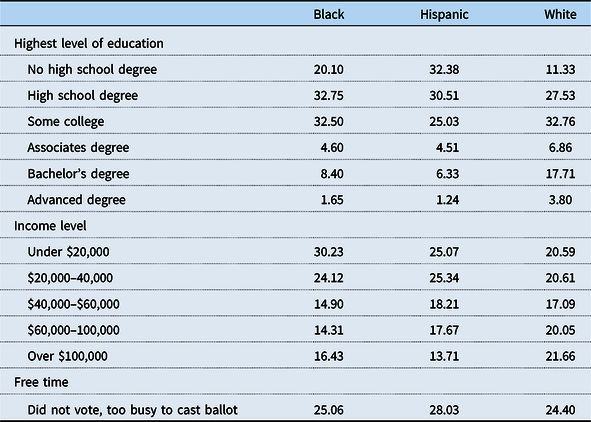
Cells show percent of each group within education and income categories or the percent of each group that did not vote and reported being too busy to cast a ballot. Source: Authors tabulations of American Community Survey (education and income) and Current Population Survey (free time) (2000–2016, both). Youth = 18–29 years old. Black and white are non-Hispanic. χ2 tests suggest differences in overall income and education rates between racial and ethnic groups are significant at the p < .000 level, while differences in time are only significant for Hispanic and white individuals (p < .000).
Turning to income, white youths continue to fare better than their racially and ethnically different counterparts (p < .000, each), while Hispanic youths have higher incomes than Black youths (p < .000). White youths are less likely than Black or Hispanic youths to have incomes under $40,000, while much more likely to have incomes over $60,000. Similarly, Hispanic youths are less likely than Black youths to be in the lowest income bracket while more likely to be in almost any other income group other than the highest income group. Again, white (youths) possess greater participatory resources, on average, than Black or Hispanic (youths) (c.f. Verba, Schlozman and Brady Reference Verba, Schlozman and Brady1995).
Last, though no direct question of free time is included in these surveys, the CPS asks respondents who did not vote a more specific question: whether they were too busy to vote. 25.06% of non-voting Black youths were too busy, as were 28.03% of Hispanic youths and 25.40% of white youths. No significant differences were uncovered between white and Black youths (p = .690), or between Black and Hispanic youths (p = .140). However, Hispanic youths are significantly more likely than white youths to cite being too busy as a reason for not voting (p = .011). This is further supported by previous work suggesting that Black and white voters faced similar time constraints while Hispanic voters had significantly less free time (Verba, Schlozman and Brady Reference Verba, Schlozman and Brady1995).
These patterns closely mirror those found for racial and ethnic Americans in the aggregate (Verba, Schlozman and Brady Reference Verba, Schlozman and Brady1995), and given the resource theory of participation, suggest the pattern in the effects of electoral reforms may be similar for racial and ethnic youths as it is for these voters in the aggregate. Considering previous research has found altering the difficulty with which citizens register and vote disproportionately affects Black and Hispanic voters compared to their white counterparts (Herron and Smith Reference Herron and Smith2014; Ritter and Tolbert Reference Ritter and Tolbert2020), it is likely that a similar pattern is found for racial and ethnic youths.
Hypothesis 2: Black and Hispanic youth turnout will decrease at higher rates than white youth turnout as state voting environments become more restrictive.
Data and methods
To examine how restrictive or accessible electoral environments affect the turnout of Black, Hispanic, and white youths, this study uses data on voting and individual level demographics from the CPS (2000–2016),Footnote 6 with Catalist voter roll data (CVR, 2012) as an additional robustness check to safeguard against bias associated with self-reported voting. The CPS is utilized for several reasons. First, the sampling process of the CPS results in a more accurate measure of voter turnout than other prominent surveys (Burden et al. Reference Burden2014, 101; Fraga and Holbein Reference Fraga and Holbein2020; Highton Reference Highton2005; Hur and Achen Reference Hur and Achen2013). Second, this survey is state representative and stratifies by, among other things, age and race. Third, the large size of the CPS provides greater statistical accuracy for estimating the effects of increased costs to vote on young racial and ethnic voters. These factors provide more accurate estimates of the effects of state-level electoral reforms on the voting behavior of young racial and ethnic voters. Fourth, the CPS is frequently used to study electoral reforms, allowing for greater comparability to other investigations of reforms and turnout (e.g., Burden et al. Reference Burden2014; Leighley and Nagler Reference Leighley and Nagler2013). However, there are potential issues with the CPS data, potentially stemming from its self-reported voter turnout measure and group representativeness as the state level.
First, previous works have argued that social desirability in responses to voter turnout questions can result in overestimation of turnout and bias results (Hur and Achen Reference Hur and Achen2013). However, the CPS is known to provide one of the better estimates of voter turnout (Highton Reference Highton2005; Hur and Achen Reference Hur and Achen2013), particularly for specific demographic groups (Fraga and Holbein Reference Fraga and Holbein2020, but see Ansolabehere, Fraga, and Schaffner Reference Ansolabehere, Fraga and Schaffner2021). For example, comparing the CPS to state voter rolls, McDonald (Reference McDonald2007) finds the demographic breakdown of the CPS is considerably similar to that of several state voter files, including for age, race, or ethnicity (McDonald Reference McDonald2007).
When it comes to overreporting, a study comparing youth turnout in the CPS and Cooperative Congressional Election Study (CCES) to data from national voter files finds the CPS does tend to slightly overestimate youth turnout, but that the correlation between youth turnout in the CPS and national voter files is high while the correlation between that of the CCES and the national voter files is rather low (Fraga and Holbein Reference Fraga and Holbein2020; see, also Ansolabehere and Hersh Reference Ansolabehere and Hersh2012). The authors argue that the small state sample sizes in the CCES account for this low correlation, as few youths are sampled in certain states, an issue less prevalent in the CPS data due to its large sample sizes. However, Ansolabehere, Fraga, and Schaffner (Reference Ansolabehere, Fraga and Schaffner2021) find that the CPS overestimates Black and Hispanic turnout compared to white, non-Hispanic turnout.
While bias in self-reported turnout is a concern for the study at hand, the potential effect on the quantities of interest may actually bias these findings in the conservative direction given the hypothesized effects. This study expects that (younger) Black and Hispanic voters will be less likely to vote as electoral environments become more restrictive compared to (young) white voters or to their older counterparts. As such, using data that may overestimate the turnout of Black and Hispanic voters may make uncovering significant effects in the expected direction more difficult, as Black and Hispanic voters may appear more likely to vote while white, non-Hispanic voters may not. However, to ensure the accuracy and reliability of the results presented here, additional robustness checks were executed. Presented below are analyses using data from national voter rolls rather than self-reported voter turnout. Models were also re-estimated weighting the data to account for overreporting (Hur and Achen Reference Hur and Achen2013, but see Ansolabehere, Fraga, and Schaffner Reference Ansolabehere, Fraga and Schaffner2021). Other robustness checks, including alternate coding structures of the independent and dependent variables, varying the youth age range, and multilevel modeling were also conducted. Last, because racial and ethnic overreporting has been tied to the size of co-ethnic/racial groups (Bernstein, Chadha, and Montjoy Reference Bernstein, Chadha and Montjoy2001), included are measures of these groups. Results are robust to nearly all alternative modeling strategies (see Appendix C in Supplementary material).
Second, there may be concerns of the ability of the CPS to provide representative samples of specific groups within states. But, as already mentioned, previous work has found that the demographic breakdowns of CPS state samples are similar to that of voter files (McDonald Reference McDonald2007). Further, the long-time series used in this study helps ameliorate some of these concerns. However, some may still be concerned that the CPS may under/over-represent certain demographic groups. Additional analyses suggest that representativeness is not of great concern, as the distribution of young racial and ethnic voters in the CPS is similar to that of other demographic and political benchmarks.Footnote 7
The Cost of Voting Index (COVI; Li, Pomante, and Schraufnagel Reference Li, Pomante and Schraufnagel2018) is used to measure the restrictiveness of each states’ electoral environments.Footnote 8 The COVI uses factor analysis to combine over 30 electoral laws, such as youth preregistration, voter identification requirements, early voting, same day registration, and more,Footnote 9 into a unidimensional index that measures how restrictive each state’s electoral environment is for presidential election years. Studies that examine a single electoral reform are plentiful and beneficial in that these studies illustrate the effects of a single law in detail. However, single indicators do not capture the full range of how permissive or restrictive the cumulation of state electoral reforms make the election environment (Burden et al. Reference Burden2014). The index ranges from −2.92 to 1.77 for the years under study, where positive values indicate increased costs (more restrictive environments), and negative values represent less costs (more permissive environments). Previous studies have demonstrated the cost of voting is a significant predictor of voter turnout (Juelich and Coll Reference Juelich and Coll2020; LaCombe and Juelich Reference LaCombe and Juelich2019; Li, Pomante II, Scraufnagel Reference Li, Pomante and Schraufnagel2018).
Figure 1 displays the values of COVI divided by standard deviations across the states for the 2000–2016 presidential elections, where darker shades indicate greater costs. Because the index has only been created for presidential election years and the demographic shifts documented above become especially prominent in 2000 and beyond, this study uses the 2000–2016 presidential elections. Providing face validity, historically restrictive states of the South frequently boast restrictive election environments (e.g., Alabama and Texas) while the canonically permissive states of the West have the most accessible environments (e.g., Oregon and Washington).
Cost of Voting Index, 2000–2016 (Li, Pomante II, Schraufnagel Reference Li, Pomante and Schraufnagel2018). Darker shading reflects greater electoral law restrictiveness, divided by standard deviation (µ = 0, σ = .724).

To estimate the effects of state electoral laws, this study employs logistic regression with year fixed effects and robust standard errors clustered by state.Footnote 10 Included in the models as the dependent variable is whether the respondent voted in the presidential election in that year, coded 1 if they voted, 0 if they did not. Given the role of election competitiveness on youth voter turnout (Pacheco Reference Pacheco2008), the inverse of the presidential vote margin is included as a measure of the competitiveness. Previous work has suggested that the size of the local co-ethnic or racial population may affect voter turnout (e.g., Fraga Reference Fraga2018) and vote overreporting (e.g., Bernstein, Chadha, and Montjoy Reference Bernstein, Chadha and Montjoy2001), and as such, also included is a measure of the percent of the state that is of the same racial or ethnic group as the respondent. Individual level variables consist of gender, race, ethnicity, income, education, employment status, marital status, and homeownership.Footnote 11 Summary statistics for all variables used in this study can be found in Appendix A, Supplementary material.
The cost of voting and young racial and ethnic voters
Table 4 displays four models. The first is a subsample of all youths to form a reference group, followed by further subsamples of Black, Hispanic, and white youths. These further subsample models isolate the impact of increasing costs on different voters while also allowing the effects of other covariates to vary across groups (see Leighley and Vedlitz Reference Leighley and Vedlitz1999). To aid in interpretation, the predicted probabilities of voting varying the COVI +/− 2 standard deviations for each model are reported in Table 5 (see, also Figure B1 in Appendix B, Supplementary material).
The effects of the costs of voting on youth voter turnout overall and by racial and ethnic group
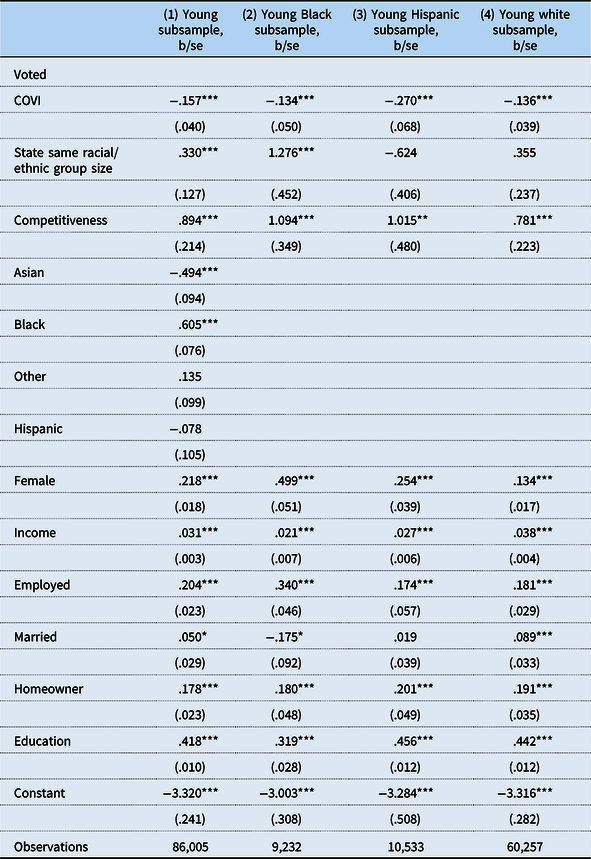
Logistic regression with robust and clustered standard errors, and year fixed effects. COVI = Cost of Voting Index (Li, Pomante II, and Schraufnagel Reference Li, Pomante and Schraufnagel2018). Young = 29 years old and below. * .1 ** .05 ***.01

Turning to model 1 in Table 4, the coefficient for COVI is negative and statistically significant, suggesting increased costs decrease youth turnout. The top row of Table 2 shows that moving from a state two standard deviations below the mean (i.e., more permissive electoral environments, e.g., Maine, North Dakota) to a state two standard deviations above the mean (i.e., more restrictive, e.g., Mississippi, Texas) decreases the probability a young American reports voting by 10.9 percentage points. In line with previous work (e.g., Juelich and Coll Reference Juelich and Coll2020), these results suggest that changing the costs to vote can alter youth voting propensities. Given the importance of formulating voting as a habitual act (e.g., Plutzer Reference Plutzer2002), it is worth considering how maturing politically in more restrictive electoral environments impacts long-term political habituation, and the extent to which today’s youths are growing up in systematically different electoral environments than their parents or grandparents.
Model 2 further subsamples Black youths, with a negative and statistically significant effect of the cost of voting on self-reported voter turnout uncovered. Black respondents in more restrictive electoral environments are 9.4 percentage points less likely to report voting than those in more permissive states. This effect is smaller than that found for aggregate youths, suggesting that the depressing effect on youth voters is driven by its larger effect on other young racial and ethnic Americans.
Turning to model 3, which subsamples young Hispanic respondents, the coefficient is, again, negative and statistically significant. Self-reported Hispanic youth turnout drops by 17.2 percentage points between permissive and restrictive environments. This effect is much larger than found for youths in the aggregate, emphasizing the core assertion of this study: grouping together all youths in xxxstudies of electoral reforms ignores the heterogeneous effects on different youths. Comparing Black and Hispanic youth turnout across electoral environments, Hispanic youths are 11.0 percentage points less likely to vote in permissive environments than are Black youths, but this disparity increases to 18.8 in restrictive states. Black youths in restrictive areas are also just as likely to vote as Hispanic youths in permissive areas. Additional analyses directly comparing Black and Hispanic youths find that Hispanic youths are deterred at statistically significant larger rates (see Tables B1 and B3 in Appendix B, Supplementary material), in line with the above analyses suggesting they have fewer (civic and time) resources.
For the final youth subsample, model 4 includes only young white respondents. The negative and statistically significant COVI coefficient indicates white youths are also deterred by increased costs to participate. Moving from a more permissive state to a more restrictive state results in a decrease in the probability of reporting voting of 9.5 percentage points. Regardless of election environment, white youths vote as much, if not more than, Hispanic youths, even comparing a white youth in the most restrictive environment to a Hispanic youth in the most permissive. Additionally analyses suggest Hispanic youths are affected to a larger degree by increased costs than are white, non-Hispanic youths (see Tables B1 and B3 in Appendix B, Supplementary material), in line with Hypothesis 2. Contrary to Hypothesis 2, the effect of the COVI is not statistically different between Black and white youths (see Tables B1 and B3 in Appendix B, Supplementary material), potentially due to more similar education and free time resources compared to Hispanic and white youths.
The evidence presented thus far suggests young voters are burdened by increased costs to vote, particularly Hispanic youths. Is this effect due only to racial and ethnic status, or is age also relevant? If the effects uncovered in Tables 4 and 5 are solely due to race, there should not be significantly different effects of the costs of voting index on younger and older individuals of the same racial and ethnic status. At the same time, if the results were due to age alone, this study would not have uncovered the statistically significant results reported above. To determine the role age plays, Table 6 first shows the differential effect of the cost of voting between age groups in the general population then subsamples by racial and ethnic group. Figure 2 then plots the probability of voting for each model, with the respective point estimates listed in Table 7.
Comparing the effect of the cost of voting between young and old racial and ethnic voters
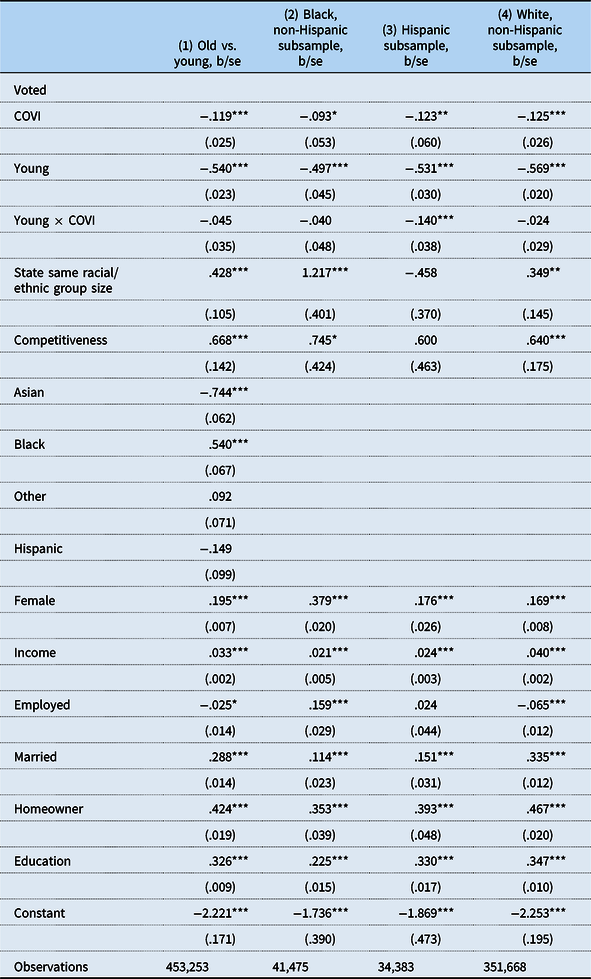
Logistic regression with robust and clustered standard errors, and year fixed effects. * .1 ** .05 ***.01.
Comparing the effect of the cost of voting between young and old racial and ethnic voters. Top right panel shows an insignificant relationship.

Point estimates derived from Table 6
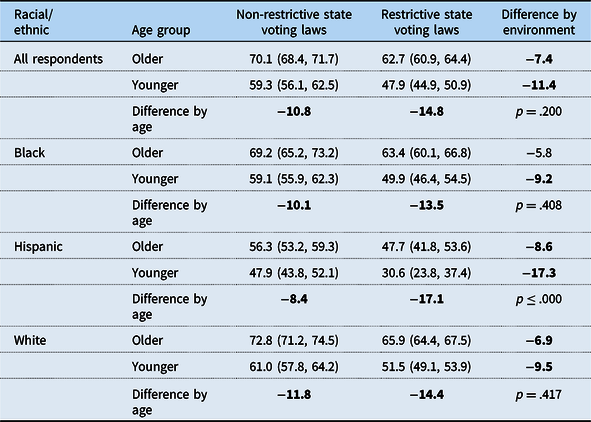
Bolded differences are significantly different at the p ≤ .05 level (95% confidence intervals shown in parentheses). Estimates reflect changes in the predicted probability of voting varying the Cost of Voting Index (COVI) +/− 2 standard deviations, derived from models 1–4 in Table 3. P-values in lower right-hand corner of each row reflect whether the effect of COVI is significantly different by age groups within racial or ethnic groups. Black and white youths are non-Hispanic. Young = 18–29, Older = 30+.
Turning toward model 1, which samples all respondents and interacts the COVI with the respondent’s age group (18–29, 30+), this study first determines the effect on the general population for comparison. Contrary to previous analyses (Juelich and Coll Reference Juelich and Coll2020), model 1 does not find that youths are significantly deterred from voting at greater rates than older voters (p = .200), though some evidence of an increased effect on youths is uncovered under different robustness checks (see Appendix C, Supplementary material). Point estimates (see Table 7 and Figure 2) suggest that increased costs deter older voters by 7.4 percentage points and youths by 11.4, though this difference is statistically insignificant in model 1. Older voters are 10.8 points more likely to report voting in permissive states than youth voters, while 14.8 points more likely to vote in restrictive states, both statistically significantly different. Older voters outvote younger voters regardless of how restrictive the electoral environment is.
Model 2 in Table 6 subsamples all Black respondents and includes an interaction between whether the voter is considered young and the COVI. The interaction is insignificant (p = .408), suggesting that increased costs do not deter Black youths at higher rates than their older counterparts. Looking at the top right panel in Figure 2 and row 2 in Table 7, it appears that changing the costs of voting does not have a significant impact on older Black voters but does have a significant impact on Black youths (−9.2); however, the negative impact of the COVI on Black youths is not statistically different than the (insignificant) negative impact on older Black voters. This may suggest that increasing the costs to vote impacts older and younger Black voters similarly. Alternatively, this finding may also be due to 2 out of 5 presidential elections examined including Barack Obama, a Black candidate and president who emphasized turning out Black and young voters. An additional robustness check that omits years 2012 and 2016 comes to a similar conclusion, suggesting that this may not be due to Obama’s presidency. Given these findings, future work should examine this relationship more thoroughly. Last, comparing within electoral environment, younger Black voters vote less in both permissive (−10.1) and restrictive (−13.5) areas than older Black voters.
Next, model 3 subsamples Hispanic respondents, with a statistically significant interaction (p ≤ .000). According to the bottom left panel of Figure 2 and row 3 of Table 7, moving from a permissive to a restrictive voting environment, older Hispanic respondents see a decrease of 8.6 percentage points in the probability of reporting voting while younger Hispanic individuals see a 17.3 percentage point decrease. Further, Hispanic youths are 8.4 percentage points less likely to vote in permissive environments than their older counterparts but 17.1 percentage points less in the most restrictive, emphasizing the increased impact electoral reforms can have on younger voters. Older Hispanic voters in restrictive states are similarly as likely to report voting as younger voters in permissive states. Comparing these estimates directly to those of old and young Black voters, regardless of age group, Hispanic respondents report voting at lower rates across almost every electoral environment. More telling, within the same electoral environment, young Black voters vote at the same rates as older Hispanic voters, highlighting the stark differences in political participation between racial, ethnic, and age groups.
Last, model 4 subsamples white, non-Hispanic respondents, though no significant difference is found between young and old white respondents (p = .417). Like previously, this finding suggests that increased costs burden old and young white voters similarly. The bottom right panel of Figure 2 and last row in Table 7 display the predicated probability of voting across age group and environment. Both old and young white individuals are significantly burdened by decreasing costs. Older individuals are 6.9 percentage points less likely to report voting if they reside in a restrictive state compared to their permissive-residing counterparts. Younger white individuals see a larger decrease, with a discrepancy of 9.5 percentage points between permissive and restrictive environments. In permissive environments, white youths lag 11.8 percentage points behind their older counterparts. This increases to 14.4 percentage points in more restrictive areas. The results also suggest that white individuals tend to vote equal to or outvote their Hispanic counterparts in nearly every electoral environment. Additionally, white youths in restrictive states are only slightly less likely to report voting than older Hispanic respondents in more permissive states. However, younger (older) white respondents report voting at slightly higher rates within the same election environment as younger (older) Black respondents.
Robustness check using voter file data
The above analyses using the CPS suggest that increasing the restrictiveness of voting decreases the likelihood that young Americans report voting, but that this effect is especially pronounced for Hispanic youths in comparison to other racial and ethnic youths or to their older counterparts. However, as mentioned earlier, using self-reported voter turnout to examine the effects of electoral reforms may bias the findings if respondents misreport voting, particularly if certain groups are more likely to misreport than others (Ansolabehere and Hersh Reference Ansolabehere and Hersh2012). To ensure these results are not driven by misreporting of voter turnout, this study uses Catalist voter roll data (CVR). Catalist is a political data vendor that obtains voter roll data from each state and supplements the data with proprietary information purchased from private companies (for a detailed description of the CVR, see Ansolabehere and Hersh Reference Ansolabehere and Hersh2012; Hersh Reference Hersh2015).
Using voter rolls provides several advantages over the CPS. First, measures of voter turnout come directly from state voter rolls, not self-reported surveys, alleviating self-reporting bias. Second, the appending of 50 separate state voter rolls results in a larger set of observations than is found in surveys, allowing for greater statistical precision and cross-state comparisons. Third, the voter rolls also contain vote histories, allowing the inclusion of whether the individual had voted in the past year, a strong predictor of future participation (Plutzer Reference Plutzer2002).
However, there are some downsides to using these data. First, previous works have suggested that voter roll data may not well capture young or non-white populations (Igielnik et al. Reference Igielnik2018; Merivaki Reference Merivaki2020; Nickerson Reference Nickerson2006; Shino et al. Reference Shino2020; but see Fraga and Holbein Reference Fraga and Holbein2020), potentially biasing the representativeness of the voter rolls. Additional analyses suggest that the distribution of young racial and ethnic voters is somewhat similar to other benchmarks.Footnote 12 Second, not all state voter rolls require registrants provide important demographic information such as race and education. To overcome this issue, Catalist uses a series of algorithms combined with commercial and public records to impute missing information. While this may be of some concern, previous work has indicated that the imputed variables have high reliability (Ansolabehere and Hersh Reference Ansolabehere and Hersh2012; Hersh Reference Hersh2015). Third, Catalist usually does not allow researchers access to the full dataset, instead, providing a 1%, state representative sample. Fourth, due to data availability, the voter turnout data used in this study only cover the 2012 presidential election (with validated voter turnout from 2008).Footnote 13
With the above-mentioned strengths and weaknesses in mind, this study used the 1% sample (N = 2.3 million) of the 2012 national voter roll data provided by Catalist. Like above, logistic regression with robust standard errors clustered by state is employed. To ensure direct comparability with the results uncovered above, models are constructed as similar to the CPS models as possible, with the only major difference being the inclusion of whether the respondent voted in the previous year and, due to data limitations, education measured as the probability the voter has a bachelor’s degree or greater. Results are robust to their exclusion. For brevity, tables reported below include only the main variables of interest, with control variables included in the estimation but omitted for space (see Tables B2–B4 in Appendix B for full tables, Supplementary material).
Table 8 reports the effects of increasing electoral restrictiveness on a subsample of youths, then on further subsamples of Black, Hispanic, and white youths. Like above, results show that young voters are disenfranchised by increasing electoral restrictiveness and that this effect is largest for Hispanic youths. While Black and white youth turnout decrease by 15 percentage points, each (significantly indistinguishable, see Table B3 in Appendix B, Supplementary material), the probability a Hispanic youth votes drops by 29 points (significantly different from Black and white youths, see Table B3 in Appendix B, Supplementary material).
The effects of the costs of voting on youth voter turnout overall and by racial and ethnic group using national voter file data (Catalist, 2012)

Logistic regression with robust and clustered standard errors, and year fixed effects. COVI = Cost of Voting Index (Li, Pomante II, and Schraufnagel Reference Li, Pomante and Schraufnagel2018). Young=29 years old and below. Controls included but omitted for brevity (see Tables B2 in Appendix B, Supplementary material). *.1 **.05 ***.01.
Table 9, which subsamples by race and ethnicity while interacting the COVI with whether the respondent is considered young, suggests youths may not be disadvantaged to a greater extent than older voters in the aggegate; however, white youths, and particularly Hispanic youths, are. Older white voting decreases by 13 percentage points while white youth voting decreases by a slightly larger 16 points (p < .000), suggesting only a slight difference in the effect of increasing registration and voting restrictiveness on white youths. A much larger effect is found between older and younger Hispanic voters. Older Hispanic voters are 22 points less likely to vote in more restrictive environments, while younger Hispanic voters are 35 points less likely, a difference of 13 percentage points (p < .000). Like above, no significantly different effects were uncovered for Black voters (p = .707). Together, these results strongly support the findings presented earlier, while also suggesting that the CPS may be underestimating the impact of the COVI on voter turnout.
Comparing the effect of the cost of voting between young and old racial and ethnic voters using national voter roll data (Catalist, 2012)
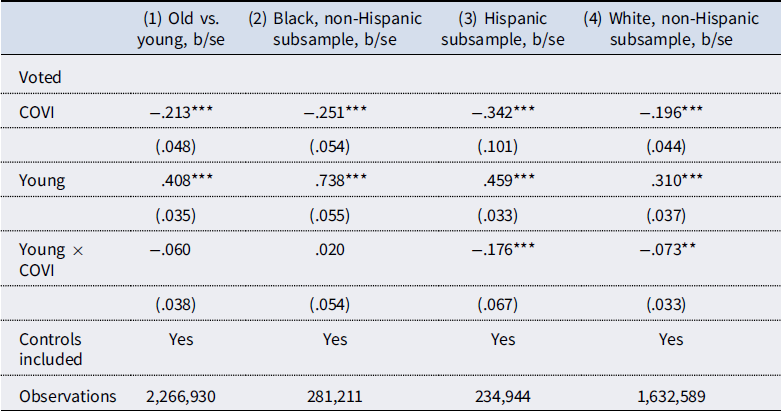
Logistic regression with robust and clustered standard errors, and year fixed effects. COVI = Cost of Voting Index (Li, Pomante II, and Schraufnagel Reference Li, Pomante and Schraufnagel2018). Young = 29 years old and below. Controls included but omitted for brevity (see Table B4 in Appendix B, Supplementary material). * .1 ** .05 ***.01.
Implications for youth participation, voter habituation, and policy responsiveness
Today’s young Americans represent the most racially and ethnically diverse cohort of any age group in U.S. history, though a majority of young Americans still identify as white non-Hispanic, 23% identify as Hispanic and 13% as Black. However, previous studies have sought to explain youth voter turnout without giving due consideration to the large variation in racial and ethnic identity unique to these cohorts. The study at hand sought to go beyond considering youths as a homogenous group and, instead, attempts to investigate how the variation in identity, coupled with the variation of electoral environments across the states, interacts to affect youth voting.
Using individual, self-reported voter turnout data from the CPS (2000–2016), validated turnout from official voter records (Catalist, 2012), and an index of how restrictive each state’s election environment is (Li, Pomante II, and Schraufnagel Reference Li, Pomante and Schraufnagel2018), this study tests the effect of a state’s cumulative electoral environment on young Black (non-Hispanic), Hispanic, and white (non-Hispanic) voters. This study finds that Black, Hispanic, and white youths are deterred by increasing costs, but that this effect is most pronounced for young Hispanic voters. Additionally, large discrepancies in the probability of voting between racial and ethnic youths within and across electoral environments were uncovered. Hispanic youths vote at the lowest rates, even comparing Hispanic youths in permissive states to Black or white youths in restrictive states. At the same time, this study also finds some significant differences comparing young racial and ethnic voters to their older counterparts. Strong evidence indicates that Hispanic youths are deterred from voting at higher rates as elections become more difficult to access, with some evidence also suggesting the same for white youths, but little evidence supporting this assertion is found among Black youths.
These findings shed new light on the importance of considering the variation in diversity among and between cohorts when comparing across or within cohorts. This research also has important normative implications for voter habituation and policy representation. As voters begin to vote, they gain inertia that propels them to continue voting (Plutzer Reference Plutzer2002). However, if younger individuals are prevented from voting due to increased costs of voting, then it may take longer for them to habituate voting. This could lead to significant differences in voter habituation and turnout comparing today’s youths later in life to older voters now (i.e., differently timed life cycles), or comparing youths between states with different electoral environments. Further, if young voters are prevented from voting at different rates due to issues linked to their race or ethnicity, this may result in significant turnout differences down the road between voters of different races and ethnicity, as members of one group habituate voting at a faster rate than another.
These participatory differences can then culminate into a second issue: contemporary and future policy biases. There are stark differences in policy preferences between today’s youths and older voters (Rouse and Ross Reference Rouse and Ross2018). And, even among youths, policy preferences differ somewhat along racial and ethnic identity (Rouse and Ross Reference Rouse and Ross2018). However, elected officials have been found to listen more closely to the preferences of (white) voters (Griffin and Newman Reference Griffin and Newman2005, Reference Griffin and Newman2008), characteristics that do not well reflect today’s youths. Contemporarily, this begs the question of whether the preferences of today’s (racial and ethnic) youths are being adequately reflected in public policy in states with restrictive electoral reforms. Looking toward the future, the differences in the effects of electoral reforms on racial and ethnic youth voting, and potentially habituation, may also have policy impacts down the road if particular racial and ethnic groups habituate and continue voting at higher rates than others.
These two questions—whether electoral reforms defer the habituation of voting and whether the disenfranchisement of (racial and ethnic) younger voters results in skewed public policy relative to public preferences—are worth exploring in future work. Further, future works should consider investigating potentially moderating impacts of these effects that may differ across racial and ethnic groups. For example, political socialization has been found to be an important predictor of political participation, particularly for young voters (Pacheco Reference Pacheco2008; Plutzer Reference Plutzer2002). At the same time, parental socialization may differ across demographic groups (Humphries, Muller, and Schiller Reference Humphries, Muller and Schiller2013). Future work should consider how these differences influence the impact of electoral reforms on young voters. Additionally, this study mentioned several characteristics of today’s racial and ethnic youths that set them apart from youths of different identities and their older counterparts (e.g., religiosity, immigration experiences). Future work should tease out the impact of these and other differences to examine the degree to which they moderate the results presented here.
Supplementary material
To view supplementary material for this article, please visit https://doi.org/10.1017/rep.2022.5


 Open access

