





Introduction
Clostridioides difficile (CD) infection remains a major healthcare burden, with antibiotic exposure as its primary risk factor. Reference Magill, Edwards and Bamberg1,Reference Johanesen, Mackin and Hutton2 Overuse of antibiotics, particularly quinolones and cephalosporins, significantly increases the risk of C. difficile infection (CDI). Screening and isolating asymptomatic carriers have been proposed as infection control measures, as carriers serve as reservoirs of CD spores. Reference Longtin, Paquet-Bolduc and Gilca3 When combined with thorough terminal cleaning and contact precautions, this approach reduce horizontal transmission in quasi-experimental studies. Reference Longtin, Paquet-Bolduc and Gilca3–Reference Gilboa, Houri-Levi and Cohen5 Additionally, screening may contribute to improved antibiotic stewardship, particularly when directed toward carriers, potentially lowering their risk of progression from asymptomatic carriage to active infection. Reference Poirier, Gervais and Fuchs6
In 2017, we initiated a large-scale C. difficile carriage screening intervention. Over a 10-week pre-intervention stage, we identified risk factors for carriage and refined the screening criteria for our intervention. Reference Meltzer, Smollan and Huppert7 During this phase, patients’ carriage status was not disclosed to hospital staff.
To assess the impact of notifying medical staff about a patient’s C. difficile carrier status and implementing targeted educational initiatives, we compared antibiotic use among screened carriers and non-carriers across two stages. In the first stage, physicians were unaware of patient carriage status, while in the second stage, they were informed. This study aimed to evaluate whether incorporating C. difficile carriage screening into antimicrobial stewardship strategies optimizes antibiotic use among hospitalized patients.
Methods
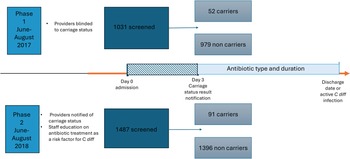
This quasi-experimental study was conducted in internal medicine wards of a tertiary hospital over two time periods. A pre/post design was used to compare antibiotic prescribing in two stages. In Stage 1 (June–August 2017), clinicians were blinded to CD carriage results. In Stage 2 (June–August 2018), clinicians were informed of carriage status, following an educational intervention to guide antibiotic stewardship efforts. To minimize confounding due to seasonal variations, identical months were used for comparison. The study received The Institutional Review Board approval (see supplementary methods 1.1).
Patients defined as high risk for CD carriage (see supplementary Methods 1.2) were screened using rectal swabs and PCR testing for toxigenic strains. Patients exhibiting symptoms of CDI at admission were excluded. Screening was performed upon admission, and results were available within 48–72 hours in Stage 2 (supplementary methods 1.3).
The intervention consisted of structured educational sessions delivered to physicians in internal medicine wards. These sessions emphasized the importance of avoiding unnecessary antibiotic use in CD carriers, reducing high-risk antibiotics such as quinolones and cephalosporins, and optimizing antibiotic duration (Detailed intervention – see supplementary Methods 1.4).
Baseline characteristics, antibiotic prescribing patterns, and clinical outcomes were extracted from the medical records. Antibiotic usage was calculated as (i) the proportion of hospitalization days with antibiotic treatment, and (ii) whether a patient received any antibiotic treatment. Secondary outcomes included CDI incidence and mortality rates within 90 days post-discharge (supplementary methods 1.5).
A difference-in-differences (DiD) approach was employed to compare antibiotic use between stages, adjusting for patient demographics, comorbidities, and immunosuppression status. Poisson and logistic regression models estimated rate ratios and odds ratios, respectively, for antibiotic use (supplementary methods 1.6).
Results
A total of 2,518 patients met the inclusion criteria, with 1,031 patients enrolled in Stage 1 and 1,487 in Stage 2 (Figure 1). The prevalence of CD carriage increased slightly from 5.04% in Stage 1 to 6.11% in Stage 2. The median age was similar between groups, with no significant differences in baseline characteristics, including Charlson comorbidity scores and Norton scores. Baseline characteristics of the carriers and non-carriers for each stage are described in Table 1S.
Study cohort flow diagram.
Note: This figure illustrates the flow of patient inclusion across the two study stages. A total of 2,518 patients met the inclusion criteria, with 1,031 enrolled in Stage 1 (before intervention) and 1,487 in Stage 2 (after intervention). The diagram shows the number of patients screened, excluded, and included in each stage, as well as the number of CD carriers and non-carriers identified. This figure provides an overview of the study design and population structure.

In Stage 1, 91% of non-carriers and 65% of carriers received antibiotics. In Stage 2, these proportions decreased to 56% and 64%, respectively. (Table 2S) The rate of antibiotic treatment, measured as the proportion of hospitalization days covered by antibiotics, decreased significantly among carriers compared to non-carriers, with a rate ratio of 0.81 (95% CI 0.67–0.97) in adjusted models (Figure 2, Table 3S–5S).
Difference-in-differences analysis of antibiotic use among CD carriers.
Note: Crude (blue) and adjusted (red) likelihood ratios with 95% confidence intervals are shown for eight antibiotic-related outcomes, comparing Stage 1 and Stage 2 using a difference-in-differences (DiD) approach. Outcomes include receipt and rate of treatment with any antibiotic, quinolones, cephalosporins, and third-/fourth-generation cephalosporins. Adjusted models control for age, sex, comorbidities, Norton score, and ward type. Ratios <1 indicate reduced use post-intervention among carriers. “Rate of treatment” refers to the number of antibiotic days per hospitalization days.

A significant reduction in quinolone treatment was observed among carriers (rate ratio 0.38, 95% CI 0.25–0.55), reflecting adherence to stewardship recommendations. In contrast, cephalosporin use did not change significantly (rate ratio 1.13, 95% CI 0.80–1.63), indicating that further interventions may be required to modify prescribing patterns for this class.
CDI incidence remained low, with no statistically significant difference between stages (OR 1.1, 95% CI 0.35–3.70). Mortality rates at 90 days post-discharge did not differ significantly between groups, supporting the safety of antibiotic de-escalation efforts in carriers (Table 6S, supplementary results 2.1).
Further analysis of antibiotic classes showed a significant reduction in overall broad-spectrum antibiotic use, with a 22% decline (rate ratio 0.78, 95% CI 0.65–0.94) in prescription rates among CD carriers. Length of hospitalization remained stable between the two periods, reinforcing that reduced antibiotic exposure did not adversely impact patient outcomes. Regression discontinuity analysis supported the observed trends, demonstrating a sharp decline in quinolone prescriptions immediately following intervention implementation. Results of the regression discontinuity analysis as well as a more elaborate description of the results can be found in the supplementary file (supplementary results Tables s2 and s3).
Discussion
Our study demonstrates that integrating CD carriage screening with targeted education effectively reduces unnecessary antibiotic use, particularly quinolones. These findings align with existing antimicrobial stewardship strategies that emphasize avoiding antibiotics that increase CDI risk. While this study was not powered to detect reductions in CDI incidence, the significant decline in high-risk antibiotic prescriptions suggests a potential downstream impact on CDI rates.
CDI incidence did not significantly differ between study stages, likely due to the small sample size. However, a larger, long-term study conducted by our group Reference Regev-Yochay, Rahav and Smollan8 found a reduction in CDI cases following the implementation of asymptomatic carriage screening. As isolation and antibiotic stewardship were introduced together, their individual contributions to this effect could not be distinguished.
This study has several limitations. First, it was a quasi-experimental observational study, and patients were not randomly assigned to different groups. To mitigate these effects, we adjusted for age, comorbidities, degree of debilitation, and baseline antibiotic exposure. Second, differences in patient composition and prescribing patterns unrelated to the intervention could have influenced results. While we employed DiD analysis and regression discontinuity models to control for secular trends and potential confounders, residual confounding cannot be entirely ruled out. The greater reduction in carriers, despite overall declines, supports a targeted intervention effect. Additionally, the study was conducted at a single institution, which may limit generalizability to other healthcare settings. A longer study could have provided insights into the long-term impact of the intervention, but institutional constraints limited our timeframe. Future studies should explore multicenter trials with larger populations and longer follow-up periods to assess the sustainability of these interventions.
Finally, while randomized controlled trials would provide stronger evidence of causality, they may present ethical and logistical challenges, particularly in obtaining informed consent from asymptomatic carriers. Alternative study designs, such as stepped-wedge trials, may provide a feasible approach to further evaluate the impact of CD screening integration with antimicrobial stewardship.
In conclusion, this study highlights the potential benefits of C. difficile screening not only in infection control but also in antibiotic stewardship. Future research should aim to refine screening criteria, optimize educational strategies, and assess long-term clinical outcomes to further establish the role of CD carriage screening in stewardship initiatives.
Supplementary material
The supplementary material for this article can be found at https://doi.org/10.1017/ice.2025.10213
Data availability statement
Data can be provided by the corresponding author upon reasonable request.
Acknowledgements
The Sheba Infection Control (SHIC) research group: Sharon Beni, Natasha Blausov, Adi Brom, Olga Feld-Simon, Ronen Fluss, Mayan Gilboa, Yehudit Eden-Friedman, Shiraz Halevy, Esther Houri-Levi, Amit Hupert, Amnah Jbarien, Naty Keller, Leonid Maisels, Eyal Melzer, Nani Pinas-Zade, Galia Rahav, Shir Raibman-Spector, Gili Regev-Yochay (PI), Marina Brod, Dalit Shachar, Kassem Sharif, Shoshi Segal, Amitai Segev, Gill Smollan, Ilana Tal, Ido Weiss, Tal Zilberman-Daniels, Eyal Zimlichman. We greatly acknowledge the work and assistance of the whole Infection Prevention & Control team at the Sheba Medical Centre, the Internal Medicine ward directors for their full collaboration, Ms Efrat Steinberger for coordinating the study, and The Sheba Medical Centre management for their full support.
Author contributions
MG, GRY, DY, and NB designed the study and wrote the protocol; all authors participated in data extraction; MG, YP, GRY, and NB performed the analyses; MG, GRY, DY, and NB wrote the initial draft of the manuscript; all authors revised and approved the manuscript.
Financial support
No external funding.
Competing interests
DY has collaborative research with Pfizer and an investigator-initiated study supported by Shionogi. GRY reports institutional grant funding of studies unrelated to the current study from Pfizer, Moderna and Astrazeneca, consulting/honoraria from MSD, GSK, Astrazeneca, Pfizer, and Moderna, MG, EM, IC, YP, TZ, AS, SA, NB- have no conflict of interests.
Use of artificial intelligence tools
During the preparation of this work, the authors utilized Chat-GPT and Grammarly only to enhance language clarity. After using those tools, the authors reviewed and edited the content as needed and take full responsibility for these publication’s content.


 Open access

