

Chapter 5 Publicity stunts in Athenian politics
An ancient prejudice has been removed
It is perhaps surprising that when the Athenians incorporated supplication into their Assembly the people who benefited the most were not those who otherwise would not have had a voice but the already influential and well connected. To these it provided an opportunity to assume, albeit implicitly, a role with powerful associations in the Athenian imaginary. Athens had cast off its kings already in mythical times, but supplication in the Assembly allowed ambitious politicians to claim a little of their mantle, to implicitly perform the role of Theseus for a time – at least until another politician came along and tried to perform it too. This was one way in which some elites of the second half of the fourth century sought to take advantage of the resources of image-making and theatricality that other elites might criticize as being extra-institutional.
While the use of supplication in the Assembly in that respect was new, the political use of theatricality was not. Elites in the fifth century were already staging and acting in theatrical scenes outside the civic institutions. These scenes always took place (or are described as taking place) in public, crowded places. This is because they aimed to create a stir among the crowd in order to shift public opinion and make it more likely that the audience in the institutions would receive their arguments favorably. Here too Solon was a true forefather of Athenian politics, and closer to Thespis than he pretended to be. His Salamis stunt is paradigmatic of an entire genre of political performance in which a politician sought to disseminate an argument in the extra-institutional public sphere that he then drew on in the institutional one in order to bring about a desired outcome.
“Publicity stunt”: why apply such a modern term to an ancient phenomenon? The earliest occurrence of the term, according to the Oxford English Dictionary, was in 1908. According to Google’s Ngram Viewer, the term enjoys a sudden surge of popularity in the 1920s. Two factors lie behind its appearance and its popularity. The first is the rise of public relations and advertising as professional disciplines. The second is the increasing prevalence of mass media, particularly newspapers and radio. In other words, it belongs to an era and a movement which Habermas saw as responsible for the eclipse of the true public sphere. For now we see professionals cunningly seeking to manipulate public opinion by orchestrating “events” that would seem “newsworthy” and get published or broadcast by the media, thereby generating interest and promoting the aim of their employer, usually to increase sales of a product.1 The fact that stunts are manipulative by design quickly gave the term a negative sense that has now become its main one. To say that something is “a publicity stunt” is to dismiss it as an unserious attempt to manipulate an audience into holding an opinion. It is to suggest that it is a “performance,” and hence not real. In politics, it is most often encountered as an accusation, something one imputes to one’s opponent. It suggests that he is not behaving as he ought but is pursuing his objective by inappropriate means or in inappropriate places.
This is why the term is singularly appropriate for what I propose to study. I am interested in staged displays designed to influence Athenian public sentiment or create public opinion about a person or issue. If Greek had a term for it it would probably be mêkhanê, which Detienne and Vernant define as a device of “cunning intelligence which is sufficiently quick and supple, wily and deceitful, to confront the unexpected on every occasion, to counter the most changeable of circumstances and to triumph, in unequal combat, over adversaries who are better equipped for a trial of strength” (Reference Detienne1991 [1974]: 43). Mêkhanê was the term that Aeschylus applied to the supplication of the Danaids (Suppl. 209). It is also the term that Herodotus applies to the most famous stunt of Athenian history, as we will see shortly. What qualifies the events that I examine below as political mêkhanai, or “publicity stunts”, is that they took place outside the civic institutions and could be construed as manipulative attempts to influence their work. They were not institutionally sanctioned means of addressing the Athenian crowd. And yet they sought to influence the crowd no less than speeches in the Assembly or the courts did, with the aim that the crowd would bring their influence into the institutions.
I examine each stunt along three axes. First, what kind of meaning was the stunt designed to convey? Each stunt drew on a repertoire of meanings associated with particular cultural forms and practices which would be legible to the audience, although not necessarily to us. This was the “background text.”2 It is possible that not every member of the stunt’s audience would have immediately grasped the significance of the stunt. Here the stunt’s spectacular character would have come into play. By creating interest (or “buzz” as we might call it today), the stunt would have ensured that people would discuss it, and by discussing it disperse its meaning throughout Athens’ social networks, making it more likely to be effective.
Second, how did the stunt articulate with institutional procedure? We have seen that Athenian political thought postulated a gap between the civic institutions and the Street. Regardless of their proximity and interdependence, one was construed as (relatively) orderly and rational, and the other figured as prone to draw out powerful emotions that could warp political and legal judgment. Thus the stunt had an important function in Athens. It existed at the intersection of the formal and informal public spheres. In the terms of contemporary political communication theory, by creating a scene it would “prime” public opinion in order to “frame” an issue in a way favorable to those who organized it and whose “agenda” it helped “set.”3 These terms describe the effect of news reporting on public opinion. Similar processes existed in Athens, except that news was transmitted by word of mouth.4
Finally, what were the results of the stunts? How effective were they in bringing about the desired outcomes of their authors? As we will see, some were quite effective while others could have unexpected consequences or backfire. Perhaps stunts’ unreliability as a political tool contributed to the nearly complete disappearance of publicity stunts from the historical record after the end of the fifth century. There are some indications that they continued to be performed, but they no longer seem to have the same importance as they did during the sixth and fifth centuries. I will suggest some possible reasons for the eclipse of the publicity stunt.
Some comment about our sources for such stunts is also necessary here because the events I focus on have not been systematically studied before. When scholars do take note of them it is in passing or to dismiss them as sideshows to the main attraction, the result of ancient campaigns of slander and misinformation that have found their way into the historical record but are not to be taken seriously. Stunts were ephemeral acts meant to influence a particular decision at a particular point in time. However, they were also designed to get picked up in communal webs of discourse and circulation; they aimed to get people talking in order to produce, we might say, a groundswell of emotion. In that respect at least they share a common ancestor with much of what we read in Herodotus, Xenophon, and even Thucydides, insofar as the historians relied, directly and otherwise, on the same oral sources of information.5
For a stunt had several audiences. The primary and most immediate one was the smallest. It consisted of people who were actually eyewitnesses to the event. The number of these would be limited by the problem of visibility: how many people could actually see the performance for themselves. Behind each eyewitness stood a much larger number of secondary witnesses, who would hear of the stunt from the eyewitness himself or other secondary witnesses who passed on the tale almost as if they had been there. The extent of Athenian social networks was the only limit here. Recent research, discussed in Chapter 2, has highlighted the multiple and overlapping levels of association that potentially stretched out to include every single Athenian man and woman, slave or free. With each telling the event would come to life before their eyes. If the message was well calibrated it could provoke a desirable response and help shift public opinion, affecting substantively how audiences in the civic institutions – the Assembly and the courts – might react to particular rhetorical arguments.
Our historians constitute the third audience. The major difference from the second audience is that they set the stunt down in a text of narrative history. Here the element of deception or manipulation comes to the fore. The historians lift the veil for their readers to show them how someone tricked the Athenians into making a specific decision. In doing so they certainly altered crucial elements or left others out as it served their purposes, as we will see. The mediating and “flattening” role of this third audience might explain why stunts are only attributed to political figures. Historians were simply not interested in the doings of the small and insignificant. As discussed above, all eyes were on the famous, or the “recognizable ones” (gnôrimoi) as Athenian idiom described them. In the following chapter I will suggest that it is possible to glimpse the publicity stunts of non-elites who also intended to influence institutional outcomes, but on a smaller scale. The historians’ role might also account for why nearly all the stunts we know about were resounding successes. Unsuccessful stunts, for the most part, were not memorable.
A woman named Phye
We have already encountered Pisistratus as an inveterate trickster. We saw how in his apocryphal encounter with Solon the lawgiver approached the future tyrant and castigated him for introducing theatricality into politics. The problem, as he told Thespis, was that by introducing the element of play into the business of politics Pisistratus threatened to contaminate the serious with the theatrical. As I pointed out, it was ironic for Solon to make this charge as he did not hesitate to engage in theatrics when it suited his purpose. The occasion for Solon’s admonition was when Pisistratus wounded himself and stumbled into the Agora claiming that he had been attacked by enemies of the people, so that the people voted him a protective guard which he then promptly used to install himself as the leader of Athens. I will return to that stunt shortly. But here I am concerned with Pisistratus’ most famous stunt, which took place some time afterward, after he left Athens when his rivals joined forces to expel him.6
His return (according to Herodotus) had two aspects, a private and a public one. The private aspect was an arrangement Pisistratus made with one of his two rivals, Megacles, who himself had a falling out with the other rival, Lycurgus. They sealed their alliance with a marriage agreement: Pisistratus was to wed Megacles’ daughter. It is interesting that public support did not follow automatically the agreement between the two powerful leaders but had to be obtained. This perhaps gives us a small but revealing glimpse into the structure of the phenomenon of archaic tyranny, that it needed a significant degree of popular support.7 Such popular support was arranged by means of the following “stunt” (Hdt. 1. 60. 3, mêkhanôntai). They found a strikingly tall Athenian woman named Phye whom they dressed up in hoplite armor and put on a chariot “in a posture that would seem most suitable” (Hdt. 1. 60. 4). Next to her stood Pisistratus and together they drove to the city, preceded by heralds who announced, “Athenians, receive with a kindly mind Pisistratus, whom Athena herself honors more than all men and returns to her very own acropolis!” (1. 60. 5). Herodotus goes on to add that the rumor (phatis) spread throughout the countryside that Athena was returning Pisistratus, while people in the city ran out to witness the event and prayed to the woman and did her bidding. At least, that is Herodotus’ account. The historian passes the following judgment on the stunt:
This device for his return is the silliest thing that I ever heard of, by far. The Greeks have been distinguished since ancient times from the barbarians as being cannier and freer from silly simple-mindedness, and the Athenians are considered first in wisdom among the Greeks. But it was among them that such a stunt was devised.
μηχανῶνται δὴ ἐπὶ τῇ κατόδῳ πρῆγμα εὐηθέστατον, ὡς ἐγὼ εὑρίσκω, μακρῷ, ἐπεί γε ἀπεκρίθη ἐκ παλαιτέρου τοῦ βαρβάρου ἔθνεος τὸ Ἑλληνικὸν ἐὸν καὶ δεξιώτερον καὶ εὐηθείης ἠλιθίου ἀπηλλαγμένον μᾶλλον, εἰ καὶ τότε γε οὗτοι ἐν Ἀθηναίοισι τοῖσι πρώτοισι λεγομένοισι εἶναι Ἑλλήνων σοφίην μηχανῶνται τοιάδε.
Herodotus’ bemused comment does reveal something important about his understanding of this event. He is hard-pressed to explain why it worked. He thus proposes that the Athenians actually believed that Phye was the goddess Athena and “worshipped the woman and took back Pisistratus [προσεύχοντό τε τὴν ἄνθρωπον καὶ ἐδέκοντο Πεισίστρατον].” Another text that also narrates this stunt, the Aristotelian Athenaion Politeia, similarly suggests that the act was performed “in a primitive and excessively simple manner [ἀρχαίως καὶ λίαν ἁπλῶς]” (14. 4), suggesting that its author also did not understand why it worked.
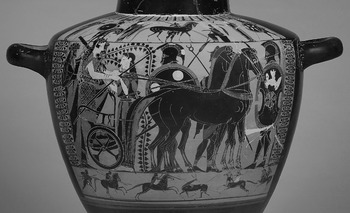
Modern historians have been more inclined to give the Athenians the benefit of the doubt. They have proposed several theories of the meaning of Phye’s parade.8 Notable here is the theory of John Boardman, who noticed the resemblance between the scene described by Herodotus and a series of sixth-century black-figure vases depicting Athena on a chariot beside Heracles.9 He argued that either the Phye stunt inspired the vases’ artists or the vases were propaganda for Pisistratus. For they depict Athena leading Heracles to Olympus and deification.
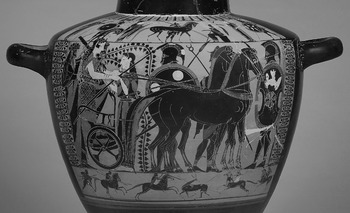
Figure 6. Black-figure scene of the apotheosis of Heracles on a chariot beside Athena, c. 525 BCE, which John Boardman interpreted as inspired by or based on Pisistratus’ stunt with Phye.
This would make a smooth and easy connection between Pisisitratid legitimation and public ceremonial. The scene with Phye would thus be depicting Pisistratus in the role of Heracles and figuring the Acropolis as Olympus. Presumably “deification” would translate into “legitimacy.” Others have been skeptical of the equation between Pisistratus and Heracles, arguing that the vases are likely older than the event.10
Here I do not have a new solution to offer for Phye to those already proposed. Each of the solutions offers a possible reading (some more possible than others) by trying to find the missing background text. But I think we can squeeze a little more out of the texts themselves. For although the ancient sources that record this stunt, Herodotus and the Athenaion Politeia, found puzzling why it worked, they are a bit more confident about how it worked. As Chaniotis notes, “Even if it is Herodotus’ invention, it reflects contemporary practices” (Reference Chaniotis2009: 36). In their attempts to make sense of it, our sources tell us something important about how stunts worked in Athens in general. For both authors try to make the story about Phye conform to their general expectation about how such stunts work.
It is thus quite interesting that both writers attribute the success of the stunt, in part, to the work of rumor. This is an element of the story that is often overlooked in scholarly accounts of it. The Athenaion Politeia states, “they sent around the story [προδιασπείρας γὰρ λόγον]” (14. 4), while Herodotus states, “they sent heralds ahead [προδρόμους κήρυκας προπέμψαντες] who announced the news as they traveled toward the city” (1. 60. 5). Herodotus places more emphasis on the announcement as ritual proclamation, but the effect is similar. The kind of stunt they imagine occurring requires a significant degree of public awareness and interaction. In Herodotus’ account, heralds give the stunt its “frame.” Without the work of the heralds that summon the crowds to witness an unusual and exciting sight, Pisistratus would simply have been riding on a chariot with a tall woman in armor beside him. Note that in his account most people do not actually witness the stunt. Herodotus is quite explicit, distinguishing between people in the countryside who only heard about the story, and people in the city who actually saw it. Although only a minority saw the event with their own eyes, its effect was wide-reaching. The power in this stunt, as with the others I will discuss, comes in part from circulation of talk in the crowd (phatis). Key is a widespread public awareness of the stunt’s having taken place, even though they did not witness it for themselves. Compare our earliest Latin source for this event. Valerius Maximus was writing under a different culture of spectacle.11 For him what made the stunt work was the “display” (ostentatio) of the woman (1. 2. ext. 2).12 This term emphasizes physical presence (cf. TLL II. B). By contrast, Herodotus assumes that the circulation of rumor was an essential component of why the stunt worked.
Herodotus’ account gives us two key elements of Athenian publicity stunts that I outlined above, spectacle and rumor. At this remove we cannot interpret the metaphorical work of the stunt with any degree of confidence. Was Pisistratus reenacting an epiphany, a sacred marriage, a deification scene, a fertility rite, or something else entirely? More crucially, we also cannot fill in the second axis, namely how the stunt related to an institutional procedure that formalized the result. Perhaps Herodotus’ source did not fill in the gap from stunt to enactment.13 Herodotus’ quip glosses over this part, suggesting that the Athenians naïvely believed that the woman was Athena and simply acclaimed Pisistratus as their leader. On the other hand, Herodotus suggests, Pisistratus maintained power thanks to his relationship with Megacles. As he goes on to record with relish, Pisistratus and Megacles had a falling out due to Pisistratus’ “abnormal” sexual practices with Megacles’ daughter. Whatever popular support his stunt created, in other words, was not sufficient to enable him to hold on to power once his personal alliance with Megacles crumbled. If Pisistratus’ stunt did actually take place (and there is little reason to doubt that it did), the pattern would lead us to expect that it must have been accompanied by some kind of formal, institutional act that affirmed Pisistratus’ position. Herodotus does not tell us what that was, presumably because he could not conceive what kind of act would have been appropriate to the context.
We can get a sense of how an institutional procedure might formalize the public knowledge that a stunt created by comparing how the sources deal with another of Pisistratus’ stunts, his self-wounding. This was the stunt that Solon criticized as too theatrical. Both Herodotus (1. 59. 4) and the Athenaion Politeia (14. 1) also record it.14 And both imagine the stunt in similar ways. Herodotus reports that Pisistratus wounded himself and his mules and drove his cart into the Agora, “as if he had just fled from enemies.” Then: “He asked the demos to obtain some sort of protection of himself; he had previously distinguished himself as leader in the war against the Megarians when he captured Nisaia and displayed great deeds.” Herodotus seems to imagine a meeting of the Assembly in which Pisistratus argued that he deserved a protective bodyguard in return for his military leadership. The AP agrees with this series of events, and even adds the name of the person (Aristion) who proposed the decree granting Pisistratus his guards.15 Plutarch is the most expansive: “On account of this [the self-wounding], the crowd was ready to defend Pisistratus, and the people assembled. Ariston [sic] proposed that fifty cone-bearers be given to him as protection for his body. Solon opposed” (Sol. 30. 2–3).16
Much does not add up in this story on its own terms. For instance, as Wallace notes, “It is striking that a wealthy and powerful aristocrat felt he had to ask the Assembly for these 50 men, rather than simply supplying them from his own dependents” (Reference Wallace, Morris and Raaflaub1997: 19). For my purposes whether the event occurred exactly as the sources record it is less important than how they imagine it worked. Namely, this stunt created a kind of knowledge that was then formalized in an institution, leading to a concrete outcome. The process has two aspects, an informal and a formal one. It involved a spectacular act on the street that would arouse interest and promote talk among the people, as well as an institutional act that would draw on the interest the stunt aroused and formalize the opinion it promoted. In this case, the sudden appearance of a wounded Pisistratus in a mule-driven cart, and the mules themselves wounded, would have created quite a stir. Pisistratus’ story, according to Herodotus, was that he was traveling to his fields where he was set upon by his enemies. How might this relate to a formal request for bodyguard? Here the AP adds the detail that Pisistratus seemed to be the “most supportive of the people [dêmotikôtatos].” Plutarch similarly has Pisistratus claim he was attacked owing to his politics (Sol. 30. 1). The sources starting with Herodotus find the self-wounding less perplexing than the Phye episode perhaps because they understood how it might relate to an orator’s attempt to conjure up the fears of an anti-demos conspiracy in order to portray himself as its embattled champion; compare how the demagogue Cleon portrays himself in Aristophanes’ Knights, “On account of you I am beaten … because I love you, Demos, I am in love with you!” (730–2). By contrast, no one suggests that an assembly debate followed Phye’s ride. And rightly so, because what public argument could Pisistratus possibly make based on that stunt?
Ephialtes “naked” at the altar
The next stunt I will consider is preserved only in a single source, the Athenaion Politeia. So it will not be possible to compare different versions in order to see what is distinctive in each and what is common, as I did above. It stems from Ephialtes’ campaign against the Areopagus. The Areopagus was the oldest deliberative institution in Athens, and also the most aristocratic. Only former archons could serve on its council, and they were appointed for life. Before the 460s it seems to have had a greater role in Athenian government.17 Ephialtes gets the credit for reforms that transferred its powers to institutions more closely aligned with populist democratic politics, namely the courts and the Assembly. Some have seen in these reforms the most decisive step in the development of Athenian democracy.18 According to the AP, a stunt helped bring this about. Historians have generally tended to dismiss the story as implausible. They have especially found suspicious the involvement of Themistocles, who was probably not in Athens when the reforms were enacted. But, putting that objection aside, we can still learn much from the story about how publicity stunts worked in fifth-century politics.
According to the story, the Areopagus was about to charge Themistocles as a Persian sympathizer (AP 25. 3).19 He thus had a personal interest in wanting to see that institution diminished. True to form, he sought to further his aim by orchestrating a manipulative trick (cf. Hdt. 8. 75–82; Plut. Them. 10. 1). Themistocles told the Areopagites that certain people were conspiring against them. He promised to take them to the conspirators. At the same time he informed Ephialtes that the Areopagus was about to arrest him for conspiring against it, which was actually the case. When Ephialtes saw the Areopagites approaching with Themistocles leading the way:
Stunned, he sat on the altar in only his underwear. Everyone was shocked by this event. After this, when the Council was assembled Ephialtes and Themistocles accused the Areopagites, and again in the Assembly similarly, until they stripped away their power.
καταπλαγείς, καθίζει μονοχίτων ἐπὶ τὸν βωμόν. θαυμασάντων δὲ πάντων τὸ γεγονός, καὶ μετὰ ταῦτα συναθροισθείσης τῆς βουλῆς τῶν πεντακοσίων, κατηγόρουν τῶν Ἀρεοπαγιτῶν ὅ τ’ Ἐφιάλτης καὶ <ὁ> Θεμιστοκλῆς, καὶ πάλιν ἐν τῷ δήμῳ τὸν αὐτὸν τρόπον, ἕως περιείλοντο αὐτῶν τὴν δύναμιν.
Wilamowitz commented wryly on this passage: “ancient biographers observed greater tact than modern ones, who cherry-pick this story with obvious relish” (Reference Wilamowitz-Moellendorff1893: 1. 140). The story, he suggests, is impossible to accept as historical. After enumerating the contradictions, mostly chronological but also internal to the text itself, he concludes: “It is pardonable if the story dazzled for a brief moment after the discovery [of the text]; but whoever seriously suggests that we can somehow believe it forfeits the right to be taken seriously” (142).
At the risk of not being taken seriously, I suggest that we consider how the stunt might have worked, or rather, how the story suggests that it worked to bring about an institutional outcome. Most historians have heeded Wilamowitz’s warning because of the chronological problems the story raises; chief among them being that Themistocles was certainly not in Athens in 462/1, the archon year to which the AP dates the reforms.20 Even if that information is accurate, it is just possible that Ephialtes and Themistocles might have cooperated against the Areopagus. As the text makes clear, the stunt was part of a prolonged campaign. There is no reason to assume that the entirety of the campaign took place entirely in one year. Institutional change of this sort does not happen quickly.21 Furthermore, it does appear that supporters of the Areopagus were magnifying its importance by claiming it responsible for the victory of Salamis.22 So a rivalry between Themistocles, the hero of Salamis, and the Areopagus is not out of the question. The story seems to fuse different perspectives uncomfortably. It depicts Ephialtes as both a dupe and a conspirator, first having him manipulated by the cunning Themistocles and then cooperating with him against the Areopagus. It is almost as if the author has found the story in a pro-Areopagus source that was responding to anti-Areopagus propaganda by portraying the stunt as motivated by petty feuds and manipulation, and therefore lacking a serious message.
At any rate, even if the stunt did not take place as AP describes it, it can serve to highlight some important features of publicity stunts in general. Like Pisistratus’ self-wounding or his parade with Phye, it draws attention to itself thanks to its shocking and unexpected appearance. Second, it frames an issue in a particular way. Third, it is continued in an institutional venue. In this case the text marks the pivot especially starkly: the stunt happened, everyone was amazed, and then through attacks in the Council and the Assembly the Areopagus was undermined.
Regardless if it was a result of manipulation or a calculated gesture, the stunt dramatizes an argument that would potentially be quite damaging to the Areopagus. The curious detail that Ephialtes was wearing only his undergarment (monokhitôn) is relevant here. His being in such a state of undress would first of all have aimed to draw as much attention as possible. The sight of a well-known politician sitting on an altar in his underwear would inevitably have that consequence. Ephialtes was not the only Athenian to perform such an act. Some 130 years later, a public slave named Pittalacus also sat at an altar in a similar fashion.23 He wanted to draw attention to his plight and he timed his stunt to coincide with a meeting of the Council (Aeschin. 1. 60). On that occasion, Aeschines remarks, “a crowd gathered quickly, as tends to happen.” Ephialtes would have aimed for the same result, to gather the kind of crowd that stunts in public places tended to attract. If so, he succeeded: “everyone was shocked at the event [θαυμασάντων δὲ πάντων τὸ γεγονός],” the AP notes.
Moreover, Ephialtes’ supplication also served to present his campaign against the Areopagus against the backdrop of an Athenian tradition of protecting innocent suppliants pursued by aggressive villains, which I discussed in the previous chapter. The detail about the chiton is also relevant here. Athenian men did not like to appear without their outer cloak (himation), especially in official places such as the Assembly. (Look at the Foundry Cup illustrated at Figure 5 on p. 63 for an example of what it looked like.) This garment was worn loosely with a simple fold to hold it in place. It curtailed movement significantly, and perhaps that was the point, since when one wore one’s cloak one had to move leisurely.24 Thus, to drop one’s cloak in public was a sign that one felt accosted and startled. Demosthenes narrates a scene of a raucous meeting of the Assembly during which “I dropped my himation and was almost naked [gymnou] in my short chiton as I tried to avoid him, and he was pulling me” (21. 216). Similarly a victim of an alleged assault complains: “I was carried away by people who happened past, naked [gymnos] since [my assailants] took off with my himation” (Dem. 54. 9). Ephialtes’ appearance in his undergarment is thus evidence of the aggression from which he is seeking refuge, and not because it would “contribute to the self-abasement appropriate to the act of supplication” (Rhodes Reference Rhodes1993: 321). Ephialtes must have been fleeing with sincere fear if he appears as a suppliant without his cloak.
For the Areopagus the image of threatening a suppliant would have been especially damaging. Whatever its specific range of competence at this time, what is clear is that as far back as we can tell, its authority was based on being “an ancient, venerable, and sacred tribunal” (Wallace Reference Wallace1989: 127). And protecting suppliants was one of Athens’ most influential traditions. Relevantly to the case at hand, Aeschylus’ charter myth for the Areopagus in his Eumenides, staged shortly after Ephialtes’ reforms, depicts the Areopagus as the final arbiter of the plea of the suppliant Orestes (242, 409). Desperate and distraught, he has come to Athens for protection from the Furies of his mother who are hot in pursuit and finds in the Areopagus the protection and purification that has eluded him.
As I pointed out above, supplication invariably has a “triangulating” function.25 The ritual serves to quickly assign the participants to three roles: the suppliant, the pursuer, and the champion. The audience expects, and quite often gets, exactly this pattern. Just as the proverbial cowboy in a white hat is followed invariably by one in a black hat, the appearance of a suppliant is followed by the appearance of someone who is trying to harm him and by the appearance of someone else who will protect him. In the Suppliants, the suppliants are the Danaids, the pursuer is the Egyptian herald, and the protector is Pelasgus. In the Eumenides the role of the pursuer is played by the Furies, and the protector is in turn Apollo, Athena, and the Areopagus. Ephialtes’ stunt takes advantage of the same tradition that Aeschylus would draw on a few years later but from the opposite orientation, presenting the Areopagus as an aggressor against a suppliant rather than as a defender. An Areopagus that could conceivably wrench a suppliant from the altar would be a far cry from the council that, in Aeschylus’ drama, heard the case of the suppliant Orestes and absolved him of his crimes after a careful deliberative procedure.26 Such behavior as Ephialtes’ stunt imputed to it would not evoke sentiments of “reverential awe” (sebas) that the Areopagus was supposed to inspire in the citizens (Aesch. Eum. 690–1). Isocrates later eulogized the Areopagus as an inspirational source of self- control (sôphrosyne) and good order (eutaxia) (7. 37–9). Its mere presence was sufficient to ennoble even scoundrels: “When they would go up to the Areopagus they would hesitate to obey their natural impulses and would abide by its customs rather than by their own wickedness” (38). Ephialtes’ stunt can be seen as a challenge to its image of piety, which was its main source of legitimacy subsequently and probably already at the time as well.
Also of interest is the way in which the stunt figures as part of a broader campaign within the institutions. According to the text, Ephialtes sued individual Areopagites “for their management [περὶ τῶν διῳκημένων]” (25. 2). Similarly, at 25. 4, immediately after the description of the stunt, we are told that Ephialtes and Themistocles cooperated in accusing the Areopagus as a whole in the Council and the Assembly, and they kept at it “until they took away their power [ἕως περιείλοντο αὐτῶν τὴν δύναμιν].” I propose that the stunt was in fact a dramaturgical version of Ephialtes’ overall argument against the Areopagus. We get only the faintest trace of the argument in our sources, but it seems that Ephialtes and his allies argued, in short, that the Areopagus had deviated from its original domain and needed to be restored; it had to be “pruned” (Ar. Pol. 1274b8) of its “additional” roles (AP 25. 2).27 Presenting members of the Areopagus as aggressors against a suppliant would have put Athenians into a frame of mind that might make them more receptive to the argument that the Areopagus had strayed from its traditions and needed to return to them. In essence, this line of argument tracks rather closely the standard reading of Aeschylus’ portrayal of the Areopagus in Eumenides, where he presents the original founding of the Areopagus as a homicide court. If I am right about the force and meaning of Ephialtes’ stunt, then perhaps the original role of the Areopagus, as Aeschylus was reminding his audience, was not only that of a homicide court (and nothing in addition to that), but also that of a pious protector of suppliants.28
Thus, Ephialtes’ stunt, if it happened, could have served an important purpose in his campaign against the Areopagus. It was not just a scandalous story that found its way into the text and should be dismissed out of hand, as Wilamowitz urged. Instead, it was a dramatic version of the overall thrust of the argument that Ephialtes and the allies pursued in the institutions, namely that the Areopagus had deviated from its traditional character. As a stunt it worked first of all because it provoked interest. The scene of one of the leading men of the city running to an altar in the Agora, wearing only his chiton, and pursued by members of the Areopagus would certainly produce a large crowd of bystanders and onlookers. The crowd is important, because the knowledge this stunt created would have circulated with it as rumor that would then have been translated through work in the institutions into a concrete outcome: a law or decree that announced the limitation, or “restoration,” of the Areopagus and the transfer of some of its responsibilities to the courts and the Assembly.
A mournful Apaturia
The next stunt to consider dates to nearly sixty years after Ephialtes’, yet the basic structure is similar: both involve a theatrical scene in the Street that draws on cultural practices with traditional, established meanings and contributes to an institutional act. Its occasion was one of the most notorious political trials of classical Athenian history, the trial of the generals for their failure to rescue shipwrecked sailors after the victorious sea battle of Arginusae in 406.
The Athenian generalship was a perilous job. It was not unusual for generals to face impeachment and penalties ranging from fines to death.29 What was unusual in this case is that the entire board was condemned. Of the eight serving that year, six were executed and the others escaped only because they did not return to Athens to stand trial. This incident has been seen as one of the low points of Athenian democracy. As Diodorus puts it, “They put to death people who not only had committed no crime against the city, but who had won the greatest sea battle of Greeks versus Greeks” (13. 102. 4). Plato (Apol. 32b) and Xenophon (Hist. 1. 7. 35) assert that the whole case was a gross miscarriage of justice which the Athenians quickly regretted. For them it showed what can happen when orators manipulate the demos’ emotions (cf. [Pl.] Ax. 368d–e). Modern historians have followed suit. Ostwald’s verdict is representative: the trial “turned a smashing military victory into a humiliating political defeat for the principle of popular sovereignty and stigmatized all major organs of the Athenian democracy” (Ostwald Reference Ostwald1986: 434). My intention here is not to defend the Athenians against these charges.30 Rather, it is to understand how a stunt figures in the historical accounts of the event.
There are two main versions, in Diodorus and in Xenophon. Their accounts are mutually contradictory at several important points and attempts to reconcile them have not won wide acceptance.31 Xenophon would seem more likely to be reliable. Though he was not present in Athens at the time of the trial, he probably knew several of the participants personally.32 But historians have generally tended to favor Diodorus.33 His account is more straightforward than Xenophon’s, but the moral of the story is somewhat different.
For Diodorus, the execution was a result of a confluence of circumstance and error. For one, the issue was not about rescuing living sailors, but about collecting the dead for burial (13. 100. 1). He claims that a sudden storm was ultimately responsible for the deaths but that the generals dug their own grave by trying preemptively to blame Theramenes. “This was the prime cause of their trouble. Although they could have had as co-defendants Theramenes and his associates, men who were capable speakers and had many friends … they had them as opponents and bitter accusers” (101. 3). Diodorus depicts the crowd in the Assembly as a wounded animal and the contest as being over who would get thrown to it, the generals or Theramenes. Contributing to the mood was the fact that also present in the Assembly were relatives of the deceased still wearing their mourning attire, “asking the demos for revenge against those who looked the other way as those who willingly died for their fatherland lay unburied” (101. 6). For Diodorus, the rhetorical skill of Theramenes, along with his many supporters, guaranteed that the generals would lose.
If Diodorus tells the event as tragedy, Xenophon sees it as travesty. For one, the central issue is not whether the generals failed to collect dead sailors but whether they failed to rescue live ones. Xenophon agrees with Diodorus that public opinion wavered during the assembly that decided the generals’ fate. There they had many allies who spoke in their defense, and “they were persuading the demos” (7. 7). But here Xenophon’s account diverges in important ways. For now (he says) the debate had gone on for so long that the sun had set and it was hard to see and count the hands. So they decided to postpone the final decision until a later meeting. This is quite unusual, in fact it is the only example we have of such a postponed decision. Scholars have struggled to make sense of it. MacDowell suggests, “All this was, legally, a debate … rather than a trial. Probably some specific proposition had been made, but we do not know its terms” (Reference MacDowell1978: 188). This raises questions. What could the Council have possibly put before the Assembly, except “Are the generals guilty?”34 And furthermore, as Lang (Reference Lang1992: 273) points out, if it was too dark to see, how did they vote on the motion to refer the case back to the Council? My suggestion is that Xenophon goes to great effort to construct a narrative that illustrates the corruption of institutional procedure by extra-institutional theatrics – even if that means twisting the story in a way that shows its sutures.
The point of greatest divergence between the accounts of Xenophon and Diodorus involves the relatives of the deceased. In Diodorus’ version, it was a coincidence that relatives of the deceased happened to attend the Assembly in their mourning clothes. Xenophon also suggests that a display of grief contributed to public sentiment against the generals. The difference is that he claims that these mourners were actually a fraud, or rather, a stunt:
After this occurred the Apaturia, in which phrateres and relatives gather together.35 So Theramenes’ associates arranged for many men wearing black and with heads shaved to attend the festival so that they could come to the Assembly pretending to be relatives of the deceased.
μετὰ δὲ ταῦτα ἐγίγνετο Ἀπατούρια, ἐν οἷς οἵ τε φρατέρες καὶ οἱ συγγενεῖς σύνεισι σφίσιν αὐτοῖς. οἱ οὖν περὶ τὸν Θηραμένην παρεσκεύασαν ἀνθρώπους μέλανα ἱμάτια ἔχοντας καὶ ἐν χρῷ κεκαρμένους πολλοὺς ἐν ταύτῃ τῇ ἑορτῇ, ἵνα πρὸς τὴν ἐκκλησίαν ἥκοιεν, ὡς δὴ συγγενεῖς ὄντες τῶν ἀπολωλότων.
Most historians dismiss this stunt as unlikely to have occurred as Xenophon describes it.36 It does not make sense for Theramenes or his supporters to unnecessarily stoke the passions of the Athenians. It would have been quite dangerous because the trick could backfire if the Athenians sided with the generals against Theramenes or considered him complicit; remember that the generals accused him first. Furthermore, the passage is in sharp contrast with the aftermath, after the Athenians came to their senses. Some were indicted for “misleading the demos” but Xenophon does not identify Theramenes as one of them (1. 7. 35). Nor does Xenophon have Critias bring up Theramenes’ role in the stunt in his speech against him where he recounts his crimes under both democracy and oligarchy (2. 3. 10). There is also no reference to it in the anti-Theramenes passage of Lysias’ Against Eratosthenes (12. 62–78), where we might expect to find it if Theramenes’ role in it was widely seen as Xenophon describes it.
Such are the reasons to dismiss the stunt as implausible. To this we might counter that Xenophon does not actually say that Theramenes orchestrated it; instead he holds responsible “the associates of Theramenes [οἱ … περὶ τὸν Θηραμένην]” (1. 7. 8). The legacy of Theramenes was certainly subject to debate after his death, as we can see in Lysias’ Against Eratosthenes and the Theramenes excursus in the Athenaion Politeia (28. 5).37 So we should not be surprised if the stunt did not become one of the stock charges against him (in contrast to the one that he was an opportunistic kothornos, a boot designed to fit either the left foot or the right), especially if the Athenians blamed others for misleading them on this occasion.38
At any rate, my main concern here is not whether the stunt actually happened as Xenophon describes it but how Xenophon depicts such a stunt as working, and especially how he relates it to institutional procedure. And here we must note two details of his narrative that are not usually highlighted: the peculiar nature of the procedure of the generals’ trial, and the fact that the stunt occurred during the festival of the Apaturia. The Apaturia was celebrated in the month of Pyanepsion (October/November). It was the most important festival for the tribal associations called phratries.39 During its three days these descent-based associations would assemble to sacrifice and feast, and especially to celebrate the coming of age of new members. Their enrollment on the phratry’s registers would mark their recognition by the other members of the phratry as the legitimate descendants of their fathers (as discussed in Chapter 2). To be enrolled was proof of legitimacy if any legal challenges to title or identity should arise. The Apaturia was a time of festivity, a celebration of the continuity between generations and the perseverance of kinship. Quite probably, every Athenian citizen would have belonged to one of these groups.40 The festival’s coming on the heels of the battle at Arginusae and the debate about the generals’ responsibility surely heightened the sense of grief. Most interesting is how, in Xenophon’s narrative, a procedure transmitted the emotion of grief into the Assembly.
To return to his narrative: Theramenes’ associates enlisted a man named Callixenus to accuse the generals in the Council. It was his proposal that the Council endorsed, and it read:
Since the Athenians have listened to the accusers of the generals and to their defense in the previous assembly, they are to proceed to vote by tribe; they are to place two hydria containers before each tribe, and before each a herald is to announce, “Whoever thinks that the generals have committed a crime by not rescuing the victors of the sea battle, place your vote in the first one; whoever thinks the opposite, in the second one.” And if they are judged to be guilty, they are to be punished with death and their property is to be confiscated, and one-tenth is to belong to the goddess.
Ἐπειδὴ τῶν τε κατηγορούντων κατὰ τῶν στρατηγῶν καὶ ἐκείνων ἀπολογουμένων ἐν τῇ προτέρᾳ ἐκκλησίᾳ ἀκηκόασι, διαψηφίσασθαι Ἀθηναίους ἅπαντας κατὰ φυλάς· θεῖναι δὲ εἰς τὴν φυλὴν ἑκάστην δύο ὑδρίας· ἐφ’ ἑκάστῃ δὲ τῇ φυλῇ κήρυκα κηρύττειν, ὅτῳ δοκοῦσιν ἀδικεῖν οἱ στρατηγοὶ οὐκ ἀνελόμενοι τοὺς νικήσαντας ἐν τῇ ναυμαχίᾳ, εἰς τὴν προτέραν ψηφίσασθαι, ὅτῳ δὲ μή, εἰς τὴν ὑστέραν· ἂν δὲ δόξωσιν ἀδικεῖν, θανάτῳ ζημιῶσαι καὶ τοῖς ἕνδεκα παραδοῦναι καὶ τὰ χρήματα δημοσιεῦσαι, τὸ δ’ ἐπιδέκατον τῆς θεοῦ εἶναι.
Scholars rightly point out the irregularity of foreclosing the debate and proceeding immediately to the vote.41 Less noticed is the further irregularity of how the vote was to be conducted. Voting in two urns was standard practice in lawcourts. But there the point was to conceal one’s true vote in order to avoid pressure-based voting.42 Here the point seems to be to reveal how each person voted. Such voting was characteristic of trials under the Thirty Tyrants (Xen. Hell. 2. 4. 8–10; Lys. 12. 52). But why vote by tribes? Xenophon does not spell out the reason, perhaps because it would have been apparent to his readers.43
I propose that the reason Callixenus’ proposal calls for a vote by tribe is because this arrangement would take advantage of Athenians’ phratry-based relationships. A tribe, as I noted in Chapter 2, consisted of all the members of a group of three demes drawn from the city, the rural periphery and the shore. Membership in a phratry often (although not always) entailed membership in the deme in which it was located or in a neighboring deme.44 And this in turn meant that a significant portion of a given phratry’s membership would belong to the same tribe. For example, if the phratry members listed in IG II2 2344, from the early fourth century, were present at that meeting they would have voted alongside each other because they all belonged to a small group of families from the same deme.45 Callixenus’ procedure in other words might be seen as a devious way to ensure that many members of phratries would be voting in the same pair of urns. The co-presence of so many kinsmen near each other would bring social networks to bear in a particularly unmediated fashion. We can imagine the scene. In the large, crushing crowd Athenians would have flocked close to their acquaintances and kin and friends. Their division by tribe, as the decree of Callixenus specified, would have encouraged that natural tendency. This in turn would have made it likelier that the feeling of grief of a few would be more intense and contagious to their kinsmen. The open voting would have sealed the generals’ fate, almost as if there had never been any debate at all; precisely as Xenophon claims happened.
To be clear, I am not arguing that this is what actually happened. I am arguing that this might be what Xenophon wants us to read into his account. As I suggested above, Xenophon expands and compresses his narrative as it suits his purposes. According to the pseudo-Platonic Axiochus, the generals were condemned at a subsequent meeting of the Assembly, not, as Xenophon has it, at the same one in which Socrates famously defied the crowd (368e–9a). Xenophon compresses the time-frame here because it suits his aims to present the procedure as part of the same strategy that produced the suppositious relatives. In the Assembly procedural attempts to save the generals fail to stem the tide of public anger. When some propose to impeach the proposal as illegal, “the crowd shouted it is terrible if the demos is not permitted to do what it wishes” (1. 7. 12). Opponents of the generals cowed the objectors with the threat to judge them alongside the generals. And when the prytaneis, on which Socrates happened to be that day, refuse to allow the Assembly to vote on the Council’s proposal, Callixenus threatens them with the same fate. “The mob raised a din again [ἐπεθορύβησε πάλιν ὁ ὄχλος],” and the committee under duress allows the proposal to come to a vote. Xenophon elsewhere characterizes the force of the crowd that day as an “irresistible force” against which no law, let alone an individual, could resist: “When [Socrates] was on the executive committee of the Assembly he did not allow the demos to vote contrary to the law, but he stood up on the side of the laws against such a force of the demos which I don’t think another person could have endured [σὺν τοῖς νόμοις ἠναντιώθη τοιαύτῃ ὁρμῇ τοῦ δήμου ἣν οὐκ ἂν οἶμαι ἄλλον οὐδένα ἄνθρωπον ὑπομεῖναι]” (Mem. 4. 4. 2).
This is an unparalleled account of the Assembly descending into near-anarchy by someone who bears little love for the Athenian democracy. Xenophon uses loaded terms, okhlos, thorybos, plêthos, to highlight the sense that the proceedings amounted to little more than a judicial lynching. And yet, despite Euryptolemus’ forceful argument in his speech against Callixenus’ proposal, there was nothing really illegal or even very irregular (by Athenian standards) in the proceedings.46 The Council and the Assembly operated as they should: a vote took place after debate and after procedural attempts to stop the vote failed. The vote initially went for the generals but a revote sealed their fate (1. 7. 34). As I already noted, it was not unusual to put generals on trial. And given the prominence and importance of generals, and the nature of such proceedings, it is hard to believe that this would have been the only time that emotions ran high.47
Xenophon wants to show how extra-institutional pressure corrupted the political process. There was a too-close link between institutional procedure and extra-institutional theatrics, between the decree of Callixenus calling for an open vote by tribe and the stunt of the Apaturia mourners that took advantage of phratry-based associations. To make this case more forcefully still he even claims that the Assembly met during the Apaturia: he baldly states that the actors attended the festival and then made their way to the Assembly where their presence enflamed the passions of the audience. This is the only evidence we have that the Assembly met during the festival, and it is hard to believe. In the fourth century the Council gave itself five days off to celebrate it, “in order that the Council might celebrate the festival with the other Athenians, according to ancestral custom” (Ath. 4. 171e). This probably did not mean that the Council would have been open for business before the change. It probably meant that in addition to the three days for the rituals that it already had off it now received an additional two, presumably, as Lambert (Reference Lambert1993: 156) suggests, in order to recover from the heavy drinking and feasting that was typical of the occasion. Athens was notorious for its frequent festivals during which normal government operations were postponed.48 Given the scale and nature of the Apaturia, it is implausible that the trial of the generals took place during the festival, as Xenophon implies.49 But the implication serves Xenophon’s purpose, which is to illustrate the undue influence which extra-institutional pressures place on the institutions and how that can lead to injustice receiving legal sanction.
The problem with the label of “lawful,” as Xenophon argued elsewhere, is that it can legitimize mere force under any regime (Mem. 1. 2. 40–6). Indeed, Critias applied it to Theramenes’ execution under the oligarchy (Hell. 2. 3. 51), just as Theramenes had applied it to the execution of the generals under the democracy.50 Both trials involved the presence of extra-institutional forces corrupting the procedures within the institutions. In the trial of the generals under the democracy, this took the form of a stunt that stoked the Athenians’ emotions and gave them a structure and an outlet at the same time. In the trial of Theramenes under the oligarchy, it was the silent presence of a group of enforcers with concealed daggers standing silently just outside the Council’s barrier that intimidated the councilors inside it.
The decline of the political stunt
Our historical sources record these stunts because they occurred at pivotal moments of time that shaped the course of Athenian history. Such moments, as Victor Turner argued, are apt to produce “social dramas” in which people can adopt roles almost despite themselves and deep, structural tensions come to the fore.51 Certainly more stunts occurred than our sources tell us about. We glimpse these in passing without being able to grasp their point. For instance, shortly after the Arginusae affair we hear that Cleophon opposed the proposal of peace with Sparta by speaking in the Assembly drunk and wearing a breastplate (AP 34. 1). Perhaps it was on this occasion that he threatened to slit the throat of anyone who mentioned peace (Aesch. 2. 76; 3. 150).52 This reads like a version of Solon’s Salamis stunt, or his public display of his weapons after Pisistratus took power (AP 14. 2), as Rhodes notes (Reference Rhodes1993: 426). Perhaps Cleophon’s theatrics related to his argument against peace, but it is impossible to know.53 Not merely the famous engaged in stunts, as we can see from this particularly lurid example: in the context of the debate about the Sicilian Expedition, Plutarch records a curious story of a nameless man who climbed onto the Altar of the Twelve Gods, walked around on it, took a stone, and mutilated his genitals (περιβὰς ἀπέκοψεν αὑτοῦ λίθω τὸ αἰδοῖον) (Plut. Nic. 13. 4–5). Who can say if this was a political statement or merely a deranged act of a lunatic, or both? Plutarch records the story among other signs that the expedition would have a bad outcome.
In connection with the Sicilian Expedition we also have the most puzzling stunt of all, the mutilation of the herms in 415. In one night as the fleet was getting ready to launch, all the herm statues in Athens were mutilated. No one knew who did it. The Athenians launched an investigation that led to mass arrests, both involving the herms and the crime of the profanation of the Mysteries in private homes, which came to light along the way (And. 1. 10–69; Thuc. 6. 27–9, 60–1). The prevailing fear was that a conspiracy was afoot by aristocratic associations (hetaireiai) to overthrow the democracy.54 Many came forth to offer information about each scandal, or both. Andocides, an aristocrat himself, was the prime informant, and he appeared especially credible because he admitted complicity and offered information against his associates in exchange for immunity. The names of the condemned on each charge, chief among whom was Alcibiades (though absent from the city at the time), were written up along with a list of their confiscated property on stones that were consecrated to the Two Goddesses in the Eleusinion, a stark warning against other conspiring aristocrats.55
Thucydides does not appear very credulous of Andocides (6. 60. 2, 5). In fact, his account differs substantially from Andocides’ in his On the Mysteries. In his version, the herms are the first scandal to break, coming immediately on the heels of the debate in the Assembly that led to the decision to launch the Sicilian invasion. Such a passion possessed the Athenians to sail, he says, that no one was willing to speak against the expedition for fear of appearing “inimical [kakonous]” to the city (6. 24. 4).56 Thucydides seems to suggest that the silent dissenters were somehow involved in the mutilation of the herms, as if the stunt could accomplish extra-institutionally what they could not accomplish in the Assembly. It was during the investigation into the herms that the Athenians found out about the Mysteries. Andocides in his account reverses the order of events, declaring that it was during the Assembly debate that someone first accused Alcibiades of parodying the Mysteries (1. 11), and only later does he come around to talk about the herms, without explicitly stating when their mutilation occurred.57 It probably suited him better to begin with the charge with which he was least implicated and to come last to the more sensitive material.58
Whatever the truth of this murky business, for my purposes it shows that stunts could easily get out of hand; and this is perhaps what happened here. Stunts depended on continuous discussion to acquire meaning and persuasive force. And at that point an author of a stunt did not have much control over the process. We can imagine that the mutilation of the herms started out as an attempt to provoke the Athenians to reconsider the decision to invade Sicily, but got caught up in a web of conflicting agendas and interests and quickly turned into a very different kind of story colored now by the accusations about the profanation of the Mysteries: a story about a conspiracy to overthrow the democracy by disaffected aristocrats who care little about traditional forms of piety. In fact the messiness of the Scandals of 415 might have been one factor why political stunts seem to fall out of favor at the end of the fifth century.
Stunts do not vanish completely in the fourth century. Demosthenes mentions in passing that some people mutilated the acroteria of the Temple of Athena Nike on the Acropolis and the goddess punished them for it (24. 121). We know nothing more about this act, but the term he uses, perikopsantes, is the usual term to refer to the mutilation of the herms in 415 (cf. Dem. 21. 147). But something appears to change in the fourth century. Xenophon, Diodorus, even the “Oxyrhynchus historian,” our main historians for fourth-century Athenian history, record nothing else like the stunts of the previous century, such as the theatrics of Solon, Pisistratus, Ephialtes, and Themistocles. We also have a unique resource in the surviving Attic orations, which number over a hundred: these texts stem directly from contemporary political struggles and feuds. They overflow with invective, but oddly we do not find the charge that one’s opponents engaged in a publicity stunt of the sort we have seen was far from uncommon in the sixth and fifth centuries. There is plenty of criticism of one’s opponent’s behavior as inordinately theatrical. The dueling speeches of Aeschines and Demosthenes brim with this kind of criticism. But they do not accuse each other of engaging in the kind of stunts we have examined here.59 In fact there appears to be a qualitative and sudden change in the culture of theatricality, from the classical culture of the stunt toward a Hellenistic culture of the image.60 Stunts continued to be staged, but now the ones who engage in them are in some sense marginal to the central political arena.61 I already mentioned the example of the public slave Pittalacus who sat on an altar in order to publicize his complaints against the politician Timarchus. This stunt was quite similar to Ephialtes’ one hundred years previously. He chose the altar in front of the Council house and timed his supplication as the councilors were coming in for a meeting. Also like Ephialtes, he was gymnos, “naked” (1. 60), that is, he sat on the altar wearing nothing but his chiton. “A crowd gathered,” says Aeschines, “as tends to happen.” I will have more to say in the next chapter about publicity stunts by marginal people. But if I am right that there was a shift in Athenian political culture, what explains the fact that elite political actors no longer found it necessary or appropriate to engage in stunts? There are several possibilities.
The final years of the fifth century were especially tumultuous. Sensitive observers would have noticed that the civic institutions had failed to check the tumult, and had actually exacerbated it, leading to the overthrow of the democracy.62 In 415 in a mood of supreme confidence the Assembly voted overwhelmingly to invade Sicily. I already mentioned the subsequent affair of the herms as a stunt that got out of hand. Four years later, after the invasion ended in colossal failure, the democracy had been abolished and was replaced by a short-lived oligarchy. Thucydides portrays the revolution as the work of an opportunistic group of upper-class discontents who took advantage of their tight social network (8. 54. 4; 68. 4), and of the climate of despair and distrust that prevailed among the Athenians (66). But this was no insurrection. It was a bloodless coup carried out in large part through the political institutions, the Council and the Assembly, and with the consent of the crowd.63 Like the Arginusae case some five years later, events showed how easily institutions can get swept away in the absence of constitutional brakes. The introduction of the committee of probouloi in the immediate aftermath of the disaster in Sicily perhaps suggests that there was already sufficient concern with how easily the civic institutions had been swayed to justify installing a crude kind of break on the impulses of the crowd (Thuc. 8. 1. 1–4).64 We cannot be sure what the original responsibilities of the probouloi were, but their name suggests that they had authority to control the agenda of the Assembly. It was only a small step from the probouloi to the oligarchy of the 400, thereby controlling the crowd by excluding it from decision-making entirely.
Thucydides notes that in the meeting which decreed the abolition of the democracy, at Colonus Hippius outside the wall rather than at the regular meeting ground on the Pnyx, the first measure taken, it seems on the guidance of the probouloi or of a successor committee, was the prohibition of the procedure of graphe paranomon (8. 67. 2; AP 29. 2). This procedure allowed an individual to impeach any proposal made to the Assembly as being “contrary to the law,” even after it was passed. This would suspend the decree from going into effect and introduce a court challenge that could serve as a break on institutional procedure, slowing the process and providing an opportunity for more deliberation and politicking.65 Its first mention is connected to the Mysteries affair of 415 (And. 1. 17), but it clearly did not do much good on that occasion. That the probouloi were behind the prohibition of graphe paranomon in 411 was a bitter irony, as one measure meant to protect the democracy from itself helped to undermine another. Xenophon suggests that the graphe paranomon procedure was a possibility in 406 but also failed to act as a break in the proceedings against the generals because of the emotional climate in the Assembly. Allies of the generals moved to have the proposal declared paranomon, he says, but the noisy crowd swept them aside.
In the fourth century the procedure of graphe paranomon becomes better established and more effective. Hansen (Reference Hansen1974: 28–43) catalogues thirty-nine instances where someone impeached a decree, twelve of which we know were successful. The effect of the graphe paranomon was to make legislation inconclusive. In theory, no decision of the Assembly would be final. Accordingly, to stage a stunt would no longer be an effective means of generating public opinion, since in the meeting of the Assembly (or subsequently) a speaker might challenge the decree and throw the issue to a court, further delaying the outcome and blunting the force of public opinion that the stunt was designed to shape. If the Assembly at Colonus had not declared the procedure out of bounds it is quite likely that the oligarchy of the 400 would not have been set up. This is why it was the first and only step the probouloi needed to take to abolish the democracy, making the decisions of the Assembly unreviewable and final. Had the proposed motion against the decree of Callixenus gone through it would certainly have been declared paranomon and the generals would not have been executed; this is the point Xenophon wants to drive home in the speech of Euryptolemus which forms the climax of his narrative.66
In addition, had that issue gone to trial, further changes in the fourth century in how juries were appointed would have made a stunt even less effective.67 For most of the fifth century juries were allotted beforehand (it is unclear precisely how) to particular courts for an extended period of time. It would thus have been easy to know where to find the relevant audience for one’s theatrics and to time them when it would be most receptive. We also hear of juries bribed in this period (AP 27. 5; cf. [Xen.] Ath. Pol. 3. 7). But by the fourth century jurors would be assigned randomly to juries by an extremely elaborate procedure (AP 63–9). “As a consequence, litigants and anyone else who hoped to influence judgments beforehand could not easily make contact with dikasts and be sure they would be in the right place at the right time” (Boegehold Reference Boegehold1995: 22).
These are all negative reasons why politicians might have stopped staging stunts. A positive reason – and I think the main one – is that they had found a better way to communicate with the public outside the institutions. We are in the realm of speculation here. But it is at least suggestive that the decline of the publicity stunt coincides roughly with the rise of “political pamphleteering,” the publication of texts with a political intent, including speeches that pertain to specific procedural issues or cases and whose apparent aim was to influence public opinion.68
The rise of logography
The case of fourth-century oratory is certainly complicated by the influence of rhetorical theory and the transformation of oratory into literature.69 But in the late fifth and early fourth centuries, that is, around the time that we find the last publicity stunts by elite politicians, we have enough examples extant and know of enough others that do not survive to see that the written word was increasingly useful in political projects and campaigns. For example, when in the aftermath of the civil war of 403 Phormisius proposed a decree to restrict citizenship to property owners, “in order that that not happen,” says Dionysius of Halicarnassus, “Lysias wrote a speech … If it was delivered is unclear; but it reads as if it is suitable for a debate” (Lys. 32). In the previous era someone who wanted to attack Phormisius’ proposal might have staged a stunt that dramatized the argument against it and spurred its dissemination through Athens’ social fabric. This is what Pisistratus, Ephialtes, and Theramenes all did. A written speech could do the job much more efficiently and predictably.70
The big question is how these texts could influence public opinion, and what their relation was to institutional procedures. Did they circulate only among the elite?71 Isocrates, for one, claims that he wrote the Antidosis to counter the perception among the wider public that he was a sophist, something he says he became aware of only on the occasion of a trial involving a challenge for funding a trierarchy (15. 6–7). The Antidosis wears its fictionality as a badge of honor while other texts seek to hide it, pretending they are the orator’s ipsissima verba at a particular and singular occasion. Alcidamas calls attention to this ethic of verisimilitude: “They seem to write best when their speeches least resemble written ones” (13).72 Isocrates is different in that he calls attention to his desire for his text to speak to several audiences: to posterity, but also to the people who sat on the juror panel and voted against him because they had a false opinion of him. He calls them idiôtai (15. 4). He expects that somehow his speech can reach these also and influence their opinion of him. The question is, how?
Estimates of Athenian literacy vary, but it was probably not nearly high enough to support a singular reader–text relationship, quite apart from the challenges involved in the production and distribution of texts.73 A better model might be early modern pamphleteering and reading culture that combined elements of oral and textual communication.74 Early modern pamphlets circulated not only to be read and to influence the reader directly, but more importantly to be read aloud and discussed; to be easily excerpted and transmitted along informal channels of communication. They relied on a broad array of popular discussion about politics that flowed through the cafes, salons, and bookshops. Far from simply an elite writer transmitting information to a mass audience, the mass audience in a manner of speaking was also the means of publication.
Here the logopoioi, whom I discussed in Chapter 3, might provide a missing link between text and wider public. Intriguing in this regard is the semantic overlap between the term logographos, a writer of speeches, and logopoios, a teller of stories and gossip. As I discussed previously, logopoioi in Athens were individuals who were hired to make the rounds of the Agora and its workshops to talk about their client’s case in an effort to shift public opinion. The fifth-century sophist Alcidamas uses the two terms, logographos and logopoios, interchangeably (7–8). At least two strands connect them. First, a written speech necessarily had an oral supplement to it. Thus Thucydides criticizes his predecessors, poets and logographoi, for “composing with an eye more toward what would seduce in listening than what was true [λογογράφοι ξυνέθεσαν ἐπὶ τὸ προσαγωγότερον τῇ ἀκροάσει ἢ ἀληθέστερον]” (1. 21. 1; my italics). We know that ancient reading was primarily a social act. Second, both the logographos and logopoios were seen as suspicious, shady figures. We have already seen that the logopoios denoted a low-status, marginal figure and a teller of lies. Herodotus accordingly characterizes Hecataeus (2. 143, 5. 36, 5. 125) and Aesop (2. 134) as logopoioi in part because he sees them as predecessors in the writing of prose and in part because he sees them as untrustworthy story-tellers.75
Just as no orator admits hiring a logopoios but only ascribes the practice to others, so no orator admits being a logographos.76 Thus Hyperides in a speech he wrote for a client in a contract dispute characterizes his client’s opponent, without a hint of irony, as “a logographos, a creature of the market” (4. 3). Similarly, Aeschines calls Demosthenes a logographos and describes him acting like a logopoios (1. 94). The suspicion logographoi and logopoioi provoked was not simply due to their receipt of payment, although that is clearly important. I suggest, the concept of the logographos also overlaps with the concept of the logopoios because both attempt to shape public opinion illegitimately in ways that threaten the integrity of the institutional process. The logopoios corrupts the audience before they enter the institutional arena, the logographos corrupts them after they enter it.77
The turn of the fifth century has been characterized as a period where oral and literary genres coexisted and coalesced.78 From this perspective, the logopoios figure can be seen as a kind of “publicity man” who bridged oral and textual forms of communication. Consider the following passage from Dinarchus’ Against Demosthenes. Here Dinarchus alleges that when the opportunity arose to rebel from Alexander, when the Spartan-led rebellion under Agis erupted around 331, Demosthenes preferred to abstain from institutional action:
Did you make any formal proposals about these dangers? Did you offer any advice? Did you secure any funds? Were you useful in any way to the people working for our common safety? Not at all. Instead, you went around arranging for logopoioi and writing a letter to yourself, disgracing the reputation of the city. Dangling it from his fingers he travels around in luxury while our city suffers, carried in a litter on the road to the Piraeus, mocking the poverty of the needy.
ἔγραψάς τι περὶ τούτων κινδύνων; συνεβούλευσας; ἐπόρισας χρήματα; μικρόν τι χρήσιμος ἐγένου τοῖς ὑπὲρ τῆς κοινῆς σωτηρίας πράττουσιν; οὐδ’ ὁτιοῦν, ἀλλὰ περιῄεις κατασκευάζων λογοποιούς, καὶ παρ’ αὑτῷ γράφων ἐπιστολήν, καὶ καταισχύνων τὴν τῆς πόλεως δόξαν, ἐκ τῶν δακτύλων ἀναψάμενος περιεπορεύετο, τρυφῶν ἐν τοῖς τῆς πόλεως κακοῖς, καὶ ἐπὶ φορείου κατακομιζόμενος τὴν εἰς Πειραιᾶ ὁδόν, καὶ τὰς τῶν πενήτων ἀπορίας ὀνειδίζων.
Just as for their publicity stunt Theramenes’ associates “arranged,” pareskeuasan, for actors, here Demosthenes “arranges,” kataskeuazôn, for logopoioi. The jobs of both kinds of hirelings are analogous in their position outside the institutions. In this passage Dinarchus suggests that Demosthenes had the opportunity to take concrete political action in the institutional channels, but instead of actually proposing a decree or a motion he preferred to work the “back-channels” of the Athenian public sphere by writing fake letters and hiring logopoioi.79 Note the conjunction. This seems to imply that the logopoioi Dinarchus has in mind talked about something also contained in the text that he “dangled from his fingertips” as he was traveling in his sedan chair.
Of course, it is a letter that Dinarchus mentions here rather than a speech. It is possible that the generic difference between the two forms of prose might provide him with sufficient cover to criticize Demosthenes’ textual politics without calling his own into question. Indeed it is quite rare to find an orator attacking the authenticity of an opponent’s speech, as being not in fact what he said in a court or assembly.80 The generic difference between letter and speech in this case serves to shield Dinarchus’ own speech behind a thin but important veil of fictionality. Speeches are supposed to be the ipsissima verbaof an orator at the moment of performance in the institutional arena. This is perhaps why in his own account of Demosthenes’ response to Agis’ rebellion, Aeschines insists that Demosthenes made a fool of himself by delivering an inane speech in the Assembly (3. 165–70). It better serves his rhetorical purposes to portray Demosthenes as a buffoon.81 By contrast, in Dinarchus, Demosthenes’ letter-writing and hiring of logopoioi underscores his complete abstention from the political arena. Normally only someone absent from the city would write a letter, such as the letters Demosthenes subsequently wrote from exile.82 At any rate, as Goldstein notes, letters as well as orations could function as pamphlets (Reference Goldstein1968: 98–9). Logopoioi could “publish” the arguments of Demosthenes’ letters no less than the arguments of his speeches.
Demosthenes’ First Epistle in fact seems to allude to multiple audiences for his text, just as Isocrates does, and hints at how the audiences might be bridged:
I decided to send this letter … [because] I wanted to reveal to those who choose to speak all that I happen to know through experience and through observing affairs, to give them ample talking-points [aphthonous aphormas] about what I think is beneficial to you, and to make the best choice easy for the many.
ἔδοξέ μοι τὴν ἐπιστολὴν πέμπειν … ὅσα τυγχάνω δι’ ἐμπειρίαν καὶ τὸ παρηκολουθηκέναι τοῖς πράγμασιν εἰδώς, ταῦτ’ ἐβουλήθην τοῖς μὲν προαιρουμένοις λέγειν ἐμφανῆ ποιήσας ἀφθόνους ἀφορμὰς ὧν ὑπολαμβάνω συμφέρειν ὑμῖν δοῦναι, τοῖς δὲ πολλοῖς ῥᾳδίαν τὴν τῶν βελτίστων αἵρεσιν καταστῆσαι.
Demosthenes imagines the letter being read aloud in the Assembly, as was normal for important letters. He imagines his words receiving a hostile reception there and thus unable to reach the public without some help. “A text [biblion] has no recourse against those who raise a ruckus [thorybountas],” he notes (3). Instead, he hopes that speakers will pick up the points of his text and develop them further orally, and thus slowly bring around the audience toward the right way of thinking. The letter’s premise is that once the speakers have heard the letter they will be ready to expound its ideas in public.
This model of how public opinion can shift via a text mediated through speech might also describe the work of the logopoioi more generally. By way of speculation, I suggest the following scenario. A letter or speech perhaps first circulated among the elite, the group Demosthenes calls “those who choose to speak.” Such people, Aeschines alleges, frequently read letters to one another (3. 250). As we know, the act of reading a letter, like reading in general, was more often than not a social one, and was followed by discussion.83 If Plato’s Phaedrus or Isocrates’ Panathenaicus (200 ff.) are any indication, discussion also followed the reading of speeches. Perhaps among the audience of the reading would be the logopoioi who would undertake to disseminate the letter’s ideas among wider social circles. This is what Demosthenes calls aphormai, an obscure term that we might perhaps translate as “talking points.”84 These could serve as sources of ideas for discussion in the Assembly just as easily as in the Street. Hence statements attributed to logopoioi seem to contain as if in embryonic form an entire argument or story that we encounter in speeches. For example, Andocides’ opponents, he tells us, employed logopoioi to put the story out that he informed against his companions to save himself (And. 1. 54). In fact the Lysianic Against Andocides makes this charge a central element of its argument against him (6. 7, 23). It is impossible to know which came first, the speech or the gossip. Nor is it necessary to know it. For such a charge contained in itself the kernel of the entire case against Andocides: that he holds no relationship sacred, whether with his family and friends, with his city or with the gods. A skilled logopoios could expand on these “talking points” depending on his audience’s interests and inclinations, just as Alcidamas claimed was a special ability of speakers who trained in improvisation rather than by writing out speeches (22–4). In this regard, logopoioi were similar to the oral performers of poetry and epic, the logioi and aoidoi of Pindar (Pyth. 1. 94).85 It is thus not surprising at all that Isocrates classifies “those who are able to logopoiein in private gatherings and pretend to know everything” alongside rhetors and poets, as all being instrumental in shaping public opinion “about individual citizens and about policy [περὶ ἑνὸς ἑκάστου τῶν πολιτῶν ἀλλὰ καὶ περὶ ὅλων τῶν πραγμάτων]” (15. 136–7).
Assuming I am right that written speeches did take up some of the space in the field of communication that publicity stunts previously occupied, this would imply that texts could in a sense reach a wide public. Even if, as is likely, the texts’ primary public was the same elite that produced the politicians, they did not necessarily circulate in a mere “echo chamber.” The porousness of social boundaries and the permeability of oral and literary forms of communications suggest that it was possible, indeed likely, that information, arguments, and ideas disseminated through texts, combined with word of mouth, could reach a far wider public.86 I have already mentioned the story of Crates reading aloud from Aristotle’s Protrepticus while sitting in a workshop, where the slaves would listen in as they worked (Arist. fr. 50 Rose). Isocrates intends his Antidosis to reach as wide an audience as the one that judged against him in his trial, and to affect their opinion of him. Although many elements in that speech are self-consciously eccentric, that is not entirely the case for this one.
1 The rise of public relations also has an academic aspect, coinciding with a social-scientific interest in crowds and “mass society” that goes back to the late nineteenth century. See Borch Reference Borch2012. An intriguing figure here is Edward Bernays, a nephew of Freud’s, and one of the most successful publicity men of the 1920s and 30s. He organized many publicity stunts, including the famous “Torches of Freedom” that he credited with shifting public attitudes toward women smoking in public (Tye Reference Tye2001: 28–31). His belief in his ability to mold public perception had a theoretical foundation, which he set forth in Crystallizing Public Opinion (Reference Bernays1923) and Propaganda (Reference Bernays1928).
2 For the term see Alexander Reference Alexander2010.
3 For a succinct overview of the field see Scheufele and Tewksbury Reference Scheufele and Tewksbury2007.
4 See Coulet Reference Coulet1996; S. Lewis Reference Lewis1996.
5 See Dover Reference Dover1988; Thomas Reference Thomas1989; Lateiner Reference Lateiner1991; Luraghi Reference Luraghi2001; Murray Reference Murray2001 [1987]; Reference Murray2001.
6 On the chronology of Pisistratus’ career and its status as history see Rhodes Reference Rhodes1993: 191–9.
7 See Anderson Reference Allen, Allen and Light2005; Hammer Reference Hammer2005.
8 Gernet (Reference Gernet1968 [1954]) interpreted it as Pisistratus’ attempt to evoke rituals of sacred marriage, in which the tyrant portrayed himself as “marrying” the city of Athens by “marrying” its patron goddess Athena. Delcourt interpreted the story as reflecting a ritual of spring which Pisistratus took advantage of to broadcast the era of prosperity that he was escorting in to Athens (Delcourt Reference Delcourt1981 [1944]: 179–80). For Fadinger Reference Fadinger, Pircher and Treml2000 the procession was timed with the celebration of the newly founded Panathenaea and was an attempt to introduce an eastern-style ritual of sacred marriage. For Connor Reference Connor1987 it was in part an attempt to create a climate of carnival, in which the established order could be overturned. For Sinos Reference Sinos1993 Pisistratus was using the “politics of epiphany.” Dressing up a mortal as a god was an accepted ritual practice. Pisistratus was simply using it for political purposes. For Blok Reference Blok and Sancisi-Weerdenburg2000 the act was more like a Roman triumph, and quite possibly took place after the battle of Pallene which the sources locate some years later. More recently Anderson Reference Anderson2003: 68–71 has eschewed the whole approach of trying to see the procession as an attempt to legitimate tyrannical rule, and suggests that the whole thing was timed to coincide with the dedication of a new building on the Acropolis.
9 Boardman Reference Boardman1972; Reference Boardman1975; Reference Boardman1989. Boardman collects and categorizes the images in LIMC 5. 126–32.
10 For skepticism see Ferrari Reference Ferrari1994.
11 Much has been written about the Roman culture of spectacle. See, for example, Flower Reference Flower and Flower2004.
12 This section of the text is from an epitome, so it is possible that the key term ostentationem is not actually Valerius’ own. The point stands, however, in setting up a contrast with Herodotus’ account, where the key element is not display but the circulation of rumor.
13 What was this source? We have no idea. Most follow Jacoby Reference Jacoby1949: 188 ff. (against Wilamowitz) in believing that oral traditions were the source, although it is difficult to be more specific than that. The most recent challenge to this view is Grethlein Reference Grethlein2010: 206–9, who argues that Herodotus and Thucydides relied on commemorative genres of poetry and oratory for their reconstruction of sixth-century Athenian history (the poiêtai and logographoi in Thuc. 1. 21. 1).
14 Other sources are Plutarch, Sol. 30. 1–2; D. L. 1. 60; Diod. Sic. 13. 95. 5–6 (in which Dionysius copied Pisistratus; Aristotle Rhet. 1357b30–6 is aware of the similarity, as presumably would be Plato Rep. 8. 566b5–8).
15 Rhodes (Reference Rhodes1993: 200) considers this detail “surely anachronistic,” although he does entertain the possibility that Aristion might have existed and might have served as a supporter of Pisistratus. There is an Aristion roughly contemporary with Pisistratus (IG I3 1256), who has been proposed as his supporter (e.g. Wilamowitz-Moellendorff Reference Wilamowitz-Moellendorff1893: 1. 261), especially since his gravestone was located in the part of Attica traditionally associated with Pisistratus’ power-base. The name also appears on a sixth-century graffito (Agora 21 D 22). But the name is quite common.
16 The name here is a little different. Also different, as Wilamowitz (Reference Wilamowitz-Moellendorff1893: 1. 260–1) stresses, is that Plutarch records the number of the bodyguard as fifty. This difference suggested to Wilamowitz that Plutarch drew on a source independent of Herodotus (who says they numbered 300) and the Athenaion Politeia (which does not give a number). But the fact that he has a different number is not in itself enough to show that he used a different source, especially since the gist of his version is so similar to that of Herodotus/AP.
17 It is not clear what this was. Later writers thought that the Areopagus was quite important before Ephialtes, but they do not seem to have had any evidence for this. See Rihll Reference Rihll1995: 90–2 for a survey of scholars’ arguments about the motive for the attack against the Areopagus. His own suggestion is that the dispute was about the Areopagus’ monopoly of the scrutiny of magistrates. Chambers Reference Chambers1990: 257–9 expresses healthy skepticism about what it is possible to know about this topic.
18 Most explicitly Raaflaub Reference Raaflaub2007.
19 Another source suggests that he was in debt to the state (hyp. Isok. 7).
20 Most likely based on information of the “Laws of Ephialtes and Archestratus,” which the Thirty Tyrants would subsequently and significantly remove from the site of the Areopagus as a prelude to their supposed restoration of the “ancestral constitution” that Ephialtes subverted (AP 35. 2).
21 This is the argument of R. Lewis Reference Lewis1997.
22 Plut. Them. 10. 4; AP 23. 1; Arist. Pol. 1304a17–24; Clidemus FrGrH 323 F 21; see Rhodes Reference Rhodes1993: 287–9.
23 Although he is described as gymnos, not monokhitôn, we should probably imagine that he was also in his undergarment. We probably have here gymnos LSJ A5 (“lightly clad”), not A (“unclad”). LSJ Suppl. clarifies helpfully, “stripped, i.e. with one’s main garment removed.”
24 See Geddes Reference Geddes1987: 312–13.
25 “In supplication, it is not simply a matter of a person describing a desperate need here and now for a particular object: through their formalized gestures suppliants … align their particular demand with a long tradition of urgent needs” (Crotty Reference Crotty1994: 18).
26 Ephialtes’ stunt was innovative but its implicit charge was not unprecedented. Undermining an opponent’s moral authority by accusing him of disrespecting suppliants was common already in the 480s, as we can infer from a shard cast against Aristides, who was himself a member of the Areopagite class and rival of Themistocles (Agora 25. 44).
27 Most historians have followed the idea of Wilamowitz (Reference Wilamowitz-Moellendorff1893: 2. 186) that the suggestion that Ephialtes returned the Areopagus to its original role represents contemporary pro-Ephialtian propaganda, rather than impartial historical description.
28 It is possible that Aeschylus presented the Areopagus as a protector of suppliants in part to blunt the force of Ephialtes’ stunt, which was recalled precisely because of the influence of Aeschylus’ play (I owe this suggestion to Angelos Chaniotis). Here then we would have an example of a complex process by which a stunt in the Street influenced an “institutional” discourse in the theater, which then shaped how the original stunt was remembered in the Street!
29 See Hamel Reference Hamel1998: 122 ff.
30 Some recent attempts are Burchkardt Reference Burchkardt, Burchkardt and von Ungern-Sternberg2000; Hunt Reference Hunt2001; and Asmonti Reference Asmonti2006. Burchkardt reads the trial from the perspective of a suffering Athens lashing out and trying to assert its values. This approach goes back to Grote (Reference Grote1888: 6. 397–430). Hunt suggests that the generals’ decision to offer citizenship to slave rowers might have promoted resentment. Asmonti tries to connect the case to a broader realignment of political and social power.
31 e.g. Cloché Reference Cloché1919.
32 See Németh Reference Németh1984.
33 His reputation has significantly benefited from the publication of the fragments of the Hellenica Oxyrhynchia. Andrewes Reference Andrewes1974 has been influential for the favoring of Diodorus over Xenophon on the Arginusae affair. Skeptics include Sordi Reference Sordi1981 and Burchkardt Reference Burchkardt, Burchkardt and von Ungern-Sternberg2000.
34 Hurni makes a brave attempt to make sense of this discrepancy. According to him (Reference Hurni2010: 165–6), the Assembly was debating a question about whether the charge should be heard by the Assembly or a court. This requires us to argue away the language of legal accusation with which Xenophon describes the meeting (e.g. katêgoroun at 1. 7. 4, apelogêsato at 1. 7. 5).
35 Reading, with Dindorf, φρατέρες instead of πατέρες.
36 Cloché tries to reconcile the two sources by suggesting that Theramenes merely encouraged the parents of the deceased to show up to the Assembly rather than actually hiring actors to impersonate them (Reference Cloché1919: 48).
37 Most recently on Theramenes see Hurni Reference Hurni2010, very much of the pro-Theramenes camp himself.
38 Lang Reference Lang1992 argues that the demagogues were the scapegoats of a “revisionist history.”
39 On the Apaturia and the phratries see especially Lambert Reference Lambert1993: 143–89. More concisely, see Parker Reference Parker2005: 458–61.
40 See Hedrick Reference Hedrick1991.
41 This is the only example of a trial that extends over more than one day. Worthington Reference Worthington1989 argues that Demosthenes’ trial in connection with Harpalus and the crown affair must have taken more than one day, but that is based solely on the length of the texts. This is based on the questionable assumption that the texts of Demosthenes and Aeschines represent the ipsissima verba of the orators.
42 See Boegehold Reference Boegehold1963; Reference Boegehold1995: 209–11.
43 It has been suggested that Callixenus’ procedure was normal for the Assembly at this time (Boegehold Reference Boegehold1963: 373–4). This view depends in part on the belief that the Pnyx was divided into ten sections, coinciding with the ten Clisthenic tribes (Stanton and Bicknell Reference Stanton and Bicknell1987). Hansen Reference Hansen1988 has shown that there is little solid evidence to support this belief, and much reason to doubt it. Aside from archeological remains, the main literary evidence for this belief is the passage under discussion. Here, as Hansen rightly argues, “Callixenus’ minute description of how the vote is to be taken shows that the ballot he prescribes is exceptional and not standard procedure” (Reference Rouland and Planel1988: 54).
44 On the loose connection between demes and phratries see Hedrick Reference Hedrick1991; Lambert Reference Lambert1993: 31–43; N. Jones Reference Jones1999: 196–9.
45 Judging from the fact that none of the names features a demotic: see Hedrick Reference Hedrick1989. That the practice of not inscribing a demotic could be a problem in large phratries we can infer from the amendment of Menexenus to the Demotionidae decree, which advised the phratry to set up a list of children of members accompanied by their father’s name and his deme affiliation, as well as their mother’s name and her deme affiliation (IG II2 1237. 114–20). This was a measure designed to make it easier to police membership in a large phratry whose members were clearly not well acquainted with one another. Yet even here the named individuals at least belonged to the same deme or a neighboring deme; and both demes were part of the tribe of Hippothontis (Hedrick Reference Hedrick1991: 243–4; more extensively Hedrick Reference Hedrick1990). So they too would have voted alongside each other in the procedure of Callixenus.
46 See Mehl Reference Mehl1982; Pownall Reference Pownall2000: 502–4. Euryptolemus attempts to read something like a “right” to individual trial behind Athenian laws and decrees. To make sense of Euryptolemus’ appeal to the Decree of Cannonus, Ostwald (Reference Ostwald1986: 440 n. 118) endorses the emendation at 1. 7. 20 of dedemenon “bound” to dialeleimenon “at intervals.” Lavelle Reference Lavelle1988 is probably right that the appeal to the decree, along with the suggestion that his own kinsman Pericles be the first to be tried, is rhetorically designed to evoke one of the cruelest procedures available, in which a defendant makes his defense while bound. The ms. reading also preserves the thrust of the joke at Arist. Eccl. 1090, the only other reference to this decree. The point is: Try Pericles by the most extreme procedure we have, but try him as an individual! This also makes sense of the further reference to the laws for temple-robbers and traitors. These were heinous crimes but their heinousness did not preclude individual trials. For this argument as a landmark of Athenian legal thinking see Carawan Reference Carawan2007.
47 According to Demosthenes, it would be a great benefit for Athens if the same people who serve under generals also served on the juries and committees that judge them. That way they would not rely on rumors but on what they had seen with their own eyes of the generals’ conduct. As it is, he says, a general can expect to be tried two or three times in his career and face a death penalty (4. 47). See Pritchett Reference Pritchett1971–91: 2. 4–33; Hamel Reference Hamel1998: 122 ff.
48 [Xen.] Ath. Pol. 3. 2. 8; Aeschin. 3. 66–7; Dem. 24. 26; AP 43. 3.
49 Mikalson Reference Mikalson1975: 79.
50 Compare AP’s opposing judgment about Theramenes as a man who resisted illegality no matter what constitution he lived under (28. 5). It seems we have here a point of contention between pro- and anti-Theramenes perspectives. For a comparison between Xenophon’s treatment of the Arginusae trial and the subsequent trial of Theramenes by the Thirty see now Villacèque Reference Villacèque2013: 201–16.
51 See especially V. Turner Reference Turner1974. For an application of Turner’s concept to Athens see Strauss Reference Strauss, Rosen and Farrell1993.
52 Wilamowitz-Moellendorff Reference Wilamowitz-Moellendorff1893: 1. 130 n. 15 suggested that the account was based on eyewitness information.
53 “The breast plate could have been a gimmick, designed to show the Athenians that they could not relax their guard as soon as Sparta offered terms. Or it could have implied to the people that their popular leader walked in fear of violence from the oligarchs. On another level, it might have recalled the portraits of Pericles with his inevitable helmet, serving simultaneously as a favourable contrast to the fineries of Alcibiades” (Baldwin Reference Baldwin1974: 44–5).
54 See Furley Reference Furley1996; Graf Reference Graf, Burchkardt and von Ungern-Sternberg2000; Todd Reference Todd, Cairns and Knox2004. Dioclides testified, “He saw more than 300 men standing around in circles of five and ten men, some more than twenty” (And. 1. 38). This image captures succinctly the fears Athenians had of aristocratic associations, their extent and loose organization, and also their ability to coordinate in a common objective (Murray Reference Murray1990: 151).
55 See Pritchett Reference Pritchett1953; Reference Pritchett1956.
56 The word kakonous, as Hornblower notes (Reference Hornblower1991–2008: 3. 364), is the reverse of the common formula which the city employed in honoring its benefactors, eunous.
57 See the chronological discussion in MacDowell Reference MacDowell1962: 181–5.
58 According to Thucydides (6. 60. 4), Andocides confessed to the herms affair, whereas the speaker of Lysias 6 describes him as an offender against the Two Goddesses (51). Andocides denies involvement with the Mysteries (1. 10), and admits minimal involvement only in the herms affair (61–9). Furley Reference Furley1996 argues that ancient sources had their own reasons for conflating the charges, but they should be thought as separate acts. He suggests the herms were an anti-war stunt, which makes sense. Less persuasive is his suggestion that the Mysteries were a pro-war gesture, since the goddesses were associated with peace.
59 See Hall Reference Hall1995; Duncan Reference Duncan2006: 58–89. The tradition of Solon and the Salamis ode (which I discussed above) can serve as a barometer of shifting attitudes toward norms of public display. A late fifth-century statue commemorating this event depicted Solon in the restrained pose of a rhetor with hand inside his cloak (Aeschin. 1. 26–7; Dem. 19. 251–2). Quite different from the way in which the biographical tradition presents him, as we saw.
60 On Hellenistic theatricality see especially Chaniotis Reference Chaniotis and Le Guen1997; Reference Chaniotis2009.
61 Compare the incident of the statue of Athena on the Acropolis that was found turned around, facing west, and spitting blood from her mouth, which was seen as an insult by Augustus (Cassius Dio 54. 7. 3). See Hoff Reference Hoff1989b.
62 See Ostwald Reference Ostwald1986; Munn Reference Munn2000.
63 AP. 29–32 has a slightly different account of the procedures from Thucydides. For discussion see the respective commentaries of Rhodes Reference Rhodes1993 and Andrewes in Gomme et al. Reference Gomme, Andrewes and Dover1948–81: 5. 153 ff. Ostwald Reference Ostwald1986: 344–411 provides a useful synthesis. More recently, see Heftner Reference Heftner2001.
64 See Ostwald Reference Ostwald1986: 338 ff.; Munn Reference Munn2000: 130 ff.; Heftner Reference Heftner2001: 6–16. It is tempting to read Aristophanes’ Lysistrata against this background. The play was produced in 411, while the trouble was brewing. Aristophanes offers a parody of the probouloi, presenting one as a hapless policeman trying to restrain the license of the women. The women’s sex-strike, of course, can be considered an especially blunt attempt to influence institutional decisions by extra-institutional means. Note also 387–96: the women’s lamentations for Adonis that could be heard within the Assembly as it was debating the decision to sail to Sicily.
65 On the procedure see Wolff Reference Wolff1970; Hansen Reference Hammer and Balot1974.
66 There were other procedures that would have had a similar effect of protecting institutions from extra-institutional political pressure. Closely related to the graphe paranomon, but less frequently attested, was the graphe nomon me epitedion theinai, which provided for “judicial review” of laws rather than decrees, on the grounds that they were “not beneficial” (see Hansen Reference Hammer and Balot1974: 44–8). The procedure of paragraphe was introduced after the reconciliation agreement of 403. Its original intent was to enforce the amnesty provision of the agreement, whereby no one litigated against former oligarchic partisans. If someone faced a charge that violated the agreement, he could sue his accuser and his suit would take precedence. It later came to be used for different kinds of cases, especially trade disputes. On its development see Wolff Reference Wolff1966.
67 For a summary of changes in the Athenian democracy between the fifth and the fourth century see Rhodes Reference Rhodes1980; Reference Rhodes1995a.
68 The view that the earliest speeches were political pamphlets goes back to Eduard Schwartz (Reference Schwarz1893) and Wilamowitz (Reference Wilamowitz-Moellendorff1893: 1. 161–85), but is nowadays not widely accepted.
69 The best account of this remains Dover Reference Dover1968.
70 The fragment, quoted at lengthy by Dionysius, is traditionally called Against the Subversion of the Ancestral Constitution (Lys. 34). Other examples of political pamphlets of this period are: [Xen.] Athenaion Politeia (most scholars read it as a serious pamphlet, but cf. the dissenting view of Hornblower Reference Hornblower2000); Andocides, On the Peace (see Missiou Reference Missiou1992); Lysias On the Charge of Subverting the Constitution (see Dover Reference Dover1968: 188–9). Isocrates’ symbouleutic orations are the best representatives of this genre and are unique in calling attention to their own fictionality (see Too Reference Too1995). Non-extant instances are: Andocides, To his Companions, which Plutarch tells us included a passage about the democracy’s mistreatment of Themistocles’ corpse that Andocides intended “to rile up the oligarchs against the people” (Them. 32. 4); Thrasymachus’ speech about the patrios politeia (fr. 1. 38–44 DK), which was either a sophistical display piece (epideixis) or a piece of propaganda; propaganda was probably his For the Larisaeans, which urged the Athenians to oppose the Macedonian King Archelaus (fr. 2). We do not know of any “Against Theramenes” speech-texts, but it does appear that his role in the oligarchies of 411 and 404 was a hot topic of pro- and anti-Theramenes writers. A passage of Lysias’ Against Eratosthenes (12. 62–78) reacts quite strongly against attempts to cast Theramenes as a “good” oligarch. P. Mich 5982 (first published in Youtie and Merkelbach Reference Youtie and Merkelbach1968) has an interesting relationship with Lysias, as it seeks to defend Theramenes’ role in the establishment of the Thirty, responding quite closely to 68–9. Andrewes Reference Andrewes1970: 37 suggests that the text is a political pamphlet responding to Lysias; although Lysias might just as easily be responding to this text. For a strong argument for a late fourth-century date for the text, and for its place in the genre of political pamphleteering, see Engels Reference Engels1993: 145–54. The imagined speeches for and against Socrates in his trial for impiety might also be classified in this genre; as can the speeches against Alcibiades (Isoc. 16; Lys. 14, fr. 8 Carey; And. 4; Ant. fr. 68–9). See Goldstein Reference Goldstein1968: 120–7; Gribble Reference Gribble1999: 149–53.
71 Ober Reference Ober1998b posits the existence of an elite “critical community” that was nonetheless theoretically permeable to lower strata.
72 See Lavency Reference Lavency1964: 164–6.
73 See W. Harris Reference Harris1989: 65–115. His low estimate of Athenian literacy has been challenged recently by Missiou Reference Missiou2011.
74 See especially Zaret Reference Zaret2000; De Vivo Reference De Vivo2007; Darnton Reference Darnton2009.
75 See Kurke Reference Kurke2011: 361 ff.
76 On the “illegitimacy” of the logographos see Lavency Reference Lavency1964: 113–22.
77 Plato relies on this conceptual split when he shockingly suggests that in fact politicians who engage in the supposedly legitimate political work of sponsoring laws and decrees in the Assembly are little different from logographoi, because they also like to put their logoi in writing and even go so far as to put their name on them along with the name of those who praised them. (His riddle refers to inscribed decrees that begin with the preface “it seemed good to the demos or council” and the identity of the proposer.) It is thus hypocritical, he suggests, for politicians to criticize logographoi like Lysias for engaging in similar activity (Phdr. 257d–258d).
78 See Thomas Reference Thomas and Yunis2003.
79 The meaning of παρ’ αὑτῷ in Dinarchus’ text is puzzling, as Ceccarelli (Reference Ceccarelli2013: 283–4) points out. She translates “at home,” as it is usually taken, and reads the thought as being that Demosthenes is trying to show off his connections to foreign potentates while also stressing his luxurious lifestyle with multiple residences. More simply, we can also take the Greek to be saying, as I translated it, that Demosthenes wrote a letter addressed to himself, pretending that he had word from powerful friends abroad. It was a fake letter (cf. Aeschin. 3. 225, 250–1; Ceccarelli Reference Ceccarelli2013: 285–6). This is what Dinarchus considered embarrassing to the city. On para for a letter’s addressee, see Eidinow and Taylor Reference Eidinow and Taylor2010: 33.
80 In fact only Aeschines tells us that, about Demosthenes’ Ag. Midias (3. 52), a case almost twenty years old at the time. On the controversy of whether this is to be believed or not see Harris Reference Harris1989.
81 Aeschines perhaps preserves a bit of Demosthenes’ text that he found especially florid (including the same image of letters “dangling from fingertips” at 164). I thank Danielle Allen for calling my attention to these passages.
82 Six letters of Demosthenes have come down to us. The letter form, he says, is due to his absence from Athens (Ep. 1. 2–4; 3. 1, 35). These texts have long been doubted, but Goldstein Reference Goldstein1968 makes a strong case that at least Letters 1–4 are genuine. All seek to influence public opinion. According to the Plutarchan Lives of the Ten Orators, the third letter succeeded in persuading the Athenians to show clemency to the children of Lycurgus (842e). On letters more generally see now Ceccarelli Reference Ceccarelli2013.
83 Eur. IA 117–18; Xen. Cyr. 4. 5. 26; Speusippus, Letter to Philip 1. See Rubinstein Reference Rubinstein, Kremmydas and Tempest2013 on the importance of oral performance accompanying textual communications in Hellenistic inter-state relations.
84 Thrasymachus wrote a handbook entitled Aphormai Rhetorikai (DK 85 A 1). Timaeus of Tauromenion also collected a set of aphormai in sixty-eight books (FrGrH 566 T 1).
85 See Nagy Reference Nagy1987. The text of a speech allowed an iterable (but not invariable) performance. Just as a poet might consult a text before reciting (see the famous image of Sappho reading her work before reciting), the logopoios might also read the text before performing it, or a version of it. This is what Phaedrus is trying to do when Socrates catches him and makes him simply read the text of the speech aloud (Pl. Phdr. 228a–b).
86 Allen Reference Allen2010 argues that Plato himself saw his dialogues as reaching a similarly wide secondary public.