





Law and society scholarship has been understandably preoccupied with the legibility and legitimacy of social categories (Trubek Reference Trubek1977; Silbey and Sarat Reference Silbey and Sarat1987; Nelson Reference Nelson1988, Espeland Reference Espeland1994; Munger Reference Munger1998; Richman Reference Richman2002; Sohoni Reference Sohoni2007; Chua Reference Chua2012, Darian Smith Reference Darian‐Smith2015; Reiter and Coutin Reference Reiter and Coutin2017; Frost and Schaaf Reference Frost and Schaaf2024). While legality offers structure for understanding the rights of a given social or identity category – e.g., protections around race, immigration, gender, disability, religion – it is in social exchange and interpersonal lived experience that transgressions to these categories get clarified. Attention to interactions, for example, allow insights into what kinds of categories have social and legal significance (e.g., Meadows Reference Meadow2010; Weinberg Reference Weinberg2016; Reiter and Coutin Reference Reiter and Coutin2017; Volger Reference Vogler2021; McNamarah Reference McNamarah2021; Waldman Reference Waldman2024), what kinds of speech is deemed offensive (e.g., Nielsen Reference Nielsen2009), and ultimately, what kinds of transgressions on these categories are deemed justifiable (e.g., Kelps Reference Kleps2022, McNamarah Reference McNamarah2021; Baumle et al. Reference Baumle, Boutcher, Badgett and Tomaskovic-Devey2024). Particularly when membership within legal categories is ambiguous or invisible or tenuous, sociolegal lenses can help clarify the ways in which attacks on identity might be produced or allowed to persist (Chua Reference Chua2012; Sohoni Reference Sohoni2007). Further, when harm in these cases is unobvious (for e.g., when they are non-physical), sociolegal frameworks help us recognize that our capacity to discern the very existence of violence is moderated by social, cultural and legal understandings of harm (Couzens Reference Couzens1971; Fricker Reference Fricker2007; Hoebel Reference Hoebel1954; Miller and Simpson Reference Miller and Simpson1991; Nielsen Reference Nielsen2009). But how do researchers consider interactional violence that is not legal discrimination or even socially legible as problematic, but still causes harm?
For example, a few years ago, after much deliberation, I publicly came out as gender nonbinary. This had been an internal – and embodied – identity struggle for longer, but the terrifying isolation of the pandemic made the introspection inevitable, and California’s laws (at the time) about gender on state IDs made its public validation possible. Yet, despite significant changes in my gender presentation, I am still mostly gendered as a cis woman (most notably by being referred to with she/her pronouns in interactions rather than they/them), both by people who historically knew me as a cis-woman, and in newer interactions with those I have not known in that capacity. In itself, this misgendering might not have a direct legal cause of action. For one, state recognition of genderqueerness is a complicated form of reassurance (Cooper Reference Cooper2024; Waldman Reference Waldman2024) and while my state-ID has some personal meaning, it is limited in its enforceability. But more importantly, while gender expression and identity might be notionally protected (McNamarah Reference McNamarah2021), they are rarely enforced (Saguy et al. Reference Saguy, Williams and Rees2020) and it is unlikely that a swift slip or an “oops” moment where people – understandably, even – revert to old patterns of gendering will be seen as a discriminatory attack on this protection.
Even beyond legality, this identity navigation is mired in social scripts of legibility and recognition. To extend the personal example further: although there remain unintentional slips from people who quickly correct themselves, a more common response to my ambiguous gender identity has been unapologetic disengagement in the social category of genderqueerness. For example, one interlocutor told me that they were just “not there yet” with neopronouns and has since consistently used she/her pronouns while referring to me. Embedded in the response pattern is also a tendency to justify any pronoun misuse as legitimate and deserving of my understanding. For example, another interlocutor asked me to preemptively forgive them for all the times they were likely to get my gender wrong in the future because they were just “too old to change” the way their “brain was wired.” Another time, ironically while being charged with speaking about inclusion, I was misgendered repeatedly by the (well-meaning and benevolent) cis discussant. In all these cases, to the extent the interlocutors thought the misgendering was problematic, the social expectation – upon discussing the interaction with them as well as others present – was that I should not be offended, and that if I was, it was a disproportionate response to focus on the gendering rather than the generosity of the compliment.
This experience of navigating a new and ambiguously legible identity category has offered an important window to considering social categories moderated by legal and social flux. From a sociolegal perspective, these interactional encounters are not surprising. Especially within legal institutions – like law schools and the legal profession – where the rigidity of categories is part of the cultural script, deviations from what is considered ideal or normative come with repercussions. Seen that way, the misgendering and the expectations surrounding it are mere repercussions of being a non-ideal (i.e., traditional gender conforming) actor. At the same time, I cannot help but observe that navigating genderqueerness feels like a distinctly different pattern of interpersonal navigation when compared to my other intersectional minority identities as a first-generation South Asian immigrant in the United States. For one, race and gender performance and immigrant status are not co-constitutive, so it follows that their experience would produce different outcomes. Yet, even beyond absolute distinctions in category, the relative newness of the genderqueer identity category offers nascent scripts of interactional navigation and negotiation. While similar interactional aggressions might have happened about race or immigrant status (e.g., saying my name wrong or suggesting my English is articulate), interlocutors are much less likely to have been disengaged and unapologetic in ways they could be about my gender expression. Simultaneously, category novelty is not without historic analogies. The way genderqueerness operates as a new identity category within social interactions is not dissimilar from the ways in which queerness itself was accommodated a few decades ago. And there are parallels in these interactional navigations to the experiences of racial and ethnic minorities before they were seen as recognizable categories for social and legal purposes. In all, the theoretical project at stake is to consider the work of temporal legality in producing social conduct. What can we do, this research asks, by observing the period before a right is calcified in social and legal consciousness? How can such attention inform the production of our implicit and explicit biases?
Drawing inspiration from empirical Critical Race Theory “eCRT” scholarship – which grounds empirical research in intuition from lived experience (Obasogie Reference Obasogie2013) – these comparative autoethnographic experiences extend a jumping off point to empirically and critically consider ambiguous identity categories in legal – and social – flux. Attention to deviance – as critical race theorists centrally posit (Hooks Reference Hooks2004; Harris Reference Harris2002; Paul-Emile Reference Paul-Emile2014) – affords insights into the underlying tenants of a given institution and the structural inequalities inherent in its constitution. It follows then that empirically considering the experiences of minority actors could shed light on the limits to inclusion within institutional spaces and offer more texture to the salience and valence of social categories. To try and observe these patterns, I interviewed sixty professionals with a range of minority identities to understand their experiences of deviance and discrimination. This theoretically motivated research design helped reveal what I posit in this Article as a pattern of “blasé” interactions.
Centrally, these comparative data reveal that although dismissal of ambiguous or non-physical violence – a microinvalidation – is a common microaggression pattern for those with minority identity categories; those with socially and legally ambiguous categories of identity (like gender ambiguity) offer new nodes for understanding violence in everyday discrimination. Unlike accusations of active discrimination (e.g., about a protected category like race) where the perpetrator might have denied the harm, or even socially acceptable microaggressions (e.g., technically non-discriminatory acts that still suggest racism or sexism, or even homophobia), where an interlocutor might have backpedaled or explained themselves to the person suggesting harm, interactions about more ambiguous categories of identity might involve little remorse from interlocutors. Instead, on being confronted, interlocutors are likely to either (a) ignore the violence experienced by the respondent (i.e., by not responding or acknowledging the harm), (b) respond with exasperation at their request, and/or (c) justify the perpetrator’s own reasons for the act in question. In all three cases (or any combination of them thereof), there is a disregard and further perpetuation, without a feeling of contrition, of the respondent’s harm. Unlike microaggression, which might have resonance in common cultural parlance as an operationalization of structural violence, what distinguishes blasé discrimination, I argue, is the ordinariness of the act in common interactional parlance alongside its relative unlikeliness to be seen as problematic when confronted. It is this possibility of defense and even justification in the face of being questioned about the violence that makes blasé discrimination and its ambiguous parameters worthy of our attention in identity jurisprudence.
Ideality, identity, and deviance among legal professionals
Ideality and deviance have been important sociological nodes from which to understand the perception and experience of identity within social and legal institutions (Becker Reference Becker1963, Reference Becker1997; Weber Reference Weber1978). While ideal types offer frameworks for expectations and coordinates of successful navigation (Acker Reference Acker1990, Reid Reference Reid2015), social deviance offers the crucial perspective of the “outsider” (Becker Reference Becker1963, Reference Becker1997) to investigate the experience of those who do not fit in. Although traditionally used within law and society scholarship concerned with criminal processes and outcomes (e.g., Rubin Reference Rubin2021), the framework of deviance offers useful empirical and theoretical purchase for tracing organizational inequalities. Particularly when experiences are investigated with qualitative methods, they can offer, as Patricia and Silbey (Reference Patricia and Silbey1995) suggest, “hegemonic and subversive narratives” with insights into understanding the working of power and the taken-for-granted connections between lived experiences and the organizations they are embedded in.
The legal profession has historically offered a rich landscape for sociolegal scholarship unconvinced of institutional neutrality and committed to highlighting systemic structural inequalities (e.g., Galanter Reference Galanter1974; Dixon and Seron Reference Dixon and Seron1995; Vyes and Garth Reference Vyes and Garth1996; Garth and Dezalay Reference Garth and Dezalay2010; Yves and Garth Reference Yves and Garth2021; Edelman and Suchman Reference Edelman and Suchman1999; Hagan and Kay Reference Hagan and Kay2007; Payne-Pikus et al. Reference Payne-Pikus, Hagan and Nelson2010; Gorman Reference Gorman2015; Headworth et al. Reference Headworth, Nelson, Dinovitzer and Wilkins2016; Culver Reference Culver2018; Ballakrishnen Reference Ballakrishnen2021; Reference Ballakrishnen2023a; Nelson et al. Reference Nelson, Dinovitzer, Garth, Sterling, Wilkins, Dawe and Michelson2023). With some exceptions (e.g., early work that connected organizational navigation to an archaic construction of homosexuality as “sexual deviance,” Achilles Reference Achilles, Gagnon and Simon1967; Richman Reference Richman2002; Weston and Rofel Reference Weston and Rofel1984), deviance has not been the main framework within which these organizational inequalities have been considered. However, irrespective of nomenclature, an important strain of research on organizational inequality deals with minority identity performance and cultures of inclusion (e.g., Wilkins and Mitu Gulati Reference Wilkins and Mitu Gulati1996; Carbado and Gulati Reference Carbado and Gulati2000; Adediran Reference Adediran2018; Melaku Reference Melaku2019; Ballakrishnen Reference Ballakrishnen2021) and tracks what organizational scholars have termed “identity management practices” (Reid Reference Reid2015) adopted by those with variation – or, deviance – from the “ideal type” (Acker Reference Acker1990). Similarly, without explicitly naming it as such, across sites, minority professional performance has been explained as deviance, with these organizations being largely unwelcome to outsiders (e.g., Best et al. Reference Best, Edelman, Krieger and Eliason2011; Dinovitzer Reference Dinovitzer2006) and fraught with identity dissonances for those who did not naturally align alongside expectations of race, gender, and class ideal types (Sommerlad Reference Sommerlad2007; Wilkins Reference Wilkins1998). Minority lawyers are routinely called upon to either “cover” their identities to make them central in professional interactions (Yoshino Reference Yoshino2007) or “bleach out” in ways that undermine their authentic self to suit more normative scripts of professionalism (Wilkins Reference Wilkins1998). Still, not all might be able to “work” their identities in ways that bleach out (Carbado and Gulati Reference Carbado and Gulati2000), and those who might be able to do it, might still find their distinctions and deviations from expected performance to hold dubious and unreliable social capital (Ballakrishnen Reference Ballakrishnen2023a).
Other scholars note that the cultural expectation of normativity is so ingrained in law school culture that it both shapes law school experiences and can be formative in decision-making beyond law school, causing law students to feel pushed to pursue normative outcomes from their law school, like law firm positions (Chang and Davis Reference Chang and Davis2010; Sturm and Guinier Reference Sturm and Guinier2007) and be unreflective in their legal education because of the propensity of the embedded structural racism in their spaces to feel “normal” (Capulong et al. Reference Capulong, King-Ries and Mills2021). For example, in an empirical study on Asian American and Latinx law students, minority student groups used baseline “bleached-out” language when assessing logics of success and achievement (e.g., to become a successful corporate attorney), even as they navigated law school very differently in relation to their peers (Pan Reference Pan2015). As a result, although many pursued BigLaw, they hoped to stay true to their roots through various pro bono opportunities. This juxtaposition between logics of authentic self and expectation alongside the pressure to bleach out highlights the nuanced ways in which minority actors might be called to “work” their identity (Carbado and Gulati Reference Carbado and Gulati2000) while bearing the burden of what Wilkins and Mitu Gulati (Reference Wilkins and Mitu Gulati1996) call an “obligation thesis” to their communities. These expectations have even more extreme implications on intersectional minorities who might find these cultural scripts about normativity and deviance in legal institutions – what scholars have called a “white space” (Capers Reference Capers2021) and a “straight space” (Ballakrishnen Reference Ballakrishnen2023b) – hard to deflect (Deo Reference Deo2020). For example, Melaku’s research (2019) on black women in the legal profession surfaces these institutional parameters that make professional navigation particularly difficult for those with intersectional identities since they are constantly being compared to “ideal type” frameworks that are unviable for them and because these individuals are least likely to find institutional “fit” or have the incentives to “fight” and stay within these organizations. Altogether, as Carbado and Gulati (Reference Carbado and Gulati2000) warn, even when minority actors “race to the top” they are not likely to make any institutional changes because their inclusion is likely to be predicated on their assimilation rather than their particularities. Instead, as Adediran (2018) reminds us, this is likely to offer more performative capital for the institutions they are part of rather than being structurally transformative for the individual’s chances of success. It is this line of scholarship about professional identity formation and the costs of deviance as important nodes to consider institutional inequality that framed the empirical context of this research inquiry.
Illegible violence, microaggressions, & discrimination
Violence has historically been considered a breach of the social contract and core of what law was designed to prevent and protect its constituents from (Bohannan Reference Bohannan1957:1989). But the study of violence has evolved to recognize a range of harms not traditionally seen as “violent” (Austin and Thomas Reference Austin and Thomas1992) and sociolegal frameworks have illuminated how our understandings of violence and its illegitimacy are primarily derived from institutional norms (Couzens Reference Couzens1971; Hoebel Reference Hoebel1954). For example, Weinberg’s (Reference Weinberg2016) “consensual violence” research on mixed martial arts and sexual sadism and machoism complicates the assumptions of consent and invitation in violent interpersonal contracts. Simultaneously, there might be a range of non-consensual acts that cause harm, but are not coded as violent. Altogether, research has revealed the ways in which violence might be subjective and primed by a range of understandings about legitimate harm. For example, in their early research on “courtship violence,” Miller and Simpson (Reference Miller and Simpson1991), show how violence in intimate partnerships are coded as problematic differently by men and women who are in them and that recourses to such violence are also gendered depending on the resources women feel are available to them. Similarly, Laura Beth Neilson’s research (Reference Nielsen2009) on public speech reveals that while everyday interactions for minorities are rife with offensive comments about their identities that they find to be a serious personal and social problem, most targets of such speech do not see it as rising to the level of legal harm and do not wish to use the law to diffuse it. At least some part of this resistance to using legal frameworks for understanding interpersonal violence is that standards for such harm are difficult to meet through formal processes (e.g., Pérez Reference Pérez2022 on the illegibility of racist humor to be coded as harm), especially for those without identity privilege (Clair 2020; Kleps Reference Kleps2022) and that legal institutions themselves could produce “slow violence” through their processes (Barak Reference Barak2023). Further, who is seen as a reliable witness of their own experience is also predicated on sociolegal understandings of harm. Following philosopher Miranda Fricker’s (Reference Fricker2007) framework for epistemic injustice – i.e., that someone might be wronged specifically in their capacity as a knower – scholars have argued that a range of minority perspectives are discredited based on their ability to be seen as legible, valuable, or relevant (Ballakrishnen and Lawsky Reference Ballakrishnen and Lawsky2022; Washington Reference Washington2022). For example, women’s testimonial credibility in cases of sexual violence harassment are routinely seen as not credible enough to warrant legal sanction and intervention because of stereotypes associated with their identity (Banet-Weiser and Claire Higgins Reference Banet-Weiser and Claire Higgins2023; Tuerkheimer Reference Tuerkheimer2017). Lisa Washington (Reference Washington2022), similarly uses this framework – and specifically Fricker’s construction of “hermeneutical injustice” – to show how mothers who are survivors are not seen as credible sources even of their own personal situations because of structural identity prejudices that obscure the legitimacy of their narrative.
Approaching our understandings of these systemic inequalities and credibility deficiencies using the position of the deviant offers new ways for us to understand nuance in discrimination. Sociolegal research has consistently shown that even when there are strict and consistent understandings of civil rights and protected categories, there is ambiguity of enforcement given the interactional nature of issue (Kleps Reference Kleps2022; Marshall Reference Marshall2005; Moyer and Haire Reference Moyer and Haire2015). Because of this ambiguity in enforcement, many who face discrimination might choose to not contest it (Marshall Reference Marshall2005:106–108). This is particularly true of those who are deviant: i.e., those whose status within a given group is contested, or perceived to be “lower” will both perceive more discrimination (Hirsh and Lyons Reference Elizabeth and Lyons2010; David et al. Reference David, Nielsen and Weinberg2017; Nelson et al. Reference Nelson, Sendroiu, Ronit and Dawe2019) and report it less than others with high status identities because they might second guess their experience (Doering et al. Reference Doering, Doering and Tilcsik2023; Kaiser and Major Reference Kaiser and Major2006; Payne-Pikus et al. Reference Payne-Pikus, Hagan and Nelson2010). Women, for example, might choose to stay invisible while contesting hostile work environments (Ballakrishnen et al. Reference Ballakrishnen, Fielding-Singh and Magliozzi2019), or they might try and make light of their circumstances or deflect the seriousness of their experience (Quinn Reference Quinn2000) or might think what happened to them was not “real” (Doering et al. Reference Doering, Doering and Tilcsik2023). Similarly, Black professionals might perceive their discrimination as “benign” (Payne-Pikus et al. Reference Payne-Pikus, Hagan and Nelson2010) and forgive institutional difficulties more easily because they might feel such endorsement will minimize the extent to which they feel discrimination (Kaiser and Major Reference Kaiser and Major2006: 808). Research also shows that those with intersectional identities are uniquely disadvantaged (Best et al. Reference Best, Edelman, Krieger and Eliason2011; Morgan Reference Morgan2023 on race and disability; Harpalani Reference Harpalani2013; Ocampo Reference Ocampo2022 on intersectional ethnicities) and that those with more novel (e.g., Espeland Reference Espeland1994 on legal mediation of indigenous identity) or visibily marginal identities might have more positive social and legal responses to their rights claims (Engel and Munger Reference Engel and Munger1996; Engel Reference Engel2001).
Beyond deviance, category liminality might have implications for how violence is experienced, coded, and ultimately, denied. As Sykes and Matza’s classic theory (Reference Sykes and Matza2017) of neutralization offers, people are often aware of their moral obligation to abide by the law but they are also likely to deny harm and responsibility depending on the nature and legibility of the legality. Empirical research exploring the experiences of ambiguously protected rights categories like fatness (Kirkland Reference Kirkland2008) and restricted custody populations (Rudes et al. Reference Rudes, Magnuson, Ingel and Hartwell2021) reveals the ways in which these subjects’ claims are inefficiently considered within rights frameworks. For example, as Kirkland’s (Reference Kirkland2008) on the fat acceptance movement shows, new categories of identity have an uneasy relationship with linear models of understanding discrimination and need more creative nuance in their exploration. Similarly, institutions are unlikely to consider favorably “choice statuses” like transness (Anna et al. Reference Anna, Shauhin and Perone2021) and motherhood (Kricheli-Katz Reference Kricheli-Katz2012).
If category liminality and deviance from normativity implicate clear legal standards of discrimination, what about the protection of minority identities embedded within more ambiguous legal standards? The suggestion here is not so much to equate these identities and claims, especially given their intersectionalities; rather, it is to offer blasé-ness as a visible interactional cue to explore patterns of discriminatory bias in plain sight that we might be complicit in reproducing because their meanings are still in flux. Most research on discrimination follows claim contestations for rights that are already in existence. Yet, notwithstanding the lag in social norms and consciousness (that all laws have), the capacity of an act to be seen as an aggression might be predicated on legal legitimization of subordination and social categories. Scholars have shown that even if seen as a “worthwhile concept” (Hoffmann Reference Hoffmann2019), new values without laws do not receive social compliance (Heimer and Tolman Reference Heimer and Tolman2021; Hoffmann Reference Hoffmann2019, Reference Hoffmann2022). In fact, even when there are legal protections for some rights, their assertions to move from de facto to more traditional categories of rights need clear strategies and negotiations (Gleeson Reference Gleeson2009; Heimer and Tolman Reference Heimer and Tolman2021; Kirkland Reference Kirkland2003).
This sight for what is “worthwhile” for social and legal recognition is even more arduous when being claimed on behalf of actors whose identity categories are in flux or contested. Further still, not all identities are likely to be (or become) legally recognized and the stage of their legal recognition is likely to have implications for social navigation. Abrego’s research (Reference Abrego2019) on mixed-status families shows how changes in legal inclusion have shifted the experience and visibility of different actors with varying claims to identity and Vogler’s research on queer asylum seekers remind us that legal ambiguity allows for identity to shape the law (2016:882). Beyond institutional structures, interlocutors and interactions implicate the experience of these liminal identities and their sense of legibility and “worth.” Bower (Reference Bower1994), for example, suggests that public recognition of identity norms may be prone to misrecognition of both individual and institutional possibilities, but that even if marginalized groups may claim that “their identities cannot be contained by the legal classifications that define them,” they may still have incentives to familiarize themselves with the “appropriate dominant consumer imagery” of the more mainstream legal and social normalization that governs them (1994:1019). In a similar vein, Berrey, Hoffman and Nielson (Reference Ellen, Hoffman and Beth Nielsen2012), suggest that identity shapes a framework of “situated justice” within which individuals approach legal institutions and can have implications for how their navigation is experienced. In her research on cockfighters in Hawaii, Young (Reference Young2014) deftly reveals the ways in which multiple identities of legal and illegal citizenry can provide a “significant disruption” to the “identity feedback loop” which those with more compatible identities may reinforce. Lejeune and Ringelheim (Reference Lejeune and Ringelheim2019) reinforce this idea of legal audience being crucial to settling into identity by showing how the changing legal definitions of antidiscrimination law allowed a sense of self (and in this case, disabled identity) to become clearer and more reinforced (1000).
These debates about worthwhile and legible discrimination have important implications for the temporality of observing nonbinary navigation. Legal victories for the nonbinary movement – to the extent it exists as an independent movement – are still nascent, precarious, and in flux (now more than ever, as this Article goes to press!). Genderqueer government documentation was only recognized in 2022 (when the X marker became available to all U.S. passport holders) and was predicated on the legal demonstration of sex (i.e., being biologically intersex) rather than a declared gender identity. The limited legislative accommodations for flexible gender identification - to the extent they will continue to exist - are more disparate at the state level. Still, beyond the technical differences in identity proof requirements, we know little about the lived experiences of these persons across discriminatory contexts. Simultaneously, it is hardly an irrelevant demographic. Recent data from the Williams Institute suggests that about 1.2 million people – and 11% of all LGBTQIA+ adults – in the United States identify as nonbinary (Wilson and Ilan Reference Wilson and Ilan2021). This might seem like a small number, but it is an actively growing one, since the majority of this population is under 30 years of age – suggesting an ongoing cultural shift in the ways gendered identities are socially claimed. Other empirical research on this population in legal institutions (Ballakrishnen Reference Ballakrishnen2023b; Bodamer and Langer Reference Bodamer and Langer2021; Langer and O'Kelley Reference Langer and O’Kelley2019; Meredith Reference Meredith2022; ) shows an even quicker change in percentage for law students, especially as student cohorts reflect younger populations who are, as studies show, less and less likely to be tied to ideas of gender performance and conformity no matter any larger trends in rights retrenchments (Ballakrishnen Reference Ballakrishnen2023b; Bodamer and O’Kelley Reference Bodamer and O’Kelley2023).
It is within this context of a changing social and cultural demographic set against a lagging and jagged legal regime that understanding the performance of interactional inequality becomes salient. In a legal culture focused on clear standards of injury and harm to determine judicial standing – and in a larger political environment rife with free speech contestations against equality considerations – paying attention to these slippages in articulating harm is critical to a nuanced understanding of our rights frameworks more generally. At the same time, while the lack of a cohesive legal infrastructure makes the experience of genderqueer individuals a useful vantage point from which to consider how law’s liminality produces entitlement and inequality, it is the lack of attention to this population in the middle of a polarizing national crisis on identity politics and queer rights that makes this project urgent.
Mapping the margins: data and methods
This Article draws from 60 interviews with students and early-career professionals with a range of understudied – and differently recognized – minority identities within the legal profession (Table 1). As my other research projects reveal, peripheries are useful positions to locate research design in (Ballakrishnen Reference Ballakrishnen2023a) and different minority professionals could feel differently disconnected to institutional norms and networks depending on their identity category (Ballakrishnen and Silver Reference Ballakrishnen and Silver2019; Paik, Ballakrishnen, Silver et al. Reference Paik, Ballakrishnen, Silver, Boutcher and Rouleau Whitworth2023). This project’s research design followed this intuition that the cumulative experiences of different kinds of minority actors deviating from an institutional ideal type (here, a neurotypical, cisgender, straight White man with class privilege), could shed light on the inequalities inherent in the institution. The attention to a range of legible (e.g., gender and race and religion) and less-legible (e.g., gender performance and neurodivergence) minority identity categories was intentional to analytically vary the experiences of different professionals. Rather than focusing on a singular category of minority experience (e.g., genderqueer students) or considering deviance as an additive category of analysis (e.g., contrasting the experience of genderqueer students to their cis peers), the research design focused on non-normativity to consider institutional inequalities and to tease out how non-legible and legitimate identity categories were treated. As other sociolegal scholars reinforce (e.g., Chua and Massoud Reference Chua and Massoud2024), analysis positioned within new “out of place” vantage points bridge site specific empirical analysis alongside broader theoretical possibilities. Similarly, the research project drew inspiration from the CRT assertion that law and legal institutions have investments in supporting the unequal status quo, and accordingly lends itself empirically to starting from the queer perspective of the “interlopers who do not belong” (Hooks Reference Hooks and Darder1994; Gentle Reference Gentle2018).
Demographic interview data
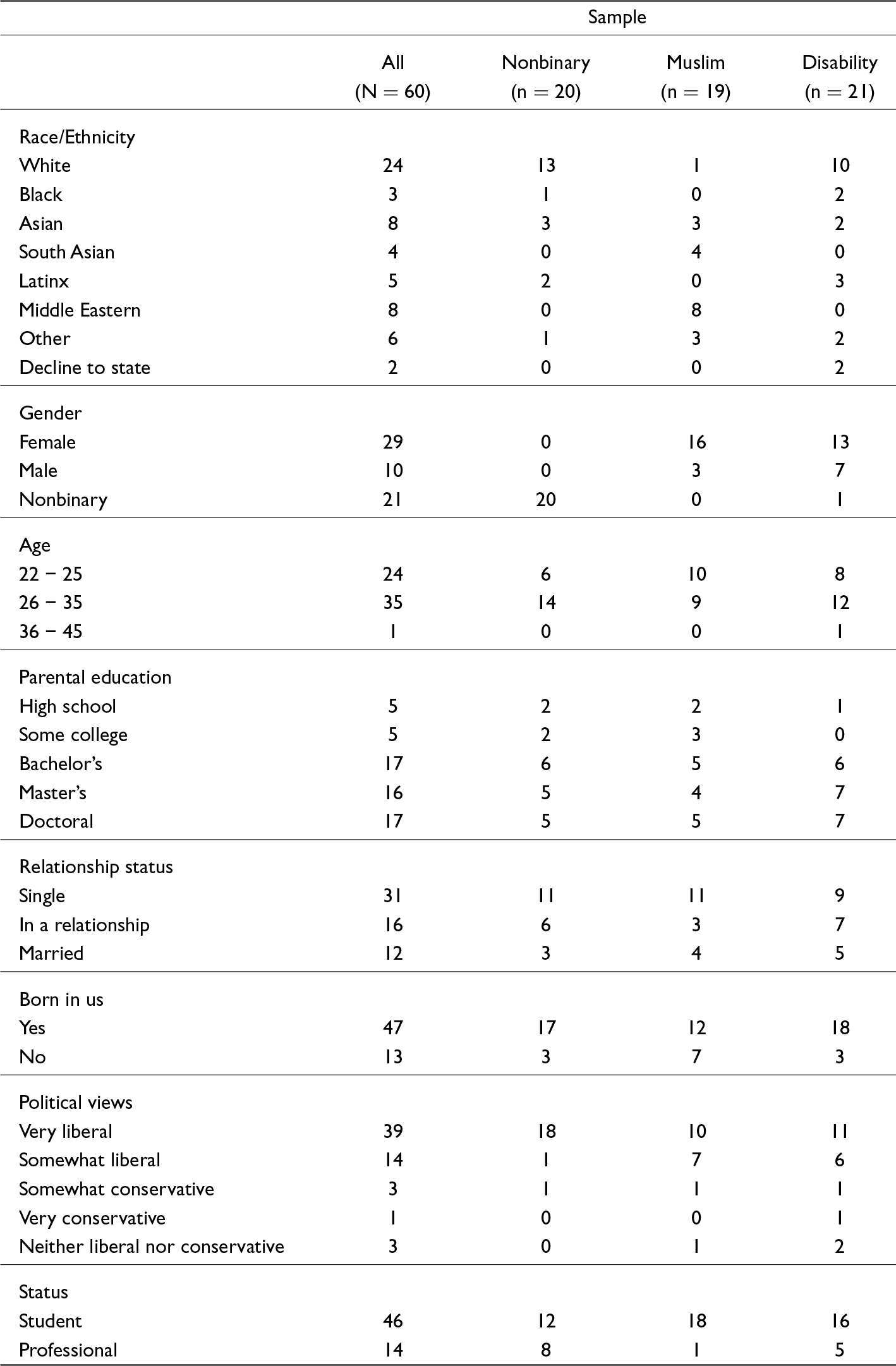
In turn, the research design – that I am beginning to think of as a queer eCRT “QuEer CRT” approach – located the experience of deviance as a central node of analysis and extends Matsuda’s (Reference Matsuda1987) call to “look to the bottom” by also considering empirical design to and from the periphery. In addition to an interest in non-normativity as the central node, I was interested in using mutual experiences across peripheral categories to consider a comprehensive account of the critical outsider’s (Valdes Reference Valdes1999; Reference Valdes2002) perspective. While considering a range of peripheral positions, I was theoretically motivated by three strains of critical inequality research that complicated identity beyond straightforward categories: (a) the ethno-racial conflation of the religious category of “Muslim” within American spaces and law in the last two decades (Ahmad Reference Ahmad2004; Aziz Reference Aziz2021; Chen Reference Chen2010; Gotanda Reference Gotanda2011), (b) research on deviance and disability as a critical identity project for critical race scholars to pay attention to (e.g., Harris Reference Harris2019; Reference Harris2021; Morgan Reference Morgan2023; Ocen Reference Ocen2010; tenBroek Reference tenBroek1966), and (c) the “OutCrit” literature that urges for intersectional queer approaches and attention (Valdes Reference Valdes1998; Reference Valdes1999; Reference Valdes2002). In highlighting the experiences of deviant actors, these interrelated articulations offer a way to consider structural inequalities hiding in plain sight, a core tenet of the eCRT movement (Gómez Reference Gómez2010; Obasogie Reference Obasogie and Sarat2007; Reference Obasogie2013). Simultaneously, in moving beyond the narrow operationalization of sexuality as the dominant queer intervention (Valdes Reference Valdes1998:1422), these empirical choices make the case for queerness as method in identity research. Together, they offer a new roadmap to follow Barnes (Reference Barnes2016) excellent advice to “do eCRT” by paying attention to initial formations of hierarchy with a “watchful eye” for possible categorical extensions and adaptations.
Despite their mention as categories of subordination (e.g., Hutchinson Reference Hutchinson1999, p. 12–13, 39; Chang and Davis Reference Chang and Davis2010; Jones and Wade Reference Jones and Wade2020 p 213), and despite CRT’s investments in intersectionality (e.g., Crenshaw Reference Crenshaw1989, 151–2; Nash Reference Nash2011, 456), cosynthesis (Valdes Reference Valdes1999), and the interconnectedness of identity categories (Carbado Reference Carbado1999; Carbado and Gulati Reference Carbado and Gulati2000; Hutchinson Reference Hutchinson1999; Reference Hutchinson2003), CRT scholarship has not always organically extended beyond its focus on race, and there is only a modicum of dedicated queer sites analyzed within the literature (e.g., Quinn Reference Quinn2000; Valdes Reference Valdes1999). Even critical race feminism (Wing Reference Wing2003), beyond some focus on sexuality (e.g., Gilmore Reference Gilmore1990; Hernández-Truyol Reference Hernández-Truyol1999) does not theoretically invest in what its early orientations describe as a “QueerRaceCrit” movement (Wing 2003:5). Similarly, although there is increasing attention to sexuality and LGBTQIA+ issues within law and society scholarship (e.g., Adam Reference Adam2017; Baumle et al. Reference Baumle, Boutcher, Badgett and Tomaskovic-Devey2024; Reference Baumle, Boutcher, Badgett and Tomaskovic-Devey2024; Bower Reference Bower1994; Chua Reference Chua2012; Lane et al. Reference Lane, Shepherd, Avella and Martin2023; Rollins Reference Rollins2002; Meadows Reference Meadow2018; Sagit and Pikkel Reference Sagit and Pikkel2019; Saguy et al. Reference Saguy, Williams and Rees2020; Vogler Reference Vogler2021; Waldman Reference Waldman2024), queer theory has not been used as a primary sociolegal lens within which to consider the experience of minorities. This lack of synergy is unfortunate because despite differences – and as CRT scholars are increasingly starting to acknowledge (Green and Gear Rich Reference Green and Gear Rich2024) – both CRT and queer theory start from the lens of the outsider to consider the blatant inequalities of normative systems.
At first glance, comparing nonbinary legal professionals to their Muslim peers or to those who have disabilities is not likely to offer substantive comparisons in experience. Critical race scholars have long warned about the ineffectiveness of clubbing experiences of differently placed groups (e.g., Harris Reference Harris and Maschke2013; Onwuachi-Willig Reference Onwuachi-Willig2018) while reinforcing the importance of intersectionality as essential praxis for nuanced understandings of inequality (Crenshaw Reference Crenshaw1989; Reference Crenshaw1991; Crenshaw, Gotanda Reference Gotanda2011; West Reference West, Crenshaw, Gotanda, Peller and Thomas1996; Gómez Reference Gómez2012; Reference Gómez and Sarat2017; Spade Reference Spade2015; Reference Spade2020; Bridges Reference Bridges2019), especially in empirical work about legal institutions (Barnes and Mertz Reference Barnes and Mertz2018; Butler Reference Butler2018; Deo Reference Deo2020; Gruber Reference Gruber2014; Hancock Reference Hancock2013; Reference Hancock2014; Leachman Reference Leachman2016; Su and Yamamoto Reference Su, Yamamoto, Valdes, Culp and Harris2002). Still, studying the experiences of these seemingly disparate actors together offers a reminder that identities necessarily produce different categories of association and narrative, and that unpacking their interconnected relationships might offer productive resolutions and opportunities for theory building. Similarly, the intuition was that their collective experience might offer us a reinforced perspective of inequality within their embedding institutions. I drew inspiration for these design choices from Adam’s (Reference Adam2017) calls for more “intra-movement solidarity” in sociolegal research about queer subjects, and the invaluable resource that eCRT scholar Ange-Marie Hancock (Reference Hancock2013) offered for empirically testing intersectionality in the quantitative predictive context, especially along the line of fixed (crisp) and more ambiguous (fuzzy) predictive categories of analysis.
In addition to considering overlapping inequalities produced by normativity, variations in peripheral position also allowed me to analytically vary the kinds of minority identity on how socially or legally accepted their status was. While Muslims (n = 19) and those with disabilities (n = 21) were protected broadly – even if not substantively – under a range of civil rights laws, gender expression and identity were still a category under legal – and social – flux. This offered site variation in visibility and legibility alongside legality and its temporality. Assumptions of who was Muslim, or disabled, or genderqueer (n = 20) were all similarly predicated on normative scripts of white, cis, able-bodied expectations. At the same time, their variations in legality and legibility – as well as their intersectionalities – offered new nodes to consider normativity.
Broad calls for participants were sent via email to the publicly available mailing lists of national professional affinity organizations (National Disability Lawyers Association, National Association for Muslim Lawyers, and the National Trans Bar Association) to get the most representative sample of interviews. In addition, several law schools with traceable affinity group emails were also contacted with an invitation to participate in the study. Some respondents referred known others, but this snowball sample was small (n = 3) and the majority of the respondents were voluntary participants who responded to the initial research recruitment email. Interviews were exploratory and descriptive, focusing on examples of experience and identity performance in legal spaces for each respondent with questions that focused on how respondents came to their identity and interactional experiences that primed their identity. Each respondent also completed an exit survey to collect demographic data and additional attitudinal information that might not have been captured in the interview. All interviews were recorded, transcribed, anonymized and analytically open coded using the software Maxdqa for theoretical connections in experience across sites as well as experiences particular to each subpopulation. Although I focus particularly on the sub-sample of genderqueer respondents in this Article to highlight the experience of inhabiting ambiguous sociolegal categories, analytical codes appeared across sub-samples to expose the framework that I describe in this Article as “blasé.” Altogether, the design was aimed at locating possibilities for “translation competence” between different cultural sites (Spradley Reference Spradley1979) that could cumulatively build “grounded theory” (Glaser and Strauss Reference Glaser and Strauss1967) about normative assumptions about the legal profession from the focus of the cumulative periphery.
Findings
Across respondents, the experience of peripheral identity offered new nodes to consider the normative expectations embedded in legal institutions. While different actors experienced professional spaces in unique ways, their narratives about identity performance and reception had important overlaps. One such common narrative was the resilience and resignation minority professionals had to exhume when contending with attacks on the veracity of their identity. These attacks, unsurprisingly, were predicated on assumptions about acceptable deviance and polite gatekeeping that subtly reinforced the idea that non-ideal outsiders did not belong naturally within these institutions. For example, many students – especially students of color – spoke about how they were judged by those giving them accommodations when they did not “look” like they needed it – thereby suggesting that their testing accommodations were being used to “beat the system” in law school. Others gave examples of how ableism was embedded in social expectations with stigma attached to those who needed to prove that they were “disabled enough” alongside having to negotiate their own relationships to the identity of “disability.” Kiara (NILED10:3),Footnote 1 a queer disabled student who was trying to explain their bipolar accommodations to an administrator, was told “oh, you don’t seem like you are [bioplar],” indicating the need for a publicly perceivable performance of disability. Kiara’s response was typically to be “easy-going” and “down to joke around” in the wake of exchanges such as these, but this gave them pause because they felt the need to have to adhere to people’s assumptions of what disability looked like, especially given the subsequent advice she received, to “be prudent, take a leave of absence and drop out.” Even if levity was not the immediate response to identity gibes for others, minority actors still had to buffer themselves in interactions because constant contestation had its own limits. A Muslim law student, Zalima, recounted how during an internship someone found out her religious orientation and “went off and called [her]..a terrorist” and proceeded to give her a Bible “to educate herself.” Having faced these overtly violent interventions, Zalima felt like she could no longer be fazed by “little comments” by peers in her classroom. She recounts “cringing” when her classmates would give “neutral” examples of how “it was okay to discriminate based on race or appearances if they appeared to be Muslim” but could not bring herself to keep contesting it because of how prevalent and normalized the violence was in everyday public discourse and reasoning:
Yeah. It’s really upsetting. But for me, I’m already tired enough. And I don’t have the brain capacity or energy to fight the little comments that just keep coming up everyday; in class, or whether you watch it on media. It’s all the same. (NILEM5: 4)
The social expectation and normalization of certain kinds of interpersonal violence as unavoidable and omnipresent made contesting the narrative not only exhausting, but also fruitless because it was unlikely to persuade any perpetrators. In turn, it made these minority actors second-guess their identity performance and expectations. An Asian transfemme nonbinary lawyer said they were pushed back into the closet for almost seven years because they were told that they were “not like that” and that they “still had a little bit of guy” in them (NILENB18:3). Similarly, when the administrator in the exchange above told Kiara, “Oh, you are bipolar” – it suggested to them that the administrator had not only not read their file, they were also suggesting that Kiara was an unreliable witness to their own experience, causing them to second-guess their capacity to continue the interaction. Some of this second-guessing came from benevolence that masked the interactional violence. Nic, a transmasc nonbinary person, felt after being misgendered by a professor they admired that they could not “lose out on those currently on their side” and because it would feed into “the stereotype that trans people were overbearing and needy..and trying to make everything about themselves, and..overreacting” (NILENBT3:10).
This feeling that individual representation always implicated a larger group’s identity constrained several respondents. Yet, their response to this conflation was not always the same. For attorneys in settings of institutional power, it made them either completely cover or demand visibility in legible ways from their surroundings. Many Muslim respondents who were not visibly coded as Muslim, for example, kept their religious life and identity personal and those who visibly presented as Muslim were cautious about their speech because they felt like everything they said reflected on their community. Similarly, respondents worried about those dependent on their professional roles. As Poppy, a nonbinary transfemme attorney, explained – they did not out themselves until they had “everything situated” in relation to their transition because they felt their genderqueer identity would be a disservice to their clients (NILENBT9:5). Instead, Poppy led what they call a “double life,” wearing masculine-presenting clothes to work until they could change their name, dress differently, use different pronouns in professional and non-professional spheres (she and they, respectively), and make the transition as seamless as possible. Poppy explained that as a trial lawyer, there was an incentive to not have “something bad happen” that could impact their clients, and they did not want to alienate the bench when they were approaching without a lot of power in the exchange.
While invisibility was strategic for many, visibility also offered reassurances. As another trans attorney explained, when one is openly trans, people cannot not “use the threat of outing you” (NILENBT3:2). In contrast, for those without visible cues that were normatively accepted, managing ambiguous identities, especially within structures of power, was complicated. For example, Feather, a nonbinary person, said they felt awkward correcting people about new pronouns but that it was “a lot easier to just introduce yourself for the first time instead of having to go back and be like, “Oh, actually I use these pronouns now.” Feather did not have the same problem updating pronouns on behalf of other nonbinary persons but felt it hard to do for themselves personally. Despite signaling nonbinary pronouns in all their work correspondence and interactions, they were consistently misgendered. Yet, it is their justification for passivity which is informative:
…It feels like I don’t want to center myself too much, or have to do this big education thing, when it’s really not about me. So, I don’t correct them (NILENB5:6).
Feather’s justification maps how queer theorists consider the role of interiority and performance in interactions (Ballakrishnen Reference Ballakrishnen2023c; Snorton Reference Snorton2005). Raced and queered bodies often navigate the social reading of their physical embodiment with dissonance and have the balance identity performance with self-preservation. If Feather was to respond to every slip in pronoun usage with a retort, then it would result in a constant contestation about identity that would leave them consistently ill at ease. Also embedded in this is the nature of power in these exchanges: Feather went on in the interview to contrast the differences between clients (who were dependent on them) using the right pronouns and colleagues misgendering them. Client representation, as Feather notes, was not a place to center oneself, but the misgendering from colleagues was a different matter. Even if Feather was unlikely to call attention to themselves in either interaction, they were likely to code these slips differently given their distinct nature.
Intersectional identities further complicated the experience of interactions. For example, Muslim respondents were impacted by a range of assumptive stereotypes but their experiences were also marked by their racial identities, with white Muslim men experiencing their spaces distinctly differently from South Asian Muslim women. For example, Chris, a white Muslim man, was self-reflexive about the ways in which categories of race did not complicate his identity the way it did for his South Asian female partner who wore a hijab (NILEM7:9). At the same time, he had to contend with being seen as “Muslim lite” amongst his own peers because there was not a way in which to communicate his identity effectively; the invisibility both helped him and hurt him in different ways than for those who seemingly “looked Muslim.” Similarly, while queers from conservative and rural social backgrounds felt like navigating their environments offered new extensions to their intersectional identities, white non-binary and trans persons in more urban queer-friendly spaces felt differently about claiming a minority identity when compared to their peers of color, and for many white students with a disability, claiming a minority identity felt disingenuous because it “took away” rewards from their historically marginalized peers. Across identity categories, class position was crucial in dictating experience, with first generational and working-class legal professionals much more likely to feel conscious of their identity than be able to “work it” (Carbado and Gulati Reference Carbado and Gulati2000) in ways that advanced their career. Juniper’s experience as a neurodivergent biracial nonbinary person who presents as white and male to many audiences elucidates this confliction of intersectionality acutely
In some ways, I felt guilty about it at times, too. Because …— I am a very easy diversity point. I mean, I mostly present as male. At least on first impressions. And I’m white-presenting and I am from a middle-class background. So, I just felt like I’m an easy sort of diversity tick on the box. Which I didn’t want to be, and so I felt conflicted… it sort of felt like multiple conflictions. (NILENB13:3)
Similar to Juniper’s hesitation to “tick an easy diversity box,” were others for whom it felt “too soon” to claim an identity. Nonbinary professionals who were just starting to identify that way were much more likely to make concessions for their interlocutors than those who had not gotten more settled in their identity and expectations. Juniper, for instance, despite their conflictions, felt it was important self-advocacy to not let misgendering slide. Even if there were times when they might “let it go,” they did not feel the need to always “make it easy on everybody,” as Feather – who had started identifying as nonbinary more recently – felt predisposed to do. Similarly, those who were recently made aware of their disability felt more conflicted about asking for accommodations because of a sense that “it was just pain” or “not that bad” or that “it would go away”; while others with longer termed disabilities were more assertive about their needs.
Over and above the ways in which these minority experiences cumulatively paint a picture about everyday interactional inequities, the differences between them were informative too. Although many minority actors experienced what felt like cutting dismissals of their identity, those with newer and more ambiguous identity statuses had even more particular contestations about their entitlements and subsequent harms. As the examples above illustrate, ambiguous unobvious and invisible identities garnered pushback in interactions, but there was a different texture of resistance against genderqueer contestations that were seen as “not real” or unrelated to a tangible category of harm. Unlike the inconsiderate responses to racio-religious or ableist microaggressions that the Muslim and disabled respondents faced (which, if pushed, perpetrators might have argued were, respectively, not racist or ableist), interactions with genderqueer respondents were not seen as harm and interlocutors, even when pushed, did not feel the need to defend themselves. Since gender performance and expression was perceived as a preference rather than protected identity, acknowledging it felt like a choice rather than required social convention. Similarly, its lack of clear legal protection meant that it could be legitimately dismissed. It is this legitimized persistence of the dismissal, even upon exchange, and its capacity to be not seen as violence, that I term blasé.
Across contexts and sites, genderqueer respondents routinely recalled how much of the interactional violence they experienced, when contested, would either be ignored, reinforced, or dismissed. My data are rife with justifications for these everyday acts in question – most often related to misidentification or service provision – and their accompanying justification, which varied from the seemingly very practical or rational (e.g., that it was confusing to use the first person plural in writing or that it felt unprofessional to use neopronouns), to the toothlessly benevolent (e.g., the lack of budget to build gender neutral restrooms despite a more general signaling towards queer equity), to explicit personal discomfort (e.g., that one was too old to think about gender differently or use certain pronouns or change their language to accommodate the preference of the nonbinary person). The interactional pattern regularly resembled the following arc: an introductory declaration by the nonbinary person of their identity markers (e.g., “Hello, my name is X, I use they/them pronouns”), a rejection or misuse of that identity marker by an interactional other (e.g., Y might use “she/her” or “he/him” to address X), followed by a confrontation by X of Y’s misuse in some manner. The capacity for an interactional other to be able to decide what constitutes an acceptable amount of identity performance is of crucial note in these interactional patterns. At first glance, there might be a tendency to dismiss this as a microaggression, but this is not a microaggression – especially given its impact – it is instead a macro aggression where the aggression is not tied to a calibrated legal right and therefore, not seen as aggression by the perpetrator. In a sense, it is a macro non-aggression.
Yet, there were other times when contestation was not even a choice because of the power structures the respondents were embedded in. In contrast to Feather and Poppy’s anecdotes above regarding the difference in power relations between peers and clients, nonbinary navigation in law schools were rooted in power hierarchies which made nonconfrontation a necessity rather than a choice. For law students, the standing example was related to cold calling with gendered honorifics that made them feel isolated, excluded, or, in some cases, struck by the violence of their dysmorphia. Several students relayed how their professors consistently misgendered them without remorse and often gaslit their experience. Many students relayed how their professors had actively declared that they did not believe in pronoun performativity and thereby had shut down any possible exchange before it began. But even for those who attempted to push back, their efforts were in vain. One nonbinary lawyer was told that their nameplate was irrelevant to how they were gendered because it was not something that the organization “had guidance about.” (NILENB14). Another who complained about a peer who continued to misgender them, was told the perpetrator could “not be transphobic because he was gay” (NILENB11). Several were told they could not change their email address from their deadname to their new name because of administrative limitations (NILENB2, NILENB8, NILENB17). These neutral and rational justifications offer insight into the seemingly ordinary nature of persistent everyday interactional violence. In an effort to remedy an increasingly hostile class environment, one student who was repeatedly misgendered, re-relayed their gender-neutral pronouns to their professor. The professor’s response was he did not use pronouns to refer to students – which, the respondent reported was “patently false” – and still ended the conversation without any effective resolution (NILENBT7:7). Even Juniper, who was forthcoming in their self-advocacy in many contexts, mentioned an incident of cold calling in a large doctrinal first year law school class that was reflective:
….there were three of us, and all had raised our hands to answer a question. And he [the professor] pointed to… the person on my left and the person on my right. And then he was like, “The man in the middle.” And I was sort of like … I mean, I knew the answer. I had the right answer; I had the answer that he was looking for. But I couldn’t articulate it at that moment, because I was sort of just like I was used to getting “he” a lot, but not “the man.” And it was just very sort of defining. I don’t know. It was just fucked up? (NILENB13:3)
Juniper’s impossibility to answer their professor’s question despite knowing the answer keenly outlines that even when blasé dismissal of identity feels innocuous, it has brutal consequences. The professor’s decision to render misgendering a non-issue is striking because it rests the decision to gender – and the importance of such gendering – with the professor rather than the person whose identity is in question, i.e., Juniper. Instead of considering the actions of misgendering, the professor was blasé enough to both not notice the misgendering and to transfer the fault in the interaction onto Juniper for not knowing the answer to his question. In turn, it made Juniper not seek this professor out again for any further mentorship or instruction, which was a shame because they had hoped to specialize in this particular professor’s field prior to law school. Juniper’s reference that the interaction was “defining” in the way it chilled their speech offers insight into the ways in which blasé misgendering can extend beyond the interaction to have more longstanding implications.
These interactions might seem like commonplace identity conflict, but these data urge our attention to what routinely follows the confrontation when identity is ambiguous and inarticulable within normative categories. Consider this recollection by Dream, a Black nonbinary lawyer about an employment interview with a senior elite professional:
[My potential employer] told me at the interview, “How may I address you, because I’m confused by your reference letters.” I said I am [Dream]. You use [Dream]. And they/them.
He said “Okay, there it is. I can’t do that. You are asking me to think too much. I can use [Dream]. I can use she, or he. But I can’t use they. You are asking me to think too much. I’m not going to let this affect my hiring. I will hire based on fit and who I feel comfortable working with, and who I think can do the work. But I just want to let you know. (NILENB17:9)
The interviewer’s lack of interest in using Dream’s pronouns (“I can’t do that”) combined with the justification (“you are asking too much”) is a classic operationalization of specific kind of everyday blasé dismissal of ambiguous identities. The employer was careful to caveat that all decisions about hiring would be predicated on “fit” and “comfort” – factors notorious for hiding discrimination in plain sight (Berrey Reference Berrey2015; Rivera Reference Rivera2012) – and not Dream’s identity. Nonetheless, his capacity to tell Dream that he could not recognize their gender identity is indicative of the kind of entitled and effortless post-confrontation response received by those whose identity categories had flexible legal and social standing. Beyond the interaction, other institutional buffers made the harm illegible. When they reported this interaction, Dream’s recommenders advised them to withdraw their application, if necessary, but not to confront or complain about the interaction. Another colleague told them “At least he was honest and said that to you. He gave you the truth. Can’t that be enough?” These decisions to “not rock the boat over” (NILENB17:11) not only kept Dream from accessing a support network, but it also made them second-guess taking any action against their experience.
Discussion
These data offer important reminders about the role of peripheral subjects in illuminating the coordinates of latent institutional inequalities. For one, the experiences of differently placed deviant actors help reveal insights about a range of implicit biases that are baked into institutional cultures. Further, the interactions across different identity navigations also give us new nodes for considering intersectional identities and their priming – and limits – in different social contexts. In turn, these collective portraits of peripheral identity navigation offer a comprehensive consideration of assumptive normativity within legal institutions and its costs for minority actors. Alongside these comparable similarities, these data also offer important observations about distinctions in the way discrimination is experienced, internalized, and contested across different sociolegal contexts. Centrally, unlike other forms of discrimination that have achieved a more settled sociolegal legibility (and are more likely to be denied or contested if alleged), challenges to more peripheral categories of identity struggle to even be seen as harm.
CRT scholars have offered many reminders that discrimination for minority actors is likely to be disguised through proxies (Rich Reference Rich2004; Onuwachi-Willig and Barnes Reference Angela and Barnes2005; Barnes and Mertz Reference Barnes and Mertz2018) that allow for plausible deniability (Pfeiffer and Xiaoqian Reference Pfeiffer and Xiaoqian2024). At first glance, the interactional pattern of misgendering a nonbinary person might seem like a commonplace slight similar to other microaggressions. Subtle and often automatic “put downs” have historically been seen as second-degree interactional violence (Pierce 1970), and more recent microaggression research (Nadal Reference Nadal2019) has included gender and sexual orientation as categories of identity which might experience intentional or unintentional “brief and commonplace daily verbal, behavioral and environmental indignities” (Sue et al. Reference Sue, Capodilupo, Torino, Bucceri, Holder, Nadal and Esquilin2007:271). Yet the interactional commonality amongst these patterns demands our attention, and even within these matrices of illegibility, there are distinctions.
Dream’s exchanges with their interviewer and mentors, for example, offer an illustrative node to consider the particular frustration of navigating identities when they lack legal and social clarity. Although all kinds of non-normative identities had their particular forms of slights and discrimination; those with invisible, ambiguous or illegible identities were trapped in exchange labyrinths that invalidated the viability of their own identities. At first glance, Dream’s exchange with the interviewer seems similar to Zalima being called a Muslim or Kiara not being seen as bipolar. In fact, the patterns of dismissal and disregard that those with peripheral identities had to get used to combatting were indeed similar across contexts. But even though Zalima felt she had to stop being fazed by the “little comments” she received, and Kiara had to don a disposition of being “easy going” to handle their environment, neither of them were likely to have been told as directly as Dream was that their identity’s existence was not in fact real or possible. This ability for the perpetrator to hold the power of deciding whether an identity is worthy of recognition distinguishes the impact of the blasé response for differently situated actors. While Zalima and Kiara knew that they had some recourse to report the discrimination they faced (though each chose not to) – Nic and Juniper and Dream felt less sure of this. Although reporting of discrimination across contexts had limits, the ambiguous nature of their identity and its rootedness in rights made them second guess their own experience as discrimination. Dream’s interviewer saying “but I can’t use they” is a direct reinforcement of identity erasure – it signals not just an inability on the part of the interviewer, but also an express dismissal of the request as not even valid. In particular, nonbinary respondents felt engulfed in the impossibility of contesting their identities because unlike their other peers – including, openly trans peers who enjoyed specific civic and legal statuses – their identity claims were neither protected nor legible.
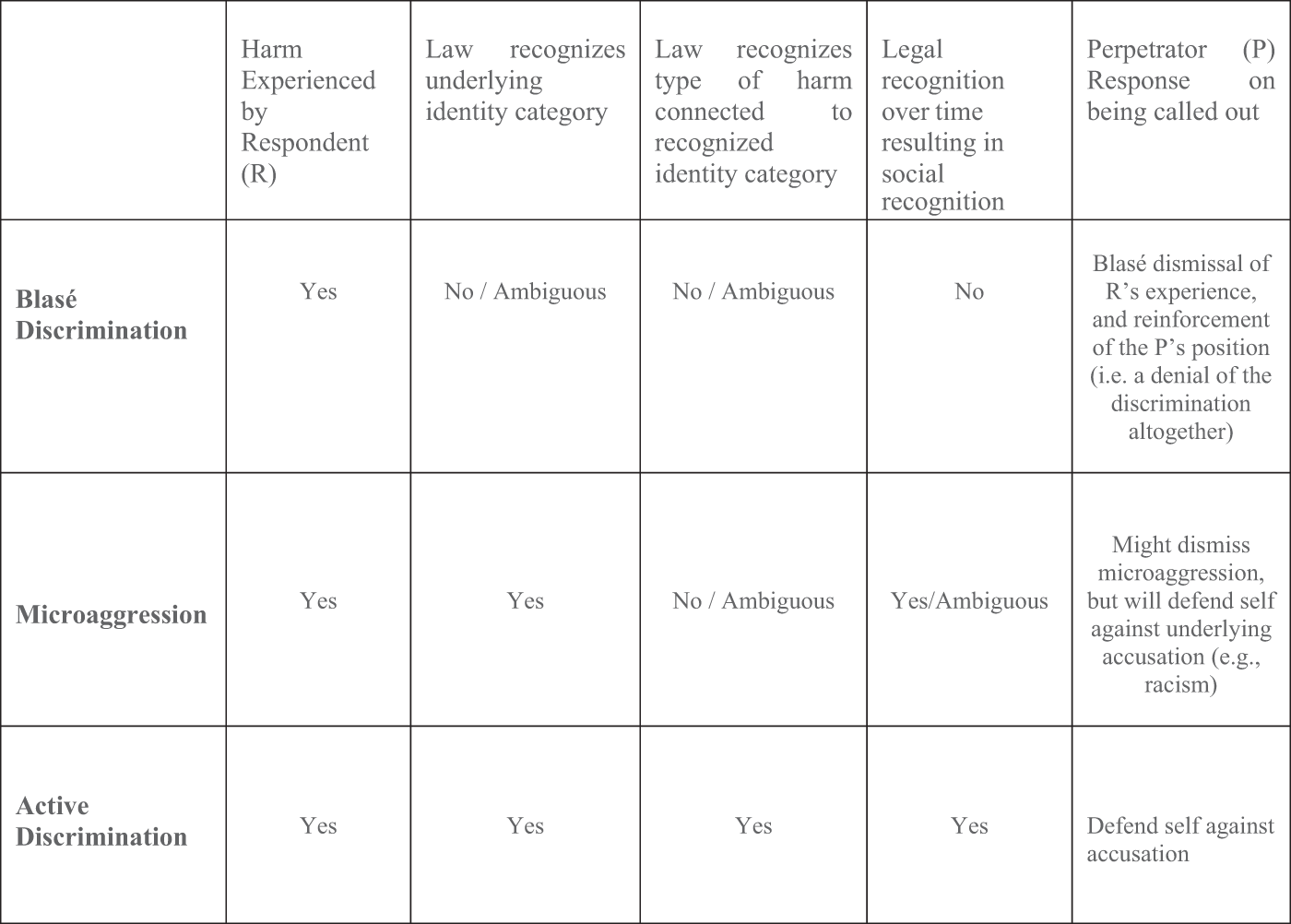
It is this recurring theme of feigned indifference or dismissal of conflict in response to identity assertions that I am starting to theorize as “blasé” in this research. Blasé originates from the root word blaser – which deems something unworthy of reaction because it has been witnessed so much that one is cloyed, sickened, or bored. I use it here to suggest a lack of attention or empathy by perpetrators to the experiences of, particularly, genderqueer respondents. While there are surely perpetrators of microaggressions who do not feel contrite after causing offense, the difference is in what happens when they are called out for such contriteness. While perpetrators might deny or reject the harm of a microaggression, they are also likely to deny its underlying connection to a protected identity category (e.g., being racist). For example, someone using a racial microaggression might not feel remorse about the microaggression, but inherent in their denial is the suggestion that the microaggression is not racist. Similarly, someone who has used a gendered microaggression, is likely to deny that their action is sexist. Gender identity is a more newly protected category, but to the extent it operates as a protected class, gender expression is not incorporated into its protection legally or socially. Thus, unlike someone who will use a microaggression and then backtrack on its connection to the more distinctly articulatable harm, someone who has a blasé response to nonbinary gender expression, even when pushed, is likely to attribute it to a “difference of opinion” rather than an interactional violence because misgendering – like pronouncing someone’s name wrong, for example – is not tied to a legally clear right. Thus, beyond the feelings of the perpetrator, it is the continued insistence on the conflict not being of issue, that distinguishes blasé responses to microaggressions and more direct forms of discrimination. Particularly, while discrimination always extends beyond legally ambiguous categories of identity, blasé-ness highlights the ways in which interactional harm might be experienced by vulnerable peripheral actors whose status has not yet gained the social and legal recognition necessary to acknowledge – or epistemically articulate (Ballakrishnen and Lawsky Reference Ballakrishnen and Lawsky2022; Fricker Reference Fricker2007) their experienced harms (Figure 1). In a sense, it offers a consideration of violation before they are coded to be micro- or macro – aggressions.
Variations in experience between active, micro, and blasé interactions between perpetrator (P) and respondent (R).
Additionally, power, institutional embeddedness and codes of propriety had implications for identity performance and the reception of blasé dismissals among these respondents. While Poppy and Feather had different expectations from and duties towards their clients – who they saw as dependent on them – they each reserved different frameworks for judging similar experiences with colleagues. Similarly, Juniper and Dreams interactions with those having authority over them reveal an insidious extension to blaséness that is brutal precisely because its non-contestation lacks agency. Altogether, despite variations predicated on individual hierarchies (e.g., actors with positions of power versus deference) and the nature of the interaction or institutional context (e.g., a professional versus personal exchange), these exchanges are, similar to other critical scholars’ accounts of minority identity navigation, likely to add to the “subtle dehumanization” that create fictions about non normative actors (Matthew Reference Matthew2019) and offer a “deniable degradation” of perpetrator’s acts (Gustafson Reference Gustafson2013) which reinforce an “implicit hetero-binary favoritism” alongside the white favoritism other critical scholars have observed (Richardson Reference Richardson2015). They also reveal the variations in reception of identity categories based on assumptions of their legibility within normative legal institutions.
This gaslighting without an expression of contrition might not be dissimilar to the experience of sexual minorities before the decriminalization of sodomy laws, or the experience of race-based discrimination before the civil rights movement. Still, even beyond everyday slights about the identity category that were made without an expression of contrition – something respondents across categories experienced – the more general gaslighting in these interactions have important parallels. The second-guessing that made respondents wonder if they were “queer/disabled enough” or if they were “making a big deal about nothing” have synergies with other minority actors in other contexts. As other research shows, these patterns of doubting one’s own knowledge are often imminent in interactional contexts where identity expectations are in flux (e.g., women might second guess the appropriateness of sexist comments when embedded in environments where such comments are common) or where the violence itself is yet to have social acceptance and visibility (e.g., Fricker Reference Fricker2007). Similarly, precarious actors who are embedded in institutions that do not fully account for them might hesitate to make claims around their identity and minority actors might come to expect the hierarchies imposed upon them (Nielsen Reference Nielsen2009). For example, recent research (Doering et al. Reference Doering, Doering and Tilcsik2023) reveals how women, when confronted with ambiguous situations in professional work, are not likely to pursue administrative actions because they are unsure whether the interaction, they are reporting about is a function of their own actions or “real” gender discrimination. Within this broader research on the natural propensity for minority actors to expect inequality – blaséness offers a framework not only to consider a response to an interaction, but also its production of an internal expectation amongst new kinds of minority actors whose identity recognition is in legal and social flux. As a genderqueer person second-guessing the significance of this research even as I write this, I share empathy for this predicament.
It follows then that the temporal legal context for understanding the social navigation of nonbinary identity rights is an important part of this analysis. Flux in legal identity status as well as stage of legal recognition within a given social movement and environment were all crucial components for analyzing variations in experience. These data also offer us an important reminder of the persistent assumptions of ideality that are baked into our environments, and the ways in which the coordinates of ideality change and morph with time and social movements. As the examples of the seemingly in-group interactions reveal, temporality was similarly relevant in determining who was seen as an insider and outsider within a given context. As these data show, not all blasé interactions were from identity outsiders, and groups historically seen as deviant might be newly capable of wielding power against even newer entrants, reminding us of the shifting nature of these cores and peripheries across contexts. Like the gay male colleague who denied the possibility of being transphobic, other in-group interactions demanded specific kinds of gendered performance to be legitimately seen as worthy of the identity label (e.g., “you just do not read in that way because you look [too masculine/too feminine/not a certain way that they imagine genderqueer persons to look]”). For others still, being pushed back on something like misgendering triggered a feeling of annoyance at having been corrected for a “difference in opinion” or “generational quirk” (as one gay elder remarked to students, “my pronouns are professor”). In turn, these interactions produced responses from the respondents – independent of the intention of the perpetrator – that varied from forced self-justification to second-guessing the legitimacy of their claims and normalizing the everyday alienation they were embedded in. Alongside these levels of analysis, personal temporal navigation was crucial: the individual’s negotiation of their own status (for example, coming out as nonbinary and/or their negotiation of their disability identity) had implications for how they navigated their environments. Variations in law and social culture of a given environment, were also crucial nodes in determining how a newly peripheral identity was likely to be navigated. Altogether, flux in the identity perception and reception – or what I started to code as blasé temporality – offered what was a blasé justification for why an interaction was not coded as violent by the perpetrator even if it was received as violent by the person holding the identity.
Finally, this project hopes to contribute to conversations about critical method in sociolegal research. Allowing cases to build theory has long been a stronghold of critical race scholarship, but the narrative of specific harm (usually based on lived subjective experience) has run against limitations of method as not being generalizable. In valuable response, the work of eCRT scholarship has been to use lived experience to “study up” the institutional mechanisms and empirical impetuses causing the harm. However, treating these two things – i.e., the narrative about the site of harm and the empirics about the institutional mechanisms producing it – as disparate parts, undermines the value of narrative as empirical cornerstones. If narrative is only valuable to isolate a research question for empirical research, then our commitments to the CRT project might be compromised. Sociolegal research on race – and other forms of minority identity – no doubt benefits from a dedicated and methodologically sound research agenda, but in itself it might not constitute as research in the tradition of CRT. Instead, following these mutual priors might require a commitment to doing empirical work with a critical lens. Yet, how does one do this work methodologically and theoretically? Is it by situating the research question and scholarship in the CRT literature? Is it by foregrounding narrative as the sole methodological tool through which to respond to these questions? The suggestion in this Article is that, beyond the specifics of methodology (which no doubt need to be rooted in the coordinates of a specific research question rather than a specific tradition of scholarship), starting research at the periphery – or, building in a queer approach to empirics by prioritizing the periphery in studying the core – could serve critical sociolegal scholars.
This exploration of the blasé response to discrimination sheds light on the opportunities available for theory building when difference is analyzed across narrative to focus on the commonalities of deviance across sub-categories of assumed identity. Rather than isolating minority experience to case studies or adding minority comparisons to show distance from normative categories, grounding sociolegal research in the situational outsider affords a critical introspection of institutional inequalities. In turn, this vantage point of the outsider – borrowing from queer theory – could allow narrative in empirical CRT to offer more than just a locus of exposure and, instead, be a valuable methodological intervention in itself. Central to such an empirical exploration of queer and CRT priors – a “QuEer-CRT” approach – is the commitment to building an anti-subordination research agenda across different peripheral stakes and vantage points. This experience of blasé – or the capacity to build theory about this experience – would not have happened if the sub-samples in this research were in comparison to a main “normative” sample or population or if I had studied only one sub-sample without the focus on comparative experiences of such normativity. Not all research questions are elevated with comparison, but the QuEer-CRT method bolsters the call to leverage comparative cases where the focus is on the structural distance from the locus of normativity rather than the individuality of the sites themselves. Considering the periphery as a means of analysis for doing empirical research could be a valuable tool for critical scholars interested in minority identities and their experience.
This is not to say that queer frameworks – or seeing identity categories as always peripheral – will necessarily aid every research project. Resistance might be justified, for example, by the legitimate threat of dilution: adding identity categories might displace the salience of race as the preliminary metric of analysis. It could be argued that intersectionality helps buffer some of this resistance (see, for example, Smith Reference Smith2007). Yet, even beyond intersectionality that implicates race, a queer analysis from the perspective of non-normative actors could illuminate new considerations for the persistence of hegemonic institutions. Particularly, locating points of deep deviance within each identity category (e.g., locating the struggles of a first-generation trans woman of color as distinctly different when compared to the experience of an older upper middle class white gay man despite both of them being “lgbtq+”) could buffer the potential for solidarities across delineated categories of identity. This is particularly important because there remains an ideological pull to stay within one’s legitimated boundaries of representation that renders the crevices within categories invisible (and those between them, to be insurmountable). Being able to connect their experiences – in these data, by illuminating the mechanism of blasé discrimination – might offer new language to voice cross-categorical violence in ways that could not be named before. In turn, this starting point of the periphery could build up scholarship about the core while staying bound to the generalizability that substantiates individual narrative alongside its extensions for other outsider locations.
These interventions are collectively crucial for several reasons. From an empirical perspective, there was never a more crucial moment for these modes of analyses to have synergies. Contemporary social movements – and at the time of this writing, political landscapes – have been revealing numerous overlaps between struggles of violence faced by marginalized groups, and the recent resistance to CRT as a mode of analysis has been increasingly in lockstep with the anti-tans resistance in many places. From a theoretical perspective, the overlaps – as other disciplinary traditions have observed and built on – feel organic. Law, as a normative institution, works predominantly to create rules and structures that are at odds with those who do not fit within these boundaries. Queer theory, with its focus on the deviance of the non-normative, offers a compelling analytical framework for those interested in understanding the limits of the law, and employing its theoretical priors in methodology can help add empirical rigor to our considerations.
Conclusion
This research reveals how coordinates of deviance from normative categories (of, in this case, professional performance) can reveal nuanced insights about the experience of discrimination. Empirically, it suggests that starting from the position of the deviant -rather than the ideal – actor in an empirical project can offer important nodes to critically understand the experience of inequality. Further, in varying deviation from normativity from the perspective of different kinds of non-ideal actors, it offers that the experience of discrimination is different for different identity categories in different sociolegal contexts. While discrimination that is normalized in legal, social and cultural schema follows distinct dynamics of harm and visibility, that which is less presupposed has more adulterated understandings in legality and sociality alike. It is this distinction that I highlight and differentiate from other forms of harm using the concept of “blasé,” and it is the method embedded in this conceptual innovation – QuEer-CRT – that I offer as contributions to the larger law and society literature.
These variations in the experience of discrimination and contestation across different sociolegal contexts in the periphery also give us new tools for considering interactional harm. First, these comparative data suggest that lack of interactional attention or acknowledgment of harm do not suggest a lack of impact. In fact, it is precisely interpersonal harm enabled by ill-attention that the concept of blasé attempts to capture. Second, the blasé-ness I have started to theorize in this Article is distinguished from harms caused by active discrimination which are legally valid and visible. Similarly, it is different from microaggressions which, while subjective, are usually well-defined by public consensus about the nature of their harm. Still, the connections between these mechanisms remain pertinent. Particularly, beyond the similarity in self-justifications offered by perpetrators (e.g., defending the “r” word as a proper characterization of a neurodivergent person, or not feeling remorse while calling a Muslim person “a terrorist”), I argue that this interactional dynamic offers an exploratory lens to investigate bias and discriminatory behavior that precedes rights and identity recognition in a particular context. Relatedly, third, although more recognized targets of discrimination might also experience blasé responses to the invisible or contested parts of their identities, genderqueerness – because of its current social and legal characteristics – offered a particularly salient site to observe this pattern of bias. Altogether, while normalized and legally acknowledged forms of discrimination followed distinct dynamics of social exchange and legibility, discrimination associated with more ambiguous categories of identity struggled to shake off the blatant blasé dismissal of their identities in interactions. Together, these patterns reveal ways in which considering the periphery as a starting point rather than as additive analysis in empirical research – what I am starting to consider as a QueEr-CRT approach – is imperative for those of us that are concerned with thinking critically about law’s role in maintaining and reinforcing hierarchies.


 Open access

