


Justice Brennan once said that the selection of cases for review is “second to none in importance.” With the passage of the Judiciary Act of 1925, known as the Judges’ Bill, the Supreme Court was not only given the power to set its own agenda, but also the ability to shape the nation’s political and policy agenda. At first glance, Supreme Court agenda-setting follows a binary procedure, where the Court decides whether or not to alter the status quo. However, this process has two stages, the first of which gathers far less public and scholarly attention. Justices must first decide whether or not to hear a case, and if so, only then do they decide the outcome of the dispute.
Like the decision on the merits, the decision to grant cert is full of nuance – shaped by the ideology and preferences of the justices themselves, legal precedent, the political and institutional environment, as well as external pressures from legal advocates and swings in public opinion. Given the complexities inherent to this decision, Gibbs (Reference Gibbs1955) suggests that both decisions are on the merits, but the first judgement is tentative.Footnote 1
Scholarship remains mixed in ascertaining the relationship between cert and on the merits decision-making. On one hand, some suggest that justices are more inclined to grant cert when the conditions on the Court favor their preferred outcomes on the merits (Schubert Reference Schubert1959; Baum Reference Baum1977; Palmer Reference Palmer1982; Brenner and Krol Reference Brenner and Krol1989; Krol and Brenner Reference Krol and Brenner1990; Boucher and Segal Reference Boucher and Segal1995; Caldeira, Wright, and Zorn Reference Caldeira, Wright and Zorn1999). In contrast, others note that the adherence of justices to their understanding of proper judicial behavior can sometimes prevent them from making strategic, policy-oriented decisions (Provine Reference Provine1980). Ultimately, cert decision-making is most likely a mix of strategic and sincere behavior depending on the circumstances at hand. Various factors, both ideological and strategic, are intertwined during the cert stage to shape each justice’s decision to grant or deny review (Perry Reference Perry1994).
We seek to further investigate the relationship between judicial decision-making in the cert and merit stages, particularly focusing on how the justices’ decision to grant or deny cert shapes their later behavior on the merits. We base our research on the assumption that justices’ decision-making at the cert stage is influenced by their preferences on the merits. This perspective views cert and merit decisions as parts of a continuous process, where cert decisions inherently consider all potential outcomes on the merits (Gibbs Reference Gibbs1955).
Given this assumption, we propose that the cert decision has a downstream effect on both the crafting of the dispositional majority, as well as its doctrinal implications, manifestly opinion writing. For instance, we know that justices act strategically, considering whether their cert decision will help them achieve their preferred outcomes on the merits and casting their votes accordingly (Caldeira, Wright, and Zorn Reference Caldeira, Wright and Zorn1999; Cordray and Cordray Reference Cordray and Cordray2004), and that such consideration includes the likelihood of being assigned as the majority opinion writer (Sommer Reference Sommer2014). Additionally, as part of the opinion writing process, justices have the ability to craft or join a separate opinion, while remaining in the majority, or write/join a dissent while in the minority. These separate opinions, although lacking precedential value, serve to signal fairness and democratic decision-making (Salamone Reference Salamone2014), as well as the potential for future doctrinal changes (Kelsh Reference Kelsh1999; Hettinger, Lindquist, and Martinek Reference Hettinger, Lindquist and Martinek2006). Given that the decision of departing from the majority is shaped by the influence of external actors (Collins Reference Collins2008a), among other factors (Wahlbeck, Spriggs, and Maltzman Reference Wahlbeck, Spriggs and Maltzman1999; Maltzman, Spriggs, and Wahlbeck Reference Maltzman, Spriggs and Wahlbeck2000; Spriggs and Hansford Reference Spriggs and Hansford2001; Hettinger, Lindquist, and Martinek Reference Hettinger, Lindquist and Martinek2003; Carrubba et al. Reference Carrubba, Friedman, Martin and Vanberg2012), the justices’ strategic behavior in deciding to grant cert is also intertwined with their consideration of external signals, which potentially impacts their decisions throughout the life of the case.
In view of the complexity and nuances present in judicial behavior, our research recasts the justices’ opinions as the culmination of a strategic and holistic process that includes early decisions on cert and engagement with external interests. In this paper, we test how a justice’s decision to grant or deny cert shapes their decision on the merits – specifically to depart from the majority opinion by writing/joining a separate opinion. Furthermore, we explore the effect of those who are most interested in the specific opinions and rationales of the justices, as part of their long-term engagement with the issue. We expect organized interests – via amicus curiae briefs – to both contribute to a justice’s opinion and, more specifically, to shape the effect of a justice’s earlier strategic consideration on the later stages of the case, that is, the decision to depart from, and potentially weaken the majority opinion. Given the Court’s increasing relevance in shaping the legal and political landscape of the nation, it is crucial to continue expanding our understanding of how the Court’s agenda setting process interacts with the Court’s internal institutional and professional dynamics, as well as the presence and quality of external factors.
Downstream effects of granting cert
The judicial decision-making process begins with the submission of approximately 5,000 to 7,000 cert petitions. Upon receipt, the Chief Justice initiates the process to determine which cases will be granted review by circulating the discuss list, to which other justices can append additional cases during the Court’s weekly conference meetings (Ward and Weiden Reference Ward and Weiden2006).Footnote 2 The Conference marks the justices’ inaugural deliberation and recording of their inclinations about a case, before a small portion of petitions are advanced to the merits stage.Footnote 3 Once a case reaches the plenary stage, a justice makes two decisions: first whether to rule in favor of the petitioner or respondent, which means joining the majority or minority, and second, how this decision is expressed in opinion-writing. In addition to joining the majority opinion, a justice can write or join a regular concurrence, special concurrence, or dissenting opinion. A justice’s choices in the plenary stage is the cumulative effect of all the behaviors and decisions made in the earlier stages of this process, which have a downstream effect on the final and most consequential part of the justices’ behavior, the opinions.
The level of secrecy maintained during the agenda-setting stage hinders the ability of researchers to fully explore the impact of a justice’s decision to vote in favor or against granting cert (Black and Boyd Reference Black and Boyd2013). This aspect of judicial decision-making provides “maximum discretion, based on very little collegial deliberation, with virtually no public disclosure or explanation of their actions and subject to no precedential constraints” (Cordray and Cordray Reference Cordray and Cordray2004). This means that our understanding of the justices’ agenda-setting behavior and its effect on plenary decisions, that is, opinion-writing, is limited to the rare instances where justices disclose their rationale through certiorari-stage opinions or the release of a justice’s private papers (e.g., Epstein, Segal, and Spaeth Reference Epstein, Segal and Spaeth2007; Yablon Reference Yablon2014).
Notwithstanding these limitations, scholars have made important advances in shedding light on cert decision-making and its effect on merits stage deliberations and outcomes. Caldeira and Wright’s (Reference Caldeira and Wright1988) seminal multivariate analysis reveals that the Court is more likely to grant cert when the following conditions are present: 1) the United States is the petitioner; 2) the lower court reversed the decision of the court below it; 3) the legal question involves a live inter-circuit conflict or another conflict specified in Rule 10; 4) the decision below is ideologically inconsistent with the Supreme Court’s stance; and 5) amicus briefs are present at the certiorari stage, regardless of whether they support or oppose review. Moreover, they show that a dissent in the lower court increases the likelihood of a cert grant, although this effect diminishes when the analysis is limited to cases on the discuss list. These “standard factors” have been repeatedly confirmed in subsequent research, including studies based on justice-vote level data (e.g., McGuire and Caldeira Reference McGuire and Caldeira1993; Black and Owens Reference Black and Owens2009, Reference Black and Owens2012; Black and Boyd Reference Black and Boyd2013; Schoenherr and Black Reference Schoenherr and Black2019).
Moreover, based on interviews with several justices and their clerks, Perry (Reference Perry1994, 418–419) concludes that “each justice’s sense of what is important is shaped by each justice’s philosophy about the Court’s proper role in the judicial system and society.” Although, it is characterized by some justices as a “feel,” it is a “feel” grounded in rule-based and strategic considerations that speak of the Court’s attitude toward a case that is unlikely to subside during on the merits deliberations and decision-making. In light of this, justices engage in a combination of strategic and sincere behavior with an eye for their preferred outcome (Schubert Reference Schubert1959; Baum Reference Baum1977; Provine Reference Provine1980; Palmer Reference Palmer1982; Brenner and Krol Reference Brenner and Krol1989; Krol and Brenner Reference Krol and Brenner1990; Boucher and Segal Reference Boucher and Segal1995; Caldeira, Wright, and Zorn Reference Caldeira, Wright and Zorn1999), constrained by both ideological and jurisprudential considerations (Perry Reference Perry1994).
These findings underscore an essential theme in docket control: justices do not merely operate within the confines of their ideological or policy leanings when granting cert. Instead, they maneuver strategically to narrow the gap between their individual preferences, and the possible outcomes on the merits. This strategic maneuvering on agenda setting is part of a continuous process where both legal and policy considerations shape the justices decision-making, including their vote on the merits and opinion-writing choices.
Strategic pursuit of policy outcomes
Is the best policy the one that aligns with each justice’s preferences, best resolves conflicts in the law, or that which responds to the preference of societal interests? The decision to grant cert not only produces winners and losers, but “sometimes a public policy outcome with broad dimensions” (Ulmer Reference Ulmer1972, 435). This agenda-setting process generates the cases that the Court uses to set national legal policy (Black and Boyd Reference Black and Boyd2013), which warrants further research into early judicial decision-making and its impact on litigation outcomes. For instance, the cases that brought an end to the separate but equal doctrine (Brown v. Board of Education 1955) or The Defense of Marriage Act (DOMA) (United States v. Windsor, 570 US 12-307 (2013)), began with a decision of the justices to grant these issues a space for argumentation.
Our study seeks to provide new insights into how the justices’ decision to grant or deny cert shapes their later behavior on the merits. When a justice votes to grant cert, it is because they have an expectation that the Court is disposed toward an outcome of the case that is closer to their preferences than the status quo (Baum Reference Baum1977; Caldeira and Wright Reference Caldeira and Wright1988; Caldeira, Wright, and Zorn Reference Caldeira, Wright and Zorn1999).Footnote 4 If a justice is acting in a sincere manner, we expect a vote to grant review to be followed by a vote for reversal on the merits, and a denial to be followed by a vote to affirm. However, we know justices sometimes act strategically, by granting review to later vote to affirm the lower court’s decision (e.g., Brenner and Krol Reference Brenner and Krol1989; Benesh, Brenner, and Spaeth Reference Benesh, Brenner and Spaeth2002), as they seek to attain their most preferred policy goals.Footnote 5
We maintain that the downstream effect of the cert decision is bound to affect not only the crafting of the dispositional majority, but, more specifically, its doctrinal implications, that is, the opinion-writing process and outcomes. As a justice considers how their decision on cert will help them achieve their preferred outcome on the merits, they are bound to consider opinion writing, as this is a crucial vehicle for the justices to articulate their preferences via legal parlance (Friedman Reference Friedman2006). Sommer (Reference Sommer2014) empirically demonstrates that the justices’ strategic thinking is not limited to the disposition of the case – reverse or affirm. Instead, as rational actors, the justices evaluate their role in shaping the opinion of the Court, specifically the likelihood of being assigned as the majority opinion writer. Therefore, by excluding opinion writing, previous approaches of strategic behavior on cert decision-making fail to capture the full array of strategic considerations facing the justices (Sommer Reference Sommer2014).
The overall “nature and scope of the law” established by a case comes from the array of opinions the justices have the ability to write – the majority, regular and special concurrences, and dissenting opinions (Maltzman and Wahlbeck Reference Maltzman and Wahlbeck2005, 122). The latter three opinion-writing outcomes carry with it the possibility of introducing greater ambiguity into the precedent established by the Court. As such, strategic justices vote for cert when they foresee an outcome that they desire and, given that they are likely good (albeit not perfect) at predicting the outcome, they will be less likely to write/join a dissent or concurrence when they vote to grant cert, hence: $ {\boldsymbol{H}}_{\boldsymbol{1}} $
: We expect justices to be less likely to write/join a separate opinion, when they have voted to grant review on writ of certiorari.
$ {\boldsymbol{H}}_{\boldsymbol{1}} $
: We expect justices to be less likely to write/join a separate opinion, when they have voted to grant review on writ of certiorari.
Considering that regular and special concurrences partially depart from the majority opinion to provide additional information, justices are expected to refrain from engaging in nonconsensual behavior that would dilute the strength of the majority opinion, unless they are compelled to by additional forces.
Rationales for granting cert
Undoubtedly, the cert process lacks the features of plenary judicial decision-making, such as collegial deliberation, majority rule, and public accountability. However, previous exploration of the impact of the justices’ cert considerations on merits decisions points to other jurisprudential considerations shaping the choice to grant/deny cert, including the nature of the precedent, uniformity in federal law, and the court’s role in effecting social change (Cordray and Cordray Reference Cordray and Cordray2004).
Among the few instances where the Court makes public cert outcomes, it provides the reason for granting review in a one-line order released in accordance with Rule 10 of the Procedures of the US Supreme Court.Footnote 6 The considerations governing the cert review process are partial measures of case characteristics deemed worthy of review by the Supreme Court. In general terms, most of the reasons given by the Court include conflicts/confusion between lower courts, and the importance of the question(s) presented. In some instances the Court fails to comply with Rule 10, providing no reason for granting cert.Footnote 7
The identification of conflict/confusion in cert petitions speaks to the Court’s mission “to define the rights guaranteed by the Constitution, to assure the uniformity of federal law, and to maintain the constitutional distribution of powers in our federal system” (Brennan Reference Brennan1973, 482). Keeping with this mission, the Court prefers cases involving “decisions issued by either state supreme courts or US courts of appeals that conflict with either state courts of last resort, US circuit courts, or the US Supreme Court,” as well as “decisions in which either state supreme courts or federal circuit courts decide an issue that has never been settled by the US Supreme Court,” and finally, decisions wherein “one of these courts departs from the accepted and usual course of judicial proceedings” (Lane and Black Reference Lane and Black2017, 5). However, in some instances, the justices grant certiorari in cases where they deem there is a sufficiently “important” question to merit the Court’s review. These provide the Court with maximum discretion, where “it is free to decide which precedent to revisit, which new circumstances to consider, and which error to correct” (Narechania Reference Narechania2022, 926).
As such, the reason for granting cert serves as an indicator of the level of constraint on the strategic considerations of the justices in all stages of the decision-making process. It is expected that when the Court grants review due to lower court conflict, the justices are more constrained in their ability to introduce ambiguity into the opinion of the Court. We argue that for cases granted review due to lower court conflict, a justice that voted to grant cert will be less likely to write a separate opinion because this poses the risk of introducing further ambiguity in the law, which is contrary to the reason for which cert was granted.Footnote 8 However, when the reason for cert is an “important” question, this frees the justices from jurisprudential considerations to purse their policy goals, increasing the likelihood of writing/joining a separate opinion, hence: $ {\boldsymbol{H}}_{\boldsymbol{2}} $
: We expect the justices to be less likely to write/join a separate opinion when the reason for cert is conflict/confusion, and more likely to write/join a separate opinion when the reason for cert is an “important” question.
$ {\boldsymbol{H}}_{\boldsymbol{2}} $
: We expect the justices to be less likely to write/join a separate opinion when the reason for cert is conflict/confusion, and more likely to write/join a separate opinion when the reason for cert is an “important” question.
When answering an “important” question, the Court’s mission is extended to provide the justices with enough space to implement their attitudinal preferences, and as such are more likely to engage in nonconsensual behavior.
Number, power, and diversity of external influence
In their pursuit of the best policy outcome, justices exercise their ability to dissent in accordance with court norms and behaviors (Campbel Reference Campbel1983). As said by Justice Alito et al. (Reference Alito, McConnell, Starr, Dellinger and Kmiec2009, 56), “concurrences affect the way the opinion of the Court is interpreted later.” Hence, despite a lack in precedential value, separate opinions provide an opportunity to translate disagreement into doctrine, as they signal the potential for future doctrinal changes (Scalia Reference Scalia1994; Kelsh Reference Kelsh1999; Hettinger, Lindquist, and Martinek Reference Hettinger, Lindquist and Martinek2006), and increase the likelihood that a majority opinion is overturned down the line (Spriggs and Hansford Reference Spriggs and Hansford2001).
Separate opinions can also foster acceptance of the Court’s decision by those who disagree with the majority’s logic or legal reasoning (Salamone Reference Salamone2014). Although this form of nonconsensual behavior sometimes poses risks for the institutional legitimacy of the Court, it is still considered valuable enough (Wahlbeck, Spriggs, and Maltzman Reference Wahlbeck, Spriggs and Maltzman1999) to be undertaken on the justices’ personal time (Ginsburg Reference Ginsburg1990, 142). The importance of these opinions, as suggested by Chief Justice Stone (Reference Stone1942, 87), is that “it is some assurance to counsel and to the public that the decision has not been perfunctory, which is one of the most important objects of opinion writing.” Dissents and concurrences serve to “discipline the opinion of the Court, … but more importantly, it is also a discipline for the individual justice who must take a public stand” (Alito et al. Reference Alito, McConnell, Starr, Dellinger and Kmiec2009, 56).
We believe that this same internal discipline takes place in the service of the Court’s interaction with external actors, specifically through the mechanism of amicus briefs. As such, separate opinions also serve as a signal to the public and interest groups that the decision-making process is fair and democratic by allowing dissensus.
Judicial behavior models converge around the notion that justices take into consideration the preferences of those who have a vested interest in the case being discussed before the Court (Caldeira and Wright Reference Caldeira and Wright1990; Kearney and Merrill Reference Kearney and Merrill2000; Collins Reference Collins2008a, Reference Collins2008b). But why should justices care about the preferences of external parties to the case, especially when the Supreme Court is not subject to elections or the legitimation mechanisms of the other two branches? On one hand, they provide the justices with case specific information that is not usually found in the litigants’ briefs. It presents the Court with a range of social scientific, legal, and political information that could be useful to the justices in constructing their arguments (Collins Reference Collins2004). On the other hand, they serve to gauge the state of public opinion regarding a particular issue currently before the Court (Kearney and Merrill Reference Kearney and Merrill2000). It is important to note that this information is not neutral, but meant to support the position of petitioners, respondents, or some alternative. As such, amicus curiae briefs not only serve as a source of supplemental legal information, but also as a way for interest groups to advocate on behalf of a constituency, be it made of special interests and the public at large.
At both the certiorari and merits stage, there is ample evidence supporting the notion that amicus curiae briefs drive the justice’s strategic considerations in addition to providing information (Caldeira and Wright Reference Caldeira and Wright1988; Kearney and Merrill Reference Kearney and Merrill2000; Collins Reference Collins2004, 2008a), controlling for their ideological preferences. An increase of over 800% in the incidence of amicus briefs over the past fifty years demonstrates that, at the very least, it is perceived as a useful participatory mechanism by both interest groups and the Court (Kearney and Merrill Reference Kearney and Merrill2000, 749). The volume of amicus briefs has been shown to change the informational environment of the Court, creating the need for the justices to further explain the rationale of their decisions. The information provided by amici presents the justices with a wide variety of alternative arguments which bring to light the broader legal and political ramifications of their decision, or introduce greater complexity into the case, creating the need to write separate opinions (Spriggs and Wahlbeck Reference Spriggs and Wahlbeck1997; Collins Reference Collins2008a). In the absence of amicus briefs, the justices only have two perspectives to consider, hence: $ {\boldsymbol{H}}_{\boldsymbol{3}} $
: In the presence of a greater number of amicus curiae briefs, we expect justices to be more likely to write/join a dissenting opinion.
$ {\boldsymbol{H}}_{\boldsymbol{3}} $
: In the presence of a greater number of amicus curiae briefs, we expect justices to be more likely to write/join a dissenting opinion.
In theory, open to everyone, amicus briefs are filed by individuals, government organizations, membership organizations, and corporations, among others. Under the democratic ideal, all interests are given similar opportunities to advocate their preferred outcome (Dahl Reference Dahl1961). However, these groups are widely diverse – they command varying levels of resources, access, and prestige, and have a wide range of ideological preferences – and have an ample range of influence over politics and public policy (e.g., Box-Steffensmeier, Christenson, and Hitt Reference Box-Steffensmeier, Christenson and Hitt2013; Goelzhauser and Vouvalis Reference Goelzhauser and Vouvalis2014; Phinney Reference Phinney2017).
Theories of signaling and diverse coalitions establish that when traditionally disimilar groups come together, they send a stronger and more credible signal to institutional actors (e.g., Bailey, Kamoie, and Maltzman Reference Bailey, Kamoie and Maltzman2005; Goelzhauser and Vouvalis Reference Goelzhauser and Vouvalis2014; Hansford and Johnson Reference Hansford and Johnson2014; Manzi and Hall Reference Manzi and Matthew2017; Phinney Reference Phinney2017; Lorenz Reference Lorenz2019; Junk Reference Junk2019; Dwidar Reference Dwidar2022). Diverse coalitions have the advantage of attracting greater attention due to their unusual nature and the potential of serving broad constituencies (Dwidar Reference Dwidar2022). Moreover, diverse coalitions can produce a richer informational environment that can be tapped into, which combined to be striking in nature, sends a credible signal to public officials (Phinney Reference Phinney2017). At the agenda setting stage, Goelzhauser and Vouvalis (Reference Goelzhauser and Vouvalis2014) show that the likelihood of being granted review by the Supreme Courts is partially a function of the ideological heterogeneity of state amicus coalitions.
As interest groups participate at an unequal rate, their different identities and amounts of power also send different signals to institutional actors. For instance, Box-Steffensmeier, Christenson, and Hitt (Reference Box-Steffensmeier, Christenson and Hitt2013) argue that the influence of interest groups on Supreme Court cases might be better operationalized as the groups’ relative power within its network. In their study, the authors find that in cases with similar numbers of briefs on each side, the position of amicus-filing organizations based on their level of participation sends a stronger signal to the justices, increasing the likelihood of success for the litigants.
This suggests that the structure of an amicus coalition serves as another heuristic for the Court to rely on, where the composition and identity of cosigners signal to the Court the overlap in policy preferences represented by the cosigners, as well as the unique outcome of the combination of interests with respect to the legal issues raised by the case. Justices may not be aware of this overlap in policy implications until it is conveyed by amicus briefs, suggesting that the identity of amicus filers is not just a cue for the presence of useful and relevant information, but of the breadth of interests that will be affected by the Court’s decision, hence: $ {\boldsymbol{H}}_{\boldsymbol{4}} $
: In the presence of powerful amicus curiae groups, we expect justices to be more likely to write/join a dissenting opinion.
$ {\boldsymbol{H}}_{\boldsymbol{4}} $
: In the presence of powerful amicus curiae groups, we expect justices to be more likely to write/join a dissenting opinion. $ {\boldsymbol{H}}_{\boldsymbol{5}} $
: In the presence of diverse amicus curiae groups, we expect justices to be more likely to write/join a dissenting opinion.
$ {\boldsymbol{H}}_{\boldsymbol{5}} $
: In the presence of diverse amicus curiae groups, we expect justices to be more likely to write/join a dissenting opinion.
Again, navigating the judicial decision-making process as rational actors, we expect the justices to consider the range of options – including separate opinions – they have to achieve the best policy outcome in each case. In sum, we test the effects of the decision to grant writ of certiorari on nonconsensual behavior, and if it is impacted by external actors, such as the number of amicus briefs, and the power and composition of organizations cosiging amicus briefs. As we also discuss in the section immediately below, while our hypotheses are straightforward given in the literature, the lack of attention to these precise questions suggests challenges in gathering the data. In particular, we require not only data on merits opinion writing, but less readily available data on individual justice decisions at the cert stage. In addition, we require measures of external influence from groups with specific interests in the case decisions and rationales.
Data: Cert, amici, and opinions
The judicial decision-making process goes beyond what is most evident in the litigation stage. In addition, decisions at all stages of judicial review are in some measure or another affected by the influence of external actors. As such, to deepen our understanding of the effects of the early decisions of the court on merits stage outcomes, we revisit the impact of justice’s cert decision on the merits stage considerations, specifically the likelihood of writing or joining a separate opinion. Moreover, given the impact of external actors on the justice’s considerations throughout the judicial review process, we evaluate how the presence and qualities of amicus curiae shapes the justice’s decision to write or join a separate opinion, given their early decision on cert.
Our dependent variable is whether each justice, excluding the majority opinion author, wrote or joined a separate opinion during the 1986–1993 terms. Separate opinions include a regular concurrence, a separate concurrence, and a dissent. A regular concurrence is issued when the Justice agrees with both the outcome of the case and the logic behind it, but wishes to expand on the majority’s reasoning. A special concurrence reflects the justice’s agreement with the outcome of the case, but not with the reasoning behind it. And a dissenting opinion is where the justice(s) disagree with both the outcome of the case and the reasoning of the majority for reaching that outcome. The dependent variable is the binary outcome of whether a justice writes/joins a dissent or concurrence versus joining the majority opinion.
We limit our inquiry to 1986–1993 as the justices’ individual vote on cert is only available in instances where a justice has made public their private papers. Justice Harry A. Blackmun, appointed to the US Supreme Court in 1970 as an associate justice until his retirement in 1994, gave his papers to the Library of Congress, where they joined the papers of other justices and chief justices in the Manuscript Division. Epstein, Segal, and Spaeth (Reference Epstein, Segal and Spaeth2007) photographed and published documents spanning Blackmun’s twenty-four years of service as an associate justice. We use these papers to code the justices’ cert votes.
To test the effect of cert decision, we use the Blackmun paper collection as they contain the docket sheets for the above-mentioned period,Footnote 9 which specify the vote of each justice at the writ of certiorari stage. The dataset only includes petitions that were included in the discuss list, and excludes all petitions that were summarily dismissed without any review or discussion. The justice’s vote on cert is coded as 0, when a justice denied a cert petition, and 1 when a justice voted to grant review. As per the Rule of Four, only those cases that get four or more votes move on to the merits stage. Our data is limited to cases that were granted certiorari.
For the justice and case-centered variables we use the Spaeth et al. (Reference Spaeth, Epstein, Martin, Segal, Ruger and Benson2015) database, which contains relevant information about each case, the parties, and each justice’s opinion choices. The Supreme Court database, or Spaeth data as it is known, is the most extensive and widely used dataset for studies pertaining to the US Supreme Court. The latest version contains 247 covariates for each case, which fall into six main categories.
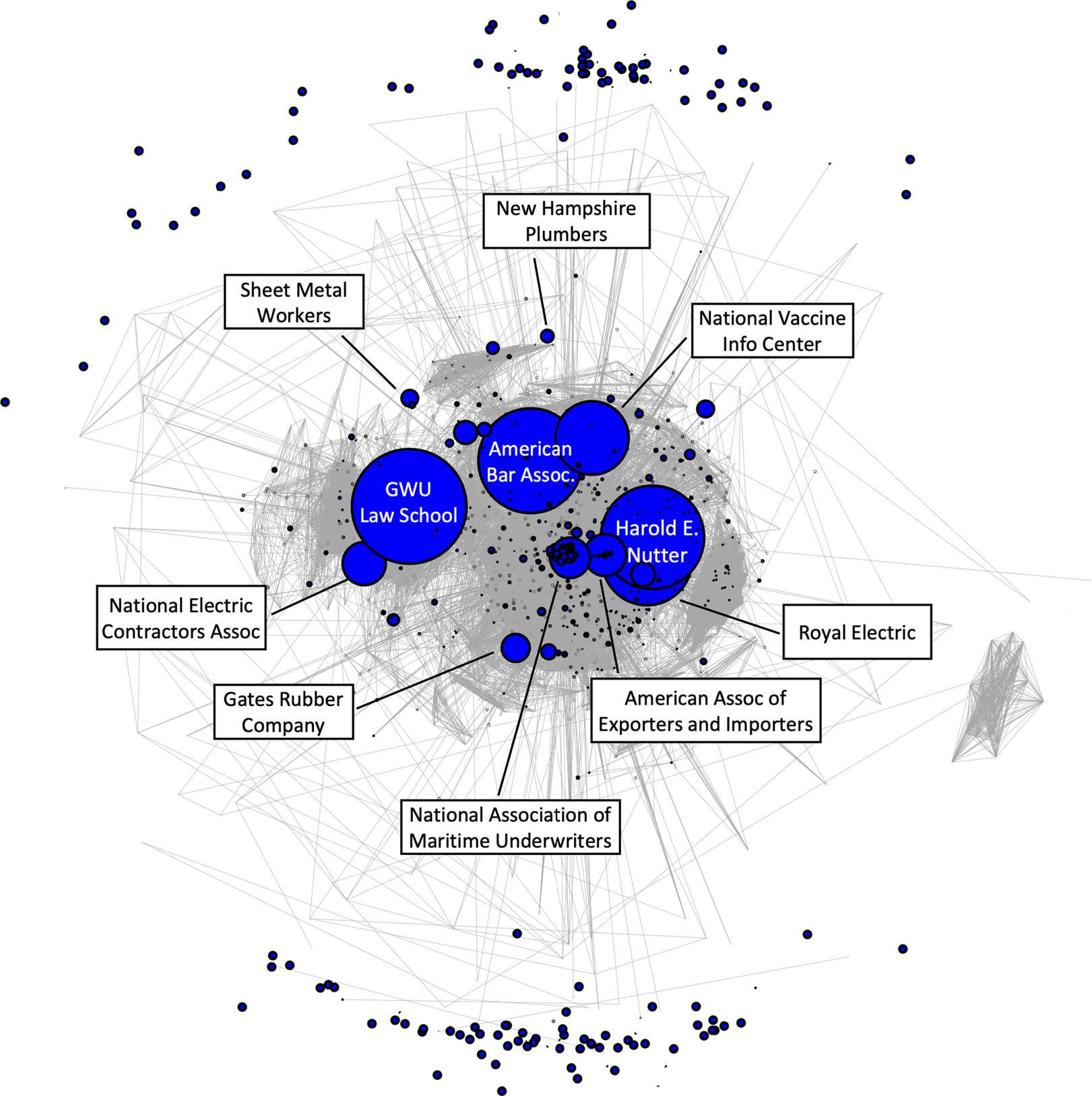
To test the influence of external actors, we include the number of amicus briefs and construct two measures of interest group composition derived from the amicus curiae network data developed by Box-Steffensmeier and Christenson (Reference Box-Steffensmeier and Christenson2016), which contains information about the amici-filing organizations, and amicus briefs filed in each case.Footnote 10 The first composition measure is a centrality score of the relative position of each interest group within the amicus curiae network. As shown in Figure 1, each group that cosigns a brief is represented with a node (blue circle) in the network. Whenever two groups cosign an amicus brief together it is represented through an edge or tie (grey line). The advantage of utilizing network statistics to create a composition measure is that we are able to capture endogenous attributes based on how interest groups interact with each other. For this we use Bonacich’s family of centrality measures $ c\left(\alpha, \beta \right) $
, given by the parameters
$ c\left(\alpha, \beta \right) $
, given by the parameters $ \alpha $
and
$ \alpha $
and $ \beta $
(Bonacich Reference Bonacich1987).
$ \beta $
(Bonacich Reference Bonacich1987).
Cosigner Network by Group Power.

The Bonacich centrality measure is generated based on the relative status of each group within the network. When $ \beta $
is positive, the measure acts as a conventional centrality measure where a group’s status increases as it is more connected to other centrally positioned groups, as in a communications network. A negative
$ \beta $
is positive, the measure acts as a conventional centrality measure where a group’s status increases as it is more connected to other centrally positioned groups, as in a communications network. A negative $ \beta $
is more adequate to measure power. Hence, the power of a unit (node) increases as its connections to a greater number of less powerful groups increases as well. Although there are no explicit differences in the status of groups as brief cosigners, the interest groups’ network has features that closely resemble a communication network, due to the resources shared when groups cosign an amicus brief. Therefore, we use a positive
$ \beta $
is more adequate to measure power. Hence, the power of a unit (node) increases as its connections to a greater number of less powerful groups increases as well. Although there are no explicit differences in the status of groups as brief cosigners, the interest groups’ network has features that closely resemble a communication network, due to the resources shared when groups cosign an amicus brief. Therefore, we use a positive $ \beta $
.
$ \beta $
.
As observed in Figure 1, the size of each node (blue) represents the relative power of each interest group within the network. At the center of the graph, we find the most central groups (larger diameter), which serve as a proxy for latent skills such as experience, greater access to resources, reputation for providing reliable of information, and a good understanding of the Court’s norms (Box-Steffensmeier, Christenson, and Hitt Reference Box-Steffensmeier, Christenson and Hitt2013). Since we are interested in measuring group characteristics at the case level, the basic measure of interest group power is calculated by taking the maximum standardized value for all organizations that cosigned an amicus brief on a case. We dichotomize the power variable using the mean of the power scores for all amici organizations on the case as a threshold. When the most powerful amici group on a case scores below the mean, the amici measure is weak and denoted with 0, and when it is above the mean it is considered powerful and denoted with 1.
The second measure captures group heterogeneity based on the Standard Industrial Classification (SIC) of each group cosigning an amicus brief. The SIC is a system used by the US government, as well as other countries, for the purpose of classifying industries into detailed four-digit codes. The digits of the SIC code provide increasing detail on the groups’ membership beginning with the division, followed by major industry. While there are many characteristics that can be used to assess the composition of interest groups at the case level (e.g., group size, age, or budget), we believe an analysis based on the SIC is a particularly meaningful measure of heterogeneity, since it captures a host of information about what each group stands for, who they represent, and how they represent them.Footnote 11
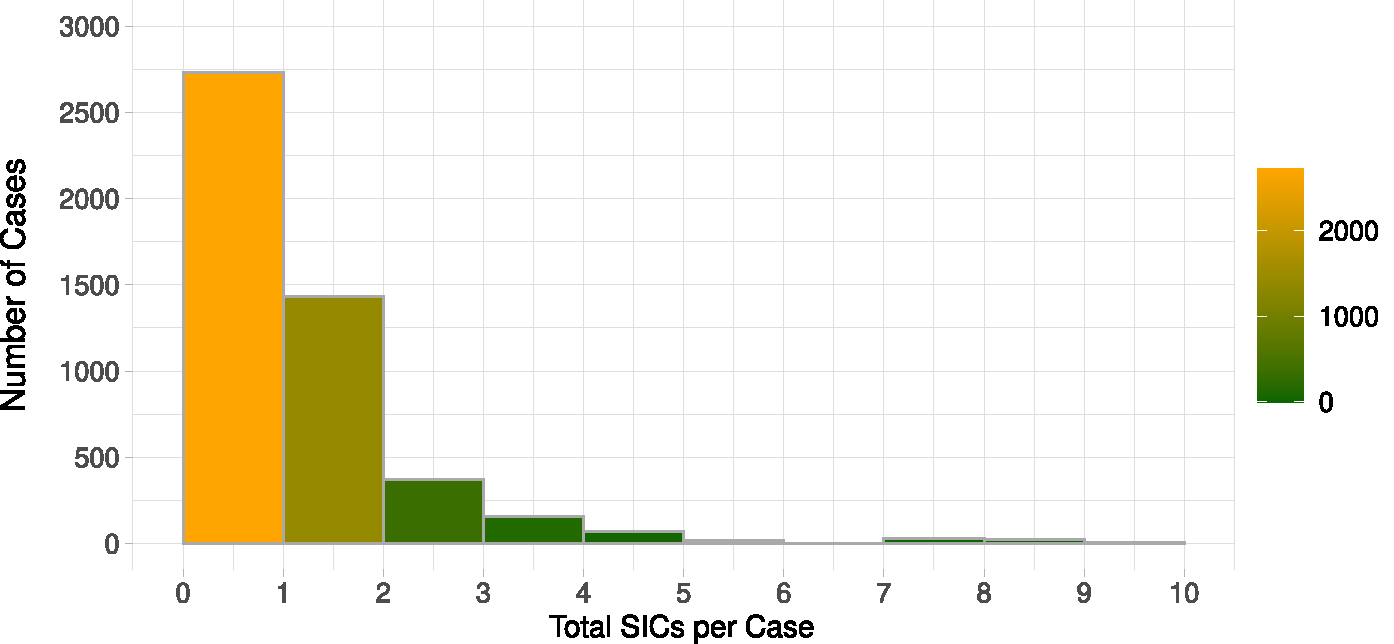
The measure is created by taking the two digit SIC for each amicus-filling organization and counting the unique number of SICs captured by all amicus cosigning organizations for each case. This level of identification ensures that we capture the overall labor division, and the major group under which each organization falls. For instance, an organization with an SIC of 33 is part of the Manufacturing division, and falls under the Primary Metal Industries group. As shown in the histogram in Figure 2, this measure contains the frequency of the unique SIC values corresponding to all the cosigners per each case, which ranges between 0 and 10.Footnote 12 The mean number of unique SICs per case is 2.27. Amici diversity is taken as an expression of the breadth of actors that support the litigants, given by two or more distinct industries represented by amicus-filling organizations. As such, we chose to dichotomize this variable by assigning cases with below the mean number of SICs as having a homogenous mix of amici, denoted as 0; and those above the mean as a diverse mix of amici organizations denoted as 1.
Histograms of Group SIC Heterogeneity by Case.

As established in Rule 10, the court also publishes the primary reason for accepting a case for review. The reason for cert variable contains three categories that group similar reasons together. This variable provides the reasons, if any, that the Court gives for granting the petition for certiorari. The reason for granting cert has been taken from the Spaeth et al. (Reference Spaeth, Epstein, Martin, Segal, Ruger and Benson2015) Supreme Court Database, where the authors used the reasons the Court gave for granting cert as outlined in Rule 10 and organized it into thirteen categories. Eight of these reasons capture some form of conflict/confusion between the different lower courts, and one category is for any cases arising from questions the Court deems of high importance or significance. The other five reasons include cases where the reason is “to resolve a question presented,” “no reason given,” “other,” or the case did not arrive through cert.
To make this classification optimal for testing, we consolidated these thirteen reasons from Spaeth et al. (Reference Spaeth, Epstein, Martin, Segal, Ruger and Benson2015) into a categorical variable with three outcomes. The base category, coded as 0, contains all cases that lack a clear reason, or those that arrived to the court through means other than cert. The remaining categories are grouped between those relating to conflict/confusion and important questions that merit the Court’s review, respectively. The category of conflict/confusion aggregates all cases granted based on confusion, conflict, or uncertainty among state and federal courts, coded as 1, and the category capturing important or significant questions is coded as 2. Categorizing the reasons for cert in this manner, allows us to separate cases in which legalistic concerns are the main drivers in the review process, versus a societal change driven by support or opposition of a large or powerful constituency. Certainly, this does not imply the absence of both in the issue presented to the Court, however, it allows us to test whether the reasoning behind the decision on cert is more or less likely to give the justices greater room to incorporate their strategic considerations.
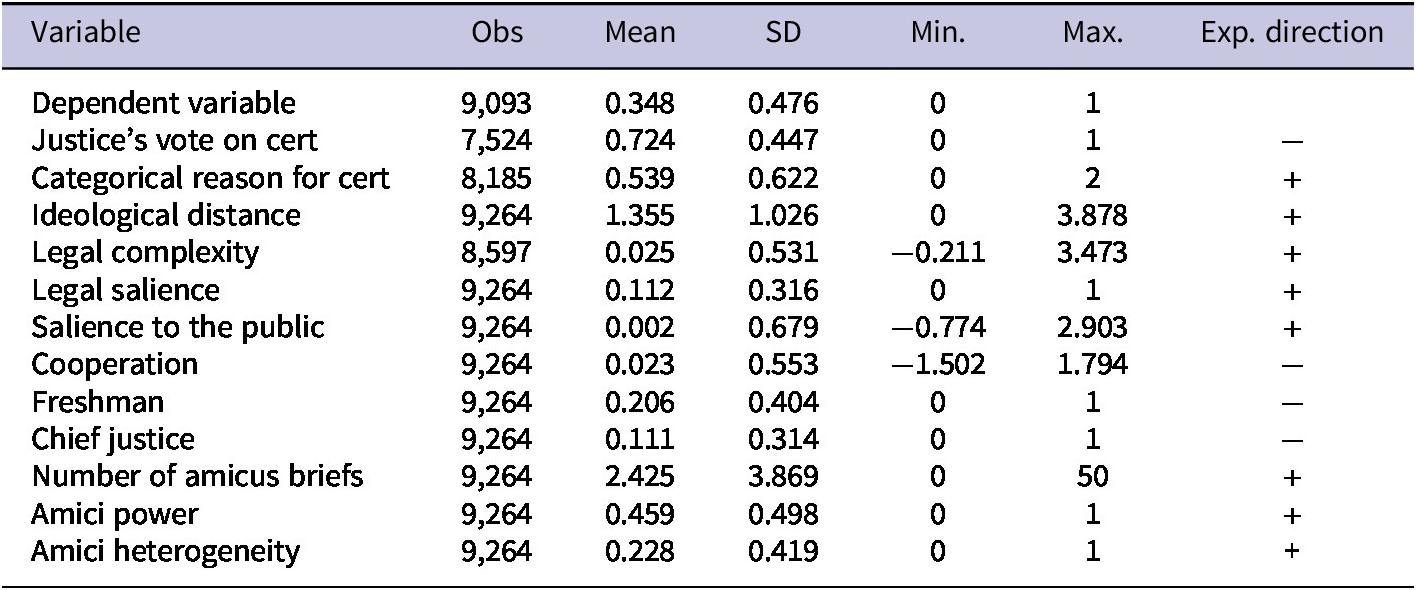
Of course, other factors may affect both the presence of amicus briefs and judicial behavior. To that end, we include a number of control variables. Table 1 lists the summary statistics for each variable as well as the expected direction of its relationship with judicial opinion writing. One of the most salient factors shaping judicial behavior is ideology (Pritchett Reference Pritchett1948; Schubert Reference Schubert1965; Segal and Spaeth Reference Segal and Spaeth2002). The ideological preferences of the majority opinion author greatly defines the content of the majority opinion. Therefore, a justice’s decision to write or join a separate opinion will depend on his/her ideological proximity to the majority opinion author. The expectation is that an increase in the ideological distance between a justice and the majority opinion author will increase the likelihood of a justice’s nonconsensual behavior. To calculate the ideological distance, we take the absolute difference between each justice’s ideology and the majority opinion author’s ideological score as provided by Martin and Quinn (Reference Martin and Quinn2002).Footnote 13 We expect positive results for this variable as greater values reflect more ideological distance between the justices.
Summary Statistics

The dependent variable is the most complete at 9,903 observations, as this is carried over from the Supreme Court Database (Spaeth et al. Reference Spaeth, Epstein, Martin, Segal, Ruger and Benson2015) The available observations drop to 9,264 for most independent and control variables due to missing values in the Salience to the Public, and Amicus Briefs variables. In addition, our dependent variable contains a substantial amount of missing values as the Blackmun papers do not record the justice’s votes for all the cases in our database. The models in the paper are based on the number of observations (6,502) available for the Justice’s Vote on Cert.
There is evidence that when a case is legally complex, it is difficult for the majority opinion to adequately address the variety of concerns presented by other justices (Wahlbeck, Spriggs, and Maltzman Reference Wahlbeck, Spriggs and Maltzman1999). For this, we derive a legal complexity measure based on a factor analysis of the number of issues raised by a case and the number of legal provisions relevant to the case, following Collins (Reference Collins2008a) and Wahlbeck, Spriggs, and Maltzman (Reference Wahlbeck, Spriggs and Maltzman1999). The expected sign of this variable is positive, making authorship of separate opinions more likely.
Nonconsensual behavior is also expected to be more likely in cases where the majority overrules a precedent or declares a law unconstitutional. Due to the rarity of the Court overruling itself (Spriggs and Hansford Reference Spriggs and Hansford2001), we expect that when the majority overrules a previous decision, this will increase the likelihood of a justice writing or joining a separate opinion to signal their dissatisfaction with a violation of this implicit norm. Moreover, the Court also rarely declares local, state, or federal laws unconstitutional, which is also expected to lead to an increase in nonconsensual behavior. For this, an indicator of legal salience is created, which consists of a binary variable scored 1 when the majority overruled precedent or declared a local, state, or federal law unconstitutional, and 0 otherwise.
In addition to case attributes and ideological concerns, there are justice-specific characteristics that influence nonconsensual behavior. Several studies demonstrate that newly appointed justices are less likely to engage in nonconsensual behavior due to acclimation issues (Hettinger, Lindquist, and Martinek Reference Hettinger, Lindquist and Martinek2003) and the undeveloped state of their policy preferences (Brenner Reference Brenner1983). We test this with a freshman variable, which is scored 1 if a justice has served for less than two full terms on the bench, and 0 otherwise. The results are expected to be negatively signed, as justices who are new to the Court will be less likely to engage in nonconsensual behavior (Collins Reference Collins2008a). Similarly consistent with the Court’s norms of consensus, chief justices are also less likely to write or join separate opinions (Wahlbeck, Spriggs, and Maltzman Reference Wahlbeck, Spriggs and Maltzman1999). The chief justice, expected to be negative, is scored 1 for Chief Justice Rehnquist, and 0 for all other justices.
Studies into judicial behavior also point to the fact that justices are “participants in a repeated game” (Murphy Reference Murphy1964, 38; Wahlbeck, Spriggs, and Maltzman Reference Wahlbeck, Spriggs and Maltzman1999, 496). As such, it is expected that past cooperation will have an effect on whether a justice decides to write a separate opinion or join other justices in nonconsensual behavior. Based on past studies (Collins Reference Collins2008a), we expect a justice to be less likely to exhibit nonconsensual behavior if he or she has cooperated with the majority opinion author in the past. A measure of cooperation is adopted by calculating the percentage of the time the majority opinion author joined a separate opinion written by another justice in a previous term (Wahlbeck, Spriggs, and Maltzman Reference Wahlbeck, Spriggs and Maltzman1999, 500). To account for ideological compatibility, the cooperation measure consists of the residuals of the percentage of times the majority opinion author joined a separate opinion regressed on the ideological distance variable. Accordingly, the expected sign of this variable is negative, indicating that a justice is less likely to engage in nonconsensual behavior if he or she has cooperated with the majority opinion author in the past.
Finally, research also indicates that justices are more likely to write separate opinions in salient cases (e.g., Wahlbeck, Spriggs, and Maltzman Reference Wahlbeck, Spriggs and Maltzman1999; Maltzman, Spriggs, and Wahlbeck Reference Maltzman, Spriggs and Wahlbeck2000; Hettinger, Lindquist, and Martinek Reference Hettinger, Lindquist and Martinek2004; Lax and Cameron Reference Lax and Cameron2007). We use the salience to the public measure, taken from Clark, Lax, and Rice (Reference Clark, Lax and Rice2015), which incorporates media coverage for a case across multiple newspapers for its entire lifecycle.
Results: Early and external factors of separate opinions
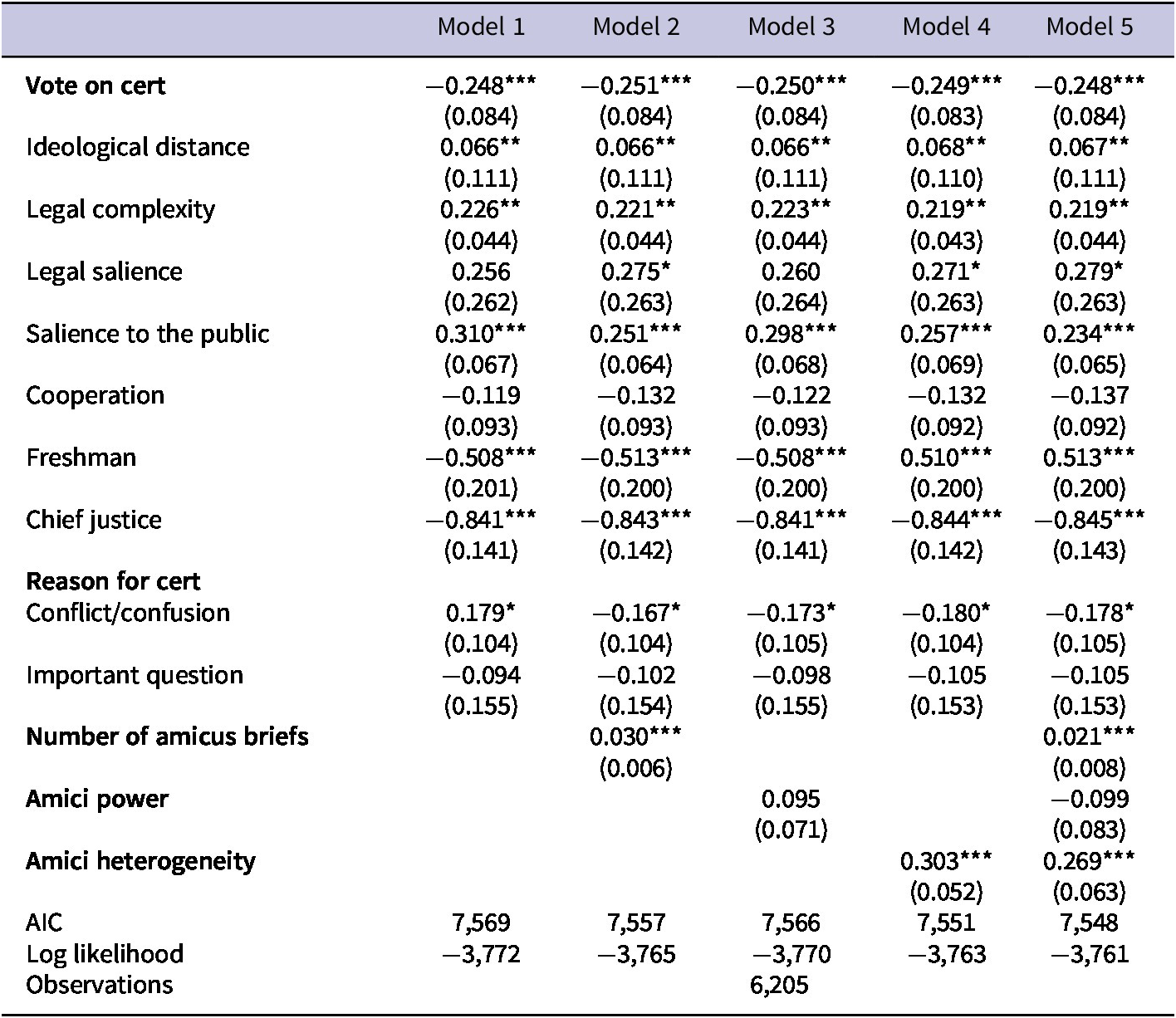
Table 2 shows the results of our analyses. We use a logit model to estimate the likelihood that a justice will author or join a separate opinion, relative to joining the majority opinion (base decision). In all the models, we use issue area and term fixed effects to account for variation in unobserved confounders over time and case topic, as well as standard errors clustered on the justice to account for shared variance. We build up our final model stepwise. Model 1 contains the terms testing the direct effect of a justice’s cert vote and the reasons for cert on the likelihood of writing/joining a separate opinion (H1). Models 2 to 4 bring in each one of the amicus curiae measures separately (H3–H5). Model 5 includes all the aforementioned variables together.Footnote 14
Logistic Regression Model for Judicial Behavior, 1986–1994 Terms

Notes: Clustered standard errors by justice in parentheses. All models have term and issue area fixed effects.
***p < 0.1; p < 0.05; ***p < 0.01
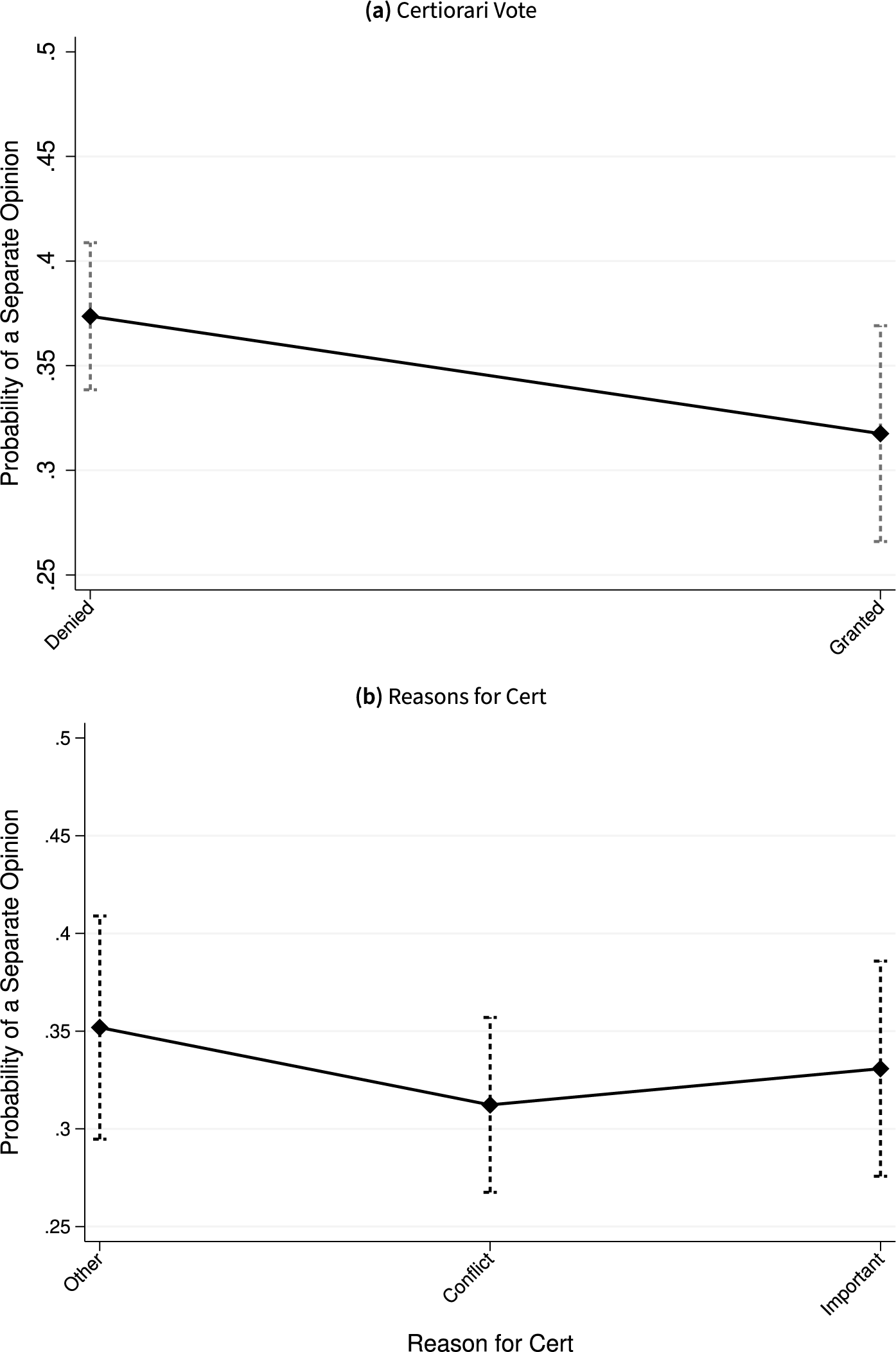
Table 2 shows a consistently negative relationship between voting to grant writ of certiorari and nonconsensual behavior for all five models. Figure 3a shows a 5% decrease in the likelihood of writing or joining a separate opinion when the justice has voted to grant cert. This is interpreted as a decrease in the likelihood of nonconsensual behavior in line with H1. In addition, the cert reasoning coefficient is negative for both Conflict/Confusion and Important Question, relative to the base category (Other), but only statistically significant for Conflict/Confusion Reason for Cert. As shown in Figure 3b, there is a 4% decrease in the likelihood of dissensus when the justice has voted to grant cert. This is partially consistent with H2, where we interpret the reason of conflict/confusion to impose jurisprudential constraints on the justices, decreasing the likelihood of nonconsensual behavior.
Effect of Cert Decisions on Nonconsensual Behavior.

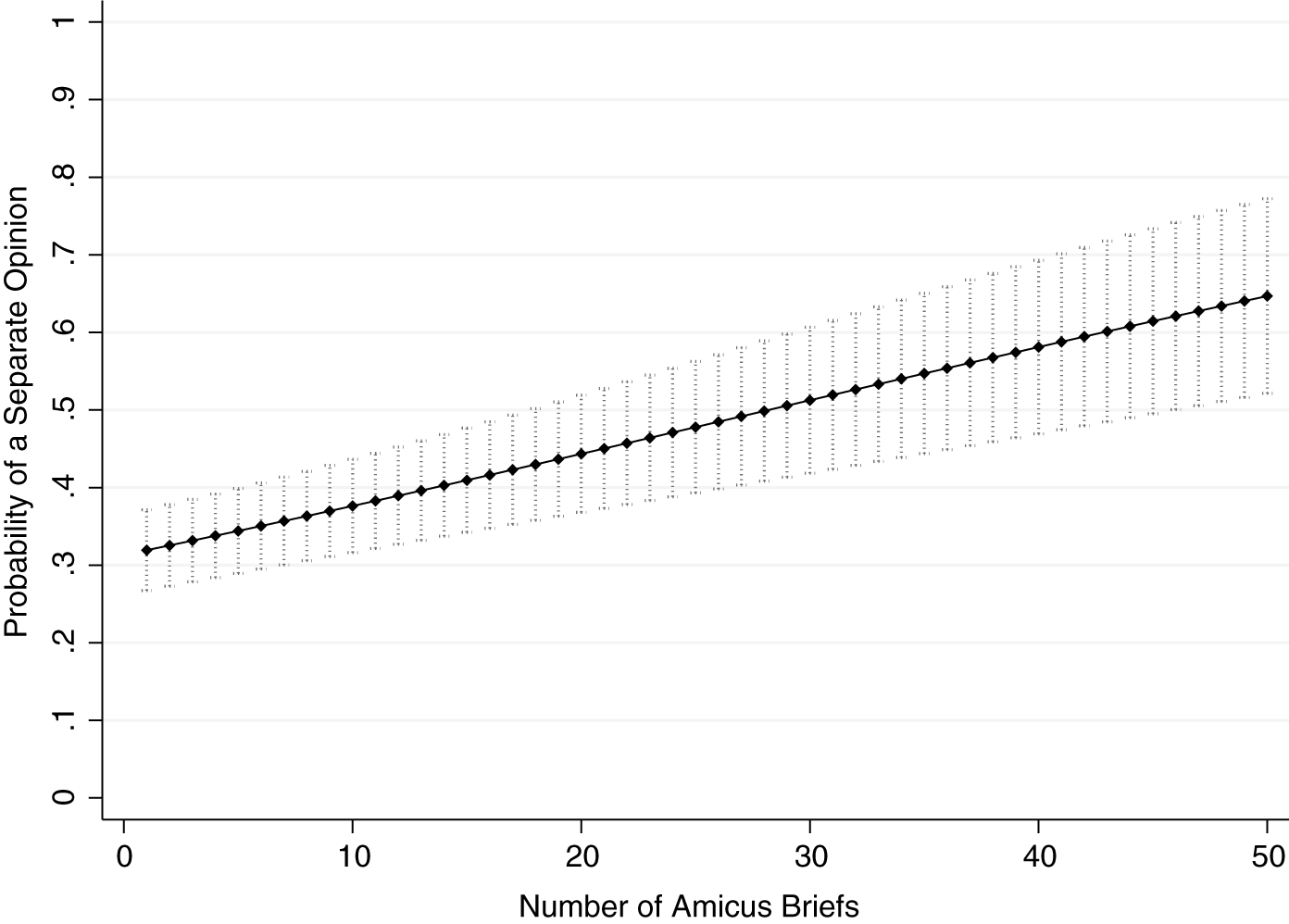
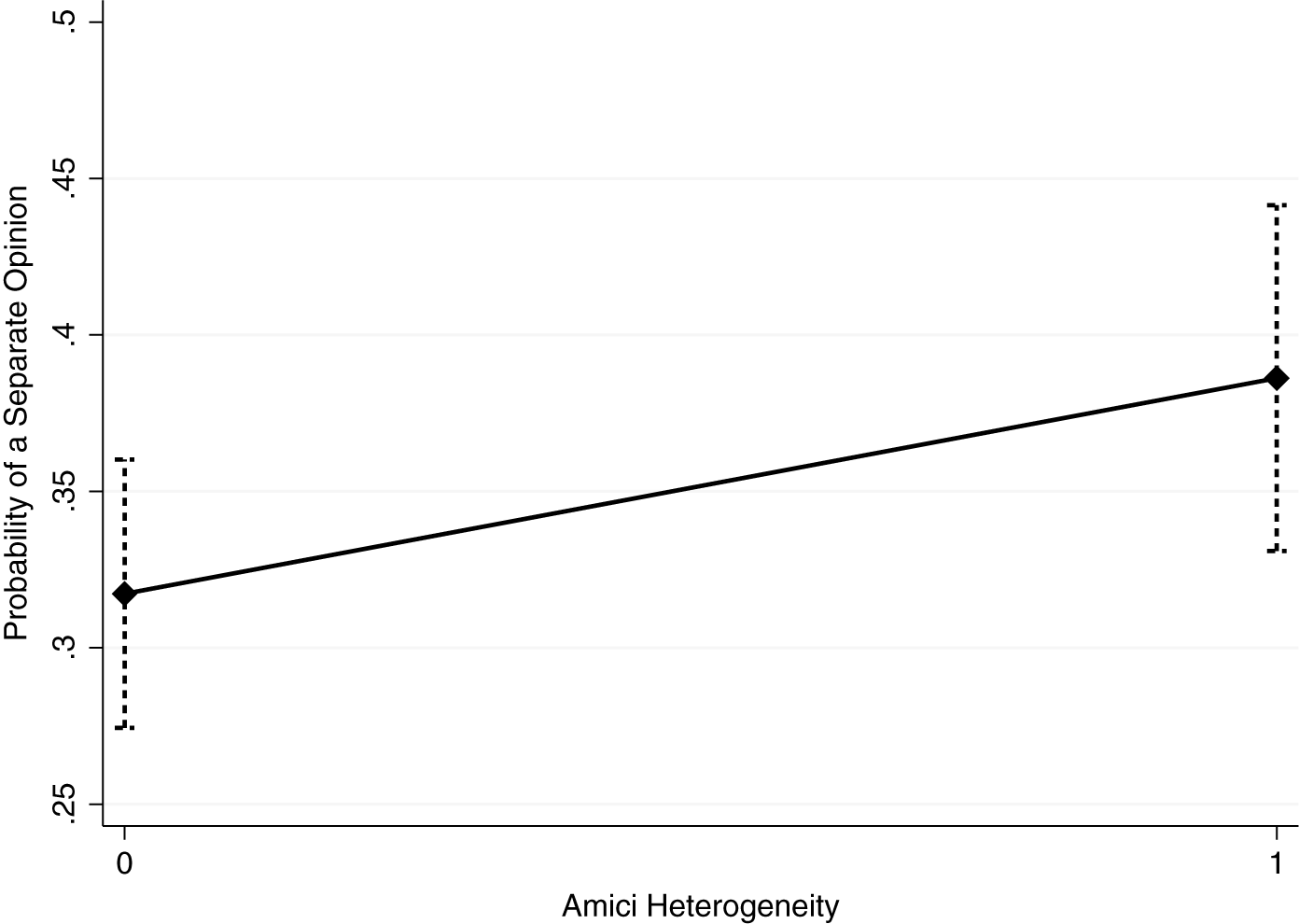
The number of amicus briefs has been shown to increase the likelihood of nonconsensual behavior (Collins Reference Collins2008a), and this holds true in our Model 2 as well. However, when we examine alternative refined measures of the impact of amici, we see that the Amici Power measure does not reach statistical significance in either Model 3 or 5. In contrast, the Amici Heterogeneity measure is statistically significant alone in Model 4 and remains statistically significant in the fully specified Model 5. The statistically significant and positive coefficient for the Number of Amicus Briefs and Amici Heterogeneity variables suggests that as the number and diversity of interests supporting the litigants increases, there is an increase in the probability of writing/joining a separate opinion.
These results point to a fundamental difference in the signals communicated by different qualities of amici coalitions. This supports our initial argument, that justices will refrain from introducing ambiguity into the outcome of the case, unless they are compelled by a significant external cue, such as the solicitor general (Bailey, Kamoie, and Maltzman Reference Bailey, Kamoie and Maltzman2005) or amicus briefs (Collins Reference Collins2008a). Moreover, not all amici signals are the same; the cues of the number of amicus briefs comes from the additional information provided by interest groups, and a diverse coalition signals the impact that the decision of the Court will have on a wider range of interests. Hence, this leads the justices to expand on their reasoning through separate opinions, be it to incorporate additional arguments not raised by the litigants, or as a way of speaking to the diverse set of interests that will be affected by the Court’s disposition and legal reasoning.
As shown in Figure 4, the number of amicus briefs increases the likelihood of a separate opinion by approximately 30%. Similarly, the effect of a heterogeneous amicus increases the likelihood of writing a separate opinion by approximately 5%, as shown in Figure 5. Considering that regular and special concurrences only depart from the majority opinion to provide additional information and expand on the logic of the majority, justices refrain from engaging in behavior that would dilute the strength and impact of the majority opinion, unless compelled by external forces. In this sense, concurrences would be written when justices find it very difficult to reconcile their arguments with the dispositional majority, and negotiate their preferred outcome into the Court’s opinion. These results suggest that when amicus briefs change the informational environment of the Court and/or diverse coalitions signal a broader impact to the Court’s decision, justices are more willing to engage in nonconsensual behavior.
Effect of Number of Amicus Briefs on Nonconsensual Behavior.

Effect of Heterogeneous Amicus on Nonconsensual Behavior.

In addition to the hypothesized covariates, the justice-related covariates are consistent with previous literature. One of the strongest predictors of judicial behavior remains the ideological standing of each justice. The ideological distance covariate, between each justice and the majority opinion writer, remains positive and statistically significant in all five models. Being chief justice, a freshman justice, or an instance of previous cooperation between justices, decreases the likelihood of engaging in nonconsensual behavior, but only the chief justice and freshman are statistically significant.
For case-related covariates, all three measures are positive and statistically significant in Model 5 and generally across all the models. The case-related variables include the legal complexity of the case, as measured by the number of legal provisions it refers to and issues it addresses; the legal salience of the case, as measured through overturning precedent and unconstitutional declarations; and salience to the public.
Conclusion: Opinions as a holistic process
There are downstream effects on the behavior of justices – voting to grant cert is not limited to setting the agenda. One of the major contributions of this paper is that the justices’ earliest decisions on a case, whether to grant it cert or not, affect their last decision on the case, whether to write a separate opinion or not. In looking at the impact of early decisions made by the Court on subsequent judicial behavior, we find that when justices have voted to grant review during the initial stage of the case, it diminishes the incentives for a justice to introduce ambiguity into the case through a separate opinion. Likewise, when a case is granted review due to conflict, confusion or uncertainty in the issue presented, it decreases the likelihood of nonconsensual behavior. This points to the fact that justices are not oblivious to the political and policy ramifications of their legal decision-making, rather, the preferences and interests of the public interact with and influence judicial behavior in multiple ways. Ultimately, this paper shows that judicial behavior at the certiorari and merit stages are not entirely independent, which provides an important contribution to our understanding of judicial behavior across all its stages.
There are other factors too, particularly external ones, working in the opposite direction of early votes in support of cert. Justices appear to be compelled by the breadth of those indirectly affected by the outcome of the case in amicus curiae briefs. When organized interests representing a wide variety of areas signal their interest to the Court, it motivates the justices to expel the effort to craft a separate opinion. When it comes to the influence of special interests, breadth matters more than simple quantity or the presence of powerful interests. When deciding a case, justices are seekers of best policy outcomes, in addition to solving disputes and providing legal interpretation. The location of the current legal status quo shapes every justice’s decisions regarding what case to accept, what disposition to take, what opinion to write, or to endorse or reject. Likewise, as policy-makers in a democracy, justices can be influenced by interest groups, which allow mobilization for representation. Indeed, the more diversity the coalition of amicus-filling interests, the more likely there will be dissensus as shown by the writing of separate opinions by the justices. Representation happens when groups participate. Nevertheless, interest groups have different rates of participation, access, and resources. Therefore, the manner in which the composition of pressure from communities influences political actors, and the justices in particular, is consequential for the equal protection of a wide range of interests, and hence achieving the democratic ideal within a pluralist society.
We believe this work also motivates a number of different areas for future research. For instance, a justice’s reasoning for granting or refusing the review of a lower court’s decision might vary greatly from one case to the next. A justice might vote to grant a case because they consider the legal question ripe for review. A justice might also be influenced by the recommendations of the Solicitor General, or the bargaining process within the court itself. Moreover, a justice might vote to refuse cert because he/she believes the question is not ripe to be considered by the court, or the opposite, because it is ripe, but they do not think they can obtain their preferred outcome on the merits. Further exploring the mechanisms connecting early decisions with a justice’s behavior on the merits is crucial to constructing a more comprehensive picture of the influence of external cues on judicial behavior.
Supplementary material
The supplementary material for this article can be found at http://doi.org/10.1017/jlc.2024.21.
Data availability statement
All replication materials are available on the Journal of Law and Courts Dataverse archive.
Acknowledgments
The authors’ names are listed alphabetically. We are grateful to Tom Clark, editor-in-chief, and the anonymous reviewers for their guidance, insightful comments and excellent suggestions. We also want to thank our colleagues Douglas Kriner and David Glick for their many insightful comments and suggestions in the early stages of this paper.
Financial support
This research was supported by grants from the National Science Foundation’s Law and Social Science Program (1124386), and the National Science Foundation’s Political Science Program (112436).
Competing interest
The authors declare no competing interests.


 Open access

