

Introduction
Universities’ commitments to inclusion, equality and diversity have become increasingly commonplace. Universities’ pursuit of inclusion has raised several issues, from bureaucratization to limited effectiveness of purposive organizational action (Baltaru Reference Baltaru2023; Ahmed Reference Ahmed2007). Recent political contestations over inclusion, equality, and diversity suggest that inclusion-oriented organizational expansion should also not be taken for granted (Schachle-Gordon et al. Reference Schachle-Gordon, Coley and Tetteh2025; Wilson Reference Wilson2018). Universities’ inclusionary commitments are editable and interruptible just as they have been diffused by societal forces at work over the last couple of decades (Kwak et al. Reference Kwak, Gabriela Gavrila, Ramirez, Christensen, Gornitzka and Ramirez2019; Baltaru Reference Baltaru2019). To anticipate whether, and in what ways, universities’ inclusionary commitments morph throughout political uncertainty, it is key that we delve deeper into universities’ display of inclusionary commitments and map the institutional contexts in which these commitments gain validation and confer legitimacy.
This study asks: to what extent are universities’ inclusionary commitments a globally diffused ‘fashion’ as opposed to being shaped by the regulatory and resource conditions specific to the national higher-education (HE) systems in which they operate? To answer this question, I draw on historical and sociological institutionalist theories which treat universities’ display of inclusionary commitments as the behaviour of culturally embedded, institutionalized actors, rather than a functional response to structural needs and competition (Bleiklie Reference Bleiklie2025; Baltaru Reference Baltaru2018). A comparative case study of universities’ inclusionary commitments in the UK and in Norway is provided. Qualitative data from the inclusion-oriented pages and inclusion-oriented strategies/action plans of two selected universities from each of the above HE systems are used to outline similarities and differences in the way in which commitments are articulated. The results are discussed in the light of local and global cultural embedment, with empirical evidence informing further research into the transformation of inclusionary commitments as society and politics change.
Inclusionary Commitments and the Environments of Universities
Inclusionary commitments are not made in isolation from the institutionalized environments that universities inhabit. In setting their goals and courses of action, universities follow expectations about how they should act and what they should be committing to. The sociological institutionalist perspective highlights the global cultural emphases on individual empowerment, as a normative direction, and the spread of formal organization, as a model of institutional identity and purpose (Meyer and Rowan Reference Meyer and Rowan1977; Meyer and Jepperson Reference Meyer and Jepperson2000; see also DiMaggio and Powell Reference DiMaggio and Powell1983). Empirical studies in Europe and the US have documented the transformation of universities, from institutions with taken for granted identity and purpose, into ‘organizational actors’, i.e. strategic, goal-oriented entities that can be held responsible for their actions (Krücken and Meier Reference Krücken, Meier, Drori, Meyer and Hwang2006; Krücken Reference Krücken2011; Baltaru Reference Baltaru2018; Ramirez and Christensen Reference Ramirez and Christensen2013). Within this context, inclusionary commitments do not only reflect culturally desirable goals in terms of democratization and individual empowerment, but they also enable universities to articulate organizational actorhood (Baltaru Reference Baltaru2026; Kwak et al. Reference Kwak, Gabriela Gavrila, Ramirez, Christensen, Gornitzka and Ramirez2019).
It is equally important not to lose sight of institutional relationships and values ingrained at the (HE) system level, as cultural heritage can play a role in whether and how an institution reforms (Brunsson and Olsen Reference Brunsson and Olsen1993). National circumstances could matter in how inclusionary commitments are made by universities. The very agentification of universities in the pursuit of inclusion, whereby inclusion is seen as the prerogative of the university rather than the state, can come at odds with established practices in welfare systems (Baltaru Reference Baltaru2020). Where there is a tradition of governmental regulation and state subsidy, there may be limits to the strengthening of universities’ managerial backbone, more so than in deregulated HE systems. The historical institutionalist perspective draws attention to ‘path dependencies’ and ‘social learning’ that institutions undergo in changing socio-economic and political environments, thus one should be careful not to overestimate the autonomy of institutions in determining their own trajectories (Pierson Reference Pierson2000; Thelen Reference Thelen1999; Hall Reference Hall1993). In addition to the global pressures of formal organization, universities absorb routines and values historically cultivated in their national HE systems (Bleiklie et al. Reference Bleiklie, Enders and Lepori2015; Bleiklie Reference Bleiklie2025).
Such a temporal lens has been crucial to the development of both the historical and sociological institutionalist perspective, and new institutionalist insights have been increasingly employed in cross-sectional empirical research and case studies that situate their object of analysis against the backdrop of historical developments in governance, culture and organization (Soysal and Baltaru Reference Soysal and Baltaru2021; Ramirez and Christensen Reference Ramirez and Christensen2013). Following this research avenue, the current study will use secondary literature on the development of each selected HE system to lay the basis for interpreting universities’ inclusionary commitments as they present themselves in the mid-2020s.
Selection of Case Studies and Method
The United Kingdom and Norway provide a good comparison for this investigation. Despite notable differences in how HE institutions have been governed in these two countries, and notwithstanding their embedment into the global HE field, inclusionary commitments are displayed by both Norwegian and UK universities. Environmental embedment of inclusionary commitments will be explored in two stages: (a) through secondary analysis of existing literature and official documents, which will be used to outline similarities and differences between two HE systems; (b) through analysis of textual data collected from the official, public facing, inclusion-oriented webpages of two university cases (one English university and one Norwegian university), which are otherwise comparable in terms of foundation era and research orientation.
The HE systems of Norway and the UK exhibit substantial differences in the funding and governance of universities. This means that the imprint of regulatory traditions on universities’ inclusionary commitments, expected according to the historical institutionalists, is plausible (Collier and Collier Reference Collier and Collier1991). Both institutions have been active since the mid-twentieth century. In this period, the idea of universities as drivers of individual empowerment and socio-economic development has been institutionalized around the world (Schofer and Meyer Reference Schofer and Meyer2005) shaping the HE field internationally (Soysal and Baltaru Reference Soysal and Baltaru2021). Therefore, it is also possible that inclusionary commitments reflect globally diffused trends in the perceived value of universities, as argued by the sociological institutionalists.
United Kingdom
According to Universities UK and based on data returns to the UK’s Higher Education Statistics Agency, in 2022/23 there were 260 HE providers (UUK 2025) and approximatively 2.94 million students, with international students accounting for about 23% of the student body.Footnote a UK universities are a frontrunner when it comes to the display of inclusionary commitments. As of 2018, a web census investigating the official websites of over 100 UK universities found that virtually all universities under investigation had an inclusion-oriented webpage, and almost 40% established an inclusion-oriented office or team (Baltaru Reference Baltaru2020). While commitments to inclusion are framed in a voluntaristic fashion, i.e. as part of a university’s own ambitions, the UK universities do not act in isolation. In my most recent research I have shown that they operate in a fully-fledged inclusion-oriented organizational field structured around governmental equality directives and a range of inclusion-oriented third-party organizations, charities, companies and trusts (Baltaru Reference Baltaru2026). A notable example has been the UK’s Equality Challenge Unit (ECU) (currently a part of Advance HE); founded in 2001, this charity promoted equality and diversity in universities through sector-wide initiatives such as the ongoing Athena Swan Gender Equality Charter and the Race Equality Charter (Advance HE Reference Advance2018).
The development of an inclusion-oriented organizational field must be seen against the backdrop of recent historical developments where the sector underwent major changes. The so-called ‘golden age’ of UK universities is often traced to the 1960s, when the cost for higher education was mostly covered by the government. Following the Education Act of 1962 (Education Act 1962), local authorities were mandated to cover tuition fees, while the University Grants Committee (1919–1989) advised on the allocation of research grants (Anderson Reference Anderson2016). The university sector was substantially expanded upon granting university status to the colleges of advanced technology following the Robbins Report of 1963 (The Robbins Report 1963). Through regulation and subsidy, the state took an active role in widening the pool of highly skilled employees and shaping its citizenry, and it brought together fragmented universities and colleges into a nationally useful ‘sector’ of activity. However, since the 1980s, the UK university sector underwent re-regulation towards deregulation as part of the New Public Management reforms. Organizational autonomy was prioritized, such that universities could diversify their funding and manage themselves (Jarratt Report 1985), and tuition fees for all students were introduced (Dearing Report 1997; Teaching and HE Act 1998).
After the gradual lifting of the cap on tuition fees, substantially so following the Browne Review (Browne Reference Browne2010), as of 2022/23 tuition fees and education contracts account for over 60% of the sector’s income (UUK 2025). Concomitantly, universities have been subject to newer equality directives from the state. The equality legislation of the early 2000s was most consequential, as it imposed ‘equality duties’ on public institutions, i.e., the Disability Equality Duty, the Race Equality Duty, the Gender Equality Duty, later combined into a generalized duty (Equality Act 2010). Universities started being expected to take a proactive approach towards tackling discrimination and fostering diversity, through so-called ‘positive actions’ at the institutional level. A fertile ground for diversity management emerged, with inclusion-oriented offices, networks, pledges, strategic reports and awards becoming commonplace (Saloniki et al. Reference Saloniki, Halvorsrud, Whelan, Halim, George and Orkin2024). However, inclusionary commitments and actions at the institutional level had limited impact on their targeted demographics (Nwosu Reference Nwosu2024; Baltaru Reference Baltaru2023; Gregory-Smith Reference Gregory-Smith2017) and have been criticized for making it possible for universities to empower historically underrepresented groups in superficial or moderate ways (Tzanakou and Pearce Reference Tzanakou and Pearce2019; Ahmed Reference Ahmed2007).
The expectation that universities should tackle discrimination, combined with the relaxation of governmental regulation on tuition fees, has virtually shifted responsibility for inclusion from the government to universities. This has paved the way for a new paradigm of agentic inclusion in higher education, whereby universities were gradually turned into ‘agents’ of inclusion (Baltaru Reference Baltaru2020, Reference Baltaru2026). Those universities who charged higher fees were asked to outline plans for widening participation, called ‘access agreements’ (OFFA 2004). Universities also started joining the sector-level equality charters steered by the Equality Challenge Unit. Inclusion become embedded into their managerial backbone.
In sum, the UK’s HE sector has been expanded and organized as a nationally useful sector for socio-economic development; universities underwent deregulation and financial diversification; the HE sector heavily relies on tuition fees and has successfully marketed itself internationally; universities are subject to equality legislation; statutory ‘equality duties’ on public institutions and (voluntary) participation in sector-wide equality charters have strengthened inclusion organization in universities.
Norway
Currently, Norway has 11 universities, four university colleges and six scientific colleges owned by the Ministry of Education and Research, but the total number of HE institutions (HEIs) more than doubles if we consider private HEIs, many of which receive some financial support from the government (Ministry of Education and Research 2025a; Eurydice 2023). As of 2024, there were 314,277 students in HE in Norway (Statistisk sentralbyrå 2025).Footnote b Norwegian universities make commitments to inclusion, just like their UK counterparts. On the official websites of Norway’s two oldest universities, we can see that, as in the case of the UK universities, inclusionary commitments are displayed publicly in designated, inclusion-oriented webpages (UiO 2025; UiB 2025), the same being observed in institutions that only recently gained university status (OsloMet 2025). Norway does not have an inclusion-oriented agency to oversee and promote universities’ inclusionary commitments that is comparable, in reach, legal status, and length of activity, to the UK’s Equality Challenge Unit/Advance HE. A historical concern with women’s rights and national policy instruments can, however, be noted.
In Norway, campaigning for equal representation of women in public life has been characterized by remarkable engagement with state institutions; working through political channels, feminist causes would go beyond the realm of the civic society and become embedded into public policy (Hernes Reference Hernes1987; see also Sass Reference Sass2024). Not surprisingly, gender equality is a core component of inclusion organization up to the present day. Taking a new mandate in 2022, the Committee for Gender Balance and Diversity in Research (KIF) was appointed by the Ministry of Education and Research to support equality efforts across the sector with respect to gender equality, and it gradually expanded to issues such as ethnic diversity (Kilden 2024; KIF 2026). Just as in UK universities, Norwegian universities and university colleges are expected to make systematic efforts to foster diversity in line with equality legislation, i.e. the Equality and Anti-Discrimination Act of 2018 (Equality and Anti-Discrimination Act 2018), with the Equality and Anti-Discrimination Ombud promoting equality and providing guidance (Ministry of Culture and Equality 2025). The act places an ‘activity duty’ on all public institutions to promote equality and tackle discrimination, and it is cross-referenced with an emphasis on ‘gender equality’ in ‘Section 7-1’ of the Universities and University Colleges Act (2025), specifically concerning ‘Appointments’ (Ministry of Culture and Equality 2025).
Many of these policy instruments are of utmost importance for equality and diversity across staff, first, because of the role of equality legislation in governing employment relations, and second, because research activities have become increasingly internationalized and attuned to the inclusionary commitments of funders. For example, Universities Norway (‘Universitets og høgskolerådet’, UHR), the umbrella organization representing Norwegian universities and university colleges, has been committing to engage with the inclusion, equality and diversity policy actions of the European Research Area (UHR 2025). The Gender Equality Plan Requirement (GEP) introduced by the Research Council of Norway (RCN) for applications made in 2022 and later (RCN 2021) is linked with the requirements of the European Commission for Horizon Europe funding calls (RCN 2019).
Highly relevant for the pursuit of inclusion among students is that, in Norway, the government secures over 90% of the sector’s finances (OECD 2024). The strong state subsidization of HE in Norway is part of the so-called Mass Public Model, also present in other Scandinavian countries such as Sweden and Denmark (Ansell Reference Ansell2010). While high enrolment rates and high public spending are quoted features of this model, significant widening in access to HE after the Second World War has been noted all around the world (Schofer and Meyer Reference Schofer and Meyer2005). Perhaps more specific to the Nordic countries is the idea that an egalitarian society is desirable and possible through national educational policy (Frønes et al. Reference Frønes, Pettersen, Radišic and Buchholtz2020). In Norway, the realization of HE as a nationally useful sector of activity followed a tradition of social democracy, the Social Democratic Party being the largest party in parliament from the 1927 election and up until the early 2000s (Bleiklie and Michelsen Reference Bleiklie and Michelsen2019).
Just as in the UK, in the mid-twentieth century the utility of HE as an engine of socio-economic growth was highlighted, and HE expanded after the 1960s. This expansion was underpinned by the emergence of new universities, under the authority of the Ministry of Education, and by the fragmented body of teaching institutions and district colleges being included within the HE system, managed initially by county-level regional boards (Bleiklie Reference Bleiklie2025). Equality concerns in the Nordic countries also revolved around regional differences in access to education and the distribution of skills in the population (Blossing et al. Reference Blossing, Imsen, Moos, Blossing, Imsen and Moos2014; Buchholtz et al. Reference Buchholtz, Stuart, Frønes, Frønes, Pettersen, Radišic and Buchholtz2020). For example, in Norway the expansion of the college sector and of vocational education in the 1970s/1980s was supposed to make HE more accessible at the regional level (Bleiklie et al. Reference Bleiklie, Høstaker and Vabø2000).
While the Norwegian HE system has been characterized by concerns surrounding the distribution of HE across the nation and did not follow market principles to the same extent as the UK HE system, Norwegian universities have been integrated nationally and internationally (Bleiklie Reference Bleiklie2025). They are pressed to standardize (consider the Bologna process introduced by the Quality Reform of 2003), compete for research funding (consider Horizon Europe), and to figure in international rankings. Additionally, the various HE quality reforms since the 1980s have introduced an emphasis on organization and leadership, and universities are formally managed by objectives (Bleiklie et al. Reference Bleiklie, Høstaker and Vabø2000).
In sum, the Norwegian HE sector has been expanded and organized as a nationally useful sector for socio-economic development, balancing equalitarian concerns and regional needs; universities are largely subsidized by the state and access to HE is traditionally free;Footnote c quality reforms have been concerned with national and international integration; universities are subject to national equality legislation and have an ‘activity duty’ to promote equality; ‘gender equality’ is a category emphasized both in national HE policy and among the requirements of the European Research Area.
Expectations Informed by the National HE Contexts
As we move forward to exploring how inclusionary commitments are articulated by universities in Norway and in the UK, few research expectations can be outlined. Similarities between the Norwegian and the UK HE systems indicate institutionalization within the global HE field. First, in both countries, the purpose of HE has been linked to socio-economic development; the HE sectors expanded and tailored educational provision to the perceived needs of the nation. Second, over the last four decades universities in both systems have been expected to strengthen their leadership and manage by objectives. To the extent to which inclusion is a desirable societal goal and formal organization is valorized in universities, inclusion organization purveys universities with legitimacy beyond national borders. It is possible that UK and Norwegian universities articulate inclusionary commitments in similar ways.
It is also possible that UK universities, which have been re-organized along market lines and faced remarkable pressures to show that they remained equitable, highlight their agency in the display of inclusionary commitments more so than the Norwegian universities. For example, UK universities might frame inclusion as part of university’s own mission and have multilayered managerial structures to cater for it. Norwegian universities may instead prioritize governmental directives in their display of inclusionary commitments and have less elaborated inclusion-oriented organizational structures. This is because, in Norway, the principle of equality in HE has been a historical prerogative of the government, i.e. top-down inclusionary policy may replace the need for elaborated university-level actions to achieve demographic diversification. For example, in Norway, access to HE has been secured through public subsidy and attempts to (de)centralize HE provision to mainstream quality higher education across the population, while in the UK universities were required to develop plans and actions (the so-called ‘Access Agreements’) in order to show how they widened participation despite charging higher tuition fees (OFFA 2004).
The Display of Inclusion Organization at an English and at a Norwegian University
As both the UK and the Norwegian HE systems are stratified, it is important to ensure that the selected university cases are comparable. Institutional differences that are reflective of other factors than the influence of the national HE sector should be minimized. One public university has been selected from each HE system: from Norway (pseudonym: Uni-NO) and from England, UK (pseudonym: Uni-UK).Footnote d, Footnote e Uni-UK and Uni-NO are research universities, founded in the mid-twentieth century, a period where the HE system was expanded to cater for a growing segment of the population. None of the universities has college roots. While state colleges underwent academic drift and contributed to the expansion of the HE in both countries, their institutional imprint in terms of professional rather than generalist education would be a confounding factor in the comparative research design.
Data collection started with identifying the main inclusion-oriented webpages on the official websites of the two universities. An inclusion-oriented webpage is a virtual space where the university articulates commitments to inclusion, equality and diversity in scripted form. When researching how organizations present themselves in institutionalized environments, we are precisely interested in that which is publicly and openly displayed. This approach has also been used to map the cultural scripts underpinning university self-presentation worldwide (Christensen et al. Reference Christensen, Gornitzka and Ramirez2019).
While the presence of an inclusion-oriented webpage is in itself a statement of commitment to inclusion, the display of inclusionary commitments can take many forms. Throughout the collection and analysis of inclusion-oriented webpages attention was paid to: (a) whether an opening, inclusion-oriented statement is present, and the highlighted inclusion-oriented activities and practices; (b) documents outlining university’s inclusion-oriented policy/action plan; and (c) information about dedicated inclusion, equality and diversity organizational sub-divisions and personnel.Footnote f
In the case of Uni-UK, the inclusion-oriented webpage was identified under the ‘About’ sub-heading and named ‘Equality, diversity and inclusion’. In the case of Uni-NO, the inclusion-oriented webpage was identified under the ‘For employees’ sub-heading and named ‘Gender, equality and diversity’. Upon contacting the professional services of Uni-NO, confirmation was received that the identified webpage was indeed the main inclusion-oriented webpage of the university, even if it was located under the staff pages. The page is, however, accessible to any member of the public, not just to employees.
Findings and Discussion
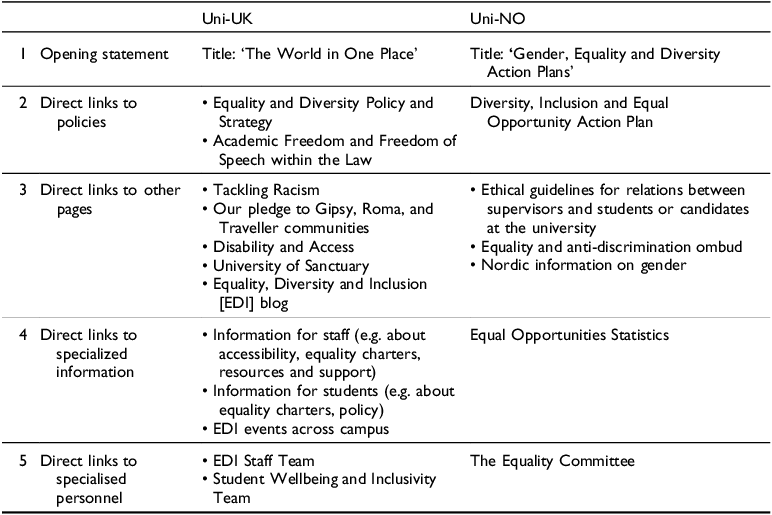
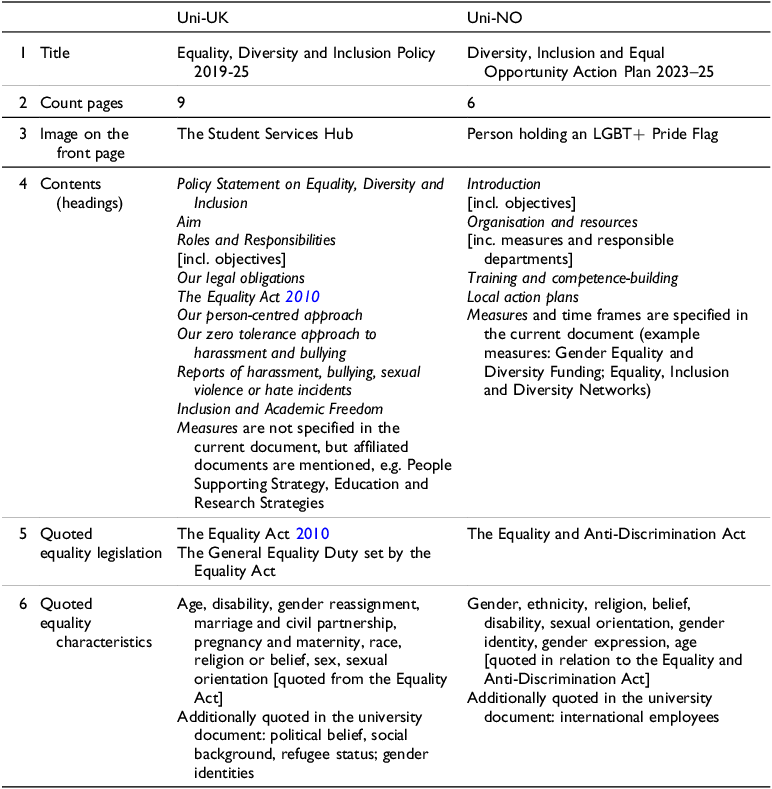
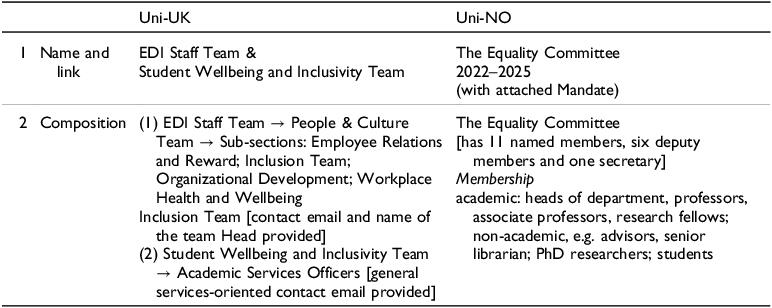
Table 1 summarizes the information available on the inclusion-oriented webpages of the English and Norwegian universities. Table 2 summarizes the information displayed on the main inclusion-oriented policy documents linked to the webpages. Table 3 summarizes displayed information about the inclusion-oriented personnel of the university.
Summary of displayed inclusion-oriented webpages in the UK university case (Uni-UK) and the Norwegian university case (Uni-NO) as of 2025

Note: Webpages accessed 12 June 2025.
Summary of displayed inclusion-oriented policy documents in the UK university case (Uni-UK) and the Norwegian university case (Uni-NO) as of 2025

Notes: Uni-UK: document review date (September 2025); Uni-No: page date (19 February 2024).
Summary of displayed inclusion-oriented personnel structures in the UK university case (Uni-UK) and the Norwegian university case (Uni-NO) as of 2025

Note: Uni-NO committee composition updated as of 11 February 2025.
Similarities in the Pursuit of Inclusion: Organizational Actorhood and Regulation
Formally articulated statements of commitment are present both in the inclusion-oriented webpages of Uni-UK and Uni-NO (Table 1, Row 1). Scripted plans of action towards achieving inclusion have been developed by both universities (Table 1, Row 2). The actions outlined in universities’ inclusion-oriented plans (Uni-UK’s policy; Uni-NO’s action plan) follow instrumental templates that articulate desired ends (e.g. ‘objectives’) and accountability structures (e.g., responsibility layers) (Table 2, Row 4). Both Uni-UK and Uni-NO assign personnel to the university’s pursuit of inclusion: the Equality, Diversity and Inclusion (EDI) Staff Team and the Student Wellbeing and Inclusivity Team in the case of Uni-UK, and the Equality Committee in the case of Uni-NO (Table 3, Row 1).
References to equality legislation are displayed by both Uni-UK and Uni-NO in their inclusion-oriented documents (Table 2, Row 5). In both cases, universities quote various characteristics subject to inclusion such as gender, ethnicity and sexual orientation, but not socio-economic disadvantage (Table 2, Row 6).Footnote g Many of these characteristics are supplied by equality legislation, which is referenced by Uni-UK (specifically, The Equality Act) as well as by Uni-NO (specifically, the Equality and Anti-Discrimination Act) (Table 2, Row 5). While the characteristic ‘gender’ is present in both cases, in the case of Uni-NO it is highlighted in the title of the opening statement (Table 1, Column 2, Row 1).Footnote h
Heightened Organizational Embedment and Student Orientation in the Case of Uni-UK
Inclusion-oriented structures are more organizationally embedded in Uni-UK than in Uni-NO, i.e. they are strongly linked to other internal and sector-level organizational structures and display a higher degree of formal elaboration.
In the case of Uni-UK, the link to the university’s Equality and Diversity Policy is followed by a link to information about Academic Freedom and Freedom of Speech within the Law (Table 1, Row 2, Column 1), and information is explicitly tailored to students and to staff (Table 1, Row 4, Column 1). Uni-UK displays an elaborate organizational toolkit when it comes to inclusion, e.g. ‘sanctuary initiatives’, ‘blogs’, ‘events’ (Table 1, Rows 3/4, Column 1). Uni-NO provides what could be interpreted as rudimentary and locally relevant provisions, e.g. guidelines for ethical student–staff relations, ombud and regional ‘Nordic’ information tabs (Table 1, Row 3, Column 2). Similarly, external organizational embedment is flagged to a higher extent in the case of Uni-UK than in the case of Uni-NO. While both Uni-UK and Uni-NO refer to equality legislation, Uni-UK also refers to sector-level inclusion-oriented initiatives such as equality charters (Table 1, Row 4, Column 1).
One may also note that, in the case of Uni-UK, the organizational structures consistently flag a consideration of students in addition to staff. Further to the ‘EDI Staff Team’ there is the ‘Student Wellbeing and Inclusivity Team’ (Table 3, Row 2, Column 1). Unlike Uni-NO, the inclusion-oriented webpages and policy of Uni-UK frequently address students, e.g. tailored information for students is available early on the inclusion-oriented page (Table 1, Row 4, Column 1), and the Student Services Hub [building] is displayed on the first page of the inclusion-oriented policy document (Table 2, Row 3, Column 1).
High-visibility Measures and Regional Focus in the Case of Uni-NO
Only in the case of Uni-NO are inclusionary ‘measures’ clearly outlined in the action plan. The policy document of Uni-UK contains references to other strategic documents (e.g. the ‘People Supporting’/‘Education’/‘Research’ strategies), making it possible that concrete measures are highlighted elsewhere. Upon exploring these documents, I found that the ways of achieving inclusion displayed by Uni-UK were articulated in broader terms compared with those displayed by Uni-NO. For example, in its Education Strategy, Uni-UK specifies in a somewhat circular fashion that ‘the inclusive community of educators’ will be enabled ‘by delivering equality’. Meanwhile, in the case of Uni-NO, an inclusion-oriented measure is designated to Gender, Equality and Diversity (Annual) Funding (Table 2, Row 4, Column 2).Footnote i
When searching for the composition of the inclusion-oriented team in the case of Uni-UK, the public user unfolds several organizational layers, i.e. the ‘EDI Staff Team’ and the ‘Student Wellbeing and Inclusivity Team’’, with the first team being linked to the ‘People & Culture Team’ (which displays the ‘Inclusion Team’ among a few other sub-teams) (Table 3, Row 2, Column 1). Accessing ‘The Equality Committee’ tab in Uni-NO directly opens the list of committee members and displays their mandate (Table 3, Rows 1/2, Column 1). In the case of Uni-UK, one general services-oriented contact email is provided under the ‘Student Wellbeing and Inclusivity Team’, and one contact person is provided for the ‘Inclusion Team’, specifically the Head of the team (Table 3, Row 2, Column 1). Here, the teams appear to comprise mostly administrative (professional services) staff, while in the case of Uni-NO the committee includes academics, administrators and students.
Another aspect that stands out in the case of Uni-NO is the consideration of international staff as a matter of inclusion (Table 2, Row 6, Column 2), since the action plan mentions measures supporting employees to achieve proficiency in the Norwegian language. The (inter)national/regional theme also appears in other parts of the inclusion-oriented webpage, for example when a reference is being made to the ‘Nordic information on gender’ (NIKK) (Table 1, Row 3, Column 2), i.e. a cooperation body under the Nordic Council of Ministers, which aims to bring a Nordic, cross-sectoral perspective on the field (NIKK 2025).
The Organizational Display of Inclusion: National Pathways or Cultural Isomorphism?
With English and Norwegian universities dealing with distinct regulatory and resource conditions, similarities in how Uni-UK and Uni-NO display inclusionary commitments may point towards ‘collective sources’ of influence that go beyond structural differences. Earlier in this article, I considered the cultural explanation proposed by sociology’s new institutionalism. According to this perspective, institutional actors get to be more like each other as they become attuned to the cultural ideologies of rationalization and individual empowerment (Frank et al. Reference Frank, Meyer and Miyahara1995). Rationalization translates into an exacerbated display of organizational actorhood, i.e. universities present themselves as proactive, goal-oriented and accountable for their actions (Krücken Reference Krücken2011), while the ideology of individual empowerment underpins inclusion as a socially desirable goal (Baltaru Reference Baltaru2019; Kwak et al. Reference Kwak, Gabriela Gavrila, Ramirez, Christensen, Gornitzka and Ramirez2019). The identified similarities in the display of inclusionary commitments in the selected Norwegian and English university in terms of the presence of formally articulated statements, policies, plans and designated personnel illustrate the diffusion of organizational actorhood beyond national borders.
As expected in institutionalist organizational theory, the state itself is a key rationalizer (DiMaggio and Powell Reference DiMaggio and Powell1983), and when it comes to inclusion its influence is manifested through equality legislation (Baltaru Reference Baltaru2026). The responsiveness of Uni-No and Uni-UK to equality legislation can be seen as a case of legal rationalization of universities (Futura and Ramirez Reference Furuta, Ramirez, Christensen, Gornitzka and Ramirez2019). Both in Norway and in the UK, equality legislation supplies universities and other public institutions with standardized frameworks for defining discrimination and vulnerable groups and propels expectations of proactiveness on institutions. While regulation is often cited in institutionalist studies as a source of structural differentiation between HE systems, the similarities that we see when it comes to specific regulatory developments (equality legislation included) beg a thorough consideration of supranational environments in shaping regulation. It is remarkable that the definition of vulnerable groups both in Norway and in the UK considers identity-based descriptors, such as gender, ethnicity, sexual orientation, age, disability and so on, that are distinct from socio-economic inequalities. Fraser’s observation that ‘recognitional’ inequalities dominate the current inclusion paradigm as opposed to ‘redistributional’ inequalities (Fraser Reference Fraser1995) has compelling applicability here. Even in Norway, a country that has historically distinguished itself through socialist democratic principles, equality legislation does not deviate from the trend when it comes to emphasizing recognitional as opposed to redistributional issues. Distributional issues are dealt with elsewhere, via collaboration between unions, employer associations and the state.
Substantial differences in the way in which the two universities display their organizational commitments to inclusion are also noted. Uni-UK exhibits a high level of organizational embedment of inclusionary commitments, both internally, in terms of references to other institutional policies, and to student and staff sub/divisions, and at the sector-level, references being made to equality charters. This difference may be explained by the earlier introduction of managerial principles in the UK compared with Norway (Baltaru Reference Baltaru, Sarrico, Rosa and Carvalho2022). English universities have been set en route towards greater organizational autonomy and institutional-level accountability as early as 1980s through Research Assessment Exercises and through efficiency measures (Jarratt Report 1985). Given the UK Government’s push towards financial diversification, which included tightening the public purse and introducing tuition fees, English universities have had both more room and a greater need to organize and manage. They were pushed towards competition on the global HE market, i.e. to attract international students and maintain a reputation of being internationally excellent, to a greater extent than Norwegian universities. In addition, as English is a language of international circulation, retaining students locally and recruiting globally was especially realizable for English universities. This may put into perspective the careful consideration given to students in the display of inclusion-oriented information on the webpages of Uni-UK.
On the inclusion-oriented webpages, inclusionary measures are easier to spot in Uni-NO than in Uni-UK, despite organizational structures being more elaborated in the case of Uni-UK. The ambiguity of inclusionary measures in the case of Uni-UK is further highlighted by the fact that information on the members of the inclusion-oriented teams is only partially provided compared with the information on Uni-NO’s inclusion-oriented committee. Reduced (public) display of information at high levels of organizational elaboration is interesting, but not unexpected. While accountability and transparency are culturally praised features of organizational actorhood, complexity in organizations can also blur the chains of action and command (Verlinden et al. Reference Verlinden, Wynen, Kleizen and Verhoest2022). Indeed, a growing body of research on the pursuit of inclusion in the UK has been contrasting the booming of inclusion-oriented organizational structures with the slow progress on inclusionary matters at the demographic level, i.e. whether the student and staff bodies reflect the demographic composition of the population, especially when it comes to historically underrepresented groups (Nwosu Reference Nwosu2024; Baltaru Reference Baltaru2023; Gregory-Smith Reference Gregory-Smith2017). The highlighting of ‘Gender, Equality and Diversity Funding’ in Uni-NO’s inclusionary action plan, may reflect the legitimacy and popularity of direct measures and financial intervention in Norway, where the state has been playing an active role in tackling financial barriers to higher education.
Finally, the opening statement on the inclusion-oriented webpage of Uni-UK celebrates internationalization broadly: ‘the world in one place’ (Table 1, Row 1, Column 1) while the inter(national) theme in Uni-NO’s inclusion-oriented documents speaks more directly to regional (Nordic) identity and functional requirements of language proficiency. This reflects the consistency of a ‘national service’ narrative in the Norwegian HE sector in addition to the ‘academic excellence’ narrative, two narratives potentially paving the way for different scenarios for the future of the Norwegian HE (Bleiklie Reference Bleiklie2025).
Limitations and Further Research
This article offers an in-depth comparative case study of universities’ display of inclusionary commitments, but it has limitations.
First, universities’ inclusion-oriented webpages show what a university chooses to display and may only partially reflect the organizational structures on the ground. From an institutionalist perspective, whether and how universities choose to display their inclusionary commitments enable us to gauge legitimized models of institutional identity and purpose, which universities can source from the national or global institutional environments they inhabit. While this has been the scope of this study, further research may evaluate the level of (de)coupling between what a university says it does and its practices on the ground.
Second, it is important to consider the influence of web development experts on page design, for example in positioning information on the webpage and wording. In this research, the issue was minimized: (a) by additionally exploring official documents linked to the page, in this case, the inclusion-oriented policies and action plans, which undergo extensive organizational approval; (b) by limiting the analysis of terminology to names of organizational structures/units, headlines of institutional policies/action plans and wording clearly linked to external organizational structures, e.g. demographic groups highlighted by equality legislation.
Third, the selected universities are illustrative, but not representative, of the respective HE systems. This allows for a meaningful comparison with high levels of transparency and replicability. Further research may explore whether institutions from other university layers (e.g. universities with college roots) exhibit different patterns in their display of inclusionary commitments.
Conclusion
Universities’ pursuit of inclusion is transformed by the global emphases on organization as a model of institutional identity and purpose. However, inclusionary organizational actorhood is also marked by the regulatory and resource conditions of the HE system.
Located in one of the most marketized European HE systems, the English public research university displays finely grained inclusion-oriented managerial structures, often tailored to the needs of students, although organizational elaboration does not necessarily translate into clearer inclusionary measures. Located in one of the most equalitarian European HE systems, where access to university education is free for most students, the Norwegian public research university displays minimal but remarkably transparent inclusionary structures and measures, mainly oriented towards its staff. Both universities display responsiveness to national equality legislation, but when it comes to formulating their inclusionary reach, the English university articulates a ‘world-wide’ outlook, while the Norwegian university refers to regional (Nordic) frameworks of cooperation.
The two formulae can be consequential for whether and how inclusionary commitments are framed and upheld in a world where equality and diversity directions are increasingly challenged, and nationally oriented models of action can work both to strengthen welfare locally and to corrode it. It is possible that the internationally oriented, self-managed, customer-seeking English university will continue to cater for its inclusionary commitments irrespective of how politics change. Ceteris paribus, we might see more regional and/or nationally oriented framing of inclusion in the Norwegian university, but, to the extent to which inclusionary measures maintain the transparency and specificity remarked in this study, such (re)framing will remain subject to meaningful debate.
Acknowledgements
The author would like to thank Ivar Bleiklie and Ann Nilsen for the valuable discussions about the Norwegian HE context and for the constructive feedback on this paper.
Competing interests
While the author is employed in the Norwegian university sector, this comparative case study does not make a normative statement as to which university is more inclusive. This research article uses two university cases to outline similarities and differences in the way in which universities in two distinct HE systems display their inclusionary commitments.
Roxana-Diana Baltaru is an associate professor in Sociology at the University of Bergen. Prior to this, she taught and conducted research at the University of Warwick and the University of Essex. Her research brings together sociological and institutionalist perspectives to study cultural trends and organizational transformations, especially in higher education. Her most recent investigations problematize issues faced by universities worldwide, from administrative expansion and financial sustainability to the emergence of new university missions such as inclusion, equality and diversity and internationalization.

 Open access

