


Table of Contents
Introduction 1
The Beginnings of Modern Psychotherapy 2
Sigmund Freud 3
The First World War and Shell Shock 7
Early Twentieth Century Developments 8
The Scottish Contribution: Ian Suttie and Ronald Fairbairn 10
The ‘Middle Group’: Michael Balint, John Bowlby, and Donald Winnicott 11
The Turn to the Child 13
Psychosis 13
Concluding Remarks 14
Introduction
In accounts of the evolution of psychiatry, historians have offered opposing opinions as to the role played by psychotherapy. In A History of Medical Psychology, Gregory Zilboorg portrays psychiatry as emerging from a dark and brutal past of physical and coercive treatment to a new, enlightened era, ushered in by Freudian-inspired therapies.Reference Zilboorg1 By contrast, in From the Era of the Asylum to Prozac, Edward Shorter maintains that Freudian psychoanalysis represented a calamitous wrong turn from the path being forged by biological psychiatry.Reference Shorter2 He claims that, whereas psychoanalysis offered no real help, or even made patients worse, advances in the biological sciences have led to a greater understanding of psychiatric illness and to effective treatment. A third narrative is provided by Fulford et al who see the history of psychiatry as recurrently veering between biological and psychological explanations of mental illness.Reference Fulford, Thornton and Graham3 For many clinicians, the task has been to reconcile these seemingly polarised approaches. For example, Jeremy Holmes has emphasised that biological research has made an important contribution to the theory and practice of psychotherapy.Reference Holmes, Bloch, Green and Holmes4 Indeed, Freud in his Project for a Scientific Psychology expressed the hope that science would ultimately uncover the biological underpinning of psychoanalysis.
If one concentrates on the history of psychological therapies in psychiatry and, in particular, on psychodynamic psychotherapy, when and where does one begin? Does it all begin with psychoanalysis and Freud in fin de siècle Vienna? Or with hypnotism and Jean-Martin Charcot in nineteenth-century France? Or, in the late eighteenth century with ‘moral treatment’ and Pinel in Paris, and William Tuke in York? Or, with the demonstration of animal magnetism by Franz Anton Mesmer in Munich in 1775? Or, as Henri Ellenberger has suggested in his magisterial The Discovery of the Unconscious, can we trace the roots of psychotherapy all the way back to ancient and classical civilisations with their religious and magical rituals?Reference Ellenberger5 Historians have observed that such claims for its ancient lineage are a means of lending authority to present-day psychotherapy: it is the distillation of age-old wisdom, such an historical reading implies.Reference Marks6 In a survey of the modern era, the psychologist Frank Tallis maintains that Freud and subsequent psychotherapists have built up a substantial, but often neglected, body of knowledge about the workings of the mind that not only alleviates human misery but can serve as a guide to how we conduct our lives.Reference Tallis7 Some scholars have claimed that most of the insights into the human condition proffered by psychotherapists can be found in the work of great writers and thinkers such as Shakespeare, Pascal, Schopenhauer, Nietzsche, and Dostoyevksy.Reference Webster8 Freud, who was deeply read and aware of such arguments, would have countered that psychoanalysts had provided a ‘scientific’ explanation for the intuitions of the artists, a contention that has been by no means universally accepted.
This chapter will first consider the origins of psychodynamic psychotherapy and then the work of Freud, before looking at subsequent developments. These include the growing acceptance of Freudian thought in Britain following the phenomenon of shell shock in the First World War; the founding of the Tavistock Clinic; the formulation of object relations theory; and the turn to a child-centred perspective by John Bowlby and Donald Winnicott in response to the experiences of children who were evacuated during the Second World War. The history of psychodynamic psychotherapy is extensive, and one cannot cover everything in a short chapter. We will not have space to cover important developments in the USA, South America, Germany, or the Paris school. The role of US-based psychoanalysts Heinz Kohut and Heinz Hartmann are mentioned in Chapter 4; the influence of contemporary US clinicians and educators is apparent throughout this book, in particular the work of Glen Gabbard and Nancy McWilliams.
The Beginnings of Modern Psychotherapy
The birth of modern psychotherapy can be traced back to the eighteenth century and two separate developments: the introduction of ‘moral treatment’ into the asylum and the development of mesmerism.Reference Burns and Burns-Lundgren9 ‘Moral treatment’, probably better understood as psychological treatment, was a reaction against the coercive asylum treatment of chains and physical punishment. Instead, the patient was to be treated with respect and kindness and to be encouraged to gain self-control of their unruly urges. So-called moral treatment was introduced into France by Philippe Pinel at the Bicetre and Salpetriere Hospitals in Paris, and into Britain by William Tuke at the York Retreat. These developments were famously deconstructed by Michel Foucault in his book, Madness and Civilisation, in which he depicted moral treatment as merely replacing the external chains with internal, ‘mental chains’: the inmate became his or her own prison guard, monitoring themselves for disturbed thoughts or intentions.Reference Foucault10 Whether one accepts Foucault’s interpretation or not, the era did represent a major shift from physical to psychological conceptions of how the mentally ill should be treated. Towards the end of the eighteenth century, the German doctor Franz Anton Mesmer developed animal magnetism or ‘mesmerism’, an early version of hypnotism, which relied on powerful suggestion and the force of the doctor’s personality. The phenomenon of mesmerism seemed to suggest that the mind contained elements that were outwith conscious control. Mesmerism and its creator fell into disrepute, but the use of hypnotism was revived in the second half of the nineteenth century at the Salpetriere Hospital by the eminent neurologist Jean-Martin Charcot who used it to treat patients suffering from hysteria. Charcot held that ideas could lodge in the mind where they could be transformed into bodily symptoms. The young Sigmund Freud attended Charcot’s demonstrations and was greatly influenced by his exposure to the ideas of the ‘Napoleon of the neuroses’, as the French physician was dubbed.
The term ‘psycho-therapeutics’ was coined in 1872 by the English doctor Daniel Hack Tuke, a great grandson of William Tuke, in his work Illustrations of the Influence of the Mind upon the Body in Health and Disease, designed to elucidate the Action of the Imagination.Reference Shamdasani11 The term was taken up in 1886 by the French clinician Hippolyte Bernheim in his discussions of hypnotism. By the end of the nineteenth century the term was ubiquitous and was widely adopted by writers and artists.
According to Ellenberger, chronologically speaking the French doctor Pierre Janet, whose professional life spanned from 1885 to 1935, was the first to found a new system of dynamic psychiatry aimed at replacing those of the nineteenth century, and because of this his work is also a link between the previous dynamic psychotherapy, as exemplified by Charcot, and the newer systems of Freud and others.Reference Ellenberger12 Paul Brown maintains that modern dynamic psychiatry began in 1892 at the Salpetriere when Janet ‘made the revolutionary proposal that in hysteria, it was the idea representing the organ or its function which was lost to consciousness’.Reference Brown, Janet and Freeman13 His work was also one of the main sources for Freud, Adler, and Jung. Although Freud initially acknowledged his debt to Janet in formulating his theories about hysteria, 30 years later he denied that psychoanalysis was based on that research.
Sigmund Freud
Freud continues to divide opinion, as George Makari neatly highlights:
Sigmund Freud was a genius. Sigmund Freud was a fraud. Sigmund Freud was really a man of letters, or perhaps a philosopher, or a crypto-biologist. Sigmund Freud discovered psychoanalysis by delving deep into his own dreams and penetrating the mysteries of his patients. Sigmund Freud stole most of his good ideas from others and invented the rest out of his own odd imagination. Freud was the maker of a new science of the mind that dominated the West for much of the twentieth century. Freud was an unscientific conjurer who created a mass delusion.Reference Makari14
Sigmund Freud was born in Freiburg, Austria–Hungary in 1856 and studied medicine in Vienna.Reference Gay15,Reference Whitebrook16After attending Charcot’s demonstrations in Paris, Freud published, along with his colleague Josef Breuer, Studies on Hysteria in 1895. The authors maintained that ‘hysterics’ suffered from painful, unpleasant traumatic memories, which were unconsciously repressed. These repressed memories were converted into the physical symptoms of hysteria.
Building on these early clinical experiences with ‘hysterical’ patients, Freud developed a method of therapy that, in 1896, he was to call ‘psychoanalysis’. Hypnosis, as recommended by Charcot, was abandoned, and, instead, the patient was asked to say whatever came into their head or to ‘free associate’. By doing so, they would reveal clues about their neurosis, which were held to lie hidden and ‘repressed’ in their unconscious. In 1899, Freud published The Interpretation of Dreams in which he claimed that dreams represented the unconscious fulfilment of wishes, which were often disturbing and sexual in nature. As a result, they had to be disguised. Freud called such disguises the ‘manifest content’ of the dream. This material was then ‘interpreted’ or translated by the psychoanalyst into the ‘latent content’: what the dream ‘really’ meant. In The Interpretation of Dreams, Freud also sketched a model of mind as comprising the unconscious, pre-conscious and conscious systems. Pre-conscious material and processes were closer to the surface and could be rendered conscious more easily than unconscious processes. Freud called this the ‘topographical model’, the analogy being to a schematic map (i.e. topography) of the mind. In The Psychopathology of Everyday Life, Freud extended his method of interpretation to human behaviour generally. He claimed that supposedly accidental phenomena, such as slips of the tongue and forgetting words, were actually meaningful and that they revealed the speaker’s unconscious wishes and desires.
In The Interpretation of Dreams, Freud examined Oedipus whose story was related in Oedipus Rex, the Greek tragedy by Sophocles. Freud maintained that Oedipus acted out a wish that was universal in childhood: the son falls in love with his mother and wants rid of his father. Freud would later call this phenomenon the ‘Oedipus complex’. In his 1905 work Three Essays on the Theory of Sexuality, Freud outlined the stages of psycho-sexual development: the infant progressed from an initial ‘oral’ stage through an ‘anal’ to a ‘phallic’ stage. This process was completed by around the age of five. The child then developed the ‘Oedipus complex’, which, if male, led him to desire his mother and hate his father whom he feared would castrate him; if the child was female, she would desire her father and conclude that she had already been castrated. At about the age of six, the Oedipus complex was eventually repressed and the child’s sex drive disappeared, only to remerge at puberty. If the infant failed to negotiate these stages and became arrested or ‘fixated’ at a particular stage, then neurotic symptoms would arise in later life. (Please see Chapter 2, Box 6, for a contemporary clinical perspective on ‘oedipal’ dynamics and the transition of moving from a dyadic relationship to navigating three-person relationships.) Neurosis in adulthood represented a return or ‘regression’ to this early fixated level. In 1923, Freud proposed a new tripartite model of mind, which encompassed the ego, the id, and the superego. The id represented the primitive, unconscious basis of the psyche and was dominated by basic urges. The ego was the guide to reality and acted as an inhibiting agency. The superego represented parental authority, which had been internalised.
Increasingly in his later years, Freud commented on the wider society and the human condition. In 1920, he published Beyond the Pleasure Principle in which he argued that human beings had a tendency to be drawn towards the ‘pleasure principle’, but that the ‘reality principle’ served to delay pleasure if there were risks involved. In The Future of an Illusion of 1928, he attacked religion as a ‘universal obsessional neurosis’. In his 1930 book Civilization and Its Discontents, Freud observed that there was an irreconcilable tension between the individual who sought instinctual freedom and society, which sought conformity and the repression of desire. As a result, individuals were doomed to feel discontent. In 1938, Freud was forced to flee Nazi Europe with his wife and daughter, Anna.Reference Edmundson17 They sought refuge in London, where Freud died in 1939.
Clinical Practice
Freud held that the most suitable case for analysis was a young adult of good intelligence, reasonably educated, well-motivated, and of reliable character. Patients with psychosis or an organic brain condition were unsuitable. Freud saw patients six times a week. He would sit behind the patient who lay on a couch. He advised that the analyst should only make occasional comments and that the physician should be ‘opaque’ to the patient. The analyst must not permit pity for his suffering patients to overwhelm him. He must not offer reassurance as this would keep the neurosis in place.Reference Gay18 Gay has observed that although Freud outlined a rather austere therapeutic technique, in practice he didn’t always follow his own prescriptions.Reference Gay19 He could be chatty, give advice, and even befriend some of his patients. Elsewhere in his writings, he emphasised the emotional receptiveness of the analyst towards the patient. He wrote that the analyst ‘must turn his own unconscious like a receptive organ towards the transmitting unconscious of the patient. He must adjust himself to the patient as a telephone receiver is adjusted to the transmitting microphone.’Reference Freud and Strachey20
Freud encountered a phenomenon in analysis which he called ‘transference’. This was the process by which the patient displaced on to their analyst feelings and ideas, which derived from previous significant figures in his or her life, and then related to the analyst as if they were the significant figure.Reference Rycroft21 Initially transference was seen as a problem preventing recovery. However, by 1912 Freud had come to see it as an essential part of the therapeutic process.
Anthony Clare examined Freud’s published case histories and was struck by how few there were.Reference Clare, Bynum, Porter and Shepherd22 He found that there were only six extended accounts by Freud of patients undergoing psychoanalysis: the Schreber case; Little Hans; Dora; the Rat Man; the Wolf Man; and an unnamed female patient. Two were not treated first-hand by Freud. In the case of Schreber, Freud based his analysis on the patient’s memoirs, and in the case of Little Hans, he spoke to the father but not the little boy. Clare judged that the Wolf Man was no better and that the Rat Man was Freud’s only therapeutic success, although details of his follow-up were sparse, making a definitive judgment difficult. Against Clare’s rather bleak judgment, other commentators have praised Freud’s clinical abilities. For example, in his biography, Gay gives a very thorough account of Freud’s clinical style and judges that it was humane, thoughtful, and, at times, daring.Reference Gay23 And, although he only published six full case histories, Freud saw very many patients throughout his professional life, most of whom he did not write up for publication, though his papers do contain many shorter clinical excerpts.
Freud’s Legacy
Freud’s legacy remains contested. Ellenberger feels that Freud’s originality resides in four innovations: firstly, his model of the dream where he distinguishes between its manifest and latent content; secondly, his observation that the manifest content is a distortion of the latent content; thirdly, his technique of free association as a method of analysing the dream; and lastly, his practice of systematic dream interpretation as a tool of psychotherapy.Reference Ellenberger24
There is, however, a vast literature, much of it critical, of the founder of psychoanalysis.Reference Fisher and Greenberg25,Reference Gellner26,Reference Torrey27,Reference Crews28 Critics have objected to what they see as the psychic determinism of Freudian theory, which manifests itself in several ways: firstly, it rests on an out-of-date mechanistic model of the mind, based on the closed, deterministic world-view of nineteenth-century physics; secondly, it lacks an ethical dimension – if the behaviour of human beings is entirely the result of mental mechanisms, then they are not free to make ethical choices; and thirdly, it neglects the interpersonal and social context. Such limitations were to be addressed by later psychotherapists. For example, Rycroft and others have argued that psychoanalysis is better understood as a hermeneutic activity, rather than as part of the natural sciences.
Rycroft writes:
Although psychoanalysis is usually presented as a causal theory which explains psychological phenomena as the consequences of prior events, a number of analysts … argued that it … is really a theory of meaning, and that Freud’s crucial observation that hysterical symptoms were psychogenic was really the discovery that they have meaning, i.e. that they could be interpreted as gestures and communications. Advocates of this view argue that theories of causality are only applicable to the world of inanimate objects and that Freud’s attempt to apply deterministic principles derived from the physical sciences to human behaviour fails to take account of the fact that man is a living agent capable of making decisions and choices and of being creative.Reference Rycroft29
An important early criticism was advanced by Ellenberger. Although admiring of Freud, he described what he called the ‘Freudian Legend’, and outlined two of its cardinal features:
The first is the theme of the solitary hero struggling against a host of enemies, suffering ‘the slings and arrows of outrageous fortune’ but triumphing in the end. The legend considerably exaggerates the extent and role of anti-Semitism, the hostility of the academic world, and of alleged Victorian prejudices. The second feature … is the blotting out of the greatest part of the scientific and cultural context in which psychoanalysis developed, hence the theme of the absolute originality of the achievements, in which the hero is credited with the achievements of his predecessors, associates, disciples, rivals and contemporaries.Reference Ellenberger30
Ellenberger warns against accepting at face value the traditional account of the emergence of psychoanalysis, an account largely promulgated by Freud and loyally recounted by his some of his early followers. As Paul Roazen has suggested, Freud had very little ability to tolerate criticism from his followers or deviance from his theories. Fellow analysts who developed their own ideas were dismissed as ‘heretics’.Reference Roazen31 This was the fate of, amongst others, Carl Jung, Alfred Adler, and also, to some extent, Sandor Ferenczi. Though it should be noted that initially and for several years, Freud had a good relationship with these men, particularly Ferenczi and Jung, the latter of whom he saw as the ‘Crown Prince’, entrusted to continue Freud’s work after he was gone.
J. A. C. Brown notes that after the defections of Adler and Jung:
… orthodox Freudians began to show the peculiar intolerance to criticism … and, as in certain religious and political bodies but in sharp contrast to what is usually regarded as scientific procedure, those within the group were expected not to criticize its fundamental beliefs and those without were informed that they had no authority to do so.Reference Brown32
Roazen comments: ‘Whether he liked to admit it or not, Freud had become the head of a sect … If one sees psychoanalysis as partly a religious phenomenon, then it is not surprising if the followers were united in their worship of Freud and of the unconscious.’Reference Roazen33
Jung, like many others, objected to Freud’s emphasis on the sexual drive being the sole determinant of human behaviour, arguing that other factors, such as the spiritual, were also important. He also objected to Freud’s notion that the first five years of life determined future development. For Jung, all stages in life were important, a journey which he saw as a process of ‘individuation’. Adler, likewise, objected to the Freudian emphasis on sexuality and posited the concept of the inferiority complex, whereby individuals strive to counter their feelings of physical and mental inadequacy. Ferenczi criticised the idea that the analyst should be remote and unresponsive, arguing that they should interact with the patient. He developed what he called ‘active therapy’ and ‘mutual analysis’, which involved bestowing affection on patients and introducing an element of mutuality into the relationship. According to Brown, Ferenczi was the first to recognise the importance of the interpersonal aspect of analysis.Reference Brown34 However, some of Ferenczi’s experiments went too far and served to confuse the boundary between patient and therapist in a way that was unhelpful to both. Ferenczi should be given credit, though, for his early recognition that children who had been sexually abused suffered particular psychological damage. In the 1940s, he described how the abused child might dissociate when overwhelmed by their traumatic experience. The child had to deal with their guilty feelings and confusion about their part in the abuse: were they to blame, or was it the adult perpetrator?
Later analysts, such as Eric Fromm and Karen Horney, maintained that it was important to consider the role that society played in an individual’s difficulties and that it was not just a matter of the internal workings of the mind.Reference Brown35,Reference Bateman and Holmes36 Freudian theory has also attracted criticism from feminists (see Chapter 2, Box 6).
At the beginning of this section, we quoted Makari who acknowledged that the founder of psychoanalysis continues to divide opinion. However, in the conclusion to his book Revolution in the Mind, he judged:
Psychoanalysis emerged from the rubble of postwar Europe as the leading modern theory of the mind. Its model of unconscious passions, its notion of defence and inner conflict, and its method of unravelling self-deception, encroached upon traditional sources of self-understanding like religion. In the U.S., psychoanalysis made its way into the courts, schools and hospitals, and informed literature, cinema, television, journalism, theatre, and art. Its ideas spread into popular discourse as adages, clichés, and jokes.Reference Makari37
Indeed, many contemporary psychotherapists hold that Freud made formative contributions to therapeutic practice, which include the concepts of transference, inner conflict, repression, and the superego, all of which remain useful today in the understanding of mental life.
The First World War and Shell Shock
The First World War and, in particular, the phenomenon of shell shock was to have a great impact on the standing of psychotherapy in Britain.Reference Stone, Bynum, Porter and Shepherd38 The term shell shock was coined by the experimental psychologist Dr Charles Myers in 1915 to describe the mental disintegration that afflicted many soldiers fighting on the Front. Conventional psychiatric approaches, built on notions that mental disorder was the result of brain disease and hereditary degeneration, proved to be ineffective and misguided. For a start, the condition seemed to disproportionately affect the officer class, most of whom had shown no previous signs of degeneration. Secondly, physical methods of treatment were of little benefit. In contrast, psychotherapeutic approaches proved to be more fruitful. Three clinicians were prominent in pushing psychotherapeutic approaches: William McDougall, William Brown, and, most famously, W. H. Rivers, whose article in The Lancet in 1917, ‘Freud’s Psychology of the Unconscious’, was very influential and helped bring about the acceptance of Freud’s ideas in medical circles. Although these clinicians were influenced by Freud, they did not agree with his central tenet that sexual factors played a crucial role in the cause of neurosis. Instead, they maintained that the soldier experienced a conflict between doing his duty and trying to stay alive. For many it was an impossible choice, which eventually led to mental disturbance, or more specifically shell shock. There was a widespread feeling amongst British doctors after the First World War that shell shock had effectively ‘disproved’ Freud’s theory of the primacy of sexual factors in the aetiology of neurosis.
During the war, Rivers was based at Craiglockhart Hospital in Edinburgh, and he used a modified form of Freudian psychotherapy. His clinical work, which included treating the poet Siegfried Sassoon, has subsequently achieved wider public attention due to the novels of Pat Barker and the accompanying film. Ben ShephardReference Shephard39 argues that Rivers’s views had a considerable impact on British medicine, while Malcolm PinesReference Pines, Berrios and Freeman40 has judged: ‘it was Rivers who, probably more than anyone else, made psychoanalytical thinking acceptable to a wide circle of influential persons – psychiatrists, psychologists, and anthropologists’.
Before 1914 there were only a small number of doctors using psychological methods to treat nervous disorders and most of these were based in private practice in and around London.Reference Stone, Bynum, Porter and Shepherd41 The situation was a little different in Scotland, and, for example, Isobel Hutton, the first woman psychiatrist at the Royal Edinburgh Asylum, described how the asylum chief Dr George Robertson welcomed Freudian ideas, which helped to contribute to the relatively positive attitude to psychoanalysis in Scottish psychiatry at the time.Reference Pines, Berrios and Freeman42 However, the vast majority of British neurologists and asylum doctors took no practical interest in psychotherapy. By the end of the war this situation had changed dramatically. There was a great increase in the number of doctors practising and being trained in psychotherapy. Drs Maurice Craig and Henry Head established the Cassel Hospital in London, whose remit was to provide psychotherapy for the civilian population. The Tavistock Clinic was also founded during this period and it too provided psychotherapy for the public. The concept of mental disorder expanded, and it came to be seen as something that could afflict anyone, not just those of ‘tainted stock’. From the early 1920s a proliferation of books on psychotherapy were published. These changes had been brought about by the war-time experience of shell shock.
Early Twentieth Century Developments
The Tavistock Clinic was established in 1920 as one of the first outpatient clinics in Britain to provide systematic psychodynamic psychotherapy for patients who could not afford private fees.Reference Dicks43 Its founding medical director was Hugh Crichton-Miller who had worked with shell shock victims in the First World War. He wished to bring Freudian theory to the civilian population and, in particular, to those suffering from neuroses and personality disorder. He brought an eclectic approach to the clinic, which embraced other therapies, but in the years following the Second World War, orthodox psychoanalysis came to dominate the institution. The period from 1930 to 1960 saw an upsurge of interest in psychoanalysis in Britain, greatly stimulated by the many refugees fleeing Nazi Europe and settling in Britain. As we have seen, this included Freud and his daughter Anna in 1938, but also Hannah Segal and Michael Balint. During this period, there emerged the Tavistock Institute of Human Relations, which became responsible for teaching and research.
Anna Freud
In 1936, Anna Freud published The Ego and the Mechanism of Defence, which developed her father’s concept of the ego and the role of defence mechanisms. Her work was favourably received in America by the so-called ego psychologists such as Heinz Hartmann. Anna Freud, along with Melanie Klein, was a pioneer in establishing psychoanalytic psychotherapy for children. Unfortunately, they strongly disagreed with each other’s theoretical position and clinical approach. As Likierman has observed, the technique of child analysis developed through disputes and conflicts, leading finally to an open confrontation, described as the ‘controversial discussions’.Reference Likerman, Freud, Klein and Freeman44 These took place between 1941 and 1945 in London, to where both women had emigrated. No consensus could be reached. Anna defended her father’s position against Klein’s view that the Oedipus complex occurred earlier than Freud had speculated. Unlike Klein, Anna thought that children were not capable of developing transferences the way adults could. She emphasised the importance of forming a supportive bond with a child in analysis. Since children were still under the influence of their parents, she argued, the internal structure of their mind had not yet fully formed and was not capable of developing a transference relation with a therapist.Reference Rodman45 Anna Freud emphasised the importance of the environment in a child’s development, an environment which in the first instance mainly involved the mother whom the analyst must not displace but rather work alongside.Reference Appignanesi46
Melanie Klein and Object Relations Theory
Melanie Klein was responsible for an approach to psychoanalysis that came to be known as object relations theory.Reference Greenberg and Mitchell47,Reference Gomez48 Object relations theory aimed to replace Freud’s drive theory with a radically different model which emphasised the primacy of relations with others. It was concerned with exploring the relationship between real people in the external world and the internal images of them that individuals formed. It sought to examine how these two entities, external and internal ‘objects’, interacted.
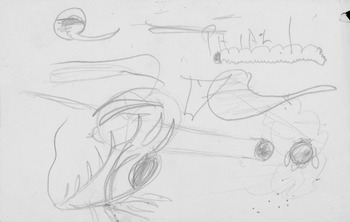
Klein was an Austrian analyst who moved to London in the 1920s at the invitation of Ernest Jones, a British colleague of Freud and his first major biographer.Reference Maddox49 Klein depicted the mental life of the child and adult as being an intricate web of phantasied relations between the self and others, both in the external world and in the internal world of internal ‘objects’. She maintained that aspects of the internal world, such as feelings or images, could be ‘projected’ externally, while aspects of the outer world could be ‘introjected’ into the inner world. Klein worked with children as well as adults, and her technique with children involved using play and art materials (Figure 1.1).
Drawing by ‘Richard’, one of Klein’s patients, in 1941. Klein described this work with ‘Richard’ in detail in ‘Narrative of a Child Analysis’ in 1961.Reference Klein50 Klein viewed child’s spontaneous play as the equivalent of free association in the adult. Her work, along with other early child psychotherapists, influenced the subsequent development of the discipline of play therapy.Reference Ray51
Klein held that the crucial period in life was infancy when the baby experienced an intolerable conflict between love and hate. The baby tried to resolve this conflict by projecting the aggressive part of him or herself on to the outer world. The infant perceived ‘objects’ as partial: they were split into the all-good, as represented by the nourishing ‘good breast’, or the all-bad as represented by the unsatisfying ‘bad breast’. At a later period, the infant was said to develop a more balanced relation to the mother and see her as a whole person made up of good and bad qualities. However, the infant also felt guilt, remorse, and depression at the realisation that they had entertained violent emotions about the mother. This led to what Klein termed the ‘paranoid position’ and the ‘depressive position’, with the former defending the child against the ‘depressed’ feelings (i.e. more mixed and realistic feelings) of the latter. As Lisa Appignanesi has observed, Klein’s complex theory gradually permeated wider society and led to the impossible implication for the mother that she was both utterly passive and infinitely responsible for her child.Reference Appignanesi52
The Scottish Contribution: Ian Suttie and Ronald Fairbairn
Some of the early criticism of Klein and of Freud came from Scotland. The Glasgow psychiatrist Ian Suttie, author of The Origins of Love and Hate, objected to the Kleinian picture of the infant as paranoid and aggressive.Reference Suttie53 Instead, Suttie held that the infant had an innately benign and sociable relationship with others, and that negative qualities only emerged if normal development had been impaired by a troubled upbringing. Suttie quoted with approval Ferenczi’s contention that it was the therapist’s ‘love’ that cured the patient. In Freud and the Post-Freudians, Brown contrasted Suttie’s The Origins of Love and Hate, which he maintained offered a democratic and matriarchal perspective, based on love, with what he saw as Freud’s authoritarian and patriarchal perspective, based on the sexual drive.Reference Brown54
The Edinburgh analyst Ronald Fairbairn objected that Freud’s theory was mechanistic, atomistic, and was expressed in depersonalised language.Reference Tantam, Freeman and Berrios55 His own theory shifted from Freud’s drive model to a relational one. Where Freud had suggested that the infant was born into the world unrelated to others and became related only secondarily as they provided him or her with pleasure, Fairbairn held that infants were orientated towards others from the start. Subsequent emotional and mental difficulties were seen not as deriving from conflicts over pleasure-seeking impulses, but disturbances in relations with others. Fairburn also criticised Melanie Klein, in particular her notion that all the action took place within the child’s head, and argued, instead, for the importance of seeing the child’s parents as real people, rather than objects of fantasy.
Towards the end of his career, Fairbairn became critical of the standard analytic method. He maintained that ‘The relationship existing between the patient and analyst is more important than the details of technique.’Reference Fairbairn56 GomezReference Gomez57 has judged that Fairbairn’s work had a far-reaching effect on how psychotherapy was practised. Analysts began to accept that patients needed a genuine relationship with their therapist rather than just merely being given interpretations. Suttie and Fairbairn have been seen by Gavin MillerReference Miller58 as providing a particularly Scottish perspective on psychoanalysis characterised by a philosophy of questioning from first principles the foundations of Freudian theory, and by an emphasis on kinship and community, rather than on the isolated and self-seeking ego of classical analysis. In later years, Dr Jock Sutherland, who had been the Medical Director of the Tavistock Clinic from 1947 to 1968, returned to his native Edinburgh, where in 1972 he was instrumental in the formation of the Scottish Institute for Human Relations, considered the Scottish counterpart to the Tavistock.
The ‘Middle Group’: Michael Balint, John Bowlby, and Donald Winnicott
In the post-war period, there emerged a permanent split in the training programme at the Tavistock: one group followed Melanie Klein, and another, Anna Freud.Reference Burston59 Those who were appalled by the dogmatisms of the Kleinians and Freudians joined the so-called Middle Group, which included Michael Balint, Jock Sutherland, John Bowlby, Donald Winnicott, Charles Rycroft, and Marion Milner.
Michael Balint
Michael Balint was an Hungarian psychoanalyst who had been analysed by Ferenczi. He is remembered for creating the ‘Balint groups’.Reference Holmes, Bloch, Green and Holmes60 Balint realised that from a practical point of view, the high cost and time-consuming nature of psychoanalysis militated against it making a major impact on the general population. Instead, he proposed that frontline workers in the mental health field should be trained in psychodynamic thinking. He set up groups where clinicians would meet regularly with a psychoanalytically trained facilitator to discuss case material brought by participants. Such groups proved very successful, and versions of them still run today (see Chapter 18).
John Bowlby
John Bowlby, along with Donald Winnicott, played a major role in shaping the post-war establishment’s consensus on parenting.Reference Appignanesi61 Bowlby was one of the few clinicians to play an influential part, both within British psychoanalysis and in the setting up of the NHS after the war. Bowlby had been sent away early to boarding school by his rather cold, upper-class family, and was acutely sensitive to the importance of separation for young children.Reference Holmes, Bloch, Green and Holmes62 After the Second World War, he undertook groundbreaking investigations into the lives of children who had been evacuated or displaced during the conflict. In his Forty-Four Thieves: Their Characters and Home Life, Bowlby argued that prolonged separation of small children from their homes and their mothers led in many cases to the development of a criminal character. In the 1951 WHO Report, Maternal Care and Mental Health, Bowlby concluded that it was essential for their mental health that an infant or young child experienced a warm, intimate, and continuous relationship with their mother or her permanent substitute. If not, the child would subsequently show signs of deprivation, manifest by depression or an excessive need for love or revenge. He emphasised the importance of the quality of this real relationship rather than the infant’s fantasies about it. As Appignanesi has commented, Bowlby’s work consolidated the theory that mothers needed to stay as close to their infants as possible, while fathers went out to work to provide money for the home.Reference Holmes, Bloch, Green and Holmes63
Drawing on research in ethology as well as psychoanalysis, Bowlby fully developed his theory of ‘attachment’ in his influential trilogy: Attachment (1969), Separation (1973), and Loss, Grief and Mourning (1980). He argued that the mother or ‘attachment figure’ should acknowledge the infant’s needs for comfort and protection, while also respecting their need for autonomy. If this ‘secure attachment’ was successfully achieved, then the child would develop an internal model of the self as valued and reliable. If it was unsuccessful, the result was an ‘insecure attachment’ and the creation of an unworthy and incompetent self. Bowlby saw therapy as a ‘reparative’, emotional process, and maintained that it was not just about attaining intellectual insights. However, the understanding of attachment has evolved since Bowlby outlined his initial theories and there is now a recognition that insecure attachment is common and does not inevitably lead to major emotional problems, although it does influence how an individual develops psychologically (see Chapter 2).
Donald Winnicott
Donald Winnicott was a paediatrician by training and, like Bowlby, had studied the effects on young children of being evacuated from their homes during the Second World War.Reference Rodman64,Reference Phillips65 Appignanesi sees him as a romantic who believed that an infant who enjoyed a relationship with a ‘good-enough mother’ would develop an authentic and creative self.Reference Appignanesi66 Winnicott constructed a theory to explain how the self emerged out of its relations with others. He held that a lack of contact with others or, alternatively, an immersion in the world of others, presented dangers. He focused on the conditions that enabled the child to see his or herself as separate from others. The mother provided a crucial role in helping the self of the infant to emerge. If maternal provision was inadequate, the infant self might fragment. The infant would become overwhelmed by the demands of others and would lose touch with their own spontaneous needs. This would result in a split between the ‘true self’ and the ‘false self’. The ‘true self’ would hide away, while the ‘false self’, which was moulded by maternal expectations, would deal with the outside world. The ‘false self’ served to protect the integrity of the ‘true self’. In adult life, if this strategy failed, the self could fragment into several parts and psychosis could develop. Winnicott’s work was to influence the radical Scottish psychiatrist R. D. Laing when he came to depict the inner world of psychosis.Reference Beveridge67
Winnicott believed that Klein had described the infant in isolation from the actual reciprocal primary relationship in which he or she developed. He noted that Freud and Klein had emphasised the role of disillusionment in human development, during which growing up was portrayed as a process of mourning, but, in contrast, he contended, development was better viewed as a creative process of collaboration between mother and child. Adam Phillips has judged that one of Winnicott’s major contributions to therapy ‘was to have evolved a genuinely collaborative model of psychoanalytic treatment in which the analyst creates a setting that also makes possible the patient’s self-interpretations’.Reference Phillips68 The therapist’s role was not to be overly interpretative, but to provide a congenial milieu in which the patient would make a journey of self-discovery.
The Turn to the Child
Commentators have noted how the focus in psychoanalytic thinking shifted from the sex instinct to the mother and child relationship. Just as the experience of shell shock in the First World War had been influential in the development and acceptance of psychoanalytic theory, the problems of evacuated children in Britain during the Second World War changed psychoanalytic thinking about childhood.Reference Phillips69
As Appignanesi observes:
Mothers displaced castrating fathers as the crucial authority dominating both childhood and the inner life: it was on the base of that earliest and fundamental relationship, not the paternal one, that all future relations, of love and power, of attachment and dependence, would be placed.Reference Appignanesi70
Phillips pointed out that this new conception of child development had social consequences, especially for women:
Just as women were being encouraged to stay at home again after their crucial work during the war, coercive and convincing theories about the importance for children of continuous mothering, of the potential dangers of separation, began to be published which could easily be used to persuade them to stay there.Reference Phillips71
Another consequence of the Second World War was the development of both group psychotherapy and the ‘therapeutic community’. In the 1940s at the Northfield Military Hospital near Birmingham, two clinicians, John Rickman and Wilfred Bion, set up what was known as the ‘first Northfield experiment’.Reference Shephard72,Reference Pines and Freeman73 This was taken over by Michael Foulkes for a second experiment, this time comprising group psychotherapy. The lessons learnt informed the future use of group psychotherapy with civilian populations in the post-war period. Also working at the Northfield Hospital was Tom Main, who coined the term ‘therapeutic community’. Main introduced a more democratic structure to the hospital which involved patients in decision-making and which sought ‘resocialisation of the neurotic individual.’Reference Millard and Freeman74 In civilian life, he continued this work at the Cassel Hospital, as did Maxwell Jones at the Henderson Hospital. In Europe, Victor Frankl, who had survived the Nazi concentration camps, returned to Vienna where he introduced his existential-inspired ‘Logotherapy’, founded on his belief that human beings were primarily concerned with finding a meaning to their life.Reference Frankl75
Psychosis
Although Freud generally did not think that people with psychotic illnesses could be treated with psychoanalysis, he observed that ‘so many things that in the neuroses have to be laboriously fetched up from the depths are found in the psychoses upon the surface, visible to every eye’.Reference Freud76
The attempt to use psychotherapy to treat patients with psychosis was practised much more in America than Britain. An exception was R. D. Laing, who had trained at the Tavistock in the late 1950s. Holmes credits Laing with introducing British readers to therapists such Harry Stack Sullivan, Harold Searles, and Fromm-Reichmann and their psychoanalytic models of psychosis. Holmes writes:
Laing’s long-term influence should not be underestimated … He validated the inner world and experience of the severely mentally ill, seeing psychotic phenomena as covert communications, often about traumatic or painful experiences, rather than meaningless manifestations of a dysfunctional brain. He emphasised the family context of psychosis.Reference Holmes, Bloch, Green and Holmes77
Concluding Remarks
This brief history has shown how social and cultural factors have influenced both the theory and practice of psychodynamic psychotherapy. We have seen how the two world wars had a significant impact on the development of psychotherapy. We have also seen how Freud’s original theories were challenged and, it could be argued, this has led to improvements in how psychotherapy is conducted and thought about. The therapist is more active and responsive to the patient. Courses of treatments are shorter. Patriarchal assumptions have been exposed, and, in theorising about psychotherapy, more attention is paid to the role of the mother and her interaction with her child.
Some commentators, though, have seen the emergence of psychotherapy in modern times and the apparent extension of its concepts to all aspects of everyday life as a cause for concern. The sociologist Frank Furedi has used the term ‘therapy culture’ to decry what he sees as people’s loss of the ability to be stoical and accepting in the face of the inevitable hardships of life.Reference Furedi78 Instead, people increasingly see themselves as passive victims in need of therapy. While there is undoubtedly some truth in Furedi’s contention, he has been criticised for minimising human suffering and advocating an old-fashioned stiff-upper-lip approach to mental pain.
At the beginning of this chapter, we observed that there has often been a conflict between psychotherapeutic and biological approaches to the treatment of mental illness but that many clinicians wished to see a rapprochement between the two sides. This would seem to be vital. No matter what advances are made in biological psychiatry, the patient remains a unique individual with a unique set of experiences and personal history. Contemporary neuroscience has a tendency to see human beings as malfunctioning mechanisms. Psychodynamic psychotherapy, with its stress on attending in great detail to the individual’s life story, is especially placed to ensure that the patient as a person does not disappear.

