


Introduction
Fears of being contaminated and spreading contamination are most commonly provoked by physical contact with a contaminant perceived as dirty or infectious (Rachman, Reference Rachman2004). In obsessive-compulsive disorder (OCD), these fears can become all encompassing, eliciting strong urges to wash oneself or clean the contaminated object. In many cases, however, contamination-related fears can be triggered without contact with any physical contaminants. Instead, these instances of contamination are brought on by recalling and misinterpreting violations such as disturbing memories or immoral thoughts and acts (Rachman, Reference Rachman1997; Rachman, Reference Rachman1998; Rachman et al., Reference Rachman, Coughtrey, Shafran and Radomsky2015). This distinctive psychological phenomenon is termed mental contamination. Since the identification of mental contamination, a large body of qualitative, psychometric and experimental work has been conducted to explore its phenomenology. The Mental Contamination Report (MCR) was developed to measure in-the-moment feelings of mental contamination in response to experimental provocations (Herba and Rachman, Reference Herba and Rachman2007; Radomsky et al., Reference Radomsky, Elliot, Rachman, Fairbrother and Newth2008). Despite its widespread adoption for this purpose, the psychometric properties of the MCR have not yet, to the best of our knowledge, been investigated. Therefore, the aim of the present study was to evaluate the psychometric properties of the MCR and propose a revised version with optimized research utility if warranted.
The current framework of mental contamination is based in cognitive theories of anxiety disorders and OCD (e.g. Clark, Reference Clark1986; Rachman, Reference Rachman1997; Rachman, Reference Rachman1998). These theories posit that mental contamination can be present (Radomsky et al., Reference Radomsky, Coughtrey, Shafran and Rachman2018) and effectively induced (De Putter et al., Reference De Putter, Van Yper and Koster2017) in non-clinical populations in a transient and tolerable nature. However, the cognitive theory of mental contamination proposes that it becomes pathological when individuals seriously and repeatedly misappraise a violating experience as an indication that they are, or are seen by others as, worthless, pathetic, tainted, weak, and/or immoral (Rachman et al., Reference Rachman, Coughtrey, Shafran and Radomsky2015). These misappraisals subsequently lead to shame, guilt, and disgust, as well as neutralization and avoidance behaviours aimed at reducing negative emotions and ‘cleansing’ oneself of internal dirtiness. Compared with contact contamination, mental contamination is felt diffusely throughout the body and is less effectively mitigated by washing compulsions, even though the urge to wash may be present (Coughtrey et al., Reference Coughtrey, Shafran and Rachman2014; Rachman, Reference Rachman2004). Mental contamination is also considered an important cognitive construct in phobias and post-traumatic stress disorder due to similarities in symptoms, such as intrusive thoughts or memories about the feared stimuli or traumatic event and the resultant feelings of pollution, disgust and shame (Brake et al., Reference Brake, Tipsword and Badour2021; Fairbrother and Rachman, Reference Fairbrother and Rachman2004; Zysk et al., Reference Zysk, Shafran and Williams2018).
To examine the properties and underlying cognitive mechanisms of mental contamination, a substantial body of work has examined this phenomenon experimentally. In doing so, these studies have demonstrated that these feelings can be effectively evoked in the laboratory using various experimental paradigms. For example, Fairbrother et al. (Reference Fairbrother, Newth and Rachman2005) found that feelings of contamination could be provoked in female undergraduate students by having them listen to an audio recording of a non-consensual kiss from a man (i.e. the ‘dirty kiss’ paradigm). In a series of follow-up experiments, researchers manipulated the morality of the man in the recording such that participants listened to either a consensual or non-consensual kiss from a moral or immoral man (Elliot and Radomsky, Reference Elliot and Radomsky2009; Radomsky and Elliot, Reference Radomsky and Elliot2009). Since then, there have been various adaptations to these paradigms, all of which involve exposing participants to an imagined violation of some kind and measuring subsequent mental contamination feelings and urges to wash (e.g. Kennedy and Simonds, Reference Kennedy and Simonds2017; Krause and Radomsky, Reference Krause and Radomsky2021; Millar et al., Reference Millar, Salkovskis and Brown2016). All of these studies have produced important insights about the phenomenology of mental contamination. However, our ability to draw confident conclusions from any of these studies is dependent on the validity and reliability of the measurement tools employed.
Currently, there are two widely used self-report measures that assess mental contamination: the Vancouver Obsessional Compulsive Inventory-Mental Contamination Scale (VOCI-MC; Radomsky et al., Reference Radomsky, Rachman, Shafran, Coughtrey and Barber2014) and the Mental Contamination Report (MCR; Herba and Rachman, Reference Herba and Rachman2007; MCR; Radomsky et al., Reference Radomsky, Elliot, Rachman, Fairbrother and Newth2008). The VOCI-MC was developed as an adjunct to the Vancouver Obsessional Compulsive Inventory (VOCI; Thordarson et al., Reference Thordarson, Radomsky, Rachman, Shafran, Sawchuk and Hakstian2004) to assess symptoms of mental contamination with good to excellent internal consistency (α=.94 to .97), convergent validity and divergent validity (Radomsky et al., Reference Radomsky, Rachman, Shafran, Coughtrey and Barber2014). The measure asks participants to respond to a total of 20 items rated on a 5-point Likert scales that capture their general experience of mental contamination feelings (e.g. ‘Often I look clean but feel dirty’, ‘I often feel dirty or contaminated even though I haven’t touched anything dirty’). The MCR, by contrast, was designed to measure in-the-moment severity and changes in mental contamination, mainly for use in experimental or provocation-based studies. As such, the measure assesses four aspects of mental contamination (Emotions, Behavioural Urges, Contamination Sites, and Rationale for Neutralizing) by asking participants to rate their experience of various mental contamination-related phenomena in the present moment. Specifically, participants are asked to rate on a scale of 0 to 100, the extent to which they are currently experiencing mental contamination related emotions (e.g. ‘On a scale from 0 to 100, how dirty/cheap/sleazy/ashamed do you feel in this moment?’) and urges to engage in neutralizing behaviours (e.g. ‘If you feel dirty, do you have an urge to do anything about this feeling of dirtiness? Please rate each urge on a scale from 0 to 100’). Moreover, using check boxes, participants indicate the sites of contamination (e.g. hands, face, stomach, etc.) and rationale for engaging in neutralizing behaviour(s) (e.g. ‘It would make me feel less distressed or anxious’). The MCR is commonly used in experimental research on mental contamination in both Western (e.g. Elliot and Radomsky, Reference Elliot and Radomsky2009; Herba and Rachman, Reference Herba and Rachman2007; Krause and Radomsky, Reference Krause and Radomsky2021) and non-Western samples (e.g. Bilekli and Inozu, Reference Bilekli and Inozu2018; Inozu et al., Reference Inozu, Kahya, Üzümcü and Evliyaoğlu2022; Tang et al., Reference Tang, Fu and Wang2022).
Although the MCR has been widely used in key studies on mental contamination, its psychometric properties have yet, to the best of our knowledge, to be examined systematically. While one could argue that the prominent use of the MCR in research over the years is evidence for its reliability and validity, this logic runs the risk of reification, whereby an unvalidated idea is treated as an established reality, increasing the risk of circular reasoning and misleading conclusions. Given the mismatch between its popularity and its limited psychometric backing, we believe it is critical to establish its psychometric properties empirically to improve the accuracy and confidence of our findings from past and future studies in the area.
Of note, the measure has several important limitations that could be improved upon. Firstly, the MCR contains several emotions that are not specific to mental contamination (i.e. angry, distressed, afraid, sad, and anxious). As a result, their inclusion in the measure reduces its specificity and makes it difficult to discern whether experimental manipulations are inducing the unique emotional and cognitive profile associated with mental contamination or merely eliciting a general negative affective state. For instance, reading about or imagining a morally violating event could reasonably provoke sadness, anxiety, or distress without necessarily triggering feelings of internal dirtiness or contamination. Secondly, the behavioural urges assessed on the MCR only include urges to engage in washing behaviour (e.g. ‘Wash my hands’, ‘Take a shower’). In a recent qualitative study of individuals with OCD and/or trauma histories, we found that washing was just one of many behavioural urges participants reported in the context of mental contamination (Krause and Radomsky, Reference Krause and Radomsky2024). Furthermore, these findings suggested that it may be more useful to identify the function of individuals’ behaviours (e.g. reclaiming a sense of control, avoidance, self-punishment) rather than identifying the behaviour itself (e.g. washing, thought replacement, mental rituals). Finally, the contamination site and rationale for neutralizing checklists included on the MCR may have limited research utility. While these checklists may provide counts of participants’ experiences that could provide qualitative insights, they are difficult to synthesize quantitatively in a meaningful way. For example, more items being selected does not correlate with greater severity necessarily, nor is it clear whether certain checklist items are more characteristic of mental contamination than others. Research has demonstrated that the contamination site for mental contamination is, by definition, diffuse and difficult to identify (Coughtrey et al., Reference Coughtrey, Shafran, Lee and Rachman2012). With regard to the rationale for neutralizing, little research has been done to clarify the function of neutralizing behaviour in the context of mental contamination. Furthermore, the rationale for neutralizing response options provided on the original MCR do not align with findings from the small body of research that has been done in this domain (e.g. Coughtrey et al., Reference Coughtrey, Shafran, Lee and Rachman2012; Krause and Radomsky, Reference Krause and Radomsky2024). Therefore, these items do not serve the MCR’s purpose of measuring the intensity of mental contamination. For this reason, we believe they add little to the MCR, and in fact obfuscate the scale’s interpretability and utility.
As such, the aims of this study were twofold – to examine the psychometric properties of the MCR in a sample of undergraduate students, and to propose a revised version optimized for future research purposes. We hypothesized that:
-
(1) There would be a two-factor solution for the MCR Emotions Subscale and high internal consistency for the mental contamination-specific emotions factor.
-
(2) There would be high convergent and divergent validity such that the MCR scores would correlate more strongly with measures of more general mental and contact contamination symptoms than with measures of hoarding and indecisiveness.
Method
Participants
Data for these analyses were collected as part of a larger experiment examining the impact of moral self-violation on mental contamination (Krause and Radomsky, Reference Krause and Radomsky2023). The sample consisted of 150 undergraduate students recruited via Concordia University’s Psychology Participant Pool. Participants were provided with course credit as compensation for participation. Inclusion criteria required participants to be over 18 years old and fluent in English. For the majority of the analyses, we used only data obtained from the experimental condition of the study wherein participants took part in a mental contamination provocation task (n=50). The control condition was used as a comparison group for the analysis of known groups validity.
Measures
Mental Contamination Report (MCR; Herba and Rachman, Reference Herba and Rachman 2007 )
The MCR is a measure designed to assess individuals’ state levels of mental contamination. It consists of four subscales – mental contamination-related emotions, mental contamination-related behavioural urges, location of contamination, and rationale for behavioural urges.
For the mental contamination-related emotions, participants are asked to rate the degree to which they are currently experiencing 13 different mental contamination-related emotions (e.g. dirty, sleazy, icky, cheap) in this moment. Each emotion is rated on a scale from 0 (‘not at all’) to 100 (‘completely’).
For the behaviour section, participants are asked to rate the degree to which they have an urge to engage in seven different washing behaviours (i.e. rinse their mouth, spit, or drink something; brush their teeth or use mouthwash; wash their face; wash their hands; take a shower) in response to feelings of dirtiness. Responses for all items range from 0 (‘not at all’) to 100 (‘completely’). There is also a free text ‘other’ option for individuals to indicate any other behavioural urges they have.
In addition to dimensional items, the measure also has two sets of checklist items. For the MCR’s section on site of contamination, participants are asked to locate the site(s) of contamination out of 10 options (e.g. mouth, hands, diffuse, internal) and to select the rationale for neutralizing out of six options (e.g. other people will be able to tell I feel dirty, it would make me less distressed, I am worried about spreading the dirtiness). For both subscales, participants are asked to select as many of the options that apply. There is also a free text ‘other’ option for individuals to write additional options not included in either list.
Vancouver Obsessional-Compulsive Inventory-Mental Contamination (VOCI-MC; Radomsky et al., Reference Radomsky, Rachman, Shafran, Coughtrey and Barber2014)
The VOCI-MC is a 20-item scale designed to measure symptoms of mental contamination. All items are rated on a 5-point Likert scale, ranging from 0 (‘not at all’) to 4 (‘very much’). The VOCI-MC had excellent internal consistency in the current sample ( ${\rm{\alpha }}$
=.93).
${\rm{\alpha }}$
=.93).
Vancouver Obsessional-Compulsive Inventory (VOCI; Thordarson et al., Reference Thordarson, Radomsky, Rachman, Shafran, Sawchuk and Hakstian2004)
The VOCI is a 55-item measure of OCD symptoms. It assesses six OCD symptom domains – contamination, checking, repugnant obsessions, hoarding, just right, and indecisiveness. The VOCI total scale ( ${\rm{\alpha }}$
=.96) had excellent internal consistency and the Contamination (
${\rm{\alpha }}$
=.96) had excellent internal consistency and the Contamination ( ${\rm{\alpha }}$
=.85), Hoarding (
${\rm{\alpha }}$
=.85), Hoarding ( ${\rm{\alpha }}$
=.89), and Indecisiveness Subscales had good internal consistency (
${\rm{\alpha }}$
=.89), and Indecisiveness Subscales had good internal consistency ( ${\rm{\alpha }}$
=.85) in the current sample.
${\rm{\alpha }}$
=.85) in the current sample.
Procedure
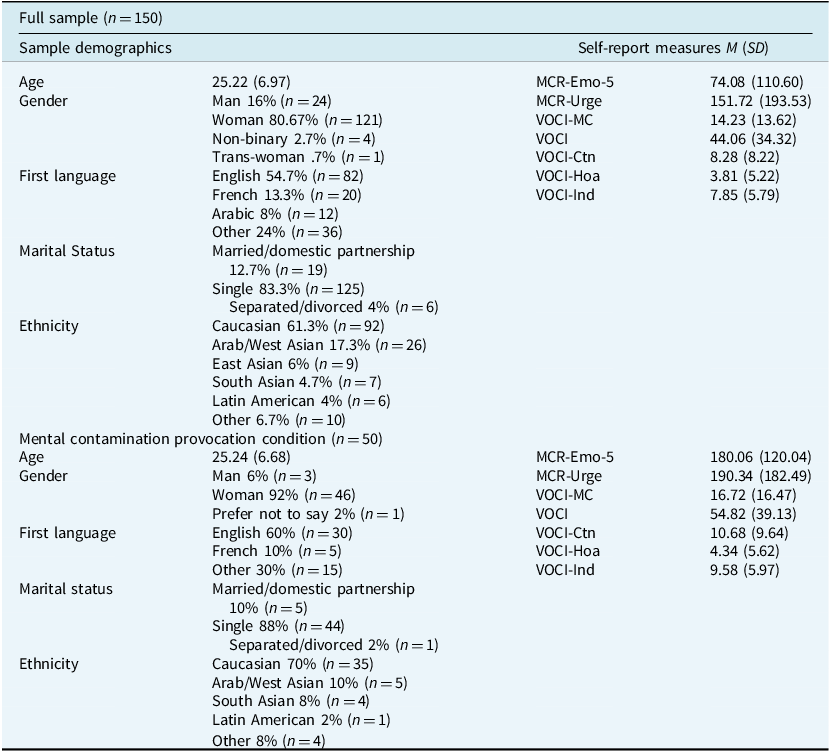
Participants first provided written informed consent to participate in the study and to allow their data to be used in any resulting publications. To emulate a clinical OCD sample, participants were asked to complete a bogus personality test and received the false feedback that they were in the top fifth percentile of respondents on the Morality Subscale. Next, participants were randomly assigned to one of three conditions – violated self (VS), bolstered self (BS), or general negative (GN), wherein participants were either asked to spend five minutes writing about a time where they were highly immoral, morally virtuous, or about a non-self-referent negative event, respectively. Participants then completed a battery of questionnaires related to OCD including the aforementioned measures as well as the Contamination Sensitivity Scale (CSS; Radomsky et al., Reference Radomsky, Rachman, Shafran, Coughtrey and Barber2014), Obsessive Beliefs Questionnaire-44 Item Version (OBQ-44; Obsessive Compulsive Cognitions Working Group, 2005), Perceptions of Betrayal Scale (POBS; Pagdin et al., Reference Pagdin, Salkovskis, Nathwani, Wilkinson-Tough and Warnock-Parkes2021), PTSD Checklist for DSM-5 (PCL-5; Blevins et al., Reference Blevins, Weathers, Davis, Witte and Domino2015). For more details on the study procedure, see Krause and Radomsky (Reference Krause and Radomsky2023). See Table 1 for the sample’s demographics and descriptive statistics.
Results
Due to the limited research utility of the MCR’s checkbox subscales (i.e. Contamination Site Subscale and Rationale for Neutralizing Subscale), we only examined the psychometric properties of the MCR Emotions and Behavioural Urges Subscales.
Internal consistency
MCR Emotions
The emotions section of the MCR with all items included has excellent internal consistency ( ${\rm{\alpha }}$
=0.92). However, several of the items capture general negative emotions non-specific to mental contamination (i.e. distressed, angry, anxious, afraid, and sad). Therefore, we conducted an exploratory factor analysis (EFA) to explore the factor structure of this section of the MCR. We conducted an EFA using MPlus (Muthén and Muthén, Reference Muthén and Muthén2017) with a Geomin oblique rotation, as we expected the factors would correlate with one another. We ran a parallel analysis and compared eigenvalues of the sample correlation matrix to eigenvalues of the parallel analysis (Fabrigar et al., Reference Fabrigar, Wegener, MacCallum and Strahan1999; Goretzko et al., Reference Goretzko, Pham and Bühner2021), which suggested that a one- or two-factor solution would best fit the data. Therefore, we compared Geomin rotated factor loadings for three different solutions (one-, two-, and three-factor solutions) and concluded that the two-factor solution was the most conceptually sound solution that resulted in well-defined factors.
${\rm{\alpha }}$
=0.92). However, several of the items capture general negative emotions non-specific to mental contamination (i.e. distressed, angry, anxious, afraid, and sad). Therefore, we conducted an exploratory factor analysis (EFA) to explore the factor structure of this section of the MCR. We conducted an EFA using MPlus (Muthén and Muthén, Reference Muthén and Muthén2017) with a Geomin oblique rotation, as we expected the factors would correlate with one another. We ran a parallel analysis and compared eigenvalues of the sample correlation matrix to eigenvalues of the parallel analysis (Fabrigar et al., Reference Fabrigar, Wegener, MacCallum and Strahan1999; Goretzko et al., Reference Goretzko, Pham and Bühner2021), which suggested that a one- or two-factor solution would best fit the data. Therefore, we compared Geomin rotated factor loadings for three different solutions (one-, two-, and three-factor solutions) and concluded that the two-factor solution was the most conceptually sound solution that resulted in well-defined factors.
Demographics and descriptive statistics for self-report measures

MCR-Emo-5, Mental Contamination Report-Emotions Subscale – 5-item version; MCR-Urge, Mental Contamination Report-Behavioural Urges Subscale; VOCI-MC, Vancouver Obsessional Compulsive Inventory-Mental Contamination Scale; VOCI, Vancouver Obsessional Compulsive Inventory; VOCI-Ctn, Vancouver Obsessional Compulsive Inventory-Contamination Subscale; VOCI-Hoa, Vancouver Obsessional Compulsive Inventory-Hoarding Subscale; VOCI-Ind, Vancouver Obsessional Compulsive Inventory-Indecisiveness Subscale.
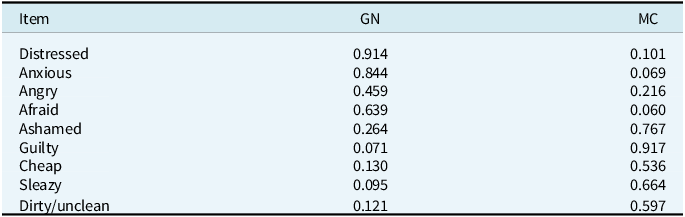
The items we propose to include on the revised MCR are those that loaded heavily on a single factor (i.e. factor loading >0.45) and that did not cross-load across factors (i.e. difference in factor loadings of <0.2 between factors). We removed three items due to cross-loading (i.e. disgusted, humiliated, sad) and one due to low loading across both factors (i.e. icky). This resulted in a final pool of nine items, four of which loaded onto a general negative emotion factor (i.e. distress, anxious, afraid, angry) and five of which loaded onto a mental contamination-specific emotion factor (i.e. ashamed, guilty, cheap, sleazy, dirty/unclean). See Table 2 for the factor loadings for the two-factor solution with the final pool of items. The mental contamination-specific emotion factor had excellent internal consistency ( ${\rm{\alpha }}$
=0.90).
${\rm{\alpha }}$
=0.90).
EFA Geomin rotated factor loadings for a two-factor solution with reduced items

GN, General Negative Emotions Factor; MC, Mental Contamination-Specific Emotions Factor.
MCR Behavioural Urges
The Behavioural Urges Subscale of the MCR had excellent internal consistency ( ${\rm{\alpha }}$
=0.91). However, many respondents selected the ‘other’ option and reported behavioural urges not included in the MCR list, suggesting the existing items included on the subscale may be insufficient. The most common responses reported were: distract myself (e.g. change environment, sleep, watch television, listen to music), scratch skin, and mental urges (e.g. rationalize, analyze, suppress thoughts).
${\rm{\alpha }}$
=0.91). However, many respondents selected the ‘other’ option and reported behavioural urges not included in the MCR list, suggesting the existing items included on the subscale may be insufficient. The most common responses reported were: distract myself (e.g. change environment, sleep, watch television, listen to music), scratch skin, and mental urges (e.g. rationalize, analyze, suppress thoughts).
Convergent validity
In line with our hypotheses, we found significant correlations between the MCR (5-item Emotions Subscale and Behavioural Urges Subscale) and more global mental and contact contamination fears (i.e. VOCI-Contamination Subscale and VOCI-Mental Contamination Scale). See Table 3 for the full correlation matrix.
Correlations between the MCR Subscales and measures of related/distinct constructs

MCR-Emo-5, Mental Contamination Report-Emotions Subscale 5-item version; MCR-Urge, Mental Contamination Report-Behavioural Urges Subscale; VOCI-MC, Vancouver Obsessional Compulsive Inventory-Mental Contamination Scale; VOCI-Ctn, Vancouver Obsessional Compulsive Inventory-Contamination Subscale; VOCI-Ind, Vancouver Obsessional Compulsive Inventory-Indecisiveness Subscale; VOCI-Hoa, Vancouver Obsessional Compulsive Inventory-Hoarding Subscale. **p<.01.
Divergent validity
As hypothesized, scores on the 5-item Emotions Subscale of the MCR were uncorrelated with hoarding symptoms and the MCR Behavioural Urges Subscale was not significantly correlated with indecisiveness. Contrary to our hypotheses, the MCR Emotions Subscale was significantly correlated with Indecisiveness and the Behavioural Urges Subscale was significantly correlated with hoarding symptoms. Of note, there were no strong correlations between the MCR and any other measures, suggesting the MCR may be tapping into a construct more distinct in nature than more stable symptom measures. See Table 3 for the full correlation matrix.
Known groups validity
An ANOVA revealed that the MCR’s 5-item Emotions Subscale demonstrated excellent known groups validity, F 2,147=63.17, p<.001, ηp 2=.46, as it discriminated between individuals who received a self-violating writing task (M=180.06, SD=120.04) from those who received a self-bolstering (M=20.24, SD=64.14) or non-self-referent (M=21.94, SD=38.48) writing task in the experiment. The MCR’s Behavioural Urges Subscale, however, was not able to effectively discriminate between conditions in the experiment, F 2,147=2.19, p=12, ηp 2=.02.
Discussion
The aim of the present study was to evaluate the psychometric properties of the MCR to enable, if warranted, the proposal of a more psychometrically sound and conceptually useful revised version of the measure. Given the shortcomings of the utility of the original MCR, an update was deemed to be appropriate. Based on an exploratory factor analysis of the MCR Emotions Subscale, we identified a 5-item mental contamination-specific list of emotions. For the reduced 5-item version of the Emotions Subscale we found excellent internal consistency, strong known groups validity, good convergent validity, and somewhat mixed results with regard to divergent validity. For the Behavioural Urges Subscale, we found excellent internal consistency, good convergent validity, relatively weak divergent validity, and no known groups validity. These findings inform our recommendations for the Mental Contamination Report-Revised Version (MCR-RV, see Appendix A).
The range of negative emotions included on the MCR limits is specificity as a tool to measure mental contamination rather than a measure of general negative affect. An exploratory factor analysis confirmed this proposal, suggesting a two-factor solution to the items on this subscale – one capturing five mental contamination-specific emotions, and one capturing four general negative emotions. The reduced 5-item Emotions Subscale had strong internal consistency, convergent, divergent, and known groups validity. As the condensed version has strong psychometric properties and reflects a more parsimonious and face valid version of the Subscale, we propose using this 5-item version for the MCR-RV (see Appendix A). This revised version of the Emotions Subscale will allow for greater specificity when interpreting the impact of experimental manipulations. We know that perceived violations are associated with a range of negative emotional outcomes including, but not limited to, shame, guilt, anger, contempt, fear, and contamination (e.g. Resick et al., Reference Resick, Monson and Chard2016; Rozin et al., Reference Rozin, Lowery, Imada and Haidt1999). By limiting the emotions included on the MCR-RV to those specific to mental contamination, it will allow researchers to establish greater nuance in understanding the triggers and cognitive mechanisms driving mental contamination, uniquely, rather than those at play in general negative mood states.
As hypothesized, the 5-item Emotions Subscale was significantly correlated with the VOCI-MC and VOCI-Contamination and was not correlated with hoarding symptoms. However, contrary to our hypotheses, it was significantly correlated with the VOCI-Indecisiveness Subscale. One possible explanation for this correlation may be that both mental contamination and indecisiveness result from emotional reasoning processes and/or doubt (Chiang and Purdon, Reference Chiang and Purdon2023; Paredes-Mealla et al., Reference Paredes-Mealla, Martinez-Borba, Miragall, Garcia-Palacios, Baños and Suso-Ribera2023; Rachman et al., Reference Rachman, Coughtrey, Shafran and Radomsky2015). Indeed, just as interpreting feelings of anxiety as an indication that one has made a ‘wrong’ decision may lead to indecisiveness, interpreting feelings of disgust as an indication that one is ‘tainted’ or ‘blemished’ may similarly lead to feelings of mental contamination. Future research should explore the subscale’s divergent validity further by comparing with other unrelated constructs and should explore this emotional reasoning hypothesis more directly. Of note, none of the correlations – convergent or divergent – was particularly high, perhaps highlighting the distinction between individuals’ general tendencies and fears versus their acute reactions to experimental stimuli.
Finally, the 5-item Emotions Subscale showed excellent known groups validity. Specifically, scores on the subscale were significantly higher in an experimental condition that involved a perceived violation of one’s moral self-concept than in a condition that involved a bolstered self-concept or a non-self-referent negative mood induction. Cognitive models of mental contamination propose that these feelings arise when individuals make a serious negative misappraisal about the personal significance of a perceived violation (Rachman et al., Reference Rachman, Coughtrey, Shafran and Radomsky2015). Therefore, these results demonstrate that the MCR-RV’s 5-item Emotions Subscale effectively differentiated individuals who did and did not experience a violation in this study. It is important to note that the paradigm used in this study used a self-violation provocation task. Future research should, therefore, replicate these results with other externally violating experimental paradigms commonly used to explore mental contamination-related phenomena, such as the ‘dirty kiss’ paradigm (e.g. Elliot and Radomsky, Reference Elliot and Radomsky2009; Fairbrother et al., Reference Fairbrother, Newth and Rachman2005).
Regarding the MCR-RV’s Behavioural Urges Subscale, psychometric properties were mixed. As hypothesized, the subscale showed excellent internal consistency, was significantly correlated with convergent validity measures (i.e. VOCI-MC and VOCI-Contamination), and was uncorrelated with Indecisiveness. However, contrary to hypotheses, the subscale was significantly correlated with Hoarding and known groups validity was not established for the subscale as there were no significant differences between experimental conditions.
Further, the MCR Emotions and Behavioural Urges Subscales were not significantly correlated, suggesting that there may be important mental contamination-related behaviours not captured on the MCR. Indeed, many participants selected the ‘other’ option on this subscale and reported a range of other behaviours in free text. This aligns with a growing body of research acknowledging that washing may be just one type of behaviour individuals feel compelled to engage in in response to feelings of mental contamination (e.g. Krause and Radomsky, Reference Krause and Radomsky2024; Rachman et al., Reference Rachman, Coughtrey, Shafran and Radomsky2015).
Given these limitations identified for the Behavioural Urges Subscale, and in light of current clinical literature we propose a revision for future studies. For case conceptualization purposes, there seems to be greater utility to understanding the function of an individual’s behaviour than identifying the behaviours themselves (Craske et al., Reference Craske, Treanor, Conway, Zbozinek and Vervliet2014; Krause and Radomsky, Reference Krause and Radomsky2024; Rachman et al., Reference Rachman, Coughtrey, Shafran and Radomsky2015). Our recent qualitative study examining the experience of mental contamination in those with OCD and/or trauma histories revealed three themes of behaviour functions in the context of mental contamination – to reclaim a sense of control, avoidance/distraction, and self-punishment/self-destruction (Krause and Radomsky, Reference Krause and Radomsky2024). Thus, rather than broadening the MCR’s Behavioural Urges Subscale to include a range of other behaviours (e.g. thought suppression, mental rituals), we propose revising this subscale to instead assess for the urge to engage in any behaviour to serve the aforementioned functions (i.e. ‘to what extent do you feel the urge to do something to reclaim a sense of control/avoid or distract/punish yourself ?’; see Appendix A).
Finally, to maximize the research utility of the MCR-RV, we propose removing the checklist items (i.e. site of contamination and rationale of neutralizing) from the original MCR. Mental contamination is not characterized by any particular site of contamination, as it is proposed to be a diffuse and non-localized feeling (Rachman, Reference Rachman2004; Rachman et al., Reference Rachman, Coughtrey, Shafran and Radomsky2015). Furthermore, the checklist format of these two subscales of the MCR make the results difficult to interpret. For example, it is unclear whether the endorsement of more items on these checklists is reflective of greater severity, or whether the endorsement of particular items is more characteristic of mental contamination. Therefore, for conceptual clarity and parsimony, the removal of these items will help to make the MCR-RV a more practical research tool.
The MCR is a widely used outcome measure for experimental research on mental contamination, despite the fact that its psychometric properties have never been formally evaluated. The present study aimed to address this gap and propose a revised version of the MCR in light of the psychometric findings and existing theory. However, the study is not without limitations. First, we did not explicitly evaluate the MCR-RV we propose in Appendix A. Therefore, future research should validate the MCR-RV before its widespread adoption. Furthermore, this psychometric evaluation was conducted in an analogue sample of undergraduate students. While analogue samples have been shown to be effective for studying OCD phenomena (Abramowitz et al., Abramowitz et al., Reference Abramowitz, Fabricant, Taylor, Deacon, McKay and Storch2014; De Putter et al., Reference De Putter, Van Yper and Koster2017), future research should confirm these findings in a clinical sample. Finally, the nature of the experimental paradigm used to establish known groups validity involved a moral self-violation. However, the most common experimental provocation task for mental contamination research has been an external violation (i.e. a non-consensual kiss). Therefore, future research should validate the MCR-RV using the ‘dirty kiss’ and other paradigms to confirm the generalizability of these findings to other forms of mental contamination induction tasks.
Data availability statement
The data that support the findings of this study are available from the corresponding author (A.S.R.) upon reasonable request.
Acknowledgements
None.
Author contributions
Sandra Krause: Conceptualization (Lead), Formal analysis (Lead), Funding acquisition (Equal), Investigation (Equal), Methodology (Lead), Project administration (Lead), Writing - original draft (Lead), Writing - review & editing (Equal); Cailyn Fridgen: Conceptualization (Supporting), Writing - original draft (Equal), Writing - review & editing (Equal); Adam Radomsky: Conceptualization (Supporting), Funding acquisition (Equal), Resources (Equal), Supervision (Lead), Writing - review & editing (Equal)
Financial support
This project was funded by the Canadian Institutes of Health Research (CIHR) Frederick Banting and Charles Best Canada Graduate Scholarship – Doctoral (Funding Reference Number: 170803) awarded to Sandra Krause and by a CIHR-Project Grant (Grant Number: PJT153180) awarded to Adam S. Radomsky.
Competing interests
There are no competing interests to report for any of the authors.
Ethical standards
The study received ethical approval from the Concordia University Human Research Ethics Committee (#30017847). The study conforms with the principles outlined in the Declaration of Helsinki. Study hypotheses, methods, and analysis plans were pre-registered on the Open Science Framework (https://doi.org/10.17605/OSF.IO/XNV8Y).
Appendix A: Mental Contamination Report – Revised Version (MCR-RV)
Now that you have imagined yourself in that scenario, please answer the following questions about how you feel at this moment.
On a scale from 0 to 100, where 0 represents “not at all” and 100 represents “completely”, please rate the extent to which you currently feel:
-
1. Ashamed: _________
-
2. Guilty: _________
-
3. Cheap: _________
-
4. Sleazy: _________
-
5. Dirty/Unclean: _________
On a scale from 0 to 100, where 0 represents “not at all” and 100 represents “completely”, please rate the extent to which you currently feel the urge to do something to:
-
1. Reclaim a sense of control: _________
-
2. Avoid or distract yourself: _________
-
3. Punish yourself: _________


 Open access


Comments
No Comments have been published for this article.