





Introduction
Tree structural diversity and species composition play a significant role in the diversity of forest arthropod communities (Kennedy and Southwood Reference Kennedy and Southwood1984; Gunnarsson Reference Gunnarsson1990; Summerville and Crist Reference Summerville and Crist2004). Arthropod assemblages in forest stands, particularly the arboreal species, are shaped by more than tree structural diversity (Halaj et al. Reference Halaj, Ross and Moldenke2000). Arboreal species use tree structure to build webs, for movement or dispersal, and for protection. For example, conifer branches and needle arrangements offer greater protection from vertebrate predators than deciduous branches do, as well as substrate for things like spider web attachment (Halaj et al. Reference Halaj, Ross and Moldenke2000; Matevski and Schuldt Reference Matevski and Schuldt2021). Coniferous trees can therefore support a higher number and greater diversity of species than deciduous trees can (Pinzon et al. Reference Pinzon, Spence and Langor2011). Arthropod assemblages in forests are also determined by the ability of trees to modify the thermal environment for invertebrates (Riechert and Tracy Reference Riechert and Tracy1975). Particularly in the understorey, forests achieve this by providing shade and reducing incident solar radiation, as well as through evapotranspiration and by modifying wind patterns (De Frenne et al. Reference De Frenne, Lenoir, Luoto, Scheffers, Zellweger and Aalto2021). Within forests, coniferous trees offer distinct microhabitats and resources compared to deciduous trees, and each type of tree therefore typically supports different biological communities (Mupepele et al. Reference Mupepele, Müller, Dittrich and Floren2014; Ampoorter et al. Reference Ampoorter, Baeten, Vanhellemont, Bruelheide, Scherer-Lorenzen and Baasch2015).
Beyond its influence on arthropod community structure and insect–tree interactions, forest composition can also mediate predator–prey interactions, which help shape ecological communities (Halaj et al. Reference Halaj, Ross and Moldenke1998). Spiders are key predators in most terrestrial ecosystems (e.g., Michalko et al. Reference Michalko, Pekár and Entling2019; Bowden et al. Reference Bowden, van der Meer, Moise, Johns and Williams2022), and they can influence the dynamics of their prey, with implications for trophic cascades, and impact productivity, biodiversity, nutrient cycling, disease dynamics, and carbon storage (Lawrence and Wise Reference Lawrence and Wise2000; Wise Reference Wise2004). In addition to preying on numerous insect species, spiders also serve as prey for birds (Gunnarsson Reference Gunnarsson1996), bats (Krull et al. Reference Krull, Schumm, Metzner and Neuweiler1991), ants (Halaj et al. Reference Halaj, Ross and Moldenke1997), and other arthropods (Cappuccino et al. Reference Cappuccino, Lavertu, Bergeron and Régnière1998; Petráková et al. Reference Petráková, Michalko, Loverre, Sentenská, Korenko and Pekár2016; Royama et al. Reference Royama, Eveleigh, Morin, Pollock, McCarthy, McDougall and Lucarotti2017). Spiders are ideal model organisms for studying biodiversity patterns in forests. They are abundant, their taxonomy is relatively stable and accessible (Coddington and Levi Reference Coddington and Levi1991), and they can serve as bioindicators (Pearce and Venier Reference Pearce and Venier2006).
The “enemies hypothesis” (Root Reference Root1973) suggests that a higher plant- or tree-species diversity supports a higher abundance and diversity of natural enemies. Spiders may be influenced by the density of natural enemies, with higher predator density potentially leading to lower spider abundance (Halaj et al. Reference Halaj, Ross and Moldenke1997; Petráková et al. Reference Petráková, Michalko, Loverre, Sentenská, Korenko and Pekár2016). Similarly, as natural enemies themselves, spiders could be expected to be more diverse in stands with higher tree-species diversity – that is, in stands with trees that are more phylogenetically diverse (Staab and Schuldt Reference Staab and Schuldt2020). However, research on spider diversity in temperate forest stands in Europe has shown little support for the enemies hypothesis as a driver of spider diversity in forests (Schuldt et al. Reference Schuldt, Both, Bruelheide, Härdtle, Schmid, Zhou and Assmann2011), and evidence suggests that tree identity may indeed be more important in determining arboreal spider assemblages (e.g., Mupepele et al. Reference Mupepele, Müller, Dittrich and Floren2014; Matevski and Schuldt Reference Matevski and Schuldt2021).
Although many spider diversity and faunistic studies have been conducted at the tree level (Jennings and Collins Reference Jennings and Collins1986b; Jennings and Dimond Reference Jennings and Dimond1988; Gunnarsson Reference Gunnarsson1990; Thunes et al. Reference Thunes, Skarveit and Gjerde2003; Mallis and Rieske Reference Mallis and Rieske2011), few have explored biodiversity patterns at the stand level and across different stand types in the boreal forest of Canada (but see Pinzon et al. Reference Pinzon, Spence and Langor2011). Several studies indicate that spider abundance, richness, and community structure are related to the variety of spiders’ ecological roles and their dependence on specific habitat features (Bell et al. Reference Bell, Wheater and Cullen2001), particularly on the structural complexity of vegetation (Jennings and Collins Reference Jennings and Collins1986a; Gunnarsson Reference Gunnarsson1990; Mallis and Rieske Reference Mallis and Rieske2011). At the stand level, forests exhibit emergent properties that cannot be predicted at the tree level – for example, productivity, light penetration, and water and temperature regulation (Macdonald and Fenniak Reference Macdonald and Fenniak2007), and these are reflected in stand-level spider assemblages (Matevski and Schuldt Reference Matevski and Schuldt2021). Moreover, predator–prey interactions can exist at scales beyond a single tree: for example, searching and hunting efforts can extend across tens of metres or more (Larrivée and Buddle Reference Larrivée and Buddle2009; Rypstra and Buddle Reference Rypstra and Buddle2013). These broader processes, which include habitat connectivity and neighbour effects, likely play significant roles in shaping ecological communities (Hsieh and Linsenmair Reference Hsieh and Linsenmair2012; Butz et al. Reference Butz, Schmitt, Parker and Burghardt2023; Wildermuth et al. Reference Wildermuth, Dönges, Matevski, Penanhoat, Seifert and Seidel2023); however, the extent to which arthropod assemblages respond to these stand-level properties remains little known (but see Matevski and Schuldt Reference Matevski and Schuldt2021), underscoring the need for further research into patterns and processes beyond the single-tree scale.
Assessing the diversity of arboreal spider communities in the boreal forest sheds light on potential predation pressure on prey species, including insect pests such as the spruce budworm, Choristoneura fumiferana (Clemens) (Lepidoptera: Tortricidae) (Pureswaran et al. Reference Pureswaran, Johns, Heard and Quiring2016). Bowden et al.’s (Reference Bowden, van der Meer, Moise, Johns and Williams2022) investigation in Gros Morne National Park, western Newfoundland, Canada, revealed that approximately 30% of arboreal spiders had recently consumed spruce budworm, highlighting a clear link between these taxa. For these reasons (e.g., pest control, biodiversity), data that contribute to our understanding of spider assemblages are needed at the stand level but are limited or lacking for most forest stand types, even across boreal Canada (but see Pinzon et al. Reference Pinzon, Spence and Langor2011).
To determine whether stand-level differences in tree composition influence spider communities, we established nine field sites in the eastern boreal forest of Newfoundland and Labrador, Canada, to address the following question: Does the abundance, diversity, and composition of the arboreal spider community differ among the three stand types studied? Samu et al. (Reference Samu, Lengyel, Szita, Bidló and Ódor2014) found a positive correlation between tree-species richness and spider-species richness, and in other forested systems, research shows that higher tree-species diversity typically begets higher spider diversity (Ampoorter et al. Reference Ampoorter, Barbaro, Jactel, Baeten, Boberg and Carnol2020; Matevski and Schuldt Reference Matevski and Schuldt2021). Furthermore, Butz et al. (Reference Butz, Schmitt, Parker and Burghardt2023) recently showed that higher tree-species diversity supports higher spider abundances in temperate forests and that the trees in mixed stands are more phylogenetically dissimilar. Accordingly, we predicted that mixedwood stands, which contain both deciduous and coniferous trees, would support greater abundance, diversity, and a distinct composition of arboreal spiders. We also predicted that deciduous stands would yield the lowest arthropod species richness and abundance and a significantly different species composition.
Methods
Study region
The Canadian boreal forest is defined by long, cold winters and short, cool summers. Although dominated by coniferous trees, deciduous species are fairly common in the region. The boreal forest has three typical stand types: coniferous, the least common deciduous, and mixedwood (Brandt Reference Brandt2009). In eastern Canadian boreal forests, the most common coniferous trees are balsam fir, Abies balsamea (Linnaeus) Miller, black spruce, Picea mariana (Miller) Britton, Sterns, and Poggenburg, and white spruce, Picea glauca (Moench) Voss (all Pinaceae). Deciduous trees primarily include white birch, Betula papyrifera Marsh (Betulaceae), trembling aspen, Populus tremuloides Michaux (Salicaceae), and balsam poplar, Populus balsamifera Linnaeus (Salicaceae).
We conducted the study during the summers of 2021 and 2022 in a managed forestry region in insular western Newfoundland and Labrador (Fig. 1). The region’s forest is dominated by two conifer species, balsam fir and black spruce, with deciduous stands dominated by white birch and trembling aspen. Only mature stands with a dominant tree height over five metres tall and an understorey containing balsam fir regeneration were selected. We selected sites that represented the three major stand types in the region: coniferous containing more than 70% conifer trees, deciduous stands with less than 30% conifer content, and mixedwood stands with 30–60% conifer trees. Most of the conifer content was balsam fir, but black spruce comprised a small percentage (∼10%). The most common deciduous species was white birch, but yellow birch, Betula alleghaniensis (Britton) (Betulaceae), and red maple, Acer rubrum (Linnaeus) (Sapindaceae), made up a small percentage (∼5%).
A, Sampling site locations within the B, study area (Loggerschool Road and George’s Lake) in C, western insular Newfoundland and Labrador, Canada.

Using a provincial forest inventory and stand composition layer in ArcMap 10.8 (https://www.esri.com/en-us/arcgis/products/arcgis-desktop/resources) and confirming suitability by ground truthing, we established nine sites southwest of Corner Brook, Newfoundland and Labrador. Using a blocked design, we created three replicates of each stand type, with at least 500 metres between treatments and at least six kilometres between replicates.
Sample collection
We collected spiders using a modified beat-sheet method at four time periods throughout the summer (June, July, August, and September) in 2021 and 2022. To minimise potential phenological effects, we sampled all sites within a 72-hour period each month (Supplementary material, Appendix S1). Our beat-sheet method consisted of branch beating with a 1-m-long stick over a 1-m × 1-m white cloth sheet held taut by a PVC frame and with a collection cup fixed to the centre of the sheet. The sheet had a hole cut in the centre, under which a funnel was glued. A 16-dram vial was attached by glueing the snap cap lid (containing a drilled-out hole in the centre) to the funnel, allowing the vial collection cup to be removed and sealed following each sampling bout. Balsam fir was selected as the focal species due to its widespread ability to regenerate across different stand types in the region, thereby providing a standardised and consistent associate tree species for the study: any significant differences in spider assemblages would therefore reflect stand-level effects. Three balsam fir trees per site were randomly sampled for 40 seconds each, for a total sampling effort of two minutes per site, with all reachable branches at the low-mid crown (∼0.5–3 m height) being beaten. Directly following each site collection, 80% ethanol was added to each vial to preserve the contents. All samples were then returned to the lab for identification.
The samples were pooled together at the site level, based on the collection date. The spiders were then sorted from the sample debris. We used Paquin and Dupérré (Reference Paquin and Dupérré2003), Pickavance and Dondale (Reference Pickavance and Dondale2005), Bug Guide (2023), and Murray and Lentz (Reference Murray and Lentz2023) as references to identify adults to the species level. Nomenclature followed the World Spider Catalog 2022 (Natural History Museum Bern 2022). We deposited a voucher collection of adults at Natural Resources Canada, Canadian Forest Service, Corner Brook, Newfoundland and Labrador. Juveniles were excluded from the analysis because they cannot be identified to the species level and do not impact the interpretation of diversity indices (Sackett et al. Reference Sackett, Buddle and Vincent2008).
Data analysis
We compared spider communities among stand types by assessing differences in spider species abundance, diversity, and composition. Because seasonal variation was not the focus of this study, samples were pooled over both years. All analyses were performed in R, version 4.2.2 (R Core Team 2022), using the RStudio graphical user interface (RStudio Team 2022).
Abundance
We used a fixed-effects generalised linear model that used the base R package glm function with a Poisson error family to test for the influence of stand type on overall adult spider abundance (significance at P < 0.05). We obtained P-values using the car package, version 3.1.2, anova function (Fox and Weisberg Reference Fox and Weisberg2018). Because our experimental design included only a single independent factor, we used Type II sums of squares because interaction tests were not applicable. We used the emmeans package, version 1.10.5, means function (Lenth Reference Lenth2023) with a post hoc Tukey honestly significant difference adjustment to test pair-wise comparisons between stand types.
Diversity indices
We calculated diversity indices for each stand type using Hill numbers with the iNEXT package, version 3.0.1 (Chao et al. Reference Chao, Gotelli, Hsieh, Sander, Ma, Colwell and Ellison2014; Hsieh et al. Reference Hsieh, Ma and Chao2016). We created diversity profiles with confidence intervals based on 50 bootstrap resamples. The analysis used the default settings of 40 interpolation and extrapolation “knots” (sample size) to ensure a smooth rarefaction curve for standardised comparisons.
Community composition
To visualise the raw species richness in each stand type, we created a Venn diagram using the draw.triple.venn function of the VennDiagram package, version 1.7.3 (Chen and Boutros Reference Chen and Boutros2022). The Venn diagram displays the number of species unique to each stand type and the number shared among stand types. To visualise species composition, we used nonmetric multidimensional scaling ordination (Legendre and Legendre Reference Legendre and Legendre2012) with the metaMDS function in the vegan package, version 2.6.4 (Oksanen et al. Reference Oksanen, Simpson, Blanchet, Kindt, Legendre and Minchin2015). The approach uses Bray–Curtis similarity scores, allowing the visualisation of site similarity using an abundance-based species matrix. We used the ggplot function in the ggplot2 package, version 3.5.1 (Wickham Reference Wickham2016), to create the nonmetric multidimensional scaling plot, excluding singletons. To statistically test for differences in spider composition between stand types, we performed a permutational multivariate analysis of variance using the Bray–Curtis dissimilarity measure, as implemented in the adonis2 function from the vegan R package (Oksanen et al. Reference Oksanen, Simpson, Blanchet, Kindt, Legendre and Minchin2015).
Results
We collected 3395 spiders over the two field seasons. Of these, 2636 were juveniles. The 760 adults collected were identified as 41 species (Supplementary material, Appendix S1) from 13 families. The most abundant families represented by the adults were the Linyphiidae (71%), followed by Dictynidae (12%), Theridiidae (8%), Clubionidae (3%), and Philodromidae (2%). Araneidae, Mimetidae, Salticidae, Tetragnathidae, Thomisidae, and Uloboridae represented the remaining 4%. Linyphiidae was the most speciose (16 spp.), followed by Theridiidae (8 spp.), Clubionidae (3 spp.), and Araneidae (3 spp.). Ceraticelus atriceps O. Pickard-Cambridge (Linyphiidae) was the most abundant species (214 individuals; 28%). The second most abundant species was Ceraticelus fissiceps O. Pickard-Cambridge (Linyphiidae) (178 individuals; 23%), followed by Grammonota angusta Dondale (Linyphiidae) (107 individuals; 14%), Dictyna brevitarsus Emerton (Dictynidae) (88 individuals; 12%), Theridion varians Hahn (Theridiidae) (42 individuals; 6%), and Clubiona trivialis C.L. Koch (Clubionidae) (16 individuals; 2%). The 10 most abundant species made up 90% of the collection. They belonged to the families Clubionidae, Dictynidae, Linyphiidae, Philodromidae, Salticidae, and Theridiidae (Fig. 2). Three species collected are not found in the most recent checklist of spiders for the island of Newfoundland (Pickavance and Dondale Reference Pickavance and Dondale2005) and therefore represent new records for the island of Newfoundland. These new records are of Islandiana longisetosa Emerton (Linyphiidae) (n = 1), Theridion varians (n = 24), and Pelegrina flaviceps Kaston (Salticidae) (n = 11).
Total abundance of the 10 most abundant spider species collected by stand type in the boreal forest of western Newfoundland, Canada.

Spider abundance
Total spider abundance differed by stand type (P < 0.001), ranging from 219 individuals in conifer stands to 303 individuals in deciduous stands. Post hoc analysis revealed that spiders were significantly more abundant in deciduous stands than in coniferous stands but, although higher, did not differ from mixedwood stands. Spider abundances in coniferous and mixedwood stands did not differ significantly (Fig. 3).
Overall spider abundance for each stand type (coniferous, deciduous, mixedwood) in the boreal forest of western Newfoundland, Canada.

Species diversity indices
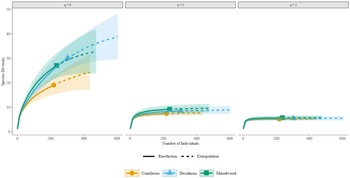
Species diversity, measured as Hill numbers (q = 0, q = 1, and q = 2), varied among forest stand types. For species richness (q = 0), deciduous and mixedwood stands exhibited the highest diversity, followed by coniferous stands; however, the 95% confidence intervals overlapped among the stand types. Species richness was slightly higher in the mixedwood and deciduous stands than in coniferous stands, but there was no statistical support, given the 95% confidence intervals overlapping between the stand types (Fig. 4).
Rarefaction and extrapolation curves for spider species diversity (Hill numbers: q = 0 (species richness), q = 1 (Shannon diversity), and q = 2 (Simpson diversity)) across three forest stand types (coniferous, deciduous, and mixedwood). Solid lines represent rarefied diversity, dashed lines represent extrapolated diversity, and shaded areas indicate 95% confidence intervals.

For Shannon diversity (q = 1), which accounts for species evenness, the three stand types showed similar levels of diversity, all with overlapping confidence intervals. This suggests comparable relative abundances of common species across stand types. A similar trend was observed for Simpson diversity (q = 2), where the diversity of dominant species was nearly identical across stand types, indicating that relative abundances and dominance patterns are very similar among stand types.
Species composition
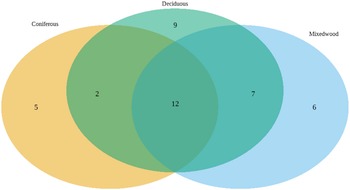
Twelve of the total 41 species (29%) were collected in all three stand types (Fig. 5). In total, five species (12% of the total) were exclusive to coniferous stands, nine species (22% of the total) were found only in the deciduous stands, and six species (15% of the total) were collected only in mixedwood stands. Coniferous stands shared two species with deciduous stands. No species were collected from both coniferous and mixedwood stands only, and seven species were collected from both deciduous and mixedwood stands only.
Venn diagram representing raw species richness by stand type, showing the number of unique and shared species (singletons included) of arboreal spiders within coniferous, deciduous, and mixedwood stands located in western Newfoundland, Canada.

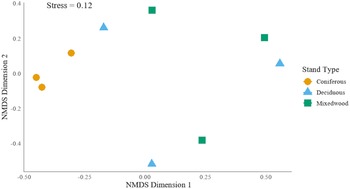
We did not observe distinct spider assemblages between the stand types in the nonmetric multidimensional scaling ordination (Bray–Curtis method, stress = 0.12; Fig. 6). Although the coniferous stands clustered well, the lack of clear separation in the ordination suggests an overlap of the spider community among the stand types. This was supported by the permutational multivariate analysis of variance, which confirmed that spider composition did not differ significantly by stand type (F = 1.354, P = 0.140).
Two-dimensional nonmetric multidimensional scaling (NMDS) scatterplot of spider assemblages pooled across all dates among stand types using Bray–Curtis dissimilarity. Ordination stress = 0.12.

Discussion
We used a replicated field experiment to test how arboreal spider assemblages differed among the common forest stand types found in the eastern boreal forest of Canada. Our results revealed that stand composition significantly influenced spider abundance, with deciduous stands supporting significantly higher numbers of spiders than coniferous stands do and with mixedwood stands falling in between. However, contrary to our initial hypothesis, we did not observe significant differences in species diversity or composition among the stand types.
Spider abundance
Spider abundance was significantly higher in deciduous stands than in either coniferous or mixedwood stands (Fig. 3). Pinzon et al. (Reference Pinzon, Spence and Langor2011) found that coniferous stands generally supported higher spider abundance. Their study credited higher spider densities to the structural features of coniferous trees, which provided better microhabitats and protection. Although our samples were not collected from deciduous trees, dispersal and spillover are common, suggesting that these neighbouring trees could serve as sources of individuals. The dense canopy and leaf litter of deciduous trees also help maintain higher humidity levels and provide shade (Macdonald and Fenniak Reference Macdonald and Fenniak2007), creating a favourable microclimate for spiders, which are typically sensitive to desiccation (Agnew and Smith Reference Agnew and Smith1989).
In contrast, the coniferous stands in our study supported significantly lower spider abundance. Although coniferous forests are often characterised by more uniform vegetation structure with less variation in canopy height and composition (Macdonald and Fenniak Reference Macdonald and Fenniak2007), spiders respond to environmental drivers at very small spatial scales (e.g., Ziesche and Roth Reference Ziesche and Roth2008). Other researchers have reported that coniferous stands support more spiders, largely because of the stands’ structural substrate and the protection from predators they provide (Pinzon et al. Reference Pinzon, Spence and Langor2011; Matevski and Schuldt Reference Matevski and Schuldt2021).
Contrary to our expectations, our results also demonstrate that mixedwood stands do not always support more spiders than coniferous stands do. We sampled only balsam fir trees in each of these stand types to standardise our sampling approach. Balsam fir represented about half of the composition in the sampled mixedwood stands and was rare (< 30%) in deciduous stands, and therefore, it is possible that a beaten fir tree branch may have been closer to a deciduous neighbour tree. Also, mixedwood stands may not provide the same level of structural complexity that deciduous forests do, which might explain why the spider abundance of the mixedwood stands did not differ significantly from that of the coniferous stands. In addition, as the “enemies hypothesis” (Root Reference Root1973) suggests, higher tree diversity in mixedwood stands may increase the densities of spider predators, thereby suppressing spider populations. Although the structural complexity of mixedwood stands could support a variety of prey species for spiders, the increased presence of generalist predators that prey on spiders may offset the positive effects of greater prey availability.
Species diversity
Although we observed significant differences in spider abundances, we did not detect major differences in species diversity between the study sites; however, species richness (q = 0) was lowest in the conifer-dominated stands and highest in the mixedwood stands. Our prediction that mixedwood stands would exhibit higher species richness than coniferous or deciduous stands was not supported statistically. Recent work by Matevski and Schuldt (Reference Matevski and Schuldt2021) showed that tree-species richness promoted arboreal spider species richness in temperate forests in Germany. Similarly, in a meta-analysis of stand effects on natural enemies that included arboreal spiders, Stemmelen et al. (Reference Stemmelen, Jactel, Brockerhoff and Castagneyrol2022) found that mixed stands yielded higher spider species richness. Indeed, a higher local diversity of tree species likely reflects differences in vegetation structure, microhabitats, and complexity among stand types. With their simpler structure, coniferous forests may provide fewer microhabitats and a less diverse prey base, resulting in lower species richness (Halaj et al. Reference Halaj, Ross and Moldenke2000; Pearce et al. Reference Pearce, Venier, Eccles, Pedlar and Mckenney2004). In contrast, mixedwood and deciduous stands, with their greater tree-species diversity and more complex vegetation, may affect a wider array of niches and a more diverse prey base, supporting a greater variety of spider species. Indeed, several other studies have shown a positive relationship between habitat complexity and species diversity (Gunnarsson Reference Gunnarsson1988; Halaj et al. Reference Halaj, Ross and Moldenke1998; Pinzón and Spence Reference Pinzón and Spence2010; Pinzon et al. Reference Pinzon, Spence and Langor2011). These differences in habitat complexity may be responsible, in part, for the differences in spider abundances and richness observed in the present study.
Shannon (q = 1) and Simpson (q = 2) diversity indices did not differ significantly among stand types in the present study. The spider community that we collected from insular western Newfoundland exhibited few dominant species and many singletons and doubletons, with the latter representing one-third of the species found across the three stand types studied. This likely contributed to the lack of significant differences in diversity indices, which is consistent with Chao et al. (Reference Chao, Gotelli, Hsieh, Sander, Ma, Colwell and Ellison2014), who highlighted the limitations of traditional diversity indices like Shannon and Simpson when assessing communities with highly uneven species distributions.
Species composition
Spider assemblages in the present study showed no significant differences in species composition among stand types. Likewise, Pearce et al. (Reference Pearce, Venier, Eccles, Pedlar and Mckenney2004) found that species composition among ground-dwelling spider assemblages did not differ between deciduous and mixedwood stands. The lack of significant differences in species composition in the present study could be due to similar microclimatic conditions provided by balsam fir trees across the three stand types. Turnbull (Reference Turnbull1973) further suggests that factors such as plant architecture and microclimatic conditions may influence spider communities. Indeed, our findings are supported by previous work conducted in other forests: Matevski and Schuldt (Reference Matevski and Schuldt2021) indicated that, at the stand level, more uniformly coniferous (or otherwise less diverse) stands tend to yield lower metrics of arboreal spider diversity, pointing to low tree-species turnover. Those authors also emphasise the importance of tree-species identity in driving patterns of arboreal species composition. In the case of the present study, although other tree species were present in the different stands, we consistently sampled only balsam fir across all treatments to standardise our sampling and to be able to make like comparisons among the stand types. In a similar fashion, Larrivée and Buddle (Reference Larrivée and Buddle2009), who sought to compare arboreal spider assemblages in temperate forests of Quebec, Canada, found significant differences between understorey and canopy spider assemblages but found that canopy assemblages did not differ between tree species.
Conclusion
The mechanisms that drive community structure are complex and multifaceted, and the present study provides valuable insights into the role of stand composition in shaping spider assemblages in the eastern boreal forest of Canada. Our findings suggest that spiders exhibit minimal recognition of differences at the stand level, instead highlighting the importance of the tree level for spider assemblages. This contrasts with our hypothesis that spider assemblages may reflect stand-scale variation in forest composition. Although neither tree-species composition nor structural complexity was explicitly measured in this study, our results suggest that specific emergent properties of forest stands, such as vegetation structure and microclimatic conditions, may influence spider populations, underscoring the complex interplay between individual trees and the broader forest matrix in shaping biodiversity. Factors such as prey availability, microhabitats, and predation pressure may also influence spider abundance and diversity across different stand types.
Our study has produced a valuable baseline of biodiversity information on arboreal spider communities using a replicated study to show stand-level similarities across three stand types in the boreal forest of insular Newfoundland in Canada. Even though spiders are generalist predators, the results of our replicated study suggest that tree species are important in structuring spider assemblages in the boreal ecosystem. Further studies that investigate the mechanisms that drive spider assemblages at multiple spatial scales to inform sustainable forest management are recommended.
Supplementary material
The supplementary material for this article can be found at https://doi.org/10.4039/tce.2025.10010.
Acknowledgements
The authors thank the people who assisted with the fieldwork necessary to collect data for this project: Jamie Warren, Veronica Barnes, Logan Alcock, and Jodi Young. They would also like to acknowledge Natural Resources Canada, Canadian Forest Service, and Memorial University of Newfoundland and Labrador for funding and infrastructure support.
Competing interests
The authors declare that they have no competing interests.




 Open access

