





Introduction
The energy transition, broadly defined as the shift from fossil fuels to renewable energy sources (Mares et al. Reference Mares, Scheve and Toenshoff2025), constitutes one of the most significant policy challenges of the first quarter of the 21st century. Far from being a purely technical adjustment, similar to other climate change mitigation policies, the energy transition is already generating an increasing number of conflicts that are both ideological and distributive. These conflicts arise because the transition cuts across multiple policy dimensions, requiring a balance between the need for stable, affordable energy supplies to support economic growth and efforts to combat climate change, as fossil fuel–based energy is a major source of CO2 emissions (Kuzemko et al. Reference Kuzemko, Blondeel, Dupont and Brisbois2022; Nicoli et al. Reference Nicoli, van der Duin and Burgoon2023; Osička and Černoch Reference Osička and Černoch2022). Additionally, its social implications have drawn increasing attention, as rising energy prices tend to disproportionately burden low-income households, and many ecological measures may have regressive effects (Gaikwad et al. Reference Gaikwad, Genovese and Tingley2022; Mandelli et al. Reference Mandelli, Sabato and Jessoula2021).
The Russian invasion of Ukraine, which started in February 2022, raising concerns over EU energy security and triggering a surge in energy prices, has further heightened the urgency of tackling these intertwined issues and the conflicts they generate (Natili and Visconti Reference Natili and Visconti2023). These developments highlight a central policy dilemma: how can the green transition, conceived as a shift towards renewable energy, be advanced amid the heightened complexity and social tensions exacerbated by the energy crisis?
In this paper, we examine the priorities and emerging divides within public opinion across European countries in support of different policy packages addressing the ‘energy crisis’ and related emerging approaches to resolving these divides. We postulate that combining social compensation with renewables investments helps to increase public support for the energy transition. We also expect that support for this policy combination increases, especially among more vulnerable individuals and social categories, and among political constituencies that traditionally prefer state intervention in the economy. To test these hypotheses, we employ an original conjoint experiment embedded in a survey conducted in seven European countries in December 2022, when the energy crisis triggered by the Russian invasion of Ukraine peaked. The experiment is designed to allow the respondents to evaluate a series of hypothetical policy packages that vary in three factors that represent interrelated and potentially contrasting goals: the strategy adopted to ensure economic growth and energy security, the type of social compensation used to address the negative externalities of macroeconomic policy, and the financing source.
We believe that this research contributes to a deeper understanding of public opinion preferences regarding navigating multiple, potentially conflicting, policy goals. While the literature provides valuable insights (Baute Reference Baute2025; Beiser-McGrath and Busemeyer Reference Beiser-McGrath and Busemeyer2024; Gaikwad et al. Reference Gaikwad, Genovese and Tingley2022; Mares et al. Reference Mares, Scheve and Toenshoff2025; Parth and Vlandas Reference Parth and Vlandas2022), it has yet to fully integrate preferences for energy policy options and associated growth strategies with views on social policies and redistributive mechanisms in the context of increasing costs of living. Furthermore, existing research does not clearly identify potential socioeconomic and political constituencies in favour of the different policy packages that propose (different) combinations of interventions. Since broad political coalitions are needed to undertake any large societal transition, such as tackling the climate crisis, it is crucial to understand which policies, if any, can increase support for national actions intended to address environmental challenges.
Our results are threefold. First, we confirm that synergies exist between ecological and social goals by showing that social transfers significantly helped to increase support for renewable energy investments (Baute Reference Baute2025; Gaikwad et al. Reference Gaikwad, Genovese and Tingley2022; Mares et al. Reference Mares, Scheve and Toenshoff2025; Nordbrandt et al. Reference Nordbrandt, Peterson, Mårtensson and Palme2025). Specifically, we show how a ‘just-transition’ strategy that combines support for renewables with social transfers and progressive taxation achieved, on average, the highest level of approval. Second, we demonstrate that ideological preferences matter in this regard and that among leftist and centrist voters, such a just-transition paradigm that combines climate mitigation policies with attention given to equity considerations is the preferred solution to emerging challenges, whereas this is not the case for right-wing voters. Finally, and most interestingly, our results highlight that aggregating this broad and latent support for a just-transition approach may constitute a daunting challenge, even for leftist parties, owing to the opposition of their traditional working-class base as well as the fragmented and diversified nature of the constituencies supporting this paradigm. This paper shows that the different types of vulnerabilities (Gaikwad et al. Reference Gaikwad, Genovese and Tingley2022) emerging from the green transition further divide the workforces of Western European countries, which are already more fragmented than they were in the past because of the shift to a postindustrial labour market, globalisation and the technological revolution (Abou-Chadi and Hix Reference Abou-Chadi and Hix2021; Häusermann and Kitschelt Reference Häusermann and Kitschelt2024).
This article is organised as follows. The next section reviews the literature on ‘ecosocial’ divides and advances hypotheses regarding which individual factors affect public preferences for a policy package that combines renewables investments with social compensation and redistributive mechanisms. The following two sections describe the survey data employed and the experimental design. Then, the paper illustrates the empirical results. Finally, the last section concludes and discusses the implications of the findings.
Public opinion and the distributive politics of the energy transition
Mitigating the effects of climate change while guaranteeing prosperity and equity is likely to constitute one of the greatest challenges of the 21st century (Gough Reference Gough2011; Hirvilammi et al. Reference Hirvilammi, Häikiö, Johansson, Koch and Perkiö2023). Few areas illustrate this challenge more clearly than does the energy sector, which is simultaneously a major source of CO2 emissions, a cornerstone of economic activity, and a critical factor influencing household expenditure and well-being (Kuzemko et al. Reference Kuzemko, Blondeel, Dupont and Brisbois2022; Mares et al. Reference Mares, Scheve and Toenshoff2025). The war in Ukraine and ensuing economic sanctions against Russia dramatically emphasised the urgent need to reorganise energy supply sources because many European countries’ productive sectors depended heavily on fossil fuel imports from Russia. Such a transition away from a dependence on Russian energy also entailed a crucial choice: whether to postpone the ‘climate turn’ in energy policy, strongly promoted by recent EU initiatives (Dupont et al. Reference Dupont, Oberthür and von Homeyer2020; von Homeyer et al. Reference von Homeyer, Oberthür and Jordan2021), or to accelerate the ‘green transition’, thereby aligning economic priorities more closely with environmental sustainability goals. However, governments also had to carefully consider how to address the increasing energy prices that exacerbated the already increasing inflation, which imposed severe negative effects on household purchasing power, particularly among poorer social groups (Tassinari et al. Reference Tassinari, Di Carlo, Ibsen and Molina2025). In brief, the consequences of the Russian invasion of Ukraine confronted policy-makers with a multidimensional puzzle in which economic, social, and environmental considerations had to be seriously considered (Kuzemko et al. Reference Kuzemko, Blondeel, Dupont and Brisbois2022; Natili and Visconti Reference Natili and Visconti2023; Osička and Černoch Reference Osička and Černoch2022).
While it is well-known that simultaneously promoting growth, equity, and environmental sustainability poses major challenges (Mandelli et al. Reference Mandelli, Sabato and Jessoula2021; O’Connor Reference O’Connor2007), this paper explores the multiple political trade-offs and opportunities arising from the multidimensional nature of the energy transition. Specifically, we first emphasise that ignoring the social consequences of the green transition can be politically risky, as doing so creates fertile ground for a green backlash to emerge (see also Mares et al. Reference Mares, Scheve and Toenshoff2025), in particular during a period of rising energy prices. The electoral success of leaders such as Donald Trump (United States), Rodrigo Duterte (Philippines), Jair Bolsonaro (Brazil), and Javier Milei (Argentina) has partly stemmed from their politicisation of green transition strategies, which they portray as dangerous to the economy and as having failed to protect ordinary citizens during periods of high inflation. Similarly, in the 2024 European Parliament elections, held after the adoption of the landmark EU Green Deal, the Greens/European Free Alliance group lost seats (from 70 in 2019 to 53 in 2024). At the same time, parties such as Rassemblement National in France, Alternative für Deutschland in Germany, and Freiheitliche Partei Österreichs in Austria gained ground, with positions ranging from climate change scepticism to the outright rejection of the EU’s Green Deal and other mitigation measures (Toygür and Sojka Reference Toygür and Sojka2026).
Therefore, in recent years – characterised by the increasing salience of the climate change issue (Kenny and Egge Langsæther Reference Kenny and Egge Langsæther2023), rising energy prices and (related) growing polarisation over national and EU green policies (Baranowski et al. Reference Baranowski, Huber, Jabkowski and Szulecka2025; Caldwell et al. Reference Caldwell, Cohen and Vivyan2025; Ladini and Biancalana Reference Ladini and Biancalana2025) – we expect that combining renewables investments with social compensation and redistributive measures will enhance public support for energy transition (see also Baute Reference Baute2025; Mares et al. Reference Mares, Scheve and Toenshoff2025). Incorporating a social dimension is likely to mitigate perceived threats among those social groups most vulnerable to the socioeconomic impacts of this transformative shift.
In this context, we propose that synergies may exist among energy, climate, and social policies. Specifically, addressing the equity dimension of the green transition may help bolster public support, even under adverse conditions such as an energy crisis. Beyond compensation, the way in which green investments are financed can also significantly affect public attitudes, which are sensitive to the perceived fairness of fiscal instruments (Huber, Wicki, and Bernauer Reference Huber, Wicki and Bernauer2020). Redistributive forms of financing, such as a wealth tax, may be viewed more positively than socially regressive alternatives, such as social spending cuts or carbon taxes without redistribution. We therefore expect that policy packages relying on progressive financing mechanisms will receive greater public support. Accordingly, we formulate the following hypotheses:
H1 (Ecosocial Synergy Hypotheses):
H1a: Individuals are more likely to support policy packages that combine investment in renewable energy with social compensation measures than those that exclude such elements.
H1b: Individuals are more likely to support policy packages that combine investment in renewable energy with redistributive sources of financing (such as a wealth tax) than those that exclude such elements.
Although overall support for the energy transition may increase when accompanied by social compensation mechanisms, socioeconomic groups are likely to differ substantially in how they respond to the trade-offs inherent in the transition process. Scholars have highlighted the emergence of an ‘ecosocial’ divide, referring to the growing tensions arising from competing individual preferences regarding environmental and social policy objectives (Armingeon and Bürgisser Reference Armingeon and Bürgisser2021; Fritz and Koch Reference Fritz and Koch2019; Otto and Gugushvili Reference Otto and Gugushvili2020; Ronchi et al. Reference Ronchi, Natili and Molteni2023). The basic insight of this literature is that the main socioeconomic constituencies supporting eco-friendly and social compensation mechanisms tend to diverge. High-income groups, who are better able to bear the transition costs, are generally more in favour of climate change mitigation measures but more sceptical of the welfare state. The opposite pattern tends to hold for lower-income constituencies, who are traditionally recipients of social benefits but are more threatened by the transition costs (Armingeon and Bürgisser Reference Armingeon and Bürgisser2021; Fairbrother et al. Reference Fairbrother, Johansson Sevä and Kulin2019; Fritz and Koch Reference Fritz and Koch2019; Ronchi et al. Reference Ronchi, Natili and Molteni2023).
However, a closer look at the heterogeneous worlds of the middle-class constituencies typical of post-industrial societies (Oesch Reference Oesch2006) reveals a more complex picture, and a group of ‘ecosocial enthusiasts’ (Otto and Gugushvili Reference Otto and Gugushvili2020) emerges. Scholars have shown that highly educated middle classes, or ‘sociocultural professionals’Footnote 1 , tend to support climate and welfare policies simultaneously, with a particular preference for social investments. Conversely, the same literature highlights that lower-skilled, ‘old’ middle classes generally prefer social protection and remain relatively sceptical of green policies (Ronchi et al. Reference Ronchi, Natili and Molteni2023). In this context, we expect that social groups who perceive themselves as more exposed to the potential economic losses of the green transition – such as unemployed and low-skilled workers employed in both the manufacturing and service sectors – are less likely to support environmental policies and investments in renewable energy. In contrast, professionals and sociocultural workers, while not necessarily high-income workers, are generally less exposed to the economic risks associated with the green transition and are therefore more inclined to support such measures. Accordingly, we propose the following hypotheses:
H2 (Structural Position Hypotheses)
H2a: Unemployed individuals and low-skilled workers are less likely to support investments in renewable energy than professionals and sociocultural workers.
However, support for the green transition among unemployed and low-skilled workers is likely to increase when investments in renewables are accompanied by targeted social compensation measures (see also Baute Reference Baute2025; Gaikwad et al. Reference Gaikwad, Genovese and Tingley2022; Lindh and Nelson Reference Lindh and Nelson2025).
H2b: Support among unemployed and low-skilled workers increases when renewables are combined with targeted social compensation (eg transfers to affected workers or low-income households).
This divide between (anti-)green and (pro-)social protection is even more marked when one focuses not only on structural positions but also on (perceptions of being) exposed to the environmental crisis (Gaikwad et al. Reference Gaikwad, Genovese and Tingley2022; Oatley Reference Oatley2024). In this context, Gaikwad et al. (Reference Gaikwad, Genovese and Tingley2022: 1667) introduced a highly valuable distinction regarding different types of vulnerability related to climate change and the green transition. On the one hand, environmental vulnerability refers to those individuals subject to socioeconomic risks that stem directly from environmental degradation and climate change consequences, such as air and water pollution, floods, droughts, heavy storms and rainfall, heatwaves, water stress, wildfires, and deforestation (Gugushvili and Otto Reference Gugushvili and Otto2023). On the other hand, Gaikwad et al. (Reference Gaikwad, Genovese and Tingley2022) defined policy vulnerability as referring to those individuals who may be concerned about losing their jobs because of climate change mitigation policies. These two kinds of vulnerabilities are only partially related; thus, individuals may experience or perceive one or both of them. We expect greater support for the energy transition among respondents who feel threatened by the consequences of pollution and climate change than we do among those who do not.
H3 (Environmental Vulnerability Hypothesis): Individuals who perceive themselves as highly exposed to environmental degradation and the consequences of climate change are more likely to support green transition strategies than those who do not.
Conversely, respondents who fear job losses because of climate policies are likely to show lower support.
H4 (Policy Vulnerability Hypotheses):
H4a: Respondents who fear losing their jobs because of climate mitigation policies are less likely to support green transition strategies than those who have no such fear.
H4b: Support by respondents who fear losing their jobs because of climate mitigation policies increases when renewables investments are combined with social compensation targeted at workers affected by the green transition.
Beyond structural positions and risk perceptions, political ideology also matters in discussions regarding the energy transition. Notably, unlike socioeconomic positions and self-interest, ideology shapes support for both social and environmental policies in the same direction (Gugushvili and Otto Reference Gugushvili and Otto2023; Natili and Visconti Reference Natili and Visconti2023). People with left-wing views emphasise collective responsibility, environmental justice, and the role of the state in regulating markets and promoting sustainable practices (McCright et al. Reference McCright, Dunlap and Marquart-Pyatt2016; Poortinga et al. Reference Poortinga, Whitmarsh, Steg, Böhm and Fisher2019). They also tend to trust more in the solutions proposed by scientists and experts to mitigate the consequences of climate change. On the other hand, people who support nationalist and right-wing populist parties prioritise individual freedom, economic growth, and distrust towards government intervention, often leading to scepticism towards the very existence of climate change and its anthropogenic nature (Lockwood Reference Lockwood2018) as well as a preference for market-based solutions or delayed climate action (Kulin et al. Reference Kulin, Johansson and Dunlap2021) and redistribution.
Thus, a green transition strategy, particularly one with strong redistributive elements, is likely to be more strongly supported by left-wing respondents, whereas right-wing respondents are expected to express greater support for a policy strategy that continues to rely on fossil fuels. Accordingly, our fifth and final set of hypotheses reads as follows:
H5 (Political Ideology Hypotheses)
H5a: Left-wing respondents are more likely than right-wing respondents to support policy packages promoting renewable energy, especially when they are combined with redistributive measures.
H5b: Right-wing respondents are more likely than left-wing respondents to support energy strategies that continue to rely on fossil fuels and to oppose redistributive mechanisms.
Experimental design
To study public preferences regarding the trade-offs among economic growth, equity, and ecological sustainability, we used a conjoint design in the form of a discrete-choice and rating-based factorial vignette study. Survey experimental designs are well-suited to achieving the internal validity of classic experiments through the randomisation of factors, while also enhancing external validity by employing the same sampling strategies as standard surveys (Aguinis and Bradley Reference Aguinis and Bradley2014). Furthermore, compared with traditional survey experiments, conjoint analyses are particularly effective in eliciting respondents’ preferences regarding multidimensional issues such as policy packages (Hainmueller et al. Reference Hainmueller, Hopkins and Yamamoto2014). By manipulating multiple treatment components simultaneously, conjoint experiments allow us to make causal claims about how specific policy dimensions affect public support for broader policy packages. To ensure that the experiment remains cognitively manageable for respondents (Nicoli et al. Reference Nicoli, van der Duin and Burgoon2023) and to increase its internal validity across countries, we simplified the policy options available and restricted the number of dimensions around which the policies are structured.
In the experiment, respondents were presented with hypothetical government policy scenarios that varied randomly along three dimensions: the climate and energy strategy pursued, the compensation for the socioeconomic consequences, and the way the policy package was financed. To make the trade-offs among economic growth, energy security, environmental sustainability and equity even more evident for the respondents, in the preamble of the experiment, we explicitly referred to the energy crisis that hit Europe in the aftermath of the Russian invasion of Ukraine. Specifically, on an introductory screen, we shared the following information with the respondents:
‘To fight climate change and avoid an ever-warming climate, we need an array of policies. Climate policies are needed to transform the way we produce energy, to make buildings greener, to put greener cars on the roads and reduce our fossil fuel consumption. But public policies also need to protect people’s jobs and incomes. However, after the Russian invasion of Ukraine, European governments are facing a massive rise in energy prices that makes it even more difficult to pursue the aim of climate sustainability. Please, read carefully the following hypothetical scenarios.’
A potential limitation of this design is that the framing used in the experiment may have primed respondents to express greater support for the green transition. However, this priming was justified by the context in which the experiment took place: during the height of the energy crisis in late 2022, when inflation surged, and energy prices reached historic highs across Europe.
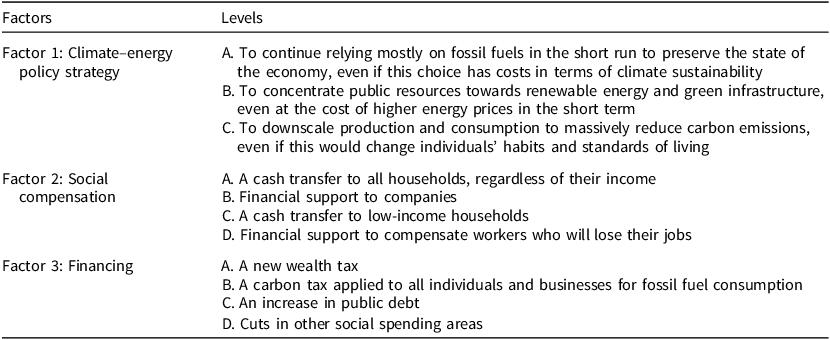
After this preamble, the respondents evaluated two pairs of randomly assigned policy packages. Each policy package consisted of three dimensions, Factors 1, 2, and 3, related to the climate and energy strategy, social compensation and financing, respectively. Each dimension had three or four levels, resulting in a conjoint design of 44 possible profiles (3*4*4).Footnote 2
‘The [NATIONALITY] government has proposed [FACTOR 1]. To protect people’s jobs and incomes, the government would also adopt [FACTOR 2]. This policy package would be financed by [FACTOR 3]’.
The scenarios administered to the respondents changed based on the options illustrated in Table 1. For each respondent, two pairs of policy scenarios, four scenarios in total, were randomly generated. As Figure A5 in the online Appendix shows, the respondents received all levels of all attributes in essentially the same proportion.
Experimental design

Note: Factor 2, Level D cannot be combined with Factor 1, Level A.
Source: Ferrera et al. (Reference Ferrera, Kyriazi, Mirò, Natili, Pellegata, Ronchi and Visconti2022).
The first dimension pertains to different potential strategies to address European countries’ transition away from dependence on Russian energy, with each embodying a different combination of macroeconomic and environmental strategies. On the one hand, the green transition might be rapidly enhanced, which involves massively investing in renewable energy that directly influences the green energy supply (Factor 1B). On the other hand, since a shift towards clean and renewable sources may not reduce energy prices quickly enough, the recent ‘climate turn’ in energy policy might be postponed by a continued reliance on fossil fuels to preserve the economy, even at the expense of climate sustainability (Factor 1A). In the weeks after the invasion of Ukraine and the introduction of sanctions on Russia, many EU governments looked for (the cheapest) available fossil fuel alternatives to Russian fuel, for example, by extending the life of coal-fired power plants and shifting the government’s long-term focus back to less sustainable energy infrastructures. Eventually, governments may also decide to gradually downscale production and consumption behaviours to decrease the energy demand in their economic system (Factor 1C). These three levels are framed in a way that highlights the costs associated with each strategy. We are fully aware that the economic growth strategy employed by the government is the result of a complex array of different policy choices that cannot be equated simply to the strategy pursued to secure the energy supply. However, given that the experiment was fielded at the peak of the energy crisis (see the next section), we decided to focus our first factor on the potential response that national governments may adopt. This choice allows us to exacerbate the economy–environment trade-off.
The second dimension relates to the different strategies available to compensate ‘losers’ of the energy policy strategy. In the context of the ‘cost-of-living’ crisis that followed the Russian invasion of Ukraine, all three of these policy choices imply costs and distributive consequences. Therefore, the experiment was designed to introduce a form of social compensation. A first possibility would be to rely on ‘traditional’ welfare benefits, either through social transfers targeting workers directly affected by climate mitigation policies (Factor 2D) or through a benefit targeting low-income households struggling with inflation and decreasing purchasing power (Factor 2C). A second opportunity would be a more drastic restructuring of the welfare state through the introduction of a cash benefit for the whole population (Factor 2A), a sort of (environmental) universal basic income (Büchs Reference Büchs2021). Finally, governments may choose a different direction by designing compensatory instruments that benefit those private companies negatively affected by green transition policies or simply by increasing energy prices in the aftermath of the Ukraine war (Factor 2B). A limitation of this design is that the duration of financial support, whether to individuals or companies, was not specified, leaving respondents to interpret these measures as either temporary or permanent. Such differences in interpretation could affect levels of support, as some might oppose, for example, a permanent basic income to address what they perceive as a temporary problem.
A closely related yet distinct issue involves the way in which the energy and compensating instruments should be financed. Building on the literature (Baute Reference Baute2025; Nicoli et al. Reference Nicoli, van der Duin and Burgoon2023), we selected the following policy options, each of which has specific distributive consequences: cutting current expenditures and, in particular, retrenching existing welfare states that are the main source of expenditure for European countries (Factor 3D); increasing public debt (Factor 3C), thus allowing future generations, who will benefit the most from reaching environmental goals, to pay for the cost of the green transition; introducing a carbon tax (Factor 3B); or taxing the rich with a wealth tax (Factor 3A).
After seeing each pair of policy packages, the respondents answered two questions. A discrete-choice question asked the respondents which of the two proposals they preferred, resulting in a dichotomous choice, our main dependent variable. Second, the respondents were asked to rate each of the two policy proposals by expressing the degree to which they supported the first and second scenarios on a scale ranging from 0 to 10, on which 0 indicated ‘strongly against’ and 10 indicated ‘strongly in favour’. We used the respondents’ scores on the rating variable as an alternative dependent variable to test the robustness of our results (see online Appendix Figure A8). Figure 1 presents a screenshot from the online survey experiment that shows an example of a pair of policy scenarios randomly assigned to the respondents, followed by the discrete-choice question asking which of the two policies they preferred to see adopted by their national government.
Screenshot from the online survey experiment.
Source: Ferrera et al. (Reference Ferrera, Kyriazi, Mirò, Natili, Pellegata, Ronchi and Visconti2022).

Data and methods
The conjoint experiment was included in a cross-national survey conducted in seven European countries: Germany, France, Italy, Spain, Sweden, Poland, and the United Kingdom (Ferrera et al. Reference Ferrera, Kyriazi, Mirò, Natili, Pellegata, Ronchi and Visconti2022). This selection included politically relevant countries in Europe and ensured sufficient variation in country-level factors that might affect public preferences for the green transition. These countries face the challenge of addressing climate change while ensuring energy security and resilience against inflationary crises in uneven ways. They display significant heterogeneity in terms of economic capacity, fiscal constraints, welfare state models, and energy profiles. As shown in Appendix Table A1, the countries vary substantially in GDP size and growth, social expenditure, public debt, renewable energy use, and energy import dependence. This variation ensures that our analysis captures public opinion dynamics in diverse structural contexts. Although the analysis of cross-country differences falls outside the scope of this study, the Appendix outlines the rationale for the country selection. Furthermore, Figure A1 in the Appendix shows how levels of public support for the policy vary across the sampled countries depending on its characteristics.
We recruited national samples of at least 1,500 respondents per country, for 11,020 respondents, drawn from an online opt-in panel provided by the polling company YouGov. The national samples were stratified by age (18–34, 34–55, 55+), gender, educational level (low, middle, high based on the ISCED classification), and region of residence (NUTS-1).Footnote 3 The survey was conducted between December 1 and 9, 2022, a period during which the energy crisis triggered by the Russian invasion of Ukraine was particularly strong. Eurostat data show that in the second quarter of 2022, the average household electricity and gas prices increased sharply and reached the highest level on record in Eurostat. In particular, between the second half of 2021 and the second half of 2022, gas prices increased in all 27 EU countries by an average of 70%.Footnote 4 All of these price increases were caused by the energy and supply component and were driven mainly by the energy crisis, as well as taxes and other related costs. Increases in energy prices were also among the main drivers of the inflation rate (consumer price index), which was 2.5 per cent in the EU at the end of 2021 but reached 9.22 per cent in December 2022.Footnote 5
Individuals’ sociostructural positions were measured using the respondents’ self-reported occupation in seven categories: business owners, managers, professionals, clerical workers, lower grade service workers, sociocultural workers, and production workers; and categories were added for retired and unemployed individuals. Climate change vulnerability was operationalised through a binary variable resulting from a combination of three survey items asking, ‘Thinking about your neighbourhood, to what extent, if at all, was it affected by the following events over the last 12 months? “air pollution”; “water pollution”; “extreme weather (floods, droughts, wildfires, etc.)”’. Answers were given on a five-point Likert scale: 1 – ‘not at all affected’; 2 – ‘not very much affected’; 3 – ‘somewhat affected’; 4 – ‘very much affected’; and 5 – ‘extremely affected’. The resulting binary variable was coded as 1 – ‘affected’, if the respondents reported that their neighbourhood was ‘very much’ or ‘extremely’ affected (4 or 5) by at least one of the phenomena: air pollution, water pollution, or extreme weather; otherwise, the binary variable was coded as 0 – ‘not affected’. The respondent’s vulnerability to policies mitigating the effects of climate change was estimated through answers to the question, ‘How likely do you think it is that you will lose your job or have to close down your activity in the next five years due to the following events? Your activity/company being seriously limited by policies for protecting the environment’. Responses were also collected in five categories from 1 – ‘not at all likely’ to 5 – ‘extremely likely’ and were recoded into three classes: ‘not likely’ (0), ‘somewhat likely’ (1), and ‘likely’ (2). Finally, we measured ideological leanings with individual self-placement on a 0 (‘left’)–10 (‘right’) scale, recoded into six categories: ‘left’ (0–1), ‘centre-left’ (2–3), ‘centre’ (4–6), ‘centre-right’ (7–8), ‘right’ (9–10), and ‘not located’ (those who did not know where to locate themselves). Tables A1–A5 in the online Appendix report the descriptive statistics of all of the moderating factors included in the empirical analyses.
Empirical results
Our empirical analysis proceeds as follows. First, we examine individual preferences across our three key policy dimensions – energy strategy, social compensation, and financing mechanism – and how these characteristics are interrelated. Second, we investigate how the respondent’s socioeconomic position, climate, and policy vulnerability, and ideological orientation shape these preferences. Finally, in a third section, we identify which policy packages emerge as most popular among our survey respondents, thereby offering insights into which solutions may help navigate the multiple trade-offs highlighted in this study.
Public preferences for single policy features and their interactions
This section presents the results of a discrete-choice analysis, in which we forced the respondents to choose between two policy packages with varying attributes for each of the three factors, in the form of ‘marginal means’. In contrast to the average marginal component effect (AMCE), marginal means are favoured because they do not depend on an arbitrarily selected reference category (Leeper et al. Reference Leeper, Hobolt and Tilley2020). This makes marginal means more appropriate when the aim is to compare subgroup preferences. In this setting, marginal means can be interpreted as the probability of a profile being selected when it contains a specific attribute, averaged over all the remaining attributes. Since each respondent had to choose between two competing policy profiles, we accounted for the nonindependence of observations using clustered standard errors at the respondent level. Analyses were estimated in R with the cregg package and included poststratification weights to correct misrepresentation in quotas for age, gender, education, and macroarea of residence (Leeper Reference Leeper2018).
Figure 2 presents the estimated marginal means indicating the support level for the policy package across the whole sample, pooling the respondents from all seven countries included in the study for the presence of each specific attribute of the three dimensions. The horizontal lines extending from the point estimates represent the 95% confidence intervals for each attribute.
Marginal means for policy package attributes.
Note: Horizontal lines represent 95% confidence intervals computed with respondent-clustered standard errors.
Source: Authors’ elaboration based on Ferrera et al. (Reference Ferrera, Kyriazi, Mirò, Natili, Pellegata, Ronchi and Visconti2022).

With respect to the first factor, the energy strategy, the respondents were significantly more likely to choose a policy package that included investing in renewable energy (0.54). On the contrary, respondents are indifferent to downscaling production (0.5), while a strategy that aims at relying on fossil fuels decreases public support for the policy (0.46).
Regarding social compensation, both supporting affected workers (0.53) and providing a cash transfer to low-income households (0.52) increase support for a policy package. Interestingly, supporting affected companies decreases the support level (0.45). In contrast, transferring cash to all households does not affect the respondents’ choice (0.51), suggesting that a basic income remains a divisive proposal for both supporters and opponents.
How such a policy would be financed is also relevant in shaping public support for a policy package. The attribute that increases support the most is the introduction of a wealth tax (0.59). On the other hand, both increasing public debt (0.47) to finance energy and social policies and reducing social spending (0.43) significantly reduce the probability of support for a policy package, averaging across all other attributes of a package. In contrast, the introduction of a carbon tax is quite controversial among the public (0.50).
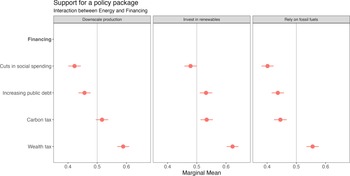
The next step of our empirical analysis is to assess whether, and to what extent, social compensation and redistributive financing forms help to increase support for investing in renewable energy, in line with H1a–b. Thus, Figures 3 and 4 report the marginal means of the social compensation attributes and those of the financing sources, respectively, by the respondents’ preferred energy policy. These graphs allow us to evaluate the existence of heterogeneity across the conjoint features and investigate whether the effect of one factor on public support is moderated by the attribute of another factor.
Interaction between the energy policy and the preferred social compensation.
Note: Horizontal lines represent 95% confidence intervals computed with respondent-clustered standard errors.
Source: Authors’ elaboration based on Ferrera et al. (Reference Ferrera, Kyriazi, Mirò, Natili, Pellegata, Ronchi and Visconti2022).

Interaction between support for the energy policy and the preferred financing source.
Note: Horizontal lines represent 95% confidence intervals computed with respondent-clustered standard errors.
Source: Authors’ elaboration based on Ferrera et al. (Reference Ferrera, Kyriazi, Mirò, Natili, Pellegata, Ronchi and Visconti2022).

In line with H1a, Figure 3 shows that the presence of social compensation measures increases the respondents’ likelihood of supporting investment in renewable energy and green infrastructures. This finding indicates the emergence of a synergy between eco- and social policies, as framing social policies as part of the energy transition increases support for the policy package, transcending traditional constituencies that favour either social spending or renewables investments. Support for affected workers and cash transfers to either low-income households or all citizens have approximately the same positive effect on the likelihood of supporting an energy strategy based on renewables investments. Conversely, support for affected companies does not affect the respondents’ choices. Interestingly, with respect to the other two energy policy options, the respondents’ support for a policy package pursuing downscaling production or continuing to rely on fossil fuels does not change and even slightly decreases when associated with the different social compensation measures proposed.
Figure 4 shows that the effect of the third factor, the financing source, on the likelihood of preferring a policy package is also moderated by the preferred energy policy option. Irrespective of the energy policy option, but with differences in the magnitude of the effects, the respondents’ likelihood of preferring a policy package always tends to decrease when it is financed by cutting spending in other social areas, whereas it increases when it is financed with a wealth tax. Interestingly, both increasing the public debt and a carbon tax increase the respondents’ support for a policy package only when the latter also includes investing in renewable energy and green infrastructures (0.52). Overall, the analysis confirms that redistributive compensation mechanisms tend to increase public support for renewable energy policies. This finding underscores the potential for a synergy between ecological and social goals, validating H1b.
Interaction with respondent characteristics: the effects of structural positions, vulnerabilities, and political attitudes
To test H2–H5, we examined the heterogeneity in the evaluation of policy packages based on respondents’ structural positions, perceived vulnerabilities and ideological leanings. Starting from structural positions, Figures 5 and 6 report the differences across occupational categories.
Marginal means for the occupational categories.
Note: Horizontal lines represent 95% confidence intervals computed with respondent-clustered standard errors.
Source: Authors’ elaboration based on Ferrera et al. (Reference Ferrera, Kyriazi, Mirò, Natili, Pellegata, Ronchi and Visconti2022).

Interaction between the energy policy and the preferred social compensation by occupational category.
Note: Horizontal lines represent 95% confidence intervals computed with respondent-clustered standard errors.
Source: Authors’ elaboration based on Ferrera et al. (Reference Ferrera, Kyriazi, Mirò, Natili, Pellegata, Ronchi and Visconti2022).

Figure 5 supports H2a, showing that production workers and unemployed individuals are the occupational groups most concerned with the economic risk of transitioning to environmental sustainability. Specifically, these two categories remain indifferent between the energy policy options and do not support the green transition in the energy field, in the form of either renewables investments or downscaling production. Interestingly, low-income service workers share similar preferences to those held by high-skilled service workers, professionals, pensioners, and business owners, all of whom exhibit greater support for policy packages involving renewable energy investments. This finding points to a divide between low-skilled workers who are potentially directly affected by the green transition (ie production workers) and those who are not, which apparently transcends the distributive consequences of green transition packages (see also Appendix Figure A4 reporting support for the policy paradigms by occupation).
Looking at compensation mechanisms yields some puzzling results. On the one hand, compensating companies and providing means-tested support for the poor works as expected. Targeted support for low-income households increases approval among pensioners and production workers, while being disliked by professionals, managers, and business owners. Compensating companies that face higher energy prices decreases support for policy packages across all occupational categories, except for business owners, professionals, and managers. However, and somewhat surprisingly, economic support for affected workers does not increase approval among low-income workers, but rather among sociocultural workers, pensioners, professionals, managers, and business owners. With regard to the financing of these packages, few differences across occupational categories emerge, as there is a broad consensus against cutting social expenditure, except among production workers, and in favour of a wealth tax.
We may be better able to understand these findings if we focus our analysis on the interaction between compensation mechanisms and support for different energy strategies (Figure 6). On this basis, the results only partially confirm H2b, which posited that redistributive compensation is particularly effective in strengthening support for the energy transition among structurally weaker labour market groups. In contrast, the effect of social compensation – in the form of financial benefits to workers affected by the energy transition or cash transfers to low-income households – is stronger among sociocultural workers and professionals than among the workers in other occupational categories. Production workers exhibit greater support for renewables only when combined with cash transfers to low-income households. Although the effect is modest, this result – also observed among lower-grade service workers – partially aligns with our expectation, with a caveat: only means-tested social assistance benefits (slightly) increase support among production workers, whereas this is not the case for social insurance or universal benefits (see also Lindh and Nelson Reference Lindh and Nelson2025). Only lower-grade service workers are more likely to support renewables investing when the policy is paired with a universal cash transfer to all households. Overall, these findings highlight a more complex dynamic within the working class, in which social compensation alone may not suffice to secure support from those most exposed to structural labour market risks.
A focus on policy vulnerabilities helps shed light on these puzzling results. Figure 7 shows the estimated marginal means for those who believe that policies aimed at countering the effect of climate change affect their job or professional activity compared with those who do not. Notably, whether individuals perceive themselves as being directly affected by the green transition, particularly through the fear of job loss, has a strong effect on their support levels for the energy transition. Among those who feel vulnerable, no energy policy option significantly increases support; in particular, support for renewables investments is markedly lower than it is among their counterparts. This finding confirms H4a, suggesting that the fear of becoming unemployed may serve as a key barrier to the implementation of climate mitigation policies.
Marginal means for perceived policy vulnerability.
Note: Horizontal lines represent 95% confidence intervals computed with respondent-clustered standard errors.
Source: Authors’ elaboration based on Ferrera et al. (Reference Ferrera, Kyriazi, Mirò, Natili, Pellegata, Ronchi and Visconti2022).
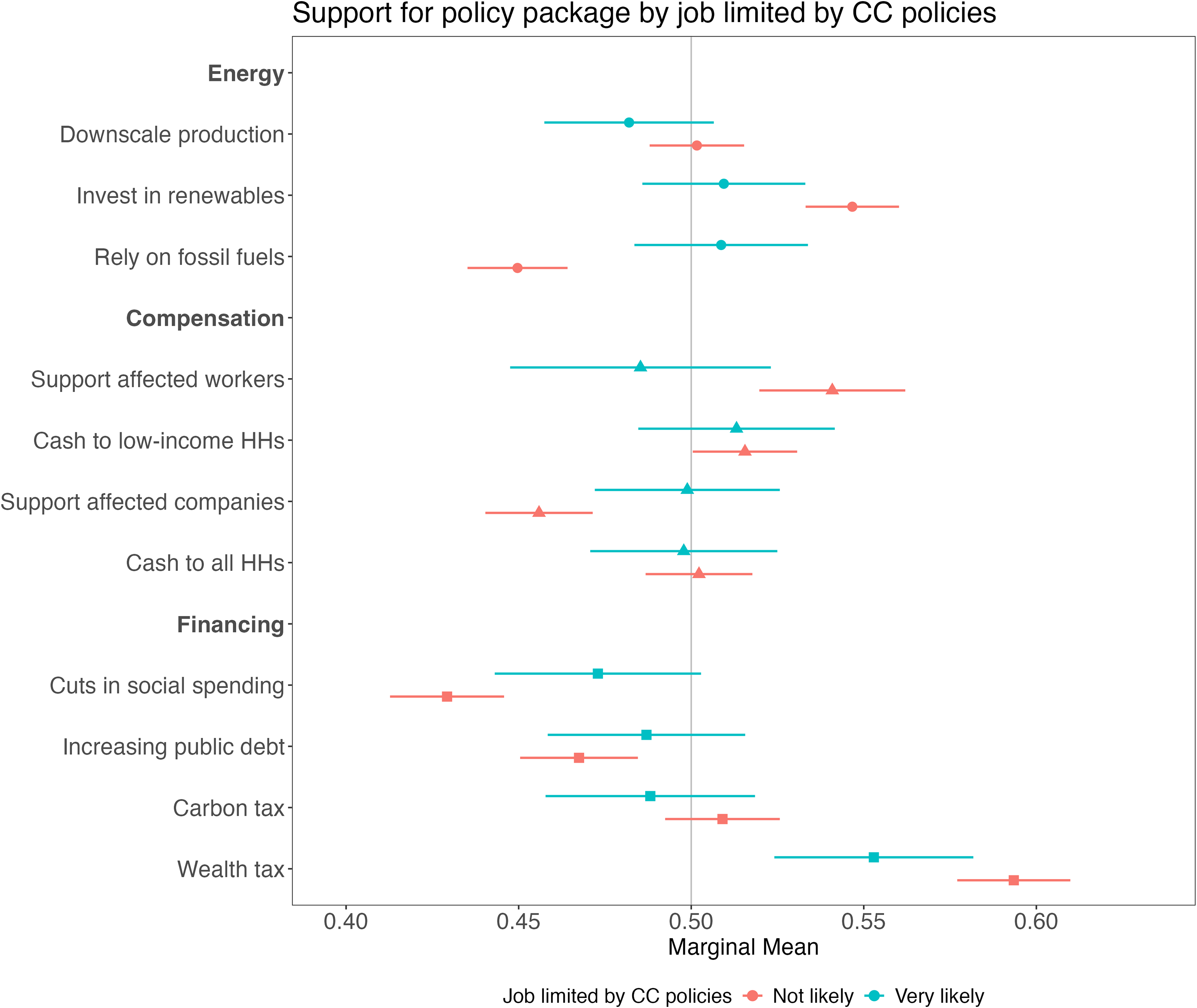
Furthermore, respondents who perceive greater threats from climate mitigation policies remain indifferent to the proposed social compensation measures. In contrast, these compensation mechanisms are particularly consequential for respondents who do not feel threatened by the energy transition (Figure 8). The latter constitutes one of the very few groups that are not opposed to supporting affected companies, suggesting that, for them, protecting jobs is the most important heuristic used to evaluate policy packages. H4b is thus rejected.
Interaction between the energy policy and the preferred social compensation by perceived policy vulnerability.
Note: Horizontal lines represent 95% confidence intervals computed with respondent-clustered standard errors.
Source: Authors’ elaboration based on Ferrera et al. (Reference Ferrera, Kyriazi, Mirò, Natili, Pellegata, Ronchi and Visconti2022).

While generally less impactful, the perception of being affected by pollution and extreme weather events has the opposite effect of increasing support for the energy transition. Figure 9 shows the marginal means for the respondents believing that their neighbourhood has been very much or extremely affected by air or water pollution or extreme weather events (such as floods, droughts, or wildfires) or both, versus those respondents not affected by any of these factors. The respondents who perceive themselves as vulnerable to environmental degradation are more supportive of an energy strategy focused on investing in renewables than those who do not perceive themselves as vulnerable. Moreover, they also favour downscaling production, an option that instead reduces support among the respondents who feel less vulnerable to environmental degradation. Finally, respondents who perceive themselves as affected by environmental degradation are also significantly less in favour of continuing to rely on fossil fuels than their counterparts.
Marginal means for perceived environmental vulnerability.
Note: Horizontal lines represent 95% confidence intervals computed with respondent-clustered standard errors.
Source: Authors’ elaboration based on Ferrera et al. (Reference Ferrera, Kyriazi, Mirò, Natili, Pellegata, Ronchi and Visconti2022).

No difference regarding the social compensation measures across this segment of the respondents emerges. Eventually, respondents for whom the salience of climate change is greater, given their perception of being affected by its consequences, are consistently more in favour of a carbon tax that aims to reduce emissions while providing resources to finance compensation measures.
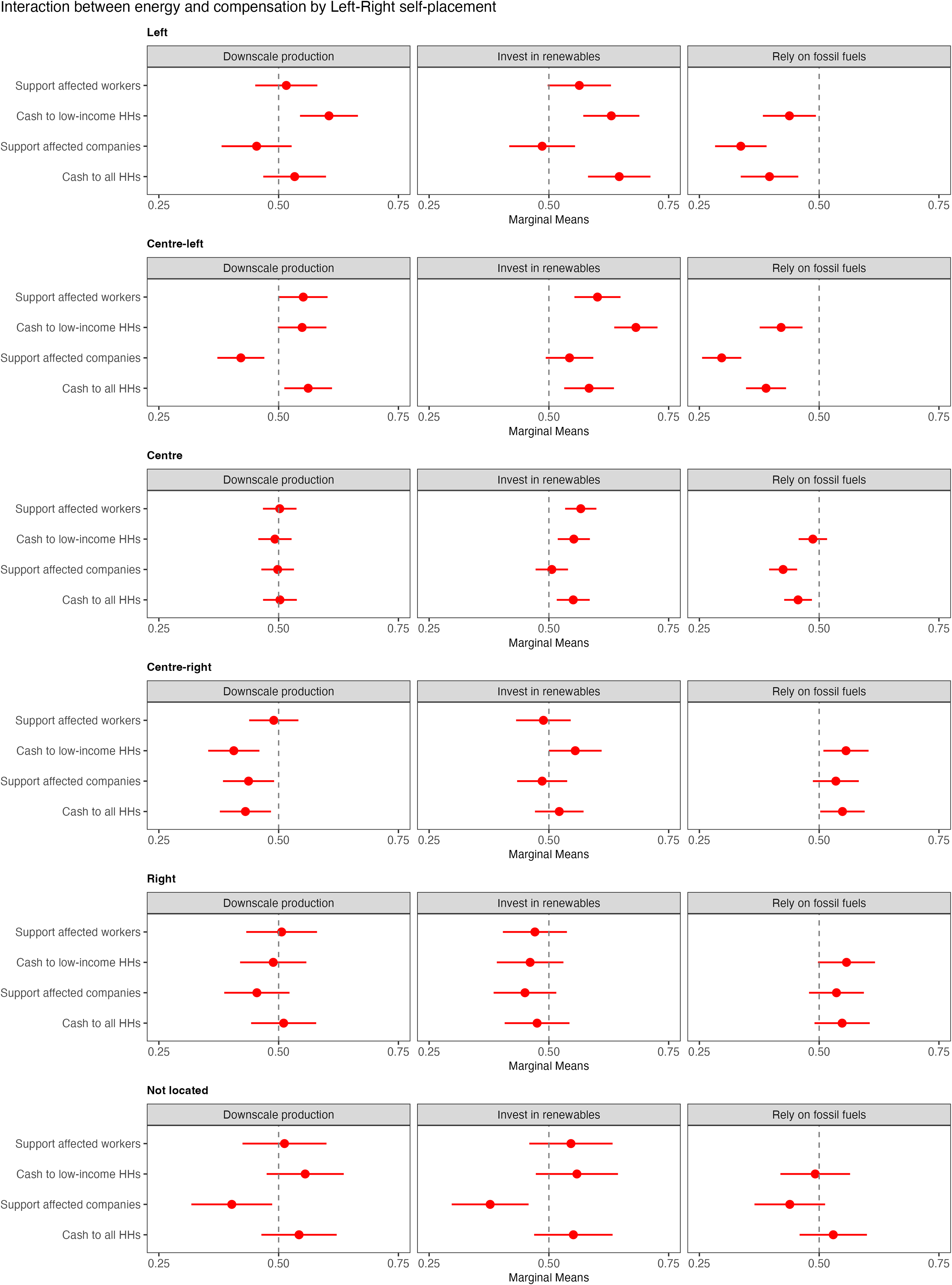
As expected, political ideology also plays a role in shaping individual preferences for policy responses to the energy crisis. The results displayed in Figure 10 confirm H5a and H5b. For the left-wing and centrist respondents, renewables investing significantly increases support for the policy package, whereas the green option reduces support among the right-wing respondents. On the other hand, the latter favour continuing to rely on fossil fuels, an option that instead reduces support among the centrist and especially among the left-leaning respondents. Furthermore, the presence of social compensation mechanisms as well as redistributive elements does not affect the likelihood of supporting the policy package among the right-wing respondents. In contrast, including benefits targeted at affected workers or low-income households in the policy package increases the left-wing respondents’ support for the policy package, whereas financial support to affected companies tends to decrease it. Similarly, the left-wing respondents do not like policy packages financed through welfare retrenchment, but such respondents are more likely to prefer policies financed via a carbon or a wealth tax.
Marginal means for ideology (left–right self-placement).
Note: Horizontal lines represent 95% confidence intervals computed with respondent-clustered standard errors.
Source: Authors’ elaboration based on Ferrera et al. (Reference Ferrera, Kyriazi, Mirò, Natili, Pellegata, Ronchi and Visconti2022).

The role played by the interconnections between the energy strategy and the social compensation is even clearer in Figure 11, which shows the results of the interaction between these two factors across ideological positions. The left-wing and centre-left respondents show significantly greater support for green transition strategies when they are paired with redistributive elements. In contrast, the right-wing respondents remain broadly sceptical of both the ecological policies and the social compensation mechanisms, showing no increase in support when compensation is introduced. These findings are consistent with the literature on the alignment between pro-environmental and redistributive preferences among the left and indicate that redistributive framing is particularly effective among these ideological constituencies (Caldwell et al.; McCright et al. Reference McCright, Dunlap and Marquart-Pyatt2016).
Interaction between the energy policy and the preferred social compensation by ideological position.
Note: Horizontal lines represent 95% confidence intervals computed with respondent-clustered standard errors.
Source: Authors’ elaboration based on Ferrera et al. (Reference Ferrera, Kyriazi, Mirò, Natili, Pellegata, Ronchi and Visconti2022).
Public support for different policy packages to respond to the energy crisis
Our experimental design also allows us to deepen our analysis by ranking public support for different policy packages to respond to the energy crisis, namely, combinations of climate–energy policies with specific social compensation mechanisms and financing sources. Relevantly, these policies can be closely associated with the paradigms that have emerged over the last few decades to address the multidimensional challenges of the green transition, namely, the growth-first, green-growth, just-transition and postgrowth paradigms (Koch Reference Koch2025; Mandelli et al. Reference Mandelli, Sabato and Jessoula2021).
Relying on our experimental design, a policy package in line with a growth-first approach would prioritise preserving the state of the economy in the short term, a continued reliance on fossil fuels, combined with support for companies to avoid damage stemming from increasing energy prices. To finance the increasing expenditures for the energy policy, we argue that supporters of this approach would oppose any tax increase and would instead be more likely to appreciate welfare state retrenchment.
A green-growth response would instead support redirecting investment from fossil fuels to renewables while, in general, sharing similar preferences to the previous approach as the other two dimensions: support for companies to adapt to the green transition—and little labour market intervention, limited at maximum to favouring retraining and improving skills—and opposition to the introduction of other taxes or increasing public debt.
A just-transition strategy to react to the energy crisis would generally be supportive of moving past fossil fuels and investing in renewables. Compensating the losers of this transition is a crucial dimension of this framework, which is compatible with the introduction of a benefit targeting workers losing their jobs or with a targeted transfer to low-income families. In terms of financing, this approach is open to more policy options, including the introduction of a carbon or wealth tax.
Finally, a response in line with the postgrowth sustainable welfare approach, a paradigm which questions the ‘growth imperative’ (Daly and Farley Reference Daly and Farley2011; Koch Reference Koch2025) and prioritises the joint pursuit of ecologically and socially sustainable alternatives, can be associated with a policy package that combines the downscaling of production and consumption with the introduction of a universal basic income to be financed through increasing taxes on the rich. Since different combinations of energy policies, social compensation, and financing sources can be broadly associated with these four policy paradigms, we also tested public support for several alternative combinations, the results of which are presented in the Appendix.
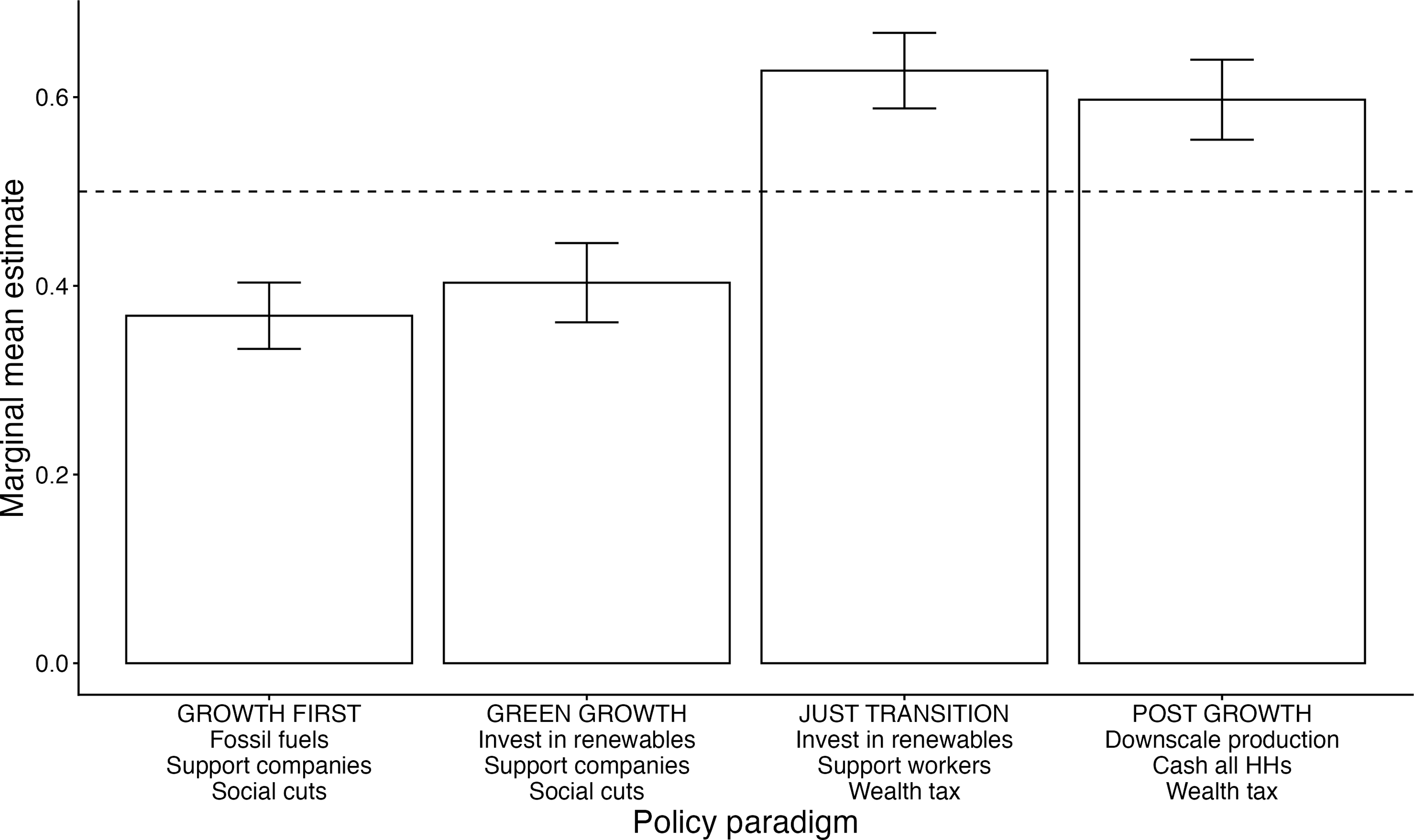
Figure 12 presents the predicted support for a selected set of policy packages we chose to exemplify the four policy paradigms. The figure suggests that a just-transition strategy with a robust redistributive dimension that combines investment in renewables, support for affected workers and financing by a wealth tax is, all else equal, the preferred policy package (0.63). Support for a just-transition strategy also remains high when it includes support for low-income households with a wealth tax (0.64) or with a carbon tax (0.58), and it receives the lowest support level (0.5) when it combines support for workers affected by the transition with a carbon tax (see Figure A3 in the Appendix).
Predicted support for specific policy paradigms.
Note: Horizontal dashed line corresponds to an estimate of the marginal mean equal to 0.5.
Source: Authors’ elaboration based on Ferrera et al. (Reference Ferrera, Kyriazi, Mirò, Natili, Pellegata, Ronchi and Visconti2022).
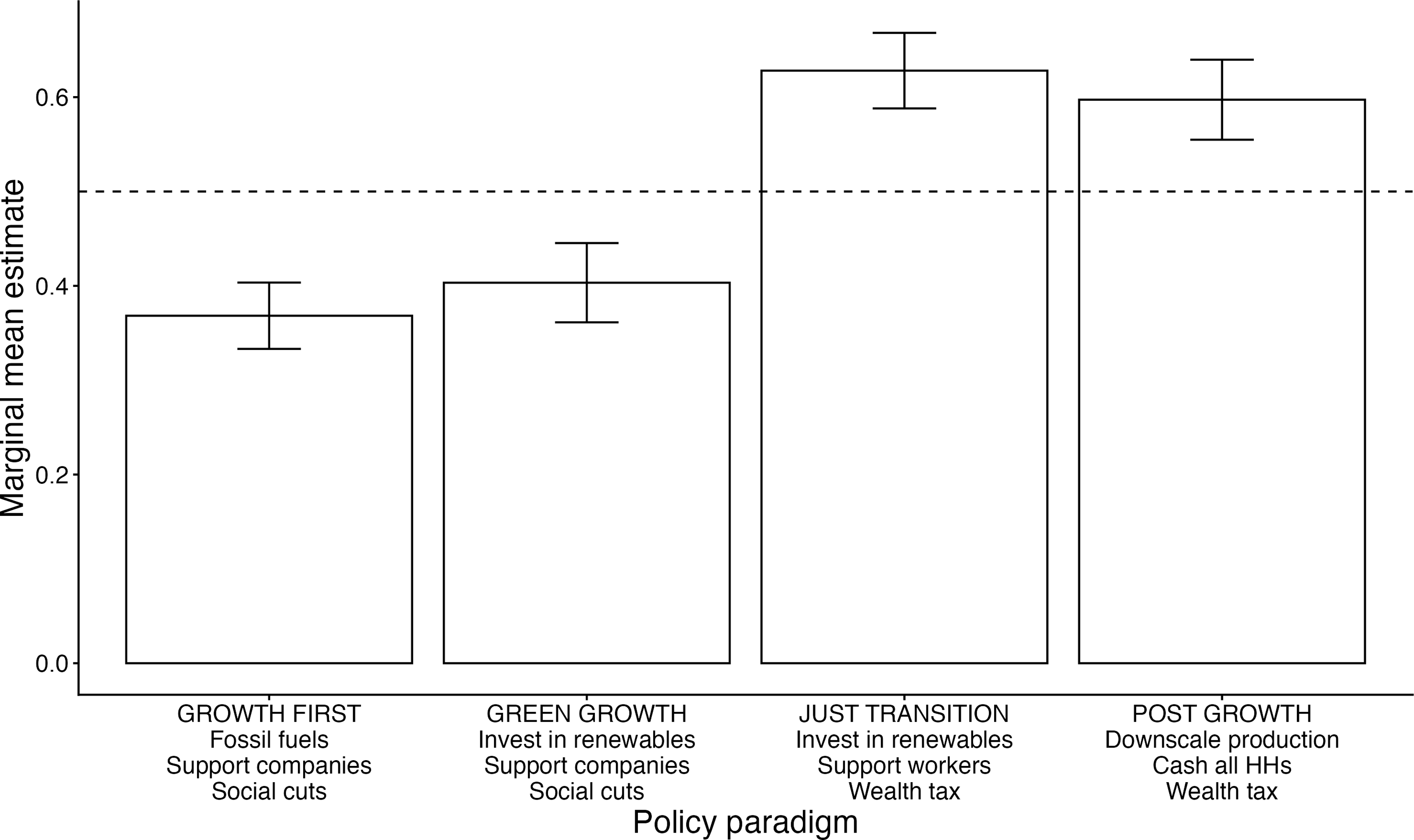
The growth-first approach, which combines a reliance on fossil fuels with support for companies affected by increasing energy prices paid through social cuts, does not seem to represent the policy preferences of citizens in the seven studied European countries (0.37). Similarly, a green-growth approach that combines renewables investments with support for affected companies financed through social cuts does not receive most of the predicted support (0.40). Surprisingly, instead, we detected high support for a post-growth paradigm, as downscaling production combined with a basic income and a wealth tax receives support at approximately the same level as the just-transition paradigms (0.60).
Overall, in line with our expectations, the just-transition strategy appears to garner the highest support. Shifting to cleaner energy production methods, combined with measures that guarantee equity on the expenditure and financing sides, warrants greater support for the policy package. As shown in the analyses, the strong social compensation character of policy packages in line with this paradigm is particularly relevant for increasing the likelihood of preferring this strategy to cope with the consequences of the energy crisis. This is particularly true for those respondents, such as sociocultural professionals, who support energy transition more than other respondents, as well as for those who feel themselves more threatened by climate mitigation policies. Notably, opting for different policy packages that are compatible with the just-transition paradigm does not substantially alter the outcomes (see Appendix Figure A3).
Discussion and conclusions
What kind of energy transition do European citizens want? Amid the rapid pace of atmospheric changes and the alarming loss of biodiversity, recent EU climate initiatives – promoting a ‘green growth’ strategy but downplaying social considerations (Crespy and Munta Reference Crespy and Munta2023; Mandelli et al. Reference Mandelli, Sabato and Jessoula2021) – have, in the context of rising living costs, contributed to fuelling Eurosceptic voting (Toygür and Sojka Reference Toygür and Sojka2026). Against this backdrop, an informed discussion on how we can fundamentally transform our economy and, more broadly, our way of living is more urgent than ever. This article seeks to contribute to that endeavour.
Overall, our results suggest that, to avoid a green backlash – especially during periods of rising energy prices – the energy transition needs to be combined with social protection and redistributive mechanisms. A just-transition strategy with a robust redistributive dimension – one that combines investment in renewables, support for affected workers or low-income families, and that is financed by a wealth tax – is, all else equal, the preferred policy package to respond to the energy crisis. Policy packages that focus primarily on economic growth, such as the growth-first approach, or that promote growth through green technologies without addressing social sustainability (eg green growth) tend to receive limited public support. Surprisingly, support may be greater for a post-growth approach, as downscaling production combined with a basic income and a wealth tax, while quite controversial in some cases, does not seem to be as opposed by EU citizens as the ‘techno-optimist’ laissez-faire policy strategy.
However, the reception of this just-transition strategy is markedly uneven across political constituencies, reflecting divergent priorities and ideological orientations. Leftists and the pivotal group of centrist voters seem particularly supportive of a green transition when its distributive dimension is carefully addressed. In contrast, techno-optimists and growth-first supporters are among the right-leaning voters. Overall, we do not find that ecological and social considerations create inconsistent demands on party leaders; rather, the socioeconomic dimension tends to align with the environmental dimension.
When considering socioeconomic constituencies, relevant divides within potential party bases emerge instead: production workers and unemployed individuals clearly fear the transition towards environmental sustainability, whereas another constituency potentially vulnerable to the distributive consequences of the green transition, low-skilled workers employed in service sectors, are rather supportive of investing in renewables. This contradiction reinforces our final main finding: policy vulnerabilities and individuals’ situations and perceptions matter a great deal (Gaikwad et al. Reference Gaikwad, Genovese and Tingley2022; Ronchi et al. Reference Ronchi, Natili and Molteni2023). Workers who perceive that their jobs are threatened by environmental protection policies consistently oppose green transition measures, even when social compensation mechanisms are proposed. Conversely, individuals who feel particularly affected by pollution or extreme weather events show greater support for both postgrowth and just-transition approaches. On one hand, these findings underscore the potential divisions within the workforce regarding policy packages aimed at addressing climate change (Gugushvili and Otto Reference Gugushvili and Otto2023; Ronchi et al. Reference Ronchi, Natili and Molteni2023). On the other hand, our experiment suggests that two highly redistributive instruments – a robust means-tested social assistance benefit and, even more effectively, a progressive wealth tax - when combined with investments in renewables, can play an important role in bridging these divides and securing support for the energy transition.
Taken together, these results emphasise the dilemmas, trade-offs, and opportunities that different political parties face in navigating the green transition. Notably, public appetite is significant for a redistributive just-transition strategy, particularly among leftist voters, offering a potential avenue for revitalising a social democratic project that has been described as in decline for decades (Bandau Reference Bandau2022; Häusermann and Kitschelt Reference Häusermann and Kitschelt2024). To seize this opportunity, trade unions and left-wing parties must develop a comprehensive policy package capable of persuading both vulnerable workers and citizens that they will not become the new “losers” of yet another structural transformation.
Supplementary material
The supplementary material for this article can be found at https://doi.org/10.1017/S1475676526100784
Data availability statement
The replication code and data that support the findings of this study are openly available on the Harvard Dataverse at this link: https://doi.org/10.7910/DVN/RP7MKP.
Acknowledgements
Previous versions of this paper were presented at the 2023 ECPR General Conference, the 2023 Conference of Europeanists, the 2023 SISP Conference, and the Villa Vigoni Workshop held in March 2024. We are very grateful to all participants - and in particular to Reto Bürgisser, Cecilia Biancalana, Bianca Luna Fabris, Paolo Graziano, Riccardo Ladini, Matteo Mandelli, and Fedra Negri - as well as to the anonymous reviewers for their valuable comments and suggestions.
Funding statement
The collection of the survey data used in this publication was financially supported by the University of Milan, Department of Social and Political Sciences (DECC 2018–2022).
Competing interests
The authors declared no potential conflicts of interest with respect to the research, authorship, and/or publication of this article.
Ethical statement
The Unimi Eco-Social survey was administered online by the polling company YouGov to an online-panel on quota-based, adult samples (18+) in seven European countries. Participation was voluntary, and all respondents provided explicit informed consent prior to taking part in this study. Minors and vulnerable individuals were not included. The study involved no deception and posed no more than minimal risk to participants. Data processing complied with the General Data Protection Regulation (GDPR). The researchers did not have access to any personal identifying information of respondents; the company separates personal data from survey responses and provides only fully anonymised datasets to the research team. Further details on the ethical standards and procedures of the survey are provided in the ‘Research Ethics Appendix’ included in the supplementary materials.






 Open access

