


Acute myocardial infarction (heart attack), hypertension, hypothermia, or hyperthermia are among the causes of the death of the victims under the debris in an earthquake.Reference Alexander1, Reference Li, Qian and Liu2 In hypothermia, body temperature falls below 35°C2 while homeostasis tries to keep it constant against the decreasing ambient temperature.Reference Yıldız, Bilgin and Yilmaz3 Exposure to cold increases the rates of fat and glycogen metabolism and fluid and electrolyte loss. Acid-base disorder increases the blood viscosity and deteriorates the heat regulation mechanisms,Reference Constable, Hinchcliff and Done4 leading to an increase in the ketone and glucose levels and muscle tremors. The exact survival time under hypothermic conditions depends on the individual factors for each person and is difficult to predict with precision.Reference Turk5 In general, at a body temperature of 30°C, the mortality rate is about 70% and people do not lose consciousness, but mortality rate becomes more than 90% at a body temperature of 26°C. When the body cannot effectively dissipate heat and the body temperature reaches 40°C or above, hyperthermia occurs. Prolonged hypothermia may have fatal consequences.Reference Palmiere and Mangin6
The conversion rate of the consumed food into energy is determined by the rate of the metabolism. BMR (basal metabolic rate) is the baseline amount of the calories needed by the body to function. Energy expenditure and longevity are inversely proportional in the larger and longer-lived animals, which has lower BMR.Reference Ruggiero and Ferrucci7 The BMR is sometimes referred to as the resting metabolic rate and implies the total number of calories that the body needs to perform the essential, life-sustaining functions including circulation, breathing, cell production, nutrient processing, protein synthesis, and ion transport. Daily energy expenditure is less in older adults because their basal metabolic rate and thermic effect of the foods are less when compared to those of the younger adults, even when they have similar amounts of lean tissue and consume a similar size meal.Reference Du, Rajjo, Santosa and Jensen8 High BMR was associated with the risk of early death.Reference Ruggiero, Metter and Melenovsky9–Reference Han, Hu and Wang11 In the Baltimore Longitudinal Study of Aging, which was conducted for 40-years of follow-up period, it was observed that BMR decreased with age, and the individuals who had higher BMR died earlier than the ones who had slower BMR.Reference Ruggiero, Metter and Melenovsky9 This observation agrees with the “entropy theory of aging.”Reference Silva and Annamalai12 Results of the entropic age studies assumed a new role to “entropy generation.”Reference Hayflick13–Reference Yildiz, Semerciöz and Yalcinkaya18 Annamalai and Silva Reference Annamalai and Silva19 made significant contribution to the entropic-age concept by quantifying aging stress on the individual organs.
AmanoReference Amano20 argued that the BMR of children less than 2 years of age was proportional to body weight. BMR was reported to be proportional with the square root of the body weight in children older than 2 years. The maintenance fluid volume for children 2-18 years of age may be calculated with the formula suggested by Holliday and Segar.Reference Holliday and Segar21 The metabolic rate may show an acute phenotypic flexibility with the changes in the internal state or environment of an animal, but this change may decrease with exposure time.Reference Seebacher, White and Franklin22 It has also been stated that BMR may vary with the level of food availability.Reference Zeng, Fu and Fu23
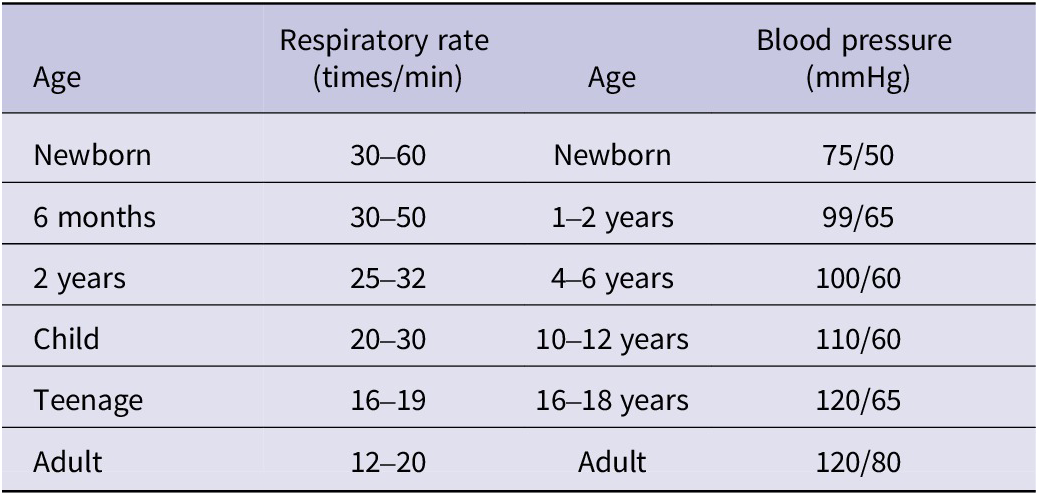
Blood pressure, respiration, body temperature/temperature, pain, and pulse are the signs of vitality.Reference Lockwood, Conroy-Hiller and Page24 The rate of respiration may vary with age; while it is 16-20/minute in healthy young adults, it may be 16-25/minute in advanced age.Reference Braun, Walker, Hall and Hurst25 Blood pressure is affected by age, gender, exercise, nutrition and position of the body, smoking, race, drug use and diseases.26 Variation of respiratory rate and blood pressure in association to age is presented in Table 1.
Variation of the respiratory rates and the blood pressures with ages
The balance between heat generated and dissipated determines body temperature. While heat generation occurs as a result of metabolism, heat loss occurs through radiation, convection, conduction, and evaporation. Heat generation increases with the rate of metabolism, and the body temperature decreases when the heat generation decreases. Age, gender, physical activity, daily temperature cycle, emotional state, environment, hormonal factors, drugs, sweating, sleepiness, and bleeding are among the factors affecting body temperature. Hyperpyrexia occurs when the body temperature rises to 41°C. At 42°C, brain cells are affected; at 44°C, respiration stops, tissue proteins are destroyed, enzymes are inactivated, vital activities stop, and death occurs.Reference Garami and Székely27
Hypothermia occurs when body temperature drops below 36 °C. Below 35°C, tremor, memory loss, depression, and difficulty in perception occur. Below 34.4°C, pulse, respiration, and blood pressure decrease and cyanosis (a bluish discoloration of the skin due to poor circulation or inadequate oxygenation of the blood) occurs. As temperature drops further, loss of consciousness, arrhythmia, and unresponsiveness to painful stimuli occur. Minimum and the maximum values of body temperature depend on where it is measured. The normal range of oral temperature measurements is 35.5-37.5°C, and those of rectal, axilla (arm pit), and tympanic (ear) temperature measurements are 37-38, 36-37, and 36.5-37.5°C, respectively.
Serious crushing and injuries to the head or chest and loss of blood due to internal bleeding are among the causes of death in an earthquake. In addition to situations caused by external factors such as dehydration, hypothermia, and hyperthermia, it is possible to develop conditions that require amputation in people who remain under debris for a few hours or days. In such cases, symptoms such as kidney failure and fatal cardiac arrhythmia are likely to occur. Kidney failure is frequently observed in the earthquake victims. An organized approach to cope with kidney failure was initiated after the Armenian Spitak earthquake in 1988.Reference Vanholder, Sever and Lameire28 Heavy dust released from collapsed buildings can cause suffocation and upper respiratory tract obstruction and can be life-threatening. Sudden pulmonary oedema may result from powder inhalation and causes delayed death. Chronic diseases such as diabetes, hypertension, or heart disease combined with depression, anxiety, or respiratory distress may lead to death.Reference Herrera, Campos-Romero and Szabo29 In the Marmara Earthquake, 97% of the victims were saved after remaining under the debris for 5-8 hours, and the time that an individual can stay under debris was determined to be 11.7-14.3 hours.Reference Sever, Erek and Vanholder30
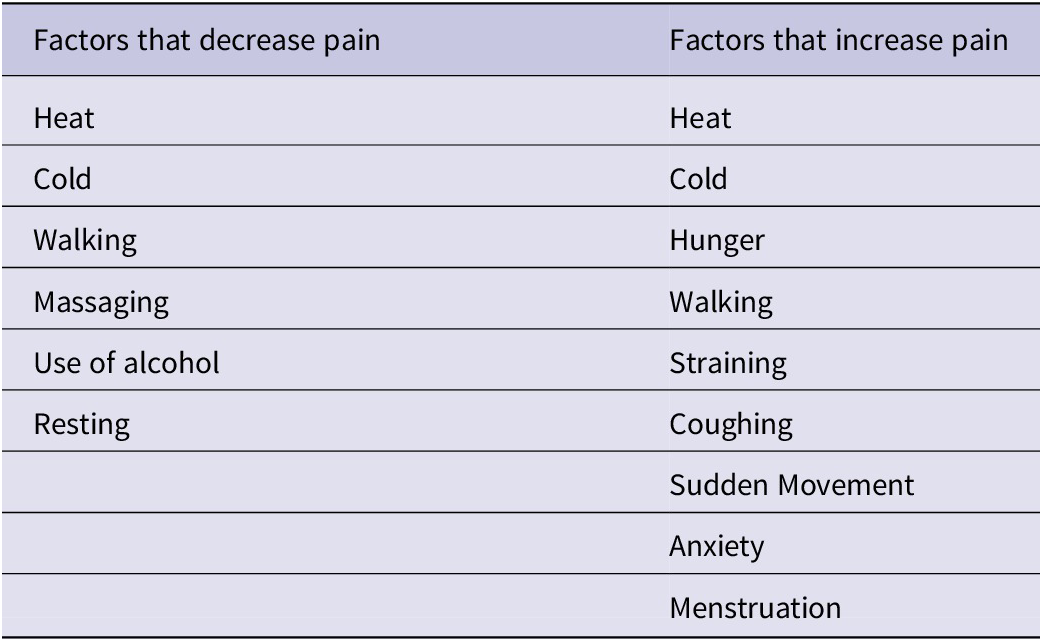
Air temperature affects heart disease patients more when compared to the healthy people because it may cause thrombosis due to concentration of the blood. In addition, the increase in blood circulation on the skin surface to prevent heat loss from the human body can trigger pain in the chest and cause heart attack. In the cases of long-term exposure to heat, heat cramps and heat stroke, and the effects of long-term thirst, acute kidney failure, blood viscosity, and increased cholesterol may be among the conditions encountered.Reference Schwartz, Samet and Patz31 Patients with chronic diseases may not have access to their medicines both during and after disasters; therefore, these patients were at higher risk of catching diseases, such as the common cold.Reference Kobayashi, Hanagama and Yamanda32 Earthquake victims with chronic diseases such as high blood pressure, chronic heart failure, diabetes, rheumatism, and chronic lung disease have higher morbidity compared to individuals who do not have these diseases.337 The sense of pain of an individual originating from a certain part of the body may be dependent or independent of tissue damage. Acute or chronic diseases, surgical conditions, trauma, immobility, medical interventions, and emotional factors can be the causes of the pain. While hot, cold, walking, massage, alcohol, lying down, and sleep/rest may have pain-reducing effects, heat, cold, hunger, walking, straining, coughing, sudden movement, anxiety, and menstruation may increase pain.Reference Shankland34
Pulse rate of an individual is affected by factors such as exercise,Reference Yalcinkaya, Genç and Yılmaz35 hyperthermia, hypothermia, acute pain and anxiety, chronic and long-lasting pain, drugs, age, metabolism, bleeding, and posture changes.Reference Summit and Böckelmann36 Age, gender, build of the body, physical activity level, drug use, exercise, fever, pain, anxiety, loss of blood, and posture may affect blood pressure, respiration, and pulse rates (Table 2).
Variation of the arterial blood pressure, respiration rate and pulse rate with aging

Under normal conditions, systolic pressure is below 90 mm Hg and the diastolic pressure is less than 50 mm Hg. Hypotension occurs when the blood pressure is below the normal value. When hypotension prevails, symptoms such as dizziness, cold sweating, increase in heart rate, mental fuzziness, and decrease in urination are observed. In hypertension, the blood pressure is consistently above its normal value for a period. Acute or chronic diseases, surgical interventions, trauma, immobility, medical interventions for diagnosis and treatment, and psychological and emotional factors may cause pain.
Nutritional status, environmental conditions, mental state (stress), hormonal activity level, exercise, age, perspiration rate, sleepiness, bleeding, slowdown of the metabolism due to aging, and the taking of vasodilators (medicines that open the blood vessels) and sedatives (medicines promoting a calming effect on body temperature) must be considered. Hyperpyrexia is the condition where the body temperature reaches 41°C. At 42°C, brain cells are affected; at 44°C, breathing stops, tissue proteins are destroyed, enzymes are inactivated, vital activities stop, brain cells die, and death occurs. Hypothermia is the decrease of the body temperature to less than 36°C. When the body temperature drops below 35°C, tremor (a rhythmic shaking movement in 1 or more parts of the body), memory loss, depression, and difficulty in perception develop. When body temperature falls below 34.4°C, pulse, respiration, and blood pressure drop, and cyanosis occurs. When body temperature drops further, loss of consciousness, arrhythmia, and painful impairment to stimulus develop. Factors that decrease or increase pain are summarized in Table 3.
Factors that decrease or increase the pain
Methods
Fundamental laws of thermodynamics as explained by Özilgen and SorgüvenReference Özilgen and Sorgüven37 and Özilgen and YilmazReference Özilgen and Yılmaz38 were employed to evaluate the data. The first law of thermodynamics is expressed as:
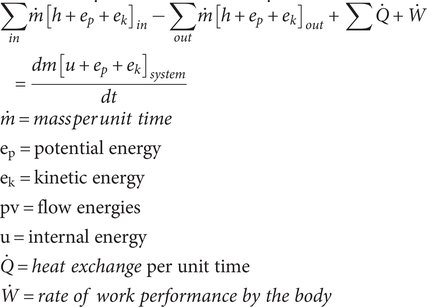 $$ {\displaystyle \begin{array}{l}\sum \limits_{in}\dot{m}\dot{{\left[h+{e}_p+{e}_k\right]}_{in}}-\sum \limits_{out}\dot{m}\dot{{\left[h+{e}_p+{e}_k\right]}_{out}}+\sum \dot{Q}+\dot{W}\\ {}\hskip1em =\frac{dm{\left[u+{e}_p+{e}_k\right]}_{system}}{dt}\\ {}\dot{m}= mass\; per\; unit\ time\\ {}{\mathrm{e}}_{\mathrm{p}}=\mathrm{potential}\ \mathrm{energy}\\ {}{\mathrm{e}}_{\mathrm{k}}=\mathrm{kinetic}\ \mathrm{energy}\\ {}\mathrm{pv}=\mathrm{flow}\ \mathrm{energies}\\ {}\mathrm{u}=\mathrm{internal}\ \mathrm{energy}\\ {}\dot{Q}= heat\ exchange\hskip0.42em \mathrm{per}\hskip0.42em \mathrm{u}\mathrm{nit}\ \mathrm{time}\\ {}\dot{W}= rate\ of\ work\ performance\hskip0.42em by\hskip0.42em the\ body\end{array}} $$
For someone who is under debris $ {\dot{m}}_{in}={\dot{m}}_{out} $
. ep and ek may be neglected because they are small compared to their internal energy, and then Equation (1) becomes:
$ {\dot{m}}_{in}={\dot{m}}_{out} $
. ep and ek may be neglected because they are small compared to their internal energy, and then Equation (1) becomes:
 $$ \sum \dot{Q}+\dot{W}=\frac{dm{\left[\;u+{e}_p+{e}_k\right]}_{system}}{dt} $$
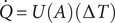
When the ambient temperature is 30°C or less, Equation (3) describes the heat removal rate from the body as:
 $$ \dot{Q}=U(A)\left(\Delta T\right) $$
Where U= Total heat transfer coefficient, A= Heat transfer area, $ \Delta T $
= Difference between the environment and body temperature. The values of U may be calculated as:
$ \Delta T $
= Difference between the environment and body temperature. The values of U may be calculated as:
 $$ \frac{1}{U\left(\frac{W}{K{m}^2}\right)}=\frac{1}{h\left(\frac{W}{K{m}^2}\right)}+\frac{x_1(mm)}{k_1\left(\frac{mW}{Km}\right)} $$
The k1 and x1 are the values of the heat transfer coefficient and thickness of the clothing on the individual. If the thickness of the clothing can be neglected, the final equation will be:
 $$ U\left(\frac{W}{K{m}^2}\right)=h\left(\frac{W}{K{m}^2}\right) $$
The average surface area of a male and adults and the 9-year-old child were 1.9 m2, 1.6 m2, and 1.07 m2, respectively.39 When body temperature was 35 °C (308 K) with A = 1.9 m2, ∆T = 276K-308K = -32K heat transfer coefficient U was 3.3 W/K m2 in the sitting position and 3.4 W/KmReference Li, Qian and Liu2 in the lying (sleeping) position of the male adult. The metabolic rate was 58 W/m2 in the seated position and 46 W/m2 for the sleeping (lying) position.40 Total metabolic heat loss was obtained by multiplying the surface area with the metabolic rate as (58 W/m2) x 1.9 m2 = 110.2 W in the seated and (46 W/m2) x 1.9 m2 = 87.4 W in the lying positions of the adult male; therefore, $ \dot{Q}=-200.64\;W $
and -206.74 W, in sitting and lying male adults, respectively. When the previous calculations are repeated for a female, metabolic heat generation rate would be (46 W/m2) x 1.6 m2 = 73.6 W and would be
$ \dot{Q}=-200.64\;W $
and -206.74 W, in sitting and lying male adults, respectively. When the previous calculations are repeated for a female, metabolic heat generation rate would be (46 W/m2) x 1.6 m2 = 73.6 W and would be $ \dot{Q}=-168.96\;W $
in the sitting position. The metabolic heat generation rate would be -76.16 W and
$ \dot{Q}=-168.96\;W $
in the sitting position. The metabolic heat generation rate would be -76.16 W and $ \dot{Q}=-172.5\;W $
in the lying female adult.Reference Kayali, Yavuz and Yilmaz41 When the same calculations are repeated for the child, metabolic heat generation rate would be (58 W/m2) x 1.07 m2 = 62.06 W and
$ \dot{Q}=-172.5\;W $
in the lying female adult.Reference Kayali, Yavuz and Yilmaz41 When the same calculations are repeated for the child, metabolic heat generation rate would be (58 W/m2) x 1.07 m2 = 62.06 W and $ \dot{Q}=-112.992\;W $
in the sitting position. In the lying position, metabolic heat generation rate would be (46 W/m2) x 1.07 m2 = 49.22 W and
$ \dot{Q}=-112.992\;W $
in the sitting position. In the lying position, metabolic heat generation rate would be (46 W/m2) x 1.07 m2 = 49.22 W and $ \dot{Q}= $
-67.196 W.Reference Çengel42
$ \dot{Q}= $
-67.196 W.Reference Çengel42
Entropy balance is expressed with Equation (6):
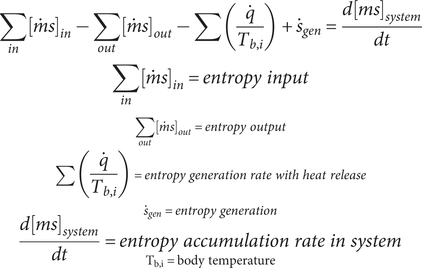 $$ {\displaystyle \begin{array}{c}\sum_{in}{\left[\dot{m}s\right]}_{in}-\sum_{out}{\left[\dot{m}s\right]}_{out}-\sum \left(\frac{\dot{q}}{T_{b,i}}\right)+{\dot{s}}_{gen}=\frac{d{\left[ ms\right]}_{system}}{dt}\\ {}\sum_{in}{\left[\dot{m}s\right]}_{in}= entropy\ input\\ {}\begin{array}{c}\sum_{out}{\left[\dot{m}s\right]}_{out}= entropy\ output\\ {}\sum \left(\frac{\dot{q}}{T_{b,i}}\right)= entropy\ generation\ rate\ with\ heat\ release\\ {}\begin{array}{c}{\dot{s}}_{gen}= entropy\ generation\\ {}\frac{d{\left[ ms\right]}_{system}}{dt}= entropy\ accumulation\ rate\ in\ system\\ {}{\mathrm{T}}_{\mathrm{b},\mathrm{i}}=\mathrm{body}\ \mathrm{temperature}\end{array}\end{array}\end{array}} $$
Under extreme conditions, if the body temperature (Tb) is $ 35{}^{\circ}\mathrm{C}, $
the value of sgen used in this equation is always positive. It can also be 0 if the process is reversible. Because this value is not a property of the system, it depends on the process. The entropy changes of the system or the environment can be negative. Entropy is a non-conserved property. As a result, it can be said that the entropy of the universe is in a continuous increase.Reference Çengel42 The change in entropy (∆S) is calculated with the above equation. Again, for someone under the debris
$ 35{}^{\circ}\mathrm{C}, $
the value of sgen used in this equation is always positive. It can also be 0 if the process is reversible. Because this value is not a property of the system, it depends on the process. The entropy changes of the system or the environment can be negative. Entropy is a non-conserved property. As a result, it can be said that the entropy of the universe is in a continuous increase.Reference Çengel42 The change in entropy (∆S) is calculated with the above equation. Again, for someone under the debris $ {\dot{m}}_{in}={\dot{m}}_{out} $
. The
$ {\dot{m}}_{in}={\dot{m}}_{out} $
. The $ \sum \left(\frac{\dot{q}}{T_{b,i}}\right) $
part can also not be evaluated because the amount of heat that will be released from the system will be very low, so it will not influence entropy. The final equation turns into:
$ \sum \left(\frac{\dot{q}}{T_{b,i}}\right) $
part can also not be evaluated because the amount of heat that will be released from the system will be very low, so it will not influence entropy. The final equation turns into:
 $$ {\dot{s}}_{gen}=\frac{d{\left[ ms\right]}_{system}}{dt} $$
 $$ {\mathrm{C}}_6{\mathrm{H}}_{12}{\mathrm{O}}_6+6{\mathrm{O}}_2\to 6{\mathrm{H}}_2\mathrm{O}+6\mathrm{C}{\mathrm{O}}_2 $$
 $$ {\mathrm{C}}_6{\mathrm{H}}_{32}{\mathrm{O}}_2+13{\mathrm{O}}_2\to 6\mathrm{C}{\mathrm{O}}_2+16{\mathrm{H}}_2\mathrm{O} $$
 $$ \Delta {\dot{s}}_{rxn1}^o=6{\dot{s}}_{CO2}^o+6{\dot{s}}_{H2O}^o-{\dot{s}}_{C6H12O6}^o-6{\dot{s}}_{O2}^o $$
 $$ \Delta {\dot{s}}_{rxn2}^o=6{\dot{s}}_{CO2}^o+16{\dot{s}}_{H2O}^o-{\dot{s}}_{C6H32O2}^o-13{\dot{s}}_{O2}^o $$
Where glucose, C6H12O6, represents carbohydrates and palmitic acid, C6H32O2 represents the lipids used in the metabolic activities, and both are metabolized by O2 in the body and leave the body as H2O and CO2 as described by equations (8) and (9). Equations (10) and (11) describe the entropy change of these metabolic reactions, where $ 6{\dot{s}}_{CO2}^o $
and
$ 6{\dot{s}}_{CO2}^o $
and $ {\dot{6s}}_{H2O}^o $
are the entropy output rates of the products after the metabolic activities at body temperature, and the
$ {\dot{6s}}_{H2O}^o $
are the entropy output rates of the products after the metabolic activities at body temperature, and the $ {\dot{s}}_{C6H12O6}^o $
,
$ {\dot{s}}_{C6H12O6}^o $
, $ {\dot{s}}_{\mathrm{C}6\mathrm{H}32\mathrm{O}2}^o $
, and
$ {\dot{s}}_{\mathrm{C}6\mathrm{H}32\mathrm{O}2}^o $
, and $ {\dot{s}}_{O2}^o $
reactants are also the absolute entropy generation rates by the metabolism of glucose and the lipids at room temperature. In this study, the thermodynamic properties of glucose and palmitic acid were adapted from KuddusiReference Kuddusi43 and used for metabolic calculations (Table 4). The amino acids are structural elements and not employed in the energy metabolism.Reference Annamalai44 By following a similar approach with Sánchez-Paz et al.,Reference Sánchez-Paz, García-Carreño and Muhlia-Almazán45 who studied the starvation of crustations and did not include the metabolism of amino acids into their calculations.
$ {\dot{s}}_{O2}^o $
reactants are also the absolute entropy generation rates by the metabolism of glucose and the lipids at room temperature. In this study, the thermodynamic properties of glucose and palmitic acid were adapted from KuddusiReference Kuddusi43 and used for metabolic calculations (Table 4). The amino acids are structural elements and not employed in the energy metabolism.Reference Annamalai44 By following a similar approach with Sánchez-Paz et al.,Reference Sánchez-Paz, García-Carreño and Muhlia-Almazán45 who studied the starvation of crustations and did not include the metabolism of amino acids into their calculations.
Thermodynamic properties of foods used in metabolic activities and the products formed as a result of metabolic reaction under 1 atm, where sio and si are the absolute entropy values of metabolic reactants and products of metabolism under standard conditions Reference Kuddusi43
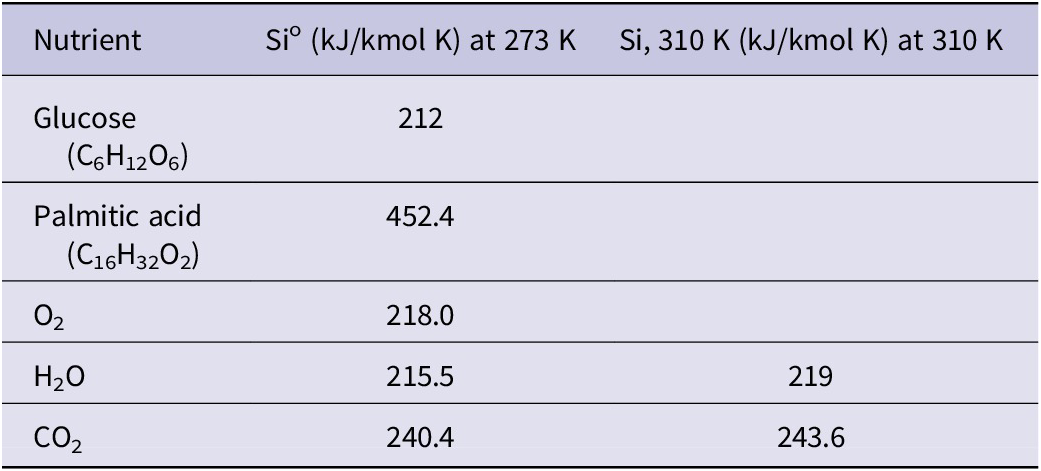
As a result of the calculations made by using Equation (10) and the values given in Table 4, $ \Delta {\dot{s}}_{rxn1}^o $
for the carbohydrate metabolic activity was found as 1255.6 kJ/kmol K. Similarly, the
$ \Delta {\dot{s}}_{rxn1}^o $
for the carbohydrate metabolic activity was found as 1255.6 kJ/kmol K. Similarly, the $ \Delta {\dot{s}}_{rxn2}^o $
value for the lipid metabolic activity is 1679.2 kJ/kmol K. To summarize, the
$ \Delta {\dot{s}}_{rxn2}^o $
value for the lipid metabolic activity is 1679.2 kJ/kmol K. To summarize, the $ {\dot{s}}_{gen} $
entropy value obtained in Equation (7) can be called
$ {\dot{s}}_{gen} $
entropy value obtained in Equation (7) can be called $ {\dot{s}}_{g{en}_{glucose}} $
for carbohydrate metabolism and its value is 1255.6 kJ/kmol K, and for lipid metabolism,
$ {\dot{s}}_{g{en}_{glucose}} $
for carbohydrate metabolism and its value is 1255.6 kJ/kmol K, and for lipid metabolism, $ {\dot{s}}_{g{en}_{palmitic\ acid}} $
is 1679.2 kJ/kmol K.
$ {\dot{s}}_{g{en}_{palmitic\ acid}} $
is 1679.2 kJ/kmol K.
Results and Discussion
Environmental factors, diseases, and the rate of metabolism are among the factors affecting death rate. In the presents study, calculations were made for women, men, and children for both sitting and lying positions. It was found that the adult man lost -90.44 W of heat in the sitting position; in the lying position, his heat loss rate was -119.32 W. The heat loss rate in the lying position was higher than in the sitting position due to the fact that the body has more space to lose heat. When the same calculations were made for adult women, they were found to be -76.16 and -100.48 W in sitting and lying positions, respectively. As can be understood from this result, a loss of heat and energy has occurred from the human body. Likewise, in the calculations made for the child, finding -50.932 and -67.196 W for sitting and lying positions, respectively, shows that there is heat and energy loss for the child. One of the reasons for this is that the ambient temperature is very low (e.g., 3°C), as stated above. In addition, if a comparison would be made with the values obtained between men, women, and children, it can be said that the adult men will lose more heat than the women and children because their surface area for heat transfer is greater. The same interpretation can also be made in the comparison of women and children, and it can be interpreted that adult women woman will lose more heat than children. Therefore, by evaluating only these data as mortality, it can be predicted that the death of adult men will occur earlier than that of adult women and children. According to these values, children will lose less heat, so it may be estimated that children may stay under the debris longer. SmithReference Smith46 in her review explained fundamental differences in child–adult thermoregulation, which is found to be a lifesaving advantage for the children trapped under rubble in an earthquake.
There are also other factors affecting these results. Metabolic rate values were taken as the same for adult men, women, and children, but it is known that metabolic rates are higher in men than in women, although there may be different affecting factors.Reference Arciero, Goran and Poehlman47 This factor was ignored for this study and this can be shown as the reason for values to change. As it can be understood from the values taken as metabolic rate, work done by a person in the sitting and lying positions is different, and metabolic speed in the sitting position is higher than in the lying position. This affects the work done in sitting and lying positions and affects heat and energy loss.
Equation (5) was used to ignore the thickness of people’s clothing in Equation (4) while making the calculations. Because the thickness of the clothing was ignored without relying on certain data, this also affected the obtained U value and indirectly the Q value. A person could be wearing a thick sweater at that moment, or he/she could be wearing thin pyjamas. If he/she was wearing a thick clothing, the U value would decrease for that person and the Q value would also decrease, causing him/her to lose less heat and energy; but if he/she was wearing a thin outfit, on the contrary, it would cause more heat and energy loss. This is one of the reasons that affect the result of energy balance.
In addition, 2 types of positions were examined while making these calculations, which is a variable situation because people may be in different positions at that time, which may affect the result. The fact that the heat transfer coefficient value taken for humans is not personal, and that it is taken from an average and thermal mannequin, can be shown as another factor affecting the result. As a common interpretation, it can be interpreted that the human body will lose a lot of heat and energy in winter environments where ambient temperatures are low, and that the body cannot maintain its life activities because it cannot provide sufficient efficiency and energy balance at a body temperature of 35°C.
When calculations are made for the case of an earthquake in summer, not in winter, the energy balance for the adult male was found to be 53.77 and 29.26 W in the sitting and lying positions, respectively. It was found to be 45.28 and 24.64 W for women and 30.281 and 16.478 W for children. As can be understood from these results, there will be no heat and energy loss from the body under debris. In this case, it can be said that disease, metabolic rate, the situation under the debris, injury, and infection will be the leading causes of morbidity and death rather than heat loss due to environmental factors.
The entropy produced in the human body, in summary, shows activity levels of heat flowing and the movements of substances in the body and the reactions that take place. Entropy production in basal conditions and in the temperature range of 26-32°C is almost constant and does not depend on environmental factors. It is possible to obtain the entropy produced in the human body by the difference between the change in entropy and the net entropy entering the body, and this calculated value is positive.Reference Aoki48
Some parameters have been neglected in the equation we used to calculate entropy in this study. In this case, where we assume that the body temperature is below 35°C and the air temperature is low, the temperature released from the human body is accepted as 0. Glucose was chosen as the carbohydrate and palmitic acid was chosen as the lipid to be used in the calculations. Proteins, which are used in the body after carbohydrates and lipids, were not included in this study. As a result of the calculations, the entropy changes that occur after the metabolic reactions of carbohydrate and lipid with oxygen, or in other words, their metabolic activities are as follows, respectively, 1255.6 kJ/kmol K and 1679.2 kJ/kmol K.
Entropy generation occurs in the body as a result of the chemical reactions of protein, fat, and carbohydrates taken with food, increasing total entropy generation and shortening the lifespan.Reference Kuddusi43–Reference Öngel, Yıldız and Özilgen51 Age groups, population in age group, number of the crush victims, and the number of the deaths accounted for in the Marmara Earthquake of 1999 are summarized in Table 5. Table 5 shows that in the age group of 0-9 year, the mortality rate of the crush victims was 0 because the BMR of these children was low; also, the earthquake happened at 3:03 in the morning, which is probably the coldest time of day, and they were losing sufficient heat to avoid hyperpraxia. As the population and age of the victims increased, more people died and the survival rate decreased. The highest mortality rate was in the 60+ age group. According to the entropic age concept, this group of victims had already accumulated a lot of entropy (e.g., heath problems) and were more prone to death.
Age group, population, number of the crush patients, number of deaths, crush rate per 100,000, mortality rate per 100,000 and the mortality rate of the crush victims accounted in the Marmara Earthquake of August 17, 1999. Data were adapted from Sever et al (2002)Reference Sever, Erek and Vanholder30


 Open access

