





Introduction
Over the past few decades, many countries have implemented democratic innovations (DIs), resulting in diverse institutional formats, diffusion paths, and evolutions in process design – that is, diverse trajectories of DI.Footnote 1 Yet, as highlighted in the introduction to this Special Issue, we still know relatively little about these trajectories from a systematic, country-level perspective, let alone enough to enable robust cross-national comparison. This article addresses this gap for the German case by asking two questions: How have DIs spread and institutionally evolved across levels of government in Germany since 1990? To what extent and in which directions have these trajectories shifted citizens’ opportunities to engage in political processes? In answering these questions, we add to the existing literature with fresh data on the dissemination of DIs in Germany, published for the first time, and offer a critical analysis of their potential contributions to citizens’ opportunities and democratic functions.
Germany is an especially interesting case for delineating the trajectories of DIs and analysing their contributions to broadening citizens’ opportunities. Against the background of the negative historical experiences with plebiscitary elements in the Weimar Republic and the Nazi dictatorship, the constituent assembly of the Federal Republic of Germany (FRG) developed a constitution with a strong emphasis on representative institutions. Participatory reforms thus progressed slowly, culminating in the proliferation of DIs since the reunification of East and West Germany in the early 1990s. As in most democratic systems, DIs were introduced in addition to and not as a replacement for the institutions of representative democracy. Empirical research on DIs and their evolution in Germany remains scarce.
In this paper, we provide original data covering the time frame of 1990 – 2024, ie, after the reunification of Germany. We focus on three types of DIs that have been applied in Germany: direct democratic instruments, participatory budgeting (PB), and deliberative mini-publics (DMPs), as these are the most prominent innovations. We add to the research with fresh data by using unique datasets on direct democratic instruments and Bürgerräte (German lot-based DMPs) that are hosted by the Institute for Democratic and Participatory Research (IDPF) at Wuppertal University.
This paper not only provides a description of the trajectories of DIs in Germany but also examines these trajectories by applying an analytical framework with a focus on citizens’ opportunities (Elstub and Escobar Reference Elstub, Escobar, Elstub and Escobar2019) complemented by a system perspective (Warren Reference Warren2017). This framework is a useful tool to understand the potential contributions of different DIs to the enhancement of democratic functions via the provision of more and novel opportunities for citizens to engage with political processes. We apply this framework to three crucial DIs in Germany, from 1990 to 2024.
The paper begins with the description of our theoretical framework (‘Theoretical framework’ section) and a brief overview of democratic reforms in Germany since 1950 (‘Democratic reforms in Germany: Overview’ section). It explains the methods and data we used (‘Methods’ section) and proceeds to the main part, ie, the mapping of the descriptive trajectories and their evaluation (‘Three trajectories’ section). We show that Germany has experienced various peaks in the implementation of different types of DIs as well as shifting type preferences. We also demonstrate that DIs proliferated differently across the different levels of governance (local, state, and federal). Applying our theoretical framework allows us to identify a trend towards formats providing unempowered and partly inclusive participation with communicative means for deliberation and will-formation, but with limited opportunities for influence and decision-making. In the conclusions we summarise our findings and provide an outlook for future research.
Theoretical framework
To assess the trajectories of DIs in Germany and their potential to enhance citizen opportunities, a conceptual framework is needed. Elstub and Escobar provide a useful starting point, conceptualising DIs as:
…processes or institutions that are new to a policy issue, policy role, or level of governance, and developed to reimagine and deepen the role of citizens in governance processes by increasing opportunities for participation, deliberation and influence. (Reference Elstub, Escobar, Elstub and Escobar2019: 11).
Their conceptual framework serves two purposes. First, it establishes comprehensive criteria for identifying which processes and institutions qualify as DIs (Elstub and Escobar Reference Elstub, Escobar, Elstub and Escobar2019: 23). Second, it specifies what DIs should offer citizens, ie, ‘opportunities for participation, deliberation, and influence’ (Reference Elstub, Escobar, Elstub and Escobar2019: 11). ‘Participation’ refers to the possibilities for citizens to be involved in political processes. ‘Opportunities for deliberation’ relates to the means of communication provided within the political sphere. ‘Influence’ describes the opportunities for citizens to have an impact on public policies.
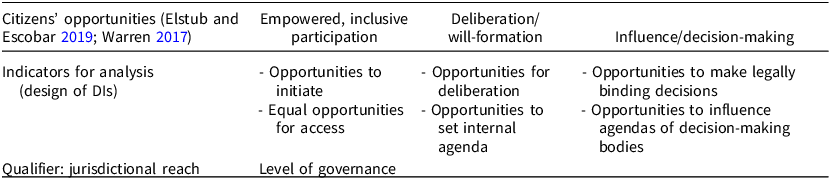
Whereas Elstub and Escobar focus on opportunities to participate as they relate to citizens, Warren’s approach adds a system perspective focused on the ‘functions’ of a democracy: empowered inclusion, collective will-formation, and collective decision-making (Reference Warren2017). For example, a change in citizens’ opportunities for political influence simultaneously shapes the decision-making function within a democracy. On the basis of Elstub and Escobar’s conceptualisation of citizens’ opportunities and complemented by the system perspective of Warren, we thus develop a useful analytical frame with the following dimensions: empowered and inclusive participation; deliberation for collective will-formation; and influence on decision-making.
Empowered and inclusive participation refers to the core normative principle of democracy, in that those who are (potentially) affected by a collective decision should also have a voice (participation) in the making of that decision. This includes the right to demand and enforce the inclusion of their voice through participatory formats. The opportunity to exercise these rights should be equitably distributed (Warren Reference Warren2017: 44).
Deliberation for collective will-formation refers to communicative practices for transforming individual preferences and opinions into a collective will of the citizenry (‘communicative means’) (Warren Reference Warren2017: 44). This should include the power to set the internal agenda for deliberation within the respective DI.
Influence on decision-making means that citizens are empowered as a ‘collective’ and have ‘the capacity to make and impose binding decisions upon themselves’ (Warren Reference Warren2017: 44). We operationalise collective decision-making as degrees of formal authority in the policy-making process prescribed within the DI design (Bua Reference Bua, Elstub and Escobar2019: 287). This refers, first, to opportunities for making binding decisions within the relevant jurisdiction and, second, to non-binding decisions, in that citizens can provide recommendations to which authorities are under a formal obligation to respond, ie, citizens can influence the political agenda of decision-making bodies.
Table 1 summarises our analytical approach. To assess the contributions of DIs for citizens’ opportunities, we operationalise the concepts and identify several indicators specified in Table 1. We expect that the diffusion and institutional evolution of DIs in Germany will enhance citizens’ opportunities by expanding their chances to participate in, deliberate about, and influence political processes.
Analytical frame: Citizens’ opportunities (as means to enhance democratic functions)

DI, democratic innovation
In our analysis, the level of governance will be considered as a qualifier of jurisdictional reach. This also allows us to compare the dissemination vertically (across local, state, and federal political levels) and horizontally (between states). In the German federation, the Länder (German states) possess substantial authority in core policy domains, and municipalities enjoy constitutionally protected self-government; nevertheless, federal-level venues generally entail broader jurisdictional reach (Sack Reference Sack2013).
Democratic reforms in Germany: Overview
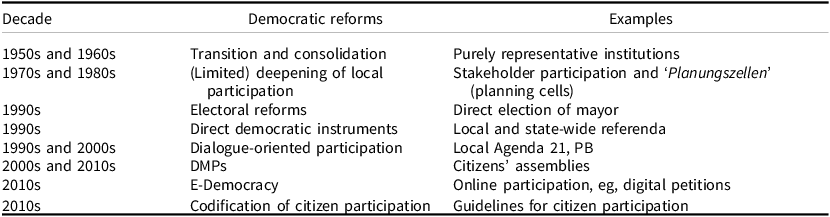
In Germany, the implementation of DIs is part of an ongoing process of democratic reform (Hendriks Reference Hendriks2023: 3), beginning at the end of 1945 and with a push after reunification in 1990. Table 2 sketches major reform episodes since the 1950s and locates innovations within them.
Phases in the introduction of democratic reforms in Germany, following Kersting (Reference Kersting and Kersting2017: 89 et seq.)

Source: Kersting (Reference Kersting and Kersting2017: 89 et seq.)
The initial phase (1950s – 1960s) encompasses the transition and consolidation from former authoritarian governance structures to democratic ones. During the 1970s and 1980s, local government became legally obliged to publish information on significant planning projects and, in many cases, to provide some form of feedback channel for stakeholders (Geissel and Kersting Reference Geissel, Kersting, Stock, Behringer, Stiftung and Evangelisch-Reformierte Landeskirche2014). This was also the time of increasing New Social Movements as well as Chancellor Willy Brandt’s policy of ‘mehr Demokratie wagen’ (‘daring more democracy’).Footnote 2 Planning cells, a prototype of DMPs at local level, also emerged (‘DMPs’ section).
In the 1990s, three developments took place: electoral reforms, the increase and deepening of direct democratic instruments, and the proliferation of dialogue-oriented participation.
Local elections underwent significant reform with the introduction of direct voting for mayors, the option of recall, and personal voting of councillors (‘kumulieren und panaschieren’). Citizens could now vote for their preferred candidates within or even across parties, potentially altering the pre-fixed ranking.
Direct democratic instruments were already available in some states before the 1990s, but their availability and practice increased significantly after German reunification. From 1990 onwards, they were introduced in many German states at local and state levels – particularly in the states of the former German Democratic Republic (East Germany). In the ‘old’ West German states, new direct democratic instruments were implemented, or existing instruments were expanded. Today, direct democratic instruments are present in all states (‘Direct democratic instruments’ section).
In the late 1990s, dialogue-oriented forms of participation also proliferated. These were preceded by planning cells in Western Germany and the so-called Runde Tische (round tables) in the late 1980s and early 1990s in East Germany. Round tables were part of the political and socioeconomic transformations of 1989/90 in East Germany and took place at the national, state, and local levels. The central round table in Berlin (1989 – 90), for example, included representatives from government and civil society opposition to negotiate a smooth and peaceful transformation (Thaysen 1990). Similar formats were (temporarily) established throughout the eastern German regions and cities (Weil Reference Weil2011). However, they hardly succeeded in notably influencing the institutional transformation of East Germany.
In the now unified FGR, other forms of dialogue-oriented participation became prominent. Indicative are the Local Agenda 21 processes, which aimed to develop plans for the sustainable development of municipalities in Germany by opening spaces for dialogue, consultation, and mutual learning between citizens, civil society organisations, private enterprises, and local authorities. Between 1997 and 2005, around 20% of municipalities in Germany employed such processes, all of which were purely consultative, with the decision-making power remaining within the city council (Geissel and Hess Reference Geissel, Hess and Heinelt2018).
The 2000s and 2010s saw a rise of randomly selected DMPs (‘DMPs’ section) and multi-staged, dialogue-oriented participatory formats. For example, in 2008, the state of Rhineland-Palatinate employed citizens’ conferences, planning cells, and a citizens’ report to support local and administrative reforms. To circumvent a political impasse, the state government initiated a multi-stage participation process, enabling deliberation between politicians, experts, and lay citizens (self-selected and randomly selected) at the state and local levels of affected municipalities. The recommendations which came out of this process were perceived to have greatly facilitated the local and administrative reforms (König, König, and Sarcinelli Reference König, König and Sarcinelli2011). Similar examples can be found in Baden-Württemberg (Brettschneider Reference Brettschneider and Brettschneider2019) and with processes of participatory constitutional reform in several states (Geißel and Kersting Reference Geißel, Kersting, Kersting, Radtke and Baringhorst2023). As in most countries, many participation processes in Germany were also conducted online (Kersting Reference Kersting and Kersting2017).
The 2010s saw an increase in the codification of citizen participation at the local and state levels. Across Germany, more than 200 municipalities adopted guidelines for citizen participation. Prominently, the ‘Politik des Gehörtwerdens’ (‘policy of being heard’, Erler Reference Erler2024) in Baden-Württemberg offers a consolidation of citizen participation at the state level by introducing a state commissar for citizen participation (Hauser and Winkler Reference Hauser and Winkler2022).
To summarise, a variety of democratic reforms have occurred in Germany since the 1950s, with a clear proliferation of DIs since the 1990s. This is thus where our time frame for tracing the trajectories of DIs in Germany begins.
Methods
We trace the trajectories of DIs in Germany in terms of their dissemination across time (from 1990 to 2024) and levels of governance, as well as by changes in process designs and regulations. For the trajectories of (local) direct democratic instruments and for DMPs, we draw from unique, centralised, and original databases. The data from the database Bürgerräte (covering DMPs) are published here for the first time in an international context. For PB in Germany, no consolidated database exists. This paper therefore contributes by compiling data from diverse sources to offer an overview of existing cases.
The database BürgerbegehrenFootnote 3 (covering local-level direct democratic instruments) was established in 1997 at the Research Centre for Citizen Participation and Direct Democracy (Philipps University, Marburg) and is now hosted at the IDPF (University of Wuppertal), where it is maintained and updated. Data collection was initially based on local and national media coverage (newspapers, radio, etc.) but is now carried out through ongoing keyword-based internet searches. The data collection is supplemented by entries from the civil society association Mehr Demokratie (‘More Democracy’) and is also open to input and entries from citizens (citizen science), which are then verified by the IDPF. All entries are validated by secondary literature, including at least two independent sources. The database defines direct democratic instruments as issue-based votes, excluding votes on personnel (‘Direct democratic instruments’ section). As of August 2025, the database contained a total of 11,080 cases, spanning 1946 – 2025. The cases used for the following analysis were consolidated, ie, they contained sufficient and verified information and were within our time frame (1990 – 2024).
The database Volksbegehren (covering state-level direct democratic instruments) is hosted by Mehr Demokratie and maintains a record of all direct democratic instruments on the state level, defined as issue-based votes. Similar to the Bürgerbegehren database, data are collected through media and internet research. Eligible cases are either initiated by citizens through signature collection, by a parliamentary decision, or triggered automatically by law (‘Direct democratic instruments’ section). In contrast to the Bürgerbegehren database, the Volksbegehren database is only partially available online.Footnote 4
On PB, there is no centralised, consolidated, and regularly updated database in Germany. The data therefore come from monographs (Sintomer, Herzberg, and Röcke Reference Sintomer, Herzberg and Röcke2010), annual reports of the Netzwerk Bürgerhaushalt (Participatory Budgeting Network),Footnote 5 as well as the Participatory Budgeting World Atlas (Alenitskaya, Stepniak, and Vorwerk Reference Alenitskaya, Stepniak, Vorwerk, Dias, Enríquez, Cardita, Júlio and Serrano2021; Hanke and Alenitskaya Reference Hanke, Alenitskaya, Dias, Enríquez and Júlio2021). The criterion for selecting the cases was their occurrence in the respective year (newly initiated or still ongoing). Because of the different data sources, there may be inaccuracies regarding the exact number of cases. Where possible, we have triangulated existing sources to verify the data (using articles, reports, and websites).
The Bürgerräte (DMPs) databaseFootnote 6 was established in 2022 at the University of Wuppertal in collaboration with Mehr Demokratie. It records only lottery-based DMPs. The data collection is based on archival materials from IDPF and Mehr Demokratie, as well as from process facilitators such as the nexus Institute, Institute for Organizational Communication (ifok), and others. The IDPF supplements the archival materials with ongoing internet research. The database is also open to entries from citizens (citizen science, also double-checked), and the entries are validated by secondary literature (at least two independent sources). As of August 2025, the database contained 389 cases, spanning 1972 – 2026. The cases used for the following analysis were consolidated and were within our time frame of 1990 – 2024.
Three trajectories
To answer our research questions, we first examine the trajectories of three DIs in Germany (direct democratic instruments, PB, and DMPs) in terms of their dissemination across time and levels of governance, as well as their evolutions in institutional design and regulations. We then assess how these trajectories have affected citizens’ opportunities for empowered and inclusive participation, deliberation and collective will-formation, and influence and decision-making.
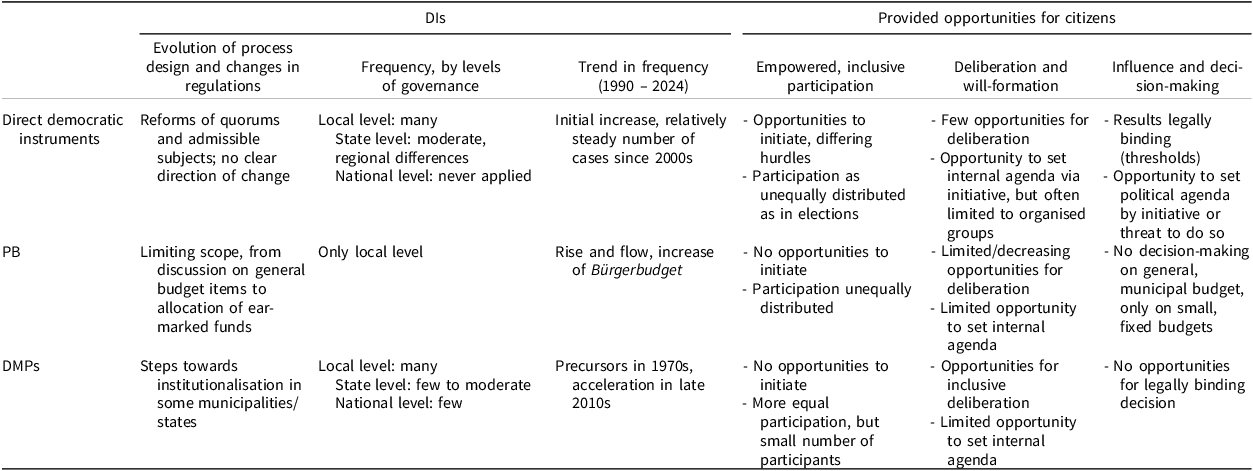
Our analysis shows three distinct trajectories and three directions of movement for citizens’ opportunities (Table 4). Combined, the trajectories of DIs in Germany show a movement towards opportunities for inclusive participation, deliberation, and will-formation of a few citizens in DMPs, rather than opportunities for empowered participation or influence on political agendas and decisions.
Direct democratic instruments in Germany

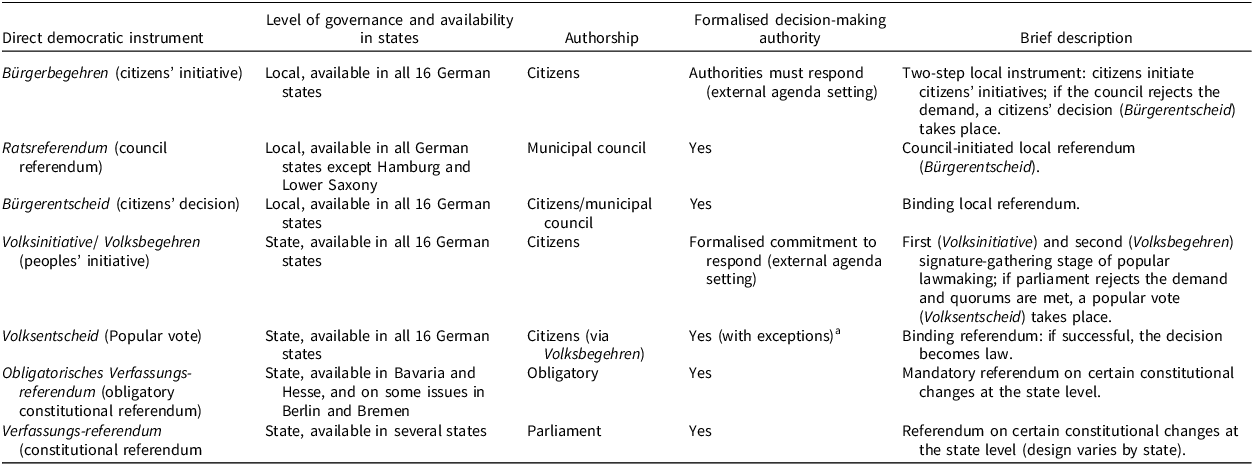
a In Berlin, for example, the successful popular vote on the expropriation of large real estate companies (‘Volksentscheid Deutsche Wohnen & Co. enteignen’) was not implemented, because it did not propose a law, but concerned ‘sonstige Beschlüsse’ (‘other decisions’) that had no legal binding effects (Mehr Demokratie e.V. Reference Mehr Demokratie2021: 10).
Trajectories of democratic innovations in Germany

DI, democratic innovation; DMP, deliberative mini-public; PB, participatory budgeting
Direct democratic instruments
The trajectory of direct democratic instruments in Germany has been characterised by gradual but uneven diffusion across states and municipalities since 1990, accompanied by continual – and often contradictory – reforms to thresholds, admissible subject areas, and decision rules. These instruments have expanded citizens’ opportunities to influence political agendas and decisions at local and state levels, yet in ways that remain uneven across regions and social groups and are constrained by quorums, the scope of admissible issues, and limited provision of opportunities for deliberation and collective will-formation.
Dissemination and evolutions
In Germany, direct democratic instruments are available at the local and state levels. On the national level these instruments are permitted only for territorial restructuring and constitutional ratification. Table 3 summarises the terms and the institutional designs of the most common direct democratic instruments in Germany. The terminologies and regulations vary across states and municipalities – here, we introduce the most common terms and rules (Kost and Solar Reference Kost and Solar2019; Rehmet Reference Rehmet2024; Rehmet, Socher, Wölfel et al. Reference Rehmet, Socher, Wölfel and Müller2025).
Figure 1 shows the increase in direct democratic procedures on the local level after 1990. After peaks in 1996 and 1997 (Bürgerbegehren [citizens’ initiatives], Bürgerentscheid [citizens’ decision]) as well as in 2001 (Ratsreferendum [council referendum]), the frequency has remained at a stable level. For reference, the number of municipalities has declined from approximately 16,000 in 1991 to less than 11,000 in 2024.
Direct democratic procedures on the local level in Germany 1990 – 2024.

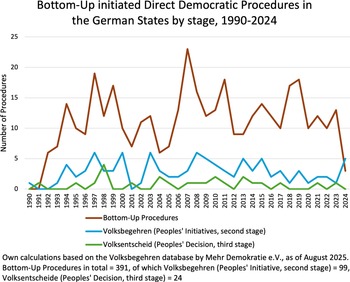
At the level of the German states, 391 direct democratic procedures were initiated by citizens between 1990 and 2024. One-quarter of these advanced from the first stage (Volksinitiative) to the second stage (Volksbegehren), the preliminary step of collecting signatures to initiate a Volksentscheid (popular vote) (Table 3). Only 22 of these were followed by a binding Volksentscheid.Footnote 7 The data show a steady rise of bottom-up procedures during the 1990s, reaching sustained double-digit numbers in the 2000s, with notable peaks in 1997 and 2007. Yet, despite this expansion, activity has remained uneven, with many years of modest numbers and only a small share of initiatives advancing to a binding Volksentscheid (Figure 2). Over the same period, 33 obligatory constitutional referendums were held, typically no more than three each year, with none in most years but a striking concentration of 15 in Hesse in 2018.
Number and frequency of bottom-up direct democratic procedures on the state level from 1990 to 2024.

The number and frequency of direct democratic procedures at the local and state levels are unevenly distributed across the German states (Rehmet Reference Rehmet2024: 16; Rehmet, Socher, Wölfel et al. Reference Rehmet, Socher, Wölfel and Müller2025: 15). This variation is not yet fully explained, but the variation in regulations regarding the initiation of direct democratic instruments (e.g., quorums, deadlines, permissible subject areas) seems to be crucial (Magin, Eder and Vatter Reference Magin, Eder, Vatter, Hildebrandt and Wolf2008: 355).Footnote 8 The signature quorums for citizens’ initiatives (Bürgerbegehren) range from 3% to 10%, while the voting/approval quorums for citizens’ decisions (Bürgerentscheide) range from 8% to 25%.Footnote 9 On the level of the federal states, Volksbegehren face quorums ranging from 3.6% to 10% of the electorate. The approval quorum for simple laws varies between 25% and no quorum,Footnote 10 while the approval quorum for constitutional referendums varies between 40% and 50% and a two-thirds majority (Rehmet Reference Rehmet2024: 12).
Rules on direct democratic instruments are subject to continuous changes with no clear direction. On the one hand, a continuous expansion of direct democratic instruments emerged after their early establishment by lowering quorums, opening subject areas, and making administrative processes more accessible. Saxony, for example, lowered the signature quorum from 10% to 5% in 2022. This coincided with an increase in direct democratic initiatives and referendums. However, there are opposing trends. Lower Saxony restricted the scope of direct democratic instruments by excluding hospital and rescue service planning (2021). Similarly, in 2023, the federal government of Schleswig-Holstein planned to restrict citizens’ initiatives on urban planning. After a petition and subsequent negotiations, the plans were abandoned, but the quorums were lifted slightly (Rehmet, Socher, Wölfel et al. Reference Rehmet, Socher, Wölfel and Müller2025: 13).
Analysis on citizens’ opportunities
Direct democratic instruments have the capacity to open the political process for the citizenry by giving them the right to initiate a direct democratic procedure on the local and state levels, thus fostering the empowered participation of the citizenry. However, they are also criticised for strengthening the participation opportunities of those who already enjoy a high level of political efficacy. Empirical arguments for the criticism are (a) low voter turnout and (b) the political mobilisation of milieus with rather high social resources (Mittendorf, Sack, Müller, et al. Reference Mittendorf2023). The opportunities for participating can thus be unevenly distributed socially and regionally, potentially limiting the inclusive participation of citizens – similar to elections (Krämling, Reference Krämling2024).
Bürger- and Volksbegehren allow initiators to determine which issues enter the political process, thus offering citizens comparatively significant opportunities for agenda-setting. Yet, the deliberation on the shape of this agenda largely takes place prior to formal initiation and is typically dominated by organised groups able to shoulder the demanding institutional requirements (Rehmet Reference Rehmet2024: 22). Once launched, the procedures provide only weak communicative means for broader deliberation, relying instead on signature collection and voting. They thus strengthen agenda-setting but provide limited opportunities for deliberation and will-formation.
In sum, direct democratic instruments expand the opportunities for citizens to influence political decision-making and the political agendas of decision-making bodies. They can lead to legally binding decisions (when respective thresholds are reached). This is unique among the three DIs discussed in this paper. Direct democratic instruments can also be used to boost an issue by threatening to initiate a referendum, ie, they can have indirect agenda-setting effects. Yet, these opportunities are constrained: Binding decisions depend on reaching strict quorums, the scope of admissible issues is narrow, and direct democracy is restricted to the local and state levels. Moreover, citizens themselves cannot alter these rules, which limits their influence over the design of the instruments. Thus, opportunities for influence and agenda-setting are significant but constrained.
Participatory Budgeting
Our analysis shows that PB in Germany has followed a trajectory of modest, locally confined diffusion, evolving from consultative processes centred around transparency and feedback on general budget items (Bürgerhaushalt) to processes that allocate small, earmarked funds (Bürgerbudgets). This trajectory has slightly expanded citizens’ opportunities for agenda-setting and decision-making by granting limited rights to propose and vote on local projects, yet overall the offered opportunities for empowered and inclusive participation, deliberation, and influence remain narrow and tightly constrained.
Dissemination and evolutions
PB was introduced to Germany in 1998, and since then, numerous variations have emerged. From the outset, the institutional design of PB in Germany diverged significantly from its Brazilian role model of Porto Alegre, where citizens decided together with political representatives on the city budget. In Germany, the two main ideal/typical process designs have consisted of informing citizens about city budgets and getting information on citizens’ preferences (Bürgerhaushalt) and proposing and deciding on projects within a small budget (Bürgerbudgets).
In contrast to the approach taken in Porto Alegre, the initial implementation of PB in Germany did not entail the (re-)distribution of the city budget. Instead, it was conceived as a means of enhancing transparency in budget planning and incorporating citizens’ perspectives into the evaluation of public services (Sintomer, Herzberg, and Röcke Reference Sintomer, Herzberg and Röcke2010: 116). These early processes typically followed three steps: information, consultation, and feedback from local authorities. Citizens received accessible information on selected budget items chosen by the authorities. Subsequently, citizens were consulted on these budget items and, in some cases, were able to deliberate on and prioritise them. Finally, politicians were required to publicly declare how citizens’ input had been incorporated into budget planning. The Bürgerhaushalt in Berlin-Lichtenberg represents an exemplary case for this process design.
A second process design emerged a decade after the first implementation of PB in Germany. Here, citizens no longer deliberated on and prioritised (parts of) the city budget but instead voted on the allocation of a fixed sum, usually between €10,000 and €200,000. Within this Bürgerbudget they could propose and prioritise small local projects, often in a range of €1,000–15,000. Proposals and voting are frequently organised through online platforms, sometimes with the possibility of commenting on proposals (Vorwerk and Gonçalves Reference Vorwerk, Gonçalves and Sommer2019). The city of Eberswalde became a role model for this design.
Figure 3 presents the frequency of active PB processes in Germany from the first implementation in 1998 until 2020. In this period the number of cases rose in waves. After a slow start in the first decade, PB saw a steep rise from 2008 until 2013/14. The number of cases began to drop but slowly recovered in the following years. This rise in overall numbers is credited to the increasing implementation of the Bürgerbudget, while the implementation of the Bürgerhaushalt design has been in decline since 2013 (Vorwerk Reference Vorwerk2018: 3). In Germany, all PB processes were implemented at the local level; there have been no cases at the state or federal levels.
PB in Germany from 1998 to 2020 (local level only).

Currently, the most active state is Brandenburg in Eastern Germany, with 50 active cases. This represents more than one-third of all cases across Germany, even though Brandenburg accounts for only 3% of the total population and approximately 4% of all municipalities. All the cases in Brandenburg are Bürgerbudgets. The overall rise in case numbers as well as the fairly high number of cases in 2020 hint at PB establishing itself as a format on the local level in Germany – especially in Brandenburg. However, considering the overall number of municipalities in Germany, it remains a marginal phenomenon.
Analysis on citizens’ opportunities
In regard to empowered and inclusive participation, PB in Germany gives potentially affected citizens a (small) voice in budget planning. Yet, three major challenges constrain its contribution. First, PB exists only at the local level. Second, participation in budgetary planning is not a political right in German municipalities, since PB is not obligatory and the design is decided by the respective local authorities. Citizens may call for a PB procedure, yet they cannot legally compel its initiation or influence its design. Third, actual participation remains small in scale, limiting the inclusion of ‘all affected’ (Geißel, Neunecker, and Kolleck Reference Geißel, Neunecker and Kolleck2015). Moreover, PB relies heavily on self-selection, producing biases towards well-educated and well-off groups (Neunecker Reference Neunecker2016: 116). As a result, the narrow scope and the biased composition of participation severely restrict opportunities for empowered and inclusive participation. The shift from the consultative Bürgerhaushalt to the more decisive Bürgerbudget (on a small sum of money) added some nuances of empowerment by granting citizens a limited right to propose and vote, but it simultaneously reduced the scope of decisions, thus not substantially expanding citizens’ opportunities for empowered and inclusive participation.
Regarding deliberation and will-formation, a change can be observed over time. Early Bürgerhaushalt processes provided some opportunities for deliberation, but the Bürgerbudgets increasingly restricted communication to online commenting and voting. Thus, the overall trajectory shows a decrease in communicative means for deliberation. Yet, even in the Bürgerhaushalt, the scope of discussion was narrow. Citizens never deliberated on the entire budget, and politicians retained agenda-setting power, sometimes excluding costly and controversial projects from debate (Sintomer, Herzberg and Röcke Reference Sintomer, Herzberg and Röcke2010: 126). In later iterations, citizens gained limited agenda-setting power by voting and prioritising the issues they wanted to discuss at PB meetings, as in Wuppertal or Berlin-Lichtenberg. Nevertheless, authorities pre-selected topics and restricted deliberation to a small part of the municipal budget (Franzke and Roeder Reference Franzke, Roeder and van den Dool2015). The same applies to the Bürgerbudgets, now the most common PB design in Germany. Here, citizens are partly able to set the agenda by proposing projects, but only within the confines of small, fixed budgets. In sum, PB in Germany seems to reveal a decline in the provision of opportunities for deliberation and only a modest evolution from very limited to limited internal agenda-setting power, underscored by the spread of the Bürgerbudget design. PB has expanded citizens’ opportunities for deliberation and collective will-formation only rarely.
In contrast to the famous Porto Alegre PB, the opportunities for citizen influence and decision-making through PB in Germany have remained very limited; decisions on the general budget have remained the purview of elected officials. In the first iterations, citizens’ roles remained purely consultative, with no decision-making and very limited external agenda-setting opportunities. In some cases, consultation was even used by politicians and administrators to legitimise budget cuts (Sintomer, Herzberg and Röcke Reference Sintomer, Herzberg and Röcke2010: 116). With the introduction of Bürgerbudgets, citizens gained the right to propose projects for the budgetary agenda and to make binding decisions regarding their realisation. Yet, local officials predetermined the size of this budget, severely limiting the scope of the agenda-setting and decision-making opportunity. Moreover, confining the opportunity for citizen influence to these small, fixed budgets effectively decoupled them from decisions on the general budget. PB in Germany has shifted from consultative but broader claims on the general budget (Bürgerhaushalt) to narrow binding decisions on small projects (Bürgerbudget), leaving citizens with very limited opportunities for influence and agenda-setting, confined to the local level and relatively few municipalities.
In summary, PB has become established in some German municipalities, but without meaningful opportunities for empowered and inclusive participation, deliberation and will-formation, or influence and decision-making comparable to Porto Alegre. Instead, PB in Germany often serves as a format through which public officials pursue a ‘participatory modernisation’ of public service delivery. These practices of PB can be described as self-selected consultative suggestion schemes (Geißel, Neunecker and Kolleck Reference Geißel, Neunecker and Kolleck2015) with limited policy impacts (Geissel and Hess Reference Geissel, Hess and Heinelt2018).
Deliberative Mini-Publics
Since the 2000s, DMPs in Germany have evolved from rare, ad hoc experiments into a format still marginal but steadily proliferating across all levels of governance, with steps towards institutionalisation in some municipalities and states. Within our analytical framework, this trajectory can be viewed as extending opportunities for inclusive deliberation, albeit only for the relatively small group of randomly selected participants. At the same time, rights to initiate such processes, shape their agendas, and decide on the uptake of their recommendations remain with political authorities in that, by design, opportunities for empowered participation and influence on agenda-setting and decision-making remain limited.
Dissemination and evolution
Forums in which randomly selected citizens engage in structured deliberations to develop policy recommendations have a long tradition in Germany (Dean, Hoffmann, Geissel et al. Reference Dean, Hoffmann, Geissel, Jung and Wipfler2022). Planning cells, often seen as one of the archetypes of DMPs, have gained global prominence, but similar forums have been developed under a variety of labels and with variations in design. These variations include the recruitment of participants (simple lottery, stratified sortition, stratification criteria), the number of participants (6–10,000), the number of meetings, and the form of the meetings (face-to-face, hybrid, purely digital) (Wieczorek, Freier, and Oppold Reference Wieczorek, Freier and Oppold2024). While the literature occasionally seeks to typologise these formats (Harris Reference Harris, Elstub and Escobar2019), such distinctions are less relevant here. What they share – and what we will subsume under the term ‘DMPs’ (Bürgerräte) – is that randomly (at least partly) selected citizens deliberate in a moderated setting to formulate recommendations aimed at influencing decision-making bodies or public discourse (Vrydagh Reference Vrydagh, Reuchamps, Vrydagh and Welp2023).
DMPs are not stipulated by law. They can be initiated by civil society organisations to push a certain topic (bottom-up) or, more commonly, by political executives or legislatures (top-down). At the local, state, and federal levels, DMPs are usually initiated by political authorities, which makes their existence fragile. A case in point is the German Bundestag (lower house of parliament). The governing coalition of the 20th legislative period announced three DMPs, but after the first was held, disagreements over the second DMP prevented its realisation, and the coalition collapsed before it could be initiated. Nonetheless, steps towards institutionalisation can be observed, particularly at the local level. Notable examples include the permanent DMP in Aachen, which is convened yearly, and the DMP in Konstanz, which citizens can trigger via petitions. At the state level, Baden-Württemberg is at the forefront of institutionalisation – its Act on Dialogue-based Citizen Participation and related initiatives enshrine DMPs in law (Arndt Reference Arndt2021).
Figure 4 summarises the dissemination of DMPs in Germany between 1990 and 2024. In total, 321 cases were recorded – a small number compared with the overall number of municipalities. During the 1990s and 2000s, DMPs were a marginal practice, with only a handful of cases per year. Numbers remained modest in the early 2010s but began to rise in the second half of the decade. From 2019 onwards, the frequency increased sharply, with more than two-thirds of all recorded cases taking place since then. Roughly four out of five DMPs were convened at the local level, while the remainder occurred at state or federal levels, which also show growth after 2019. This period is characterised by important national and international developments – nationally, with the proliferation of dialogue-oriented citizen participation in Baden-Württemberg, as well as the general trend towards dialogue-oriented participation on the local and federal levels. Overall, the development of DMPs in Germany can be seen as part of an international ‘deliberative wave’ (Organisation for Economic Co-operation and Development [OECD] 2020).
Frequencies of DMPs in Germany by level of governance, 1990 – 2024.

DMPs are also unevenly distributed across the German states. This is most evident at the state level, where more than half of all state-level DMPs have taken place in Baden-Württemberg. At the local level, North Rhine-Westphalia accounts for about one-quarter of all cases, followed by Baden-Württemberg with around one-fifth and Bavaria with 15% of cases. By contrast, DMPs in Thuringia, Mecklenburg-Western Pomerania, Rhineland-Palatinate, Saxony-Anhalt, and Schleswig-Holstein make up only about 1% each and are mostly held at the local level. Systematic and robust empirical evidence explaining these differences is absent and remains a task for future research.
Analysis on citizens’ opportunities
In regard to inclusive participation, DMPs expand opportunities for more inclusive participation through the lottery principle, which increases the likelihood that social groups typically disadvantaged in other participation processes are represented. Given the small number of participants, the coverage of citizens remains rather restricted. Yet, because participation in DMPs is voluntary and the criteria for stratification vary, the goal of achieving equality of access cannot be assumed. Moreover, with few local exceptions, citizens have no legal claim in terms of public authorities initiating a DMP – unlike in the case of direct democratic instruments, where such rights exist. At the local level, formal rights to initiate a DMP are found only in very few cases, and at the state or federal levels they are entirely absent. Taken together, these features point to a trajectory of expanding citizens’ opportunities for inclusive participation, but overall with no opportunities for citizens to initiate a DMP (empowered inclusion).
Regarding deliberation and collective will-formation, most DMPs in Germany provide communicative means through moderated deliberation, enabling participants to exchange arguments and form considered judgements. However, the internal agenda is usually predetermined by the commissioning body, leaving citizens with only moderate power to shape the issues under discussion. In most cases, the overall topic is fixed in advance, and participants can only specify sub-questions, as seen for example in the Bundestag DMP on nutrition. While the Bundestag tasked the DMP with deliberating on the role of the state in the nutrition system, citizens were then able to identify areas of interest within it (e.g., school lunches and food waste). In rare instances, this limitation is partially mitigated. In Konstanz, citizens can trigger a DMP via petition, and in Aachen they can suggest and vote on topics. Nevertheless, final agenda-setting power often remains with political decision makers. Overall, while DMPs reliably provide communicative means for deliberation, they offer only limited opportunities for citizens to exercise agenda-setting power within the process. The trajectory shows that, despite the recent proliferation of cases, the expansion of opportunities for deliberation has not been matched by greater opportunities for internal agenda-setting of the deliberations.
DMPs do not provide opportunities to directly influence policies, eg, via making legally binding decisions. Their potential opportunity for influence lies instead in shaping political agendas or informing decision-making bodies and public discourse. While political bodies frequently express willingness to discuss the results, collective decision-making ultimately remains at their discretion. The influence of DMPs on political agendas and decision-making has not yet been systematically evaluated, though preliminary evidence suggests that their effects remain limited (Wieczorek, Freier and Oppold Reference Wieczorek, Freier and Oppold2024: 28 et seq.). The trajectory of DMPs indicates that, despite the recent proliferation of these processes, the opportunities they provide for citizens to exercise influence over decision-making remain weak, while their inputs remain largely advisory in nature.
Conclusion
How have DIs spread and institutionally evolved across levels of government in Germany since 1990, and to what extent and in which directions have these trajectories shifted citizens’ opportunities to engage in political processes? Table 4 summarises our findings. Since 1990 the repertoire of DIs was broadened, but mostly at the subnational level. The dissemination of direct democratic instruments stabilised at the local level and partly at the state level. PB was established in some municipalities, with a design shift from consultative Bürgerhaushalte to Bürgerbudgets, which decide on small budget expenditures for local projects. DMPs, designed to facilitate deliberation in small groups, are on the rise and are increasingly found at all levels of governance, with a trend towards institutionalisation in a few states and municipalities.
We evaluated these developments using our analytical framework and identified some gains for citizens’ opportunities, though these gains are rather limited: Empowered participation remains sparse beyond direct democratic instruments, which remain restricted to subnational levels and with rather limiting regulations. DMPs, trending upward in usage, offer inclusive participation as well as communicative means for deliberation and will-formation, but only to a small number of participants in a few locations. Influence and collective decision opportunities are mostly confined to direct democratic instruments. While they have proliferated since the 1990s, empowering citizens to make binding decisions, direct democratic instruments remain very restricted and have never been used at the national level.
In summary, the trajectories of DIs in Germany display a trend towards formats, such as DMPs, that emphasise inclusive participation, deliberation, and will-formation for small groups of citizens, rather than empowered participation or influence. These formats are prioritised over innovations which provide for empowered inclusion of the whole citizenry, collective agenda-setting, and meaningful decision-making opportunities. If this trend continues, DIs in Germany may rather contribute to a new form of democratic elitism than to the empowerment of citizens.
While our exploration of the three trajectories adds fresh data and new insights to the comparative research on DIs, our findings also hint at three unanswered questions and research gaps. First, regional differences are visible but remain unexplained. We cannot answer the question as to why DIs evolved in different ways in different German states. Little is yet known about the reasons for these differences. Research comparing the German states requires a comprehensive causal-analytical framework and ample empirical research to identify explanatory factors (e.g., party differences, role of interest groups) and remains a task for future research. Second, our study traced the trajectories of three types of DIs but did not examine the slowly emerging ‘couplings’ of DIs, eg, the sequencing of DMPs and direct democratic instruments. This is a new development not only in Germany and may contribute to the strengthening of citizens’ opportunities (Hoffmann and Geißel Reference Hoffmann, Geißel, Dahm, Hartmann-Cwiertnia and Decker2025). Future research might evaluate this development. Third, more theoretical and conceptual work is required to connect the three opportunities of empowered, inclusive participation, deliberation and will-formation, and influence and decision-making (Geissel Reference Geissel, Reuchamps, Vrydagh and Welp2023). In this paper we touched upon this topic but must leave it for future enquiry.
Our study sought to uncover the trajectories and trends of DIs in Germany. The importance of our findings goes beyond the German case, as we offer ideas on how to analyse the trajectories of DIs in relation to their potential enhancement of citizens’ opportunities. Comparing our findings on the trajectories in Germany with those in other countries, as intended in this Special Issue, will enable an important step forward in research on DIs globally. Our findings are therefore useful not only for academia but also for political actors, inspiring reflection on which citizens’ opportunities are to be enhanced and by which democratic instruments.
The authors thank Frank Rehmet (Mehr Demokratie e.V., Berlin, Germany) for providing data and explanations on the Volksbegehren database, Joel Müller (IDPF, Wuppertal, Germany) for providing data from the Bürgerbegehren database, and Jannos Karabotsos-Galonski (IDPF, Wuppertal, Germany) for providing data from the Bürgerräte database.
Data availability statement
This article draws on existing datasets, which are publicly accessible via the databases cited in the ‘Methods’ section of the manuscript. The authors also performed additional aggregations and calculations for the purposes of this study. These processed data are available from the corresponding author upon reasonable request.
Funding statement
This research received no specific grant from any funding agency or commercial or not-for-profit sectors.
Competing interests
On behalf of all authors, the corresponding author states that there is no conflict of interest.



 Open access

