





Introduction
Among the successor states of the Soviet Union, Ukraine has the largest Russian ethnic population outside of the Russian Federation (Bremmer Reference Bremmer1994, 262) and is the European nation state with the largest ethnic minority (Barrington Reference Barrington2002, 83). After Ukrainian independence, many observers feared interethnic tensions between the Russian and Ukrainian populations of the country (Barrington Reference Barrington2002, 83). Luckily, such apprehensions proved to be wrong, and interethnic relations and attitudes in general remained friendly. Since then, most scholars have lost interest in interethnic relations and attitudes in the country. The war in Eastern Ukraine, which started in 2014 following the pro-European protests on Maidan Square and the Russian annexation of Crimea, has again increased worries about the relations and attitudes between the Russian and Ukrainian ethnic groups or Russian and Ukrainian speakers in Ukraine. For example, Kappeler (Reference Kappeler2015, 380) suggests that the most tragic consequence of the war in Donbas might be that the peaceful coexistence of ethnic Russians and Ukrainians would be threatened. Similarly, Pogrebinskiy (Reference Pogrebinskiy2015, 97) warns that ethnic frames have increased and that “[i]f the tendencies we observe today persist, there is a high probability that the political conflict will develop into an ethnic one,” although he believes that the “enemy is mainly defined not in ethnic terms but ideologically.”
Beside the war, another reason why prejudice against ethnic Russians or Russian speakers might have increased in 2014 is political change: the political rhetoric and identity politics – e.g., language or history politics – under President Petro Poroshenko, elected in spring 2014, focused much more on furthering an ethnic Ukrainian identity compared to his predecessor Viktor Yanukovych. It might be reasoned that identity politics promoting an ethnic Ukrainian nationalism depreciated ethnic Russians and Russian speakers; thus, prejudice against these groups might have varied with the intensity of ethnic Ukrainian nationalism. However, in 2006–2009, President Viktor Yushchenko’s politics and rhetoric were relatively similar; thus, if ethnic Ukrainian identity politics alone would lead to more animosity against ethnic Russians or Russian speakers, this could have been observed under Yushchenko as well. I am cautious in interpreting this comparison as evidence for lack of any effect of identity politics though: identity politics and war with the multitude of its societal, political, and economic consequences could have created a complex interaction effect ultimately leading to the outcome reported in this paper.
While both these considerations coincide with what many people believe about prejudice, the research on prejudice is relatively unclear about how these changes affect attitudes toward minorities. Most sociological research on prejudice focuses on individual predictors, such as educational level (e.g., Wagner and Zick Reference Wagner and Zick1995) or social contact with outgroup members (Pettigrew and Tropp Reference Pettigrew and Tropp2008) (for an overview, see Hodson and Dhont (Reference Hodson and Dhont2015)). In contrast, we know relatively little about macro-predictors of prejudice. In general, while it seems to be widely believed that negative events such as wars poison the attitudes toward minorities that are linked to groups responsible for the event, the existing literature on this issue is rather ambiguous and “[c]urrent research remains relatively silent on why, how, and under which circumstances an event may affect the perception of an out-group” (Legewie Reference Legewie2013, 1200). Similarly, the question of how nation-building policies and rhetoric affect prejudice against minorities is still very unclear (Helbling, Reeskens, and Wright Reference Helbling, Reeskens and Wright2016; Hjerm and Schnabel Reference Hjerm and Schnabel2010; for a more elaborated discussion, see below). Although one must be careful in making claims about causality based on the data that I use, this study offers some clues as to how war and political rhetoric affect attitudes toward other groups.
While studying the development of attitudes toward Russian speakers contributes to our understanding of prejudice in general, it should be of interest for students of Ukrainian politics and society as well. Considering that a main focus in the study of Ukraine has been on the cleavages along ethnic, linguistic, and regional lines, the relatively low interest in attitudes toward the different ethnic, linguistic and regional groups is rather astonishing. The existing research on intergroup attitudes and relations in Ukraine stems mainly from the 1990s and has mostly examined ethnic groups. It shows that intergroup relations and attitudes in Ukraine have been relatively close and friendly, respectively (Barrington Reference Barrington2002; Hagendoorn et al. Reference Hagendoorn, Drogendijk, Tumanov and Hraba1998; Hagendoorn, Linssen, and Tumanov Reference Hagendoorn, Linssen and Tumanov2001; Barrington and Herron Reference Barrington and Herron2004). Newer studies are rare. A survey experiment conducted in summer 2014 suggests that ethnicity and language of a fictional candidate running for parliament are relatively unimportant for the vote choices of Ukrainians (Frye Reference Frye2015). While this study indicates that, at least in the political sphere, ethnicity and language are irrelevant to the perception of other people, Constant, Kahanec, and Zimmermann (Reference Constant, Kahanec and Zimmermann2012) find a wage premium for ethnic Russians compared to ethnic Ukrainians, which the authors explain by language rather than ethnicity. None of these studies, however, explores the temporal development over a longer period.
This study seeks to close this research gap by examining how the attitudes of Ukrainians toward Russian-speaking Ukrainians changed between 1995 and 2018; it is based on survey data provided by the Kyiv International Institute of Sociology (KIIS). My analyses show that attitudes toward Russian speakers became more negative after the beginning of the war in Donbas in 2014, although the changes are relatively small, and in general, the evaluation has remained rather positive. This change cannot solely be attributed to identity politics during the years of war under observation, which promoted Ukrainian ethnic nationalism, because similar differences cannot be observed under President Yushchenko (2006–2009), who pursued similar identity politics. Thus, it seems that it was mainly the perception of Russia as an aggressor that influenced attitudes toward Russian speakers or that allowed the political rhetoric to better resonate in the population.
In contrast to most of the existing studies of Ukraine, I examine the attitudes toward a linguistic group – Russian-speaking Ukrainians – instead of an ethnic group. Ethnicity and linguistic identification or practice do not coincide in Ukraine. In 2001, when the latest census was conducted in Ukraine, 30% indicated Russian as their mother tongue (State Statistics Committee of Ukraine n.d.a); even more speak mainly Russian in daily life (Kulyk Reference Kulyk2018). Among them, only 56% identified as ethnic Russians and 39% as ethnic Ukrainians (own calculations based on State Statistics Committee of Ukraine n.d.b). However, these clear-cut numbers hide that ethnic and linguistic identification and language use are often hybrid, blurry, and highly situational (Hentschel and Taranenko Reference Hentschel and Taranenko2015). To examine attitudes toward Russian speakers instead of ethnic Russians is not only interesting because this has been rarely analyzed but also because language issues have played a major role in Ukrainian nation building. As Bernsand (Reference Bernsand2001, 39) writes, “The Ukrainian nation has been conceptualized mainly through its language since the 19th century, and romantic notions on the essentiality of nations and languages and on their correlation is often accepted on a common-sense basis.” For post-Soviet Ukraine, the relevance of language becomes especially apparent in the field of identity politics. Although, according to surveys, large parts of the population do not regard language politics as one of the most urgent issues (Kulyk Reference Kulyk2013a, 287), and most accept the symbolic dominance of the Ukrainian language and the simultaneously widespread use of the Russian language (Kulyk Reference Kulyk and Ryazanova-Clarke2014, 138–139), language politics have been discussed heatedly, and observers have commented that language has become politicized during the post-Soviet period (Bilaniuk Reference Bilaniuk2016, 140; Zhurzhenko Reference Zhurzhenko and Bove2002, 11).
The article is structured as follows: In the next section, I discuss the war in Donbas and identity politics as potential factors that affected attitudes toward Russian speakers. In the following section, I present the data and the methodological approach. The final section presents the results. I conclude with a short summary and discussion.
What Might have Changed Prejudice against Russian Speakers?
As mentioned, examining the post-Soviet history of Ukraine, two political events might have been consequential for the perception of Russian-speaking Ukrainians: the war in Donbas as well as altering identity politics and elite rhetoric. In this section, I discuss why these events might have influenced attitudes about Russian speakers. Beforehand, it should be acknowledged that one must be cautious when attributing changes in attitudes toward the war in Donbas and identity politics. First, both the war and identity politics are associated with each other. For example, the nationalist rhetoric of the Poroshenko era can be interpreted as a reaction to the war. Second, it might be argued that the direction of causality is not completely clear. For instance, the political rhetoric influences attitudes in the population but is in turn affected by elections or expectations about the population’s wishes. Third, the rhetoric might resonate differently in the population during a war than in peacetime.
War in Donbas
Following the Euromaidan protests, which started in late 2013, and the flight of President Yanukovych in late February 2014, anti-government and pro-Russian protests occurred in the Eastern and Southeastern regions of Ukraine. In March 2014, Russia annexed the Ukrainian peninsula of Crimea. Shortly thereafter in Donbas, separatists declared Donets’k and Luhans’k People’s Republics and occupied state institutions. This action led to an armed conflict between the Ukrainian government and the separatists. According to data from the United Nations, in Donbas between April 2014 and 2018, 12,800 to 13,000 people were killed and 27,000 to 30,000 people were wounded (Radio Free Europe/Radio Liberty 2019).
Research has shown that negative events that are highly discussed in the public – such as terror attacks or wars – can lead to the increase of prejudice against the whole group to which the perpetrators or those responsible for belong (e.g., Bar-Tal and Labin Reference Bar-Tal and Labin2001; Legewie Reference Legewie2013; Hopkins Reference Hopkins2010; Echebaria-Echabe and Fernández-Guede Reference Echebarria-Echabe and Fernández-Guede2006; Seago Reference Seago1947), but it is still relatively unclear when exactly this happens (Legewie Reference Legewie2013, 1200). Such effects can be explained by realistic group conflict theory (for a literature review and discussion see Jackson Reference Jackson1993), according to which stereotypes stem from real or perceived conflicts and competition over scarce resources, such as material values, power, or territory. In the following section, I argue that the Russian-speaking population was associated with the source of the war, and therefore it is plausible that attitudes toward this group became more negative after the beginning of the war.
While Russia is not involved in the conflict in Ukraine officially, scholars, international organizations, and media, as well as the Ukrainian government, have emphasized Russia’s involvement with and support of the separatists since 2014. Regarding how the conflict has affected attitudes toward Russian speakers, it is not important which role Russia actually played and plays in the conflict but that the Ukrainian population perceives Russia to be a warring party: Fischer (Reference Fischer2019, 18), who conducted interviews with political actors, experts, and representatives of civil society organizations, concludes that “[i]n Kyiv there is broad consensus that the events in the Donbas are part of a hybrid war conducted by Russia against Ukraine.” This belief is in line with the official stance of the Ukrainian government (10 Facts You Should Know About Russian Military Aggression against Ukraine 2017). In September 2014, approximately 70% of the Ukrainian population agreed with the statement that there is a war between Ukraine and Russia, while only 19% did not (Onuch Reference Onuch, Pikulicka-Wilczewska and Sakwa2015, 49). Roughly half of the population agreed strongly with the statement that Russians actively supported pro-Russian oriented forces in Eastern Ukraine, and another quarter agreed with this statement; only 15% of the sample disagreed with it (Onuch Reference Onuch, Pikulicka-Wilczewska and Sakwa2015, 47).
Further considerations make it seem likely that the perception of the war in Donbas as a war caused by Russia led to an increase in prejudice against Russian speakers. In the context of the annexation of Crimea and the events in Donbas, many have argued that Russian speakers were used to legitimate the Russian engagement (Hutchings and Szostek Reference Hutchings and Szostek2015, 190; Ryazanova-Clarke Reference Ryazanova-Clarke2017, 451). Officials from the Russian Federation emphasized the threat to Russian speakers and Russia’s responsibility for its compatriots [sootechestvenniki] in Ukraine. For example, in June 2014 Putin stated that “We will always protect the ethnic Russians in Ukraine, as well as that part of Ukraine’s population that feels inseparably linked with Russia ethnically, culturally, and linguistically, that feels to be a part of the broader Russian World [russkyi mir]” (RIA Novosti 2014). The concepts of compatriots and of russkyi mir refer to a common ground based on the same culture, religion and language, rather than on citizenship. The term describes an extended understanding of Russians to which not only Russian citizens belong but also ethnic Russians and Russian language speakers. Referring to Ukraine in 2014, the term was highly conflated with Russian speakers (Pieper Reference Pieper2018, 20–21). Thus, since the Russian-speaking population was used to legitimize an intervention in Ukraine, it is very plausible that this war could be perceived as being linked to the Russian-speaking population of Ukraine.
In addition, it seems self-evident that the Russian language is associated with Russia. Debates over language issues, which have been heatedly conducted since Ukraine’s independence, have often rather seemed to be about geopolitics. The political debate over language laws shows that the question of language is strongly related to the overall debate on the degree of Ukraine’s closeness to Russia: whereas so-called pro-Russian politicians usually advance the view that Russian and Ukrainian should be officially equally ranked, so-called pro-European forces normally take the position that Ukrainian as the titular language must be privileged. Moreover, Kulyk (Reference Kulyk2018) argues that Euromaidan and the war in Donbas decreased identification with Russian language and ethnicity. These shifts away from identification with the Russian language suggest that the Russian language is associated with the aggressor party.Footnote 1
Nationalist Rhetoric and Nation-Building Efforts
In the previous section, I argued that not only the war directly but also the frames and interpretations of the war might have influenced views about Russian speakers. In particular, I reasoned that the official Russian interpretation of the war might have alienated Russian speakers from Ukrainian ones. Another important factor might be the dominant elite rhetoric and discourse in Ukraine directly or indirectly concerning ethnic Russians or the Russian-speaking population.
Debates that might have affected the attitudes toward Russian speakers in Ukraine have been over identity, identity politics, and nationbuilding. Such discussions have focused on the question of how “Ukrainian” Ukraine must be and how distinct Ukraine should be from Russia or the Soviet Union. First and foremost, these debates have been about language laws, history, and memory politics, but they can be found in other fields, such as (especially lately) church politics. In these debates, Russia has often been depicted as “the other” (Kuzio Reference Kuzio2001a). It should be noted that ethnic Russians and Russian speakers were not demonized or denigrated by mainstream political actors and that these debates have not focused on social groups. In addition, the proponents of a more Ukrainian Ukraine stressed the necessity to promote Ukrainian rather than to fight Russian culture or language. Nevertheless, it seems plausible that a political discourse emphasizing that what belongs to Ukraine should be Ukrainian – be it culture, language, history, or religion – at least indirectly devaluates and delegitimizes other cultures, ethnicities, religions and, possibly, their representatives. While there has been a consensus among the Ukrainian elite that Ukraine is an independent state, the official discourse and political aims concerning national identity and nation-building efforts underwent tremendous changes during the period of observation. These changes are associated with the different Ukrainian presidents – Leonid Kuchma (1994–2004), Viktor Yushchenko (2005–2010), Viktor Yanukovych (2010–2014), and Petro Poroshenko (2014–2019). Although identity politics were not always loudly espoused by the presidents themselves, but this task has been partly overtaken by their entourages (Kasianov Reference Kasianov, Miller and Lipman2012, 162), identity politics and rhetoric have changed remarkably between the different presidencies; this trend has been compared to a “pendulum” that “swings from one extreme to another along the identity dimension as the parties in power alternate” (Charnysh Reference Charnysh2013, 2).
Under Yushchenko and Poroshenko, the ethnic Ukrainian nationalist element was much stronger than under Kuchma and Yanukovych. Yushchenko and Poroshenko (especially toward the end of the latter’s presidency) were both much more engaged in promoting the Ukrainian language, emphasized parts of Ukrainian history that, as Kasianov (Reference Kasianov, Miller and Lipman2012, 151) puts it referring to Yushchenko, were “presented in extremely exclusive form, as constituents of Ukrainian ethnic history alone,” and they supported a united Ukrainian Orthodox Church. In contrast, although Kuchma and Yanukovych did not completely abolish the nationalizing policies of their predecessors, both presented themselves as opponents of the ethnic Ukrainian nationalism of their predecessors, they supported the elevation of the Russian language, and their approach to history was much more ambivalent. This is not to say that Yushchenko’s and Poroshenko’s or Kuchma’s and Yanukovych’s identity politics and political rhetoric completely coincided – the presidents had different backgrounds, came to power under different circumstances, had different rhetorical styles and targeted somewhat different issues; besides, the rhetoric also evolved over the period of the presidencies. However, with regard to the promotion of an ethnic Ukrainian identity there are strong similarities between these presidencies and strong differences to those preceding; this is important for interpreting the findings of this study.
The argument that these changes in identity politics and elite rhetoric might have affected attitudes against Russian speakers is inspired by three different strands of research arguing that elite discourse and interpretations can affect the perceptions, attitudes, and actions of the population. First, political scientists have shown that when asked about their political attitudes, individuals often do not process the complete information but rely on speaker cues – such as elite affiliation – basing their decision rather on who said what than what was said (Zaller Reference Zaller1992; Lupia Reference Lupia1994; Rahn Reference Rahn1993). Second, aggressive and nationalist elite rhetoric has been described as an explanation of ethnic conflict (Fearon and Laitin Reference Fearon and Laitin2000; Oberschall Reference Oberschall2000). Third, the literature on prejudice has stressed that individuals are less hesitant to voice prejudices if prominent and especially elected figures express them, since this fact suggests that such prejudices do not contradict social norms (Newman et al. Reference Newman, Merolla, Shah, Lemi, Collingwood and Ramakrishnan2020; Schaffner Reference Schaffner2020). Despite these hypothetical links of elite rhetoric with popular attitudes and ethnic hostility, it is not so clear if nation-building politics and elite rhetoric emphasizing the core nation lead to increased prejudice against Russian speakers in the Ukrainian context. While nationalism is usually associated with a higher level of prejudice against outgroups (Pehrson, Vignoles, and Brown Reference Pehrson, Vignoles and Brown2009), it is unclear if Russian speakers are perceived as an outgroup. Also, studies on the association between nationalist elite rhetoric and popular attitudes have led to unclear results: While Hjerm and Schnabel (Reference Hjerm and Schnabel2010) do not find that nationalist elite rhetoric affects nationalist attitudes in the population, Helbling, Reeskens, and Wright (Reference Helbling, Reeskens and Wright2016) argue that exclusive comments by political elites of who belongs to the nation – in contrast to inclusive notions – resonate in the population. Additionally, the literature on elite cueing focuses on political attitudes rather than attitudes toward social groups. Furthermore, in contrast to the literature on prejudice and ethnic conflicts, there has been no open denigration of Russian speakers by the political elite. At last, if and to which degree individuals adopt elite opinions depends on many factors, such as incumbency (Matsubayashi Reference Matsubayashi2013), popularity (Mondak Reference Mondak1993), partisanship (Goren, Federico, and Kittilson Reference Goren, Federico and Kittilson2009), elite consensus (Zaller Reference Zaller1992), or the complexity of the issue (Nicholson Reference Nicholson2011); if, for example the elite speaker is disliked, this can even lead to a stronger resentment of an elite statement (Schaffner Reference Schaffner2020; Clark and Kastellec Reference Clark and Kastellec2015; Kam Reference Kam2020). While Ukrainian presidents were unlikely influential actors from the point of view of some of these arguments – e.g., due to low popularity and lack of elite consensus – other factors speak for their relevance: Ukrainian presidents have a relatively powerful position in Ukrainian politics, which is underscored by the fact that turns in ethnic politics were highly associated with new presidents. In addition, at least for the period under Kuchma, Kulyk (Reference Kulyk2006) argues that the media, which are important for opinion making (Zaller Reference Zaller1992), adopted the views of the political elite.
In summary, it seems plausible that prejudice toward Russian-speaking Ukrainians increased due to the war in Donbas and due to more pronounced ethnic identity politics under Yushchenko and Poroshenko. In the following section, I present the data and the methodological approach to examine these arguments.
Data and Methods
Data
This analysis is based on the Omnibus Surveys of the KIIS from 1995 to 2018. The KIIS is independent and one of the most renowned Ukrainian polling centersFootnote 2; many studies of Ukraine have used data from this polling center (e.g., Coupe and Obrizan Reference Coupe and Obrizan2016; Kulyk Reference Kulyk2018; Beissinger Reference Beissinger2013). The Omnibus Survey is conducted several times per year with many questions asked regularly. If the same issues come up in different waves, the wording and response categories are usually the same, making it possible to compare different waves. The interviews are conducted in a face-to-face situation at the respondent’s home. In every poll, approximately 2,000 individuals are chosen by four-stage random sampling. The analysis is limited to individuals older than 17 years old. Since April 2014, the KIIS sample does not cover Crimea anymore, and areas that are not under Ukrainian government control were not polled; therefore, I omitted respondents from the Donets’k and Luhans’k regions from the whole sample for better comparability (a similar approach was used by Kulyk (Reference Kulyk2018) for the same data set to compare identity changes). I use all of the years in which social distance, a measure of prejudice, was measured. Thus, with the exceptions of 2005 and 2011, the data are analyzed for every year since 1995. Sampling occurred at different times during the year. In 2013, the sample period was in September, before Euromaidan; in 2014, polling occurred in October.
While so far, researchers have not focused on Russian-speaking Ukrainians, there are some studies that have previously used the rich KIIS data on social distance. For example, Panina (Reference Panina2004) and Paniotto (Reference Paniotto2008) use the survey up to 2004 and 2007, respectively, in studies of antisemitism and xenophobia in Ukraine. While their focus is on other minority groups, they report the social distance to Russian and Ukrainian speakers for comparison. In addition, the social distance toward different groups has been reported in press releases by the KIIS. Examining social change in Ukraine after the start of the war, Alexseev (Reference Alexseev2015) compares KIIS data from 2013 and 2014. He concludes that the acceptance of Russians and Russian-speaking Ukrainians decreased during the period, while it increased for all others. In contrast to this study, the aforementioned studies do not observe changes in social distance toward Russian speakers from 1995 to 2018 or apply multivariate statistical methods.
For the analysis, I compared the social distance toward Russian-speaking Ukrainians between the different waves. Since this study relies on cross-sectional rather than panel data, it should be emphasized that differences between the years might be caused by changes in the sample rather than changes in the whole population. To check whether the different waves are comparable, I tested whether the waves differ concerning other sociodemographic variables, such as age or gender (see Online Supplementary Material (SM) 1). The analyses do not uncover conspicuous shifts between the years; thus, they do not argue against comparing the data.
While comparisons over time are problematic with all cross-sectional data, for this study, two issues deserve particular discussion: First, the war in Donbas and the annexation of Crimea have caused massive migration flows. According to data from the Ukrainian Ministry of Social PolicyFootnote 3 from May 2016 in the regions in the sample, 796.540 internally displaced persons (IDPs) were registered (Slovo i dilo, May 10, 2016). Because the data contain no information about the place of origin or whether a person has fled, it is not possible to exclude refugees from the sample. Thus, changes in prejudice might be due to inflows of former residents of the Luhans’k and Donets’k regions.
Second, it would make sense to exclude Russian speakers from the analysis because it seems unlikely that attitudes toward their own ingroup would be affected by political incidents. However, such identities are not stable over lifetimes. In particular, it has been argued that identification with Ukrainian identity markers (language, ethnicity) has grown as a consequence of Euromaidan and the war in Donbas (Kulyk Reference Kulyk2016, Reference Kulyk2017, Reference Kulyk2018). Additionally, it has been argued that the meaning of some of these markers has changed, for example, how ethnicity (national’nist’) is understood (Kulyk Reference Kulyk2013b, Reference Kulyk2018). Thus, excluding Russian speakers or ethnic Russians from the sample might even complicate comparisons over time.
Using cross-sectional data, these problems cannot be overcome completelyFootnote 4; to my best knowledge, panel data on attitudes toward Russian speakers in Ukraine, which would be able to identify intrapersonal changes, do not exist. However, by controlling for observable characteristics in multivariate models and examining different subgroups I attempt to overcome these problems to the extent possible.
Samples
The focus of this study is on the attitudes of those classified as Ukrainian-speaking Ukrainians; only for this group – the first sample – which does not identify with Russian language or ethnicity, it seems plausible that its view of Russian speakers is affected by the political rhetoric or the war. However, as has been argued earlier, due to identity shifts, it seems questionable how comparable the different waves are. The second and the third sample account for this problem: The second sample encompasses the whole population (with the exception of the Luhans’k and Donets’k regions and Crimea, which are excluded from all samples) irrespective of ethnicity and language. The third sample comprises observations from regions in which the change in ethno-linguistic identification has been small: These regions saw the share of Ukrainian-speaking Ukrainians in the years 1995–1997 compared to 2017–2018 change by less than five percentage points. Concerning the share of Ukrainian-speaking Ukrainians, these regions are very heterogeneous. The fourth sample encloses only regions where the share of IDPs has been less than 0.5% (the regional share of IDPs differs extremely) to address the problem that the sample composition might have changed due to migration from the Luhans’k and Donets’k regions and Crimea; this could have strongly influenced the attitudes that I investigate.Footnote 5 All of these regions are in the Western part of Ukraine, leading to little geographical variation in this group (for more information on the different samples, see SM 2).
Measuring Prejudice: Social Distance
I measure prejudice with the social distance scale. Since 1995, almost every year, one section in the KIIS Omnibus Survey has inquired about social distance toward different ethnic, national and linguistic groups, among them Russian-speaking Ukrainians. The social distance scale goes back to Bogardus (Reference Bogardus1959, 7), who defines social distance as “the degree of sympathetic understanding that functions between person and person, between person and group, and between groups.” Other scholars have described that the scale measures how close or intimate (Mather, Jones, and Moats Reference Mather, Jones and Moats2017) one feels toward other groups. Bogardus’ definition of social distance is reminiscent of definitions of prejudice. The way in which social distance is measured by KIIS is very similar to the version proposed by Bogardus: the respondents are asked to complete the statement “I agree to accept representatives of the particular ethnic [natsional’nyi] group” with at least one answer option for each group. These answer options are “as member of my family”, “as close friends”, “as neighbors”, “as colleagues at work”, “as residents of Ukraine”, “as guests of Ukraine” and, at worst, “I would not let them into Ukraine.”Footnote 6 I assume that the scale is hierarchical (meaning that someone who is accepted as a family member will be accepted as a close friend too) and examine the closest position indicated only. To reduce the social desirability bias, this part of the questionnaire was administered to the respondents, and they answered the questions independently. We do not know how strong the bias is anyway. If the social desirability bias is high for this question, it does not measure the acceptance of the respondents but encompasses rather what people believe is socially accepted and thus, rather, the norm of social distance.
A conspicuous fact concerning the data that should be mentioned is the relatively low acceptance of one’s own group. For example, in all years, only 62.2% of the 16,094 Ukrainian-speaking ethnic Ukrainians indicate that they would accept a Ukrainian speaker as a family member. Although this group is that which they accept most, the small number might indicate that a proportion of the respondents did not understand the question; thus, one should be cautious drawing conclusions about the real social distance in society based on these data. However, since there is no reason why the degree to which respondents understand the question might have changed over the years, and I am mostly interested in changes between waves, this response behavior does not seem problematic for this study. In addition, the results for social distance toward different groups vary strongly, which would not be the case had the respondents selected answer categories without understanding them.
Models
While I present some descriptive analyses first, I additionally estimate multivariate models to consider that changes in prejudice could be due to changes in the composition of the sample over time. All of the models that are reported in the article are linear regression models with robust standard errors. As usually done (Bogardus Reference Bogardus1947, 308; Parrillo and Donoghue Reference Parrillo and Donoghue2005, Reference Parrillo and Donoghue2013), the dependent variable of social distance is measured quasi-metrically from one (“would accept as family members”) to seven (“would not let them into Ukraine”). Because it might be objected that the intervals between the neighboring answer categories are not equal, I additionally estimate models in which the dependent variable is binary: these binary variables distinguish whether the respondent accepts Russian-speaking Ukrainians as a) family members; b) close friends or family members; and c) residents of Ukraine or in a closer position. The readiness to accept someone as a friend (or closer) indicates readiness to accept someone in his/her close environment. Since most Ukrainians accept Russian speakers as close friends, I also examine the boundary to accept representatives of this group as family members. To accept someone as a resident of Ukraine is relatively similar to the acceptance of individuals as conationals. Thus, this variable might give an impression about whom respondents count as belonging to the nation. For robustness checks, logit models were estimated for the binary dependent variables as well; their results are similar to the linear probability models (see SM 5.2).
Explanatory Variable: Different Presidencies
Since I am interested in whether, during the war and during times with stronger ethnic Ukrainian identity politics, prejudice against Russian-speaking Ukrainians was higher, my main variables of interest are dummies for time periods that differ in the dominant identity politics and the occurrence of the war in Donbas. As discussed, the Yushchenko (2006–2009) and Poroshenko (2014–2018) periods were characterized by much stronger ethnic Ukrainian identity politics than both the Kuchma (1995–2004) and Yanukovych (2010–2013) periods. Thus, I separate periods by the different presidencies: 1995–2004 Kuchma; 2006–2009 Yushchenko; 2010–2013 Yanukovych; and 2014–2018 Poroshenko. In addition, Poroshenko’s presidential term coincides with the war in Donbas (for the years of observation). Since a focus of this study lies on changes after the beginning of the war, I use the Yanukovych period as the reference group. Although one must be careful with causal claims based on these data, if prejudice against Russian speakers has increased in both the Poroshenko and Yushchenko periods (compared to the Yanukovych and Kuchma periods), it indicates that ethnic identity politics affect prejudice. If under Poroshenko, prejudice against Russian speakers was higher than under Yushchenko, this fact would speak to an effect of the war.Footnote 7
Control Variables
In the regression models, I control for variables that were found to be important in previous studies of prejudice to account for the different composition of the waves. Since some of the variables might be mediators and thus lead to overcontrol bias (Elwert and Winship Reference Elwert and Winship2014), I first estimate models without any control variables. In the other models, I control for the following variables (for further information on the control variables, see SM 3): education, because it has been shown to be negatively correlated with prejudice (Wagner and Zick Reference Wagner and Zick1995); urban (vs. rural) residency, since inhabitants of cities are known to be less prejudiced than those in rural places (Tuch Reference Tuch1987); gender, since many studies have shown different levels of prejudice for men and women (Ekehammar, Akrami, and Araya Reference Ekehammar, Akrami and Araya2003, 1509–10); age, because it is usually correlated with prejudice (Stewart, Hippel, and Radvansky Reference Stewart, von Hippel and Radvansky2009); region, since attitudes in Ukraine are highly dependent on the region in which one lives; and the different cohorts, to consider the generational change in the data, which were collected over more than twenty years.
It has been argued that economic status influences the level of prejudice against outgroups and that economic hardship goes with higher levels of prejudice (Burns and Gimpel Reference Burns and Gimpel2000) because the ingroup and outgroup potentially compete over economic resources; especially in the case of shrinking resources, the outgroup is perceived as a threat to economic resources (Butz and Yogeeswaran Reference Butz and Yogeeswaran2011). Although we do not know whether Russian speakers as a group are seen as economic competitors, it might well be that the changeable economy might have influenced Ukrainian speakers’ prejudice against Russian speakers over the last decade. Ukraine’s economy underwent several crises in the time of observation. Due to the war, the economy suffered even more. Because the shrinking economy was at least partly an effect of the war, to some extent, economic status might mediate the war’s effect. Since the individual economic status might be most important, I control for economic status by including information about the consumption possibilities of the household. Because the variable has not been surveyed in all years and because it might induce overcontrol bias, models with and without this variable are estimated.
Results
Descriptive Results
Figure 1 presents the answers of the subgroup of Ukrainian-speaking Ukrainians (sample 1). The number of those accepting Russian speakers as family members clearly drops between 2013 and 2014. Considerable differences between the earlier presidencies are not apparent. Thus, the war seems to have affected attitudes toward Russian speakers. While in the first years of observation, the acceptance of Russian speakers is at a somewhat higher level, from 1999 to 2013, the share of those accepting Russian speakers as family members oscillates around 40%. Up to 2014, the year with the lowest share of those accepting Russian speakers as family members is 2008, that is, under Yushchenko. The years in which Russian speakers are most accepted as family members are under Kuchma and Yanukovych. Although there are no clear shifts between the different presidencies, this finding supports the consideration that ethnic Ukrainian identity politics affect prejudice against Russian speakers. During the whole observation period, the share of those saying they would not let Russian speakers into Ukraine has remained small and relatively stable. Only in 2018 this number is strikingly high. After a sudden rise in social distance between 2013 and 2014, it seems to have slightly decreased but increased again in 2018. Since Poroshenko’s political rhetoric focused much more on ethnic identity in 2018 than in the years before, this development fits the consideration quite well that attitudes are affected by political rhetoric.
Social Distance of Ukrainian-Speaking Ukrainians (N=19363) toward Russian-Speaking Ukrainians, 1995–2018

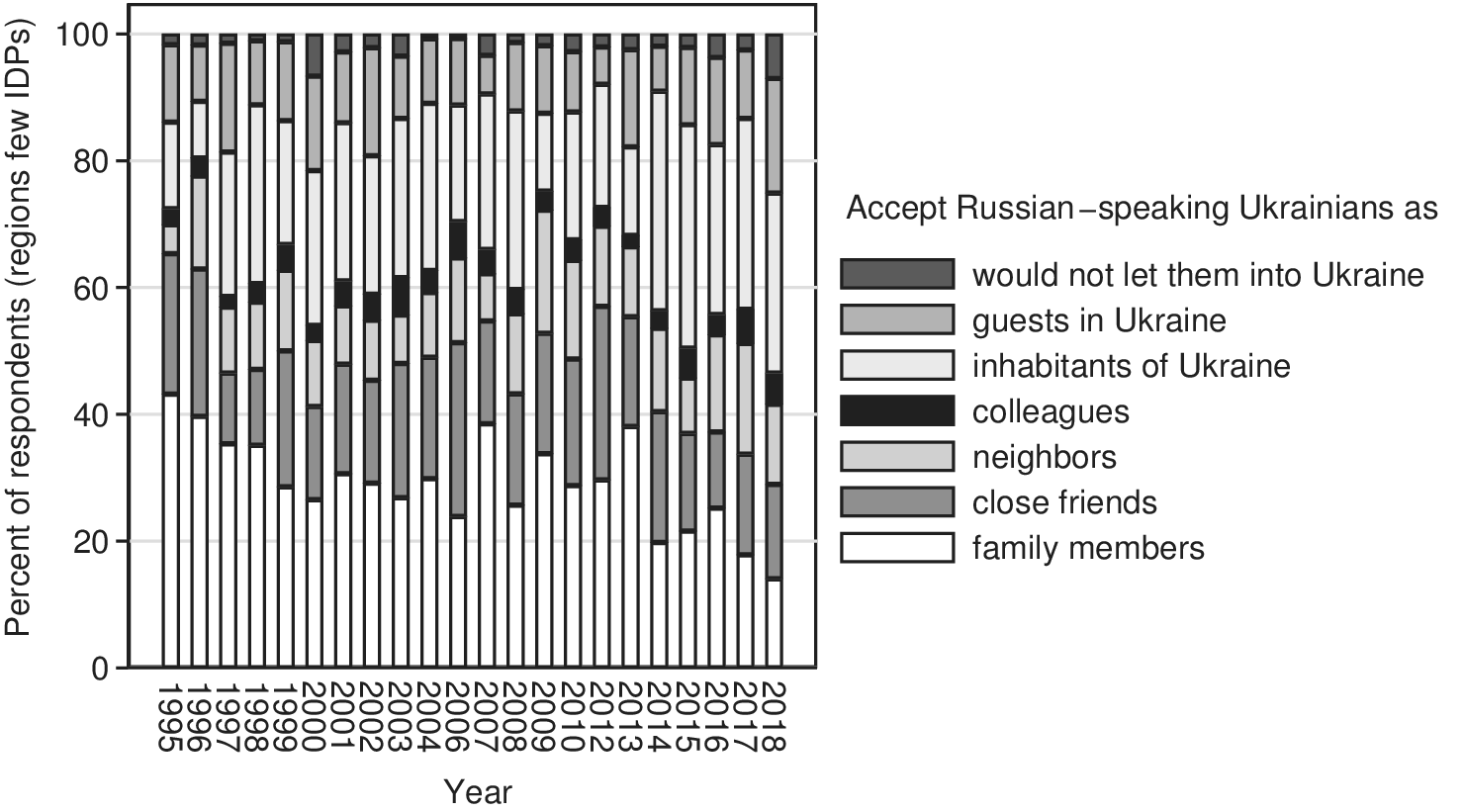
For the other samples, the patterns are relatively similar. In the whole population (Figure 2) the acceptance of Russian speakers is higher than in sample 1 (Ukrainian-speaking Ukrainians), and the changes are less pronounced. Because of the many Russian speakers among the respondents in this sample, this finding is not surprising. Figure 3 presents the answers of the population in regions in which the share of those identifying as Ukrainian-speaking Ukrainians has been relatively stable (sample 3). Changes between the years are much more pronounced in this group than in the other groups, which might be explained by the smaller sample size. Surprisingly, a decrease in attitudes toward Russian speakers occurs only after 2014, but between 2013 and 2014, the number of those accepting Russian speakers as family members even increases. Figure 4 shows the results for regions with a small proportion of IDPs (sample 4). Since the shifts between the years are sometimes quite pronounced, it is more difficult to see any patterns before 2014. However, there is a striking difference between 2013 and 2014, when the acceptance of Russian speakers as family members is nearly 20 percentage points lower than the previous year. After 2014, the share of those accepting Russian speakers as family members oscillates around 20%. This sample comprises regions from the Western part of the country only, rendering the relatively high level of social distance during the whole observation period not surprising.
Social Distance of the Whole Population (N=34229) toward Russian-Speaking Ukrainians, 1995–2018

Social Distance toward Russian-Speaking Ukrainians in Regions with Low Change in Identity (N= 9342), 1995–2018

Social Distance toward Russian-Speaking Ukrainians in Regions with Low Share of IDPs (N= 9731), 1995–2018
Multivariate Models
Table 1 shows the linear regression models for the subgroup of Ukrainian-speaking Ukrainians (that is, it corresponds to figure 1). While the first model is without any control variables, they are added in models 2 and 3; in the third model, the number of observations is smaller because the added control variable “economic status” has not been surveyed in all of the years. The results change only slightly when adding control variables.Footnote 8 Models 4–6 measure the acceptance of Russian speakers using binary variables (using the same control variables as model 2). In all models, we see statistically significant differences between the Yanukovych and Poroshenko eras. According to models 1–3, compared to the Yanukovych period, after 2014, social distance increased statistically significantly by roughly 0.5. This finding means that, on average, approximately every second person chose a category lower under Poroshenko than under Yanukovych. In contrast, these models do not detect any significant differences between the Yanukovych and Yushchenko eras. Only in one other model can another significant difference be found between the Yanukovych period and earlier presidencies: when controlling for sociodemographic variables, there is a statistically significant difference between Kuchma and Yanukovych (model 2), but the difference in this model is small (approximately 0.1).
Linear Regression Models: Social Distance of Ukrainian−Speaking Ukrainians (sample 1) toward Russian−Speaking Ukrainians

Robust standard errors in parentheses
* p < 0.05, ** p < 0.01, *** p < 0.001
Models 4–6 – here social distance is measured with binary variables – show what has already become visible in the descriptive figures: while the readiness for close relations has decreased after 2014, the share of those accepting Russian speakers as residents of Ukraine has remained fairly stable. The models estimate that, compared to the Yanukovych era, in the Poroshenko era, the share of those accepting Russian speakers as family members decreased by ten percentage points, of those accepting them as friends or family members by 13 percentage points, and of those accepting them as residents of Ukraine (and further positions) by 2.7 percentage points. For the other presidencies, the patterns are less clear. In the models, some additional significant changes can be found between other presidencies, but the changes are clearly the largest when comparing the Poroshenko and Yanukovych eras. Only the effect of the Yushchenko era is remarkable; the share of those accepting Russian speakers as family members decreased by 4.2 percentage points compared to the Yanukovych era. For friends, a similar effect cannot be found.
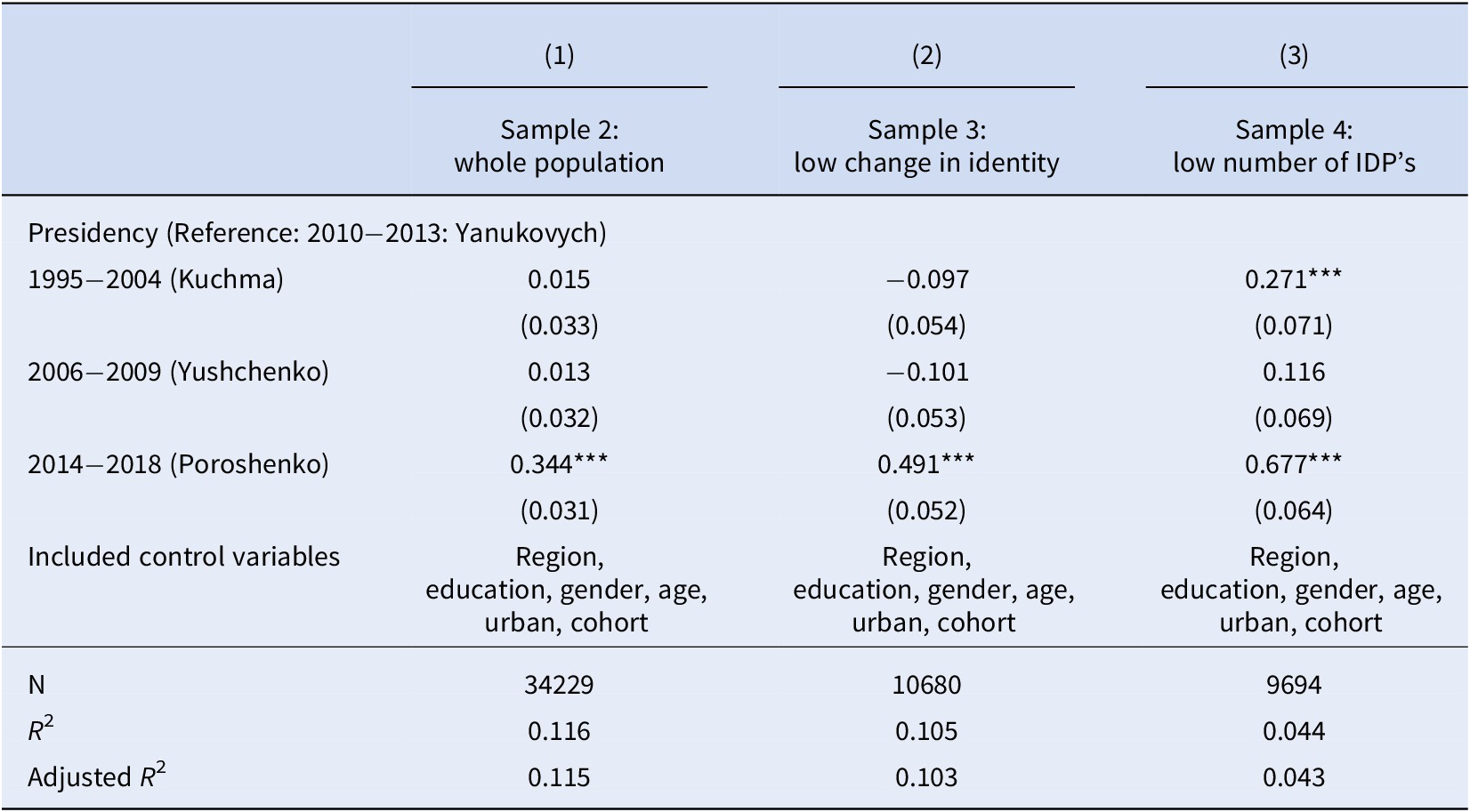
Table 2 shows the models with control variables (except for economic status) for the other three samples.Footnote 9 Overall, the patterns are similar to the sample of Ukrainian-speaking Ukrainians, but the effect sizes differ: in all of these models, we see statistically significant effects for the Poroshenko period (compared to the Yanukovych era) but none for the Yushchenko era. Among the whole population, on average, one third of the population chose a category lower under Poroshenko than under Yanukovych. For regions with small identity changes, on average, under Poroshenko, 40% of the respondents chose a category one scale point lower than under Yanukovych. For regions with a small share of IDPs, the differences between the Poroshenko and Yanukovych eras are much more pronounced than among the other groups (approximately 0.67). In addition, in this sample, the social distance toward Russian speakers grew statistically significantly under Kuchma compared to Yanukovych, but the difference is much smaller. It is not clear whether the large difference between Yanukovych and Poroshenko in this group is due to the small number of IDPs in these regions. Instead, it might be a regional effect since the regions in this sample are all in Western Ukraine. This explanation is supported by models for the different macroregions showing that regions in the West experienced a stronger change in attitudes toward Russian speakers (SM 6).
Linear Regression Models: Social Distance (metric) toward Russian−Speaking Ukrainians
Robust standard errors in parentheses
* p < 0.05, ** p < 0.01, *** p < 0.001
Similarly, models with these different samples using binary variables (see SM 4) show relatively similar patterns to the same models for Ukrainian-speaking Ukrainians. In all of the samples, the more intimate relations suffer most after 2014. The readiness to accept a Russian speaker as a resident of Ukraine decreased in most models after the beginning of the war but to a rather small extent. It should be noted that there are some other significant changes in these models, but the size of the coefficients is negligible.
Altogether, the models show that attitudes toward Russian speakers have become more negative since the beginning of the war, but overall, the evaluation of Russian speakers has remained relatively positive. While on average, attitudes toward Russian speakers have been slightly more negative under Yushchenko than under Yanukovych as well, these differences are rarely statistically significant, notwithstanding the similarity in identity politics during these two presidencies. Thus, the impression from the descriptive analysis – which showed that, during some years of Yushchenko’s presidency, attitudes about Russian speakers were relatively negative – is not supported when embracing the different years under Yushchenko. This finding suggests that identity politics and elite rhetoric – at least in peacetime – were rather unimportant in affecting attitudes toward Russian speakers (again, the caveats concerning the comparability of the rhetoric of Yushchenko and Poroshenko presented above apply).
To account for the possibility that Russian speakers are evaluated more negatively during the war due to general pessimism and thus more negative evaluations of everybody or at least every outgroup, I checked how attitudes toward other groups developed during the same period. The social distance toward Belarusians and Jews – groups that had no particular link with the war – decreased since the beginning of the war (see SM 7 for a more detailed analysis). Thus, the effects on Russian speakers cannot be explained by a generally more negative evaluation.
Attitudes about Russia and toward Russian Speakers
As I have shown above, even since the beginning of the war, attitudes toward Russian speakers have remained relatively positive, and while there have been statistically significant changes, these changes have been rather small. On average, only half of Ukrainian-speaking Ukrainians chose a category that was one category lower under Poroshenko than under Yanukovych. One reason might be that Russian speakers are not perceived to be closely linked to the Russian Federation – in contrast to my earlier argument. To explore this argument, I examine whether and how strong attitudes toward the Russian Federation and Russian speakers are correlated and if attitudes toward Russia mediate the effect of the war. In the KIIS omnibus survey, two different questions target attitudes toward Russia. The first question asks respondents how they wish the relations between Russia and Ukraine to be, with the following answer categories: “same as with other states”, “independent but friendly states”, and “unite to become one state.” The second question, which was asked in fewer waves, asks respondents about their general evaluations of Russia using an answer scale with four categories from very positive to very negative. Figure 5 shows the share of those that prefer the relations between Russia and Ukraine to be like those between other states, as well as the average evaluation of RussiaFootnote 10 and the average value of social distance toward Russian speakers for the years in which these issues were surveyed. The figures show that the attitude toward Russia worsened after the beginning of the war. A similar tendency can be observed regarding social distance. The Pearson’s correlation coefficients estimated on the average values support this view (for social distance and general attitude toward Russia: ρ = 0.6289; for social distance and preferred relation between Russia and UkraineFootnote 11: ρ = -0.7734). The correlation is, however, much smaller when we examine the intrapersonal correlation (for social distance and general attitude toward Russia: ρ = 0.215; for social distance and preferred relation between Russia and Ukraine: ρ = -0.2021). This finding suggests that the view on Russia is rather unimportant for the attitude toward Russian speakers and speaks against a severe increase in prejudice against Russian speakers after the beginning of the war in Donbas.
Social Distance toward Russian Speaking Ukrainians, Attitudes about Russia, and Wished Relations between Ukraine and Russia, 1995–2018

To explore if the attitude toward Russia mediates the effect of the war on attitudes toward Russian speakers, I estimate models with and without controlling for the attitude toward RussiaFootnote 12 (Models 1–4 in table 3). The effect is much smaller if we control for attitudes on Russia but remains statistically significant. This supports our assumption that at least to a large part the war effect is mediated by the attitude toward Russia.
Linear Regression Models: Social Distance (metric) of Ukrainian−Speaking Ukrainians (sample 1) toward Russian−Speaking Ukrainians

Robust standard errors in parentheses
* p < 0.05, ** p < 0.01, *** p < 0.001
The Presidents’ Popularity and Rhetoric
I have argued earlier that the effect of the presidential rhetoric might be low because of a low popularity of most of the presidents. To explore this argument, I study if the effect of the presidential rhetoric is moderated by the president’s popularity. These analyses are based on a dummy variable that informs if somebody would vote for the current president if there were upcoming presidential elections.Footnote 13 I interact this variable with the different periods (Model 5 in table 3). While we see small differences for those who would and those who would not vote for the respective presidents, they are only significant under Yushchenko: interviewees who would vote for Yushchenko, are more distanced to Russian speakers. Yanukovych’s proponents are less distanced toward Russian speakers, but this difference is statistically insignificant. While these results suggest that the presidential rhetoric resonates somewhat better if the president is liked, the effects are small or statistically insignificant.
Conclusion and discussion
In this paper, I have explored how prejudice against the Russian-speaking population has developed in Ukraine between 1995 and 2018. I have shown that attitudes toward Russian speakers have changed only slightly among the presidencies of Kuchma, Yushchenko, and Yanukovych. In contrast, there has been a noticeable change since the beginning of the war, coinciding with Poroshenko’s presidency. Compared to the years immediately before the war in Donbas, on average, every second Ukrainian-speaking person chose a category one scale point more distanced to that before the conflict. Since identity politics have been relatively similar under Yushchenko and Poroshenko, it seems that ethnic identity politics alone have not affected attitudes toward Russian speakers very much. Thus, the difference between Yanukovych and Poroshenko was likely caused by the war in Donbas and the perception that Russian speakers are linked with Russia. At least in times of peace, the political rhetoric did not fall on fertile ground.
From a broader social science perspective, the study indicates that not only those directly affected by war – those fleeing, fighting, or living in war-torn areas – suffer from war but also ethnic or linguistic minorities that are seen to belong to the opponent of a war might experience increased prejudice as a consequence of war. This outcome might even be the case – as in Ukraine – when prejudice before the negative event has been low. In addition, the study suggests that at least when identities are as blurry as in Ukraine, elite rhetoric promoting the core nation – but not denigrating minorities – does not lead to prejudice against these groups.
While an increase in social distance toward the Russian-speaking population in Ukraine sounds alarming, it should be emphasized that most Ukrainians are still willing to accept Russian speakers as friends or family members. Thus, concern about interethnic conflict in Ukraine that has been raised since the beginning of the war seems to rather overrate the importance of ethnic or linguistic identification or the perception that Russian speakers are linked to Russia. This argument is supported by the presidential elections in 2019, which suggest that identity politics, such as language questions, are rather irrelevant for many Ukrainians: The overwhelming majority of Ukrainians did not vote for President Poroshenko, who had campaigned using rather nationalist slogans and promoting an ethnic Ukrainian identity, but for his rival, the entertainer Volodymyr Zelensky, who had not voiced nationalist ideas and had even been criticized by nationalists for having produced most of his films in Russian (Trubetskoy, Halling, and Nelles Reference Trubetskoy, Halling and Nelles2019, 16–17).
One might debate the relationship between the results of this study and the research on Ukrainian nationalism. The question of which type of nationalism – ethnic or civic – has been dominant and how its nature has changed since Euromaidan or the war in Donbas has been discussed vividly (Kulyk Reference Kulyk2016). This distinction, which has been criticized repeatedly (Brubaker Reference Brubaker, Kriesl, Armingeon, Siegrist and Wimmer1999; Kuzio Reference Kuzio2001b), centers on the criteria for being a member of a nation: are ethnic (e.g., ethnicity, ancestry, or culture) or civic criteria (e.g., place of living or birth) more important for belonging to the nation? While most researchers agree that a civic identity or understanding of being Ukrainian has remained stable or been strengthened since Euromaidan (Bureiko and Moga Reference Bureiko and Moga2019; Sasse and Lackner Reference Sasse and Lackner2018; Zhurzhenko Reference Zhurzhenko2014; Kulyk Reference Kulyk2017, Reference Kulyk2018), Shevel (Reference Shevel2018) points out that different studies use the same measure – the Soviet-inherited concept of national’nist’, which is usually translated as “ethnicity” – to quantify either ethnic or civic identity. Thus, it seems that the results of these studies must be read with some caution. This study has not focused on Ukrainian nationalism but on prejudice against Russian speakers. However, one might argue that the social distance scale offers a hint at the question of who is accepted as a conational. One of the categories of the social distance scale is whether the target group would be accepted as a resident of Ukraine; although there is a difference between a conational and a resident, for most respondents, this distinction might be rather unimportant. Thus, a decrease in the acceptance of Russian speakers as residents might be interpreted as an increase in ethnic nationalism. The analysis has shown that the acceptance of Russian speakers as residents has been relatively stable. On these grounds, it might be argued that ethnic nationalism has not strengthened since 2014.
As has been discussed, the study acknowledges its limitations related to the causal identification of the effects. However, studying the research question as thoroughly as possible is important – even if causal analysis in its strongest sense is impossible – because it helps to assess the potential threats of intergroup clashes in Ukraine. By comparing different time periods and using multivariate regression models, this paper indicates that the war in Donbas is associated with more negative attitudes toward Russian speakers in Ukraine. Nevertheless, the social distance toward Russian speakers has remained relatively low during the whole period under observation. Thus, one might tentatively conclude that the peaceful coexistence of different linguistic groups does not seem to be threatened.
Supplementary Material
To view supplementary material for this article, please visit http://doi.org/10.1017/nps.2021.100.
Acknowledgements
The author is grateful to Alexander Libman, Natalia Kudriavtseva, Mark Brüggemann, Oxana Shevel and the participants of a research colloquium at the LMU Munich (2019) and at University of Regensburg (2019), participants of the Ukraine Summer School in Kherson (2019), of the Conference of junior scholars in the field of East European studies in Bochum (2019), and at the Annual Convention of ASEEES (2019) in San Francisco and Gulnaz Sharafutdinova and two anonymous reviewers for their helpful comments. All mistakes remain my own. I thank the Kyiv International Institute of Sociology for providing data. The paper is part of my cumulative PhD dissertation.
Disclosures
None.


 Open access

