

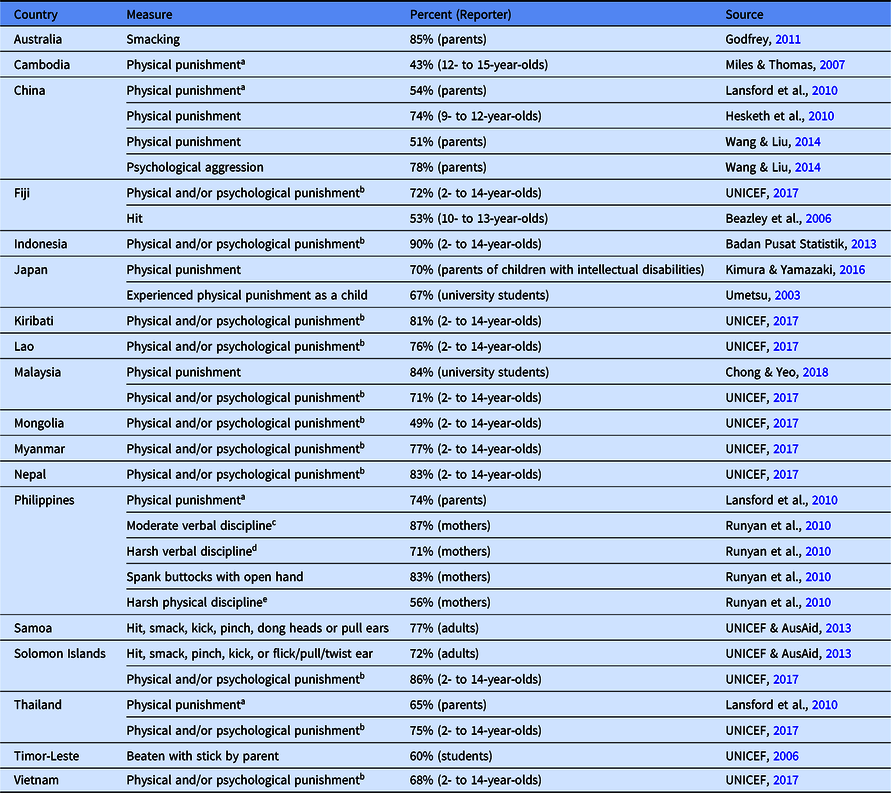
Over centuries and across cultures, physical and emotional punishment — acts intended to cause physical pain, fear, and/or humiliation to correct children’s behavior — have been considered an appropriate response to adult-child conflict. In the Asia-Pacific region, these punishments are commonplace. Table 1 summarizes the findings of a number of studies which, although their methods and quality vary, show that physical and psychological punishments are common experiences in the lives of children in the region. In Tonga, for example, beating has been identified as the principal form of punishment in children’s homes (Government of Tonga & UNICEF, 2006). In a study of children’s punishment experiences in eight Asia-Pacific countries, reports of beating, kicking, punching and verbal attacks were common (Beazley, Bessell, Ennew, & Waterson, Reference Beazley, Bessell, Ennew and Waterson2006).
Physical and Emotional Punishment Rates Reported in Asia-Pacific Countries
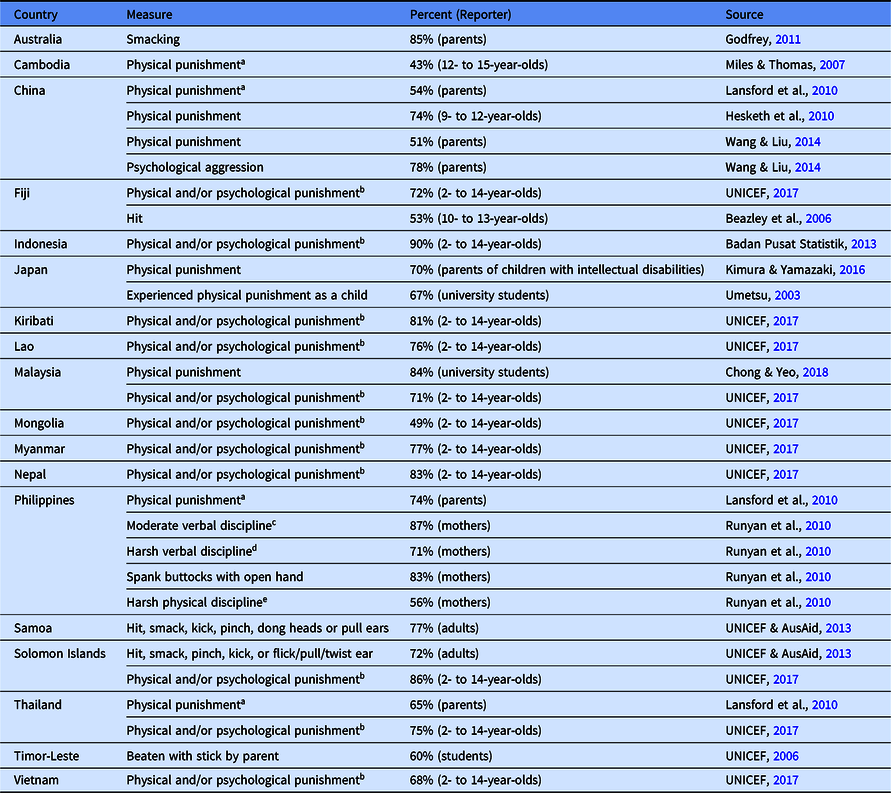
Note:aPhysical punishment = spanking, hitting, slapping, shaking, hitting with object. bPhysical and/or psychological punishment = spanking, hitting, slapping, shaking, hitting with object, and shouting, yelling, screaming, name-calling, respectively. cModerate verbal discipline = shouting, screaming, yelling, refusing to speak to child, withholding food. dHarsh verbal discipline = cursing or calling child names, threatening abandonment, threatening to invoke ghosts/evil spirits, locking child out of house, threatening with knife/gun. eHarsh physical discipline = kicking, choking, smothering with hand or pillow, burning/scalding/branding; beating, shaking child under two years.
Physical and emotional punishments have long been identified as forms of violence and violations of children’s rights to protection and dignity (European Court of Human Rights, 1978; Key, Reference Key1909; Pinheiro, Reference Pinheiro2006). The Convention on the Rights of the Child (CRC; United Nations General Assembly, 1989), ratified by all United Nations (UN) member states except the United States, requires governments “to take all legislative, administrative, social and educational measures to protect the child from all forms of physical or mental violence”. The UN Committee on the Rights of the Child (2006) consistently calls for legal prohibition of physical and emotional punishment of children in all UN Member States. The UN’s 2030 Agenda for Sustainable Development (UN, 2015) identifies the elimination of all violence against children as a key target.
These calls to action reflect the findings of decades of research, which consistently reveal that physical and emotional punishments predict physical harm; psychological maladjustment; impaired cognitive development; aggression and antisocial behavior; disrupted attachment; and lower levels of altruistic behavior, empathy, and moral judgment (Gershoff, Reference Gershoff2002; Wekerle, Reference Wekerle2011; Wekerle et al., Reference Wekerle, Leung, Wall, MacMillan, Boyle, Trocmé and Waechter2009). These findings have been replicated across cultures, including China, Japan, Malaysia, Philippines, Sri Lanka and Thailand (Chong & Yeo, Reference Chong and Yeo2018; De Zoysa, Newcombe, & Tajapakse, Reference De Zoysa, Newcombe and Rajapakse2008; Gershoff et al., Reference Gershoff, Grogan-Kaylor, Lansford, Change, Zelli, Deater-Deckard and Dodge2010; Hesketh et al., Reference Hesketh, Zhen, Lu, Dong, Jun and Xing2010; Lansford et al., Reference Lansford, Sharma, Malone, Woodlief, Dodge, Oburu and Di Guinta2014; Masuda et al., Reference Masuda, Yamanaka, Hirakawa, Koga, Minomo, Munemoto and Tei2007; Okuzono, Fujiwara, Kato, & Kawachi, Reference Okuzono, Fujiwara, Kato and Kawachi2017; Tong et al., Reference Tong, Shinohara, Sugisawa, Tanaka, Watanabe, Koeda and Anme2015; Wang, Wang, & Liu, Reference Wang, Wang and Liu2016). A recent meta-analysis of 75 studies of “spanking” yielded 79 unique and statistically significant effect sizes. Of these, 99% indicated negative outcomes (Gershoff & Grogan-Kaylor, Reference Gershoff and Grogan-Kaylor2016). It is estimated that the annual economic losses to the East Asia-Pacific region due to physical and emotional maltreatment are (in 2004 dollars) USD$39.6 billion and $65.9 billion, respectively (UNICEF, 2015).
Thus, there is an urgent need to address and transform the beliefs that perpetuate these responses to parent-child conflict. Key among these is the belief that such punishments are acceptable, deserved, nonharmful and effective — a belief rooted in childhood experience (Durrant, Acar, McNeil, Watkinson, & McGillivray, Reference Durrant, Acar, McNeil, Watkinson and McGillivray2017). The importance of parents’ attitudes has been repeatedly demonstrated. For example, Winstok and Straus (Reference Winstok and Straus2011) found that parents’ approval of “aggressive discipline” (beating and/or physical force) predicts their use of emotional punishment (shouting, scolding, “telling the child off”), physical punishment (spanking, smacking, shaking), and physical abuse (beating, punching, hitting with a stick or belt). Approval and normalization of physical punishment has been found to be a powerful predictor of its use (Ateah & Durrant, Reference Ateah and Durrant2005; Durrant, Rose-Krasnor, & Broberg, Reference Durrant, Rose-Krasnor and Broberg2003; Vittrup, Holden, & Buck, Reference Vittrup, Holden and Buck2006; Socolar & Stein, Reference Socolar and Stein1995). When parents with a childhood history of being physically punished become frustrated, they are more likely to use physical punishment if they approve of it (Russa, Rodriguez, & Silvia, Reference Russa, Rodriguez and Silvia2014). The association between parenting stress and child abuse potential appears to be moderated by the strength of parents’ beliefs in the value of physical punishment (Crouch & Behl, Reference Crouch and Behl2001). A key belief held by mothers at high risk for using physical punishment is that it is necessary and instrumental (Taylor, Hamvas, & Paris, Reference Taylor, Hamvas and Paris2011).
In countries where severe physical punishment is normative, these attitudes can be strongly entrenched and resistant to change (Beazley et al., Reference Beazley, Bessell, Ennew and Waterson2006). Approval of physical punishment is particularly strong in the Asia-Pacific Region (Straus, Reference Straus, Straus, Douglas and Medieros2014). For example, a study of traditional beliefs in Papua New Guinea, Vanuatu and Solomon Islands concluded that punishment with potential to cause serious physical and psychological harm “was not unusual and that, on the whole, such punishment was sanctioned or, at the very least, ignored by many within the adult community” (Dorning, Gow, & Kaucz, Reference Dorning, Gow and Kaucz2005, p. 26). These punishments included being hung on a tree, being beaten with a stick, being placed in heavy smoke, or being tied up outside overnight. Approximately one-quarter of the Papua New Guinea sample believed that “modern” discipline methods such as “light smacking” were ineffective and contributed to disrespect among children for their elders. Clearly, targeting the beliefs that perpetuate punishment across generations is a significant challenge. The purpose of the present study was to assess whether parents in three Asia-Pacific countries who participated in a program aimed at reducing physical and emotional punishment became less supportive of such punishments over the course of the program. If so, this program may hold promise as a method of transforming attitudes, beliefs, and ultimately behaviors of parents in this region.
Positive discipline in everyday parenting
In 2006, the UN published a report documenting the high global prevalence of physical and emotional punishment of children (Pinheiro, Reference Pinheiro2006). It called for the development of parenting programs that emphasize the importance of relationships, increase understanding of child development, and promote discipline approaches that comply with human rights standards. In response to this recommendation, Save the Children Sweden (SCS), an international nongovernmental organization (NGO), intensified its campaign to eliminate physical and emotional punishment of children. One of its strategies was implemented through collaborating with a developmental psychologist to develop a nonviolent discipline approach that would be relevant across cultural contexts.
This approach, “Positive Discipline in Everyday Parenting” (PDEP; Durrant, Reference Durrant2016), differs from most established “parent training” programs, which are rooted in behaviorist principles of reward and punishment (e.g., time-out, removing privileges) to elicit children’s compliance. In contrast, PDEP presents a framework for nonpunitive problem-solving that is based on children’s developmental needs and their rights to protection, dignity and participation. It aims to help parents understand the emotional and developmental reasons underlying common parent-child conflicts. Rather than prescribing rewards and punishments, PDEP helps parents learn how to engage children in collaborative problem-solving and conflict resolution. PDEP was designed from the outset as a universal program, intended for all caregivers regardless of socio-demographic characteristics. Its primary objective is to reduce their approval of punitive responses to conflict by equipping them with knowledge of child development and skills in problem-solving. Over eight weekly 2-hour sessions, plus a follow-up session, groups of parents are taught a simple framework for fostering healthy adult-child relationships and problem-solving in the face of conflict.
The PDEP framework has four components. The first — identifying long-term goals — aims to refocus parents’ awareness from short-term frustration to their long-term vision. It is expected that as they become aware of their long-term goals, they will recognize the inherent contradiction in using verbal or physical aggression to raise children who they hope will be grow into empathic and nonviolent adults, and with whom they hope to maintain close and positive relationships. The second component — providing warmth and structure — helps parents understand the fundamental tools needed for strong, healthy relationships. Warmth creates a safe, secure environment in which children can gain confidence and competence over time, while structure shifts parents’ focus from punishment to “scaffolding” children’s understanding by providing the information and guidance they need in order to learn. The third component — understanding how children think and feel — focuses on children’s perspectives and the major themes that propel children’s development from infancy through adolescence, such as the drives for attachment, exploration, autonomy, and mastery. Parents learn about emotional, cognitive, and brain development to help them understand the reasons that often underlie children’s behavior. The fourth component of PDEP — problem-solving — focuses on giving parents practise in synthesizing the previous components to identify responses to conflict that lead them toward their long-term goals, ensure their children’s safety and security, scaffold their children’s learning, and respect their children’s developmental level.
PDEP is based on the theory of planned behavior (TPB; Ajzen, Reference Ajzen2002), a social cognitive theory that identifies three central belief systems influencing the likelihood of behavior change. First, behavioral beliefs determine an individual’s evaluation of a behavior as positive or negative. For example, a parent who believes that children who are not physically punished will be spoiled is likely to hold a positive attitude toward physical punishment which, in turn, makes their use of it more likely. PDEP targets parents’ approval of physical punishment by increasing their understanding of its long-term developmental risks, as well as their awareness of children’s need for security and the nature of children’s learning.
Second, normative beliefs refer to the degree of perceived social pressure to engage in a behavior, as well as their subjective norms regarding others’ behavior. For example, a parent who believes that physical punishment is a social norm in the face of child “misbehavior” will be more likely to intentionally apply physical punishment. PDEP aims to increase parents’ knowledge of normative child behavior and normative parent-child conflicts, thereby shifting their attributions for child behavior that would otherwise invoke perceived social pressure to spank.
Third, control beliefs are an individual’s perceptions of factors that might facilitate or impede their ability to perform a behavior. These beliefs influence one’s sense of self-efficacy — that is, their ability to perform the intended behavior. For example, a parent who feels unprepared to respond to conflict nonpunitively is less likely to do so. PDEP is designed to strengthen parents’ skills in responding constructively to conflict through practice in problem-solving in challenging situations. It is expected that as they become increasingly skilled in problem-solving, they will feel better prepared to implement it with their own children.
The PDEP approach was first articulated in a book for parents (Durrant, Reference Durrant2007), which was reviewed by parents in Thailand and by youth in Hong Kong, Japan and Fiji. Following revisions based on their feedback, the book was made available online free of charge through Save the Children’s online resource center. A 2-day orientation workshop, piloted with participants from across Asia, evolved into an 8-week parent program and a 4-day facilitator training program. Save the Children has organized trainings of facilitators in several Asia-Pacific countries (Australia, China, Fiji, Indonesia, Korea, Nepal, Papua New Guinea, Philippines, Solomon Islands, Sri Lanka, Thailand). These facilitators are staff of NGOs, family support workers, social workers, and others with the capacity to work directly with parents.
In an initial assessment of PDEP with 321 parents in Canada, participation was associated with decreased approval of physical punishment and increased childrearing efficacy (Durrant et al., Reference Durrant, Plateau, Ateah, Stewart-Tufescu, Jones, Ly, Barker and Tapanya2014). These findings are promising but further examination of PDEP’s potential to shift parental beliefs about punishment is warranted, particularly in the Asia Pacific region where physical punishment is particularly prevalent, and its approval is particularly strong.
Purpose and hypotheses
The present study provides the first assessment of PDEP in the Asia-Pacific region. Our purpose was to examine whether there is evidence of change in parents’ behavioral, normative and control beliefs in three countries: Australia, Japan, and Philippines. These countries were selected for several reasons. First, PDEP has been implemented in each for a sufficiently long time for adequate sample sizes to have been collected. Second, they represent considerable socio-cultural diversity to provide a strong assessment of PDEP’s potential to have impact in the region. Third, despite their economic, ethnic, linguistic and religious diversity, all three countries have high rates of physical punishment of children (Table 1).
Australia is classified as a Very High Development country by the United Nations Development Programme (UNDP, 2018). As a former British colony, Australia inherited the common law defense providing parents protection from assault charges if the force used is “reasonable” and corrective, along with its underlying assumption of original sin, which is the perception that children require physical punishment for proper socialization and valuing of obedience (Durrant, Reference Durrant and Dwyer2019; Greven, Reference Greven1991). There has been little progress made toward law reform, despite the efforts of several Children’s Commissioners (Australian Institute of Family Studies, 2017; Saunders & Cashmore, Reference Saunders, Cashmore, Durrant and Smith2011). Opinion polls and academic studies conducted in Australia have found a high prevalence of physical punishment and high levels of approval of its use over time (Poulsen, Reference Poulsen2018, Reference Poulsen2019).
Japan also is classified as a Very High Development country (UNDP, 2018). However, in contrast to Australia, Japan’s traditional childrearing culture reflected the Confucian notion of children’s innate goodness, emphasizing wakaraseru (helping the child understand and internalize reasons) over submissive compliance, mimamoru (allowing the child to learn through natural consequences) rather than punishment, and shin (a mutual, humane and flexible relationship) over authoritarianism (Holloway, Reference Holloway2010; Holloway & Nagase, Reference Holloway, Nagase, Selin and Schvaneveldt2014). However, the post-World War II Allied occupation of Japan brought Western influence to Japanese parenting. By 2010, 65% of parents believed that corporal punishment is necessary (Iwai, Reference Iwai2010). In 2017, a survey of 20,000 adults found that 60% thought that hitting children was an acceptable form of discipline (Japan Times, 2018). At the time the present study was conducted, Japanese law permitted corporal punishment in the home.
The Philippines is classified as a Middle Development country (UNDP, 2018). In contrast to the relative homogeneity of Australia and Japan, the Philippines is composed of 7000 islands that are highly diverse in terms of language, religion and ethnicity (more than 175 ethnolinguistic nations), due to its history of immigration from Japan, Malaysia, China, Britain and France, among other countries, and its colonization by Spain and the United States. As a result of colonialism, political turbulence, 40 years of internal conflict, and high levels of poverty and inequity, violence is pervasive, including punitive violence (Table 1). By 2015, 55% of a sample of 3866 children and youth from 17 regions reported experiencing “mild” physical punishment in their homes and 30% reported more severe physical punishment (Council for the Welfare of Children & UNICEF, 2016). In general, a high value is placed on child obedience, and parental attitudes tend to be authoritarian (University of the Philippines Manila, University of Edinburgh, Child Protection Network Foundation & UNICEF Philippines, 2016). The Family Code of the Philippines allows parents to use discipline “as may be required under the circumstances” (Article 220).
We hypothesized that changes in parents’ behavioral, normative and control beliefs would be found over the course of their participation in PDEP in all three target countries. We based this hypothesis on the findings of a previous study conducted in 13 countries classified as high, medium, and low on their human development indices, which found that parents viewed the program as relevant and effective across these diverse contexts (Durrant et al., Reference Durrant, Plateau, Ateah, Holden, Barker, Stewart-Tufescu and Ahmed2017). Specifically, we expected that over the course of the program, parents who took PDEP in the three target countries would become: (1) less likely to approve of physical and other punishments; (2) less likely to attribute typical child behavior to intentional misbehavior; and (3) more likely to feel prepared to respond constructively to conflict with their children. As we have no previous data on which to base a hypothesis regarding the relative degree of change across the three target countries or across demographic groups, we assumed the null hypothesis — that is, that the predicted changes would be of similar magnitude across the three countries and that they would not vary by parents’ demographic characteristics.
Method
Participants
We conducted a power analysis for a one-way analysis of variance (ANOVA) with three groups using an alpha of .05, power of .80, and a medium effect size (F = 0.20). Based on these assumptions, the required sample size is 159. The study sample consisted of 377 participants who completed the PDEP program in Australia (n = 135; 35.8%), Japan (n = 172; 45.6%) or the Philippines (n = 70; 18.6%).
Each participant was enrolled in a group program led by a trained facilitator. Parents were recruited through advertisements distributed by the organizations delivering the programs. Parents were accepted until each group reached its maximum number, which varied according to agencies’ space and resources (group size range from 5 to 16).
Measures
All participants in the present sample completed the standardized PDEP Pre and Post Program Parent Questionnaires (Durrant et al., Reference Durrant, Plateau, Ateah, Stewart-Tufescu, Jones, Ly, Barker and Tapanya2014), which were designed to measure changes in parents’ attitudes and beliefs over the course of the program. The items were originally generated by an international group of content specialists, based on the objectives of the program. The content validity of the items was assessed through a consultative process. Pre- and posttest pencil-and-paper questionnaires were constructed and piloted first in Canada with three groups of PDEP facilitators working with widely diverse parent groups. Those facilitators were asked to assess the relevance, clarity and appropriateness of the items for their parent communities, and the questionnaires were revised on the basis of their feedback. Items deemed too complex or culturally inappropriate were modified or deleted. Two experts in English as a second language independently reviewed and simplified the wording of the items. The questionnaires were then piloted by a PDEP facilitator in the Solomon Islands. Further modifications were made to reduce the complexity of the items and optimize their cross-cultural appropriateness. The reading levels of the final questionnaires were assessed using Microsoft Word software, which calculated the Flesch Reading Ease score to be 66.3 (on a scale of 0 to 100; higher scores indicate greater ease of reading; average range is 60 to 70) and the Flesch Kincaid Grade Level to be 8.4.
The questionnaires were administered in English to parents in Australia, where English is the official language, and in the Philippines, where English is one of two official languages. In Japan, the questionnaires were translated into Japanese and then reviewed and revised by a bilingual (English/Japanese) trained PDEP facilitator and finalized in consultation with the evaluation team. In the present study, we focused on the questionnaire items that measured the variables of interest: (1) attitude toward punishment, (2) attribution of typical child behavior to intentional misbehavior, and (3) feeling prepared to respond constructively to parent-child conflict.
Pretest
Parents rated on a 6-point scale (1 = strongly disagree, 2 = mostly disagree, 3 = somewhat disagree, 4 = somewhat agree, 5 = mostly agree, 6 = strongly agree) how strongly they agreed with each of the 18 statements described below.
Attitude toward punishment was operationalized as the strength of parents’ agreement with each of 12 statements. Four of these statements pertained to physical punishment: (1) “Sometimes a spank or swat is the best way to get a child to listen”; (2) “Spanking is fine as long as the parent is not angry”; (3) “Parents should have the right to decide whether to use physical punishment”; and (4) “It’s ok to spank a five-year-old’s bottom if she does something dangerous”. The remaining eight statements pertained to nonphysical punishments or punishment in general: (1) “Instead of spanking, parents should take away privileges when their children break the rules”; (2) “If a 16-year-old breaks her curfew, the best response is to ground her”; (3) “When a 12-year-old gets into trouble at school, her parent should punish her before she has a chance to give excuses”; (4) “A teenager who says her parents‘ rules are unfair should be told that if she doesn’t like them she can leave”; (5) “If parents don’t use punishment, their children will be spoiled”; (6) “Children who are punished learn how to behave better than children who aren’t punished”; (7) “If a 14-year-old is failing in school, his parent should make him do hard physical chores to get him to work harder”; and (8) “If a 16-year-old wears a hairstyle that his parent disapproves of, he should not be allowed to go outside until he changes it”.
Attribution of typical behavior to intentional misbehavior was operationalized as the strength of parents’ agreement with six statements: (1) “Young children who say ‘no!’ are being defiant”; (2) “Usually, children have tantrums because they are spoiled; (3) “Four-year-olds who interrupt adults are rude”; (4) “A teenager who does not want to be seen with his mother should be ashamed of himself”; (5) “Babies cry in the middle of the night to make their parents angry”; and (6) “If an eight-year-old uses bad words in front of his parents, this is a sign of disrespect”. In a study of Canadian parents (Durrant et al., Reference Durrant, Plateau, Ateah, Stewart-Tufescu, Jones, Ly, Barker and Tapanya2014), these six items formed a scale with adequate internal consistency (α = .66).
Posttest
At posttest, parents rated the items described above on the same 6-point scale, so that their pre- and posttest responses could be compared.
Feeling prepared to respond constructively. Parents were also asked to rate, on the same 6-point scale, seven additional statements measuring how prepared they felt to respond constructively to conflict: (1) “Learning about positive discipline will help me use less physical punishment”; (2) “Since I learned about positive discipline, I believe more strongly that parents should ask children for their point of view”; (3) “Learning about positive discipline will help me communicate better with my child(ren) ”; (4) “Learning about positive discipline has helped me understand my child(ren)‘s feelings”; (5) “Learning about positive discipline will help me control my anger”; (6) “Learning about positive discipline will help me build stronger relationships with my child(ren)”; and (7) “Learning about positive discipline has helped me understand my child(ren)’s development”.
Procedures
The pretest was administered in the first session of each parent program, after parents had introduced themselves and some rapport had been established, but before they were exposed to any program content. The pretest included a face sheet on which parents identified: (1) the program’s location; (2) the facilitator’s name; (3) their gender; (4) their age; (5) the number and ages of their children; and (6) their highest level of education. The posttest was administered after all program content was covered and parents’ questions were answered, but before the program’s formal closing.
Approval for the study was obtained from the first author’s university Research Ethics Board prior to the commencement of data collection (Certificate #42074). All facilitators were trained in the ethical administration of the measures. Facilitators were provided with a script that explained the processes in place to guarantee anonymity and confidentiality. All parents provided informed consent. Minimal demographic information was collected to reduce the likelihood that an individual parent’s responses could be identified. Each parent wrote a self-generated “code word” on the pretest questionnaire that had meaning to the individual parent but could not be used by anyone else to identify them. Parents were asked to record their code words in a private place so that they would be able to remember them at the end of the program, at which time they wrote their code words on the posttest questionnaire. This method allowed each parent’s pre- and posttest questionnaires to be matched without violating their anonymity. The modal time from pre- to posttest was 8 weeks.
Analysis
The analysis was conducted in five stages. First, we examined the demographic characteristics of the country subsamples to identify any significant differences among them that would need to be controlled in the subsequent analyses. Second, we conducted a confirmatory factor analysis on each measure (approval of punishment, attribution of typical behavior to intentional misbehavior, and feeling prepared to respond constructively) to determine whether they formed cohesive scales. Third, we computed a series of Bonferonni paired t tests to examine within-country pre-post changes on the resulting scales. Fourth, we conducted a series of one-way (scale × country) ANOVAs with the pretest and posttest data to explore any between-country differences. Finally, we calculated each parent’s pre-post difference scores and conducted multiple regression analyses to examine the relative contributions of their demographic characteristics and country to predicting the magnitude of pre-post change on each scale. As very few data were missing, we assumed throughout the analyses that data are missing completely at random.
Results
Demographic characteristics of the sample
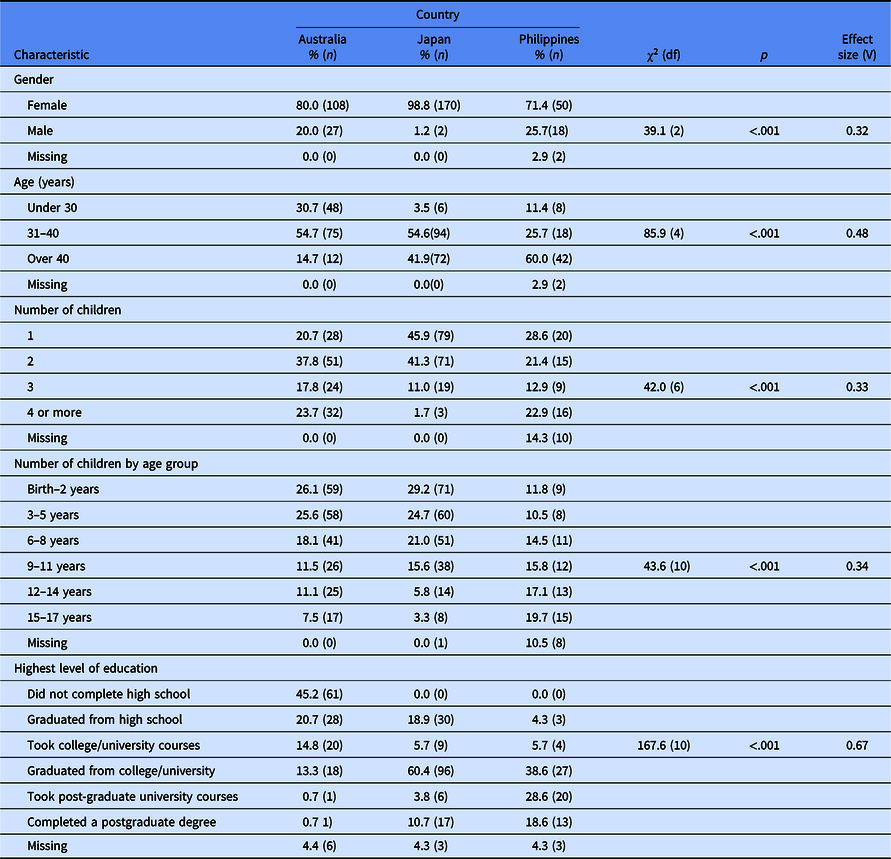
The demographic characteristics of the sample are presented by country in Table 2. In each country, at least 70% of the participants were mothers. From chi-square tests, five significant between-country differences emerged (Table 2). Compared to parents in Japan and the Philippines, parents in Australia were younger and had less education. The Japanese sample comprised fewer fathers and smaller families than the other two samples. Children in the Filipino families were older than those in the Australian and Japanese families.
Demographic Characteristics of the Three Country Samples
Factor structure of the measures
The confirmatory factor analysis (CFA) revealed that the 12 items measuring attitude toward punishment did not form a single factor. The fit statistics for the single factor solution were not adequate (root mean square error of approximation [RMSEA] = 0.13; adjusted goodness of fit index [AGFI] = 0.77; Bentler comparative fit index = 0.82). Thus, we examined a two-factor solution. The fit statistics clearly showed a two-factor solution forming an Approval of Punishment factor and an Approval of Physical Punishment factor (RMSEA = 0.09; AGFI = 0.89; and Bentler comparative fit index = 0.93). Items were retained if they obtained factor loadings of at least .60. As a result, three items were dropped. Table 3 shows the retained items and their factor loadings. The five-item Approval of Punishment (AP) and four-item Approval of Physical Punishment (APP) factors were treated as scales in the subsequent analyses. Both scales had acceptable internal consistency reliability (α = .71 and .84 respectively). Higher scores on the AP Scale indicated stronger approval of punishment generally (potential range = 5 to 30). Higher scores on the APP Scale indicated stronger approval of physical punishment specifically (potential range = 4 to 24).
Items Retained Following Confirmatory Factor Analysis and Their Factor Loadings
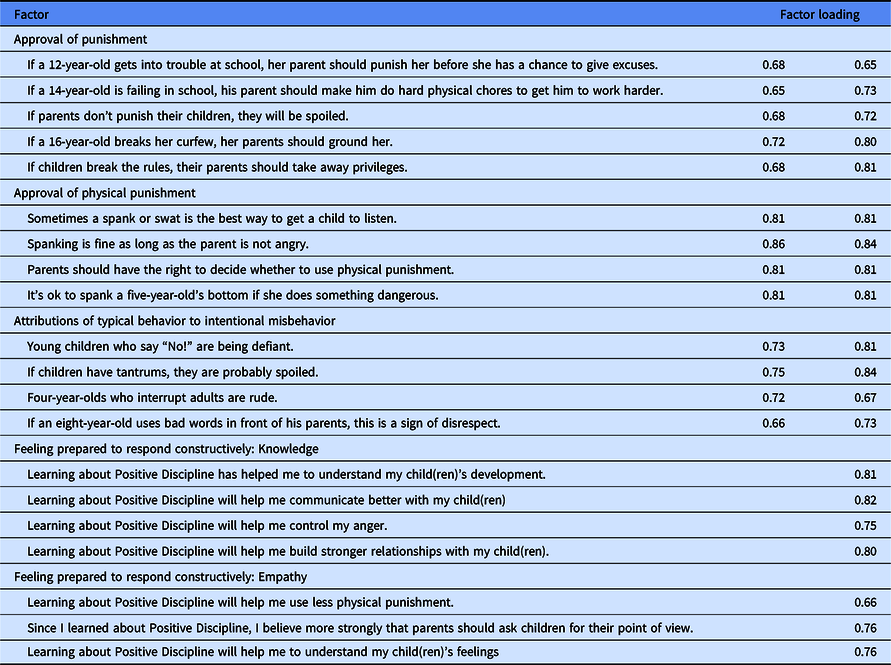
Of the six items administered to measure parents’ tendency to attribute typical behavior to intentional misbehavior, four loaded onto a single factor (Table 3; RMSEA = 0.08, AGFI = 0.96, Bentler comparative fit index = 0.99). Two items did not obtain factor loadings of at least .60 and were dropped. The Attribution for Typical Behavior to Intentional Misbehavior (ATB) factor was treated as a scale in the subsequent analyses (α = .64). Higher scores on the ATB scale indicate stronger attribution of typical child behavior to intentional misbehavior (potential range = 4 to 24).
The seven items administered to assess parents’ sense of feeling prepared to respond constructively at posttest did form a single factor (RMSEA = 0.70, AGFI = 0.94, Bentler comparative fit index = 0.97). However, two of the items had factor loadings of less than .60. A two-factor solution fit the data well (RMSEA = 0.07, AGFI = 0.94, Bentler comparative fit index = 0.97) and was affirmed by the strong factor loadings of all items (Table 3). The two factors measured: (1) feeling more knowledgeable/skilled (Knowledge factor); and (2) being more empathic and less punitive (Empathy factor). These factors were treated as scales in the subsequent analyses (α = .78 and .52 respectively). Higher Knowledge scores indicate a stronger belief that the knowledge and skills necessary to respond constructively had been acquired through PDEP (potential range = 4 to 24). Higher Empathy scores indicate a more empathic and less punitive orientation following PDEP (potential range = 3 to 18).
Within-country analyses
Table 4 shows the pre- and posttest means and differences for the full sample and the three country subsamples. Parents’ approval of punishment in general, their approval of physical punishment specifically, and their attributions for typical behavior to intentional misbehavior decreased significantly from pre- to posttest across the full sample and within each country subsample. Of the 12 effect sizes generated, 10 were large or very large; the remaining two were medium in magnitude.
Pre- and Posttest Means and Differences
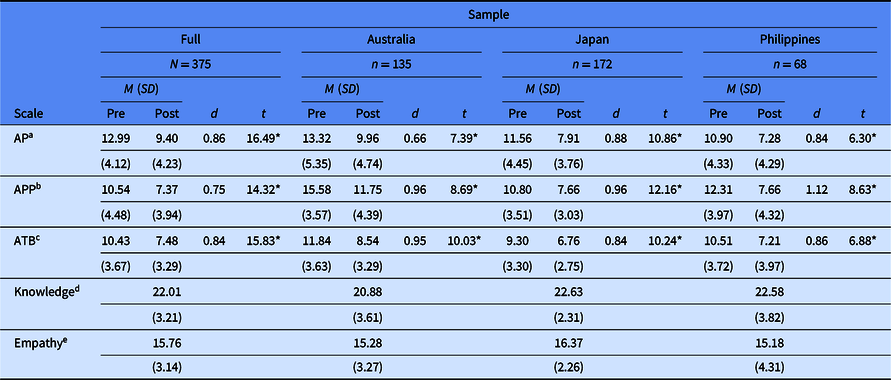
Note: For each test, df = n – 1. aAP, Approval of punishment in general; bAPP, approval of physical punishment; cATB, attribution of typical behavior to intentional misbehavior; dKnowledge, perceived increase in knowledge at posttest; eEmpathy, perceived increase in empathy at posttest.
*p < .01.
Regarding their perceptions of changes in their knowledge, most parents in Australia, Japan and the Philippines “mostly” or “strongly” agreed that PDEP had helped them understand their children’s development (83% to 98% respectively) and would help them communicate better (82% to 97%), control their anger (76% to 93%), and build stronger relationships (87% to 98%). Regarding their perceptions of changes in their empathy, most parents in Australia, Japan and the Philippines respectively, mostly or strongly agreed that PDEP will help them use less physical punishment (83% to 98%) and understand their children’s feelings (88% to 100%), and that they now believe more strongly that parents should ask children for their point of view (81% to 89%).
Between-country analyses
Pretest
Parents’ AP pretest scores differed by country, F(2,373) = 66.50, p < .001, ηp2 = 0.26. Post hoc tests showed that parents in Australia approved of punishment more strongly than parents in Japan, F(1,374) = 131.51, p < .001, d = 1.32, who, in turn, approved of punishment more strongly than parents in the Philippines, F(1,374) = 37.56, p = .001, d = 0.91.
Parents’ APP pretest scores also differed by country, F(2,374) = 7.7, p < 001, ηp2= 0.04. Parents in Australia approved of physical punishment more strongly than parents in Japan, F(1,374) = 10.10, p = .001, d = 0.37, or the Philippines, F(1,374) = 11.85, p < .001, d = 0.51.
Parents’ ATB pretest scores also differed by country, F(2,374) = 12.10, p < .001, ηp2 = 0.06. Parents in Australia were more likely to attribute typical behavior to intentional misbehavior than parents in Japan, F(1,374) = 39.65, p < .001, d = 0.73.
Posttest
At posttest, parents’ AP scores differed by country, F(2,374) = 49.83, p < .001, ηp2 = 0.21. Parents in Australia approved of punishment more strongly than parents in Japan, F(1,374) = 86.84, p < .001, d = 1.07, or the Philippines, F(1,374) = 53.23, p < .001, d = 1.08.
Parents’ posttest APP scores also differed by country, F(2,374) = 12.60, p < .001, ηp2 = 0.06. Parents in Australia approved of physical punishment more strongly than parents in Japan, F(1,374) = 17.72, p < .001, d = 0.49, or the Philippines, F(1,374) = 18.35, p < .001, d = 0.63.
Parents’ posttest ATB scores different by country, F(2, 374) = 12.05, p < 001, ηp2 = 0.06. Parents in Australia were more likely to attribute typical behavior to intentional misbehavior than those in Japan, F(1,374) = 23.51, p < .001, d = 0.56, or the Philippines, F(1,374) = 7.91, p = .005, d = 0.42.
Posttest knowledge scores
These differed by country, F(2, 366) = 13.25, p < .001, ηp2 = 0.07. Parents in Australia perceived their levels of knowledge as changing less than parents in Japan, F(1,374) = 23.69, p < .001, d = 0.56, or the Philippines, F(1,374) = 13.05, p < .001, d = 0.53.
Posttest empathy scores
These differed by country, F(2,374) = 6.10, p < .002, ηp2 = 0.03. Parents in Japan perceived their empathy as increasing more than those in Australia, F(1,374) = 9.26, p = .002, d = 0.35, or the Philippines, F(1,374) = 7.22, p = .007, d = 0.38.
Predicting the magnitude of change
Multiple regression analyses were conducted to examine the relative contributions of country and parents’ demographic characteristics to the magnitude of their pre- to posttest change scores on each scale. The magnitude of change in parents’ approval of punishment was not predicted by country or any demographic characteristic (p > .05 in all cases). The magnitude of change in parents’ approval of physical punishment in general was predicted by country. Parents’ scores decreased to a greater extent in Japan than in the Philippines (df = 1, Estimate = -1.80, SE = 0.80, Wald χ2 = 5.09, p = .02). The magnitude of change in parents’ approval of physical punishment specifically was also predicted by parent age. The scores of parents over the age of 40 decreased to a greater extent than those of parents under 30 (df = 1, Estimate = -1.93, SE = 0.86, Wald χ2 = 5.21, p = .02) or between 31 and 40 (df = 1, Estimate = -1.68, SE = 0.56, Wald χ2 = 9.09, p = .00). The magnitude of change in parents’ tendency to attribute typical behavior to intentional misbehavior was not predicted by country (p > .05), but it was predicted by parents’ education level. This tendency decreased to a greater extent among parents who did not complete high school than among those who had graduated from high school (df = 1, Estimate = -1.33, SE = 0.66, Wald χ2 = 4.04, p = .04).
Discussion
Physical and emotional punishment of children is widespread and broadly accepted in the Asia-Pacific region. Given the consistency of research findings demonstrating its many developmental risks, it is not surprising that its economic costs to the region are immense (Fry & Blight, Reference Fry and Blight2016). The elimination of physical and emotional punishment by caregivers has been identified as an indicator of progress toward the UN Sustainable Development Goals (United Nations, 2015). The Global Partnership to End Violence against Children has identified parent/caregiver support and ending the social acceptance of punitive violence against children as two key strategies in this effort (Fry & Blight, Reference Fry and Blight2016). Based on the theory of planned behavior (Ajzen, Reference Ajzen2002), PDEP aims to reduce parents’ behavioral, normative and control beliefs, which are expected to influence their actual behavior. That is, PDEP aims to reduce parents’ approval of physical and other punishments, decrease their attributions for typical child behavior to intentional misbehavior, and increase their perceived ability to respond constructively to conflict with their children. PDEP is being implemented across the Asia-Pacific region, but its impact there has not yet been evaluated. In this study, we aimed to assess whether there is evidence of change among parents who have taken PDEP in Australia, Japan and the Philippines, which were selected for their high levels of physical punishment and socio-cultural variation.
In all three countries, parents’ behavioral beliefs shifted over the course of PDEP. Their approval of punishment in general declined to the same extent across cultural contexts and demographic groups. Parents’ approval of physical punishment specifically also declined in all three countries and did not vary across parent gender or education or the number of children in the family. Interestingly, the magnitude of change was greater in Japan than in the Philippines. This finding warrants further exploration, as it could reflect a difference in facilitators’ skills or a difference in the cultural contexts of the countries. Parents’ normative beliefs also changed. They became less likely to attribute typical child behavior to intentional misbehavior and the magnitude of this change did not vary across countries.
We also found evidence of a perceived increase in parents’ control beliefs; by the end of the program, at least 75% of parents in each country reported that they felt better prepared to respond constructively to conflict with their children. The only previous study of PDEP’s impact was conducted in Canada (Durrant et al., Reference Durrant, Plateau, Ateah, Stewart-Tufescu, Jones, Ly, Barker and Tapanya2014), where physical punishment is much less prevalent than it is in the three countries examined in the present study (Fréchette & Romano, Reference Fréchette and Romano2015). The higher prevalence of physical punishment in the Asia-Pacific region provides a stronger test of the program’s impact on the key components of the theory of planned behavior. The findings suggest that PDEP could be a useful tool in reducing the physical punishment even in a region where it is common and socially approved.
A striking finding was the difference among the three country samples in their behavioral, normative and control beliefs. Prior to taking PDEP, parents in Australia showed the highest acceptance of physical and other punishments and the lowest awareness that child behaviors that often trigger parent-child conflict are developmentally normative. While these beliefs declined significantly among parents in all three target countries over the course of the program, they remained higher among Australian parents than the other two groups at the end of the program. Further, while most Australian parents felt more knowledgeable/skilled after taking PDEP, this proportion was lower than it was among the other two groups. These findings suggest that Australian parents may be at particularly high risk for punitive violence. A recent report revealed that more than 20,000 reports of emotional abuse (3.8 per 1000 children) and more than 8000 reports of physical abuse were substantiated in Australia in 2015–16 – a figure that represents only a small portion of actual maltreatment (Child Family Community Australia, 2017).
Limitations
The data available to assess the impact of PDEP in this study were limited to pre- and posttest measures. Without a control group, it is not possible to attribute the changes observed to the program itself. However, randomized control trials are underway in Canada and Indonesia (Ruiz-Casares et al., Reference Ruiz-Casares, Lilley, Thombs, Platt, Scott, Isdijoso and Andrina2019), which will provide data addressing the question of whether PDEP is a direct cause of changes in parental cognition.
A second limitation was the lack of follow-up measures, which are needed to assess whether the observed changes were maintained over time. Recently, follow-up assessments were carried out in Canada (Durrant, Barker, Cavers, Shanks, & Roloff, Reference Durrant, Barker, Cavers, Shanks and Roloff2018) and Kosovo (Balogun, Smulders, & Lindström, Reference Balogun, Smulders and Lindström2019), which could provide a foundation for conducting them in Asia-Pacific countries, as well. A third limitation is the relatively small sample size obtained in the Philippines. As the database grows, we will be able to carry out replication studies to assess the reliability of the present findings. Fourth, all measures were based on parent self-report; actual behavior was not measured, and the reliability of the ATB and Empathy scales was only moderate. With additional scale development, we will strengthen the measurement of the dependent variables. Finally, the samples examined were not representative of the national populations. They were drawn from the subpopulations of parents who sought out parent support and who chose to participate in PDEP.
Directions for future research
In order to assess PDEP’s impact in the vast and diverse Asia-Pacific region, it will be important to expand the range of countries studied. Qualitative studies are needed to determine whether the mechanisms of change in parents’ beliefs differ across countries. When the impact of PDEP on parents’ beliefs has been confirmed, it will be important to determine whether these cognitive changes lead to behavioral changes. Finally, further research is needed to confirm the finding that approval of punishment is higher in Australia than in other countries in the region.
Conclusion
This study assessed whether PDEP could produce change in parents’ behavioral, normative and control beliefs — three areas of cognition which, according to the theory of planned behavior, are key determinants of behavior change. Conducted in three countries with high levels of approval and use of physical punishment (Australia, Japan and the Philippines), the study found significant change in all three areas of cognition. These findings suggest that PDEP may be a useful approach to reducing physical punishment even in countries where its use and approval are strongly entrenched.


 Open access

