


The spread of constitutionalism throughout the globe has been one of the world’s most significant political developments since the “third wave of democratization” (Huntington Reference Huntington1991). As Stone Sweet (Reference Stone Sweet, Rosenfeld and Sajó2012, 819) notes, “virtually no one writes a constitution today without providing for rights protection and a mode of review,” reflecting a broader shift of power away from elected representative institutions and toward judiciaries (Ginsburg Reference Ginsburg2003). At the core of this global trend lies the dramatic growth of Hans Kelsen’s (Reference Kelsen1942) model of specialized constitutional courts as a key mechanism for enforcing human rights, enhancing government accountability, and resolving thorny issues of law and governance. As our data indicate, in 1947, only one advanced capitalist democracy and one developing country had a specialized and centralized court for constitutional review, and in 1974, at the third wave’s beginning, no more than nine countries did so. By 2019, 82 developed and developing countries around the world had adopted this institution, with Europe accounting for nearly half (43.3%) of all constitutional court adoptions. This poses a puzzle because countries facing similar political and sociocultural conditions (O’Donnell Reference O’Donnell1998; Shapiro Reference Shapiro, Kenney, Reisinger and Reitz1999) have varied greatly in terms of whether and when they establish a specialized constitutional court. What explains the global, yet Eurocentric, spread of specialized constitutional courts across developed and developing countries?
We offer the first systematic analysis of the determinants of the uneven global distribution of country adoptions of specialized constitutional courts since the third wave of democratization. In particular, we underscore the role of domestic and international legal institutions in shaping critical processes of constitutional design. The scholarly attention to the institutional foundations of constitutional design has been scarce in comparison to approaches emphasizing the electoral motivations of politicians or the spread of world culture. Building on the institutionalist literature in social science, we emphasize that countries’ institutional endowments systematically relate to the adoption of constitutional courts by shaping the affinity between constitutional innovations and those countries’ existing system in law and constitutional justice. First of all, we argue that common law countries are less likely to establish specialized constitutional courts because of the common law system’s relatively weak affinity with the Kelsenian constitutional court model, while civil law countries are more prone toward adoption due to their domestic legal system’s stronger compatibility with the model. Second, we go beyond the institutionalist literature’s almost exclusive focus on the domestic sources of institutional endowments, and uncover the important but ignored role of international institutions as another institutional endowment in the adoption of constitutional courts. Specifically, we claim that countries that are engaged by the Council of Europe’s European Commission for Democracy through Law—better known as the Venice Commission—are more likely to create specialized constitutional courts because of the organization’s sustained efforts specifically to promote the Kelsenian model of constitutional review, primarily—but not exclusively—in Europe.
We test the theory by conducting event history analyses of 172 developed and developing countries and 80 constitutional court adoptions from 1947 to 2019 with original data. Controlling for electoral politics, regional contagion, country location in Europe and the former Soviet Union, American rule-of-law assistance, and other factors, we find robust evidence that the common law system is significantly and negatively correlated with constitutional court creation, while the civil law system and the Venice Commission’s engagement are significantly and positively associated with the adoption of the Kelsenian model of judicial review. These results remain unchanged, even after we measure constitutional court adoption in terms of both the year of operation and the year of constitutional legislation, after we consider constitutional legislation for the Kelsenian and the American models of judicial review as competing events, after we explicitly address the possible endogeneity of the Venice Commission’s in-country engagement based on the two-stage estimation method, and after we account for the potential endogeneity bias caused by unobserved country-level heterogeneity using the between-within approach to fixed effects.
The question of when and why governments across the world choose the Kelsenian model of constitutional review over other alternatives has become increasingly important. In addition to specialized constitutional courts spreading widely, they have been active in both mediating the boundaries of power among government institutions as well as addressing significant rights claims of individuals and groups. For instance, constitutional courts from Asia through Africa to Europe have struck down authoritarian-era laws and the death penalty as fundamental violations of human rights, invalidated neoliberal austerity measures, enforced socioeconomic rights, and adjudicated conflicts between the president and the parliament or between the central government and subnational units (Comella Reference Comella2009; Harding and Nicholson Reference Harding2010; Nolette Reference Nolette2003; Saunders Reference Saunders, Albert and Harding2018; Scheppele Reference Scheppele, Czarnota, Krygier and Sadurski2005). More fundamentally, we underscore that if one wishes to tackle post-creation constitutional court issues like constitutional courts’ effectiveness and independence, it is crucial to understand why governments create constitutional courts in the first place. This is because constitutional courts’ post-creation performance is to a great extent influenced by governments’ underlying motives and institutional design choices during the adoption process. As such, our research on the question of constitutional court adoption is the first step toward understanding the question of the working of constitutional courts post-adoption.
Our examination of the global, yet Eurocentric, spread of specialized constitutional courts sheds new light on the global “judicialization of politics” (Tate and Vallinder Reference Tate and Vallinder1995) that has resulted in crucial shifts of political power and bolstered the otherwise puzzling growth of democratic accountability institutions in the world (O’Donnell Reference O’Donnell1998). While the existing literature has concentrated on electoral politics or world culture as the main driver of the adoption of constitutional courts, our theory underscores the importance of the particular ways in which domestic and international legal institutions shape the (non)adoption of constitutional review mechanisms as a political choice. Furthermore, by highlighting the role of the Venice Commission in this process, we contribute to the “second image reversed” literature that emphasizes that the sources of domestic political and institutional changes are often international (Almond Reference Almond1989; Bush Reference Bush2011; Gourevitch Reference Gourevitch1978; Kim Reference Kim2013; Reference Kim2016; Pevehouse Reference Pevehouse2005). In doing so, we also create the first dataset of its kind on the Venice Commission and conduct systematic and rigorous tests of its relationships with constitutional court adoption.
The Uneven Global Geography of Constitutional Courts
Reflecting Hans Kelsen’s model of judicial review, constitutional courts are specialized and centralized courts that are formally and exclusively mandated to review the constitutionality of legislative and executive actions (Kelsen Reference Kelsen1942).Footnote 1 Although judicial review is an American invention, specialized constitutional courts are fundamentally different from ordinary supreme courts and the American model of judicial review. In the Kelsenian model, specialized constitutional courts monopolize the power of constitutional adjudication outside the normal judicial system, and ordinary courts lack constitutional jurisdiction (Stone Sweet Reference Stone Sweet2002, 79–80). In contrast, the American model, often referred to as the “diffuse” model of judicial review, allows ordinary courts at all levels to exercise decentralized constitutional review (Shapiro and Stone Reference Shapiro and Stone1994, 400). Second, judicial activism characterizes constitutional courts in their exercise of constitutional review. In the American model, the raison d’être of ordinary courts is to resolve “a concrete case or controversy” between litigants, and constitutional review is only incidental to the lawsuit’s resolution. As such, courts are predisposed to “avoid or discourage” constitutional review if they can resolve the case on a nonconstitutional basis (Schwartz Reference Schwartz, Schedler, Diamond and Plattner1999, 196–97). In the Kelsenian model, constitutional courts have a specific mandate to decide on constitutional questions, which can generally be raised by individual citizens, ordinary-court judges, or other political institutions (Stone Sweet Reference Stone Sweet2002, 86–87). As some scholars have suggested, this specific mandate may lead constitutional courts to be “extremely activist, without hesitation” in engaging in constitutional adjudication (Schwartz Reference Schwartz, Schedler, Diamond and Plattner1999, 199).Footnote 2
Figure 1 presents the global trend toward the adoption of Kelsenian constitutional courts across Europe versus the rest of the world by decade from 1949 to 2019, while figure 2 shows cross-regional variations in constitutional court adoptions as of 2019, based on our new data.Footnote 3 Since the end of World War II, there has been a dramatic increase in the spread of constitutional courts worldwide. In 1949, only one advanced capitalist democracy—namely, Austria, for which Kelsen himself had written the Austrian Constitution of 1920, and served as a judge of the world’s first specialized constitutional court that became operational in the same year (Lagi Reference Lagi2012, 282–83)—had a specialized and centralized court for constitutional review. Although Czechoslovakia and Spain had also adopted the Kelsenian model and opened a constitutional court in 1921 and 1933, respectively, they had abolished it before 1949 (in 1948 and 1939, respectively). By 2019, 82 developed and developing countries around the world had adopted this institution. Europe, however, has been at the forefront of the trend to institutionalize the Kelsenian model of judicial review, accounting for nearly half (43.3%) of all constitutional court adoptions since 1920. Indeed, as of 2019, European countries had far more (34) constitutional courts in operation than their counterparts in any other region of the world, namely, Asia and the Pacific (six), the Americas (seven), the Middle East and North Africa (11), and Sub-Saharan Africa (24).
Number of Countries with a Kelsenian Constitutional Court in Operation, by Decade, 1949–2019
Note: Numbers in bars indicate the total numbers of countries with a Kelsenian constitutional court in operation by decade from 1949 to 2019.

Number of Countries with a Kelsenian Constitutional Court in Operation in 2019, by Region
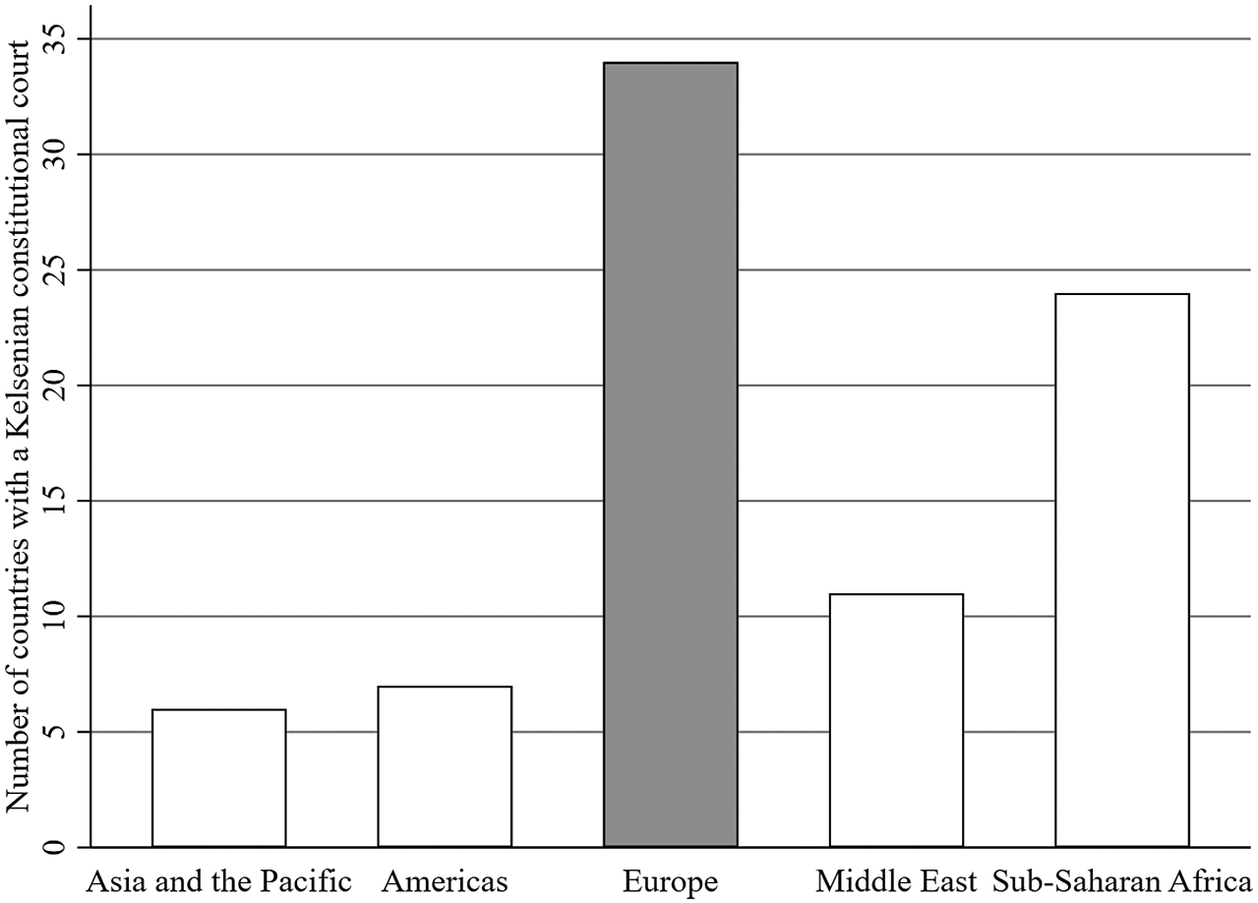
This poses a puzzle because constitutional court establishment has occurred in a number of countries despite the lack or weakness of the historico-political conditions, such as the rule of law or human rights culture, that accounted for early constitutional court adoptions in Western European old democracies (O’Donnell Reference O’Donnell1998; Shapiro Reference Shapiro, Kenney, Reisinger and Reitz1999). Also, the uneven global geography of the spread of constitutional courts raises the question of what explains the wide and rapid proliferation of these institutions across European countries during the post-Cold War period. This article seeks to explain the global, yet Eurocentric, spread of constitutional courts across developed and developing countries around the world.
Potential Explanations for the Adoption of Constitutional Courts
What factors explain governments’ choice of a judicial review model? The existing scholarship offers several possible explanations for why countries adopt constitutional courts capable of restraining majority rule. These theories can be categorized into two groups. The most common explanations fall into a first group emphasizing domestic factors within political regimes as determining governments’ decisions to establish a constitutional court. The second group of explanations, while generally overlooked in studies of the adoption of constitutional courts, focuses on the role of international factors external to those regimes.
A first set of explanations for why governments adopt judicial review centers on domestic factors. One subset of theories emphasizes the importance of existing political structures in shaping constitutional design. Countries with a commitment to judicial independence, which indicates a strong rule-of-law tradition, are more likely to adopt empowered judiciaries capable of checking political majorities (Shapiro Reference Shapiro, Kenney, Reisinger and Reitz1999). Federal systems may also be more likely to adopt empowered judiciaries because of courts’ roles in mediating disputes between the central government and subunits (Öhlinger Reference Öhlinger2003). Moreover, presidential systems are less likely to feature independent constitutional courts because they often degenerate into superpresidentialism or populism that ignores “horizontal accountability” mechanisms designed to check the executive, such as courts (Dargent Reference Dargent2009, 276; O’Donnell Reference O’Donnell1998).
Another subset of domestic regime explanations attends to the agency of powerful domestic political actors, as opposed to political structures themselves, as relevant for judicial review adoption. Ginsburg (Reference Ginsburg2003) emphasizes the role of electoral politics and the strategic choices of political leaders, suggesting that constitutional courts can serve as a form of “political insurance” for parties facing the prospect of losing power. Creating an independent judiciary capable of checking government action allows political leaders to staff an institution that will persist even if they lose control of the legislative and executive branches (Ginsburg Reference Ginsburg2003; Hirschl Reference Hirschl2004; Stroh and Heyl Reference Stroh and Heyl2015). Also important to domestic political actors is the construction of “constitutional governance coalitions” that have influence over the judiciary in the new regime (Brinks and Blass Reference Brinks and Blass2018).
A country’s historical experience may also be important in constitutional court adoption, particularly during and after democratic transition. Ferejohn (Reference Ferejohn2002, 51) suggests that what judiciaries in post-authoritarian regimes have in common is that “the judges that are still on the bench are implicated, to some extent, in the practices of the previous regime.” Establishing a new constitutional court is a way to signal a sharp break with the authoritarian past, thus making it more likely that the new institutions will garner the trust necessary to provide real checks on lawmakers. Popular distrust of judges trained under the previous regime may provide an impetus for new democracies to create new, centralized judicial institutions (Ginsburg Reference Ginsburg2003, 9–10).
Domestic economic considerations may also play a role in shaping institutional creation. In particular, governments with greater available resources may be more willing to experiment with institutional and policy innovations (Berry and Berry Reference Berry, Berry and Sabatier1999; Mallinson Reference Mallinson2020). This is because financially healthy countries may take institutional risks, such as establishing a new constitutional court, that their financially insecure counterparts may not.
Consideration of such domestic factors has been central in explanations for the spread of judicial review. However, international factors can contribute crucially to this phenomenon. As countries adopt certain constitutional practices, these practices tend to diffuse to similarly situated countries. For instance, Goderis and Versteeg (Reference Goderis and Versteeg2013, 25) find that “the rights-related content of a country’s constitution is indeed shaped by the constitutional choices of other countries.” However, the extant literature has yet to elucidate international influences on countries’ constitutional court adoption. Indeed, as Ginsburg and Versteeg (Reference Ginsburg and Versteeg2013, 2) note, “little is known in an empirical and systematic way about the origins and evolution of constitutional review on a global scale.” The burgeoning literature on the global diffusion of political and economic liberalism offers some useful analytic starting points.
One set of explanations highlights the role of acculturation or “emulation” in catalyzing the global spread of liberal constitutionalism (Simmons, Dobbin, and Garrett Reference Simmons, Dobbin and Garrett2006, 799–801). The world society theory asserts that national states’ immersion in world-cultural structures leads to global policy convergence among otherwise dissimilar countries (Meyer et al. Reference Meyer, Boli, Thomas and Ramirez1997). According to this theory, national states adopt similar policy models not because of domestic functional needs, but because they feel social pressure to conform to appropriate and legitimate norms of modern statehood at the global level (Meyer Reference Meyer2010; Meyer et al. Reference Meyer, Boli, Thomas and Ramirez1997). The adoption of a specialized constitutional court could be regarded as part of “world culture” since the third wave of democratization, especially given that constitutional review has become a taken-for-granted part of any constitution (Stone Sweet Reference Stone Sweet, Rosenfeld and Sajó2012, 819) and that the Kelsenian model of constitutional review has become increasingly more popular than its rival American model since the early twentieth century (Ginsburg and Versteeg Reference Ginsburg and Versteeg2013, 6; see also Stroh and Heyl Reference Stroh and Heyl2015, 174).
Finally, regional emulation, instead of global acculturation, may be relevant for constitutional court adoption. Elkins and Simmons (Reference Elkins and Simmons2005, 45) suggest that regional demonstration effects are likely to drive the diffusion of political liberalism because “policy makers will align their country’s policies with those of geographically and culturally proximate nations.” Given that countries within the same region tend to share cultural, religious, and linguistic similarities, geographic regions can serve as an important reference or peer group guiding the decision of countries to adopt a constitutional court (Simmons Reference Simmons2009, 88–96).
The above scholarship has provided possible explanations for the global spread of constitutional courts, but this literature remains incomplete. Theories for the adoption of constitutional review mechanisms abound, but empirical research focusing on generalizable tests of hypotheses has only just recently begun (Ginsburg and Versteeg Reference Ginsburg and Versteeg2013). The only large-N empirical analyses of the adoption of constitutional courts have found the greatest support for the influence of domestic factors, particularly the logic of political insurance (Ginsburg and Versteeg Reference Ginsburg and Versteeg2013; Romeu Reference Romeu2006). More fundamentally, however, both the broader theoretical literature and the empirical studies have paid curiously little analytic attention to the institutional foundations of the adoption of constitutional courts. This omission is both important and surprising because, given that constitutional courts are key to upholding the rule of law and guaranteeing political freedoms, their adoption has created frictions and tensions with the existing institutions and their supporters in many polities.
In this article, we will focus on the legal institutions most likely to play a role in countries’ (non)adoption of constitutional courts at the domestic and international levels, respectively: the domestic legal system and the Venice Commission. Below we provide theoretical reasoning and empirical evidence suggesting the crucial importance of considering these factors in the analysis of the global, yet Eurocentric, spread of constitutional courts.
The Argument
This article argues that a country’s decision to adopt a specialized constitutional court systematically and probabilistically reflects its institutional endowments in the field of constitutional justice. Specifically, inspired by the insights of so-called new institutionalism (for example, Bourdieu Reference Bourdieu and Nice1977; Reference Bourdieu and Collier2020; DiMaggio and Powell Reference DiMaggio and Powell1991; North Reference North1990), we claim that the specific legal institutional settings of a country support some types of constitutional innovations and hamper others. First, we underscore the significance of domestic legal systems as a country’s core institutional endowment that influences the affinity and uncertainty the Kelsenian model of constitutional review has vis-à-vis the country’s existing institutions and institutionalized actors, thereby creating differing degrees of traction for that model. Second, we go beyond the literature’s almost exclusive focus on domestic institutional endowments, and instead uncover the Venice Commission’s important but ignored role as a key international institutional endowment. In doing so, we theorize how domestic and international legal institutions can shape not only governments’ and other domestic political actors’ material cost-benefit calculations but also their identities, preferences, and interests regarding constitutional court (non)adoption.
Domestic Legal System
As the first source of institution-building preferences, we argue that a country’s existing domestic legal system plays a significant role in the adoption of the Kelsenian constitutional court model. Existing studies of the adoption of constitutional courts have paid curiously little attention to the role of the legal system, despite several important features of each system that can influence choices concerning the constitutional design of the judiciary. These features, we suggest, form a crucial part of a country’s institutional endowments influencing the structural form of constitutional review that the country adopts (Levy and Spiller Reference Levy and Spiller1994). Specifically, we argue that countries with the common law system tend to resist or delay the adoption of Kelsenian constitutional courts while those with the civil law system tend to embrace their adoption.
Several features of both legal systems are relevant to the likelihood of resistance or receptivity to adopting a Kelsenian constitutional court. For one, the common law system tends to operate under a generalist model in which courts and judges have wide jurisdiction over multiple areas of the law. Civil law countries, by contrast, have typically featured greater judicial specialization, including separate high courts for civil and criminal cases, on the one hand, and administrative cases, on the other (Garlicki Reference Garlicki2007). While the adoption of specialized constitutional courts may serve as a natural extension of judicial specialization in civil law countries, such a separation of judicial duties marks a sharper departure from the status quo in common law countries.
The central role of precedent and stare decisis Footnote 4 in the common law system is also important, raising issues concerning how rulings among separate high courts could fit into the existing body of the common law. Unlike the civil law system in which precedents play little or no official role, the common law system has greater difficulties cleanly separating “constitutional” issues from “ordinary” law. Maintaining both areas of the law under the single structure of the “ordinary” courts may thus be more compatible with the common law system. Furthermore, the role of stare decisis provides the common law system with a method of achieving legal certainty. While civil law countries must look to other ways to avoid the potential of inconsistent rulings among different courts and will likely create a centralized constitutional court with separate jurisdictions as a functional response to the civil law system’s demand for legal certainty and uniformity (Comella Reference Comella2009, 20–26), stare decisis serves as an internal mechanism that lessens the need for common law countries to establish separate courts in order to achieve this goal.
These institutional endowments shape the identities, preferences, and interests of the judges, lawyers, and other legal professionals operating within the legal systems, and make them “carriers and enactors” of those endowments. As Bourdieu (Reference Bourdieu1987) emphasizes, law consists of not simply specific rules and regulations but practices and experiences shaping daily life in a particular legal field. As people are socialized in this (or any) field, they gradually learn and internalize a set of norms and shared expectations that predispose them to particular ways of thinking and acting (Bourdieu Reference Bourdieu and Nice1977; Reference Bourdieu and Collier2020). Education is important for producing and reproducing this socialization process, as there are significant differences in how law schools train lawyers in the common law versus civil law systems (Grimes Reference Grimes2017). The legal academy in the United States, for example, has long been skeptical of Hans Kelsen’s work despite his centrality in civil law education, and Kelsen is rarely included in curricula in American law schools (Telman Reference Telman2008). Furthermore, internships, apprenticeships, and vocational training are equally important elements of becoming a qualified lawyer in the common law system, and achieving this training and being successful on the job requires an acceptance of the typical way of “thinking like a lawyer” within the system (Grimes Reference Grimes2017). Divergence from standard ways of legal practice is costly for individuals seeking qualification in the profession, thereby making cross-adoption of ideas and practices from a different type of legal system more unlikely.
This notion of “practical sense,” produced and reproduced through legal education and on-the-job training, may help to explain why common law legal professionals are both more skeptical of the Kelsenian constitutional court model compared to civil law legal professionals and more willing and able to resist this institutional innovation. In the civil law system, judges are “civil servant[s] without independent authority to create legal rules” and tasked with applying and interpreting legislative codes narrowly (Simmons Reference Simmons2009, 73). In contrast, common law judges occupy higher-status positions as independent policy makers, with far more expansive and discretionary interpretative roles for legal rules (Mahoney Reference Mahoney2001; Simmons Reference Simmons2009, 73–74). The Kelsenian model of judicial review creates uncertainty for the common law legal profession by shifting jurisdiction over “political” questions away from existing legal institutions to a new separate constitutional court operating outside the normal judicial system. This effectively narrows the political role of the existing judiciary both by restricting the jurisdiction of the ordinary courts over future cases and by opening new possibilities of conflict and tension with the existing body of the common law.
These factors can influence constitutional drafters who ultimately make the choice of institutional design. Given their desire to create a constitutional system that will actually work in practice, constitutional drafters likely will both consider how new institutions will align with existing structures, and give particular heed to the views of the sector most connected to the operation of the judiciary in a new regime (see also Brinks and Blass Reference Brinks and Blass2018). This is particularly true in the common law system, where legal professionals’ role in political and legal development means that they can be particularly important allies (or opponents) influencing the success of policy implementation in the new regime. This differs from civil law countries where the judiciary plays a more functionary role vis-à-vis the lawmaking branches and has less independence and power to resist the actions of the other branches of government.
Regional Legal Organization
As the second source of institution-building preferences, we argue that the Venice Commission—a regional legal organization in Europe—has catalyzed its target countries’ constitutional court adoption and contributed to the Eurocentric spread of the Kelsenian model of judicial review since the end of the Cold War by shaping countries’ policy preferences with its expertise and authority. A theoretical focus on the Venice Commission is especially important, because it is the main international organization that makes organized and sustained efforts specifically to promote constitutional reform and serves as the international dimension of countries’ institutional endowments.
The initiative to create the Venice Commission began at the Conference of European Constitutional Courts in 1987, when the chief judges of the Italian and German constitutional courts proposed the creation of an official commission that could offer advice to emerging democracies and document constitutional developments (Mavčič Reference Mavčič2012, 1–2). The Commission consists of professionals and high-level public officials who have achieved international reputation through their practitioner experience and intellectual contributions in the fields of democratic institutions, law, and political science, such as constitutional court judges, lawyers, and ministers of justice (Dürr Reference Dürr and Tanja2010, 156–57). While they are appointed by the Venice Commission’s member state governments, they work as independent experts, not as government representatives (Jowell Reference Jowell2001, 675). The Venice Commission’s influence has continuously expanded beyond its earliest focus on constitutional reform in transitional countries in Eastern and Central Europe, including providing constitutional assistance and advice to South Africa, Bolivia, Mexico, Jordan, Libya, Morocco, Tunisia, and Palestine (Venice Commission 2009; 2015).
The Venice Commission’s organizational interests in promoting constitutional court adoption are twofold. First, the Venice Commission’s work is part of the larger efforts of its parent organization, the Council of Europe, to promote democratic security and prosperity. As Pevehouse (Reference Pevehouse2005, 18) emphasizes, the tenet that democracies do not fight one another but create a separate zone of peace, trade, and cooperation has become the bedrock of external democracy promotion by international organizations as well as Western governments. The Venice Commission has contributed to the Council of Europe’s pursuit of “democratic security” (Klebes Reference Klebes1999) by focusing its actions on “the guarantees offered by law in the service of democracy” (Venice Commission 2002, 3), as well as applying its parent organization’s standards of plural democracy, human rights, and the rule of law in its operations. Indeed, the Venice Commission’s official name—that is, the European Commission for Democracy through Law—embodies its founding father Antonio La Pergola’s vision that “sustainable democracy can only be built in a sound constitutional framework based on the rule of law” (Dürr Reference Dürr and Tanja2010, 152).
Second, the Venice Commission’s focus on constitutional courts reflects its experts’ view of what constitutes the appropriate and legitimate model of judicial review. The Venice Commission is predisposed to prioritize, informally but in practice, the Kelsenian model of judicial review via constitutional court over other alternatives, particularly its rival American model. For instance, Venice Commission Vice President Helmut Steinberger authored a document that explicitly “recommended [transitional countries] to have constitutional jurisdiction exercised by a permanent special constitutional court” because “the judges of the ordinary courts may be neither trained nor used to dealing with constitutional matters” (Venice Commission 1993, 3). This was echoed by Hanna Suchocka, the former Polish Prime Minister and one of the most active Venice Commission experts, when she emphasized that Kelsen’s notion of specialized constitutional tribunals formed a crucial part of “the basic principles of European constitutionalism” (Venice Commission 1996, 88). The organization’s preference for the Kelsenian model of judicial review is unsurprising given that La Pergola, the charismatic Venice Commission president from its outset until 2007, had been judge and president of the Constitutional Court of Italy. Furthermore, the most active Venice Commission experts include legal professionals from countries that were both early adopters of the Kelsenian constitutional court model and Western great powers exercising leadership roles within the organization, such as Austria, France, Germany, and Italy.
The Venice Commission promotes the adoption of constitutional courts through two non-directive and dialogue-based methods. First, at the request of individual countries or the organs of the Council of Europe, it provides its target countries with expert advice and technical assistance during the processes of drafting and implementing constitutions and founding laws for constitutional courts (Jowell Reference Jowell2001, 676–80; Malinverni Reference Malinverni and Sicilianos2001, 126–30). Second, the Venice Commission holds transnational seminars to promote its target countries’ awareness-raising and education about constitutional courts as part of “the common European constitutional heritage.” In particular, from the first year of its operation, the Venice Commission has organized a series of “Universities for Democracy (UniDem)” seminars on various aspects of constitutional courts (Malinverni Reference Malinverni and Sicilianos2001, 132–33; Venice Commission 1990; 1993).
The Venice Commission’s working methods can influence its target countries’ deliberations and decisions in favor of constitutional court adoption for several reasons. First, the Venice Commission’s advice, consultation, and education offers a focal point or a cognitive shortcut for countries to choose the Kelsenian model of judicial review over other alternatives. Developing countries particularly tend to lack prior experiences with the rule of law and democracy and to suffer from the long-standing legacies of colonialism, authoritarianism, and totalitarianism (Hamilton Reference Hamilton1999, 3–4). The Venice Commission has provided those countries with information, technical knowledge, and legal expertise on constitutional courts that they would otherwise not have, especially given that the Kelsenian model as a constitutional innovation poses uncertainty and risk to them.
Second, the Venice Commission has seminars, country reports, and field missions as policy tools in its arsenal to shape countries’ policy preferences for constitutional court adoption more specifically and purposefully. The Venice Commission practices what Adler (Reference Adler and Barnett1998) calls “seminar diplomacy,” in that it utilizes seminars and other multilateral meetings to teach the organization’s principles and practical knowledge about the constitutional court model for governmental and nongovernmental participants, who in turn transmit these norms and practices to their home countries. As Adler (Reference Adler and Barnett1998, 141) emphasizes, seminar diplomacy is especially important for new member states’ learning. Also, the Venice Commission can influence the decisions of member state governments on whether and how to create a constitutional court, by serving as an “endorser” (Grieco et al. Reference Grieco, Gelpi, Reifler and Feaver2011; Kim Reference Kim2013, 514–16) and issuing country reports that analyze and criticize a proposed constitutional or legal text regarding the constitutional review mechanism. This increases the burden on governments to justify why they failed to create a constitutional court or created a deficient one, thereby nudging them toward actioning the Venice Commission’s advice on the Kelsenian model, compared to what they would have chosen in the absence of the Venice Commission. Furthermore, through in-country missions, the Venice Commission engages in “on-site teaching activities in member states” (Finnemore Reference Finnemore1993, 587) by lobbying national cabinet members, discussing constitutional court issues with constitutional drafters, and meeting other stakeholders like opposition politicians and civil society groups.
Finally, Venice Commission experts’ own expertise and international reputation makes the Venice Commission’s advisory and educational work credible to the countries for which it works (Dürr Reference Dürr and Tanja2010, 156–57). This increases the likelihood that legal professionals and government officials in those countries will act on Venice Commission opinions and recommendations in favor of constitutional court establishment. Therefore, the Venice Commission can catalyze countries to choose the Kelsenian model of judicial review via constitutional court over other alternatives.
Research Design
We conduct event history analysis to test how domestic legal systems and the Venice Commission relate to countries’ decision to establish a constitutional court. Our analysis begins in 1947, the first year after the contemporary international system emerged with the conclusion of World War II, and ends in 2019, the last year for which accurate data are available. The unit of analysis is the country-year. Our dataset (Kim and Nolette Reference Kim and Nolette2023) includes 172 independent states—including both developed and developing countries—and 8,074 country-year observations, excluding microstates with populations less than 250,000. Due to missing data, our main statistical model includes 168 countries and 7,934 country-year observations.
The Model
Event history analysis estimates the relationships between explanatory variables and both the occurrence and timing of constitutional court establishment. We employ the Cox proportional hazards regression model, which estimates the occurrence and timing of constitutional court adoption as a function of the baseline hazard rateFootnote 5 and a set of explanatory variables while leaving the shape of the baseline hazard rate unspecified and unestimated (Box-Steffensmeier and Jones Reference Box-Steffensmeier and Jones2004, 47–67). We chose the Cox model because, by obviating the need to estimate temporal dependence, it helps us to focus on modeling the theoretical relationships between the key explanatory variables of our interest and the dependent variable, and to avoid statistical bias that may result from incorrectly specifying the form of temporal dependence (Box-Steffensmeier and Jones Reference Box-Steffensmeier and Jones2004, 47–48).Footnote 6 Our statistical analysis uses a one-year lag for all explanatory variables to reduce endogeneity bias—that is, to ensure the correct temporal sequencing of explanatory and dependent variables (Box-Steffensmeier and Jones Reference Box-Steffensmeier and Jones2004, 111).
The Dependent Variable
The dependent variable is measured as the time since 1946, or the year of independence, until the actual establishment of a constitutional court. To compute this variable, we use the complete lists of constitutional courts around the world compiled by the Venice Commission and the Constitutional Court of South Korea, and record the year of operation for each constitutional court (Constitutional Research Institute n.d.; Venice Commission 2014b). The unique contribution of our data creation effort is that, for the first time, we measure constitutional courts that are actually established and in operation. This is in contrast with existing studies that rely on constitutional texts alone, thereby running the risk of incorrectly including courts that were mentioned in the constitution but never came into existence (Ginsburg and Versteeg Reference Ginsburg and Versteeg2013; Romeu Reference Romeu2006). For example, although Ginsburg and Versteeg’s (Reference Ginsburg and Versteeg2013) text-based constitutional review data from the Comparative Constitutions Project code South Korea as if it has continued to have a constitutional court since its inception in 1948, Ginsburg’s (Reference Ginsburg2003, 218) own work refutes their data’s validity by confirming that South Korea’s Kelsenian “Constitutional Court was established by the Constitutional Court Act of 1988.” Our new measurement is not only more accurate in measuring the actual timing of constitutional court establishment, but also more theory- and policy-relevant than the previous ones, not least because a constitutional court existing only on paper cannot fulfill its role as political insurance for political parties or as a human rights protector. Thus, by explicitly measuring not the year of legislation but the year of operation, we greatly reduce measurement errors and improve the precision of statistical inference. It should be noted that six countries in our data have abolished their constitutional court, with five of them having reestablished it after a few years. Rather than selecting either the first or the latest institutional creation for the analysis, we explicitly and properly incorporate these cases as “repeated events”: that is, once a country has established a constitutional court for the first time, it has become no longer at risk of adoption, yet the country reenters the risk set for a second-time adoption in the year in which it abolished the first-time constitutional court.Footnote 7 Accordingly, for the second event, the dependent variable is the time since the year of reentry into the risk set after the previous event until that country’s reestablishment of a constitutional court. If the government of a country did not establish a constitutional court by the end of the observation period, the observation is right-censored. Importantly, we report robustness checks against alternative operationalization of the dependent variable, focusing on the year of constitutional legislation instead of the year of operation. We do so by following Ginsburg and Versteeg’s (Reference Ginsburg and Versteeg2013, 14–17) own analytic focus on whether a given country’s written constitution assigns the formal mandate of constitutional review to a constitutional court or council in a year, and by using Elkins and Ginsburg’s (Reference Elkins and Ginsburg2021) Characteristics of National Constitutions, Version 3.0 data (see model 5 in table 1 in this article and table OA3 in the supplementary material).
Determinants of Constitutional Court Establishment, 1947–2019

Note: Coefficients are reported. Numbers in parentheses are robust standard errors clustered on country, except for models 4 and 5 where they are standard errors. All explanatory variables use a one-year lag. *** p ≤ 0.01; ** p ≤ 0.05; * p ≤ .010, in two-tailed tests.
The Explanatory Variables of Theoretical Interest
The first explanatory variable of interest, common law system, represents common law countries’ resistance to constitutional court adoption. As La Porta and his colleagues note, “Most writers identify two main secular legal traditions: common law and civil law, and several subtraditions—French, German, socialist, and Scandinavian—within civil law” (La Porta, Lopez-de-Silanes, and Shleifer Reference La Porta, Lopez-de-Silanes and Shleifer2008, 288). Thus, the variable is coded 1 if a country’s legal system is based on the common law system and 0 otherwise (that is, if the domestic legal system is one of those four variants of the civil law system), using La Porta, Lopez-de-Silanes, and Shleifer’s (Reference La Porta, Lopez-de-Silanes and Shleifer2008) legal origins data. Because all the countries’ legal systems are either common law or civil law, the common law system variable tells us about not only the relationship between common law countries and adoption but also that between civil law countries and adoption: that is, the sign of the coefficient estimate of the civil law system is the reverse of common law system while having the same coefficient size and standard errors.
The second explanatory variable of interest, Venice Commission engagement, captures the Venice Commission’s concrete activities in promoting specialized constitutional courts. It equals 1 if the Venice Commission specifically and purposefully promotes the Kelsenian model of constitutional review for a country in a given year by adopting an opinion on draft constitutional court-founding legislation, sending a special country mission to visit constitutional drafters, and/or hosting a UniDem seminar on constitutional courts, and 0 otherwise. To measure this variable, we construct the first dataset of its kind by reading all the annual reports and the Science and Technique of Democracy documents published by the Venice Commission (Venice Commission 2014a; 2014c). To preview the supplementary material’s robustness check, we explicitly account for the possible endogeneity of the Venice Commission’s in-country engagement, using the two-stage estimation method.
Control Variables
Several control variables are included to take into account other factors in the processes of establishing constitutional courts. Political insurance represents the assertion that constitutional court adoption is driven by the balance of power between political parties within the legislature. Specifically, weaker political parties desire to create a constitutional court as an insurance to check the ruling party’s government and to mitigate the risk of electoral defeat in the future, while stronger political parties prefer not to adopt an independent constitutional review mechanism (Ginsburg Reference Ginsburg2003, 21–63; Ginsburg and Versteeg Reference Ginsburg and Versteeg2013, 9). Thus, the greater the power gap between stronger and weaker political parties within the legislature, the less likely a country is to establish a constitutional court (Ginsburg and Versteeg Reference Ginsburg and Versteeg2013, 21). To measure this variable, we follow Ginsburg and Versteeg’s (Reference Ginsburg and Versteeg2013, 18–19) operationalization. For democracies and multiparty dictatorships that allow more than one political party to exist legally, we compute the number of seats held by the largest party minus the number of seats held by the second largest party in the lower legislative chamber, divided by the total number of seats in that chamber, using the Political Constraint Index 2021 data (Henisz Reference Henisz2002), Boix, Miller, and Rosato’s (Reference Boix, Miller and Rosato2013; Reference Boix, Miller and Rosato2022) regime classification, and Cheibub, Gandhi, and Vreeland’s (Reference Cheibub, Gandhi and Vreeland2010) data on the legal status of parties.Footnote 8 For one-party (or no-party) dictatorships as well as for democracies or multiparty dictatorships that have zero seats in the lower legislative chamber over some years, the political insurance variable takes the value 1.Footnote 9 According to Ginsburg and Versteeg (Reference Ginsburg and Versteeg2013, 24), this variable also taps into regime type in that “political insurance will be stronger in democratic regimes, since competition between two or more parties is one of the defining features of a democracy.” Following Ginsburg and Versteeg’s (Reference Ginsburg and Versteeg2013, 24, 30) advice, we do not include a separate measurement of the level of democracy in our main statistical model, but do so in the supplementary material as part of robustness checks against omitted variable bias.
Regional contagion captures regional contagion as a catalyst of policy diffusion, given that countries can emulate their neighbors’ prior institutional adoptions within a given region (Simmons, Dobbin, and Garrett Reference Simmons, Dobbin and Garrett2006). Following Neumayer’s (Reference Neumayer2008, 256) operationalization and using the World Bank’s regional classification, for a country in a given year, it measures the proportion of countries with a constitutional court in operation within that country’s geographic region, divided by the proportion of countries with a constitutional court in the globe.Footnote 10 In the supplementary material, we report a robustness check that employs Simmons’s (Reference Simmons2009, 384) alternative operationalization of regional emulation, which, for a country in a given year, measures the percentage of all the countries with a constitutional court within that country’s geographic region.
Recent democratic transition taps into the role of democratic transition as a window of opportunity for institutional reform like constitutional court creation (Ferejohn Reference Ferejohn2002). It is coded 1 if a country has experienced a democratic transition within the past three years and still remains a democracy in a given year, and 0 otherwise, based on Boix, Miller, and Rosato’s (Reference Boix, Miller and Rosato2013; Reference Boix, Miller and Rosato2022) data on regime transitions. This variable’s three-year window is selected based on Méon and Sekkat’s (Reference Méon and Sekkat2022) advice, and accounts for the fact that in a new democracy, institutional reform does not necessarily occur instantly after transitioning from dictatorship but tends to take time to unfold.Footnote 11 In the supplementary material, we use one-, five-, and ten-year windows since democratic transition as robustness checks against alternative operationalization of control variables.
Presidentialism considers the claim that presidential systems tend to hinder the development of horizontal accountability institutions that check and balance against the executive branch (O’Donnell Reference O’Donnell1998). It is a continuous variable that measures the extent to which a country’s political regime is characterized by presidentialism in a year on a 0 (the least presidential) to 1 (the most presidential) scale, using the Varieties of Democracy Dataset, Version 12 (Coppedge et al. Reference Coppedge, Gerring, Knutsen, Lindberg, Teorell, Alizada and Altman2022).
GDP per capita accounts for the slack resources theory that the availability of material resources makes governments more willing to experiment with policy and institutional innovations (Berry and Berry Reference Berry, Berry and Sabatier1999, 182–83). It is the natural log of purchasing-power-parity-converted real gross domestic product (GDP) per capita in constant 2010 international dollars for a country in a year, using Fariss and colleagues’ (Fariss et al. Reference Fariss, Anders, Markowitz and Barnum2022) new GDP and population data. Table OA1 in the supplementary material reports the hypotheses and summary statistics for all explanatory variables.
Results and Discussion
The statistical results offer strong support for our theory. In table 1, model 1 is the main statistical model, while models 2 to 5 are part of robustness checks to be discussed in the next section. A positively signed coefficient indicates that the explanatory variable makes a country more likely to establish a constitutional court and do so earlier in time. In contrast, a negatively signed variable makes the country less likely and slower to adopt the Kelsenian model of judicial review. To begin with, the results show the appropriateness of our statistical model. As table OA2 in the supplementary material verifies, our main Cox model satisfies the proportional hazards assumption both variable-specifically and globally.
In model 1, common law system is negatively correlated with the hazard rate of establishing a constitutional court, while Venice Commission engagement is positively associated with the hazard rate of constitutional court adoption. Also, they are all highly statistically significant. Given that all countries’ legal systems are either common law or civil law, the coefficient estimate of the civil law system is the same as common law system in terms of size and standard errors except with the reversed sign: namely, 1.773***. As such, civil law system is positively and highly statistically significantly correlated with the hazard rate of constitutional court establishment. Figure 3 presents the substantive significance of domestic legal systems and the Venice Commission in the adoption process. The baseline prediction, based on model 1 in table 1, is the hazard rate of constitutional court adoption for the hypothetical average country in the dataset, for which all continuous and categorical variables are held constant at their mean value and modal category. The first line of the figure shows the change in the baseline prediction when a country has the common law system, as opposed to the civil law system. The hazard rate of constitutional court creation is 83.0% lower. Conversely, the second line illustrates that a civil law country is nearly five times (that is, 488.8%) more prone to adopt the Kelsenian model of constitutional review than its common law counterpart. What happens if a country is engaged by the Venice Commission in a given year? The result is striking. That country becomes 1,893.3% more likely to establish a constitutional court than another country having no such international assistance. Thus, controlling for political insurance, regional contagion, and other factors, the common law system inhibits or slows the adoption of constitutional courts, while the civil law system and the Venice Commission spur and accelerate their adoption across countries.
Prospect of Constitutional Court Establishment
Note: Changes in the predicted baseline hazard rate of constitutional court establishment are computed by shifting one explanatory variable at a time while holding all the others constant at mean level and modal category, specifically by increasing a categorical variable from 0 to 1 and a continuous one from its minimum to maximum. *** p ≤ 0.01; ** p ≤ 0.05; * p ≤ 0.10, in two-tailed tests.
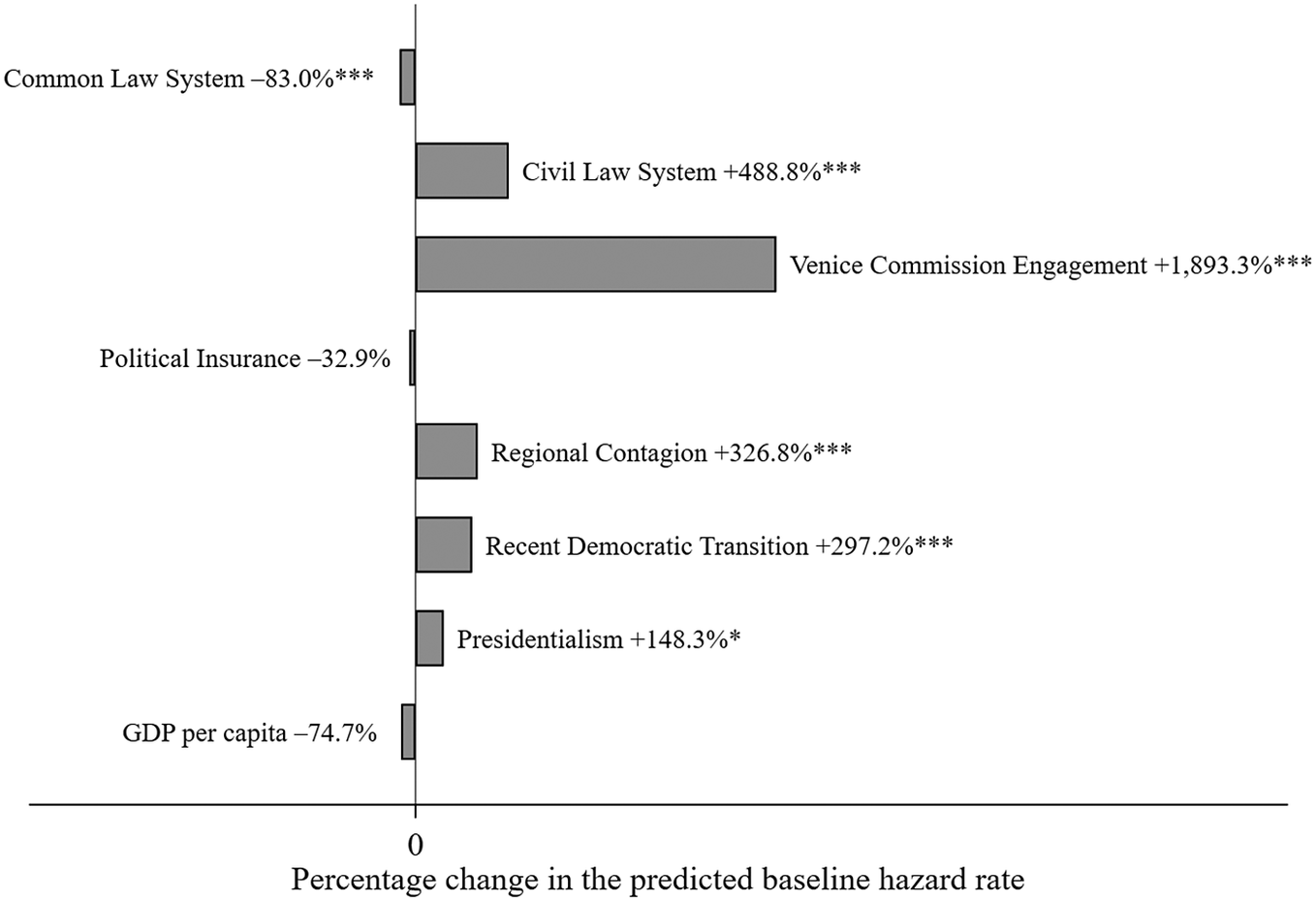
Most of the control variables take the expected sign, but not all of them are statistically significant. First of all, political insurance is negative but never achieves statistical significance, thereby undermining the suggestion that constitutional courts are adopted to compensate for weaker political parties who are facing electoral defeats. Second, both regional contagion and recent democratic transition are positive and highly statistically significant, with large substantive impacts of 326.8 and 297.2%, respectively. These results confirm the important roles regional contagion and democratic transition play in the adoption process. Finally, presidentialism and GDP per capita alike are consistently opposite of the hypothesized sign, but only the former is weakly significant. The result for presidentialism undermines the assertion that presidential systems are inherently hostile to the development of horizontal accountability institutions. Also, the finding about GDP per capita contradicts the contention that governments’ financial health is a prerequisite for constitutional court adoption.
Robustness Checks
While we find firm empirical evidence for our main statistical model, we take several further steps to ensure that our key statistical findings are robust against various possible confounding factors. To conserve space, we report the full details of our robustness checks in this article’s supplementary material.
First, we demonstrate that the Venice Commission’s role is distinct from, and irreducible to, country location in Europe and the former Soviet Union. As models 2 and 3 in table 1 show, the main results for Venice Commission engagement as well as common law system remain virtually the same, regardless of the inclusion of indicator variables for Europe and the former Soviet Union. This is strong evidence that the Venice Commission’s impact on constitutional court adoption cannot be reduced to country location in Europe and the former Soviet Union.
Second, as a robustness check against model dependence, we revisit the article’s main model with the conditional frailty model that accounts for both event dependence and unobserved heterogeneity (Box-Steffensmeier, De Boef, and Joyce Reference Box-Steffensmeier, Boef and Joyce2007). While our data include only five second-time constitutional court adoptions, event dependence might be present so that a country’s prior adoption may alter the likelihood of that country’s second-time adoption and its timing. Also, unobserved time-invariant, country-level heterogeneity like political culture or historical legacy may predispose some countries, but not others, to be inherently more susceptible to the adoption or nonadoption of a constitutional court. The conditional frailty model solves these issues. It handles event dependence by stratifying the repeated events data according to event number and hence allowing for event-specific baseline hazards (239–40). It addresses unobserved heterogeneity by incorporating country-specific frailties (240–41). In short, as model 4 in table 1 demonstrates, the main results for common law system and Venice Commission engagement remain virtually identical, regardless of the use of the conditional frailty model.
Third, we replicate the main model in table 1 by focusing on the year of constitutional legislation for a constitutional court as the new dependent variable, based on Ginsburg and Versteeg’s (Reference Ginsburg and Versteeg2013, 14–17) operationalization and Elkins and Ginsburg’s (Reference Elkins and Ginsburg2021) constitutional review data. Specifically, for the first event, the dependent variable is the time since 1946, or the year of independence, until a country’s constitutional text explicitly assigns the formal mandate of judicial review (that is, the interpretation of the constitution) to a constitutional court or council. Once the country has enacted a constitutional law mentioning a constitutional court or council, it exits the risk set (Ginsburg and Versteeg Reference Ginsburg and Versteeg2013, 29), yet becomes eligible again for a next-time adoption in the year in which its constitutional text stops mentioning a constitutional court or council (via, for instance, a constitutional amendment or replacement). As such, for the second and subsequent events, the dependent variable is the time since the year of reentry into the risk set after the previous event until that country experiences another constitutional enactment mentioning a constitutional court or council for judicial review. We employ the conditional frailty model (Box-Steffensmeier, De Boef, and Joyce Reference Box-Steffensmeier, Boef and Joyce2007) because shifting the dependent variable from the year of operation to the year of constitutional legislation increases the number of repeated constitutional court adoptions by nearly three times, and because this may have resulted from event dependence, unobserved heterogeneity, or both. As model 5 in table 1 presents, in essence, the article’s key findings about common law system and Venice Commission engagement remain unchanged, regardless of the use of alternative measurement of the dependent variable. This demonstrates that the key findings about the roles of domestic legal systems and the Venice Commission do not rely on a particular operationalization of the dependent variable. Note that the result for political insurance in model 5 refutes Ginsburg and Versteeg’s (Reference Ginsburg and Versteeg2013) assertion because, even though we explicitly focus on the year of constitutional legislation as per their operationalization, now their explanatory variable is opposite of the hypothesized negative sign and statistically significantly so. Furthermore, we estimate both the unstratified and stratified Fine and Gray competing-risks models (Fine and Gray Reference Fine and Gray1999; Zhou et al. Reference Zhou, Latouche, Rocha and Fine2011), which examine the risk of constitutional legislation for the Kelsenian model of judicial review as the event of interest in the presence of constitutional legislation for the American model of judicial review as the competing event, and the results remain essentially identical to those of model 5. (See table OA3 in the supplementary material for the full discussion.)
Fourth, we account for the possibility that unobserved time-invariant, country-level heterogeneity may be not only present but also correlated with the explanatory variables, especially given Ginsburg and Versteeg’s (Reference Ginsburg and Versteeg2013, 12–13) concern with country fixed effects as a confounder. We address this potential endogeneity bias by going beyond the traditional dummy variables approach to fixed effects (for example, Ginsburg and Versteeg Reference Ginsburg and Versteeg2013, 12–13), and by utilizing the between-within (or hybrid) approach that handles country fixed effects through decomposing the predictor-outcome association into its cross- and within-country dimensions (Allison Reference Allison2009; Neuhaus and Kalbfleisch Reference Neuhaus and Kalbfleisch1998). In short, the article’s main results for common law system and Venice Commission engagement remain unchanged, regardless of the use of the fixed-effects estimation method. Worth noting, the between-within models’ results for political insurance raise doubts about Ginsburg and Versteeg’s (Reference Ginsburg and Versteeg2013) assertion because their explanatory variable takes the completely opposite signs across the cross- and within-country dimensions of the same constitutional court creation process. (See table OA4 in the supplementary material for the full details on robustness checks against endogeneity bias arising from unobserved country-level heterogeneity.)
Fifth, we consider the possibility that the Venice Commission’s in-country engagement may be endogenous to a target country’s willingness in the first place to establish a constitutional court, given that the Venice Commission has often provided expertise and assistance at the request of individual countries. We address this potential selection bias by using the two-stage estimation method and purging out such a confounding effect from the statistical association between the Venice Commission’s engagement and constitutional court adoption, and the finding remains highly robust both statistically and substantively. (See tables OA5 to OA6 in the supplementary material for robustness checks against endogeneity bias caused by the potential selectivity of the Venice Commission’s in-country engagement, including our instrument validity tests for the two-stage estimation.)
Sixth, we estimate a number of additional statistical models that include other possible determinants of constitutional court adoption or alternative operationalization of control variables, such as the role of American rule-of-law assistance as a possible rival to the Venice Commission, federalism, judicial independence, the level of democracy, globalization, and alternative measurements of regional emulation and democratic transition. In all cases, the key findings about common law system and Venice Commission engagement remain unchanged. These demonstrate that our key findings about the roles of domestic legal systems and the Venice Commission are not an artifact of omitting other explanatory factors or relying on a particular operationalization of control variables. (See tables OA7 and OA8 in the supplementary material.)
Finally, we take into account the claim that since the mid-2000s, there appears to have emerged an important international wave toward authoritarianism and against the rule of law across many regions of the world, and that this wave may have countered the global trend toward constitutional court adoptions.Footnote 12 We explicitly address this possibility by measuring and controlling for the level of global and regional dictatorship in seven different ways as additional robustness checks against omitted variable bias: namely, foreign policy similarity to Russia (formerly, the Soviet Union) and foreign policy similarity to China; and regional dictatorship in terms of the proportion of dictatorships and of the average reverse scores of polyarchy (that is, electoral democracy), judicial constraints on the executive, the rule of law, and judicial independence. In brief, the article’s main results for common law system and Venice Commission engagement remain unchanged in all cases. Also, all seven variables for global and regional dictatorship turn out to be consistently opposite of the expected negative sign with respect to the hazard rate of constitutional court creation, thereby suggesting that the emerging international wave of authoritarianism has not worked as a countermove against the global trend toward the adoption of Kelsenian constitutional courts in and beyond Europe. (See table OA9 and figures OA1 to OA9 in the supplementary material.)
Conclusion
The global spread of constitutionalism has been one of the world’s most significant political developments since the third wave of democratization. Accompanying the rise of global constitutionalism has been the creation of empowered judiciaries tasked with helping to maintain state commitments to new constitutional orders. Yet, this trend toward the global spread of constitutional review has come in different institutional forms. Why have some countries—many of which are European—adopted the Kelsenian model of specialized constitutional courts while others have not?
This article has emphasized the crucial but often overlooked roles of domestic legal systems and the Venice Commission in this question of fundamental constitutional design. A common thread linking these factors is the importance of countries’ institutional endowments in shaping the form of constitutional review that they adopt. In essence, the common law system serves to slow or stop the adoption of specialized constitutional courts, while the civil law system and the Venice Commission serve to accelerate such adoption. The event history analyses demonstrated that both these factors matter systematically and robustly, even while controlling for several competing explanations.
We believe that this article’s findings will inform future research examining the global spread of constitutional review particularly and legal innovations more generally. They challenge several existing theories about constitutional review diffusion by showing that once we properly account for domestic legal systems and the Venice Commission, the traditional rival factors—including political insurance, federalism, and the level of economic development—become much less effective for explaining governments’ choice of constitutional review mechanisms than commonly assumed in the existing literature. In contrast, by calling attention to the role of domestic and international legal institutions as the systematic parts of the picture, we demonstrate that cross-national differences in institutional endowments create differing degrees of traction for the Kelsenian model of constitutional review, thereby leading to the uneven global spread of that model. Thus, our findings fill the important theoretical and empirical void in the existing scholarship that has been dominated by constitutional law scholars, who often have not been exposed to theoretical lenses highlighting the role of international actors like the Venice Commission or may have taken for granted and underestimated the domestic legal system’s significance. If one excludes domestic and international legal institutions from the analysis of governments’ choice of constitutional review mechanisms, one will ultimately get a partial or even wrong story about this politico-constitutional phenomenon of crucial real-life and policy importance.
These findings also suggest international–domestic linkages in legal areas as a promising avenue for future research. We have offered both novel theoretical insights and firm empirical evidence that the Venice Commission as an international legal institution is critically important in shaping governments’ choice of constitutional review mechanisms. We hope that this article’s findings will spur sustained scholarly attention to the role of the Venice Commission and other intergovernmental—or even international nongovernmental—legal organizations in spreading other forms of legal and institutional innovations, given the wide range of activities in which these organizations engage. Compared to other legal institutions of the Council of Europe, notably the European Court of Human Rights, the impact of the Venice Commission has tended to be less appreciated among political scientists and legal scholars. We believe that examining the Venice Commission’s contributions to expanding “transnational legal orders” (Halliday and Shaffer Reference Halliday and Shaffer2015) affecting multiple jurisdictions will be a rich area for study.
Supplementary Material
To view supplementary material for this article, please visit http://doi.org/10.1017/S1537592723002025.
Acknowledgments
We thank Dr. Chonghyun Choi, the Perspectives on Politics’s anonymous but extremely perceptive reviewers, and especially the Perspectives on Politics editor Professor Michael Bernhard and Dongeun Lee for their thorough comments and other invaluable help.


 Open access

